Lecture
on
Detergents and its Environmental
issues
1
By
Prof. Manorma Sharma & Lokesh Kumar Gupta
RKGITM
2
Content
•What is detergent?
•Types of detergent
•Structure
•Preparation
•Properties
•Comparison of soap & soap less detergent
•Advantages and limitaions
•Environmental impacts
2
WHAT IS A DETERGENT?
3
A detergent is a surfactant or a mixture of surfactants with
cleansing properties in dilute solutions.
Detergents are the sodium or potassium salts of long chain
benzene sulphonic acids.
TYPES OF DETERGENTS
4
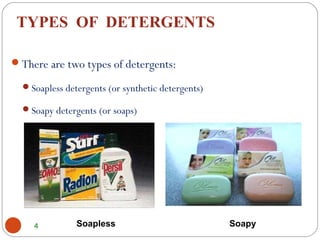
There are two types of detergents:
Soapless detergents (or synthetic detergents)
Soapy detergents (or soaps)
Soapless Soapy
Soap less detergents
5
They are also known as synthetic detergents.
Soapless detergent is a synthetic cleansing agent distilled from
petroleum-based and oil/fat-based substances. 
Its chemical composition prevents the formation of soap scum
when combined with hard water.
Soapy detergents
6
They are commonly known as soaps.
They are metal salts of long chain higher fatty acids.
They are prepared from vegetable oils & animal fats.
They cannot be used effectively in hard water due to the
formation of scum i.e. insoluble precipitates of Ca2+,
Mg2+
,
Fe2+
 etc.
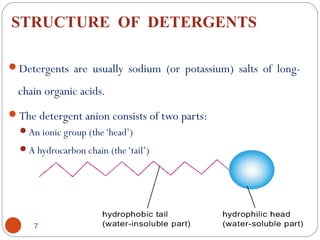
STRUCTURE OF DETERGENTS
7
Detergents are usually sodium (or potassium) salts of long-
chain organic acids.
The detergent anion consists of two parts:
An ionic group (the‘head’)
A hydrocarbon chain (the‘tail’)
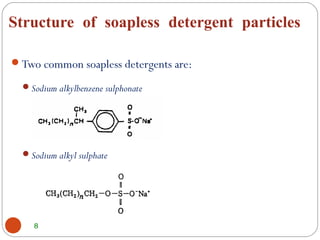
Structure of soapless detergent particles
8
Two common soapless detergents are:
Sodium alkylbenzene sulphonate
Sodium alkyl sulphate
Structure of soap particles
9
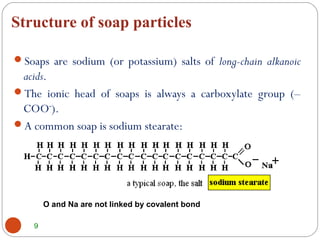
Soaps are sodium (or potassium) salts of long-chain alkanoic
acids.
The ionic head of soaps is always a carboxylate group (–
COO−
).
A common soap is sodium stearate:
O and Na are not linked by covalent bond
PROPERTIES OF DETERGENTS
10
WettingAgent
EmulsifyingAgent
CleansingAgent
Wetting Agent
11
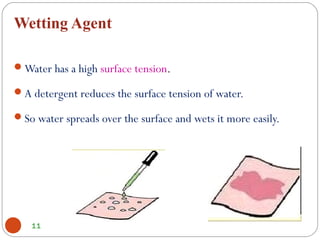
Water has a high surface tension.
A detergent reduces the surface tension of water.
So water spreads over the surface and wets it more easily.
EMULSIFYING AGENT
12
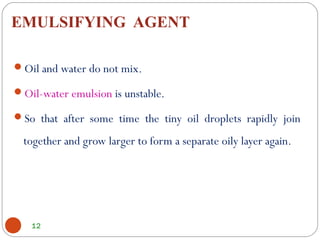
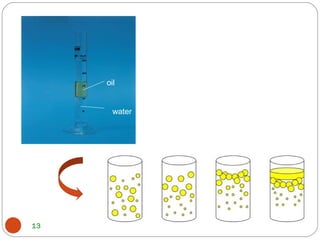
Oil and water do not mix.
Oil-water emulsion is unstable.
So that after some time the tiny oil droplets rapidly join
together and grow larger to form a separate oily layer again.
13
water
oil
CLEANSING ACTION
14
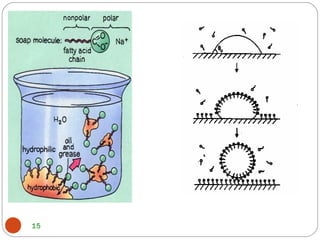
Detergents are act as a cleansing agents.
They are surfactants (surface active agents).
 They work by reducing the surface tension of water,
enabling it to wet things more effectively, and by emulsifying
grease.
15
PREPARATION OF DETERGENT
SOAP LESS DETERGENT
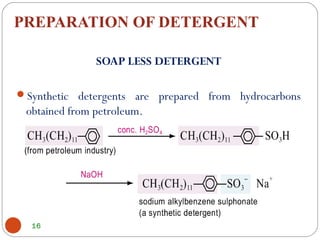
Synthetic detergents are prepared from hydrocarbons
obtained from petroleum.
16
PREPARATION OF DETERGENT
SOAPY DETERGENT (SOAP)
Soaps are made from animal fats (e.g. beef and other fat) or
vegetable oils (e.g. palm oil and coconut oil etc).
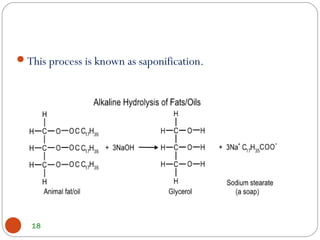
Soaps are formed by the alkaline hydrolysis (breaking up) of
fats and oils by sodium or potassium hydroxide by boiling
under reflux conditions.
17
This process is known as saponification.
18
COMPARISON OF SOAP & SOAPLESS
DETERGENTS
SOAPY DETERGENTS SOAPLESS DETERGENTS
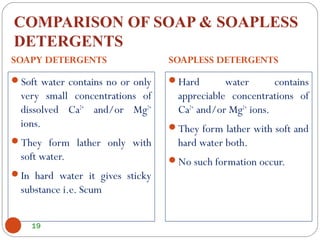
Soft water contains no or only
very small concentrations of
dissolved Ca2+
and/or Mg2+
ions.
They form lather only with
soft water.
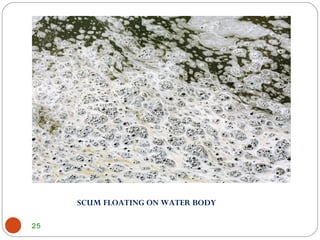
In hard water it gives sticky
substance i.e. Scum
Hard water contains
appreciable concentrations of
Ca2+
and/or Mg2+
ions.
They form lather with soft and
hard water both.
No such formation occur.
19
SOAPLESS DETERGENTS
Advantages Limitaions
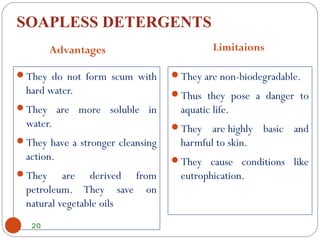
They do not form scum with
hard water.
They are more soluble in
water.
They have a stronger cleansing
action.
They are derived from
petroleum. They save on
natural vegetable oils
They are non-biodegradable.
Thus they pose a danger to
aquatic life.
They are highly basic and
harmful to skin.
They cause conditions like
eutrophication.
20
SOAPY DETERGENTS
Soaps are eco-friendly and bio
degradable.
They work very well in soft
water.
Non-toxic to aquatic life.
They are only mildly alkaline
Thus it seldom causes skin
allergy.
They derived from vegetable
oil and other natural
resources.
They do not work well in hard
water.
They form sticky scum.
They have weaker cleansing
properties than detergents.
21
Advantages Limitations
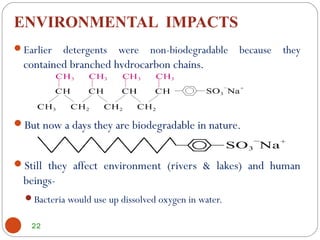
ENVIRONMENTAL IMPACTS
Earlier detergents were non-biodegradable because they
contained branched hydrocarbon chains.
But now a days they are biodegradable in nature.
Still they affect environment (rivers & lakes) and human
beings-
Bacteria would use up dissolved oxygen in water.
22
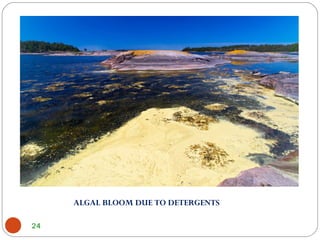
Plant nutrient (Phosphate) available in detergent supports the growth
of algae.
Ultimately it causes Eutrophication.
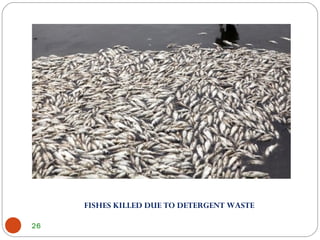
Loss of aquatic lives e.g. fishes
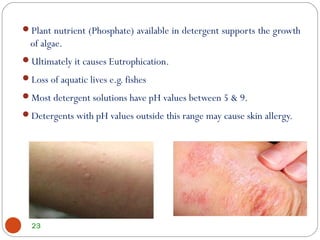
Most detergent solutions have pH values between 5 & 9.
Detergents with pH values outside this range may cause skin allergy.
23
24
ALGAL BLOOM DUE TO DETERGENTS
25
SCUM FLOATING ON WATER BODY
26
FISHES KILLED DUE TO DETERGENT WASTE
27
SUMMARY
• A detergent is a substance which helps water to cleanse things
better.
• A detergent has cleansing properties.
• It acts as a wetting agent and an emulsifying agent.
• There are two types of detergents:
• Soapless detergents —petroleum products
• Soaps —animal fats or plant oils
28
• Detergents are usually sodium (or potassium) salts
of long-chain organic acids.
• Soaps can be made by reacting animal fats or plant oils with
sodium hydroxide i.e. Saponification
fat / oil + sodium hydroxide → glycerol + soap
• Soft water contains no or only very low concentrations of
dissolved Ca2+
and/or Mg2+
ions.
• Hard water contains appreciable concentrations of
Ca2+
and/or Mg2+
ions.
29
• Soaps work well in soft water but not in hard water.
• Soapless detergents work well in both soft and hard water.
• Problems associated with the use of detergents:
• Detergents may cause skin allergy.
• Detergents go down the drain into the sewage system and
eventually to rivers or seas.
30
• Bacteria in water use up oxygen during the decomposition of
these detergents.
• This would kill aquatic lives.
• Many detergents contain phosphate additives. The phosphates
are nutrients for algae. This may lead to eutrophication and
death of aquatic lives.
REFERENCES
Katz David A. (2000);THE SCIENCE OF SOAPS AND
DETERGENTS.
src.gov.jm/wpcontent/uploads/.../soapanddetergents-
121119040041-phpapp01.ppt
www.chymist.com/Soap%20and%20detergent.pdf
31

Soaps and detergents

  • 1.
    Lecture on Detergents and itsEnvironmental issues 1 By Prof. Manorma Sharma & Lokesh Kumar Gupta RKGITM
  • 2.
    2 Content •What is detergent? •Typesof detergent •Structure •Preparation •Properties •Comparison of soap & soap less detergent •Advantages and limitaions •Environmental impacts 2
  • 3.
    WHAT IS ADETERGENT? 3 A detergent is a surfactant or a mixture of surfactants with cleansing properties in dilute solutions. Detergents are the sodium or potassium salts of long chain benzene sulphonic acids.
  • 4.
    TYPES OF DETERGENTS 4 Thereare two types of detergents: Soapless detergents (or synthetic detergents) Soapy detergents (or soaps) Soapless Soapy
  • 5.
    Soap less detergents 5 Theyare also known as synthetic detergents. Soapless detergent is a synthetic cleansing agent distilled from petroleum-based and oil/fat-based substances.  Its chemical composition prevents the formation of soap scum when combined with hard water.
  • 6.
    Soapy detergents 6 They arecommonly known as soaps. They are metal salts of long chain higher fatty acids. They are prepared from vegetable oils & animal fats. They cannot be used effectively in hard water due to the formation of scum i.e. insoluble precipitates of Ca2+, Mg2+ , Fe2+  etc.
  • 7.
    STRUCTURE OF DETERGENTS 7 Detergentsare usually sodium (or potassium) salts of long- chain organic acids. The detergent anion consists of two parts: An ionic group (the‘head’) A hydrocarbon chain (the‘tail’)
  • 8.
    Structure of soaplessdetergent particles 8 Two common soapless detergents are: Sodium alkylbenzene sulphonate Sodium alkyl sulphate
  • 9.
    Structure of soapparticles 9 Soaps are sodium (or potassium) salts of long-chain alkanoic acids. The ionic head of soaps is always a carboxylate group (– COO− ). A common soap is sodium stearate: O and Na are not linked by covalent bond
  • 10.
  • 11.
    Wetting Agent 11 Water hasa high surface tension. A detergent reduces the surface tension of water. So water spreads over the surface and wets it more easily.
  • 12.
    EMULSIFYING AGENT 12 Oil andwater do not mix. Oil-water emulsion is unstable. So that after some time the tiny oil droplets rapidly join together and grow larger to form a separate oily layer again.
  • 13.
  • 14.
    CLEANSING ACTION 14 Detergents areact as a cleansing agents. They are surfactants (surface active agents).  They work by reducing the surface tension of water, enabling it to wet things more effectively, and by emulsifying grease.
  • 15.
  • 16.
    PREPARATION OF DETERGENT SOAPLESS DETERGENT Synthetic detergents are prepared from hydrocarbons obtained from petroleum. 16
  • 17.
    PREPARATION OF DETERGENT SOAPYDETERGENT (SOAP) Soaps are made from animal fats (e.g. beef and other fat) or vegetable oils (e.g. palm oil and coconut oil etc). Soaps are formed by the alkaline hydrolysis (breaking up) of fats and oils by sodium or potassium hydroxide by boiling under reflux conditions. 17
  • 18.
    This process isknown as saponification. 18
  • 19.
    COMPARISON OF SOAP& SOAPLESS DETERGENTS SOAPY DETERGENTS SOAPLESS DETERGENTS Soft water contains no or only very small concentrations of dissolved Ca2+ and/or Mg2+ ions. They form lather only with soft water. In hard water it gives sticky substance i.e. Scum Hard water contains appreciable concentrations of Ca2+ and/or Mg2+ ions. They form lather with soft and hard water both. No such formation occur. 19
  • 20.
    SOAPLESS DETERGENTS Advantages Limitaions Theydo not form scum with hard water. They are more soluble in water. They have a stronger cleansing action. They are derived from petroleum. They save on natural vegetable oils They are non-biodegradable. Thus they pose a danger to aquatic life. They are highly basic and harmful to skin. They cause conditions like eutrophication. 20
  • 21.
    SOAPY DETERGENTS Soaps areeco-friendly and bio degradable. They work very well in soft water. Non-toxic to aquatic life. They are only mildly alkaline Thus it seldom causes skin allergy. They derived from vegetable oil and other natural resources. They do not work well in hard water. They form sticky scum. They have weaker cleansing properties than detergents. 21 Advantages Limitations
  • 22.
    ENVIRONMENTAL IMPACTS Earlier detergentswere non-biodegradable because they contained branched hydrocarbon chains. But now a days they are biodegradable in nature. Still they affect environment (rivers & lakes) and human beings- Bacteria would use up dissolved oxygen in water. 22
  • 23.
    Plant nutrient (Phosphate)available in detergent supports the growth of algae. Ultimately it causes Eutrophication. Loss of aquatic lives e.g. fishes Most detergent solutions have pH values between 5 & 9. Detergents with pH values outside this range may cause skin allergy. 23
  • 24.
    24 ALGAL BLOOM DUETO DETERGENTS
  • 25.
  • 26.
    26 FISHES KILLED DUETO DETERGENT WASTE
  • 27.
    27 SUMMARY • A detergentis a substance which helps water to cleanse things better. • A detergent has cleansing properties. • It acts as a wetting agent and an emulsifying agent. • There are two types of detergents: • Soapless detergents —petroleum products • Soaps —animal fats or plant oils
  • 28.
    28 • Detergents areusually sodium (or potassium) salts of long-chain organic acids. • Soaps can be made by reacting animal fats or plant oils with sodium hydroxide i.e. Saponification fat / oil + sodium hydroxide → glycerol + soap • Soft water contains no or only very low concentrations of dissolved Ca2+ and/or Mg2+ ions. • Hard water contains appreciable concentrations of Ca2+ and/or Mg2+ ions.
  • 29.
    29 • Soaps workwell in soft water but not in hard water. • Soapless detergents work well in both soft and hard water. • Problems associated with the use of detergents: • Detergents may cause skin allergy. • Detergents go down the drain into the sewage system and eventually to rivers or seas.
  • 30.
    30 • Bacteria inwater use up oxygen during the decomposition of these detergents. • This would kill aquatic lives. • Many detergents contain phosphate additives. The phosphates are nutrients for algae. This may lead to eutrophication and death of aquatic lives.
  • 31.
    REFERENCES Katz David A.(2000);THE SCIENCE OF SOAPS AND DETERGENTS. src.gov.jm/wpcontent/uploads/.../soapanddetergents- 121119040041-phpapp01.ppt www.chymist.com/Soap%20and%20detergent.pdf 31