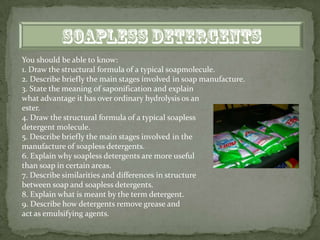
Soapless detergents are synthetic chemicals that are used as substitutes for soap. They are made from chemicals produced in a chemical factory from fats, oils, petroleum, and benzene. These detergents do not react with hard water like soap does, so they can be used effectively in both hard and soft water. Detergents are generally considered better than soap because they can be used in all water types, wet fabrics more quickly than soap, and do not leave residue on clothes or tubs.
Submitted By: NibrasAl Haq C.M
Subject: Chemistry
Grade: 8
Silvermount International School
2.
Soap fewer detergentsare very much like soap in appearance and use and are
now being widely used as soap substitutes. These are made from chemicals
that are produced synthetically in a chemical factory, hence also known as,
'Synthetic Detergent'. These are derived from fats and oils, petroleum and
benzene in solution, these detergents form liquids of varying degrees of alkanet.
All soap less detergents have the advantages of not reacting with the water
hardness, so they wash equally well in soft and hard water. They can also be used
in water that has acid or salt added i.e. for washing coloured articles where the
dye tends to run.
3.
There is agreater and wider horizon for detergents. It is generally felt that
detergents are better than soaps because they:
1. can be used in hard as well as soft water. They wet fabrics more quickly and
readily than soap.
2. leave no soap scum or curd on tub or clothes.
3. dissolve freely even in cool water, rise freely even in hard water.
4. greatly increases removal of dirt.
5. contain superior built-in optical bleach or brighter which eliminates the
need for excessive use of chlorine bleach or for bluing.
4.
6. are activeemulsifiers of motor grease?
7. are 'one-package' products containing not only detergent but also builders,
optical?
bleach and water softener all 'built in' to do a superior soil-removal job.
The expense of these detergents is greater than that of soap, however, it must
be remembered that half as much only is used.
5.
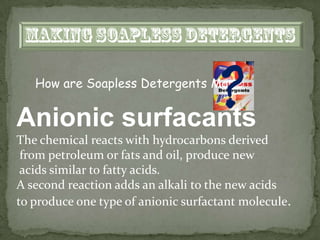
How are SoaplessDetergents Made
Anionic surfacants
?
The chemical reacts with hydrocarbons derived
from petroleum or fats and oil, produce new
acids similar to fatty acids.
A second reaction adds an alkali to the new acids
to produce one type of anionic surfactant molecule.
6.
Nonionic Surfactants
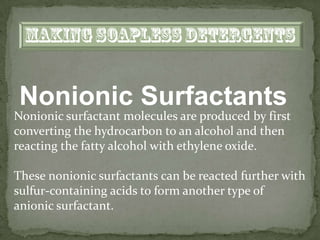
Nonionic surfactantmolecules are produced by first
converting the hydrocarbon to an alcohol and then
reacting the fatty alcohol with ethylene oxide.
These nonionic surfactants can be reacted further with
sulfur-containing acids to form another type of
anionic surfactant.
7.
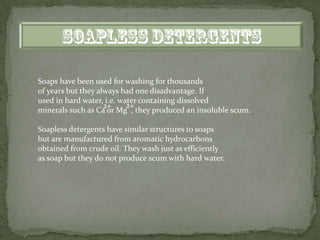
Soaps have beenused for washing for thousands
of years but they always had one disadvantage. If
used in hard water, i.e. water containing dissolved
2+ 2+
minerals such as Ca or Mg , they produced an insoluble scum.
Soapless detergents have similar structures to soaps
but are manufactured from aromatic hydrocarbons
obtained from crude oil. They wash just as efficiently
as soap but they do not produce scum with hard water.
8.
You should beable to know:
1. Draw the structural formula of a typical soapmolecule.
2. Describe briefly the main stages involved in soap manufacture.
3. State the meaning of saponification and explain
what advantage it has over ordinary hydrolysis os an
ester.
4. Draw the structural formula of a typical soapless
detergent molecule.
5. Describe briefly the main stages involved in the
manufacture of soapless detergents.
6. Explain why soapless detergents are more useful
than soap in certain areas.
7. Describe similarities and differences in structure
between soap and soapless detergents.
8. Explain what is meant by the term detergent.
9. Describe how detergents remove grease and
act as emulsifying agents.