Active packaging
Presented by- SUVAJIT MAJUMDAR
IKG PUNJAB TECHNICAL UNIVERSITY
MSc. Food Science and Technology
• Protection
• Preservation
• Promotions
• Easy to use
• Atmosphere inside the package changes constantly.
• Many food plants produces ethylene.
• Each food have its own optimal gas composition a
nd humidity level.
Events happening inside the
packaging
• Packaging material that interacts with the internal gas
environment to extend the shelf-life of a food while
maintaining the quality.
• Such technologies “continuously” modify the gas
environment inside the package.
• Also known as interactive packaging.
Active packs
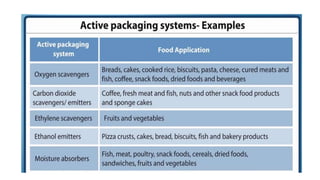
• Important active packaging systems currently
known to date, including oxygen scavengers,
carbon dioxide emitters/absorbers, moisture
absorbers, ethylene absorbers, ethanol emitter
s, flavor releasing/absorbing systems, time-tem
-perature indicators, and antimicrobial containi
-ng films and other controllers of active variabl
es.
Active
packaging
O2
Scavengers
Moisture
scavengers
CO2
scavengers
Ethylene
absorber
Flavor
absorbing
system
Antimicrobial
films
Time-Temp
indicator
Contents
• Introduction
• Oxygen scavengers/ Oxygen absorbers.
• Moisture scavengers.
• Carbon dioxide emitters
• Ethylene absorber.
• Flavor absorbing / Releasing system.
• Antimicrobial films.
• Time-Temperature indicator.
• Other active packaging material.
O2
scavenger
Antioxidants
AbsorbersInterceptors
• Oxygen scavengers or oxygen absorbers are added to
enclosed packaging to help remove or decrease the leve
l of oxygen in the package. They are used to help maint
ain product safety and extend shelf life. There are many
types of oxygen absorbers available to cover a wide arra
y of applications.
• Currently used oxygen absorbers-
1. Iron based;
– 1 gram of iron can absorb 300ml O2
– O2 level down to zero within 36 hours
– amount of iron required
– will not pass through iron detector
2. Chemical based
3. Enzyme based
• In general, existing O2-scavenging technologies utilize one
or more of the following concepts:
• Iron powder oxidation, ascorbic acid oxidation, photo-se
nsitive dye oxidation, enzymatic oxidation ,unsaturated f
atty acids ,immobilized yeast on a solid material.
• The majority of currently commercially available O2-scaven
gers are based on the principle of iron oxidation .
Oxygen scavenger sachet
Oxygen scavenging crown
• Sachets
Consumer resistance to sachets
• Labels
• Absorbing substance included in polymer
films, adhesive ink or coatings.
• Bottle closures i.e. beer, juice and wine in
dustry
O2 absorbers are widely used in food products
such as :-
Bakery products, meat and poultry products , dried
food products, spices and powdered milk.
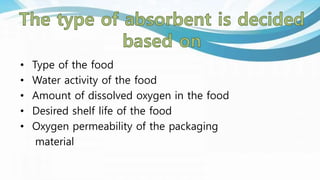
• Type of the food
• Water activity of the food
• Amount of dissolved oxygen in the food
• Desired shelf life of the food
• Oxygen permeability of the packaging
material
Advantages
• Reduces the oxygen concentration to an ultra-low
level
• capital investments needed are significantly
cheaper
Disadvantage
• Packaging material is visible where as in gas
packaging gases are invisible
• O2-scavenging is effective in preventing growth of
moulds and aerobic bacteria.
• O2-scavengers can also be used to control insect
infestation in cereal products during storage.
• O2-absorbers can also prevent oxidative damage
of a wide range of food constituents such as:-
• Oils and fats to prevent rancidity, both plant and
muscle pigments and Flavor's to prevent discolora
tion (e.g. meat) and loss of taste and nutritive ele
ments e.g. vitamins to prevent nutrient loss.
• O2-scavengers can be used alone or in combina
tion with MAP. Their use alone eliminates the ne
ed for MAP machinery and can increase packagi
ng speeds.
• However, it is usually more common in commerc
ial applications to remove most of the atmosphe
ric O2 by MAP and then use a relatively small an
d inexpensive scavenger to remove the residual
O2 within the food package .
• CO2 is formed in some foods due to deterioration and
respiration reactions.
• The produced CO2 has to be removed from the package to
avoid food deterioration and/or package destruction.
• Fresh meat, poultry, and cheese can benefit from packaging
in a high CO2-atmosphere as high CO2-levels (10±80%) are
desirable for foods such as meat and poultry because these
high levels inhibit surface microbial growth and thereby
extends shelf-life.
• Films or sachets.
• High CO2 levels are desirable for meat and poul
try.
• High CO2 would cause fruits to enter anaerobic
glycolysis.
• CO2 causes the package to burst.
• CO2 scavenger is mixture of iron powder and Calcium
hydroxide.
• Sachet producing CO2 consists of ascorbic acid and
iron carbonate.
• CO2 scavenger for fresh ground coffee increases the
shelf- life.
• Foods susceptible to moisture damage need to
be packaged in a high humidity barrier material.
A certain amount of moisture can be trapped in
the packaging or develop during distribution.
• Need of moisture absorber
• Interest to use these absorbers
• Silica gels, zeolites, superabsorbent polymers- p
olyacryl salts & graft polymers of starch.
• Adding additives- amphiphillic additives
• Ethylene (C2H4) acts as a plant hormone that
has different physiological effects on fresh fruit
and vegetables. It accelerates respiration,
leading to maturity and also softening and
ripening of many kinds of fruit.
• Ethylene accumulation can cause yellowing of
green vegetables and may be responsible for a
number of specific postharvest disorders in fresh
fruits and vegetables.
• To prolong shelf-life and maintain an acceptable
visual and organoleptic quality.
• Potassium permanganate
1. Metallic catalyst
2. Activated carbon
3. Minerals such as zeolites
Ethylene absorber system
• Some sachets, in addition to ethanol, may contain trace
amounts of flavoring substances, such as vanilla or other
flavors, to mask the alcohol odor in the package.
• The effectiveness of an ethylene generating system prim
arily depends on the :-
1. Type and size of the carrier material.
2. The amount of ethylene entrapped by the carrier materi
al
3. The permeability of the sachet material to water vapor a
nd ethanol.
4. The water activity of the food.
5. The ethylene permeability of the packaging film.
Ethylene absorber smart packaging
Flavor Absorbing/Releasing Systems
• Food packaging materials, particularly some plastics,
may interact with food flavors, resulting in loss of
flavors, known as flavor scalping.
• Flavors are usually lost or degraded after processing
foods at high temperatures or after packaging.
• Therefore, there is a need to replace these lost flavor
constituents when scalping or degradation occurs.
Flavor Absorbing/Releasing Systems
• Consumers always like to smell good flavors
when they first open a food package.
• Flavor releasing systems, flavor absorbers
scavenge undesirable flavors, aromas, and odors
present in the package headspace.
Formation of off flavour
• The formation of off-flavors and off-odors in
food products originates mainly from :-
1. The oxidation of fats and oils, leading to the
formation of aldehydes.
2. The breakdown of proteins of fish muscle into a
mines.
• Sachets containing ferrous salt and ascorbic acid
can be used.
• Cellulose acetate film containing naringinase
enzyme.
• Reduction of bitterness in grapefruit juice.
Off-flavor absorber
• Polymeric films of various flavours
Purpose
• Minimisation of flavour scalping
• Masking off odours
• Improving the flavour of food
Anti Microbial
Against
microorganism
• Chemical or biological agent which
inhibit and kill the microorganisms in
the different mode of action.
Antimicrobial agents Mode of action
Amino
glycosides:
gentamycin
Block protein
synthesis
Glycopeptides:
vancomycin
Block cell wall
formation
Beta lactams:
Penicillins
Block cell wall
formation
Sulfonamide Block
formation of
nucleic acids
Chemical preservatives that can be used in active
antimicrobial releasing systems include organic
acids and their salts (primarily sorbates, benzoates,
and propionates), parabens,sulfites, nitrites,
chlorides, phosphates, epoxides, alcohols, ozone,
hydrogen peroxide,diethyl pyrocarbonate ,
antibiotics, and bacteriocins.
Some chemical preservatives used in the
development of non-edible antimicrobial
systems are listed in table:
Conditions Influencing the Effectiveness of
Antimicrobial Agent Activity
• Population size: larger populations take longer to kill than smaller
populations.
• Type of microorganisms : microorganisms differ markedly in their
sensitivity to various agents.
• Concentration or intensity of the antimicrobial agent: higher
concentrations or intensities are generally more efficient, but the
relationship is not linear.
• Duration of exposure: the longer the exposure, the greater the number of
organisms killed.
• Temperature: a higher temperature will usually (but not always) increase
the effectiveness of killing.
Conditions Influencing the Effectiveness
of Antimicrobial Agent Activity
• Local environment: environmental factors, such
as pH, viscosity, and concentration of organic m
atter can profoundly influence the effectiveness
of a particular antimicrobial agent.
• There are some factor that affect the selection
of antimicrobial agent:-
1. Type of organisms
2. Nature of food material
3. Nature of packaging material
4. Storage condition
5. cost
Antimicrobial
agents
Packaging
material
Microorganisms
Benzoic acids PE Total bacteria
Lysozyme Zein E.coli
Nisin PE,Corn zein S .aureus
Benomyl LDPE Moulds
Chitason LDPE E .coli
Clove extract LDPE S .cerevisice
Ethanol Silicon oxide Moulds
Antibiotics PE E .coli
• Ethanol is used as preservatives
• At high conc. ethanol denatures protein of moul
d and yeast
• Can be used by spraying
• Sachets can be used containing ethicap
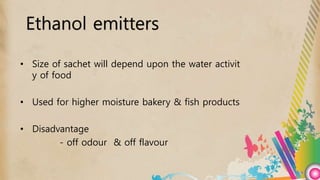
• Size of sachet will depend upon the water activit
y of food
• Used for higher moisture bakery & fish products
• Disadvantage
- off odour & off flavour
Ethanol emitters
Other types of active packaging functions
Insulating materials Temperature control for restricting microbial
growth
Self heating Al/steel containers Cooking of food via build in heating mechanis
m
Surface-treated food packaging materials Fluorine-based plasmas
Growth inhibition of bacteria
Self cooling Al/steel cans Cooling of food materials
Temperature sensitive films To avoid anaerobic respiration
Microwave susceptors Drying, crisping and ultimately browning of micr
owaved food
Other types of active packaging functions
UV-irradiated nylon film Growth inhibition of spoilage bacteri
a
Fresh pad Releasing natural volatile oils, absorb
ing oxygen and excess juice, Growth i
nhibition of bacteria
Moisture control
Self-life improvement
Fresh pads
Time temperature indicator
Refrences
• L. Vermeiren et al. / Trends in Food Science & Technol
ogy 10 (1999)
• MURAT OZDEMIR & JOHN D. FLOROS (2004): Active F
ood Packaging Technologies, Critical Reviews in Food
Science and Nutrition, 44:3, 185-193
• Wikipedia
Thankyou

Active packaging

  • 1.
    Active packaging Presented by-SUVAJIT MAJUMDAR IKG PUNJAB TECHNICAL UNIVERSITY MSc. Food Science and Technology
  • 2.
    • Protection • Preservation •Promotions • Easy to use
  • 3.
    • Atmosphere insidethe package changes constantly. • Many food plants produces ethylene. • Each food have its own optimal gas composition a nd humidity level. Events happening inside the packaging
  • 4.
    • Packaging materialthat interacts with the internal gas environment to extend the shelf-life of a food while maintaining the quality. • Such technologies “continuously” modify the gas environment inside the package. • Also known as interactive packaging.
  • 5.
  • 6.
    • Important activepackaging systems currently known to date, including oxygen scavengers, carbon dioxide emitters/absorbers, moisture absorbers, ethylene absorbers, ethanol emitter s, flavor releasing/absorbing systems, time-tem -perature indicators, and antimicrobial containi -ng films and other controllers of active variabl es.
  • 7.
  • 8.
    Contents • Introduction • Oxygenscavengers/ Oxygen absorbers. • Moisture scavengers. • Carbon dioxide emitters • Ethylene absorber. • Flavor absorbing / Releasing system. • Antimicrobial films. • Time-Temperature indicator. • Other active packaging material.
  • 10.
  • 11.
    • Oxygen scavengersor oxygen absorbers are added to enclosed packaging to help remove or decrease the leve l of oxygen in the package. They are used to help maint ain product safety and extend shelf life. There are many types of oxygen absorbers available to cover a wide arra y of applications.
  • 12.
    • Currently usedoxygen absorbers- 1. Iron based; – 1 gram of iron can absorb 300ml O2 – O2 level down to zero within 36 hours – amount of iron required – will not pass through iron detector 2. Chemical based 3. Enzyme based
  • 13.
    • In general,existing O2-scavenging technologies utilize one or more of the following concepts: • Iron powder oxidation, ascorbic acid oxidation, photo-se nsitive dye oxidation, enzymatic oxidation ,unsaturated f atty acids ,immobilized yeast on a solid material. • The majority of currently commercially available O2-scaven gers are based on the principle of iron oxidation .
  • 15.
  • 16.
  • 17.
    • Sachets Consumer resistanceto sachets • Labels • Absorbing substance included in polymer films, adhesive ink or coatings. • Bottle closures i.e. beer, juice and wine in dustry
  • 18.
    O2 absorbers arewidely used in food products such as :- Bakery products, meat and poultry products , dried food products, spices and powdered milk.
  • 19.
    • Type ofthe food • Water activity of the food • Amount of dissolved oxygen in the food • Desired shelf life of the food • Oxygen permeability of the packaging material
  • 20.
    Advantages • Reduces theoxygen concentration to an ultra-low level • capital investments needed are significantly cheaper Disadvantage • Packaging material is visible where as in gas packaging gases are invisible
  • 21.
    • O2-scavenging iseffective in preventing growth of moulds and aerobic bacteria. • O2-scavengers can also be used to control insect infestation in cereal products during storage. • O2-absorbers can also prevent oxidative damage of a wide range of food constituents such as:- • Oils and fats to prevent rancidity, both plant and muscle pigments and Flavor's to prevent discolora tion (e.g. meat) and loss of taste and nutritive ele ments e.g. vitamins to prevent nutrient loss.
  • 22.
    • O2-scavengers canbe used alone or in combina tion with MAP. Their use alone eliminates the ne ed for MAP machinery and can increase packagi ng speeds. • However, it is usually more common in commerc ial applications to remove most of the atmosphe ric O2 by MAP and then use a relatively small an d inexpensive scavenger to remove the residual O2 within the food package .
  • 23.
    • CO2 isformed in some foods due to deterioration and respiration reactions. • The produced CO2 has to be removed from the package to avoid food deterioration and/or package destruction. • Fresh meat, poultry, and cheese can benefit from packaging in a high CO2-atmosphere as high CO2-levels (10±80%) are desirable for foods such as meat and poultry because these high levels inhibit surface microbial growth and thereby extends shelf-life.
  • 25.
    • Films orsachets. • High CO2 levels are desirable for meat and poul try. • High CO2 would cause fruits to enter anaerobic glycolysis. • CO2 causes the package to burst.
  • 26.
    • CO2 scavengeris mixture of iron powder and Calcium hydroxide. • Sachet producing CO2 consists of ascorbic acid and iron carbonate. • CO2 scavenger for fresh ground coffee increases the shelf- life.
  • 27.
    • Foods susceptibleto moisture damage need to be packaged in a high humidity barrier material. A certain amount of moisture can be trapped in the packaging or develop during distribution.
  • 28.
    • Need ofmoisture absorber • Interest to use these absorbers • Silica gels, zeolites, superabsorbent polymers- p olyacryl salts & graft polymers of starch. • Adding additives- amphiphillic additives
  • 29.
    • Ethylene (C2H4)acts as a plant hormone that has different physiological effects on fresh fruit and vegetables. It accelerates respiration, leading to maturity and also softening and ripening of many kinds of fruit. • Ethylene accumulation can cause yellowing of green vegetables and may be responsible for a number of specific postharvest disorders in fresh fruits and vegetables. • To prolong shelf-life and maintain an acceptable visual and organoleptic quality.
  • 30.
    • Potassium permanganate 1.Metallic catalyst 2. Activated carbon 3. Minerals such as zeolites
  • 33.
  • 34.
    • Some sachets,in addition to ethanol, may contain trace amounts of flavoring substances, such as vanilla or other flavors, to mask the alcohol odor in the package. • The effectiveness of an ethylene generating system prim arily depends on the :- 1. Type and size of the carrier material. 2. The amount of ethylene entrapped by the carrier materi al 3. The permeability of the sachet material to water vapor a nd ethanol. 4. The water activity of the food. 5. The ethylene permeability of the packaging film.
  • 35.
  • 36.
    Flavor Absorbing/Releasing Systems •Food packaging materials, particularly some plastics, may interact with food flavors, resulting in loss of flavors, known as flavor scalping. • Flavors are usually lost or degraded after processing foods at high temperatures or after packaging. • Therefore, there is a need to replace these lost flavor constituents when scalping or degradation occurs.
  • 37.
    Flavor Absorbing/Releasing Systems •Consumers always like to smell good flavors when they first open a food package. • Flavor releasing systems, flavor absorbers scavenge undesirable flavors, aromas, and odors present in the package headspace.
  • 38.
    Formation of offflavour • The formation of off-flavors and off-odors in food products originates mainly from :- 1. The oxidation of fats and oils, leading to the formation of aldehydes. 2. The breakdown of proteins of fish muscle into a mines.
  • 39.
    • Sachets containingferrous salt and ascorbic acid can be used. • Cellulose acetate film containing naringinase enzyme. • Reduction of bitterness in grapefruit juice. Off-flavor absorber
  • 40.
    • Polymeric filmsof various flavours Purpose • Minimisation of flavour scalping • Masking off odours • Improving the flavour of food
  • 41.
  • 42.
    • Chemical orbiological agent which inhibit and kill the microorganisms in the different mode of action.
  • 43.
    Antimicrobial agents Modeof action Amino glycosides: gentamycin Block protein synthesis Glycopeptides: vancomycin Block cell wall formation Beta lactams: Penicillins Block cell wall formation Sulfonamide Block formation of nucleic acids
  • 44.
    Chemical preservatives thatcan be used in active antimicrobial releasing systems include organic acids and their salts (primarily sorbates, benzoates, and propionates), parabens,sulfites, nitrites, chlorides, phosphates, epoxides, alcohols, ozone, hydrogen peroxide,diethyl pyrocarbonate , antibiotics, and bacteriocins.
  • 45.
    Some chemical preservativesused in the development of non-edible antimicrobial systems are listed in table:
  • 46.
    Conditions Influencing theEffectiveness of Antimicrobial Agent Activity • Population size: larger populations take longer to kill than smaller populations. • Type of microorganisms : microorganisms differ markedly in their sensitivity to various agents. • Concentration or intensity of the antimicrobial agent: higher concentrations or intensities are generally more efficient, but the relationship is not linear. • Duration of exposure: the longer the exposure, the greater the number of organisms killed. • Temperature: a higher temperature will usually (but not always) increase the effectiveness of killing.
  • 47.
    Conditions Influencing theEffectiveness of Antimicrobial Agent Activity • Local environment: environmental factors, such as pH, viscosity, and concentration of organic m atter can profoundly influence the effectiveness of a particular antimicrobial agent.
  • 48.
    • There aresome factor that affect the selection of antimicrobial agent:- 1. Type of organisms 2. Nature of food material 3. Nature of packaging material 4. Storage condition 5. cost
  • 49.
    Antimicrobial agents Packaging material Microorganisms Benzoic acids PETotal bacteria Lysozyme Zein E.coli Nisin PE,Corn zein S .aureus Benomyl LDPE Moulds Chitason LDPE E .coli Clove extract LDPE S .cerevisice Ethanol Silicon oxide Moulds Antibiotics PE E .coli
  • 50.
    • Ethanol isused as preservatives • At high conc. ethanol denatures protein of moul d and yeast • Can be used by spraying • Sachets can be used containing ethicap
  • 51.
    • Size ofsachet will depend upon the water activit y of food • Used for higher moisture bakery & fish products • Disadvantage - off odour & off flavour Ethanol emitters
  • 52.
    Other types ofactive packaging functions Insulating materials Temperature control for restricting microbial growth Self heating Al/steel containers Cooking of food via build in heating mechanis m Surface-treated food packaging materials Fluorine-based plasmas Growth inhibition of bacteria Self cooling Al/steel cans Cooling of food materials Temperature sensitive films To avoid anaerobic respiration Microwave susceptors Drying, crisping and ultimately browning of micr owaved food
  • 53.
    Other types ofactive packaging functions UV-irradiated nylon film Growth inhibition of spoilage bacteri a Fresh pad Releasing natural volatile oils, absorb ing oxygen and excess juice, Growth i nhibition of bacteria Moisture control Self-life improvement
  • 54.
  • 55.
  • 56.
    Refrences • L. Vermeirenet al. / Trends in Food Science & Technol ogy 10 (1999) • MURAT OZDEMIR & JOHN D. FLOROS (2004): Active F ood Packaging Technologies, Critical Reviews in Food Science and Nutrition, 44:3, 185-193 • Wikipedia
  • 57.

Editor's Notes

  • #3 New techniques are involved in food packaging
  • #10 Residual oxygen within both the food and headspace of hermetically sealed barrier containers reacts to oxidize food components.
  • #20 Enzymatic oxygen scavenging they require the addition of water and, therefore, cannot be e€ectively used for low-water foodstu€s
  • #22 Pre-vention of mould growth is important for dairy pro- ducts such as cheese and bakery products. O2-levels of 0.1% or lower are required to prevent the growth of many molds
  • #30 some e€ects of ethylene are positive such as degreening of citrus fruit, ethylene is often detrimental to the quality and shelf-life of fruits and vegetables.
  • #37 Although the use of high barrier plastics holds food flavors in the package, additional flavor releasing systems may be necessary in some instances, particularly when heat seal layers of a package have high affinity to flavors. For example, most of the dry instant coffee manufacturers often fill the headspace with volatiles distilled from the dehydration process to deliver fresh coffee fragrance when the package is first opened.
  • #39 Although aldehydes and amines can be removed from package headspaces by forming active flavor scavengers, these systems may mask or absorb off-flavors and off-odors that are indicative of spoilage