Smart Host Microcontroller for Optimal Battery
Charging in a Solar-Powered Robotic Vehicle
Abstract:
This paper focuses on the design and construction of an optimization charging system for
batteries by means of tracked solar panels. Thus, the implementation of a complete Energy
management system applied to a robotic exploration vehicle is put forward. The proposed system
was tested on the robotic platform an unmanned exploration vehicle specialized in recognition.
The interest of this robotic system lies in the design concept, based on a smart host
microcontroller. On this basis, our proposal makes a twofold significant contribution. On the one
hand, it presents the construction of a solar tracking mechanism aimed at increasing the rover’s
power regardless of its mobility. On the other hand, it proposes an alternative design of power
system performance based on a pack of batteries. The aim is completing the process of charging
a battery independently while the other battery provides all the energy consumed by the robotic
vehicle.

Existing System:
Solar based unmanned exploration vehicles are used in some space researches.
The existing exploration vehicle uses static solar panels, which cannot track maximum power
from solar cells. Here we are using a solar tracking system

to produce maximum power.

Proposed System:
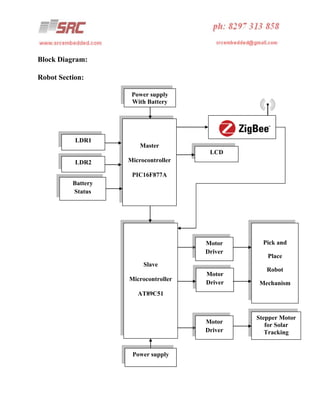
The proposed system uses Master and Slave based Microcontrollers. The Master
controller PIC16F877A senses the light intensity from two different directions using LDR (Light
Dependent Resistors). The panel’s direction is adjusted according to the sunlight direction using
a stepper motor. The exploration robot has two-fingered arm to pic and place the objects. The
robot is controlled using Zigbee protocol. The Battery status will be continuously measured and
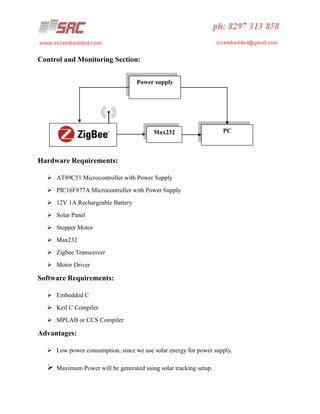
sent back to the monitoring unit through Zigbee. The monitoring section consist a PC with
Zigbee transceiver, VB based user interface used to control the unmanned exploration vehicle.
Since we are using solar-based system, power consumption is reduced.
Block Diagram:
Robot Section:
Power supply
With Battery

LDR1

Master
LCD

LDR2

Microcontroller
PIC16F877A

Battery
Status

Motor
Driver
Slave

Pick and
Place
Robot
Mechanism

Motor
Driver

Microcontroller

Motor
Driver

Stepper Motor
for Solar
Tracking

AT89C51

Power supply
Control and Monitoring Section:
Power supply

Max232

PC

Hardware Requirements:
 AT89C51 Microcontroller with Power Supply
 PIC16F877A Microcontroller with Power Supply
 12V 1A Rechargeable Battery
 Solar Panel
 Stepper Motor
 Max232
 Zigbee Transceiver
 Motor Driver

Software Requirements:
 Embedded C
 Keil C Compiler
 MPLAB or CCS Compiler

Advantages:
 Low power consumption, since we use solar energy for power supply.



Maximum Power will be generated using solar tracking setup.

Smart host microcontroller for optimal battery abstract

  • 1.
    Smart Host Microcontrollerfor Optimal Battery Charging in a Solar-Powered Robotic Vehicle Abstract: This paper focuses on the design and construction of an optimization charging system for batteries by means of tracked solar panels. Thus, the implementation of a complete Energy management system applied to a robotic exploration vehicle is put forward. The proposed system was tested on the robotic platform an unmanned exploration vehicle specialized in recognition. The interest of this robotic system lies in the design concept, based on a smart host microcontroller. On this basis, our proposal makes a twofold significant contribution. On the one hand, it presents the construction of a solar tracking mechanism aimed at increasing the rover’s power regardless of its mobility. On the other hand, it proposes an alternative design of power system performance based on a pack of batteries. The aim is completing the process of charging a battery independently while the other battery provides all the energy consumed by the robotic vehicle. Existing System: Solar based unmanned exploration vehicles are used in some space researches. The existing exploration vehicle uses static solar panels, which cannot track maximum power from solar cells. Here we are using a solar tracking system to produce maximum power. Proposed System: The proposed system uses Master and Slave based Microcontrollers. The Master controller PIC16F877A senses the light intensity from two different directions using LDR (Light Dependent Resistors). The panel’s direction is adjusted according to the sunlight direction using a stepper motor. The exploration robot has two-fingered arm to pic and place the objects. The robot is controlled using Zigbee protocol. The Battery status will be continuously measured and sent back to the monitoring unit through Zigbee. The monitoring section consist a PC with Zigbee transceiver, VB based user interface used to control the unmanned exploration vehicle. Since we are using solar-based system, power consumption is reduced.
  • 2.
    Block Diagram: Robot Section: Powersupply With Battery LDR1 Master LCD LDR2 Microcontroller PIC16F877A Battery Status Motor Driver Slave Pick and Place Robot Mechanism Motor Driver Microcontroller Motor Driver Stepper Motor for Solar Tracking AT89C51 Power supply
  • 3.
    Control and MonitoringSection: Power supply Max232 PC Hardware Requirements:  AT89C51 Microcontroller with Power Supply  PIC16F877A Microcontroller with Power Supply  12V 1A Rechargeable Battery  Solar Panel  Stepper Motor  Max232  Zigbee Transceiver  Motor Driver Software Requirements:  Embedded C  Keil C Compiler  MPLAB or CCS Compiler Advantages:  Low power consumption, since we use solar energy for power supply.  Maximum Power will be generated using solar tracking setup.