
SINGLE AXIS SMART SOLAR TRACKING
SYSTEM USING ARDUINO
Department of Electronics & Telecommunications Engineering
Presented By
Tanvir Ahmed & Asadur Rahman
ID: 2013-1-55-017 ID: 2013-1-55-010
Supervised By
Dr. Md. Habibur Rahman
Professor
Dept. of Electrical & Electronics Engineering
University of Dhaka
OBJECTIVE
 To design a smart solar tracking system
 To construct a solar tracking circuit to improve the
performance of PV system
 To test the functionality of LDR sensor and Servo
Motor in tracking system
 To design a tracking system with low cost
components
AIM OF THE PROJECT
In this project, we proposed a single axis solar
tracking system, by which we can harness more
energy from the sun by always facing the PV
panel towards the sun during daylight time.
WHAT IS SOLAR TRACKER?
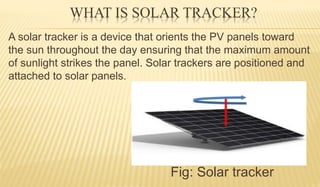
A solar tracker is a device that orients the PV panels toward
the sun throughout the day ensuring that the maximum amount
of sunlight strikes the panel. Solar trackers are positioned and
attached to solar panels.
Fig: Solar tracker
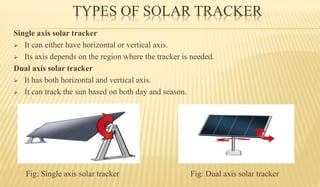
TYPES OF SOLAR TRACKER
Single axis solar tracker
 It can either have horizontal or vertical axis.
 Its axis depends on the region where the tracker is needed.
Dual axis solar tracker
 It has both horizontal and vertical axis.
 It can track the sun based on both day and season.
Fig: Single axis solar tracker Fig: Dual axis solar tracker
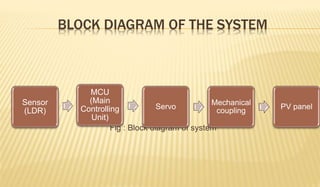
BLOCK DIAGRAM OF THE SYSTEM
Fig : Block diagram of system
Sensor
(LDR)
MCU
(Main
Controlling
Unit)
Servo
Mechanical
coupling
PV panel
COMPONENTS USED IN THE SYSTEM
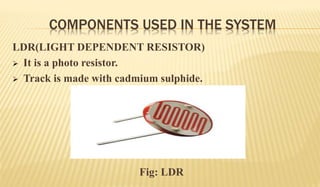
LDR(LIGHT DEPENDENT RESISTOR)
 It is a photo resistor.
 Track is made with cadmium sulphide.
Fig: LDR
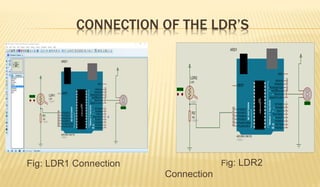
CONNECTION OF THE LDR’S
Fig: LDR1 Connection Fig: LDR2
Connection
COMPONENTS USED IN THE SYSTEM(CONTD.)
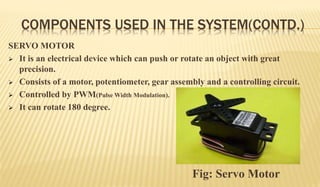
SERVO MOTOR
 It is an electrical device which can push or rotate an object with great
precision.
 Consists of a motor, potentiometer, gear assembly and a controlling circuit.
 Controlled by PWM(Pulse Width Modulation).
 It can rotate 180 degree.
Fig: Servo Motor
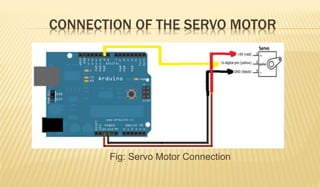
CONNECTION OF THE SERVO MOTOR
Fig: Servo Motor Connection
COMPONENTS USED IN THE SYSTEM(CONTD.)
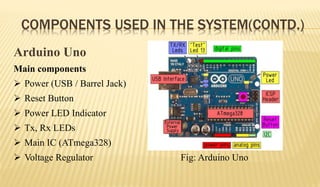
Arduino Uno
Main components
 Power (USB / Barrel Jack)
 Reset Button
 Power LED Indicator
 Tx, Rx LEDs
 Main IC (ATmega328)
 Voltage Regulator Fig: Arduino Uno
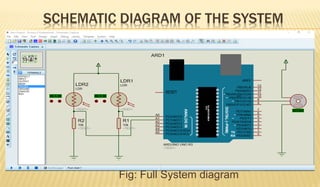
SCHEMATIC DIAGRAM OF THE SYSTEM
Fig: Full System diagram
PERFORMANCE STUDY OF THE SYSTEM
Different values of voltages for different intensity of light:
Light intensity For LDR1
At night 0.2v
Indoor with all lights OFF 1.10v
Indoor with mobile torch light 3.06v
PERFORMANCE STUDY OF THE SYSTEM(CONTD.)
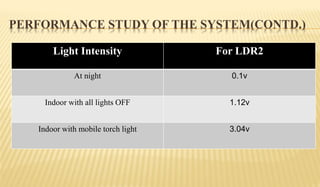
Light Intensity For LDR2
At night 0.1v
Indoor with all lights OFF 1.12v
Indoor with mobile torch light 3.04v
PERFORMANCE STUDY OF THE SYSTEM(CONTD.)
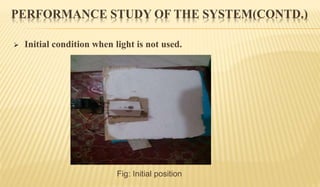
 Initial condition when light is not used.
Fig: Initial position
PERFORMANCE STUDY OF THE SYSTEM(CONTD.)
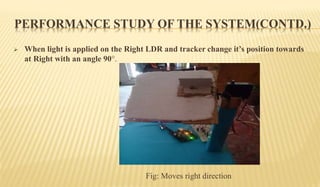
 When light is applied on the Right LDR and tracker change it’s position towards
at Right with an angle 90°.
Fig: Moves right direction
PERFORMANCE STUDY OF THE SYSTEM(CONTD.)
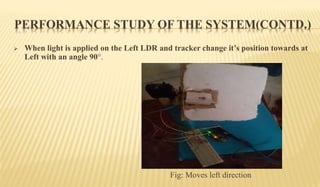
 When light is applied on the Left LDR and tracker change it’s position towards at
Left with an angle 90°.
Fig: Moves left direction
ADVANTAGES
 Generate more electricity than fixed tilt systems.
 Higher reliability system than dual axis system.
 Higher lifespan.
DISADVANTAGES
 Solar trackers are slightly more expensive than fixed
tilt systems.
 Trackers are a more complex system than fixed
racking.
CONCLUSION
The completion of this project has led to several
conclusions to be made about this solar tracking system as
well as solar tracking systems in general.
 LDR can be used successfully to detect the sun position.
 Servo motor can easily adjust position of solar panel.
 Arduino Uno can easily used in solar tracker.
 Our developed solar tracker works properly.
THANK YOU

Single AXIs Smart SOLAR TRACKING SYSTEM USING ARDUINO

  • 1.
    SINGLE AXIS SMARTSOLAR TRACKING SYSTEM USING ARDUINO Department of Electronics & Telecommunications Engineering
  • 2.
    Presented By Tanvir Ahmed& Asadur Rahman ID: 2013-1-55-017 ID: 2013-1-55-010 Supervised By Dr. Md. Habibur Rahman Professor Dept. of Electrical & Electronics Engineering University of Dhaka
  • 3.
    OBJECTIVE  To designa smart solar tracking system  To construct a solar tracking circuit to improve the performance of PV system  To test the functionality of LDR sensor and Servo Motor in tracking system  To design a tracking system with low cost components
  • 4.
    AIM OF THEPROJECT In this project, we proposed a single axis solar tracking system, by which we can harness more energy from the sun by always facing the PV panel towards the sun during daylight time.
  • 5.
    WHAT IS SOLARTRACKER? A solar tracker is a device that orients the PV panels toward the sun throughout the day ensuring that the maximum amount of sunlight strikes the panel. Solar trackers are positioned and attached to solar panels. Fig: Solar tracker
  • 6.
    TYPES OF SOLARTRACKER Single axis solar tracker  It can either have horizontal or vertical axis.  Its axis depends on the region where the tracker is needed. Dual axis solar tracker  It has both horizontal and vertical axis.  It can track the sun based on both day and season. Fig: Single axis solar tracker Fig: Dual axis solar tracker
  • 7.
    BLOCK DIAGRAM OFTHE SYSTEM Fig : Block diagram of system Sensor (LDR) MCU (Main Controlling Unit) Servo Mechanical coupling PV panel
  • 8.
    COMPONENTS USED INTHE SYSTEM LDR(LIGHT DEPENDENT RESISTOR)  It is a photo resistor.  Track is made with cadmium sulphide. Fig: LDR
  • 9.
    CONNECTION OF THELDR’S Fig: LDR1 Connection Fig: LDR2 Connection
  • 10.
    COMPONENTS USED INTHE SYSTEM(CONTD.) SERVO MOTOR  It is an electrical device which can push or rotate an object with great precision.  Consists of a motor, potentiometer, gear assembly and a controlling circuit.  Controlled by PWM(Pulse Width Modulation).  It can rotate 180 degree. Fig: Servo Motor
  • 11.
    CONNECTION OF THESERVO MOTOR Fig: Servo Motor Connection
  • 12.
    COMPONENTS USED INTHE SYSTEM(CONTD.) Arduino Uno Main components  Power (USB / Barrel Jack)  Reset Button  Power LED Indicator  Tx, Rx LEDs  Main IC (ATmega328)  Voltage Regulator Fig: Arduino Uno
  • 13.
    SCHEMATIC DIAGRAM OFTHE SYSTEM Fig: Full System diagram
  • 14.
    PERFORMANCE STUDY OFTHE SYSTEM Different values of voltages for different intensity of light: Light intensity For LDR1 At night 0.2v Indoor with all lights OFF 1.10v Indoor with mobile torch light 3.06v
  • 15.
    PERFORMANCE STUDY OFTHE SYSTEM(CONTD.) Light Intensity For LDR2 At night 0.1v Indoor with all lights OFF 1.12v Indoor with mobile torch light 3.04v
  • 16.
    PERFORMANCE STUDY OFTHE SYSTEM(CONTD.)  Initial condition when light is not used. Fig: Initial position
  • 17.
    PERFORMANCE STUDY OFTHE SYSTEM(CONTD.)  When light is applied on the Right LDR and tracker change it’s position towards at Right with an angle 90°. Fig: Moves right direction
  • 18.
    PERFORMANCE STUDY OFTHE SYSTEM(CONTD.)  When light is applied on the Left LDR and tracker change it’s position towards at Left with an angle 90°. Fig: Moves left direction
  • 19.
    ADVANTAGES  Generate moreelectricity than fixed tilt systems.  Higher reliability system than dual axis system.  Higher lifespan.
  • 20.
    DISADVANTAGES  Solar trackersare slightly more expensive than fixed tilt systems.  Trackers are a more complex system than fixed racking.
  • 21.
    CONCLUSION The completion ofthis project has led to several conclusions to be made about this solar tracking system as well as solar tracking systems in general.  LDR can be used successfully to detect the sun position.  Servo motor can easily adjust position of solar panel.  Arduino Uno can easily used in solar tracker.  Our developed solar tracker works properly.
  • 22.