Building community
through Slack: a student-
owned digital
space for connectivity and
collaboration
Dr Richard Walker
Dr Nathan Page
Programme Design and Learning Technology Team
University of York
Background and Context
Digital Communities
- Important for the future of HE (Bayne and Gallagher, 2020; Walker
and Page, 2020)
- Socialisation is known to be a key element to online learning
(Garrison and Anderson, 2003)
Our context
- Needed to create programme-level digital communities, particularly
for fully online programmes that launched in 2018
- Pandemic accelerated the need for digital communities for all
(Rapanta et al, 2020; Shaw, 2021)
Why have a Digital Community?
Literature on digital communities
- For fostering learning communities (Lave and Wenger, 1991; De
Wilde, 2019)
- To allow interdisciplinarity and networking (Haythornthwaite,
2006; Bayne and Gallagher, 2020)
Intuitively, we know that...
- A socialisation space can enhance learning, e.g. ‘café conversations’
- There are affective / emotional / motivational benefits to feeling
connected and part of a community (THE Campus Weekly, 2021)
Slack
Advantages of using Slack
- Successfully used by staff for home working, including cross-team
collaborations, and when trialled with students for teaching and
learning (Walker et al, 2021)
- Affordances of the tool include:
- Participants can set up distinct channels for their own
purposes (e.g. for questioning, ideas sharing)
- Push notifications to support agile problem solving / sharing of
info
- Useful for synchronous and asynchronous messaging
HE sector use of tools for digital community
- Some institutions use VLE discussion boards, others use dedicated
communication tools e.g. MS Teams or Discord (Bills, 2021)
Our Pilot and its Evaluation
Pilot
- Phase 1: approx 30 students given Slack (May - July 2021)
- Phase 2: approx 400 students added to the main channel, and a
channel for their module in the next term (July - Sept. 2021)
- ‘Light touch’ implementation, in consultation with student reps, inc.
offering usage guides, messaging around positive community
building, rules of engagement / netiquette
Evaluation
- Usage data inc. quantitative check on number of posts/threads
- Questionnaire (n=16)
- Focus group (n=4)
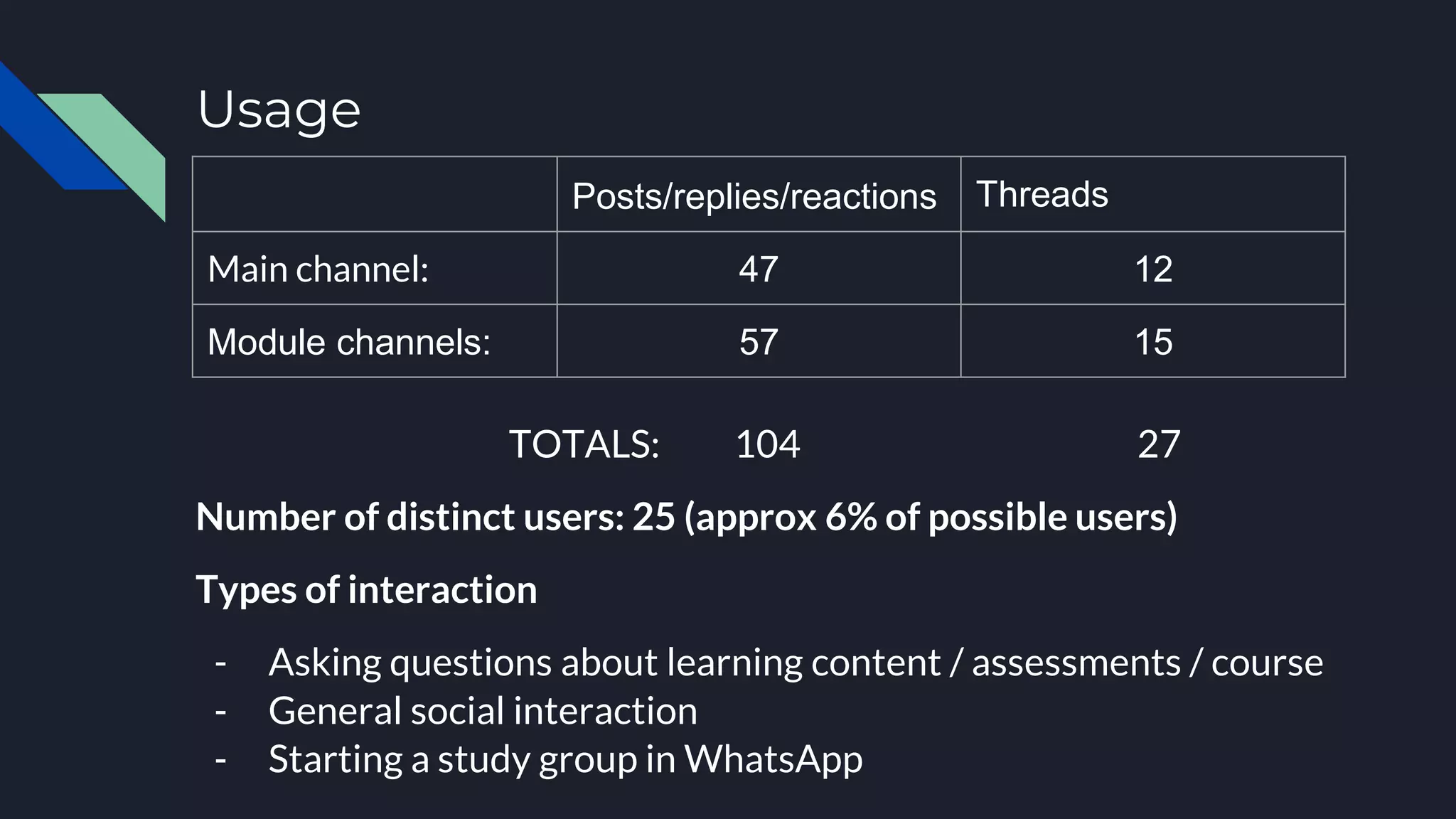
Usage
TOTALS: 104 27
Number of distinct users: 25 (approx 6% of possible users)
Types of interaction
- Asking questions about learning content / assessments / course
- General social interaction
- Starting a study group in WhatsApp
Posts/replies/reactions Threads
Main channel: 47 12
Module channels: 57 15
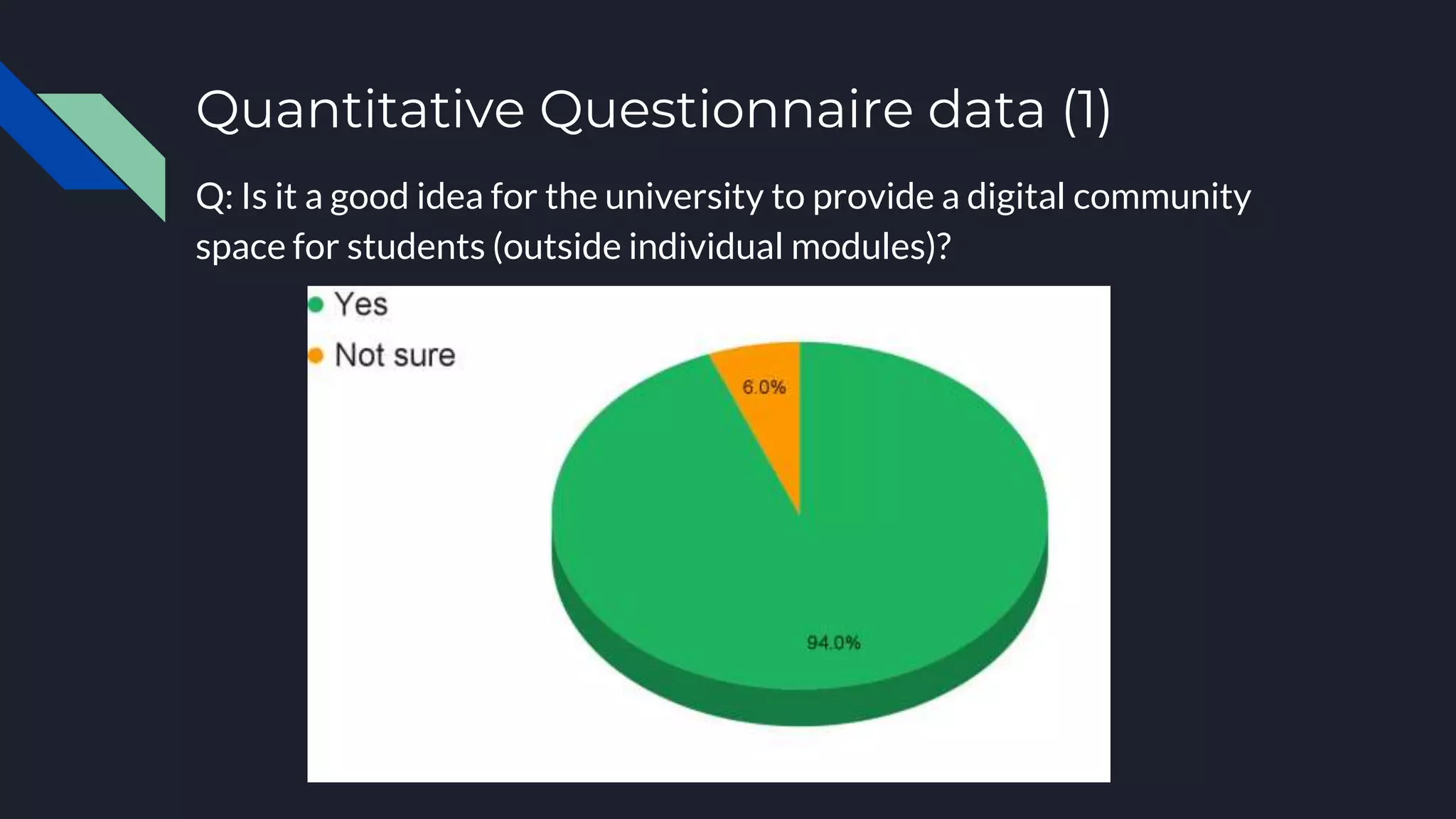
Quantitative Questionnaire data (1)
Q: Is it a good idea for the university to provide a digital community
space for students (outside individual modules)?
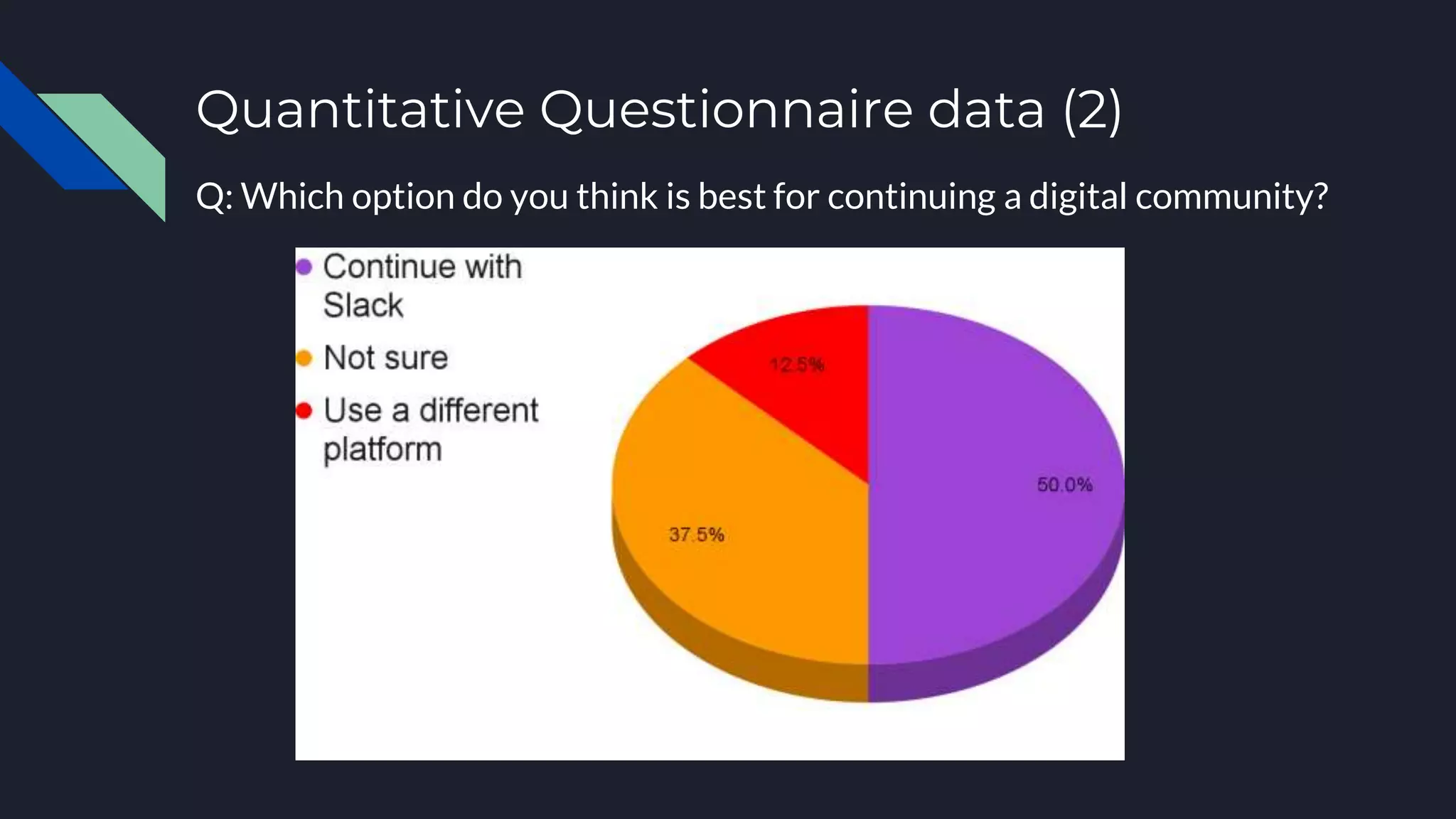
Quantitative Questionnaire data (2)
Q: Which option do you think is best for continuing a digital community?
Qualitative Q’re/FG data (1)
Themes - perceived usefulness of the community in its pilot form
➕ Good for creating connections with other members of the
programme
➖ Would be useful, but needs greater activity / interaction between
students
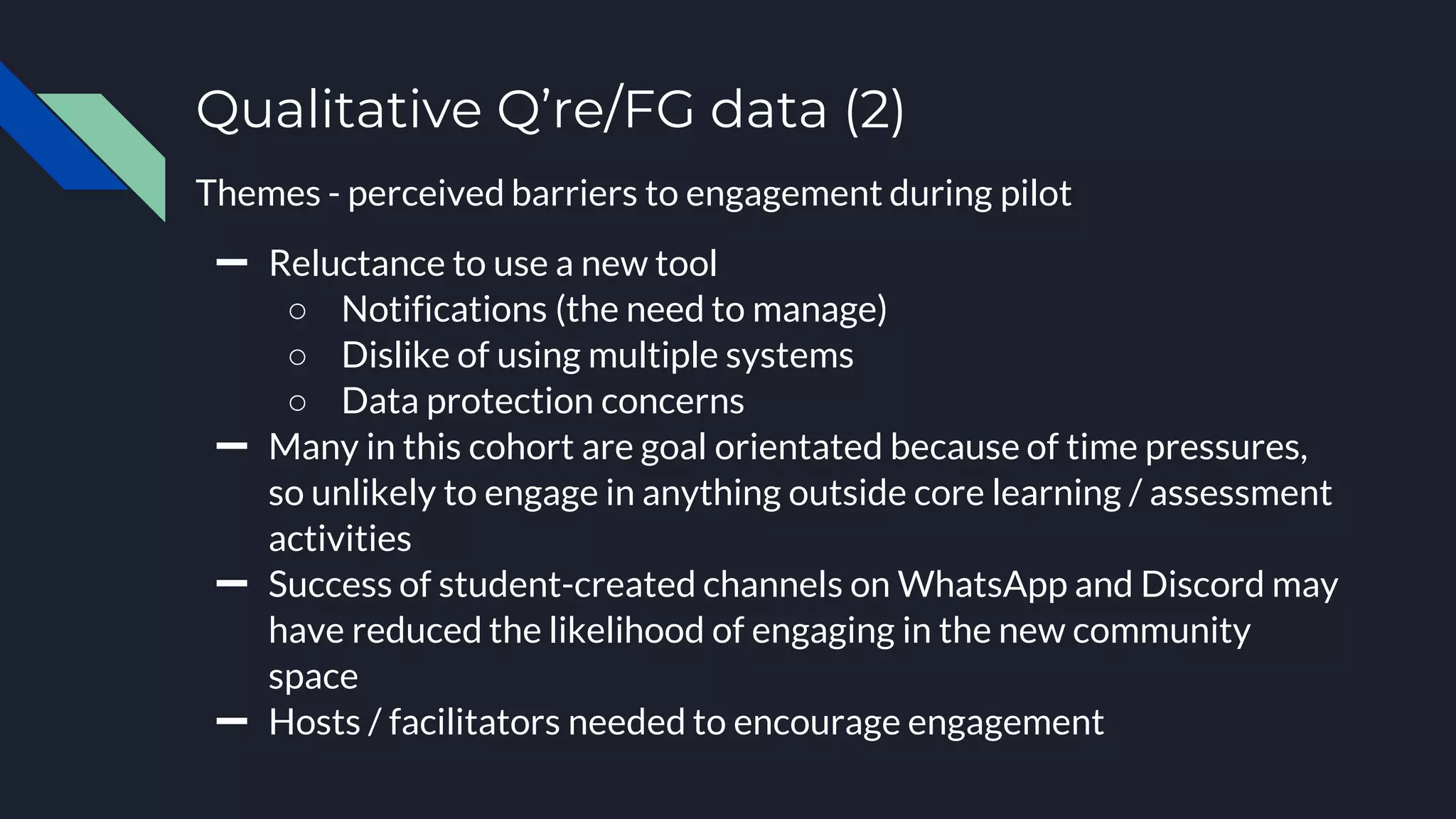
Qualitative Q’re/FG data (2)
Themes - perceived barriers to engagement during pilot
➖ Reluctance to use a new tool
○ Notifications (the need to manage)
○ Dislike of using multiple systems
○ Data protection concerns
➖ Many in this cohort are goal orientated because of time pressures,
so unlikely to engage in anything outside core learning / assessment
activities
➖ Success of student-created channels on WhatsApp and Discord may
have reduced the likelihood of engaging in the new community
space
➖ Hosts / facilitators needed to encourage engagement
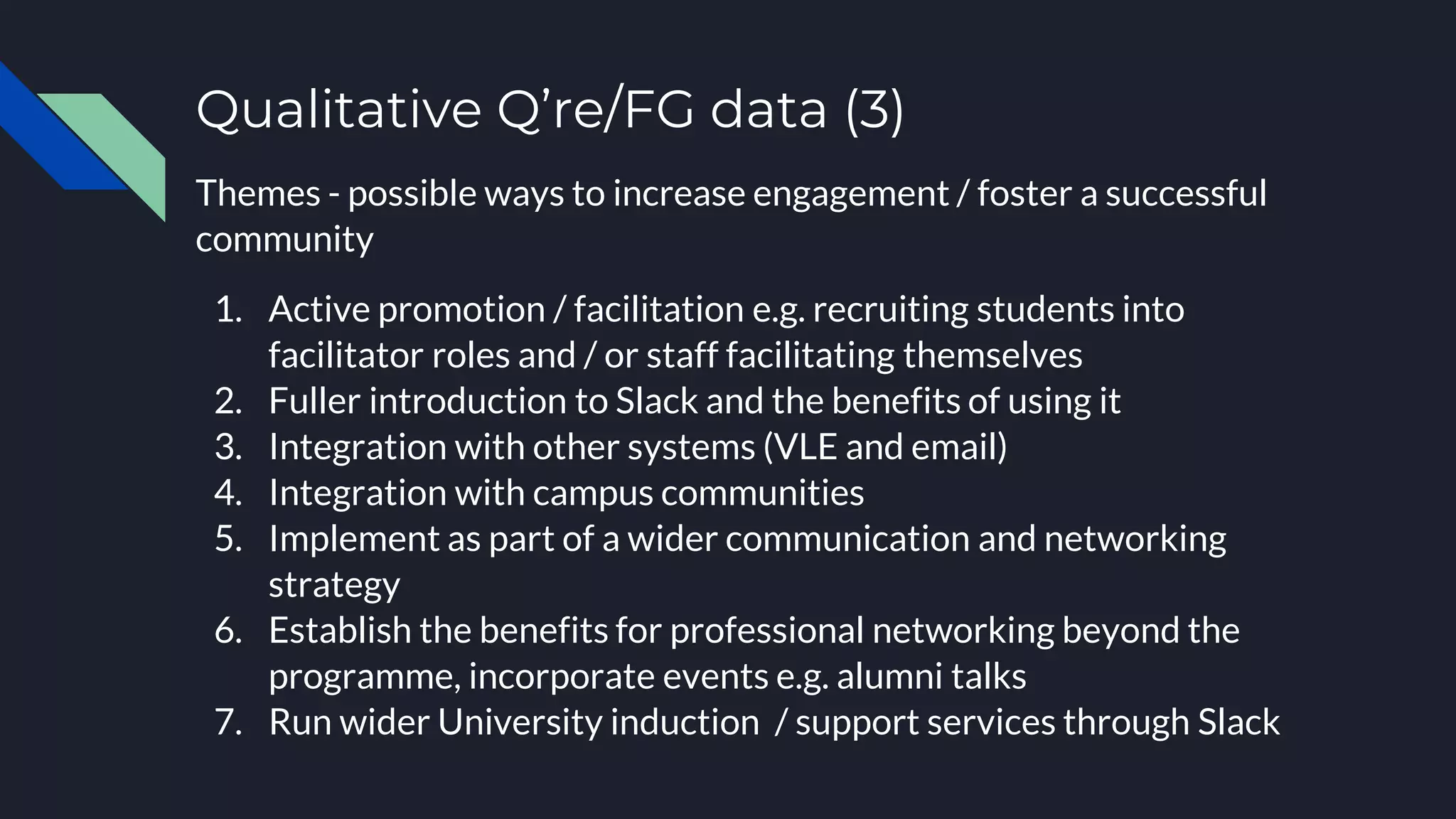
Qualitative Q’re/FG data (3)
Themes - possible ways to increase engagement / foster a successful
community
1. Active promotion / facilitation e.g. recruiting students into
facilitator roles and / or staff facilitating themselves
2. Fuller introduction to Slack and the benefits of using it
3. Integration with other systems (VLE and email)
4. Integration with campus communities
5. Implement as part of a wider communication and networking
strategy
6. Establish the benefits for professional networking beyond the
programme, incorporate events e.g. alumni talks
7. Run wider University induction / support services through Slack
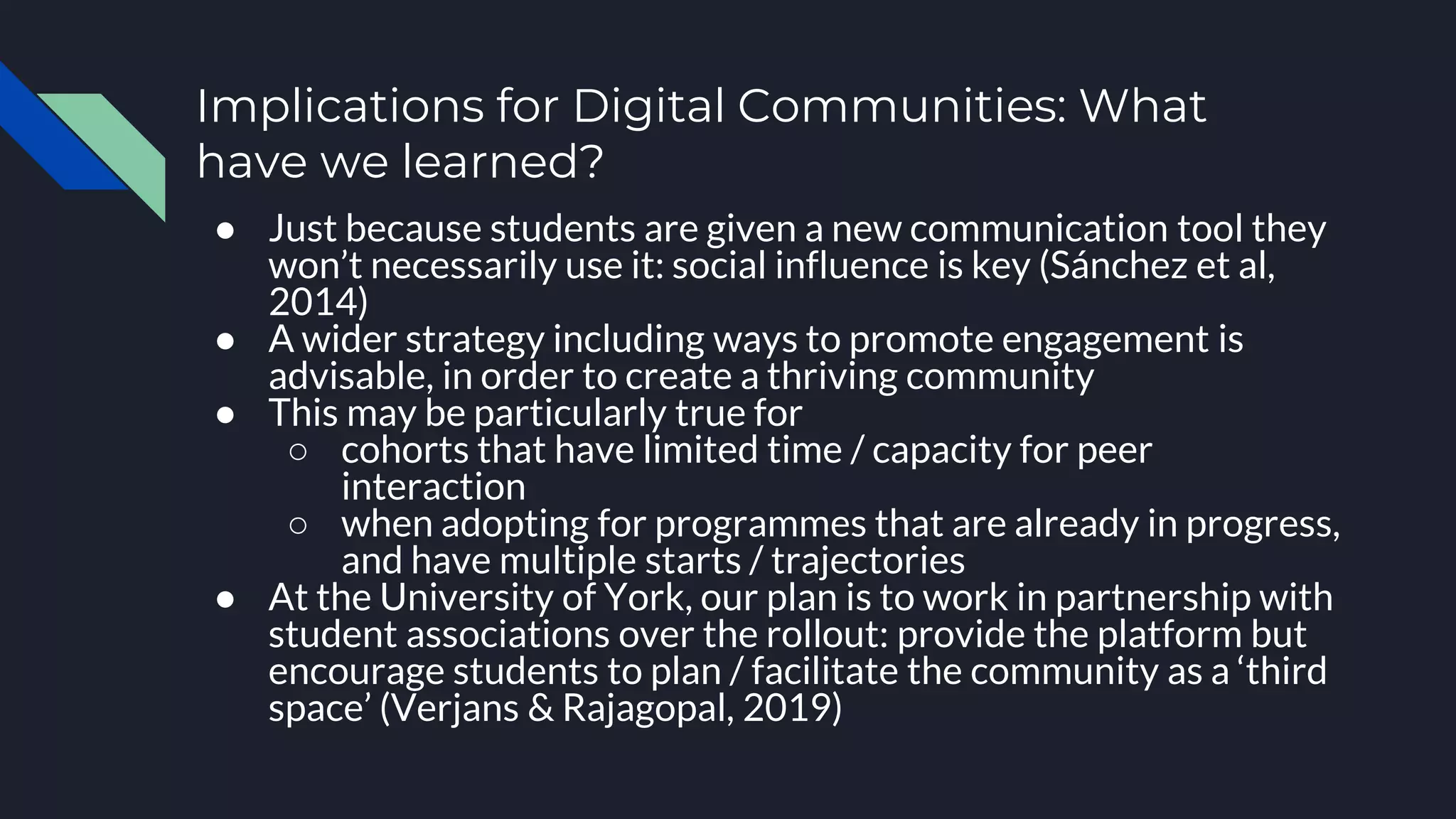
Implications for Digital Communities: What
have we learned?
● Just because students are given a new communication tool they
won’t necessarily use it: social influence is key (Sánchez et al,
2014)
● A wider strategy including ways to promote engagement is
advisable, in order to create a thriving community
● This may be particularly true for
○ cohorts that have limited time / capacity for peer
interaction
○ when adopting for programmes that are already in progress,
and have multiple starts / trajectories
● At the University of York, our plan is to work in partnership with
student associations over the rollout: provide the platform but
encourage students to plan / facilitate the community as a ‘third
space’ (Verjans & Rajagopal, 2019)
References
Bayne, S. & Gallagher, M. (2020). 'Anticipating the near future of teaching'. Twelfth International Conference on
Networked Learning, Denmark.
Bills, O. (2021). Taking the university community virtual with Discord: A Success Story. University of Kent,
Digitally Enhanced Education Webinar Series.
De Wilde, J. (2019). Creating online postgraduate communities of practice: between pedagogy and practice.
UKCGE Workshop, London.
Garrison, D. R. & Anderson, T. (2003). E-Learning in the 21st century: a framework for research and practice.
London: Routledge.
Haythornthwaite, C. (2006). Learning and knowledge networks in interdisciplinary collaborations. Journal of
the American Society for Information Science and Technology, 57(8), 1079-1092.
Lave, J., & Wenger, E. (1991). Situated learning: Legitimate peripheral participation. Cambridge university
press.
Rapanta, C., Botturi, L., Goodyear, P. et al. (2020). Online University Teaching During and After the Covid-19
Crisis: Refocusing Teacher Presence and Learning Activity. Postdigital Science and Education, 2, 923–945.
References (continued)
Sánchez, R. A, Cortijo, V. & Javed, U. (2014). Students' perceptions of Facebook for academic purposes.
Computers & Education, Volume 70, 138-149.
Shaw, R. (2021). Academic Community Building. What have we learned from the Coronavirus Pandemic and
What Next? Blog post (29 Jan 2021).
THE Campus Weekly (2021). ‘Supporting student well-being from afar. Advice on supporting student well-
being through your online teaching practices’. THE Campus Weekly, Friday 21st May.
Verjans, S. & Rajagopal, K. (2019). Seeking support, seeking challenges or something else? The case of a
student-driven ecosystem of Facebook groups as ‘third space’ at a distance learning university. ALT-C 2019.
Walker, R., Chong, S., & Chong, J. (2021). Facilitating peer-led group research through virtual collaboration
spaces: an exploratory research study. Research in Learning Technology, 29.
Walker, R. & Page, N. (2020). Defining a digital future for teaching, learning and assessment: what do our
students want? Blog post (30 Sept. 2020).
Questions and contact details
Thanks for listening. Do you have any questions or comments?
Contact details
Richard Walker - richard.walker@york.ac.uk
@RichardM_Walker
Nathan Page - n.page@york.ac.uk

Building community through Slack: a student-owned digital space for connectivity and collaboration

  • 1.
    Building community through Slack:a student- owned digital space for connectivity and collaboration Dr Richard Walker Dr Nathan Page Programme Design and Learning Technology Team University of York
  • 2.
    Background and Context DigitalCommunities - Important for the future of HE (Bayne and Gallagher, 2020; Walker and Page, 2020) - Socialisation is known to be a key element to online learning (Garrison and Anderson, 2003) Our context - Needed to create programme-level digital communities, particularly for fully online programmes that launched in 2018 - Pandemic accelerated the need for digital communities for all (Rapanta et al, 2020; Shaw, 2021)
  • 3.
    Why have aDigital Community? Literature on digital communities - For fostering learning communities (Lave and Wenger, 1991; De Wilde, 2019) - To allow interdisciplinarity and networking (Haythornthwaite, 2006; Bayne and Gallagher, 2020) Intuitively, we know that... - A socialisation space can enhance learning, e.g. ‘café conversations’ - There are affective / emotional / motivational benefits to feeling connected and part of a community (THE Campus Weekly, 2021)
  • 4.
    Slack Advantages of usingSlack - Successfully used by staff for home working, including cross-team collaborations, and when trialled with students for teaching and learning (Walker et al, 2021) - Affordances of the tool include: - Participants can set up distinct channels for their own purposes (e.g. for questioning, ideas sharing) - Push notifications to support agile problem solving / sharing of info - Useful for synchronous and asynchronous messaging HE sector use of tools for digital community - Some institutions use VLE discussion boards, others use dedicated communication tools e.g. MS Teams or Discord (Bills, 2021)
  • 5.
    Our Pilot andits Evaluation Pilot - Phase 1: approx 30 students given Slack (May - July 2021) - Phase 2: approx 400 students added to the main channel, and a channel for their module in the next term (July - Sept. 2021) - ‘Light touch’ implementation, in consultation with student reps, inc. offering usage guides, messaging around positive community building, rules of engagement / netiquette Evaluation - Usage data inc. quantitative check on number of posts/threads - Questionnaire (n=16) - Focus group (n=4)
  • 6.
    Usage TOTALS: 104 27 Numberof distinct users: 25 (approx 6% of possible users) Types of interaction - Asking questions about learning content / assessments / course - General social interaction - Starting a study group in WhatsApp Posts/replies/reactions Threads Main channel: 47 12 Module channels: 57 15
  • 7.
    Quantitative Questionnaire data(1) Q: Is it a good idea for the university to provide a digital community space for students (outside individual modules)?
  • 8.
    Quantitative Questionnaire data(2) Q: Which option do you think is best for continuing a digital community?
  • 9.
    Qualitative Q’re/FG data(1) Themes - perceived usefulness of the community in its pilot form ➕ Good for creating connections with other members of the programme ➖ Would be useful, but needs greater activity / interaction between students
  • 10.
    Qualitative Q’re/FG data(2) Themes - perceived barriers to engagement during pilot ➖ Reluctance to use a new tool ○ Notifications (the need to manage) ○ Dislike of using multiple systems ○ Data protection concerns ➖ Many in this cohort are goal orientated because of time pressures, so unlikely to engage in anything outside core learning / assessment activities ➖ Success of student-created channels on WhatsApp and Discord may have reduced the likelihood of engaging in the new community space ➖ Hosts / facilitators needed to encourage engagement
  • 11.
    Qualitative Q’re/FG data(3) Themes - possible ways to increase engagement / foster a successful community 1. Active promotion / facilitation e.g. recruiting students into facilitator roles and / or staff facilitating themselves 2. Fuller introduction to Slack and the benefits of using it 3. Integration with other systems (VLE and email) 4. Integration with campus communities 5. Implement as part of a wider communication and networking strategy 6. Establish the benefits for professional networking beyond the programme, incorporate events e.g. alumni talks 7. Run wider University induction / support services through Slack
  • 12.
    Implications for DigitalCommunities: What have we learned? ● Just because students are given a new communication tool they won’t necessarily use it: social influence is key (Sánchez et al, 2014) ● A wider strategy including ways to promote engagement is advisable, in order to create a thriving community ● This may be particularly true for ○ cohorts that have limited time / capacity for peer interaction ○ when adopting for programmes that are already in progress, and have multiple starts / trajectories ● At the University of York, our plan is to work in partnership with student associations over the rollout: provide the platform but encourage students to plan / facilitate the community as a ‘third space’ (Verjans & Rajagopal, 2019)
  • 13.
    References Bayne, S. &Gallagher, M. (2020). 'Anticipating the near future of teaching'. Twelfth International Conference on Networked Learning, Denmark. Bills, O. (2021). Taking the university community virtual with Discord: A Success Story. University of Kent, Digitally Enhanced Education Webinar Series. De Wilde, J. (2019). Creating online postgraduate communities of practice: between pedagogy and practice. UKCGE Workshop, London. Garrison, D. R. & Anderson, T. (2003). E-Learning in the 21st century: a framework for research and practice. London: Routledge. Haythornthwaite, C. (2006). Learning and knowledge networks in interdisciplinary collaborations. Journal of the American Society for Information Science and Technology, 57(8), 1079-1092. Lave, J., & Wenger, E. (1991). Situated learning: Legitimate peripheral participation. Cambridge university press. Rapanta, C., Botturi, L., Goodyear, P. et al. (2020). Online University Teaching During and After the Covid-19 Crisis: Refocusing Teacher Presence and Learning Activity. Postdigital Science and Education, 2, 923–945.
  • 14.
    References (continued) Sánchez, R.A, Cortijo, V. & Javed, U. (2014). Students' perceptions of Facebook for academic purposes. Computers & Education, Volume 70, 138-149. Shaw, R. (2021). Academic Community Building. What have we learned from the Coronavirus Pandemic and What Next? Blog post (29 Jan 2021). THE Campus Weekly (2021). ‘Supporting student well-being from afar. Advice on supporting student well- being through your online teaching practices’. THE Campus Weekly, Friday 21st May. Verjans, S. & Rajagopal, K. (2019). Seeking support, seeking challenges or something else? The case of a student-driven ecosystem of Facebook groups as ‘third space’ at a distance learning university. ALT-C 2019. Walker, R., Chong, S., & Chong, J. (2021). Facilitating peer-led group research through virtual collaboration spaces: an exploratory research study. Research in Learning Technology, 29. Walker, R. & Page, N. (2020). Defining a digital future for teaching, learning and assessment: what do our students want? Blog post (30 Sept. 2020).
  • 15.
    Questions and contactdetails Thanks for listening. Do you have any questions or comments? Contact details Richard Walker - richard.walker@york.ac.uk @RichardM_Walker Nathan Page - n.page@york.ac.uk

Editor's Notes

  • #5 Mention: roll outs to students (PGT) are now in process for the new academic year, and that we are in contact with ASU who use Slack widely for University services and digital community
  • #6 Mention: small sample size
  • #7 Mention: Low numbers - done with very little push Platform acted as a jumping off point to another channel - not seen as a negative, although would they have gone off platform if given extra introduction to Slack as a tool?
  • #8 Replace graphic Mention: re-state small sample size, so need to be cautious with the data
  • #9 Replace graphic Mention: re-state small sample size, so need to be cautious with the data
  • #12 Mention: On campus communities point - department and central services, wider University and interdisciplinary, students On comms/networking point - reference Uni strategy on community, GSA to have control on rules of engagement Also - If it’s going to be student-led, that would need a framework On prof networking/alumni point - mention that ASU are looking into this for their students At end: emphasise that many of these points refer to adding potential value to engagement with the platform/community channels
  • #13 Mention: On multiple starts/trajectories point - emphasise the opportunity to reduced isolated/fragmented studies via a successful digital community At end - We don’t expect to have everything covered, however the pilot and being hooked into sector knowledge sharing communities (e.g. ASU connection) have helped us to prepare and we expect to learn a lot more after roll-out to students