EDUCATION IN CHINA
A SNAPSHOT
Yuanyuan PAN
(20/02/2017)
Outline
• Background information
• Organisation and management of education
• Educational reforms and current issues
• Participating regions in PISA 2015
2
Background Information
on China’s Administrative System
3
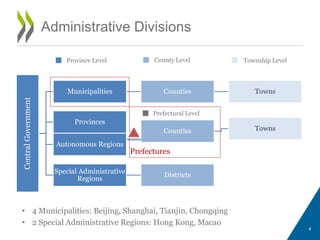
Administrative DivisionsCentralGovernment
Municipalities Counties Towns
Provinces
Counties Towns
Autonomous Regions
Special Administrative
Regions
Districts
4
• 4 Municipalities: Beijing, Shanghai, Tianjin, Chongqing
• 2 Special Administrative Regions: Hong Kong, Macao
Province Level County Level Township Level
Prefectures
Prefectural Level
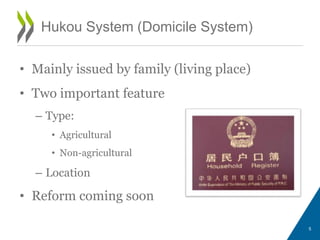
Hukou System (Domicile System)
• Mainly issued by family (living place)
• Two important feature
– Type:
• Agricultural
• Non-agricultural
– Location
• Reform coming soon
5
Organisation and Management
of Education in China
6
Schooling Development
Ministry of Education
Managing Development
Policies and Reforms
Educational Finance
Teacher
Student
Curriculum
7
8
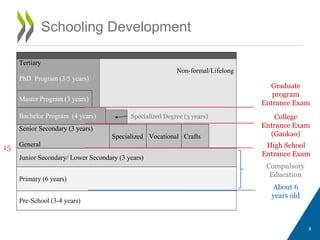
Schooling Development
Tertiary
PhD. Program (3/5 years)
Non-formal/Lifelong
Master Program (3 years)
Bachelor Program (4 years)
Senior Secondary (3 years)
General
Specialized Vocational Crafts
Junior Secondary/ Lower Secondary (3 years)
Primary (6 years)
Pre-School (3-4 years)
About 6
years old
High School
Entrance Exam
Graduate
program
Entrance Exam
Compulsory
Education
College
Entrance Exam
(Gaokao)
Specialized Degree (3 years)
15
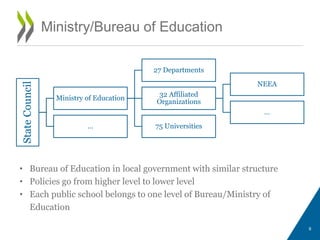
Ministry/Bureau of EducationStateCouncil
Ministry of Education
27 Departments
32 Affiliated
Organizations
NEEA
…
75 Universities…
9
• Bureau of Education in local government with similar structure
• Policies go from higher level to lower level
• Each public school belongs to one level of Bureau/Ministry of
Education
Managing the Development of Education
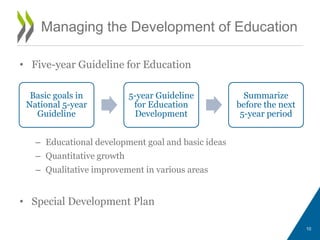
• Five-year Guideline for Education
– Educational development goal and basic ideas
– Quantitative growth
– Qualitative improvement in various areas
• Special Development Plan
10
Basic goals in
National 5-year
Guideline
5-year Guideline
for Education
Development
Summarize
before the next
5-year period
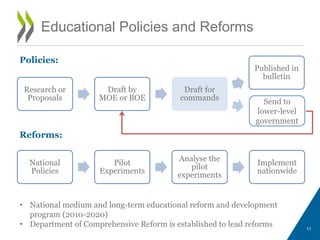
National
Policies
Pilot
Experiments
Analyse the
pilot
experiments
Implement
nationwide
Educational Policies and Reforms
Research or
Proposals
Draft by
MOE or BOE
Draft for
commands
Published in
bulletin
11
Send to
lower-level
government
Policies:
Reforms:
• National medium and long-term educational reform and development
program (2010-2020)
• Department of Comprehensive Reform is established to lead reforms
Educational Finance
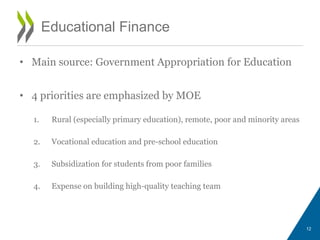
• Main source: Government Appropriation for Education
• 4 priorities are emphasized by MOE
1. Rural (especially primary education), remote, poor and minority areas
2. Vocational education and pre-school education
3. Subsidization for students from poor families
4. Expense on building high-quality teaching team
12
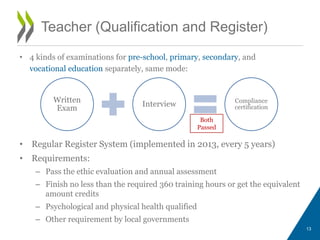
Teacher (Qualification and Register)
Written
Exam
Interview Compliance
certification
13
• 4 kinds of examinations for pre-school, primary, secondary, and
vocational education separately, same mode:
Both
Passed
• Regular Register System (implemented in 2013, every 5 years)
• Requirements:
– Pass the ethic evaluation and annual assessment
– Finish no less than the required 360 training hours or get the equivalent
amount credits
– Psychological and physical health qualified
– Other requirement by local governments
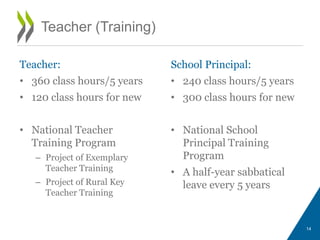
Teacher (Training)
Teacher:
• 360 class hours/5 years
• 120 class hours for new
• National Teacher
Training Program
– Project of Exemplary
Teacher Training
– Project of Rural Key
Teacher Training
14
School Principal:
• 240 class hours/5 years
• 300 class hours for new
• National School
Principal Training
Program
• A half-year sabbatical
leave every 5 years
Teacher (Training)
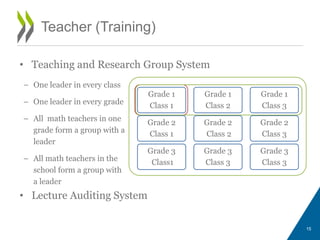
• Teaching and Research Group System
• Lecture Auditing System
15
Grade 1
Class 1
Grade 2
Class 1
Grade 3
Class1
Grade 1
Class 2
Grade 2
Class 2
Grade 3
Class 3
Grade 1
Class 3
Grade 2
Class 3
Grade 3
Class 3
– One leader in every class
– One leader in every grade
– All math teachers in one
grade form a group with a
leader
– All math teachers in the
school form a group with
a leader
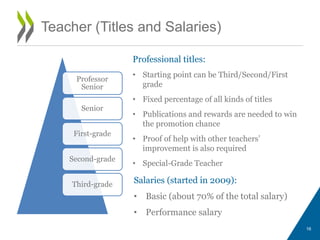
Teacher (Titles and Salaries)
Professor
Senior
Senior
First-grade
Second-grade
Third-grade
16
Professional titles:
• Starting point can be Third/Second/First
grade
• Fixed percentage of all kinds of titles
• Publications and rewards are needed to win
the promotion chance
• Proof of help with other teachers’
improvement is also required
• Special-Grade Teacher
Salaries (started in 2009):
• Basic (about 70% of the total salary)
• Performance salary
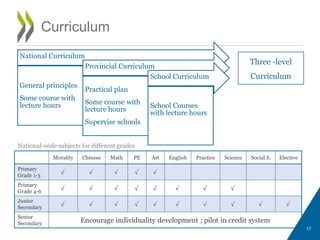
Curriculum
17
National Curriculum
General principles
Some course with
lecture hours
Provincial Curriculum
Practical plan
Some course with
lecture hours
Supervise schools
School Curriculum
School Courses
with lecture hours
Three -level
Curriculum
Morality Chinese Math PE Art English Practice Science Social S. Elective
Primary
Grade 1-3
√ √ √ √ √
Primary
Grade 4-6
√ √ √ √ √ √ √ √
Junior
Secondary
√ √ √ √ √ √ √ √ √ √
Senior
Secondary Encourage individuality development ; pilot in credit system
National-wide subjects for different grades
Educational Reforms and
Current Issues
18
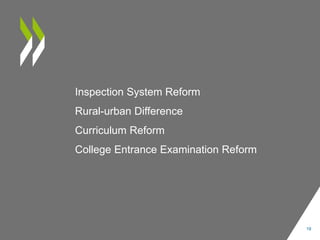
Inspection System Reform
Rural-urban Difference
Curriculum Reform
College Entrance Examination Reform
19
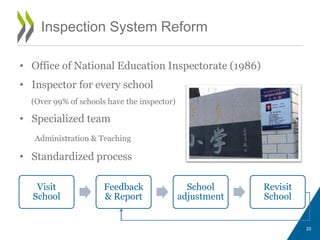
Inspection System Reform
• Office of National Education Inspectorate (1986)
• Inspector for every school
(Over 99% of schools have the inspector)
• Specialized team
Administration & Teaching
• Standardized process
20
Visit
School
Feedback
& Report
School
adjustment
Revisit
School
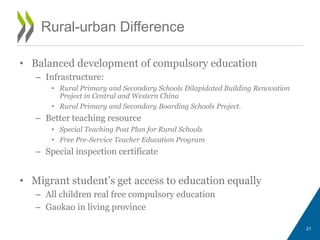
Rural-urban Difference
• Balanced development of compulsory education
– Infrastructure:
• Rural Primary and Secondary Schools Dilapidated Building Renovation
Project in Central and Western China
• Rural Primary and Secondary Boarding Schools Project.
– Better teaching resource
• Special Teaching Post Plan for Rural Schools
• Free Pre-Service Teacher Education Program
– Special inspection certificate
• Migrant student’s get access to education equally
– All children real free compulsory education
– Gaokao in living province
21
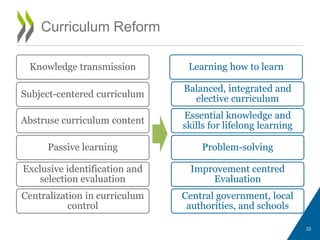
Curriculum Reform
22
Knowledge transmission
Subject-centered curriculum
Abstruse curriculum content
Passive learning
Exclusive identification and
selection evaluation
Centralization in curriculum
control
Learning how to learn
Balanced, integrated and
elective curriculum
Essential knowledge and
skills for lifelong learning
Problem-solving
Improvement centred
Evaluation
Central government, local
authorities, and schools
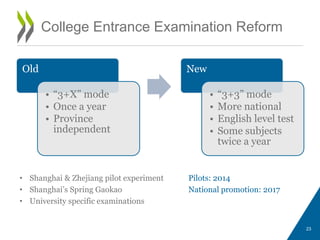
College Entrance Examination Reform
23
Old
• “3+X” mode
• Once a year
• Province
independent
New
• “3+3” mode
• More national
• English level test
• Some subjects
twice a year
• Shanghai & Zhejiang pilot experiment
• Shanghai’s Spring Gaokao
• University specific examinations
Pilots: 2014
National promotion: 2017
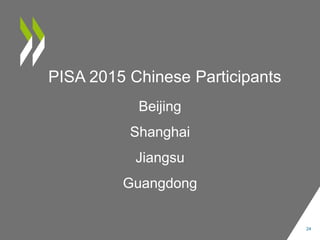
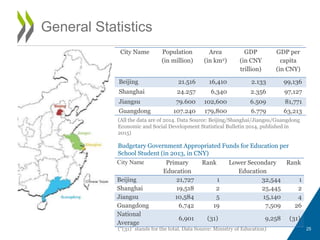
PISA 2015 Chinese Participants
24
Beijing
Shanghai
Jiangsu
Guangdong
General Statistics
25
City Name Population
(in million)
Area
(in km2)
GDP
(in CNY
trillion)
GDP per
capita
(in CNY)
Beijing 21.516 16,410 2.133 99,136
Shanghai 24.257 6,340 2.356 97,127
Jiangsu 79.600 102,600 6.509 81,771
Guangdong 107.240 179,800 6.779 63,213
City Name Primary
Education
Rank Lower Secondary
Education
Rank
Beijing 21,727 1 32,544 1
Shanghai 19,518 2 25,445 2
Jiangsu 10,584 5 15,140 4
Guangdong 6,742 19 7,509 26
National
Average
6,901 (31) 9,258 (31)
Budgetary Government Appropriated Funds for Education per
School Student (in 2013, in CNY)
(“(31)” stands for the total. Data Source: Ministry of Education)
(All the data are of 2014. Data Source: Beijing/Shanghai/Jiangsu/Guangdong
Economic and Social Development Statistical Bulletin 2014, published in
2015)
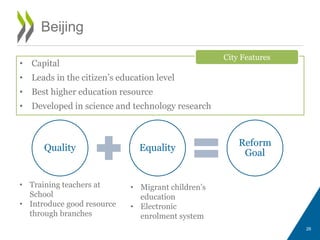
Beijing
• Capital
• Leads in the citizen’s education level
• Best higher education resource
• Developed in science and technology research
26
Quality Equality
Reform
Goal
• Training teachers at
School
• Introduce good resource
through branches
• Migrant children’s
education
• Electronic
enrolment system
City Features
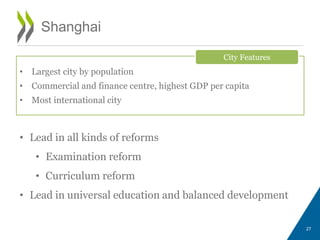
Shanghai
27
• Largest city by population
• Commercial and finance centre, highest GDP per capita
• Most international city
City Features
• Lead in all kinds of reforms
• Examination reform
• Curriculum reform
• Lead in universal education and balanced development
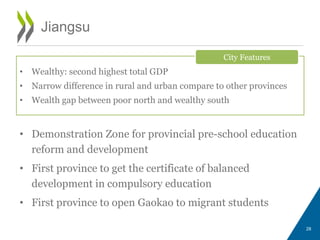
• Demonstration Zone for provincial pre-school education
reform and development
• First province to get the certificate of balanced
development in compulsory education
• First province to open Gaokao to migrant students
28
Jiangsu
• Wealthy: second highest total GDP
• Narrow difference in rural and urban compare to other provinces
• Wealth gap between poor north and wealthy south
City Features
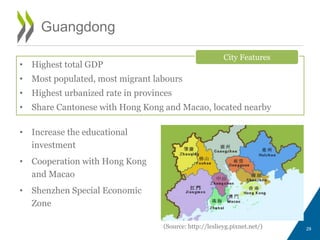
• Increase the educational
investment
• Cooperation with Hong Kong
and Macao
• Shenzhen Special Economic
Zone
29
Guangdong
• Highest total GDP
• Most populated, most migrant labours
• Highest urbanized rate in provinces
• Share Cantonese with Hong Kong and Macao, located nearby
City Features
(Source: http://leslieyg.pixnet.net/)
Personal Summary
• Independent among province-level divisions, different
but also similar
• Large regional difference
– West and East
– Big city and other areas
• Always on reform
• Cultural influence:
– Outstanding in education = brilliant future
– Good at math = clever; Social science are lower than STEM
30
Thank You!
Q&A
31
Email: panyuanyuan.chn@gmail.com

Education in China - a Snapshot

  • 1.
    EDUCATION IN CHINA ASNAPSHOT Yuanyuan PAN (20/02/2017)
  • 2.
    Outline • Background information •Organisation and management of education • Educational reforms and current issues • Participating regions in PISA 2015 2
  • 3.
    Background Information on China’sAdministrative System 3
  • 4.
    Administrative DivisionsCentralGovernment Municipalities CountiesTowns Provinces Counties Towns Autonomous Regions Special Administrative Regions Districts 4 • 4 Municipalities: Beijing, Shanghai, Tianjin, Chongqing • 2 Special Administrative Regions: Hong Kong, Macao Province Level County Level Township Level Prefectures Prefectural Level
  • 5.
    Hukou System (DomicileSystem) • Mainly issued by family (living place) • Two important feature – Type: • Agricultural • Non-agricultural – Location • Reform coming soon 5
  • 6.
    Organisation and Management ofEducation in China 6
  • 7.
    Schooling Development Ministry ofEducation Managing Development Policies and Reforms Educational Finance Teacher Student Curriculum 7
  • 8.
    8 Schooling Development Tertiary PhD. Program(3/5 years) Non-formal/Lifelong Master Program (3 years) Bachelor Program (4 years) Senior Secondary (3 years) General Specialized Vocational Crafts Junior Secondary/ Lower Secondary (3 years) Primary (6 years) Pre-School (3-4 years) About 6 years old High School Entrance Exam Graduate program Entrance Exam Compulsory Education College Entrance Exam (Gaokao) Specialized Degree (3 years) 15
  • 9.
    Ministry/Bureau of EducationStateCouncil Ministryof Education 27 Departments 32 Affiliated Organizations NEEA … 75 Universities… 9 • Bureau of Education in local government with similar structure • Policies go from higher level to lower level • Each public school belongs to one level of Bureau/Ministry of Education
  • 10.
    Managing the Developmentof Education • Five-year Guideline for Education – Educational development goal and basic ideas – Quantitative growth – Qualitative improvement in various areas • Special Development Plan 10 Basic goals in National 5-year Guideline 5-year Guideline for Education Development Summarize before the next 5-year period
  • 11.
    National Policies Pilot Experiments Analyse the pilot experiments Implement nationwide Educational Policiesand Reforms Research or Proposals Draft by MOE or BOE Draft for commands Published in bulletin 11 Send to lower-level government Policies: Reforms: • National medium and long-term educational reform and development program (2010-2020) • Department of Comprehensive Reform is established to lead reforms
  • 12.
    Educational Finance • Mainsource: Government Appropriation for Education • 4 priorities are emphasized by MOE 1. Rural (especially primary education), remote, poor and minority areas 2. Vocational education and pre-school education 3. Subsidization for students from poor families 4. Expense on building high-quality teaching team 12
  • 13.
    Teacher (Qualification andRegister) Written Exam Interview Compliance certification 13 • 4 kinds of examinations for pre-school, primary, secondary, and vocational education separately, same mode: Both Passed • Regular Register System (implemented in 2013, every 5 years) • Requirements: – Pass the ethic evaluation and annual assessment – Finish no less than the required 360 training hours or get the equivalent amount credits – Psychological and physical health qualified – Other requirement by local governments
  • 14.
    Teacher (Training) Teacher: • 360class hours/5 years • 120 class hours for new • National Teacher Training Program – Project of Exemplary Teacher Training – Project of Rural Key Teacher Training 14 School Principal: • 240 class hours/5 years • 300 class hours for new • National School Principal Training Program • A half-year sabbatical leave every 5 years
  • 15.
    Teacher (Training) • Teachingand Research Group System • Lecture Auditing System 15 Grade 1 Class 1 Grade 2 Class 1 Grade 3 Class1 Grade 1 Class 2 Grade 2 Class 2 Grade 3 Class 3 Grade 1 Class 3 Grade 2 Class 3 Grade 3 Class 3 – One leader in every class – One leader in every grade – All math teachers in one grade form a group with a leader – All math teachers in the school form a group with a leader
  • 16.
    Teacher (Titles andSalaries) Professor Senior Senior First-grade Second-grade Third-grade 16 Professional titles: • Starting point can be Third/Second/First grade • Fixed percentage of all kinds of titles • Publications and rewards are needed to win the promotion chance • Proof of help with other teachers’ improvement is also required • Special-Grade Teacher Salaries (started in 2009): • Basic (about 70% of the total salary) • Performance salary
  • 17.
    Curriculum 17 National Curriculum General principles Somecourse with lecture hours Provincial Curriculum Practical plan Some course with lecture hours Supervise schools School Curriculum School Courses with lecture hours Three -level Curriculum Morality Chinese Math PE Art English Practice Science Social S. Elective Primary Grade 1-3 √ √ √ √ √ Primary Grade 4-6 √ √ √ √ √ √ √ √ Junior Secondary √ √ √ √ √ √ √ √ √ √ Senior Secondary Encourage individuality development ; pilot in credit system National-wide subjects for different grades
  • 18.
  • 19.
    Inspection System Reform Rural-urbanDifference Curriculum Reform College Entrance Examination Reform 19
  • 20.
    Inspection System Reform •Office of National Education Inspectorate (1986) • Inspector for every school (Over 99% of schools have the inspector) • Specialized team Administration & Teaching • Standardized process 20 Visit School Feedback & Report School adjustment Revisit School
  • 21.
    Rural-urban Difference • Balanceddevelopment of compulsory education – Infrastructure: • Rural Primary and Secondary Schools Dilapidated Building Renovation Project in Central and Western China • Rural Primary and Secondary Boarding Schools Project. – Better teaching resource • Special Teaching Post Plan for Rural Schools • Free Pre-Service Teacher Education Program – Special inspection certificate • Migrant student’s get access to education equally – All children real free compulsory education – Gaokao in living province 21
  • 22.
    Curriculum Reform 22 Knowledge transmission Subject-centeredcurriculum Abstruse curriculum content Passive learning Exclusive identification and selection evaluation Centralization in curriculum control Learning how to learn Balanced, integrated and elective curriculum Essential knowledge and skills for lifelong learning Problem-solving Improvement centred Evaluation Central government, local authorities, and schools
  • 23.
    College Entrance ExaminationReform 23 Old • “3+X” mode • Once a year • Province independent New • “3+3” mode • More national • English level test • Some subjects twice a year • Shanghai & Zhejiang pilot experiment • Shanghai’s Spring Gaokao • University specific examinations Pilots: 2014 National promotion: 2017
  • 24.
    PISA 2015 ChineseParticipants 24 Beijing Shanghai Jiangsu Guangdong
  • 25.
    General Statistics 25 City NamePopulation (in million) Area (in km2) GDP (in CNY trillion) GDP per capita (in CNY) Beijing 21.516 16,410 2.133 99,136 Shanghai 24.257 6,340 2.356 97,127 Jiangsu 79.600 102,600 6.509 81,771 Guangdong 107.240 179,800 6.779 63,213 City Name Primary Education Rank Lower Secondary Education Rank Beijing 21,727 1 32,544 1 Shanghai 19,518 2 25,445 2 Jiangsu 10,584 5 15,140 4 Guangdong 6,742 19 7,509 26 National Average 6,901 (31) 9,258 (31) Budgetary Government Appropriated Funds for Education per School Student (in 2013, in CNY) (“(31)” stands for the total. Data Source: Ministry of Education) (All the data are of 2014. Data Source: Beijing/Shanghai/Jiangsu/Guangdong Economic and Social Development Statistical Bulletin 2014, published in 2015)
  • 26.
    Beijing • Capital • Leadsin the citizen’s education level • Best higher education resource • Developed in science and technology research 26 Quality Equality Reform Goal • Training teachers at School • Introduce good resource through branches • Migrant children’s education • Electronic enrolment system City Features
  • 27.
    Shanghai 27 • Largest cityby population • Commercial and finance centre, highest GDP per capita • Most international city City Features • Lead in all kinds of reforms • Examination reform • Curriculum reform • Lead in universal education and balanced development
  • 28.
    • Demonstration Zonefor provincial pre-school education reform and development • First province to get the certificate of balanced development in compulsory education • First province to open Gaokao to migrant students 28 Jiangsu • Wealthy: second highest total GDP • Narrow difference in rural and urban compare to other provinces • Wealth gap between poor north and wealthy south City Features
  • 29.
    • Increase theeducational investment • Cooperation with Hong Kong and Macao • Shenzhen Special Economic Zone 29 Guangdong • Highest total GDP • Most populated, most migrant labours • Highest urbanized rate in provinces • Share Cantonese with Hong Kong and Macao, located nearby City Features (Source: http://leslieyg.pixnet.net/)
  • 30.
    Personal Summary • Independentamong province-level divisions, different but also similar • Large regional difference – West and East – Big city and other areas • Always on reform • Cultural influence: – Outstanding in education = brilliant future – Good at math = clever; Social science are lower than STEM 30
  • 31.