Recording Techniques Ways of Documenting Observations
Anecdotal Records
Anecdotal Records “ An  anecdotal record  is "a written record kept in a positive tone of a child's progress based on milestones particular to that child's social, emotional, physical, aesthetic, and cognitive development," notes the American Association of School Administrators (1992, p. 21).” http://home.gwu.edu/~anniehp/portfolio/Anecdotal_Records.htm
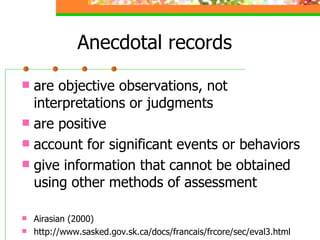
Anecdotal records are objective observations, not interpretations or judgments are positive account for significant events or behaviors  give information that cannot be obtained using other methods of assessment Airasian (2000) http://www.sasked.gov.sk.ca/docs/francais/frcore/sec/eval3.html
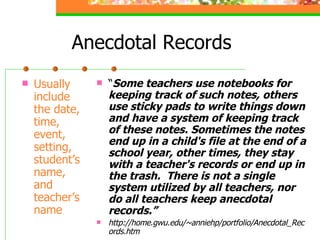
Anecdotal Records  Usually include the date, time, event, setting, student’s name, and teacher’s name “ Some teachers use notebooks for keeping track of such notes, others use sticky pads to write things down and have a system of keeping track of these notes. Sometimes the notes end up in a child's file at the end of a school year, other times, they stay with a teacher's records or end up in the trash.  There is not a single system utilized by all teachers, nor do all teachers keep anecdotal records.” http://home.gwu.edu/~anniehp/portfolio/Anecdotal_Records.htm
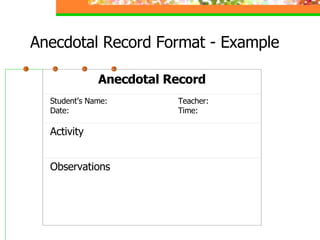
Anecdotal Record Format - Example Anecdotal Record Student’s Name:   Teacher: Date: Time: Activity     Observations              
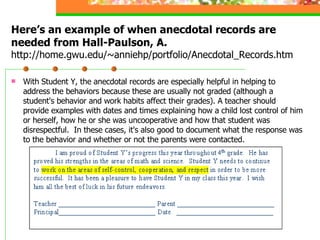
Here’s an example of when anecdotal records are needed from Hall-Paulson, A.  http://home.gwu.edu/~anniehp/portfolio/Anecdotal_Records.htm With Student Y, the anecdotal records are especially helpful in helping to address the behaviors because these are usually not graded (although a student's behavior and work habits affect their grades). A teacher should provide examples with dates and times explaining how a child lost control of him or herself, how he or she was uncooperative and how that student was disrespectful.  In these cases, it's also good to document what the response was to the behavior and whether or not the parents were contacted. 
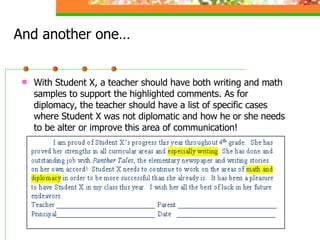
And another one… With Student X, a teacher should have both writing and math samples to support the highlighted comments. As for diplomacy, the teacher should have a list of specific cases where Student X was not diplomatic and how he or she needs to be alter or improve this area of communication!
Checklists
Checklists  are written lists of criteria used while a product or a student’s behavior is being assessed involve the use of a checkmark next to the criterion that is represented by the observed behavior  can be used for diagnostic purposes and for tracking change
Disadvantages of Checklists Only two choices: criterion is performed or not, goal is met or not. There is no middle ground for scoring and no representation of extent. Time and organizational issues Example from Airasian (2000) p. 161-162
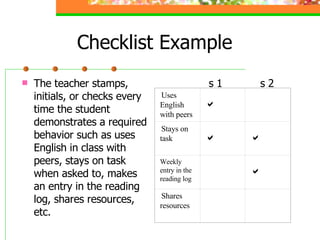
Checklist Example The teacher stamps, initials, or checks every time the student demonstrates a required behavior such as uses English in class with peers, stays on task when asked to, makes an entry in the reading log, shares resources, etc.    s 1   s 2    Uses English with peers          Stays on task         Weekly entry in the reading log              Shares resources        
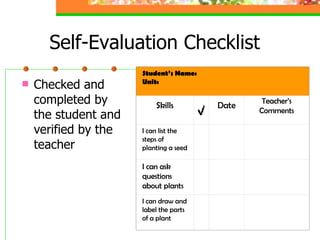
Self-Evaluation Checklist Checked and completed by the student and verified by the teacher Student’s Name: Unit: Skills Date Teacher’s Comments I can list the steps of planting a seed       I can ask questions about plants       I can draw and label the parts of a plant      
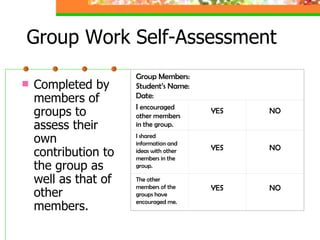
Group Work Self-Assessment  Completed by members of groups to assess their own contribution to the group as well as that of other members. Group Members: Student’s Name: Date: I  encouraged other members in the group. YES NO I shared information and ideas with other members in the group. YES NO The other members of the groups have encouraged me. YES NO
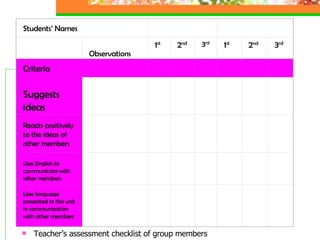
Teacher’s assessment checklist of group members Students’ Names       Observations 1 st 2 nd 3 rd 1 st 2 nd 3 rd Criteria               Suggests ideas                       Reacts positively to the ideas of other members                 Uses English to communicate with other members               Uses language presented in the unit in communication with other members              
Rating Scales
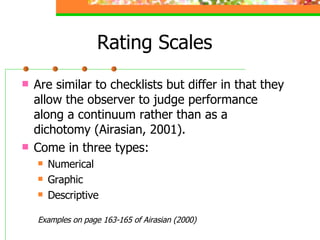
Rating Scales Are similar to checklists but differ in that they allow the observer to judge performance along a continuum rather than as a dichotomy (Airasian, 2001). Come in three types: Numerical Graphic Descriptive Examples on page 163-165 of Airasian (2000)
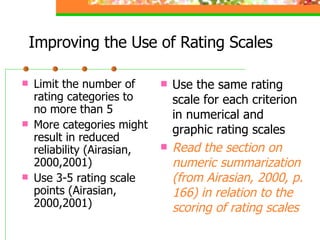
Improving the Use of Rating Scales Limit the number of rating categories to no more than 5 More categories might result in reduced reliability (Airasian, 2000,2001) Use 3-5 rating scale points (Airasian, 2000,2001) Use the same rating scale for each criterion in numerical and graphic rating scales Read the section on numeric summarization (from Airasian, 2000, p. 166) in relation to the scoring of rating scales
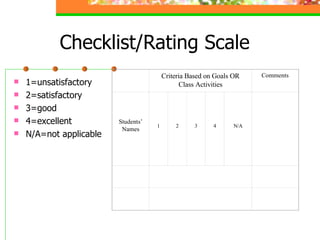
Checklist/Rating Scale 1=unsatisfactory 2=satisfactory 3=good 4=excellent N/A=not applicable Période de l'évaluation:  __________________________    Criteria Based on Goals OR Class Activities Comments Students’ Names         1         2 3 4 N/A              
Rubrics
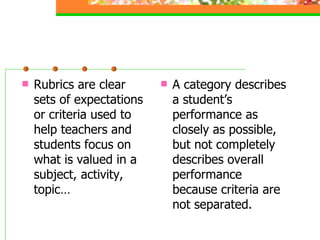
Rubrics are clear sets of expectations or criteria used to help teachers and students focus on what is valued in a subject, activity, topic… A category describes a student’s performance as closely as possible, but not completely describes overall performance because criteria are not separated.
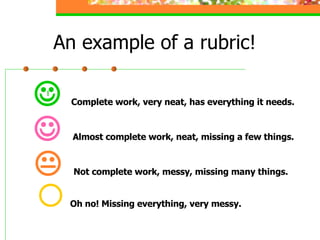
An example of a rubric!    Complete work, very neat, has everything it needs.    Almost complete work, neat, missing a few things.         Not complete work, messy, missing many things.      Oh no! Missing everything, very messy.
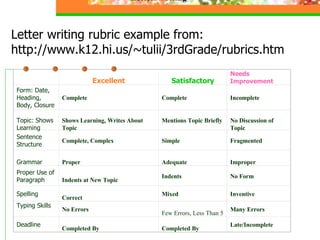
Letter writing rubric example from: http://www.k12.hi.us/~tulii/3rdGrade/rubrics.htm Letter Writing   Excellent Satisfactory Needs Improvement Form: Date, Heading, Body, Closure Complete Complete Incomplete Topic: Shows Learning Shows Learning, Writes About Topic Mentions Topic Briefly No Discussion of Topic Sentence Structure Complete, Complex Simple Fragmented Grammar Proper Adequate Improper Proper Use of Paragraph Indents at New Topic Indents No Form Spelling Correct Mixed Inventive Typing Skills No Errors Few Errors, Less Than 5 Many Errors Deadline Completed By Completed By Late/Incomplete
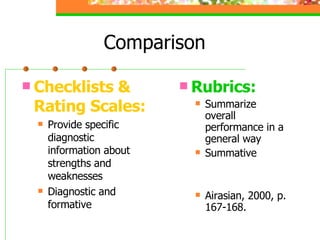
Comparison Checklists & Rating Scales: Provide specific diagnostic information about  strengths and weaknesses Diagnostic and formative Rubrics: Summarize overall performance in a general way Summative Airasian, 2000, p. 167-168.

Recording Classroom Observations

  • 1.
    Recording Techniques Waysof Documenting Observations
  • 2.
  • 3.
    Anecdotal Records “An anecdotal record is "a written record kept in a positive tone of a child's progress based on milestones particular to that child's social, emotional, physical, aesthetic, and cognitive development," notes the American Association of School Administrators (1992, p. 21).” http://home.gwu.edu/~anniehp/portfolio/Anecdotal_Records.htm
  • 4.
    Anecdotal records areobjective observations, not interpretations or judgments are positive account for significant events or behaviors give information that cannot be obtained using other methods of assessment Airasian (2000) http://www.sasked.gov.sk.ca/docs/francais/frcore/sec/eval3.html
  • 5.
    Anecdotal Records Usually include the date, time, event, setting, student’s name, and teacher’s name “ Some teachers use notebooks for keeping track of such notes, others use sticky pads to write things down and have a system of keeping track of these notes. Sometimes the notes end up in a child's file at the end of a school year, other times, they stay with a teacher's records or end up in the trash.  There is not a single system utilized by all teachers, nor do all teachers keep anecdotal records.” http://home.gwu.edu/~anniehp/portfolio/Anecdotal_Records.htm
  • 6.
    Anecdotal Record Format- Example Anecdotal Record Student’s Name: Teacher: Date: Time: Activity     Observations              
  • 7.
    Here’s an exampleof when anecdotal records are needed from Hall-Paulson, A. http://home.gwu.edu/~anniehp/portfolio/Anecdotal_Records.htm With Student Y, the anecdotal records are especially helpful in helping to address the behaviors because these are usually not graded (although a student's behavior and work habits affect their grades). A teacher should provide examples with dates and times explaining how a child lost control of him or herself, how he or she was uncooperative and how that student was disrespectful.  In these cases, it's also good to document what the response was to the behavior and whether or not the parents were contacted. 
  • 8.
    And another one…With Student X, a teacher should have both writing and math samples to support the highlighted comments. As for diplomacy, the teacher should have a list of specific cases where Student X was not diplomatic and how he or she needs to be alter or improve this area of communication!
  • 9.
  • 10.
    Checklists arewritten lists of criteria used while a product or a student’s behavior is being assessed involve the use of a checkmark next to the criterion that is represented by the observed behavior can be used for diagnostic purposes and for tracking change
  • 11.
    Disadvantages of ChecklistsOnly two choices: criterion is performed or not, goal is met or not. There is no middle ground for scoring and no representation of extent. Time and organizational issues Example from Airasian (2000) p. 161-162
  • 12.
    Checklist Example Theteacher stamps, initials, or checks every time the student demonstrates a required behavior such as uses English in class with peers, stays on task when asked to, makes an entry in the reading log, shares resources, etc. s 1 s 2   Uses English with peers          Stays on task         Weekly entry in the reading log              Shares resources        
  • 13.
    Self-Evaluation Checklist Checkedand completed by the student and verified by the teacher Student’s Name: Unit: Skills Date Teacher’s Comments I can list the steps of planting a seed       I can ask questions about plants       I can draw and label the parts of a plant      
  • 14.
    Group Work Self-Assessment Completed by members of groups to assess their own contribution to the group as well as that of other members. Group Members: Student’s Name: Date: I encouraged other members in the group. YES NO I shared information and ideas with other members in the group. YES NO The other members of the groups have encouraged me. YES NO
  • 15.
    Teacher’s assessment checklistof group members Students’ Names       Observations 1 st 2 nd 3 rd 1 st 2 nd 3 rd Criteria               Suggests ideas                       Reacts positively to the ideas of other members                 Uses English to communicate with other members               Uses language presented in the unit in communication with other members              
  • 16.
  • 17.
    Rating Scales Aresimilar to checklists but differ in that they allow the observer to judge performance along a continuum rather than as a dichotomy (Airasian, 2001). Come in three types: Numerical Graphic Descriptive Examples on page 163-165 of Airasian (2000)
  • 18.
    Improving the Useof Rating Scales Limit the number of rating categories to no more than 5 More categories might result in reduced reliability (Airasian, 2000,2001) Use 3-5 rating scale points (Airasian, 2000,2001) Use the same rating scale for each criterion in numerical and graphic rating scales Read the section on numeric summarization (from Airasian, 2000, p. 166) in relation to the scoring of rating scales
  • 19.
    Checklist/Rating Scale 1=unsatisfactory2=satisfactory 3=good 4=excellent N/A=not applicable Période de l'évaluation:  __________________________   Criteria Based on Goals OR Class Activities Comments Students’ Names         1         2 3 4 N/A              
  • 20.
  • 21.
    Rubrics are clearsets of expectations or criteria used to help teachers and students focus on what is valued in a subject, activity, topic… A category describes a student’s performance as closely as possible, but not completely describes overall performance because criteria are not separated.
  • 22.
    An example ofa rubric!  Complete work, very neat, has everything it needs.  Almost complete work, neat, missing a few things.      Not complete work, messy, missing many things.  Oh no! Missing everything, very messy.
  • 23.
    Letter writing rubricexample from: http://www.k12.hi.us/~tulii/3rdGrade/rubrics.htm Letter Writing Excellent Satisfactory Needs Improvement Form: Date, Heading, Body, Closure Complete Complete Incomplete Topic: Shows Learning Shows Learning, Writes About Topic Mentions Topic Briefly No Discussion of Topic Sentence Structure Complete, Complex Simple Fragmented Grammar Proper Adequate Improper Proper Use of Paragraph Indents at New Topic Indents No Form Spelling Correct Mixed Inventive Typing Skills No Errors Few Errors, Less Than 5 Many Errors Deadline Completed By Completed By Late/Incomplete
  • 24.
    Comparison Checklists &Rating Scales: Provide specific diagnostic information about strengths and weaknesses Diagnostic and formative Rubrics: Summarize overall performance in a general way Summative Airasian, 2000, p. 167-168.