We learn differently… so do our students. with
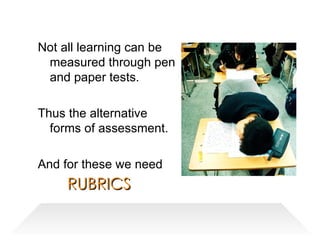
Not all learning can be measured through pen and paper tests. Thus the alternative forms of assessment. And for these we need RUBRICS
Your goal is to produce a rubric using the online generator RUBISTAR. RUBISTAR is a  free   online rubric maker  for teachers.
QUICK STOP Rubric is an established set of criteria for scoring a student’s performance. It defines in writing what is expected of the students to get a particular grade on an assignment.
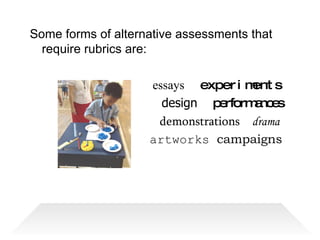
Some forms of alternative assessments that require rubrics are: essays   experiments design  performances demonstrations  drama  artworks  campaigns
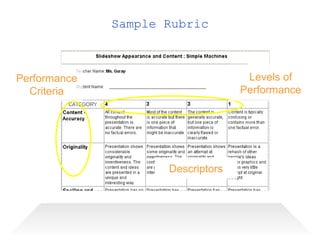
PerformanceCriteria Levels of Performance Descriptors Sample Rubric
GUIDELINES Limit the number of criteria. Typically, fewer than ten is best. Do not assess everything.  Ex. Grammar may not be that essential in an art activity. Smaller, less significant tasks require fewer criteria. Use an even number of levels to avoid middle scoring.
GUIDELINES Describe each level.  Distinguish between the levels for each criterion. Be fair at all times.  Make sure that each criteria is measurable and observable. As much as possible, involve the students in choosing criteria.  Communicate the rubric to your students and  colleagues.
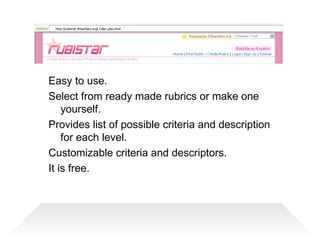
Easy to use.  Select from ready made rubrics or make one yourself. Provides list of possible criteria and description for each level. Customizable criteria and descriptors. It is free.
Using Rubistar
PRACTICE Generate a rubric for a slide show project on simple machines. Go to Rubistar by clicking the link below Return to this page after publishing your rubric.
Performance Criteria:   What is being evaluated? Are there a manageable number of performance criteria?  Are the performance criteria measurable/teachable? Do performance criteria match the objectives? Are the performance criteria clearly stated with a label? How many yes’s?___ Check your rubric
Scales and Levels of Proficiency:   Degrees of quality Is there an even number of levels to avoid middle scoring? Does the highest level represent exemplary performance? Is each level on the scale meaningful and non-judgmental? How many yes’s?___ Check your rubric
Descriptions:   What would success look like? Are they written in student language? Clear and understandable? Are they positively stated? Are the differences in descriptions observable? Clearly stated expectations? Is there a progression of differences among the descriptions? How many yes’s?___ Check your rubric
Score your work 11 Yes Congratulations, you did a good job! Your rubric followed all the guidelines. 9-10 Yes You did fairly well.  Strictly follow the guidelines next time. 7-8 Yes Your rubric needs improvement.  It does not cover the major aspects of evaluation. 6 and below Please revise your work.
Summing Up A rubric is an ideal tool for evaluating performance-based assessments. To make it more effective, the rubric must be communicated to the students before the project is made, so it can serve as a project guide.
Credits Rubistar http://rubistar.4teachers.org/index.php Checklist http:// www.sasinschool.com Content http:// www.ascd.org/readingroom http:// ide.ed.psu.edu http://teachers.teach-nology.com author/developer Maria Lorena Guray instructor/consultant Dr. Celia T. Adriano EdTech 206, Instructional Systems Development University of the Philippines, Diliman March 16, 2009

Rubric with Rubistar

  • 1.
    We learn differently…so do our students. with
  • 2.
    Not all learningcan be measured through pen and paper tests. Thus the alternative forms of assessment. And for these we need RUBRICS
  • 3.
    Your goal isto produce a rubric using the online generator RUBISTAR. RUBISTAR is a free online rubric maker for teachers.
  • 4.
    QUICK STOP Rubricis an established set of criteria for scoring a student’s performance. It defines in writing what is expected of the students to get a particular grade on an assignment.
  • 5.
    Some forms ofalternative assessments that require rubrics are: essays experiments design performances demonstrations drama artworks campaigns
  • 6.
    PerformanceCriteria Levels ofPerformance Descriptors Sample Rubric
  • 7.
    GUIDELINES Limit thenumber of criteria. Typically, fewer than ten is best. Do not assess everything. Ex. Grammar may not be that essential in an art activity. Smaller, less significant tasks require fewer criteria. Use an even number of levels to avoid middle scoring.
  • 8.
    GUIDELINES Describe eachlevel. Distinguish between the levels for each criterion. Be fair at all times. Make sure that each criteria is measurable and observable. As much as possible, involve the students in choosing criteria. Communicate the rubric to your students and colleagues.
  • 9.
    Easy to use. Select from ready made rubrics or make one yourself. Provides list of possible criteria and description for each level. Customizable criteria and descriptors. It is free.
  • 10.
  • 11.
    PRACTICE Generate arubric for a slide show project on simple machines. Go to Rubistar by clicking the link below Return to this page after publishing your rubric.
  • 12.
    Performance Criteria: What is being evaluated? Are there a manageable number of performance criteria? Are the performance criteria measurable/teachable? Do performance criteria match the objectives? Are the performance criteria clearly stated with a label? How many yes’s?___ Check your rubric
  • 13.
    Scales and Levelsof Proficiency: Degrees of quality Is there an even number of levels to avoid middle scoring? Does the highest level represent exemplary performance? Is each level on the scale meaningful and non-judgmental? How many yes’s?___ Check your rubric
  • 14.
    Descriptions: What would success look like? Are they written in student language? Clear and understandable? Are they positively stated? Are the differences in descriptions observable? Clearly stated expectations? Is there a progression of differences among the descriptions? How many yes’s?___ Check your rubric
  • 15.
    Score your work11 Yes Congratulations, you did a good job! Your rubric followed all the guidelines. 9-10 Yes You did fairly well. Strictly follow the guidelines next time. 7-8 Yes Your rubric needs improvement. It does not cover the major aspects of evaluation. 6 and below Please revise your work.
  • 16.
    Summing Up Arubric is an ideal tool for evaluating performance-based assessments. To make it more effective, the rubric must be communicated to the students before the project is made, so it can serve as a project guide.
  • 17.
    Credits Rubistar http://rubistar.4teachers.org/index.phpChecklist http:// www.sasinschool.com Content http:// www.ascd.org/readingroom http:// ide.ed.psu.edu http://teachers.teach-nology.com author/developer Maria Lorena Guray instructor/consultant Dr. Celia T. Adriano EdTech 206, Instructional Systems Development University of the Philippines, Diliman March 16, 2009