ALT-C 2019, University of Edinburgh
Facilitating Peer-led Group Research
Through Virtual Collaboration Spaces
Dr. Richard Walker
Programme Design & Learning Technology Team
University of York
Outline
● Bioinformatics projects and challenges
● Peer-led group research: Our blended approach to
support collaboration in project work
● Assessment of the approach and our findings
● Lessons learned
● Future work
btle.york.ac.uk
Final Year Biosciences
Undergraduate Projects
● Traditional 2 term projects
● Supervised
● Lab or non-lab based
● Expected 2.5 days of work per week
● Students learn new skills
● Work can be collaborative but this is
rare and difficult to encourage
● Individual independent report for
assessment
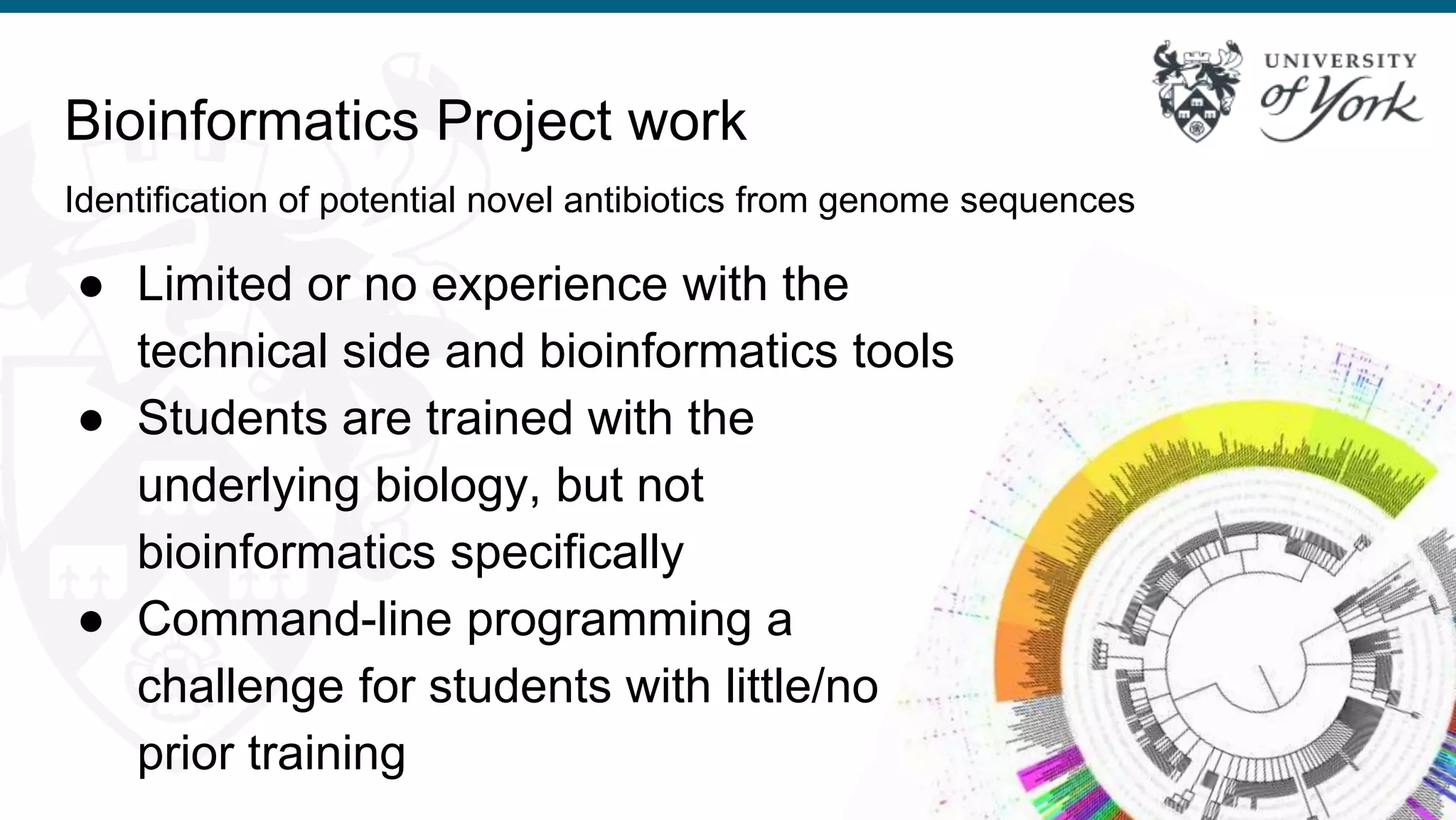
Bioinformatics Project work
● Limited or no experience with the
technical side and bioinformatics tools
● Students are trained with the
underlying biology, but not
bioinformatics specifically
● Command-line programming a
challenge for students with little/no
prior training
Identification of potential novel antibiotics from genome sequences
Desired Learning Outcomes from
Independent Final Year Projects
● Independent work
● Solving technical challenges
● Skills for employability
● Wanting to address knowledge gaps
● Co-operative learning
Challenges Faced by Traditional
Approaches to Learning Skills
● Tend to be one-to-one
● Timetabling of meetings / supervision can be a challenge
● Little/no benefit to/from peers
● Propagation of solutions is slow
● Increasingly multidisciplinary emphasis needs to be
addressed
Our Solution: Peer-led group
research – a blended approach
● Students allocated to project groups facilitated by ‘near peers’
– experienced in using bioinformatics tools
● Weekly plenary face-to-face meetings (and as needed)
● Use of communication tools
○ Virtual shared space where students feel comfortable to
ask questions of instructors, ‘near peers’ and each other
○ Hub to share ideas / findings; engage in collaborative
problem-solving & trouble-shooting
Virtual Collaboration Space
● Google Team Drive
○ Shared digital and updatable protocol
○ Easy to use
● Slack
○ Distinct channels for questioning, ideas sharing
○ Push notifications to support agile problem solving
Both tools are institutionally licensed / centrally managed –
offering a secure space for shared learning.
Study Design
● Phase 1 [2017-18 cohort; n=6] initial observations
● Phase 2 [2018-19 cohort; n=7] adjusted design based on
lessons learned
○ greater attention to role of ‘near peers’– their learning
facilitation role in supporting project groups
○ specific steer to encourage students to interact in
shared space (rather than email / direct messaging)
Assessment of the Effectiveness of the
Approach
Mixed mode evaluation design:
● Surveys and activity logs
○ reflective
○ exit
● Focus group
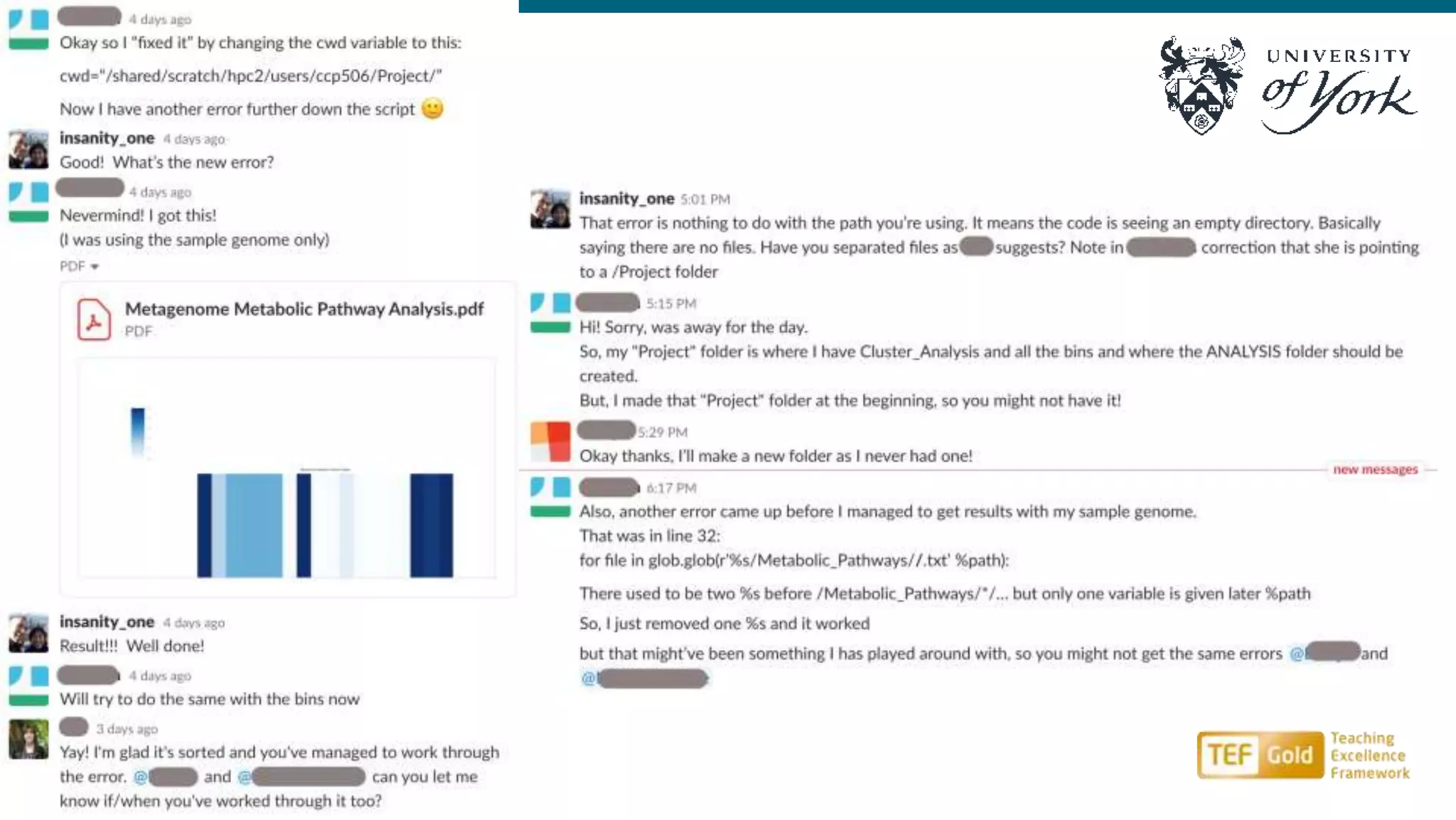
● Content analysis of student posts to Slack environment
based on adapted version of Fox & MacKeogh framework (2003)
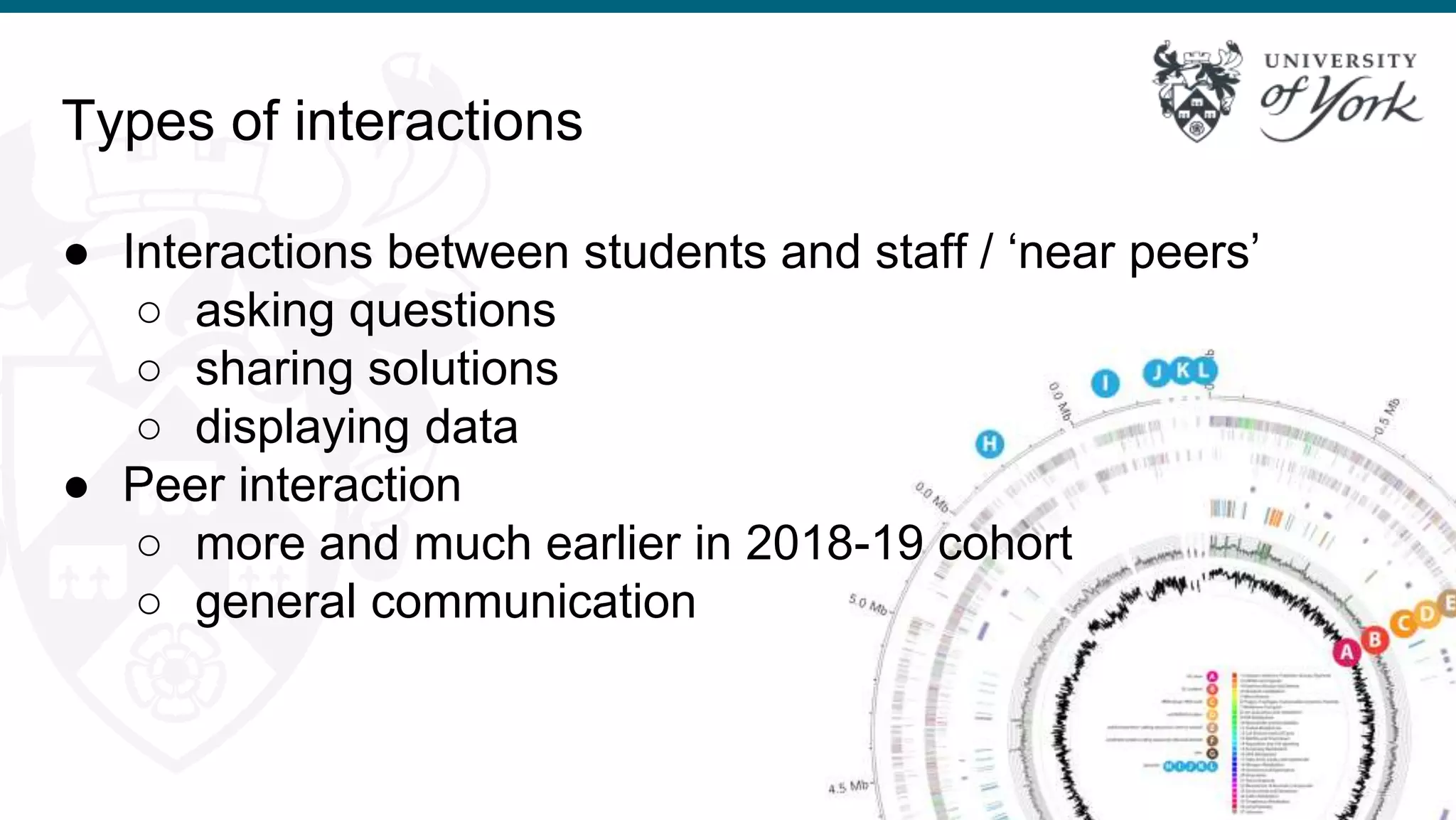
Types of interactions
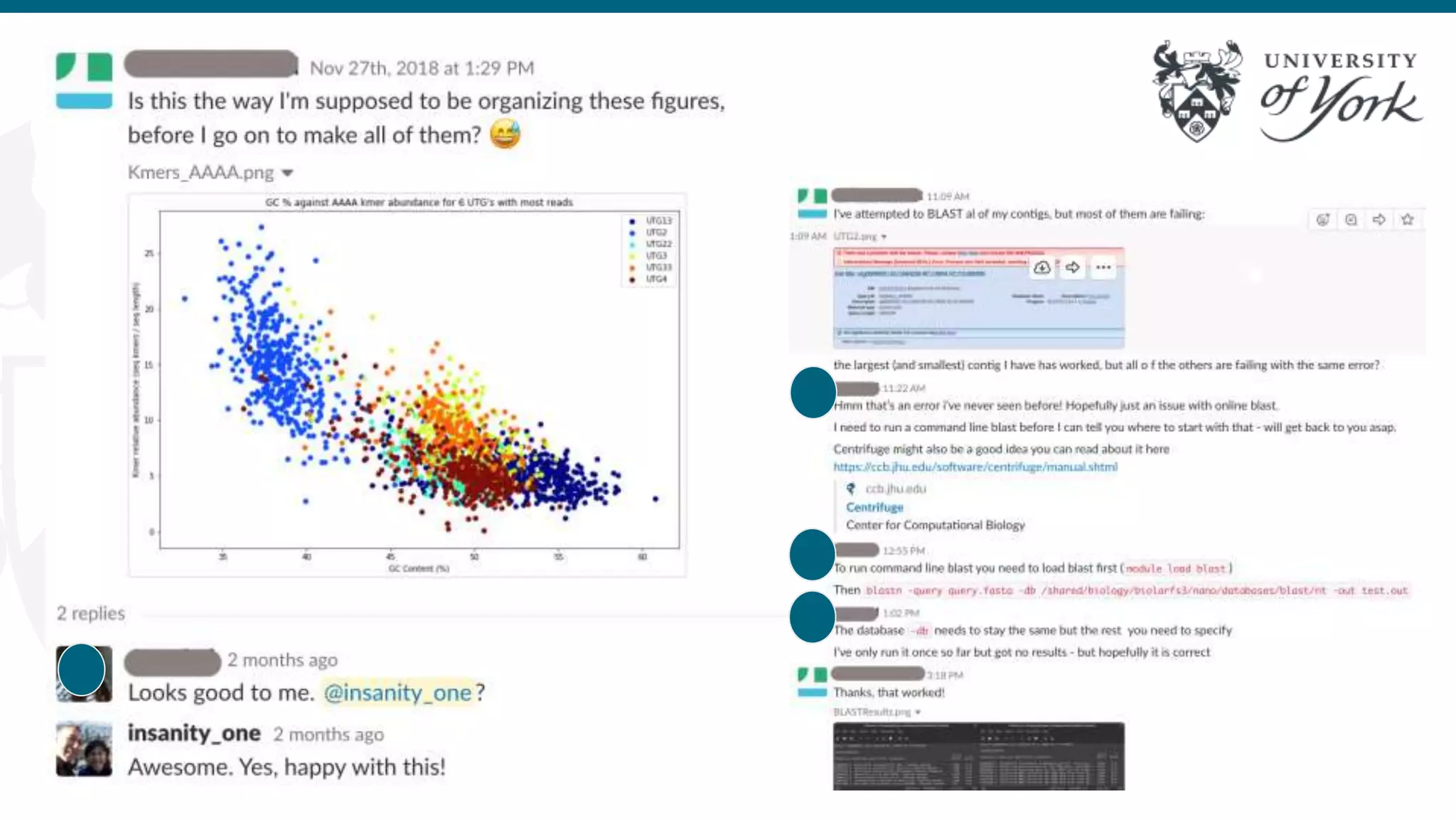
● Interactions between students and staff / ‘near peers’
○ asking questions
○ sharing solutions
○ displaying data
● Peer interaction
○ more and much earlier in 2018-19 cohort
○ general communication
Students’ collaborative behaviour (2018-19 cohort) increases
over time
Christmas
Journal club
Write up
Staff and students
contribute
differently to
collaborations
Increasing critical engagement in project work (2018-19
cohort)
Christmas Journal club
Write up
‘We were told it’s like
Twitter but with groups.
It was pretty intuitive.’
Reflections on Slack
‘It is easy to keep a record
of what’s been
said…especially group
conversations where it’s all
in a feed layout’‘You could quite easily send
screenshots across..you
can get a very quick
response on how to fix [an
error].’
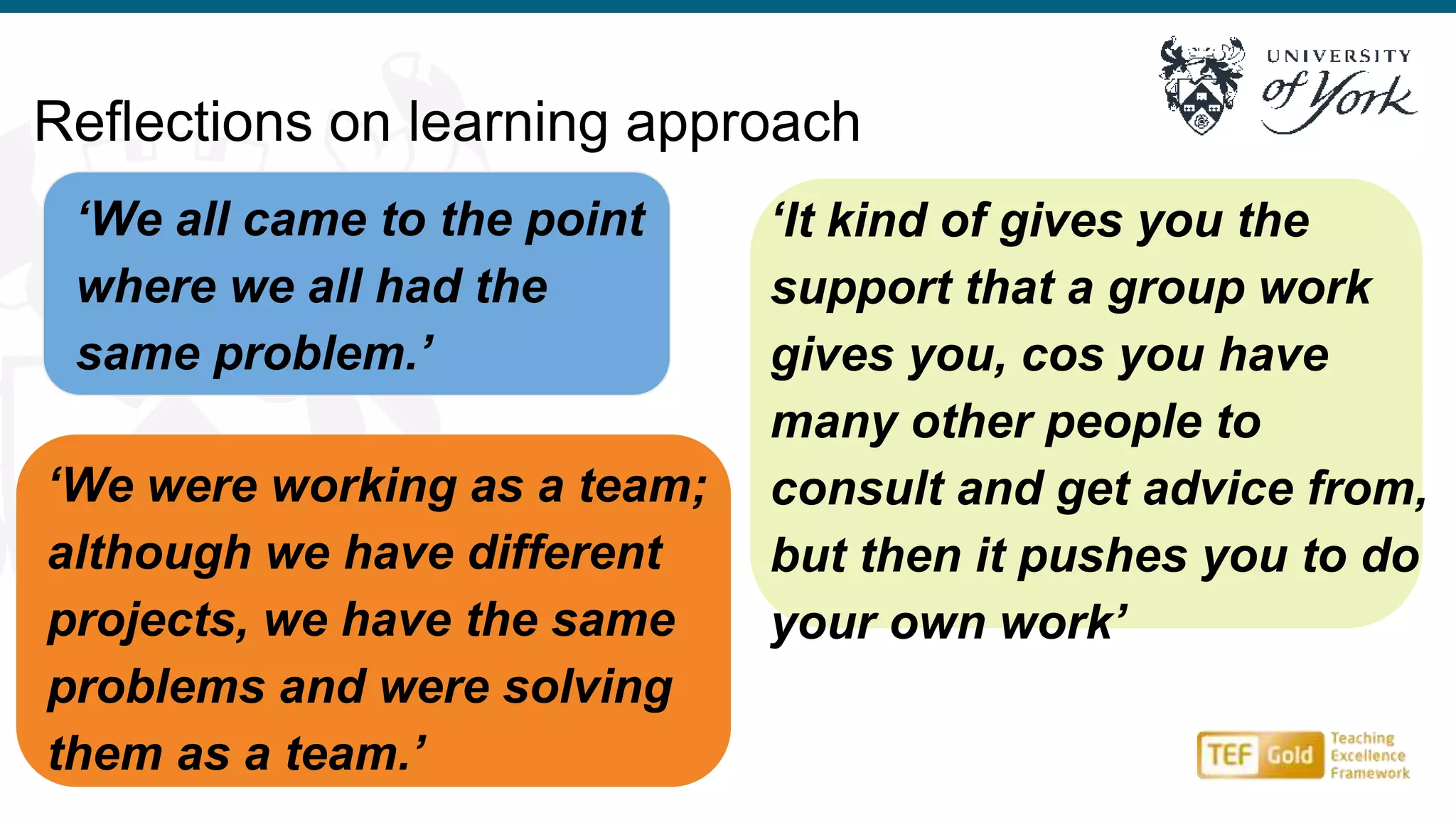
‘We all came to the point
where we all had the
same problem.’
Reflections on learning approach
‘It kind of gives you the
support that a group work
gives you, cos you have
many other people to
consult and get advice from,
but then it pushes you to do
your own work’
‘We were working as a team;
although we have different
projects, we have the same
problems and were solving
them as a team.’
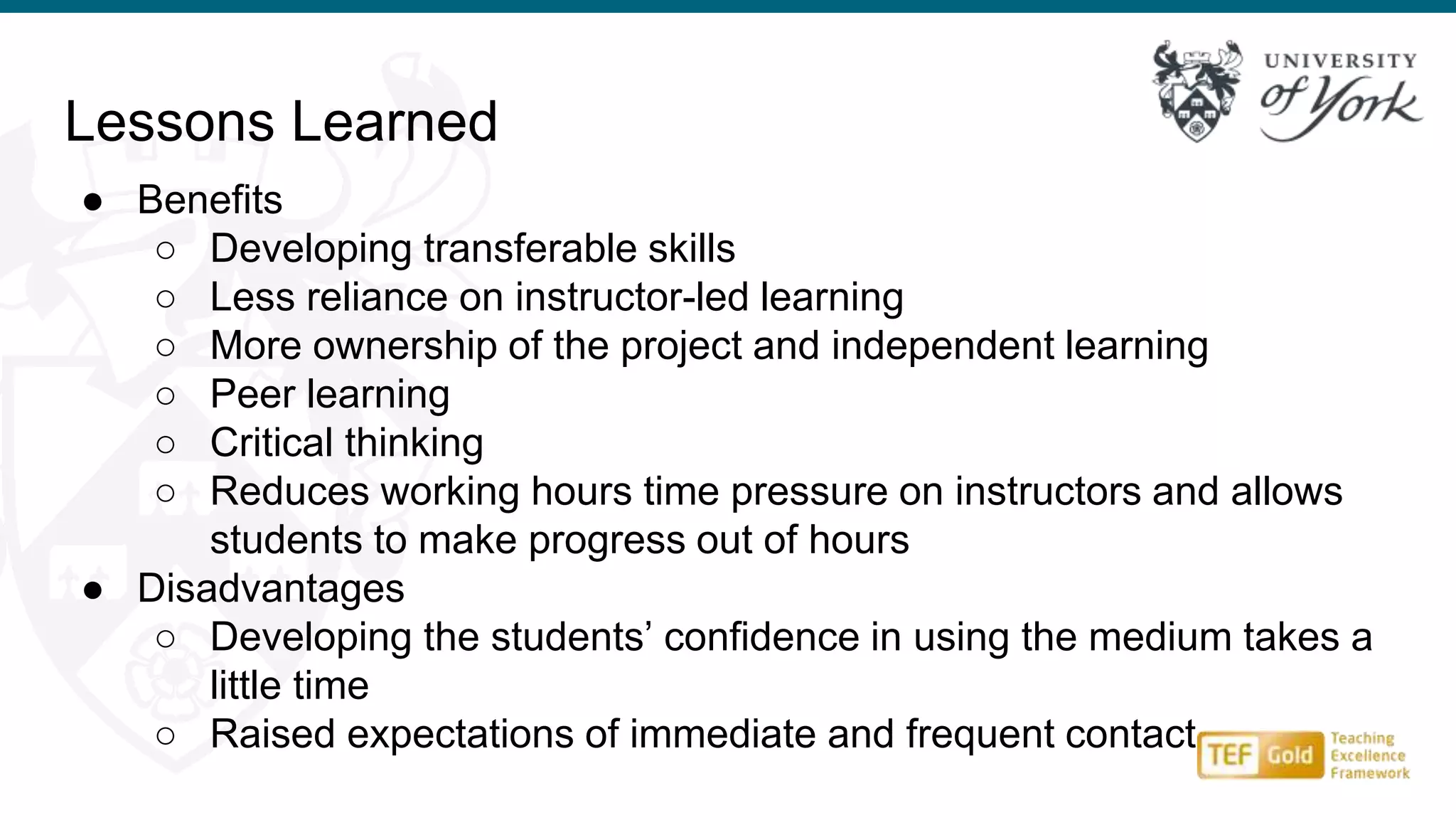
Lessons Learned
● Benefits
○ Developing transferable skills
○ Less reliance on instructor-led learning
○ More ownership of the project and independent learning
○ Peer learning
○ Critical thinking
○ Reduces working hours time pressure on instructors and allows
students to make progress out of hours
● Disadvantages
○ Developing the students’ confidence in using the medium takes a
little time
○ Raised expectations of immediate and frequent contact
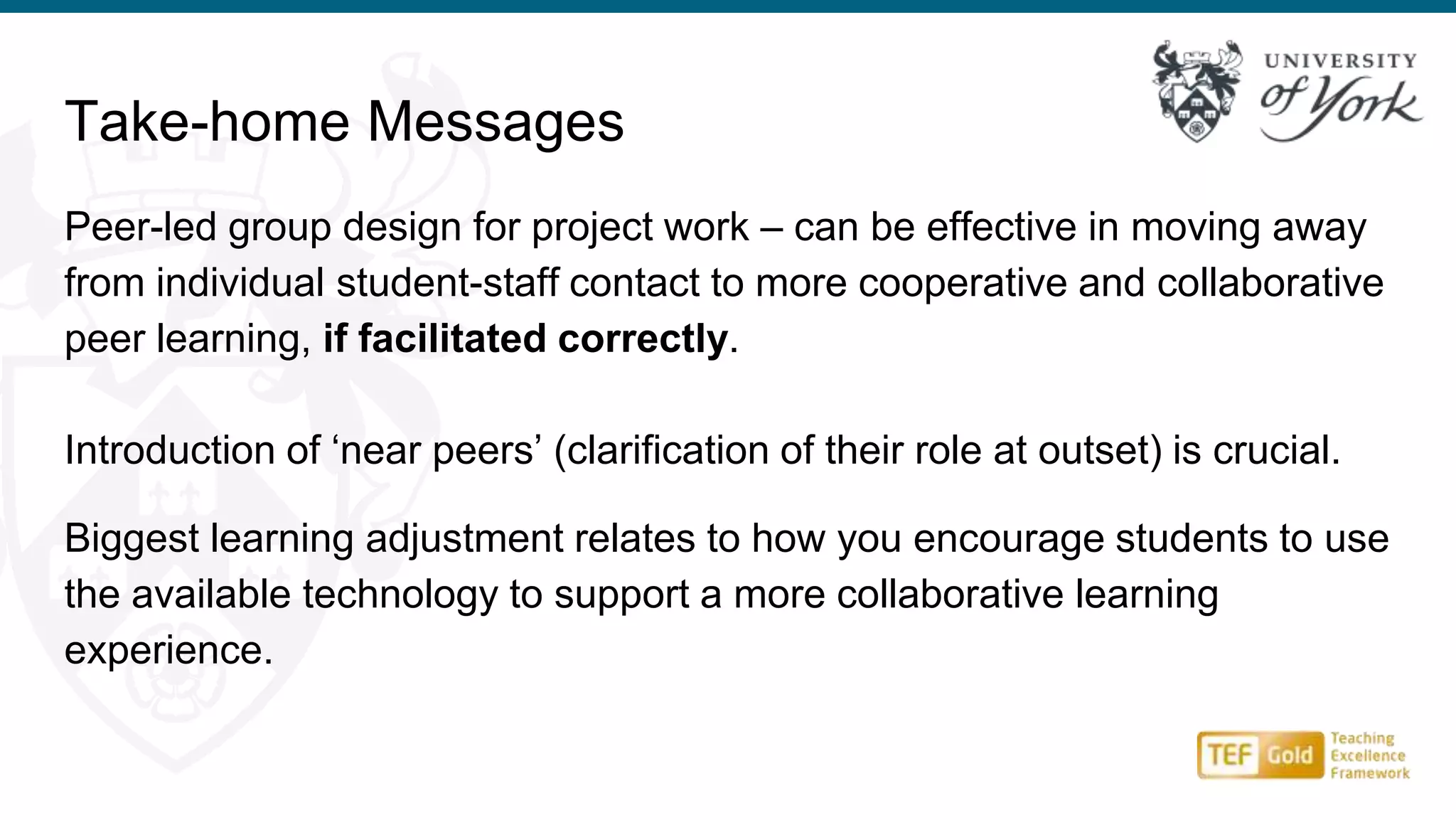
Peer-led group design for project work – can be effective in moving away
from individual student-staff contact to more cooperative and collaborative
peer learning, if facilitated correctly.
Introduction of ‘near peers’ (clarification of their role at outset) is crucial.
Biggest learning adjustment relates to how you encourage students to use
the available technology to support a more collaborative learning
experience.
Take-home Messages
What’s Next?
A research paper based on our longitudinal study of student
engagement patterns with virtual collaborative tools for
Biosciences research projects.
‘We needed a forum to talk to
people - Slack did that perfectly’
Professor James Chong and Dr. Setareh Chong (Department of Biology)
Postgraduate Support
● Kimberley Barnes
● Annabel Cansdale
Our undergraduate students
Acknowledgments
Chong, S, Chong, J. & Walker R. (2018). Facilitating peer-led group research through virtual collaboration
spaces: Case Study. Available at: https://elearningyork.wordpress.com/learning-design-and-
development/case-studies-archived/facilitating-peer-led-group-research-through-virtual-collaboration-
spaces/
Fox, S. and MacKeogh, K. (2003) 'Can eLearning Promote Higher-order Learning Without Tutor Overload?',
Open Learning: The Journal of Open and Distance Learning, 18: 2, 121 — 134. Available at:
https://www.tandfonline.com/doi/abs/10.1080/02680510307410
Pazos, P., Micari, M. & Light, G. (2010). Developing an Instrument to characterise peer‐led groups in
collaborative learning environments: assessing problem‐solving approach and Group
Interaction. Assessment & Evaluation in Higher Education 35 (2). Routledge: 191–208. Available at:
https://srhe.tandfonline.com/doi/abs/10.1080/02602930802691572
Resources and References

Facilitating peer-led group research

  • 1.
    ALT-C 2019, Universityof Edinburgh Facilitating Peer-led Group Research Through Virtual Collaboration Spaces Dr. Richard Walker Programme Design & Learning Technology Team University of York
  • 2.
    Outline ● Bioinformatics projectsand challenges ● Peer-led group research: Our blended approach to support collaboration in project work ● Assessment of the approach and our findings ● Lessons learned ● Future work
  • 3.
    btle.york.ac.uk Final Year Biosciences UndergraduateProjects ● Traditional 2 term projects ● Supervised ● Lab or non-lab based ● Expected 2.5 days of work per week ● Students learn new skills ● Work can be collaborative but this is rare and difficult to encourage ● Individual independent report for assessment
  • 4.
    Bioinformatics Project work ●Limited or no experience with the technical side and bioinformatics tools ● Students are trained with the underlying biology, but not bioinformatics specifically ● Command-line programming a challenge for students with little/no prior training Identification of potential novel antibiotics from genome sequences
  • 5.
    Desired Learning Outcomesfrom Independent Final Year Projects ● Independent work ● Solving technical challenges ● Skills for employability ● Wanting to address knowledge gaps ● Co-operative learning
  • 6.
    Challenges Faced byTraditional Approaches to Learning Skills ● Tend to be one-to-one ● Timetabling of meetings / supervision can be a challenge ● Little/no benefit to/from peers ● Propagation of solutions is slow ● Increasingly multidisciplinary emphasis needs to be addressed
  • 7.
    Our Solution: Peer-ledgroup research – a blended approach ● Students allocated to project groups facilitated by ‘near peers’ – experienced in using bioinformatics tools ● Weekly plenary face-to-face meetings (and as needed) ● Use of communication tools ○ Virtual shared space where students feel comfortable to ask questions of instructors, ‘near peers’ and each other ○ Hub to share ideas / findings; engage in collaborative problem-solving & trouble-shooting
  • 8.
    Virtual Collaboration Space ●Google Team Drive ○ Shared digital and updatable protocol ○ Easy to use ● Slack ○ Distinct channels for questioning, ideas sharing ○ Push notifications to support agile problem solving Both tools are institutionally licensed / centrally managed – offering a secure space for shared learning.
  • 9.
    Study Design ● Phase1 [2017-18 cohort; n=6] initial observations ● Phase 2 [2018-19 cohort; n=7] adjusted design based on lessons learned ○ greater attention to role of ‘near peers’– their learning facilitation role in supporting project groups ○ specific steer to encourage students to interact in shared space (rather than email / direct messaging)
  • 10.
    Assessment of theEffectiveness of the Approach Mixed mode evaluation design: ● Surveys and activity logs ○ reflective ○ exit ● Focus group ● Content analysis of student posts to Slack environment based on adapted version of Fox & MacKeogh framework (2003)
  • 11.
    Types of interactions ●Interactions between students and staff / ‘near peers’ ○ asking questions ○ sharing solutions ○ displaying data ● Peer interaction ○ more and much earlier in 2018-19 cohort ○ general communication
  • 14.
    Students’ collaborative behaviour(2018-19 cohort) increases over time Christmas Journal club Write up
  • 15.
  • 16.
    Increasing critical engagementin project work (2018-19 cohort) Christmas Journal club Write up
  • 17.
    ‘We were toldit’s like Twitter but with groups. It was pretty intuitive.’ Reflections on Slack ‘It is easy to keep a record of what’s been said…especially group conversations where it’s all in a feed layout’‘You could quite easily send screenshots across..you can get a very quick response on how to fix [an error].’
  • 18.
    ‘We all cameto the point where we all had the same problem.’ Reflections on learning approach ‘It kind of gives you the support that a group work gives you, cos you have many other people to consult and get advice from, but then it pushes you to do your own work’ ‘We were working as a team; although we have different projects, we have the same problems and were solving them as a team.’
  • 19.
    Lessons Learned ● Benefits ○Developing transferable skills ○ Less reliance on instructor-led learning ○ More ownership of the project and independent learning ○ Peer learning ○ Critical thinking ○ Reduces working hours time pressure on instructors and allows students to make progress out of hours ● Disadvantages ○ Developing the students’ confidence in using the medium takes a little time ○ Raised expectations of immediate and frequent contact
  • 20.
    Peer-led group designfor project work – can be effective in moving away from individual student-staff contact to more cooperative and collaborative peer learning, if facilitated correctly. Introduction of ‘near peers’ (clarification of their role at outset) is crucial. Biggest learning adjustment relates to how you encourage students to use the available technology to support a more collaborative learning experience. Take-home Messages
  • 21.
    What’s Next? A researchpaper based on our longitudinal study of student engagement patterns with virtual collaborative tools for Biosciences research projects. ‘We needed a forum to talk to people - Slack did that perfectly’
  • 22.
    Professor James Chongand Dr. Setareh Chong (Department of Biology) Postgraduate Support ● Kimberley Barnes ● Annabel Cansdale Our undergraduate students Acknowledgments
  • 23.
    Chong, S, Chong,J. & Walker R. (2018). Facilitating peer-led group research through virtual collaboration spaces: Case Study. Available at: https://elearningyork.wordpress.com/learning-design-and- development/case-studies-archived/facilitating-peer-led-group-research-through-virtual-collaboration- spaces/ Fox, S. and MacKeogh, K. (2003) 'Can eLearning Promote Higher-order Learning Without Tutor Overload?', Open Learning: The Journal of Open and Distance Learning, 18: 2, 121 — 134. Available at: https://www.tandfonline.com/doi/abs/10.1080/02680510307410 Pazos, P., Micari, M. & Light, G. (2010). Developing an Instrument to characterise peer‐led groups in collaborative learning environments: assessing problem‐solving approach and Group Interaction. Assessment & Evaluation in Higher Education 35 (2). Routledge: 191–208. Available at: https://srhe.tandfonline.com/doi/abs/10.1080/02602930802691572 Resources and References