Prepared By
Prof. Ashish Makwana
Civil Engg. Dept.
1Prof. Ashish Makwana
PRESENTATION
OUTLINE…
• Slum
• Causes of slums
• Characteristics of slums
• Effects of slums
• Slum clearance
2Prof. Ashish Makwana
3Prof. Ashish Makwana
Slum
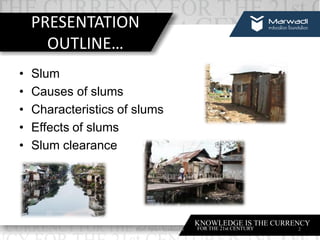
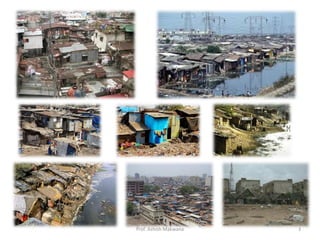
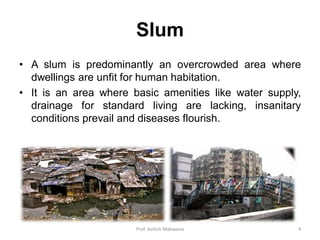
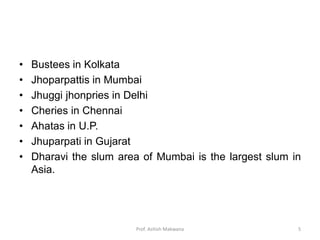
• A slum is predominantly an overcrowded area where
dwellings are unfit for human habitation.
• It is an area where basic amenities like water supply,
drainage for standard living are lacking, insanitary
conditions prevail and diseases flourish.
4Prof. Ashish Makwana
• Bustees in Kolkata
• Jhoparpattis in Mumbai
• Jhuggi jhonpries in Delhi
• Cheries in Chennai
• Ahatas in U.P.
• Jhuparpati in Gujarat
• Dharavi the slum area of Mumbai is the largest slum in
Asia.
5Prof. Ashish Makwana
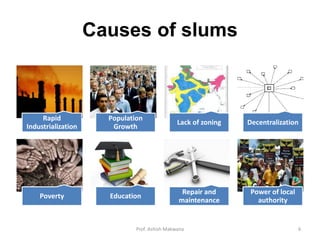
Causes of slums
Rapid
Industrialization
Population
Growth
Lack of zoning Decentralization
Poverty Education
Repair and
maintenance
Power of local
authority
6Prof. Ashish Makwana
Causes of slums
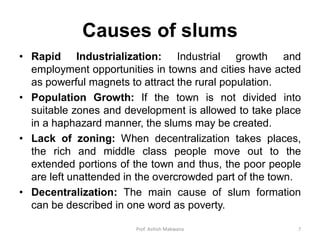
• Rapid Industrialization: Industrial growth and
employment opportunities in towns and cities have acted
as powerful magnets to attract the rural population.
• Population Growth: If the town is not divided into
suitable zones and development is allowed to take place
in a haphazard manner, the slums may be created.
• Lack of zoning: When decentralization takes places,
the rich and middle class people move out to the
extended portions of the town and thus, the poor people
are left unattended in the overcrowded part of the town.
• Decentralization: The main cause of slum formation
can be described in one word as poverty.
7Prof. Ashish Makwana
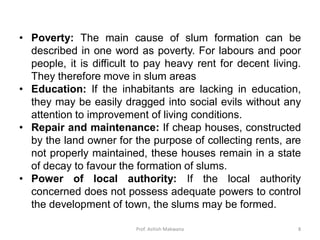
• Poverty: The main cause of slum formation can be
described in one word as poverty. For labours and poor
people, it is difficult to pay heavy rent for decent living.
They therefore move in slum areas
• Education: If the inhabitants are lacking in education,
they may be easily dragged into social evils without any
attention to improvement of living conditions.
• Repair and maintenance: If cheap houses, constructed
by the land owner for the purpose of collecting rents, are
not properly maintained, these houses remain in a state
of decay to favour the formation of slums.
• Power of local authority: If the local authority
concerned does not possess adequate powers to control
the development of town, the slums may be formed.
8Prof. Ashish Makwana
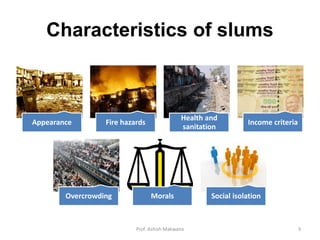
Characteristics of slums
Appearance Fire hazards
Health and
sanitation
Income criteria
Overcrowding Morals Social isolation
9Prof. Ashish Makwana
• Appearance: This is rather the universal mark of the
slum and its unpleasant appearance offends the eyes,
nose and conscience. The structures appear to be
deteriorated and to be of over-age.
• Fire hazards: The slum area is often exposed to fire
accidents and consequent damages. One stick of
matches may prove to be sufficient to reduce the whole
slum to ashes in no time.
• Health and sanitation: The slum is characterized by low
standards of sanitation. It also refers an area of high
sickness and death rates.
Characteristics of slums
10Prof. Ashish Makwana
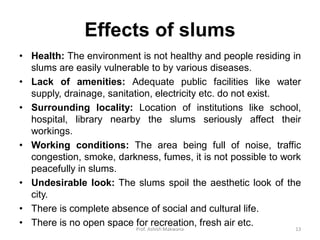
• Income criteria: The slum is a poverty area and it is
occupied by people of the lowest income group of the
society.
• Overcrowding: The slum is overcrowded with buildings
or the buildings are overcrowded with people or both
conditions prevail in the slum.
• Morals: The socially disorganized slum may prove to be
an area of delinquency, crime and vice.
• Social isolation: The slum area is of the lowest social
status and it is usually linked up with the rest of the
community through its labour force.
11Prof. Ashish Makwana
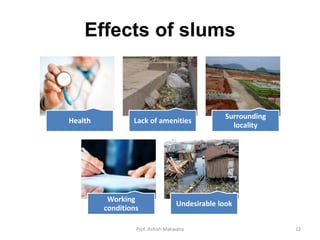
Effects of slums
Health Lack of amenities
Surrounding
locality
Working
conditions
Undesirable look
12Prof. Ashish Makwana
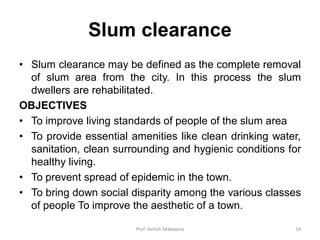
• Health: The environment is not healthy and people residing in
slums are easily vulnerable to by various diseases.
• Lack of amenities: Adequate public facilities like water
supply, drainage, sanitation, electricity etc. do not exist.
• Surrounding locality: Location of institutions like school,
hospital, library nearby the slums seriously affect their
workings.
• Working conditions: The area being full of noise, traffic
congestion, smoke, darkness, fumes, it is not possible to work
peacefully in slums.
• Undesirable look: The slums spoil the aesthetic look of the
city.
• There is complete absence of social and cultural life.
• There is no open space for recreation, fresh air etc.
Effects of slums
13Prof. Ashish Makwana
Slum clearance
• Slum clearance may be defined as the complete removal
of slum area from the city. In this process the slum
dwellers are rehabilitated.
OBJECTIVES
• To improve living standards of people of the slum area
• To provide essential amenities like clean drinking water,
sanitation, clean surrounding and hygienic conditions for
healthy living.
• To prevent spread of epidemic in the town.
• To bring down social disparity among the various classes
of people To improve the aesthetic of a town.
14Prof. Ashish Makwana
Difficulties in slum clearance
• Lack of resources
• High cost of alternative sites near place of work
• Unwillingness of the slum dwellers to move from slum
area to new colonies
• Lengthy and time consuming procedures of acquisition
of slum area
• Low rent paying capacity of slum dwellers
15Prof. Ashish Makwana
Methods of slum clearance
1. Improvement method
• This method is adopted where slums are due to poor
drainage system and unhealthy conditions. Hence the
drainage arrangement is modified and improved. Public
utility services like water, drainage, gas, electricity may
be provided in the slum area.
2. Complete removal method
• In this method, the slum area is completely cleaned out
of the existing locality. All the dilapilated structures are
demolished. Only such buildings which are really in good
conditions are retained.
16Prof. Ashish Makwana
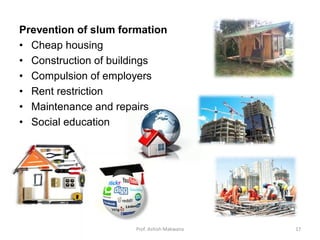
Prevention of slum formation
• Cheap housing
• Construction of buildings
• Compulsion of employers
• Rent restriction
• Maintenance and repairs
• Social education
17Prof. Ashish Makwana
THANK YOU
18Prof. Ashish Makwana

Slums_Building and Town Planning

  • 1.
    Prepared By Prof. AshishMakwana Civil Engg. Dept. 1Prof. Ashish Makwana
  • 2.
    PRESENTATION OUTLINE… • Slum • Causesof slums • Characteristics of slums • Effects of slums • Slum clearance 2Prof. Ashish Makwana
  • 3.
  • 4.
    Slum • A slumis predominantly an overcrowded area where dwellings are unfit for human habitation. • It is an area where basic amenities like water supply, drainage for standard living are lacking, insanitary conditions prevail and diseases flourish. 4Prof. Ashish Makwana
  • 5.
    • Bustees inKolkata • Jhoparpattis in Mumbai • Jhuggi jhonpries in Delhi • Cheries in Chennai • Ahatas in U.P. • Jhuparpati in Gujarat • Dharavi the slum area of Mumbai is the largest slum in Asia. 5Prof. Ashish Makwana
  • 6.
    Causes of slums Rapid Industrialization Population Growth Lackof zoning Decentralization Poverty Education Repair and maintenance Power of local authority 6Prof. Ashish Makwana
  • 7.
    Causes of slums •Rapid Industrialization: Industrial growth and employment opportunities in towns and cities have acted as powerful magnets to attract the rural population. • Population Growth: If the town is not divided into suitable zones and development is allowed to take place in a haphazard manner, the slums may be created. • Lack of zoning: When decentralization takes places, the rich and middle class people move out to the extended portions of the town and thus, the poor people are left unattended in the overcrowded part of the town. • Decentralization: The main cause of slum formation can be described in one word as poverty. 7Prof. Ashish Makwana
  • 8.
    • Poverty: Themain cause of slum formation can be described in one word as poverty. For labours and poor people, it is difficult to pay heavy rent for decent living. They therefore move in slum areas • Education: If the inhabitants are lacking in education, they may be easily dragged into social evils without any attention to improvement of living conditions. • Repair and maintenance: If cheap houses, constructed by the land owner for the purpose of collecting rents, are not properly maintained, these houses remain in a state of decay to favour the formation of slums. • Power of local authority: If the local authority concerned does not possess adequate powers to control the development of town, the slums may be formed. 8Prof. Ashish Makwana
  • 9.
    Characteristics of slums AppearanceFire hazards Health and sanitation Income criteria Overcrowding Morals Social isolation 9Prof. Ashish Makwana
  • 10.
    • Appearance: Thisis rather the universal mark of the slum and its unpleasant appearance offends the eyes, nose and conscience. The structures appear to be deteriorated and to be of over-age. • Fire hazards: The slum area is often exposed to fire accidents and consequent damages. One stick of matches may prove to be sufficient to reduce the whole slum to ashes in no time. • Health and sanitation: The slum is characterized by low standards of sanitation. It also refers an area of high sickness and death rates. Characteristics of slums 10Prof. Ashish Makwana
  • 11.
    • Income criteria:The slum is a poverty area and it is occupied by people of the lowest income group of the society. • Overcrowding: The slum is overcrowded with buildings or the buildings are overcrowded with people or both conditions prevail in the slum. • Morals: The socially disorganized slum may prove to be an area of delinquency, crime and vice. • Social isolation: The slum area is of the lowest social status and it is usually linked up with the rest of the community through its labour force. 11Prof. Ashish Makwana
  • 12.
    Effects of slums HealthLack of amenities Surrounding locality Working conditions Undesirable look 12Prof. Ashish Makwana
  • 13.
    • Health: Theenvironment is not healthy and people residing in slums are easily vulnerable to by various diseases. • Lack of amenities: Adequate public facilities like water supply, drainage, sanitation, electricity etc. do not exist. • Surrounding locality: Location of institutions like school, hospital, library nearby the slums seriously affect their workings. • Working conditions: The area being full of noise, traffic congestion, smoke, darkness, fumes, it is not possible to work peacefully in slums. • Undesirable look: The slums spoil the aesthetic look of the city. • There is complete absence of social and cultural life. • There is no open space for recreation, fresh air etc. Effects of slums 13Prof. Ashish Makwana
  • 14.
    Slum clearance • Slumclearance may be defined as the complete removal of slum area from the city. In this process the slum dwellers are rehabilitated. OBJECTIVES • To improve living standards of people of the slum area • To provide essential amenities like clean drinking water, sanitation, clean surrounding and hygienic conditions for healthy living. • To prevent spread of epidemic in the town. • To bring down social disparity among the various classes of people To improve the aesthetic of a town. 14Prof. Ashish Makwana
  • 15.
    Difficulties in slumclearance • Lack of resources • High cost of alternative sites near place of work • Unwillingness of the slum dwellers to move from slum area to new colonies • Lengthy and time consuming procedures of acquisition of slum area • Low rent paying capacity of slum dwellers 15Prof. Ashish Makwana
  • 16.
    Methods of slumclearance 1. Improvement method • This method is adopted where slums are due to poor drainage system and unhealthy conditions. Hence the drainage arrangement is modified and improved. Public utility services like water, drainage, gas, electricity may be provided in the slum area. 2. Complete removal method • In this method, the slum area is completely cleaned out of the existing locality. All the dilapilated structures are demolished. Only such buildings which are really in good conditions are retained. 16Prof. Ashish Makwana
  • 17.
    Prevention of slumformation • Cheap housing • Construction of buildings • Compulsion of employers • Rent restriction • Maintenance and repairs • Social education 17Prof. Ashish Makwana
  • 18.