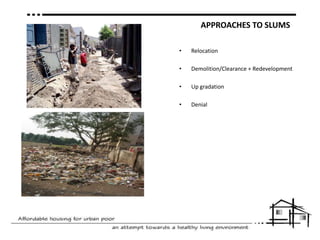
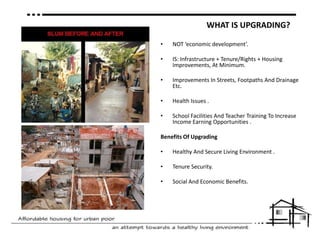
INTRODUCTIONPresently, Indian population is 1/6th of the world population. Accelerating urbanization is forcefully effecting  the transformation of Indian society. Slightly more than 28% of the country’s population is urbanized, but unfortunately 21.68% (61.8 million) of the urban population lives in slum area. As per last NBO report total housing shortage was 19.4 million unit. In urban area the shortage is 6.6 million unit and 90% of these shortage hits poor and LIG people. It has become a very common urban scenario that thousands of dwellings made of straw, mud, tin etc and are squeezed into area of a small city block. In these cramped dwellings, often only an arm-span in width, entire family lives without running water, electricity etc. Few have beds, they sleep on scraps of cloth padding on dirty floor.Need and justification for selection of the topicThe population is growing at a larger scale in india and most of its people live in urban areas. For a higher growth and to avail better job opportunities most of the people in villages are migrating towards cities or urban areas and slum areas are developed at a larger scale due to overcrowding and limited job opportunities.Slums are characterized by overcrowding, kutcha or dilapidated structures, unhygienic conditions, grossly inadequate basic amenities, unplanned layouts and poor accessibility. These are generally house economically weaker sections of the community who are after engaged in causal service occupations.Thus the resulting demand for such problems is housing.
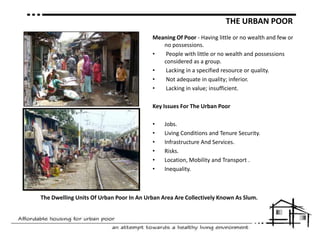
THE URBAN POORMeaning OfPoor - Having little or no wealth and few or no possessions. People with little or no wealth and possessions considered as a group. Lacking in a specified resource or quality.  Not adequate in quality; inferior. Lacking in value; insufficient.Key Issues For The Urban PoorJobs.Living Conditions and Tenure Security.Infrastructure And Services.Risks.Location, Mobility and Transport .Inequality.The Dwelling Units Of Urban Poor In An Urban Area Are Collectively Known As Slum.
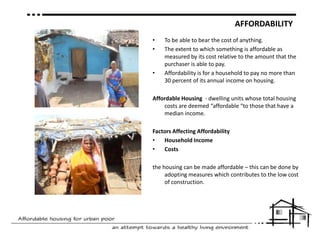
AFFORDABILITYTo be able to bear the cost of anything.The extent to which something is affordable as measured by its cost relative to the amount that the purchaser is able to pay. Affordability is for a household to pay no more than 30 percent of its annual income on housing.Affordable Housing  - dwelling units whose total housing costs are deemed “affordable “to those that have a median income. Factors AffectingAffordabilityHousehold IncomeCoststhe housing can be made affordable – this can be done by adopting measures which contributes to the low cost of construction.
MEANING OF HEALTHY ENVIRONMENTSurrounding Living Conditions.Issues  Causing The Greatest Problems.Environmental Hazards.
AIMS AND OBJECTIVESTo study and understand the physical and psychological needs and problems faced by the urban poor and to establish framework and guidelines for the rehabilitation based on Chhattishgari  lifestyle and to improve the environmental conditions.
METHODOLOGY
SCOPE AND LIMITATIONTo undertake study of a slum area after proper identification and considering the problems and nature of remedies needed.The research work intends to suggest methods to manage sanitation, drinking water, drainage and waste generated in the slum area under study effectively.Though the study and waste management system suggested will be focused to a particular slum area, it will be useful and may be possible to implement in other slum areas.This development will continue as a process and not a project.This will form a basis for other settlements to develop and upgrade their standard of living.The project will incorporate all the services required at site level.The final outcome of the project will be in the form of drawings and illustrations showing how the scheme will proceed towards development of infrastructure and services.
THE DEFINITION OF “SLUM” The National Definition of ‘Slum areas’ was set by the Slum Areas Improvement and Clearance act of 1956.1 It defines them as places where buildings:	a) Are in any respect unfit for human habitation;	b) Are by reason of dilapidation, overcrowding, faulty arrangement and design of such buildings, narrowness or faulty arrangement of streets, lack of ventilation, light, sanitation facilities or any combination of these factors which are detrimental to safety, health and morals.The Census of India defines a slum as "a compact area of at least 300 in population or about 60-70 households of poorly built, congested tenements in an unhygienic environment usually with inadequate infrastructure and lacking proper sanitary and drinking water facilities."
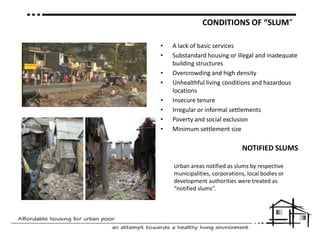
CONDITIONS OF “SLUM” A lack of basic servicesSubstandard housing or illegal and inadequate building structuresOvercrowding and high densityUnhealthful living conditions and hazardous locationsInsecure tenureIrregular or informal settlementsPoverty and social exclusionMinimum settlement sizeNOTIFIED SLUMSUrban areas notified as slums by respective municipalities, corporations, local bodies or development authorities were treated as “notified slums”.
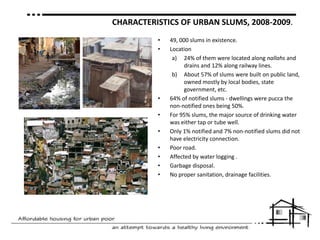
CHARACTERISTICS OF URBAN SLUMS, 2008-2009.49, 000 slums in existence.
Location  24% of them were located along nallahsand drains and 12% along railway lines.About 57% of slums were built on public land, owned mostly by local bodies, state government, etc.64% of notified slums - dwellings were pucca the non-notified ones being 50%.
For 95% slums, the major source of drinking water was either tap or tube well.Only 1% notified and 7% non-notified slums did not have electricity connection.Poor road.Affected by water logging .Garbage disposal.No proper sanitation, drainage facilities.
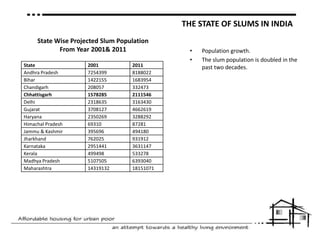
THE STATE OF SLUMS IN INDIAState Wise Projected Slum Population From Year 2001& 2011Population growth.The slum population is doubled in the past two decades.
THE STATE OF SLUMS IN INDIAType Of Structure Of Majority Of  Houses Source Of Drinking Water For Slum Dwellers
THE STATE OF SLUMS IN INDIA
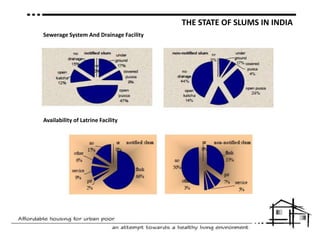
THE STATE OF SLUMS IN INDIASewerage System And Drainage FacilityAvailability of Latrine Facility
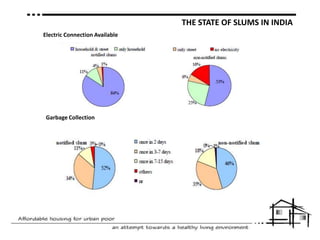
THE STATE OF SLUMS IN INDIAElectric Connection Available Garbage Collection
THE STATE OF SLUMS IN INDIA
HEALTH RISKS TO SLUM DWELLERS Contaminated water (cholera , typhoid, etc)
  Inadequate disposal of human wastes
  Wastewater and garbage
  Insects, pests (e.g. rats) and parasites in homes
  Insufficient living spaces, poor ventilation and overcrowding
  Children at risk from traffic, unsafe or contaminated sites
 Indoor air pollution
 Nutritional deficiencies
 No or inadequate health care and advice
 No emergency services
High rates of mental illness and suicideCAUSES OF SLUMSDecentralizationEconomic condition EducationImproper use of land IndustrializationLack of zoning MigrantsPowers of local authority Repairs and maintenance

13

  • 2.
    INTRODUCTIONPresently, Indian populationis 1/6th of the world population. Accelerating urbanization is forcefully effecting the transformation of Indian society. Slightly more than 28% of the country’s population is urbanized, but unfortunately 21.68% (61.8 million) of the urban population lives in slum area. As per last NBO report total housing shortage was 19.4 million unit. In urban area the shortage is 6.6 million unit and 90% of these shortage hits poor and LIG people. It has become a very common urban scenario that thousands of dwellings made of straw, mud, tin etc and are squeezed into area of a small city block. In these cramped dwellings, often only an arm-span in width, entire family lives without running water, electricity etc. Few have beds, they sleep on scraps of cloth padding on dirty floor.Need and justification for selection of the topicThe population is growing at a larger scale in india and most of its people live in urban areas. For a higher growth and to avail better job opportunities most of the people in villages are migrating towards cities or urban areas and slum areas are developed at a larger scale due to overcrowding and limited job opportunities.Slums are characterized by overcrowding, kutcha or dilapidated structures, unhygienic conditions, grossly inadequate basic amenities, unplanned layouts and poor accessibility. These are generally house economically weaker sections of the community who are after engaged in causal service occupations.Thus the resulting demand for such problems is housing.
  • 3.
    THE URBAN POORMeaningOfPoor - Having little or no wealth and few or no possessions. People with little or no wealth and possessions considered as a group. Lacking in a specified resource or quality. Not adequate in quality; inferior. Lacking in value; insufficient.Key Issues For The Urban PoorJobs.Living Conditions and Tenure Security.Infrastructure And Services.Risks.Location, Mobility and Transport .Inequality.The Dwelling Units Of Urban Poor In An Urban Area Are Collectively Known As Slum.
  • 4.
    AFFORDABILITYTo be ableto bear the cost of anything.The extent to which something is affordable as measured by its cost relative to the amount that the purchaser is able to pay. Affordability is for a household to pay no more than 30 percent of its annual income on housing.Affordable Housing - dwelling units whose total housing costs are deemed “affordable “to those that have a median income. Factors AffectingAffordabilityHousehold IncomeCoststhe housing can be made affordable – this can be done by adopting measures which contributes to the low cost of construction.
  • 5.
    MEANING OF HEALTHYENVIRONMENTSurrounding Living Conditions.Issues Causing The Greatest Problems.Environmental Hazards.
  • 6.
    AIMS AND OBJECTIVESTostudy and understand the physical and psychological needs and problems faced by the urban poor and to establish framework and guidelines for the rehabilitation based on Chhattishgari lifestyle and to improve the environmental conditions.
  • 7.
  • 8.
    SCOPE AND LIMITATIONToundertake study of a slum area after proper identification and considering the problems and nature of remedies needed.The research work intends to suggest methods to manage sanitation, drinking water, drainage and waste generated in the slum area under study effectively.Though the study and waste management system suggested will be focused to a particular slum area, it will be useful and may be possible to implement in other slum areas.This development will continue as a process and not a project.This will form a basis for other settlements to develop and upgrade their standard of living.The project will incorporate all the services required at site level.The final outcome of the project will be in the form of drawings and illustrations showing how the scheme will proceed towards development of infrastructure and services.
  • 9.
    THE DEFINITION OF“SLUM” The National Definition of ‘Slum areas’ was set by the Slum Areas Improvement and Clearance act of 1956.1 It defines them as places where buildings: a) Are in any respect unfit for human habitation; b) Are by reason of dilapidation, overcrowding, faulty arrangement and design of such buildings, narrowness or faulty arrangement of streets, lack of ventilation, light, sanitation facilities or any combination of these factors which are detrimental to safety, health and morals.The Census of India defines a slum as "a compact area of at least 300 in population or about 60-70 households of poorly built, congested tenements in an unhygienic environment usually with inadequate infrastructure and lacking proper sanitary and drinking water facilities."
  • 10.
    CONDITIONS OF “SLUM”A lack of basic servicesSubstandard housing or illegal and inadequate building structuresOvercrowding and high densityUnhealthful living conditions and hazardous locationsInsecure tenureIrregular or informal settlementsPoverty and social exclusionMinimum settlement sizeNOTIFIED SLUMSUrban areas notified as slums by respective municipalities, corporations, local bodies or development authorities were treated as “notified slums”.
  • 11.
    CHARACTERISTICS OF URBANSLUMS, 2008-2009.49, 000 slums in existence.
  • 12.
    Location 24%of them were located along nallahsand drains and 12% along railway lines.About 57% of slums were built on public land, owned mostly by local bodies, state government, etc.64% of notified slums - dwellings were pucca the non-notified ones being 50%.
  • 13.
    For 95% slums,the major source of drinking water was either tap or tube well.Only 1% notified and 7% non-notified slums did not have electricity connection.Poor road.Affected by water logging .Garbage disposal.No proper sanitation, drainage facilities.
  • 14.
    THE STATE OFSLUMS IN INDIAState Wise Projected Slum Population From Year 2001& 2011Population growth.The slum population is doubled in the past two decades.
  • 15.
    THE STATE OFSLUMS IN INDIAType Of Structure Of Majority Of Houses Source Of Drinking Water For Slum Dwellers
  • 16.
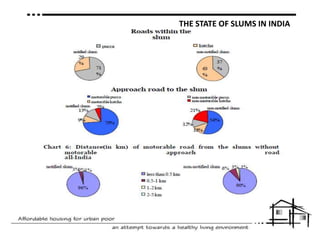
    THE STATE OFSLUMS IN INDIA
  • 17.
    THE STATE OFSLUMS IN INDIASewerage System And Drainage FacilityAvailability of Latrine Facility
  • 18.
    THE STATE OFSLUMS IN INDIAElectric Connection Available Garbage Collection
  • 19.
    THE STATE OFSLUMS IN INDIA
  • 20.
    HEALTH RISKS TOSLUM DWELLERS Contaminated water (cholera , typhoid, etc)
  • 21.
    Inadequatedisposal of human wastes
  • 22.
    Wastewaterand garbage
  • 23.
    Insects,pests (e.g. rats) and parasites in homes
  • 24.
    Insufficientliving spaces, poor ventilation and overcrowding
  • 25.
    Childrenat risk from traffic, unsafe or contaminated sites
  • 26.
    Indoor airpollution
  • 27.
  • 28.
    No orinadequate health care and advice
  • 29.
  • 30.
    High rates ofmental illness and suicideCAUSES OF SLUMSDecentralizationEconomic condition EducationImproper use of land IndustrializationLack of zoning MigrantsPowers of local authority Repairs and maintenance

Editor's Notes

  • #13 India's urban population is increasing at a faster rate than its total population.The slum population is constantly increasing: it has doubled in the past two decades.