1
SLUM DEFINTIONS, TYPOLOGY &
CHARATERISTICS
DEFINITION BYCENSUS OF INDIA
1. All areas notified as “Slum” by state/local Government and UT (Union Territories) administration
under particular slum act.
2. All areas recognized as “Slum” by state/local Government and UT (Union Territories)
administration, which have not formally notified as slum under the slum act.
3. A compact area at least 300 population or about 60-70 household of poorly built congested
tenements in unhygienic environment usually which inadequate infrastructure and lacking in
proper sanitary and drinking water facilities (Census of India: 2001)10.
_____________________________________________________
2
URDPFI GUIDELINES-
Slums are legal/ illegal substandard settlements with a lack of adequate
services .
3
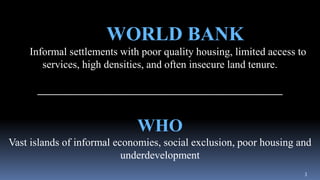
WORLD BANK
Informal settlements with poor quality housing, limited access to
services, high densities, and often insecure land tenure.
______________________________________________
WHO
Vast islands of informal economies, social exclusion, poor housing and
underdevelopment
4
The National Housing Authority Of Thailand (NHA) defines
slum as:
A dirty, damp, swampy or unhealthy area with overcrowded buildings and
dwellings which can be harmful for health or lives or can be a source of
unlawful or immoral actions, with a minimum number of 30 housing units
per 1,600 square metres’
___________________________________________________________
The Bangkok Metropolitan Authority defines a slum as:
‘An overcrowded, non-orderly and dilapidated community with unample
[sic] environment which can be harmful to health and lives and with a
minimum of 15 housing units per area (1,600 square metres)’.
5
DEFINITION OF SLUMS BYBergel
“Slums may be characterized as areas of sub – standard housing condition
within a city. A slum is always an area a single neglected building even in
the worst stage of deterioration does not make a slum”.
________________________________________
Ford's definition of a slum is:
The slum is a residential area in which housing is so deteriorated, so
substandard, or so unwholesome as to be a menace to the health, safety,
morality or welfare of the occupants
DEFINITION OF SLUM BYMarshall Clinard
Slum have been commonly define as those portions of cities
in which housing is crowded, Neglected, deteriorated and
often obsolete” .
6
_______________________________________________
ACCORDING TO RAO RATNA
“A physically deteriorated area where human beings
live an organized life of their own thought they are
economically poor”
Types of slums in India
• All notified areas in a town or city notified as ‘Slum’ by
State, UT Administration or Local Government under any
Act including a ‘Slum Act’.
Notified Slums
• All areas recognized as ‘Slum’ by State, UT Administration or Local
Government, Housing and Slum Boards
• It may have not been formally notified as slum under any act .Recognized Slums
• A compact area of at least 300 population or about 60-70 households
• poorly built congested tenements, in unhygienic environment usually
with inadequate infrastructure and lacking in proper sanitary and
drinking water facilities (Identified).
Identified Slums
7
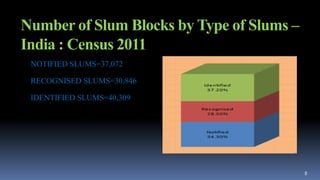
Number of Slum Blocks by Type of Slums –
India : Census 2011
8
NOTIFIED SLUMS=37,072
RECOGNISED SLUMS=30,846
IDENTIFIED SLUMS=40,309
9
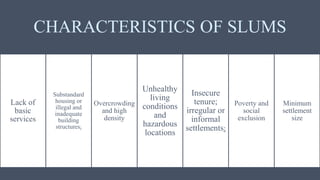
CHARACTERISTICS OF SLUMS
Lack of
basic
services
Substandard
housing or
illegal and
inadequate
building
structures:
Overcrowding
and high
density
Unhealthy
living
conditions
and
hazardous
locations
Insecure
tenure;
irregular or
informal
settlements:
Poverty and
social
exclusion
Minimum
settlement
size
SLUMS FORMATION
Slum
formation
Poverty
Income
inequality
Lack of
economic growth
Lack of
affordable housing
In-migration
10
POLICIES & SCHEMES FOR SLUMS
1. Slum Rehabilitation Schemes (SRS) across
2. Ahmadabad: Role of an External Agency.
3. Environmental Improvement of Urban Slums (EIUS) and Slum Improvement Programme
(SIP) .
4. Urban Basic Services for Poor (UBSP)
5. The Low Cost Sanitation (LCS) Programme,
6. The Slum Networking Programme (SNP)3
7. The Sites and Services (S&S) Schemes
8. Slum Up gradation Programme (SUP)
9. Basic Services for the Urban Poor (BSUP) and the Integrated Housing and Slum
Development Programme (IHSDP)
10. Rajiv Awas Yojana (RAY)
11. The National Slum Development Programme(NSDP)
12. Jawaharlal Nehru National Urban Renewal Mission (JNNURM)
13. Slum Areas (Improvement and Clearance) Act, 1956
SCHEMES
12
13
5 YEAR PLANS
14
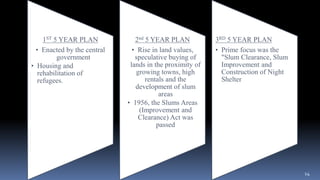
1ST 5 YEAR PLAN
• Enacted by the central
government
• Housing and
rehabilitation of
refugees.
2nd 5 YEAR PLAN
• Rise in land values,
speculative buying of
lands in the proximity of
growing towns, high
rentals and the
development of slum
areas
• 1956, the Slums Areas
(Improvement and
Clearance) Act was
passed
3RD 5 YEAR PLAN
• Prime focus was the
"Slum Clearance, Slum
Improvement and
Construction of Night
Shelter
4th 5 YEAR PLAN
• Urban Land Policy-
• Environment
Improvement of Urban
Slums (1972-73)
6TH 5 YEAR PLAN
• Slum improvement , low
cost water supply schemes,
small scale employment
generation , drainage and
sanitation, were the major
components
15
5TH 5 YEAR PLAN
•For infrastructural development
of cities with population over
300,000
•The sites and services scheme
for making serviced land
available to the poor was
launched in this plan period
7th 5 YEAR PLAN
• “Radical (re)orientation of all
policies related to housing”
• Entrusted responsibility of
housing construction to the
private sector.
8TH 5 YEAR PLAN
• Convergence of all related
programmes, i.e. IDSMT,
housing and infrastructure
development programmes of
HUDCO, NRY and UBSP
• Educated Unemployed of
Employment Generation in
Urban Localities (SEEGUL)
9TH 5 YEAR PLAN
• Alleviation of urban poverty
and unemployment
• (JNNURM) ,2005 :
Preparation of CDP’s
• Accelerated development of
housing, particularly for the
low income groups
16
17
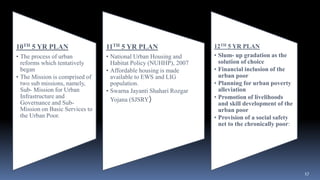
10TH 5 YR PLAN
• The process of urban
reforms which tentatively
began
• The Mission is comprised of
two sub missions, namely,
Sub- Mission for Urban
Infrastructure and
Governance and Sub-
Mission on Basic Services to
the Urban Poor.
11TH 5 YR PLAN
• National Urban Housing and
Habitat Policy (NUHHP), 2007
• Affordable housing is made
available to EWS and LIG
population.
• Swarna Jayanti Shahari Rozgar
Yojana (SJSRY)
12TH 5 YR PLAN
• Slum- up gradation as the
solution of choice
• Financial inclusion of the
urban poor
• Planning for urban poverty
alleviation
• Promotion of livelihoods
and skill development of the
urban poor
• Provision of a social safety
net to the chronically poor:
18
THANK YOU

Slums

  • 1.
  • 2.
    DEFINITION BYCENSUS OFINDIA 1. All areas notified as “Slum” by state/local Government and UT (Union Territories) administration under particular slum act. 2. All areas recognized as “Slum” by state/local Government and UT (Union Territories) administration, which have not formally notified as slum under the slum act. 3. A compact area at least 300 population or about 60-70 household of poorly built congested tenements in unhygienic environment usually which inadequate infrastructure and lacking in proper sanitary and drinking water facilities (Census of India: 2001)10. _____________________________________________________ 2 URDPFI GUIDELINES- Slums are legal/ illegal substandard settlements with a lack of adequate services .
  • 3.
    3 WORLD BANK Informal settlementswith poor quality housing, limited access to services, high densities, and often insecure land tenure. ______________________________________________ WHO Vast islands of informal economies, social exclusion, poor housing and underdevelopment
  • 4.
    4 The National HousingAuthority Of Thailand (NHA) defines slum as: A dirty, damp, swampy or unhealthy area with overcrowded buildings and dwellings which can be harmful for health or lives or can be a source of unlawful or immoral actions, with a minimum number of 30 housing units per 1,600 square metres’ ___________________________________________________________ The Bangkok Metropolitan Authority defines a slum as: ‘An overcrowded, non-orderly and dilapidated community with unample [sic] environment which can be harmful to health and lives and with a minimum of 15 housing units per area (1,600 square metres)’.
  • 5.
    5 DEFINITION OF SLUMSBYBergel “Slums may be characterized as areas of sub – standard housing condition within a city. A slum is always an area a single neglected building even in the worst stage of deterioration does not make a slum”. ________________________________________ Ford's definition of a slum is: The slum is a residential area in which housing is so deteriorated, so substandard, or so unwholesome as to be a menace to the health, safety, morality or welfare of the occupants
  • 6.
    DEFINITION OF SLUMBYMarshall Clinard Slum have been commonly define as those portions of cities in which housing is crowded, Neglected, deteriorated and often obsolete” . 6 _______________________________________________ ACCORDING TO RAO RATNA “A physically deteriorated area where human beings live an organized life of their own thought they are economically poor”
  • 7.
    Types of slumsin India • All notified areas in a town or city notified as ‘Slum’ by State, UT Administration or Local Government under any Act including a ‘Slum Act’. Notified Slums • All areas recognized as ‘Slum’ by State, UT Administration or Local Government, Housing and Slum Boards • It may have not been formally notified as slum under any act .Recognized Slums • A compact area of at least 300 population or about 60-70 households • poorly built congested tenements, in unhygienic environment usually with inadequate infrastructure and lacking in proper sanitary and drinking water facilities (Identified). Identified Slums 7
  • 8.
    Number of SlumBlocks by Type of Slums – India : Census 2011 8 NOTIFIED SLUMS=37,072 RECOGNISED SLUMS=30,846 IDENTIFIED SLUMS=40,309
  • 9.
    9 CHARACTERISTICS OF SLUMS Lackof basic services Substandard housing or illegal and inadequate building structures: Overcrowding and high density Unhealthy living conditions and hazardous locations Insecure tenure; irregular or informal settlements: Poverty and social exclusion Minimum settlement size
  • 10.
    SLUMS FORMATION Slum formation Poverty Income inequality Lack of economicgrowth Lack of affordable housing In-migration 10
  • 11.
  • 12.
    1. Slum RehabilitationSchemes (SRS) across 2. Ahmadabad: Role of an External Agency. 3. Environmental Improvement of Urban Slums (EIUS) and Slum Improvement Programme (SIP) . 4. Urban Basic Services for Poor (UBSP) 5. The Low Cost Sanitation (LCS) Programme, 6. The Slum Networking Programme (SNP)3 7. The Sites and Services (S&S) Schemes 8. Slum Up gradation Programme (SUP) 9. Basic Services for the Urban Poor (BSUP) and the Integrated Housing and Slum Development Programme (IHSDP) 10. Rajiv Awas Yojana (RAY) 11. The National Slum Development Programme(NSDP) 12. Jawaharlal Nehru National Urban Renewal Mission (JNNURM) 13. Slum Areas (Improvement and Clearance) Act, 1956 SCHEMES 12
  • 13.
  • 14.
    14 1ST 5 YEARPLAN • Enacted by the central government • Housing and rehabilitation of refugees. 2nd 5 YEAR PLAN • Rise in land values, speculative buying of lands in the proximity of growing towns, high rentals and the development of slum areas • 1956, the Slums Areas (Improvement and Clearance) Act was passed 3RD 5 YEAR PLAN • Prime focus was the "Slum Clearance, Slum Improvement and Construction of Night Shelter
  • 15.
    4th 5 YEARPLAN • Urban Land Policy- • Environment Improvement of Urban Slums (1972-73) 6TH 5 YEAR PLAN • Slum improvement , low cost water supply schemes, small scale employment generation , drainage and sanitation, were the major components 15 5TH 5 YEAR PLAN •For infrastructural development of cities with population over 300,000 •The sites and services scheme for making serviced land available to the poor was launched in this plan period
  • 16.
    7th 5 YEARPLAN • “Radical (re)orientation of all policies related to housing” • Entrusted responsibility of housing construction to the private sector. 8TH 5 YEAR PLAN • Convergence of all related programmes, i.e. IDSMT, housing and infrastructure development programmes of HUDCO, NRY and UBSP • Educated Unemployed of Employment Generation in Urban Localities (SEEGUL) 9TH 5 YEAR PLAN • Alleviation of urban poverty and unemployment • (JNNURM) ,2005 : Preparation of CDP’s • Accelerated development of housing, particularly for the low income groups 16
  • 17.
    17 10TH 5 YRPLAN • The process of urban reforms which tentatively began • The Mission is comprised of two sub missions, namely, Sub- Mission for Urban Infrastructure and Governance and Sub- Mission on Basic Services to the Urban Poor. 11TH 5 YR PLAN • National Urban Housing and Habitat Policy (NUHHP), 2007 • Affordable housing is made available to EWS and LIG population. • Swarna Jayanti Shahari Rozgar Yojana (SJSRY) 12TH 5 YR PLAN • Slum- up gradation as the solution of choice • Financial inclusion of the urban poor • Planning for urban poverty alleviation • Promotion of livelihoods and skill development of the urban poor • Provision of a social safety net to the chronically poor:
  • 18.