Unit 2
INSPECTION AND GENERAL
INSTRUMENTS
Linear andAngular Measurements:
⚫The Linear Measurement
measurements of length,
includes
diameters,
⚫The Angular measurement includes
the measurement of angles or tapers
heights and thickness
Measurements:
⚫Measurement systems are mainly used
in industries for quality control.
⚫Often widely using measurements are
◦ Linear Measurement
◦ Angular measurement
Classification of Linear measuring instruments:
⚫A very common measurement is that of
dimensions,i.e.,length,width,height of an
object
⚫Linear measuring instruments are classified as
follows,
Low resolution devices (up to 0.25mm)
Medium resolution devices (up to 0.0025mm)
High resolution devices (less than microns)
Low resolution devices:
⚫Steel rule
⚫Steel rule with assistance of
◦ Calipers
◦ Dividers &
◦ Surface gauges
⚫Thickness gauges
Medium resolution devices:
⚫Micrometer
⚫Micrometer with assistance of
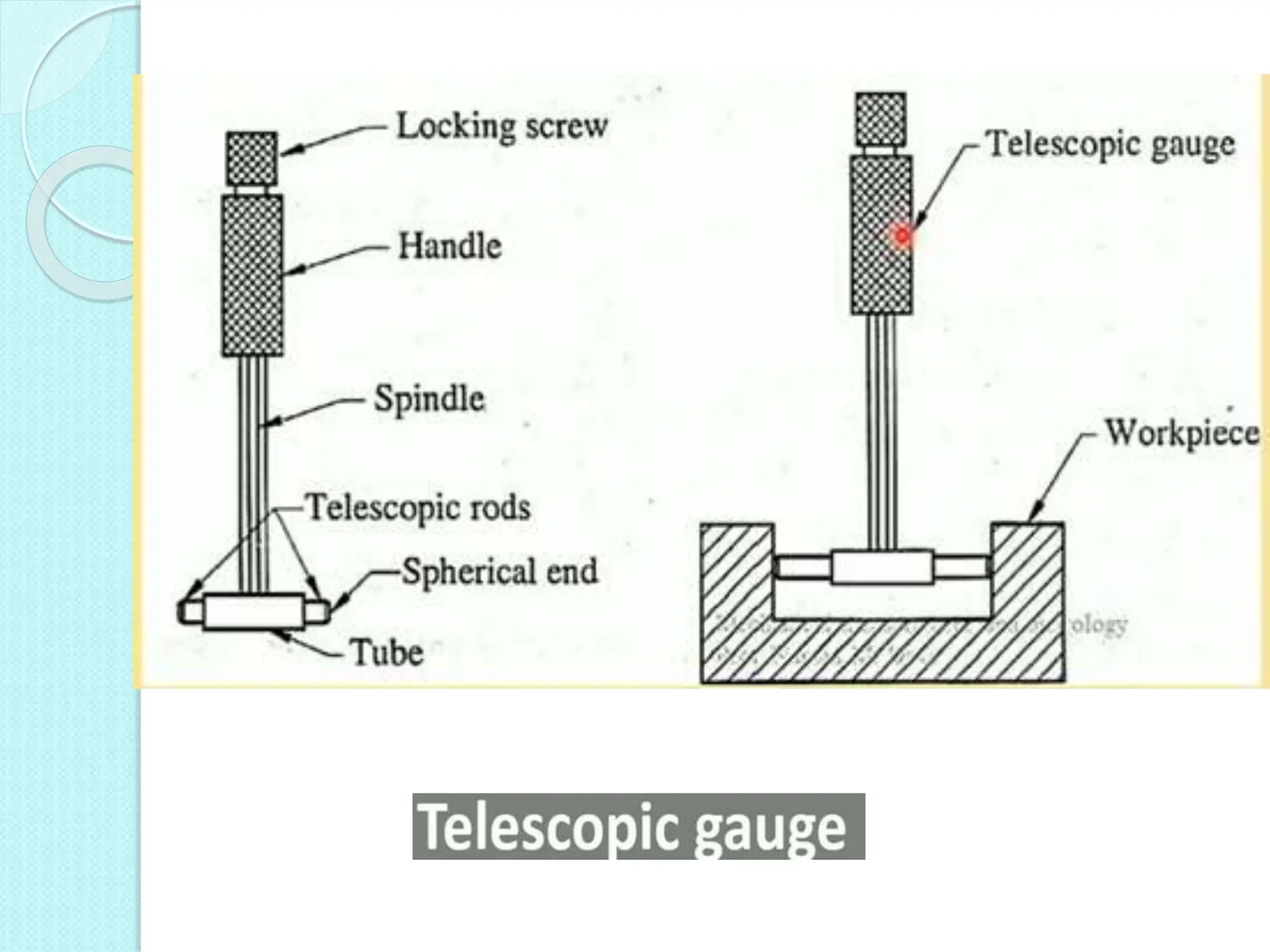
◦ Telescoping
◦ Extendable ball gauges
⚫Vernier calipers
⚫Dial indicators
⚫Microscope
High resolution devices:
⚫Gauge blocks
⚫Gauge block with assistance of
◦ Mechanical comparator
◦ Electronic comparator
◦ Pneumatic comparator
◦ Optical flats
Linear Measuring Instruments:
⚫Vernier caliper
⚫Micrometer
⚫Slip gauge or gauge blocks
⚫Optical flats
⚫Interferometer
⚫Comparators
VERNIER CALIPER:
⚫ Vernier calipers are available in size of 150
mm, 225 mm,900 mm and 1200 mm.
⚫ The selection of the size depends on the
measurements to be taken.
⚫ Vernier calipers are precision instruments,
and extreme care should be taken while handing
them.
Vernier caliper:
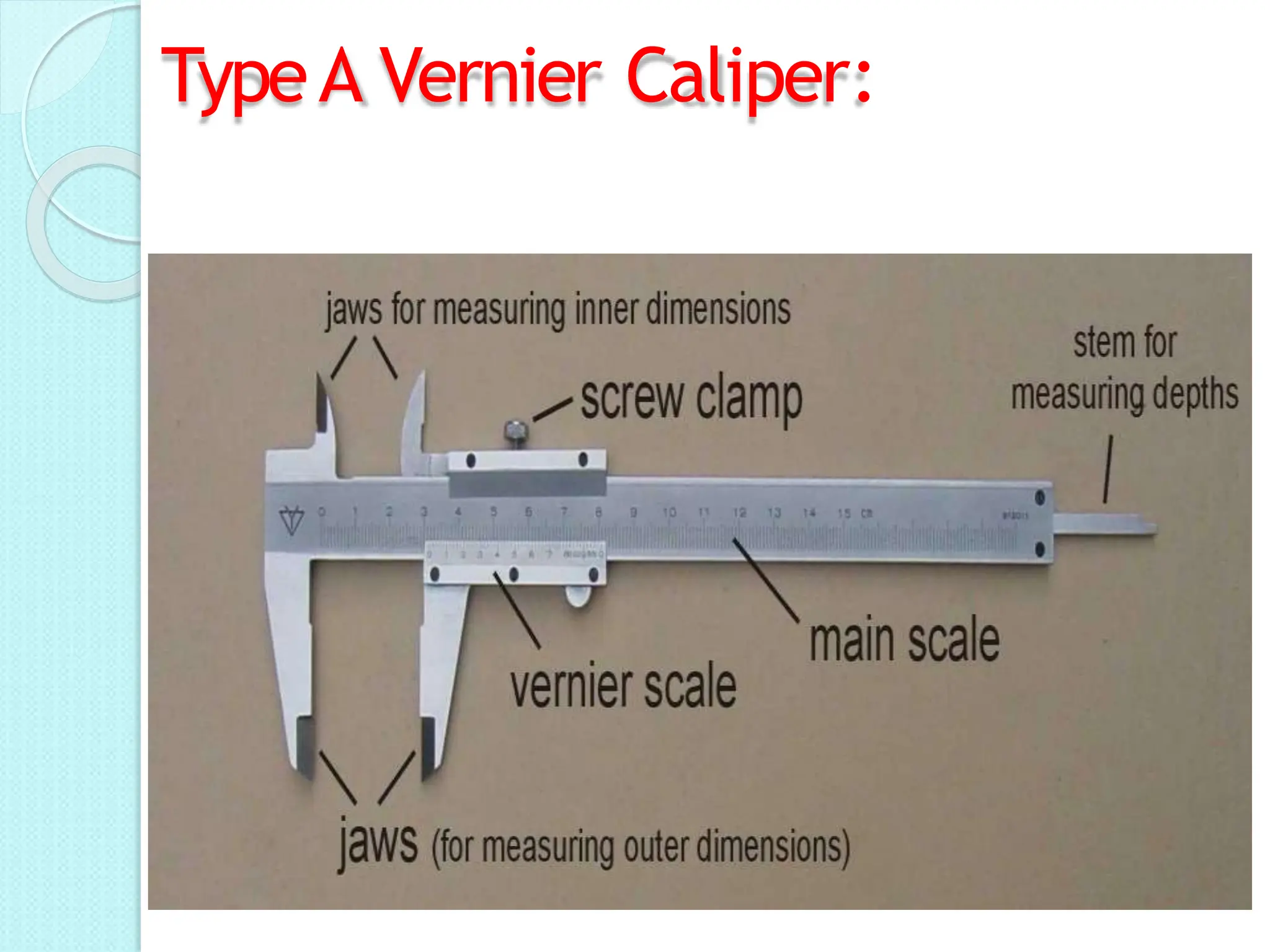
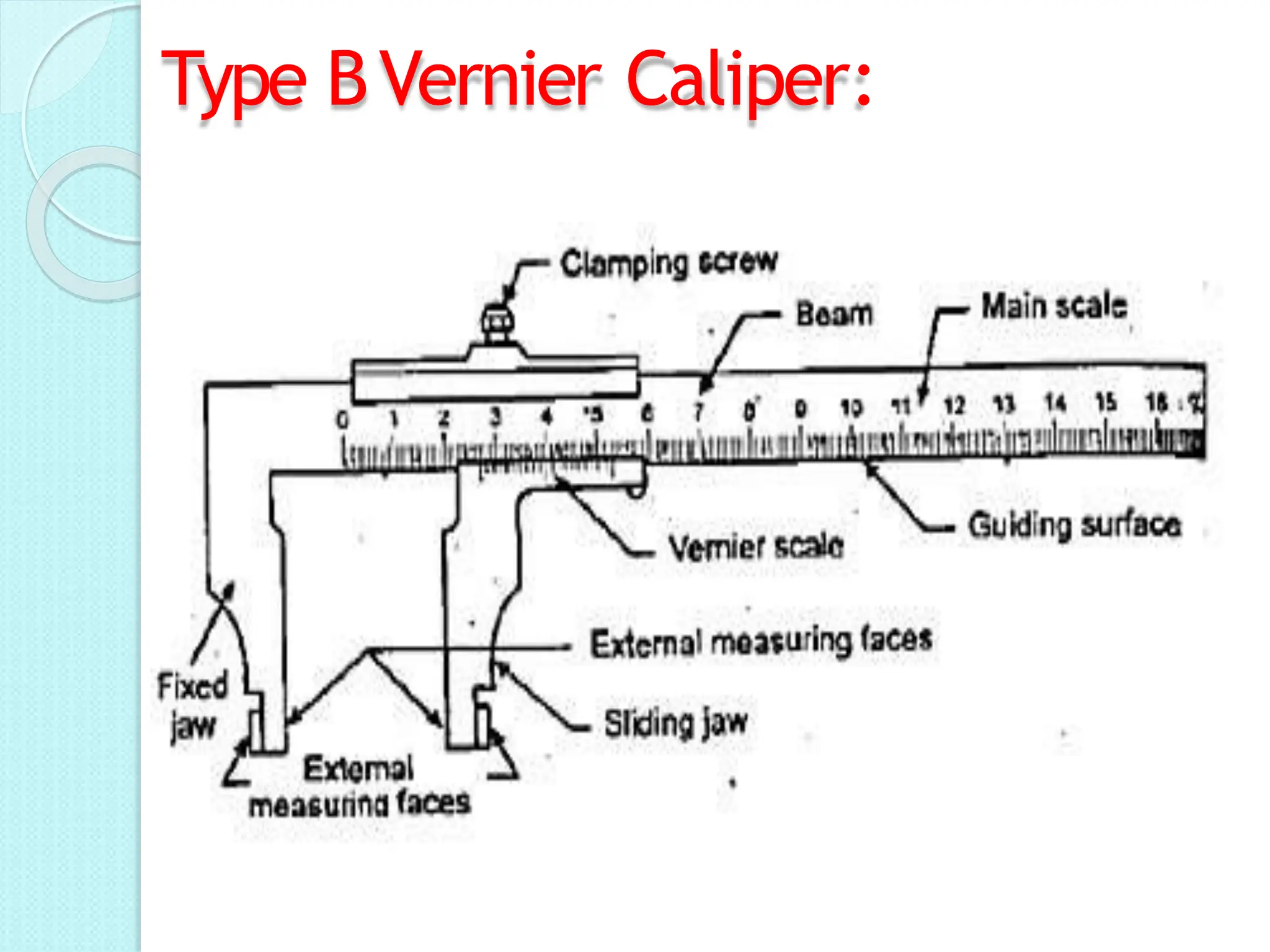
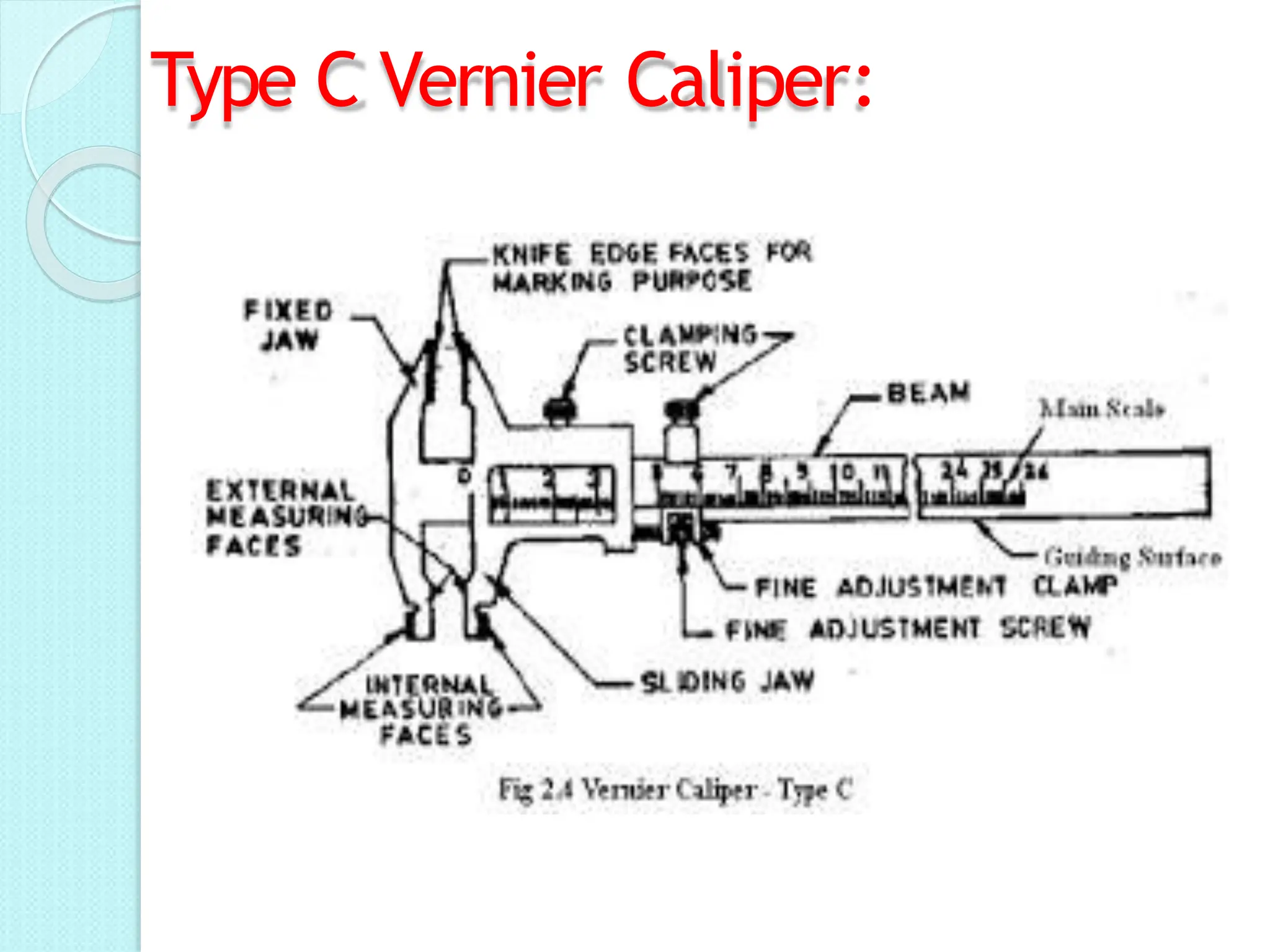
⚫Components ofVernier calipers are
◦ Main scale
◦ Vernier scale
◦ Fixed jaw
◦ Movable jaw
⚫T
ypes ofVernier calipers
◦ T
ypeA vernier caliper
◦ T
ype B vernier caliper
◦ T
ype C vernier caliper
TypeA Vernier Caliper:
Type BVernier Caliper:
Type C Vernier Caliper:
Vernier caliper:
VERIER CALIPER WITH 0.02MM LEAST COUNT IS GENERLY USED
IM WORK SHOP.
In this Vernier caliper main scale division (49mm) are divided in to 50
equal part in the Vernier scale.
=1 mm
=4950 mm
i.e. 1 main scale division
(MSD)
1.Vernier scale division
(VSD)
Least count is 1mm – 4950 =150 mm
THE DIFFERENCE BETWEEN 1.MSD and 1. VSD=0.02MM
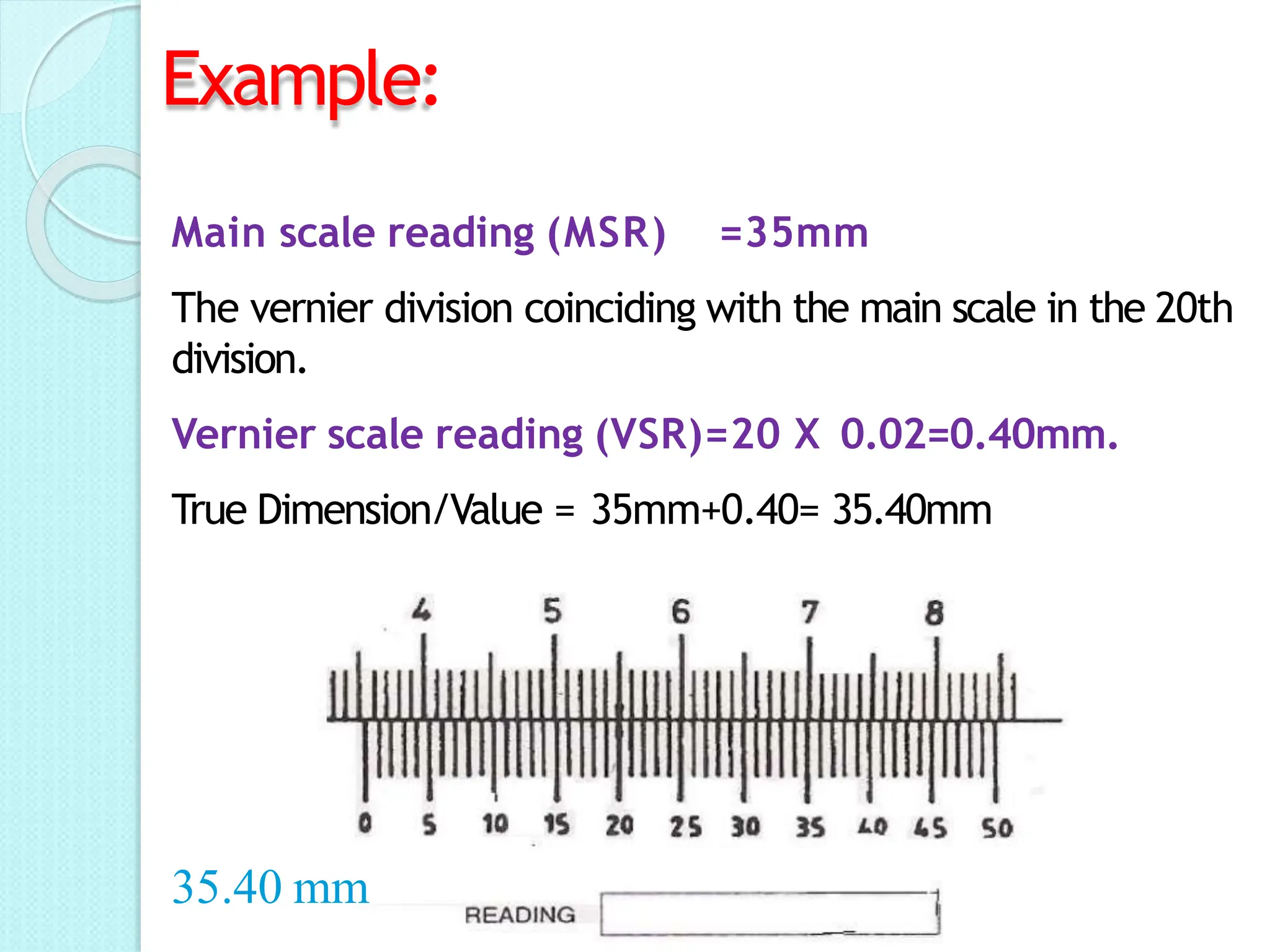
Example:
Main scale reading (MSR) =35mm
The vernier division coinciding with the main scale in the 20th
division.
Vernier scale reading (VSR)=20 X 0.02=0.40mm.
True Dimension/Value = 35mm+0.40= 35.40mm
35.40 mm
Vernier Depth Gauge:
 A vernier depth is very commonly used
precision instrument for measuring depth of
holes recesses,slot and step.
 Its construction and method of reading are
similar to those of a vernier caliper.
VERNIER DEPTH GAUGE:
 Base
 Graduated beam
 Clamping screw
 Fine adjustment mechanism
 Vernier scale
VERNIER DEPTH GAUGE
Errors in depth measurement
Base is Lifted when measured point is slided with pressure
Point pressure causes the base a triffle
Gauge is imperceptible
VERNIER HEIGHT GAUGE:
.
The main parts of a vernier
height gauge and their
function are given
 Base
 Beam
 Vernier slide
 Fine setting device
 Vernier plate
 Locking screws
 Scriber
VERNIER HEIGHT GAUGE
MICRO METER :
A micro meter is a precision instrument
used to measure a job, generally within an
accuracy of 0.01mm.
take
used to
are know
the outside
as outside
Micrometer
measurements
micrometer.
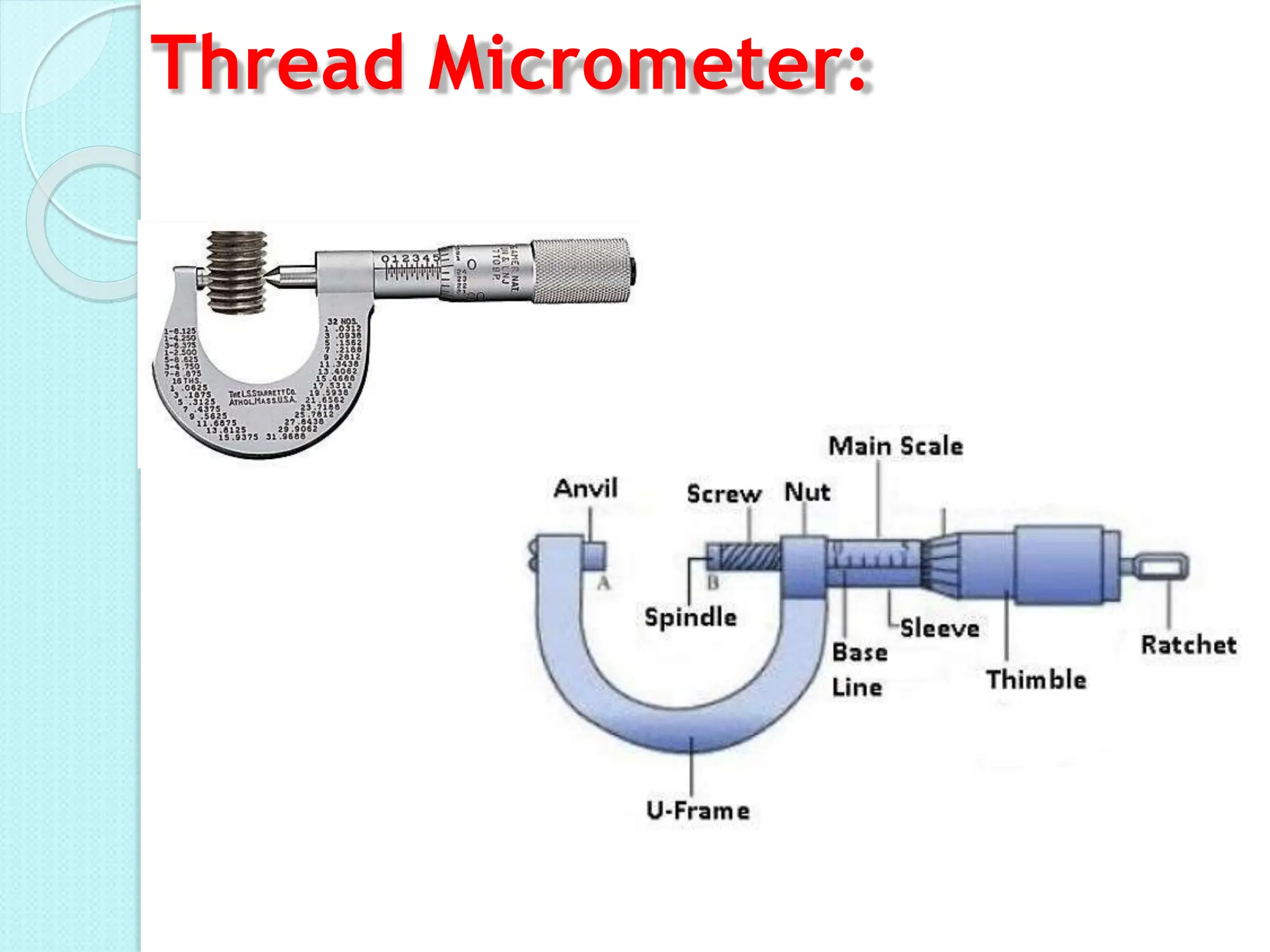
PARTS OF MICROMETER:
1. Frame
2. Anvil and spindle
3. Screwed spindle
4. Graduated sleeve or barrel
5. Ratchet or friction stop
6. Spindle clamp
Inside Micrometer:
Stick Micrometer:
Micrometer Depth Gauge:
Thread Micrometer:
V-Anvil Micrometer:
Reading the MICRO METER :
Reading the MICRO METER : contd.,
Bore gauge
Most bore gauges consist of a dial
indicator, extension pieces, bezel and
locknut, spring-loaded guide, and sensor
button
Measuring a bore with a bore gauge
.
practice is to check the
bore gauge in the standard
after you take each set of
measurements
to ensure that readings
are accurate
Gauge blocks – Use and precautions
28/01/2012 lec# 7 & 8
41
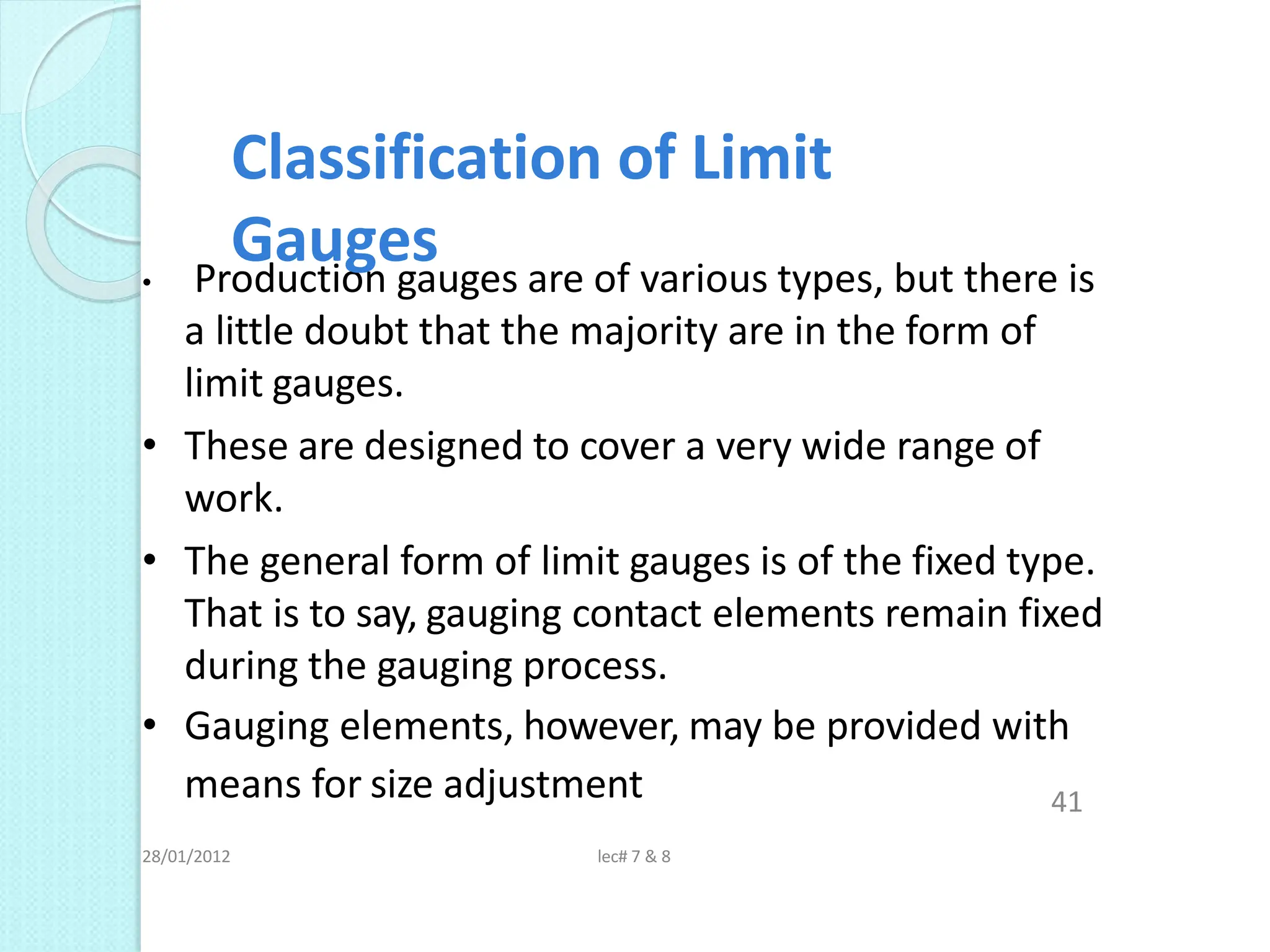
• Production gauges are of various types, but there is
a little doubt that the majority are in the form of
limit gauges.
• These are designed to cover a very wide range of
work.
• The general form of limit gauges is of the fixed type.
That is to say, gauging contact elements remain fixed
during the gauging process.
• Gauging elements, however, may be provided with
means for size adjustment
Classification of Limit
Gauges
28/01/2012 lec# 7 & 8
42
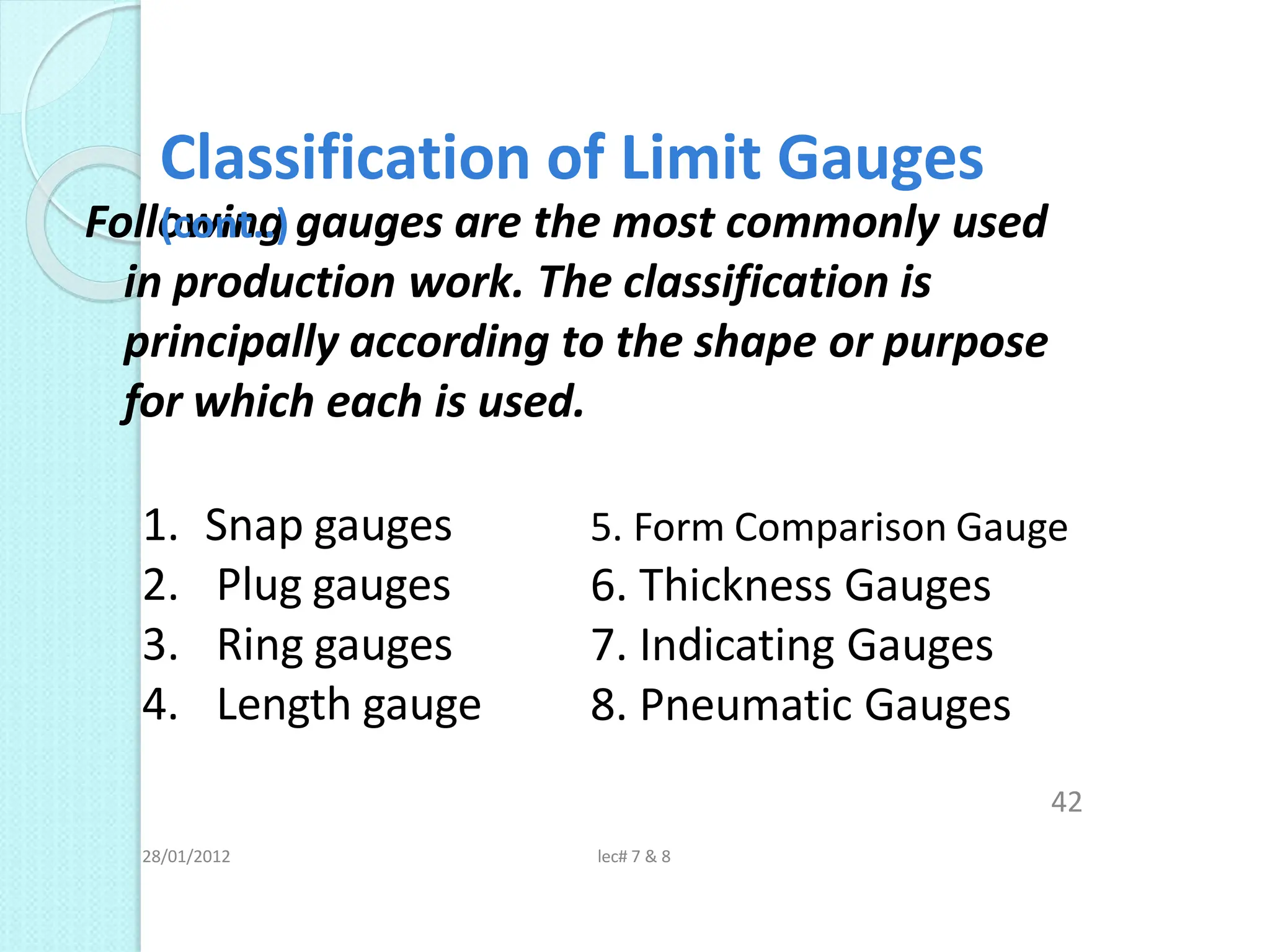
Following gauges are the most commonly used
in production work. The classification is
principally according to the shape or purpose
for which each is used.
1. Snap gauges 5. Form Comparison Gauge
6. Thickness Gauges
7. Indicating Gauges
8. Pneumatic Gauges
2. Plug gauges
3. Ring gauges
4. Length gauge
Classification of Limit Gauges
(cont..)
28/01/2012 lec# 7 & 8
43
9. Electric Gauges
10. Electronic Gauges
11. Projecting Gauges
12. Multiple Dimension Gauges
Classification of Limit Gauges
(cont..)
28/01/2012 lec# 7 & 8
44
1. Snap Gauges:
a. A Snap gauge is used in the measurement of
external dimensions,
b. It consist of a U-shaped frame having jaws
equipped with suitable gauging surfaces.
c. A plan gauge has two parallel jaws or anvils
which are made to some standard size & cannot
be adjusted
d. They may be either single-or double -ended
Description of some commonly used gauges:
28/01/2012 lec# 7 & 8
45
1. Snap Gauges: (Cont..)
e. Special forgings & stampings are
available commercially for their
manufacture, or they may be constructed
from gauge plate
f. Special snap or gap gauges may have to
be used for checking the recessed
diameters & other features
Description of some commonly used gauges: (Cont..)
Snap Or Gap
Gauge
28/01/2012 lec# 7 & 8
46
28/01/2012 lec# 7 & 8
47
2. Plug Gauges:
◦ A plain plug gauge is an accurate cylinder used
as an internal gauge for size control of holes
◦ It is provided with a suitable handle for holding
& is made in a variety of styles
◦ These gauges may be either single or double
ended
◦ Double ended plain gauges have “GO” and “NOT
GO” members assembled on opposite ends,
where as Progressive gauges have both gauging
sections combined on one side
Description of some commonly used gauges: (Cont..)
28/01/2012 lec# 7 & 8
48
2. Plug Gauges: (cont..)
Possible Forms of Plug Gauges:
a. Solid Type (Double ended)
b. Solid Type (Single ended)
c. Renewable-end type (Double ended)
d. Progressive Type
e. Shell form type (Double ended)
f. Shell form type (Single ended)
g. Bar end Type
h. Special Types
Description of some commonly used gauges: (Cont..)
Plug
Gauge
28/01/2012 lec# 7 & 8
49
28/01/2012 lec# 7 & 8
50
3. Ring Gauges:
– Used to gauge outside diameters
– Used in Pairs as “Go” & “Not Go”
4. Taper Gauges:
– Taper gauges are not dimensional gauges but
rather a means of checking in terms of degrees
– Their use is a matter more of fitting rather than
measuring
Description of some commonly used gauges: (Cont..)
Ring, Taper Plug & Taper Hole Gauge
28/01/2012 lec# 7 & 8
51
28/01/2012 lec# 7 & 8
52
5. Thickness or Feeder Gauge:
◦ It consist of a number of thin blades & is used in
checking clearances & for gauging in narrow places
6. Dial Gauge:
◦ Dial gauges or Dial Test Indicators are used for checking
flatness of surfaces & parallelism of bars & rods
◦ They are also used for testing the m/c tools
◦ They can also be used for measurement of linear
dimensions of jobs which require easy readability &
moderate precision
Description of some commonly used gauges: (Cont..)
Thickness
Gauge
28/01/2012 lec# 7 & 8
53
Dial
Gauge
28/01/2012 lec# 7 & 8
54
Comparators – Working and advantages
MECHANICAL COMPARATOR
Advantages
•Mechanical comparators are not
expensive as compared to other types of
amplifying devices.
•These types of comparators don't need
any external electricity supply.
•It has extremely high magnification.
•Its optical lever is lightweight.
•These are easily understood due to a
linear scale.
ELECTRICAL COMPARATOR
Advantages of Electrical
Comparator:
•Vibrations are reduced due to
least weight of mechanical.
•It consists of less moving parts.
•By AC supply the friction errors
are reduced.
•For measuring units the
indicating instrument can be held
at remote locations.
Advantages of pneumatic
comparator
It is very accurate and precise.
High magnification up to 30000:
1 is possible in a pneumatic
comparator. Since indicating
device and measuring head are
placed at different places, there
is no interference. They are self-
cleaning because a jet of air
helps in cleaning the workpiece
Opto-mechanical measurements using
measuring microscope
OPTICAL MICROSCOPY
PROFILE PROJECTOR
Angular measuring instruments
Bevel protractor
UNIVERSAL BEVELPROTECTOR
clinometer
The clinometer is a tool used by plumbers,
surveyors, miners, skiers, artillery gunners, sailors,
foresters, and chiropractors to measure angles of
elevation and to determine slopes using gravity.
Although the clinometer was invented in 1889 by
William B. Melick, it is still used today to measure
the heights of objects that are difficult or cannot
be directly measured.
Angle gauges
Level gauges are sensing and measuring devices used to monitor the
level of a fluid in a tank or other storage container. These instruments
are commonly used in industrial process applications to monitor fluid
levels in drums, tanks, pressure vessels, and other similar applications.
The gauge comprises numerous pieces, including a head, float,
measuring tape, bottom anchored bracket, guide wires, elbows,
anchors, coupler, pipe support brackets, and pipework.
Level gauges have various benefits, including tolerating high
pressure, temperature, and vibrations in difficult situations. They can
be used in conjunction with a switch or alarm in a system and are
easily read from a distance. They need minimum maintenance, may be
repaired without disrupting the system, and can be tailored for
demanding applications.
Level gauges are frequently used when a direct physical measurement
of the fluid’s level is either impossible or impractical, such as when the
fluid being measured is toxic, or the tank or vessel carrying the liquid is
sealed and under pressure.
Precision level
SINE BAR
Angle dekkor
Alignment telescope
Measurement of Gears

UNIT - 2 - MM MOD - Copy.pptx

  • 1.
    Unit 2 INSPECTION ANDGENERAL INSTRUMENTS
  • 2.
    Linear andAngular Measurements: ⚫TheLinear Measurement measurements of length, includes diameters, ⚫The Angular measurement includes the measurement of angles or tapers heights and thickness
  • 3.
    Measurements: ⚫Measurement systems aremainly used in industries for quality control. ⚫Often widely using measurements are ◦ Linear Measurement ◦ Angular measurement
  • 4.
    Classification of Linearmeasuring instruments: ⚫A very common measurement is that of dimensions,i.e.,length,width,height of an object ⚫Linear measuring instruments are classified as follows, Low resolution devices (up to 0.25mm) Medium resolution devices (up to 0.0025mm) High resolution devices (less than microns)
  • 5.
    Low resolution devices: ⚫Steelrule ⚫Steel rule with assistance of ◦ Calipers ◦ Dividers & ◦ Surface gauges ⚫Thickness gauges
  • 6.
    Medium resolution devices: ⚫Micrometer ⚫Micrometerwith assistance of ◦ Telescoping ◦ Extendable ball gauges ⚫Vernier calipers ⚫Dial indicators ⚫Microscope
  • 7.
    High resolution devices: ⚫Gaugeblocks ⚫Gauge block with assistance of ◦ Mechanical comparator ◦ Electronic comparator ◦ Pneumatic comparator ◦ Optical flats
  • 8.
    Linear Measuring Instruments: ⚫Verniercaliper ⚫Micrometer ⚫Slip gauge or gauge blocks ⚫Optical flats ⚫Interferometer ⚫Comparators
  • 9.
    VERNIER CALIPER: ⚫ Verniercalipers are available in size of 150 mm, 225 mm,900 mm and 1200 mm. ⚫ The selection of the size depends on the measurements to be taken. ⚫ Vernier calipers are precision instruments, and extreme care should be taken while handing them.
  • 10.
    Vernier caliper: ⚫Components ofVerniercalipers are ◦ Main scale ◦ Vernier scale ◦ Fixed jaw ◦ Movable jaw ⚫T ypes ofVernier calipers ◦ T ypeA vernier caliper ◦ T ype B vernier caliper ◦ T ype C vernier caliper
  • 11.
  • 12.
  • 13.
  • 14.
  • 15.
  • 16.
  • 17.
    Vernier caliper: VERIER CALIPERWITH 0.02MM LEAST COUNT IS GENERLY USED IM WORK SHOP. In this Vernier caliper main scale division (49mm) are divided in to 50 equal part in the Vernier scale. =1 mm =4950 mm i.e. 1 main scale division (MSD) 1.Vernier scale division (VSD) Least count is 1mm – 4950 =150 mm THE DIFFERENCE BETWEEN 1.MSD and 1. VSD=0.02MM
  • 18.
    Example: Main scale reading(MSR) =35mm The vernier division coinciding with the main scale in the 20th division. Vernier scale reading (VSR)=20 X 0.02=0.40mm. True Dimension/Value = 35mm+0.40= 35.40mm 35.40 mm
  • 19.
    Vernier Depth Gauge: A vernier depth is very commonly used precision instrument for measuring depth of holes recesses,slot and step.  Its construction and method of reading are similar to those of a vernier caliper.
  • 20.
    VERNIER DEPTH GAUGE: Base  Graduated beam  Clamping screw  Fine adjustment mechanism  Vernier scale
  • 21.
  • 22.
    Errors in depthmeasurement Base is Lifted when measured point is slided with pressure Point pressure causes the base a triffle Gauge is imperceptible
  • 23.
    VERNIER HEIGHT GAUGE: . Themain parts of a vernier height gauge and their function are given  Base  Beam  Vernier slide  Fine setting device  Vernier plate  Locking screws  Scriber
  • 24.
  • 25.
    MICRO METER : Amicro meter is a precision instrument used to measure a job, generally within an accuracy of 0.01mm. take used to are know the outside as outside Micrometer measurements micrometer.
  • 26.
    PARTS OF MICROMETER: 1.Frame 2. Anvil and spindle 3. Screwed spindle 4. Graduated sleeve or barrel 5. Ratchet or friction stop 6. Spindle clamp
  • 27.
  • 28.
  • 29.
  • 30.
  • 31.
  • 32.
  • 33.
    Reading the MICROMETER : contd.,
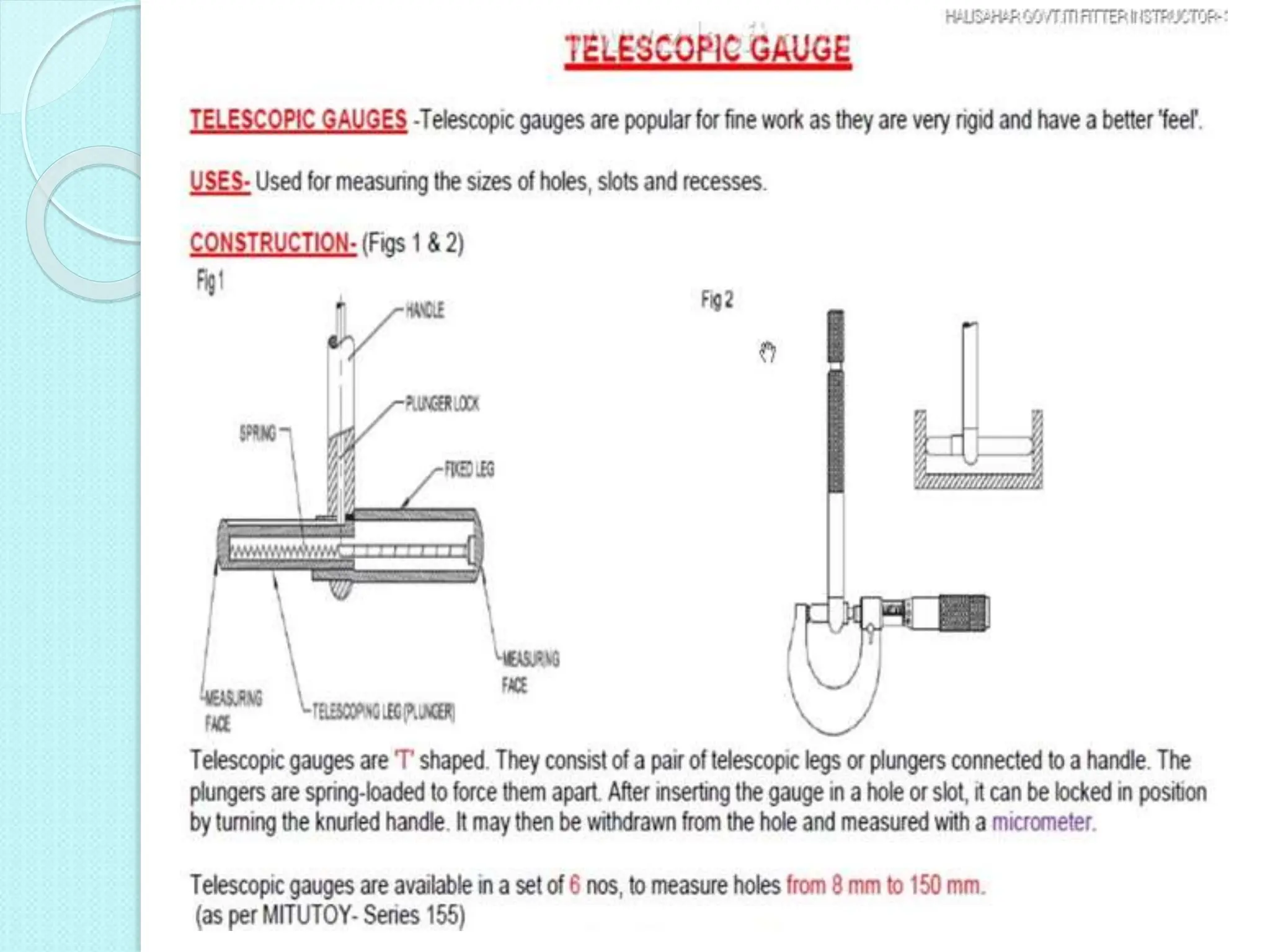
  • 34.
    Bore gauge Most boregauges consist of a dial indicator, extension pieces, bezel and locknut, spring-loaded guide, and sensor button
  • 35.
    Measuring a borewith a bore gauge . practice is to check the bore gauge in the standard after you take each set of measurements to ensure that readings are accurate
  • 38.
    Gauge blocks –Use and precautions
  • 41.
    28/01/2012 lec# 7& 8 41 • Production gauges are of various types, but there is a little doubt that the majority are in the form of limit gauges. • These are designed to cover a very wide range of work. • The general form of limit gauges is of the fixed type. That is to say, gauging contact elements remain fixed during the gauging process. • Gauging elements, however, may be provided with means for size adjustment Classification of Limit Gauges
  • 42.
    28/01/2012 lec# 7& 8 42 Following gauges are the most commonly used in production work. The classification is principally according to the shape or purpose for which each is used. 1. Snap gauges 5. Form Comparison Gauge 6. Thickness Gauges 7. Indicating Gauges 8. Pneumatic Gauges 2. Plug gauges 3. Ring gauges 4. Length gauge Classification of Limit Gauges (cont..)
  • 43.
    28/01/2012 lec# 7& 8 43 9. Electric Gauges 10. Electronic Gauges 11. Projecting Gauges 12. Multiple Dimension Gauges Classification of Limit Gauges (cont..)
  • 44.
    28/01/2012 lec# 7& 8 44 1. Snap Gauges: a. A Snap gauge is used in the measurement of external dimensions, b. It consist of a U-shaped frame having jaws equipped with suitable gauging surfaces. c. A plan gauge has two parallel jaws or anvils which are made to some standard size & cannot be adjusted d. They may be either single-or double -ended Description of some commonly used gauges:
  • 45.
    28/01/2012 lec# 7& 8 45 1. Snap Gauges: (Cont..) e. Special forgings & stampings are available commercially for their manufacture, or they may be constructed from gauge plate f. Special snap or gap gauges may have to be used for checking the recessed diameters & other features Description of some commonly used gauges: (Cont..)
  • 46.
  • 47.
    28/01/2012 lec# 7& 8 47 2. Plug Gauges: ◦ A plain plug gauge is an accurate cylinder used as an internal gauge for size control of holes ◦ It is provided with a suitable handle for holding & is made in a variety of styles ◦ These gauges may be either single or double ended ◦ Double ended plain gauges have “GO” and “NOT GO” members assembled on opposite ends, where as Progressive gauges have both gauging sections combined on one side Description of some commonly used gauges: (Cont..)
  • 48.
    28/01/2012 lec# 7& 8 48 2. Plug Gauges: (cont..) Possible Forms of Plug Gauges: a. Solid Type (Double ended) b. Solid Type (Single ended) c. Renewable-end type (Double ended) d. Progressive Type e. Shell form type (Double ended) f. Shell form type (Single ended) g. Bar end Type h. Special Types Description of some commonly used gauges: (Cont..)
  • 49.
  • 50.
    28/01/2012 lec# 7& 8 50 3. Ring Gauges: – Used to gauge outside diameters – Used in Pairs as “Go” & “Not Go” 4. Taper Gauges: – Taper gauges are not dimensional gauges but rather a means of checking in terms of degrees – Their use is a matter more of fitting rather than measuring Description of some commonly used gauges: (Cont..)
  • 51.
    Ring, Taper Plug& Taper Hole Gauge 28/01/2012 lec# 7 & 8 51
  • 52.
    28/01/2012 lec# 7& 8 52 5. Thickness or Feeder Gauge: ◦ It consist of a number of thin blades & is used in checking clearances & for gauging in narrow places 6. Dial Gauge: ◦ Dial gauges or Dial Test Indicators are used for checking flatness of surfaces & parallelism of bars & rods ◦ They are also used for testing the m/c tools ◦ They can also be used for measurement of linear dimensions of jobs which require easy readability & moderate precision Description of some commonly used gauges: (Cont..)
  • 53.
  • 54.
  • 55.
    Comparators – Workingand advantages MECHANICAL COMPARATOR
  • 56.
    Advantages •Mechanical comparators arenot expensive as compared to other types of amplifying devices. •These types of comparators don't need any external electricity supply. •It has extremely high magnification. •Its optical lever is lightweight. •These are easily understood due to a linear scale.
  • 57.
  • 58.
    Advantages of Electrical Comparator: •Vibrationsare reduced due to least weight of mechanical. •It consists of less moving parts. •By AC supply the friction errors are reduced. •For measuring units the indicating instrument can be held at remote locations.
  • 60.
    Advantages of pneumatic comparator Itis very accurate and precise. High magnification up to 30000: 1 is possible in a pneumatic comparator. Since indicating device and measuring head are placed at different places, there is no interference. They are self- cleaning because a jet of air helps in cleaning the workpiece
  • 61.
    Opto-mechanical measurements using measuringmicroscope OPTICAL MICROSCOPY
  • 63.
  • 64.
  • 65.
  • 67.
  • 68.
    clinometer The clinometer isa tool used by plumbers, surveyors, miners, skiers, artillery gunners, sailors, foresters, and chiropractors to measure angles of elevation and to determine slopes using gravity. Although the clinometer was invented in 1889 by William B. Melick, it is still used today to measure the heights of objects that are difficult or cannot be directly measured.
  • 70.
  • 73.
    Level gauges aresensing and measuring devices used to monitor the level of a fluid in a tank or other storage container. These instruments are commonly used in industrial process applications to monitor fluid levels in drums, tanks, pressure vessels, and other similar applications. The gauge comprises numerous pieces, including a head, float, measuring tape, bottom anchored bracket, guide wires, elbows, anchors, coupler, pipe support brackets, and pipework. Level gauges have various benefits, including tolerating high pressure, temperature, and vibrations in difficult situations. They can be used in conjunction with a switch or alarm in a system and are easily read from a distance. They need minimum maintenance, may be repaired without disrupting the system, and can be tailored for demanding applications. Level gauges are frequently used when a direct physical measurement of the fluid’s level is either impossible or impractical, such as when the fluid being measured is toxic, or the tank or vessel carrying the liquid is sealed and under pressure. Precision level
  • 75.
  • 77.
  • 78.
  • 84.