International Surgery Journal | August 2023 | Vol 10 | Issue 8 Page 1400
International Surgery Journal
Vagholkar K et al. Int Surg J. 2023 Aug;10(8):1400-1402
http://www.ijsurgery.com pISSN 2349-3305 | eISSN 2349-2902
Case Report
Sliding inguinal hernia: a technical challenge
Ketan Vagholkar*, Tanay Purandare
INTRODUCTION
Sliding inguinal hernia is an uncommon hernia. It was
first described by Gallen and later described with
specificity by Antonio Scarpa.1,2
The most precise way of
defining a sliding inguinal hernia is when the viscera
constitute a part of the wall of the sac. In other words,
herniation of the extraperitoneal surface of an organ. On
the left side the content is usually the sigmoid colon
followed by the urinary bladder. Whereas on the right
side, the content is usually the caecum and appendix
followed by the urinary bladder. It is quite difficult to
diagnose a sliding hernia pre-operatively. A case of
sliding inguinal hernia containing the sigmoid colon is
presented.
CASE REPORT
A 54-year-old male patient presented with a large left
sided inguino-scrotal swelling. The duration of the
swelling was 3 years. The swelling had increased in size
over a period of time and had become irreducible. There
was no history of symptoms suggestive of obstruction,
strangulation or alteration in bowel habits.
Physical examination revealed a large partially
irreducible left sided inguinoscrotal hernia. A USG of the
swelling revealed bowel loops. Patient underwent
surgical repair under regional anesthesia. The sac was
identified and dissected free from the cord structures. The
contents of the sac couldn’t be reduced fully. The sac was
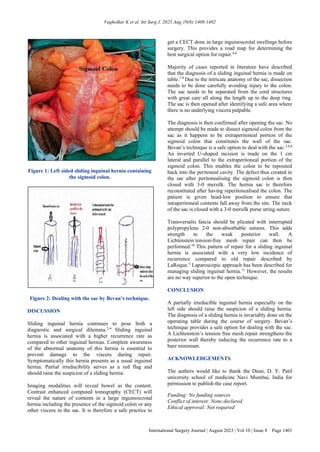
opened at a safe site. The content was a large length of
the sigmoid colon (Figure 1).
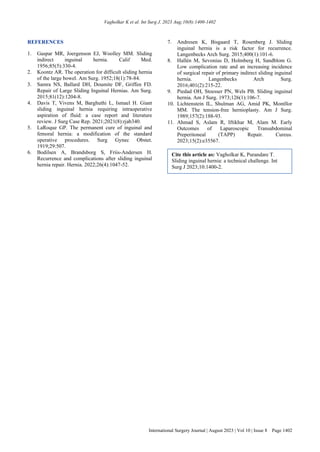
Bevan’s technique was used to deal with the sac (Figure
2). An inverted U-Shaped incision was made parallel and
1 cm away from the attachment of the sac and sigmoid
colon up to the deep ring. The sigmoid colon was
reposited back into the peritoneum cavity and defect in
the wall of the sac was sutured with 3-0 mersilk. The sac
was closed by a purse string suture flush with the plane of
the inferior epigastric artery. The transversalis fascia was
plicated with interrupted 2-0 Prolene sutures. A tension
free Lichtenstein mesh repair was done.
The layers of the incision were closed. A firm scrotal
support was given for 48 hours. Skin staples were
removed on the tenth postoperative day. Patient has been
following up for one year with no evidence of the
recurrence.
ABSTRACT
Sliding inguinal hernia continues to be the most challenging hernia to treat. Both diagnosis and treatment pose a
dilemma to the attending surgeon. Understanding the pathological anatomy of the sliding inguinal hernia is essential
for optimal choice of surgical procedure without causing damage to the involved viscera. A case of sliding inguinal
hernia is presented to highlight the diagnostic and technical challenges for repair of sliding hernia. Majority of sliding
hernias are diagnosed at the time of surgery. Sigmoid colon is a commonest content in a left sided sliding hernia.
Bevan’s technique is best suited to deal with the sac followed by Lichtenstein tension-free mesh repair.
Keywords: Sliding, Inguinal, Hernia, Treatment
Department of Surgery, D.Y. Patil University School of Medicine, Navi Mumbai, Maharashtra, India
Received: 07 February 2023
Accepted: 06 July 2023
*Correspondence:
Dr. Ketan Vagholkar,
E-mail: kvagholkar@yahoo.com
Copyright: © the author(s), publisher and licensee Medip Academy. This is an open-access article distributed under
the terms of the Creative Commons Attribution Non-Commercial License, which permits unrestricted non-commercial
use, distribution, and reproduction in any medium, provided the original work is properly cited.
DOI: https://dx.doi.org/10.18203/2349-2902.isj20232163
Vagholkar K et al. Int Surg J. 2023 Aug;10(8):1400-1402
International Surgery Journal | August 2023 | Vol 10 | Issue 8 Page 1401
Figure 1: Left sided sliding inguinal hernia containing
the sigmoid colon.
Figure 2: Dealing with the sac by Bevan’s technique.
DISCUSSION
Sliding inguinal hernia continues to pose both a
diagnostic and surgical dilemma.2-4
Sliding inguinal
hernia is associated with a higher recurrence rate as
compared to other inguinal hernias. Complete awareness
of the abnormal anatomy of this hernia is essential to
prevent damage to the viscera during repair.
Symptomatically this hernia presents as a usual inguinal
hernia. Partial irreducibility serves as a red flag and
should raise the suspicion of a sliding hernia.
Imaging modalities will reveal bowel as the content.
Contrast enhanced computed tomography (CECT) will
reveal the nature of contents in a large inguinoscrotal
hernia including the presence of the sigmoid colon or any
other viscera in the sac. It is therefore a safe practice to
get a CECT done in large inguinoscrotal swellings before
surgery. This provides a road map for determining the
best surgical option for repair.4-6
Majority of cases reported in literature have described
that the diagnosis of a sliding inguinal hernia is made on
table.7-9
Due to the intricate anatomy of the sac, dissection
needs to be done carefully avoiding injury to the colon.
The sac needs to be separated from the cord structures
with great care all along the length up to the deep ring.
The sac is then opened after identifying a safe area where
there is no underlying viscera palpable.
The diagnosis is then confirmed after opening the sac. No
attempt should be made to dissect sigmoid colon from the
sac as it happens to be extraperitoneal portion of the
sigmoid colon that constitutes the wall of the sac.
Bevan’s technique is a safe option to deal with the sac.3,4,8
An inverted U-shaped incision is made on the 1 cm
lateral and parallel to the extraperitoneal portion of the
sigmoid colon. This enables the colon to be reposited
back into the peritoneal cavity. The defect thus created in
the sac after peritonealising the sigmoid colon is then
closed with 3-0 mersilk. The hernia sac is therefore
reconstituted after having reperitonealised the colon. The
patient is given head-low position to ensure that
intraperitoneal contents fall away from the site. The neck
of the sac is closed with a 3-0 mersilk purse string suture.
Transversalis fascia should be plicated with interrupted
polypropylene 2-0 non-absorbable sutures. This adds
strength to the weak posterior wall. A
Lichtenstein tension-free mesh repair can then be
performed.10
This pattern of repair for a sliding inguinal
hernia is associated with a very low incidence of
recurrence compared to old repair described by
LaRoque.5
Laparoscopic approach has been described for
managing sliding inguinal hernia.11
However, the results
are no way superior to the open technique.
CONCLUSION
A partially irreducible inguinal hernia especially on the
left side should raise the suspicion of a sliding hernia.
The diagnosis of a sliding hernia is invariably done on the
operating table during the course of surgery. Bevan’s
technique provides a safe option for dealing with the sac.
A Lichtenstein’s tension free mesh repair strengthens the
posterior wall thereby reducing the recurrence rate to a
bare minimum.
ACKNOWLEDGEMENTS
The authors would like to thank the Dean, D. Y. Patil
university school of medicine Navi Mumbai, India for
permission to publish the case report.
Funding: No funding sources
Conflict of interest: None declared
Ethical approval: Not required
Vagholkar K et al. Int Surg J. 2023 Aug;10(8):1400-1402
International Surgery Journal | August 2023 | Vol 10 | Issue 8 Page 1402
REFERENCES
1. Gaspar MR, Joergenson EJ, Woolley MM. Sliding
indirect inguinal hernia. Calif Med.
1956;85(5):330-4.
2. Koontz AR. The operation for difficult sliding hernia
of the large bowel. Am Surg. 1952;18(1):78-84.
3. Samra NS, Ballard DH, Doumite DF, Griffen FD.
Repair of Large Sliding Inguinal Hernias. Am Surg.
2015;81(12):1204-8.
4. Davis T, Vivens M, Barghuthi L, Ismael H. Giant
sliding inguinal hernia requiring intraoperative
aspiration of fluid: a case report and literature
review. J Surg Case Rep. 2021;2021(8):rjab340.
5. LaRoque GP. The permanent cure of inguinal and
femoral hernia: a modification of the standard
operative procedures. Surg Gynec Obstet.
1919;29:507.
6. Bodilsen A, Brandsborg S, Friis-Andersen H.
Recurrence and complications after sliding inguinal
hernia repair. Hernia. 2022;26(4):1047-52.
7. Andresen K, Bisgaard T, Rosenberg J. Sliding
inguinal hernia is a risk factor for recurrence.
Langenbecks Arch Surg. 2015;400(1):101-6.
8. Hallén M, Sevonius D, Holmberg H, Sandblom G.
Low complication rate and an increasing incidence
of surgical repair of primary indirect sliding inguinal
hernia. Langenbecks Arch Surg.
2016;401(2):215-22.
9. Piedad OH, Stoesser PN, Wels PB. Sliding inguinal
hernia. Am J Surg. 1973;126(1):106-7.
10. Lichtenstein IL, Shulman AG, Amid PK, Montllor
MM. The tension-free hernioplasty. Am J Surg.
1989;157(2):188-93.
11. Ahmad S, Aslam R, Iftikhar M, Alam M. Early
Outcomes of Laparoscopic Transabdominal
Preperitoneal (TAPP) Repair. Cureus.
2023;15(2):e35567.
Cite this article as: Vagholkar K, Purandare T.
Sliding inguinal hernia: a technical challenge. Int
Surg J 2023;10:1400-2.

Sliding hernia.pdf

  • 1.
    International Surgery Journal| August 2023 | Vol 10 | Issue 8 Page 1400 International Surgery Journal Vagholkar K et al. Int Surg J. 2023 Aug;10(8):1400-1402 http://www.ijsurgery.com pISSN 2349-3305 | eISSN 2349-2902 Case Report Sliding inguinal hernia: a technical challenge Ketan Vagholkar*, Tanay Purandare INTRODUCTION Sliding inguinal hernia is an uncommon hernia. It was first described by Gallen and later described with specificity by Antonio Scarpa.1,2 The most precise way of defining a sliding inguinal hernia is when the viscera constitute a part of the wall of the sac. In other words, herniation of the extraperitoneal surface of an organ. On the left side the content is usually the sigmoid colon followed by the urinary bladder. Whereas on the right side, the content is usually the caecum and appendix followed by the urinary bladder. It is quite difficult to diagnose a sliding hernia pre-operatively. A case of sliding inguinal hernia containing the sigmoid colon is presented. CASE REPORT A 54-year-old male patient presented with a large left sided inguino-scrotal swelling. The duration of the swelling was 3 years. The swelling had increased in size over a period of time and had become irreducible. There was no history of symptoms suggestive of obstruction, strangulation or alteration in bowel habits. Physical examination revealed a large partially irreducible left sided inguinoscrotal hernia. A USG of the swelling revealed bowel loops. Patient underwent surgical repair under regional anesthesia. The sac was identified and dissected free from the cord structures. The contents of the sac couldn’t be reduced fully. The sac was opened at a safe site. The content was a large length of the sigmoid colon (Figure 1). Bevan’s technique was used to deal with the sac (Figure 2). An inverted U-Shaped incision was made parallel and 1 cm away from the attachment of the sac and sigmoid colon up to the deep ring. The sigmoid colon was reposited back into the peritoneum cavity and defect in the wall of the sac was sutured with 3-0 mersilk. The sac was closed by a purse string suture flush with the plane of the inferior epigastric artery. The transversalis fascia was plicated with interrupted 2-0 Prolene sutures. A tension free Lichtenstein mesh repair was done. The layers of the incision were closed. A firm scrotal support was given for 48 hours. Skin staples were removed on the tenth postoperative day. Patient has been following up for one year with no evidence of the recurrence. ABSTRACT Sliding inguinal hernia continues to be the most challenging hernia to treat. Both diagnosis and treatment pose a dilemma to the attending surgeon. Understanding the pathological anatomy of the sliding inguinal hernia is essential for optimal choice of surgical procedure without causing damage to the involved viscera. A case of sliding inguinal hernia is presented to highlight the diagnostic and technical challenges for repair of sliding hernia. Majority of sliding hernias are diagnosed at the time of surgery. Sigmoid colon is a commonest content in a left sided sliding hernia. Bevan’s technique is best suited to deal with the sac followed by Lichtenstein tension-free mesh repair. Keywords: Sliding, Inguinal, Hernia, Treatment Department of Surgery, D.Y. Patil University School of Medicine, Navi Mumbai, Maharashtra, India Received: 07 February 2023 Accepted: 06 July 2023 *Correspondence: Dr. Ketan Vagholkar, E-mail: kvagholkar@yahoo.com Copyright: © the author(s), publisher and licensee Medip Academy. This is an open-access article distributed under the terms of the Creative Commons Attribution Non-Commercial License, which permits unrestricted non-commercial use, distribution, and reproduction in any medium, provided the original work is properly cited. DOI: https://dx.doi.org/10.18203/2349-2902.isj20232163
  • 2.
    Vagholkar K etal. Int Surg J. 2023 Aug;10(8):1400-1402 International Surgery Journal | August 2023 | Vol 10 | Issue 8 Page 1401 Figure 1: Left sided sliding inguinal hernia containing the sigmoid colon. Figure 2: Dealing with the sac by Bevan’s technique. DISCUSSION Sliding inguinal hernia continues to pose both a diagnostic and surgical dilemma.2-4 Sliding inguinal hernia is associated with a higher recurrence rate as compared to other inguinal hernias. Complete awareness of the abnormal anatomy of this hernia is essential to prevent damage to the viscera during repair. Symptomatically this hernia presents as a usual inguinal hernia. Partial irreducibility serves as a red flag and should raise the suspicion of a sliding hernia. Imaging modalities will reveal bowel as the content. Contrast enhanced computed tomography (CECT) will reveal the nature of contents in a large inguinoscrotal hernia including the presence of the sigmoid colon or any other viscera in the sac. It is therefore a safe practice to get a CECT done in large inguinoscrotal swellings before surgery. This provides a road map for determining the best surgical option for repair.4-6 Majority of cases reported in literature have described that the diagnosis of a sliding inguinal hernia is made on table.7-9 Due to the intricate anatomy of the sac, dissection needs to be done carefully avoiding injury to the colon. The sac needs to be separated from the cord structures with great care all along the length up to the deep ring. The sac is then opened after identifying a safe area where there is no underlying viscera palpable. The diagnosis is then confirmed after opening the sac. No attempt should be made to dissect sigmoid colon from the sac as it happens to be extraperitoneal portion of the sigmoid colon that constitutes the wall of the sac. Bevan’s technique is a safe option to deal with the sac.3,4,8 An inverted U-shaped incision is made on the 1 cm lateral and parallel to the extraperitoneal portion of the sigmoid colon. This enables the colon to be reposited back into the peritoneal cavity. The defect thus created in the sac after peritonealising the sigmoid colon is then closed with 3-0 mersilk. The hernia sac is therefore reconstituted after having reperitonealised the colon. The patient is given head-low position to ensure that intraperitoneal contents fall away from the site. The neck of the sac is closed with a 3-0 mersilk purse string suture. Transversalis fascia should be plicated with interrupted polypropylene 2-0 non-absorbable sutures. This adds strength to the weak posterior wall. A Lichtenstein tension-free mesh repair can then be performed.10 This pattern of repair for a sliding inguinal hernia is associated with a very low incidence of recurrence compared to old repair described by LaRoque.5 Laparoscopic approach has been described for managing sliding inguinal hernia.11 However, the results are no way superior to the open technique. CONCLUSION A partially irreducible inguinal hernia especially on the left side should raise the suspicion of a sliding hernia. The diagnosis of a sliding hernia is invariably done on the operating table during the course of surgery. Bevan’s technique provides a safe option for dealing with the sac. A Lichtenstein’s tension free mesh repair strengthens the posterior wall thereby reducing the recurrence rate to a bare minimum. ACKNOWLEDGEMENTS The authors would like to thank the Dean, D. Y. Patil university school of medicine Navi Mumbai, India for permission to publish the case report. Funding: No funding sources Conflict of interest: None declared Ethical approval: Not required
  • 3.
    Vagholkar K etal. Int Surg J. 2023 Aug;10(8):1400-1402 International Surgery Journal | August 2023 | Vol 10 | Issue 8 Page 1402 REFERENCES 1. Gaspar MR, Joergenson EJ, Woolley MM. Sliding indirect inguinal hernia. Calif Med. 1956;85(5):330-4. 2. Koontz AR. The operation for difficult sliding hernia of the large bowel. Am Surg. 1952;18(1):78-84. 3. Samra NS, Ballard DH, Doumite DF, Griffen FD. Repair of Large Sliding Inguinal Hernias. Am Surg. 2015;81(12):1204-8. 4. Davis T, Vivens M, Barghuthi L, Ismael H. Giant sliding inguinal hernia requiring intraoperative aspiration of fluid: a case report and literature review. J Surg Case Rep. 2021;2021(8):rjab340. 5. LaRoque GP. The permanent cure of inguinal and femoral hernia: a modification of the standard operative procedures. Surg Gynec Obstet. 1919;29:507. 6. Bodilsen A, Brandsborg S, Friis-Andersen H. Recurrence and complications after sliding inguinal hernia repair. Hernia. 2022;26(4):1047-52. 7. Andresen K, Bisgaard T, Rosenberg J. Sliding inguinal hernia is a risk factor for recurrence. Langenbecks Arch Surg. 2015;400(1):101-6. 8. Hallén M, Sevonius D, Holmberg H, Sandblom G. Low complication rate and an increasing incidence of surgical repair of primary indirect sliding inguinal hernia. Langenbecks Arch Surg. 2016;401(2):215-22. 9. Piedad OH, Stoesser PN, Wels PB. Sliding inguinal hernia. Am J Surg. 1973;126(1):106-7. 10. Lichtenstein IL, Shulman AG, Amid PK, Montllor MM. The tension-free hernioplasty. Am J Surg. 1989;157(2):188-93. 11. Ahmad S, Aslam R, Iftikhar M, Alam M. Early Outcomes of Laparoscopic Transabdominal Preperitoneal (TAPP) Repair. Cureus. 2023;15(2):e35567. Cite this article as: Vagholkar K, Purandare T. Sliding inguinal hernia: a technical challenge. Int Surg J 2023;10:1400-2.