International Surgery Journal | September 2023 | Vol 10 | Issue 9 Page 1541
International Surgery Journal
Vagholkar K et al. Int Surg J. 2023 Sep;10(9):1541-1543
http://www.ijsurgery.com pISSN 2349-3305 | eISSN 2349-2902
Case Report
Hyperbaric oxygen therapy a boon for complex post traumatic wounds
Ketan Vagholkar*, Aarya Sharma, Mehnish Malik, Siddharth Garg,
Volam Siddhartha, Tanay Purandare
INTRODUCTION
Wound management continues to be the biggest
challenge to a general surgeon. Etiology of wounds is
multifactorial with both intrinsic and extrinsic factors
playing a variable role. There is no specific algorithm for
management of wound healing. A variety of topical
medications are available for treating wounds. However,
the cost and therapeutic efficacy of these products is
debatable. HBOT is a traditional method for treating
resistant wounds. 1
A case of post-traumatic fore foot
gangrene successfully treated by HBOT is presented to
highlight the therapeutic efficacy of HBOT in
management of such challenging wounds.
CASE REPORT
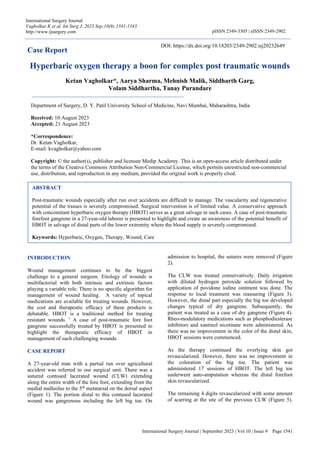
A 27-year-old man with a partial run over agricultural
accident was referred to our surgical unit. There was a
sutured contused lacerated wound (CLW) extending
along the entire width of the fore foot, extending from the
medial malleolus to the 5th
metatarsal on the dorsal aspect
(Figure 1). The portion distal to this contused lacerated
wound was gangrenous including the left big toe. On
admission to hospital, the sutures were removed (Figure
2).
The CLW was treated conservatively. Daily irrigation
with diluted hydrogen peroxide solution followed by
application of povidone iodine ointment was done. The
response to local treatment was reassuring (Figure 3).
However, the distal part especially the big toe developed
changes typical of dry gangrene. Subsequently, the
patient was treated as a case of dry gangrene (Figure 4).
Rheo-modulatory medications such as phosphodiesterase
inhibitors and xantinol nicotinate were administered. As
there was no improvement in the color of the distal skin,
HBOT sessions were commenced.
As the therapy continued the overlying skin got
revascularized. However, there was no improvement in
the coloration of the big toe. The patient was
administered 17 sessions of HBOT. The left big toe
underwent auto-amputation whereas the distal forefoot
skin revascularized.
The remaining 4 digits revascularized with some amount
of scarring at the site of the previous CLW (Figure 5).
ABSTRACT
Post-traumatic wounds especially after run over accidents are difficult to manage. The vascularity and regenerative
potential of the tissues is severely compromised. Surgical intervention is of limited value. A conservative approach
with concomitant hyperbaric oxygen therapy (HBOT) serves as a great salvage in such cases. A case of post-traumatic
forefoot gangrene in a 27-year-old laborer is presented to highlight and create an awareness of the potential benefit of
HBOT in salvage of distal parts of the lower extremity where the blood supply is severely compromised.
Keywords: Hyperbaric, Oxygen, Therapy, Wound, Care
Department of Surgery, D. Y. Patil University School of Medicine, Navi Mumbai, Maharashtra, India
Received: 10 August 2023
Accepted: 21 August 2023
*Correspondence:
Dr. Ketan Vagholkar,
E-mail: kvagholkar@yahoo.com
Copyright: © the author(s), publisher and licensee Medip Academy. This is an open-access article distributed under
the terms of the Creative Commons Attribution Non-Commercial License, which permits unrestricted non-commercial
use, distribution, and reproduction in any medium, provided the original work is properly cited.
DOI: https://dx.doi.org/10.18203/2349-2902.isj20232649
Vagholkar K et al. Int Surg J. 2023 Sep;10(9):1541-1543
International Surgery Journal | September 2023 | Vol 10 | Issue 9 Page 1542
The patient now is able to walk confidently with the left
foot.
Figure 1: On presentation.
Figure 2: After immediate removal of sutures on
admission to hospital.
Figure 3: After 4 sessions of HBOT.
Figure 4: Dry and mummified appearance with dry
gangrene of the left big toe.
Figure 5: After 17 sessions of HBOT.
DISCUSSION
The case presented highlights the important role of
HBOT in the management of complex traumatic wounds.
In wounds, wherein the vascularity is doubtful or
severely compromised it is impossible to achieve healing
by commercially available topical preparations or with
the help of rheomodulatory agents. HBOT is the use of
100% oxygen at pressure greater than the atmospheric
pressure (Greater than 1 atmosphere absolute) [ATA].
The usual therapy comprises administration of 100%
oxygen at 2-3 ATA with an average duration of 60-90
min.1,2
There is no fix protocol with respect to number of
HBOT sessions required. It is a matter of individual
response of each wound to HBOT that determines the
continuation of HBOT sessions.
Vagholkar K et al. Int Surg J. 2023 Sep;10(9):1541-1543
International Surgery Journal | September 2023 | Vol 10 | Issue 9 Page 1543
HBOT has two physical mechanisms of action,
hyperoxygenation and a decrease in bubble size.2,3
Hyperoxygenation takes place in conformity with the
Henry’s Law which results in increase in the dissolved
oxygen content in plasma due to increased partial
pressure of arterial oxygen. A pressure of 3 ATA can
cause approximately 6 mL of oxygen to dissolve in 100
CC of plasma thereby increasing the oxygen delivery to
the tissues by many folds. Decrease in the bubble size is
in conformity with the Boyle’s Law in which the bubble
volume decreases proportionate to increasing pressure.
This mechanism is useful to treating patients suffering
from arterial gas embolism.
The secondary mechanisms of action of HBOT include
vasoconstriction, neo-angiogenesis, proliferation of
fibroblast, oxidative killing by leukocyte and inhibition of
toxins.3,4
Increased oxygen content causes
vasoconstriction in the normal tissue HBOT, auto-
amputation which helps in reducing post-traumatic edema
of the tissues as was seen in the case presented.
Vasoconstriction contrary to the general belief does not
cause hypoxia as it is compensated by increased plasma
oxygen content as well as increase in micro-vascular
blood flow caused by angiogenesis.4
Oxygen also helps in
hydroxylation of lysine and proline residues which are
essential for collagen synthesis as well as for maturation
of collagen. Hence the lack of mature collagen formation
is corrected by HBOT. At a cellular level there is
significant angiogenesis which increases the capillary
network thereby increasing the oxygen delivery. 4-6
HBOT also increases the oxygen gradient between
central and the peripheral portions of the wound thereby
aiding strong angiogenesis. Fibroblast proliferation is
also increased which adds to neovascularization. HBOT
also leads to generation of free oxygen radicals which
typically inhibit bacterial metabolic function, particularly
effective against anaerobes which are destroyed. 6-8
In the case presented vascular doppler reports were
equivocal. The removal of the sutures led to decrease in
the pressure at the level of the subcutaneous plane.
Conservative treatment was the only option as any
overzealous surgical intervention could have jeopardized
the already compromised blood supply thereby hastening
the process of gangrene. The aim of conservative
treatment was to maintain the state of dry gangrene which
was evidenced by mummification of the affected part
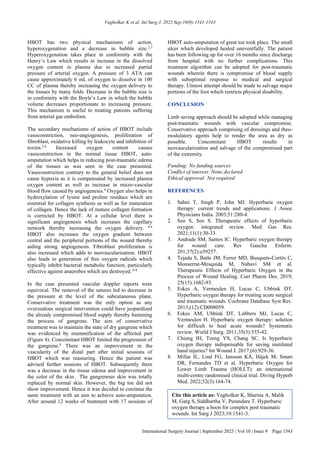
(Figure 4). Concomitant HBOT limited the progression of
the gangrene.8
There was an improvement in the
vascularity of the distal part after initial sessions of
HBOT which was reassuring. Hence the patient was
advised further sessions of HBOT. Subsequently there
was a decrease in the tissue edema and improvement in
the color of the skin. The gangrenous skin was totally
replaced by normal skin. However, the big toe did not
show improvement. Hence it was decided to continue the
same treatment with an aim to achieve auto-amputation.
After around 12 weeks of treatment with 17 sessions of
HBOT auto-amputation of great toe took place. The small
ulcer which developed healed uneventfully. The patient
has been following up for over 16 months since discharge
from hospital with no further complications. This
treatment algorithm can be adopted for post-traumatic
wounds wherein there is compromise of blood supply
with suboptimal response to medical and surgical
therapy. Utmost attempt should be made to salvage major
portions of the foot which restricts physical disability.
CONCLUSION
Limb saving approach should be adopted while managing
post-traumatic wounds with vascular compromise.
Conservative approach comprising of dressings and rheo-
modulatory agents help to render the area as dry as
possible. Concomitant HBOT results in
neovascularization and salvage of the compromised part
of the extremity.
Funding: No funding sources
Conflict of interest: None declared
Ethical approval: Not required
REFERENCES
1. Sahni T, Singh P, John MJ. Hyperbaric oxygen
therapy: current trends and applications. J Assoc
Physicians India. 2003;51:280-4.
2. Sen S, Sen S. Therapeutic effects of hyperbaric
oxygen: integrated review. Med Gas Res.
2021;11(1):30-33.
3. Andrade SM, Santos IC. Hyperbaric oxygen therapy
for wound care. Rev Gaucha Enferm.
201;37(2):e59257.
4. Tejada S, Batle JM, Ferrer MD, Busquets-Cortés C,
Monserrat-Mesquida M, Nabavi SM et al.
Therapeutic Effects of Hyperbaric Oxygen in the
Process of Wound Healing. Curr Pharm Des. 2019;
25(15):1682-93.
5. Eskes A, Vermeulen H, Lucas C, Ubbink DT.
Hyperbaric oxygen therapy for treating acute surgical
and traumatic wounds. Cochrane Database Syst Rev.
2013;(12):CD008059.
6. Eskes AM, Ubbink DT, Lubbers MJ, Lucas C,
Vermeulen H. Hyperbaric oxygen therapy: solution
for difficult to heal acute wounds? Systematic
review. World J Surg. 2011;35(3):535-42.
7. Chiang IH, Tzeng YS, Chang SC. Is hyperbaric
oxygen therapy indispensable for saving mutilated
hand injuries? Int Wound J. 2017;(6):929-36.
8. Millar IL, Lind FG, Jansson KÅ, Hájek M, Smart
DR, Fernandes TD et al. Hyperbaric Oxygen for
Lower Limb Trauma (HOLLT): an international
multi-centre randomised clinical trial. Diving Hyperb
Med. 2022;52(3):164-74.
Cite this article as: Vagholkar K, Sharma A, Malik
M, Garg S, Siddhartha V, Purandare T. Hyperbaric
oxygen therapy a boon for complex post traumatic
wounds. Int Surg J 2023;10:1541-3.

Hyperbaric oxygen therapy a boon for complex post traumatic wounds

  • 1.
    International Surgery Journal| September 2023 | Vol 10 | Issue 9 Page 1541 International Surgery Journal Vagholkar K et al. Int Surg J. 2023 Sep;10(9):1541-1543 http://www.ijsurgery.com pISSN 2349-3305 | eISSN 2349-2902 Case Report Hyperbaric oxygen therapy a boon for complex post traumatic wounds Ketan Vagholkar*, Aarya Sharma, Mehnish Malik, Siddharth Garg, Volam Siddhartha, Tanay Purandare INTRODUCTION Wound management continues to be the biggest challenge to a general surgeon. Etiology of wounds is multifactorial with both intrinsic and extrinsic factors playing a variable role. There is no specific algorithm for management of wound healing. A variety of topical medications are available for treating wounds. However, the cost and therapeutic efficacy of these products is debatable. HBOT is a traditional method for treating resistant wounds. 1 A case of post-traumatic fore foot gangrene successfully treated by HBOT is presented to highlight the therapeutic efficacy of HBOT in management of such challenging wounds. CASE REPORT A 27-year-old man with a partial run over agricultural accident was referred to our surgical unit. There was a sutured contused lacerated wound (CLW) extending along the entire width of the fore foot, extending from the medial malleolus to the 5th metatarsal on the dorsal aspect (Figure 1). The portion distal to this contused lacerated wound was gangrenous including the left big toe. On admission to hospital, the sutures were removed (Figure 2). The CLW was treated conservatively. Daily irrigation with diluted hydrogen peroxide solution followed by application of povidone iodine ointment was done. The response to local treatment was reassuring (Figure 3). However, the distal part especially the big toe developed changes typical of dry gangrene. Subsequently, the patient was treated as a case of dry gangrene (Figure 4). Rheo-modulatory medications such as phosphodiesterase inhibitors and xantinol nicotinate were administered. As there was no improvement in the color of the distal skin, HBOT sessions were commenced. As the therapy continued the overlying skin got revascularized. However, there was no improvement in the coloration of the big toe. The patient was administered 17 sessions of HBOT. The left big toe underwent auto-amputation whereas the distal forefoot skin revascularized. The remaining 4 digits revascularized with some amount of scarring at the site of the previous CLW (Figure 5). ABSTRACT Post-traumatic wounds especially after run over accidents are difficult to manage. The vascularity and regenerative potential of the tissues is severely compromised. Surgical intervention is of limited value. A conservative approach with concomitant hyperbaric oxygen therapy (HBOT) serves as a great salvage in such cases. A case of post-traumatic forefoot gangrene in a 27-year-old laborer is presented to highlight and create an awareness of the potential benefit of HBOT in salvage of distal parts of the lower extremity where the blood supply is severely compromised. Keywords: Hyperbaric, Oxygen, Therapy, Wound, Care Department of Surgery, D. Y. Patil University School of Medicine, Navi Mumbai, Maharashtra, India Received: 10 August 2023 Accepted: 21 August 2023 *Correspondence: Dr. Ketan Vagholkar, E-mail: kvagholkar@yahoo.com Copyright: © the author(s), publisher and licensee Medip Academy. This is an open-access article distributed under the terms of the Creative Commons Attribution Non-Commercial License, which permits unrestricted non-commercial use, distribution, and reproduction in any medium, provided the original work is properly cited. DOI: https://dx.doi.org/10.18203/2349-2902.isj20232649
  • 2.
    Vagholkar K etal. Int Surg J. 2023 Sep;10(9):1541-1543 International Surgery Journal | September 2023 | Vol 10 | Issue 9 Page 1542 The patient now is able to walk confidently with the left foot. Figure 1: On presentation. Figure 2: After immediate removal of sutures on admission to hospital. Figure 3: After 4 sessions of HBOT. Figure 4: Dry and mummified appearance with dry gangrene of the left big toe. Figure 5: After 17 sessions of HBOT. DISCUSSION The case presented highlights the important role of HBOT in the management of complex traumatic wounds. In wounds, wherein the vascularity is doubtful or severely compromised it is impossible to achieve healing by commercially available topical preparations or with the help of rheomodulatory agents. HBOT is the use of 100% oxygen at pressure greater than the atmospheric pressure (Greater than 1 atmosphere absolute) [ATA]. The usual therapy comprises administration of 100% oxygen at 2-3 ATA with an average duration of 60-90 min.1,2 There is no fix protocol with respect to number of HBOT sessions required. It is a matter of individual response of each wound to HBOT that determines the continuation of HBOT sessions.
  • 3.
    Vagholkar K etal. Int Surg J. 2023 Sep;10(9):1541-1543 International Surgery Journal | September 2023 | Vol 10 | Issue 9 Page 1543 HBOT has two physical mechanisms of action, hyperoxygenation and a decrease in bubble size.2,3 Hyperoxygenation takes place in conformity with the Henry’s Law which results in increase in the dissolved oxygen content in plasma due to increased partial pressure of arterial oxygen. A pressure of 3 ATA can cause approximately 6 mL of oxygen to dissolve in 100 CC of plasma thereby increasing the oxygen delivery to the tissues by many folds. Decrease in the bubble size is in conformity with the Boyle’s Law in which the bubble volume decreases proportionate to increasing pressure. This mechanism is useful to treating patients suffering from arterial gas embolism. The secondary mechanisms of action of HBOT include vasoconstriction, neo-angiogenesis, proliferation of fibroblast, oxidative killing by leukocyte and inhibition of toxins.3,4 Increased oxygen content causes vasoconstriction in the normal tissue HBOT, auto- amputation which helps in reducing post-traumatic edema of the tissues as was seen in the case presented. Vasoconstriction contrary to the general belief does not cause hypoxia as it is compensated by increased plasma oxygen content as well as increase in micro-vascular blood flow caused by angiogenesis.4 Oxygen also helps in hydroxylation of lysine and proline residues which are essential for collagen synthesis as well as for maturation of collagen. Hence the lack of mature collagen formation is corrected by HBOT. At a cellular level there is significant angiogenesis which increases the capillary network thereby increasing the oxygen delivery. 4-6 HBOT also increases the oxygen gradient between central and the peripheral portions of the wound thereby aiding strong angiogenesis. Fibroblast proliferation is also increased which adds to neovascularization. HBOT also leads to generation of free oxygen radicals which typically inhibit bacterial metabolic function, particularly effective against anaerobes which are destroyed. 6-8 In the case presented vascular doppler reports were equivocal. The removal of the sutures led to decrease in the pressure at the level of the subcutaneous plane. Conservative treatment was the only option as any overzealous surgical intervention could have jeopardized the already compromised blood supply thereby hastening the process of gangrene. The aim of conservative treatment was to maintain the state of dry gangrene which was evidenced by mummification of the affected part (Figure 4). Concomitant HBOT limited the progression of the gangrene.8 There was an improvement in the vascularity of the distal part after initial sessions of HBOT which was reassuring. Hence the patient was advised further sessions of HBOT. Subsequently there was a decrease in the tissue edema and improvement in the color of the skin. The gangrenous skin was totally replaced by normal skin. However, the big toe did not show improvement. Hence it was decided to continue the same treatment with an aim to achieve auto-amputation. After around 12 weeks of treatment with 17 sessions of HBOT auto-amputation of great toe took place. The small ulcer which developed healed uneventfully. The patient has been following up for over 16 months since discharge from hospital with no further complications. This treatment algorithm can be adopted for post-traumatic wounds wherein there is compromise of blood supply with suboptimal response to medical and surgical therapy. Utmost attempt should be made to salvage major portions of the foot which restricts physical disability. CONCLUSION Limb saving approach should be adopted while managing post-traumatic wounds with vascular compromise. Conservative approach comprising of dressings and rheo- modulatory agents help to render the area as dry as possible. Concomitant HBOT results in neovascularization and salvage of the compromised part of the extremity. Funding: No funding sources Conflict of interest: None declared Ethical approval: Not required REFERENCES 1. Sahni T, Singh P, John MJ. Hyperbaric oxygen therapy: current trends and applications. J Assoc Physicians India. 2003;51:280-4. 2. Sen S, Sen S. Therapeutic effects of hyperbaric oxygen: integrated review. Med Gas Res. 2021;11(1):30-33. 3. Andrade SM, Santos IC. Hyperbaric oxygen therapy for wound care. Rev Gaucha Enferm. 201;37(2):e59257. 4. Tejada S, Batle JM, Ferrer MD, Busquets-Cortés C, Monserrat-Mesquida M, Nabavi SM et al. Therapeutic Effects of Hyperbaric Oxygen in the Process of Wound Healing. Curr Pharm Des. 2019; 25(15):1682-93. 5. Eskes A, Vermeulen H, Lucas C, Ubbink DT. Hyperbaric oxygen therapy for treating acute surgical and traumatic wounds. Cochrane Database Syst Rev. 2013;(12):CD008059. 6. Eskes AM, Ubbink DT, Lubbers MJ, Lucas C, Vermeulen H. Hyperbaric oxygen therapy: solution for difficult to heal acute wounds? Systematic review. World J Surg. 2011;35(3):535-42. 7. Chiang IH, Tzeng YS, Chang SC. Is hyperbaric oxygen therapy indispensable for saving mutilated hand injuries? Int Wound J. 2017;(6):929-36. 8. Millar IL, Lind FG, Jansson KÅ, Hájek M, Smart DR, Fernandes TD et al. Hyperbaric Oxygen for Lower Limb Trauma (HOLLT): an international multi-centre randomised clinical trial. Diving Hyperb Med. 2022;52(3):164-74. Cite this article as: Vagholkar K, Sharma A, Malik M, Garg S, Siddhartha V, Purandare T. Hyperbaric oxygen therapy a boon for complex post traumatic wounds. Int Surg J 2023;10:1541-3.