Laparoscopic Roux-en-Y Gastric Bypass: One Surgeon’s Technique George S. Ferzli MD, FACS New York, NY
Dr. John Linner 1954 Jejuno-ileal bypass THE BEGINNING
COMPLICATIONS OF JEJUNOILEAL BYPASS Electrolyte disturbances Osteoporosis/osteomalacia Protein malnutrition Cholelithiasis Diarrhea Hair loss Arthritis Liver failure Steatosis Renal calculi Neuropathy Anemia
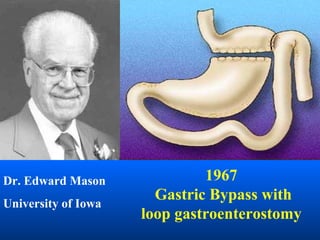
Dr. Edward Mason University of Iowa 1967 Gastric Bypass with  loop gastroenterostomy
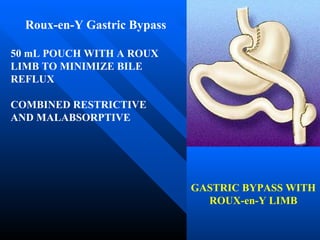
GASTRIC BYPASS WITH ROUX-en-Y LIMB Roux-en-Y Gastric Bypass 50 mL POUCH WITH A ROUX LIMB TO MINIMIZE BILE REFLUX  COMBINED RESTRICTIVE AND MALABSORPTIVE
GASTRIC BYPASS WITH ROUX-en-Y LIMB Roux-en-Y Gastric Bypass SUBSEQUENTLY MODIFIED 50 mL POUCH WITH A ROUX LIMB TO MINIMIZE BILE REFLUX  ROUX LIMB WAS LENGTHENED TO INCREASE MALABSORPTION AND IMPROVE WEIGHT LOSS COMBINED RESTRICTIVE AND MALABSORPTIVE
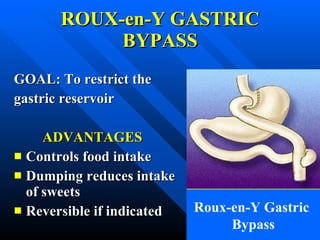
ROUX-en-Y GASTRIC BYPASS GOAL: To restrict the gastric reservoir ADVANTAGES Controls food intake Dumping reduces intake of sweets Reversible if indicated Roux-en-Y Gastric  Bypass
 
Roux-en-Y Gastric Bypass: Operative Options Retro-colic/Retro-gastric gastrojejunostomy Ante-colic/Ante-gastric gastrojejunostomy Stapled gastrojejunostomy Hand-sewn gastrojejunostomy
Roux-en-Y Gastric Bypass: Our Technique Identify LOT Divide jejunum Measure Roux limb Complete jejuno-jejunostomy, close mesentery Create gastric pouch Ante-colic/Ante-gastric gastrojejunostomy Leak test
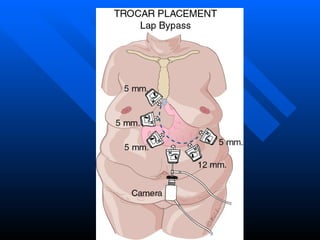
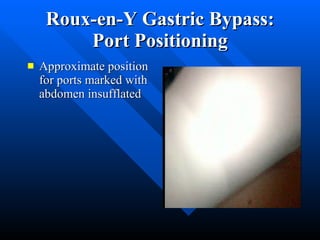
Roux-en-Y Gastric Bypass: Port Positioning Approximate position for ports marked with abdomen insufflated
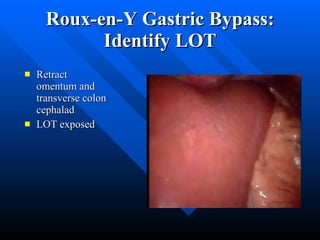
Roux-en-Y Gastric Bypass: Identify LOT Retract omentum and transverse colon cephalad LOT exposed
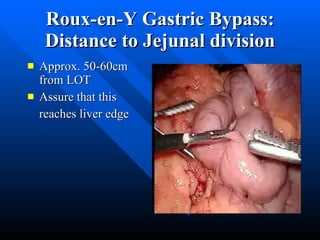
Roux-en-Y Gastric Bypass: Distance to Jejunal division Approx. 50-60cm from LOT Assure that this  reaches liver edge
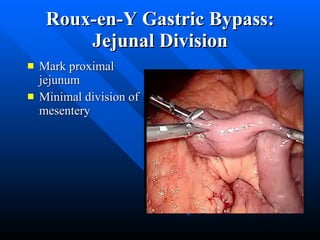
Roux-en-Y Gastric Bypass: Jejunal Division Mark proximal jejunum Minimal division of mesentery
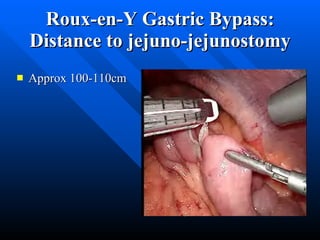
Roux-en-Y Gastric Bypass: Distance to jejuno-jejunostomy Approx 100-110cm
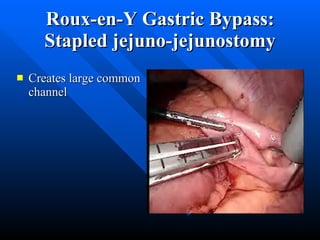
Roux-en-Y Gastric Bypass: Stapled jejuno-jejunostomy Creates large common channel
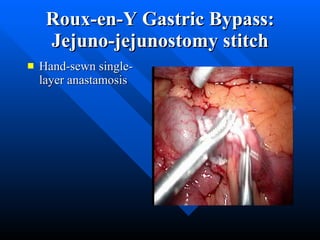
Roux-en-Y Gastric Bypass: Jejuno-jejunostomy stitch Hand-sewn single-layer anastamosis
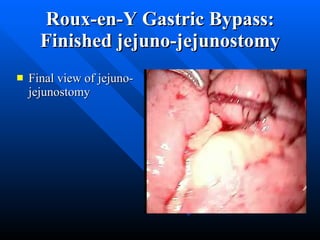
Roux-en-Y Gastric Bypass: Finished jejuno-jejunostomy Final view of jejuno-jejunostomy
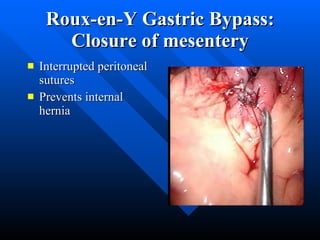
Roux-en-Y Gastric Bypass: Closure of mesentery Interrupted peritoneal sutures  Prevents internal hernia
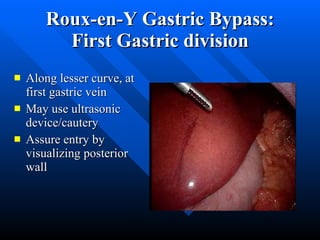
Roux-en-Y Gastric Bypass: First Gastric division Along lesser curve, at first gastric vein May use ultrasonic device/cautery Assure entry by visualizing posterior wall
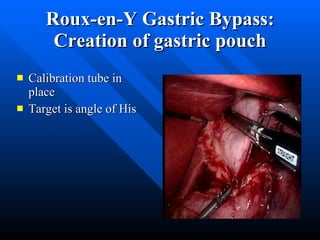
Roux-en-Y Gastric Bypass: Creation of gastric pouch Calibration tube in  place Target is angle of His
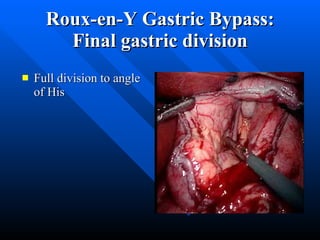
Roux-en-Y Gastric Bypass: Final gastric division Full division to angle of His
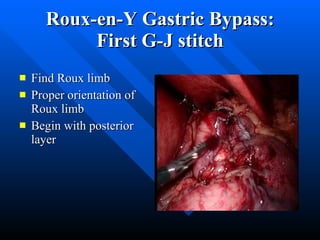
Roux-en-Y Gastric Bypass: First G-J stitch Find Roux limb Proper orientation of Roux limb Begin with posterior layer
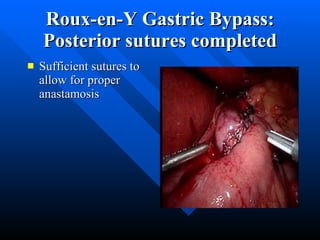
Roux-en-Y Gastric Bypass: Posterior sutures completed Sufficient sutures to allow for proper anastamosis
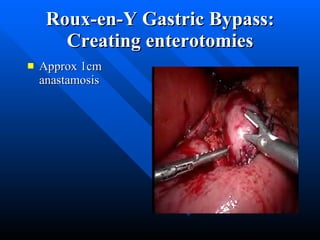
Roux-en-Y Gastric Bypass: Creating enterotomies Approx 1cm anastamosis
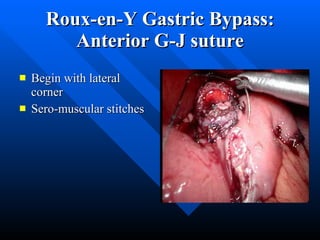
Roux-en-Y Gastric Bypass: Anterior G-J suture Begin with lateral corner Sero-muscular stitches
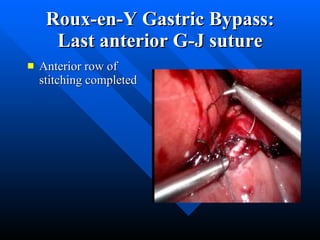
Roux-en-Y Gastric Bypass: Last anterior G-J suture Anterior row of stitching completed
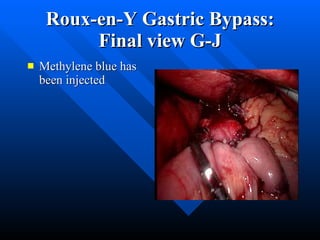
Roux-en-Y Gastric Bypass: Final view G-J Methylene blue has been injected
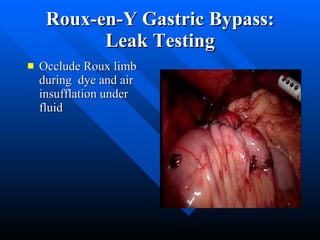
Roux-en-Y Gastric Bypass: Leak Testing Occlude Roux limb during  dye and air insufflation under fluid
Roux-en-Y Gastric Bypass: Summary Jejuno-jejunostomy created  Correctly identify LOT, proximal and distal limbs Minimal division of mesentery Gastric pouch created Assure appropriate pouch size Use calibrating tube if necessary
Roux-en-Y Gastric Bypass: Summary Ante-Colic/Ante-Gastric gastro-jejunostomy Properly orient Roux limb, with minimal tension Split omentum if necessary Stapling device used primarily for divisions Hand-sewn anastamosis whenever possible Always perform leak test Best opportunity to fix/reinforce anastamosis

Laparoscopic Roux En-Y-Gastric Bypass: One Surgeon's Technique

  • 1.
    Laparoscopic Roux-en-Y GastricBypass: One Surgeon’s Technique George S. Ferzli MD, FACS New York, NY
  • 2.
    Dr. John Linner1954 Jejuno-ileal bypass THE BEGINNING
  • 3.
    COMPLICATIONS OF JEJUNOILEALBYPASS Electrolyte disturbances Osteoporosis/osteomalacia Protein malnutrition Cholelithiasis Diarrhea Hair loss Arthritis Liver failure Steatosis Renal calculi Neuropathy Anemia
  • 4.
    Dr. Edward MasonUniversity of Iowa 1967 Gastric Bypass with loop gastroenterostomy
  • 5.
    GASTRIC BYPASS WITHROUX-en-Y LIMB Roux-en-Y Gastric Bypass 50 mL POUCH WITH A ROUX LIMB TO MINIMIZE BILE REFLUX COMBINED RESTRICTIVE AND MALABSORPTIVE
  • 6.
    GASTRIC BYPASS WITHROUX-en-Y LIMB Roux-en-Y Gastric Bypass SUBSEQUENTLY MODIFIED 50 mL POUCH WITH A ROUX LIMB TO MINIMIZE BILE REFLUX ROUX LIMB WAS LENGTHENED TO INCREASE MALABSORPTION AND IMPROVE WEIGHT LOSS COMBINED RESTRICTIVE AND MALABSORPTIVE
  • 7.
    ROUX-en-Y GASTRIC BYPASSGOAL: To restrict the gastric reservoir ADVANTAGES Controls food intake Dumping reduces intake of sweets Reversible if indicated Roux-en-Y Gastric Bypass
  • 8.
  • 9.
    Roux-en-Y Gastric Bypass:Operative Options Retro-colic/Retro-gastric gastrojejunostomy Ante-colic/Ante-gastric gastrojejunostomy Stapled gastrojejunostomy Hand-sewn gastrojejunostomy
  • 10.
    Roux-en-Y Gastric Bypass:Our Technique Identify LOT Divide jejunum Measure Roux limb Complete jejuno-jejunostomy, close mesentery Create gastric pouch Ante-colic/Ante-gastric gastrojejunostomy Leak test
  • 11.
    Roux-en-Y Gastric Bypass:Port Positioning Approximate position for ports marked with abdomen insufflated
  • 12.
    Roux-en-Y Gastric Bypass:Identify LOT Retract omentum and transverse colon cephalad LOT exposed
  • 13.
    Roux-en-Y Gastric Bypass:Distance to Jejunal division Approx. 50-60cm from LOT Assure that this reaches liver edge
  • 14.
    Roux-en-Y Gastric Bypass:Jejunal Division Mark proximal jejunum Minimal division of mesentery
  • 15.
    Roux-en-Y Gastric Bypass:Distance to jejuno-jejunostomy Approx 100-110cm
  • 16.
    Roux-en-Y Gastric Bypass:Stapled jejuno-jejunostomy Creates large common channel
  • 17.
    Roux-en-Y Gastric Bypass:Jejuno-jejunostomy stitch Hand-sewn single-layer anastamosis
  • 18.
    Roux-en-Y Gastric Bypass:Finished jejuno-jejunostomy Final view of jejuno-jejunostomy
  • 19.
    Roux-en-Y Gastric Bypass:Closure of mesentery Interrupted peritoneal sutures Prevents internal hernia
  • 20.
    Roux-en-Y Gastric Bypass:First Gastric division Along lesser curve, at first gastric vein May use ultrasonic device/cautery Assure entry by visualizing posterior wall
  • 21.
    Roux-en-Y Gastric Bypass:Creation of gastric pouch Calibration tube in place Target is angle of His
  • 22.
    Roux-en-Y Gastric Bypass:Final gastric division Full division to angle of His
  • 23.
    Roux-en-Y Gastric Bypass:First G-J stitch Find Roux limb Proper orientation of Roux limb Begin with posterior layer
  • 24.
    Roux-en-Y Gastric Bypass:Posterior sutures completed Sufficient sutures to allow for proper anastamosis
  • 25.
    Roux-en-Y Gastric Bypass:Creating enterotomies Approx 1cm anastamosis
  • 26.
    Roux-en-Y Gastric Bypass:Anterior G-J suture Begin with lateral corner Sero-muscular stitches
  • 27.
    Roux-en-Y Gastric Bypass:Last anterior G-J suture Anterior row of stitching completed
  • 28.
    Roux-en-Y Gastric Bypass:Final view G-J Methylene blue has been injected
  • 29.
    Roux-en-Y Gastric Bypass:Leak Testing Occlude Roux limb during dye and air insufflation under fluid
  • 30.
    Roux-en-Y Gastric Bypass:Summary Jejuno-jejunostomy created Correctly identify LOT, proximal and distal limbs Minimal division of mesentery Gastric pouch created Assure appropriate pouch size Use calibrating tube if necessary
  • 31.
    Roux-en-Y Gastric Bypass:Summary Ante-Colic/Ante-Gastric gastro-jejunostomy Properly orient Roux limb, with minimal tension Split omentum if necessary Stapling device used primarily for divisions Hand-sewn anastamosis whenever possible Always perform leak test Best opportunity to fix/reinforce anastamosis

Editor's Notes

  • #3 The first bariatric procedure to be presented to a recognized surgical society and published in a peer reviewed journal was that of Linner and Kremen in 1954. The case which they presented was of a jejuno-ileal bypass.(JIB). Jejuno-ileal bypass involved joining the upper small intestine to the lower part of the small intestine bypassing a large segment of the small bowel, which is thus taken out of the nutrient absorptive circuit. The premise of this bypass was that patients could eat large amounts of food and the excess would either be poorly digested or passed along too rapidly for the body to absorb. In addition, the procedure caused a temporary decrease in appetite which also resulted in weight loss. The procedure was very successful at producing weight loss, however patients developed chronic diarrhea, kidney stones, and liver disease. So a search for a better procedure followed.
  • #4 As a consequence of all these complications, jejuno-ileal bypass is no longer a recommended Bariatric Surgical Procedure. Indeed, the current recommendation for anyone who has undergone JIB and still has the operation intact, is to strongly consider having it taken down and converted to one of the gastric restrictive procedures.
  • #5 In 1967 the gastric bypass was devised and performed by Dr. Edward Mason at the University of Iowa. Dr. Mason noted that patients who underwent subtotal gastrectomy for peptic ulcer disease remained below normal weight and could not gain weight easily. His approach involved stapling most of the stomach, bypassing the duodenum, and allowing the undigested food to pass directly into the jejunum. Most of the early operations failed because the pouch eventually became enlarged.
  • #6 The technique was modified to obtain a 50 mL pouch and a Roux-en-Y limb to minimize bile reflux from the loop gastrojejunostomy. The roux limb was lengthened to 100-150 cm in order to increase malabsorption and improve weight loss. The technique has been modified throughout the years with regard to the gastric pouch and retrocolic position of the roux limb. This procedure has stood the test of time, with one series of 500 patients followed for 14 years with patients maintaining 50% excess weight loss.
  • #7 The technique was modified to obtain a 50 mL pouch and a Roux-en-Y limb to minimize bile reflux from the loop gastrojejunostomy. The roux limb was lengthened to 100-150 cm in order to increase malabsorption and improve weight loss. The technique has been modified throughout the years with regard to the gastric pouch and retrocolic position of the roux limb. This procedure has stood the test of time, with one series of 500 patients followed for 14 years with patients maintaining 50% excess weight loss.