Algorithms for  Large Data Sets Ziv Bar-Yossef Lecture 2 March 26, 2006 http://www.ee.technion.ac.il/courses/049011
Information Retrieval
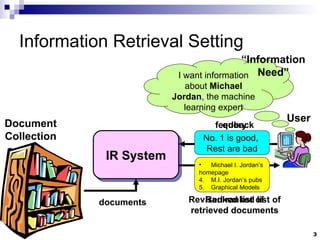
Information Retrieval Setting I want information about  Michael Jordan , the machine learning expert query User Document Collection “ Information Need” +”Michael Jordan” -basketball Michael I. Jordan’s  homepage NBA.com Michael Jordan on TV Ranked list of retrieved documents IR System documents No. 1 is good,  Rest are bad feedback Revised ranked list of retrieved documents Michael I. Jordan’s  homepage M.I. Jordan’s pubs Graphical Models
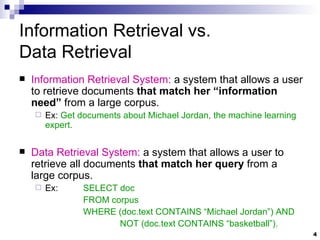
Information Retrieval   vs. Data Retrieval Information Retrieval System:  a system that allows a user to retrieve documents  that match her “information need”  from a large corpus. Ex:  Get documents about Michael Jordan, the machine learning expert. Data Retrieval System:  a system that allows a user to retrieve all documents  that match her query  from a large corpus. Ex:  SELECT doc  FROM corpus  WHERE (doc.text CONTAINS “Michael Jordan”) AND   NOT (doc.text CONTAINS “basketball”).
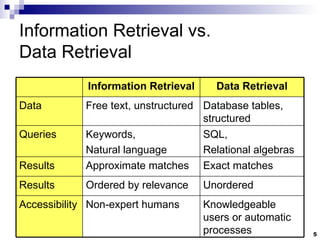
Information Retrieval vs.  Data Retrieval Database tables, structured Free text, unstructured Data Knowledgeable users or automatic processes Non-expert humans Accessibility Unordered Ordered by relevance Results Exact matches Approximate matches Results SQL,  Relational algebras Keywords, Natural language Queries Data Retrieval Information Retrieval
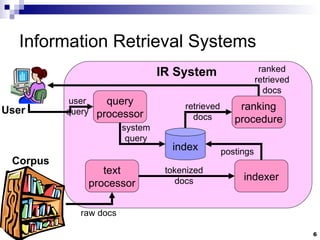
Information Retrieval Systems IR System query processor text processor user query ranked retrieved docs User Corpus ranking procedure system query retrieved docs index indexer tokenized docs postings raw docs
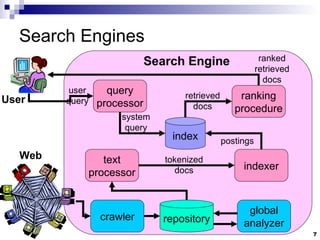
Search Engines Search Engine query processor text processor user query ranked retrieved docs User Web ranking procedure system query retrieved docs index indexer tokenized docs postings crawler global analyzer repository
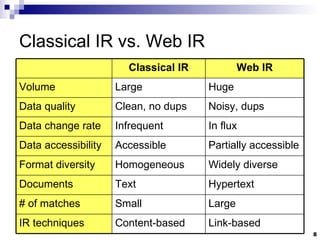
Classical IR vs. Web IR Hypertext Text Documents Large Small # of matches Partially accessible Accessible Data accessibility Huge Large Volume Link-based Content-based IR techniques Widely diverse Homogeneous Format diversity In flux Infrequent Data change rate Noisy, dups Clean, no dups Data quality Web IR Classical IR
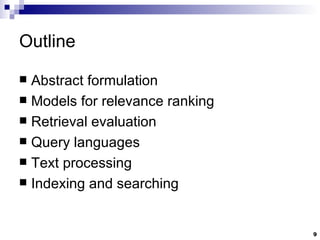
Outline Abstract formulation Models for relevance ranking Retrieval evaluation Query languages Text processing Indexing and searching
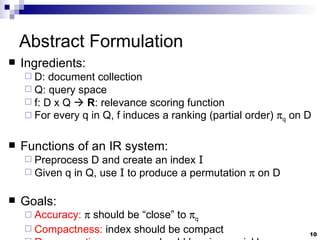
Abstract Formulation Ingredients: D: document collection Q: query space f: D x Q     R : relevance scoring function  For every q in Q, f induces a ranking (partial order)   q  on D Functions of an IR system: Preprocess D and create an index  I Given q in Q, use  I  to produce a permutation    on D Goals: Accuracy:     should be “close” to   q Compactness:  index should be compact Response time:  answers should be given quickly
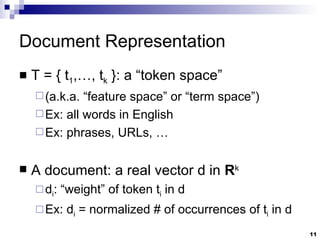
Document Representation T = { t 1 ,…, t k  }: a “token space”  (a.k.a. “feature space” or “term space”) Ex: all words in English Ex: phrases, URLs, … A document: a real vector d in  R k d i : “weight” of token t i  in d Ex: d i  = normalized # of occurrences of t i  in d
Classic IR (Relevance) Models The Boolean model The Vector Space Model (VSM)
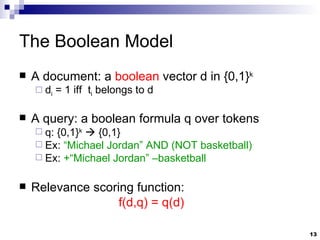
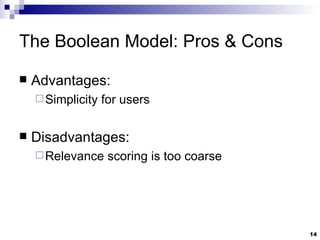
The Boolean Model A document: a  boolean  vector d in {0,1} k d i  = 1 iff  t i  belongs to d A query: a boolean formula q over tokens q: {0,1} k     {0,1} Ex:  “Michael Jordan” AND (NOT basketball) Ex:  +“Michael Jordan” –basketball Relevance scoring function:   f(d,q) = q(d)
The Boolean Model: Pros & Cons Advantages: Simplicity for users Disadvantages: Relevance scoring is too coarse
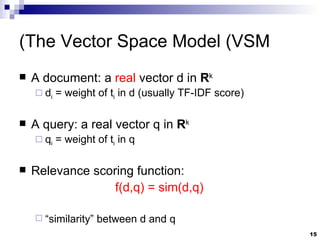
The Vector Space Model (VSM) A document: a  real  vector d in  R k d i  = weight of t i  in d (usually TF-IDF score) A query: a real vector q in  R k q i  = weight of t i  in q Relevance scoring function:  f(d,q) = sim(d,q)  “ similarity” between d and q
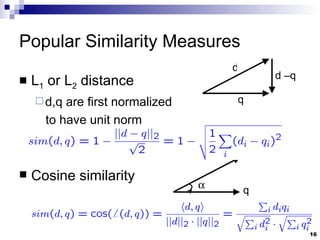
Popular Similarity Measures L 1  or L 2  distance  d,q are first normalized  to have unit norm Cosine similarity d q d –q   d q
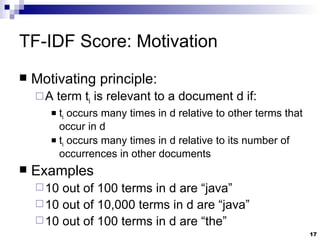
TF-IDF Score: Motivation Motivating principle: A term t i  is relevant to a document d if: t i  occurs many times in d relative to other terms that occur in d t i  occurs many times in d relative to its number of occurrences in other documents Examples 10 out of 100 terms in d are “java” 10 out of 10,000 terms in d are “java” 10 out of 100 terms in d are “the”
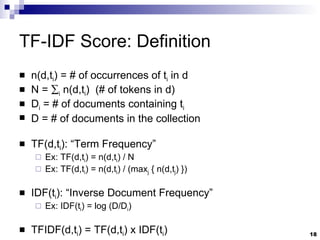
TF-IDF Score: Definition n(d,t i ) = # of occurrences of t i  in d N =   i  n(d,t i )  (# of tokens in d) D i  = # of documents containing t i D = # of documents in the collection TF(d,t i ): “Term Frequency” Ex: TF(d,t i ) = n(d,t i ) / N Ex: TF(d,t i ) = n(d,t i ) / (max j  { n(d,t j ) }) IDF(t i ): “Inverse Document Frequency” Ex: IDF(t i ) = log (D/D i ) TFIDF(d,t i ) = TF(d,t i ) x IDF(t i )
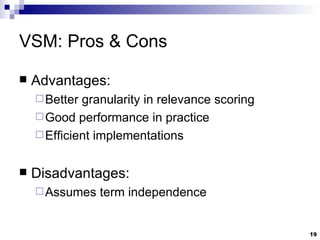
VSM: Pros & Cons Advantages: Better granularity in relevance scoring Good performance in practice Efficient implementations Disadvantages: Assumes term independence
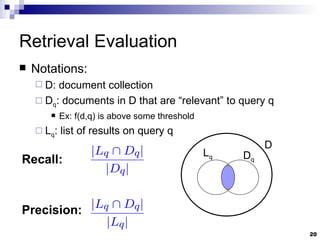
Retrieval Evaluation Notations: D: document collection D q : documents in D that are “relevant” to query q Ex: f(d,q) is above some threshold L q : list of results on query q D L q D q Recall:  Precision:
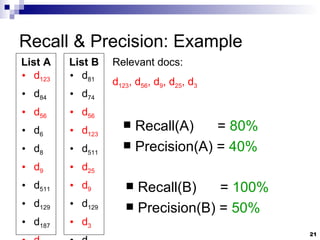
Recall & Precision: Example Recall(A)  =  80% Precision(A) =  40% d 123 d 84 d 56 d 6 d 8 d 9 d 511 d 129 d 187 d 25 List A Relevant docs: d 123 , d 56 , d 9 , d 25 , d 3 d 81 d 74 d 56 d 123 d 511 d 25 d 9 d 129 d 3 d 5 List B Recall(B)  =  100% Precision(B) =  50%
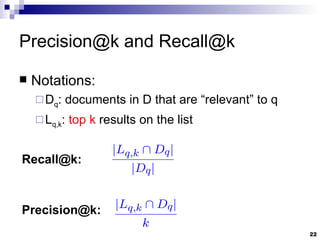
Precision@k and Recall@k Notations: D q : documents in D that are “relevant” to q L q,k :  top k  results on the list Recall@k:  Precision@k:
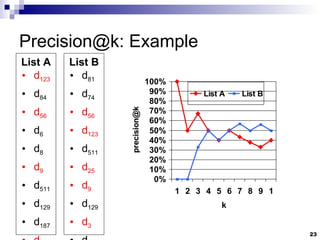
Precision@k: Example d 123 d 84 d 56 d 6 d 8 d 9 d 511 d 129 d 187 d 25 List A d 81 d 74 d 56 d 123 d 511 d 25 d 9 d 129 d 3 d 5 List B
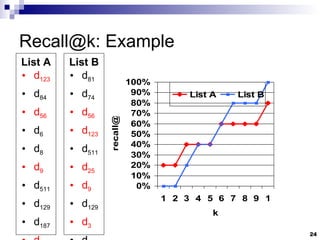
Recall@k: Example d 123 d 84 d 56 d 6 d 8 d 9 d 511 d 129 d 187 d 25 List A d 81 d 74 d 56 d 123 d 511 d 25 d 9 d 129 d 3 d 5 List B
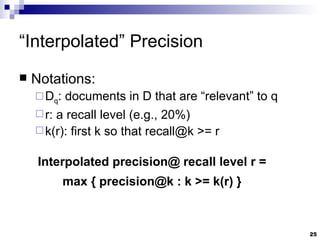
“ Interpolated” Precision Notations: D q : documents in D that are “relevant” to q r: a recall level (e.g., 20%) k(r): first k so that recall@k >= r Interpolated precision@ recall level r = max { precision@k : k >= k(r) }
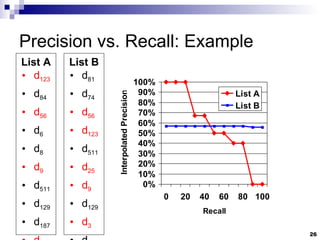
Precision vs. Recall: Example d 123 d 84 d 56 d 6 d 8 d 9 d 511 d 129 d 187 d 25 List A d 81 d 74 d 56 d 123 d 511 d 25 d 9 d 129 d 3 d 5 List B
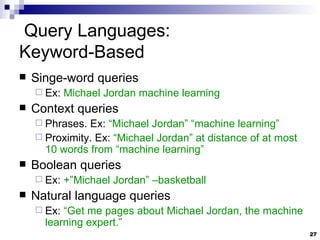
Query Languages:  Keyword-Based Singe-word queries Ex:  Michael Jordan machine learning Context queries Phrases. Ex:  “Michael Jordan” “machine learning” Proximity. Ex:  “Michael Jordan” at distance of at most 10 words from “machine learning” Boolean queries Ex:  +”Michael Jordan” –basketball Natural language queries Ex:  “Get me pages about Michael Jordan, the machine learning expert.”
Query Languages:  Pattern Matching Prefixes Ex:  prefix:comput Suffixes Ex:  suffix:net Regular Expressions Ex:  [0-9]+th world-wide web conference
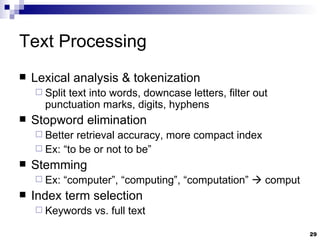
Text Processing Lexical analysis & tokenization Split text into words, downcase letters, filter out punctuation marks, digits, hyphens Stopword elimination Better retrieval accuracy, more compact index Ex: “to be or not to be” Stemming Ex: “computer”, “computing”, “computation”    comput Index term selection Keywords vs. full text
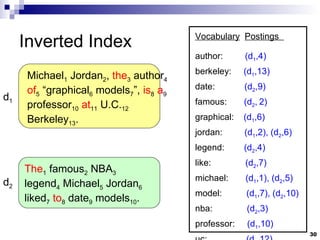
Inverted Index Michael 1  Jordan 2 ,  the 3  author 4   of 5  “graphical 6  models 7 ”,  is 8   a 9  professor 10   at 11  U.C. 12  Berkeley 13 . The 1  famous 2  NBA 3  legend 4  Michael 5  Jordan 6  liked 7   to 8  date 9  models 10 . d 1 d 2 author:   (d 1 ,4) berkeley:   (d 1 ,13) date:   (d 2 ,9) famous:   (d 2 , 2) graphical:   (d 1 ,6) jordan:  (d 1 ,2), (d 2 ,6) legend:   (d 2 ,4) like:   (d 2 ,7) michael:  (d 1 ,1), (d 2 ,5) model:   (d 1 ,7), (d 2 ,10) nba:   (d 2 ,3) professor:   (d 1 ,10) uc:   (d 1 ,12) Vocabulary   Postings
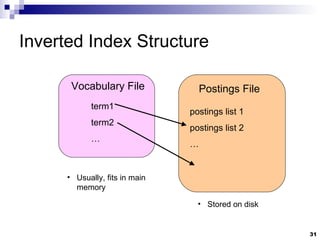
Inverted Index Structure Vocabulary File term1 term2 … Postings File postings list 1 postings list 2 … Usually, fits in main memory Stored on disk
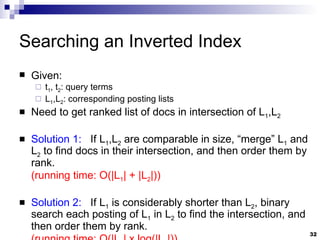
Searching an Inverted Index Given: t 1 , t 2 : query terms L 1 ,L 2 : corresponding posting lists Need to get ranked list of docs in intersection of L 1 ,L 2 Solution 1:   If L 1 ,L 2  are comparable in size, “merge” L 1  and L 2  to find docs in their intersection, and then order them by rank.  (running time: O(|L 1 | + |L 2 |)) Solution 2:   If L 1  is considerably shorter than L 2 , binary search each posting of L 1  in L 2  to find the intersection, and then order them by rank. (running time: O(|L 1 | x log(|L 2 |))
Search Optimization Improvement:  Order docs in posting lists by static rank (e.g., PageRank). Then, can output top matches, without scanning the whole lists.
Index Construction Given a stream of documents, store  (did,tid,pos)  triplets in a file Sort and group file by  tid Extract posting lists
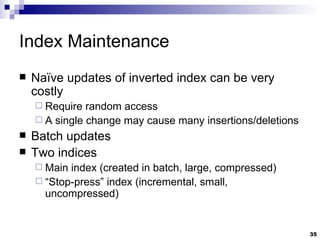
Index Maintenance Naïve updates of inverted index can be very costly Require random access A single change may cause many insertions/deletions Batch updates Two indices Main index (created in batch, large, compressed) “ Stop-press” index (incremental, small, uncompressed)
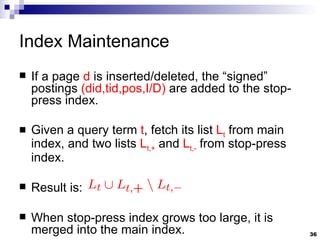
Index Maintenance If a page  d  is inserted/deleted, the “signed” postings  (did,tid,pos,I/D)  are added to the stop-press index. Given a query term  t , fetch its list  L t  from main index, and two lists  L t,+  and  L t,-  from stop-press index. Result is: When stop-press index grows too large, it is merged into the main index.
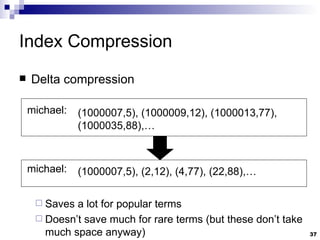
Index Compression Delta compression Saves a lot for popular terms Doesn’t save much for rare terms (but these don’t take much space anyway) michael: (1000007,5), (1000009,12), (1000013,77), (1000035,88),… michael: (1000007,5), (2,12), (4,77), (22,88),…
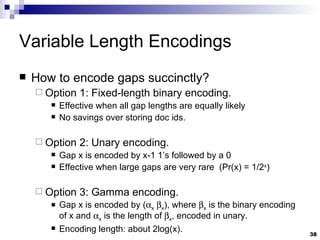
Variable Length Encodings How to encode gaps succinctly? Option 1: Fixed-length binary encoding. Effective when all gap lengths are equally likely No savings over storing doc ids. Option 2: Unary encoding. Gap x is encoded by x-1 1’s followed by a 0 Effective when large gaps are very rare  (Pr(x) = 1/2 x )  Option 3: Gamma encoding. Gap x is encoded by (  x    x ), where   x  is the binary encoding of x and   x  is the length of   x , encoded in unary. Encoding length: about 2log(x).
End of Lecture 2

Slides

  • 1.
    Algorithms for Large Data Sets Ziv Bar-Yossef Lecture 2 March 26, 2006 http://www.ee.technion.ac.il/courses/049011
  • 2.
  • 3.
    Information Retrieval SettingI want information about Michael Jordan , the machine learning expert query User Document Collection “ Information Need” +”Michael Jordan” -basketball Michael I. Jordan’s homepage NBA.com Michael Jordan on TV Ranked list of retrieved documents IR System documents No. 1 is good, Rest are bad feedback Revised ranked list of retrieved documents Michael I. Jordan’s homepage M.I. Jordan’s pubs Graphical Models
  • 4.
    Information Retrieval vs. Data Retrieval Information Retrieval System: a system that allows a user to retrieve documents that match her “information need” from a large corpus. Ex: Get documents about Michael Jordan, the machine learning expert. Data Retrieval System: a system that allows a user to retrieve all documents that match her query from a large corpus. Ex: SELECT doc FROM corpus WHERE (doc.text CONTAINS “Michael Jordan”) AND NOT (doc.text CONTAINS “basketball”).
  • 5.
    Information Retrieval vs. Data Retrieval Database tables, structured Free text, unstructured Data Knowledgeable users or automatic processes Non-expert humans Accessibility Unordered Ordered by relevance Results Exact matches Approximate matches Results SQL, Relational algebras Keywords, Natural language Queries Data Retrieval Information Retrieval
  • 6.
    Information Retrieval SystemsIR System query processor text processor user query ranked retrieved docs User Corpus ranking procedure system query retrieved docs index indexer tokenized docs postings raw docs
  • 7.
    Search Engines SearchEngine query processor text processor user query ranked retrieved docs User Web ranking procedure system query retrieved docs index indexer tokenized docs postings crawler global analyzer repository
  • 8.
    Classical IR vs.Web IR Hypertext Text Documents Large Small # of matches Partially accessible Accessible Data accessibility Huge Large Volume Link-based Content-based IR techniques Widely diverse Homogeneous Format diversity In flux Infrequent Data change rate Noisy, dups Clean, no dups Data quality Web IR Classical IR
  • 9.
    Outline Abstract formulationModels for relevance ranking Retrieval evaluation Query languages Text processing Indexing and searching
  • 10.
    Abstract Formulation Ingredients:D: document collection Q: query space f: D x Q  R : relevance scoring function For every q in Q, f induces a ranking (partial order)  q on D Functions of an IR system: Preprocess D and create an index I Given q in Q, use I to produce a permutation  on D Goals: Accuracy:  should be “close” to  q Compactness: index should be compact Response time: answers should be given quickly
  • 11.
    Document Representation T= { t 1 ,…, t k }: a “token space” (a.k.a. “feature space” or “term space”) Ex: all words in English Ex: phrases, URLs, … A document: a real vector d in R k d i : “weight” of token t i in d Ex: d i = normalized # of occurrences of t i in d
  • 12.
    Classic IR (Relevance)Models The Boolean model The Vector Space Model (VSM)
  • 13.
    The Boolean ModelA document: a boolean vector d in {0,1} k d i = 1 iff t i belongs to d A query: a boolean formula q over tokens q: {0,1} k  {0,1} Ex: “Michael Jordan” AND (NOT basketball) Ex: +“Michael Jordan” –basketball Relevance scoring function: f(d,q) = q(d)
  • 14.
    The Boolean Model:Pros & Cons Advantages: Simplicity for users Disadvantages: Relevance scoring is too coarse
  • 15.
    The Vector SpaceModel (VSM) A document: a real vector d in R k d i = weight of t i in d (usually TF-IDF score) A query: a real vector q in R k q i = weight of t i in q Relevance scoring function: f(d,q) = sim(d,q) “ similarity” between d and q
  • 16.
    Popular Similarity MeasuresL 1 or L 2 distance d,q are first normalized to have unit norm Cosine similarity d q d –q  d q
  • 17.
    TF-IDF Score: MotivationMotivating principle: A term t i is relevant to a document d if: t i occurs many times in d relative to other terms that occur in d t i occurs many times in d relative to its number of occurrences in other documents Examples 10 out of 100 terms in d are “java” 10 out of 10,000 terms in d are “java” 10 out of 100 terms in d are “the”
  • 18.
    TF-IDF Score: Definitionn(d,t i ) = # of occurrences of t i in d N =  i n(d,t i ) (# of tokens in d) D i = # of documents containing t i D = # of documents in the collection TF(d,t i ): “Term Frequency” Ex: TF(d,t i ) = n(d,t i ) / N Ex: TF(d,t i ) = n(d,t i ) / (max j { n(d,t j ) }) IDF(t i ): “Inverse Document Frequency” Ex: IDF(t i ) = log (D/D i ) TFIDF(d,t i ) = TF(d,t i ) x IDF(t i )
  • 19.
    VSM: Pros &Cons Advantages: Better granularity in relevance scoring Good performance in practice Efficient implementations Disadvantages: Assumes term independence
  • 20.
    Retrieval Evaluation Notations:D: document collection D q : documents in D that are “relevant” to query q Ex: f(d,q) is above some threshold L q : list of results on query q D L q D q Recall: Precision:
  • 21.
    Recall & Precision:Example Recall(A) = 80% Precision(A) = 40% d 123 d 84 d 56 d 6 d 8 d 9 d 511 d 129 d 187 d 25 List A Relevant docs: d 123 , d 56 , d 9 , d 25 , d 3 d 81 d 74 d 56 d 123 d 511 d 25 d 9 d 129 d 3 d 5 List B Recall(B) = 100% Precision(B) = 50%
  • 22.
    Precision@k and Recall@kNotations: D q : documents in D that are “relevant” to q L q,k : top k results on the list Recall@k: Precision@k:
  • 23.
    Precision@k: Example d123 d 84 d 56 d 6 d 8 d 9 d 511 d 129 d 187 d 25 List A d 81 d 74 d 56 d 123 d 511 d 25 d 9 d 129 d 3 d 5 List B
  • 24.
    Recall@k: Example d123 d 84 d 56 d 6 d 8 d 9 d 511 d 129 d 187 d 25 List A d 81 d 74 d 56 d 123 d 511 d 25 d 9 d 129 d 3 d 5 List B
  • 25.
    “ Interpolated” PrecisionNotations: D q : documents in D that are “relevant” to q r: a recall level (e.g., 20%) k(r): first k so that recall@k >= r Interpolated precision@ recall level r = max { precision@k : k >= k(r) }
  • 26.
    Precision vs. Recall:Example d 123 d 84 d 56 d 6 d 8 d 9 d 511 d 129 d 187 d 25 List A d 81 d 74 d 56 d 123 d 511 d 25 d 9 d 129 d 3 d 5 List B
  • 27.
    Query Languages: Keyword-Based Singe-word queries Ex: Michael Jordan machine learning Context queries Phrases. Ex: “Michael Jordan” “machine learning” Proximity. Ex: “Michael Jordan” at distance of at most 10 words from “machine learning” Boolean queries Ex: +”Michael Jordan” –basketball Natural language queries Ex: “Get me pages about Michael Jordan, the machine learning expert.”
  • 28.
    Query Languages: Pattern Matching Prefixes Ex: prefix:comput Suffixes Ex: suffix:net Regular Expressions Ex: [0-9]+th world-wide web conference
  • 29.
    Text Processing Lexicalanalysis & tokenization Split text into words, downcase letters, filter out punctuation marks, digits, hyphens Stopword elimination Better retrieval accuracy, more compact index Ex: “to be or not to be” Stemming Ex: “computer”, “computing”, “computation”  comput Index term selection Keywords vs. full text
  • 30.
    Inverted Index Michael1 Jordan 2 , the 3 author 4 of 5 “graphical 6 models 7 ”, is 8 a 9 professor 10 at 11 U.C. 12 Berkeley 13 . The 1 famous 2 NBA 3 legend 4 Michael 5 Jordan 6 liked 7 to 8 date 9 models 10 . d 1 d 2 author: (d 1 ,4) berkeley: (d 1 ,13) date: (d 2 ,9) famous: (d 2 , 2) graphical: (d 1 ,6) jordan: (d 1 ,2), (d 2 ,6) legend: (d 2 ,4) like: (d 2 ,7) michael: (d 1 ,1), (d 2 ,5) model: (d 1 ,7), (d 2 ,10) nba: (d 2 ,3) professor: (d 1 ,10) uc: (d 1 ,12) Vocabulary Postings
  • 31.
    Inverted Index StructureVocabulary File term1 term2 … Postings File postings list 1 postings list 2 … Usually, fits in main memory Stored on disk
  • 32.
    Searching an InvertedIndex Given: t 1 , t 2 : query terms L 1 ,L 2 : corresponding posting lists Need to get ranked list of docs in intersection of L 1 ,L 2 Solution 1: If L 1 ,L 2 are comparable in size, “merge” L 1 and L 2 to find docs in their intersection, and then order them by rank. (running time: O(|L 1 | + |L 2 |)) Solution 2: If L 1 is considerably shorter than L 2 , binary search each posting of L 1 in L 2 to find the intersection, and then order them by rank. (running time: O(|L 1 | x log(|L 2 |))
  • 33.
    Search Optimization Improvement: Order docs in posting lists by static rank (e.g., PageRank). Then, can output top matches, without scanning the whole lists.
  • 34.
    Index Construction Givena stream of documents, store (did,tid,pos) triplets in a file Sort and group file by tid Extract posting lists
  • 35.
    Index Maintenance Naïveupdates of inverted index can be very costly Require random access A single change may cause many insertions/deletions Batch updates Two indices Main index (created in batch, large, compressed) “ Stop-press” index (incremental, small, uncompressed)
  • 36.
    Index Maintenance Ifa page d is inserted/deleted, the “signed” postings (did,tid,pos,I/D) are added to the stop-press index. Given a query term t , fetch its list L t from main index, and two lists L t,+ and L t,- from stop-press index. Result is: When stop-press index grows too large, it is merged into the main index.
  • 37.
    Index Compression Deltacompression Saves a lot for popular terms Doesn’t save much for rare terms (but these don’t take much space anyway) michael: (1000007,5), (1000009,12), (1000013,77), (1000035,88),… michael: (1000007,5), (2,12), (4,77), (22,88),…
  • 38.
    Variable Length EncodingsHow to encode gaps succinctly? Option 1: Fixed-length binary encoding. Effective when all gap lengths are equally likely No savings over storing doc ids. Option 2: Unary encoding. Gap x is encoded by x-1 1’s followed by a 0 Effective when large gaps are very rare (Pr(x) = 1/2 x ) Option 3: Gamma encoding. Gap x is encoded by (  x  x ), where  x is the binary encoding of x and  x is the length of  x , encoded in unary. Encoding length: about 2log(x).
  • 39.