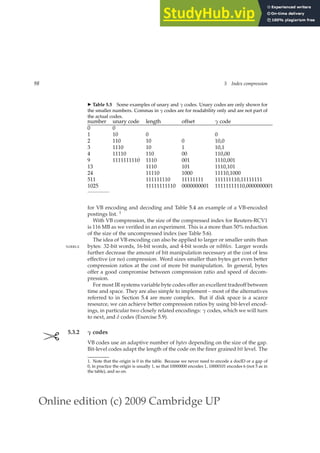
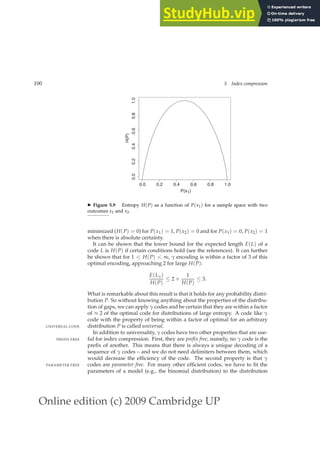
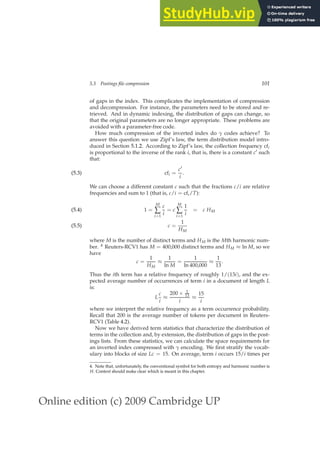
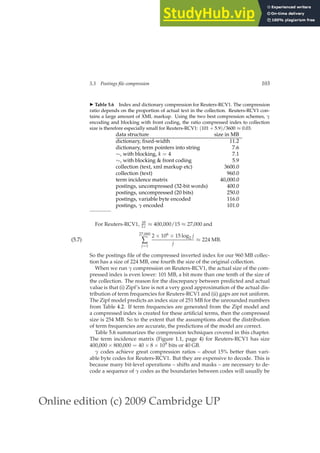
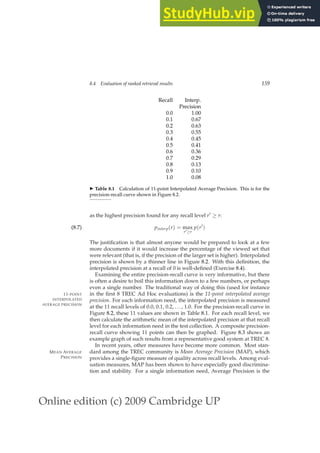
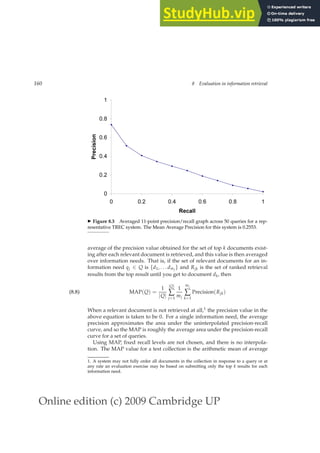
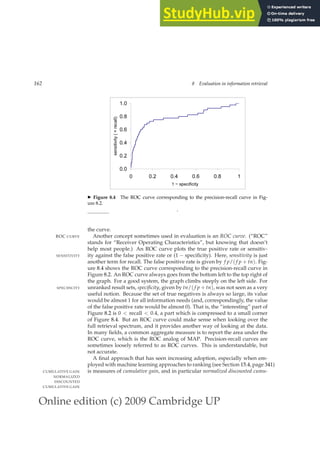
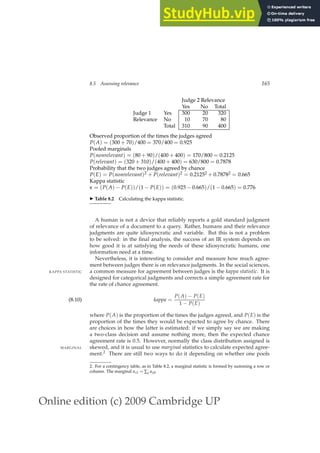
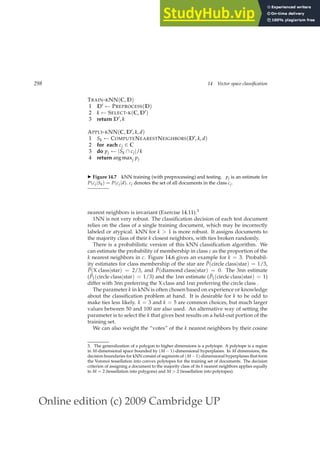
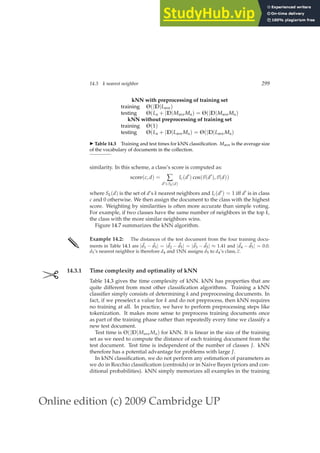
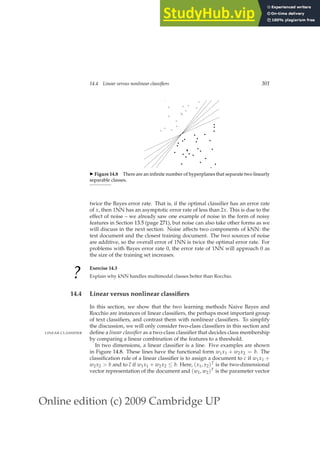
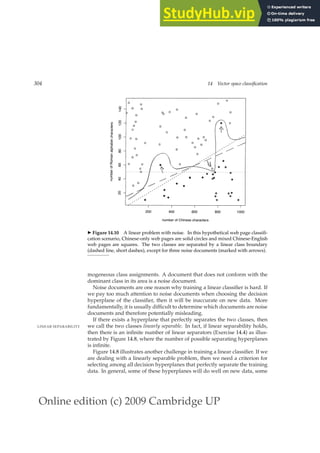
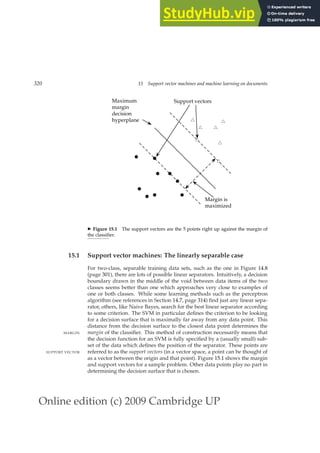
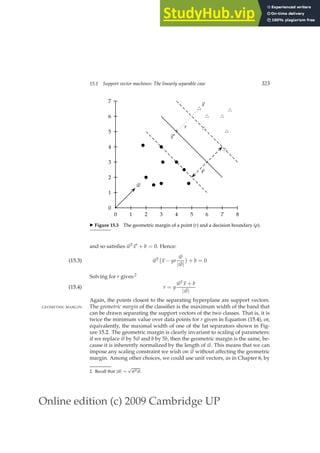
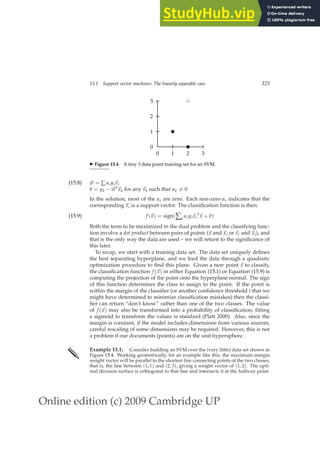
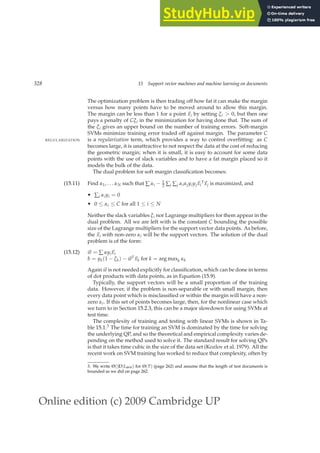
Online edition (c) 2009 Cambridge UP
An
Introduction
to
Information
Retrieval
Draft of April 1, 2009
Online edition (c) 2009 Cambridge UP
An
Introduction
to
Information
Retrieval
Christopher D. Manning
Prabhakar Raghavan
Hinrich Schütze
Cambridge University Press
Cambridge, England
Online edition (c) 2009 Cambridge UP
DRAFT!
DO NOT DISTRIBUTE WITHOUT PRIOR PERMISSION
© 2009 Cambridge University Press
By Christopher D. Manning, Prabhakar Raghavan & Hinrich Schütze
Printed on April 1, 2009
Website: http://www.informationretrieval.org/
Comments, corrections, and other feedback most welcome at:
informationretrieval@yahoogroups.com
Online edition (c) 2009 Cambridge UP
DRAFT! © April 1, 2009 Cambridge University Press. Feedback welcome. v
Brief Contents
1 Boolean retrieval 1
2 The term vocabulary and postings lists 19
3 Dictionaries and tolerant retrieval 49
4 Index construction 67
5 Index compression 85
6 Scoring, term weighting and the vector space model 109
7 Computing scores in a complete search system 135
8 Evaluation in information retrieval 151
9 Relevance feedback and query expansion 177
10 XML retrieval 195
11 Probabilistic information retrieval 219
12 Language models for information retrieval 237
13 Text classification and Naive Bayes 253
14 Vector space classification 289
15 Support vector machines and machine learning on documents 319
16 Flat clustering 349
17 Hierarchical clustering 377
18 Matrix decompositions and latent semantic indexing 403
19 Web search basics 421
20 Web crawling and indexes 443
21 Link analysis 461
Online edition (c) 2009 Cambridge UP
DRAFT! © April 1, 2009 Cambridge University Press. Feedback welcome. vii
Contents
Table of Notation xv
Preface xix
1 Boolean retrieval 1
1.1 An example information retrieval problem 3
1.2 A first take at building an inverted index 6
1.3 Processing Boolean queries 10
1.4 The extended Boolean model versus ranked retrieval 14
1.5 References and further reading 17
2 The term vocabulary and postings lists 19
2.1 Document delineation and character sequence decoding 19
2.1.1 Obtaining the character sequence in a document 19
2.1.2 Choosing a document unit 20
2.2 Determining the vocabulary of terms 22
2.2.1 Tokenization 22
2.2.2 Dropping common terms: stop words 27
2.2.3 Normalization (equivalence classing of terms) 28
2.2.4 Stemming and lemmatization 32
2.3 Faster postings list intersection via skip pointers 36
2.4 Positional postings and phrase queries 39
2.4.1 Biword indexes 39
2.4.2 Positional indexes 41
2.4.3 Combination schemes 43
2.5 References and further reading 45
3 Dictionaries and tolerant retrieval 49
3.1 Search structures for dictionaries 49
3.2 Wildcard queries 51
3.2.1 General wildcard queries 53
Online edition (c) 2009 Cambridge UP
viii Contents
3.2.2 k-gram indexes for wildcard queries 54
3.3 Spelling correction 56
3.3.1 Implementing spelling correction 57
3.3.2 Forms of spelling correction 57
3.3.3 Edit distance 58
3.3.4 k-gram indexes for spelling correction 60
3.3.5 Context sensitive spelling correction 62
3.4 Phonetic correction 63
3.5 References and further reading 65
4 Index construction 67
4.1 Hardware basics 68
4.2 Blocked sort-based indexing 69
4.3 Single-pass in-memory indexing 73
4.4 Distributed indexing 74
4.5 Dynamic indexing 78
4.6 Other types of indexes 80
4.7 References and further reading 83
5 Index compression 85
5.1 Statistical properties of terms in information retrieval 86
5.1.1 Heaps’ law: Estimating the number of terms 88
5.1.2 Zipf’s law: Modeling the distribution of terms 89
5.2 Dictionary compression 90
5.2.1 Dictionary as a string 91
5.2.2 Blocked storage 92
5.3 Postings file compression 95
5.3.1 Variable byte codes 96
5.3.2 γ codes 98
5.4 References and further reading 105
6 Scoring, term weighting and the vector space model 109
6.1 Parametric and zone indexes 110
6.1.1 Weighted zone scoring 112
6.1.2 Learning weights 113
6.1.3 The optimal weight g 115
6.2 Term frequency and weighting 117
6.2.1 Inverse document frequency 117
6.2.2 Tf-idf weighting 118
6.3 The vector space model for scoring 120
6.3.1 Dot products 120
6.3.2 Queries as vectors 123
6.3.3 Computing vector scores 124
Online edition (c) 2009 Cambridge UP
Contents ix
6.4 Variant tf-idf functions 126
6.4.1 Sublinear tf scaling 126
6.4.2 Maximum tf normalization 127
6.4.3 Document and query weighting schemes 128
6.4.4 Pivoted normalized document length 129
6.5 References and further reading 133
7 Computing scores in a complete search system 135
7.1 Efficient scoring and ranking 135
7.1.1 Inexact top K document retrieval 137
7.1.2 Index elimination 137
7.1.3 Champion lists 138
7.1.4 Static quality scores and ordering 138
7.1.5 Impact ordering 140
7.1.6 Cluster pruning 141
7.2 Components of an information retrieval system 143
7.2.1 Tiered indexes 143
7.2.2 Query-term proximity 144
7.2.3 Designing parsing and scoring functions 145
7.2.4 Putting it all together 146
7.3 Vector space scoring and query operator interaction 147
7.4 References and further reading 149
8 Evaluation in information retrieval 151
8.1 Information retrieval system evaluation 152
8.2 Standard test collections 153
8.3 Evaluation of unranked retrieval sets 154
8.4 Evaluation of ranked retrieval results 158
8.5 Assessing relevance 164
8.5.1 Critiques and justifications of the concept of
relevance 166
8.6 A broader perspective: System quality and user utility 168
8.6.1 System issues 168
8.6.2 User utility 169
8.6.3 Refining a deployed system 170
8.7 Results snippets 170
8.8 References and further reading 173
9 Relevance feedback and query expansion 177
9.1 Relevance feedback and pseudo relevance feedback 178
9.1.1 The Rocchio algorithm for relevance feedback 178
9.1.2 Probabilistic relevance feedback 183
9.1.3 When does relevance feedback work? 183
Online edition (c) 2009 Cambridge UP
x Contents
9.1.4 Relevance feedback on the web 185
9.1.5 Evaluation of relevance feedback strategies 186
9.1.6 Pseudo relevance feedback 187
9.1.7 Indirect relevance feedback 187
9.1.8 Summary 188
9.2 Global methods for query reformulation 189
9.2.1 Vocabulary tools for query reformulation 189
9.2.2 Query expansion 189
9.2.3 Automatic thesaurus generation 192
9.3 References and further reading 193
10 XML retrieval 195
10.1 Basic XML concepts 197
10.2 Challenges in XML retrieval 201
10.3 A vector space model for XML retrieval 206
10.4 Evaluation of XML retrieval 210
10.5 Text-centric vs. data-centric XML retrieval 214
10.6 References and further reading 216
10.7 Exercises 217
11 Probabilistic information retrieval 219
11.1 Review of basic probability theory 220
11.2 The Probability Ranking Principle 221
11.2.1 The 1/0 loss case 221
11.2.2 The PRP with retrieval costs 222
11.3 The Binary Independence Model 222
11.3.1 Deriving a ranking function for query terms 224
11.3.2 Probability estimates in theory 226
11.3.3 Probability estimates in practice 227
11.3.4 Probabilistic approaches to relevance feedback 228
11.4 An appraisal and some extensions 230
11.4.1 An appraisal of probabilistic models 230
11.4.2 Tree-structured dependencies between terms 231
11.4.3 Okapi BM25: a non-binary model 232
11.4.4 Bayesian network approaches to IR 234
11.5 References and further reading 235
12 Language models for information retrieval 237
12.1 Language models 237
12.1.1 Finite automata and language models 237
12.1.2 Types of language models 240
12.1.3 Multinomial distributions over words 241
12.2 The query likelihood model 242
Online edition (c) 2009 Cambridge UP
Contents xi
12.2.1 Using query likelihood language models in IR 242
12.2.2 Estimating the query generation probability 243
12.2.3 Ponte and Croft’s Experiments 246
12.3 Language modeling versus other approaches in IR 248
12.4 Extended language modeling approaches 250
12.5 References and further reading 252
13 Text classification and Naive Bayes 253
13.1 The text classification problem 256
13.2 Naive Bayes text classification 258
13.2.1 Relation to multinomial unigram language model 262
13.3 The Bernoulli model 263
13.4 Properties of Naive Bayes 265
13.4.1 A variant of the multinomial model 270
13.5 Feature selection 271
13.5.1 Mutual information 272
13.5.2 χ2 Feature selection 275
13.5.3 Frequency-based feature selection 277
13.5.4 Feature selection for multiple classifiers 278
13.5.5 Comparison of feature selection methods 278
13.6 Evaluation of text classification 279
13.7 References and further reading 286
14 Vector space classification 289
14.1 Document representations and measures of relatedness in
vector spaces 291
14.2 Rocchio classification 292
14.3 k nearest neighbor 297
14.3.1 Time complexity and optimality of kNN 299
14.4 Linear versus nonlinear classifiers 301
14.5 Classification with more than two classes 306
14.6 The bias-variance tradeoff 308
14.7 References and further reading 314
14.8 Exercises 315
15 Support vector machines and machine learning on documents 319
15.1 Support vector machines: The linearly separable case 320
15.2 Extensions to the SVM model 327
15.2.1 Soft margin classification 327
15.2.2 Multiclass SVMs 330
15.2.3 Nonlinear SVMs 330
15.2.4 Experimental results 333
15.3 Issues in the classification of text documents 334
Online edition (c) 2009 Cambridge UP
xii Contents
15.3.1 Choosing what kind of classifier to use 335
15.3.2 Improving classifier performance 337
15.4 Machine learning methods in ad hoc information retrieval 341
15.4.1 A simple example of machine-learned scoring 341
15.4.2 Result ranking by machine learning 344
15.5 References and further reading 346
16 Flat clustering 349
16.1 Clustering in information retrieval 350
16.2 Problem statement 354
16.2.1 Cardinality – the number of clusters 355
16.3 Evaluation of clustering 356
16.4 K-means 360
16.4.1 Cluster cardinality in K-means 365
16.5 Model-based clustering 368
16.6 References and further reading 372
16.7 Exercises 374
17 Hierarchical clustering 377
17.1 Hierarchical agglomerative clustering 378
17.2 Single-link and complete-link clustering 382
17.2.1 Time complexity of HAC 385
17.3 Group-average agglomerative clustering 388
17.4 Centroid clustering 391
17.5 Optimality of HAC 393
17.6 Divisive clustering 395
17.7 Cluster labeling 396
17.8 Implementation notes 398
17.9 References and further reading 399
17.10 Exercises 401
18 Matrix decompositions and latent semantic indexing 403
18.1 Linear algebra review 403
18.1.1 Matrix decompositions 406
18.2 Term-document matrices and singular value
decompositions 407
18.3 Low-rank approximations 410
18.4 Latent semantic indexing 412
18.5 References and further reading 417
19 Web search basics 421
19.1 Background and history 421
19.2 Web characteristics 423
19.2.1 The web graph 425
Online edition (c) 2009 Cambridge UP
Contents xiii
19.2.2 Spam 427
19.3 Advertising as the economic model 429
19.4 The search user experience 432
19.4.1 User query needs 432
19.5 Index size and estimation 433
19.6 Near-duplicates and shingling 437
19.7 References and further reading 441
20 Web crawling and indexes 443
20.1 Overview 443
20.1.1 Features a crawler must provide 443
20.1.2 Features a crawler should provide 444
20.2 Crawling 444
20.2.1 Crawler architecture 445
20.2.2 DNS resolution 449
20.2.3 The URL frontier 451
20.3 Distributing indexes 454
20.4 Connectivity servers 455
20.5 References and further reading 458
21 Link analysis 461
21.1 The Web as a graph 462
21.1.1 Anchor text and the web graph 462
21.2 PageRank 464
21.2.1 Markov chains 465
21.2.2 The PageRank computation 468
21.2.3 Topic-specific PageRank 471
21.3 Hubs and Authorities 474
21.3.1 Choosing the subset of the Web 477
21.4 References and further reading 480
Bibliography 483
Author Index 519
Online edition (c) 2009 Cambridge UP
DRAFT! © April 1, 2009 Cambridge University Press. Feedback welcome. xv
Table of Notation
Symbol Page Meaning
γ p. 98 γ code
γ p. 256 Classification or clustering function: γ(d) is d’s class
or cluster
Γ p. 256 Supervised learning method in Chapters 13 and 14:
Γ(D) is the classification function γ learned from
training set D
λ p. 404 Eigenvalue
~
µ(.) p. 292 Centroid of a class (in Rocchio classification) or a
cluster (in K-means and centroid clustering)
Φ p. 114 Training example
σ p. 408 Singular value
Θ(·) p. 11 A tight bound on the complexity of an algorithm

ω, ωk p. 357 Cluster in clustering
Ω p. 357 Clustering or set of clusters {ω1, . . . , ωK}
arg maxx f (x) p. 181 The value of x for which f reaches its maximum
arg minx f (x) p. 181 The value of x for which f reaches its minimum
c, cj p. 256 Class or category in classification
cft p. 89 The collection frequency of term t (the total number
of times the term appears in the document collec-
tion)
C p. 256 Set {c1, . . . , cJ} of all classes
C p. 268 A random variable that takes as values members of
C
Online edition (c) 2009 Cambridge UP
xvi Table of Notation
C p. 403 Term-document matrix
d p. 4 Index of the dth
document in the collection D
d p. 71 A document
~
d,~
q p. 181 Document vector, query vector
D p. 354 Set {d1, . . . , dN} of all documents
Dc p. 292 Set of documents that is in class c
D p. 256 Set {hd1, c1i, . . . , hdN, cNi} of all labeled documents
in Chapters 13–15
dft p. 118 The document frequency of term t (the total number
of documents in the collection the term appears in)
H p. 99 Entropy
HM p. 101 Mth harmonic number
I(X; Y) p. 272 Mutual information of random variables X and Y
idft p. 118 Inverse document frequency of term t
J p. 256 Number of classes
k p. 290 Top k items from a set, e.g., k nearest neighbors in
kNN, top k retrieved documents, top k selected fea-
tures from the vocabulary V
k p. 54 Sequence of k characters
K p. 354 Number of clusters
Ld p. 233 Length of document d (in tokens)
La p. 262 Length of the test document (or application docu-
ment) in tokens
Lave p. 70 Average length of a document (in tokens)
M p. 5 Size of the vocabulary (|V|)
Ma p. 262 Size of the vocabulary of the test document (or ap-
plication document)
Mave p. 78 Average size of the vocabulary in a document in the
collection
Md p. 237 Language model for document d
N p. 4 Number of documents in the retrieval or training
collection
Nc p. 259 Number of documents in class c
N(ω) p. 298 Number of times the event ω occurred
Online edition (c) 2009 Cambridge UP
Table of Notation xvii
O(·) p. 11 A bound on the complexity of an algorithm
O(·) p. 221 The odds of an event
P p. 155 Precision
P(·) p. 220 Probability
P p. 465 Transition probability matrix
q p. 59 A query
R p. 155 Recall
si p. 58 A string
si p. 112 Boolean values for zone scoring
sim(d1, d2) p. 121 Similarity score for documents d1, d2
T p. 43 Total number of tokens in the document collection
Tct p. 259 Number of occurrences of word t in documents of
class c
t p. 4 Index of the tth
term in the vocabulary V
t p. 61 A term in the vocabulary
tft,d p. 117 The term frequency of term t in document d (the to-
tal number of occurrences of t in d)
Ut p. 266 Random variable taking values 0 (term t is present)
and 1 (t is not present)
V p. 208 Vocabulary of terms {t1, . . . , tM} in a collection (a.k.a.
the lexicon)
~
v(d) p. 122 Length-normalized document vector
~
V(d) p. 120 Vector of document d, not length-normalized
wft,d p. 125 Weight of term t in document d
w p. 112 A weight, for example for zones or terms
~
wT
~
x = b p. 293 Hyperplane; ~
w is the normal vector of the hyper-
plane and wi component i of ~
w
~
x p. 222 Term incidence vector ~
x = (x1, . . . , xM); more gen-
erally: document feature representation
X p. 266 Random variable taking values in V, the vocabulary
(e.g., at a given position k in a document)
X p. 256 Document space in text classification
|A| p. 61 Set cardinality: the number of members of set A
|S| p. 404 Determinant of the square matrix S
Online edition (c) 2009 Cambridge UP
xviii Table of Notation
|si| p. 58 Length in characters of string si
|~
x| p. 139 Length of vector ~
x
|~
x −~
y| p. 131 Euclidean distance of ~
x and ~
y (which is the length of
(~
x −~
y))
Online edition (c) 2009 Cambridge UP
DRAFT! © April 1, 2009 Cambridge University Press. Feedback welcome. xix
Preface
As recently as the 1990s, studies showed that most people preferred getting
information from other people rather than from information retrieval sys-
tems. Of course, in that time period, most people also used human travel
agents to book their travel. However, during the last decade, relentless opti-
mization of information retrieval effectiveness has driven web search engines
to new quality levels where most people are satisfied most of the time, and
web search has become a standard and often preferred source of information
finding. For example, the 2004 Pew Internet Survey (Fallows 2004) found
that “92% of Internet users say the Internet is a good place to go for getting
everyday information.” To the surprise of many, the field of information re-
trieval has moved from being a primarily academic discipline to being the
basis underlying most people’s preferred means of information access. This
book presents the scientific underpinnings of this field, at a level accessible
to graduate students as well as advanced undergraduates.
Information retrieval did not begin with the Web. In response to various
challenges of providing information access, the field of information retrieval
evolved to give principled approaches to searching various forms of con-
tent. The field began with scientific publications and library records, but
soon spread to other forms of content, particularly those of information pro-
fessionals, such as journalists, lawyers, and doctors. Much of the scientific
research on information retrieval has occurred in these contexts, and much of
the continued practice of information retrieval deals with providing access to
unstructured information in various corporate and governmental domains,
and this work forms much of the foundation of our book.
Nevertheless, in recent years, a principal driver of innovation has been the
World Wide Web, unleashing publication at the scale of tens of millions of
content creators. This explosion of published information would be moot
if the information could not be found, annotated and analyzed so that each
user can quickly find information that is both relevant and comprehensive
for their needs. By the late 1990s, many people felt that continuing to index
Online edition (c) 2009 Cambridge UP
xx Preface
the whole Web would rapidly become impossible, due to the Web’s expo-
nential growth in size. But major scientific innovations, superb engineering,
the rapidly declining price of computer hardware, and the rise of a commer-
cial underpinning for web search have all conspired to power today’s major
search engines, which are able to provide high-quality results within subsec-
ond response times for hundreds of millions of searches a day over billions
of web pages.
Book organization and course development
This book is the result of a series of courses we have taught at Stanford Uni-
versity and at the University of Stuttgart, in a range of durations including
a single quarter, one semester and two quarters. These courses were aimed
at early-stage graduate students in computer science, but we have also had
enrollment from upper-class computer science undergraduates, as well as
students from law, medical informatics, statistics, linguistics and various en-
gineering disciplines. The key design principle for this book, therefore, was
to cover what we believe to be important in a one-term graduate course on
information retrieval. An additional principle is to build each chapter around
material that we believe can be covered in a single lecture of 75 to 90 minutes.
The first eight chapters of the book are devoted to the basics of informa-
tion retrieval, and in particular the heart of search engines; we consider this
material to be core to any course on information retrieval. Chapter 1 in-
troduces inverted indexes, and shows how simple Boolean queries can be
processed using such indexes. Chapter 2 builds on this introduction by de-
tailing the manner in which documents are preprocessed before indexing
and by discussing how inverted indexes are augmented in various ways for
functionality and speed. Chapter 3 discusses search structures for dictionar-
ies and how to process queries that have spelling errors and other imprecise
matches to the vocabulary in the document collection being searched. Chap-
ter 4 describes a number of algorithms for constructing the inverted index
from a text collection with particular attention to highly scalable and dis-
tributed algorithms that can be applied to very large collections. Chapter 5
covers techniques for compressing dictionaries and inverted indexes. These
techniques are critical for achieving subsecond response times to user queries
in large search engines. The indexes and queries considered in Chapters 1–5
only deal with Boolean retrieval, in which a document either matches a query,
or does not. A desire to measure the extent to which a document matches a
query, or the score of a document for a query, motivates the development of
term weighting and the computation of scores in Chapters 6 and 7, leading
to the idea of a list of documents that are rank-ordered for a query. Chapter 8
focuses on the evaluation of an information retrieval system based on the
Online edition (c) 2009 Cambridge UP
Preface xxi
relevance of the documents it retrieves, allowing us to compare the relative
performances of different systems on benchmark document collections and
queries.
Chapters 9–21 build on the foundation of the first eight chapters to cover
a variety of more advanced topics. Chapter 9 discusses methods by which
retrieval can be enhanced through the use of techniques like relevance feed-
back and query expansion, which aim at increasing the likelihood of retriev-
ing relevant documents. Chapter 10 considers information retrieval from
documents that are structured with markup languages like XML and HTML.
We treat structured retrieval by reducing it to the vector space scoring meth-
ods developed in Chapter 6. Chapters 11 and 12 invoke probability theory to
compute scores for documents on queries. Chapter 11 develops traditional
probabilistic information retrieval, which provides a framework for comput-
ing the probability of relevance of a document, given a set of query terms.
This probability may then be used as a score in ranking. Chapter 12 illus-
trates an alternative, wherein for each document in a collection, we build a
language model from which one can estimate a probability that the language
model generates a given query. This probability is another quantity with
which we can rank-order documents.
Chapters 13–17 give a treatment of various forms of machine learning and
numerical methods in information retrieval. Chapters 13–15 treat the prob-
lem of classifying documents into a set of known categories, given a set of
documents along with the classes they belong to. Chapter 13 motivates sta-
tistical classification as one of the key technologies needed for a successful
search engine, introduces Naive Bayes, a conceptually simple and efficient
text classification method, and outlines the standard methodology for evalu-
ating text classifiers. Chapter 14 employs the vector space model from Chap-
ter 6 and introduces two classification methods, Rocchio and kNN, that op-
erate on document vectors. It also presents the bias-variance tradeoff as an
important characterization of learning problems that provides criteria for se-
lecting an appropriate method for a text classification problem. Chapter 15
introduces support vector machines, which many researchers currently view
as the most effective text classification method. We also develop connections
in this chapter between the problem of classification and seemingly disparate
topics such as the induction of scoring functions from a set of training exam-
ples.
Chapters 16–18 consider the problem of inducing clusters of related doc-
uments from a collection. In Chapter 16, we first give an overview of a
number of important applications of clustering in information retrieval. We
then describe two flat clustering algorithms: the K-means algorithm, an ef-
ficient and widely used document clustering method; and the Expectation-
Maximization algorithm, which is computationally more expensive, but also
more flexible. Chapter 17 motivates the need for hierarchically structured
Online edition (c) 2009 Cambridge UP
xxii Preface
clusterings (instead of flat clusterings) in many applications in information
retrieval and introduces a number of clustering algorithms that produce a
hierarchy of clusters. The chapter also addresses the difficult problem of
automatically computing labels for clusters. Chapter 18 develops methods
from linear algebra that constitute an extension of clustering, and also offer
intriguing prospects for algebraic methods in information retrieval, which
have been pursued in the approach of latent semantic indexing.
Chapters 19–21 treat the problem of web search. We give in Chapter 19 a
summary of the basic challenges in web search, together with a set of tech-
niques that are pervasive in web information retrieval. Next, Chapter 20
describes the architecture and requirements of a basic web crawler. Finally,
Chapter 21 considers the power of link analysis in web search, using in the
process several methods from linear algebra and advanced probability the-
ory.
This book is not comprehensive in covering all topics related to informa-
tion retrieval. We have put aside a number of topics, which we deemed
outside the scope of what we wished to cover in an introduction to infor-
mation retrieval class. Nevertheless, for people interested in these topics, we
provide a few pointers to mainly textbook coverage here.
Cross-language IR (Grossman and Frieder 2004, ch. 4) and (Oard and Dorr
1996).
Image and Multimedia IR (Grossman and Frieder 2004, ch. 4), (Baeza-Yates
and Ribeiro-Neto 1999, ch. 6), (Baeza-Yates and Ribeiro-Neto 1999, ch. 11),
(Baeza-Yates and Ribeiro-Neto 1999, ch. 12), (del Bimbo 1999), (Lew 2001),
and (Smeulders et al. 2000).
Speech retrieval (Coden et al. 2002).
Music Retrieval (Downie 2006) and http://www.ismir.net/.
User interfaces for IR (Baeza-Yates and Ribeiro-Neto 1999, ch. 10).
Parallel and Peer-to-Peer IR (Grossman and Frieder 2004, ch. 7), (Baeza-Yates
and Ribeiro-Neto 1999, ch. 9), and (Aberer 2001).
Digital libraries (Baeza-Yates and Ribeiro-Neto 1999, ch. 15) and (Lesk 2004).
Information science perspective (Korfhage 1997), (Meadow et al. 1999), and
(Ingwersen and Järvelin 2005).
Logic-based approaches to IR (van Rijsbergen 1989).
Natural Language Processing techniques (Manning and Schütze 1999), (Ju-
rafsky and Martin 2008), and (Lewis and Jones 1996).
Online edition (c) 2009 Cambridge UP
Preface xxiii
Prerequisites
Introductory courses in data structures and algorithms, in linear algebra and
in probability theory suffice as prerequisites for all 21 chapters. We now give
more detail for the benefit of readers and instructors who wish to tailor their
reading to some of the chapters.
Chapters 1–5 assume as prerequisite a basic course in algorithms and data
structures. Chapters 6 and 7 require, in addition, a knowledge of basic lin-
ear algebra including vectors and dot products. No additional prerequisites
are assumed until Chapter 11, where a basic course in probability theory is
required; Section 11.1 gives a quick review of the concepts necessary in Chap-
ters 11–13. Chapter 15 assumes that the reader is familiar with the notion of
nonlinear optimization, although the chapter may be read without detailed
knowledge of algorithms for nonlinear optimization. Chapter 18 demands a
first course in linear algebra including familiarity with the notions of matrix
rank and eigenvectors; a brief review is given in Section 18.1. The knowledge
of eigenvalues and eigenvectors is also necessary in Chapter 21.
Book layout
✎ Worked examples in the text appear with a pencil sign next to them in the left
margin. Advanced or difficult material appears in sections or subsections
indicated with scissors in the margin. Exercises are marked in the margin
✄ with a question mark. The level of difficulty of exercises is indicated as easy
(⋆), medium (⋆⋆), or difficult (⋆ ⋆ ⋆).
?
Acknowledgments
We would like to thank Cambridge University Press for allowing us to make
the draft book available online, which facilitated much of the feedback we
have received while writing the book. We also thank Lauren Cowles, who
has been an outstanding editor, providing several rounds of comments on
each chapter, on matters of style, organization, and coverage, as well as de-
tailed comments on the subject matter of the book. To the extent that we
have achieved our goals in writing this book, she deserves an important part
of the credit.
We are very grateful to the many people who have given us comments,
suggestions, and corrections based on draft versions of this book. We thank
for providing various corrections and comments: Cheryl Aasheim, Josh At-
tenberg, Daniel Beck, Luc Bélanger, Georg Buscher, Tom Breuel, Daniel Bur-
ckhardt, Fazli Can, Dinquan Chen, Stephen Clark, Ernest Davis, Pedro Domin-
gos, Rodrigo Panchiniak Fernandes, Paolo Ferragina, Alex Fraser, Norbert
Online edition (c) 2009 Cambridge UP
xxiv Preface
Fuhr, Vignesh Ganapathy, Elmer Garduno, Xiubo Geng, David Gondek, Ser-
gio Govoni, Corinna Habets, Ben Handy, Donna Harman, Benjamin Haskell,
Thomas Hühn, Deepak Jain, Ralf Jankowitsch, Dinakar Jayarajan, Vinay Kakade,
Mei Kobayashi, Wessel Kraaij, Rick Lafleur, Florian Laws, Hang Li, David
Losada, David Mann, Ennio Masi, Sven Meyer zu Eissen, Alexander Murzaku,
Gonzalo Navarro, Frank McCown, Paul McNamee, Christoph Müller, Scott
Olsson, Tao Qin, Megha Raghavan, Michal Rosen-Zvi, Klaus Rothenhäusler,
Kenyu L. Runner, Alexander Salamanca, Grigory Sapunov, Evgeny Shad-
chnev, Tobias Scheffer, Nico Schlaefer, Ian Soboroff, Benno Stein, Marcin
Sydow, Andrew Turner, Jason Utt, Huey Vo, Travis Wade, Mike Walsh, Changliang
Wang, Renjing Wang, and Thomas Zeume.
Many people gave us detailed feedback on individual chapters, either at
our request or through their own initiative. For this, we’re particularly grate-
ful to: James Allan, Omar Alonso, Ismail Sengor Altingovde, Vo Ngoc Anh,
Roi Blanco, Eric Breck, Eric Brown, Mark Carman, Carlos Castillo, Junghoo
Cho, Aron Culotta, Doug Cutting, Meghana Deodhar, Susan Dumais, Jo-
hannes Fürnkranz, Andreas Heß, Djoerd Hiemstra, David Hull, Thorsten
Joachims, Siddharth Jonathan J. B., Jaap Kamps, Mounia Lalmas, Amy Langville,
Nicholas Lester, Dave Lewis, Daniel Lowd, Yosi Mass, Jeff Michels, Alessan-
dro Moschitti, Amir Najmi, Marc Najork, Giorgio Maria Di Nunzio, Paul
Ogilvie, Priyank Patel, Jan Pedersen, Kathryn Pedings, Vassilis Plachouras,
Daniel Ramage, Ghulam Raza, Stefan Riezler, Michael Schiehlen, Helmut
Schmid, Falk Nicolas Scholer, Sabine Schulte im Walde, Fabrizio Sebastiani,
Sarabjeet Singh, Valentin Spitkovsky, Alexander Strehl, John Tait, Shivaku-
mar Vaithyanathan, Ellen Voorhees, Gerhard Weikum, Dawid Weiss, Yiming
Yang, Yisong Yue, Jian Zhang, and Justin Zobel.
And finally there were a few reviewers who absolutely stood out in terms
of the quality and quantity of comments that they provided. We thank them
for their significant impact on the content and structure of the book. We
express our gratitude to Pavel Berkhin, Stefan Büttcher, Jamie Callan, Byron
Dom, Torsten Suel, and Andrew Trotman.
Parts of the initial drafts of Chapters 13–15 were based on slides that were
generously provided by Ray Mooney. While the material has gone through
extensive revisions, we gratefully acknowledge Ray’s contribution to the
three chapters in general and to the description of the time complexities of
text classification algorithms in particular.
The above is unfortunately an incomplete list: we are still in the process of
incorporating feedback we have received. And, like all opinionated authors,
we did not always heed the advice that was so freely given. The published
versions of the chapters remain solely the responsibility of the authors.
The authors thank Stanford University and the University of Stuttgart for
providing a stimulating academic environment for discussing ideas and the
opportunity to teach courses from which this book arose and in which its
Online edition (c) 2009 Cambridge UP
Preface xxv
contents were refined. CM thanks his family for the many hours they’ve let
him spend working on this book, and hopes he’ll have a bit more free time on
weekends next year. PR thanks his family for their patient support through
the writing of this book and is also grateful to Yahoo! Inc. for providing a
fertile environment in which to work on this book. HS would like to thank
his parents, family, and friends for their support while writing this book.
Web and contact information
This book has a companion website at http://informationretrieval.org. As well as
links to some more general resources, it is our intent to maintain on this web-
site a set of slides for each chapter which may be used for the corresponding
lecture. We gladly welcome further feedback, corrections, and suggestions
on the book, which may be sent to all the authors at informationretrieval (at) yahoogroups (dot) com.
Online edition (c) 2009 Cambridge UP
DRAFT! © April 1, 2009 Cambridge University Press. Feedback welcome. 1
1 Boolean retrieval
The meaning of the term information retrieval can be very broad. Just getting
a credit card out of your wallet so that you can type in the card number
is a form of information retrieval. However, as an academic field of study,
information retrieval might be defined thus:
INFORMATION
RETRIEVAL
Information retrieval (IR) is finding material (usually documents) of
an unstructured nature (usually text) that satisfies an information need
from within large collections (usually stored on computers).
As defined in this way, information retrieval used to be an activity that only
a few people engaged in: reference librarians, paralegals, and similar pro-
fessional searchers. Now the world has changed, and hundreds of millions
of people engage in information retrieval every day when they use a web
search engine or search their email.1 Information retrieval is fast becoming
the dominant form of information access, overtaking traditional database-
style searching (the sort that is going on when a clerk says to you: “I’m sorry,
I can only look up your order if you can give me your Order ID”).
IR can also cover other kinds of data and information problems beyond
that specified in the core definition above. The term “unstructured data”
refers to data which does not have clear, semantically overt, easy-for-a-computer
structure. It is the opposite of structured data, the canonical example of
which is a relational database, of the sort companies usually use to main-
tain product inventories and personnel records. In reality, almost no data
are truly “unstructured”. This is definitely true of all text data if you count
the latent linguistic structure of human languages. But even accepting that
the intended notion of structure is overt structure, most text has structure,
such as headings and paragraphs and footnotes, which is commonly repre-
sented in documents by explicit markup (such as the coding underlying web
1. In modern parlance, the word “search” has tended to replace “(information) retrieval”; the
term “search” is quite ambiguous, but in context we use the two synonymously.
Online edition (c) 2009 Cambridge UP
2 1 Boolean retrieval
pages). IR is also used to facilitate “semistructured” search such as finding a
document where the title contains Java and the body contains threading.
The field of information retrieval also covers supporting users in browsing
or filtering document collections or further processing a set of retrieved doc-
uments. Given a set of documents, clustering is the task of coming up with a
good grouping of the documents based on their contents. It is similar to ar-
ranging books on a bookshelf according to their topic. Given a set of topics,
standing information needs, or other categories (such as suitability of texts
for different age groups), classification is the task of deciding which class(es),
if any, each of a set of documents belongs to. It is often approached by first
manually classifying some documents and then hoping to be able to classify
new documents automatically.
Information retrieval systems can also be distinguished by the scale at
which they operate, and it is useful to distinguish three prominent scales.
In web search, the system has to provide search over billions of documents
stored on millions of computers. Distinctive issues are needing to gather
documents for indexing, being able to build systems that work efficiently
at this enormous scale, and handling particular aspects of the web, such as
the exploitation of hypertext and not being fooled by site providers manip-
ulating page content in an attempt to boost their search engine rankings,
given the commercial importance of the web. We focus on all these issues
in Chapters 19–21. At the other extreme is personal information retrieval. In
the last few years, consumer operating systems have integrated information
retrieval (such as Apple’s Mac OS X Spotlight or Windows Vista’s Instant
Search). Email programs usually not only provide search but also text clas-
sification: they at least provide a spam (junk mail) filter, and commonly also
provide either manual or automatic means for classifying mail so that it can
be placed directly into particular folders. Distinctive issues here include han-
dling the broad range of document types on a typical personal computer,
and making the search system maintenance free and sufficiently lightweight
in terms of startup, processing, and disk space usage that it can run on one
machine without annoying its owner. In between is the space of enterprise,
institutional, and domain-specific search, where retrieval might be provided for
collections such as a corporation’s internal documents, a database of patents,
or research articles on biochemistry. In this case, the documents will typi-
cally be stored on centralized file systems and one or a handful of dedicated
machines will provide search over the collection. This book contains tech-
niques of value over this whole spectrum, but our coverage of some aspects
of parallel and distributed search in web-scale search systems is compara-
tively light owing to the relatively small published literature on the details
of such systems. However, outside of a handful of web search companies, a
software developer is most likely to encounter the personal search and en-
terprise scenarios.
Online edition (c) 2009 Cambridge UP
1.1 An example information retrieval problem 3
In this chapter we begin with a very simple example of an information
retrieval problem, and introduce the idea of a term-document matrix (Sec-
tion 1.1) and the central inverted index data structure (Section 1.2). We will
then examine the Boolean retrieval model and how Boolean queries are pro-
cessed (Sections 1.3 and 1.4).
1.1 An example information retrieval problem
A fat book which many people own is Shakespeare’s Collected Works. Sup-
pose you wanted to determine which plays of Shakespeare contain the words
Brutus AND Caesar AND NOT Calpurnia. One way to do that is to start at the
beginning and to read through all the text, noting for each play whether
it contains Brutus and Caesar and excluding it from consideration if it con-
tains Calpurnia. The simplest form of document retrieval is for a computer
to do this sort of linear scan through documents. This process is commonly
referred to as grepping through text, after the Unix command grep, which
GREP
performs this process. Grepping through text can be a very effective process,
especially given the speed of modern computers, and often allows useful
possibilities for wildcard pattern matching through the use of regular expres-
sions. With modern computers, for simple querying of modest collections
(the size of Shakespeare’s Collected Works is a bit under one million words
of text in total), you really need nothing more.
But for many purposes, you do need more:
1. To process large document collections quickly. The amount of online data
has grown at least as quickly as the speed of computers, and we would
now like to be able to search collections that total in the order of billions
to trillions of words.
2. To allow more flexible matching operations. For example, it is impractical
to perform the query Romans NEAR countrymen with grep, where NEAR
might be defined as “within 5 words” or “within the same sentence”.
3. To allow ranked retrieval: in many cases you want the best answer to an
information need among many documents that contain certain words.
The way to avoid linearly scanning the texts for each query is to index the
INDEX
documents in advance. Let us stick with Shakespeare’s Collected Works,
and use it to introduce the basics of the Boolean retrieval model. Suppose
we record for each document – here a play of Shakespeare’s – whether it
contains each word out of all the words Shakespeare used (Shakespeare used
about 32,000 different words). The result is a binary term-document incidence
INCIDENCE MATRIX
matrix, as in Figure 1.1. Terms are the indexed units (further discussed in
TERM
Section 2.2); they are usually words, and for the moment you can think of
Online edition (c) 2009 Cambridge UP
4 1 Boolean retrieval
Antony Julius The Hamlet Othello Macbeth ...
and Caesar Tempest
Cleopatra
Antony 1 1 0 0 0 1
Brutus 1 1 0 1 0 0
Caesar 1 1 0 1 1 1
Calpurnia 0 1 0 0 0 0
Cleopatra 1 0 0 0 0 0
mercy 1 0 1 1 1 1
worser 1 0 1 1 1 0
...
◮ Figure 1.1 A term-document incidence matrix. Matrix element (t, d) is 1 if the
play in column d contains the word in row t, and is 0 otherwise.
them as words, but the information retrieval literature normally speaks of
terms because some of them, such as perhaps I-9 or Hong Kong are not usually
thought of as words. Now, depending on whether we look at the matrix rows
or columns, we can have a vector for each term, which shows the documents
it appears in, or a vector for each document, showing the terms that occur in
it.2
To answer the query Brutus AND Caesar AND NOT Calpurnia, we take the
vectors for Brutus, Caesar and Calpurnia, complement the last, and then do a
bitwise AND:
110100 AND 110111 AND 101111 = 100100
The answers for this query are thus Antony and Cleopatra and Hamlet (Fig-
ure 1.2).
The Boolean retrieval model is a model for information retrieval in which we
BOOLEAN RETRIEVAL
MODEL can pose any query which is in the form of a Boolean expression of terms,
that is, in which terms are combined with the operators AND, OR, and NOT.
The model views each document as just a set of words.
Let us now consider a more realistic scenario, simultaneously using the
opportunity to introduce some terminology and notation. Suppose we have
N = 1 million documents. By documents we mean whatever units we have
DOCUMENT
decided to build a retrieval system over. They might be individual memos
or chapters of a book (see Section 2.1.2 (page 20) for further discussion). We
will refer to the group of documents over which we perform retrieval as the
(document) collection. It is sometimes also referred to as a corpus (a body of
COLLECTION
CORPUS texts). Suppose each document is about 1000 words long (2–3 book pages). If
2. Formally, we take the transpose of the matrix to be able to get the terms as column vectors.
Online edition (c) 2009 Cambridge UP
1.1 An example information retrieval problem 5
Antony and Cleopatra, Act III, Scene ii
Agrippa [Aside to Domitius Enobarbus]: Why, Enobarbus,
When Antony found Julius Caesar dead,
He cried almost to roaring; and he wept
When at Philippi he found Brutus slain.
Hamlet, Act III, Scene ii
Lord Polonius: I did enact Julius Caesar: I was killed i’ the
Capitol; Brutus killed me.
◮ Figure 1.2 Results from Shakespeare for the query Brutus AND Caesar AND NOT
Calpurnia.
we assume an average of 6 bytes per word including spaces and punctuation,
then this is a document collection about 6 GB in size. Typically, there might
be about M = 500,000 distinct terms in these documents. There is nothing
special about the numbers we have chosen, and they might vary by an order
of magnitude or more, but they give us some idea of the dimensions of the
kinds of problems we need to handle. We will discuss and model these size
assumptions in Section 5.1 (page 86).
Our goal is to develop a system to address the ad hoc retrieval task. This is
AD HOC RETRIEVAL
the most standard IR task. In it, a system aims to provide documents from
within the collection that are relevant to an arbitrary user information need,
communicated to the system by means of a one-off, user-initiated query. An
information need is the topic about which the user desires to know more, and
INFORMATION NEED
is differentiated from a query, which is what the user conveys to the com-
QUERY
puter in an attempt to communicate the information need. A document is
relevant if it is one that the user perceives as containing information of value
RELEVANCE
with respect to their personal information need. Our example above was
rather artificial in that the information need was defined in terms of par-
ticular words, whereas usually a user is interested in a topic like “pipeline
leaks” and would like to find relevant documents regardless of whether they
precisely use those words or express the concept with other words such as
pipeline rupture. To assess the effectiveness of an IR system (i.e., the quality of
EFFECTIVENESS
its search results), a user will usually want to know two key statistics about
the system’s returned results for a query:
Precision: What fraction of the returned results are relevant to the informa-
PRECISION
tion need?
Recall: What fraction of the relevant documents in the collection were re-
RECALL
turned by the system?
Online edition (c) 2009 Cambridge UP
6 1 Boolean retrieval
Detailed discussion of relevance and evaluation measures including preci-
sion and recall is found in Chapter 8.
We now cannot build a term-document matrix in a naive way. A 500K ×
1M matrix has half-a-trillion 0’s and 1’s – too many to fit in a computer’s
memory. But the crucial observation is that the matrix is extremely sparse,
that is, it has few non-zero entries. Because each document is 1000 words
long, the matrix has no more than one billion 1’s, so a minimum of 99.8% of
the cells are zero. A much better representation is to record only the things
that do occur, that is, the 1 positions.
This idea is central to the first major concept in information retrieval, the
inverted index. The name is actually redundant: an index always maps back
INVERTED INDEX
from terms to the parts of a document where they occur. Nevertheless, in-
verted index, or sometimes inverted file, has become the standard term in infor-
mation retrieval.3 The basic idea of an inverted index is shown in Figure 1.3.
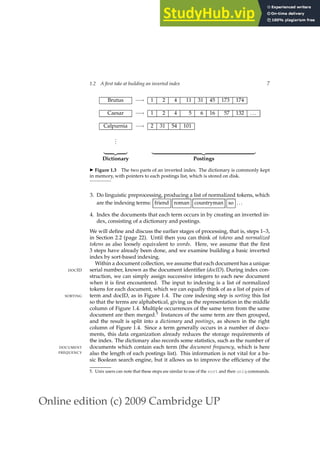
We keep a dictionary of terms (sometimes also referred to as a vocabulary or
DICTIONARY
VOCABULARY lexicon; in this book, we use dictionary for the data structure and vocabulary
LEXICON
for the set of terms). Then for each term, we have a list that records which
documents the term occurs in. Each item in the list – which records that a
term appeared in a document (and, later, often, the positions in the docu-
ment) – is conventionally called a posting.4 The list is then called a postings
POSTING
POSTINGS LIST list (or inverted list), and all the postings lists taken together are referred to as
the postings. The dictionary in Figure 1.3 has been sorted alphabetically and
POSTINGS
each postings list is sorted by document ID. We will see why this is useful in
Section 1.3, below, but later we will also consider alternatives to doing this
(Section 7.1.5).
1.2 A first take at building an inverted index
To gain the speed benefits of indexing at retrieval time, we have to build the
index in advance. The major steps in this are:
1. Collect the documents to be indexed:
Friends, Romans, countrymen. So let it be with Caesar ...
2. Tokenize the text, turning each document into a list of tokens:
Friends Romans countrymen So ...
3. Some information retrieval researchers prefer the term inverted file, but expressions like in-
dex construction and index compression are much more common than inverted file construction and
inverted file compression. For consistency, we use (inverted) index throughout this book.
4. In a (non-positional) inverted index, a posting is just a document ID, but it is inherently
associated with a term, via the postings list it is placed on; sometimes we will also talk of a
(term, docID) pair as a posting.
Online edition (c) 2009 Cambridge UP
1.2 A first take at building an inverted index 7
Brutus −→ 1 2 4 11 31 45 173 174
Caesar −→ 1 2 4 5 6 16 57 132 ...
Calpurnia −→ 2 31 54 101
.
.
.
| {z } | {z }
Dictionary Postings
◮ Figure 1.3 The two parts of an inverted index. The dictionary is commonly kept
in memory, with pointers to each postings list, which is stored on disk.
3. Do linguistic preprocessing, producing a list of normalized tokens, which
are the indexing terms: friend roman countryman so ...
4. Index the documents that each term occurs in by creating an inverted in-
dex, consisting of a dictionary and postings.
We will define and discuss the earlier stages of processing, that is, steps 1–3,
in Section 2.2 (page 22). Until then you can think of tokens and normalized
tokens as also loosely equivalent to words. Here, we assume that the first
3 steps have already been done, and we examine building a basic inverted
index by sort-based indexing.
Within a document collection, we assume that each document has a unique
serial number, known as the document identifier (docID). During index con-
DOCID
struction, we can simply assign successive integers to each new document
when it is first encountered. The input to indexing is a list of normalized
tokens for each document, which we can equally think of as a list of pairs of
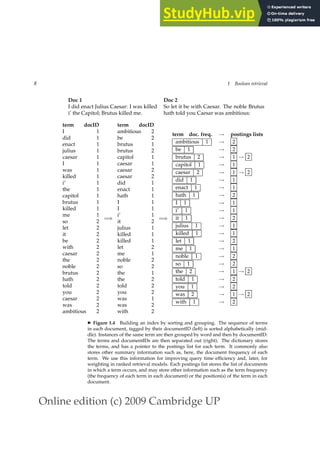
term and docID, as in Figure 1.4. The core indexing step is sorting this list
SORTING
so that the terms are alphabetical, giving us the representation in the middle
column of Figure 1.4. Multiple occurrences of the same term from the same
document are then merged.5 Instances of the same term are then grouped,
and the result is split into a dictionary and postings, as shown in the right
column of Figure 1.4. Since a term generally occurs in a number of docu-
ments, this data organization already reduces the storage requirements of
the index. The dictionary also records some statistics, such as the number of
documents which contain each term (the document frequency, which is here
DOCUMENT
FREQUENCY also the length of each postings list). This information is not vital for a ba-
sic Boolean search engine, but it allows us to improve the efficiency of the
5. Unix users can note that these steps are similar to use of the sort and then uniq commands.
Online edition (c) 2009 Cambridge UP
8 1 Boolean retrieval
Doc 1 Doc 2
I did enact Julius Caesar: I was killed
i’ the Capitol; Brutus killed me.
So let it be with Caesar. The noble Brutus
hath told you Caesar was ambitious:
term docID
I 1
did 1
enact 1
julius 1
caesar 1
I 1
was 1
killed 1
i’ 1
the 1
capitol 1
brutus 1
killed 1
me 1
so 2
let 2
it 2
be 2
with 2
caesar 2
the 2
noble 2
brutus 2
hath 2
told 2
you 2
caesar 2
was 2
ambitious 2
=⇒
term docID
ambitious 2
be 2
brutus 1
brutus 2
capitol 1
caesar 1
caesar 2
caesar 2
did 1
enact 1
hath 1
I 1
I 1
i’ 1
it 2
julius 1
killed 1
killed 1
let 2
me 1
noble 2
so 2
the 1
the 2
told 2
you 2
was 1
was 2
with 2
=⇒
term doc. freq. → postings lists
ambitious 1 → 2
be 1 → 2
brutus 2 → 1 → 2
capitol 1 → 1
caesar 2 → 1 → 2
did 1 → 1
enact 1 → 1
hath 1 → 2
I 1 → 1
i’ 1 → 1
it 1 → 2
julius 1 → 1
killed 1 → 1
let 1 → 2
me 1 → 1
noble 1 → 2
so 1 → 2
the 2 → 1 → 2
told 1 → 2
you 1 → 2
was 2 → 1 → 2
with 1 → 2
◮ Figure 1.4 Building an index by sorting and grouping. The sequence of terms
in each document, tagged by their documentID (left) is sorted alphabetically (mid-
dle). Instances of the same term are then grouped by word and then by documentID.
The terms and documentIDs are then separated out (right). The dictionary stores
the terms, and has a pointer to the postings list for each term. It commonly also
stores other summary information such as, here, the document frequency of each
term. We use this information for improving query time efficiency and, later, for
weighting in ranked retrieval models. Each postings list stores the list of documents
in which a term occurs, and may store other information such as the term frequency
(the frequency of each term in each document) or the position(s) of the term in each
document.
Online edition (c) 2009 Cambridge UP
1.2 A first take at building an inverted index 9
search engine at query time, and it is a statistic later used in many ranked re-
trieval models. The postings are secondarily sorted by docID. This provides
the basis for efficient query processing. This inverted index structure is es-
sentially without rivals as the most efficient structure for supporting ad hoc
text search.
In the resulting index, we pay for storage of both the dictionary and the
postings lists. The latter are much larger, but the dictionary is commonly
kept in memory, while postings lists are normally kept on disk, so the size
of each is important, and in Chapter 5 we will examine how each can be
optimized for storage and access efficiency. What data structure should be
used for a postings list? A fixed length array would be wasteful as some
words occur in many documents, and others in very few. For an in-memory
postings list, two good alternatives are singly linked lists or variable length
arrays. Singly linked lists allow cheap insertion of documents into postings
lists (following updates, such as when recrawling the web for updated doc-
uments), and naturally extend to more advanced indexing strategies such as
skip lists (Section 2.3), which require additional pointers. Variable length ar-
rays win in space requirements by avoiding the overhead for pointers and in
time requirements because their use of contiguous memory increases speed
on modern processors with memory caches. Extra pointers can in practice be
encoded into the lists as offsets. If updates are relatively infrequent, variable
length arrays will be more compact and faster to traverse. We can also use a
hybrid scheme with a linked list of fixed length arrays for each term. When
postings lists are stored on disk, they are stored (perhaps compressed) as a
contiguous run of postings without explicit pointers (as in Figure 1.3), so as
to minimize the size of the postings list and the number of disk seeks to read
a postings list into memory.
?
Exercise 1.1 [⋆]
Draw the inverted index that would be built for the following document collection.
(See Figure 1.3 for an example.)
Doc 1 new home sales top forecasts
Doc 2 home sales rise in july
Doc 3 increase in home sales in july
Doc 4 july new home sales rise
Exercise 1.2 [⋆]
Consider these documents:
Doc 1 breakthrough drug for schizophrenia
Doc 2 new schizophrenia drug
Doc 3 new approach for treatment of schizophrenia
Doc 4 new hopes for schizophrenia patients
a. Draw the term-document incidence matrix for this document collection.
Online edition (c) 2009 Cambridge UP
10 1 Boolean retrieval
Brutus −→ 1 → 2 → 4 → 11 → 31 → 45 → 173 → 174
Calpurnia −→ 2 → 31 → 54 → 101
Intersection =⇒ 2 → 31
◮ Figure 1.5 Intersecting the postings lists for Brutus and Calpurnia from Figure 1.3.
b. Draw the inverted index representation for this collection, as in Figure 1.3 (page 7).
Exercise 1.3 [⋆]
For the document collection shown in Exercise 1.2, what are the returned results for
these queries:
a. schizophrenia AND drug
b. for AND NOT(drug OR approach)
1.3 Processing Boolean queries
How do we process a query using an inverted index and the basic Boolean
retrieval model? Consider processing the simple conjunctive query:
SIMPLE CONJUNCTIVE
QUERIES
(1.1) Brutus AND Calpurnia
over the inverted index partially shown in Figure 1.3 (page 7). We:
1. Locate Brutus in the Dictionary
2. Retrieve its postings
3. Locate Calpurnia in the Dictionary
4. Retrieve its postings
5. Intersect the two postings lists, as shown in Figure 1.5.
The intersection operation is the crucial one: we need to efficiently intersect
POSTINGS LIST
INTERSECTION postings lists so as to be able to quickly find documents that contain both
terms. (This operation is sometimes referred to as merging postings lists:
POSTINGS MERGE
this slightly counterintuitive name reflects using the term merge algorithm for
a general family of algorithms that combine multiple sorted lists by inter-
leaved advancing of pointers through each; here we are merging the lists
with a logical AND operation.)
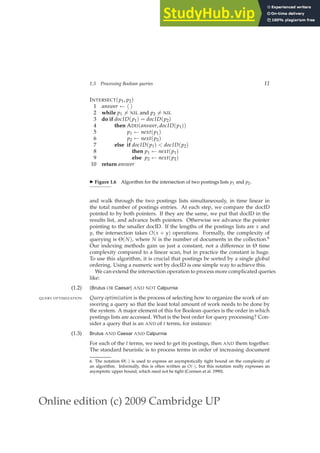
There is a simple and effective method of intersecting postings lists using
the merge algorithm (see Figure 1.6): we maintain pointers into both lists
Online edition (c) 2009 Cambridge UP
1.3 Processing Boolean queries 11
INTERSECT(p1, p2)
1 answer ← h i
2 while p1 6= NIL and p2 6= NIL
3 do if docID(p1) = docID(p2)
4 then ADD(answer, docID(p1))
5 p1 ← next(p1)
6 p2 ← next(p2)
7 else if docID(p1) < docID(p2)
8 then p1 ← next(p1)
9 else p2 ← next(p2)
10 return answer
◮ Figure 1.6 Algorithm for the intersection of two postings lists p1 and p2.
and walk through the two postings lists simultaneously, in time linear in
the total number of postings entries. At each step, we compare the docID
pointed to by both pointers. If they are the same, we put that docID in the
results list, and advance both pointers. Otherwise we advance the pointer
pointing to the smaller docID. If the lengths of the postings lists are x and
y, the intersection takes O(x + y) operations. Formally, the complexity of
querying is Θ(N), where N is the number of documents in the collection.6
Our indexing methods gain us just a constant, not a difference in Θ time
complexity compared to a linear scan, but in practice the constant is huge.
To use this algorithm, it is crucial that postings be sorted by a single global
ordering. Using a numeric sort by docID is one simple way to achieve this.
We can extend the intersection operation to process more complicated queries
like:
(1.2) (Brutus OR Caesar) AND NOT Calpurnia
Query optimization is the process of selecting how to organize the work of an-
QUERY OPTIMIZATION
swering a query so that the least total amount of work needs to be done by
the system. A major element of this for Boolean queries is the order in which
postings lists are accessed. What is the best order for query processing? Con-
sider a query that is an AND of t terms, for instance:
(1.3) Brutus AND Caesar AND Calpurnia
For each of the t terms, we need to get its postings, then AND them together.
The standard heuristic is to process terms in order of increasing document
6. The notation Θ(·) is used to express an asymptotically tight bound on the complexity of
an algorithm. Informally, this is often written as O(·), but this notation really expresses an
asymptotic upper bound, which need not be tight (Cormen et al. 1990).
Online edition (c) 2009 Cambridge UP
12 1 Boolean retrieval
INTERSECT(ht1, . . . , tni)
1 terms ← SORTBYINCREASINGFREQUENCY(ht1, . . . , tni)
2 result ← postings( first(terms))
3 terms ← rest(terms)
4 while terms 6= NIL and result 6= NIL
5 do result ← INTERSECT(result, postings( first(terms)))
6 terms ← rest(terms)
7 return result
◮ Figure 1.7 Algorithm for conjunctive queries that returns the set of documents
containing each term in the input list of terms.
frequency: if we start by intersecting the two smallest postings lists, then all
intermediate results must be no bigger than the smallest postings list, and we
are therefore likely to do the least amount of total work. So, for the postings
lists in Figure 1.3 (page 7), we execute the above query as:
(1.4) (Calpurnia AND Brutus) AND Caesar
This is a first justification for keeping the frequency of terms in the dictionary:
it allows us to make this ordering decision based on in-memory data before
accessing any postings list.
Consider now the optimization of more general queries, such as:
(1.5) (madding OR crowd) AND (ignoble OR strife) AND (killed OR slain)
As before, we will get the frequencies for all terms, and we can then (con-
servatively) estimate the size of each OR by the sum of the frequencies of its
disjuncts. We can then process the query in increasing order of the size of
each disjunctive term.
For arbitrary Boolean queries, we have to evaluate and temporarily store
the answers for intermediate expressions in a complex expression. However,
in many circumstances, either because of the nature of the query language,
or just because this is the most common type of query that users submit, a
query is purely conjunctive. In this case, rather than viewing merging post-
ings lists as a function with two inputs and a distinct output, it is more ef-
ficient to intersect each retrieved postings list with the current intermediate
result in memory, where we initialize the intermediate result by loading the
postings list of the least frequent term. This algorithm is shown in Figure 1.7.
The intersection operation is then asymmetric: the intermediate results list
is in memory while the list it is being intersected with is being read from
disk. Moreover the intermediate results list is always at least as short as the
other list, and in many cases it is orders of magnitude shorter. The postings
Online edition (c) 2009 Cambridge UP
1.3 Processing Boolean queries 13
intersection can still be done by the algorithm in Figure 1.6, but when the
difference between the list lengths is very large, opportunities to use alter-
native techniques open up. The intersection can be calculated in place by
destructively modifying or marking invalid items in the intermediate results
list. Or the intersection can be done as a sequence of binary searches in the
long postings lists for each posting in the intermediate results list. Another
possibility is to store the long postings list as a hashtable, so that membership
of an intermediate result item can be calculated in constant rather than linear
or log time. However, such alternative techniques are difficult to combine
with postings list compression of the sort discussed in Chapter 5. Moreover,
standard postings list intersection operations remain necessary when both
terms of a query are very common.
?
Exercise 1.4 [⋆]
For the queries below, can we still run through the intersection in time O(x + y),
where x and y are the lengths of the postings lists for Brutus and Caesar? If not, what
can we achieve?
a. Brutus AND NOT Caesar
b. Brutus OR NOT Caesar
Exercise 1.5 [⋆]
Extend the postings merge algorithm to arbitrary Boolean query formulas. What is
its time complexity? For instance, consider:
c. (Brutus OR Caesar) AND NOT (Antony OR Cleopatra)
Can we always merge in linear time? Linear in what? Can we do better than this?
Exercise 1.6 [⋆⋆]
We can use distributive laws for AND and OR to rewrite queries.
a. Show how to rewrite the query in Exercise 1.5 into disjunctive normal form using
the distributive laws.
b. Would the resulting query be more or less efficiently evaluated than the original
form of this query?
c. Is this result true in general or does it depend on the words and the contents of
the document collection?
Exercise 1.7 [⋆]
Recommend a query processing order for
d. (tangerine OR trees) AND (marmalade OR skies) AND (kaleidoscope OR eyes)
given the following postings list sizes:
Online edition (c) 2009 Cambridge UP
14 1 Boolean retrieval
Term Postings size
eyes 213312
kaleidoscope 87009
marmalade 107913
skies 271658
tangerine 46653
trees 316812
Exercise 1.8 [⋆]
If the query is:
e. friends AND romans AND (NOT countrymen)
how could we use the frequency of countrymen in evaluating the best query evaluation
order? In particular, propose a way of handling negation in determining the order of
query processing.
Exercise 1.9 [⋆⋆]
For a conjunctive query, is processing postings lists in order of size guaranteed to be
optimal? Explain why it is, or give an example where it isn’t.
Exercise 1.10 [⋆⋆]
Write out a postings merge algorithm, in the style of Figure 1.6 (page 11), for an x OR y
query.
Exercise 1.11 [⋆⋆]
How should the Boolean query x AND NOT y be handled? Why is naive evaluation
of this query normally very expensive? Write out a postings merge algorithm that
evaluates this query efficiently.
1.4 The extended Boolean model versus ranked retrieval
The Boolean retrieval model contrasts with ranked retrieval models such as the
RANKED RETRIEVAL
MODEL vector space model (Section 6.3), in which users largely use free text queries,
FREE TEXT QUERIES
that is, just typing one or more words rather than using a precise language
with operators for building up query expressions, and the system decides
which documents best satisfy the query. Despite decades of academic re-
search on the advantages of ranked retrieval, systems implementing the Boo-
lean retrieval model were the main or only search option provided by large
commercial information providers for three decades until the early 1990s (ap-
proximately the date of arrival of the World Wide Web). However, these
systems did not have just the basic Boolean operations (AND, OR, and NOT)
which we have presented so far. A strict Boolean expression over terms with
an unordered results set is too limited for many of the information needs
that people have, and these systems implemented extended Boolean retrieval
models by incorporating additional operators such as term proximity oper-
ators. A proximity operator is a way of specifying that two terms in a query
PROXIMITY OPERATOR
Online edition (c) 2009 Cambridge UP
1.4 The extended Boolean model versus ranked retrieval 15
must occur close to each other in a document, where closeness may be mea-
sured by limiting the allowed number of intervening words or by reference
to a structural unit such as a sentence or paragraph.
✎ Example 1.1: Commercial Boolean searching: Westlaw. Westlaw (http://www.westlaw.com/)
is the largest commercial legal search service (in terms of the number of paying sub-
scribers), with over half a million subscribers performing millions of searches a day
over tens of terabytes of text data. The service was started in 1975. In 2005, Boolean
search (called “Terms and Connectors” by Westlaw) was still the default, and used
by a large percentage of users, although ranked free text querying (called “Natural
Language” by Westlaw) was added in 1992. Here are some example Boolean queries
on Westlaw:
Information need: Information on the legal theories involved in preventing the
disclosure of trade secrets by employees formerly employed by a competing
company. Query: "trade secret" /s disclos! /s prevent /s employe!
Information need: Requirements for disabled people to be able to access a work-
place.
Query: disab! /p access! /s work-site work-place (employment /3 place)
Information need: Cases about a host’s responsibility for drunk guests.
Query: host! /p (responsib! liab!) /p (intoxicat! drunk!) /p guest
Note the long, precise queries and the use of proximity operators, both uncommon
in web search. Submitted queries average about ten words in length. Unlike web
search conventions, a space between words represents disjunction (the tightest bind-
ing operator), & is AND and /s, /p, and /k ask for matches in the same sentence,
same paragraph or within k words respectively. Double quotes give a phrase search
(consecutive words); see Section 2.4 (page 39). The exclamation mark (!) gives a trail-
ing wildcard query (see Section 3.2, page 51); thus liab! matches all words starting
with liab. Additionally work-site matches any of worksite, work-site or work site; see
Section 2.2.1 (page 22). Typical expert queries are usually carefully defined and incre-
mentally developed until they obtain what look to be good results to the user.
Many users, particularly professionals, prefer Boolean query models. Boolean
queries are precise: a document either matches the query or it does not. This of-
fers the user greater control and transparency over what is retrieved. And some do-
mains, such as legal materials, allow an effective means of document ranking within a
Boolean model: Westlaw returns documents in reverse chronological order, which is
in practice quite effective. In 2007, the majority of law librarians still seem to rec-
ommend terms and connectors for high recall searches, and the majority of legal
users think they are getting greater control by using them. However, this does not
mean that Boolean queries are more effective for professional searchers. Indeed, ex-
perimenting on a Westlaw subcollection, Turtle (1994) found that free text queries
produced better results than Boolean queries prepared by Westlaw’s own reference
librarians for the majority of the information needs in his experiments. A general
problem with Boolean search is that using AND operators tends to produce high pre-
cision but low recall searches, while using OR operators gives low precision but high
recall searches, and it is difficult or impossible to find a satisfactory middle ground.
In this chapter, we have looked at the structure and construction of a basic
Online edition (c) 2009 Cambridge UP
16 1 Boolean retrieval
inverted index, comprising a dictionary and postings lists. We introduced
the Boolean retrieval model, and examined how to do efficient retrieval via
linear time merges and simple query optimization. In Chapters 2–7 we will
consider in detail richer query models and the sort of augmented index struc-
tures that are needed to handle them efficiently. Here we just mention a few
of the main additional things we would like to be able to do:
1. We would like to better determine the set of terms in the dictionary and
to provide retrieval that is tolerant to spelling mistakes and inconsistent
choice of words.
2. It is often useful to search for compounds or phrases that denote a concept
such as “operating system”. As the Westlaw examples show, we might also
wish to do proximity queries such as Gates NEAR Microsoft. To answer
such queries, the index has to be augmented to capture the proximities of
terms in documents.
3. A Boolean model only records term presence or absence, but often we
would like to accumulate evidence, giving more weight to documents that
have a term several times as opposed to ones that contain it only once. To
be able to do this we need term frequency information (the number of times
TERM FREQUENCY
a term occurs in a document) in postings lists.
4. Boolean queries just retrieve a set of matching documents, but commonly
we wish to have an effective method to order (or “rank”) the returned
results. This requires having a mechanism for determining a document
score which encapsulates how good a match a document is for a query.
With these additional ideas, we will have seen most of the basic technol-
ogy that supports ad hoc searching over unstructured information. Ad hoc
searching over documents has recently conquered the world, powering not
only web search engines but the kind of unstructured search that lies behind
the large eCommerce websites. Although the main web search engines differ
by emphasizing free text querying, most of the basic issues and technologies
of indexing and querying remain the same, as we will see in later chapters.
Moreover, over time, web search engines have added at least partial imple-
mentations of some of the most popular operators from extended Boolean
models: phrase search is especially popular and most have a very partial
implementation of Boolean operators. Nevertheless, while these options are
liked by expert searchers, they are little used by most people and are not the
main focus in work on trying to improve web search engine performance.
?
Exercise 1.12 [⋆]
Write a query using Westlaw syntax which would find any of the words professor,
teacher, or lecturer in the same sentence as a form of the verb explain.
Online edition (c) 2009 Cambridge UP
1.5 References and further reading 17
Exercise 1.13 [⋆]
Try using the Boolean search features on a couple of major web search engines. For
instance, choose a word, such as burglar, and submit the queries (i) burglar, (ii) burglar
AND burglar, and (iii) burglar OR burglar. Look at the estimated number of results and
top hits. Do they make sense in terms of Boolean logic? Often they haven’t for major
search engines. Can you make sense of what is going on? What about if you try
different words? For example, query for (i) knight, (ii) conquer, and then (iii) knight OR
conquer. What bound should the number of results from the first two queries place
on the third query? Is this bound observed?
1.5 References and further reading
The practical pursuit of computerized information retrieval began in the late
1940s (Cleverdon 1991, Liddy 2005). A great increase in the production of
scientific literature, much in the form of less formal technical reports rather
than traditional journal articles, coupled with the availability of computers,
led to interest in automatic document retrieval. However, in those days, doc-
ument retrieval was always based on author, title, and keywords; full-text
search came much later.
The article of Bush (1945) provided lasting inspiration for the new field:
“Consider a future device for individual use, which is a sort of mech-
anized private file and library. It needs a name, and, to coin one at
random, ‘memex’ will do. A memex is a device in which an individual
stores all his books, records, and communications, and which is mech-
anized so that it may be consulted with exceeding speed and flexibility.
It is an enlarged intimate supplement to his memory.”
The term Information Retrieval was coined by Calvin Mooers in 1948/1950
(Mooers 1950).
In 1958, much newspaper attention was paid to demonstrations at a con-
ference (see Taube and Wooster 1958) of IBM “auto-indexing” machines, based
primarily on the work of H. P. Luhn. Commercial interest quickly gravitated
towards Boolean retrieval systems, but the early years saw a heady debate
over various disparate technologies for retrieval systems. For example Moo-
ers (1961) dissented:
“It is a common fallacy, underwritten at this date by the investment of
several million dollars in a variety of retrieval hardware, that the al-
gebra of George Boole (1847) is the appropriate formalism for retrieval
system design. This view is as widely and uncritically accepted as it is
wrong.”
The observation of AND vs. OR giving you opposite extremes in a precision/
recall tradeoff, but not the middle ground comes from (Lee and Fox 1988).
Online edition (c) 2009 Cambridge UP
18 1 Boolean retrieval
The book (Witten et al. 1999) is the standard reference for an in-depth com-
parison of the space and time efficiency of the inverted index versus other
possible data structures; a more succinct and up-to-date presentation ap-
pears in Zobel and Moffat (2006). We further discuss several approaches in
Chapter 5.
Friedl (2006) covers the practical usage of regular expressions for searching.
REGULAR EXPRESSIONS
The underlying computer science appears in (Hopcroft et al. 2000).
Online edition (c) 2009 Cambridge UP
DRAFT! © April 1, 2009 Cambridge University Press. Feedback welcome. 19
2 The term vocabulary and postings
lists
Recall the major steps in inverted index construction:
1. Collect the documents to be indexed.
2. Tokenize the text.
3. Do linguistic preprocessing of tokens.
4. Index the documents that each term occurs in.
In this chapter we first briefly mention how the basic unit of a document can
be defined and how the character sequence that it comprises is determined
(Section 2.1). We then examine in detail some of the substantive linguis-
tic issues of tokenization and linguistic preprocessing, which determine the
vocabulary of terms which a system uses (Section 2.2). Tokenization is the
process of chopping character streams into tokens, while linguistic prepro-
cessing then deals with building equivalence classes of tokens which are the
set of terms that are indexed. Indexing itself is covered in Chapters 1 and 4.
Then we return to the implementation of postings lists. In Section 2.3, we
examine an extended postings list data structure that supports faster query-
ing, while Section 2.4 covers building postings data structures suitable for
handling phrase and proximity queries, of the sort that commonly appear in
both extended Boolean models and on the web.
2.1 Document delineation and character sequence decoding
2.1.1 Obtaining the character sequence in a document
Digital documents that are the input to an indexing process are typically
bytes in a file or on a web server. The first step of processing is to convert this
byte sequence into a linear sequence of characters. For the case of plain En-
glish text in ASCII encoding, this is trivial. But often things get much more
Online edition (c) 2009 Cambridge UP
20 2 The term vocabulary and postings lists
complex. The sequence of characters may be encoded by one of various sin-
gle byte or multibyte encoding schemes, such as Unicode UTF-8, or various
national or vendor-specific standards. We need to determine the correct en-
coding. This can be regarded as a machine learning classification problem,
as discussed in Chapter 13,1 but is often handled by heuristic methods, user
selection, or by using provided document metadata. Once the encoding is
determined, we decode the byte sequence to a character sequence. We might
save the choice of encoding because it gives some evidence about what lan-
guage the document is written in.
The characters may have to be decoded out of some binary representation
like Microsoft Word DOC files and/or a compressed format such as zip files.
Again, we must determine the document format, and then an appropriate
decoder has to be used. Even for plain text documents, additional decoding
may need to be done. In XML documents (Section 10.1, page 197), charac-
ter entities, such as &amp;, need to be decoded to give the correct character,
namely & for &amp;. Finally, the textual part of the document may need to
be extracted out of other material that will not be processed. This might be
the desired handling for XML files, if the markup is going to be ignored; we
would almost certainly want to do this with postscript or PDF files. We will
not deal further with these issues in this book, and will assume henceforth
that our documents are a list of characters. Commercial products usually
need to support a broad range of document types and encodings, since users
want things to just work with their data as is. Often, they just think of docu-
ments as text inside applications and are not even aware of how it is encoded
on disk. This problem is usually solved by licensing a software library that
handles decoding document formats and character encodings.
The idea that text is a linear sequence of characters is also called into ques-
tion by some writing systems, such as Arabic, where text takes on some
two dimensional and mixed order characteristics, as shown in Figures 2.1
and 2.2. But, despite some complicated writing system conventions, there
is an underlying sequence of sounds being represented and hence an essen-
tially linear structure remains, and this is what is represented in the digital
representation of Arabic, as shown in Figure 2.1.
2.1.2 Choosing a document unit
The next phase is to determine what the document unit for indexing is. Thus
DOCUMENT UNIT
far we have assumed that documents are fixed units for the purposes of in-
dexing. For example, we take each file in a folder as a document. But there
1. A classifier is a function that takes objects of some sort and assigns them to one of a number
of distinct classes (see Chapter 13). Usually classification is done by machine learning methods
such as probabilistic models, but it can also be done by hand-written rules.
Online edition (c) 2009 Cambridge UP
2.1 Document delineation and character sequence decoding 21
ٌ
‫ب‬َ
ِ
‫آ‬ ⇐ ٌ ‫ب‬ ‫ا‬ ‫ت‬ ِ ‫ك‬
un b ā t i k
/kitābun/ ‘a book’
◮ Figure 2.1 An example of a vocalized Modern Standard Arabic word. The writing
is from right to left and letters undergo complex mutations as they are combined. The
representation of short vowels (here, /i/ and /u/) and the final /n/ (nunation) de-
parts from strict linearity by being represented as diacritics above and below letters.
Nevertheless, the represented text is still clearly a linear ordering of characters repre-
senting sounds. Full vocalization, as here, normally appears only in the Koran and
children’s books. Day-to-day text is unvocalized (short vowels are not represented
but the letter for ā would still appear) or partially vocalized, with short vowels in-
serted in places where the writer perceives ambiguities. These choices add further
complexities to indexing.
  ‫ا‬ ‫ا‬ ‫ا‬
1962

132
 ‫ا‬ ‫ال‬ ! !#
.
← → ← → ← START
‘Algeria achieved its independence in 1962 after 132 years of French occupation.’
◮ Figure 2.2 The conceptual linear order of characters is not necessarily the order
that you see on the page. In languages that are written right-to-left, such as Hebrew
and Arabic, it is quite common to also have left-to-right text interspersed, such as
numbers and dollar amounts. With modern Unicode representation concepts, the
order of characters in files matches the conceptual order, and the reversal of displayed
characters is handled by the rendering system, but this may not be true for documents
in older encodings.
are many cases in which you might want to do something different. A tra-
ditional Unix (mbox-format) email file stores a sequence of email messages
(an email folder) in one file, but you might wish to regard each email mes-
sage as a separate document. Many email messages now contain attached
documents, and you might then want to regard the email message and each
contained attachment as separate documents. If an email message has an
attached zip file, you might want to decode the zip file and regard each file
it contains as a separate document. Going in the opposite direction, various
pieces of web software (such as latex2html) take things that you might regard
as a single document (e.g., a Powerpoint file or a L
ATEX document) and split
them into separate HTML pages for each slide or subsection, stored as sep-
arate files. In these cases, you might want to combine multiple files into a
single document.
More generally, for very long documents, the issue of indexing granularity
INDEXING
GRANULARITY arises. For a collection of books, it would usually be a bad idea to index an
Online edition (c) 2009 Cambridge UP
22 2 The term vocabulary and postings lists
entire book as a document. A search for Chinese toys might bring up a book
that mentions China in the first chapter and toys in the last chapter, but this
does not make it relevant to the query. Instead, we may well wish to index
each chapter or paragraph as a mini-document. Matches are then more likely
to be relevant, and since the documents are smaller it will be much easier for
the user to find the relevant passages in the document. But why stop there?
We could treat individual sentences as mini-documents. It becomes clear
that there is a precision/recall tradeoff here. If the units get too small, we
are likely to miss important passages because terms were distributed over
several mini-documents, while if units are too large we tend to get spurious
matches and the relevant information is hard for the user to find.
The problems with large document units can be alleviated by use of ex-
plicit or implicit proximity search (Sections 2.4.2 and 7.2.2), and the trade-
offs in resulting system performance that we are hinting at are discussed
in Chapter 8. The issue of index granularity, and in particular a need to
simultaneously index documents at multiple levels of granularity, appears
prominently in XML retrieval, and is taken up again in Chapter 10. An IR
system should be designed to offer choices of granularity. For this choice to
be made well, the person who is deploying the system must have a good
understanding of the document collection, the users, and their likely infor-
mation needs and usage patterns. For now, we will henceforth assume that
a suitable size document unit has been chosen, together with an appropriate
way of dividing or aggregating files, if needed.
2.2 Determining the vocabulary of terms
2.2.1 Tokenization
Given a character sequence and a defined document unit, tokenization is the
task of chopping it up into pieces, called tokens, perhaps at the same time
throwing away certain characters, such as punctuation. Here is an example
of tokenization:
Input: Friends, Romans, Countrymen, lend me your ears;
Output: Friends Romans Countrymen lend me your ears
These tokens are often loosely referred to as terms or words, but it is some-
times important to make a type/token distinction. A token is an instance
TOKEN
of a sequence of characters in some particular document that are grouped
together as a useful semantic unit for processing. A type is the class of all
TYPE
tokens containing the same character sequence. A term is a (perhaps nor-
TERM
malized) type that is included in the IR system’s dictionary. The set of index
terms could be entirely distinct from the tokens, for instance, they could be
Online edition (c) 2009 Cambridge UP
2.2 Determining the vocabulary of terms 23
semantic identifiers in a taxonomy, but in practice in modern IR systems they
are strongly related to the tokens in the document. However, rather than be-
ing exactly the tokens that appear in the document, they are usually derived
from them by various normalization processes which are discussed in Sec-
tion 2.2.3.2 For example, if the document to be indexed is to sleep perchance to
dream, then there are 5 tokens, but only 4 types (since there are 2 instances of
to). However, if to is omitted from the index (as a stop word, see Section 2.2.2
(page 27)), then there will be only 3 terms: sleep, perchance, and dream.
The major question of the tokenization phase is what are the correct tokens
to use? In this example, it looks fairly trivial: you chop on whitespace and
throw away punctuation characters. This is a starting point, but even for
English there are a number of tricky cases. For example, what do you do
about the various uses of the apostrophe for possession and contractions?
Mr. O’Neill thinks that the boys’ stories about Chile’s capital aren’t
amusing.
For O’Neill, which of the following is the desired tokenization?
neill
oneill
o’neill
o’ neill
o neill ?
And for aren’t, is it:
aren’t
arent
are n’t
aren t ?
A simple strategy is to just split on all non-alphanumeric characters, but
while o neill looks okay, aren t looks intuitively bad. For all of them,
the choices determine which Boolean queries will match. A query of neill
AND capital will match in three cases but not the other two. In how many
cases would a query of o’neill AND capital match? If no preprocessing of a
query is done, then it would match in only one of the five cases. For either
2. That is, as defined here, tokens that are not indexed (stop words) are not terms, and if mul-
tiple tokens are collapsed together via normalization, they are indexed as one term, under the
normalized form. However, we later relax this definition when discussing classification and
clustering in Chapters 13–18, where there is no index. In these chapters, we drop the require-
ment of inclusion in the dictionary. A term means a normalized word.
Online edition (c) 2009 Cambridge UP
24 2 The term vocabulary and postings lists
Boolean or free text queries, you always want to do the exact same tokeniza-
tion of document and query words, generally by processing queries with the
same tokenizer. This guarantees that a sequence of characters in a text will
always match the same sequence typed in a query.3
These issues of tokenization are language-specific. It thus requires the lan-
guage of the document to be known. Language identification based on clas-
LANGUAGE
IDENTIFICATION sifiers that use short character subsequences as features is highly effective;
most languages have distinctive signature patterns (see page 46 for refer-
ences).
For most languages and particular domains within them there are unusual
specific tokens that we wish to recognize as terms, such as the programming
languages C++ and C#, aircraft names like B-52, or a T.V. show name such
as M*A*S*H – which is sufficiently integrated into popular culture that you
find usages such as M*A*S*H-style hospitals. Computer technology has in-
troduced new types of character sequences that a tokenizer should probably
tokenize as a single token, including email addresses (jblack@mail.yahoo.com),
web URLs (http://stuff.big.com/new/specials.html),numeric IP addresses (142.32.48.231),
package tracking numbers (1Z9999W99845399981), and more. One possible
solution is to omit from indexing tokens such as monetary amounts, num-
bers, and URLs, since their presence greatly expands the size of the vocab-
ulary. However, this comes at a large cost in restricting what people can
search for. For instance, people might want to search in a bug database for
the line number where an error occurs. Items such as the date of an email,
which have a clear semantic type, are often indexed separately as document
metadata (see Section 6.1, page 110).
In English, hyphenation is used for various purposes ranging from split-
HYPHENS
ting up vowels in words (co-education) to joining nouns as names (Hewlett-
Packard) to a copyediting device to show word grouping (the hold-him-back-
and-drag-him-away maneuver). It is easy to feel that the first example should be
regarded as one token (and is indeed more commonly written as just coedu-
cation), the last should be separated into words, and that the middle case is
unclear. Handling hyphens automatically can thus be complex: it can either
be done as a classification problem, or more commonly by some heuristic
rules, such as allowing short hyphenated prefixes on words, but not longer
hyphenated forms.
Conceptually, splitting on white space can also split what should be re-
garded as a single token. This occurs most commonly with names (San Fran-
cisco, Los Angeles) but also with borrowed foreign phrases (au fait) and com-
3. For the free text case, this is straightforward. The Boolean case is more complex: this tok-
enization may produce multiple terms from one query word. This can be handled by combining
the terms with an AND or as a phrase query (see Section 2.4, page 39). It is harder for a system
to handle the opposite case where the user entered as two terms something that was tokenized
together in the document processing.
Online edition (c) 2009 Cambridge UP
2.2 Determining the vocabulary of terms 25
pounds that are sometimes written as a single word and sometimes space
separated (such as white space vs. whitespace). Other cases with internal spaces
that we might wish to regard as a single token include phone numbers ((800) 234-
2333) and dates (Mar 11, 1983). Splitting tokens on spaces can cause bad
retrieval results, for example, if a search for York University mainly returns
documents containing New York University. The problems of hyphens and
non-separating whitespace can even interact. Advertisements for air fares
frequently contain items like San Francisco-Los Angeles, where simply doing
whitespace splitting would give unfortunate results. In such cases, issues of
tokenization interact with handling phrase queries (which we discuss in Sec-
tion 2.4 (page 39)), particularly if we would like queries for all of lowercase,
lower-case and lower case to return the same results. The last two can be han-
dled by splitting on hyphens and using a phrase index. Getting the first case
right would depend on knowing that it is sometimes written as two words
and also indexing it in this way. One effective strategy in practice, which
is used by some Boolean retrieval systems such as Westlaw and Lexis-Nexis
(Example 1.1), is to encourage users to enter hyphens wherever they may be
possible, and whenever there is a hyphenated form, the system will general-
ize the query to cover all three of the one word, hyphenated, and two word
forms, so that a query for over-eager will search for over-eager OR “over eager”
OR overeager. However, this strategy depends on user training, since if you
query using either of the other two forms, you get no generalization.
Each new language presents some new issues. For instance, French has a
variant use of the apostrophe for a reduced definite article ‘the’ before a word
beginning with a vowel (e.g., l’ensemble) and has some uses of the hyphen
with postposed clitic pronouns in imperatives and questions (e.g., donne-
moi ‘give me’). Getting the first case correct will affect the correct indexing
of a fair percentage of nouns and adjectives: you would want documents
mentioning both l’ensemble and un ensemble to be indexed under ensemble.
Other languages make the problem harder in new ways. German writes
compound nouns without spaces (e.g., Computerlinguistik ‘computational lin-
COMPOUNDS
guistics’; Lebensversicherungsgesellschaftsangestellter ‘life insurance company
employee’). Retrieval systems for German greatly benefit from the use of a
compound-splitter module, which is usually implemented by seeing if a word
COMPOUND-SPLITTER
can be subdivided into multiple words that appear in a vocabulary. This phe-
nomenon reaches its limit case with major East Asian Languages (e.g., Chi-
nese, Japanese, Korean, and Thai), where text is written without any spaces
between words. An example is shown in Figure 2.3. One approach here is to
perform word segmentation as prior linguistic processing. Methods of word
WORD SEGMENTATION
segmentation vary from having a large vocabulary and taking the longest
vocabulary match with some heuristics for unknown words to the use of
machine learning sequence models, such as hidden Markov models or condi-
tional random fields, trained over hand-segmented words (see the references
Online edition (c) 2009 Cambridge UP
26 2 The term vocabulary and postings lists
✁ ✂ ✄ ☎ ✆ ✝ ✞ ✆ ✟ ✠ ✡ ☛ ☞ ✌ ✍ ✎ ✏ ✑ ✒ ✓ ✔ ✕ ✖
✗ ✘ ✙
✁ ✂ ✄ ✆ ✟ ✠ ✚ ✛ ✜ ✢ ✣ ✤ ✥ ✦ ✧ ★ ✩ ✪ ✫ ✬
✘
✒ ✬
✘ ✭ ✮ ✯ ✙
✁ ✂ ✄ ✰ ✱ ★ ✲ ✟ ✌ ✳ ✴ ✒
◮ Figure 2.3 The standard unsegmented form of Chinese text using the simplified
characters of mainland China. There is no whitespace between words, not even be-
tween sentences – the apparent space after the Chinese period (◦) is just a typograph-
ical illusion caused by placing the character on the left side of its square box. The
first sentence is just words in Chinese characters with no spaces between them. The
second and third sentences include Arabic numerals and punctuation breaking up
the Chinese characters.
◮ Figure 2.4 Ambiguities in Chinese word segmentation. The two characters can
be treated as one word meaning ‘monk’ or as a sequence of two words meaning ‘and’
and ‘still’.
a an and are as at be by for from
has he in is it its of on that the
to was were will with
◮ Figure 2.5 A stop list of 25 semantically non-selective words which are common
in Reuters-RCV1.
in Section 2.5). Since there are multiple possible segmentations of character
sequences (see Figure 2.4), all such methods make mistakes sometimes, and
so you are never guaranteed a consistent unique tokenization. The other ap-
proach is to abandon word-based indexing and to do all indexing via just
short subsequences of characters (character k-grams), regardless of whether
particular sequences cross word boundaries or not. Three reasons why this
approach is appealing are that an individual Chinese character is more like a
syllable than a letter and usually has some semantic content, that most words
are short (the commonest length is 2 characters), and that, given the lack of
standardization of word breaking in the writing system, it is not always clear
where word boundaries should be placed anyway. Even in English, some
cases of where to put word boundaries are just orthographic conventions –
think of notwithstanding vs. not to mention or into vs. on to – but people are
educated to write the words with consistent use of spaces.
Online edition (c) 2009 Cambridge UP
2.2 Determining the vocabulary of terms 27
2.2.2 Dropping common terms: stop words
Sometimes, some extremely common words which would appear to be of
little value in helping select documents matching a user need are excluded
from the vocabulary entirely. These words are called stop words. The general
STOP WORDS
strategy for determining a stop list is to sort the terms by collection frequency
COLLECTION
FREQUENCY (the total number of times each term appears in the document collection),
and then to take the most frequent terms, often hand-filtered for their se-
mantic content relative to the domain of the documents being indexed, as
a stop list, the members of which are then discarded during indexing. An
STOP LIST
example of a stop list is shown in Figure 2.5. Using a stop list significantly
reduces the number of postings that a system has to store; we will present
some statistics on this in Chapter 5 (see Table 5.1, page 87). And a lot of
the time not indexing stop words does little harm: keyword searches with
terms like the and by don’t seem very useful. However, this is not true for
phrase searches. The phrase query “President of the United States”, which con-
tains two stop words, is more precise than President AND “United States”. The
meaning of flights to London is likely to be lost if the word to is stopped out. A
search for Vannevar Bush’s article As we may think will be difficult if the first
three words are stopped out, and the system searches simply for documents
containing the word think. Some special query types are disproportionately
affected. Some song titles and well known pieces of verse consist entirely of
words that are commonly on stop lists (To be or not to be, Let It Be, I don’t want
to be, ...).
The general trend in IR systems over time has been from standard use of
quite large stop lists (200–300 terms) to very small stop lists (7–12 terms)
to no stop list whatsoever. Web search engines generally do not use stop
lists. Some of the design of modern IR systems has focused precisely on
how we can exploit the statistics of language so as to be able to cope with
common words in better ways. We will show in Section 5.3 (page 95) how
good compression techniques greatly reduce the cost of storing the postings
for common words. Section 6.2.1 (page 117) then discusses how standard
term weighting leads to very common words having little impact on doc-
ument rankings. Finally, Section 7.1.5 (page 140) shows how an IR system
with impact-sorted indexes can terminate scanning a postings list early when
weights get small, and hence common words do not cause a large additional
processing cost for the average query, even though postings lists for stop
words are very long. So for most modern IR systems, the additional cost of
including stop words is not that big – neither in terms of index size nor in
terms of query processing time.
Online edition (c) 2009 Cambridge UP
28 2 The term vocabulary and postings lists
Query term Terms in documents that should be matched
Windows Windows
windows Windows, windows, window
window window, windows
◮ Figure 2.6 An example of how asymmetric expansion of query terms can usefully
model users’ expectations.
2.2.3 Normalization (equivalence classing of terms)
Having broken up our documents (and also our query) into tokens, the easy
case is if tokens in the query just match tokens in the token list of the doc-
ument. However, there are many cases when two character sequences are
not quite the same but you would like a match to occur. For instance, if you
search for USA, you might hope to also match documents containing U.S.A.
Token normalization is the process of canonicalizing tokens so that matches
TOKEN
NORMALIZATION occur despite superficial differences in the character sequences of the to-
kens.4 The most standard way to normalize is to implicitly create equivalence
EQUIVALENCE CLASSES
classes, which are normally named after one member of the set. For instance,
if the tokens anti-discriminatory and antidiscriminatory are both mapped onto
the term antidiscriminatory, in both the document text and queries, then searches
for one term will retrieve documents that contain either.
The advantage of just using mapping rules that remove characters like hy-
phens is that the equivalence classing to be done is implicit, rather than being
fully calculated in advance: the terms that happen to become identical as the
result of these rules are the equivalence classes. It is only easy to write rules
of this sort that remove characters. Since the equivalence classes are implicit,
it is not obvious when you might want to add characters. For instance, it
would be hard to know to turn antidiscriminatory into anti-discriminatory.
An alternative to creating equivalence classes is to maintain relations be-
tween unnormalized tokens. This method can be extended to hand-constructed
lists of synonyms such as car and automobile, a topic we discuss further in
Chapter 9. These term relationships can be achieved in two ways. The usual
way is to index unnormalized tokens and to maintain a query expansion list
of multiple vocabulary entries to consider for a certain query term. A query
term is then effectively a disjunction of several postings lists. The alterna-
tive is to perform the expansion during index construction. When the doc-
ument contains automobile, we index it under car as well (and, usually, also
vice-versa). Use of either of these methods is considerably less efficient than
equivalence classing, as there are more postings to store and merge. The first
4. It is also often referred to as term normalization, but we prefer to reserve the name term for the
output of the normalization process.
Online edition (c) 2009 Cambridge UP
2.2 Determining the vocabulary of terms 29
method adds a query expansion dictionary and requires more processing at
query time, while the second method requires more space for storing post-
ings. Traditionally, expanding the space required for the postings lists was
seen as more disadvantageous, but with modern storage costs, the increased
flexibility that comes from distinct postings lists is appealing.
These approaches are more flexible than equivalence classes because the
expansion lists can overlap while not being identical. This means there can
be an asymmetry in expansion. An example of how such an asymmetry can
be exploited is shown in Figure 2.6: if the user enters windows, we wish to
allow matches with the capitalized Windows operating system, but this is not
plausible if the user enters window, even though it is plausible for this query
to also match lowercase windows.
The best amount of equivalence classing or query expansion to do is a
fairly open question. Doing some definitely seems a good idea. But doing a
lot can easily have unexpected consequences of broadening queries in unin-
tended ways. For instance, equivalence-classing U.S.A. and USA to the latter
by deleting periods from tokens might at first seem very reasonable, given
the prevalent pattern of optional use of periods in acronyms. However, if I
put in as my query term C.A.T., I might be rather upset if it matches every
appearance of the word cat in documents.5
Below we present some of the forms of normalization that are commonly
employed and how they are implemented. In many cases they seem helpful,
but they can also do harm. In fact, you can worry about many details of
equivalence classing, but it often turns out that providing processing is done
consistently to the query and to documents, the fine details may not have
much aggregate effect on performance.
Accents and diacritics. Diacritics on characters in English have a fairly
marginal status, and we might well want cliché and cliche to match, or naive
and naïve. This can be done by normalizing tokens to remove diacritics. In
many other languages, diacritics are a regular part of the writing system and
distinguish different sounds. Occasionally words are distinguished only by
their accents. For instance, in Spanish, peña is ‘a cliff’, while pena is ‘sorrow’.
Nevertheless, the important question is usually not prescriptive or linguistic
but is a question of how users are likely to write queries for these words. In
many cases, users will enter queries for words without diacritics, whether
for reasons of speed, laziness, limited software, or habits born of the days
when it was hard to use non-ASCII text on many computer systems. In these
cases, it might be best to equate all words to a form without diacritics.
5. At the time we wrote this chapter (Aug. 2005), this was actually the case on Google: the top
result for the query C.A.T. was a site about cats, the Cat Fanciers Web Site http://www.fanciers.com/.
Online edition (c) 2009 Cambridge UP
30 2 The term vocabulary and postings lists
Capitalization/case-folding. A common strategy is to do case-folding by re-
CASE-FOLDING
ducing all letters to lower case. Often this is a good idea: it will allow in-
stances of Automobile at the beginning of a sentence to match with a query of
automobile. It will also help on a web search engine when most of your users
type in ferrari when they are interested in a Ferrari car. On the other hand,
such case folding can equate words that might better be kept apart. Many
proper nouns are derived from common nouns and so are distinguished only
by case, including companies (General Motors, The Associated Press), govern-
ment organizations (the Fed vs. fed) and person names (Bush, Black). We al-
ready mentioned an example of unintended query expansion with acronyms,
which involved not only acronym normalization (C.A.T. → CAT) but also
case-folding (CAT → cat).
For English, an alternative to making every token lowercase is to just make
some tokens lowercase. The simplest heuristic is to convert to lowercase
words at the beginning of a sentence and all words occurring in a title that is
all uppercase or in which most or all words are capitalized. These words are
usually ordinary words that have been capitalized. Mid-sentence capitalized
words are left as capitalized (which is usually correct). This will mostly avoid
case-folding in cases where distinctions should be kept apart. The same task
can be done more accurately by a machine learning sequence model which
uses more features to make the decision of when to case-fold. This is known
as truecasing. However, trying to get capitalization right in this way probably
TRUECASING
doesn’t help if your users usually use lowercase regardless of the correct case
of words. Thus, lowercasing everything often remains the most practical
solution.
Other issues in English. Other possible normalizations are quite idiosyn-
cratic and particular to English. For instance, you might wish to equate
ne’er and never or the British spelling colour and the American spelling color.
Dates, times and similar items come in multiple formats, presenting addi-
tional challenges. You might wish to collapse together 3/12/91 and Mar. 12,
1991. However, correct processing here is complicated by the fact that in the
U.S., 3/12/91 is Mar. 12, 1991, whereas in Europe it is 3 Dec 1991.
Other languages. English has maintained a dominant position on the WWW;
approximately 60% of web pages are in English (Gerrand 2007). But that still
leaves 40% of the web, and the non-English portion might be expected to
grow over time, since less than one third of Internet users and less than 10%
of the world’s population primarily speak English. And there are signs of
change: Sifry (2007) reports that only about one third of blog posts are in
English.
Other languages again present distinctive issues in equivalence classing.
Online edition (c) 2009 Cambridge UP
2.2 Determining the vocabulary of terms 31
✁ ✂ ✄ ☎ ✆ ✝ ✞ ✟ ✝ ✠ ✡ ☛ ☞ ✌ ✍ ✎ ✏ ✁ ✑ ✒ ✓ ✔ ✕ ✖ ✗ ✘ ✙ ✞ ✚ ✛
✜ ✢ ✣ ✤ ✤ ✥ ✦ ✧ ✥ ✦ ★ ✩
☞ ✪ ✁ ☞ ✫ ✬ ✭ ✮ ✠ ✯ ✰ ✱ ✲ ✳ ✴ ✵ ✮ ✏ ✌
✶
☞ ✷ ✸ ✹ ✺ ✻ ✼ ✫ ✰ ✽ ✾ ✡ ✿ ❀ ✿ ❁ ✞ ❂ ❃ ✠ ❄ ❅ ❆ ❇ ❈ ✕ ✲ ❉ ❊
✻ ✽ ✾ ✡ ✿ ❀ ✿ ❁ ✮ ❋ ● ✯ ❍ ■ ✠ ✯ ✿
✜ ❏
✮ ❑ ✰ ▲ ▼ ◆ ❄ ❖ P
✜ ◗ ❘
❙
✁ ❚ ✞ ❯ ❱ ❱ ❲ ❳ ❨ ✫ ❩ ❬ ◆ ❄ ✮ ✛ ✰ ❭ ❪ ❀ ❫ ❴ ✰ ✒ ❵ ✹ ❛ ✰ ❜
❀ ❝ ✞ ❞ ❡ ✯ ❢ ❱ ❣ ❤ ❱ ✲ ❄ ✐ ◆ ❥ ❦ ❧ ♠ ♥ ✓ ✿ ❆ ♦ ✝ ✟ ✝ ♣ ◆ ✺ ✰
q
❱ r s t ✉ ✫ ✈ ✇ ① ✮
◗ ② ③ ④
❤ ⑤ ✫ ⑥ ✝ ✕ ⑦ ⑧ ▼ ❄ ❅ ❆
◮ Figure 2.7 Japanese makes use of multiple intermingled writing systems and,
like Chinese, does not segment words. The text is mainly Chinese characters with
the hiragana syllabary for inflectional endings and function words. The part in latin
letters is actually a Japanese expression, but has been taken up as the name of an
environmental campaign by 2004 Nobel Peace Prize winner Wangari Maathai. His
name is written using the katakana syllabary in the middle of the first line. The first
four characters of the final line express a monetary amount that we would want to
match with ¥500,000 (500,000 Japanese yen).
The French word for the has distinctive forms based not only on the gender
(masculine or feminine) and number of the following noun, but also depend-
ing on whether the following word begins with a vowel: le, la, l’, les. We may
well wish to equivalence class these various forms of the. German has a con-
vention whereby vowels with an umlaut can be rendered instead as a two
vowel digraph. We would want to treat Schütze and Schuetze as equivalent.
Japanese is a well-known difficult writing system, as illustrated in Fig-
ure 2.7. Modern Japanese is standardly an intermingling of multiple alpha-
bets, principally Chinese characters, two syllabaries (hiragana and katakana)
and western characters (Latin letters, Arabic numerals, and various sym-
bols). While there are strong conventions and standardization through the
education system over the choice of writing system, in many cases the same
word can be written with multiple writing systems. For example, a word
may be written in katakana for emphasis (somewhat like italics). Or a word
may sometimes be written in hiragana and sometimes in Chinese charac-
ters. Successful retrieval thus requires complex equivalence classing across
the writing systems. In particular, an end user might commonly present a
query entirely in hiragana, because it is easier to type, just as Western end
users commonly use all lowercase.
Document collections being indexed can include documents from many
different languages. Or a single document can easily contain text from mul-
tiple languages. For instance, a French email might quote clauses from a
contract document written in English. Most commonly, the language is de-
tected and language-particular tokenization and normalization rules are ap-
plied at a predetermined granularity, such as whole documents or individual
paragraphs, but this still will not correctly deal with cases where language
changes occur for brief quotations. When document collections contain mul-
Online edition (c) 2009 Cambridge UP
32 2 The term vocabulary and postings lists
tiple languages, a single index may have to contain terms of several lan-
guages. One option is to run a language identification classifier on docu-
ments and then to tag terms in the vocabulary for their language. Or this
tagging can simply be omitted, since it is relatively rare for the exact same
character sequence to be a word in different languages.
When dealing with foreign or complex words, particularly foreign names,
the spelling may be unclear or there may be variant transliteration standards
giving different spellings (for example, Chebyshev and Tchebycheff or Beijing
and Peking). One way of dealing with this is to use heuristics to equiva-
lence class or expand terms with phonetic equivalents. The traditional and
best known such algorithm is the Soundex algorithm, which we cover in
Section 3.4 (page 63).
2.2.4 Stemming and lemmatization
For grammatical reasons, documents are going to use different forms of a
word, such as organize, organizes, and organizing. Additionally, there are fami-
lies of derivationally related words with similar meanings, such as democracy,
democratic, and democratization. In many situations, it seems as if it would be
useful for a search for one of these words to return documents that contain
another word in the set.
The goal of both stemming and lemmatization is to reduce inflectional
forms and sometimes derivationally related forms of a word to a common
base form. For instance:
am, are, is ⇒ be
car, cars, car’s, cars’ ⇒ car
The result of this mapping of text will be something like:
the boy’s cars are different colors ⇒
the boy car be differ color
However, the two words differ in their flavor. Stemming usually refers to
STEMMING
a crude heuristic process that chops off the ends of words in the hope of
achieving this goal correctly most of the time, and often includes the re-
moval of derivational affixes. Lemmatization usually refers to doing things
LEMMATIZATION
properly with the use of a vocabulary and morphological analysis of words,
normally aiming to remove inflectional endings only and to return the base
or dictionary form of a word, which is known as the lemma. If confronted
LEMMA
with the token saw, stemming might return just s, whereas lemmatization
would attempt to return either see or saw depending on whether the use of
the token was as a verb or a noun. The two may also differ in that stemming
most commonly collapses derivationally related words, whereas lemmatiza-
tion commonly only collapses the different inflectional forms of a lemma.
Online edition (c) 2009 Cambridge UP
2.2 Determining the vocabulary of terms 33
Linguistic processing for stemming or lemmatization is often done by an ad-
ditional plug-in component to the indexing process, and a number of such
components exist, both commercial and open-source.
The most common algorithm for stemming English, and one that has re-
peatedly been shown to be empirically very effective, is Porter’s algorithm
PORTER STEMMER
(Porter 1980). The entire algorithm is too long and intricate to present here,
but we will indicate its general nature. Porter’s algorithm consists of 5 phases
of word reductions, applied sequentially. Within each phase there are var-
ious conventions to select rules, such as selecting the rule from each rule
group that applies to the longest suffix. In the first phase, this convention is
used with the following rule group:
(2.1) Rule Example
SSES → SS caresses → caress
IES → I ponies → poni
SS → SS caress → caress
S → cats → cat
Many of the later rules use a concept of the measure of a word, which loosely
checks the number of syllables to see whether a word is long enough that it
is reasonable to regard the matching portion of a rule as a suffix rather than
as part of the stem of a word. For example, the rule:
(m  1) EMENT →
would map replacement to replac, but not cement to c. The official site for the
Porter Stemmer is:
http://www.tartarus.org/˜martin/PorterStemmer/
Other stemmers exist, including the older, one-pass Lovins stemmer (Lovins
1968), and newer entrants like the Paice/Husk stemmer (Paice 1990); see:
http://www.cs.waikato.ac.nz/˜eibe/stemmers/
http://www.comp.lancs.ac.uk/computing/research/stemming/
Figure 2.8 presents an informal comparison of the different behaviors of these
stemmers. Stemmers use language-specific rules, but they require less know-
ledge than a lemmatizer, which needs a complete vocabulary and morpho-
logical analysis to correctly lemmatize words. Particular domains may also
require special stemming rules. However, the exact stemmed form does not
matter, only the equivalence classes it forms.
Rather than using a stemmer, you can use a lemmatizer, a tool from Nat-
LEMMATIZER
ural Language Processing which does full morphological analysis to accu-
rately identify the lemma for each word. Doing full morphological analysis
produces at most very modest benefits for retrieval. It is hard to say more,
Online edition (c) 2009 Cambridge UP
34 2 The term vocabulary and postings lists
Sample text: Such an analysis can reveal features that are not easily visible
from the variations in the individual genes and can lead to a picture of
expression that is more biologically transparent and accessible to
interpretation
Lovins stemmer: such an analys can reve featur that ar not eas vis from th
vari in th individu gen and can lead to a pictur of expres that is mor
biolog transpar and acces to interpres
Porter stemmer: such an analysi can reveal featur that ar not easili visibl
from the variat in the individu gene and can lead to a pictur of express
that is more biolog transpar and access to interpret
Paice stemmer: such an analys can rev feat that are not easy vis from the
vary in the individ gen and can lead to a pict of express that is mor
biolog transp and access to interpret
◮ Figure 2.8 A comparison of three stemming algorithms on a sample text.
because either form of normalization tends not to improve English informa-
tion retrieval performance in aggregate – at least not by very much. While
it helps a lot for some queries, it equally hurts performance a lot for others.
Stemming increases recall while harming precision. As an example of what
can go wrong, note that the Porter stemmer stems all of the following words:
operate operating operates operation operative operatives operational
to oper. However, since operate in its various forms is a common verb, we
would expect to lose considerable precision on queries such as the following
with Porter stemming:
operational AND research
operating AND system
operative AND dentistry
For a case like this, moving to using a lemmatizer would not completely fix
the problem because particular inflectional forms are used in particular col-
locations: a sentence with the words operate and system is not a good match
for the query operating AND system. Getting better value from term normaliza-
tion depends more on pragmatic issues of word use than on formal issues of
linguistic morphology.
The situation is different for languages with much more morphology (such
as Spanish, German, and Finnish). Results in the European CLEF evaluations
have repeatedly shown quite large gains from the use of stemmers (and com-
pound splitting for languages like German); see the references in Section 2.5.
Online edition (c) 2009 Cambridge UP
2.2 Determining the vocabulary of terms 35
? Exercise 2.1 [⋆]
Are the following statements true or false?
a. In a Boolean retrieval system, stemming never lowers precision.
b. In a Boolean retrieval system, stemming never lowers recall.
c. Stemming increases the size of the vocabulary.
d. Stemming should be invoked at indexing time but not while processing a query.
Exercise 2.2 [⋆]
Suggest what normalized form should be used for these words (including the word
itself as a possibility):
a. ’Cos
b. Shi’ite
c. cont’d
d. Hawai’i
e. O’Rourke
Exercise 2.3 [⋆]
The following pairs of words are stemmed to the same form by the Porter stemmer.
Which pairs would you argue shouldn’t be conflated. Give your reasoning.
a. abandon/abandonment
b. absorbency/absorbent
c. marketing/markets
d. university/universe
e. volume/volumes
Exercise 2.4 [⋆]
For the Porter stemmer rule group shown in (2.1):
a. What is the purpose of including an identity rule such as SS → SS?
b. Applying just this rule group, what will the following words be stemmed to?
circus canaries boss
c. What rule should be added to correctly stem pony?
d. The stemming for ponies and pony might seem strange. Does it have a deleterious
effect on retrieval? Why or why not?
Online edition (c) 2009 Cambridge UP
36 2 The term vocabulary and postings lists
◮ Figure 2.9 Postings lists with skip pointers. The postings intersection can use a
skip pointer when the end point is still less than the item on the other list.
2.3 Faster postings list intersection via skip pointers
In the remainder of this chapter, we will discuss extensions to postings list
data structures and ways to increase the efficiency of using postings lists. Re-
call the basic postings list intersection operation from Section 1.3 (page 10):
we walk through the two postings lists simultaneously, in time linear in the
total number of postings entries. If the list lengths are m and n, the intersec-
tion takes O(m + n) operations. Can we do better than this? That is, empiri-
cally, can we usually process postings list intersection in sublinear time? We
can, if the index isn’t changing too fast.
One way to do this is to use a skip list by augmenting postings lists with
SKIP LIST
skip pointers (at indexing time), as shown in Figure 2.9. Skip pointers are
effectively shortcuts that allow us to avoid processing parts of the postings
list that will not figure in the search results. The two questions are then where
to place skip pointers and how to do efficient merging using skip pointers.
Consider first efficient merging, with Figure 2.9 as an example. Suppose
we’ve stepped through the lists in the figure until we have matched 8 on
each list and moved it to the results list. We advance both pointers, giving us
16 on the upper list and 41 on the lower list. The smallest item is then the
element 16 on the top list. Rather than simply advancing the upper pointer,
we first check the skip list pointer and note that 28 is also less than 41. Hence
we can follow the skip list pointer, and then we advance the upper pointer
to 28 . We thus avoid stepping to 19 and 23 on the upper list. A number
of variant versions of postings list intersection with skip pointers is possible
depending on when exactly you check the skip pointer. One version is shown
Online edition (c) 2009 Cambridge UP
2.3 Faster postings list intersection via skip pointers 37
INTERSECTWITHSKIPS(p1, p2)
1 answer ← h i
2 while p1 6= NIL and p2 6= NIL
3 do if docID(p1) = docID(p2)
4 then ADD(answer, docID(p1))
5 p1 ← next(p1)
6 p2 ← next(p2)
7 else if docID(p1)  docID(p2)
8 then if hasSkip(p1) and (docID(skip(p1)) ≤ docID(p2))
9 then while hasSkip(p1) and (docID(skip(p1)) ≤ docID(p2))
10 do p1 ← skip(p1)
11 else p1 ← next(p1)
12 else if hasSkip(p2) and (docID(skip(p2)) ≤ docID(p1))
13 then while hasSkip(p2) and (docID(skip(p2)) ≤ docID(p1))
14 do p2 ← skip(p2)
15 else p2 ← next(p2)
16 return answer
◮ Figure 2.10 Postings lists intersection with skip pointers.
in Figure 2.10. Skip pointers will only be available for the original postings
lists. For an intermediate result in a complex query, the call hasSkip(p) will
always return false. Finally, note that the presence of skip pointers only helps
for AND queries, not for OR queries.
Where do we place skips? There is a tradeoff. More skips means shorter
skip spans, and that we are more likely to skip. But it also means lots of
comparisons to skip pointers, and lots of space storing skip pointers. Fewer
skips means few pointer comparisons, but then long skip spans which means
that there will be fewer opportunities to skip. A simple heuristic for placing
skips, which has been found to work well in practice, is that for a postings
list of length P, use
√
P evenly-spaced skip pointers. This heuristic can be
improved upon; it ignores any details of the distribution of query terms.
Building effective skip pointers is easy if an index is relatively static; it
is harder if a postings list keeps changing because of updates. A malicious
deletion strategy can render skip lists ineffective.
Choosing the optimal encoding for an inverted index is an ever-changing
game for the system builder, because it is strongly dependent on underly-
ing computer technologies and their relative speeds and sizes. Traditionally,
CPUs were slow, and so highly compressed techniques were not optimal.
Now CPUs are fast and disk is slow, so reducing disk postings list size dom-
inates. However, if you’re running a search engine with everything in mem-
Online edition (c) 2009 Cambridge UP
38 2 The term vocabulary and postings lists
ory then the equation changes again. We discuss the impact of hardware
parameters on index construction time in Section 4.1 (page 68) and the im-
pact of index size on system speed in Chapter 5.
?
Exercise 2.5 [⋆]
Why are skip pointers not useful for queries of the form x OR y?
Exercise 2.6 [⋆]
We have a two-word query. For one term the postings list consists of the following 16
entries:
[4,6,10,12,14,16,18,20,22,32,47,81,120,122,157,180]
and for the other it is the one entry postings list:
[47].
Work out how many comparisons would be done to intersect the two postings lists
with the following two strategies. Briefly justify your answers:
a. Using standard postings lists
b. Using postings lists stored with skip pointers, with a skip length of
√
P, as sug-
gested in Section 2.3.
Exercise 2.7 [⋆]
Consider a postings intersection between this postings list, with skip pointers:
3 5 9 15 24 39 60 68 75 81 84 89 92 96 97 100 115
and the following intermediate result postings list (which hence has no skip pointers):
3 5 89 95 97 99 100 101
Trace through the postings intersection algorithm in Figure 2.10 (page 37).
a. How often is a skip pointer followed (i.e., p1 is advanced to skip(p1))?
b. How many postings comparisons will be made by this algorithm while intersect-
ing the two lists?
c. How many postings comparisons would be made if the postings lists are inter-
sected without the use of skip pointers?
Online edition (c) 2009 Cambridge UP
2.4 Positional postings and phrase queries 39
2.4 Positional postings and phrase queries
Many complex or technical concepts and many organization and product
names are multiword compounds or phrases. We would like to be able to
pose a query such as Stanford University by treating it as a phrase so that a
sentence in a document like The inventor Stanford Ovshinsky never went to uni-
versity. is not a match. Most recent search engines support a double quotes
syntax (“stanford university”) for phrase queries, which has proven to be very
PHRASE QUERIES
easily understood and successfully used by users. As many as 10% of web
queries are phrase queries, and many more are implicit phrase queries (such
as person names), entered without use of double quotes. To be able to sup-
port such queries, it is no longer sufficient for postings lists to be simply lists
of documents that contain individual terms. In this section we consider two
approaches to supporting phrase queries and their combination. A search
engine should not only support phrase queries, but implement them effi-
ciently. A related but distinct concept is term proximity weighting, where a
document is preferred to the extent that the query terms appear close to each
other in the text. This technique is covered in Section 7.2.2 (page 144) in the
context of ranked retrieval.
2.4.1 Biword indexes
One approach to handling phrases is to consider every pair of consecutive
terms in a document as a phrase. For example, the text Friends, Romans,
Countrymen would generate the biwords:
BIWORD INDEX
friends romans
romans countrymen
In this model, we treat each of these biwords as a vocabulary term. Being
able to process two-word phrase queries is immediate. Longer phrases can
be processed by breaking them down. The query stanford university palo alto
can be broken into the Boolean query on biwords:
“stanford university” AND “university palo” AND “palo alto”
This query could be expected to work fairly well in practice, but there can
and will be occasional false positives. Without examining the documents,
we cannot verify that the documents matching the above Boolean query do
actually contain the original 4 word phrase.
Among possible queries, nouns and noun phrases have a special status in
describing the concepts people are interested in searching for. But related
nouns can often be divided from each other by various function words, in
phrases such as the abolition of slavery or renegotiation of the constitution. These
needs can be incorporated into the biword indexing model in the following
Online edition (c) 2009 Cambridge UP
40 2 The term vocabulary and postings lists
way. First, we tokenize the text and perform part-of-speech-tagging.6 We
can then group terms into nouns, including proper nouns, (N) and function
words, including articles and prepositions, (X), among other classes. Now
deem any string of terms of the form NX*N to be an extended biword. Each
such extended biword is made a term in the vocabulary. For example:
renegotiation of the constitution
N X X N
To process a query using such an extended biword index, we need to also
parse it into N’s and X’s, and then segment the query into extended biwords,
which can be looked up in the index.
This algorithm does not always work in an intuitively optimal manner
when parsing longer queries into Boolean queries. Using the above algo-
rithm, the query
cost overruns on a power plant
is parsed into
“cost overruns” AND “overruns power” AND “power plant”
whereas it might seem a better query to omit the middle biword. Better
results can be obtained by using more precise part-of-speech patterns that
define which extended biwords should be indexed.
The concept of a biword index can be extended to longer sequences of
words, and if the index includes variable length word sequences, it is gen-
erally referred to as a phrase index. Indeed, searches for a single term are
PHRASE INDEX
not naturally handled in a biword index (you would need to scan the dic-
tionary for all biwords containing the term), and so we also need to have an
index of single-word terms. While there is always a chance of false positive
matches, the chance of a false positive match on indexed phrases of length 3
or more becomes very small indeed. But on the other hand, storing longer
phrases has the potential to greatly expand the vocabulary size. Maintain-
ing exhaustive phrase indexes for phrases of length greater than two is a
daunting prospect, and even use of an exhaustive biword dictionary greatly
expands the size of the vocabulary. However, towards the end of this sec-
tion we discuss the utility of the strategy of using a partial phrase index in a
compound indexing scheme.
6. Part of speech taggers classify words as nouns, verbs, etc. – or, in practice, often as finer-
grained classes like “plural proper noun”. Many fairly accurate (c. 96% per-tag accuracy) part-
of-speech taggers now exist, usually trained by machine learning methods on hand-tagged text.
See, for instance, Manning and Schütze (1999, ch. 10).
Online edition (c) 2009 Cambridge UP
2.4 Positional postings and phrase queries 41
to, 993427:
h 1, 6: h7, 18, 33, 72, 86, 231i;
2, 5: h1, 17, 74, 222, 255i;
4, 5: h8, 16, 190, 429, 433i;
5, 2: h363, 367i;
7, 3: h13, 23, 191i; ... i
be, 178239:
h 1, 2: h17, 25i;
4, 5: h17, 191, 291, 430, 434i;
5, 3: h14, 19, 101i; ... i
◮ Figure 2.11 Positional index example. The word to has a document frequency
993,477, and occurs 6 times in document 1 at positions 7, 18, 33, etc.
2.4.2 Positional indexes
For the reasons given, a biword index is not the standard solution. Rather,
a positional index is most commonly employed. Here, for each term in the
POSITIONAL INDEX
vocabulary, we store postings of the form docID: hposition1, position2, ... i,
as shown in Figure 2.11, where each position is a token index in the docu-
ment. Each posting will also usually record the term frequency, for reasons
discussed in Chapter 6.
To process a phrase query, you still need to access the inverted index en-
tries for each distinct term. As before, you would start with the least frequent
term and then work to further restrict the list of possible candidates. In the
merge operation, the same general technique is used as before, but rather
than simply checking that both terms are in a document, you also need to
check that their positions of appearance in the document are compatible with
the phrase query being evaluated. This requires working out offsets between
the words.
✎ Example 2.1: Satisfying phrase queries. Suppose the postings lists for to and
be are as in Figure 2.11, and the query is “to be or not to be”. The postings lists to access
are: to, be, or, not. We will examine intersecting the postings lists for to and be. We
first look for documents that contain both terms. Then, we look for places in the lists
where there is an occurrence of be with a token index one higher than a position of to,
and then we look for another occurrence of each word with token index 4 higher than
the first occurrence. In the above lists, the pattern of occurrences that is a possible
match is:
to: h. . . ; 4:h. . . ,429,433i; . . . i
be: h. . . ; 4:h. . . ,430,434i; . . . i
Online edition (c) 2009 Cambridge UP
42 2 The term vocabulary and postings lists
POSITIONALINTERSECT(p1, p2, k)
1 answer ← h i
2 while p1 6= NIL and p2 6= NIL
3 do if docID(p1) = docID(p2)
4 then l ← h i
5 pp1 ← positions(p1)
6 pp2 ← positions(p2)
7 while pp1 6= NIL
8 do while pp2 6= NIL
9 do if |pos(pp1) − pos(pp2)| ≤ k
10 then ADD(l, pos(pp2))
11 else if pos(pp2)  pos(pp1)
12 then break
13 pp2 ← next(pp2)
14 while l 6= h i and |l[0] − pos(pp1)|  k
15 do DELETE(l[0])
16 for each ps ∈ l
17 do ADD(answer, hdocID(p1), pos(pp1), psi)
18 pp1 ← next(pp1)
19 p1 ← next(p1)
20 p2 ← next(p2)
21 else if docID(p1)  docID(p2)
22 then p1 ← next(p1)
23 else p2 ← next(p2)
24 return answer
◮ Figure 2.12 An algorithm for proximity intersection of postings lists p1 and p2.
The algorithm finds places where the two terms appear within k words of each other
and returns a list of triples giving docID and the term position in p1 and p2.
The same general method is applied for within k word proximity searches,
of the sort we saw in Example 1.1 (page 15):
employment /3 place
Here, /k means “within k words of (on either side)”. Clearly, positional in-
dexes can be used for such queries; biword indexes cannot. We show in
Figure 2.12 an algorithm for satisfying within k word proximity searches; it
is further discussed in Exercise 2.12.
Positional index size. Adopting a positional index expands required post-
ings storage significantly, even if we compress position values/offsets as we
Online edition (c) 2009 Cambridge UP
2.4 Positional postings and phrase queries 43
will discuss in Section 5.3 (page 95). Indeed, moving to a positional index
also changes the asymptotic complexity of a postings intersection operation,
because the number of items to check is now bounded not by the number of
documents but by the total number of tokens in the document collection T.
That is, the complexity of a Boolean query is Θ(T) rather than Θ(N). How-
ever, most applications have little choice but to accept this, since most users
now expect to have the functionality of phrase and proximity searches.
Let’s examine the space implications of having a positional index. A post-
ing now needs an entry for each occurrence of a term. The index size thus
depends on the average document size. The average web page has less than
1000 terms, but documents like SEC stock filings, books, and even some epic
poems easily reach 100,000 terms. Consider a term with frequency 1 in 1000
terms on average. The result is that large documents cause an increase of two
orders of magnitude in the space required to store the postings list:
Expected Expected entries
Document size postings in positional posting
1000 1 1
100,000 1 100
While the exact numbers depend on the type of documents and the language
being indexed, some rough rules of thumb are to expect a positional index to
be 2 to 4 times as large as a non-positional index, and to expect a compressed
positional index to be about one third to one half the size of the raw text
(after removal of markup, etc.) of the original uncompressed documents.
Specific numbers for an example collection are given in Table 5.1 (page 87)
and Table 5.6 (page 103).
2.4.3 Combination schemes
The strategies of biword indexes and positional indexes can be fruitfully
combined. If users commonly query on particular phrases, such as Michael
Jackson, it is quite inefficient to keep merging positional postings lists. A
combination strategy uses a phrase index, or just a biword index, for certain
queries and uses a positional index for other phrase queries. Good queries
to include in the phrase index are ones known to be common based on re-
cent querying behavior. But this is not the only criterion: the most expensive
phrase queries to evaluate are ones where the individual words are com-
mon but the desired phrase is comparatively rare. Adding Britney Spears as
a phrase index entry may only give a speedup factor to that query of about
3, since most documents that mention either word are valid results, whereas
adding The Who as a phrase index entry may speed up that query by a factor
of 1000. Hence, having the latter is more desirable, even if it is a relatively
less common query.
Online edition (c) 2009 Cambridge UP
44 2 The term vocabulary and postings lists
Williams et al. (2004) evaluate an even more sophisticated scheme which
employs indexes of both these sorts and additionally a partial next word
index as a halfway house between the first two strategies. For each term, a
next word index records terms that follow it in a document. They conclude
NEXT WORD INDEX
that such a strategy allows a typical mixture of web phrase queries to be
completed in one quarter of the time taken by use of a positional index alone,
while taking up 26% more space than use of a positional index alone.
? Exercise 2.8 [⋆]
Assume a biword index. Give an example of a document which will be returned
for a query of New York University but is actually a false positive which should not be
returned.
Exercise 2.9 [⋆]
Shown below is a portion of a positional index in the format: term: doc1: hposition1,
position2, . . . i; doc2: hposition1, position2, . . . i; etc.
angels: 2: h36,174,252,651i; 4: h12,22,102,432i; 7: h17i;
fools: 2: h1,17,74,222i; 4: h8,78,108,458i; 7: h3,13,23,193i;
fear: 2: h87,704,722,901i; 4: h13,43,113,433i; 7: h18,328,528i;
in: 2: h3,37,76,444,851i; 4: h10,20,110,470,500i; 7: h5,15,25,195i;
rush: 2: h2,66,194,321,702i; 4: h9,69,149,429,569i; 7: h4,14,404i;
to: 2: h47,86,234,999i; 4: h14,24,774,944i; 7: h199,319,599,709i;
tread: 2: h57,94,333i; 4: h15,35,155i; 7: h20,320i;
where: 2: h67,124,393,1001i; 4: h11,41,101,421,431i; 7: h16,36,736i;
Which document(s) if any match each of the following queries, where each expression
within quotes is a phrase query?
a. “fools rush in”
b. “fools rush in” AND “angels fear to tread”
Exercise 2.10 [⋆]
Consider the following fragment of a positional index with the format:
word: document: hposition, position, . . .i; document: hposition, . . .i
. . .
Gates: 1: h3i; 2: h6i; 3: h2,17i; 4: h1i;
IBM: 4: h3i; 7: h14i;
Microsoft: 1: h1i; 2: h1,21i; 3: h3i; 5: h16,22,51i;
The /k operator, word1 /k word2 finds occurrences of word1 within k words of word2 (on
either side), where k is a positive integer argument. Thus k = 1 demands that word1
be adjacent to word2.
a. Describe the set of documents that satisfy the query Gates /2 Microsoft.
b. Describe each set of values for k for which the query Gates /k Microsoft returns a
different set of documents as the answer.
Online edition (c) 2009 Cambridge UP
2.5 References and further reading 45
Exercise 2.11 [⋆⋆]
Consider the general procedure for merging two positional postings lists for a given
document, to determine the document positions where a document satisfies a /k
clause (in general there can be multiple positions at which each term occurs in a sin-
gle document). We begin with a pointer to the position of occurrence of each term
and move each pointer along the list of occurrences in the document, checking as we
do so whether we have a hit for /k. Each move of either pointer counts as a step. Let
L denote the total number of occurrences of the two terms in the document. What is
the big-O complexity of the merge procedure, if we wish to have postings including
positions in the result?
Exercise 2.12 [⋆⋆]
Consider the adaptation of the basic algorithm for intersection of two postings lists
(Figure 1.6, page 11) to the one in Figure 2.12 (page 42), which handles proximity
queries. A naive algorithm for this operation could be O(PLmax
2), where P is the
sum of the lengths of the postings lists (i.e., the sum of document frequencies) and
Lmax is the maximum length of a document (in tokens).
a. Go through this algorithm carefully and explain how it works.
b. What is the complexity of this algorithm? Justify your answer carefully.
c. For certain queries and data distributions, would another algorithm be more effi-
cient? What complexity does it have?
Exercise 2.13 [⋆⋆]
Suppose we wish to use a postings intersection procedure to determine simply the
list of documents that satisfy a /k clause, rather than returning the list of positions,
as in Figure 2.12 (page 42). For simplicity, assume k ≥ 2. Let L denote the total
number of occurrences of the two terms in the document collection (i.e., the sum of
their collection frequencies). Which of the following is true? Justify your answer.
a. The merge can be accomplished in a number of steps linear in L and independent
of k, and we can ensure that each pointer moves only to the right.
b. The merge can be accomplished in a number of steps linear in L and independent
of k, but a pointer may be forced to move non-monotonically (i.e., to sometimes
back up)
c. The merge can require kL steps in some cases.
Exercise 2.14 [⋆⋆]
How could an IR system combine use of a positional index and use of stop words?
What is the potential problem, and how could it be handled?
2.5 References and further reading
Exhaustive discussion of the character-level processing of East Asian lan-
EAST ASIAN
LANGUAGES guages can be found in Lunde (1998). Character bigram indexes are perhaps
the most standard approach to indexing Chinese, although some systems use
word segmentation. Due to differences in the language and writing system,
word segmentation is most usual for Japanese (Luk and Kwok 2002, Kishida
Online edition (c) 2009 Cambridge UP
46 2 The term vocabulary and postings lists
et al. 2005). The structure of a character k-gram index over unsegmented text
differs from that in Section 3.2.2 (page 54): there the k-gram dictionary points
to postings lists of entries in the regular dictionary, whereas here it points
directly to document postings lists. For further discussion of Chinese word
segmentation, see Sproat et al. (1996), Sproat and Emerson (2003), Tseng et al.
(2005), and Gao et al. (2005).
Lita et al. (2003) present a method for truecasing. Natural language pro-
cessing work on computational morphology is presented in (Sproat 1992,
Beesley and Karttunen 2003).
Language identification was perhaps first explored in cryptography; for
example, Konheim (1981) presents a character-level k-gram language identi-
fication algorithm. While other methods such as looking for particular dis-
tinctive function words and letter combinations have been used, with the
advent of widespread digital text, many people have explored the charac-
ter n-gram technique, and found it to be highly successful (Beesley 1998,
Dunning 1994, Cavnar and Trenkle 1994). Written language identification
is regarded as a fairly easy problem, while spoken language identification
remains more difficult; see Hughes et al. (2006) for a recent survey.
Experiments on and discussion of the positive and negative impact of
stemming in English can be found in the following works: Salton (1989), Har-
man (1991), Krovetz (1995), Hull (1996). Hollink et al. (2004) provide detailed
results for the effectiveness of language-specific methods on 8 European lan-
guages. In terms of percent change in mean average precision (see page 159)
over a baseline system, diacritic removal gains up to 23% (being especially
helpful for Finnish, French, and Swedish). Stemming helped markedly for
Finnish (30% improvement) and Spanish (10% improvement), but for most
languages, including English, the gain from stemming was in the range 0–
5%, and results from a lemmatizer were poorer still. Compound splitting
gained 25% for Swedish and 15% for German, but only 4% for Dutch. Rather
than language-particular methods, indexing character k-grams (as we sug-
gested for Chinese) could often give as good or better results: using within-
word character 4-grams rather than words gave gains of 37% in Finnish, 27%
in Swedish, and 20% in German, while even being slightly positive for other
languages, such as Dutch, Spanish, and English. Tomlinson (2003) presents
broadly similar results. Bar-Ilan and Gutman (2005) suggest that, at the
time of their study (2003), the major commercial web search engines suffered
from lacking decent language-particular processing; for example, a query on
www.google.fr for l’électricité did not separate off the article l’ but only matched
pages with precisely this string of article+noun.
The classic presentation of skip pointers for IR can be found in Moffat and
SKIP LIST
Zobel (1996). Extended techniques are discussed in Boldi and Vigna (2005).
The main paper in the algorithms literature is Pugh (1990), which uses mul-
tilevel skip pointers to give expected O(log P) list access (the same expected
Online edition (c) 2009 Cambridge UP
2.5 References and further reading 47
efficiency as using a tree data structure) with less implementational complex-
ity. In practice, the effectiveness of using skip pointers depends on various
system parameters. Moffat and Zobel (1996) report conjunctive queries run-
ning about five times faster with the use of skip pointers, but Bahle et al.
(2002, p. 217) report that, with modern CPUs, using skip lists instead slows
down search because it expands the size of the postings list (i.e., disk I/O
dominates performance). In contrast, Strohman and Croft (2007) again show
good performance gains from skipping, in a system architecture designed to
optimize for the large memory spaces and multiple cores of recent CPUs.
Johnson et al. (2006) report that 11.7% of all queries in two 2002 web query
logs contained phrase queries, though Kammenhuber et al. (2006) report
only 3% phrase queries for a different data set. Silverstein et al. (1999) note
that many queries without explicit phrase operators are actually implicit
phrase searches.
Online edition (c) 2009 Cambridge UP
DRAFT! © April 1, 2009 Cambridge University Press. Feedback welcome. 49
3 Dictionaries and tolerant
retrieval
In Chapters 1 and 2 we developed the ideas underlying inverted indexes
for handling Boolean and proximity queries. Here, we develop techniques
that are robust to typographical errors in the query, as well as alternative
spellings. In Section 3.1 we develop data structures that help the search
for terms in the vocabulary in an inverted index. In Section 3.2 we study
the idea of a wildcard query: a query such as *a*e*i*o*u*, which seeks doc-
WILDCARD QUERY
uments containing any term that includes all the five vowels in sequence.
The * symbol indicates any (possibly empty) string of characters. Users pose
such queries to a search engine when they are uncertain about how to spell
a query term, or seek documents containing variants of a query term; for in-
stance, the query automat* would seek documents containing any of the terms
automatic, automation and automated.
We then turn to other forms of imprecisely posed queries, focusing on
spelling errors in Section 3.3. Users make spelling errors either by accident,
or because the term they are searching for (e.g., Herman) has no unambiguous
spelling in the collection. We detail a number of techniques for correcting
spelling errors in queries, one term at a time as well as for an entire string
of query terms. Finally, in Section 3.4 we study a method for seeking vo-
cabulary terms that are phonetically close to the query term(s). This can be
especially useful in cases like the Herman example, where the user may not
know how a proper name is spelled in documents in the collection.
Because we will develop many variants of inverted indexes in this chapter,
we will use sometimes the phrase standard inverted index to mean the inverted
index developed in Chapters 1 and 2, in which each vocabulary term has a
postings list with the documents in the collection.
3.1 Search structures for dictionaries
Given an inverted index and a query, our first task is to determine whether
each query term exists in the vocabulary and if so, identify the pointer to the
Online edition (c) 2009 Cambridge UP
50 3 Dictionaries and tolerant retrieval
corresponding postings. This vocabulary lookup operation uses a classical
data structure called the dictionary and has two broad classes of solutions:
hashing, and search trees. In the literature of data structures, the entries in
the vocabulary (in our case, terms) are often referred to as keys. The choice
of solution (hashing, or search trees) is governed by a number of questions:
(1) How many keys are we likely to have? (2) Is the number likely to remain
static, or change a lot – and in the case of changes, are we likely to only have
new keys inserted, or to also have some keys in the dictionary be deleted? (3)
What are the relative frequencies with which various keys will be accessed?
Hashing has been used for dictionary lookup in some search engines. Each
vocabulary term (key) is hashed into an integer over a large enough space
that hash collisions are unlikely; collisions if any are resolved by auxiliary
structures that can demand care to maintain.1 At query time, we hash each
query term separately and following a pointer to the corresponding post-
ings, taking into account any logic for resolving hash collisions. There is no
easy way to find minor variants of a query term (such as the accented and
non-accented versions of a word like resume), since these could be hashed to
very different integers. In particular, we cannot seek (for instance) all terms
beginning with the prefix automat, an operation that we will require below
in Section 3.2. Finally, in a setting (such as the Web) where the size of the
vocabulary keeps growing, a hash function designed for current needs may
not suffice in a few years’ time.
Search trees overcome many of these issues – for instance, they permit us
to enumerate all vocabulary terms beginning with automat. The best-known
search tree is the binary tree, in which each internal node has two children.
BINARY TREE
The search for a term begins at the root of the tree. Each internal node (in-
cluding the root) represents a binary test, based on whose outcome the search
proceeds to one of the two sub-trees below that node. Figure 3.1 gives an ex-
ample of a binary search tree used for a dictionary. Efficient search (with a
number of comparisons that is O(log M)) hinges on the tree being balanced:
the numbers of terms under the two sub-trees of any node are either equal
or differ by one. The principal issue here is that of rebalancing: as terms are
inserted into or deleted from the binary search tree, it needs to be rebalanced
so that the balance property is maintained.
To mitigate rebalancing, one approach is to allow the number of sub-trees
under an internal node to vary in a fixed interval. A search tree commonly
used for a dictionary is the B-tree – a search tree in which every internal node
B-TREE
has a number of children in the interval [a, b], where a and b are appropriate
positive integers; Figure 3.2 shows an example with a = 2 and b = 4. Each
branch under an internal node again represents a test for a range of char-
1. So-called perfect hash functions are designed to preclude collisions, but are rather more com-
plicated both to implement and to compute.
Online edition (c) 2009 Cambridge UP
3.2 Wildcard queries 51
◮ Figure 3.1 A binary search tree. In this example the branch at the root partitions
vocabulary terms into two subtrees, those whose first letter is between a and m, and
the rest.
acter sequences, as in the binary tree example of Figure 3.1. A B-tree may
be viewed as “collapsing” multiple levels of the binary tree into one; this
is especially advantageous when some of the dictionary is disk-resident, in
which case this collapsing serves the function of pre-fetching imminent bi-
nary tests. In such cases, the integers a and b are determined by the sizes of
disk blocks. Section 3.5 contains pointers to further background on search
trees and B-trees.
It should be noted that unlike hashing, search trees demand that the char-
acters used in the document collection have a prescribed ordering; for in-
stance, the 26 letters of the English alphabet are always listed in the specific
order A through Z. Some Asian languages such as Chinese do not always
have a unique ordering, although by now all languages (including Chinese
and Japanese) have adopted a standard ordering system for their character
sets.
3.2 Wildcard queries
Wildcard queries are used in any of the following situations: (1) the user
is uncertain of the spelling of a query term (e.g., Sydney vs. Sidney, which
Online edition (c) 2009 Cambridge UP
52 3 Dictionaries and tolerant retrieval
◮ Figure 3.2 A B-tree. In this example every internal node has between 2 and 4
children.
leads to the wildcard query S*dney); (2) the user is aware of multiple vari-
ants of spelling a term and (consciously) seeks documents containing any of
the variants (e.g., color vs. colour); (3) the user seeks documents containing
variants of a term that would be caught by stemming, but is unsure whether
the search engine performs stemming (e.g., judicial vs. judiciary, leading to the
wildcard query judicia*); (4) the user is uncertain of the correct rendition of a
foreign word or phrase (e.g., the query Universit* Stuttgart).
A query such as mon* is known as a trailing wildcard query, because the *
WILDCARD QUERY
symbol occurs only once, at the end of the search string. A search tree on
the dictionary is a convenient way of handling trailing wildcard queries: we
walk down the tree following the symbols m, o and n in turn, at which point
we can enumerate the set W of terms in the dictionary with the prefix mon.
Finally, we use |W| lookups on the standard inverted index to retrieve all
documents containing any term in W.
But what about wildcard queries in which the * symbol is not constrained
to be at the end of the search string? Before handling this general case, we
mention a slight generalization of trailing wildcard queries. First, consider
leading wildcard queries, or queries of the form *mon. Consider a reverse B-tree
on the dictionary – one in which each root-to-leaf path of the B-tree corre-
sponds to a term in the dictionary written backwards: thus, the term lemon
would, in the B-tree, be represented by the path root-n-o-m-e-l. A walk down
the reverse B-tree then enumerates all terms R in the vocabulary with a given
prefix.
In fact, using a regular B-tree together with a reverse B-tree, we can handle
an even more general case: wildcard queries in which there is a single * sym-
bol, such as se*mon. To do this, we use the regular B-tree to enumerate the set
W of dictionary terms beginning with the prefix se, then the reverse B-tree to
Online edition (c) 2009 Cambridge UP
3.2 Wildcard queries 53
enumerate the set R of terms ending with the suffix mon. Next, we take the
intersection W ∩ R of these two sets, to arrive at the set of terms that begin
with the prefix se and end with the suffix mon. Finally, we use the standard
inverted index to retrieve all documents containing any terms in this inter-
section. We can thus handle wildcard queries that contain a single * symbol
using two B-trees, the normal B-tree and a reverse B-tree.
3.2.1 General wildcard queries
We now study two techniques for handling general wildcard queries. Both
techniques share a common strategy: express the given wildcard query qw as
a Boolean query Q on a specially constructed index, such that the answer to
Q is a superset of the set of vocabulary terms matching qw. Then, we check
each term in the answer to Q against qw, discarding those vocabulary terms
that do not match qw. At this point we have the vocabulary terms matching
qw and can resort to the standard inverted index.
Permuterm indexes
Our first special index for general wildcard queries is the permuterm index,
PERMUTERM INDEX
a form of inverted index. First, we introduce a special symbol $ into our
character set, to mark the end of a term. Thus, the term hello is shown here as
the augmented term hello$. Next, we construct a permuterm index, in which
the various rotations of each term (augmented with $) all link to the original
vocabulary term. Figure 3.3 gives an example of such a permuterm index
entry for the term hello.
We refer to the set of rotated terms in the permuterm index as the per-
muterm vocabulary.
How does this index help us with wildcard queries? Consider the wildcard
query m*n. The key is to rotate such a wildcard query so that the * symbol
appears at the end of the string – thus the rotated wildcard query becomes
n$m*. Next, we look up this string in the permuterm index, where seeking
n$m* (via a search tree) leads to rotations of (among others) the terms man
and moron.
Now that the permuterm index enables us to identify the original vocab-
ulary terms matching a wildcard query, we look up these terms in the stan-
dard inverted index to retrieve matching documents. We can thus handle
any wildcard query with a single * symbol. But what about a query such as
fi*mo*er? In this case we first enumerate the terms in the dictionary that are
in the permuterm index of er$fi*. Not all such dictionary terms will have
the string mo in the middle - we filter these out by exhaustive enumera-
tion, checking each candidate to see if it contains mo. In this example, the
term fishmonger would survive this filtering but filibuster would not. We then
Online edition (c) 2009 Cambridge UP
54 3 Dictionaries and tolerant retrieval
◮ Figure 3.3 A portion of a permuterm index.
run the surviving terms through the standard inverted index for document
retrieval. One disadvantage of the permuterm index is that its dictionary
becomes quite large, including as it does all rotations of each term.
Notice the close interplay between the B-tree and the permuterm index
above. Indeed, it suggests that the structure should perhaps be viewed as
a permuterm B-tree. However, we follow traditional terminology here in
describing the permuterm index as distinct from the B-tree that allows us to
select the rotations with a given prefix.
3.2.2 k-gram indexes for wildcard queries
Whereas the permuterm index is simple, it can lead to a considerable blowup
from the number of rotations per term; for a dictionary of English terms, this
can represent an almost ten-fold space increase. We now present a second
technique, known as the k-gram index, for processing wildcard queries. We
will also use k-gram indexes in Section 3.3.4. A k-gram is a sequence of k
characters. Thus cas, ast and stl are all 3-grams occurring in the term castle.
We use a special character $ to denote the beginning or end of a term, so the
full set of 3-grams generated for castle is: $ca, cas, ast, stl, tle, le$.
In a k-gram index, the dictionary contains all k-grams that occur in any term
k-GRAM INDEX
in the vocabulary. Each postings list points from a k-gram to all vocabulary
Online edition (c) 2009 Cambridge UP
3.2 Wildcard queries 55
etr beetroot metric petrify retrieval
✲ ✲ ✲ ✲
◮ Figure 3.4 Example of a postings list in a 3-gram index. Here the 3-gram etr is
illustrated. Matching vocabulary terms are lexicographically ordered in the postings.
terms containing that k-gram. For instance, the 3-gram etr would point to vo-
cabulary terms such as metric and retrieval. An example is given in Figure 3.4.
How does such an index help us with wildcard queries? Consider the
wildcard query re*ve. We are seeking documents containing any term that
begins with re and ends with ve. Accordingly, we run the Boolean query $re
AND ve$. This is looked up in the 3-gram index and yields a list of matching
terms such as relive, remove and retrieve. Each of these matching terms is then
looked up in the standard inverted index to yield documents matching the
query.
There is however a difficulty with the use of k-gram indexes, that demands
one further step of processing. Consider using the 3-gram index described
above for the query red*. Following the process described above, we first
issue the Boolean query $re AND red to the 3-gram index. This leads to a
match on terms such as retired, which contain the conjunction of the two 3-
grams $re and red, yet do not match the original wildcard query red*.
To cope with this, we introduce a post-filtering step, in which the terms enu-
merated by the Boolean query on the 3-gram index are checked individually
against the original query red*. This is a simple string-matching operation
and weeds out terms such as retired that do not match the original query.
Terms that survive are then searched in the standard inverted index as usual.
We have seen that a wildcard query can result in multiple terms being
enumerated, each of which becomes a single-term query on the standard in-
verted index. Search engines do allow the combination of wildcard queries
using Boolean operators, for example, re*d AND fe*ri. What is the appropriate
semantics for such a query? Since each wildcard query turns into a disjunc-
tion of single-term queries, the appropriate interpretation of this example
is that we have a conjunction of disjunctions: we seek all documents that
contain any term matching re*d and any term matching fe*ri.
Even without Boolean combinations of wildcard queries, the processing of
a wildcard query can be quite expensive, because of the added lookup in the
special index, filtering and finally the standard inverted index. A search en-
gine may support such rich functionality, but most commonly, the capability
is hidden behind an interface (say an “Advanced Query” interface) that most
Online edition (c) 2009 Cambridge UP
56 3 Dictionaries and tolerant retrieval
users never use. Exposing such functionality in the search interface often en-
courages users to invoke it even when they do not require it (say, by typing
a prefix of their query followed by a *), increasing the processing load on the
search engine.
?
Exercise 3.1
In the permuterm index, each permuterm vocabulary term points to the original vo-
cabulary term(s) from which it was derived. How many original vocabulary terms
can there be in the postings list of a permuterm vocabulary term?
Exercise 3.2
Write down the entries in the permuterm index dictionary that are generated by the
term mama.
Exercise 3.3
If you wanted to search for s*ng in a permuterm wildcard index, what key(s) would
one do the lookup on?
Exercise 3.4
Refer to Figure 3.4; it is pointed out in the caption that the vocabulary terms in the
postings are lexicographically ordered. Why is this ordering useful?
Exercise 3.5
Consider again the query fi*mo*er from Section 3.2.1. What Boolean query on a bigram
index would be generated for this query? Can you think of a term that matches the
permuterm query in Section 3.2.1, but does not satisfy this Boolean query?
Exercise 3.6
Give an example of a sentence that falsely matches the wildcard query mon*h if the
search were to simply use a conjunction of bigrams.
3.3 Spelling correction
We next look at the problem of correcting spelling errors in queries. For in-
stance, we may wish to retrieve documents containing the term carrot when
the user types the query carot. Google reports (http://www.google.com/jobs/britney.html)
that the following are all treated as misspellings of the query britney spears:
britian spears, britney’s spears, brandy spears and prittany spears. We look at two
steps to solving this problem: the first based on edit distance and the second
based on k-gram overlap. Before getting into the algorithmic details of these
methods, we first review how search engines provide spell-correction as part
of a user experience.
Online edition (c) 2009 Cambridge UP
3.3 Spelling correction 57
3.3.1 Implementing spelling correction
There are two basic principles underlying most spelling correction algorithms.
1. Of various alternative correct spellings for a mis-spelled query, choose
the “nearest” one. This demands that we have a notion of nearness or
proximity between a pair of queries. We will develop these proximity
measures in Section 3.3.3.
2. When two correctly spelled queries are tied (or nearly tied), select the one
that is more common. For instance, grunt and grant both seem equally
plausible as corrections for grnt. Then, the algorithm should choose the
more common of grunt and grant as the correction. The simplest notion
of more common is to consider the number of occurrences of the term
in the collection; thus if grunt occurs more often than grant, it would be
the chosen correction. A different notion of more common is employed
in many search engines, especially on the web. The idea is to use the
correction that is most common among queries typed in by other users.
The idea here is that if grunt is typed as a query more often than grant, then
it is more likely that the user who typed grnt intended to type the query
grunt.
Beginning in Section 3.3.3 we describe notions of proximity between queries,
as well as their efficient computation. Spelling correction algorithms build on
these computations of proximity; their functionality is then exposed to users
in one of several ways:
1. On the query carot always retrieve documents containing carot as well as
any “spell-corrected” version of carot, including carrot and tarot.
2. As in (1) above, but only when the query term carot is not in the dictionary.
3. As in (1) above, but only when the original query returned fewer than a
preset number of documents (say fewer than five documents).
4. When the original query returns fewer than a preset number of docu-
ments, the search interface presents a spelling suggestion to the end user:
this suggestion consists of the spell-corrected query term(s). Thus, the
search engine might respond to the user: “Did you mean carrot?”
3.3.2 Forms of spelling correction
We focus on two specific forms of spelling correction that we refer to as
isolated-term correction and context-sensitive correction. In isolated-term cor-
rection, we attempt to correct a single query term at a time – even when we
Online edition (c) 2009 Cambridge UP
58 3 Dictionaries and tolerant retrieval
have a multiple-term query. The carot example demonstrates this type of cor-
rection. Such isolated-term correction would fail to detect, for instance, that
the query flew form Heathrow contains a mis-spelling of the term from – because
each term in the query is correctly spelled in isolation.
We begin by examining two techniques for addressing isolated-term cor-
rection: edit distance, and k-gram overlap. We then proceed to context-
sensitive correction.
3.3.3 Edit distance
Given two character strings s1 and s2, the edit distance between them is the
EDIT DISTANCE
minimum number of edit operations required to transform s1 into s2. Most
commonly, the edit operations allowed for this purpose are: (i) insert a char-
acter into a string; (ii) delete a character from a string and (iii) replace a char-
acter of a string by another character; for these operations, edit distance is
sometimes known as Levenshtein distance. For example, the edit distance be-
LEVENSHTEIN
DISTANCE tween cat and dog is 3. In fact, the notion of edit distance can be generalized
to allowing different weights for different kinds of edit operations, for in-
stance a higher weight may be placed on replacing the character s by the
character p, than on replacing it by the character a (the latter being closer to s
on the keyboard). Setting weights in this way depending on the likelihood of
letters substituting for each other is very effective in practice (see Section 3.4
for the separate issue of phonetic similarity). However, the remainder of our
treatment here will focus on the case in which all edit operations have the
same weight.
It is well-known how to compute the (weighted) edit distance between
two strings in time O(|s1| × |s2|), where |si| denotes the length of a string si.
The idea is to use the dynamic programming algorithm in Figure 3.5, where
the characters in s1 and s2 are given in array form. The algorithm fills the
(integer) entries in a matrix m whose two dimensions equal the lengths of
the two strings whose edit distances is being computed; the (i, j) entry of the
matrix will hold (after the algorithm is executed) the edit distance between
the strings consisting of the first i characters of s1 and the first j characters
of s2. The central dynamic programming step is depicted in Lines 8-10 of
Figure 3.5, where the three quantities whose minimum is taken correspond
to substituting a character in s1, inserting a character in s1 and inserting a
character in s2.
Figure 3.6 shows an example Levenshtein distance computation of Fig-
ure 3.5. The typical cell [i, j] has four entries formatted as a 2 × 2 cell. The
lower right entry in each cell is the min of the other three, corresponding to
the main dynamic programming step in Figure 3.5. The other three entries
are the three entries m[i − 1, j − 1] + 0 or 1 depending on whether s1[i] =
Online edition (c) 2009 Cambridge UP
3.3 Spelling correction 59
EDITDISTANCE(s1, s2)
1 int m[i, j] = 0
2 for i ← 1 to |s1|
3 do m[i, 0] = i
4 for j ← 1 to |s2|
5 do m[0, j] = j
6 for i ← 1 to |s1|
7 do for j ← 1 to |s2|
8 do m[i, j] = min{m[i − 1, j − 1] + if (s1[i] = s2[j]) then 0 else 1fi,
9 m[i − 1, j] + 1,
10 m[i, j − 1] + 1}
11 return m[|s1|, |s2|]
◮ Figure 3.5 Dynamic programming algorithm for computing the edit distance be-
tween strings s1 and s2.
f a s t
0 1 1 2 2 3 3 4 4
c
1
1
1 2
2 1
2 3
2 2
3 4
3 3
4 5
4 4
a
2
2
2 2
3 2
1 3
3 1
3 4
2 2
4 5
3 3
t
3
3
3 3
4 3
3 2
4 2
2 3
3 2
2 4
3 2
s
4
4
4 4
5 4
4 3
5 3
2 3
4 2
3 3
3 3
◮ Figure 3.6 Example Levenshtein distance computation. The 2 × 2 cell in the [i, j]
entry of the table shows the three numbers whose minimum yields the fourth. The
cells in italics determine the edit distance in this example.
s2[j], m[i − 1, j] + 1 and m[i, j − 1] + 1. The cells with numbers in italics depict
the path by which we determine the Levenshtein distance.
The spelling correction problem however demands more than computing
edit distance: given a set S of strings (corresponding to terms in the vocab-
ulary) and a query string q, we seek the string(s) in V of least edit distance
from q. We may view this as a decoding problem, in which the codewords
(the strings in V) are prescribed in advance. The obvious way of doing this
is to compute the edit distance from q to each string in V, before selecting the
Online edition (c) 2009 Cambridge UP
60 3 Dictionaries and tolerant retrieval
string(s) of minimum edit distance. This exhaustive search is inordinately
expensive. Accordingly, a number of heuristics are used in practice to effi-
ciently retrieve vocabulary terms likely to have low edit distance to the query
term(s).
The simplest such heuristic is to restrict the search to dictionary terms be-
ginning with the same letter as the query string; the hope would be that
spelling errors do not occur in the first character of the query. A more sophis-
ticated variant of this heuristic is to use a version of the permuterm index,
in which we omit the end-of-word symbol $. Consider the set of all rota-
tions of the query string q. For each rotation r from this set, we traverse the
B-tree into the permuterm index, thereby retrieving all dictionary terms that
have a rotation beginning with r. For instance, if q is mase and we consider
the rotation r = sema, we would retrieve dictionary terms such as semantic
and semaphore that do not have a small edit distance to q. Unfortunately, we
would miss more pertinent dictionary terms such as mare and mane. To ad-
dress this, we refine this rotation scheme: for each rotation, we omit a suffix
of ℓ characters before performing the B-tree traversal. This ensures that each
term in the set R of terms retrieved from the dictionary includes a “long”
substring in common with q. The value of ℓ could depend on the length of q.
Alternatively, we may set it to a fixed constant such as 2.
3.3.4 k-gram indexes for spelling correction
To further limit the set of vocabulary terms for which we compute edit dis-
tances to the query term, we now show how to invoke the k-gram index of
Section 3.2.2 (page 54) to assist with retrieving vocabulary terms with low
edit distance to the query q. Once we retrieve such terms, we can then find
the ones of least edit distance from q.
In fact, we will use the k-gram index to retrieve vocabulary terms that
have many k-grams in common with the query. We will argue that for rea-
sonable definitions of “many k-grams in common,” the retrieval process is
essentially that of a single scan through the postings for the k-grams in the
query string q.
The 2-gram (or bigram) index in Figure 3.7 shows (a portion of) the post-
ings for the three bigrams in the query bord. Suppose we wanted to retrieve
vocabulary terms that contained at least two of these three bigrams. A single
scan of the postings (much as in Chapter 1) would let us enumerate all such
terms; in the example of Figure 3.7 we would enumerate aboard, boardroom
and border.
This straightforward application of the linear scan intersection of postings
immediately reveals the shortcoming of simply requiring matched vocabu-
lary terms to contain a fixed number of k-grams from the query q: terms
like boardroom, an implausible “correction” of bord, get enumerated. Conse-
Online edition (c) 2009 Cambridge UP
3.3 Spelling correction 61
rd aboard ardent boardroom border
or border lord morbid sordid
bo aboard about boardroom border
✲ ✲ ✲ ✲
✲ ✲ ✲ ✲
✲ ✲ ✲ ✲
◮ Figure 3.7 Matching at least two of the three 2-grams in the query bord.
quently, we require more nuanced measures of the overlap in k-grams be-
tween a vocabulary term and q. The linear scan intersection can be adapted
when the measure of overlap is the Jaccard coefficient for measuring the over-
JACCARD COEFFICIENT
lap between two sets A and B, defined to be |A ∩ B|/|A ∪ B|. The two sets we
consider are the set of k-grams in the query q, and the set of k-grams in a vo-
cabulary term. As the scan proceeds, we proceed from one vocabulary term
t to the next, computing on the fly the Jaccard coefficient between q and t. If
the coefficient exceeds a preset threshold, we add t to the output; if not, we
move on to the next term in the postings. To compute the Jaccard coefficient,
we need the set of k-grams in q and t.
Since we are scanning the postings for all k-grams in q, we immediately
have these k-grams on hand. What about the k-grams of t? In principle,
we could enumerate these on the fly from t; in practice this is not only slow
but potentially infeasible since, in all likelihood, the postings entries them-
selves do not contain the complete string t but rather some encoding of t. The
crucial observation is that to compute the Jaccard coefficient, we only need
the length of the string t. To see this, recall the example of Figure 3.7 and
consider the point when the postings scan for query q = bord reaches term
t = boardroom. We know that two bigrams match. If the postings stored the
(pre-computed) number of bigrams in boardroom (namely, 8), we have all the
information we require to compute the Jaccard coefficient to be 2/(8 + 3 − 2);
the numerator is obtained from the number of postings hits (2, from bo and
rd) while the denominator is the sum of the number of bigrams in bord and
boardroom, less the number of postings hits.
We could replace the Jaccard coefficient by other measures that allow ef-
ficient on the fly computation during postings scans. How do we use these
Online edition (c) 2009 Cambridge UP
62 3 Dictionaries and tolerant retrieval
for spelling correction? One method that has some empirical support is to
first use the k-gram index to enumerate a set of candidate vocabulary terms
that are potential corrections of q. We then compute the edit distance from q
to each term in this set, selecting terms from the set with small edit distance
to q.
3.3.5 Context sensitive spelling correction
Isolated-term correction would fail to correct typographical errors such as
flew form Heathrow, where all three query terms are correctly spelled. When
a phrase such as this retrieves few documents, a search engine may like to
offer the corrected query flew from Heathrow. The simplest way to do this is to
enumerate corrections of each of the three query terms (using the methods
leading up to Section 3.3.4) even though each query term is correctly spelled,
then try substitutions of each correction in the phrase. For the example flew
form Heathrow, we enumerate such phrases as fled form Heathrow and flew fore
Heathrow. For each such substitute phrase, the search engine runs the query
and determines the number of matching results.
This enumeration can be expensive if we find many corrections of the in-
dividual terms, since we could encounter a large number of combinations of
alternatives. Several heuristics are used to trim this space. In the example
above, as we expand the alternatives for flew and form, we retain only the
most frequent combinations in the collection or in the query logs, which con-
tain previous queries by users. For instance, we would retain flew from as an
alternative to try and extend to a three-term corrected query, but perhaps not
fled fore or flea form. In this example, the biword fled fore is likely to be rare
compared to the biword flew from. Then, we only attempt to extend the list of
top biwords (such as flew from), to corrections of Heathrow. As an alternative
to using the biword statistics in the collection, we may use the logs of queries
issued by users; these could of course include queries with spelling errors.
?
Exercise 3.7
If |si| denotes the length of string si, show that the edit distance between s1 and s2 is
never more than max{|s1|, |s2|}.
Exercise 3.8
Compute the edit distance between paris and alice. Write down the 5 × 5 array of
distances between all prefixes as computed by the algorithm in Figure 3.5.
Exercise 3.9
Write pseudocode showing the details of computing on the fly the Jaccard coefficient
while scanning the postings of the k-gram index, as mentioned on page 61.
Exercise 3.10
Compute the Jaccard coefficients between the query bord and each of the terms in
Figure 3.7 that contain the bigram or.
Online edition (c) 2009 Cambridge UP
3.4 Phonetic correction 63
Exercise 3.11
Consider the four-term query catched in the rye and suppose that each of the query
terms has five alternative terms suggested by isolated-term correction. How many
possible corrected phrases must we consider if we do not trim the space of corrected
phrases, but instead try all six variants for each of the terms?
Exercise 3.12
For each of the prefixes of the query — catched, catched in and catched in the — we have
a number of substitute prefixes arising from each term and its alternatives. Suppose
that we were to retain only the top 10 of these substitute prefixes, as measured by
its number of occurrences in the collection. We eliminate the rest from consideration
for extension to longer prefixes: thus, if batched in is not one of the 10 most common
2-term queries in the collection, we do not consider any extension of batched in as pos-
sibly leading to a correction of catched in the rye. How many of the possible substitute
prefixes are we eliminating at each phase?
Exercise 3.13
Are we guaranteed that retaining and extending only the 10 commonest substitute
prefixes of catched in will lead to one of the 10 commonest substitute prefixes of catched
in the?
3.4 Phonetic correction
Our final technique for tolerant retrieval has to do with phonetic correction:
misspellings that arise because the user types a query that sounds like the tar-
get term. Such algorithms are especially applicable to searches on the names
of people. The main idea here is to generate, for each term, a “phonetic hash”
so that similar-sounding terms hash to the same value. The idea owes its
origins to work in international police departments from the early 20th cen-
tury, seeking to match names for wanted criminals despite the names being
spelled differently in different countries. It is mainly used to correct phonetic
misspellings in proper nouns.
Algorithms for such phonetic hashing are commonly collectively known as
soundex algorithms. However, there is an original soundex algorithm, with
SOUNDEX
various variants, built on the following scheme:
1. Turn every term to be indexed into a 4-character reduced form. Build an
inverted index from these reduced forms to the original terms; call this
the soundex index.
2. Do the same with query terms.
3. When the query calls for a soundex match, search this soundex index.
The variations in different soundex algorithms have to do with the conver-
sion of terms to 4-character forms. A commonly used conversion results in
a 4-character code, with the first character being a letter of the alphabet and
the other three being digits between 0 and 9.
Online edition (c) 2009 Cambridge UP
64 3 Dictionaries and tolerant retrieval
1. Retain the first letter of the term.
2. Change all occurrences of the following letters to ’0’ (zero): ’A’, E’, ’I’, ’O’,
’U’, ’H’, ’W’, ’Y’.
3. Change letters to digits as follows:
B, F, P, V to 1.
C, G, J, K, Q, S, X, Z to 2.
D,T to 3.
L to 4.
M, N to 5.
R to 6.
4. Repeatedly remove one out of each pair of consecutive identical digits.
5. Remove all zeros from the resulting string. Pad the resulting string with
trailing zeros and return the first four positions, which will consist of a
letter followed by three digits.
For an example of a soundex map, Hermann maps to H655. Given a query
(say herman), we compute its soundex code and then retrieve all vocabulary
terms matching this soundex code from the soundex index, before running
the resulting query on the standard inverted index.
This algorithm rests on a few observations: (1) vowels are viewed as inter-
changeable, in transcribing names; (2) consonants with similar sounds (e.g.,
D and T) are put in equivalence classes. This leads to related names often
having the same soundex codes. While these rules work for many cases,
especially European languages, such rules tend to be writing system depen-
dent. For example, Chinese names can be written in Wade-Giles or Pinyin
transcription. While soundex works for some of the differences in the two
transcriptions, for instance mapping both Wade-Giles hs and Pinyin x to 2,
it fails in other cases, for example Wade-Giles j and Pinyin r are mapped
differently.
?
Exercise 3.14
Find two differently spelled proper nouns whose soundex codes are the same.
Exercise 3.15
Find two phonetically similar proper nouns whose soundex codes are different.
Online edition (c) 2009 Cambridge UP
3.5 References and further reading 65
3.5 References and further reading
Knuth (1997) is a comprehensive source for information on search trees, in-
cluding B-trees and their use in searching through dictionaries.
Garfield (1976) gives one of the first complete descriptions of the permuterm
index. Ferragina and Venturini (2007) give an approach to addressing the
space blowup in permuterm indexes.
One of the earliest formal treatments of spelling correction was due to
Damerau (1964). The notion of edit distance that we have used is due to Lev-
enshtein (1965) and the algorithm in Figure 3.5 is due to Wagner and Fischer
(1974). Peterson (1980) and Kukich (1992) developed variants of methods
based on edit distances, culminating in a detailed empirical study of sev-
eral methods by Zobel and Dart (1995), which shows that k-gram indexing
is very effective for finding candidate mismatches, but should be combined
with a more fine-grained technique such as edit distance to determine the
most likely misspellings. Gusfield (1997) is a standard reference on string
algorithms such as edit distance.
Probabilistic models (“noisy channel” models) for spelling correction were
pioneered by Kernighan et al. (1990) and further developed by Brill and
Moore (2000) and Toutanova and Moore (2002). In these models, the mis-
spelled query is viewed as a probabilistic corruption of a correct query. They
have a similar mathematical basis to the language model methods presented
in Chapter 12, and also provide ways of incorporating phonetic similarity,
closeness on the keyboard, and data from the actual spelling mistakes of
users. Many would regard them as the state-of-the-art approach. Cucerzan
and Brill (2004) show how this work can be extended to learning spelling
correction models based on query reformulations in search engine logs.
The soundex algorithm is attributed to Margaret K. Odell and Robert C.
Russelli (from U.S. patents granted in 1918 and 1922); the version described
here draws on Bourne and Ford (1961). Zobel and Dart (1996) evaluate var-
ious phonetic matching algorithms, finding that a variant of the soundex
algorithm performs poorly for general spelling correction, but that other al-
gorithms based on the phonetic similarity of term pronunciations perform
well.
Online edition (c) 2009 Cambridge UP
DRAFT! © April 1, 2009 Cambridge University Press. Feedback welcome. 67
4 Index construction
In this chapter, we look at how to construct an inverted index. We call this
process index construction or indexing; the process or machine that performs it
INDEXING
the indexer. The design of indexing algorithms is governed by hardware con-
INDEXER
straints. We therefore begin this chapter with a review of the basics of com-
puter hardware that are relevant for indexing. We then introduce blocked
sort-based indexing (Section 4.2), an efficient single-machine algorithm de-
signed for static collections that can be viewed as a more scalable version of
the basic sort-based indexing algorithm we introduced in Chapter 1. Sec-
tion 4.3 describes single-pass in-memory indexing, an algorithm that has
even better scaling properties because it does not hold the vocabulary in
memory. For very large collections like the web, indexing has to be dis-
tributed over computer clusters with hundreds or thousands of machines.
We discuss this in Section 4.4. Collections with frequent changes require dy-
namic indexing introduced in Section 4.5 so that changes in the collection are
immediately reflected in the index. Finally, we cover some complicating is-
sues that can arise in indexing – such as security and indexes for ranked
retrieval – in Section 4.6.
Index construction interacts with several topics covered in other chapters.
The indexer needs raw text, but documents are encoded in many ways (see
Chapter 2). Indexers compress and decompress intermediate files and the
final index (see Chapter 5). In web search, documents are not on a local
file system, but have to be spidered or crawled (see Chapter 20). In enter-
prise search, most documents are encapsulated in varied content manage-
ment systems, email applications, and databases. We give some examples
in Section 4.7. Although most of these applications can be accessed via http,
native Application Programming Interfaces (APIs) are usually more efficient.
The reader should be aware that building the subsystem that feeds raw text
to the indexing process can in itself be a challenging problem.
Online edition (c) 2009 Cambridge UP
68 4 Index construction
◮ Table 4.1 Typical system parameters in 2007. The seek time is the time needed
to position the disk head in a new position. The transfer time per byte is the rate of
transfer from disk to memory when the head is in the right position.
Symbol Statistic Value
s average seek time 5 ms = 5 × 10⁻³ s
b transfer time per byte 0.02 µs = 2 × 10⁻⁸ s
processor’s clock rate 109 s−1
p lowlevel operation
(e.g., compare  swap a word) 0.01 µs = 10−8 s
size of main memory several GB
size of disk space 1 TB or more
4.1 Hardware basics
When building an information retrieval (IR) system, many decisions are based
on the characteristics of the computer hardware on which the system runs.
We therefore begin this chapter with a brief review of computer hardware.
Performance characteristics typical of systems in 2007 are shown in Table 4.1.
A list of hardware basics that we need in this book to motivate IR system
design follows.
• Access to data in memory is much faster than access to data on disk. It
takes a few clock cycles (perhaps 5 × 10⁻⁹ seconds) to access a byte in
memory, but much longer to transfer it from disk (about 2 × 10⁻⁸ sec-
onds). Consequently, we want to keep as much data as possible in mem-
ory, especially those data that we need to access frequently. We call the
technique of keeping frequently used disk data in main memory caching.
CACHING
• When doing a disk read or write, it takes a while for the disk head to
move to the part of the disk where the data are located. This time is called
the seek time and it averages 5 ms for typical disks. No data are being
SEEK TIME
transferred during the seek. To maximize data transfer rates, chunks of
data that will be read together should therefore be stored contiguously on
disk. For example, using the numbers in Table 4.1 it may take as little as
0.2 seconds to transfer 10 megabytes (MB) from disk to memory if it is
stored as one chunk, but up to 0.2 + 100 × (5 × 10−3) = 0.7 seconds if it
is stored in 100 noncontiguous chunks because we need to move the disk
head up to 100 times.
• Operating systems generally read and write entire blocks. Thus, reading
a single byte from disk can take as much time as reading the entire block.
Online edition (c) 2009 Cambridge UP
4.2 Blocked sort-based indexing 69
Block sizes of 8, 16, 32, and 64 kilobytes (KB) are common. We call the part
of main memory where a block being read or written is stored a buffer.
BUFFER
• Data transfers from disk to memory are handled by the system bus, not by
the processor. This means that the processor is available to process data
during disk I/O. We can exploit this fact to speed up data transfers by
storing compressed data on disk. Assuming an efficient decompression
algorithm, the total time of reading and then decompressing compressed
data is usually less than reading uncompressed data.
• Servers used in IR systems typically have several gigabytes (GB) of main
memory, sometimes tens of GB. Available disk space is several orders of
magnitude larger.
4.2 Blocked sort-based indexing
The basic steps in constructing a nonpositional index are depicted in Fig-
ure 1.4 (page 8). We first make a pass through the collection assembling all
term–docID pairs. We then sort the pairs with the term as the dominant key
and docID as the secondary key. Finally, we organize the docIDs for each
term into a postings list and compute statistics like term and document fre-
quency. For small collections, all this can be done in memory. In this chapter,
we describe methods for large collections that require the use of secondary
storage.
To make index construction more efficient, we represent terms as termIDs
(instead of strings as we did in Figure 1.4), where each termID is a unique
TERMID
serial number. We can build the mapping from terms to termIDs on the fly
while we are processing the collection; or, in a two-pass approach, we com-
pile the vocabulary in the first pass and construct the inverted index in the
second pass. The index construction algorithms described in this chapter all
do a single pass through the data. Section 4.7 gives references to multipass
algorithms that are preferable in certain applications, for example, when disk
space is scarce.
We work with the Reuters-RCV1 collection as our model collection in this
REUTERS-RCV1
chapter, a collection with roughly 1 GB of text. It consists of about 800,000
documents that were sent over the Reuters newswire during a 1-year pe-
riod between August 20, 1996, and August 19, 1997. A typical document is
shown in Figure 4.1, but note that we ignore multimedia information like
images in this book and are only concerned with text. Reuters-RCV1 covers
a wide range of international topics, including politics, business, sports, and
(as in this example) science. Some key statistics of the collection are shown
in Table 4.2.
Online edition (c) 2009 Cambridge UP
70 4 Index construction
◮ Table 4.2 Collection statistics for Reuters-RCV1. Values are rounded for the com-
putations in this book. The unrounded values are: 806,791 documents, 222 tokens
per document, 391,523 (distinct) terms, 6.04 bytes per token with spaces and punc-
tuation, 4.5 bytes per token without spaces and punctuation, 7.5 bytes per term, and
96,969,056 tokens. The numbers in this table correspond to the third line (“case fold-
ing”) in Table 5.1 (page 87).
Symbol Statistic Value
N documents 800,000
Lave avg. # tokens per document 200
M terms 400,000
avg. # bytes per token (incl. spaces/punct.) 6
avg. # bytes per token (without spaces/punct.) 4.5
avg. # bytes per term 7.5
T tokens 100,000,000
REUTERS
Extreme conditions create rare Antarctic clouds
You are here: Home  News  Science  Article
Go to a Section: U.S. International Business Markets Politics Entertainment Technology
Tue Aug 1, 2006 3:20am ET
Email This Article | Print This Article | Reprints
SYDNEY (Reuters) - Rare, mother-of-pearl colored clouds
caused by extreme weather conditions above Antarctica are a
possible indication of global warming, Australian scientists said on
Tuesday.
Known as nacreous clouds, the spectacular formations showing delicate
wisps of colors were photographed in the sky over an Australian
meteorological base at Mawson Station on July 25.
Sports Oddly Enough
[-] Text [+]
◮ Figure 4.1 Document from the Reuters newswire.
Reuters-RCV1 has 100 million tokens. Collecting all termID–docID pairs of
the collection using 4 bytes each for termID and docID therefore requires 0.8
GB of storage. Typical collections today are often one or two orders of mag-
nitude larger than Reuters-RCV1. You can easily see how such collections
overwhelm even large computers if we try to sort their termID–docID pairs
in memory. If the size of the intermediate files during index construction is
within a small factor of available memory, then the compression techniques
introduced in Chapter 5 can help; however, the postings file of many large
collections cannot fit into memory even after compression.
With main memory insufficient, we need to use an external sorting algo-
EXTERNAL SORTING
ALGORITHM rithm, that is, one that uses disk. For acceptable speed, the central require-
Online edition (c) 2009 Cambridge UP
4.2 Blocked sort-based indexing 71
BSBINDEXCONSTRUCTION()
1 n ← 0
2 while (all documents have not been processed)
3 do n ← n + 1
4 block ← PARSENEXTBLOCK()
5 BSBI-INVERT(block)
6 WRITEBLOCKTODISK(block, fn)
7 MERGEBLOCKS( f1, . . . , fn; fmerged)
◮ Figure 4.2 Blocked sort-based indexing. The algorithm stores inverted blocks in
files f1, . . . , fn and the merged index in f merged.
ment of such an algorithm is that it minimize the number of random disk
seeks during sorting – sequential disk reads are far faster than seeks as we
explained in Section 4.1. One solution is the blocked sort-based indexing algo-
BLOCKED SORT-BASED
INDEXING ALGORITHM rithm or BSBI in Figure 4.2. BSBI (i) segments the collection into parts of equal
size, (ii) sorts the termID–docID pairs of each part in memory, (iii) stores in-
termediate sorted results on disk, and (iv) merges all intermediate results
into the final index.
The algorithm parses documents into termID–docID pairs and accumu-
lates the pairs in memory until a block of a fixed size is full (PARSENEXTBLOCK
in Figure 4.2). We choose the block size to fit comfortably into memory to
permit a fast in-memory sort. The block is then inverted and written to disk.
Inversion involves two steps. First, we sort the termID–docID pairs. Next,
INVERSION
we collect all termID–docID pairs with the same termID into a postings list,
where a posting is simply a docID. The result, an inverted index for the block
POSTING
we have just read, is then written to disk. Applying this to Reuters-RCV1 and
assuming we can fit 10 million termID–docID pairs into memory, we end up
with ten blocks, each an inverted index of one part of the collection.
In the final step, the algorithm simultaneously merges the ten blocks into
one large merged index. An example with two blocks is shown in Figure 4.3,
where we use di to denote the ith
document of the collection. To do the merg-
ing, we open all block files simultaneously, and maintain small read buffers
for the ten blocks we are reading and a write buffer for the final merged in-
dex we are writing. In each iteration, we select the lowest termID that has
not been processed yet using a priority queue or a similar data structure. All
postings lists for this termID are read and merged, and the merged list is
written back to disk. Each read buffer is refilled from its file when necessary.
How expensive is BSBI? Its time complexity is Θ(T log T) because the step
with the highest time complexity is sorting and T is an upper bound for the
number of items we must sort (i.e., the number of termID–docID pairs). But
Online edition (c) 2009 Cambridge UP
72 4 Index construction
brutus d1,d3
caesar d1,d2,d4
noble d5
with d1,d2,d3,d5
brutus d6,d7
caesar d8,d9
julius d10
killed d8
postings lists
to be merged
brutus d1,d3,d6,d7
caesar d1,d2,d4,d8,d9
julius d10
killed d8
noble d5
with d1,d2,d3,d5
merged
postings lists
disk
◮ Figure 4.3 Merging in blocked sort-based indexing. Two blocks (“postings lists to
be merged”) are loaded from disk into memory, merged in memory (“merged post-
ings lists”) and written back to disk. We show terms instead of termIDs for better
readability.
the actual indexing time is usually dominated by the time it takes to parse the
documents (PARSENEXTBLOCK) and to do the final merge (MERGEBLOCKS).
Exercise 4.6 asks you to compute the total index construction time for RCV1
that includes these steps as well as inverting the blocks and writing them to
disk.
Notice that Reuters-RCV1 is not particularly large in an age when one or
more GB of memory are standard on personal computers. With appropriate
compression (Chapter 5), we could have created an inverted index for RCV1
in memory on a not overly beefy server. The techniques we have described
are needed, however, for collections that are several orders of magnitude
larger.
? Exercise 4.1
If we need T log2 T comparisons (where T is the number of termID–docID pairs) and
two disk seeks for each comparison, how much time would index construction for
Reuters-RCV1 take if we used disk instead of memory for storage and an unopti-
mized sorting algorithm (i.e., not an external sorting algorithm)? Use the system
parameters in Table 4.1.
Exercise 4.2 [⋆]
How would you create the dictionary in blocked sort-based indexing on the fly to
avoid an extra pass through the data?
Online edition (c) 2009 Cambridge UP
4.3 Single-pass in-memory indexing 73
SPIMI-INVERT(token_stream)
1 output_file = NEWFILE()
2 dictionary = NEWHASH()
3 while (free memory available)
4 do token ← next(token_stream)
5 if term(token) /
∈ dictionary
6 then postings_list = ADDTODICTIONARY(dictionary, term(token))
7 else postings_list = GETPOSTINGSLIST(dictionary, term(token))
8 if f ull(postings_list)
9 then postings_list = DOUBLEPOSTINGSLIST(dictionary, term(token))
10 ADDTOPOSTINGSLIST(postings_list, docID(token))
11 sorted_terms ← SORTTERMS(dictionary)
12 WRITEBLOCKTODISK(sorted_terms, dictionary, output_file)
13 return output_file
◮ Figure 4.4 Inversion of a block in single-pass in-memory indexing
4.3 Single-pass in-memory indexing
Blocked sort-based indexing has excellent scaling properties, but it needs
a data structure for mapping terms to termIDs. For very large collections,
this data structure does not fit into memory. A more scalable alternative is
single-pass in-memory indexing or SPIMI. SPIMI uses terms instead of termIDs,
SINGLE-PASS
IN-MEMORY INDEXING writes each block’s dictionary to disk, and then starts a new dictionary for the
next block. SPIMI can index collections of any size as long as there is enough
disk space available.
The SPIMI algorithm is shown in Figure 4.4. The part of the algorithm that
parses documents and turns them into a stream of term–docID pairs, which
we call tokens here, has been omitted. SPIMI-INVERT is called repeatedly on
the token stream until the entire collection has been processed.
Tokens are processed one by one (line 4) during each successive call of
SPIMI-INVERT. When a term occurs for the first time, it is added to the
dictionary (best implemented as a hash), and a new postings list is created
(line 6). The call in line 7 returns this postings list for subsequent occurrences
of the term.
A difference between BSBI and SPIMI is that SPIMI adds a posting di-
rectly to its postings list (line 10). Instead of first collecting all termID–docID
pairs and then sorting them (as we did in BSBI), each postings list is dynamic
(i.e., its size is adjusted as it grows) and it is immediately available to collect
postings. This has two advantages: It is faster because there is no sorting
required, and it saves memory because we keep track of the term a postings
Online edition (c) 2009 Cambridge UP
74 4 Index construction
list belongs to, so the termIDs of postings need not be stored. As a result, the
blocks that individual calls of SPIMI-INVERT can process are much larger
and the index construction process as a whole is more efficient.
Because we do not know how large the postings list of a term will be when
we first encounter it, we allocate space for a short postings list initially and
double the space each time it is full (lines 8–9). This means that some mem-
ory is wasted, which counteracts the memory savings from the omission of
termIDs in intermediate data structures. However, the overall memory re-
quirements for the dynamically constructed index of a block in SPIMI are
still lower than in BSBI.
When memory has been exhausted, we write the index of the block (which
consists of the dictionary and the postings lists) to disk (line 12). We have to
sort the terms (line 11) before doing this because we want to write postings
lists in lexicographic order to facilitate the final merging step. If each block’s
postings lists were written in unsorted order, merging blocks could not be
accomplished by a simple linear scan through each block.
Each call of SPIMI-INVERT writes a block to disk, just as in BSBI. The last
step of SPIMI (corresponding to line 7 in Figure 4.2; not shown in Figure 4.4)
is then to merge the blocks into the final inverted index.
In addition to constructing a new dictionary structure for each block and
eliminating the expensive sorting step, SPIMI has a third important compo-
nent: compression. Both the postings and the dictionary terms can be stored
compactly on disk if we employ compression. Compression increases the ef-
ficiency of the algorithm further because we can process even larger blocks,
and because the individual blocks require less space on disk. We refer readers
to the literature for this aspect of the algorithm (Section 4.7).
The time complexity of SPIMI is Θ(T) because no sorting of tokens is re-
quired and all operations are at most linear in the size of the collection.
4.4 Distributed indexing
Collections are often so large that we cannot perform index construction effi-
ciently on a single machine. This is particularly true of the World Wide Web
for which we need large computer clusters1 to construct any reasonably sized
web index. Web search engines, therefore, use distributed indexing algorithms
for index construction. The result of the construction process is a distributed
index that is partitioned across several machines – either according to term
or according to document. In this section, we describe distributed indexing
for a term-partitioned index. Most large search engines prefer a document-
1. A cluster in this chapter is a group of tightly coupled computers that work together closely.
This sense of the word is different from the use of cluster as a group of documents that are
semantically similar in Chapters 16–18.
Online edition (c) 2009 Cambridge UP
4.4 Distributed indexing 75
partitioned index (which can be easily generated from a term-partitioned
index). We discuss this topic further in Section 20.3 (page 454).
The distributed index construction method we describe in this section is an
application of MapReduce, a general architecture for distributed computing.
MAPREDUCE
MapReduce is designed for large computer clusters. The point of a cluster is
to solve large computing problems on cheap commodity machines or nodes
that are built from standard parts (processor, memory, disk) as opposed to on
a supercomputer with specialized hardware. Although hundreds or thou-
sands of machines are available in such clusters, individual machines can
fail at any time. One requirement for robust distributed indexing is, there-
fore, that we divide the work up into chunks that we can easily assign and
– in case of failure – reassign. A master node directs the process of assigning
MASTER NODE
and reassigning tasks to individual worker nodes.
The map and reduce phases of MapReduce split up the computing job
into chunks that standard machines can process in a short time. The various
steps of MapReduce are shown in Figure 4.5 and an example on a collection
consisting of two documents is shown in Figure 4.6. First, the input data,
in our case a collection of web pages, are split into n splits where the size of
SPLITS
the split is chosen to ensure that the work can be distributed evenly (chunks
should not be too large) and efficiently (the total number of chunks we need
to manage should not be too large); 16 or 64 MB are good sizes in distributed
indexing. Splits are not preassigned to machines, but are instead assigned
by the master node on an ongoing basis: As a machine finishes processing
one split, it is assigned the next one. If a machine dies or becomes a laggard
due to hardware problems, the split it is working on is simply reassigned to
another machine.
In general, MapReduce breaks a large computing problem into smaller
parts by recasting it in terms of manipulation of key-value pairs. For index-
KEY-VALUE PAIRS
ing, a key-value pair has the form (termID,docID). In distributed indexing,
the mapping from terms to termIDs is also distributed and therefore more
complex than in single-machine indexing. A simple solution is to maintain
a (perhaps precomputed) mapping for frequent terms that is copied to all
nodes and to use terms directly (instead of termIDs) for infrequent terms.
We do not address this problem here and assume that all nodes share a con-
sistent term → termID mapping.
The map phase of MapReduce consists of mapping splits of the input data
MAP PHASE
to key-value pairs. This is the same parsing task we also encountered in BSBI
and SPIMI, and we therefore call the machines that execute the map phase
parsers. Each parser writes its output to local intermediate files, the segment
PARSER
SEGMENT FILE
files (shown as a-f g-p q-z in Figure 4.5).
For the reduce phase, we want all values for a given key to be stored close
REDUCE PHASE
together, so that they can be read and processed quickly. This is achieved by
Online edition (c) 2009 Cambridge UP
76 4 Index construction
master
assign
map
phase
reduce
phase
assign
parser
splits
parser
parser
inverter
postings
inverter
inverter
a-f
g-p
q-z
a-f g-p q-z
a-f g-p q-z
a-f
segment
files
g-p q-z
◮ Figure 4.5 An example of distributed indexing with MapReduce. Adapted from
Dean and Ghemawat (2004).
partitioning the keys into j term partitions and having the parsers write key-
value pairs for each term partition into a separate segment file. In Figure 4.5,
the term partitions are according to first letter: a–f, g–p, q–z, and j = 3. (We
chose these key ranges for ease of exposition. In general, key ranges need not
correspond to contiguous terms or termIDs.) The term partitions are defined
by the person who operates the indexing system (Exercise 4.10). The parsers
then write corresponding segment files, one for each term partition. Each
term partition thus corresponds to r segments files, where r is the number
of parsers. For instance, Figure 4.5 shows three a–f segment files of the a–f
partition, corresponding to the three parsers shown in the figure.
Collecting all values (here: docIDs) for a given key (here: termID) into one
list is the task of the inverters in the reduce phase. The master assigns each
INVERTER
term partition to a different inverter – and, as in the case of parsers, reas-
signs term partitions in case of failing or slow inverters. Each term partition
(corresponding to r segment files, one on each parser) is processed by one in-
verter. We assume here that segment files are of a size that a single machine
can handle (Exercise 4.9). Finally, the list of values is sorted for each key and
written to the final sorted postings list (“postings” in the figure). (Note that
postings in Figure 4.6 include term frequencies, whereas each posting in the
other sections of this chapter is simply a docID without term frequency in-
formation.) The data flow is shown for a–f in Figure 4.5. This completes the
construction of the inverted index.
Online edition (c) 2009 Cambridge UP
4.4 Distributed indexing 77
Schema of map and reduce functions
map: input list(k,v)
reduce: (k,list(v)) output
Instantiation of the schema for index construction
map: web collection list(termID, docID)
reduce: ( termID ,
1 list(docID) , termID ,
2 list(docID) , . . . ) (postings list list
1, postings 2, ...)
Example for index construction
map: d2 : C died. d1 : C came, C c’ed. ( C, d2 , died,d2 , C,d1 , came,d1 , C,d1 , 〈c’ed,d1〉)
reduce: ( C,(d2,d1,d1) , died,(d2) , came,(d1) , c’ed,(d1) ) (〈C,(d1:2,d2:1)〉,〈died,(d2:1)〉, 〈came,(d1:1)〉, 〈c’ed,(d1:1)〉)
〉 〉
〉 〉 〉 〉
〉
〉
〉
〉 〉
〈
〈 〈
〈 〈 〈
〈
〈
〈
〈 〈
→
→
→
→
→
→
◮ Figure 4.6 Map and reduce functions in MapReduce. In general, the map func-
tion produces a list of key-value pairs. All values for a key are collected into one
list in the reduce phase. This list is then processed further. The instantiations of the
two functions and an example are shown for index construction. Because the map
phase processes documents in a distributed fashion, termID–docID pairs need not be
ordered correctly initially as in this example. The example shows terms instead of
termIDs for better readability. We abbreviate Caesar as C and conquered as c’ed.
Parsers and inverters are not separate sets of machines. The master iden-
tifies idle machines and assigns tasks to them. The same machine can be a
parser in the map phase and an inverter in the reduce phase. And there are
often other jobs that run in parallel with index construction, so in between
being a parser and an inverter a machine might do some crawling or another
unrelated task.
To minimize write times before inverters reduce the data, each parser writes
its segment files to its local disk. In the reduce phase, the master communi-
cates to an inverter the locations of the relevant segment files (e.g., of the r
segment files of the a–f partition). Each segment file only requires one se-
quential read because all data relevant to a particular inverter were written
to a single segment file by the parser. This setup minimizes the amount of
network traffic needed during indexing.
Figure 4.6 shows the general schema of the MapReduce functions. In-
put and output are often lists of key-value pairs themselves, so that several
MapReduce jobs can run in sequence. In fact, this was the design of the
Google indexing system in 2004. What we describe in this section corre-
sponds to only one of five to ten MapReduce operations in that indexing
system. Another MapReduce operation transforms the term-partitioned in-
dex we just created into a document-partitioned one.
MapReduce offers a robust and conceptually simple framework for imple-
menting index construction in a distributed environment. By providing a
semiautomatic method for splitting index construction into smaller tasks, it
can scale to almost arbitrarily large collections, given computer clusters of
Online edition (c) 2009 Cambridge UP
78 4 Index construction
sufficient size.
? Exercise 4.3
For n = 15 splits, r = 10 segments, and j = 3 term partitions, how long would
distributed index creation take for Reuters-RCV1 in a MapReduce architecture? Base
your assumptions about cluster machines on Table 4.1.
4.5 Dynamic indexing
Thus far, we have assumed that the document collection is static. This is fine
for collections that change infrequently or never (e.g., the Bible or Shake-
speare). But most collections are modified frequently with documents being
added, deleted, and updated. This means that new terms need to be added
to the dictionary, and postings lists need to be updated for existing terms.
The simplest way to achieve this is to periodically reconstruct the index
from scratch. This is a good solution if the number of changes over time is
small and a delay in making new documents searchable is acceptable – and
if enough resources are available to construct a new index while the old one
is still available for querying.
If there is a requirement that new documents be included quickly, one solu-
tion is to maintain two indexes: a large main index and a small auxiliary index
AUXILIARY INDEX
that stores new documents. The auxiliary index is kept in memory. Searches
are run across both indexes and results merged. Deletions are stored in an in-
validation bit vector. We can then filter out deleted documents before return-
ing the search result. Documents are updated by deleting and reinserting
them.
Each time the auxiliary index becomes too large, we merge it into the main
index. The cost of this merging operation depends on how we store the index
in the file system. If we store each postings list as a separate file, then the
merge simply consists of extending each postings list of the main index by
the corresponding postings list of the auxiliary index. In this scheme, the
reason for keeping the auxiliary index is to reduce the number of disk seeks
required over time. Updating each document separately requires up to Mave
disk seeks, where Mave is the average size of the vocabulary of documents in
the collection. With an auxiliary index, we only put additional load on the
disk when we merge auxiliary and main indexes.
Unfortunately, the one-file-per-postings-list scheme is infeasible because
most file systems cannot efficiently handle very large numbers of files. The
simplest alternative is to store the index as one large file, that is, as a concate-
nation of all postings lists. In reality, we often choose a compromise between
the two extremes (Section 4.7). To simplify the discussion, we choose the
simple option of storing the index as one large file here.
Online edition (c) 2009 Cambridge UP
4.5 Dynamic indexing 79
LMERGEADDTOKEN(indexes, Z0, token)
1 Z0 ← MERGE(Z0, {token})
2 if |Z0| = n
3 then for i ← 0 to ∞
4 do if Ii ∈ indexes
5 then Zi+1 ← MERGE(Ii, Zi)
6 (Zi+1 is a temporary index on disk.)
7 indexes ← indexes − {Ii}
8 else Ii ← Zi (Zi becomes the permanent index Ii.)
9 indexes ← indexes ∪ {Ii}
10 BREAK
11 Z0 ← ∅
LOGARITHMICMERGE()
1 Z0 ← ∅ (Z0 is the in-memory index.)
2 indexes ← ∅
3 while true
4 do LMERGEADDTOKEN(indexes, Z0, GETNEXTTOKEN())
◮ Figure 4.7 Logarithmic merging. Each token (termID,docID) is initially added to
in-memory index Z0 by LMERGEADDTOKEN. LOGARITHMICMERGE initializes Z0
and indexes.
In this scheme, we process each posting ⌊T/n⌋ times because we touch it
during each of ⌊T/n⌋ merges where n is the size of the auxiliary index and T
the total number of postings. Thus, the overall time complexity is Θ(T2/n).
(We neglect the representation of terms here and consider only the docIDs.
For the purpose of time complexity, a postings list is simply a list of docIDs.)
We can do better than Θ(T2/n) by introducing log2(T/n) indexes I0, I1,
I2, ...of size 20 × n, 21 × n, 22 × n .... Postings percolate up this sequence of
indexes and are processed only once on each level. This scheme is called log-
LOGARITHMIC
MERGING arithmic merging (Figure 4.7). As before, up to n postings are accumulated in
an in-memory auxiliary index, which we call Z0. When the limit n is reached,
the 20 × n postings in Z0 are transferred to a new index I0 that is created on
disk. The next time Z0 is full, it is merged with I0 to create an index Z1 of size
21× n. Then Z1 is either stored as I1 (if there isn’t already an I1) or merged
with I1 into Z2 (if I1 exists); and so on. We service search requests by query-
ing in-memory Z0 and all currently valid indexes Ii on disk and merging the
results. Readers familiar with the binomial heap data structure2 will recog-
2. See, for example, (Cormen et al. 1990, Chapter 19).
Online edition (c) 2009 Cambridge UP
80 4 Index construction
nize its similarity with the structure of the inverted indexes in logarithmic
merging.
Overall index construction time is Θ(T log(T/n)) because each posting
is processed only once on each of the log(T/n) levels. We trade this effi-
ciency gain for a slow down of query processing; we now need to merge
results from log(T/n) indexes as opposed to just two (the main and auxil-
iary indexes). As in the auxiliary index scheme, we still need to merge very
large indexes occasionally (which slows down the search system during the
merge), but this happens less frequently and the indexes involved in a merge
on average are smaller.
Having multiple indexes complicates the maintenance of collection-wide
statistics. For example, it affects the spelling correction algorithm in Sec-
tion 3.3 (page 56) that selects the corrected alternative with the most hits.
With multiple indexes and an invalidation bit vector, the correct number of
hits for a term is no longer a simple lookup. In fact, all aspects of an IR
system – index maintenance, query processing, distribution, and so on – are
more complex in logarithmic merging.
Because of this complexity of dynamic indexing, some large search engines
adopt a reconstruction-from-scratch strategy. They do not construct indexes
dynamically. Instead, a new index is built from scratch periodically. Query
processing is then switched from the new index and the old index is deleted.
?
Exercise 4.4
For n = 2 and 1 ≤ T ≤ 30, perform a step-by-step simulation of the algorithm in
Figure 4.7. Create a table that shows, for each point in time at which T = 2 ∗ k tokens
have been processed (1 ≤ k ≤ 15), which of the three indexes I0, . . . , I3 are in use. The
first three lines of the table are given below.
I3 I2 I1 I0
2 0 0 0 0
4 0 0 0 1
6 0 0 1 0
4.6 Other types of indexes
This chapter only describes construction of nonpositional indexes. Except
for the much larger data volume we need to accommodate, the main differ-
ence for positional indexes is that (termID, docID, (position1, position2, ...))
triples, instead of (termID, docID) pairs have to be processed and that tokens
and postings contain positional information in addition to docIDs. With this
change, the algorithms discussed here can all be applied to positional in-
dexes.
In the indexes we have considered so far, postings lists are ordered with
respect to docID. As we see in Chapter 5, this is advantageous for compres-
Online edition (c) 2009 Cambridge UP
4.6 Other types of indexes 81
users
documents
0/1
doc e.
, 1 otherwis
0 if user can’t read
◮ Figure 4.8 A user-document matrix for access control lists. Element (i, j) is 1 if
user i has access to document j and 0 otherwise. During query processing, a user’s
access postings list is intersected with the results list returned by the text part of the
index.
sion – instead of docIDs we can compress smaller gaps between IDs, thus
reducing space requirements for the index. However, this structure for the
index is not optimal when we build ranked (Chapters 6 and 7) – as opposed to
RANKED
Boolean – retrieval systems. In ranked retrieval, postings are often ordered ac-
RETRIEVAL SYSTEMS
cording to weight or impact, with the highest-weighted postings occurring
first. With this organization, scanning of long postings lists during query
processing can usually be terminated early when weights have become so
small that any further documents can be predicted to be of low similarity
to the query (see Chapter 6). In a docID-sorted index, new documents are
always inserted at the end of postings lists. In an impact-sorted index (Sec-
tion 7.1.5, page 140), the insertion can occur anywhere, thus complicating the
update of the inverted index.
Securityis an important consideration for retrieval systems in corporations.
SECURITY
A low-level employee should not be able to find the salary roster of the cor-
poration, but authorized managers need to be able to search for it. Users’
results lists must not contain documents they are barred from opening; the
very existence of a document can be sensitive information.
User authorization is often mediated through access control lists or ACLs.
ACCESS CONTROL LISTS
ACLs can be dealt with in an information retrieval system by representing
each document as the set of users that can access them (Figure 4.8) and then
inverting the resulting user-document matrix. The inverted ACL index has,
for each user, a “postings list” of documents they can access – the user’s ac-
cess list. Search results are then intersected with this list. However, such
an index is difficult to maintain when access permissions change – we dis-
cussed these difficulties in the context of incremental indexing for regular
postings lists in Section 4.5. It also requires the processing of very long post-
ings lists for users with access to large document subsets. User membership
is therefore often verified by retrieving access information directly from the
file system at query time – even though this slows down retrieval.
Online edition (c) 2009 Cambridge UP
82 4 Index construction
◮ Table 4.3 The five steps in constructing an index for Reuters-RCV1 in blocked
sort-based indexing. Line numbers refer to Figure 4.2.
Step Time
1 reading of collection (line 4)
2 10 initial sorts of 107 records each (line 5)
3 writing of 10 blocks (line 6)
4 total disk transfer time for merging (line 7)
5 time of actual merging (line 7)
total
◮ Table 4.4 Collection statistics for a large collection.
Symbol Statistic Value
N # documents 1,000,000,000
Lave # tokens per document 1000
M # distinct terms 44,000,000
We discussed indexes for storing and retrieving terms (as opposed to doc-
uments) in Chapter 3.
?
Exercise 4.5
Can spelling correction compromise document-level security? Consider the case where
a spelling correction is based on documents to which the user does not have access.
?
Exercise 4.6
Total index construction time in blocked sort-based indexing is broken down in Ta-
ble 4.3. Fill out the time column of the table for Reuters-RCV1 assuming a system
with the parameters given in Table 4.1.
Exercise 4.7
Repeat Exercise 4.6 for the larger collection in Table 4.4. Choose a block size that is
realistic for current technology (remember that a block should easily fit into main
memory). How many blocks do you need?
Exercise 4.8
Assume that we have a collection of modest size whose index can be constructed with
the simple in-memory indexing algorithm in Figure 1.4 (page 8). For this collection,
compare memory, disk and time requirements of the simple algorithm in Figure 1.4
and blocked sort-based indexing.
Exercise 4.9
Assume that machines in MapReduce have 100 GB of disk space each. Assume fur-
ther that the postings list of the term the has a size of 200 GB. Then the MapReduce
algorithm as described cannot be run to construct the index. How would you modify
MapReduce so that it can handle this case?
Online edition (c) 2009 Cambridge UP
4.7 References and further reading 83
Exercise 4.10
For optimal load balancing, the inverters in MapReduce must get segmented postings
files of similar sizes. For a new collection, the distribution of key-value pairs may not
be known in advance. How would you solve this problem?
Exercise 4.11
Apply MapReduce to the problem of counting how often each term occurs in a set of
files. Specify map and reduce operations for this task. Write down an example along
the lines of Figure 4.6.
Exercise 4.12
We claimed (on page 80) that an auxiliary index can impair the quality of collec-
tion statistics. An example is the term weighting method idf, which is defined as
log(N/dfi) where N is the total number of documents and dfi is the number of docu-
ments that term i occurs in (Section 6.2.1, page 117). Show that even a small auxiliary
index can cause significant error in idf when it is computed on the main index only.
Consider a rare term that suddenly occurs frequently (e.g., Flossie as in Tropical Storm
Flossie).
4.7 References and further reading
Witten et al. (1999, Chapter 5) present an extensive treatment of the subject of
index construction and additional indexing algorithms with different trade-
offs of memory, disk space, and time. In general, blocked sort-based indexing
does well on all three counts. However, if conserving memory or disk space
is the main criterion, then other algorithms may be a better choice. See Wit-
ten et al. (1999), Tables 5.4 and 5.5; BSBI is closest to “sort-based multiway
merge,” but the two algorithms differ in dictionary structure and use of com-
pression.
Moffat and Bell (1995) show how to construct an index “in situ,” that
is, with disk space usage close to what is needed for the final index and
with a minimum of additional temporary files (cf. also Harman and Candela
(1990)). They give Lesk (1988) and Somogyi (1990) credit for being among
the first to employ sorting for index construction.
The SPIMI method in Section 4.3 is from (Heinz and Zobel 2003). We have
simplified several aspects of the algorithm, including compression and the
fact that each term’s data structure also contains, in addition to the postings
list, its document frequency and house keeping information. We recommend
Heinz and Zobel (2003) and Zobel and Moffat (2006) as up-do-date, in-depth
treatments of index construction. Other algorithms with good scaling prop-
erties with respect to vocabulary size require several passes through the data,
e.g., FAST-INV (Fox and Lee 1991, Harman et al. 1992).
The MapReduce architecture was introduced by Dean and Ghemawat (2004).
An open source implementation of MapReduce is available at http://lucene.apache.org/hadoop/.
Ribeiro-Neto et al. (1999) and Melnik et al. (2001) describe other approaches
Online edition (c) 2009 Cambridge UP
84 4 Index construction
to distributed indexing. Introductory chapters on distributed IR are (Baeza-
Yates and Ribeiro-Neto 1999, Chapter 9) and (Grossman and Frieder 2004,
Chapter 8). See also Callan (2000).
Lester et al. (2005) and Büttcher and Clarke (2005a) analyze the proper-
ties of logarithmic merging and compare it with other construction methods.
One of the first uses of this method was in Lucene (http://lucene.apache.org).
Other dynamic indexing methods are discussed by Büttcher et al. (2006) and
Lester et al. (2006). The latter paper also discusses the strategy of replacing
the old index by one built from scratch.
Heinz et al. (2002) compare data structures for accumulating the vocabu-
lary in memory. Büttcher and Clarke (2005b) discuss security models for a
common inverted index for multiple users. A detailed characterization of the
Reuters-RCV1 collection can be found in (Lewis et al. 2004). NIST distributes
the collection (see http://trec.nist.gov/data/reuters/reuters.html).
Garcia-Molina et al. (1999, Chapter 2) review computer hardware relevant
to system design in depth.
An effective indexer for enterprise search needs to be able to communicate
efficiently with a number of applications that hold text data in corporations,
including Microsoft Outlook, IBM’s Lotus software, databases like Oracle
and MySQL, content management systems like Open Text, and enterprise
resource planning software like SAP.
Online edition (c) 2009 Cambridge UP
DRAFT! © April 1, 2009 Cambridge University Press. Feedback welcome. 85
5 Index compression
Chapter 1 introduced the dictionary and the inverted index as the central
data structures in information retrieval (IR). In this chapter, we employ a
number of compression techniques for dictionary and inverted index that
are essential for efficient IR systems.
One benefit of compression is immediately clear. We need less disk space.
As we will see, compression ratios of 1:4 are easy to achieve, potentially cut-
ting the cost of storing the index by 75%.
There are two more subtle benefits of compression. The first is increased
use of caching. Search systems use some parts of the dictionary and the index
much more than others. For example, if we cache the postings list of a fre-
quently used query term t, then the computations necessary for responding
to the one-term query t can be entirely done in memory. With compression,
we can fit a lot more information into main memory. Instead of having to
expend a disk seek when processing a query with t, we instead access its
postings list in memory and decompress it. As we will see below, there are
simple and efficient decompression methods, so that the penalty of having to
decompress the postings list is small. As a result, we are able to decrease the
response time of the IR system substantially. Because memory is a more ex-
pensive resource than disk space, increased speed owing to caching – rather
than decreased space requirements – is often the prime motivator for com-
pression.
The second more subtle advantage of compression is faster transfer of data
from disk to memory. Efficient decompression algorithms run so fast on
modern hardware that the total time of transferring a compressed chunk of
data from disk and then decompressing it is usually less than transferring
the same chunk of data in uncompressed form. For instance, we can reduce
input/output (I/O) time by loading a much smaller compressed postings
list, even when you add on the cost of decompression. So, in most cases,
the retrieval system runs faster on compressed postings lists than on uncom-
pressed postings lists.
If the main goal of compression is to conserve disk space, then the speed
Online edition (c) 2009 Cambridge UP
86 5 Index compression
of compression algorithms is of no concern. But for improved cache uti-
lization and faster disk-to-memory transfer, decompression speeds must be
high. The compression algorithms we discuss in this chapter are highly effi-
cient and can therefore serve all three purposes of index compression.
In this chapter, we define a posting as a docID in a postings list. For exam-
POSTING
ple, the postings list (6; 20, 45, 100), where 6 is the termID of the list’s term,
contains three postings. As discussed in Section 2.4.2 (page 41), postings in
most search systems also contain frequency and position information; but we
will only consider simple docID postings here. See Section 5.4 for references
on compressing frequencies and positions.
This chapter first gives a statistical characterization of the distribution of
the entities we want to compress – terms and postings in large collections
(Section 5.1). We then look at compression of the dictionary, using the dictionary-
as-a-string method and blocked storage (Section 5.2). Section 5.3 describes
two techniques for compressing the postings file, variable byte encoding and
γ encoding.
5.1 Statistical properties of terms in information retrieval
As in the last chapter, we use Reuters-RCV1 as our model collection (see Ta-
ble 4.2, page 70). We give some term and postings statistics for the collection
in Table 5.1. “∆%” indicates the reduction in size from the previous line.
“T%” is the cumulative reduction from unfiltered.
The table shows the number of terms for different levels of preprocessing
(column 2). The number of terms is the main factor in determining the size
of the dictionary. The number of nonpositional postings (column 3) is an
indicator of the expected size of the nonpositional index of the collection.
The expected size of a positional index is related to the number of positions
it must encode (column 4).
In general, the statistics in Table 5.1 show that preprocessing affects the size
of the dictionary and the number of nonpositional postings greatly. Stem-
ming and case folding reduce the number of (distinct) terms by 17% each
and the number of nonpositional postings by 4% and 3%, respectively. The
treatment of the most frequent words is also important. The rule of 30 states
RULE OF 30
that the 30 most common words account for 30% of the tokens in written text
(31% in the table). Eliminating the 150 most common words from indexing
(as stop words; cf. Section 2.2.2, page 27) cuts 25% to 30% of the nonpositional
postings. But, although a stop list of 150 words reduces the number of post-
ings by a quarter or more, this size reduction does not carry over to the size
of the compressed index. As we will see later in this chapter, the postings
lists of frequent words require only a few bits per posting after compression.
The deltas in the table are in a range typical of large collections. Note,
Online edition (c) 2009 Cambridge UP
5.1 Statistical properties of terms in information retrieval 87
◮ Table 5.1 The effect of preprocessing on the number of terms, nonpositional post-
ings, and tokens for Reuters-RCV1. “∆%” indicates the reduction in size from the pre-
vious line, except that “30 stop words” and “150 stop words” both use “case folding”
as their reference line. “T%” is the cumulative (“total”) reduction from unfiltered. We
performed stemming with the Porter stemmer (Chapter 2, page 33).
tokens (= number of positio
(distinct) terms nonpositional postings entries in postings)
number ∆% T% number ∆% T% number ∆% T%
unfiltered 484,494 109,971,179 197,879,290
no numbers 473,723 −2 −2 100,680,242 −8 −8 179,158,204 −9 −9
case folding 391,523 −17 −19 96,969,056 −3 −12 179,158,204 −0 −9
30 stop words 391,493 −0 −19 83,390,443 −14 −24 121,857,825 −31 −38
150 stop words 391,373 −0 −19 67,001,847 −30 −39 94,516,599 −47 −52
stemming 322,383 −17 −33 63,812,300 −4 −42 94,516,599 −0 −52
however, that the percentage reductions can be very different for some text
collections. For example, for a collection of web pages with a high proportion
of French text, a lemmatizer for French reduces vocabulary size much more
than the Porter stemmer does for an English-only collection because French
is a morphologically richer language than English.
The compression techniques we describe in the remainder of this chapter
are lossless, that is, all information is preserved. Better compression ratios
LOSSLESS
can be achieved with lossy compression, which discards some information.
LOSSY COMPRESSION
Case folding, stemming, and stop word elimination are forms of lossy com-
pression. Similarly, the vector space model (Chapter 6) and dimensionality
reduction techniques like latent semantic indexing (Chapter 18) create com-
pact representations from which we cannot fully restore the original collec-
tion. Lossy compression makes sense when the “lost” information is unlikely
ever to be used by the search system. For example, web search is character-
ized by a large number of documents, short queries, and users who only look
at the first few pages of results. As a consequence, we can discard postings of
documents that would only be used for hits far down the list. Thus, there are
retrieval scenarios where lossy methods can be used for compression without
any reduction in effectiveness.
Before introducing techniques for compressing the dictionary, we want to
estimate the number of distinct terms M in a collection. It is sometimes said
that languages have a vocabulary of a certain size. The second edition of
the Oxford English Dictionary (OED) defines more than 600,000 words. But
the vocabulary of most large collections is much larger than the OED. The
OED does not include most names of people, locations, products, or scientific
Online edition (c) 2009 Cambridge UP
88 5 Index compression
0 2 4 6 8
0
1
2
3
4
5
6
log10 T
log10
M
◮ Figure 5.1 Heaps’ law. Vocabulary size M as a function of collection size T
(number of tokens) for Reuters-RCV1. For these data, the dashed line log10 M =
0.49 ∗ log10 T + 1.64 is the best least-squares fit. Thus, k = 101.64 ≈ 44 and b = 0.49.
entities like genes. These names need to be included in the inverted index,
so our users can search for them.
5.1.1 Heaps’ law: Estimating the number of terms
A better way of getting a handle on M is Heaps’ law, which estimates vocab-
HEAPS’ LAW
ulary size as a function of collection size:
M = kTb
(5.1)
where T is the number of tokens in the collection. Typical values for the
parameters k and b are: 30 ≤ k ≤ 100 and b ≈ 0.5. The motivation for
Heaps’ law is that the simplest possible relationship between collection size
and vocabulary size is linear in log–log space and the assumption of linearity
is usually born out in practice as shown in Figure 5.1 for Reuters-RCV1. In
this case, the fit is excellent for T  105 = 100,000, for the parameter values
b = 0.49 and k = 44. For example, for the first 1,000,020 tokens Heaps’ law
Online edition (c) 2009 Cambridge UP
5.1 Statistical properties of terms in information retrieval 89
predicts 38,323 terms:
44 × 1,000,0200.49
≈ 38,323.
The actual number is 38,365 terms, very close to the prediction.
The parameter k is quite variable because vocabulary growth depends a
lot on the nature of the collection and how it is processed. Case-folding and
stemming reduce the growth rate of the vocabulary, whereas including num-
bers and spelling errors increase it. Regardless of the values of the param-
eters for a particular collection, Heaps’ law suggests that (i) the dictionary
size continues to increase with more documents in the collection, rather than
a maximum vocabulary size being reached, and (ii) the size of the dictionary
is quite large for large collections. These two hypotheses have been empir-
ically shown to be true of large text collections (Section 5.4). So dictionary
compression is important for an effective information retrieval system.
5.1.2 Zipf’s law: Modeling the distribution of terms
We also want to understand how terms are distributed across documents.
This helps us to characterize the properties of the algorithms for compressing
postings lists in Section 5.3.
A commonly used model of the distribution of terms in a collection is Zipf’s
ZIPF’S LAW
law. It states that, if t1 is the most common term in the collection, t2 is the
next most common, and so on, then the collection frequency cfi of the ith
most common term is proportional to 1/i:
cfi ∝
1
i
.
(5.2)
So if the most frequent term occurs cf1 times, then the second most frequent
term has half as many occurrences, the third most frequent term a third as
many occurrences, and so on. The intuition is that frequency decreases very
rapidly with rank. Equation (5.2) is one of the simplest ways of formalizing
such a rapid decrease and it has been found to be a reasonably good model.
Equivalently, we can write Zipf’s law as cfi = cik or as log cfi = log c +
k log i where k = −1 and c is a constant to be defined in Section 5.3.2. It
is therefore a power law with exponent k = −1. See Chapter 19, page 426,
POWER LAW
for another power law, a law characterizing the distribution of links on web
pages.
The log–log graph in Figure 5.2 plots the collection frequency of a term as
a function of its rank for Reuters-RCV1. A line with slope –1, corresponding
to the Zipf function log cfi = log c − log i, is also shown. The fit of the data
to the law is not particularly good, but good enough to serve as a model for
term distributions in our calculations in Section 5.3.
Online edition (c) 2009 Cambridge UP
90 5 Index compression
0 1 2 3 4 5 6
0
1
2
3
4
5
6
7
log10 rank
7
log10
cf
◮ Figure 5.2 Zipf’s law for Reuters-RCV1. Frequency is plotted as a function of
frequency rank for the terms in the collection. The line is the distribution predicted
by Zipf’s law (weighted least-squares fit; intercept is 6.95).
?
Exercise 5.1 [⋆]
Assuming one machine word per posting, what is the size of the uncompressed (non-
positional) index for different tokenizations based on Table 5.1? How do these num-
bers compare with Table 5.6?
5.2 Dictionary compression
This section presents a series of dictionary data structures that achieve in-
creasingly higher compression ratios. The dictionary is small compared with
the postings file as suggested by Table 5.1. So why compress it if it is respon-
sible for only a small percentage of the overall space requirements of the IR
system?
One of the primary factors in determining the response time of an IR sys-
tem is the number of disk seeks necessary to process a query. If parts of the
dictionary are on disk, then many more disk seeks are necessary in query
evaluation. Thus, the main goal of compressing the dictionary is to fit it in
main memory, or at least a large portion of it, to support high query through-
Online edition (c) 2009 Cambridge UP
5.2 Dictionary compression 91
term document
frequency
pointer to
postings list
a 656,265 −→
aachen 65 −→
... ... ...
zulu 221 −→
space needed: 20 bytes 4 bytes 4 bytes
◮ Figure 5.3 Storing the dictionary as an array of fixed-width entries.
put. Although dictionaries of very large collections fit into the memory of a
standard desktop machine, this is not true of many other application scenar-
ios. For example, an enterprise search server for a large corporation may
have to index a multiterabyte collection with a comparatively large vocab-
ulary because of the presence of documents in many different languages.
We also want to be able to design search systems for limited hardware such
as mobile phones and onboard computers. Other reasons for wanting to
conserve memory are fast startup time and having to share resources with
other applications. The search system on your PC must get along with the
memory-hogging word processing suite you are using at the same time.
5.2.1 Dictionary as a string
The simplest data structure for the dictionary is to sort the vocabulary lex-
icographically and store it in an array of fixed-width entries as shown in
Figure 5.3. We allocate 20 bytes for the term itself (because few terms have
more than twenty characters in English), 4 bytes for its document frequency,
and 4 bytes for the pointer to its postings list. Four-byte pointers resolve a
4 gigabytes (GB) address space. For large collections like the web, we need
to allocate more bytes per pointer. We look up terms in the array by binary
search. For Reuters-RCV1, we need M × (20 + 4 + 4) = 400,000 × 28 =
11.2megabytes (MB) for storing the dictionary in this scheme.
Using fixed-width entries for terms is clearly wasteful. The average length
of a term in English is about eight characters (Table 4.2, page 70), so on av-
erage we are wasting twelve characters in the fixed-width scheme. Also,
we have no way of storing terms with more than twenty characters like
hydrochlorofluorocarbons and supercalifragilisticexpialidocious. We can overcome
these shortcomings by storing the dictionary terms as one long string of char-
acters, as shown in Figure 5.4. The pointer to the next term is also used to
demarcate the end of the current term. As before, we locate terms in the data
structure by way of binary search in the (now smaller) table. This scheme
saves us 60% compared to fixed-width storage – 12 bytes on average of the
Online edition (c) 2009 Cambridge UP
92 5 Index compression
. . . s y s t i l e s y z y g e t i c s y z y g i a l s y z y g y s z a i b e l y i t e s z e c i n s z o n o . . .
freq.
9
92
5
71
12
...
4 bytes
postings ptr.
...
4 bytes
term ptr.
3 bytes
...
→
→
→
→
→
◮ Figure 5.4 Dictionary-as-a-string storage. Pointers mark the end of the preceding
term and the beginning of the next. For example, the first three terms in this example
are systile, syzygetic, and syzygial.
20 bytes we allocated for terms before. However, we now also need to store
term pointers. The term pointers resolve 400,000 × 8 = 3.2 × 10⁶ positions,
so they need to be log2 3.2 × 10⁶ ≈ 22 bits or 3 bytes long.
In this new scheme, we need 400,000 × (4 + 4 + 3 + 8) = 7.6 MB for the
Reuters-RCV1 dictionary: 4 bytes each for frequency and postings pointer, 3
bytes for the term pointer, and 8 bytes on average for the term. So we have
reduced the space requirements by one third from 11.2 to 7.6 MB.
5.2.2 Blocked storage
We can further compress the dictionary by grouping terms in the string into
blocks of size k and keeping a term pointer only for the first term of each
block (Figure 5.5). We store the length of the term in the string as an ad-
ditional byte at the beginning of the term. We thus eliminate k − 1 term
pointers, but need an additional k bytes for storing the length of each term.
For k = 4, we save (k − 1) × 3 = 9 bytes for term pointers, but need an ad-
ditional k = 4 bytes for term lengths. So the total space requirements for the
dictionary of Reuters-RCV1 are reduced by 5 bytes per four-term block, or a
total of 400,000 × 1/4 × 5 = 0.5 MB, bringing us down to 7.1 MB.
Online edition (c) 2009 Cambridge UP
5.2 Dictionary compression 93
. . . 7 s y s t i l e 9 s y z y g e t i c 8 s y z y g i a l 6 s y z y g y11s z a i b e l y i t e 6 s z e c i n . . .
freq.
9
92
5
71
12
. . .
postings ptr.
. . .
term ptr.
. . .
→
→
→
→
→
◮ Figure 5.5 Blocked storage with four terms per block. The first block consists of
systile, syzygetic, syzygial, and syzygy with lengths of seven, nine, eight, and six charac-
ters, respectively. Each term is preceded by a byte encoding its length that indicates
how many bytes to skip to reach subsequent terms.
By increasing the block size k, we get better compression. However, there
is a tradeoff between compression and the speed of term lookup. For the
eight-term dictionary in Figure 5.6, steps in binary search are shown as dou-
ble lines and steps in list search as simple lines. We search for terms in the un-
compressed dictionary by binary search (a). In the compressed dictionary, we
first locate the term’s block by binary search and then its position within the
list by linear search through the block (b). Searching the uncompressed dic-
tionary in (a) takes on average (0 + 1 + 2 + 3 + 2 + 1 + 2 + 2)/8 ≈ 1.6 steps,
assuming each term is equally likely to come up in a query. For example,
finding the two terms, aid and box, takes three and two steps, respectively.
With blocks of size k = 4 in (b), we need (0 + 1 + 2 + 3 + 4 + 1 + 2 + 3)/8 = 2
steps on average, ≈ 25% more. For example, finding den takes one binary
search step and two steps through the block. By increasing k, we can get
the size of the compressed dictionary arbitrarily close to the minimum of
400,000 × (4 + 4 + 1 + 8) = 6.8 MB, but term lookup becomes prohibitively
slow for large values of k.
One source of redundancy in the dictionary we have not exploited yet is
the fact that consecutive entries in an alphabetically sorted list share common
prefixes. This observation leads to front coding (Figure 5.7). A common prefix
FRONT CODING
Online edition (c) 2009 Cambridge UP
94 5 Index compression
(a) aid
box
den
ex
job
ox
pit
win
(b) aid box den ex
job ox pit win
◮ Figure 5.6 Search of the uncompressed dictionary (a) and a dictionary com-
pressed by blocking with k = 4 (b).
One block in blocked compression (k = 4) ...
8automata8automate9automatic10automation
⇓
...further compressed with front coding.
8automat∗a1⋄e2 ⋄ ic3⋄ion
◮ Figure 5.7 Front coding. A sequence of terms with identical prefix (“automat”) is
encoded by marking the end of the prefix with ∗ and replacing it with ⋄ in subsequent
terms. As before, the first byte of each entry encodes the number of characters.
Online edition (c) 2009 Cambridge UP
5.3 Postings file compression 95
◮ Table 5.2 Dictionary compression for Reuters-RCV1.
data structure size in MB
dictionary, fixed-width 11.2
dictionary, term pointers into string 7.6
∼, with blocking, k = 4 7.1
∼, with blocking  front coding 5.9
is identified for a subsequence of the term list and then referred to with a
special character. In the case of Reuters, front coding saves another 1.2 MB,
as we found in an experiment.
Other schemes with even greater compression rely on minimal perfect
hashing, that is, a hash function that maps M terms onto [1, . . . , M] without
collisions. However, we cannot adapt perfect hashes incrementally because
each new term causes a collision and therefore requires the creation of a new
perfect hash function. Therefore, they cannot be used in a dynamic environ-
ment.
Even with the best compression scheme, it may not be feasible to store
the entire dictionary in main memory for very large text collections and for
hardware with limited memory. If we have to partition the dictionary onto
pages that are stored on disk, then we can index the first term of each page
using a B-tree. For processing most queries, the search system has to go to
disk anyway to fetch the postings. One additional seek for retrieving the
term’s dictionary page from disk is a significant, but tolerable increase in the
time it takes to process a query.
Table 5.2 summarizes the compression achieved by the four dictionary
data structures.
?
Exercise 5.2
Estimate the space usage of the Reuters-RCV1 dictionary with blocks of size k = 8
and k = 16 in blocked dictionary storage.
Exercise 5.3
Estimate the time needed for term lookup in the compressed dictionary of Reuters-
RCV1 with block sizes of k = 4 (Figure 5.6, b), k = 8, and k = 16. What is the
slowdown compared with k = 1 (Figure 5.6, a)?
5.3 Postings file compression
Recall from Table 4.2 (page 70) that Reuters-RCV1 has 800,000 documents,
200 tokens per document, six characters per token, and 100,000,000 post-
ings where we define a posting in this chapter as a docID in a postings
list, that is, excluding frequency and position information. These numbers
Online edition (c) 2009 Cambridge UP
96 5 Index compression
◮ Table 5.3 Encoding gaps instead of document IDs. For example, we store gaps
107, 5, 43, . . . , instead of docIDs 283154, 283159, 283202, . . . for computer. The first
docID is left unchanged (only shown for arachnocentric).
encoding postings list
the docIDs ... 283042 283043 283044 283045
gaps 1 1 1
computer docIDs ... 283047 283154 283159 283202
gaps 107 5 43
arachnocentric docIDs 252000 500100
gaps 252000 248100
correspond to line 3 (“case folding”) in Table 5.1. Document identifiers are
log2 800,000 ≈ 20 bits long. Thus, the size of the collection is about 800,000 ×
200 × 6 bytes = 960 MB and the size of the uncompressed postings file is
100,000,000 × 20/8 = 250 MB.
To devise a more efficient representation of the postings file, one that uses
fewer than 20 bits per document, we observe that the postings for frequent
terms are close together. Imagine going through the documents of a collec-
tion one by one and looking for a frequent term like computer. We will find
a document containing computer, then we skip a few documents that do not
contain it, then there is again a document with the term and so on (see Ta-
ble 5.3). The key idea is that the gaps between postings are short, requiring a
lot less space than 20 bits to store. In fact, gaps for the most frequent terms
such as the and for are mostly equal to 1. But the gaps for a rare term that
occurs only once or twice in a collection (e.g., arachnocentric in Table 5.3) have
the same order of magnitude as the docIDs and need 20 bits. For an econom-
ical representation of this distribution of gaps, we need a variable encoding
method that uses fewer bits for short gaps.
To encode small numbers in less space than large numbers, we look at two
types of methods: bytewise compression and bitwise compression. As the
names suggest, these methods attempt to encode gaps with the minimum
number of bytes and bits, respectively.
5.3.1 Variable byte codes
Variable byte (VB) encoding uses an integral number of bytes to encode a gap.
VARIABLE BYTE
ENCODING The last 7 bits of a byte are “payload” and encode part of the gap. The first
bit of the byte is a continuation bit.It is set to 1 for the last byte of the encoded
CONTINUATION BIT
gap and to 0 otherwise. To decode a variable byte code, we read a sequence
of bytes with continuation bit 0 terminated by a byte with continuation bit 1.
We then extract and concatenate the 7-bit parts. Figure 5.8 gives pseudocode
Online edition (c) 2009 Cambridge UP
5.3 Postings file compression 97
VBENCODENUMBER(n)
1 bytes ← hi
2 while true
3 do PREPEND(bytes, n mod 128)
4 if n  128
5 then BREAK
6 n ← n div 128
7 bytes[LENGTH(bytes)] += 128
8 return bytes
VBENCODE(numbers)
1 bytestream ← hi
2 for each n ∈ numbers
3 do bytes ← VBENCODENUMBER(n)
4 bytestream ← EXTEND(bytestream, bytes)
5 return bytestream
VBDECODE(bytestream)
1 numbers ← hi
2 n ← 0
3 for i ← 1 to LENGTH(bytestream)
4 do if bytestream[i]  128
5 then n ← 128 × n + bytestream[i]
6 else n ← 128 × n + (bytestream[i] − 128)
7 APPEND(numbers, n)
8 n ← 0
9 return numbers
◮ Figure 5.8 VB encoding and decoding. The functions div and mod compute
integer division and remainder after integer division, respectively. PREPEND adds an
element to the beginning of a list, for example, PREPEND(h1,2i, 3) = h3, 1, 2i. EXTEND
extends a list, for example, EXTEND(h1,2i, h3, 4i) = h1, 2, 3, 4i.
◮ Table 5.4 VB encoding. Gaps are encoded using an integral number of bytes.
The first bit, the continuation bit, of each byte indicates whether the code ends with
this byte (1) or not (0).
docIDs 824 829 215406
gaps 5 214577
VB code 00000110 10111000 10000101 00001101 00001100 10110001
Online edition (c) 2009 Cambridge UP
98 5 Index compression
◮ Table 5.5 Some examples of unary and γ codes. Unary codes are only shown for
the smaller numbers. Commas in γ codes are for readability only and are not part of
the actual codes.
number unary code length offset γ code
0 0
1 10 0 0
2 110 10 0 10,0
3 1110 10 1 10,1
4 11110 110 00 110,00
9 1111111110 1110 001 1110,001
13 1110 101 1110,101
24 11110 1000 11110,1000
511 111111110 11111111 111111110,11111111
1025 11111111110 0000000001 11111111110,0000000001
for VB encoding and decoding and Table 5.4 an example of a VB-encoded
postings list. 1
With VB compression, the size of the compressed index for Reuters-RCV1
is 116 MB as we verified in an experiment. This is a more than 50% reduction
of the size of the uncompressed index (see Table 5.6).
The idea of VB encoding can also be applied to larger or smaller units than
bytes: 32-bit words, 16-bit words, and 4-bit words or nibbles. Larger words
NIBBLE
further decrease the amount of bit manipulation necessary at the cost of less
effective (or no) compression. Word sizes smaller than bytes get even better
compression ratios at the cost of more bit manipulation. In general, bytes
offer a good compromise between compression ratio and speed of decom-
pression.
For most IR systems variable byte codes offer an excellent tradeoff between
time and space. They are also simple to implement – most of the alternatives
referred to in Section 5.4 are more complex. But if disk space is a scarce
resource, we can achieve better compression ratios by using bit-level encod-
ings, in particular two closely related encodings: γ codes, which we will turn
to next, and δ codes (Exercise 5.9).
✄ 5.3.2 γ codes
VB codes use an adaptive number of bytes depending on the size of the gap.
Bit-level codes adapt the length of the code on the finer grained bit level. The
1. Note that the origin is 0 in the table. Because we never need to encode a docID or a gap of
0, in practice the origin is usually 1, so that 10000000 encodes 1, 10000101 encodes 6 (not 5 as in
the table), and so on.
Online edition (c) 2009 Cambridge UP
5.3 Postings file compression 99
simplest bit-level code is unary code. The unary code of n is a string of n 1s
UNARY CODE
followed by a 0 (see the first two columns of Table 5.5). Obviously, this is not
a very efficient code, but it will come in handy in a moment.
How efficient can a code be in principle? Assuming the 2n gaps G with
1 ≤ G ≤ 2n are all equally likely, the optimal encoding uses n bits for each
G. So some gaps (G = 2n in this case) cannot be encoded with fewer than
log2 G bits. Our goal is to get as close to this lower bound as possible.
A method that is within a factor of optimal is γ encoding. γ codes im-
γ ENCODING
plement variable-length encoding by splitting the representation of a gap G
into a pair of length and offset. Offset is G in binary, but with the leading 1
removed.2 For example, for 13 (binary 1101) offset is 101. Length encodes the
length of offset in unary code. For 13, the length of offset is 3 bits, which is 1110
in unary. The γ code of 13 is therefore 1110101, the concatenation of length
1110 and offset 101. The right hand column of Table 5.5 gives additional
examples of γ codes.
A γ code is decoded by first reading the unary code up to the 0 that ter-
minates it, for example, the four bits 1110 when decoding 1110101. Now we
know how long the offset is: 3 bits. The offset 101 can then be read correctly
and the 1 that was chopped off in encoding is prepended: 101 → 1101 = 13.
The length of offset is ⌊log2 G⌋ bits and the length of length is ⌊log2 G⌋ + 1
bits, so the length of the entire code is 2 × ⌊log2 G⌋ + 1 bits. γ codes are
always of odd length and they are within a factor of 2 of what we claimed
to be the optimal encoding length log2 G. We derived this optimum from
the assumption that the 2n gaps between 1 and 2n are equiprobable. But this
need not be the case. In general, we do not know the probability distribution
over gaps a priori.
The characteristic of a discrete probability distribution3 P that determines
its coding properties (including whether a code is optimal) is its entropy H(P),
ENTROPY
which is defined as follows:
H(P) = − ∑
x∈X
P(x) log2 P(x)
where X is the set of all possible numbers we need to be able to encode
(and therefore ∑x∈X P(x) = 1.0). Entropy is a measure of uncertainty as
shown in Figure 5.9 for a probability distribution P over two possible out-
comes, namely, X = {x1, x2}. Entropy is maximized (H(P) = 1) for P(x1) =
P(x2) = 0.5 when uncertainty about which xi will appear next is largest; and
2. We assume here that G has no leading 0s. If there are any, they are removed before deleting
the leading 1.
3. Readers who want to review basic concepts of probability theory may want to consult Rice
(2006) or Ross (2006). Note that we are interested in probability distributions over integers (gaps,
frequencies, etc.), but that the coding properties of a probability distribution are independent of
whether the outcomes are integers or something else.
Online edition (c) 2009 Cambridge UP
100 5 Index compression
0.0 0.2 0.4 0.6 0.8 1.0
0.0
0.2
0.4
0.6
0.8
1.0
P(x1)
H(P)
◮ Figure 5.9 Entropy H(P) as a function of P(x1) for a sample space with two
outcomes x1 and x2.
minimized (H(P) = 0) for P(x1) = 1, P(x2) = 0 and for P(x1) = 0, P(x2) = 1
when there is absolute certainty.
It can be shown that the lower bound for the expected length E(L) of a
code L is H(P) if certain conditions hold (see the references). It can further
be shown that for 1  H(P)  ∞, γ encoding is within a factor of 3 of this
optimal encoding, approaching 2 for large H(P):
E(Lγ)
H(P)
≤ 2 +
1
H(P)
≤ 3.
What is remarkable about this result is that it holds for any probability distri-
bution P. So without knowing anything about the properties of the distribu-
tion of gaps, we can apply γ codes and be certain that they are within a factor
of ≈ 2 of the optimal code for distributions of large entropy. A code like γ
code with the property of being within a factor of optimal for an arbitrary
distribution P is called universal.
UNIVERSAL CODE
In addition to universality, γ codes have two other properties that are use-
ful for index compression. First, they are prefix free, namely, no γ code is the
PREFIX FREE
prefix of another. This means that there is always a unique decoding of a
sequence of γ codes – and we do not need delimiters between them, which
would decrease the efficiency of the code. The second property is that γ
codes are parameter free. For many other efficient codes, we have to fit the
PARAMETER FREE
parameters of a model (e.g., the binomial distribution) to the distribution
Online edition (c) 2009 Cambridge UP
5.3 Postings file compression 101
of gaps in the index. This complicates the implementation of compression
and decompression. For instance, the parameters need to be stored and re-
trieved. And in dynamic indexing, the distribution of gaps can change, so
that the original parameters are no longer appropriate. These problems are
avoided with a parameter-free code.
How much compression of the inverted index do γ codes achieve? To
answer this question we use Zipf’s law, the term distribution model intro-
duced in Section 5.1.2. According to Zipf’s law, the collection frequency cfi
is proportional to the inverse of the rank i, that is, there is a constant c′ such
that:
cfi =
c′
i
.
(5.3)
We can choose a different constant c such that the fractions c/i are relative
frequencies and sum to 1 (that is, c/i = cfi/T):
1 =
M
∑
i=1
c
i
= c
M
∑
i=1
1
i
= c HM
(5.4)
c =
1
HM
(5.5)
where M is the number of distinct terms and HM is the Mth harmonic num-
ber. 4 Reuters-RCV1 has M = 400,000 distinct terms and HM ≈ ln M, so we
have
c =
1
HM
≈
1
ln M
=
1
ln 400,000
≈
1
13
.
Thus the ith term has a relative frequency of roughly 1/(13i), and the ex-
pected average number of occurrences of term i in a document of length L
is:
L
c
i
≈
200 × 1
13
i
≈
15
i
where we interpret the relative frequency as a term occurrence probability.
Recall that 200 is the average number of tokens per document in Reuters-
RCV1 (Table 4.2).
Now we have derived term statistics that characterize the distribution of
terms in the collection and, by extension, the distribution of gaps in the post-
ings lists. From these statistics, we can calculate the space requirements for
an inverted index compressed with γ encoding. We first stratify the vocab-
ulary into blocks of size Lc = 15. On average, term i occurs 15/i times per
4. Note that, unfortunately, the conventional symbol for both entropy and harmonic number is
H. Context should make clear which is meant in this chapter.
Online edition (c) 2009 Cambridge UP
102 5 Index compression
N documents
Lc most
frequent N gaps of 1 each
terms
Lc next most
frequent N/2 gaps of 2 each
terms
Lc next most
frequent N/3 gaps of 3 each
terms
... ...
◮ Figure 5.10 Stratification of terms for estimating the size of a γ encoded inverted
index.
document. So the average number of occurrences f per document is 1 ≤ f for
terms in the first block, corresponding to a total number of N gaps per term.
The average is 1
2 ≤ f  1 for terms in the second block, corresponding to
N/2 gaps per term, and 1
3 ≤ f  1
2 for terms in the third block, correspond-
ing to N/3 gaps per term, and so on. (We take the lower bound because it
simplifies subsequent calculations. As we will see, the final estimate is too
pessimistic, even with this assumption.) We will make the somewhat unre-
alistic assumption that all gaps for a given term have the same size as shown
in Figure 5.10. Assuming such a uniform distribution of gaps, we then have
gaps of size 1 in block 1, gaps of size 2 in block 2, and so on.
Encoding the N/j gaps of size j with γ codes, the number of bits needed
for the postings list of a term in the jth block (corresponding to one row in
the figure) is:
bits-per-row =
N
j
× (2 × ⌊log2 j⌋ + 1)
≈
2N log2 j
j
.
To encode the entire block, we need (Lc) · (2N log2 j)/j bits. There are M/(Lc)
blocks, so the postings file as a whole will take up:
M
Lc
∑
j=1
2NLc log2 j
j
.
(5.6)
Online edition (c) 2009 Cambridge UP
5.3 Postings file compression 103
◮ Table 5.6 Index and dictionary compression for Reuters-RCV1. The compression
ratio depends on the proportion of actual text in the collection. Reuters-RCV1 con-
tains a large amount of XML markup. Using the two best compression schemes, γ
encoding and blocking with front coding, the ratio compressed index to collection
size is therefore especially small for Reuters-RCV1: (101 + 5.9)/3600 ≈ 0.03.
data structure size in MB
dictionary, fixed-width 11.2
dictionary, term pointers into string 7.6
∼, with blocking, k = 4 7.1
∼, with blocking  front coding 5.9
collection (text, xml markup etc) 3600.0
collection (text) 960.0
term incidence matrix 40,000.0
postings, uncompressed (32-bit words) 400.0
postings, uncompressed (20 bits) 250.0
postings, variable byte encoded 116.0
postings, γ encoded 101.0
For Reuters-RCV1, M
Lc ≈ 400,000/15 ≈ 27,000 and
27,000
∑
j=1
2 × 106 × 15 log2 j
j
≈ 224 MB.
(5.7)
So the postings file of the compressed inverted index for our 960 MB collec-
tion has a size of 224 MB, one fourth the size of the original collection.
When we run γ compression on Reuters-RCV1, the actual size of the com-
pressed index is even lower: 101 MB, a bit more than one tenth of the size of
the collection. The reason for the discrepancy between predicted and actual
value is that (i) Zipf’s law is not a very good approximation of the actual dis-
tribution of term frequencies for Reuters-RCV1 and (ii) gaps are not uniform.
The Zipf model predicts an index size of 251 MB for the unrounded numbers
from Table 4.2. If term frequencies are generated from the Zipf model and
a compressed index is created for these artificial terms, then the compressed
size is 254 MB. So to the extent that the assumptions about the distribution
of term frequencies are accurate, the predictions of the model are correct.
Table 5.6 summarizes the compression techniques covered in this chapter.
The term incidence matrix (Figure 1.1, page 4) for Reuters-RCV1 has size
400,000 × 800,000 = 40 × 8 × 109 bits or 40 GB.
γ codes achieve great compression ratios – about 15% better than vari-
able byte codes for Reuters-RCV1. But they are expensive to decode. This is
because many bit-level operations – shifts and masks – are necessary to de-
code a sequence of γ codes as the boundaries between codes will usually be
Online edition (c) 2009 Cambridge UP
104 5 Index compression
somewhere in the middle of a machine word. As a result, query processing is
more expensive for γ codes than for variable byte codes. Whether we choose
variable byte or γ encoding depends on the characteristics of an application,
for example, on the relative weights we give to conserving disk space versus
maximizing query response time.
The compression ratio for the index in Table 5.6 is about 25%: 400 MB (un-
compressed, each posting stored as a 32-bit word) versus 101 MB (γ) and 116
MB (VB). This shows that both γ and VB codes meet the objectives we stated
in the beginning of the chapter. Index compression substantially improves
time and space efficiency of indexes by reducing the amount of disk space
needed, increasing the amount of information that can be kept in the cache,
and speeding up data transfers from disk to memory.
?
Exercise 5.4 [⋆]
Compute variable byte codes for the numbers in Tables 5.3 and 5.5.
Exercise 5.5 [⋆]
Compute variable byte and γ codes for the postings list h777, 17743, 294068, 31251336i.
Use gaps instead of docIDs where possible. Write binary codes in 8-bit blocks.
Exercise 5.6
Consider the postings list h4, 10, 11, 12, 15, 62, 63, 265, 268, 270, 400i with a correspond-
ing list of gaps h4, 6, 1, 1, 3, 47, 1, 202, 3, 2, 130i. Assume that the length of the postings
list is stored separately, so the system knows when a postings list is complete. Us-
ing variable byte encoding: (i) What is the largest gap you can encode in 1 byte? (ii)
What is the largest gap you can encode in 2 bytes? (iii) How many bytes will the
above postings list require under this encoding? (Count only space for encoding the
sequence of numbers.)
Exercise 5.7
A little trick is to notice that a gap cannot be of length 0 and that the stuff left to encode
after shifting cannot be 0. Based on these observations: (i) Suggest a modification to
variable byte encoding that allows you to encode slightly larger gaps in the same
amount of space. (ii) What is the largest gap you can encode in 1 byte? (iii) What
is the largest gap you can encode in 2 bytes? (iv) How many bytes will the postings
list in Exercise 5.6 require under this encoding? (Count only space for encoding the
sequence of numbers.)
Exercise 5.8 [⋆]
From the following sequence of γ-coded gaps, reconstruct first the gap sequence and
then the postings sequence: 1110001110101011111101101111011.
Exercise 5.9
γ codes are relatively inefficient for large numbers (e.g., 1025 in Table 5.5) as they
encode the length of the offset in inefficient unary code. δ codes differ from γ codes
δ CODES
in that they encode the first part of the code (length) in γ code instead of unary code.
The encoding of offset is the same. For example, the δ code of 7 is 10,0,11 (again, we
add commas for readability). 10,0 is the γ code for length (2 in this case) and the
encoding of offset (11) is unchanged. (i) Compute the δ codes for the other numbers
Online edition (c) 2009 Cambridge UP
5.4 References and further reading 105
◮ Table 5.7 Two gap sequences to be merged in blocked sort-based indexing
γ encoded gap sequence of run 1 1110110111111001011111111110100011111001
γ encoded gap sequence of run 2 11111010000111111000100011111110010000011111010101
in Table 5.5. For what range of numbers is the δ code shorter than the γ code? (ii) γ
code beats variable byte code in Table 5.6 because the index contains stop words and
thus many small gaps. Show that variable byte code is more compact if larger gaps
dominate. (iii) Compare the compression ratios of δ code and variable byte code for
a distribution of gaps dominated by large gaps.
Exercise 5.10
Go through the above calculation of index size and explicitly state all the approxima-
tions that were made to arrive at Equation (5.6).
Exercise 5.11
For a collection of your choosing, determine the number of documents and terms and
the average length of a document. (i) How large is the inverted index predicted to be
by Equation (5.6)? (ii) Implement an indexer that creates a γ-compressed inverted
index for the collection. How large is the actual index? (iii) Implement an indexer
that uses variable byte encoding. How large is the variable byte encoded index?
Exercise 5.12
To be able to hold as many postings as possible in main memory, it is a good idea to
compress intermediate index files during index construction. (i) This makes merging
runs in blocked sort-based indexing more complicated. As an example, work out the
γ-encoded merged sequence of the gaps in Table 5.7. (ii) Index construction is more
space efficient when using compression. Would you also expect it to be faster?
Exercise 5.13
(i) Show that the size of the vocabulary is finite according to Zipf’s law and infinite
according to Heaps’ law. (ii) Can we derive Heaps’ law from Zipf’s law?
5.4 References and further reading
Heaps’ law was discovered by Heaps (1978). See also Baeza-Yates and Ribeiro-
Neto (1999). A detailed study of vocabulary growth in large collections is
(Williams and Zobel 2005). Zipf’s law is due to Zipf (1949). Witten and Bell
(1990) investigate the quality of the fit obtained by the law. Other term distri-
bution models, including K mixture and two-poisson model, are discussed
by Manning and Schütze (1999, Chapter 15). Carmel et al. (2001), Büttcher
and Clarke (2006), Blanco and Barreiro (2007), and Ntoulas and Cho (2007)
show that lossy compression can achieve good compression with no or no
significant decrease in retrieval effectiveness.
Dictionary compression is covered in detail by Witten et al. (1999, Chap-
ter 4), which is recommended as additional reading.
Online edition (c) 2009 Cambridge UP
106 5 Index compression
Subsection 5.3.1 is based on (Scholer et al. 2002). The authors find that
variable byte codes process queries two times faster than either bit-level
compressed indexes or uncompressed indexes with a 30% penalty in com-
pression ratio compared with the best bit-level compression method. They
also show that compressed indexes can be superior to uncompressed indexes
not only in disk usage, but also in query processing speed. Compared with
VB codes, “variable nibble” codes showed 5% to 10% better compression
and up to one third worse effectiveness in one experiment (Anh and Moffat
2005). Trotman (2003) also recommends using VB codes unless disk space is
at a premium. In recent work, Anh and Moffat (2005; 2006a) and Zukowski
et al. (2006) have constructed word-aligned binary codes that are both faster
in decompression and at least as efficient as VB codes. Zhang et al. (2007) in-
vestigate the increased effectiveness of caching when a number of different
compression techniques for postings lists are used on modern hardware.
δ codes (Exercise 5.9) and γ codes were introduced by Elias (1975), who
proved that both codes are universal. In addition, δ codes are asymptotically
optimal for H(P) → ∞. δ codes perform better than γ codes if large num-
bers (greater than 15) dominate. A good introduction to information theory,
including the concept of entropy, is (Cover and Thomas 1991). While Elias
codes are only asymptotically optimal, arithmetic codes (Witten et al. 1999,
Section 2.4) can be constructed to be arbitrarily close to the optimum H(P)
for any P.
Several additional index compression techniques are covered by Witten et
al. (1999; Sections 3.3 and 3.4 and Chapter 5). They recommend using param-
PARAMETERIZED CODE
eterized codes for index compression, codes that explicitly model the probabil-
ity distribution of gaps for each term. For example, they show that Golomb
GOLOMB CODES
codes achieve better compression ratios than γ codes for large collections.
Moffat and Zobel (1992) compare several parameterized methods, including
LLRUN (Fraenkel and Klein 1985).
The distribution of gaps in a postings list depends on the assignment of
docIDs to documents. A number of researchers have looked into assign-
ing docIDs in a way that is conducive to the efficient compression of gap
sequences (Moffat and Stuiver 1996; Blandford and Blelloch 2002; Silvestri
et al. 2004; Blanco and Barreiro 2006; Silvestri 2007). These techniques assign
docIDs in a small range to documents in a cluster where a cluster can consist
of all documents in a given time period, on a particular web site, or sharing
another property. As a result, when a sequence of documents from a clus-
ter occurs in a postings list, their gaps are small and can be more effectively
compressed.
Different considerations apply to the compression of term frequencies and
word positions than to the compression of docIDs in postings lists. See Scho-
ler et al. (2002) and Zobel and Moffat (2006). Zobel and Moffat (2006) is
recommended in general as an in-depth and up-to-date tutorial on inverted
Online edition (c) 2009 Cambridge UP
5.4 References and further reading 107
indexes, including index compression.
This chapter only looks at index compression for Boolean retrieval. For
ranked retrieval (Chapter 6), it is advantageous to order postings according
to term frequency instead of docID. During query processing, the scanning
of many postings lists can then be terminated early because smaller weights
do not change the ranking of the highest ranked k documents found so far. It
is not a good idea to precompute and store weights in the index (as opposed
to frequencies) because they cannot be compressed as well as integers (see
Section 7.1.5, page 140).
Document compression can also be important in an efficient information re-
trieval system. de Moura et al. (2000) and Brisaboa et al. (2007) describe
compression schemes that allow direct searching of terms and phrases in the
compressed text, which is infeasible with standard text compression utilities
like gzip and compress.
?
Exercise 5.14 [⋆]
We have defined unary codes as being “10”: sequences of 1s terminated by a 0. In-
terchanging the roles of 0s and 1s yields an equivalent “01” unary code. When this
01 unary code is used, the construction of a γ code can be stated as follows: (1) Write
G down in binary using b = ⌊log2 j⌋ + 1 bits. (2) Prepend (b − 1) 0s. (i) Encode the
numbers in Table 5.5 in this alternative γ code. (ii) Show that this method produces
a well-defined alternative γ code in the sense that it has the same length and can be
uniquely decoded.
Exercise 5.15 [⋆ ⋆ ⋆]
Unary code is not a universal code in the sense defined above. However, there exists
a distribution over gaps for which unary code is optimal. Which distribution is this?
Exercise 5.16
Give some examples of terms that violate the assumption that gaps all have the same
size (which we made when estimating the space requirements of a γ-encoded index).
What are general characteristics of these terms?
Exercise 5.17
Consider a term whose postings list has size n, say, n = 10,000. Compare the size of
the γ-compressed gap-encoded postings list if the distribution of the term is uniform
(i.e., all gaps have the same size) versus its size when the distribution is not uniform.
Which compressed postings list is smaller?
Exercise 5.18
Work out the sum in Equation (5.7) and show it adds up to about 251 MB. Use the
numbers in Table 4.2, but do not round Lc, c, and the number of vocabulary blocks.
Online edition (c) 2009 Cambridge UP
DRAFT! © April 1, 2009 Cambridge University Press. Feedback welcome. 109
6 Scoring, term weighting and the
vector space model
Thus far we have dealt with indexes that support Boolean queries: a docu-
ment either matches or does not match a query. In the case of large document
collections, the resulting number of matching documents can far exceed the
number a human user could possibly sift through. Accordingly, it is essen-
tial for a search engine to rank-order the documents matching a query. To do
this, the search engine computes, for each matching document, a score with
respect to the query at hand. In this chapter we initiate the study of assigning
a score to a (query, document) pair. This chapter consists of three main ideas.
1. We introduce parametric and zone indexes in Section 6.1, which serve
two purposes. First, they allow us to index and retrieve documents by
metadata such as the language in which a document is written. Second,
they give us a simple means for scoring (and thereby ranking) documents

in response to a query.
2. Next, in Section 6.2 we develop the idea of weighting the importance of a
term in a document, based on the statistics of occurrence of the term.
3. In Section 6.3 we show that by viewing each document as a vector of such
weights, we can compute a score between a query and each document.
This view is known as vector space scoring.
Section 6.4 develops several variants of term-weighting for the vector space
model. Chapter 7 develops computational aspects of vector space scoring,
and related topics.
As we develop these ideas, the notion of a query will assume multiple
nuances. In Section 6.1 we consider queries in which specific query terms
occur in specified regions of a matching document. Beginning Section 6.2 we
will in fact relax the requirement of matching specific regions of a document;
instead, we will look at so-called free text queries that simply consist of query
terms with no specification on their relative order, importance or where in a
document they should be found. The bulk of our study of scoring will be in
this latter notion of a query being such a set of terms.
Online edition (c) 2009 Cambridge UP

110 6 Scoring, term weighting and the vector space model
6.1 Parametric and zone indexes
We have thus far viewed a document as a sequence of terms. In fact, most
documents have additional structure. Digital documents generally encode,
in machine-recognizable form, certain metadata associated with each docu-
METADATA
ment. By metadata, we mean specific forms of data about a document, such
as its author(s), title and date of publication. This metadata would generally
include fields such as the date of creation and the format of the document, as
FIELD
well the author and possibly the title of the document. The possible values
of a field should be thought of as finite – for instance, the set of all dates of
authorship.
Consider queries of the form “find documents authored by William Shake-
speare in 1601, containing the phrase alas poor Yorick”. Query processing then
consists as usual of postings intersections, except that we may merge post-
ings from standard inverted as well as parametric indexes. There is one para-
PARAMETRIC INDEX
metric index for each field (say, date of creation); it allows us to select only
the documents matching a date specified in the query. Figure 6.1 illustrates
the user’s view of such a parametric search. Some of the fields may assume
ordered values, such as dates; in the example query above, the year 1601 is
one such field value. The search engine may support querying ranges on
such ordered values; to this end, a structure like a B-tree may be used for the
field’s dictionary.
Zones are similar to fields, except the contents of a zone can be arbitrary
ZONE
free text. Whereas a field may take on a relatively small set of values, a zone
can be thought of as an arbitrary, unbounded amount of text. For instance,
document titles and abstracts are generally treated as zones. We may build a
separate inverted index for each zone of a document, to support queries such
as “find documents with merchant in the title and william in the author list and
the phrase gentle rain in the body”. This has the effect of building an index
that looks like Figure 6.2. Whereas the dictionary for a parametric index
comes from a fixed vocabulary (the set of languages, or the set of dates), the
dictionary for a zone index must structure whatever vocabulary stems from
the text of that zone.
In fact, we can reduce the size of the dictionary by encoding the zone in
which a term occurs in the postings. In Figure 6.3 for instance, we show how
occurrences of william in the title and author zones of various documents are
encoded. Such an encoding is useful when the size of the dictionary is a
concern (because we require the dictionary to fit in main memory). But there
is another important reason why the encoding of Figure 6.3 is useful: the
efficient computation of scores using a technique we will call weighted zone
WEIGHTED ZONE
SCORING scoring.
Online edition (c) 2009 Cambridge UP
6.1 Parametric and zone indexes 111
◮ Figure 6.1 Parametric search. In this example we have a collection with fields al-
lowing us to select publications by zones such as Author and fields such as Language.
william.author 2 3 5 8
william.title 2 4 8 16
william.abstract 11 121 1441 1729
✲ ✲ ✲ ✲
✲ ✲ ✲ ✲
✲ ✲ ✲ ✲
◮ Figure 6.2 Basic zone index ; zones are encoded as extensions of dictionary en-
tries.
william 2.author,2.title 3.author 4.title 5.author
✲ ✲ ✲ ✲
◮ Figure 6.3 Zone index in which the zone is encoded in the postings rather than
the dictionary.
Online edition (c) 2009 Cambridge UP
112 6 Scoring, term weighting and the vector space model
6.1.1 Weighted zone scoring
Thus far in Section 6.1 we have focused on retrieving documents based on
Boolean queries on fields and zones. We now turn to a second application of
zones and fields.
Given a Boolean query q and a document d, weighted zone scoring assigns
to the pair (q, d) a score in the interval [0, 1], by computing a linear combina-
tion of zone scores, where each zone of the document contributes a Boolean
value. More specifically, consider a set of documents each of which has ℓ
zones. Let g1, . . . , gℓ ∈ [0, 1] such that ∑ℓ
i=1 gi = 1. For 1 ≤ i ≤ ℓ, let si be the
Boolean score denoting a match (or absence thereof) between q and the ith
zone. For instance, the Boolean score from a zone could be 1 if all the query
term(s) occur in that zone, and zero otherwise; indeed, it could be any Boo-
lean function that maps the presence of query terms in a zone to 0, 1. Then,
the weighted zone score is defined to be
ℓ
∑
i=1
gisi.
(6.1)
Weighted zone scoring is sometimes referred to also as ranked Boolean re-
RANKED BOOLEAN
RETRIEVAL trieval.
✎ Example 6.1: Consider the query shakespeare in a collection in which each doc-
ument has three zones: author, title and body. The Boolean score function for a zone
takes on the value 1 if the query term shakespeare is present in the zone, and zero
otherwise. Weighted zone scoring in such a collection would require three weights
g1, g2 and g3, respectively corresponding to the author, title and body zones. Suppose
we set g1 = 0.2, g2 = 0.3 and g3 = 0.5 (so that the three weights add up to 1); this cor-
responds to an application in which a match in the author zone is least important to
the overall score, the title zone somewhat more, and the body contributes even more.
Thus if the term shakespeare were to appear in the title and body zones but not the
author zone of a document, the score of this document would be 0.8.
How do we implement the computation of weighted zone scores? A sim-
ple approach would be to compute the score for each document in turn,
adding in all the contributions from the various zones. However, we now
show how we may compute weighted zone scores directly from inverted in-
dexes. The algorithm of Figure 6.4 treats the case when the query q is a two-
term query consisting of query terms q1 and q2, and the Boolean function is
AND: 1 if both query terms are present in a zone and 0 otherwise. Following
the description of the algorithm, we describe the extension to more complex
queries and Boolean functions.
The reader may have noticed the close similarity between this algorithm
and that in Figure 1.6. Indeed, they represent the same postings traversal,
except that instead of merely adding a document to the set of results for
Online edition (c) 2009 Cambridge UP
6.1 Parametric and zone indexes 113
ZONESCORE(q1, q2)
1 float scores[N] = [0]
2 constant g[ℓ]
3 p1 ← postings(q1)
4 p2 ← postings(q2)
5 // scores[] is an array with a score entry for each document, initialized to zero.
6 //p1 and p2 are initialized to point to the beginning of their respective postings.
7 //Assume g[] is initialized to the respective zone weights.
8 while p1 6= NIL and p2 6= NIL
9 do if docID(p1) = docID(p2)
10 then scores[docID(p1)] ← WEIGHTEDZONE(p1, p2, g)
11 p1 ← next(p1)
12 p2 ← next(p2)
13 else if docID(p1)  docID(p2)
14 then p1 ← next(p1)
15 else p2 ← next(p2)
16 return scores
◮ Figure 6.4 Algorithm for computing the weighted zone score from two postings
lists. Function WEIGHTEDZONE (not shown here) is assumed to compute the inner
loop of Equation 6.1.
a Boolean AND query, we now compute a score for each such document.
Some literature refers to the array scores[] above as a set of accumulators. The
ACCUMULATOR
reason for this will be clear as we consider more complex Boolean functions
than the AND; thus we may assign a non-zero score to a document even if it
does not contain all query terms.
6.1.2 Learning weights
How do we determine the weights gi for weighted zone scoring? These
weights could be specified by an expert (or, in principle, the user); but in-
creasingly, these weights are “learned” using training examples that have
been judged editorially. This latter methodology falls under a general class
of approaches to scoring and ranking in information retrieval, known as
machine-learned relevance. We provide a brief introduction to this topic here
MACHINE-LEARNED
RELEVANCE because weighted zone scoring presents a clean setting for introducing it; a
complete development demands an understanding of machine learning and
is deferred to Chapter 15.
1. We are provided with a set of training examples, each of which is a tu-
ple consisting of a query q and a document d, together with a relevance
Online edition (c) 2009 Cambridge UP
114 6 Scoring, term weighting and the vector space model
judgment for d on q. In the simplest form, each relevance judgments is ei-
ther Relevant or Non-relevant. More sophisticated implementations of the
methodology make use of more nuanced judgments.
2. The weights gi are then “learned” from these examples, in order that the
learned scores approximate the relevance judgments in the training exam-
ples.
For weighted zone scoring, the process may be viewed as learning a lin-
ear function of the Boolean match scores contributed by the various zones.
The expensive component of this methodology is the labor-intensive assem-
bly of user-generated relevance judgments from which to learn the weights,
especially in a collection that changes frequently (such as the Web). We now
detail a simple example that illustrates how we can reduce the problem of
learning the weights gi to a simple optimization problem.
We now consider a simple case of weighted zone scoring, where each doc-
ument has a title zone and a body zone. Given a query q and a document d, we
use the given Boolean match function to compute Boolean variables sT(d, q)
and sB(d, q), depending on whether the title (respectively, body) zone of d
matches query q. For instance, the algorithm in Figure 6.4 uses an AND of
the query terms for this Boolean function. We will compute a score between
0 and 1 for each (document, query) pair using sT(d, q) and sB(d, q) by using
a constant g ∈ [0, 1], as follows:
score(d, q) = g · sT(d, q) + (1 − g)sB(d, q).
(6.2)
We now describe how to determine the constant g from a set of training ex-
amples, each of which is a triple of the form Φj = (dj, qj, r(dj, qj)). In each
training example, a given training document dj and a given training query qj
are assessed by a human editor who delivers a relevance judgment r(dj, qj)
that is either Relevant or Non-relevant. This is illustrated in Figure 6.5, where
seven training examples are shown.
For each training example Φj we have Boolean values sT(dj, qj) and sB(dj, qj)
that we use to compute a score from (6.2)
score(dj, qj) = g · sT(dj, qj) + (1 − g)sB(dj, qj).
(6.3)
We now compare this computed score to the human relevance judgment for
the same document-query pair (dj, qj); to this end, we will quantize each
Relevant judgment as a 1 and each Non-relevant judgment as a 0. Suppose
that we define the error of the scoring function with weight g as
ε(g, Φj) = (r(dj, qj) − score(dj, qj))2
,
Online edition (c) 2009 Cambridge UP
6.1 Parametric and zone indexes 115
Example DocID Query sT sB Judgment
Φ1 37 linux 1 1 Relevant
Φ2 37 penguin 0 1 Non-relevant
Φ3 238 system 0 1 Relevant
Φ4 238 penguin 0 0 Non-relevant
Φ5 1741 kernel 1 1 Relevant
Φ6 2094 driver 0 1 Relevant
Φ7 3191 driver 1 0 Non-relevant
◮ Figure 6.5 An illustration of training examples.
sT sB Score
0 0 0
0 1 1 − g
1 0 g
1 1 1
◮ Figure 6.6 The four possible combinations of sT and sB.
where we have quantized the editorial relevance judgment r(dj, qj) to 0 or 1.
Then, the total error of a set of training examples is given by
∑
j
ε(g, Φj).
(6.4)
The problem of learning the constant g from the given training examples
then reduces to picking the value of g that minimizes the total error in (6.4).
Picking the best value of g in (6.4) in the formulation of Section 6.1.3 re-
duces to the problem of minimizing a quadratic function of g over the inter-
val [0, 1]. This reduction is detailed in Section 6.1.3.
✄ 6.1.3 The optimal weight g
We begin by noting that for any training example Φj for which sT(dj, qj) = 0
and sB(dj, qj) = 1, the score computed by Equation (6.2) is 1 − g. In similar
fashion, we may write down the score computed by Equation (6.2) for the
three other possible combinations of sT(dj, qj) and sB(dj, qj); this is summa-
rized in Figure 6.6.
Let n01r (respectively, n01n) denote the number of training examples for
which sT(dj, qj) = 0 and sB(dj, qj) = 1 and the editorial judgment is Relevant
(respectively, Non-relevant). Then the contribution to the total error in Equa-
tion (6.4) from training examples for which sT(dj, qj) = 0 and sB(dj, qj) = 1
Online edition (c) 2009 Cambridge UP
116 6 Scoring, term weighting and the vector space model
is
[1 − (1 − g)]2
n01r + [0 − (1 − g)]2
n01n.
By writing in similar fashion the error contributions from training examples
of the other three combinations of values for sT(dj, qj) and sB(dj, qj) (and
extending the notation in the obvious manner), the total error corresponding
to Equation (6.4) is
(n01r + n10n)g2
+ (n10r + n01n)(1 − g)2
+ n00r + n11n.
(6.5)
By differentiating Equation (6.5) with respect to g and setting the result to
zero, it follows that the optimal value of g is
n10r + n01n
n10r + n10n + n01r + n01n
.
(6.6)
?
Exercise 6.1
When using weighted zone scoring, is it necessary for all zones to use the same Boo-
lean match function?
Exercise 6.2
In Example 6.1 above with weights g1 = 0.2, g2 = 0.31 and g3 = 0.49, what are all the
distinct score values a document may get?
Exercise 6.3
Rewrite the algorithm in Figure 6.4 to the case of more than two query terms.
Exercise 6.4
Write pseudocode for the function WeightedZone for the case of two postings lists in
Figure 6.4.
Exercise 6.5
Apply Equation 6.6 to the sample training set in Figure 6.5 to estimate the best value
of g for this sample.
Exercise 6.6
For the value of g estimated in Exercise 6.5, compute the weighted zone score for each
(query, document) example. How do these scores relate to the relevance judgments
in Figure 6.5 (quantized to 0/1)?
Exercise 6.7
Why does the expression for g in (6.6) not involve training examples in which sT(dt, qt)
and sB(dt, qt) have the same value?
Online edition (c) 2009 Cambridge UP
6.2 Term frequency and weighting 117
6.2 Term frequency and weighting
Thus far, scoring has hinged on whether or not a query term is present in
a zone within a document. We take the next logical step: a document or
zone that mentions a query term more often has more to do with that query
and therefore should receive a higher score. To motivate this, we recall the
notion of a free text query introduced in Section 1.4: a query in which the
terms of the query are typed freeform into the search interface, without any
connecting search operators (such as Boolean operators). This query style,
which is extremely popular on the web, views the query as simply a set of
words. A plausible scoring mechanism then is to compute a score that is the
sum, over the query terms, of the match scores between each query term and
the document.
Towards this end, we assign to each term in a document a weight for that
term, that depends on the number of occurrences of the term in the doc-
ument. We would like to compute a score between a query term t and a
document d, based on the weight of t in d. The simplest approach is to assign
the weight to be equal to the number of occurrences of term t in document d.
This weighting scheme is referred to as term frequency and is denoted tft,d,
TERM FREQUENCY
with the subscripts denoting the term and the document in order.
For a document d, the set of weights determined by the tf weights above
(or indeed any weighting function that maps the number of occurrences of t
in d to a positive real value) may be viewed as a quantitative digest of that
document. In this view of a document, known in the literature as the bag
BAG OF WORDS
of words model, the exact ordering of the terms in a document is ignored but
the number of occurrences of each term is material (in contrast to Boolean
retrieval). We only retain information on the number of occurrences of each
term. Thus, the document “Mary is quicker than John” is, in this view, iden-
tical to the document “John is quicker than Mary”. Nevertheless, it seems
intuitive that two documents with similar bag of words representations are
similar in content. We will develop this intuition further in Section 6.3.
Before doing so we first study the question: are all words in a document
equally important? Clearly not; in Section 2.2.2 (page 27) we looked at the
idea of stop words – words that we decide not to index at all, and therefore do
not contribute in any way to retrieval and scoring.
6.2.1 Inverse document frequency
Raw term frequency as above suffers from a critical problem: all terms are
considered equally important when it comes to assessing relevancy on a
query. In fact certain terms have little or no discriminating power in de-
termining relevance. For instance, a collection of documents on the auto
industry is likely to have the term auto in almost every document. To this
Online edition (c) 2009 Cambridge UP
118 6 Scoring, term weighting and the vector space model
Word cf df
try 10422 8760
insurance 10440 3997
◮ Figure 6.7 Collection frequency (cf) and document frequency (df) behave differ-
ently, as in this example from the Reuters collection.
end, we introduce a mechanism for attenuating the effect of terms that occur
too often in the collection to be meaningful for relevance determination. An
immediate idea is to scale down the term weights of terms with high collec-
tion frequency, defined to be the total number of occurrences of a term in the
collection. The idea would be to reduce the tf weight of a term by a factor
that grows with its collection frequency.
Instead, it is more commonplace to use for this purpose the document fre-
DOCUMENT
FREQUENCY quency dft, defined to be the number of documents in the collection that con-
tain a term t. This is because in trying to discriminate between documents
for the purpose of scoring it is better to use a document-level statistic (such
as the number of documents containing a term) than to use a collection-wide
statistic for the term. The reason to prefer df to cf is illustrated in Figure 6.7,
where a simple example shows that collection frequency (cf) and document
frequency (df) can behave rather differently. In particular, the cf values for
both try and insurance are roughly equal, but their df values differ signifi-
cantly. Intuitively, we want the few documents that contain insurance to get
a higher boost for a query on insurance than the many documents containing
try get from a query on try.
How is the document frequency df of a term used to scale its weight? De-
noting as usual the total number of documents in a collection by N, we define
the inverse document frequency (idf) of a term t as follows:
INVERSE DOCUMENT
FREQUENCY
idft = log
N
dft
.
(6.7)
Thus the idf of a rare term is high, whereas the idf of a frequent term is
likely to be low. Figure 6.8 gives an example of idf’s in the Reuters collection
of 806,791 documents; in this example logarithms are to the base 10. In fact,
as we will see in Exercise 6.12, the precise base of the logarithm is not material
to ranking. We will give on page 227 a justification of the particular form in
Equation (6.7).
6.2.2 Tf-idf weighting
We now combine the definitions of term frequency and inverse document
frequency, to produce a composite weight for each term in each document.
Online edition (c) 2009 Cambridge UP
6.2 Term frequency and weighting 119
term dft idft
car 18,165 1.65
auto 6723 2.08
insurance 19,241 1.62
best 25,235 1.5
◮ Figure 6.8 Example of idf values. Here we give the idf’s of terms with various
frequencies in the Reuters collection of 806,791 documents.
The tf-idf weighting scheme assigns to term t a weight in document d given
TF-IDF
by
tf-idft,d = tft,d × idft.
(6.8)
In other words, tf-idft,d assigns to term t a weight in document d that is
1. highest when t occurs many times within a small number of documents
(thus lending high discriminating power to those documents);
2. lower when the term occurs fewer times in a document, or occurs in many
documents (thus offering a less pronounced relevance signal);
3. lowest when the term occurs in virtually all documents.
At this point, we may view each document as a vector with one component
DOCUMENT VECTOR
corresponding to each term in the dictionary, together with a weight for each
component that is given by (6.8). For dictionary terms that do not occur in
a document, this weight is zero. This vector form will prove to be crucial to
scoring and ranking; we will develop these ideas in Section 6.3. As a first
step, we introduce the overlap score measure: the score of a document d is the
sum, over all query terms, of the number of times each of the query terms
occurs in d. We can refine this idea so that we add up not the number of
occurrences of each query term t in d, but instead the tf-idf weight of each
term in d.
Score(q, d) = ∑
t∈q
tf-idft,d.
(6.9)
In Section 6.3 we will develop a more rigorous form of Equation (6.9).
?
Exercise 6.8
Why is the idf of a term always finite?
Exercise 6.9
What is the idf of a term that occurs in every document? Compare this with the use
of stop word lists.
Online edition (c) 2009 Cambridge UP
120 6 Scoring, term weighting and the vector space model
Doc1 Doc2 Doc3
car 27 4 24
auto 3 33 0
insurance 0 33 29
best 14 0 17
◮ Figure 6.9 Table of tf values for Exercise 6.10.
Exercise 6.10
Consider the table of term frequencies for 3 documents denoted Doc1, Doc2, Doc3 in
Figure 6.9. Compute the tf-idf weights for the terms car, auto, insurance, best, for each
document, using the idf values from Figure 6.8.
Exercise 6.11
Can the tf-idf weight of a term in a document exceed 1?
Exercise 6.12
How does the base of the logarithm in (6.7) affect the score calculation in (6.9)? How
does the base of the logarithm affect the relative scores of two documents on a given
query?
Exercise 6.13
If the logarithm in (6.7) is computed base 2, suggest a simple approximation to the idf
of a term.
6.3 The vector space model for scoring
In Section 6.2 (page 117) we developed the notion of a document vector that
captures the relative importance of the terms in a document. The representa-
tion of a set of documents as vectors in a common vector space is known as
the vector space model and is fundamental to a host of information retrieval op-
VECTOR SPACE MODEL
erations ranging from scoring documents on a query, document classification
and document clustering. We first develop the basic ideas underlying vector
space scoring; a pivotal step in this development is the view (Section 6.3.2)
of queries as vectors in the same vector space as the document collection.
6.3.1 Dot products
We denote by ~
V(d) the vector derived from document d, with one com-
ponent in the vector for each dictionary term. Unless otherwise specified,
the reader may assume that the components are computed using the tf-idf
weighting scheme, although the particular weighting scheme is immaterial
to the discussion that follows. The set of documents in a collection then may
be viewed as a set of vectors in a vector space, in which there is one axis for
Online edition (c) 2009 Cambridge UP
6.3 The vector space model for scoring 121
0 1
0
1
jealous
gossip
~
v(q)
~
v(d1)
~
v(d2)
~
v(d3)
θ
◮ Figure 6.10 Cosine similarity illustrated. sim(d1, d2) = cos θ.
each term. This representation loses the relative ordering of the terms in each
document; recall our example from Section 6.2 (page 117), where we pointed
out that the documents Mary is quicker than John and John is quicker than Mary
are identical in such a bag of words representation.
How do we quantify the similarity between two documents in this vector
space? A first attempt might consider the magnitude of the vector difference
between two document vectors. This measure suffers from a drawback: two
documents with very similar content can have a significant vector difference
simply because one is much longer than the other. Thus the relative distribu-
tions of terms may be identical in the two documents, but the absolute term
frequencies of one may be far larger.
To compensate for the effect of document length, the standard way of
quantifying the similarity between two documents d1 and d2 is to compute
the cosine similarity of their vector representations ~
V(d1) and ~
V(d2)
COSINE SIMILARITY
sim(d1, d2) =
~
V(d1) · ~
V(d2)
|~
V(d1)||~
V(d2)|
,
(6.10)
where the numerator represents the dot product (also known as the inner prod-
DOT PRODUCT
uct) of the vectors ~
V(d1) and ~
V(d2), while the denominator is the product of
their Euclidean lengths. The dot product ~
x · ~
y of two vectors is defined as
EUCLIDEAN LENGTH
∑M
i=1 xiyi. Let ~
V(d) denote the document vector for d, with M components
~
V1(d) . . . ~
VM(d). The Euclidean length of d is defined to be
q
∑M
i=1
~
V2
i (d).
The effect of the denominator of Equation (6.10) is thus to length-normalize
LENGTH-
NORMALIZATION
the vectors ~
V(d1) and ~
V(d2) to unit vectors ~
v(d1) = ~
V(d1)/|~
V(d1)| and
Online edition (c) 2009 Cambridge UP
122 6 Scoring, term weighting and the vector space model
Doc1 Doc2 Doc3
car 0.88 0.09 0.58
auto 0.10 0.71 0
insurance 0 0.71 0.70
best 0.46 0 0.41
◮ Figure 6.11 Euclidean normalized tf values for documents in Figure 6.9.
term SaS PaP WH
affection 115 58 20
jealous 10 7 11
gossip 2 0 6
◮ Figure 6.12 Term frequencies in three novels. The novels are Austen’s Sense and
Sensibility, Pride and Prejudice and Brontë’s Wuthering Heights.
~
v(d2) = ~
V(d2)/|~
V(d2)|. We can then rewrite (6.10) as
sim(d1, d2) = ~
v(d1) ·~
v(d2).
(6.11)
✎ Example 6.2: Consider the documents in Figure 6.9. We now apply Euclidean
normalization to the tf values from the table, for each of the three documents in the
table. The quantity
q
∑M
i=1
~
V2
i (d) has the values 30.56, 46.84 and 41.30 respectively
for Doc1, Doc2 and Doc3. The resulting Euclidean normalized tf values for these
documents are shown in Figure 6.11.
Thus, (6.11) can be viewed as the dot product of the normalized versions of
the two document vectors. This measure is the cosine of the angle θ between
the two vectors, shown in Figure 6.10. What use is the similarity measure
sim(d1, d2)? Given a document d (potentially one of the di in the collection),
consider searching for the documents in the collection most similar to d. Such
a search is useful in a system where a user may identify a document and
seek others like it – a feature available in the results lists of search engines
as a more like this feature. We reduce the problem of finding the document(s)
most similar to d to that of finding the di with the highest dot products (sim
values)~
v(d) ·~
v(di). We could do this by computing the dot products between
~
v(d) and each of ~
v(d1), . . . ,~
v(dN), then picking off the highest resulting sim
values.
✎ Example 6.3: Figure 6.12 shows the number of occurrences of three terms (affection,
jealous and gossip) in each of the following three novels: Jane Austen’s Sense and Sensi-
bility (SaS) and Pride and Prejudice (PaP) and Emily Brontë’s Wuthering Heights (WH).
Online edition (c) 2009 Cambridge UP
6.3 The vector space model for scoring 123
term SaS PaP WH
affection 0.996 0.993 0.847
jealous 0.087 0.120 0.466
gossip 0.017 0 0.254
◮ Figure 6.13 Term vectors for the three novels of Figure 6.12. These are based on
raw term frequency only and are normalized as if these were the only terms in the
collection. (Since affection and jealous occur in all three documents, their tf-idf weight
would be 0 in most formulations.)
Of course, there are many other terms occurring in each of these novels. In this ex-
ample we represent each of these novels as a unit vector in three dimensions, corre-
sponding to these three terms (only); we use raw term frequencies here, with no idf
multiplier. The resulting weights are as shown in Figure 6.13.
Now consider the cosine similarities between pairs of the resulting three-dimensional
vectors. A simple computation shows that sim(~
v(SAS), ~
v(PAP)) is 0.999, whereas
sim(~
v(SAS), ~
v(WH)) is 0.888; thus, the two books authored by Austen (SaS and PaP)
are considerably closer to each other than to Brontë’s Wuthering Heights. In fact, the
similarity between the first two is almost perfect (when restricted to the three terms
we consider). Here we have considered tf weights, but we could of course use other
term weight functions.
Viewing a collection of N documents as a collection of vectors leads to a
natural view of a collection as a term-document matrix: this is an M × N matrix
TERM-DOCUMENT
MATRIX whose rows represent the M terms (dimensions) of the N columns, each of
which corresponds to a document. As always, the terms being indexed could
be stemmed before indexing; for instance, jealous and jealousy would under
stemming be considered as a single dimension. This matrix view will prove
to be useful in Chapter 18.
6.3.2 Queries as vectors
There is a far more compelling reason to represent documents as vectors:
we can also view a query as a vector. Consider the query q = jealous gossip.
This query turns into the unit vector ~
v(q) = (0, 0.707, 0.707) on the three
coordinates of Figures 6.12 and 6.13. The key idea now: to assign to each
document d a score equal to the dot product
~
v(q) ·~
v(d).
In the example of Figure 6.13, Wuthering Heights is the top-scoring docu-
ment for this query with a score of 0.509, with Pride and Prejudice a distant
second with a score of 0.085, and Sense and Sensibility last with a score of
0.074. This simple example is somewhat misleading: the number of dimen-
Online edition (c) 2009 Cambridge UP
124 6 Scoring, term weighting and the vector space model
sions in practice will be far larger than three: it will equal the vocabulary size
M.
To summarize, by viewing a query as a “bag of words”, we are able to
treat it as a very short document. As a consequence, we can use the cosine
similarity between the query vector and a document vector as a measure of
the score of the document for that query. The resulting scores can then be
used to select the top-scoring documents for a query. Thus we have
score(q, d) =
~
V(q) · ~
V(d)
|~
V(q)||~
V(d)|
.
(6.12)
A document may have a high cosine score for a query even if it does not
contain all query terms. Note that the preceding discussion does not hinge
on any specific weighting of terms in the document vector, although for the
present we may think of them as either tf or tf-idf weights. In fact, a number
of weighting schemes are possible for query as well as document vectors, as
illustrated in Example 6.4 and developed further in Section 6.4.
Computing the cosine similarities between the query vector and each doc-
ument vector in the collection, sorting the resulting scores and selecting the
top K documents can be expensive — a single similarity computation can
entail a dot product in tens of thousands of dimensions, demanding tens of
thousands of arithmetic operations. In Section 7.1 we study how to use an in-
verted index for this purpose, followed by a series of heuristics for improving
on this.
✎ Example 6.4: We now consider the query best car insurance on a fictitious collection
with N = 1,000,000 documents where the document frequencies of auto, best, car and
insurance are respectively 5000, 50000, 10000 and 1000.
term query document product
tf df idf wt,q tf wf wt,d
auto 0 5000 2.3 0 1 1 0.41 0
best 1 50000 1.3 1.3 0 0 0 0
car 1 10000 2.0 2.0 1 1 0.41 0.82
insurance 1 1000 3.0 3.0 2 2 0.82 2.46
In this example the weight of a term in the query is simply the idf (and zero for a
term not in the query, such as auto); this is reflected in the column header wt,q (the en-
try for auto is zero because the query does not contain the termauto). For documents,
we use tf weighting with no use of idf but with Euclidean normalization. The former
is shown under the column headed wf, while the latter is shown under the column
headed wt,d. Invoking (6.9) now gives a net score of 0 + 0 + 0.82 + 2.46 = 3.28.
6.3.3 Computing vector scores
In a typical setting we have a collection of documents each represented by a
vector, a free text query represented by a vector, and a positive integer K. We
Online edition (c) 2009 Cambridge UP
6.3 The vector space model for scoring 125
COSINESCORE(q)
1 float Scores[N] = 0
2 Initialize Length[N]
3 for each query term t
4 do calculate wt,q and fetch postings list for t
5 for each pair(d, tft,d) in postings list
6 do Scores[d] += wft,d × wt,q
7 Read the array Length[d]
8 for each d
9 do Scores[d] = Scores[d]/Length[d]
10 return Top K components of Scores[]
◮ Figure 6.14 The basic algorithm for computing vector space scores.
seek the K documents of the collection with the highest vector space scores on
the given query. We now initiate the study of determining the K documents
with the highest vector space scores for a query. Typically, we seek these
K top documents in ordered by decreasing score; for instance many search
engines use K = 10 to retrieve and rank-order the first page of the ten best
results. Here we give the basic algorithm for this computation; we develop a
fuller treatment of efficient techniques and approximations in Chapter 7.
Figure 6.14 gives the basic algorithm for computing vector space scores.
The array Length holds the lengths (normalization factors) for each of the N
documents, whereas the array Scores holds the scores for each of the docu-
ments. When the scores are finally computed in Step 9, all that remains in
Step 10 is to pick off the K documents with the highest scores.
The outermost loop beginning Step 3 repeats the updating of Scores, iter-
ating over each query term t in turn. In Step 5 we calculate the weight in
the query vector for term t. Steps 6-8 update the score of each document by
adding in the contribution from term t. This process of adding in contribu-
tions one query term at a time is sometimes known as term-at-a-time scoring
TERM-AT-A-TIME
or accumulation, and the N elements of the array Scores are therefore known
as accumulators. For this purpose, it would appear necessary to store, with
ACCUMULATOR
each postings entry, the weight wft,d of term t in document d (we have thus
far used either tf or tf-idf for this weight, but leave open the possibility of
other functions to be developed in Section 6.4). In fact this is wasteful, since
storing this weight may require a floating point number. Two ideas help alle-
viate this space problem. First, if we are using inverse document frequency,
we need not precompute idft; it suffices to store N/dft at the head of the
postings for t. Second, we store the term frequency tft,d for each postings en-
try. Finally, Step 12 extracts the top K scores – this requires a priority queue
Online edition (c) 2009 Cambridge UP
126 6 Scoring, term weighting and the vector space model
data structure, often implemented using a heap. Such a heap takes no more
than 2N comparisons to construct, following which each of the K top scores
can be extracted from the heap at a cost of O(log N) comparisons.
Note that the general algorithm of Figure 6.14 does not prescribe a specific
implementation of how we traverse the postings lists of the various query
terms; we may traverse them one term at a time as in the loop beginning
at Step 3, or we could in fact traverse them concurrently as in Figure 1.6. In
such a concurrent postings traversal we compute the scores of one document
at a time, so that it is sometimes called document-at-a-time scoring. We will
DOCUMENT-AT-A-TIME
say more about this in Section 7.1.5.
?
Exercise 6.14
If we were to stem jealous and jealousy to a common stem before setting up the vector
space, detail how the definitions of tf and idf should be modified.
Exercise 6.15
Recall the tf-idf weights computed in Exercise 6.10. Compute the Euclidean nor-
malized document vectors for each of the documents, where each vector has four
components, one for each of the four terms.
Exercise 6.16
Verify that the sum of the squares of the components of each of the document vectors
in Exercise 6.15 is 1 (to within rounding error). Why is this the case?
Exercise 6.17
With term weights as computed in Exercise 6.15, rank the three documents by com-
puted score for the query car insurance, for each of the following cases of term weight-
ing in the query:
1. The weight of a term is 1 if present in the query, 0 otherwise.
2. Euclidean normalized idf.
6.4 Variant tf-idf functions
For assigning a weight for each term in each document, a number of alterna-
tives to tf and tf-idf have been considered. We discuss some of the principal
ones here; a more complete development is deferred to Chapter 11. We will
summarize these alternatives in Section 6.4.3 (page 128).
6.4.1 Sublinear tf scaling
It seems unlikely that twenty occurrences of a term in a document truly carry
twenty times the significance of a single occurrence. Accordingly, there has
been considerable research into variants of term frequency that go beyond
counting the number of occurrences of a term. A common modification is
Online edition (c) 2009 Cambridge UP
6.4 Variant tf-idf functions 127
to use instead the logarithm of the term frequency, which assigns a weight
given by
wft,d =

1 + log tft,d if tft,d  0
0 otherwise
.
(6.13)
In this form, we may replace tf by some other function wf as in (6.13), to
obtain:
wf-idft,d = wft,d × idft.
(6.14)
Equation (6.9) can then be modified by replacing tf-idf by wf-idf as defined
in (6.14).
6.4.2 Maximum tf normalization
One well-studied technique is to normalize the tf weights of all terms occur-
ring in a document by the maximum tf in that document. For each document
d, let tfmax(d) = maxτ∈d tfτ,d, where τ ranges over all terms in d. Then, we
compute a normalized term frequency for each term t in document d by
ntft,d = a + (1 − a)
tft,d
tfmax(d)
,
(6.15)
where a is a value between 0 and 1 and is generally set to 0.4, although some
early work used the value 0.5. The term a in (6.15) is a smoothing term whose
SMOOTHING
role is to damp the contribution of the second term – which may be viewed as
a scaling down of tf by the largest tf value in d. We will encounter smoothing
further in Chapter 13 when discussing classification; the basic idea is to avoid
a large swing in ntft,d from modest changes in tft,d (say from 1 to 2). The main
idea of maximum tf normalization is to mitigate the following anomaly: we
observe higher term frequencies in longer documents, merely because longer
documents tend to repeat the same words over and over again. To appreciate
this, consider the following extreme example: supposed we were to take a
document d and create a new document d′ by simply appending a copy of d
to itself. While d′ should be no more relevant to any query than d is, the use
of (6.9) would assign it twice as high a score as d. Replacing tf-idft,d in (6.9) by
ntf-idft,d eliminates the anomaly in this example. Maximum tf normalization
does suffer from the following issues:
1. The method is unstable in the following sense: a change in the stop word
list can dramatically alter term weightings (and therefore ranking). Thus,
it is hard to tune.
2. A document may contain an outlier term with an unusually large num-
ber of occurrences of that term, not representative of the content of that
document.
Online edition (c) 2009 Cambridge UP
128 6 Scoring, term weighting and the vector space model
Term frequency Document frequency Normalization
n (natural) tft,d n (no) 1 n (none) 1
l (logarithm) 1 + log(tft,d) t (idf) log N
dft
c (cosine) 1
√
w2
1+w2
2+...+w2
M
a (augmented) 0.5 +
0.5×tft,d
maxt(tft,d)
p (prob idf) max{0, log N−dft
dft
} u (pivoted
unique)
1/u (Section 6.4.4)
b (boolean)

1 if tft,d  0
0 otherwise
b (byte size) 1/CharLengthα
, α  1
L (log ave)
1+log(tft,d)
1+log(avet∈d(tft,d))
◮ Figure 6.15 SMART notation for tf-idf variants. Here CharLength is the number
of characters in the document.
3. More generally, a document in which the most frequent term appears
roughly as often as many other terms should be treated differently from
one with a more skewed distribution.
6.4.3 Document and query weighting schemes
Equation (6.12) is fundamental to information retrieval systems that use any
form of vector space scoring. Variations from one vector space scoring method
to another hinge on the specific choices of weights in the vectors ~
V(d) and
~
V(q). Figure 6.15 lists some of the principal weighting schemes in use for
each of ~
V(d) and ~
V(q), together with a mnemonic for representing a spe-
cific combination of weights; this system of mnemonics is sometimes called
SMART notation, following the authors of an early text retrieval system. The
mnemonic for representing a combination of weights takes the form ddd.qqq
where the first triplet gives the term weighting of the document vector, while
the second triplet gives the weighting in the query vector. The first letter in
each triplet specifies the term frequency component of the weighting, the
second the document frequency component, and the third the form of nor-
malization used. It is quite common to apply different normalization func-
tions to ~
V(d) and ~
V(q). For example, a very standard weighting scheme
is lnc.ltc, where the document vector has log-weighted term frequency, no
idf (for both effectiveness and efficiency reasons), and cosine normalization,
while the query vector uses log-weighted term frequency, idf weighting, and
cosine normalization.
Online edition (c) 2009 Cambridge UP
6.4 Variant tf-idf functions 129
✄ 6.4.4 Pivoted normalized document length
In Section 6.3.1 we normalized each document vector by the Euclidean length
of the vector, so that all document vectors turned into unit vectors. In doing
so, we eliminated all information on the length of the original document;
this masks some subtleties about longer documents. First, longer documents
will – as a result of containing more terms – have higher tf values. Second,
longer documents contain more distinct terms. These factors can conspire to
raise the scores of longer documents, which (at least for some information
needs) is unnatural. Longer documents can broadly be lumped into two cat-
egories: (1) verbose documents that essentially repeat the same content – in
these, the length of the document does not alter the relative weights of dif-
ferent terms; (2) documents covering multiple different topics, in which the
search terms probably match small segments of the document but not all of
it – in this case, the relative weights of terms are quite different from a single
short document that matches the query terms. Compensating for this phe-
nomenon is a form of document length normalization that is independent of
term and document frequencies. To this end, we introduce a form of normal-
izing the vector representations of documents in the collection, so that the
resulting “normalized” documents are not necessarily of unit length. Then,
when we compute the dot product score between a (unit) query vector and
such a normalized document, the score is skewed to account for the effect
of document length on relevance. This form of compensation for document
length is known as pivoted document length normalization.
PIVOTED DOCUMENT
LENGTH
NORMALIZATION
Consider a document collection together with an ensemble of queries for
that collection. Suppose that we were given, for each query q and for each
document d, a Boolean judgment of whether or not d is relevant to the query
q; in Chapter 8 we will see how to procure such a set of relevance judgments
for a query ensemble and a document collection. Given this set of relevance
judgments, we may compute a probability of relevance as a function of docu-
ment length, averaged over all queries in the ensemble. The resulting plot
may look like the curve drawn in thick lines in Figure 6.16. To compute this
curve, we bucket documents by length and compute the fraction of relevant
documents in each bucket, then plot this fraction against the median docu-
ment length of each bucket. (Thus even though the “curve” in Figure 6.16
appears to be continuous, it is in fact a histogram of discrete buckets of doc-
ument length.)
On the other hand, the curve in thin lines shows what might happen with
the same documents and query ensemble if we were to use relevance as pre-
scribed by cosine normalization Equation (6.12) – thus, cosine normalization
has a tendency to distort the computed relevance vis-à-vis the true relevance,
at the expense of longer documents. The thin and thick curves crossover at a
point p corresponding to document length ℓp, which we refer to as the pivot
Online edition (c) 2009 Cambridge UP
130 6 Scoring, term weighting and the vector space model
Document length
Relevance
✑
✑
✑
✑
✑
✑
✑
✑
✑
✟
✟✟
✟
✟
✟✟
✟
ℓp
p
✟
✟✟
✟
✟
✟✟
✟
✲
✻
◮ Figure 6.16 Pivoted document length normalization.
length; dashed lines mark this point on the x− and y− axes. The idea of
pivoted document length normalization would then be to “rotate” the co-
sine normalization curve counter-clockwise about p so that it more closely
matches thick line representing the relevance vs. document length curve.
As mentioned at the beginning of this section, we do so by using in Equa-
tion (6.12) a normalization factor for each document vector ~
V(d) that is not
the Euclidean length of that vector, but instead one that is larger than the Eu-
clidean length for documents of length less than ℓp, and smaller for longer
documents.
To this end, we first note that the normalizing term for ~
V(d) in the de-
nominator of Equation (6.12) is its Euclidean length, denoted |~
V(d)|. In the
simplest implementation of pivoted document length normalization, we use
a normalization factor in the denominator that is linear in |~
V(d)|, but one
of slope  1 as in Figure 6.17. In this figure, the x− axis represents |~
V(d)|,
while the y−axis represents possible normalization factors we can use. The
thin line y = x depicts the use of cosine normalization. Notice the following
aspects of the thick line representing pivoted length normalization:
1. It is linear in the document length and has the form
a|~
V(d)| + (1 − a)piv,
(6.16)
Online edition (c) 2009 Cambridge UP
6.4 Variant tf-idf functions 131
|~
V(d)|
Pivoted normalization
y = x; Cosine
Pivoted
piv
✑
✑
✑
✑
✑
✑
✑
✑
✑
✑
✑
✑
✲
✻
◮ Figure 6.17 Implementing pivoted document length normalization by linear scal-
ing.
where piv is the cosine normalization value at which the two curves in-
tersect.
2. Its slope is a  1 and (3) it crosses the y = x line at piv.
It has been argued that in practice, Equation (6.16) is well approximated by
aud + (1 − a)piv,
where ud is the number of unique terms in document d.
Of course, pivoted document length normalization is not appropriate for
all applications. For instance, in a collection of answers to frequently asked
questions (say, at a customer service website), relevance may have little to
do with document length. In other cases the dependency may be more com-
plex than can be accounted for by a simple linear pivoted normalization. In
such cases, document length can be used as a feature in the machine learning
based scoring approach of Section 6.1.2.
?
Exercise 6.18
One measure of the similarity of two vectors is the Euclidean distance (or L2 distance)
EUCLIDEAN DISTANCE
between them:
|~
x −~
y| =
v
u
u
t
M
∑
i=1
(xi − yi)2
Online edition (c) 2009 Cambridge UP
132 6 Scoring, term weighting and the vector space model
query document
word tf wf df idf qi = wf-idf tf wf di = normalized wf qi · di
digital 10,000
video 100,000
cameras 50,000
◮ Table 6.1 Cosine computation for Exercise 6.19.
Given a query q and documents d1, d2, . . ., we may rank the documents di in order
of increasing Euclidean distance from q. Show that if q and the di are all normalized
to unit vectors, then the rank ordering produced by Euclidean distance is identical to
that produced by cosine similarities.
Exercise 6.19
Compute the vector space similarity between the query “digital cameras” and the
document “digital cameras and video cameras” by filling out the empty columns in
Table 6.1. Assume N = 10,000,000, logarithmic term weighting (wf columns) for
query and document, idf weighting for the query only and cosine normalization for
the document only. Treat and as a stop word. Enter term counts in the tf columns.
What is the final similarity score?
Exercise 6.20
Show that for the query affection, the relative ordering of the scores of the three doc-
uments in Figure 6.13 is the reverse of the ordering of the scores for the query jealous
gossip.
Exercise 6.21
In turning a query into a unit vector in Figure 6.13, we assigned equal weights to each
of the query terms. What other principled approaches are plausible?
Exercise 6.22
Consider the case of a query term that is not in the set of M indexed terms; thus our
standard construction of the query vector results in ~
V(q) not being in the vector space
created from the collection. How would one adapt the vector space representation to
handle this case?
Exercise 6.23
Refer to the tf and idf values for four terms and three documents in Exercise 6.10.
Compute the two top scoring documents on the query best car insurance for each of
the following weighing schemes: (i) nnn.atc; (ii) ntc.atc.
Exercise 6.24
Suppose that the word coyote does not occur in the collection used in Exercises 6.10
and 6.23. How would one compute ntc.atc scores for the query coyote insurance?
Online edition (c) 2009 Cambridge UP
6.5 References and further reading 133
6.5 References and further reading
Chapter 7 develops the computational aspects of vector space scoring. Luhn
(1957; 1958) describes some of the earliest reported applications of term weight-
ing. His paper dwells on the importance of medium frequency terms (terms
that are neither too commonplace nor too rare) and may be thought of as an-
ticipating tf-idf and related weighting schemes. Spärck Jones (1972) builds
on this intuition through detailed experiments showing the use of inverse
document frequency in term weighting. A series of extensions and theoret-
ical justifications of idf are due to Salton and Buckley (1987) Robertson and
Jones (1976), Croft and Harper (1979) and Papineni (2001). Robertson main-
tains a web page (http://www.soi.city.ac.uk/˜ser/idf.html) containing the history
of idf, including soft copies of early papers that predated electronic versions
of journal article. Singhal et al. (1996a) develop pivoted document length
normalization. Probabilistic language models (Chapter 11) develop weight-
ing techniques that are more nuanced than tf-idf; the reader will find this
development in Section 11.4.3.
We observed that by assigning a weight for each term in a document, a
document may be viewed as a vector of term weights, one for each term in
the collection. The SMART information retrieval system at Cornell (Salton
1971b) due to Salton and colleagues was perhaps the first to view a doc-
ument as a vector of weights. The basic computation of cosine scores as
described in Section 6.3.3 is due to Zobel and Moffat (2006). The two query
evaluation strategies term-at-a-time and document-at-a-time are discussed
by Turtle and Flood (1995).
The SMART notation for tf-idf term weighting schemes in Figure 6.15 is
presented in (Salton and Buckley 1988, Singhal et al. 1995; 1996b). Not all
versions of the notation are consistent; we most closely follow (Singhal et al.
1996b). A more detailed and exhaustive notation was developed in Moffat
and Zobel (1998), considering a larger palette of schemes for term and doc-
ument frequency weighting. Beyond the notation, Moffat and Zobel (1998)
sought to set up a space of feasible weighting functions through which hill-
climbing approaches could be used to begin with weighting schemes that
performed well, then make local improvements to identify the best combi-
nations. However, they report that such hill-climbing methods failed to lead
to any conclusions on the best weighting schemes.
Online edition (c) 2009 Cambridge UP
DRAFT! © April 1, 2009 Cambridge University Press. Feedback welcome. 135
7 Computing scores in a complete
search system
Chapter 6 developed the theory underlying term weighting in documents
for the purposes of scoring, leading up to vector space models and the basic
cosine scoring algorithm of Section 6.3.3 (page 124). In this chapter we be-
gin in Section 7.1 with heuristics for speeding up this computation; many of
these heuristics achieve their speed at the risk of not finding quite the top K
documents matching the query. Some of these heuristics generalize beyond
cosine scoring. With Section 7.1 in place, we have essentially all the compo-
nents needed for a complete search engine. We therefore take a step back
from cosine scoring, to the more general problem of computing scores in a
search engine. In Section 7.2 we outline a complete search engine, includ-
ing indexes and structures to support not only cosine scoring but also more
general ranking factors such as query term proximity. We describe how all
of the various pieces fit together in Section 7.2.4. We conclude this chapter
with Section 7.3, where we discuss how the vector space model for free text
queries interacts with common query operators.
7.1 Efficient scoring and ranking
We begin by recapping the algorithm of Figure 6.14. For a query such as q =
jealous gossip, two observations are immediate:
1. The unit vector ~
v(q) has only two non-zero components.
2. In the absence of any weighting for query terms, these non-zero compo-
nents are equal – in this case, both equal 0.707.
For the purpose of ranking the documents matching this query, we are
really interested in the relative (rather than absolute) scores of the documents
in the collection. To this end, it suffices to compute the cosine similarity from
each document unit vector ~
v(d) to ~
V(q) (in which all non-zero components
of the query vector are set to 1), rather than to the unit vector ~
v(q). For any
Online edition (c) 2009 Cambridge UP
136 7 Computing scores in a complete search system
FASTCOSINESCORE(q)
1 float Scores[N] = 0
2 for each d
3 do Initialize Length[d] to the length of doc d
4 for each query term t
5 do calculate wt,q and fetch postings list for t
6 for each pair(d, tft,d) in postings list
7 do add wft,d to Scores[d]
8 Read the array Length[d]
9 for each d
10 do Divide Scores[d] by Length[d]
11 return Top K components of Scores[]
◮ Figure 7.1 A faster algorithm for vector space scores.
two documents d1, d2
~
V(q) ·~
v(d1)  ~
V(q) ·~
v(d2) ⇔ ~
v(q) ·~
v(d1)  ~
v(q) ·~
v(d2).
(7.1)
For any document d, the cosine similarity ~
V(q) ·~
v(d) is the weighted sum,
over all terms in the query q, of the weights of those terms in d. This in turn
can be computed by a postings intersection exactly as in the algorithm of
Figure 6.14, with line 8 altered since we take wt,q to be 1 so that the multiply-
add in that step becomes just an addition; the result is shown in Figure 7.1.
We walk through the postings in the inverted index for the terms in q, accu-
mulating the total score for each document – very much as in processing a
Boolean query, except we assign a positive score to each document that ap-
pears in any of the postings being traversed. As mentioned in Section 6.3.3
we maintain an idf value for each dictionary term and a tf value for each
postings entry. This scheme computes a score for every document in the
postings of any of the query terms; the total number of such documents may
be considerably smaller than N.
Given these scores, the final step before presenting results to a user is to
pick out the K highest-scoring documents. While one could sort the complete
set of scores, a better approach is to use a heap to retrieve only the top K
documents in order. Where J is the number of documents with non-zero
cosine scores, constructing such a heap can be performed in 2J comparison
steps, following which each of the K highest scoring documents can be “read
off” the heap with log J comparison steps.
Online edition (c) 2009 Cambridge UP
7.1 Efficient scoring and ranking 137
7.1.1 Inexact top K document retrieval
Thus far, we have focused on retrieving precisely the K highest-scoring doc-
uments for a query. We now consider schemes by which we produce K doc-
uments that are likely to be among the K highest scoring documents for a
query. In doing so, we hope to dramatically lower the cost of computing
the K documents we output, without materially altering the user’s perceived
relevance of the top K results. Consequently, in most applications it suffices
to retrieve K documents whose scores are very close to those of the K best.
In the sections that follow we detail schemes that retrieve K such documents
while potentially avoiding computing scores for most of the N documents in
the collection.
Such inexact top-K retrieval is not necessarily, from the user’s perspective,
a bad thing. The top K documents by the cosine measure are in any case not
necessarily the K best for the query: cosine similarity is only a proxy for the
user’s perceived relevance. In Sections 7.1.2–7.1.6 below, we give heuristics
using which we are likely to retrieve K documents with cosine scores close
to those of the top K documents. The principal cost in computing the out-
put stems from computing cosine similarities between the query and a large
number of documents. Having a large number of documents in contention
also increases the selection cost in the final stage of culling the top K docu-
ments from a heap. We now consider a series of ideas designed to eliminate
a large number of documents without computing their cosine scores. The
heuristics have the following two-step scheme:
1. Find a set A of documents that are contenders, where K  |A| ≪ N. A
does not necessarily contain the K top-scoring documents for the query,
but is likely to have many documents with scores near those of the top K.
2. Return the K top-scoring documents in A.
From the descriptions of these ideas it will be clear that many of them require
parameters to be tuned to the collection and application at hand; pointers
to experience in setting these parameters may be found at the end of this
chapter. It should also be noted that most of these heuristics are well-suited
to free text queries, but not for Boolean or phrase queries.
7.1.2 Index elimination
For a multi-term query q, it is clear we only consider documents containing at
least one of the query terms. We can take this a step further using additional
heuristics:
1. We only consider documents containing terms whose idf exceeds a preset
threshold. Thus, in the postings traversal, we only traverse the postings
Online edition (c) 2009 Cambridge UP
138 7 Computing scores in a complete search system
for terms with high idf. This has a fairly significant benefit: the post-
ings lists of low-idf terms are generally long; with these removed from
contention, the set of documents for which we compute cosines is greatly
reduced. One way of viewing this heuristic: low-idf terms are treated as
stop words and do not contribute to scoring. For instance, on the query
catcher in the rye, we only traverse the postings for catcher and rye. The
cutoff threshold can of course be adapted in a query-dependent manner.
2. We only consider documents that contain many (and as a special case,
all) of the query terms. This can be accomplished during the postings
traversal; we only compute scores for documents containing all (or many)
of the query terms. A danger of this scheme is that by requiring all (or
even many) query terms to be present in a document before considering
it for cosine computation, we may end up with fewer than K candidate
documents in the output. This issue will discussed further in Section 7.2.1.
7.1.3 Champion lists
The idea of champion lists (sometimes also called fancy lists or top docs) is to
precompute, for each term t in the dictionary, the set of the r documents
with the highest weights for t; the value of r is chosen in advance. For tf-
idf weighting, these would be the r documents with the highest tf values for
term t. We call this set of r documents the champion list for term t.
Now, given a query q we create a set A as follows: we take the union
of the champion lists for each of the terms comprising q. We now restrict
cosine computation to only the documents in A. A critical parameter in this
scheme is the value r, which is highly application dependent. Intuitively, r
should be large compared with K, especially if we use any form of the index
elimination described in Section 7.1.2. One issue here is that the value r is set
at the time of index construction, whereas K is application dependent and
may not be available until the query is received; as a result we may (as in the
case of index elimination) find ourselves with a set A that has fewer than K
documents. There is no reason to have the same value of r for all terms in the
dictionary; it could for instance be set to be higher for rarer terms.
7.1.4 Static quality scores and ordering
We now further develop the idea of champion lists, in the somewhat more
general setting of static quality scores. In many search engines, we have avail-
STATIC QUALITY
SCORES able a measure of quality g(d) for each document d that is query-independent
and thus static. This quality measure may be viewed as a number between
zero and one. For instance, in the context of news stories on the web, g(d)
may be derived from the number of favorable reviews of the story by web
Online edition (c) 2009 Cambridge UP
7.1 Efficient scoring and ranking 139
◮ Figure 7.2 A static quality-ordered index. In this example we assume that Doc1,
Doc2 and Doc3 respectively have static quality scores g(1) = 0.25, g(2) = 0.5, g(3) =
1.
surfers. Section 4.6 (page 80) provides further discussion on this topic, as
does Chapter 21 in the context of web search.
The net score for a document d is some combination of g(d) together with
the query-dependent score induced (say) by (6.12). The precise combination
may be determined by the learning methods of Section 6.1.2, to be developed
further in Section 15.4.1; but for the purposes of our exposition here, let us
consider a simple sum:
net-score(q, d) = g(d) +
~
V(q) · ~
V(d)
|~
V(q)||~
V(d)|
.
(7.2)
In this simple form, the static quality g(d) and the query-dependent score
from (6.10) have equal contributions, assuming each is between 0 and 1.
Other relative weightings are possible; the effectiveness of our heuristics will
depend on the specific relative weighting.
First, consider ordering the documents in the postings list for each term by
decreasing value of g(d). This allows us to perform the postings intersection
algorithm of Figure 1.6. In order to perform the intersection by a single pass
through the postings of each query term, the algorithm of Figure 1.6 relied on
the postings being ordered by document IDs. But in fact, we only required
that all postings be ordered by a single common ordering; here we rely on the
g(d) values to provide this common ordering. This is illustrated in Figure 7.2,
where the postings are ordered in decreasing order of g(d).
The first idea is a direct extension of champion lists: for a well-chosen
value r, we maintain for each term t a global champion list of the r documents
Online edition (c) 2009 Cambridge UP
140 7 Computing scores in a complete search system
with the highest values for g(d) + tf-idft,d. The list itself is, like all the post-
ings lists considered so far, sorted by a common order (either by document
IDs or by static quality). Then at query time, we only compute the net scores
(7.2) for documents in the union of these global champion lists. Intuitively,
this has the effect of focusing on documents likely to have large net scores.
We conclude the discussion of global champion lists with one further idea.
We maintain for each term t two postings lists consisting of disjoint sets of
documents, each sorted by g(d) values. The first list, which we call high,
contains the m documents with the highest tf values for t. The second list,
which we call low, contains all other documents containing t. When process-
ing a query, we first scan only the high lists of the query terms, computing
net scores for any document on the high lists of all (or more than a certain
number of) query terms. If we obtain scores for K documents in the process,
we terminate. If not, we continue the scanning into the low lists, scoring doc-
uments in these postings lists. This idea is developed further in Section 7.2.1.
7.1.5 Impact ordering
In all the postings lists described thus far, we order the documents con-
sistently by some common ordering: typically by document ID but in Sec-
tion 7.1.4 by static quality scores. As noted at the end of Section 6.3.3, such a
common ordering supports the concurrent traversal of all of the query terms’
postings lists, computing the score for each document as we encounter it.
Computing scores in this manner is sometimes referred to as document-at-a-
time scoring. We will now introduce a technique for inexact top-K retrieval
in which the postings are not all ordered by a common ordering, thereby
precluding such a concurrent traversal. We will therefore require scores to
be “accumulated” one term at a time as in the scheme of Figure 6.14, so that
we have term-at-a-time scoring.
The idea is to order the documents d in the postings list of term t by
decreasing order of tft,d. Thus, the ordering of documents will vary from
one postings list to another, and we cannot compute scores by a concurrent
traversal of the postings lists of all query terms. Given postings lists ordered
by decreasing order of tft,d, two ideas have been found to significantly lower
the number of documents for which we accumulate scores: (1) when travers-
ing the postings list for a query term t, we stop after considering a prefix
of the postings list – either after a fixed number of documents r have been
seen, or after the value of tft,d has dropped below a threshold; (2) when ac-
cumulating scores in the outer loop of Figure 6.14, we consider the query
terms in decreasing order of idf, so that the query terms likely to contribute
the most to the final scores are considered first. This latter idea too can be
adaptive at the time of processing a query: as we get to query terms with
lower idf, we can determine whether to proceed based on the changes in
Online edition (c) 2009 Cambridge UP
7.1 Efficient scoring and ranking 141
document scores from processing the previous query term. If these changes
are minimal, we may omit accumulation from the remaining query terms, or
alternatively process shorter prefixes of their postings lists.
These ideas form a common generalization of the methods introduced in
Sections 7.1.2–7.1.4. We may also implement a version of static ordering in
which each postings list is ordered by an additive combination of static and
query-dependent scores. We would again lose the consistency of ordering
across postings, thereby having to process query terms one at time accumu-
lating scores for all documents as we go along. Depending on the particular
scoring function, the postings list for a document may be ordered by other
quantities than term frequency; under this more general setting, this idea is
known as impact ordering.
7.1.6 Cluster pruning
In cluster pruning we have a preprocessing step during which we cluster the
document vectors. Then at query time, we consider only documents in a
small number of clusters as candidates for which we compute cosine scores.
Specifically, the preprocessing step is as follows:
1. Pick
√
N documents at random from the collection. Call these leaders.
2. For each document that is not a leader, we compute its nearest leader.
We refer to documents that are not leaders as followers. Intuitively, in the par-
tition of the followers induced by the use of
√
N randomly chosen leaders,
the expected number of followers for each leader is ≈ N/
√
N =
√
N. Next,
query processing proceeds as follows:
1. Given a query q, find the leader L that is closest to q. This entails comput-
ing cosine similarities from q to each of the
√
N leaders.
2. The candidate set A consists of L together with its followers. We compute
the cosine scores for all documents in this candidate set.
The use of randomly chosen leaders for clustering is fast and likely to re-
flect the distribution of the document vectors in the vector space: a region
of the vector space that is dense in documents is likely to produce multi-
ple leaders and thus a finer partition into sub-regions. This illustrated in
Figure 7.3.
Variations of cluster pruning introduce additional parameters b1 and b2,
both of which are positive integers. In the pre-processing step we attach
each follower to its b1 closest leaders, rather than a single closest leader. At
query time we consider the b2 leaders closest to the query q. Clearly, the basic
scheme above corresponds to the case b1 = b2 = 1. Further, increasing b1 or
Online edition (c) 2009 Cambridge UP
142 7 Computing scores in a complete search system
◮ Figure 7.3 Cluster pruning.
b2 increases the likelihood of finding K documents that are more likely to be
in the set of true top-scoring K documents, at the expense of more compu-
tation. We reiterate this approach when describing clustering in Chapter 16
(page 354).
?
Exercise 7.1
We suggested above (Figure 7.2) that the postings for static quality ordering be in
decreasing order of g(d). Why do we use the decreasing rather than the increasing
order?
Exercise 7.2
When discussing champion lists, we simply used the r documents with the largest tf
values to create the champion list for t. But when considering global champion lists,
we used idf as well, identifying documents with the largest values of g(d) + tf-idft,d.
Why do we differentiate between these two cases?
Exercise 7.3
If we were to only have one-term queries, explain why the use of global champion
lists with r = K suffices for identifying the K highest scoring documents. What is a
simple modification to this idea if we were to only have s-term queries for any fixed
integer s  1?
Exercise 7.4
Explain how the common global ordering by g(d) values in all high and low lists
helps make the score computation efficient.
Online edition (c) 2009 Cambridge UP
7.2 Components of an information retrieval system 143
Exercise 7.5
Consider again the data of Exercise 6.23 with nnn.atc for the query-dependent scor-
ing. Suppose that we were given static quality scores of 1 for Doc1 and 2 for Doc2.
Determine under Equation (7.2) what ranges of static quality score for Doc3 result in
it being the first, second or third result for the query best car insurance.
Exercise 7.6
Sketch the frequency-ordered postings for the data in Figure 6.9.
Exercise 7.7
Let the static quality scores for Doc1, Doc2 and Doc3 in Figure 6.11 be respectively
0.25, 0.5 and 1. Sketch the postings for impact ordering when each postings list is
ordered by the sum of the static quality score and the Euclidean normalized tf values
in Figure 6.11.
Exercise 7.8
The nearest-neighbor problem in the plane is the following: given a set of N data
points on the plane, we preprocess them into some data structure such that, given
a query point Q, we seek the point in N that is closest to Q in Euclidean distance.
Clearly cluster pruning can be used as an approach to the nearest-neighbor problem
in the plane, if we wished to avoid computing the distance from Q to every one of
the query points. Devise a simple example on the plane so that with two leaders, the
answer returned by cluster pruning is incorrect (it is not the data point closest to Q).
7.2 Components of an information retrieval system
In this section we combine the ideas developed so far to describe a rudimen-
tary search system that retrieves and scores documents. We first develop
further ideas for scoring, beyond vector spaces. Following this, we will put
together all of these elements to outline a complete system. Because we con-
sider a complete system, we do not restrict ourselves to vector space retrieval
in this section. Indeed, our complete system will have provisions for vector
space as well as other query operators and forms of retrieval. In Section 7.3
we will return to how vector space queries interact with other query opera-
tors.
7.2.1 Tiered indexes
We mentioned in Section 7.1.2 that when using heuristics such as index elim-
ination for inexact top-K retrieval, we may occasionally find ourselves with
a set A of contenders that has fewer than K documents. A common solution
to this issue is the user of tiered indexes, which may be viewed as a gener-
TIERED INDEXES
alization of champion lists. We illustrate this idea in Figure 7.4, where we
represent the documents and terms of Figure 6.9. In this example we set a tf
threshold of 20 for tier 1 and 10 for tier 2, meaning that the tier 1 index only
has postings entries with tf values exceeding 20, while the tier 2 index only
Online edition (c) 2009 Cambridge UP
144 7 Computing scores in a complete search system
◮ Figure 7.4 Tiered indexes. If we fail to get K results from tier 1, query processing
“falls back” to tier 2, and so on. Within each tier, postings are ordered by document
ID.
has postings entries with tf values exceeding 10. In this example we have
chosen to order the postings entries within a tier by document ID.
7.2.2 Query-term proximity
Especially for free text queries on the web (Chapter 19), users prefer a doc-
ument in which most or all of the query terms appear close to each other,
Online edition (c) 2009 Cambridge UP
7.2 Components of an information retrieval system 145
because this is evidence that the document has text focused on their query
intent. Consider a query with two or more query terms, t1, t2, . . . , tk. Let ω
be the width of the smallest window in a document d that contains all the
query terms, measured in the number of words in the window. For instance,
if the document were to simply consist of the sentence The quality of mercy
is not strained, the smallest window for the query strained mercy would be 4.
Intuitively, the smaller that ω is, the better that d matches the query. In cases
where the document does not contain all of the query terms, we can set ω
to be some enormous number. We could also consider variants in which
only words that are not stop words are considered in computing ω. Such
proximity-weighted scoring functions are a departure from pure cosine sim-
ilarity and closer to the “soft conjunctive” semantics that Google and other
web search engines evidently use.
How can we design such a proximity-weighted scoring function to depend
PROXIMITY WEIGHTING
on ω? The simplest answer relies on a “hand coding” technique we introduce
below in Section 7.2.3. A more scalable approach goes back to Section 6.1.2 –
we treat the integer ω as yet another feature in the scoring function, whose
importance is assigned by machine learning, as will be developed further in
Section 15.4.1.
7.2.3 Designing parsing and scoring functions
Common search interfaces, particularly for consumer-facing search applica-
tions on the web, tend to mask query operators from the end user. The intent
is to hide the complexity of these operators from the largely non-technical au-
dience for such applications, inviting free text queries. Given such interfaces,
how should a search equipped with indexes for various retrieval operators
treat a query such as rising interest rates? More generally, given the various fac-
tors we have studied that could affect the score of a document, how should
we combine these features?
The answer of course depends on the user population, the query distri-
bution and the collection of documents. Typically, a query parser is used to
translate the user-specified keywords into a query with various operators
that is executed against the underlying indexes. Sometimes, this execution
can entail multiple queries against the underlying indexes; for example, the
query parser may issue a stream of queries:
1. Run the user-generated query string as a phrase query. Rank them by
vector space scoring using as query the vector consisting of the 3 terms
rising interest rates.
2. If fewer than ten documents contain the phrase rising interest rates, run the
two 2-term phrase queries rising interest and interest rates; rank these using
vector space scoring, as well.
Online edition (c) 2009 Cambridge UP
146 7 Computing scores in a complete search system
3. If we still have fewer than ten results, run the vector space query consist-
ing of the three individual query terms.
Each of these steps (if invoked) may yield a list of scored documents, for
each of which we compute a score. This score must combine contributions
from vector space scoring, static quality, proximity weighting and potentially
other factors – particularly since a document may appear in the lists from
multiple steps. This demands an aggregate scoring function that accumulates
EVIDENCE
ACCUMULATION evidence of a document’s relevance from multiple sources. How do we devise
a query parser and how do we devise the aggregate scoring function?
The answer depends on the setting. In many enterprise settings we have
application builders who make use of a toolkit of available scoring opera-
tors, along with a query parsing layer, with which to manually configure
the scoring function as well as the query parser. Such application builders
make use of the available zones, metadata and knowledge of typical doc-
uments and queries to tune the parsing and scoring. In collections whose
characteristics change infrequently (in an enterprise application, significant
changes in collection and query characteristics typically happen with infre-
quent events such as the introduction of new document formats or document
management systems, or a merger with another company). Web search on
the other hand is faced with a constantly changing document collection with
new characteristics being introduced all the time. It is also a setting in which
the number of scoring factors can run into the hundreds, making hand-tuned
scoring a difficult exercise. To address this, it is becoming increasingly com-
mon to use machine-learned scoring, extending the ideas we introduced in
Section 6.1.2, as will be discussed further in Section 15.4.1.
7.2.4 Putting it all together
We have now studied all the components necessary for a basic search system
that supports free text queries as well as Boolean, zone and field queries. We
briefly review how the various pieces fit together into an overall system; this
is depicted in Figure 7.5.
In this figure, documents stream in from the left for parsing and linguis-
tic processing (language and format detection, tokenization and stemming).
The resulting stream of tokens feeds into two modules. First, we retain a
copy of each parsed document in a document cache. This will enable us
to generate results snippets: snippets of text accompanying each document
in the results list for a query. This snippet tries to give a succinct explana-
tion to the user of why the document matches the query. The automatic
generation of such snippets is the subject of Section 8.7. A second copy
of the tokens is fed to a bank of indexers that create a bank of indexes in-
cluding zone and field indexes that store the metadata for each document,
Online edition (c) 2009 Cambridge UP
7.3 Vector space scoring and query operator interaction 147
◮ Figure 7.5 A complete search system. Data paths are shown primarily for a free
text query.
(tiered) positional indexes, indexes for spelling correction and other tolerant
retrieval, and structures for accelerating inexact top-K retrieval. A free text
user query (top center) is sent down to the indexes both directly and through
a module for generating spelling-correction candidates. As noted in Chap-
ter 3 the latter may optionally be invoked only when the original query fails
to retrieve enough results. Retrieved documents (dark arrow) are passed
to a scoring module that computes scores based on machine-learned rank-
ing (MLR), a technique that builds on Section 6.1.2 (to be further developed
in Section 15.4.1) for scoring and ranking documents. Finally, these ranked
documents are rendered as a results page.
?
Exercise 7.9
Explain how the postings intersection algorithm first introduced in Section 1.3 can be
adapted to find the smallest integer ω that contains all query terms.
Exercise 7.10
Adapt this procedure to work when not all query terms are present in a document.
7.3 Vector space scoring and query operator interaction
We introduced the vector space model as a paradigm for free text queries.
We conclude this chapter by discussing how the vector space scoring model
Online edition (c) 2009 Cambridge UP
148 7 Computing scores in a complete search system
relates to the query operators we have studied in earlier chapters. The re-
lationship should be viewed at two levels: in terms of the expressiveness
of queries that a sophisticated user may pose, and in terms of the index that
supports the evaluation of the various retrieval methods. In building a search
engine, we may opt to support multiple query operators for an end user. In
doing so we need to understand what components of the index can be shared
for executing various query operators, as well as how to handle user queries
that mix various query operators.
Vector space scoring supports so-called free text retrieval, in which a query
is specified as a set of words without any query operators connecting them. It
allows documents matching the query to be scored and thus ranked, unlike
the Boolean, wildcard and phrase queries studied earlier. Classically, the
interpretation of such free text queries was that at least one of the query terms
be present in any retrieved document. However more recently, web search
engines such as Google have popularized the notion that a set of terms typed
into their query boxes (thus on the face of it, a free text query) carries the
semantics of a conjunctive query that only retrieves documents containing
all or most query terms.
Boolean retrieval
Clearly a vector space index can be used to answer Boolean queries, as long
as the weight of a term t in the document vector for d is non-zero when-
ever t occurs in d. The reverse is not true, since a Boolean index does not by
default maintain term weight information. There is no easy way of combin-
ing vector space and Boolean queries from a user’s standpoint: vector space
queries are fundamentally a form of evidence accumulation, where the pres-
ence of more query terms in a document adds to the score of a document.
Boolean retrieval on the other hand, requires a user to specify a formula
for selecting documents through the presence (or absence) of specific com-
binations of keywords, without inducing any relative ordering among them.
Mathematically, it is in fact possible to invoke so-called p-norms to combine
Boolean and vector space queries, but we know of no system that makes use
of this fact.
Wildcard queries
Wildcard and vector space queries require different indexes, except at the
basic level that both can be implemented using postings and a dictionary
(e.g., a dictionary of trigrams for wildcard queries). If a search engine allows
a user to specify a wildcard operator as part of a free text query (for instance,
the query rom* restaurant), we may interpret the wildcard component of the
query as spawning multiple terms in the vector space (in this example, rome
Online edition (c) 2009 Cambridge UP
7.4 References and further reading 149
and roman would be two such terms) all of which are added to the query
vector. The vector space query is then executed as usual, with matching
documents being scored and ranked; thus a document containing both rome
and roma is likely to be scored higher than another containing only one of
them. The exact score ordering will of course depend on the relative weights
of each term in matching documents.
Phrase queries
The representation of documents as vectors is fundamentally lossy: the rel-
ative order of terms in a document is lost in the encoding of a document as
a vector. Even if we were to try and somehow treat every biword as a term
(and thus an axis in the vector space), the weights on different axes not in-
dependent: for instance the phrase German shepherd gets encoded in the axis
german shepherd, but immediately has a non-zero weight on the axes german
and shepherd. Further, notions such as idf would have to be extended to such
biwords. Thus an index built for vector space retrieval cannot, in general, be
used for phrase queries. Moreover, there is no way of demanding a vector
space score for a phrase query — we only know the relative weights of each
term in a document.
On the query german shepherd, we could use vector space retrieval to iden-
tify documents heavy in these two terms, with no way of prescribing that
they occur consecutively. Phrase retrieval, on the other hand, tells us of the
existence of the phrase german shepherd in a document, without any indi-
cation of the relative frequency or weight of this phrase. While these two
retrieval paradigms (phrase and vector space) consequently have different
implementations in terms of indexes and retrieval algorithms, they can in
some cases be combined usefully, as in the three-step example of query pars-
ing in Section 7.2.3.
7.4 References and further reading
Heuristics for fast query processing with early termination are described by
Anh et al. (2001), Garcia et al. (2004), Anh and Moffat (2006b), Persin et al.
(1996). Cluster pruning is investigated by Singitham et al. (2004) and by
Chierichetti et al. (2007); see also Section 16.6 (page 372). Champion lists are
described in Persin (1994) and (under the name top docs) in Brown (1995),
TOP DOCS
and further developed in Brin and Page (1998), Long and Suel (2003). While
these heuristics are well-suited to free text queries that can be viewed as vec-
tors, they complicate phrase queries; see Anh and Moffat (2006c) for an index
structure that supports both weighted and Boolean/phrase searches. Carmel
et al. (2001) Clarke et al. (2000) and Song et al. (2005) treat the use of query
Online edition (c) 2009 Cambridge UP
150 7 Computing scores in a complete search system
term proximity in assessing relevance. Pioneering work on learning of rank-
ing functions was done by Fuhr (1989), Fuhr and Pfeifer (1994), Cooper et al.
(1994), Bartell (1994), Bartell et al. (1998) and by Cohen et al. (1998).
Online edition (c) 2009 Cambridge UP
DRAFT! © April 1, 2009 Cambridge University Press. Feedback welcome. 151
8 Evaluation in information
retrieval
We have seen in the preceding chapters many alternatives in designing an IR
system. How do we know which of these techniques are effective in which
applications? Should we use stop lists? Should we stem? Should we use in-
verse document frequency weighting? Information retrieval has developed
as a highly empirical discipline, requiring careful and thorough evaluation to
demonstrate the superior performance of novel techniques on representative
document collections.
In this chapter we begin with a discussion of measuring the effectiveness
of IR systems (Section 8.1) and the test collections that are most often used
for this purpose (Section 8.2). We then present the straightforward notion of
relevant and nonrelevant documents and the formal evaluation methodol-
ogy that has been developed for evaluating unranked retrieval results (Sec-
tion 8.3). This includes explaining the kinds of evaluation measures that
are standardly used for document retrieval and related tasks like text clas-
sification and why they are appropriate. We then extend these notions and
develop further measures for evaluating ranked retrieval results (Section 8.4)
and discuss developing reliable and informative test collections (Section 8.5).
We then step back to introduce the notion of user utility, and how it is ap-
proximated by the use of document relevance (Section 8.6). The key utility
measure is user happiness. Speed of response and the size of the index are
factors in user happiness. It seems reasonable to assume that relevance of
results is the most important factor: blindingly fast, useless answers do not
make a user happy. However, user perceptions do not always coincide with
system designers’ notions of quality. For example, user happiness commonly
depends very strongly on user interface design issues, including the layout,
clarity, and responsiveness of the user interface, which are independent of
the quality of the results returned. We touch on other measures of the qual-
ity of a system, in particular the generation of high-quality result summary
snippets, which strongly influence user utility, but are not measured in the
basic relevance ranking paradigm (Section 8.7).
Online edition (c) 2009 Cambridge UP
152 8 Evaluation in information retrieval
8.1 Information retrieval system evaluation
To measure ad hoc information retrieval effectiveness in the standard way,
we need a test collection consisting of three things:
1. A document collection
2. A test suite of information needs, expressible as queries
3. A set of relevance judgments, standardly a binary assessment of either
relevant or nonrelevant for each query-document pair.
The standard approach to information retrieval system evaluation revolves
around the notion of relevant and nonrelevant documents. With respect to a
RELEVANCE
user information need, a document in the test collection is given a binary
classification as either relevant or nonrelevant. This decision is referred to as
the gold standard or ground truth judgment of relevance. The test document
GOLD STANDARD
GROUND TRUTH collection and suite of information needs have to be of a reasonable size:
you need to average performance over fairly large test sets, as results are
highly variable over different documents and information needs. As a rule
of thumb, 50 information needs has usually been found to be a sufficient
minimum.
Relevance is assessed relative to an information need, not a query. For
INFORMATION NEED
example, an information need might be:
Information on whether drinking red wine is more effective at reduc-
ing your risk of heart attacks than white wine.
This might be translated into a query such as:
wine AND red AND white AND heart AND attack AND effective
A document is relevant if it addresses the stated information need, not be-
cause it just happens to contain all the words in the query. This distinction is
often misunderstood in practice, because the information need is not overt.
But, nevertheless, an information need is present. If a user types python into a
web search engine, they might be wanting to know where they can purchase
a pet python. Or they might be wanting information on the programming
language Python. From a one word query, it is very difficult for a system to
know what the information need is. But, nevertheless, the user has one, and
can judge the returned results on the basis of their relevance to it. To evalu-
ate a system, we require an overt expression of an information need, which
can be used for judging returned documents as relevant or nonrelevant. At
this point, we make a simplification: relevance can reasonably be thought
of as a scale, with some documents highly relevant and others marginally
so. But for the moment, we will use just a binary decision of relevance. We
Online edition (c) 2009 Cambridge UP
8.2 Standard test collections 153
discuss the reasons for using binary relevance judgments and alternatives in
Section 8.5.1.
Many systems contain various weights (often known as parameters) that
can be adjusted to tune system performance. It is wrong to report results on
a test collection which were obtained by tuning these parameters to maxi-
mize performance on that collection. That is because such tuning overstates
the expected performance of the system, because the weights will be set to
maximize performance on one particular set of queries rather than for a ran-
dom sample of queries. In such cases, the correct procedure is to have one
or more development test collections, and to tune the parameters on the devel-
DEVELOPMENT TEST
COLLECTION opment test collection. The tester then runs the system with those weights
on the test collection and reports the results on that collection as an unbiased
estimate of performance.
8.2 Standard test collections
Here is a list of the most standard test collections and evaluation series. We
focus particularly on test collections for ad hoc information retrieval system
evaluation, but also mention a couple of similar test collections for text clas-
sification.
The Cranfield collection. This was the pioneering test collection in allowing
CRANFIELD
precise quantitative measures of information retrieval effectiveness, but
is nowadays too small for anything but the most elementary pilot experi-
ments. Collected in the United Kingdom starting in the late 1950s, it con-
tains 1398 abstracts of aerodynamics journal articles, a set of 225 queries,
and exhaustive relevance judgments of all (query, document) pairs.
Text Retrieval Conference (TREC). The U.S. National Institute of Standards
TREC
and Technology (NIST) has run a large IR test bed evaluation series since
1992. Within this framework, there have been many tracks over a range
of different test collections, but the best known test collections are the
ones used for the TREC Ad Hoc track during the first 8 TREC evaluations
between 1992 and 1999. In total, these test collections comprise 6 CDs
containing 1.89 million documents (mainly, but not exclusively, newswire
articles) and relevance judgments for 450 information needs, which are
called topics and specified in detailed text passages. Individual test col-
lections are defined over different subsets of this data. The early TRECs
each consisted of 50 information needs, evaluated over different but over-
lapping sets of documents. TRECs 6–8 provide 150 information needs
over about 528,000 newswire and Foreign Broadcast Information Service
articles. This is probably the best subcollection to use in future work, be-
cause it is the largest and the topics are more consistent. Because the test
Online edition (c) 2009 Cambridge UP
154 8 Evaluation in information retrieval
document collections are so large, there are no exhaustive relevance judg-
ments. Rather, NIST assessors’ relevance judgments are available only for
the documents that were among the top k returned for some system which
was entered in the TREC evaluation for which the information need was
developed.
In more recent years, NIST has done evaluations on larger document col-
lections, including the 25 million page GOV2 web page collection. From
GOV2
the beginning, the NIST test document collections were orders of magni-
tude larger than anything available to researchers previously and GOV2
is now the largest Web collection easily available for research purposes.
Nevertheless, the size of GOV2 is still more than 2 orders of magnitude
smaller than the current size of the document collections indexed by the
large web search companies.
NII Test Collections for IR Systems (NTCIR). The NTCIR project has built
NTCIR
various test collections of similar sizes to the TREC collections, focus-
ing on East Asian language and cross-language information retrieval, where
CROSS-LANGUAGE
INFORMATION
RETRIEVAL
queries are made in one language over a document collection containing
documents in one or more other languages. See: http://research.nii.ac.jp/ntcir/data/data-
en.html
Cross Language Evaluation Forum (CLEF). This evaluation series has con-
CLEF
centrated on European languages and cross-language information retrieval.
See: http://www.clef-campaign.org/
Reuters-21578 and Reuters-RCV1. For text classification, the most used test
REUTERS
collection has been the Reuters-21578 collection of 21578 newswire arti-
cles; see Chapter 13, page 279. More recently, Reuters released the much
larger Reuters Corpus Volume 1 (RCV1), consisting of 806,791 documents;
see Chapter 4, page 69. Its scale and rich annotation makes it a better basis
for future research.
20 Newsgroups. This is another widely used text classification collection,
20 NEWSGROUPS
collected by Ken Lang. It consists of 1000 articles from each of 20 Usenet
newsgroups (the newsgroup name being regarded as the category). After
the removal of duplicate articles, as it is usually used, it contains 18941
articles.
8.3 Evaluation of unranked retrieval sets
Given these ingredients, how is system effectiveness measured? The two
most frequent and basic measures for information retrieval effectiveness are
precision and recall. These are first defined for the simple case where an
Online edition (c) 2009 Cambridge UP
8.3 Evaluation of unranked retrieval sets 155
IR system returns a set of documents for a query. We will see later how to
extend these notions to ranked retrieval situations.
Precision (P) is the fraction of retrieved documents that are relevant
PRECISION
Precision =
#(relevant items retrieved)
#(retrieved items)
= P(relevant|retrieved)
(8.1)
Recall (R) is the fraction of relevant documents that are retrieved
RECALL
Recall =
#(relevant items retrieved)
#(relevant items)
= P(retrieved|relevant)
(8.2)
These notions can be made clear by examining the following contingency
table:
(8.3)
Relevant Nonrelevant
Retrieved true positives (tp) false positives (fp)
Not retrieved false negatives (fn) true negatives (tn)
Then:
P = tp/(tp + f p)
(8.4)
R = tp/(tp + f n)
An obvious alternative that may occur to the reader is to judge an infor-
mation retrieval system by its accuracy, that is, the fraction of its classifica-
ACCURACY
tions that are correct. In terms of the contingency table above, accuracy =
(tp + tn)/(tp + f p + f n + tn). This seems plausible, since there are two ac-
tual classes, relevant and nonrelevant, and an information retrieval system
can be thought of as a two-class classifier which attempts to label them as
such (it retrieves the subset of documents which it believes to be relevant).
This is precisely the effectiveness measure often used for evaluating machine
learning classification problems.
There is a good reason why accuracy is not an appropriate measure for
information retrieval problems. In almost all circumstances, the data is ex-
tremely skewed: normally over 99.9% of the documents are in the nonrele-
vant category. A system tuned to maximize accuracy can appear to perform
well by simply deeming all documents nonrelevant to all queries. Even if the
system is quite good, trying to label some documents as relevant will almost
always lead to a high rate of false positives. However, labeling all documents
as nonrelevant is completely unsatisfying to an information retrieval system
user. Users are always going to want to see some documents, and can be
Online edition (c) 2009 Cambridge UP
156 8 Evaluation in information retrieval
assumed to have a certain tolerance for seeing some false positives provid-
ing that they get some useful information. The measures of precision and
recall concentrate the evaluation on the return of true positives, asking what
percentage of the relevant documents have been found and how many false
positives have also been returned.
The advantage of having the two numbers for precision and recall is that
one is more important than the other in many circumstances. Typical web
surfers would like every result on the first page to be relevant (high preci-
sion) but have not the slightest interest in knowing let alone looking at every
document that is relevant. In contrast, various professional searchers such as
paralegals and intelligence analysts are very concerned with trying to get as
high recall as possible, and will tolerate fairly low precision results in order to
get it. Individuals searching their hard disks are also often interested in high
recall searches. Nevertheless, the two quantities clearly trade off against one
another: you can always get a recall of 1 (but very low precision) by retriev-
ing all documents for all queries! Recall is a non-decreasing function of the
number of documents retrieved. On the other hand, in a good system, preci-
sion usually decreases as the number of documents retrieved is increased. In
general we want to get some amount of recall while tolerating only a certain
percentage of false positives.
A single measure that trades off precision versus recall is the F measure,
F MEASURE
which is the weighted harmonic mean of precision and recall:
F =
1
α 1
P + (1 − α) 1
R
=
(β2 + 1)PR
β2P + R
where β2
=
1 − α
α
(8.5)
where α ∈ [0, 1] and thus β2 ∈ [0, ∞]. The default balanced F measure equally
weights precision and recall, which means making α = 1/2 or β = 1. It is
commonly written as F1, which is short for Fβ=1, even though the formula-
tion in terms of α more transparently exhibits the F measure as a weighted
harmonic mean. When using β = 1, the formula on the right simplifies to:
Fβ=1 =
2PR
P + R
(8.6)
However, using an even weighting is not the only choice. Values of β  1
emphasize precision, while values of β  1 emphasize recall. For example, a
value of β = 3 or β = 5 might be used if recall is to be emphasized. Recall,
precision, and the F measure are inherently measures between 0 and 1, but
they are also very commonly written as percentages, on a scale between 0
and 100.
Why do we use a harmonic mean rather than the simpler average (arith-
metic mean)? Recall that we can always get 100% recall by just returning all
documents, and therefore we can always get a 50% arithmetic mean by the
Online edition (c) 2009 Cambridge UP
8.3 Evaluation of unranked retrieval sets 157
0
2 0
4 0
6 0
8 0
1 0 0
0 2 0 4 0 6 0 8 0 1 0 0
P r e c i s i o n ( R e c a l l f i x e d a t 7 0 % )
M i n i m u m
M a x i m u m
A r i t h m e t i c
G
e o m e t r i c
H a r m o n i c
◮ Figure 8.1 Graph comparing the harmonic mean to other means. The graph
shows a slice through the calculation of various means of precision and recall for
the fixed recall value of 70%. The harmonic mean is always less than either the arith-
metic or geometric mean, and often quite close to the minimum of the two numbers.
When the precision is also 70%, all the measures coincide.
same process. This strongly suggests that the arithmetic mean is an unsuit-
able measure to use. In contrast, if we assume that 1 document in 10,000 is
relevant to the query, the harmonic mean score of this strategy is 0.02%. The
harmonic mean is always less than or equal to the arithmetic mean and the
geometric mean. When the values of two numbers differ greatly, the har-
monic mean is closer to their minimum than to their arithmetic mean; see
Figure 8.1.
?
Exercise 8.1 [⋆]
An IR system returns 8 relevant documents, and 10 nonrelevant documents. There
are a total of 20 relevant documents in the collection. What is the precision of the
system on this search, and what is its recall?
Exercise 8.2 [⋆]
The balanced F measure (a.k.a. F1) is defined as the harmonic mean of precision and
recall. What is the advantage of using the harmonic mean rather than “averaging”
(using the arithmetic mean)?
Online edition (c) 2009 Cambridge UP
158 8 Evaluation in information retrieval
0.0
0.2
0.4
0.6
0.8
1.0
0.0 0.2 0.4 0.6 0.8 1.0
Recall
Precision
◮ Figure 8.2 Precision/recall graph.
Exercise 8.3 [⋆⋆]
Derive the equivalence between the two formulas for F measure shown in Equa-
tion (8.5), given that α = 1/(β2 + 1).
8.4 Evaluation of ranked retrieval results
Precision, recall, and the F measure are set-based measures. They are com-
puted using unordered sets of documents. We need to extend these measures
(or to define new measures) if we are to evaluate the ranked retrieval results
that are now standard with search engines. In a ranked retrieval context,
appropriate sets of retrieved documents are naturally given by the top k re-
trieved documents. For each such set, precision and recall values can be
plotted to give a precision-recall curve, such as the one shown in Figure 8.2.
PRECISION-RECALL
CURVE Precision-recall curves have a distinctive saw-tooth shape: if the (k + 1)th
document retrieved is nonrelevant then recall is the same as for the top k
documents, but precision has dropped. If it is relevant, then both precision
and recall increase, and the curve jags up and to the right. It is often useful to
remove these jiggles and the standard way to do this is with an interpolated
precision: the interpolated precision pinterp at a certain recall level r is defined
INTERPOLATED
PRECISION
Online edition (c) 2009 Cambridge UP
8.4 Evaluation of ranked retrieval results 159
Recall Interp.
Precision
0.0 1.00
0.1 0.67
0.2 0.63
0.3 0.55
0.4 0.45
0.5 0.41
0.6 0.36
0.7 0.29
0.8 0.13
0.9 0.10
1.0 0.08
◮ Table 8.1 Calculation of 11-point Interpolated Average Precision. This is for the
precision-recall curve shown in Figure 8.2.
as the highest precision found for any recall level r′ ≥ r:
pinterp(r) = max
r′≥r
p(r′
)
(8.7)
The justification is that almost anyone would be prepared to look at a few
more documents if it would increase the percentage of the viewed set that
were relevant (that is, if the precision of the larger set is higher). Interpolated
precision is shown by a thinner line in Figure 8.2. With this definition, the
interpolated precision at a recall of 0 is well-defined (Exercise 8.4).
Examining the entire precision-recall curve is very informative, but there
is often a desire to boil this information down to a few numbers, or perhaps
even a single number. The traditional way of doing this (used for instance
in the first 8 TREC Ad Hoc evaluations) is the 11-point interpolated average
11-POINT
INTERPOLATED
AVERAGE PRECISION
precision. For each information need, the interpolated precision is measured
at the 11 recall levels of 0.0, 0.1, 0.2, ..., 1.0. For the precision-recall curve in
Figure 8.2, these 11 values are shown in Table 8.1. For each recall level, we
then calculate the arithmetic mean of the interpolated precision at that recall
level for each information need in the test collection. A composite precision-
recall curve showing 11 points can then be graphed. Figure 8.3 shows an
example graph of such results from a representative good system at TREC 8.
In recent years, other measures have become more common. Most stan-
dard among the TREC community is Mean Average Precision (MAP), which
MEAN AVERAGE
PRECISION provides a single-figure measure of quality across recall levels. Among eval-
uation measures, MAP has been shown to have especially good discrimina-
tion and stability. For a single information need, Average Precision is the
Online edition (c) 2009 Cambridge UP
160 8 Evaluation in information retrieval
0
0.2
0.4
0.6
0.8
1
0 0.2 0.4 0.6 0.8 1
Recall
Precision
◮ Figure 8.3 Averaged 11-point precision/recall graph across 50 queries for a rep-
resentative TREC system. The Mean Average Precision for this system is 0.2553.
average of the precision value obtained for the set of top k documents exist-
ing after each relevant document is retrieved, and this value is then averaged
over information needs. That is, if the set of relevant documents for an in-
formation need qj ∈ Q is {d1, . . . dmj
} and Rjk is the set of ranked retrieval
results from the top result until you get to document dk, then
MAP(Q) =
1
|Q|
|Q|
∑
j=1
1
mj
mj
∑
k=1
Precision(Rjk)
(8.8)
When a relevant document is not retrieved at all,1 the precision value in the
above equation is taken to be 0. For a single information need, the average
precision approximates the area under the uninterpolated precision-recall
curve, and so the MAP is roughly the average area under the precision-recall
curve for a set of queries.
Using MAP, fixed recall levels are not chosen, and there is no interpola-
tion. The MAP value for a test collection is the arithmetic mean of average
1. A system may not fully order all documents in the collection in response to a query or at
any rate an evaluation exercise may be based on submitting only the top k results for each
information need.
Online edition (c) 2009 Cambridge UP
8.4 Evaluation of ranked retrieval results 161
precision values for individual information needs. (This has the effect of
weighting each information need equally in the final reported number, even
if many documents are relevant to some queries whereas very few are rele-
vant to other queries.) Calculated MAP scores normally vary widely across
information needs when measured within a single system, for instance, be-
tween 0.1 and 0.7. Indeed, there is normally more agreement in MAP for
an individual information need across systems than for MAP scores for dif-
ferent information needs for the same system. This means that a set of test
information needs must be large and diverse enough to be representative of
system effectiveness across different queries.
The above measures factor in precision at all recall levels. For many promi-
PRECISION AT k
nent applications, particularly web search, this may not be germane to users.
What matters is rather how many good results there are on the first page or
the first three pages. This leads to measuring precision at fixed low levels of
retrieved results, such as 10 or 30 documents. This is referred to as “Precision
at k”, for example “Precision at 10”. It has the advantage of not requiring any
estimate of the size of the set of relevant documents but the disadvantages
that it is the least stable of the commonly used evaluation measures and that
it does not average well, since the total number of relevant documents for a
query has a strong influence on precision at k.
An alternative, which alleviates this problem, is R-precision. It requires
R-PRECISION
having a set of known relevant documents Rel, from which we calculate the
precision of the top Rel documents returned. (The set Rel may be incomplete,
such as when Rel is formed by creating relevance judgments for the pooled
top k results of particular systems in a set of experiments.) R-precision ad-
justs for the size of the set of relevant documents: A perfect system could
score 1 on this metric for each query, whereas, even a perfect system could
only achieve a precision at 20 of 0.4 if there were only 8 documents in the
collection relevant to an information need. Averaging this measure across
queries thus makes more sense. This measure is harder to explain to naive
users than Precision at k but easier to explain than MAP. If there are |Rel|
relevant documents for a query, we examine the top |Rel| results of a sys-
tem, and find that r are relevant, then by definition, not only is the precision
(and hence R-precision) r/|Rel|, but the recall of this result set is also r/|Rel|.
Thus, R-precision turns out to be identical to the break-even point, another
BREAK-EVEN POINT
measure which is sometimes used, defined in terms of this equality relation-
ship holding. Like Precision at k, R-precision describes only one point on
the precision-recall curve, rather than attempting to summarize effectiveness
across the curve, and it is somewhat unclear why you should be interested
in the break-even point rather than either the best point on the curve (the
point with maximal F-measure) or a retrieval level of interest to a particular
application (Precision at k). Nevertheless, R-precision turns out to be highly
correlated with MAP empirically, despite measuring only a single point on
Online edition (c) 2009 Cambridge UP
162 8 Evaluation in information retrieval
0.0
0.2
0.4
0.6
0.8
1.0
0 0.2 0.4 0.6 0.8 1
1 − specificity
sensitivity
(
=
recall)
◮ Figure 8.4 The ROC curve corresponding to the precision-recall curve in Fig-
ure 8.2.
.
the curve.
Another concept sometimes used in evaluation is an ROC curve. (“ROC”
ROC CURVE
stands for “Receiver Operating Characteristics”, but knowing that doesn’t
help most people.) An ROC curve plots the true positive rate or sensitiv-
ity against the false positive rate or (1 − specificity). Here, sensitivity is just
SENSITIVITY
another term for recall. The false positive rate is given by f p/( f p + tn). Fig-
ure 8.4 shows the ROC curve corresponding to the precision-recall curve in
Figure 8.2. An ROC curve always goes from the bottom left to the top right of
the graph. For a good system, the graph climbs steeply on the left side. For
unranked result sets, specificity, given by tn/( f p + tn), was not seen as a very
SPECIFICITY
useful notion. Because the set of true negatives is always so large, its value
would be almost 1 for all information needs (and, correspondingly, the value
of the false positive rate would be almost 0). That is, the “interesting” part of
Figure 8.2 is 0  recall  0.4, a part which is compressed to a small corner
of Figure 8.4. But an ROC curve could make sense when looking over the
full retrieval spectrum, and it provides another way of looking at the data.
In many fields, a common aggregate measure is to report the area under the
ROC curve, which is the ROC analog of MAP. Precision-recall curves are
sometimes loosely referred to as ROC curves. This is understandable, but
not accurate.
A final approach that has seen increasing adoption, especially when em-
ployed with machine learning approaches to ranking (see Section 15.4, page 341)
is measures of cumulative gain, and in particular normalized discounted cumu-
CUMULATIVE GAIN
NORMALIZED
DISCOUNTED
CUMULATIVE GAIN
Online edition (c) 2009 Cambridge UP
8.4 Evaluation of ranked retrieval results 163
lative gain (NDCG). NDCG is designed for situations of non-binary notions
NDCG
of relevance (cf. Section 8.5.1). Like precision at k, it is evaluated over some
number k of top search results. For a set of queries Q, let R(j, d) be the rele-
vance score assessors gave to document d for query j. Then,
NDCG(Q, k) =
1
|Q|
|Q|
∑
j=1
Zkj
k
∑
m=1
2R(j,m) − 1
log2(1 + m)
,
(8.9)
where Zkj is a normalization factor calculated to make it so that a perfect
ranking’s NDCG at k for query j is 1. For queries for which k′  k documents
are retrieved, the last summation is done up to k′.
?
Exercise 8.4 [⋆]
What are the possible values for interpolated precision at a recall level of 0?
Exercise 8.5 [⋆⋆]
Must there always be a break-even point between precision and recall? Either show
there must be or give a counter-example.
Exercise 8.6 [⋆⋆]
What is the relationship between the value of F1 and the break-even point?
Exercise 8.7 [⋆⋆]
The Dice coefficient of two sets is a measure of their intersection scaled by their size
DICE COEFFICIENT
(giving a value in the range 0 to 1):
Dice(X, Y) =
2|X ∩ Y|
|X| + |Y|
Show that the balanced F-measure (F1) is equal to the Dice coefficient of the retrieved
and relevant document sets.
Exercise 8.8 [⋆]
Consider an information need for which there are 4 relevant documents in the collec-
tion. Contrast two systems run on this collection. Their top 10 results are judged for
relevance as follows (the leftmost item is the top ranked search result):
System 1 R N R N N N N N R R
System 2 N R N N R R R N N N
a. What is the MAP of each system? Which has a higher MAP?
b. Does this result intuitively make sense? What does it say about what is important
in getting a good MAP score?
c. What is the R-precision of each system? (Does it rank the systems the same as
MAP?)
Online edition (c) 2009 Cambridge UP
164 8 Evaluation in information retrieval
Exercise 8.9 [⋆⋆]
The following list of Rs and Ns represents relevant (R) and nonrelevant (N) returned
documents in a ranked list of 20 documents retrieved in response to a query from a
collection of 10,000 documents. The top of the ranked list (the document the system
thinks is most likely to be relevant) is on the left of the list. This list shows 6 relevant
documents. Assume that there are 8 relevant documents in total in the collection.
R R N N N N N N R N R N N N R N N N N R
a. What is the precision of the system on the top 20?
b. What is the F1 on the top 20?
c. What is the uninterpolated precision of the system at 25% recall?
d. What is the interpolated precision at 33% recall?
e. Assume that these 20 documents are the complete result set of the system. What
is the MAP for the query?
Assume, now, instead, that the system returned the entire 10,000 documents in a
ranked list, and these are the first 20 results returned.
f. What is the largest possible MAP that this system could have?
g. What is the smallest possible MAP that this system could have?
h. In a set of experiments, only the top 20 results are evaluated by hand. The result
in (e) is used to approximate the range (f)–(g). For this example, how large (in
absolute terms) can the error for the MAP be by calculating (e) instead of (f) and
(g) for this query?
8.5 Assessing relevance
To properly evaluate a system, your test information needs must be germane
to the documents in the test document collection, and appropriate for pre-
dicted usage of the system. These information needs are best designed by
domain experts. Using random combinations of query terms as an informa-
tion need is generally not a good idea because typically they will not resem-
ble the actual distribution of information needs.
Given information needs and documents, you need to collect relevance
assessments. This is a time-consuming and expensive process involving hu-
man beings. For tiny collections like Cranfield, exhaustive judgments of rel-
evance for each query and document pair were obtained. For large modern
collections, it is usual for relevance to be assessed only for a subset of the
documents for each query. The most standard approach is pooling, where rel-
POOLING
evance is assessed over a subset of the collection that is formed from the top
k documents returned by a number of different IR systems (usually the ones
to be evaluated), and perhaps other sources such as the results of Boolean
keyword searches or documents found by expert searchers in an interactive
process.
Online edition (c) 2009 Cambridge UP
8.5 Assessing relevance 165
Judge 2 Relevance
Yes No Total
Judge 1 Yes 300 20 320
Relevance No 10 70 80
Total 310 90 400
Observed proportion of the times the judges agreed
P(A) = (300 + 70)/400 = 370/400 = 0.925
Pooled marginals
P(nonrelevant) = (80 + 90)/(400 + 400) = 170/800 = 0.2125
P(relevant) = (320 + 310)/(400 + 400) = 630/800 = 0.7878
Probability that the two judges agreed by chance
P(E) = P(nonrelevant)2 + P(relevant)2 = 0.21252 + 0.78782 = 0.665
Kappa statistic
κ = (P(A) − P(E))/(1 − P(E)) = (0.925 − 0.665)/(1 − 0.665) = 0.776
◮ Table 8.2 Calculating the kappa statistic.
A human is not a device that reliably reports a gold standard judgment
of relevance of a document to a query. Rather, humans and their relevance
judgments are quite idiosyncratic and variable. But this is not a problem
to be solved: in the final analysis, the success of an IR system depends on
how good it is at satisfying the needs of these idiosyncratic humans, one
information need at a time.
Nevertheless, it is interesting to consider and measure how much agree-
ment between judges there is on relevance judgments. In the social sciences,
a common measure for agreement between judges is the kappa statistic. It is
KAPPA STATISTIC
designed for categorical judgments and corrects a simple agreement rate for
the rate of chance agreement.
kappa =
P(A) − P(E)
1 − P(E)
(8.10)
where P(A) is the proportion of the times the judges agreed, and P(E) is the
proportion of the times they would be expected to agree by chance. There
are choices in how the latter is estimated: if we simply say we are making
a two-class decision and assume nothing more, then the expected chance
agreement rate is 0.5. However, normally the class distribution assigned is
skewed, and it is usual to use marginal statistics to calculate expected agree-
MARGINAL
ment.2 There are still two ways to do it depending on whether one pools
2. For a contingency table, as in Table 8.2, a marginal statistic is formed by summing a row or
column. The marginal ai.k = ∑j aijk.
Online edition (c) 2009 Cambridge UP
166 8 Evaluation in information retrieval
the marginal distribution across judges or uses the marginals for each judge
separately; both forms have been used, but we present the pooled version
because it is more conservative in the presence of systematic differences in as-
sessments across judges. The calculations are shown in Table 8.2. The kappa
value will be 1 if two judges always agree, 0 if they agree only at the rate
given by chance, and negative if they are worse than random. If there are
more than two judges, it is normal to calculate an average pairwise kappa
value. As a rule of thumb, a kappa value above 0.8 is taken as good agree-
ment, a kappa value between 0.67 and 0.8 is taken as fair agreement, and
agreement below 0.67 is seen as data providing a dubious basis for an evalu-
ation, though the precise cutoffs depend on the purposes for which the data
will be used.
Interjudge agreement of relevance has been measured within the TREC
evaluations and for medical IR collections. Using the above rules of thumb,
the level of agreement normally falls in the range of “fair” (0.67–0.8). The fact
that human agreement on a binary relevance judgment is quite modest is one
reason for not requiring more fine-grained relevance labeling from the test
set creator. To answer the question of whether IR evaluation results are valid
despite the variation of individual assessors’ judgments, people have exper-
imented with evaluations taking one or the other of two judges’ opinions as
the gold standard. The choice can make a considerable absolute difference to
reported scores, but has in general been found to have little impact on the rel-
ative effectiveness ranking of either different systems or variants of a single
system which are being compared for effectiveness.
8.5.1 Critiques and justifications of the concept of relevance
The advantage of system evaluation, as enabled by the standard model of
relevant and nonrelevant documents, is that we have a fixed setting in which
we can vary IR systems and system parameters to carry out comparative ex-
periments. Such formal testing is much less expensive and allows clearer
diagnosis of the effect of changing system parameters than doing user stud-
ies of retrieval effectiveness. Indeed, once we have a formal measure that
we have confidence in, we can proceed to optimize effectiveness by machine
learning methods, rather than tuning parameters by hand. Of course, if the
formal measure poorly describes what users actually want, doing this will
not be effective in improving user satisfaction. Our perspective is that, in
practice, the standard formal measures for IR evaluation, although a simpli-
fication, are good enough, and recent work in optimizing formal evaluation
measures in IR has succeeded brilliantly. There are numerous examples of
techniques developed in formal evaluation settings, which improve effec-
tiveness in operational settings, such as the development of document length
normalization methods within the context of TREC (Sections 6.4.4 and 11.4.3)
Online edition (c) 2009 Cambridge UP
8.5 Assessing relevance 167
and machine learning methods for adjusting parameter weights in scoring
(Section 6.1.2).
That is not to say that there are not problems latent within the abstrac-
tions used. The relevance of one document is treated as independent of the
relevance of other documents in the collection. (This assumption is actually
built into most retrieval systems – documents are scored against queries, not
against each other – as well as being assumed in the evaluation methods.)
Assessments are binary: there aren’t any nuanced assessments of relevance.
Relevance of a document to an information need is treated as an absolute,
objective decision. But judgments of relevance are subjective, varying across
people, as we discussed above. In practice, human assessors are also imper-
fect measuring instruments, susceptible to failures of understanding and at-
tention. We also have to assume that users’ information needs do not change
as they start looking at retrieval results. Any results based on one collection
are heavily skewed by the choice of collection, queries, and relevance judg-
ment set: the results may not translate from one domain to another or to a
different user population.
Some of these problems may be fixable. A number of recent evaluations,
including INEX, some TREC tracks, and NTCIR have adopted an ordinal
notion of relevance with documents divided into 3 or 4 classes, distinguish-
ing slightly relevant documents from highly relevant documents. See Sec-
tion 10.4 (page 210) for a detailed discussion of how this is implemented in
the INEX evaluations.
One clear problem with the relevance-based assessment that we have pre-
sented is the distinction between relevance and marginal relevance: whether
MARGINAL RELEVANCE
a document still has distinctive usefulness after the user has looked at cer-
tain other documents (Carbonell and Goldstein 1998). Even if a document
is highly relevant, its information can be completely redundant with other
documents which have already been examined. The most extreme case of
this is documents that are duplicates – a phenomenon that is actually very
common on the World Wide Web – but it can also easily occur when sev-
eral documents provide a similar precis of an event. In such circumstances,
marginal relevance is clearly a better measure of utility to the user. Maximiz-
ing marginal relevance requires returning documents that exhibit diversity
and novelty. One way to approach measuring this is by using distinct facts
or entities as evaluation units. This perhaps more directly measures true
utility to the user but doing this makes it harder to create a test collection.
? Exercise 8.10 [⋆⋆]
Below is a table showing how two human judges rated the relevance of a set of 12
documents to a particular information need (0 = nonrelevant, 1 = relevant). Let us as-
sume that you’ve written an IR system that for this query returns the set of documents
{4, 5, 6, 7, 8}.
Online edition (c) 2009 Cambridge UP
168 8 Evaluation in information retrieval
docID Judge 1 Judge 2
1 0 0
2 0 0
3 1 1
4 1 1
5 1 0
6 1 0
7 1 0
8 1 0
9 0 1
10 0 1
11 0 1
12 0 1
a. Calculate the kappa measure between the two judges.
b. Calculate precision, recall, and F1 of your system if a document is considered rel-
evant only if the two judges agree.
c. Calculate precision, recall, and F1 of your system if a document is considered rel-
evant if either judge thinks it is relevant.
8.6 A broader perspective: System quality and user utility
Formal evaluation measures are at some distance from our ultimate interest
in measures of human utility: how satisfied is each user with the results the
system gives for each information need that they pose? The standard way to
measure human satisfaction is by various kinds of user studies. These might
include quantitative measures, both objective, such as time to complete a
task, as well as subjective, such as a score for satisfaction with the search
engine, and qualitative measures, such as user comments on the search in-
terface. In this section we will touch on other system aspects that allow quan-
titative evaluation and the issue of user utility.
8.6.1 System issues
There are many practical benchmarks on which to rate an information re-
trieval system beyond its retrieval quality. These include:
• How fast does it index, that is, how many documents per hour does it
index for a certain distribution over document lengths? (cf. Chapter 4)
• How fast does it search, that is, what is its latency as a function of index
size?
• How expressive is its query language? How fast is it on complex queries?
Online edition (c) 2009 Cambridge UP
8.6 A broader perspective: System quality and user utility 169
• How large is its document collection, in terms of the number of doc-
uments or the collection having information distributed across a broad
range of topics?
All these criteria apart from query language expressiveness are straightfor-
wardly measurable: we can quantify the speed or size. Various kinds of fea-
ture checklists can make query language expressiveness semi-precise.
8.6.2 User utility
What we would really like is a way of quantifying aggregate user happiness,
based on the relevance, speed, and user interface of a system. One part of
this is understanding the distribution of people we wish to make happy, and
this depends entirely on the setting. For a web search engine, happy search
users are those who find what they want. One indirect measure of such users
is that they tend to return to the same engine. Measuring the rate of return
of users is thus an effective metric, which would of course be more effective
if you could also measure how much these users used other search engines.
But advertisers are also users of modern web search engines. They are happy
if customers click through to their sites and then make purchases. On an
eCommerce web site, a user is likely to be wanting to purchase something.
Thus, we can measure the time to purchase, or the fraction of searchers who
become buyers. On a shopfront web site, perhaps both the user’s and the
store owner’s needs are satisfied if a purchase is made. Nevertheless, in
general, we need to decide whether it is the end user’s or the eCommerce
site owner’s happiness that we are trying to optimize. Usually, it is the store
owner who is paying us.
For an “enterprise” (company, government, or academic) intranet search
engine, the relevant metric is more likely to be user productivity: how much
time do users spend looking for information that they need. There are also
many other practical criteria concerning such matters as information secu-
rity, which we mentioned in Section 4.6 (page 80).
User happiness is elusive to measure, and this is part of why the standard
methodology uses the proxy of relevance of search results. The standard
direct way to get at user satisfaction is to run user studies, where people en-
gage in tasks, and usually various metrics are measured, the participants are
observed, and ethnographic interview techniques are used to get qualitative
information on satisfaction. User studies are very useful in system design,
but they are time consuming and expensive to do. They are also difficult to
do well, and expertise is required to design the studies and to interpret the
results. We will not discuss the details of human usability testing here.
Online edition (c) 2009 Cambridge UP
170 8 Evaluation in information retrieval
8.6.3 Refining a deployed system
If an IR system has been built and is being used by a large number of users,
the system’s builders can evaluate possible changes by deploying variant
versions of the system and recording measures that are indicative of user
satisfaction with one variant vs. others as they are being used. This method
is frequently used by web search engines.
The most common version of this is A/B testing, a term borrowed from the
A/B TEST
advertising industry. For such a test, precisely one thing is changed between
the current system and a proposed system, and a small proportion of traf-
fic (say, 1–10% of users) is randomly directed to the variant system, while
most users use the current system. For example, if we wish to investigate a
change to the ranking algorithm, we redirect a random sample of users to
a variant system and evaluate measures such as the frequency with which
people click on the top result, or any result on the first page. (This particular
analysis method is referred to as clickthrough log analysis or clickstream min-
CLICKTHROUGH LOG
ANALYSIS
CLICKSTREAM MINING
ing. It is further discussed as a method of implicit feedback in Section 9.1.7
(page 187).)
The basis of A/B testing is running a bunch of single variable tests (either
in sequence or in parallel): for each test only one parameter is varied from the
control (the current live system). It is therefore easy to see whether varying
each parameter has a positive or negative effect. Such testing of a live system
can easily and cheaply gauge the effect of a change on users, and, with a
large enough user base, it is practical to measure even very small positive
and negative effects. In principle, more analytic power can be achieved by
varying multiple things at once in an uncorrelated (random) way, and doing
standard multivariate statistical analysis, such as multiple linear regression.
In practice, though, A/B testing is widely used, because A/B tests are easy
to deploy, easy to understand, and easy to explain to management.
8.7 Results snippets
Having chosen or ranked the documents matching a query, we wish to pre-
sent a results list that will be informative to the user. In many cases the
user will not want to examine all the returned documents and so we want
to make the results list informative enough that the user can do a final rank-
ing of the documents for themselves based on relevance to their information
need.3 The standard way of doing this is to provide a snippet, a short sum-
SNIPPET
mary of the document, which is designed so as to allow the user to decide
its relevance. Typically, the snippet consists of the document title and a short
3. There are exceptions, in domains where recall is emphasized. For instance, in many legal
disclosure cases, a legal associate will review every document that matches a keyword search.
Online edition (c) 2009 Cambridge UP
8.7 Results snippets 171
summary, which is automatically extracted. The question is how to design
the summary so as to maximize its usefulness to the user.
The two basic kinds of summaries are static, which are always the same
STATIC SUMMARY
regardless of the query, and dynamic (or query-dependent), which are cus-
DYNAMIC SUMMARY
tomized according to the user’s information need as deduced from a query.
Dynamic summaries attempt to explain why a particular document was re-
trieved for the query at hand.
A static summary is generally comprised of either or both a subset of the
document and metadata associated with the document. The simplest form
of summary takes the first two sentences or 50 words of a document, or ex-
tracts particular zones of a document, such as the title and author. Instead of
zones of a document, the summary can instead use metadata associated with
the document. This may be an alternative way to provide an author or date,
or may include elements which are designed to give a summary, such as the
description metadata which can appear in the meta element of a web
HTML page. This summary is typically extracted and cached at indexing
time, in such a way that it can be retrieved and presented quickly when dis-
playing search results, whereas having to access the actual document content
might be a relatively expensive operation.
There has been extensive work within natural language processing (NLP)
on better ways to do text summarization. Most such work still aims only to
TEXT SUMMARIZATION
choose sentences from the original document to present and concentrates on
how to select good sentences. The models typically combine positional fac-
tors, favoring the first and last paragraphs of documents and the first and last
sentences of paragraphs, with content factors, emphasizing sentences with
key terms, which have low document frequency in the collection as a whole,
but high frequency and good distribution across the particular document
being returned. In sophisticated NLP approaches, the system synthesizes
sentences for a summary, either by doing full text generation or by editing
and perhaps combining sentences used in the document. For example, it
might delete a relative clause or replace a pronoun with the noun phrase
that it refers to. This last class of methods remains in the realm of research
and is seldom used for search results: it is easier, safer, and often even better
to just use sentences from the original document.
Dynamic summaries display one or more “windows” on the document,
aiming to present the pieces that have the most utility to the user in evalu-
ating the document with respect to their information need. Usually these
windows contain one or several of the query terms, and so are often re-
ferred to as keyword-in-context (KWIC) snippets, though sometimes they may
KEYWORD-IN-CONTEXT
still be pieces of the text such as the title that are selected for their query-
independent information value just as in the case of static summarization.
Dynamic summaries are generated in conjunction with scoring. If the query
is found as a phrase, occurrences of the phrase in the document will be
Online edition (c) 2009 Cambridge UP
172 8 Evaluation in information retrieval
... In recent years, Papua New Guinea has faced severe economic
difficulties and economic growth has slowed, partly as a result of weak
governance and civil war, and partly as a result of external factors such as
the Bougainville civil war which led to the closure in 1989 of the Panguna
mine (at that time the most important foreign exchange earner and
contributor to Government finances), the Asian financial crisis, a decline in
the prices of gold and copper, and a fall in the production of oil. PNG’s
economic development record over the past few years is evidence that
governance issues underly many of the country’s problems. Good
governance, which may be defined as the transparent and accountable
management of human, natural, economic and financial resources for the
purposes of equitable and sustainable development, flows from proper
public sector management, efficient fiscal and accounting mechanisms, and
a willingness to make service delivery a priority in practice. ...
◮ Figure 8.5 An example of selecting text for a dynamic snippet. This snippet was
generated for a document in response to the query new guinea economic development.
The figure shows in bold italic where the selected snippet text occurred in the original
document.
shown as the summary. If not, windows within the document that contain
multiple query terms will be selected. Commonly these windows may just
stretch some number of words to the left and right of the query terms. This is
a place where NLP techniques can usefully be employed: users prefer snip-
pets that read well because they contain complete phrases.
Dynamic summaries are generally regarded as greatly improving the us-
ability of IR systems, but they present a complication for IR system design. A
dynamic summary cannot be precomputed, but, on the other hand, if a sys-
tem has only a positional index, then it cannot easily reconstruct the context
surrounding search engine hits in order to generate such a dynamic sum-
mary. This is one reason for using static summaries. The standard solution
to this in a world of large and cheap disk drives is to locally cache all the
documents at index time (notwithstanding that this approach raises various
legal, information security and control issues that are far from resolved) as
shown in Figure 7.5 (page 147). Then, a system can simply scan a document
which is about to appear in a displayed results list to find snippets containing
the query words. Beyond simply access to the text, producing a good KWIC
snippet requires some care. Given a variety of keyword occurrences in a
document, the goal is to choose fragments which are: (i) maximally informa-
tive about the discussion of those terms in the document, (ii) self-contained
enough to be easy to read, and (iii) short enough to fit within the normally
strict constraints on the space available for summaries.
Online edition (c) 2009 Cambridge UP
8.8 References and further reading 173
Generating snippets must be fast since the system is typically generating
many snippets for each query that it handles. Rather than caching an entire
document, it is common to cache only a generous but fixed size prefix of
the document, such as perhaps 10,000 characters. For most common, short
documents, the entire document is thus cached, but huge amounts of local
storage will not be wasted on potentially vast documents. Summaries of
documents whose length exceeds the prefix size will be based on material
in the prefix only, which is in general a useful zone in which to look for a
document summary anyway.
If a document has been updated since it was last processed by a crawler
and indexer, these changes will be neither in the cache nor in the index. In
these circumstances, neither the index nor the summary will accurately re-
flect the current contents of the document, but it is the differences between
the summary and the actual document content that will be more glaringly
obvious to the end user.
8.8 References and further reading
Definition and implementation of the notion of relevance to a query got off
to a rocky start in 1953. Swanson (1988) reports that in an evaluation in that
year between two teams, they agreed that 1390 documents were variously
relevant to a set of 98 questions, but disagreed on a further 1577 documents,
and the disagreements were never resolved.
Rigorous formal testing of IR systems was first completed in the Cranfield
experiments, beginning in the late 1950s. A retrospective discussion of the
Cranfield test collection and experimentation with it can be found in (Clever-
don 1991). The other seminal series of early IR experiments were those on the
SMART system by Gerard Salton and colleagues (Salton 1971b; 1991). The
TREC evaluations are described in detail by Voorhees and Harman (2005).
Online information is available at http://trec.nist.gov/. Initially, few researchers
computed the statistical significance of their experimental results, but the IR
community increasingly demands this (Hull 1993). User studies of IR system
effectiveness began more recently (Saracevic and Kantor 1988; 1996).
The notions of recall and precision were first used by Kent et al. (1955),
although the term precision did not appear until later. The F measure (or,
F MEASURE
rather its complement E = 1 − F) was introduced by van Rijsbergen (1979).
He provides an extensive theoretical discussion, which shows how adopting
a principle of decreasing marginal relevance (at some point a user will be
unwilling to sacrifice a unit of precision for an added unit of recall) leads to
the harmonic mean being the appropriate method for combining precision
and recall (and hence to its adoption rather than the minimum or geometric
mean).
Online edition (c) 2009 Cambridge UP
174 8 Evaluation in information retrieval
Buckley and Voorhees (2000) compare several evaluation measures, in-
cluding precision at k, MAP, and R-precision, and evaluate the error rate of
each measure. R-precision was adopted as the official evaluation metric in
R-PRECISION
the TREC HARD track (Allan 2005). Aslam and Yilmaz (2005) examine its
surprisingly close correlation to MAP, which had been noted in earlier stud-
ies (Tague-Sutcliffe and Blustein 1995, Buckley and Voorhees 2000). A stan-
dard program for evaluating IR systems which computes many measures of
ranked retrieval effectiveness is Chris Buckley’s trec_eval program used
in the TREC evaluations. It can be downloaded from: http://trec.nist.gov/trec_eval/.
Kekäläinen and Järvelin (2002) argue for the superiority of graded rele-
vance judgments when dealing with very large document collections, and
Järvelin and Kekäläinen (2002) introduce cumulated gain-based methods for
IR system evaluation in this context. Sakai (2007) does a study of the stabil-
ity and sensitivity of evaluation measures based on graded relevance judg-
ments from NTCIR tasks, and concludes that NDCG is best for evaluating
document ranking.
Schamber et al. (1990) examine the concept of relevance, stressing its multi-
dimensional and context-specific nature, but also arguing that it can be mea-
sured effectively. (Voorhees 2000) is the standard article for examining vari-
ation in relevance judgments and their effects on retrieval system scores and
ranking for the TREC Ad Hoc task. Voorhees concludes that although the
numbers change, the rankings are quite stable. Hersh et al. (1994) present
similar analysis for a medical IR collection. In contrast, Kekäläinen (2005)
analyze some of the later TRECs, exploring a 4-way relevance judgment and
the notion of cumulative gain, arguing that the relevance measure used does
substantially affect system rankings. See also Harter (1998). Zobel (1998)
studies whether the pooling method used by TREC to collect a subset of doc-
uments that will be evaluated for relevance is reliable and fair, and concludes
that it is.
The kappa statistic and its use for language-related purposes is discussed
KAPPA STATISTIC
by Carletta (1996). Many standard sources (e.g., Siegel and Castellan 1988)
present pooled calculation of the expected agreement, but Di Eugenio and
Glass (2004) argue for preferring the unpooled agreement (though perhaps
presenting multiple measures). For further discussion of alternative mea-
sures of agreement, which may in fact be better, see Lombard et al. (2002)
and Krippendorff (2003).
Text summarization has been actively explored for many years. Modern
work on sentence selection was initiated by Kupiec et al. (1995). More recent
work includes (Barzilay and Elhadad 1997) and (Jing 2000), together with
a broad selection of work appearing at the yearly DUC conferences and at
other NLP venues. Tombros and Sanderson (1998) demonstrate the advan-
tages of dynamic summaries in the IR context. Turpin et al. (2007) address
how to generate snippets efficiently.
Online edition (c) 2009 Cambridge UP
8.8 References and further reading 175
Clickthrough log analysis is studied in (Joachims 2002b, Joachims et al.
2005).
In a series of papers, Hersh, Turpin and colleagues show how improve-
ments in formal retrieval effectiveness, as evaluated in batch experiments, do
not always translate into an improved system for users (Hersh et al. 2000a;b;
2001, Turpin and Hersh 2001; 2002).
User interfaces for IR and human factors such as models of human infor-
mation seeking and usability testing are outside the scope of what we cover
in this book. More information on these topics can be found in other text-
books, including (Baeza-Yates and Ribeiro-Neto 1999, ch. 10) and (Korfhage
1997), and collections focused on cognitive aspects (Spink and Cole 2005).
Online edition (c) 2009 Cambridge UP
DRAFT! © April 1, 2009 Cambridge University Press. Feedback welcome. 177
9 Relevance feedback and query
expansion
In most collections, the same concept may be referred to using different
words. This issue, known as synonymy, has an impact on the recall of most
SYNONYMY
information retrieval systems. For example, you would want a search for
aircraft to match plane (but only for references to an airplane, not a woodwork-
ing plane), and for a search on thermodynamics to match references to heat in
appropriate discussions. Users often attempt to address this problem them-
selves by manually refining a query, as was discussed in Section 1.4; in this
chapter we discuss ways in which a system can help with query refinement,
either fully automatically or with the user in the loop.
The methods for tackling this problem split into two major classes: global
methods and local methods. Global methods are techniques for expanding
or reformulating query terms independent of the query and results returned
from it, so that changes in the query wording will cause the new query to
match other semantically similar terms. Global methods include:
• Query expansion/reformulation with a thesaurus or WordNet (Section 9.2.2)
• Query expansion via automatic thesaurus generation (Section 9.2.3)
• Techniques like spelling correction (discussed in Chapter 3)
Local methods adjust a query relative to the documents that initially appear
to match the query. The basic methods here are:
• Relevance feedback (Section 9.1)
• Pseudo relevance feedback, also known as Blind relevance feedback (Sec-
tion 9.1.6)
• (Global) indirect relevance feedback (Section 9.1.7)
In this chapter, we will mention all of these approaches, but we will concen-
trate on relevance feedback, which is one of the most used and most success-
ful approaches.
Online edition (c) 2009 Cambridge UP
178 9 Relevance feedback and query expansion
9.1 Relevance feedback and pseudo relevance feedback
The idea of relevance feedback (RF) is to involve the user in the retrieval process
RELEVANCE FEEDBACK
so as to improve the final result set. In particular, the user gives feedback on
the relevance of documents in an initial set of results. The basic procedure is:
• The user issues a (short, simple) query.
• The system returns an initial set of retrieval results.
• The user marks some returned documents as relevant or nonrelevant.
• The system computes a better representation of the information need based
on the user feedback.
• The system displays a revised set of retrieval results.
Relevance feedback can go through one or more iterations of this sort. The
process exploits the idea that it may be difficult to formulate a good query
when you don’t know the collection well, but it is easy to judge particular
documents, and so it makes sense to engage in iterative query refinement
of this sort. In such a scenario, relevance feedback can also be effective in
tracking a user’s evolving information need: seeing some documents may
lead users to refine their understanding of the information they are seeking.
Image search provides a good example of relevance feedback. Not only is
it easy to see the results at work, but this is a domain where a user can easily
have difficulty formulating what they want in words, but can easily indicate
relevant or nonrelevant images. After the user enters an initial query for bike
on the demonstration system at:
http://nayana.ece.ucsb.edu/imsearch/imsearch.html
the initial results (in this case, images) are returned. In Figure 9.1 (a), the
user has selected some of them as relevant. These will be used to refine the
query, while other displayed results have no effect on the reformulation. Fig-
ure 9.1 (b) then shows the new top-ranked results calculated after this round
of relevance feedback.
Figure 9.2 shows a textual IR example where the user wishes to find out
about new applications of space satellites.
9.1.1 The Rocchio algorithm for relevance feedback
The Rocchio Algorithm is the classic algorithm for implementing relevance
feedback. It models a way of incorporating relevance feedback information
into the vector space model of Section 6.3.
Online edition (c) 2009 Cambridge UP
9.1 Relevance feedback and pseudo relevance feedback 179
(a)
(b)
◮ Figure 9.1 Relevance feedback searching over images. (a) The user views the
initial query results for a query of bike, selects the first, third and fourth result in
the top row and the fourth result in the bottom row as relevant, and submits this
feedback. (b) The users sees the revised result set. Precision is greatly improved.
From http://nayana.ece.ucsb.edu/imsearch/imsearch.html (Newsam et al. 2001).
Online edition (c) 2009 Cambridge UP
180 9 Relevance feedback and query expansion
(a) Query: New space satellite applications
(b) + 1. 0.539, 08/13/91, NASA Hasn’t Scrapped Imaging Spectrometer
+ 2. 0.533, 07/09/91, NASA Scratches Environment Gear From Satel-
lite Plan
3. 0.528, 04/04/90, Science Panel Backs NASA Satellite Plan, But
Urges Launches of Smaller Probes
4. 0.526, 09/09/91, A NASA Satellite Project Accomplishes Incredi-
ble Feat: Staying Within Budget
5. 0.525, 07/24/90, Scientist Who Exposed Global Warming Pro-
poses Satellites for Climate Research
6. 0.524, 08/22/90, Report Provides Support for the Critics Of Using
Big Satellites to Study Climate
7. 0.516, 04/13/87, Arianespace Receives Satellite Launch Pact
From Telesat Canada
+ 8. 0.509, 12/02/87, Telecommunications Tale of Two Companies
(c) 2.074 new 15.106 space
30.816 satellite 5.660 application
5.991 nasa 5.196 eos
4.196 launch 3.972 aster
3.516 instrument 3.446 arianespace
3.004 bundespost 2.806 ss
2.790 rocket 2.053 scientist
2.003 broadcast 1.172 earth
0.836 oil 0.646 measure
(d) * 1. 0.513, 07/09/91, NASA Scratches Environment Gear From Satel-
lite Plan
* 2. 0.500, 08/13/91, NASA Hasn’t Scrapped Imaging Spectrometer
3. 0.493, 08/07/89, When the Pentagon Launches a Secret Satellite,
Space Sleuths Do Some Spy Work of Their Own
4. 0.493, 07/31/89, NASA Uses ‘Warm’ Superconductors For Fast
Circuit
* 5. 0.492, 12/02/87, Telecommunications Tale of Two Companies
6. 0.491, 07/09/91, Soviets May Adapt Parts of SS-20 Missile For
Commercial Use
7. 0.490, 07/12/88, Gaping Gap: Pentagon Lags in Race To Match
the Soviets In Rocket Launchers
8. 0.490, 06/14/90, Rescue of Satellite By Space Agency To Cost $90
Million
◮ Figure 9.2 Example of relevance feedback on a text collection. (a) The initial query
(a). (b) The user marks some relevant documents (shown with a plus sign). (c) The
query is then expanded by 18 terms with weights as shown. (d) The revised top
results are then shown. A * marks the documents which were judged relevant in the
relevance feedback phase.
Online edition (c) 2009 Cambridge UP
9.1 Relevance feedback and pseudo relevance feedback 181
◮ Figure 9.3 The Rocchio optimal query for separating relevant and nonrelevant
documents.
The underlying theory. We want to find a query vector, denoted as ~
q, that
maximizes similarity with relevant documents while minimizing similarity
with nonrelevant documents. If Cr is the set of relevant documents and Cnr
is the set of nonrelevant documents, then we wish to find:1
~
qopt = arg max
~
q
[sim(~
q, Cr) − sim(~
q, Cnr)],
(9.1)
where sim is defined as in Equation 6.10. Under cosine similarity, the optimal
query vector~
qopt for separating the relevant and nonrelevant documents is:
~
qopt =
1
|Cr| ∑
~
dj∈Cr
~
dj −
1
|Cnr| ∑
~
dj∈Cnr
~
dj
(9.2)
That is, the optimal query is the vector difference between the centroids of the
relevant and nonrelevant documents; see Figure 9.3. However, this observa-
tion is not terribly useful, precisely because the full set of relevant documents
is not known: it is what we want to find.
The Rocchio (1971) algorithm. This was the relevance feedback mecha-
ROCCHIO ALGORITHM
1. In the equation, arg maxx f (x) returns a value of x which maximizes the value of the function
f (x). Similarly, arg minx f (x) returns a value of x which minimizes the value of the function
f (x).
Online edition (c) 2009 Cambridge UP
182 9 Relevance feedback and query expansion
◮ Figure 9.4 An application of Rocchio’s algorithm. Some documents have been
labeled as relevant and nonrelevant and the initial query vector is moved in response
to this feedback.
nism introduced in and popularized by Salton’s SMART system around 1970.
In a real IR query context, we have a user query and partial knowledge of
known relevant and nonrelevant documents. The algorithm proposes using
the modified query ~
qm:
~
qm = α~
q0 + β
1
|Dr| ∑
~
dj∈Dr
~
dj − γ
1
|Dnr| ∑
~
dj∈Dnr
~
dj
(9.3)
where q0 is the original query vector, Dr and Dnr are the set of known rel-
evant and nonrelevant documents respectively, and α, β, and γ are weights
attached to each term. These control the balance between trusting the judged
document set versus the query: if we have a lot of judged documents, we
would like a higher β and γ. Starting from q0, the new query moves you
some distance toward the centroid of the relevant documents and some dis-
tance away from the centroid of the nonrelevant documents. This new query
can be used for retrieval in the standard vector space model (see Section 6.3).
We can easily leave the positive quadrant of the vector space by subtracting
off a nonrelevant document’s vector. In the Rocchio algorithm, negative term
weights are ignored. That is, the term weight is set to 0. Figure 9.4 shows the
effect of applying relevance feedback.
Relevance feedback can improve both recall and precision. But, in prac-
tice, it has been shown to be most useful for increasing recall in situations
Online edition (c) 2009 Cambridge UP
9.1 Relevance feedback and pseudo relevance feedback 183
where recall is important. This is partly because the technique expands the
query, but it is also partly an effect of the use case: when they want high
recall, users can be expected to take time to review results and to iterate on
the search. Positive feedback also turns out to be much more valuable than
negative feedback, and so most IR systems set γ  β. Reasonable values
might be α = 1, β = 0.75, and γ = 0.15. In fact, many systems, such as
the image search system in Figure 9.1, allow only positive feedback, which
is equivalent to setting γ = 0. Another alternative is to use only the marked
nonrelevant document which received the highest ranking from the IR sys-
tem as negative feedback (here, |Dnr| = 1 in Equation (9.3)). While many of
the experimental results comparing various relevance feedback variants are
rather inconclusive, some studies have suggested that this variant, called Ide
IDE DEC-HI
dec-hi is the most effective or at least the most consistent performer.
✄ 9.1.2 Probabilistic relevance feedback
Rather than reweighting the query in a vector space, if a user has told us
some relevant and nonrelevant documents, then we can proceed to build a
classifier. One way of doing this is with a Naive Bayes probabilistic model.
If R is a Boolean indicator variable expressing the relevance of a document,
then we can estimate P(xt = 1|R), the probability of a term t appearing in a
document, depending on whether it is relevant or not, as:
P̂(xt = 1|R = 1) = |VRt|/|VR|
(9.4)
P̂(xt = 1|R = 0) = (d ft − |VRt|)/(N − |VR|)
where N is the total number of documents, d ft is the number that contain
t, VR is the set of known relevant documents, and VRt is the subset of this
set containing t. Even though the set of known relevant documents is a per-
haps small subset of the true set of relevant documents, if we assume that
the set of relevant documents is a small subset of the set of all documents
then the estimates given above will be reasonable. This gives a basis for
another way of changing the query term weights. We will discuss such prob-
abilistic approaches more in Chapters 11 and 13, and in particular outline
the application to relevance feedback in Section 11.3.4 (page 228). For the
moment, observe that using just Equation (9.4) as a basis for term-weighting
is likely insufficient. The equations use only collection statistics and infor-
mation about the term distribution within the documents judged relevant.
They preserve no memory of the original query.
9.1.3 When does relevance feedback work?
The success of relevance feedback depends on certain assumptions. Firstly,
the user has to have sufficient knowledge to be able to make an initial query
Online edition (c) 2009 Cambridge UP
184 9 Relevance feedback and query expansion
which is at least somewhere close to the documents they desire. This is
needed anyhow for successful information retrieval in the basic case, but
it is important to see the kinds of problems that relevance feedback cannot
solve alone. Cases where relevance feedback alone is not sufficient include:
• Misspellings. If the user spells a term in a different way to the way it
is spelled in any document in the collection, then relevance feedback is
unlikely to be effective. This can be addressed by the spelling correction
techniques of Chapter 3.
• Cross-language information retrieval. Documents in another language
are not nearby in a vector space based on term distribution. Rather, docu-
ments in the same language cluster more closely together.
• Mismatch of searcher’s vocabulary versus collection vocabulary. If the
user searches for laptop but all the documents use the term notebook com-
puter, then the query will fail, and relevance feedback is again most likely
ineffective.
Secondly, the relevance feedback approach requires relevant documents to
be similar to each other. That is, they should cluster. Ideally, the term dis-
tribution in all relevant documents will be similar to that in the documents
marked by the users, while the term distribution in all nonrelevant docu-
ments will be different from those in relevant documents. Things will work
well if all relevant documents are tightly clustered around a single proto-
type, or, at least, if there are different prototypes, if the relevant documents
have significant vocabulary overlap, while similarities between relevant and
nonrelevant documents are small. Implicitly, the Rocchio relevance feedback
model treats relevant documents as a single cluster, which it models via the
centroid of the cluster. This approach does not work as well if the relevant
documents are a multimodal class, that is, they consist of several clusters of
documents within the vector space. This can happen with:
• Subsets of the documents using different vocabulary, such as Burma vs.
Myanmar
• A query for which the answer set is inherently disjunctive, such as Pop
stars who once worked at Burger King.
• Instances of a general concept, which often appear as a disjunction of
more specific concepts, for example, felines.
Good editorial content in the collection can often provide a solution to this
problem. For example, an article on the attitudes of different groups to the
situation in Burma could introduce the terminology used by different parties,
thus linking the document clusters.
Online edition (c) 2009 Cambridge UP
9.1 Relevance feedback and pseudo relevance feedback 185
Relevance feedback is not necessarily popular with users. Users are often
reluctant to provide explicit feedback, or in general do not wish to prolong
the search interaction. Furthermore, it is often harder to understand why a
particular document was retrieved after relevance feedback is applied.
Relevance feedback can also have practical problems. The long queries
that are generated by straightforward application of relevance feedback tech-
niques are inefficient for a typical IR system. This results in a high computing
cost for the retrieval and potentially long response times for the user. A par-
tial solution to this is to only reweight certain prominent terms in the relevant
documents, such as perhaps the top 20 terms by term frequency. Some ex-
perimental results have also suggested that using a limited number of terms
like this may give better results (Harman 1992) though other work has sug-
gested that using more terms is better in terms of retrieved document quality
(Buckley et al. 1994b).
9.1.4 Relevance feedback on the web
Some web search engines offer a similar/related pages feature: the user in-
dicates a document in the results set as exemplary from the standpoint of
meeting his information need and requests more documents like it. This can
be viewed as a particular simple form of relevance feedback. However, in
general relevance feedback has been little used in web search. One exception
was the Excite web search engine, which initially provided full relevance
feedback. However, the feature was in time dropped, due to lack of use. On
the web, few people use advanced search interfaces and most would like to
complete their search in a single interaction. But the lack of uptake also prob-
ably reflects two other factors: relevance feedback is hard to explain to the
average user, and relevance feedback is mainly a recall enhancing strategy,
and web search users are only rarely concerned with getting sufficient recall.
Spink et al. (2000) present results from the use of relevance feedback in
the Excite search engine. Only about 4% of user query sessions used the
relevance feedback option, and these were usually exploiting the “More like
this” link next to each result. About 70% of users only looked at the first
page of results and did not pursue things any further. For people who used
relevance feedback, results were improved about two thirds of the time.
An important more recent thread of work is the use of clickstream data
(what links a user clicks on) to provide indirect relevance feedback. Use
of this data is studied in detail in (Joachims 2002b, Joachims et al. 2005).
The very successful use of web link structure (see Chapter 21) can also be
viewed as implicit feedback, but provided by page authors rather than read-
ers (though in practice most authors are also readers).
Online edition (c) 2009 Cambridge UP
186 9 Relevance feedback and query expansion
? Exercise 9.1
In Rocchio’s algorithm, what weight setting for α/β/γ does a “Find pages like this
one” search correspond to?
Exercise 9.2 [⋆]
Give three reasons why relevance feedback has been little used in web search.
9.1.5 Evaluation of relevance feedback strategies
Interactive relevance feedback can give very substantial gains in retrieval
performance. Empirically, one round of relevance feedback is often very
useful. Two rounds is sometimes marginally more useful. Successful use of
relevance feedback requires enough judged documents, otherwise the pro-
cess is unstable in that it may drift away from the user’s information need.
Accordingly, having at least five judged documents is recommended.
There is some subtlety to evaluating the effectiveness of relevance feed-
back in a sound and enlightening way. The obvious first strategy is to start
with an initial query q0 and to compute a precision-recall graph. Following
one round of feedback from the user, we compute the modified query qm
and again compute a precision-recall graph. Here, in both rounds we assess
performance over all documents in the collection, which makes comparisons
straightforward. If we do this, we find spectacular gains from relevance feed-
back: gains on the order of 50% in mean average precision. But unfortunately
it is cheating. The gains are partly due to the fact that known relevant doc-
uments (judged by the user) are now ranked higher. Fairness demands that
we should only evaluate with respect to documents not seen by the user.
A second idea is to use documents in the residual collection (the set of doc-
uments minus those assessed relevant) for the second round of evaluation.
This seems like a more realistic evaluation. Unfortunately, the measured per-
formance can then often be lower than for the original query. This is partic-
ularly the case if there are few relevant documents, and so a fair proportion
of them have been judged by the user in the first round. The relative per-
formance of variant relevance feedback methods can be validly compared,
but it is difficult to validly compare performance with and without relevance
feedback because the collection size and the number of relevant documents
changes from before the feedback to after it.
Thus neither of these methods is fully satisfactory. A third method is to
have two collections, one which is used for the initial query and relevance
judgments, and the second that is then used for comparative evaluation. The
performance of both q0 and qm can be validly compared on the second col-
lection.
Perhaps the best evaluation of the utility of relevance feedback is to do user
studies of its effectiveness, in particular by doing a time-based comparison:
Online edition (c) 2009 Cambridge UP
9.1 Relevance feedback and pseudo relevance feedback 187
Precision at k = 50
Term weighting no RF pseudo RF
lnc.ltc 64.2% 72.7%
Lnu.ltu 74.2% 87.0%
◮ Figure 9.5 Results showing pseudo relevance feedback greatly improving perfor-
mance. These results are taken from the Cornell SMART system at TREC 4 (Buckley
et al. 1995), and also contrast the use of two different length normalization schemes
(L vs. l); cf. Figure 6.15 (page 128). Pseudo relevance feedback consisted of adding 20
terms to each query.
how fast does a user find relevant documents with relevance feedback vs.
another strategy (such as query reformulation), or alternatively, how many
relevant documents does a user find in a certain amount of time. Such no-
tions of user utility are fairest and closest to real system usage.
9.1.6 Pseudo relevance feedback
Pseudo relevance feedback, also known as blind relevance feedback, provides a
PSEUDO RELEVANCE
FEEDBACK
BLIND RELEVANCE
FEEDBACK
method for automatic local analysis. It automates the manual part of rele-
vance feedback, so that the user gets improved retrieval performance with-
out an extended interaction. The method is to do normal retrieval to find an
initial set of most relevant documents, to then assume that the top k ranked
documents are relevant, and finally to do relevance feedback as before under
this assumption.
This automatic technique mostly works. Evidence suggests that it tends
to work better than global analysis (Section 9.2). It has been found to im-
prove performance in the TREC ad hoc task. See for example the results in
Figure 9.5. But it is not without the dangers of an automatic process. For
example, if the query is about copper mines and the top several documents
are all about mines in Chile, then there may be query drift in the direction of
documents on Chile.
9.1.7 Indirect relevance feedback
We can also use indirect sources of evidence rather than explicit feedback on
relevance as the basis for relevance feedback. This is often called implicit (rel-
IMPLICIT RELEVANCE
FEEDBACK evance) feedback. Implicit feedback is less reliable than explicit feedback, but is
more useful than pseudo relevance feedback, which contains no evidence of
user judgments. Moreover, while users are often reluctant to provide explicit
feedback, it is easy to collect implicit feedback in large quantities for a high
volume system, such as a web search engine.
Online edition (c) 2009 Cambridge UP
188 9 Relevance feedback and query expansion
On the web, DirectHit introduced the idea of ranking more highly docu-
ments that users chose to look at more often. In other words, clicks on links
were assumed to indicate that the page was likely relevant to the query. This
approach makes various assumptions, such as that the document summaries
displayed in results lists (on whose basis users choose which documents to
click on) are indicative of the relevance of these documents. In the original
DirectHit search engine, the data about the click rates on pages was gathered
globally, rather than being user or query specific. This is one form of the gen-
eral area of clickstream mining. Today, a closely related approach is used in
CLICKSTREAM MINING
ranking the advertisements that match a web search query (Chapter 19).
9.1.8 Summary
Relevance feedback has been shown to be very effective at improving rele-
vance of results. Its successful use requires queries for which the set of rele-
vant documents is medium to large. Full relevance feedback is often onerous
for the user, and its implementation is not very efficient in most IR systems.
In many cases, other types of interactive retrieval may improve relevance by
about as much with less work.
Beyond the core ad hoc retrieval scenario, other uses of relevance feedback
include:
• Following a changing information need (e.g., names of car models of in-
terest change over time)
• Maintaining an information filter (e.g., for a news feed). Such filters are
discussed further in Chapter 13.
• Active learning (deciding which examples it is most useful to know the
class of to reduce annotation costs).
?
Exercise 9.3
Under what conditions would the modified query qm in Equation 9.3 be the same as
the original query q0? In all other cases, is qm closer than q0 to the centroid of the
relevant documents?
Exercise 9.4
Why is positive feedback likely to be more useful than negative feedback to an IR
system? Why might only using one nonrelevant document be more effective than
using several?
Exercise 9.5
Suppose that a user’s initial query is cheap CDs cheap DVDs extremely cheap CDs. The
user examines two documents, d1 and d2. She judges d1, with the content CDs cheap
software cheap CDs relevant and d2 with content cheap thrills DVDs nonrelevant. As-
sume that we are using direct term frequency (with no scaling and no document
Online edition (c) 2009 Cambridge UP
9.2 Global methods for query reformulation 189
frequency). There is no need to length-normalize vectors. Using Rocchio relevance
feedback as in Equation (9.3) what would the revised query vector be after relevance
feedback? Assume α = 1, β = 0.75, γ = 0.25.
Exercise 9.6 [⋆]
Omar has implemented a relevance feedback web search system, where he is going
to do relevance feedback based only on words in the title text returned for a page (for
efficiency). The user is going to rank 3 results. The first user, Jinxing, queries for:
banana slug
and the top three titles returned are:
banana slug Ariolimax columbianus
Santa Cruz mountains banana slug
Santa Cruz Campus Mascot
Jinxing judges the first two documents relevant, and the third nonrelevant. Assume
that Omar’s search engine uses term frequency but no length normalization nor IDF.
Assume that he is using the Rocchio relevance feedback mechanism, with α = β =
γ = 1. Show the final revised query that would be run. (Please list the vector elements
in alphabetical order.)
9.2 Global methods for query reformulation
In this section we more briefly discuss three global methods for expanding a
query: by simply aiding the user in doing so, by using a manual thesaurus,
and through building a thesaurus automatically.
9.2.1 Vocabulary tools for query reformulation
Various user supports in the search process can help the user see how their
searches are or are not working. This includes information about words that
were omitted from the query because they were on stop lists, what words
were stemmed to, the number of hits on each term or phrase, and whether
words were dynamically turned into phrases. The IR system might also sug-
gest search terms by means of a thesaurus or a controlled vocabulary. A user
can also be allowed to browse lists of the terms that are in the inverted index,
and thus find good terms that appear in the collection.
9.2.2 Query expansion
In relevance feedback, users give additional input on documents (by mark-
ing documents in the results set as relevant or not), and this input is used
to reweight the terms in the query for documents. In query expansion on the
QUERY EXPANSION
other hand, users give additional input on query words or phrases, possibly
suggesting additional query terms. Some search engines (especially on the
Online edition (c) 2009 Cambridge UP
190 9 Relevance feedback and query expansion
Y a h o o ! M y Y a h o o ! M a i l W e l c o m e , G u e s t [ S i g n I n ] H e l p
S e a r c h
p a l m
W
e b I m a g e s V i d e o L o c a l S h o p p i n g m o r e
O p t i o n s
A l s o t r y :
S P O N S O R R E S U L T S
p a
l m t r e e s ,
p a
l m s p r i n g s ,
p a
l m c e n t r o ,
p a
l m
t r e o , M o r e . . .
P
a
l m ❜ A T  T
a t t . c o m / w i r e l e s s ❧ G o m o b i l e e f f o r t l e s s l y w i t h t h e P A L M T r e o f r o m
A
T  T ( C i n g u l a r ) .
P
a
l m H a n d h e l d s
P a l m . c o m ❧ O r g a n i z e r , P l a n n e r , W i F i , M u s i c B l u e t o o t h , G a m e s ,
P h o t o s  V i d e o .
P
a
l m , I n c .
M a k e r o f h a n d h e l d P D
A
d e v i c e s t h a t a l l o w m o b i l e u s e r s t o m a n a g e
s c h e d u l e s , c o n t a c t s , a n d o t h e r p e r s o n a l a n d b u s i n e s s i n f o r m a t i o n .
w w w . p a l m . c o m ❧ C a c h e d
P
a
l m , I n c . ❜ T r e o a n d C e n t r o s m a r t p h o n e s , h a n d h e l d s ,
a n d a c c e s s o r i e s
P a l m , I n c . , i n n o v a t o r o f e a s y ❧ t o ❧ u s e m o b i l e p r o d u c t s i n c l u d i n g
P a l m ® T r e o _ a n d C e n t r o _ s m a r t p h o n e s , P a l m h a n d h e l d s , s e r v i c e s ,
a n d a c c e s s o r i e s .
w w w . p a l m . c o m / u s ❧ C a c h e d
S P O N S O R R E S U L T S
H a n d h e l d s a t D e l l
S t a y C o n n e c t e d w i t h
H
a n d h e l d P C s  P D
A
s .
S h o p a t D e l l ™ O f f i c i a l
S i t e .
w w w . D e l l . c o m
B u y P
a
l m C e n t r o
C a s e s
U
l t i m a t e s e l e c t i o n o f
c a s e s a n d a c c e s s o r i e s
f o r b u s i n e s s d e v i c e s .
w w w . C a s e s . c o m
F r e e P l a m T r e o
G e t
A
F r e e P a l m T r e o
7 0 0
W P h o n e . P a r t i c i p a t e
T o d a y .
E v
a l u a t i o n N a t i o n . c o m /
t r e o
1 ➟ 1 0
o f a b o u t 5 3 4 ,
0 0 0
,
0 0 0
f o r p a l m ( A b o u t t h i s p a g e )
➟ 0 . 1 1
s e c
.
◮ Figure 9.6 An example of query expansion in the interface of the Yahoo! web
search engine in 2006. The expanded query suggestions appear just below the “Search
Results” bar.
web) suggest related queries in response to a query; the users then opt to use
one of these alternative query suggestions. Figure 9.6 shows an example of
query suggestion options being presented in the Yahoo! web search engine.
The central question in this form of query expansion is how to generate al-
ternative or expanded queries for the user. The most common form of query
expansion is global analysis, using some form of thesaurus. For each term
t in a query, the query can be automatically expanded with synonyms and
related words of t from the thesaurus. Use of a thesaurus can be combined
with ideas of term weighting: for instance, one might weight added terms
less than original query terms.
Methods for building a thesaurus for query expansion include:
• Use of a controlled vocabulary that is maintained by human editors. Here,
there is a canonical term for each concept. The subject headings of tra-
ditional library subject indexes, such as the Library of Congress Subject
Headings, or the Dewey Decimal system are examples of a controlled
vocabulary. Use of a controlled vocabulary is quite common for well-
resourced domains. A well-known example is the Unified Medical Lan-
guage System (UMLS) used with MedLine for querying the biomedical
research literature. For example, in Figure 9.7, neoplasms was added to a
Online edition (c) 2009 Cambridge UP
9.2 Global methods for query reformulation 191
• User query: cancer
• PubMed query: (“neoplasms”[TIAB] NOT Medline[SB]) OR “neoplasms”[MeSH
Terms] OR cancer[Text Word]
• User query: skin itch
• PubMed query: (“skin”[MeSH Terms] OR (“integumentary system”[TIAB] NOT
Medline[SB]) OR “integumentary system”[MeSH Terms] OR skin[Text Word]) AND
((“pruritus”[TIAB] NOT Medline[SB]) OR “pruritus”[MeSH Terms] OR itch[Text
Word])
◮ Figure 9.7 Examples of query expansion via the PubMed thesaurus. When a user
issues a query on the PubMed interface to Medline at http://www.ncbi.nlm.nih.gov/entrez/,
their query is mapped on to the Medline vocabulary as shown.
search for cancer. This Medline query expansion also contrasts with the
Yahoo! example. The Yahoo! interface is a case of interactive query expan-
sion, whereas PubMed does automatic query expansion. Unless the user
chooses to examine the submitted query, they may not even realize that
query expansion has occurred.
• A manual thesaurus. Here, human editors have built up sets of synony-
mous names for concepts, without designating a canonical term. The
UMLS metathesaurus is one example of a thesaurus. Statistics Canada
maintains a thesaurus of preferred terms, synonyms, broader terms, and
narrower terms for matters on which the government collects statistics,
such as goods and services. This thesaurus is also bilingual English and
French.
• An automatically derived thesaurus. Here, word co-occurrence statistics
over a collection of documents in a domain are used to automatically in-
duce a thesaurus; see Section 9.2.3.
• Query reformulations based on query log mining. Here, we exploit the
manual query reformulations of other users to make suggestions to a new
user. This requires a huge query volume, and is thus particularly appro-
priate to web search.
Thesaurus-based query expansion has the advantage of not requiring any
user input. Use of query expansion generally increases recall and is widely
used in many science and engineering fields. As well as such global analysis
techniques, it is also possible to do query expansion by local analysis, for
instance, by analyzing the documents in the result set. User input is now
Online edition (c) 2009 Cambridge UP
192 9 Relevance feedback and query expansion
Word Nearest neighbors
absolutely absurd, whatsoever, totally, exactly, nothing
bottomed dip, copper, drops, topped, slide, trimmed
captivating shimmer, stunningly, superbly, plucky, witty
doghouse dog, porch, crawling, beside, downstairs
makeup repellent, lotion, glossy, sunscreen, skin, gel
mediating reconciliation, negotiate, case, conciliation
keeping hoping, bring, wiping, could, some, would
lithographs drawings, Picasso, Dali, sculptures, Gauguin
pathogens toxins, bacteria, organisms, bacterial, parasite
senses grasp, psyche, truly, clumsy, naive, innate
◮ Figure 9.8 An example of an automatically generated thesaurus. This example
is based on the work in Schütze (1998), which employs latent semantic indexing (see
Chapter 18).
usually required, but a distinction remains as to whether the user is giving
feedback on documents or on query terms.
9.2.3 Automatic thesaurus generation
As an alternative to the cost of a manual thesaurus, we could attempt to
generate a thesaurus automatically by analyzing a collection of documents.
There are two main approaches. One is simply to exploit word cooccurrence.
We say that words co-occurring in a document or paragraph are likely to be
in some sense similar or related in meaning, and simply count text statistics
to find the most similar words. The other approach is to use a shallow gram-
matical analysis of the text and to exploit grammatical relations or grammat-
ical dependencies. For example, we say that entities that are grown, cooked,
eaten, and digested, are more likely to be food items. Simply using word
cooccurrence is more robust (it cannot be misled by parser errors), but using
grammatical relations is more accurate.
The simplest way to compute a co-occurrence thesaurus is based on term-
term similarities. We begin with a term-document matrix A, where each cell
At,d is a weighted count wt,d for term t and document d, with weighting so
A has length-normalized rows. If we then calculate C = AAT, then Cu,v is
a similarity score between terms u and v, with a larger number being better.
Figure 9.8 shows an example of a thesaurus derived in basically this manner,
but with an extra step of dimensionality reduction via Latent Semantic In-
dexing, which we discuss in Chapter 18. While some of the thesaurus terms
are good or at least suggestive, others are marginal or bad. The quality of the
associations is typically a problem. Term ambiguity easily introduces irrel-
Online edition (c) 2009 Cambridge UP
9.3 References and further reading 193
evant statistically correlated terms. For example, a query for Apple computer
may expand to Apple red fruit computer. In general these thesauri suffer from
both false positives and false negatives. Moreover, since the terms in the au-
tomatic thesaurus are highly correlated in documents anyway (and often the
collection used to derive the thesaurus is the same as the one being indexed),
this form of query expansion may not retrieve many additional documents.
Query expansion is often effective in increasing recall. However, there is
a high cost to manually producing a thesaurus and then updating it for sci-
entific and terminological developments within a field. In general a domain-
specific thesaurus is required: general thesauri and dictionaries give far too
little coverage of the rich domain-particular vocabularies of most scientific
fields. However, query expansion may also significantly decrease precision,
particularly when the query contains ambiguous terms. For example, if the
user searches for interest rate, expanding the query to interest rate fascinate eval-
uate is unlikely to be useful. Overall, query expansion is less successful than
relevance feedback, though it may be as good as pseudo relevance feedback.
It does, however, have the advantage of being much more understandable to
the system user.
? Exercise 9.7
If A is simply a Boolean cooccurrence matrix, then what do you get as the entries in
C?
9.3 References and further reading
Work in information retrieval quickly confronted the problem of variant ex-
pression which meant that the words in a query might not appear in a doc-
ument, despite it being relevant to the query. An early experiment about
1960 cited by Swanson (1988) found that only 11 out of 23 documents prop-
erly indexed under the subject toxicity had any use of a word containing the
stem toxi. There is also the issue of translation, of users knowing what terms
a document will use. Blair and Maron (1985) conclude that “it is impossibly
difficult for users to predict the exact words, word combinations, and phrases
that are used by all (or most) relevant documents and only (or primarily) by
those documents”.
The main initial papers on relevance feedback using vector space models
all appear in Salton (1971b), including the presentation of the Rocchio al-
gorithm (Rocchio 1971) and the Ide dec-hi variant along with evaluation of
several variants (Ide 1971). Another variant is to regard all documents in
the collection apart from those judged relevant as nonrelevant, rather than
only ones that are explicitly judged nonrelevant. However, Schütze et al.
(1995) and Singhal et al. (1997) show that better results are obtained for rout-
ing by using only documents close to the query of interest rather than all
Online edition (c) 2009 Cambridge UP
194 9 Relevance feedback and query expansion
documents. Other later work includes Salton and Buckley (1990), Riezler
et al. (2007) (a statistical NLP approach to RF) and the recent survey paper
Ruthven and Lalmas (2003).
The effectiveness of interactive relevance feedback systems is discussed in
(Salton 1989, Harman 1992, Buckley et al. 1994b). Koenemann and Belkin
(1996) do user studies of the effectiveness of relevance feedback.
Traditionally Roget’s thesaurus has been the best known English language
thesaurus (Roget 1946). In recent computational work, people almost always
use WordNet (Fellbaum 1998), not only because it is free, but also because of
its rich link structure. It is available at: http://wordnet.princeton.edu.
Qiu and Frei (1993) and Schütze (1998) discuss automatic thesaurus gener-
ation. Xu and Croft (1996) explore using both local and global query expan-
sion.
Online edition (c) 2009 Cambridge UP
DRAFT! © April 1, 2009 Cambridge University Press. Feedback welcome. 195
10 XML retrieval
Information retrieval systems are often contrasted with relational databases.
Traditionally, IR systems have retrieved information from unstructured text
– by which we mean “raw” text without markup. Databases are designed
for querying relational data: sets of records that have values for predefined
attributes such as employee number, title and salary. There are fundamental
differences between information retrieval and database systems in terms of
retrieval model, data structures and query language as shown in Table 10.1.1
Some highly structured text search problems are most efficiently handled
by a relational database, for example, if the employee table contains an at-
tribute for short textual job descriptions and you want to find all employees
who are involved with invoicing. In this case, the SQL query:
select lastname from employees where job_desc like ’invoic%’;
may be sufficient to satisfy your information need with high precision and
recall.
However, many structured data sources containing text are best modeled
as structured documents rather than relational data. We call the search over
such structured documents structured retrieval. Queries in structured retrieval
STRUCTURED
RETRIEVAL can be either structured or unstructured, but we will assume in this chap-
ter that the collection consists only of structured documents. Applications
of structured retrieval include digital libraries, patent databases, blogs, text
in which entities like persons and locations have been tagged (in a process
called named entity tagging) and output from office suites like OpenOffice
that save documents as marked up text. In all of these applications, we want
to be able to run queries that combine textual criteria with structural criteria.
Examples of such queries are give me a full-length article on fast fourier transforms
(digital libraries), give me patents whose claims mention RSA public key encryption
1. In most modern database systems, one can enable full-text search for text columns. This
usually means that an inverted index is created and Boolean or vector space search enabled,
effectively combining core database with information retrieval technologies.
Online edition (c) 2009 Cambridge UP
196 10 XML retrieval
RDB search unstructured retrieval structured retrieval
objects records unstructured documents trees with text at leaves
model relational model vector space  others ?
main data structure table inverted index ?
queries SQL free text queries ?
◮ Table 10.1 RDB (relational database) search, unstructured information retrieval
and structured information retrieval. There is no consensus yet as to which methods
work best for structured retrieval although many researchers believe that XQuery
(page 215) will become the standard for structured queries.
and that cite US patent 4,405,829 (patents), or give me articles about sightseeing
tours of the Vatican and the Coliseum (entity-tagged text). These three queries
are structured queries that cannot be answered well by an unranked retrieval
system. As we argued in Example 1.1 (page 15) unranked retrieval models
like the Boolean model suffer from low recall. For instance, an unranked
system would return a potentially large number of articles that mention the
Vatican, the Coliseum and sightseeing tours without ranking the ones that
are most relevant for the query first. Most users are also notoriously bad at
precisely stating structural constraints. For instance, users may not know
for which structured elements the search system supports search. In our ex-
ample, the user may be unsure whether to issue the query as sightseeing AND
(COUNTRY:Vatican OR LANDMARK:Coliseum) , as sightseeing AND (STATE:Vatican OR
BUILDING:Coliseum) or in some other form. Users may also be completely un-
familiar with structured search and advanced search interfaces or unwilling
to use them. In this chapter, we look at how ranked retrieval methods can be
adapted to structured documents to address these problems.
We will only look at one standard for encoding structured documents: Ex-
tensible Markup Language or XML, which is currently the most widely used
XML
such standard. We will not cover the specifics that distinguish XML from
other types of markup such as HTML and SGML. But most of what we say
in this chapter is applicable to markup languages in general.
In the context of information retrieval, we are only interested in XML as
a language for encoding text and documents. A perhaps more widespread
use of XML is to encode non-text data. For example, we may want to export
data in XML format from an enterprise resource planning system and then
read them into an analytics program to produce graphs for a presentation.
This type of application of XML is called data-centric because numerical and
DATA-CENTRIC XML
non-text attribute-value data dominate and text is usually a small fraction of
the overall data. Most data-centric XML is stored in databases – in contrast
to the inverted index-based methods for text-centric XML that we present in
this chapter.
Online edition (c) 2009 Cambridge UP
10.1 Basic XML concepts 197
We call XML retrieval structured retrieval in this chapter. Some researchers
prefer the term semistructured retrieval to distinguish XML retrieval from database
SEMISTRUCTURED
RETRIEVAL querying. We have adopted the terminology that is widespread in the XML
retrieval community. For instance, the standard way of referring to XML
queries is structured queries, not semistructured queries. The term structured
retrieval is rarely used for database querying and it always refers to XML
retrieval in this book.
There is a second type of information retrieval problem that is intermediate
between unstructured retrieval and querying a relational database: paramet-
ric and zone search, which we discussed in Section 6.1 (page 110). In the
data model of parametric and zone search, there are parametric fields (re-
lational attributes like date or file-size) and zones – text attributes that each
take a chunk of unstructured text as value, e.g., author and title in Figure 6.1
(page 111). The data model is flat, that is, there is no nesting of attributes.
The number of attributes is small. In contrast, XML documents have the
more complex tree structure that we see in Figure 10.2 in which attributes
are nested. The number of attributes and nodes is greater than in parametric
and zone search.
After presenting the basic concepts of XML in Section 10.1, this chapter
first discusses the challenges we face in XML retrieval (Section 10.2). Next we
describe a vector space model for XML retrieval (Section 10.3). Section 10.4
presents INEX, a shared task evaluation that has been held for a number of
years and currently is the most important venue for XML retrieval research.
We discuss the differences between data-centric and text-centric approaches
to XML in Section 10.5.
10.1 Basic XML concepts
An XML document is an ordered, labeled tree. Each node of the tree is an
XML element and is written with an opening and closing tag. An element can
XML ELEMENT
have one or more XML attributes. In the XML document in Figure 10.1, the
XML ATTRIBUTE
scene element is enclosed by the two tags scene ... and /scene. It
has an attribute number with value vii and two child elements, title and verse.
Figure 10.2 shows Figure 10.1 as a tree. The leaf nodes of the tree consist of
text, e.g., Shakespeare, Macbeth, and Macbeth’s castle. The tree’s internal nodes
encode either the structure of the document (title, act, and scene) or metadata
functions (author).
The standard for accessing and processing XML documents is the XML
Document Object Model or DOM. The DOM represents elements, attributes
XML DOM
and text within elements as nodes in a tree. Figure 10.2 is a simplified DOM
representation of the XML document in Figure 10.1.2 With a DOM API, we
2. The representation is simplified in a number of respects. For example, we do not show the
Online edition (c) 2009 Cambridge UP
198 10 XML retrieval
play
authorShakespeare/author
titleMacbeth/title
act number=I
scene number=vii
titleMacbeth’s castle/title
verseWill I with wine and wassail .../verse
/scene
/act
/play
◮ Figure 10.1 An XML document.
root element
play
element
author
element
act
element
title
text
Shakespeare
text
Macbeth
attribute
number=I
element
scene
attribute
number=vii
element
verse
element
title
text
Will I with ...
text
Macbeth’s castle
◮ Figure 10.2 The XML document in Figure 10.1 as a simplified DOM object.
Online edition (c) 2009 Cambridge UP
10.1 Basic XML concepts 199
//article
[.//yr = 2001 or .//yr = 2002]
//section
[about(.,summer holidays)]
holidays
summer
section
article
◮ Figure 10.3 An XML query in NEXI format and its partial representation as a tree.
can process an XML document by starting at the root element and then de-
scending down the tree from parents to children.
XPath is a standard for enumerating paths in an XML document collection.
XPATH
We will also refer to paths as XML contexts or simply contexts in this chapter.
XML CONTEXT
Only a small subset of XPath is needed for our purposes. The XPath expres-
sion node selects all nodes of that name. Successive elements of a path are
separated by slashes, so act/scene selects all scene elements whose par-
ent is an act element. Double slashes indicate that an arbitrary number of
elements can intervene on a path: play//scene selects all scene elements
occurring in a play element. In Figure 10.2 this set consists of a single scene el-
ement, which is accessible via the path play, act, scene from the top. An initial
slash starts the path at the root element. /play/title selects the play’s ti-
tle in Figure 10.1, /play//title selects a set with two members (the play’s
title and the scene’s title), and /scene/title selects no elements. For no-
tational convenience, we allow the final element of a path to be a vocabulary
term and separate it from the element path by the symbol #, even though this
does not conform to the XPath standard. For example, title#Macbeth
selects all titles containing the term Macbeth.
We also need the concept of schema in this chapter. A schema puts con-
SCHEMA
straints on the structure of allowable XML documents for a particular ap-
plication. A schema for Shakespeare’s plays may stipulate that scenes can
only occur as children of acts and that only acts and scenes have the num-
ber attribute. Two standards for schemas for XML documents are XML DTD
XML DTD
(document type definition) and XML Schema. Users can only write structured
XML SCHEMA
queries for an XML retrieval system if they have some minimal knowledge
about the schema of the collection.
root node and text is not embedded in text nodes. See http://www.w3.org/DOM/.
Online edition (c) 2009 Cambridge UP
200 10 XML retrieval
M’s castle
title
Will I . . .
verse
scene
Julius Caesar
title
book
Gallic war
title
Julius Caesar
author
book
d1 q1 q2
◮ Figure 10.4 Tree representation of XML documents and queries.
A common format for XML queries is NEXI (Narrowed Extended XPath
NEXI
I). We give an example in Figure 10.3. We display the query on four lines for
typographical convenience, but it is intended to be read as one unit without
line breaks. In particular, //section is embedded under //article.
The query in Figure 10.3 specifies a search for sections about the sum-
mer holidays that are part of articles from 2001 or 2002. As in XPath dou-
ble slashes indicate that an arbitrary number of elements can intervene on
a path. The dot in a clause in square brackets refers to the element the
clause modifies. The clause [.//yr = 2001 or .//yr = 2002] mod-
ifies //article. Thus, the dot refers to //article in this case. Similarly,
the dot in [about(., summer holidays)] refers to the section that the
clause modifies.
The two yr conditions are relational attribute constraints. Only articles
whose yr attribute is 2001 or 2002 (or that contain an element whose yr
attribute is 2001 or 2002) are to be considered. The about clause is a ranking
constraint: Sections that occur in the right type of article are to be ranked
according to how relevant they are to the topic summer holidays.
We usually handle relational attribute constraints by prefiltering or post-
filtering: We simply exclude all elements from the result set that do not meet
the relational attribute constraints. In this chapter, we will not address how
to do this efficiently and instead focus on the core information retrieval prob-
lem in XML retrieval, namely how to rank documents according to the rele-
vance criteria expressed in the about conditions of the NEXI query.
If we discard relational attributes, we can represent documents as trees
with only one type of node: element nodes. In other words, we remove
all attribute nodes from the XML document, such as the number attribute in
Figure 10.1. Figure 10.4 shows a subtree of the document in Figure 10.1 as an
element-node tree (labeled d1).
Online edition (c) 2009 Cambridge UP
10.2 Challenges in XML retrieval 201
We can represent queries as trees in the same way. This is a query-by-
example approach to query language design because users pose queries by
creating objects that satisfy the same formal description as documents. In
Figure 10.4, q1 is a search for books whose titles score highly for the keywords
Julius Caesar. q2 is a search for books whose author elements score highly for
Julius Caesar and whose title elements score highly for Gallic war.3
10.2 Challenges in XML retrieval
In this section, we discuss a number of challenges that make structured re-
trieval more difficult than unstructured retrieval. Recall from page 195 the
basic setting we assume in structured retrieval: the collection consists of
structured documents and queries are either structured (as in Figure 10.3)
or unstructured (e.g., summer holidays).
The first challenge in structured retrieval is that users want us to return
parts of documents (i.e., XML elements), not entire documents as IR systems
usually do in unstructured retrieval. If we query Shakespeare’s plays for
Macbeth’s castle, should we return the scene, the act or the entire play in Fig-
ure 10.2? In this case, the user is probably looking for the scene. On the other
hand, an otherwise unspecified search for Macbeth should return the play of
this name, not a subunit.
One criterion for selecting the most appropriate part of a document is the
structured document retrieval principle:
STRUCTURED
DOCUMENT RETRIEVAL
PRINCIPLE Structured document retrieval principle. A system should always re-
trieve the most specific part of a document answering the query.
This principle motivates a retrieval strategy that returns the smallest unit
that contains the information sought, but does not go below this level. How-
ever, it can be hard to implement this principle algorithmically. Consider the
query title#Macbeth applied to Figure 10.2. The title of the tragedy,
Macbeth, and the title of Act I, Scene vii, Macbeth’s castle, are both good hits
because they contain the matching term Macbeth. But in this case, the title of
the tragedy, the higher node, is preferred. Deciding which level of the tree is
right for answering a query is difficult.
Parallel to the issue of which parts of a document to return to the user is
the issue of which parts of a document to index. In Section 2.1.2 (page 20), we
discussed the need for a document unit or indexing unit in indexing and re-
INDEXING UNIT
trieval. In unstructured retrieval, it is usually clear what the right document
3. To represent the semantics of NEXI queries fully we would also need to designate one node
in the tree as a “target node”, for example, the section in the tree in Figure 10.3. Without the
designation of a target node, the tree in Figure 10.3 is not a search for sections embedded in
articles (as specified by NEXI), but a search for articles that contain sections.
Online edition (c) 2009 Cambridge UP
202 10 XML retrieval
◮ Figure 10.5 Partitioning an XML document into non-overlapping indexing units.
unit is: files on your desktop, email messages, web pages on the web etc. In
structured retrieval, there are a number of different approaches to defining
the indexing unit.
One approach is to group nodes into non-overlapping pseudodocuments
as shown in Figure 10.5. In the example, books, chapters and sections have
been designated to be indexing units, but without overlap. For example, the
leftmost dashed indexing unit contains only those parts of the tree domi-
nated by book that are not already part of other indexing units. The disad-
vantage of this approach is that pseudodocuments may not make sense to
the user because they are not coherent units. For instance, the leftmost in-
dexing unit in Figure 10.5 merges three disparate elements, the class, author
and title elements.
We can also use one of the largest elements as the indexing unit, for exam-
ple, the book element in a collection of books or the play element for Shake-
speare’s works. We can then postprocess search results to find for each book
or play the subelement that is the best hit. For example, the query Macbeth’s
castle may return the play Macbeth, which we can then postprocess to identify
act I, scene vii as the best-matching subelement. Unfortunately, this two-
stage retrieval process fails to return the best subelement for many queries
because the relevance of a whole book is often not a good predictor of the
relevance of small subelements within it.
Instead of retrieving large units and identifying subelements (top down),
we can also search all leaves, select the most relevant ones and then extend
them to larger units in postprocessing (bottom up). For the query Macbeth’s
castle in Figure 10.1, we would retrieve the title Macbeth’s castle in the first
pass and then decide in a postprocessing step whether to return the title, the
scene, the act or the play. This approach has a similar problem as the last one:
The relevance of a leaf element is often not a good predictor of the relevance
Online edition (c) 2009 Cambridge UP
10.2 Challenges in XML retrieval 203
of elements it is contained in.
The least restrictive approach is to index all elements. This is also prob-
lematic. Many XML elements are not meaningful search results, e.g., typo-
graphical elements like bdefinitely/b or an ISBN number which
cannot be interpreted without context. Also, indexing all elements means
that search results will be highly redundant. For the query Macbeth’s castle
and the document in Figure 10.1, we would return all of the play, act, scene
and title elements on the path between the root node and Macbeth’s castle.
The leaf node would then occur four times in the result set, once directly and
three times as part of other elements. We call elements that are contained
within each other nested. Returning redundant nested elements in a list of
NESTED ELEMENTS
returned hits is not very user-friendly.
Because of the redundancy caused by nested elements it is common to re-
strict the set of elements that are eligible to be returned. Restriction strategies
include:
• discard all small elements
• discard all element types that users do not look at (this requires a working
XML retrieval system that logs this information)
• discard all element types that assessors generally do not judge to be rele-
vant (if relevance assessments are available)
• only keep element types that a system designer or librarian has deemed
to be useful search results
In most of these approaches, result sets will still contain nested elements.
Thus, we may want to remove some elements in a postprocessing step to re-
duce redundancy. Alternatively, we can collapse several nested elements in
the results list and use highlighting of query terms to draw the user’s atten-
tion to the relevant passages. If query terms are highlighted, then scanning a
medium-sized element (e.g., a section) takes little more time than scanning a
small subelement (e.g., a paragraph). Thus, if the section and the paragraph
both occur in the results list, it is sufficient to show the section. An additional
advantage of this approach is that the paragraph is presented together with
its context (i.e., the embedding section). This context may be helpful in in-
terpreting the paragraph (e.g., the source of the information reported) even
if the paragraph on its own satisfies the query.
If the user knows the schema of the collection and is able to specify the
desired type of element, then the problem of redundancy is alleviated as few
nested elements have the same type. But as we discussed in the introduction,
users often don’t know what the name of an element in the collection is (Is the
Vatican a country or a city?) or they may not know how to compose structured
queries at all.
Online edition (c) 2009 Cambridge UP
204 10 XML retrieval
Gates
book
Gates
author
book
Gates
creator
book
Gates
lastname
Bill
firstname
author
book
q3 q4 d2 d3
◮ Figure 10.6 Schema heterogeneity: intervening nodes and mismatched names.
A challenge in XML retrieval related to nesting is that we may need to
distinguish different contexts of a term when we compute term statistics for
ranking, in particular inverse document frequency (idf) statistics as defined
in Section 6.2.1 (page 117). For example, the term Gates under the node author
is unrelated to an occurrence under a content node like section if used to refer
to the plural of gate. It makes little sense to compute a single document
frequency for Gates in this example.
One solution is to compute idf for XML-context/term pairs, e.g., to com-
pute different idf weights for author#Gates and section#Gates.
Unfortunately, this scheme will run into sparse data problems – that is, many
XML-context pairs occur too rarely to reliably estimate df (see Section 13.2,
page 260, for a discussion of sparseness). A compromise is only to con-
sider the parent node x of the term and not the rest of the path from the
root to x to distinguish contexts. There are still conflations of contexts that
are harmful in this scheme. For instance, we do not distinguish names of
authors and names of corporations if both have the parent node name. But
most important distinctions, like the example contrast author#Gates vs.
section#Gates, will be respected.
In many cases, several different XML schemas occur in a collection since
the XML documents in an IR application often come from more than one
source. This phenomenon is called schema heterogeneity or schema diversity
SCHEMA
HETEROGENEITY and presents yet another challenge. As illustrated in Figure 10.6 comparable
elements may have different names: creator in d2 vs. author in d3. In other
cases, the structural organization of the schemas may be different: Author
Online edition (c) 2009 Cambridge UP
10.2 Challenges in XML retrieval 205
names are direct descendants of the node author in q3, but there are the in-
tervening nodes firstname and lastname in d3. If we employ strict matching
of trees, then q3 will retrieve neither d2 nor d3 although both documents are
relevant. Some form of approximate matching of element names in combina-
tion with semi-automatic matching of different document structures can help
here. Human editing of correspondences of elements in different schemas
will usually do better than automatic methods.
Schema heterogeneity is one reason for query-document mismatches like
q3/d2 and q3/d3. Another reason is that users often are not familiar with the
element names and the structure of the schemas of collections they search
as mentioned. This poses a challenge for interface design in XML retrieval.
Ideally, the user interface should expose the tree structure of the collection
and allow users to specify the elements they are querying. If we take this
approach, then designing the query interface in structured retrieval is more
complex than a search box for keyword queries in unstructured retrieval.
We can also support the user by interpreting all parent-child relationships
in queries as descendant relationships with any number of intervening nodes
allowed. We call such queries extended queries. The tree in Figure 10.3 and q4
EXTENDED QUERY
in Figure 10.6 are examples of extended queries. We show edges that are
interpreted as descendant relationships as dashed arrows. In q4, a dashed
arrow connects book and Gates. As a pseudo-XPath notation for q4, we adopt
book//#Gates: a book that somewhere in its structure contains the word
Gates where the path from the book node to Gates can be arbitrarily long.
The pseudo-XPath notation for the extended query that in addition specifies
that Gates occurs in a section of the book is book//section//#Gates.
It is convenient for users to be able to issue such extended queries without
having to specify the exact structural configuration in which a query term
should occur – either because they do not care about the exact configuration
or because they do not know enough about the schema of the collection to be
able to specify it.
In Figure 10.7, the user is looking for a chapter entitled FFT (q5). Sup-
pose there is no such chapter in the collection, but that there are references to
books on FFT (d4). A reference to a book on FFT is not exactly what the user
is looking for, but it is better than returning nothing. Extended queries do not
help here. The extended query q6 also returns nothing. This is a case where
we may want to interpret the structural constraints specified in the query as
hints as opposed to as strict conditions. As we will discuss in Section 10.4,
users prefer a relaxed interpretation of structural constraints: Elements that
do not meet structural constraints perfectly should be ranked lower, but they
should not be omitted from search results.
Online edition (c) 2009 Cambridge UP
206 10 XML retrieval
FFT
title
chapter
FFT
title
chapter
FFT
title
encryption
title
references
chapter
book
q5 q6 d4
◮ Figure 10.7 A structural mismatch between two queries and a document.
10.3 A vector space model for XML retrieval
In this section, we present a simple vector space model for XML retrieval.
It is not intended to be a complete description of a state-of-the-art system.
Instead, we want to give the reader a flavor of how documents can be repre-
sented and retrieved in XML retrieval.
To take account of structure in retrieval in Figure 10.4, we want a book
entitled Julius Caesar to be a match for q1 and no match (or a lower weighted
match) for q2. In unstructured retrieval, there would be a single dimension
of the vector space for Caesar. In XML retrieval, we must separate the title
word Caesar from the author name Caesar. One way of doing this is to have
each dimension of the vector space encode a word together with its position
within the XML tree.
Figure 10.8 illustrates this representation. We first take each text node
(which in our setup is always a leaf) and break it into multiple nodes, one for
each word. So the leaf node Bill Gates is split into two leaves Bill and Gates.
Next we define the dimensions of the vector space to be lexicalized subtrees
of documents – subtrees that contain at least one vocabulary term. A sub-
set of these possible lexicalized subtrees is shown in the figure, but there are
others – e.g., the subtree corresponding to the whole document with the leaf
node Gates removed. We can now represent queries and documents as vec-
tors in this space of lexicalized subtrees and compute matches between them.
This means that we can use the vector space formalism from Chapter 6 for
XML retrieval. The main difference is that the dimensions of vector space
Online edition (c) 2009 Cambridge UP
10.3 A vector space model for XML retrieval 207
◮ Figure 10.8 A mapping of an XML document (left) to a set of lexicalized subtrees
(right).
in unstructured retrieval are vocabulary terms whereas they are lexicalized
subtrees in XML retrieval.
There is a tradeoff between the dimensionality of the space and accuracy
of query results. If we trivially restrict dimensions to vocabulary terms, then
we have a standard vector space retrieval system that will retrieve many
documents that do not match the structure of the query (e.g., Gates in the
title as opposed to the author element). If we create a separate dimension
for each lexicalized subtree occurring in the collection, the dimensionality of
the space becomes too large. A compromise is to index all paths that end
in a single vocabulary term, in other words, all XML-context/term pairs.
We call such an XML-context/term pair a structural term and denote it by
STRUCTURAL TERM
hc, ti: a pair of XML-context c and vocabulary term t. The document in
Figure 10.8 has nine structural terms. Seven are shown (e.g., Bill and
Author#Bill) and two are not shown: /Book/Author#Bill and
/Book/Author#Gates. The tree with the leaves Bill and Gates is a lexical-
ized subtree that is not a structural term. We use the previously introduced
pseudo-XPath notation for structural terms.
As we discussed in the last section users are bad at remembering details
about the schema and at constructing queries that comply with the schema.
We will therefore interpret all queries as extended queries – that is, there can
be an arbitrary number of intervening nodes in the document for any parent-
child node pair in the query. For example, we interpret q5 in Figure 10.7 as
q6.
But we still prefer documents that match the query structure closely by
Online edition (c) 2009 Cambridge UP
208 10 XML retrieval
inserting fewer additional nodes. We ensure that retrieval results respect this
preference by computing a weight for each match. A simple measure of the
similarity of a path cq in a query and a path cd in a document is the following
context resemblance function CR:
CONTEXT
RESEMBLANCE
CR(cq, cd) =
(
1+|cq|
1+|cd|
if cq matches cd
0 if cq does not match cd
(10.1)
where |cq| and |cd| are the number of nodes in the query path and document
path, respectively, and cq matches cd iff we can transform cq into cd by in-
serting additional nodes. Two examples from Figure 10.6 are CR(cq4
, cd2
) =
3/4 = 0.75 and CR(cq4
, cd3
) = 3/5 = 0.6 where cq4
, cd2
and cd3
are the rele-
vant paths from top to leaf node in q4, d2 and d3, respectively. The value of
CR(cq, cd) is 1.0 if q and d are identical.
The final score for a document is computed as a variant of the cosine mea-
sure (Equation (6.10), page 121), which we call SIMNOMERGE for reasons
that will become clear shortly. SIMNOMERGE is defined as follows:
SIMNOMERGE(q, d) = ∑
ck∈B
∑
cl∈B
CR(ck, cl) ∑
t∈V
weight(q, t, ck)
weight(d, t, cl)
q
∑c∈B,t∈V weight2
(d, t, c)
(10.2)
where V is the vocabulary of non-structural terms; B is the set of all XML con-
texts; and weight(q, t, c) and weight(d, t, c) are the weights of term t in XML
context c in query q and document d, respectively. We compute the weights
using one of the weightings from Chapter 6, such as idft · wft,d. The inverse
document frequency idft depends on which elements we use to compute
dft as discussed in Section 10.2. The similarity measure SIMNOMERGE(q, d)
is not a true cosine measure since its value can be larger than 1.0 (Exer-
cise 10.11). We divide by
q
∑c∈B,t∈V weight2
(d, t, c) to normalize for doc-
ument length (Section 6.3.1, page 121). We have omitted query length nor-
malization to simplify the formula. It has no effect on ranking since, for
a given query, the normalizer
q
∑c∈B,t∈V weight2
(q, t, c) is the same for all
documents.
The algorithm for computing SIMNOMERGE for all documents in the col-
lection is shown in Figure 10.9. The array normalizer in Figure 10.9 contains
q
∑c∈B,t∈V weight2
(d, t, c) from Equation (10.2) for each document.
We give an example of how SIMNOMERGE computes query-document
similarities in Figure 10.10. hc1, ti is one of the structural terms in the query.
We successively retrieve all postings lists for structural terms hc′, ti with the
same vocabulary term t. Three example postings lists are shown. For the
first one, we have CR(c1, c1) = 1.0 since the two contexts are identical. The
Online edition (c) 2009 Cambridge UP
10.3 A vector space model for XML retrieval 209
SCOREDOCUMENTSWITHSIMNOMERGE(q, B, V, N, normalizer)
1 for n ← 1 to N
2 do score[n] ← 0
3 for each hcq, ti ∈ q
4 do wq ← WEIGHT(q, t, cq)
5 for each c ∈ B
6 do if CR(cq, c)  0
7 then postings ← GETPOSTINGS(hc, ti)
8 for each posting ∈ postings
9 do x ← CR(cq, c) ∗ wq ∗ weight(posting)
10 score[docID(posting)] += x
11 for n ← 1 to N
12 do score[n] ← score[n]/normalizer[n]
13 return score
◮ Figure 10.9 The algorithm for scoring documents with SIMNOMERGE.
query
hc1, ti
CR(c1, c1)=1.0
CR(c1, c2)=0
CR(c1, c3)=0.63
inverted index
hc1, ti −→ hd1, 0.5i hd4, 0.1i hd9, 0.2i ...
hc2, ti −→ hd2, 0.25i hd3, 0.1i hd12, 0.9i ...
hc3, ti −→ hd3, 0.7i hd6, 0.8i hd9, 0.6i ...
◮ Figure 10.10 Scoring of a query with one structural term in SIMNOMERGE.
next context has no context resemblance with c1: CR(c1, c2) = 0 and the cor-
responding postings list is ignored. The context match of c1 with c3 is 0.630
and it will be processed. In this example, the highest ranking document is d9
with a similarity of 1.0 × 0.2 + 0.63 × 0.6 = 0.578. To simplify the figure, the
query weight of hc1, ti is assumed to be 1.0.
The query-document similarity function in Figure 10.9 is called SIMNOMERGE
because different XML contexts are kept separate for the purpose of weight-
ing. An alternative similarity function is SIMMERGE which relaxes the match-
ing conditions of query and document further in the following three ways.
Online edition (c) 2009 Cambridge UP
210 10 XML retrieval
• We collect the statistics used for computing weight(q, t, c) and weight(d, t, c)
from all contexts that have a non-zero resemblance to c (as opposed to just
from c as in SIMNOMERGE). For instance, for computing the document
frequency of the structural term atl#recognition, we also count
occurrences of recognition in XML contexts fm/atl, article//atl etc.
• We modify Equation (10.2) by merging all structural terms in the docu-
ment that have a non-zero context resemblance to a given query struc-
tural term. For example, the contexts /play/act/scene/title and
/play/title in the document will be merged when matching against
the query term /play/title#Macbeth.
• The context resemblance function is further relaxed: Contexts have a non-
zero resemblance in many cases where the definition of CR in Equation (10.1)
returns 0.
See the references in Section 10.6 for details.
These three changes alleviate the problem of sparse term statistics dis-
cussed in Section 10.2 and increase the robustness of the matching function
against poorly posed structural queries. The evaluation of SIMNOMERGE
and SIMMERGE in the next section shows that the relaxed matching condi-
tions of SIMMERGE increase the effectiveness of XML retrieval.
?
Exercise 10.1
Consider computing df for a structural term as the number of times that the structural
term occurs under a particular parent node. Assume the following: the structural
term hc, ti = author#Herbert occurs once as the child of the node squib; there are
10 squib nodes in the collection; hc, ti occurs 1000 times as the child of article; there are
1,000,000 article nodes in the collection. The idf weight of hc, ti then is log2 10/1 ≈ 3.3
when occurring as the child of squib and log2 1,000,000/1000 ≈ 10.0 when occurring
as the child of article. (i) Explain why this is not an appropriate weighting for hc, ti.
Why should hc, ti not receive a weight that is three times higher in articles than in
squibs? (ii) Suggest a better way of computing idf.
Exercise 10.2
Write down all the structural terms occurring in the XML document in Figure 10.8.
Exercise 10.3
How many structural terms does the document in Figure 10.1 yield?
10.4 Evaluation of XML retrieval
The premier venue for research on XML retrieval is the INEX (INitiative for
INEX
the Evaluation of XML retrieval) program, a collaborative effort that has pro-
duced reference collections, sets of queries, and relevance judgments. A
yearly INEX meeting is held to present and discuss research results. The
Online edition (c) 2009 Cambridge UP
10.4 Evaluation of XML retrieval 211
12,107 number of documents
494 MB size
1995–2002 time of publication of articles
1,532 average number of XML nodes per document
6.9 average depth of a node
30 number of CAS topics
30 number of CO topics
◮ Table 10.2 INEX 2002 collection statistics.
IEEE Transac-
tion on Pat-
tern Analysis
journal title
Activity
recognition
article title
This work fo-
cuses on . . .
paragraph
Introduction
title
front matter section
body
article
◮ Figure 10.11 Simplified schema of the documents in the INEX collection.
INEX 2002 collection consisted of about 12,000 articles from IEEE journals.
We give collection statistics in Table 10.2 and show part of the schema of
the collection in Figure 10.11. The IEEE journal collection was expanded in
2005. Since 2006 INEX uses the much larger English Wikipedia as a test col-
lection. The relevance of documents is judged by human assessors using the
methodology introduced in Section 8.1 (page 152), appropriately modified
for structured documents as we will discuss shortly.
Two types of information needs or topics in INEX are content-only or CO
topics and content-and-structure (CAS) topics. CO topics are regular key-
CO TOPICS
word queries as in unstructured information retrieval. CAS topics have struc-
CAS TOPICS
tural constraints in addition to keywords. We already encountered an exam-
Online edition (c) 2009 Cambridge UP
212 10 XML retrieval
ple of a CAS topic in Figure 10.3. The keywords in this case are summer and
holidays and the structural constraints specify that the keywords occur in a
section that in turn is part of an article and that this article has an embedded
year attribute with value 2001 or 2002.
Since CAS queries have both structural and content criteria, relevance as-
sessments are more complicated than in unstructured retrieval. INEX 2002
defined component coverage and topical relevance as orthogonal dimen-
sions of relevance. The component coverage dimension evaluates whether the
COMPONENT
COVERAGE element retrieved is “structurally” correct, i.e., neither too low nor too high
in the tree. We distinguish four cases:
• Exact coverage (E). The information sought is the main topic of the com-
ponent and the component is a meaningful unit of information.
• Too small (S). The information sought is the main topic of the component,
but the component is not a meaningful (self-contained) unit of informa-
tion.
• Too large (L). The information sought is present in the component, but is
not the main topic.
• No coverage (N). The information sought is not a topic of the component.
The topical relevance dimension also has four levels: highly relevant (3),
TOPICAL RELEVANCE
fairly relevant (2), marginally relevant (1) and nonrelevant (0). Components
are judged on both dimensions and the judgments are then combined into
a digit-letter code. 2S is a fairly relevant component that is too small and
3E is a highly relevant component that has exact coverage. In theory, there
are 16 combinations of coverage and relevance, but many cannot occur. For
example, a nonrelevant component cannot have exact coverage, so the com-
bination 3N is not possible.
The relevance-coverage combinations are quantized as follows:
Q(rel, cov) =











1.00 if (rel, cov) = 3E
0.75 if (rel, cov) ∈ {2E, 3L}
0.50 if (rel, cov) ∈ {1E, 2L, 2S}
0.25 if (rel, cov) ∈ {1S, 1L}
0.00 if (rel, cov) = 0N
This evaluation scheme takes account of the fact that binary relevance judg-
ments, which are standard in unstructured information retrieval (Section 8.5.1,
page 166), are not appropriate for XML retrieval. A 2S component provides
incomplete information and may be difficult to interpret without more con-
text, but it does answer the query partially. The quantization function Q
does not impose a binary choice relevant/nonrelevant and instead allows us
to grade the component as partially relevant.
Online edition (c) 2009 Cambridge UP
10.4 Evaluation of XML retrieval 213
algorithm average precision
SIMNOMERGE 0.242
SIMMERGE 0.271
◮ Table 10.3 INEX 2002 results of the vector space model in Section 10.3 for content-
and-structure (CAS) queries and the quantization function Q.
The number of relevant components in a retrieved set A of components
can then be computed as:
#(relevant items retrieved) = ∑
c∈A
Q(rel(c), cov(c))
As an approximation, the standard definitions of precision, recall and F from
Chapter 8 can be applied to this modified definition of relevant items re-
trieved, with some subtleties because we sum graded as opposed to binary
relevance assessments. See the references on focused retrieval in Section 10.6
for further discussion.
One flaw of measuring relevance this way is that overlap is not accounted
for. We discussed the concept of marginal relevance in the context of un-
structured retrieval in Section 8.5.1 (page 166). This problem is worse in
XML retrieval because of the problem of multiple nested elements occur-
ring in a search result as we discussed on page 203. Much of the recent focus
at INEX has been on developing algorithms and evaluation measures that
return non-redundant results lists and evaluate them properly. See the refer-
ences in Section 10.6.
Table 10.3 shows two INEX 2002 runs of the vector space system we de-
scribed in Section 10.3. The better run is the SIMMERGE run, which incor-
porates few structural constraints and mostly relies on keyword matching.
SIMMERGE’s median average precision (where the median is with respect to
average precision numbers over topics) is only 0.147. Effectiveness in XML
retrieval is often lower than in unstructured retrieval since XML retrieval is
harder. Instead of just finding a document, we have to find the subpart of a
document that is most relevant to the query. Also, XML retrieval effective-
ness – when evaluated as described here – can be lower than unstructured
retrieval effectiveness on a standard evaluation because graded judgments
lower measured performance. Consider a system that returns a document
with graded relevance 0.6 and binary relevance 1 at the top of the retrieved
list. Then, interpolated precision at 0.00 recall (cf. page 158) is 1.0 on a binary
evaluation, but can be as low as 0.6 on a graded evaluation.
Table 10.3 gives us a sense of the typical performance of XML retrieval,
but it does not compare structured with unstructured retrieval. Table 10.4
directly shows the effect of using structure in retrieval. The results are for a
Online edition (c) 2009 Cambridge UP
214 10 XML retrieval
content only full structure improvement
precision at 5 0.2000 0.3265 63.3%
precision at 10 0.1820 0.2531 39.1%
precision at 20 0.1700 0.1796 5.6%
precision at 30 0.1527 0.1531 0.3%
◮ Table 10.4 A comparison of content-only and full-structure search in INEX
2003/2004.
language-model-based system (cf. Chapter 12) that is evaluated on a subset
of CAS topics from INEX 2003 and 2004. The evaluation metric is precision
at k as defined in Chapter 8 (page 161). The discretization function used for
the evaluation maps highly relevant elements (roughly corresponding to the
3E elements defined for Q) to 1 and all other elements to 0. The content-
only system treats queries and documents as unstructured bags of words.
The full-structure model ranks elements that satisfy structural constraints
higher than elements that do not. For instance, for the query in Figure 10.3
an element that contains the phrase summer holidays in a section will be rated
higher than one that contains it in an abstract.
The table shows that structure helps increase precision at the top of the
results list. There is a large increase of precision at k = 5 and at k = 10. There
is almost no improvement at k = 30. These results demonstrate the benefits
of structured retrieval. Structured retrieval imposes additional constraints on
what to return and documents that pass the structural filter are more likely
to be relevant. Recall may suffer because some relevant documents will be
filtered out, but for precision-oriented tasks structured retrieval is superior.
10.5 Text-centric vs. data-centric XML retrieval
In the type of structured retrieval we cover in this chapter, XML structure
serves as a framework within which we match the text of the query with the
text of the XML documents. This exemplifies a system that is optimized for
text-centric XML. While both text and structure are important, we give higher
TEXT-CENTRIC XML
priority to text. We do this by adapting unstructured retrieval methods to
handling additional structural constraints. The premise of our approach is
that XML document retrieval is characterized by (i) long text fields (e.g., sec-
tions of a document), (ii) inexact matching, and (iii) relevance-ranked results.
Relational databases do not deal well with this use case.
In contrast, data-centric XML mainly encodes numerical and non-text attribute-
DATA-CENTRIC XML
value data. When querying data-centric XML, we want to impose exact
match conditions in most cases. This puts the emphasis on the structural
aspects of XML documents and queries. An example is:
Online edition (c) 2009 Cambridge UP
10.5 Text-centric vs. data-centric XML retrieval 215
Find employees whose salary is the same this month as it was 12 months
ago.
This query requires no ranking. It is purely structural and an exact matching
of the salaries in the two time periods is probably sufficient to meet the user’s
information need.
Text-centric approaches are appropriate for data that are essentially text
documents, marked up as XML to capture document structure. This is be-
coming a de facto standard for publishing text databases since most text
documents have some form of interesting structure – paragraphs, sections,
footnotes etc. Examples include assembly manuals, issues of journals, Shake-
speare’s collected works and newswire articles.
Data-centric approaches are commonly used for data collections with com-
plex structures that mainly contain non-text data. A text-centric retrieval
engine will have a hard time with proteomic data in bioinformatics or with
the representation of a city map that (together with street names and other
textual descriptions) forms a navigational database.
Two other types of queries that are difficult to handle in a text-centric struc-
tured retrieval model are joins and ordering constraints. The query for em-
ployees with unchanged salary requires a join. The following query imposes
an ordering constraint:
Retrieve the chapter of the book Introduction to algorithms that follows
the chapter Binomial heaps.
This query relies on the ordering of elements in XML – in this case the order-
ing of chapter elements underneath the book node. There are powerful query
languages for XML that can handle numerical attributes, joins and ordering
constraints. The best known of these is XQuery, a language proposed for
standardization by the W3C. It is designed to be broadly applicable in all ar-
eas where XML is used. Due to its complexity, it is challenging to implement
an XQuery-based ranked retrieval system with the performance characteris-
tics that users have come to expect in information retrieval. This is currently
one of the most active areas of research in XML retrieval.
Relational databases are better equipped to handle many structural con-
straints, particularly joins (but ordering is also difficult in a database frame-
work – the tuples of a relation in the relational calculus are not ordered). For
this reason, most data-centric XML retrieval systems are extensions of rela-
tional databases (see the references in Section 10.6). If text fields are short,
exact matching meets user needs and retrieval results in form of unordered
sets are acceptable, then using a relational database for XML retrieval is ap-
propriate.
Online edition (c) 2009 Cambridge UP
216 10 XML retrieval
10.6 References and further reading
There are many good introductions to XML, including (Harold and Means
2004). Table 10.1 is inspired by a similar table in (van Rijsbergen 1979). Sec-
tion 10.4 follows the overview of INEX 2002 by Gövert and Kazai (2003),
published in the proceedings of the meeting (Fuhr et al. 2003a). The pro-
ceedings of the four following INEX meetings were published as Fuhr et al.
(2003b), Fuhr et al. (2005), Fuhr et al. (2006), and Fuhr et al. (2007). An up-
todate overview article is Fuhr and Lalmas (2007). The results in Table 10.4
are from (Kamps et al. 2006). Chu-Carroll et al. (2006) also present evidence
that XML queries increase precision compared with unstructured queries.
Instead of coverage and relevance, INEX now evaluates on the related but
different dimensions of exhaustivity and specificity (Lalmas and Tombros
2007). Trotman et al. (2006) relate the tasks investigated at INEX to real world
uses of structured retrieval such as structured book search on internet book-
store sites.
The structured document retrieval principle is due to Chiaramella et al.
(1996). Figure 10.5 is from (Fuhr and Großjohann 2004). Rahm and Bernstein
(2001) give a survey of automatic schema matching that is applicable to XML.
The vector-space based XML retrieval method in Section 10.3 is essentially
IBM Haifa’s JuruXML system as presented by Mass et al. (2003) and Carmel
et al. (2003). Schlieder and Meuss (2002) and Grabs and Schek (2002) describe
similar approaches. Carmel et al. (2003) represent queries as XML fragments.
XML FRAGMENT
The trees that represent XML queries in this chapter are all XML fragments,
but XML fragments also permit the operators +, − and phrase on content
nodes.
We chose to present the vector space model for XML retrieval because it
is simple and a natural extension of the unstructured vector space model
in Chapter 6. But many other unstructured retrieval methods have been
applied to XML retrieval with at least as much success as the vector space
model. These methods include language models (cf. Chapter 12, e.g., Kamps
et al. (2004), List et al. (2005), Ogilvie and Callan (2005)), systems that use
a relational database as a backend (Mihajlović et al. 2005, Theobald et al.
2005; 2008), probabilistic weighting (Lu et al. 2007), and fusion (Larson 2005).
There is currently no consensus as to what the best approach to XML retrieval
is.
Most early work on XML retrieval accomplished relevance ranking by fo-
cusing on individual terms, including their structural contexts, in query and
document. As in unstructured information retrieval, there is a trend in more
recent work to model relevance ranking as combining evidence from dis-
parate measurements about the query, the document and their match. The
combination function can be tuned manually (Arvola et al. 2005, Sigurbjörns-
son et al. 2004) or trained using machine learning methods (Vittaut and Gal-
Online edition (c) 2009 Cambridge UP
10.7 Exercises 217
linari (2006), cf. Section 15.4.1, page 341).
An active area of XML retrieval research is focused retrieval (Trotman et al.
FOCUSED RETRIEVAL
2007), which aims to avoid returning nested elements that share one or more
common subelements (cf. discussion in Section 10.2, page 203). There is ev-
idence that users dislike redundancy caused by nested elements (Betsi et al.
2006). Focused retrieval requires evaluation measures that penalize redun-
dant results lists (Kazai and Lalmas 2006, Lalmas et al. 2007). Trotman and
Geva (2006) argue that XML retrieval is a form of passage retrieval. In passage
PASSAGE RETRIEVAL
retrieval (Salton et al. 1993, Hearst and Plaunt 1993, Zobel et al. 1995, Hearst
1997, Kaszkiel and Zobel 1997), the retrieval system returns short passages
instead of documents in response to a user query. While element bound-
aries in XML documents are cues for identifying good segment boundaries
between passages, the most relevant passage often does not coincide with an
XML element.
In the last several years, the query format at INEX has been the NEXI stan-
dard proposed by Trotman and Sigurbjörnsson (2004). Figure 10.3 is from
their paper. O’Keefe and Trotman (2004) give evidence that users cannot reli-
ably distinguish the child and descendant axes. This justifies only permitting
descendant axes in NEXI (and XML fragments). These structural constraints
were only treated as “hints” in recent INEXes. Assessors can judge an ele-
ment highly relevant even though it violates one of the structural constraints
specified in a NEXI query.
An alternative to structured query languages like NEXI is a more sophisti-
cated user interface for query formulation (Tannier and Geva 2005, van Zwol
et al. 2006, Woodley and Geva 2006).
A broad overview of XML retrieval that covers database as well as IR ap-
proaches is given by Amer-Yahia and Lalmas (2006) and an extensive refer-
ence list on the topic can be found in (Amer-Yahia et al. 2005). Chapter 6
of Grossman and Frieder (2004) is a good introduction to structured text re-
trieval from a database perspective. The proposed standard for XQuery is
available at http://www.w3.org/TR/xquery/ including an extension for full-text
queries (Amer-Yahia et al. 2006): http://www.w3.org/TR/xquery-full-text/. Work
that has looked at combining the relational database and the unstructured
information retrieval approaches includes (Fuhr and Rölleke 1997), (Navarro
and Baeza-Yates 1997), (Cohen 1998), and (Chaudhuri et al. 2006).
10.7 Exercises
?
Exercise 10.4
Find a reasonably sized XML document collection (or a collection using a markup lan-
guage different from XML like HTML) on the web and download it. Jon Bosak’s XML
edition of Shakespeare and of various religious works at http://www.ibiblio.org/bosak/ or
the first 10,000 documents of the Wikipedia are good choices. Create three CAS topics
Online edition (c) 2009 Cambridge UP
218 10 XML retrieval
of the type shown in Figure 10.3 that you would expect to do better than analogous
CO topics. Explain why an XML retrieval system would be able to exploit the XML
structure of the documents to achieve better retrieval results on the topics than an
unstructured retrieval system.
Exercise 10.5
For the collection and the topics in Exercise 10.4, (i) are there pairs of elements e1 and
e2, with e2 a subelement of e1 such that both answer one of the topics? Find one case
each where (ii) e1 (iii) e2 is the better answer to the query.
Exercise 10.6
Implement the (i) SIMMERGE (ii) SIMNOMERGE algorithm in Section 10.3 and run it
for the collection and the topics in Exercise 10.4. (iii) Evaluate the results by assigning
binary relevance judgments to the first five documents of the three retrieved lists for
each algorithm. Which algorithm performs better?
Exercise 10.7
Are all of the elements in Exercise 10.4 appropriate to be returned as hits to a user or
are there elements (as in the example bdefinitely/b on page 203) that you
would exclude?
Exercise 10.8
We discussed the tradeoff between accuracy of results and dimensionality of the vec-
tor space on page 207. Give an example of an information need that we can answer
correctly if we index all lexicalized subtrees, but cannot answer if we only index struc-
tural terms.
Exercise 10.9
If we index all structural terms, what is the size of the index as a function of text size?
Exercise 10.10
If we index all lexicalized subtrees, what is the size of the index as a function of text
size?
Exercise 10.11
Give an example of a query-document pair for which SIMNOMERGE(q, d) is larger
than 1.0.
Online edition (c) 2009 Cambridge UP
DRAFT! © April 1, 2009 Cambridge University Press. Feedback welcome. 219
11 Probabilistic information
retrieval
During the discussion of relevance feedback in Section 9.1.2, we observed
that if we have some known relevant and nonrelevant documents, then we
can straightforwardly start to estimate the probability of a term t appearing
in a relevant document P(t|R = 1), and that this could be the basis of a
classifier that decides whether documents are relevant or not. In this chapter,
we more systematically introduce this probabilistic approach to IR, which
provides a different formal basis for a retrieval model and results in different
techniques for setting term weights.
Users start with information needs, which they translate into query repre-
sentations. Similarly, there are documents, which are converted into document
representations (the latter differing at least by how text is tokenized, but per-
haps containing fundamentally less information, as when a non-positional
index is used). Based on these two representations, a system tries to de-
termine how well documents satisfy information needs. In the Boolean or
vector space models of IR, matching is done in a formally defined but seman-
tically imprecise calculus of index terms. Given only a query, an IR system
has an uncertain understanding of the information need. Given the query
and document representations, a system has an uncertain guess of whether
a document has content relevant to the information need. Probability theory
provides a principled foundation for such reasoning under uncertainty. This
chapter provides one answer as to how to exploit this foundation to estimate
how likely it is that a document is relevant to an information need.
There is more than one possible retrieval model which has a probabilistic
basis. Here, we will introduce probability theory and the Probability Rank-
ing Principle (Sections 11.1–11.2), and then concentrate on the Binary Inde-
pendence Model (Section 11.3), which is the original and still most influential
probabilistic retrieval model. Finally, we will introduce related but extended
methods which use term counts, including the empirically successful Okapi
BM25 weighting scheme, and Bayesian Network models for IR (Section 11.4).
In Chapter 12, we then present the alternative probabilistic language model-
Online edition (c) 2009 Cambridge UP
220 11 Probabilistic information retrieval
ing approach to IR, which has been developed with considerable success in
recent years.
11.1 Review of basic probability theory
We hope that the reader has seen a little basic probability theory previously.
We will give a very quick review; some references for further reading appear
at the end of the chapter. A variable A represents an event (a subset of the
space of possible outcomes). Equivalently, we can represent the subset via a
random variable, which is a function from outcomes to real numbers; the sub-
RANDOM VARIABLE
set is the domain over which the random variable A has a particular value.
Often we will not know with certainty whether an event is true in the world.
We can ask the probability of the event 0 ≤ P(A) ≤ 1. For two events A and
B, the joint event of both events occurring is described by the joint probabil-
ity P(A, B). The conditional probability P(A|B) expresses the probability of
event A given that event B occurred. The fundamental relationship between
joint and conditional probabilities is given by the chain rule:
CHAIN RULE
P(A, B) = P(A ∩ B) = P(A|B)P(B) = P(B|A)P(A)
(11.1)
Without making any assumptions, the probability of a joint event equals the
probability of one of the events multiplied by the probability of the other
event conditioned on knowing the first event happened.
Writing P(A) for the complement of an event, we similarly have:
P(A, B) = P(B|A)P(A)
(11.2)
Probability theory also has a partition rule, which says that if an event B can
PARTITION RULE
be divided into an exhaustive set of disjoint subcases, then the probability of
B is the sum of the probabilities of the subcases. A special case of this rule
gives that:
P(B) = P(A, B) + P(A, B)
(11.3)
From these we can derive Bayes’ Rule for inverting conditional probabili-
BAYES’ RULE
ties:
P(A|B) =
P(B|A)P(A)
P(B)
=

P(B|A)
∑X∈{A,A} P(B|X)P(X)
#
P(A)
(11.4)
This equation can also be thought of as a way of updating probabilities. We
start off with an initial estimate of how likely the event A is when we do
not have any other information; this is the prior probability P(A). Bayes’ rule
PRIOR PROBABILITY
lets us derive a posterior probability P(A|B) after having seen the evidence B,
POSTERIOR
PROBABILITY
Online edition (c) 2009 Cambridge UP
11.2 The Probability Ranking Principle 221
based on the likelihood of B occurring in the two cases that A does or does not
hold.1
Finally, it is often useful to talk about the odds of an event, which provide
ODDS
a kind of multiplier for how probabilities change:
Odds: O(A) =
P(A)
P(A)
=
P(A)
1 − P(A)
(11.5)
11.2 The Probability Ranking Principle
11.2.1 The 1/0 loss case
We assume a ranked retrieval setup as in Section 6.3, where there is a collec-
tion of documents, the user issues a query, and an ordered list of documents
is returned. We also assume a binary notion of relevance as in Chapter 8. For
a query q and a document d in the collection, let Rd,q be an indicator random
variable that says whether d is relevant with respect to a given query q. That
is, it takes on a value of 1 when the document is relevant and 0 otherwise. In
context we will often write just R for Rd,q.
Using a probabilistic model, the obvious order in which to present doc-
uments to the user is to rank documents by their estimated probability of
relevance with respect to the information need: P(R = 1|d, q). This is the ba-
sis of the Probability Ranking Principle (PRP) (van Rijsbergen 1979, 113–114):
PROBABILITY
RANKING PRINCIPLE
“If a reference retrieval system’s response to each request is a ranking
of the documents in the collection in order of decreasing probability
of relevance to the user who submitted the request, where the prob-
abilities are estimated as accurately as possible on the basis of what-
ever data have been made available to the system for this purpose, the
overall effectiveness of the system to its user will be the best that is
obtainable on the basis of those data.”
In the simplest case of the PRP, there are no retrieval costs or other utility
concerns that would differentially weight actions or errors. You lose a point
for either returning a nonrelevant document or failing to return a relevant
document (such a binary situation where you are evaluated on your accuracy
is called 1/0 loss). The goal is to return the best possible results as the top k
1/0 LOSS
documents, for any value of k the user chooses to examine. The PRP then
says to simply rank all documents in decreasing order of P(R = 1|d, q). If
a set of retrieval results is to be returned, rather than an ordering, the Bayes
BAYES OPTIMAL
DECISION RULE
1. The term likelihood is just a synonym of probability. It is the probability of an event or data
according to a model. The term is usually used when people are thinking of holding the data
fixed, while varying the model.
Online edition (c) 2009 Cambridge UP
222 11 Probabilistic information retrieval
Optimal Decision Rule, the decision which minimizes the risk of loss, is to
simply return documents that are more likely relevant than nonrelevant:
d is relevant iff P(R = 1|d, q)  P(R = 0|d, q)
(11.6)
Theorem 11.1. The PRP is optimal, in the sense that it minimizes the expected loss
(also known as the Bayes risk) under 1/0 loss.
BAYES RISK
The proof can be found in Ripley (1996). However, it requires that all proba-
bilities are known correctly. This is never the case in practice. Nevertheless,
the PRP still provides a very useful foundation for developing models of IR.
11.2.2 The PRP with retrieval costs
Suppose, instead, that we assume a model of retrieval costs. Let C1 be the
cost of not retrieving a relevant document and C0 the cost of retrieval of a
nonrelevant document. Then the Probability Ranking Principle says that if
for a specific document d and for all documents d′ not yet retrieved
C0 · P(R = 0|d) − C1 · P(R = 1|d) ≤ C0 · P(R = 0|d′
) − C1 · P(R = 1|d′
)
(11.7)
then d is the next document to be retrieved. Such a model gives a formal
framework where we can model differential costs of false positives and false
negatives and even system performance issues at the modeling stage, rather
than simply at the evaluation stage, as we did in Section 8.6 (page 168). How-
ever, we will not further consider loss/utility models in this chapter.
11.3 The Binary Independence Model
The Binary Independence Model (BIM) we present in this section is the model
BINARY
INDEPENDENCE
MODEL
that has traditionally been used with the PRP. It introduces some simple as-
sumptions, which make estimating the probability function P(R|d, q) prac-
tical. Here, “binary” is equivalent to Boolean: documents and queries are
both represented as binary term incidence vectors. That is, a document d
is represented by the vector ~
x = (x1, . . . , xM) where xt = 1 if term t is
present in document d and xt = 0 if t is not present in d. With this rep-
resentation, many possible documents have the same vector representation.
Similarly, we represent q by the incidence vector ~
q (the distinction between
q and ~
q is less central since commonly q is in the form of a set of words).
“Independence” means that terms are modeled as occurring in documents
independently. The model recognizes no association between terms. This
assumption is far from correct, but it nevertheless often gives satisfactory
results in practice; it is the “naive” assumption of Naive Bayes models, dis-
cussed further in Section 13.4 (page 265). Indeed, the Binary Independence
Online edition (c) 2009 Cambridge UP
11.3 The Binary Independence Model 223
Model is exactly the same as the multivariate Bernoulli Naive Bayes model
presented in Section 13.3 (page 263). In a sense this assumption is equivalent
to an assumption of the vector space model, where each term is a dimension
that is orthogonal to all other terms.
We will first present a model which assumes that the user has a single
step information need. As discussed in Chapter 9, seeing a range of results
might let the user refine their information need. Fortunately, as mentioned
there, it is straightforward to extend the Binary Independence Model so as to
provide a framework for relevance feedback, and we present this model in
Section 11.3.4.
To make a probabilistic retrieval strategy precise, we need to estimate how
terms in documents contribute to relevance, specifically, we wish to know
how term frequency, document frequency, document length, and other statis-
tics that we can compute influence judgments about document relevance,
and how they can be reasonably combined to estimate the probability of doc-
ument relevance. We then order documents by decreasing estimated proba-
bility of relevance.
We assume here that the relevance of each document is independent of the
relevance of other documents. As we noted in Section 8.5.1 (page 166), this
is incorrect: the assumption is especially harmful in practice if it allows a
system to return duplicate or near duplicate documents. Under the BIM, we
model the probability P(R|d, q) that a document is relevant via the probabil-
ity in terms of term incidence vectors P(R|~
x,~
q). Then, using Bayes rule, we
have:
P(R = 1|~
x,~
q) =
P(~
x|R = 1,~
q)P(R = 1|~
q)
P(~
x|~
q)
(11.8)
P(R = 0|~
x,~
q) =
P(~
x|R = 0,~
q)P(R = 0|~
q)
P(~
x|~
q)
Here, P(~
x|R = 1,~
q) and P(~
x|R = 0,~
q) are the probability that if a relevant or
nonrelevant, respectively, document is retrieved, then that document’s rep-
resentation is ~
x. You should think of this quantity as defined with respect to
a space of possible documents in a domain. How do we compute all these
probabilities? We never know the exact probabilities, and so we have to use
estimates: Statistics about the actual document collection are used to estimate
these probabilities. P(R = 1|~
q) and P(R = 0|~
q) indicate the prior probability
of retrieving a relevant or nonrelevant document respectively for a query ~
q.
Again, if we knew the percentage of relevant documents in the collection,
then we could use this number to estimate P(R = 1|~
q) and P(R = 0|~
q). Since
a document is either relevant or nonrelevant to a query, we must have that:
P(R = 1|~
x,~
q) + P(R = 0|~
x,~
q) = 1
(11.9)
Online edition (c) 2009 Cambridge UP
224 11 Probabilistic information retrieval
11.3.1 Deriving a ranking function for query terms
Given a query q, we wish to order returned documents by descending P(R =
1|d, q). Under the BIM, this is modeled as ordering by P(R = 1|~
x,~
q). Rather
than estimating this probability directly, because we are interested only in the
ranking of documents, we work with some other quantities which are easier
to compute and which give the same ordering of documents. In particular,
we can rank documents by their odds of relevance (as the odds of relevance
is monotonic with the probability of relevance). This makes things easier,
because we can ignore the common denominator in (11.8), giving:
O(R|~
x,~
q) =
P(R = 1|~
x,~
q)
P(R = 0|~
x,~
q)
=
P(R=1|~
q)P(~
x|R=1,~
q)
P(~
x|~
q)
P(R=0|~
q)P(~
x|R=0,~
q)
P(~
x|~
q)
=
P(R = 1|~
q)
P(R = 0|~
q)
·
P(~
x|R = 1,~
q)
P(~
x|R = 0,~
q)
(11.10)
The left term in the rightmost expression of Equation (11.10) is a constant for
a given query. Since we are only ranking documents, there is thus no need
for us to estimate it. The right-hand term does, however, require estimation,
and this initially appears to be difficult: How can we accurately estimate the
probability of an entire term incidence vector occurring? It is at this point that
we make the Naive Bayes conditional independence assumption that the presence
NAIVE BAYES
ASSUMPTION or absence of a word in a document is independent of the presence or absence
of any other word (given the query):
P(~
x|R = 1,~
q)
P(~
x|R = 0,~
q)
=
M
∏
t=1
P(xt|R = 1,~
q)
P(xt|R = 0,~
q)
(11.11)
So:
O(R|~
x,~
q) = O(R|~
q) ·
M
∏
t=1
P(xt|R = 1,~
q)
P(xt|R = 0,~
q)
(11.12)
Since each xt is either 0 or 1, we can separate the terms to give:
O(R|~
x,~
q) = O(R|~
q) · ∏
t:xt=1
P(xt = 1|R = 1,~
q)
P(xt = 1|R = 0,~
q)
· ∏
t:xt=0
P(xt = 0|R = 1,~
q)
P(xt = 0|R = 0,~
q)
(11.13)
Henceforth, let pt = P(xt = 1|R = 1,~
q) be the probability of a term appear-
ing in a document relevant to the query, and ut = P(xt = 1|R = 0,~
q) be the
probability of a term appearing in a nonrelevant document. These quantities
can be visualized in the following contingency table where the columns add
to 1:
(11.14)
document relevant (R = 1) nonrelevant (R = 0)
Term present xt = 1 pt ut
Term absent xt = 0 1 − pt 1 − ut
Online edition (c) 2009 Cambridge UP
11.3 The Binary Independence Model 225
Let us make an additional simplifying assumption that terms not occur-
ring in the query are equally likely to occur in relevant and nonrelevant doc-
uments: that is, if qt = 0 then pt = ut. (This assumption can be changed,
as when doing relevance feedback in Section 11.3.4.) Then we need only
consider terms in the products that appear in the query, and so,
O(R|~
q,~
x) = O(R|~
q) · ∏
t:xt=qt=1
pt
ut
· ∏
t:xt=0,qt=1
1 − pt
1 − ut
(11.15)
The left product is over query terms found in the document and the right
product is over query terms not found in the document.
We can manipulate this expression by including the query terms found in
the document into the right product, but simultaneously dividing through
by them in the left product, so the value is unchanged. Then we have:
O(R|~
q,~
x) = O(R|~
q) · ∏
t:xt=qt=1
pt(1 − ut)
ut(1 − pt)
· ∏
t:qt=1
1 − pt
1 − ut
(11.16)
The left product is still over query terms found in the document, but the right
product is now over all query terms. That means that this right product is a
constant for a particular query, just like the odds O(R|~
q). So the only quantity
that needs to be estimated to rank documents for relevance to a query is the
left product. We can equally rank documents by the logarithm of this term,
since log is a monotonic function. The resulting quantity used for ranking is
called the Retrieval Status Value (RSV) in this model:
RETRIEVAL STATUS
VALUE
RSVd = log ∏
t:xt=qt=1
pt(1 − ut)
ut(1 − pt)
= ∑
t:xt=qt=1
log
pt(1 − ut)
ut(1 − pt)
(11.17)
So everything comes down to computing the RSV. Define ct:
ct = log
pt(1 − ut)
ut(1 − pt)
= log
pt
(1 − pt)
+ log
1 − ut
ut
(11.18)
The ct terms are log odds ratios for the terms in the query. We have the
odds of the term appearing if the document is relevant (pt/(1 − pt)) and the
odds of the term appearing if the document is nonrelevant (ut/(1 − ut)). The
odds ratio is the ratio of two such odds, and then we finally take the log of that
ODDS RATIO
quantity. The value will be 0 if a term has equal odds of appearing in relevant
and nonrelevant documents, and positive if it is more likely to appear in
relevant documents. The ct quantities function as term weights in the model,
and the document score for a query is RSVd = ∑xt=qt=1 ct. Operationally, we
sum them in accumulators for query terms appearing in documents, just as
for the vector space model calculations discussed in Section 7.1 (page 135).
We now turn to how we estimate these ct quantities for a particular collection
and query.
Online edition (c) 2009 Cambridge UP
226 11 Probabilistic information retrieval
11.3.2 Probability estimates in theory
For each term t, what would these ct numbers look like for the whole collec-
tion? (11.19) gives a contingency table of counts of documents in the collec-
tion, where dft is the number of documents that contain term t:
(11.19)
documents relevant nonrelevant Total
Term present xt = 1 s dft − s dft
Term absent xt = 0 S − s (N − dft) − (S − s) N − dft
Total S N − S N
Using this, pt = s/S and ut = (dft − s)/(N − S) and
ct = K(N, dft, S, s) = log
s/(S − s)
(dft − s)/((N − dft) − (S − s))
(11.20)
To avoid the possibility of zeroes (such as if every or no relevant document
has a particular term) it is fairly standard to add 1
2 to each of the quantities
in the center 4 terms of (11.19), and then to adjust the marginal counts (the
totals) accordingly (so, the bottom right cell totals N + 2). Then we have:
ĉt = K(N, dft, S, s) = log
(s + 1
2 )/(S − s + 1
2 )
(dft − s + 1
2 )/(N − dft − S + s + 1
2 )
(11.21)
Adding 1
2 in this way is a simple form of smoothing. For trials with cat-
egorical outcomes (such as noting the presence or absence of a term), one
way to estimate the probability of an event from data is simply to count the
number of times an event occurred divided by the total number of trials.
This is referred to as the relative frequency of the event. Estimating the prob-
RELATIVE FREQUENCY
ability as the relative frequency is the maximum likelihood estimate (or MLE),
MAXIMUM LIKELIHOOD
ESTIMATE
MLE
because this value makes the observed data maximally likely. However, if
we simply use the MLE, then the probability given to events we happened to
see is usually too high, whereas other events may be completely unseen and
giving them as a probability estimate their relative frequency of 0 is both an
underestimate, and normally breaks our models, since anything multiplied
by 0 is 0. Simultaneously decreasing the estimated probability of seen events
and increasing the probability of unseen events is referred to as smoothing.
SMOOTHING
One simple way of smoothing is to add a number α to each of the observed
counts. These pseudocounts correspond to the use of a uniform distribution
PSEUDOCOUNTS
over the vocabulary as a Bayesian prior, following Equation (11.4). We ini-
BAYESIAN PRIOR
tially assume a uniform distribution over events, where the size of α denotes
the strength of our belief in uniformity, and we then update the probability
based on observed events. Since our belief in uniformity is weak, we use
Online edition (c) 2009 Cambridge UP
11.3 The Binary Independence Model 227
α = 1
2. This is a form of maximum a posteriori (MAP) estimation, where we
MAXIMUM A
POSTERIORI
MAP
choose the most likely point value for probabilities based on the prior and
the observed evidence, following Equation (11.4). We will further discuss
methods of smoothing estimated counts to give probability models in Sec-
tion 12.2.2 (page 243); the simple method of adding 1
2 to each observed count
will do for now.
11.3.3 Probability estimates in practice
Under the assumption that relevant documents are a very small percentage
of the collection, it is plausible to approximate statistics for nonrelevant doc-
uments by statistics from the whole collection. Under this assumption, ut
(the probability of term occurrence in nonrelevant documents for a query) is
dft/N and
log[(1 − ut)/ut] = log[(N − dft)/dft] ≈ log N/dft
(11.22)
In other words, we can provide a theoretical justification for the most fre-
quently used form of idf weighting, which we saw in Section 6.2.1.
The approximation technique in Equation (11.22) cannot easily be extended
to relevant documents. The quantity pt can be estimated in various ways:
1. We can use the frequency of term occurrence in known relevant docu-
ments (if we know some). This is the basis of probabilistic approaches to
relevance feedback weighting in a feedback loop, discussed in the next
subsection.
2. Croft and Harper (1979) proposed using a constant in their combination
match model. For instance, we might assume that pt is constant over all
terms xt in the query and that pt = 0.5. This means that each term has
even odds of appearing in a relevant document, and so the pt and (1 − pt)
factors cancel out in the expression for RSV. Such an estimate is weak, but
doesn’t disagree violently with our hopes for the search terms appearing
in many but not all relevant documents. Combining this method with our
earlier approximation for ut, the document ranking is determined simply
by which query terms occur in documents scaled by their idf weighting.
For short documents (titles or abstracts) in situations in which iterative
searching is undesirable, using this weighting term alone can be quite
satisfactory, although in many other circumstances we would like to do
better.
3. Greiff (1998) argues that the constant estimate of pt in the Croft and Harper
(1979) model is theoretically problematic and not observed empirically: as
might be expected, pt is shown to rise with dft. Based on his data analysis,
a plausible proposal would be to use the estimate pt = 1
3 + 2
3 dft/N.
Online edition (c) 2009 Cambridge UP
228 11 Probabilistic information retrieval
Iterative methods of estimation, which combine some of the above ideas,
are discussed in the next subsection.
11.3.4 Probabilistic approaches to relevance feedback
We can use (pseudo-)relevance feedback, perhaps in an iterative process of
estimation, to get a more accurate estimate of pt. The probabilistic approach
to relevance feedback works as follows:
1. Guess initial estimates of pt and ut. This can be done using the probability
estimates of the previous section. For instance, we can assume that pt is
constant over all xt in the query, in particular, perhaps taking pt = 1
2.
2. Use the current estimates of pt and ut to determine a best guess at the set
of relevant documents R = {d : Rd,q = 1}. Use this model to retrieve a set
of candidate relevant documents, which we present to the user.
3. We interact with the user to refine the model of R. We do this by learn-
ing from the user relevance judgments for some subset of documents V.
Based on relevance judgments, V is partitioned into two subsets: VR =
{d ∈ V, Rd,q = 1} ⊂ R and VNR = {d ∈ V, Rd,q = 0}, which is disjoint
from R.
4. We reestimate pt and ut on the basis of known relevant and nonrelevant
documents. If the sets VR and VNR are large enough, we may be able
to estimate these quantities directly from these documents as maximum
likelihood estimates:
pt = |VRt|/|VR|
(11.23)
(where VRt is the set of documents in VR containing xt). In practice,
we usually need to smooth these estimates. We can do this by adding
1
2 to both the count |VRt| and to the number of relevant documents not
containing the term, giving:
pt =
|VRt| + 1
2
|VR| + 1
(11.24)
However, the set of documents judged by the user (V) is usually very
small, and so the resulting statistical estimate is quite unreliable (noisy),
even if the estimate is smoothed. So it is often better to combine the new
information with the original guess in a process of Bayesian updating. In
this case we have:
p
(k+1)
t =
|VRt| + κp
(k)
t
|VR| + κ
(11.25)
Online edition (c) 2009 Cambridge UP
11.3 The Binary Independence Model 229
Here p
(k)
t is the kth
estimate for pt in an iterative updating process and
is used as a Bayesian prior in the next iteration with a weighting of κ.
Relating this equation back to Equation (11.4) requires a bit more proba-
bility theory than we have presented here (we need to use a beta distribu-
tion prior, conjugate to the Bernoulli random variable Xt). But the form
of the resulting equation is quite straightforward: rather than uniformly
distributing pseudocounts, we now distribute a total of κ pseudocounts
according to the previous estimate, which acts as the prior distribution.
In the absence of other evidence (and assuming that the user is perhaps
indicating roughly 5 relevant or nonrelevant documents) then a value
of around κ = 5 is perhaps appropriate. That is, the prior is strongly
weighted so that the estimate does not change too much from the evi-
dence provided by a very small number of documents.
5. Repeat the above process from step 2, generating a succession of approxi-
mations to R and hence pt, until the user is satisfied.
It is also straightforward to derive a pseudo-relevance feedback version of
this algorithm, where we simply pretend that VR = V. More briefly:
1. Assume initial estimates for pt and ut as above.
2. Determine a guess for the size of the relevant document set. If unsure, a
conservative (too small) guess is likely to be best. This motivates use of a
fixed size set V of highest ranked documents.
3. Improve our guesses for pt and ut. We choose from the methods of Equa-
tions (11.23) and (11.25) for re-estimating pt, except now based on the set
V instead of VR. If we let Vt be the subset of documents in V containing
xt and use add 1
2 smoothing, we get:
pt =
|Vt| + 1
2
|V| + 1
(11.26)
and if we assume that documents that are not retrieved are nonrelevant
then we can update our ut estimates as:
ut =
dft − |Vt| + 1
2
N − |V| + 1
(11.27)
4. Go to step 2 until the ranking of the returned results converges.
Once we have a real estimate for pt then the ct weights used in the RSV
value look almost like a tf-idf value. For instance, using Equation (11.18),
Online edition (c) 2009 Cambridge UP
230 11 Probabilistic information retrieval
Equation (11.22), and Equation (11.26), we have:
ct = log

pt
1 − pt
·
1 − ut
ut

≈ log

|Vt| + 1
2
|V| − |Vt| + 1
·
N
dft
#
(11.28)
But things aren’t quite the same: pt/(1 − pt) measures the (estimated) pro-
portion of relevant documents that the term t occurs in, not term frequency.
Moreover, if we apply log identities:
ct = log
|Vt| + 1
2
|V| − |Vt| + 1
+ log
N
dft
(11.29)
we see that we are now adding the two log scaled components rather than
multiplying them.
?
Exercise 11.1
Work through the derivation of Equation (11.20) from Equations (11.18) and (11.19).
Exercise 11.2
What are the differences between standard vector space tf-idf weighting and the BIM
probabilistic retrieval model (in the case where no document relevance information
is available)?
Exercise 11.3 [⋆⋆]
Let Xt be a random variable indicating whether the term t appears in a document.
Suppose we have |R| relevant documents in the document collection and that Xt = 1
in s of the documents. Take the observed data to be just these observations of Xt for
each document in R. Show that the MLE for the parameter pt = P(Xt = 1|R = 1,~
q),
that is, the value for pt which maximizes the probability of the observed data, is
pt = s/|R|.
Exercise 11.4
Describe the differences between vector space relevance feedback and probabilistic
relevance feedback.
11.4 An appraisal and some extensions
11.4.1 An appraisal of probabilistic models
Probabilistic methods are one of the oldest formal models in IR. Already
in the 1970s they were held out as an opportunity to place IR on a firmer
theoretical footing, and with the resurgence of probabilistic methods in com-
putational linguistics in the 1990s, that hope has returned, and probabilis-
tic methods are again one of the currently hottest topics in IR. Traditionally,
probabilistic IR has had neat ideas but the methods have never won on per-
formance. Getting reasonable approximations of the needed probabilities for
Online edition (c) 2009 Cambridge UP
11.4 An appraisal and some extensions 231
a probabilistic IR model is possible, but it requires some major assumptions.
In the BIM these are:
• a Boolean representation of documents/queries/relevance
• term independence
• terms not in the query don’t affect the outcome
• document relevance values are independent
It is perhaps the severity of the modeling assumptions that makes achieving
good performance difficult. A general problem seems to be that probabilistic
models either require partial relevance information or else only allow for
deriving apparently inferior term weighting models.
Things started to change in the 1990s when the BM25 weighting scheme,
which we discuss in the next section, showed very good performance, and
started to be adopted as a term weighting scheme by many groups. The
difference between “vector space” and “probabilistic” IR systems is not that
great: in either case, you build an information retrieval scheme in the exact
same way that we discussed in Chapter 7. For a probabilistic IR system, it’s
just that, at the end, you score queries not by cosine similarity and tf-idf in
a vector space, but by a slightly different formula motivated by probability
theory. Indeed, sometimes people have changed an existing vector-space
IR system into an effectively probabilistic system simply by adopted term
weighting formulas from probabilistic models. In this section, we briefly
present three extensions of the traditional probabilistic model, and in the next
chapter, we look at the somewhat different probabilistic language modeling
approach to IR.
11.4.2 Tree-structured dependencies between terms
Some of the assumptions of the BIM can be removed. For example, we can
remove the assumption that terms are independent. This assumption is very
far from true in practice. A case that particularly violates this assumption is
term pairs like Hong and Kong, which are strongly dependent. But dependen-
cies can occur in various complex configurations, such as between the set of
terms New, York, England, City, Stock, Exchange, and University. van Rijsbergen
(1979) proposed a simple, plausible model which allowed a tree structure of
term dependencies, as in Figure 11.1. In this model each term can be directly
dependent on only one other term, giving a tree structure of dependencies.
When it was invented in the 1970s, estimation problems held back the practi-
cal success of this model, but the idea was reinvented as the Tree Augmented
Naive Bayes model by Friedman and Goldszmidt (1996), who used it with
some success on various machine learning data sets.
Online edition (c) 2009 Cambridge UP
232 11 Probabilistic information retrieval
x1
x2
x3 x4 x5
x6 x7
◮ Figure 11.1 A tree of dependencies between terms. In this graphical model rep-
resentation, a term xi is directly dependent on a term xk if there is an arrow xk → xi.
11.4.3 Okapi BM25: a non-binary model
The BIM was originally designed for short catalog records and abstracts of
fairly consistent length, and it works reasonably in these contexts, but for
modern full-text search collections, it seems clear that a model should pay
attention to term frequency and document length, as in Chapter 6. The BM25
BM25 WEIGHTS
weighting scheme, often called Okapi weighting, after the system in which it was
OKAPI WEIGHTING
first implemented, was developed as a way of building a probabilistic model
sensitive to these quantities while not introducing too many additional pa-
rameters into the model (Spärck Jones et al. 2000). We will not develop the
full theory behind the model here, but just present a series of forms that
build up to the standard form now used for document scoring. The simplest
score for document d is just idf weighting of the query terms present, as in
Equation (11.22):
RSVd = ∑
t∈q
log
N
dft
(11.30)
Sometimes, an alternative version of idf is used. If we start with the formula
in Equation (11.21) but in the absence of relevance feedback information we
estimate that S = s = 0, then we get an alternative idf formulation as follows:
RSVd = ∑
t∈q
log
N − dft + 1
2
dft + 1
2
(11.31)
Online edition (c) 2009 Cambridge UP
11.4 An appraisal and some extensions 233
This variant behaves slightly strangely: if a term occurs in over half the doc-
uments in the collection then this model gives a negative term weight, which
is presumably undesirable. But, assuming the use of a stop list, this normally
doesn’t happen, and the value for each summand can be given a floor of 0.
We can improve on Equation (11.30) by factoring in the frequency of each
term and document length:
RSVd = ∑
t∈q
log

N
dft

·
(k1 + 1)tftd
k1((1 − b) + b × (Ld/Lave)) + tftd
(11.32)
Here, tftd is the frequency of term t in document d, and Ld and Lave are the
length of document d and the average document length for the whole col-
lection. The variable k1 is a positive tuning parameter that calibrates the
document term frequency scaling. A k1 value of 0 corresponds to a binary
model (no term frequency), and a large value corresponds to using raw term
frequency. b is another tuning parameter (0 ≤ b ≤ 1) which determines
the scaling by document length: b = 1 corresponds to fully scaling the term
weight by the document length, while b = 0 corresponds to no length nor-
malization.
If the query is long, then we might also use similar weighting for query
terms. This is appropriate if the queries are paragraph long information
needs, but unnecessary for short queries.
RSVd = ∑
t∈q

log
N
dft

·
(k1 + 1)tftd
k1((1 − b) + b × (Ld/Lave)) + tftd
·
(k3 + 1)tftq
k3 + tftq
(11.33)
with tftq being the frequency of term t in the query q, and k3 being another
positive tuning parameter that this time calibrates term frequency scaling
of the query. In the equation presented, there is no length normalization of
queries (it is as if b = 0 here). Length normalization of the query is unnec-
essary because retrieval is being done with respect to a single fixed query.
The tuning parameters of these formulas should ideally be set to optimize
performance on a development test collection (see page 153). That is, we
can search for values of these parameters that maximize performance on a
separate development test collection (either manually or with optimization
methods such as grid search or something more advanced), and then use
these parameters on the actual test collection. In the absence of such opti-
mization, experiments have shown reasonable values are to set k1 and k3 to
a value between 1.2 and 2 and b = 0.75.
If we have relevance judgments available, then we can use the full form of
(11.21) in place of the approximation log(N/dft) introduced in (11.22):
RSVd = ∑
t∈q
log

(|VRt| + 1
2 )/(|VNRt| + 1
2 )
(dft − |VRt| + 1
2 )/(N − dft − |VR| + |VRt| + 1
2 )
#
(11.34)
Online edition (c) 2009 Cambridge UP
234 11 Probabilistic information retrieval
×
(k1 + 1)tftd
k1((1 − b) + b(Ld/Lave)) + tftd
×
(k3 + 1)tftq
k3 + tftq

Here, VRt, NVRt, and VR are used as in Section 11.3.4. The first part of the
expression reflects relevance feedback (or just idf weighting if no relevance
information is available), the second implements document term frequency
and document length scaling, and the third considers term frequency in the
query.
Rather than just providing a term weighting method for terms in a user’s
query, relevance feedback can also involve augmenting the query (automat-
ically or with manual review) with some (say, 10–20) of the top terms in the
known-relevant documents as ordered by the relevance factor ĉt from Equa-
tion (11.21), and the above formula can then be used with such an augmented
query vector~
q.
The BM25 term weighting formulas have been used quite widely and quite
successfully across a range of collections and search tasks. Especially in the
TREC evaluations, they performed well and were widely adopted by many
groups. See Spärck Jones et al. (2000) for extensive motivation and discussion
of experimental results.
11.4.4 Bayesian network approaches to IR
Turtle and Croft (1989; 1991) introduced into information retrieval the use
of Bayesian networks (Jensen and Jensen 2001), a form of probabilistic graph-
BAYESIAN NETWORKS
ical model. We skip the details because fully introducing the formalism of
Bayesian networks would require much too much space, but conceptually,
Bayesian networks use directed graphs to show probabilistic dependencies
between variables, as in Figure 11.1, and have led to the development of so-
phisticated algorithms for propagating influence so as to allow learning and
inference with arbitrary knowledge within arbitrary directed acyclic graphs.
Turtle and Croft used a sophisticated network to better model the complex
dependencies between a document and a user’s information need.
The model decomposes into two parts: a document collection network and
a query network. The document collection network is large, but can be pre-
computed: it maps from documents to terms to concepts. The concepts are
a thesaurus-based expansion of the terms appearing in the document. The
query network is relatively small but a new network needs to be built each
time a query comes in, and then attached to the document network. The
query network maps from query terms, to query subexpressions (built us-
ing probabilistic or “noisy” versions of AND and OR operators), to the user’s
information need.
The result is a flexible probabilistic network which can generalize vari-
ous simpler Boolean and probabilistic models. Indeed, this is the primary
Online edition (c) 2009 Cambridge UP
11.5 References and further reading 235
case of a statistical ranked retrieval model that naturally supports structured
query operators. The system allowed efficient large-scale retrieval, and was
the basis of the InQuery text retrieval system, built at the University of Mas-
sachusetts. This system performed very well in TREC evaluations and for a
time was sold commercially. On the other hand, the model still used various
approximations and independence assumptions to make parameter estima-
tion and computation possible. There has not been much follow-on work
along these lines, but we would note that this model was actually built very
early on in the modern era of using Bayesian networks, and there have been
many subsequent developments in the theory, and the time is perhaps right
for a new generation of Bayesian network-based information retrieval sys-
tems.
11.5 References and further reading
Longer introductions to probability theory can be found in most introduc-
tory probability and statistics books, such as (Grinstead and Snell 1997, Rice
2006, Ross 2006). An introduction to Bayesian utility theory can be found in
(Ripley 1996).
The probabilistic approach to IR originated in the UK in the 1950s. The
first major presentation of a probabilistic model is Maron and Kuhns (1960).
Robertson and Jones (1976) introduce the main foundations of the BIM and
van Rijsbergen (1979) presents in detail the classic BIM probabilistic model.
The idea of the PRP is variously attributed to S. E. Robertson, M. E. Maron
and W. S. Cooper (the term “Probabilistic Ordering Principle” is used in
Robertson and Jones (1976), but PRP dominates in later work). Fuhr (1992)
is a more recent presentation of probabilistic IR, which includes coverage of
other approaches such as probabilistic logics and Bayesian networks. Crestani
et al. (1998) is another survey.Spärck Jones et al. (2000) is the definitive pre-
sentation of probabilistic IR experiments by the “London school”, and Robert-
son (2005) presents a retrospective on the group’s participation in TREC eval-
uations, including detailed discussion of the Okapi BM25 scoring function
and its development. Robertson et al. (2004) extend BM25 to the case of mul-
tiple weighted fields.
The open-source Indri search engine, which is distributed with the Lemur
toolkit (http://www.lemurproject.org/) merges ideas from Bayesian inference net-
works and statistical language modeling approaches (see Chapter 12), in par-
ticular preserving the former’s support for structured query operators.
Online edition (c) 2009 Cambridge UP
DRAFT! © April 1, 2009 Cambridge University Press. Feedback welcome. 237
12 Language models for information
retrieval
A common suggestion to users for coming up with good queries is to think
of words that would likely appear in a relevant document, and to use those
words as the query. The language modeling approach to IR directly models
that idea: a document is a good match to a query if the document model
is likely to generate the query, which will in turn happen if the document
contains the query words often. This approach thus provides a different real-
ization of some of the basic ideas for document ranking which we saw in Sec-
tion 6.2 (page 117). Instead of overtly modeling the probability P(R = 1|q, d)
of relevance of a document d to a query q, as in the traditional probabilis-
tic approach to IR (Chapter 11), the basic language modeling approach in-
stead builds a probabilistic language model Md from each document d, and
ranks documents based on the probability of the model generating the query:
P(q|Md).
In this chapter, we first introduce the concept of language models (Sec-
tion 12.1) and then describe the basic and most commonly used language
modeling approach to IR, the Query Likelihood Model (Section 12.2). Af-
ter some comparisons between the language modeling approach and other
approaches to IR (Section 12.3), we finish by briefly describing various ex-
tensions to the language modeling approach (Section 12.4).
12.1 Language models
12.1.1 Finite automata and language models
What do we mean by a document model generating a query? A traditional
generative model of a language, of the kind familiar from formal language
GENERATIVE MODEL
theory, can be used either to recognize or to generate strings. For example,
the finite automaton shown in Figure 12.1 can generate strings that include
the examples shown. The full set of strings that can be generated is called
the language of the automaton.1
LANGUAGE
Online edition (c) 2009 Cambridge UP
238 12 Language models for information retrieval
I wish
I wish
I wish I wish
I wish I wish I wish
I wish I wish I wish I wish I wish I wish
...
CANNOT GENERATE: wish I wish
◮ Figure 12.1 A simple finite automaton and some of the strings in the language it
generates. → shows the start state of the automaton and a double circle indicates a
(possible) finishing state.
q1
P(STOP|q1) = 0.2
the 0.2
a 0.1
frog 0.01
toad 0.01
said 0.03
likes 0.02
that 0.04
... ...
◮ Figure 12.2 A one-state finite automaton that acts as a unigram language model.
We show a partial specification of the state emission probabilities.
If instead each node has a probability distribution over generating differ-
ent terms, we have a language model. The notion of a language model is
inherently probabilistic. A language model is a function that puts a probability
LANGUAGE MODEL
measure over strings drawn from some vocabulary. That is, for a language
model M over an alphabet Σ:
∑
s∈Σ∗
P(s) = 1
(12.1)
One simple kind of language model is equivalent to a probabilistic finite
automaton consisting of just a single node with a single probability distri-
bution over producing different terms, so that ∑t∈V P(t) = 1, as shown
in Figure 12.2. After generating each word, we decide whether to stop or
to loop around and then produce another word, and so the model also re-
quires a probability of stopping in the finishing state. Such a model places a
probability distribution over any sequence of words. By construction, it also
provides a model for generating text according to its distribution.
1. Finite automata can have outputs attached to either their states or their arcs; we use states
here, because that maps directly on to the way probabilistic automata are usually formalized.
Online edition (c) 2009 Cambridge UP
12.1 Language models 239
Model M1 Model M2
the 0.2 the 0.15
a 0.1 a 0.12
frog 0.01 frog 0.0002
toad 0.01 toad 0.0001
said 0.03 said 0.03
likes 0.02 likes 0.04
that 0.04 that 0.04
dog 0.005 dog 0.01
cat 0.003 cat 0.015
monkey 0.001 monkey 0.002
... ... ... ...
◮ Figure 12.3 Partial specification of two unigram language models.
✎ Example 12.1: To find the probability of a word sequence, we just multiply the
probabilities which the model gives to each word in the sequence, together with the
probability of continuing or stopping after producing each word. For example,
P(frog said that toad likes frog) = (0.01 × 0.03 × 0.04 × 0.01 × 0.02 × 0.01)
(12.2)
×(0.8 × 0.8 × 0.8 × 0.8 × 0.8 × 0.8 × 0.2)
≈ 0.000000000001573
As you can see, the probability of a particular string/document, is usually a very
small number! Here we stopped after generating frog the second time. The first line of
numbers are the term emission probabilities, and the second line gives the probabil-
ity of continuing or stopping after generating each word. An explicit stop probability
is needed for a finite automaton to be a well-formed language model according to
Equation (12.1). Nevertheless, most of the time, we will omit to include STOP and
(1 − STOP) probabilities (as do most other authors). To compare two models for a
data set, we can calculate their likelihood ratio, which results from simply dividing the
LIKELIHOOD RATIO
probability of the data according to one model by the probability of the data accord-
ing to the other model. Providing that the stop probability is fixed, its inclusion will
not alter the likelihood ratio that results from comparing the likelihood of two lan-
guage models generating a string. Hence, it will not alter the ranking of documents.2
Nevertheless, formally, the numbers will no longer truly be probabilities, but only
proportional to probabilities. See Exercise 12.4.
✎ Example 12.2: Suppose, now, that we have two language models M1 and M2,
shown partially in Figure 12.3. Each gives a probability estimate to a sequence of
2. In the IR context that we are leading up to, taking the stop probability to be fixed across
models seems reasonable. This is because we are generating queries, and the length distribution
of queries is fixed and independent of the document from which we are generating the language
model.
Online edition (c) 2009 Cambridge UP
240 12 Language models for information retrieval
terms, as already illustrated in Example 12.1. The language model that gives the
higher probability to the sequence of terms is more likely to have generated the term
sequence. This time, we will omit STOP probabilities from our calculations. For the
sequence shown, we get:
(12.3) s frog said that toad likes that dog
M1 0.01 0.03 0.04 0.01 0.02 0.04 0.005
M2 0.0002 0.03 0.04 0.0001 0.04 0.04 0.01
P(s|M1) = 0.00000000000048
P(s|M2) = 0.000000000000000384
and we see that P(s|M1)  P(s|M2). We present the formulas here in terms of prod-
ucts of probabilities, but, as is common in probabilistic applications, in practice it is
usually best to work with sums of log probabilities (cf. page 258).
12.1.2 Types of language models
How do we build probabilities over sequences of terms? We can always
use the chain rule from Equation (11.1) to decompose the probability of a
sequence of events into the probability of each successive event conditioned
on earlier events:
P(t1t2t3t4) = P(t1)P(t2|t1)P(t3|t1t2)P(t4|t1t2t3)
(12.4)
The simplest form of language model simply throws away all conditioning
context, and estimates each term independently. Such a model is called a
unigram language model:
UNIGRAM LANGUAGE
MODEL
Puni(t1t2t3t4) = P(t1)P(t2)P(t3)P(t4)
(12.5)
There are many more complex kinds of language models, such as bigram
BIGRAM LANGUAGE
MODEL language models, which condition on the previous term,
Pbi(t1t2t3t4) = P(t1)P(t2|t1)P(t3|t2)P(t4|t3)
(12.6)
and even more complex grammar-based language models such as proba-
bilistic context-free grammars. Such models are vital for tasks like speech
recognition, spelling correction, and machine translation, where you need
the probability of a term conditioned on surrounding context. However,
most language-modeling work in IR has used unigram language models.
IR is not the place where you most immediately need complex language
models, since IR does not directly depend on the structure of sentences to
the extent that other tasks like speech recognition do. Unigram models are
often sufficient to judge the topic of a text. Moreover, as we shall see, IR lan-
guage models are frequently estimated from a single document and so it is
Online edition (c) 2009 Cambridge UP
12.1 Language models 241
questionable whether there is enough training data to do more. Losses from
data sparseness (see the discussion on page 260) tend to outweigh any gains
from richer models. This is an example of the bias-variance tradeoff (cf. Sec-
tion 14.6, page 308): With limited training data, a more constrained model
tends to perform better. In addition, unigram models are more efficient to
estimate and apply than higher-order models. Nevertheless, the importance
of phrase and proximity queries in IR in general suggests that future work
should make use of more sophisticated language models, and some has be-
gun to (see Section 12.5, page 252). Indeed, making this move parallels the
model of van Rijsbergen in Chapter 11 (page 231).
12.1.3 Multinomial distributions over words
Under the unigram language model the order of words is irrelevant, and so
such models are often called “bag of words” models, as discussed in Chap-
ter 6 (page 117). Even though there is no conditioning on preceding context,
this model nevertheless still gives the probability of a particular ordering of
terms. However, any other ordering of this bag of terms will have the same
probability. So, really, we have a multinomial distribution over words. So long
MULTINOMIAL
DISTRIBUTION as we stick to unigram models, the language model name and motivation
could be viewed as historical rather than necessary. We could instead just
refer to the model as a multinomial model. From this perspective, the equa-
tions presented above do not present the multinomial probability of a bag of
words, since they do not sum over all possible orderings of those words, as
is done by the multinomial coefficient (the first term on the right-hand side)
in the standard presentation of a multinomial model:
P(d) =
Ld!
tft1,d!tft2,d! · · · tftM,d!
P(t1)tft1,d
P(t2)tft2,d
· · · P(tM)tftM,d
(12.7)
Here, Ld = ∑1≤i≤M tfti,d is the length of document d, M is the size of the term
vocabulary, and the products are now over the terms in the vocabulary, not
the positions in the document. However, just as with STOP probabilities, in
practice we can also leave out the multinomial coefficient in our calculations,
since, for a particular bag of words, it will be a constant, and so it has no effect
on the likelihood ratio of two different models generating a particular bag of
words. Multinomial distributions also appear in Section 13.2 (page 258).
The fundamental problem in designing language models is that we do not
know what exactly we should use as the model Md. However, we do gener-
ally have a sample of text that is representative of that model. This problem
makes a lot of sense in the original, primary uses of language models. For ex-
ample, in speech recognition, we have a training sample of (spoken) text. But
we have to expect that, in the future, users will use different words and in
Online edition (c) 2009 Cambridge UP
242 12 Language models for information retrieval
different sequences, which we have never observed before, and so the model
has to generalize beyond the observed data to allow unknown words and se-
quences. This interpretation is not so clear in the IR case, where a document
is finite and usually fixed. The strategy we adopt in IR is as follows. We
pretend that the document d is only a representative sample of text drawn
from a model distribution, treating it like a fine-grained topic. We then esti-
mate a language model from this sample, and use that model to calculate the
probability of observing any word sequence, and, finally, we rank documents
according to their probability of generating the query.
?
Exercise 12.1 [⋆]
Including stop probabilities in the calculation, what will the sum of the probability
estimates of all strings in the language of length 1 be? Assume that you generate a
word and then decide whether to stop or not (i.e., the null string is not part of the
language).
Exercise 12.2 [⋆]
If the stop probability is omitted from calculations, what will the sum of the scores
assigned to strings in the language of length 1 be?
Exercise 12.3 [⋆]
What is the likelihood ratio of the document according to M1 and M2 in Exam-
ple 12.2?
Exercise 12.4 [⋆]
No explicit STOP probability appeared in Example 12.2. Assuming that the STOP
probability of each model is 0.1, does this change the likelihood ratio of a document
according to the two models?
Exercise 12.5 [⋆⋆]
How might a language model be used in a spelling correction system? In particular,
consider the case of context-sensitive spelling correction, and correcting incorrect us-
ages of words, such as their in Are you their? (See Section 3.5 (page 65) for pointers to
some literature on this topic.)
12.2 The query likelihood model
12.2.1 Using query likelihood language models in IR
Language modeling is a quite general formal approach to IR, with many vari-
ant realizations. The original and basic method for using language models
in IR is the query likelihood model. In it, we construct from each document d
QUERY LIKELIHOOD
MODEL in the collection a language model Md. Our goal is to rank documents by
P(d|q), where the probability of a document is interpreted as the likelihood
that it is relevant to the query. Using Bayes rule (as introduced in Section 11.1,
page 220), we have:
P(d|q) = P(q|d)P(d)/P(q)
Online edition (c) 2009 Cambridge UP
12.2 The query likelihood model 243
P(q) is the same for all documents, and so can be ignored. The prior prob-
ability of a document P(d) is often treated as uniform across all d and so it
can also be ignored, but we could implement a genuine prior which could in-
clude criteria like authority, length, genre, newness, and number of previous
people who have read the document. But, given these simplifications, we
return results ranked by simply P(q|d), the probability of the query q under
the language model derived from d. The Language Modeling approach thus
attempts to model the query generation process: Documents are ranked by
the probability that a query would be observed as a random sample from the
respective document model.
The most common way to do this is using the multinomial unigram lan-
guage model, which is equivalent to a multinomial Naive Bayes model (page 263),
where the documents are the classes, each treated in the estimation as a sep-
arate “language”. Under this model, we have that:
P(q|Md) = Kq ∏
t∈V
P(t|Md)tft,d
(12.8)
where, again Kq = Ld!/(tft1,d!tft2,d! · · · tftM,d!) is the multinomial coefficient
for the query q, which we will henceforth ignore, since it is a constant for a
particular query.
For retrieval based on a language model (henceforth LM), we treat the
generation of queries as a random process. The approach is to
1. Infer a LM for each document.
2. Estimate P(q|Mdi
), the probability of generating the query according to
each of these document models.
3. Rank the documents according to these probabilities.
The intuition of the basic model is that the user has a prototype document in
mind, and generates a query based on words that appear in this document.
Often, users have a reasonable idea of terms that are likely to occur in doc-
uments of interest and they will choose query terms that distinguish these
documents from others in the collection.3 Collection statistics are an integral
part of the language model, rather than being used heuristically as in many
other approaches.
12.2.2 Estimating the query generation probability
In this section we describe how to estimate P(q|Md). The probability of pro-
ducing the query given the LM Md of document d using maximum likelihood
3. Of course, in other cases, they do not. The answer to this within the language modeling
approach is translation language models, as briefly discussed in Section 12.4.
Online edition (c) 2009 Cambridge UP
244 12 Language models for information retrieval
estimation (MLE) and the unigram assumption is:
P̂(q|Md) = ∏
t∈q
P̂mle(t|Md) = ∏
t∈q
tft,d
Ld
(12.9)
where Md is the language model of document d, tft,d is the (raw) term fre-
quency of term t in document d, and Ld is the number of tokens in docu-
ment d. That is, we just count up how often each word occurred, and divide
through by the total number of words in the document d. This is the same
method of calculating an MLE as we saw in Section 11.3.2 (page 226), but
now using a multinomial over word counts.
The classic problem with using language models is one of estimation (the
ˆ symbol on the P’s is used above to stress that the model is estimated):
terms appear very sparsely in documents. In particular, some words will
not have appeared in the document at all, but are possible words for the in-
formation need, which the user may have used in the query. If we estimate
P̂(t|Md) = 0 for a term missing from a document d, then we get a strict
conjunctive semantics: documents will only give a query non-zero probabil-
ity if all of the query terms appear in the document. Zero probabilities are
clearly a problem in other uses of language models, such as when predicting
the next word in a speech recognition application, because many words will
be sparsely represented in the training data. It may seem rather less clear
whether this is problematic in an IR application. This could be thought of
as a human-computer interface issue: vector space systems have generally
preferred more lenient matching, though recent web search developments
have tended more in the direction of doing searches with such conjunctive
semantics. Regardless of the approach here, there is a more general prob-
lem of estimation: occurring words are also badly estimated; in particular,
the probability of words occurring once in the document is normally over-
estimated, since their one occurrence was partly by chance. The answer to
this (as we saw in Section 11.3.2, page 226) is smoothing. But as people have
come to understand the LM approach better, it has become apparent that the
role of smoothing in this model is not only to avoid zero probabilities. The
smoothing of terms actually implements major parts of the term weighting
component (Exercise 12.8). It is not just that an unsmoothed model has con-
junctive semantics; an unsmoothed model works badly because it lacks parts
of the term weighting component.
Thus, we need to smooth probabilities in our document language mod-
els: to discount non-zero probabilities and to give some probability mass to
unseen words. There’s a wide space of approaches to smoothing probabil-
ity distributions to deal with this problem. In Section 11.3.2 (page 226), we
already discussed adding a number (1, 1/2, or a small α) to the observed
Online edition (c) 2009 Cambridge UP
12.2 The query likelihood model 245
counts and renormalizing to give a probability distribution.4 In this sec-
tion we will mention a couple of other smoothing methods, which involve
combining observed counts with a more general reference probability distri-
bution. The general approach is that a non-occurring term should be possi-
ble in a query, but its probability should be somewhat close to but no more
likely than would be expected by chance from the whole collection. That is,
if tft,d = 0 then
P̂(t|Md) ≤ cft/T
where cft is the raw count of the term in the collection, and T is the raw size
(number of tokens) of the entire collection. A simple idea that works well in
practice is to use a mixture between a document-specific multinomial distri-
bution and a multinomial distribution estimated from the entire collection:
P̂(t|d) = λP̂mle(t|Md) + (1 − λ)P̂mle(t|Mc)
(12.10)
where 0  λ  1 and Mc is a language model built from the entire doc-
ument collection. This mixes the probability from the document with the
general collection frequency of the word. Such a model is referred to as a
linear interpolation language model.5 Correctly setting λ is important to the
LINEAR
INTERPOLATION good performance of this model.
An alternative is to use a language model built from the whole collection
as a prior distribution in a Bayesian updating process (rather than a uniform
BAYESIAN SMOOTHING
distribution, as we saw in Section 11.3.2). We then get the following equation:
P̂(t|d) =
tft,d + αP̂(t|Mc)
Ld + α
(12.11)
Both of these smoothing methods have been shown to perform well in IR
experiments; we will stick with the linear interpolation smoothing method
for the rest of this section. While different in detail, they are both conceptu-
ally similar: in both cases the probability estimate for a word present in the
document combines a discounted MLE and a fraction of the estimate of its
prevalence in the whole collection, while for words not present in a docu-
ment, the estimate is just a fraction of the estimate of the prevalence of the
word in the whole collection.
The role of smoothing in LMs for IR is not simply or principally to avoid es-
timation problems. This was not clear when the models were first proposed,
but it is now understood that smoothing is essential to the good properties
4. In the context of probability theory, (re)normalization refers to summing numbers that cover
an event space and dividing them through by their sum, so that the result is a probability distri-
bution which sums to 1. This is distinct from both the concept of term normalization in Chapter 2
and the concept of length normalization in Chapter 6, which is done with a L2 norm.
5. It is also referred to as Jelinek-Mercer smoothing.
Online edition (c) 2009 Cambridge UP
246 12 Language models for information retrieval
of the models. The reason for this is explored in Exercise 12.8. The extent
of smoothing in these two models is controlled by the λ and α parameters: a
small value of λ or a large value of α means more smoothing. This parameter
can be tuned to optimize performance using a line search (or, for the linear
interpolation model, by other methods, such as the expectation maximimiza-
tion algorithm; see Section 16.5, page 368). The value need not be a constant.
One approach is to make the value a function of the query size. This is useful
because a small amount of smoothing (a “conjunctive-like” search) is more
suitable for short queries, while a lot of smoothing is more suitable for long
queries.
To summarize, the retrieval ranking for a query q under the basic LM for
IR we have been considering is given by:
P(d|q) ∝ P(d) ∏
t∈q
((1 − λ)P(t|Mc) + λP(t|Md))
(12.12)
This equation captures the probability that the document that the user had
in mind was in fact d.
✎ Example 12.3: Suppose the document collection contains two documents:
• d1: Xyzzy reports a profit but revenue is down
• d2: Quorus narrows quarter loss but revenue decreases further
The model will be MLE unigram models from the documents and collection, mixed
with λ = 1/2.
Suppose the query is revenue down. Then:
P(q|d1) = [(1/8 + 2/16)/2] × [(1/8 + 1/16)/2]
(12.13)
= 1/8 × 3/32 = 3/256
P(q|d2) = [(1/8 + 2/16)/2] × [(0/8 + 1/16)/2]
= 1/8 × 1/32 = 1/256
So, the ranking is d1  d2.
12.2.3 Ponte and Croft’s Experiments
Ponte and Croft (1998) present the first experiments on the language model-
ing approach to information retrieval. Their basic approach is the model that
we have presented until now. However, we have presented an approach
where the language model is a mixture of two multinomials, much as in
(Miller et al. 1999, Hiemstra 2000) rather than Ponte and Croft’s multivari-
ate Bernoulli model. The use of multinomials has been standard in most
subsequent work in the LM approach and experimental results in IR, as
well as evidence from text classification which we consider in Section 13.3
Online edition (c) 2009 Cambridge UP
12.2 The query likelihood model 247
Precision
Rec. tf-idf LM %chg
0.0 0.7439 0.7590 +2.0
0.1 0.4521 0.4910 +8.6
0.2 0.3514 0.4045 +15.1 *
0.3 0.2761 0.3342 +21.0 *
0.4 0.2093 0.2572 +22.9 *
0.5 0.1558 0.2061 +32.3 *
0.6 0.1024 0.1405 +37.1 *
0.7 0.0451 0.0760 +68.7 *
0.8 0.0160 0.0432 +169.6 *
0.9 0.0033 0.0063 +89.3
1.0 0.0028 0.0050 +76.9
Ave 0.1868 0.2233 +19.55 *
◮ Figure 12.4 Results of a comparison of tf-idf with language modeling (LM) term
weighting by Ponte and Croft (1998). The version of tf-idf from the INQUERY IR sys-
tem includes length normalization of tf. The table gives an evaluation according to
11-point average precision with significance marked with a * according to a Wilcoxon
signed rank test. The language modeling approach always does better in these exper-
iments, but note that where the approach shows significant gains is at higher levels
of recall.
(page 263), suggests that it is superior. Ponte and Croft argued strongly for
the effectiveness of the term weights that come from the language modeling
approach over traditional tf-idf weights. We present a subset of their results
in Figure 12.4 where they compare tf-idf to language modeling by evaluating
TREC topics 202–250 over TREC disks 2 and 3. The queries are sentence-
length natural language queries. The language modeling approach yields
significantly better results than their baseline tf-idf based term weighting ap-
proach. And indeed the gains shown here have been extended in subsequent
work.
? Exercise 12.6 [⋆]
Consider making a language model from the following training text:
the martian has landed on the latin pop sensation ricky martin
a. Under a MLE-estimated unigram probability model, what are P(the) and P(martian)?
b. Under a MLE-estimated bigram model, what are P(sensation|pop) and P(pop|the)?
Online edition (c) 2009 Cambridge UP
248 12 Language models for information retrieval
Exercise 12.7 [⋆⋆]
Suppose we have a collection that consists of the 4 documents given in the below
table.
docID Document text
1 click go the shears boys click click click
2 click click
3 metal here
4 metal shears click here
Build a query likelihood language model for this document collection. Assume a
mixture model between the documents and the collection, with both weighted at 0.5.
Maximum likelihood estimation (mle) is used to estimate both as unigram models.
Work out the model probabilities of the queries click, shears, and hence click shears for
each document, and use those probabilities to rank the documents returned by each
query. Fill in these probabilities in the below table:
Query Doc 1 Doc 2 Doc 3 Doc 4
click
shears
click shears
What is the final ranking of the documents for the query click shears?
Exercise 12.8 [⋆⋆]
Using the calculations in Exercise 12.7 as inspiration or as examples where appro-
priate, write one sentence each describing the treatment that the model in Equa-
tion (12.10) gives to each of the following quantities. Include whether it is present
in the model or not and whether the effect is raw or scaled.
a. Term frequency in a document
b. Collection frequency of a term
c. Document frequency of a term
d. Length normalization of a term
Exercise 12.9 [⋆⋆]
In the mixture model approach to the query likelihood model (Equation (12.12)), the
probability estimate of a term is based on the term frequency of a word in a document,
and the collection frequency of the word. Doing this certainly guarantees that each
term of a query (in the vocabulary) has a non-zero chance of being generated by each
document. But it has a more subtle but important effect of implementing a form of
term weighting, related to what we saw in Chapter 6. Explain how this works. In
particular, include in your answer a concrete numeric example showing this term
weighting at work.
12.3 Language modeling versus other approaches in IR
The language modeling approach provides a novel way of looking at the
problem of text retrieval, which links it with a lot of recent work in speech
Online edition (c) 2009 Cambridge UP
12.3 Language modeling versus other approaches in IR 249
and language processing. As Ponte and Croft (1998) emphasize, the language
modeling approach to IR provides a different approach to scoring matches
between queries and documents, and the hope is that the probabilistic lan-
guage modeling foundation improves the weights that are used, and hence
the performance of the model. The major issue is estimation of the docu-
ment model, such as choices of how to smooth it effectively. The model
has achieved very good retrieval results. Compared to other probabilistic
approaches, such as the BIM from Chapter 11, the main difference initially
appears to be that the LM approach does away with explicitly modeling rel-
evance (whereas this is the central variable evaluated in the BIM approach).
But this may not be the correct way to think about things, as some of the
papers in Section 12.5 further discuss. The LM approach assumes that docu-
ments and expressions of information needs are objects of the same type, and
assesses their match by importing the tools and methods of language mod-
eling from speech and natural language processing. The resulting model is
mathematically precise, conceptually simple, computationally tractable, and
intuitively appealing. This seems similar to the situation with XML retrieval
(Chapter 10): there the approaches that assume queries and documents are
objects of the same type are also among the most successful.
On the other hand, like all IR models, you can also raise objections to the
model. The assumption of equivalence between document and information
need representation is unrealistic. Current LM approaches use very simple
models of language, usually unigram models. Without an explicit notion of
relevance, relevance feedback is difficult to integrate into the model, as are
user preferences. It also seems necessary to move beyond a unigram model
to accommodate notions of phrase or passage matching or Boolean retrieval
operators. Subsequent work in the LM approach has looked at addressing
some of these concerns, including putting relevance back into the model and
allowing a language mismatch between the query language and the docu-
ment language.
The model has significant relations to traditional tf-idf models. Term fre-
quency is directly represented in tf-idf models, and much recent work has
recognized the importance of document length normalization. The effect of
doing a mixture of document generation probability with collection gener-
ation probability is a little like idf: terms rare in the general collection but
common in some documents will have a greater influence on the ranking of
documents. In most concrete realizations, the models share treating terms as
if they were independent. On the other hand, the intuitions are probabilistic
rather than geometric, the mathematical models are more principled rather
than heuristic, and the details of how statistics like term frequency and doc-
ument length are used differ. If you are concerned mainly with performance
numbers, recent work has shown the LM approach to be very effective in re-
trieval experiments, beating tf-idf and BM25 weights. Nevertheless, there is
Online edition (c) 2009 Cambridge UP
250 12 Language models for information retrieval
Query Query model P(t|Query)
Document Doc. model P(t|Document)
(a)
(b)
(c)
◮ Figure 12.5 Three ways of developing the language modeling approach: (a) query
likelihood, (b) document likelihood, and (c) model comparison.
perhaps still insufficient evidence that its performance so greatly exceeds that
of a well-tuned traditional vector space retrieval system as to justify chang-
ing an existing implementation.
12.4 Extended language modeling approaches
In this section we briefly mention some of the work that extends the basic
language modeling approach.
There are other ways to think of using the language modeling idea in IR
settings, and many of them have been tried in subsequent work. Rather than
looking at the probability of a document language model Md generating the
query, you can look at the probability of a query language model Mq gener-
ating the document. The main reason that doing things in this direction and
creating a document likelihood model is less appealing is that there is much less
DOCUMENT
LIKELIHOOD MODEL text available to estimate a language model based on the query text, and so
the model will be worse estimated, and will have to depend more on being
smoothed with some other language model. On the other hand, it is easy to
see how to incorporate relevance feedback into such a model: you can ex-
pand the query with terms taken from relevant documents in the usual way
and hence update the language model Mq (Zhai and Lafferty 2001a). Indeed,
with appropriate modeling choices, this approach leads to the BIM model of
Chapter 11. The relevance model of Lavrenko and Croft (2001) is an instance
of a document likelihood model, which incorporates pseudo-relevance feed-
back into a language modeling approach. It achieves very strong empirical
results.
Rather than directly generating in either direction, we can make a lan-
guage model from both the document and query, and then ask how different
these two language models are from each other. Lafferty and Zhai (2001) lay
Online edition (c) 2009 Cambridge UP
12.4 Extended language modeling approaches 251
out these three ways of thinking about the problem, which we show in Fig-
ure 12.5, and develop a general risk minimization approach for document
retrieval. For instance, one way to model the risk of returning a document d
as relevant to a query q is to use the Kullback-Leibler (KL) divergence between
KULLBACK-LEIBLER
DIVERGENCE their respective language models:
R(d; q) = KL(MdkMq) = ∑
t∈V
P(t|Mq) log
P(t|Mq)
P(t|Md)
(12.14)
KL divergence is an asymmetric divergence measure originating in informa-
tion theory, which measures how bad the probability distribution Mq is at
modeling Md (Cover and Thomas 1991, Manning and Schütze 1999). Laf-
ferty and Zhai (2001) present results suggesting that a model comparison
approach outperforms both query-likelihood and document-likelihood ap-
proaches. One disadvantage of using KL divergence as a ranking function
is that scores are not comparable across queries. This does not matter for ad
hoc retrieval, but is important in other applications such as topic tracking.
Kraaij and Spitters (2003) suggest an alternative proposal which models sim-
ilarity as a normalized log-likelihood ratio (or, equivalently, as a difference
between cross-entropies).
Basic LMs do not address issues of alternate expression, that is, synonymy,
or any deviation in use of language between queries and documents. Berger
and Lafferty (1999) introduce translation models to bridge this query-document
gap. A translation model lets you generate query words not in a document by
TRANSLATION MODEL
translation to alternate terms with similar meaning. This also provides a ba-
sis for performing cross-language IR. We assume that the translation model
can be represented by a conditional probability distribution T(·|·) between
vocabulary terms. The form of the translation query generation model is
then:
P(q|Md) = ∏
t∈q
∑
v∈V
P(v|Md)T(t|v)
(12.15)
The term P(v|Md) is the basic document language model, and the term T(t|v)
performs translation. This model is clearly more computationally intensive
and we need to build a translation model. The translation model is usually
built using separate resources (such as a traditional thesaurus or bilingual
dictionary or a statistical machine translation system’s translation diction-
ary), but can be built using the document collection if there are pieces of
text that naturally paraphrase or summarize other pieces of text. Candi-
date examples are documents and their titles or abstracts, or documents and
anchor-text pointing to them in a hypertext environment.
Building extended LM approaches remains an active area of research. In
general, translation models, relevance feedback models, and model compar-
Online edition (c) 2009 Cambridge UP
252 12 Language models for information retrieval
ison approaches have all been demonstrated to improve performance over
the basic query likelihood LM.
12.5 References and further reading
For more details on the basic concepts of probabilistic language models and
techniques for smoothing, see either Manning and Schütze (1999, Chapter 6)
or Jurafsky and Martin (2008, Chapter 4).
The important initial papers that originated the language modeling ap-
proach to IR are: (Ponte and Croft 1998, Hiemstra 1998, Berger and Lafferty
1999, Miller et al. 1999). Other relevant papers can be found in the next sev-
eral years of SIGIR proceedings. (Croft and Lafferty 2003) contains a col-
lection of papers from a workshop on language modeling approaches and
Hiemstra and Kraaij (2005) review one prominent thread of work on using
language modeling approaches for TREC tasks. Zhai and Lafferty (2001b)
clarify the role of smoothing in LMs for IR and present detailed empirical
comparisons of different smoothing methods. Zaragoza et al. (2003) advo-
cate using full Bayesian predictive distributions rather than MAP point es-
timates, but while they outperform Bayesian smoothing, they fail to outper-
form a linear interpolation. Zhai and Lafferty (2002) argue that a two-stage
smoothing model with first Bayesian smoothing followed by linear interpo-
lation gives a good model of the task, and performs better and more stably
than a single form of smoothing. A nice feature of the LM approach is that it
provides a convenient and principled way to put various kinds of prior infor-
mation into the model; Kraaij et al. (2002) demonstrate this by showing the
value of link information as a prior in improving web entry page retrieval
performance. As briefly discussed in Chapter 16 (page 353), Liu and Croft
(2004) show some gains by smoothing a document LM with estimates from
a cluster of similar documents; Tao et al. (2006) report larger gains by doing
document-similarity based smoothing.
Hiemstra and Kraaij (2005) present TREC results showing a LM approach
beating use of BM25 weights. Recent work has achieved some gains by
going beyond the unigram model, providing the higher order models are
smoothed with lower order models (Gao et al. 2004, Cao et al. 2005), though
the gains to date remain modest. Spärck Jones (2004) presents a critical view-
point on the rationale for the language modeling approach, but Lafferty and
Zhai (2003) argue that a unified account can be given of the probabilistic
semantics underlying both the language modeling approach presented in
this chapter and the classical probabilistic information retrieval approach of
Chapter 11. The Lemur Toolkit (http://www.lemurproject.org/) provides a flexi-
ble open source framework for investigating language modeling approaches
to IR.
Online edition (c) 2009 Cambridge UP
DRAFT! © April 1, 2009 Cambridge University Press. Feedback welcome. 253
13 Text classification and Naive
Bayes
Thus far, this book has mainly discussed the process of ad hoc retrieval, where
users have transient information needs that they try to address by posing
one or more queries to a search engine. However, many users have ongoing
information needs. For example, you might need to track developments in
multicore computer chips. One way of doing this is to issue the query multi-
core AND computer AND chip against an index of recent newswire articles each
morning. In this and the following two chapters we examine the question:
How can this repetitive task be automated? To this end, many systems sup-
port standing queries. A standing query is like any other query except that it
STANDING QUERY
is periodically executed on a collection to which new documents are incre-
mentally added over time.
If your standing query is just multicore AND computer AND chip, you will tend
to miss many relevant new articles which use other terms such as multicore
processors. To achieve good recall, standing queries thus have to be refined
over time and can gradually become quite complex. In this example, using a
Boolean search engine with stemming, you might end up with a query like
(multicore OR multi-core) AND (chip OR processor OR microprocessor).
To capture the generality and scope of the problem space to which stand-
ing queries belong, we now introduce the general notion of a classification
CLASSIFICATION
problem. Given a set of classes, we seek to determine which class(es) a given
object belongs to. In the example, the standing query serves to divide new
newswire articles into the two classes: documents about multicore computer chips
and documents not about multicore computer chips. We refer to this as two-class
classification. Classification using standing queries is also called routing or
ROUTING
filteringand will be discussed further in Section 15.3.1 (page 335).
FILTERING
A class need not be as narrowly focused as the standing query multicore
computer chips. Often, a class is a more general subject area like China or coffee.
Such more general classes are usually referred to as topics, and the classifica-
tion task is then called text classification, text categorization, topic classification,
TEXT CLASSIFICATION
or topic spotting. An example for China appears in Figure 13.1. Standing
queries and topics differ in their degree of specificity, but the methods for
Online edition (c) 2009 Cambridge UP
254 13 Text classification and Naive Bayes
solving routing, filtering, and text classification are essentially the same. We
therefore include routing and filtering under the rubric of text classification
in this and the following chapters.
The notion of classification is very general and has many applications within
and beyond information retrieval (IR). For instance, in computer vision, a
classifier may be used to divide images into classes such as landscape, por-
trait, and neither. We focus here on examples from information retrieval such
as:
• Several of the preprocessing steps necessary for indexing as discussed in
Chapter 2: detecting a document’s encoding (ASCII, Unicode UTF-8 etc;
page 20); word segmentation (Is the white space between two letters a
word boundary or not? page 24 ) ; truecasing (page 30); and identifying
the language of a document (page 46).
• The automatic detection of spam pages (which then are not included in
the search engine index).
• The automatic detection of sexually explicit content (which is included in
search results only if the user turns an option such as SafeSearch off).
• Sentiment detection or the automatic classification of a movie or product
SENTIMENT DETECTION
review as positive or negative. An example application is a user search-
ing for negative reviews before buying a camera to make sure it has no
undesirable features or quality problems.
• Personal email sorting. A user may have folders like talk announcements,
EMAIL SORTING
electronic bills, email from family and friends, and so on, and may want a
classifier to classify each incoming email and automatically move it to the
appropriate folder. It is easier to find messages in sorted folders than in
a very large inbox. The most common case of this application is a spam
folder that holds all suspected spam messages.
• Topic-specific or vertical search. Vertical search engines restrict searches to
VERTICAL SEARCH
ENGINE a particular topic. For example, the query computer science on a vertical
search engine for the topic China will return a list of Chinese computer
science departments with higher precision and recall than the query com-
puter science China on a general purpose search engine. This is because the
vertical search engine does not include web pages in its index that contain
the term china in a different sense (e.g., referring to a hard white ceramic),
but does include relevant pages even if they do not explicitly mention the
term China.
• Finally, the ranking function in ad hoc information retrieval can also be
based on a document classifier as we will explain in Section 15.4 (page 341).
Online edition (c) 2009 Cambridge UP
255
This list shows the general importance of classification in IR. Most retrieval
systems today contain multiple components that use some form of classifier.
The classification task we will use as an example in this book is text classifi-
cation.
A computer is not essential for classification. Many classification tasks
have traditionally been solved manually. Books in a library are assigned
Library of Congress categories by a librarian. But manual classification is
expensive to scale. The multicore computer chips example illustrates one al-
ternative approach: classification by the use of standing queries – which can
be thought of as rules – most commonly written by hand. As in our exam-
RULES IN TEXT
CLASSIFICATION ple (multicore OR multi-core) AND (chip OR processor OR microprocessor), rules are
sometimes equivalent to Boolean expressions.
A rule captures a certain combination of keywords that indicates a class.
Hand-coded rules have good scaling properties, but creating and maintain-
ing them over time is labor intensive. A technically skilled person (e.g., a
domain expert who is good at writing regular expressions) can create rule
sets that will rival or exceed the accuracy of the automatically generated clas-
sifiers we will discuss shortly; however, it can be hard to find someone with
this specialized skill.
Apart from manual classification and hand-crafted rules, there is a third
approach to text classification, namely, machine learning-based text classifi-
cation. It is the approach that we focus on in the next several chapters. In
machine learning, the set of rules or, more generally, the decision criterion of
the text classifier, is learned automatically from training data. This approach
is also called statistical text classification if the learning method is statistical.
STATISTICAL TEXT
CLASSIFICATION In statistical text classification, we require a number of good example docu-
ments (or training documents) for each class. The need for manual classifi-
cation is not eliminated because the training documents come from a person
who has labeled them – where labeling refers to the process of annotating
LABELING
each document with its class. But labeling is arguably an easier task than
writing rules. Almost anybody can look at a document and decide whether
or not it is related to China. Sometimes such labeling is already implicitly
part of an existing workflow. For instance, you may go through the news
articles returned by a standing query each morning and give relevance feed-
back (cf. Chapter 9) by moving the relevant articles to a special folder like
multicore-processors.
We begin this chapter with a general introduction to the text classification
problem including a formal definition (Section 13.1); we then cover Naive
Bayes, a particularly simple and effective classification method (Sections 13.2–
13.4). All of the classification algorithms we study represent documents in
high-dimensional spaces. To improve the efficiency of these algorithms, it
is generally desirable to reduce the dimensionality of these spaces; to this
end, a technique known as feature selection is commonly applied in text clas-
Online edition (c) 2009 Cambridge UP
256 13 Text classification and Naive Bayes
sification as discussed in Section 13.5. Section 13.6 covers evaluation of text
classification. In the following chapters, Chapters 14 and 15, we look at two
other families of classification methods, vector space classifiers and support
vector machines.
13.1 The text classification problem
In text classification, we are given a description d ∈ X of a document, where
X is the document space; and a fixed set of classes C = {c1, c2, . . . , cJ}. Classes
DOCUMENT SPACE
CLASS are also called categories or labels. Typically, the document space X is some
type of high-dimensional space, and the classes are human defined for the
needs of an application, as in the examples China and documents that talk
about multicore computer chips above. We are given a training set D of labeled
TRAINING SET
documents hd, ci,where hd, ci ∈ X × C. For example:
hd, ci = hBeijing joins the World Trade Organization, Chinai
for the one-sentence document Beijing joins the World Trade Organization and
the class (or label) China.
Using a learning method or learning algorithm, we then wish to learn a clas-
LEARNING METHOD
sifier or classification function γ that maps documents to classes:
CLASSIFIER
γ : X → C
(13.1)
This type of learning is called supervised learning because a supervisor (the
SUPERVISED LEARNING
human who defines the classes and labels training documents) serves as a
teacher directing the learning process. We denote the supervised learning
method by Γ and write Γ(D) = γ. The learning method Γ takes the training
set D as input and returns the learned classification function γ.
Most names for learning methods Γ are also used for classifiers γ. We
talk about the Naive Bayes (NB) learning method Γ when we say that “Naive
Bayes is robust,” meaning that it can be applied to many different learning
problems and is unlikely to produce classifiers that fail catastrophically. But
when we say that “Naive Bayes had an error rate of 20%,” we are describing
an experiment in which a particular NB classifier γ (which was produced by
the NB learning method) had a 20% error rate in an application.
Figure 13.1 shows an example of text classification from the Reuters-RCV1
collection, introduced in Section 4.2, page 69. There are six classes (UK, China,
..., sports), each with three training documents. We show a few mnemonic
words for each document’s content. The training set provides some typical
examples for each class, so that we can learn the classification function γ.
Once we have learned γ, we can apply it to the test set (or test data), for ex-
TEST SET
ample, the new document first private Chinese airline whose class is unknown.
Online edition (c) 2009 Cambridge UP
13.1 The text classification problem 257
classes:
training
set:
test
set:
regions industries subject areas
γ(d′) =China
first
private
Chinese
airline
UK China poultry coffee elections sports
London
congestion
Big Ben
Parliament
the Queen
Windsor
Beijing
Olympics
Great Wall
tourism
communist
Mao
chicken
feed
ducks
pate
turkey
bird flu
beans
roasting
robusta
arabica
harvest
Kenya
votes
recount
run-off
seat
campaign
TV ads
baseball
diamond
soccer
forward
captain
team
d′
◮ Figure 13.1 Classes, training set, and test set in text classification .
In Figure 13.1, the classification function assigns the new document to class
γ(d) = China, which is the correct assignment.
The classes in text classification often have some interesting structure such
as the hierarchy in Figure 13.1. There are two instances each of region cate-
gories, industry categories, and subject area categories. A hierarchy can be
an important aid in solving a classification problem; see Section 15.3.2 for
further discussion. Until then, we will make the assumption in the text clas-
sification chapters that the classes form a set with no subset relationships
between them.
Definition (13.1) stipulates that a document is a member of exactly one
class. This is not the most appropriate model for the hierarchy in Figure 13.1.
For instance, a document about the 2008 Olympics should be a member of
two classes: the China class and the sports class. This type of classification
problem is referred to as an any-of problem and we will return to it in Sec-
tion 14.5 (page 306). For the time being, we only consider one-of problems
where a document is a member of exactly one class.
Our goal in text classification is high accuracy on test data or new data – for
example, the newswire articles that we will encounter tomorrow morning
in the multicore chip example. It is easy to achieve high accuracy on the
training set (e.g., we can simply memorize the labels). But high accuracy on
the training set in general does not mean that the classifier will work well on
Online edition (c) 2009 Cambridge UP
258 13 Text classification and Naive Bayes
new data in an application. When we use the training set to learn a classifier
for test data, we make the assumption that training data and test data are
similar or from the same distribution. We defer a precise definition of this
notion to Section 14.6 (page 308).
13.2 Naive Bayes text classification
The first supervised learning method we introduce is the multinomial Naive
MULTINOMIAL NAIVE
BAYES Bayes or multinomial NB model, a probabilistic learning method. The proba-
bility of a document d being in class c is computed as
P(c|d) ∝ P(c) ∏
1≤k≤nd
P(tk|c)
(13.2)
where P(tk|c) is the conditional probability of term tk occurring in a docu-
ment of class c.1 We interpret P(tk|c) as a measure of how much evidence
tk contributes that c is the correct class. P(c) is the prior probability of a
document occurring in class c. If a document’s terms do not provide clear
evidence for one class versus another, we choose the one that has a higher
prior probability. ht1, t2, . . . , tnd
i are the tokens in d that are part of the vocab-
ulary we use for classification and nd is the number of such tokens in d. For
example, ht1, t2, . . . , tnd
i for the one-sentence document Beijing and Taipei join
the WTO might be hBeijing, Taipei, join, WTOi, with nd = 4, if we treat the terms
and and the as stop words.
In text classification, our goal is to find the best class for the document. The
best class in NB classification is the most likely or maximum a posteriori (MAP)
MAXIMUM A
POSTERIORI CLASS class cmap:
cmap = arg max
c∈C
P̂(c|d) = arg max
c∈C
P̂(c) ∏
1≤k≤nd
P̂(tk|c).
(13.3)
We write P̂ for P because we do not know the true values of the parameters
P(c) and P(tk|c), but estimate them from the training set as we will see in a
moment.
In Equation (13.3), many conditional probabilities are multiplied, one for
each position 1 ≤ k ≤ nd. This can result in a floating point underflow.
It is therefore better to perform the computation by adding logarithms of
probabilities instead of multiplying probabilities. The class with the highest
log probability score is still the most probable; log(xy) = log(x) + log(y)
and the logarithm function is monotonic. Hence, the maximization that is
1. We will explain in the next section why P(c|d) is proportional to (∝), not equal to the quantity
on the right.
Online edition (c) 2009 Cambridge UP
13.2 Naive Bayes text classification 259
actually done in most implementations of NB is:
cmap = arg max
c∈C
[log P̂(c) + ∑
1≤k≤nd
log P̂(tk|c)].
(13.4)
Equation (13.4) has a simple interpretation. Each conditional parameter
log P̂(tk|c) is a weight that indicates how good an indicator tk is for c. Sim-
ilarly, the prior log P̂(c) is a weight that indicates the relative frequency of
c. More frequent classes are more likely to be the correct class than infre-
quent classes. The sum of log prior and term weights is then a measure of
how much evidence there is for the document being in the class, and Equa-
tion (13.4) selects the class for which we have the most evidence.
We will initially work with this intuitive interpretation of the multinomial
NB model and defer a formal derivation to Section 13.4.
How do we estimate the parameters P̂(c) and P̂(tk|c)? We first try the
maximum likelihood estimate (MLE; Section 11.3.2, page 226), which is sim-
ply the relative frequency and corresponds to the most likely value of each
parameter given the training data. For the priors this estimate is:
P̂(c) =
Nc
N
,
(13.5)
where Nc is the number of documents in class c and N is the total number of
documents.
We estimate the conditional probability P̂(t|c) as the relative frequency of
term t in documents belonging to class c:
P̂(t|c) =
Tct
∑t′∈V Tct′
,
(13.6)
where Tct is the number of occurrences of t in training documents from class
c, including multiple occurrences of a term in a document. We have made the
positional independence assumption here, which we will discuss in more detail
in the next section: Tct is a count of occurrences in all positions k in the doc-
uments in the training set. Thus, we do not compute different estimates for
different positions and, for example, if a word occurs twice in a document,
in positions k1 and k2, then P̂(tk1
|c) = P̂(tk2
|c).
The problem with the MLE estimate is that it is zero for a term–class combi-
nation that did not occur in the training data. If the term WTO in the training
data only occurred in China documents, then the MLE estimates for the other
classes, for example UK, will be zero:
P̂(WTO|UK) = 0.
Now, the one-sentence document Britain is a member of the WTO will get a
conditional probability of zero for UK because we are multiplying the condi-
tional probabilities for all terms in Equation (13.2). Clearly, the model should
Online edition (c) 2009 Cambridge UP
260 13 Text classification and Naive Bayes
TRAINMULTINOMIALNB(C, D)
1 V ← EXTRACTVOCABULARY(D)
2 N ← COUNTDOCS(D)
3 for each c ∈ C
4 do Nc ← COUNTDOCSINCLASS(D, c)
5 prior[c] ← Nc/N
6 textc ← CONCATENATETEXTOFALLDOCSINCLASS(D, c)
7 for each t ∈ V
8 do Tct ← COUNTTOKENSOFTERM(textc, t)
9 for each t ∈ V
10 do condprob[t][c] ← Tct+1
∑t′ (Tct′+1)
11 return V, prior, condprob
APPLYMULTINOMIALNB(C, V, prior, condprob, d)
1 W ← EXTRACTTOKENSFROMDOC(V, d)
2 for each c ∈ C
3 do score[c] ← log prior[c]
4 for each t ∈ W
5 do score[c] += log condprob[t][c]
6 return arg maxc∈C score[c]
◮ Figure 13.2 Naive Bayes algorithm (multinomial model): Training and testing.
assign a high probability to the UK class because the term Britain occurs. The
problem is that the zero probability for WTO cannot be “conditioned away,”
no matter how strong the evidence for the class UK from other features. The
estimate is 0 because of sparseness: The training data are never large enough
SPARSENESS
to represent the frequency of rare events adequately, for example, the fre-
quency of WTO occurring in UK documents.
To eliminate zeros, we use add-one or Laplace smoothing, which simply adds
ADD-ONE SMOOTHING
one to each count (cf. Section 11.3.2):
P̂(t|c) =
Tct + 1
∑t′∈V(Tct′ + 1)
=
Tct + 1
(∑t′∈V Tct′) + B
,
(13.7)
where B = |V| is the number of terms in the vocabulary. Add-one smoothing
can be interpreted as a uniform prior (each term occurs once for each class)
that is then updated as evidence from the training data comes in. Note that
this is a prior probability for the occurrence of a term as opposed to the prior
probability of a class which we estimate in Equation (13.5) on the document
level.
Online edition (c) 2009 Cambridge UP
13.2 Naive Bayes text classification 261
◮ Table 13.1 Data for parameter estimation examples.
docID words in document in c = China?
training set 1 Chinese Beijing Chinese yes
2 Chinese Chinese Shanghai yes
3 Chinese Macao yes
4 Tokyo Japan Chinese no
test set 5 Chinese Chinese Chinese Tokyo Japan ?
◮ Table 13.2 Training and test times for NB.
mode time complexity
training Θ(|D|Lave + |C||V|)
testing Θ(La + |C|Ma) = Θ(|C|Ma)
We have now introduced all the elements we need for training and apply-
ing an NB classifier. The complete algorithm is described in Figure 13.2.
✎ Example 13.1: For the example in Table 13.1, the multinomial parameters we
need to classify the test document are the priors P̂(c) = 3/4 and P̂(c) = 1/4 and the
following conditional probabilities:
P̂(Chinese|c) = (5 + 1)/(8 + 6) = 6/14 = 3/7
P̂(Tokyo|c) = P̂(Japan|c) = (0 + 1)/(8 + 6) = 1/14
P̂(Chinese|c) = (1 + 1)/(3 + 6) = 2/9
P̂(Tokyo|c) = P̂(Japan|c) = (1 + 1)/(3 + 6) = 2/9
The denominators are (8 + 6) and (3 + 6) because the lengths of textc and textc are 8
and 3, respectively, and because the constant B in Equation (13.7) is 6 as the vocabu-
lary consists of six terms.
We then get:
P̂(c|d5) ∝ 3/4 · (3/7)3
· 1/14 · 1/14 ≈ 0.0003.
P̂(c|d5) ∝ 1/4 · (2/9)3
· 2/9 · 2/9 ≈ 0.0001.
Thus, the classifier assigns the test document to c = China. The reason for this clas-
sification decision is that the three occurrences of the positive indicator Chinese in d5
outweigh the occurrences of the two negative indicators Japan and Tokyo.
What is the time complexity of NB? The complexity of computing the pa-
rameters is Θ(|C||V|) because the set of parameters consists of |C||V| con-
ditional probabilities and |C| priors. The preprocessing necessary for com-
puting the parameters (extracting the vocabulary, counting terms, etc.) can
be done in one pass through the training data. The time complexity of this
Online edition (c) 2009 Cambridge UP
262 13 Text classification and Naive Bayes
component is therefore Θ(|D|Lave), where |D| is the number of documents
and Lave is the average length of a document.
We use Θ(|D|Lave) as a notation for Θ(T) here, where T is the length of the
training collection. This is nonstandard; Θ(.) is not defined for an average.
We prefer expressing the time complexity in terms of D and Lave because
these are the primary statistics used to characterize training collections.
The time complexity of APPLYMULTINOMIALNB in Figure 13.2 is Θ(|C|La).
La and Ma are the numbers of tokens and types, respectively, in the test doc-
ument. APPLYMULTINOMIALNB can be modified to be Θ(La + |C|Ma) (Ex-
ercise 13.8). Finally, assuming that the length of test documents is bounded,
Θ(La + |C|Ma) = Θ(|C|Ma) because La  b|C|Ma for a fixed constant b.2
Table 13.2 summarizes the time complexities. In general, we have |C||V| 
|D|Lave, so both training and testing complexity are linear in the time it takes
to scan the data. Because we have to look at the data at least once, NB can be
said to have optimal time complexity. Its efficiency is one reason why NB is
a popular text classification method.
13.2.1 Relation to multinomial unigram language model
The multinomial NB model is formally identical to the multinomial unigram
language model (Section 12.2.1, page 242). In particular, Equation (13.2) is
a special case of Equation (12.12) from page 243, which we repeat here for
λ = 1:
P(d|q) ∝ P(d) ∏
t∈q
P(t|Md).
(13.8)
The document d in text classification (Equation (13.2)) takes the role of the
query in language modeling (Equation (13.8)) and the classes c in text clas-
sification take the role of the documents d in language modeling. We used
Equation (13.8) to rank documents according to the probability that they are
relevant to the query q. In NB classification, we are usually only interested
in the top-ranked class.
We also used MLE estimates in Section 12.2.2 (page 243) and encountered
the problem of zero estimates owing to sparse data (page 244); but instead
of add-one smoothing, we used a mixture of two distributions to address the
problem there. Add-one smoothing is closely related to add-1
2 smoothing in
Section 11.3.4 (page 228).
?
Exercise 13.1
Why is |C||V|  |D|Lave in Table 13.2 expected to hold for most text collections?
2. Our assumption here is that the length of test documents is bounded. La would exceed
b|C|Ma for extremely long test documents.
Online edition (c) 2009 Cambridge UP
13.3 The Bernoulli model 263
TRAINBERNOULLINB(C, D)
1 V ← EXTRACTVOCABULARY(D)
2 N ← COUNTDOCS(D)
3 for each c ∈ C
4 do Nc ← COUNTDOCSINCLASS(D, c)
5 prior[c] ← Nc/N
6 for each t ∈ V
7 do Nct ← COUNTDOCSINCLASSCONTAININGTERM(D, c, t)
8 condprob[t][c] ← (Nct + 1)/(Nc + 2)
9 return V, prior, condprob
APPLYBERNOULLINB(C, V, prior, condprob, d)
1 Vd ← EXTRACTTERMSFROMDOC(V, d)
2 for each c ∈ C
3 do score[c] ← log prior[c]
4 for each t ∈ V
5 do if t ∈ Vd
6 then score[c] += log condprob[t][c]
7 else score[c] += log(1 − condprob[t][c])
8 return arg maxc∈C score[c]
◮ Figure 13.3 NB algorithm (Bernoulli model): Training and testing. The add-one
smoothing in Line 8 (top) is in analogy to Equation (13.7) with B = 2.
13.3 The Bernoulli model
There are two different ways we can set up an NB classifier. The model we in-
troduced in the previous section is the multinomial model. It generates one
term from the vocabulary in each position of the document, where we as-
sume a generative model that will be discussed in more detail in Section 13.4
(see also page 237).
An alternative to the multinomial model is the multivariate Bernoulli model
or Bernoulli model. It is equivalent to the binary independence model of Sec-
BERNOULLI MODEL
tion 11.3 (page 222), which generates an indicator for each term of the vo-
cabulary, either 1 indicating presence of the term in the document or 0 indi-
cating absence. Figure 13.3 presents training and testing algorithms for the
Bernoulli model. The Bernoulli model has the same time complexity as the
multinomial model.
The different generation models imply different estimation strategies and
different classification rules. The Bernoulli model estimates P̂(t|c) as the frac-
tion of documents of class c that contain term t (Figure 13.3, TRAINBERNOULLI-
Online edition (c) 2009 Cambridge UP
264 13 Text classification and Naive Bayes
NB, line 8). In contrast, the multinomial model estimates P̂(t|c) as the frac-
tion of tokens or fraction of positions in documents of class c that contain term
t (Equation (13.7)). When classifying a test document, the Bernoulli model
uses binary occurrence information, ignoring the number of occurrences,
whereas the multinomial model keeps track of multiple occurrences. As a
result, the Bernoulli model typically makes many mistakes when classifying
long documents. For example, it may assign an entire book to the class China
because of a single occurrence of the term China.
The models also differ in how nonoccurring terms are used in classifica-
tion. They do not affect the classification decision in the multinomial model;
but in the Bernoulli model the probability of nonoccurrence is factored in
when computing P(c|d) (Figure 13.3, APPLYBERNOULLINB, Line 7). This is
because only the Bernoulli NB model models absence of terms explicitly.
✎ Example 13.2: Applying the Bernoulli model to the example in Table 13.1, we
have the same estimates for the priors as before: P̂(c) = 3/4, P̂(c) = 1/4. The
conditional probabilities are:
P̂(Chinese|c) = (3 + 1)/(3 + 2) = 4/5
P̂(Japan|c) = P̂(Tokyo|c) = (0 + 1)/(3 + 2) = 1/5
P̂(Beijing|c) = P̂(Macao|c) = P̂(Shanghai|c) = (1 + 1)/(3 + 2) = 2/5
P̂(Chinese|c) = (1 + 1)/(1 + 2) = 2/3
P̂(Japan|c) = P̂(Tokyo|c) = (1 + 1)/(1 + 2) = 2/3
P̂(Beijing|c) = P̂(Macao|c) = P̂(Shanghai|c) = (0 + 1)/(1 + 2) = 1/3
The denominators are (3 + 2) and (1 + 2) because there are three documents in c
and one document in c and because the constant B in Equation (13.7) is 2 – there are
two cases to consider for each term, occurrence and nonoccurrence.
The scores of the test document for the two classes are
P̂(c|d5) ∝ P̂(c) · P̂(Chinese|c) · P̂(Japan|c) · P̂(Tokyo|c)
· (1 − P̂(Beijing|c)) · (1 − P̂(Shanghai|c)) · (1 − P̂(Macao|c))
= 3/4 · 4/5 · 1/5 · 1/5 · (1−2/5) · (1−2/5) · (1−2/5)
≈ 0.005
and, analogously,
P̂(c|d5) ∝ 1/4 · 2/3 · 2/3 · 2/3 · (1−1/3) · (1−1/3) · (1−1/3)
≈ 0.022
Thus, the classifier assigns the test document to c = not-China. When looking only
at binary occurrence and not at term frequency, Japan and Tokyo are indicators for c
(2/3  1/5) and the conditional probabilities of Chinese for c and c are not different
enough (4/5 vs. 2/3) to affect the classification decision.
Online edition (c) 2009 Cambridge UP
13.4 Properties of Naive Bayes 265
13.4 Properties of Naive Bayes
To gain a better understanding of the two models and the assumptions they
make, let us go back and examine how we derived their classification rules in
Chapters 11 and 12. We decide class membership of a document by assigning
it to the class with the maximum a posteriori probability (cf. Section 11.3.2,
page 226), which we compute as follows:
cmap = arg max
c∈C
P(c|d)
= arg max
c∈C
P(d|c)P(c)
P(d)
(13.9)
= arg max
c∈C
P(d|c)P(c),
(13.10)
where Bayes’ rule (Equation (11.4), page 220) is applied in (13.9) and we drop
the denominator in the last step because P(d) is the same for all classes and
does not affect the argmax.
We can interpret Equation (13.10) as a description of the generative process
we assume in Bayesian text classification. To generate a document, we first
choose class c with probability P(c) (top nodes in Figures 13.4 and 13.5). The
two models differ in the formalization of the second step, the generation of
the document given the class, corresponding to the conditional distribution
P(d|c):
Multinomial P(d|c) = P(ht1, . . . , tk, . . . , tnd
i|c)
(13.11)
Bernoulli P(d|c) = P(he1, . . . , ei, . . . , eMi|c),
(13.12)
where ht1, . . . , tnd
i is the sequence of terms as it occurs in d (minus terms
that were excluded from the vocabulary) and he1, . . . , ei, . . . , eMi is a binary
vector of dimensionality M that indicates for each term whether it occurs in
d or not.
It should now be clearer why we introduced the document space X in
Equation (13.1) when we defined the classification problem. A critical step
in solving a text classification problem is to choose the document represen-
tation. ht1, . . . , tnd
i and he1, . . . , eMi are two different document representa-
tions. In the first case, X is the set of all term sequences (or, more precisely,
sequences of term tokens). In the second case, X is {0, 1}M.
We cannot use Equations (13.11) and (13.12) for text classification directly.
For the Bernoulli model, we would have to estimate 2M|C| different param-
eters, one for each possible combination of M values ei and a class. The
number of parameters in the multinomial case has the same order of magni-
Online edition (c) 2009 Cambridge UP
266 13 Text classification and Naive Bayes
C=China
X1=Beijing X2=and X3=Taipei X4=join X5=WTO
◮ Figure 13.4 The multinomial NB model.
tude.3 This being a very large quantity, estimating these parameters reliably
is infeasible.
To reduce the number of parameters, we make the Naive Bayes conditional
CONDITIONAL
INDEPENDENCE
ASSUMPTION
independence assumption. We assume that attribute values are independent of
each other given the class:
Multinomial P(d|c) = P(ht1, . . . , tnd
i|c) = ∏
1≤k≤nd
P(Xk = tk|c)
(13.13)
Bernoulli P(d|c) = P(he1, . . . , eMi|c) = ∏
1≤i≤M
P(Ui = ei|c).
(13.14)
We have introduced two random variables here to make the two different
generative models explicit. Xk is the random variable for position k in the
RANDOM VARIABLE X
document and takes as values terms from the vocabulary. P(Xk = t|c) is the
probability that in a document of class c the term t will occur in position k. Ui
RANDOM VARIABLE U
is the random variable for vocabulary term i and takes as values 0 (absence)
and 1 (presence). P̂(Ui = 1|c) is the probability that in a document of class c
the term ti will occur – in any position and possibly multiple times.
We illustrate the conditional independence assumption in Figures 13.4 and 13.5.
The class China generates values for each of the five term attributes (multi-
nomial) or six binary attributes (Bernoulli) with a certain probability, inde-
pendent of the values of the other attributes. The fact that a document in the
class China contains the term Taipei does not make it more likely or less likely
that it also contains Beijing.
In reality, the conditional independence assumption does not hold for text
data. Terms are conditionally dependent on each other. But as we will dis-
cuss shortly, NB models perform well despite the conditional independence
assumption.
3. In fact, if the length of documents is not bounded, the number of parameters in the multino-
mial case is infinite.
Online edition (c) 2009 Cambridge UP
13.4 Properties of Naive Bayes 267
UAlaska=0 UBeijing=1 UIndia=0 Ujoin=1 UTaipei=1 UWTO=1
C=China
◮ Figure 13.5 The Bernoulli NB model.
Even when assuming conditional independence, we still have too many
parameters for the multinomial model if we assume a different probability
distribution for each position k in the document. The position of a term in a
document by itself does not carry information about the class. Although
there is a difference between China sues France and France sues China, the
occurrence of China in position 1 versus position 3 of the document is not
useful in NB classification because we look at each term separately. The con-
ditional independence assumption commits us to this way of processing the
evidence.
Also, if we assumed different term distributions for each position k, we
would have to estimate a different set of parameters for each k. The probabil-
ity of bean appearing as the first term of a coffee document could be different
from it appearing as the second term, and so on. This again causes problems
in estimation owing to data sparseness.
For these reasons, we make a second independence assumption for the
multinomial model, positional independence: The conditional probabilities for
POSITIONAL
INDEPENDENCE a term are the same independent of position in the document.
P(Xk1
= t|c) = P(Xk2
= t|c)
for all positions k1, k2, terms t and classes c. Thus, we have a single dis-
tribution of terms that is valid for all positions ki and we can use X as its
symbol.4 Positional independence is equivalent to adopting the bag of words
model, which we introduced in the context of ad hoc retrieval in Chapter 6
(page 117).
With conditional and positional independence assumptions, we only need
to estimate Θ(M|C|) parameters P(tk|c) (multinomial model) or P(ei|c) (Bernoulli
4. Our terminology is nonstandard. The random variable X is a categorical variable, not a multi-
nomial variable, and the corresponding NB model should perhaps be called a sequence model. We
have chosen to present this sequence model and the multinomial model in Section 13.4.1 as the
same model because they are computationally identical.
Online edition (c) 2009 Cambridge UP
268 13 Text classification and Naive Bayes
◮ Table 13.3 Multinomial versus Bernoulli model.
multinomial model Bernoulli model
event model generation of token generation of document
random variable(s) X = t iff t occurs at given pos Ut = 1 iff t occurs in doc
document representation d = ht1, . . . , tk, . . . , tnd
i, tk ∈ V d = he1, . . . , ei, . . . , eMi,
ei ∈ {0, 1}
parameter estimation P̂(X = t|c) P̂(Ui = e|c)
decision rule: maximize P̂(c) ∏1≤k≤nd
P̂(X = tk|c) P̂(c) ∏ti∈V P̂(Ui = ei|c)
multiple occurrences taken into account ignored
length of docs can handle longer docs works best for short docs
# features can handle more works best with fewer
estimate for term the P̂(X = the|c) ≈ 0.05 P̂(Uthe = 1|c) ≈ 1.0
model), one for each term–class combination, rather than a number that is
at least exponential in M, the size of the vocabulary. The independence
assumptions reduce the number of parameters to be estimated by several
orders of magnitude.
To summarize, we generate a document in the multinomial model (Fig-
ure 13.4) by first picking a class C = c with P(c) where C is a random variable
RANDOM VARIABLE C
taking values from C as values. Next we generate term tk in position k with
P(Xk = tk|c) for each of the nd positions of the document. The Xk all have
the same distribution over terms for a given c. In the example in Figure 13.4,
we show the generation of ht1, t2, t3, t4, t5i = hBeijing, and, Taipei, join, WTOi,
corresponding to the one-sentence document Beijing and Taipei join WTO.
For a completely specified document generation model, we would also
have to define a distribution P(nd|c) over lengths. Without it, the multino-
mial model is a token generation model rather than a document generation
model.
We generate a document in the Bernoulli model (Figure 13.5) by first pick-
ing a class C = c with P(c) and then generating a binary indicator ei for each
term ti of the vocabulary (1 ≤ i ≤ M). In the example in Figure 13.5, we
show the generation of he1, e2, e3, e4, e5, e6i = h0, 1, 0, 1, 1, 1i, corresponding,
again, to the one-sentence document Beijing and Taipei join WTO where we
have assumed that and is a stop word.
We compare the two models in Table 13.3, including estimation equations
and decision rules.
Naive Bayes is so called because the independence assumptions we have
just made are indeed very naive for a model of natural language. The condi-
tional independence assumption states that features are independent of each
other given the class. This is hardly ever true for terms in documents. In
many cases, the opposite is true. The pairs hong and kong or london and en-
Online edition (c) 2009 Cambridge UP
13.4 Properties of Naive Bayes 269
◮ Table 13.4 Correct estimation implies accurate prediction, but accurate predic-
tion does not imply correct estimation.
c1 c2 class selected
true probability P(c|d) 0.6 0.4 c1
P̂(c) ∏1≤k≤nd
P̂(tk|c) (Equation (13.13)) 0.00099 0.00001
NB estimate P̂(c|d) 0.99 0.01 c1
glish in Figure 13.7 are examples of highly dependent terms. In addition, the
multinomial model makes an assumption of positional independence. The
Bernoulli model ignores positions in documents altogether because it only
cares about absence or presence. This bag-of-words model discards all in-
formation that is communicated by the order of words in natural language
sentences. How can NB be a good text classifier when its model of natural
language is so oversimplified?
The answer is that even though the probability estimates of NB are of low
quality, its classification decisions are surprisingly good. Consider a document
d with true probabilities P(c1|d) = 0.6 and P(c2|d) = 0.4 as shown in Ta-
ble 13.4. Assume that d contains many terms that are positive indicators for
c1 and many terms that are negative indicators for c2. Thus, when using the
multinomial model in Equation (13.13), P̂(c1) ∏1≤k≤nd
P̂(tk|c1) will be much
larger than P̂(c2) ∏1≤k≤nd
P̂(tk|c2) (0.00099 vs. 0.00001 in the table). After di-
vision by 0.001 to get well-formed probabilities for P(c|d), we end up with
one estimate that is close to 1.0 and one that is close to 0.0. This is common:
The winning class in NB classification usually has a much larger probabil-
ity than the other classes and the estimates diverge very significantly from
the true probabilities. But the classification decision is based on which class
gets the highest score. It does not matter how accurate the estimates are. De-
spite the bad estimates, NB estimates a higher probability for c1 and therefore
assigns d to the correct class in Table 13.4. Correct estimation implies accurate
prediction, but accurate prediction does not imply correct estimation. NB classifiers
estimate badly, but often classify well.
Even if it is not the method with the highest accuracy for text, NB has many
virtues that make it a strong contender for text classification. It excels if there
are many equally important features that jointly contribute to the classifi-
cation decision. It is also somewhat robust to noise features (as defined in
the next section) and concept drift – the gradual change over time of the con-
CONCEPT DRIFT
cept underlying a class like US president from Bill Clinton to George W. Bush
(see Section 13.7). Classifiers like kNN (Section 14.3, page 297) can be care-
fully tuned to idiosyncratic properties of a particular time period. This will
then hurt them when documents in the following time period have slightly
Online edition (c) 2009 Cambridge UP
270 13 Text classification and Naive Bayes
◮ Table 13.5 A set of documents for which the NB independence assumptions are
problematic.
(1) He moved from London, Ontario, to London, England.
(2) He moved from London, England, to London, Ontario.
(3) He moved from England to London, Ontario.
different properties.
The Bernoulli model is particularly robust with respect to concept drift.
We will see in Figure 13.8 that it can have decent performance when using
fewer than a dozen terms. The most important indicators for a class are less
likely to change. Thus, a model that only relies on these features is more
likely to maintain a certain level of accuracy in concept drift.
NB’s main strength is its efficiency: Training and classification can be ac-
complished with one pass over the data. Because it combines efficiency with
good accuracy it is often used as a baseline in text classification research.
It is often the method of choice if (i) squeezing out a few extra percentage
points of accuracy is not worth the trouble in a text classification application,
(ii) a very large amount of training data is available and there is more to be
gained from training on a lot of data than using a better classifier on a smaller
training set, or (iii) if its robustness to concept drift can be exploited.
In this book, we discuss NB as a classifier for text. The independence as-
sumptions do not hold for text. However, it can be shown that NB is an
optimal classifier (in the sense of minimal error rate on new data) for data
OPTIMAL CLASSIFIER
where the independence assumptions do hold.
13.4.1 A variant of the multinomial model
An alternative formalization of the multinomial model represents each doc-
ument d as an M-dimensional vector of counts htft1,d, . . . , tftM,di where tfti,d
is the term frequency of ti in d. P(d|c) is then computed as follows (cf. Equa-
tion (12.8), page 243);
P(d|c) = P(htft1,d, . . . , tftM,di|c) ∝ ∏
1≤i≤M
P(X = ti|c)tfti,d
(13.15)
Note that we have omitted the multinomial factor. See Equation (12.8) (page 243).
Equation (13.15) is equivalent to the sequence model in Equation (13.2) as
P(X = ti|c)tfti,d
= 1 for terms that do not occur in d (tfti,d = 0) and a term
that occurs tfti,d ≥ 1 times will contribute tfti,d factors both in Equation (13.2)
and in Equation (13.15).
Online edition (c) 2009 Cambridge UP
13.5 Feature selection 271
SELECTFEATURES(D, c, k)
1 V ← EXTRACTVOCABULARY(D)
2 L ← []
3 for each t ∈ V
4 do A(t, c) ← COMPUTEFEATUREUTILITY(D, t, c)
5 APPEND(L, hA(t, c), ti)
6 return FEATURESWITHLARGESTVALUES(L, k)
◮ Figure 13.6 Basic feature selection algorithm for selecting the k best features.
?
Exercise 13.2 [⋆]
Which of the documents in Table 13.5 have identical and different bag of words rep-
resentations for (i) the Bernoulli model (ii) the multinomial model? If there are differ-
ences, describe them.
Exercise 13.3
The rationale for the positional independence assumption is that there is no useful
information in the fact that a term occurs in position k of a document. Find exceptions.
Consider formulaic documents with a fixed document structure.
Exercise 13.4
Table 13.3 gives Bernoulli and multinomial estimates for the word the. Explain the
difference.
13.5 Feature selection
Feature selection is the process of selecting a subset of the terms occurring
FEATURE SELECTION
in the training set and using only this subset as features in text classifica-
tion. Feature selection serves two main purposes. First, it makes training
and applying a classifier more efficient by decreasing the size of the effective
vocabulary. This is of particular importance for classifiers that, unlike NB,
are expensive to train. Second, feature selection often increases classifica-
tion accuracy by eliminating noise features. A noise feature is one that, when
NOISE FEATURE
added to the document representation, increases the classification error on
new data. Suppose a rare term, say arachnocentric, has no information about
a class, say China, but all instances of arachnocentric happen to occur in China
documents in our training set. Then the learning method might produce a
classifier that misassigns test documents containing arachnocentric to China.
Such an incorrect generalization from an accidental property of the training
set is called overfitting.
OVERFITTING
We can view feature selection as a method for replacing a complex clas-
sifier (using all features) with a simpler one (using a subset of the features).
Online edition (c) 2009 Cambridge UP
272 13 Text classification and Naive Bayes
It may appear counterintuitive at first that a seemingly weaker classifier is
advantageous in statistical text classification, but when discussing the bias-
variance tradeoff in Section 14.6 (page 308), we will see that weaker models
are often preferable when limited training data are available.
The basic feature selection algorithm is shown in Figure 13.6. For a given
class c, we compute a utility measure A(t, c) for each term of the vocabulary
and select the k terms that have the highest values of A(t, c). All other terms
are discarded and not used in classification. We will introduce three different
utility measures in this section: mutual information, A(t, c) = I(Ut; Cc); the
χ2 test, A(t, c) = X2(t, c); and frequency, A(t, c) = N(t, c).
Of the two NB models, the Bernoulli model is particularly sensitive to
noise features. A Bernoulli NB classifier requires some form of feature se-
lection or else its accuracy will be low.
This section mainly addresses feature selection for two-class classification
tasks like China versus not-China. Section 13.5.5 briefly discusses optimiza-
tions for systems with more than two classes.
13.5.1 Mutual information
A common feature selection method is to compute A(t, c) as the expected
mutual information (MI) of term t and class c.5 MI measures how much in-
MUTUAL INFORMATION
formation the presence/absence of a term contributes to making the correct
classification decision on c. Formally:
I(U; C) = ∑
et∈{1,0}
∑
ec∈{1,0}
P(U = et, C = ec) log2
P(U = et, C = ec)
P(U = et)P(C = ec)
,
(13.16)
where U is a random variable that takes values et = 1 (the document contains
term t) and et = 0 (the document does not contain t), as defined on page 266,
and C is a random variable that takes values ec = 1 (the document is in class
c) and ec = 0 (the document is not in class c). We write Ut and Cc if it is not
clear from context which term t and class c we are referring to.
ForMLEs of the probabilities, Equation (13.16) is equivalent to Equation (13.17):
I(U; C) =
N11
N
log2
NN11
N1.N.1
+
N01
N
log2
NN01
N0.N.1
(13.17)
+
N10
N
log2
NN10
N1.N.0
+
N00
N
log2
NN00
N0.N.0
where the Ns are counts of documents that have the values of et and ec that
are indicated by the two subscripts. For example, N10 is the number of doc-
5. Take care not to confuse expected mutual information with pointwise mutual information,
which is defined as log N11/E11 where N11 and E11 are defined as in Equation (13.18). The
two measures have different properties. See Section 13.7.
Online edition (c) 2009 Cambridge UP
13.5 Feature selection 273
uments that contain t (et = 1) and are not in c (ec = 0). N1. = N10 + N11 is
the number of documents that contain t (et = 1) and we count documents
independent of class membership (ec ∈ {0, 1}). N = N00 + N01 + N10 + N11
is the total number of documents. An example of one of the MLE estimates
that transform Equation (13.16) into Equation (13.17) is P(U = 1, C = 1) =
N11/N.
✎ Example 13.3: Consider the class poultry and the term export in Reuters-RCV1.
The counts of the number of documents with the four possible combinations of indi-
cator values are as follows:
ec = epoultry = 1 ec = epoultry = 0
et = eexport = 1 N11 = 49 N10 = 27,652
et = eexport = 0 N01 = 141 N00 = 774,106
After plugging these values into Equation (13.17) we get:
I(U; C) =
49
801,948
log2
801,948 · 49
(49+27,652)(49+141)
+
141
801,948
log2
801,948 · 141
(141+774,106)(49+141)
+
27,652
801,948
log2
801,948 · 27,652
(49+27,652)(27,652+774,106)
+
774,106
801,948
log2
801,948 · 774,106
(141+774,106)(27,652+774,106)
≈ 0.0001105
To select k terms t1, . . . , tk for a given class, we use the feature selection al-
gorithm in Figure 13.6: We compute the utility measure as A(t, c) = I(Ut, Cc)
and select the k terms with the largest values.
Mutual information measures how much information – in the information-
theoretic sense – a term contains about the class. If a term’s distribution is
the same in the class as it is in the collection as a whole, then I(U; C) =
0. MI reaches its maximum value if the term is a perfect indicator for class
membership, that is, if the term is present in a document if and only if the
document is in the class.
Figure 13.7 shows terms with high mutual information scores for the six
classes in Figure 13.1.6 The selected terms (e.g., london, uk, british for the class
UK) are of obvious utility for making classification decisions for their respec-
tive classes. At the bottom of the list for UK we find terms like peripherals
and tonight (not shown in the figure) that are clearly not helpful in deciding
6. Feature scores were computed on the first 100,000 documents, except for poultry, a rare class,
for which 800,000 documents were used. We have omitted numbers and other special words
from the top ten lists.
Online edition (c) 2009 Cambridge UP
274 13 Text classification and Naive Bayes
UK
london 0.1925
uk 0.0755
british 0.0596
stg 0.0555
britain 0.0469
plc 0.0357
england 0.0238
pence 0.0212
pounds 0.0149
english 0.0126
China
china 0.0997
chinese 0.0523
beijing 0.0444
yuan 0.0344
shanghai 0.0292
hong 0.0198
kong 0.0195
xinhua 0.0155
province 0.0117
taiwan 0.0108
poultry
poultry 0.0013
meat 0.0008
chicken 0.0006
agriculture 0.0005
avian 0.0004
broiler 0.0003
veterinary 0.0003
birds 0.0003
inspection 0.0003
pathogenic 0.0003
coffee
coffee 0.0111
bags 0.0042
growers 0.0025
kg 0.0019
colombia 0.0018
brazil 0.0016
export 0.0014
exporters 0.0013
exports 0.0013
crop 0.0012
elections
election 0.0519
elections 0.0342
polls 0.0339
voters 0.0315
party 0.0303
vote 0.0299
poll 0.0225
candidate 0.0202
campaign 0.0202
democratic 0.0198
sports
soccer 0.0681
cup 0.0515
match 0.0441
matches 0.0408
played 0.0388
league 0.0386
beat 0.0301
game 0.0299
games 0.0284
team 0.0264
◮ Figure 13.7 Features with high mutual information scores for six Reuters-RCV1
classes.
whether the document is in the class. As you might expect, keeping the in-
formative terms and eliminating the non-informative ones tends to reduce
noise and improve the classifier’s accuracy.
Such an accuracy increase can be observed in Figure 13.8, which shows
F1 as a function of vocabulary size after feature selection for Reuters-RCV1.7
Comparing F1 at 132,776 features (corresponding to selection of all features)
and at 10–100 features, we see that MI feature selection increases F1 by about
0.1 for the multinomial model and by more than 0.2 for the Bernoulli model.
For the Bernoulli model, F1 peaks early, at ten features selected. At that point,
the Bernoulli model is better than the multinomial model. When basing a
classification decision on only a few features, it is more robust to consider bi-
nary occurrence only. For the multinomial model (MI feature selection), the
peak occurs later, at 100 features, and its effectiveness recovers somewhat at
7. We trained the classifiers on the first 100,000 documents and computed F1 on the next 100,000.
The graphs are averages over five classes.
Online edition (c) 2009 Cambridge UP
13.5 Feature selection 275
# # #
#
#
#
#
#
#
# #
#
#
#
#
1 10 100 1000 10000
0.0
0.2
0.4
0.6
0.8
number of features selected
F1
measure
o
o o oo
o
o
o
o o
o
o
o
o
o
x
x
x x
x
x
x x
x
x x
x
x x
x
b
b
b
bb b b
b
b
b
b b b b
b
#
o
x
b
multinomial, MI
multinomial, chisquare
multinomial, frequency
binomial, MI
◮ Figure 13.8 Effect of feature set size on accuracy for multinomial and Bernoulli
models.
the end when we use all features. The reason is that the multinomial takes
the number of occurrences into account in parameter estimation and clas-
sification and therefore better exploits a larger number of features than the
Bernoulli model. Regardless of the differences between the two methods,
using a carefully selected subset of the features results in better effectiveness
than using all features.
13.5.2 χ2 Feature selection
Another popular feature selection method is χ2. In statistics, the χ2 test is
χ2 FEATURE SELECTION
applied to test the independence of two events, where two events A and B are
defined to be independent if P(AB) = P(A)P(B) or, equivalently, P(A|B) =
INDEPENDENCE
P(A) and P(B|A) = P(B). In feature selection, the two events are occurrence
of the term and occurrence of the class. We then rank terms with respect to
the following quantity:
X2
(D, t, c) = ∑
et∈{0,1}
∑
ec∈{0,1}
(Netec − Eetec )2
Eetec
(13.18)
Online edition (c) 2009 Cambridge UP
276 13 Text classification and Naive Bayes
where et and ec are defined as in Equation (13.16). N is the observed frequency
in D and E the expected frequency. For example, E11 is the expected frequency
of t and c occurring together in a document assuming that term and class are
independent.
✎ Example 13.4: We first compute E11 for the data in Example 13.3:
E11 = N × P(t) × P(c) = N ×
N11 + N10
N
×
N11 + N01
N
= N ×
49 + 141
N
×
49 + 27652
N
≈ 6.6
where N is the total number of documents as before.
We compute the other Eetec in the same way:
epoultry = 1 epoultry = 0
eexport = 1 N11 = 49 E11 ≈ 6.6 N10 = 27,652 E10 ≈ 27,694.4
eexport = 0 N01 = 141 E01 ≈ 183.4 N00 = 774,106 E00 ≈ 774,063.6
Plugging these values into Equation (13.18), we get a X2 value of 284:
X2
(D, t, c) = ∑
et∈{0,1}
∑
ec∈{0,1}
(Netec − Eetec )2
Eetec
≈ 284
X2 is a measure of how much expected counts E and observed counts N
deviate from each other. A high value of X2 indicates that the hypothesis of
independence, which implies that expected and observed counts are similar,
is incorrect. In our example, X2 ≈ 284  10.83. Based on Table 13.6, we
can reject the hypothesis that poultry and export are independent with only a
0.001 chance of being wrong.8 Equivalently, we say that the outcome X2 ≈
284  10.83 is statistically significant at the 0.001 level. If the two events are
STATISTICAL
SIGNIFICANCE dependent, then the occurrence of the term makes the occurrence of the class
more likely (or less likely), so it should be helpful as a feature. This is the
rationale of χ2 feature selection.
An arithmetically simpler way of computing X2 is the following:
X2
(D, t, c) =
(N11 + N10 + N01 + N00) × (N11N00 − N10N01)2
(N11 + N01) × (N11 + N10) × (N10 + N00) × (N01 + N00)
(13.19)
This is equivalent to Equation (13.18) (Exercise 13.14).
8. We can make this inference because, if the two events are independent, then X2 ∼ χ2, where
χ2 is the χ2 distribution. See, for example, Rice (2006).
Online edition (c) 2009 Cambridge UP
13.5 Feature selection 277
◮ Table 13.6 Critical values of the χ2 distribution with one degree of freedom. For
example, if the two events are independent, then P(X2  6.63)  0.01. So for X2 
6.63 the assumption of independence can be rejected with 99% confidence.
p χ2 critical value
0.1 2.71
0.05 3.84
0.01 6.63
0.005 7.88
0.001 10.83
✄ Assessing χ2 as a feature selection method
From a statistical point of view, χ2 feature selection is problematic. For a
test with one degree of freedom, the so-called Yates correction should be
used (see Section 13.7), which makes it harder to reach statistical significance.
Also, whenever a statistical test is used multiple times, then the probability
of getting at least one error increases. If 1,000 hypotheses are rejected, each
with 0.05 error probability, then 0.05 × 1000 = 50 calls of the test will be
wrong on average. However, in text classification it rarely matters whether a
few additional terms are added to the feature set or removed from it. Rather,
the relative importance of features is important. As long as χ2 feature selec-
tion only ranks features with respect to their usefulness and is not used to
make statements about statistical dependence or independence of variables,
we need not be overly concerned that it does not adhere strictly to statistical
theory.
13.5.3 Frequency-based feature selection
A third feature selection method is frequency-based feature selection, that is,
selecting the terms that are most common in the class. Frequency can be
either defined as document frequency (the number of documents in the class
c that contain the term t) or as collection frequency (the number of tokens of
t that occur in documents in c). Document frequency is more appropriate for
the Bernoulli model, collection frequency for the multinomial model.
Frequency-based feature selection selects some frequent terms that have
no specific information about the class, for example, the days of the week
(Monday, Tuesday, ...), which are frequent across classes in newswire text.
When many thousands of features are selected, then frequency-based fea-
ture selection often does well. Thus, if somewhat suboptimal accuracy is
acceptable, then frequency-based feature selection can be a good alternative
to more complex methods. However, Figure 13.8 is a case where frequency-
Online edition (c) 2009 Cambridge UP
278 13 Text classification and Naive Bayes
based feature selection performs a lot worse than MI and χ2 and should not
be used.
13.5.4 Feature selection for multiple classifiers
In an operational system with a large number of classifiers, it is desirable
to select a single set of features instead of a different one for each classifier.
One way of doing this is to compute the X2 statistic for an n × 2 table where
the columns are occurrence and nonoccurrence of the term and each row
corresponds to one of the classes. We can then select the k terms with the
highest X2 statistic as before.
More commonly, feature selection statistics are first computed separately
for each class on the two-class classification task c versus c and then com-
bined. One combination method computes a single figure of merit for each
feature, for example, by averaging the values A(t, c) for feature t, and then
selects the k features with highest figures of merit. Another frequently used
combination method selects the top k/n features for each of n classifiers and
then combines these n sets into one global feature set.
Classification accuracy often decreases when selecting k common features
for a system with n classifiers as opposed to n different sets of size k. But even
if it does, the gain in efficiency owing to a common document representation
may be worth the loss in accuracy.
13.5.5 Comparison of feature selection methods
Mutual information and χ2 represent rather different feature selection meth-
ods. The independence of term t and class c can sometimes be rejected with
high confidence even if t carries little information about membership of a
document in c. This is particularly true for rare terms. If a term occurs once
in a large collection and that one occurrence is in the poultry class, then this
is statistically significant. But a single occurrence is not very informative
according to the information-theoretic definition of information. Because
its criterion is significance, χ2 selects more rare terms (which are often less
reliable indicators) than mutual information. But the selection criterion of
mutual information also does not necessarily select the terms that maximize
classification accuracy.
Despite the differences between the two methods, the classification accu-
racy of feature sets selected with χ2 and MI does not seem to differ systemat-
ically. In most text classification problems, there are a few strong indicators
and many weak indicators. As long as all strong indicators and a large num-
ber of weak indicators are selected, accuracy is expected to be good. Both
methods do this.
Figure 13.8 compares MI and χ2 feature selection for the multinomial model.
Online edition (c) 2009 Cambridge UP
13.6 Evaluation of text classification 279
Peak effectiveness is virtually the same for both methods. χ2 reaches this
peak later, at 300 features, probably because the rare, but highly significant
features it selects initially do not cover all documents in the class. However,
features selected later (in the range of 100–300)are of better quality than those
selected by MI.
All three methods – MI, χ2 and frequency based – are greedy methods.
GREEDY FEATURE
SELECTION They may select features that contribute no incremental information over
previously selected features. In Figure 13.7, kong is selected as the seventh
term even though it is highly correlated with previously selected hong and
therefore redundant. Although such redundancy can negatively impact ac-
curacy, non-greedy methods (see Section 13.7 for references) are rarely used
in text classification due to their computational cost.
?
Exercise 13.5
Consider the following frequencies for the class coffee for four terms in the first 100,000
documents of Reuters-RCV1:
term N00 N01 N10 N11
brazil 98,012 102 1835 51
council 96,322 133 3525 20
producers 98,524 119 1118 34
roasted 99,824 143 23 10
Select two of these four terms based on (i) χ2, (ii) mutual information, (iii) frequency.
13.6 Evaluation of text classification
] Historically, the classic Reuters-21578 collection was the main benchmark
for text classification evaluation. This is a collection of 21,578 newswire ar-
ticles, originally collected and labeled by Carnegie Group, Inc. and Reuters,
Ltd. in the course of developing the CONSTRUE text classification system.
It is much smaller than and predates the Reuters-RCV1 collection discussed
in Chapter 4 (page 69). The articles are assigned classes from a set of 118
topic categories. A document may be assigned several classes or none, but
the commonest case is single assignment (documents with at least one class
received an average of 1.24 classes). The standard approach to this any-of
problem (Chapter 14, page 306) is to learn 118 two-class classifiers, one for
each class, where the two-class classifier for class c is the classifier for the two
TWO-CLASS CLASSIFIER
classes c and its complement c.
For each of these classifiers, we can measure recall, precision, and accu-
racy. In recent work, people almost invariably use the ModApte split, which
MODAPTE SPLIT
includes only documents that were viewed and assessed by a human indexer,
Online edition (c) 2009 Cambridge UP
280 13 Text classification and Naive Bayes
◮ Table 13.7 The ten largest classes in the Reuters-21578 collection with number of
documents in training and test sets.
class # train # testclass # train # test
earn 2877 1087 trade 369 119
acquisitions 1650 179 interest 347 131
money-fx 538 179 ship 197 89
grain 433 149 wheat 212 71
crude 389 189 corn 182 56
and comprises 9,603 training documents and 3,299 test documents. The dis-
tribution of documents in classes is very uneven, and some work evaluates
systems on only documents in the ten largest classes. They are listed in Ta-
ble 13.7. A typical document with topics is shown in Figure 13.9.
In Section 13.1, we stated as our goal in text classification the minimization
of classification error on test data. Classification error is 1.0 minus classifica-
tion accuracy, the proportion of correct decisions, a measure we introduced
in Section 8.3 (page 155). This measure is appropriate if the percentage of
documents in the class is high, perhaps 10% to 20% and higher. But as we
discussed in Section 8.3, accuracy is not a good measure for “small” classes
because always saying no, a strategy that defeats the purpose of building a
classifier, will achieve high accuracy. The always-no classifier is 99% accurate
for a class with relative frequency 1%. For small classes, precision, recall and
F1 are better measures.
We will use effectiveness as a generic term for measures that evaluate the
EFFECTIVENESS
quality of classification decisions, including precision, recall, F1, and accu-
racy. Performance refers to the computational efficiency of classification and
PERFORMANCE
EFFICIENCY IR systems in this book. However, many researchers mean effectiveness, not
efficiency of text classification when they use the term performance.
When we process a collection with several two-class classifiers (such as
Reuters-21578 with its 118 classes), we often want to compute a single ag-
gregate measure that combines the measures for individual classifiers. There
are two methods for doing this. Macroaveraging computes a simple aver-
MACROAVERAGING
age over classes. Microaveraging pools per-document decisions across classes,
MICROAVERAGING
and then computes an effectiveness measure on the pooled contingency ta-
ble. Table 13.8 gives an example.
The differences between the two methods can be large. Macroaveraging
gives equal weight to each class, whereas microaveraging gives equal weight
to each per-document classification decision. Because the F1 measure ignores
true negatives and its magnitude is mostly determined by the number of
true positives, large classes dominate small classes in microaveraging. In the
example, microaveraged precision (0.83) is much closer to the precision of
Online edition (c) 2009 Cambridge UP
13.6 Evaluation of text classification 281
REUTERS TOPICS=’’YES’’ LEWISSPLIT=’’TRAIN’’
CGISPLIT=’’TRAINING-SET’’ OLDID=’’12981’’ NEWID=’’798’’
DATE 2-MAR-1987 16:51:43.42/DATE
TOPICSDlivestock/DDhog/D/TOPICS
TITLEAMERICAN PORK CONGRESS KICKS OFF TOMORROW/TITLE
DATELINE CHICAGO, March 2 - /DATELINEBODYThe American Pork
Congress kicks off tomorrow, March 3, in Indianapolis with 160
of the nations pork producers from 44 member states determining
industry positions on a number of issues, according to the
National Pork Producers Council, NPPC.
Delegates to the three day Congress will be considering 26
resolutions concerning various issues, including the future
direction of farm policy and the tax law as it applies to the
agriculture sector. The delegates will also debate whether to
endorse concepts of a national PRV (pseudorabies virus) control
and eradication program, the NPPC said. A large
trade show, in conjunction with the congress, will feature
the latest in technology in all areas of the industry, the NPPC
added. Reuter
#3;/BODY/TEXT/REUTERS
◮ Figure 13.9 A sample document from the Reuters-21578 collection.
c2 (0.9) than to the precision of c1 (0.5) because c2 is five times larger than
c1. Microaveraged results are therefore really a measure of effectiveness on
the large classes in a test collection. To get a sense of effectiveness on small
classes, you should compute macroaveraged results.
In one-of classification (Section 14.5, page 306), microaveraged F1 is the
same as accuracy (Exercise 13.6).
Table 13.9 gives microaveraged and macroaveraged effectiveness of Naive
Bayes for the ModApte split of Reuters-21578. To give a sense of the relative
effectiveness of NB, we compare it with linear SVMs (rightmost column; see
Chapter 15), one of the most effective classifiers, but also one that is more
expensive to train than NB. NB has a microaveraged F1 of 80%, which is
9% less than the SVM (89%), a 10% relative decrease (row “micro-avg-L (90
classes)”). So there is a surprisingly small effectiveness penalty for its sim-
plicity and efficiency. However, on small classes, some of which only have on
the order of ten positive examples in the training set, NB does much worse.
Its macroaveraged F1 is 13% below the SVM, a 22% relative decrease (row
“macro-avg (90 classes)”).
The table also compares NB with the other classifiers we cover in this book:
Online edition (c) 2009 Cambridge UP
282 13 Text classification and Naive Bayes
◮ Table 13.8 Macro- and microaveraging. “Truth” is the true class and “call” the
decision of the classifier. In this example, macroaveraged precision is [10/(10 + 10) +
90/(10 + 90)]/2 = (0.5 + 0.9)/2 = 0.7. Microaveraged precision is 100/(100 + 20) ≈
0.83.
class 1
truth: truth:
yes no
call:
yes
10 10
call:
no
10 970
class 2
truth: truth:
yes no
call:
yes
90 10
call:
no
10 890
pooled table
truth: truth:
yes no
call:
yes
100 20
call:
no
20 1860
◮ Table 13.9 Text classification effectiveness numbers on Reuters-21578 for F1 (in
percent). Results from Li and Yang (2003) (a), Joachims (1998) (b: kNN) and Dumais
et al. (1998) (b: NB, Rocchio, trees, SVM).
(a) NB Rocchio kNN SVM
micro-avg-L (90 classes) 80 85 86 89
macro-avg (90 classes) 47 59 60 60
(b) NB Rocchio kNN trees SVM
earn 96 93 97 98 98
acq 88 65 92 90 94
money-fx 57 47 78 66 75
grain 79 68 82 85 95
crude 80 70 86 85 89
trade 64 65 77 73 76
interest 65 63 74 67 78
ship 85 49 79 74 86
wheat 70 69 77 93 92
corn 65 48 78 92 90
micro-avg (top 10) 82 65 82 88 92
micro-avg-D (118 classes) 75 62 n/a n/a 87
Rocchio and kNN. In addition, we give numbers for decision trees, an impor-
DECISION TREES
tant classification method we do not cover. The bottom part of the table
shows that there is considerable variation from class to class. For instance,
NB beats kNN on ship, but is much worse on money-fx.
Comparing parts (a) and (b) of the table, one is struck by the degree to
which the cited papers’ results differ. This is partly due to the fact that the
numbers in (b) are break-even scores (cf. page 161) averaged over 118 classes,
whereas the numbers in (a) are true F1 scores (computed without any know-
Online edition (c) 2009 Cambridge UP
13.6 Evaluation of text classification 283
ledge of the test set) averaged over ninety classes. This is unfortunately typ-
ical of what happens when comparing different results in text classification:
There are often differences in the experimental setup or the evaluation that
complicate the interpretation of the results.
These and other results have shown that the average effectiveness of NB
is uncompetitive with classifiers like SVMs when trained and tested on inde-
pendent and identically distributed (i.i.d.) data, that is, uniform data with all the
good properties of statistical sampling. However, these differences may of-
ten be invisible or even reverse themselves when working in the real world
where, usually, the training sample is drawn from a subset of the data to
which the classifier will be applied, the nature of the data drifts over time
rather than being stationary (the problem of concept drift we mentioned on
page 269), and there may well be errors in the data (among other problems).
Many practitioners have had the experience of being unable to build a fancy
classifier for a certain problem that consistently performs better than NB.
Our conclusion from the results in Table 13.9 is that, although most re-
searchers believe that an SVM is better than kNN and kNN better than NB,
the ranking of classifiers ultimately depends on the class, the document col-
lection, and the experimental setup. In text classification, there is always
more to know than simply which machine learning algorithm was used, as
we further discuss in Section 15.3 (page 334).
When performing evaluations like the one in Table 13.9, it is important to
maintain a strict separation between the training set and the test set. We can
easily make correct classification decisions on the test set by using informa-
tion we have gleaned from the test set, such as the fact that a particular term
is a good predictor in the test set (even though this is not the case in the train-
ing set). A more subtle example of using knowledge about the test set is to
try a large number of values of a parameter (e.g., the number of selected fea-
tures) and select the value that is best for the test set. As a rule, accuracy on
new data – the type of data we will encounter when we use the classifier in
an application – will be much lower than accuracy on a test set that the clas-
sifier has been tuned for. We discussed the same problem in ad hoc retrieval
in Section 8.1 (page 153).
In a clean statistical text classification experiment, you should never run
any program on or even look at the test set while developing a text classifica-
tion system. Instead, set aside a development set for testing while you develop
DEVELOPMENT SET
your method. When such a set serves the primary purpose of finding a good
value for a parameter, for example, the number of selected features, then it
is also called held-out data. Train the classifier on the rest of the training set
HELD-OUT DATA
with different parameter values, and then select the value that gives best re-
sults on the held-out part of the training set. Ideally, at the very end, when
all parameters have been set and the method is fully specified, you run one
final experiment on the test set and publish the results. Because no informa-
Online edition (c) 2009 Cambridge UP
284 13 Text classification and Naive Bayes
◮ Table 13.10 Data for parameter estimation exercise.
docID words in document in c = China?
training set 1 Taipei Taiwan yes
2 Macao Taiwan Shanghai yes
3 Japan Sapporo no
4 Sapporo Osaka Taiwan no
test set 5 Taiwan Taiwan Sapporo ?
tion about the test set was used in developing the classifier, the results of this
experiment should be indicative of actual performance in practice.
This ideal often cannot be met; researchers tend to evaluate several sys-
tems on the same test set over a period of several years. But it is neverthe-
less highly important to not look at the test data and to run systems on it as
sparingly as possible. Beginners often violate this rule, and their results lose
validity because they have implicitly tuned their system to the test data sim-
ply by running many variant systems and keeping the tweaks to the system
that worked best on the test set.
?
Exercise 13.6 [⋆⋆]
Assume a situation where every document in the test collection has been assigned
exactly one class, and that a classifier also assigns exactly one class to each document.
This setup is called one-of classification (Section 14.5, page 306). Show that in one-of
classification (i) the total number of false positive decisions equals the total number
of false negative decisions and (ii) microaveraged F1 and accuracy are identical.
Exercise 13.7
The class priors in Figure 13.2 are computed as the fraction of documents in the class
as opposed to the fraction of tokens in the class. Why?
Exercise 13.8
The function APPLYMULTINOMIALNB in Figure 13.2 has time complexity Θ(La +
|C|La). How would you modify the function so that its time complexity is Θ(La +
|C|Ma)?
Exercise 13.9
Based on the data in Table 13.10, (i) estimate a multinomial Naive Bayes classifier, (ii)
apply the classifier to the test document, (iii) estimate a Bernoulli NB classifier, (iv)
apply the classifier to the test document. You need not estimate parameters that you
don’t need for classifying the test document.
Exercise 13.10
Your task is to classify words as English or not English. Words are generated by a
source with the following distribution:
Online edition (c) 2009 Cambridge UP
13.6 Evaluation of text classification 285
event word English? probability
1 ozb no 4/9
2 uzu no 4/9
3 zoo yes 1/18
4 bun yes 1/18
(i) Compute the parameters (priors and conditionals) of a multinomial NB classi-
fier that uses the letters b, n, o, u, and z as features. Assume a training set that
reflects the probability distribution of the source perfectly. Make the same indepen-
dence assumptions that are usually made for a multinomial classifier that uses terms
as features for text classification. Compute parameters using smoothing, in which
computed-zero probabilities are smoothed into probability 0.01, and computed-nonzero
probabilities are untouched. (This simplistic smoothing may cause P(A) + P(A)  1.
Solutions are not required to correct this.) (ii) How does the classifier classify the
word zoo? (iii) Classify the word zoo using a multinomial classifier as in part (i), but
do not make the assumption of positional independence. That is, estimate separate
parameters for each position in a word. You only need to compute the parameters
you need for classifying zoo.
Exercise 13.11
What are the values of I(Ut; Cc) and X2(D, t, c) if term and class are completely inde-
pendent? What are the values if they are completely dependent?
Exercise 13.12
The feature selection method in Equation (13.16) is most appropriate for the Bernoulli
model. Why? How could one modify it for the multinomial model?
Exercise 13.13
Features can also be selected according toinformation gain (IG), which is defined as:
INFORMATION GAIN
IG(D, t, c) = H(pD) − ∑
x∈{Dt+,Dt− }
|x|
|D|
H(px)
where H is entropy, D is the training set, and Dt+ , and Dt− are the subset of D with
term t, and the subset of D without term t, respectively. pA is the class distribution
in (sub)collection A, e.g., pA(c) = 0.25, pA(c) = 0.75 if a quarter of the documents in
A are in class c.
Show that mutual information and information gain are equivalent.
Exercise 13.14
Show that the two X2 formulas (Equations (13.18) and (13.19)) are equivalent.
Exercise 13.15
In the χ2 example on page 276 we have |N11 − E11| = |N10 − E10| = |N01 − E01| =
|N00 − E00|. Show that this holds in general.
Exercise 13.16
χ2 and mutual information do not distinguish between positively and negatively cor-
related features. Because most good text classification features are positively corre-
lated (i.e., they occur more often in c than in c), one may want to explicitly rule out
the selection of negative indicators. How would you do this?
Online edition (c) 2009 Cambridge UP
286 13 Text classification and Naive Bayes
13.7 References and further reading
General introductions to statistical classification and machine learning can be
found in (Hastie et al. 2001), (Mitchell 1997), and (Duda et al. 2000), including
many important methods (e.g., decision trees and boosting) that we do not
cover. A comprehensive review of text classification methods and results is
(Sebastiani 2002). Manning and Schütze (1999, Chapter 16) give an accessible
introduction to text classification with coverage of decision trees, perceptrons
and maximum entropy models. More information on the superlinear time
complexity of learning methods that are more accurate than Naive Bayes can
be found in (Perkins et al. 2003) and (Joachims 2006a).
Maron and Kuhns (1960) described one of the first NB text classifiers. Lewis
(1998) focuses on the history of NB classification. Bernoulli and multinomial
models and their accuracy for different collections are discussed by McCal-
lum and Nigam (1998). Eyheramendy et al. (2003) present additional NB
models. Domingos and Pazzani (1997), Friedman (1997), and Hand and Yu
(2001) analyze why NB performs well although its probability estimates are
poor. The first paper also discusses NB’s optimality when the independence
assumptions are true of the data. Pavlov et al. (2004) propose a modified
document representation that partially addresses the inappropriateness of
the independence assumptions. Bennett (2000) attributes the tendency of NB
probability estimates to be close to either 0 or 1 to the effect of document
length. Ng and Jordan (2001) show that NB is sometimes (although rarely)
superior to discriminative methods because it more quickly reaches its opti-
mal error rate. The basic NB model presented in this chapter can be tuned for
better effectiveness (Rennie et al. 2003;Kołcz and Yih 2007). The problem of
concept drift and other reasons why state-of-the-art classifiers do not always
excel in practice are discussed by Forman (2006) and Hand (2006).
Early uses of mutual information and χ2 for feature selection in text clas-
sification are Lewis and Ringuette (1994) and Schütze et al. (1995), respec-
tively. Yang and Pedersen (1997) review feature selection methods and their
impact on classification effectiveness. They find that pointwise mutual infor-
POINTWISE MUTUAL
INFORMATION mation is not competitive with other methods. Yang and Pedersen refer to
expected mutual information (Equation (13.16)) as information gain (see Ex-
ercise 13.13, page 285). (Snedecor and Cochran 1989) is a good reference for
the χ2 test in statistics, including the Yates’ correction for continuity for 2 × 2
tables. Dunning (1993) discusses problems of the χ2 test when counts are
small. Nongreedy feature selection techniques are described by Hastie et al.
(2001). Cohen (1995) discusses the pitfalls of using multiple significance tests
and methods to avoid them. Forman (2004) evaluates different methods for
feature selection for multiple classifiers.
David D. Lewis defines the ModApte split at www.daviddlewis.com/resources/testcollections/reuters215
based on Apté et al. (1994). Lewis (1995) describes utility measures for the
UTILITY MEASURE
Online edition (c) 2009 Cambridge UP
13.7 References and further reading 287
evaluation of text classification systems. Yang and Liu (1999) employ signif-
icance tests in the evaluation of text classification methods.
Lewis et al. (2004) find that SVMs (Chapter 15) perform better on Reuters-
RCV1 than kNN and Rocchio (Chapter 14).
Online edition (c) 2009 Cambridge UP
DRAFT! © April 1, 2009 Cambridge University Press. Feedback welcome. 289
14 Vector space classification
The document representation in Naive Bayes is a sequence of terms or a bi-
nary vector he1, . . . , e|V|i ∈ {0, 1}|V|. In this chapter we adopt a different
representation for text classification, the vector space model, developed in
Chapter 6. It represents each document as a vector with one real-valued com-
ponent, usually a tf-idf weight, for each term. Thus, the document space X,
the domain of the classification function γ, is R|V|. This chapter introduces a
number of classification methods that operate on real-valued vectors.
The basic hypothesis in using the vector space model for classification is
the contiguity hypothesis.
CONTIGUITY
HYPOTHESIS
Contiguity hypothesis. Documents in the same class form a contigu-
ous region and regions of different classes do not overlap.
There are many classification tasks, in particular the type of text classification
that we encountered in Chapter 13, where classes can be distinguished by
word patterns. For example, documents in the class China tend to have high
values on dimensions like Chinese, Beijing, and Mao whereas documents in the
class UK tend to have high values for London, British and Queen. Documents
of the two classes therefore form distinct contiguous regions as shown in
Figure 14.1 and we can draw boundaries that separate them and classify new
documents. How exactly this is done is the topic of this chapter.
Whether or not a set of documents is mapped into a contiguous region de-
pends on the particular choices we make for the document representation:
type of weighting, stop list etc. To see that the document representation is
crucial, consider the two classes written by a group vs. written by a single per-
son. Frequent occurrence of the first person pronoun I is evidence for the
single-person class. But that information is likely deleted from the document
representation if we use a stop list. If the document representation chosen
is unfavorable, the contiguity hypothesis will not hold and successful vector
space classification is not possible.
The same considerations that led us to prefer weighted representations, in
particular length-normalized tf-idf representations, in Chapters 6 and 7 also
Online edition (c) 2009 Cambridge UP
290 14 Vector space classification
x
x
x
x
⋄
⋄
⋄
⋄
⋄
⋄
China
Kenya
UK
⋆
◮ Figure 14.1 Vector space classification into three classes.
apply here. For example, a term with 5 occurrences in a document should get
a higher weight than a term with one occurrence, but a weight 5 times larger
would give too much emphasis to the term. Unweighted and unnormalized
counts should not be used in vector space classification.
We introduce two vector space classification methods in this chapter, Roc-
chio and kNN. Rocchio classification (Section 14.2) divides the vector space
into regions centered on centroids or prototypes, one for each class, computed
PROTOTYPE
as the center of mass of all documents in the class. Rocchio classification is
simple and efficient, but inaccurate if classes are not approximately spheres
with similar radii.
kNN or k nearest neighbor classification (Section 14.3) assigns the majority
class of the k nearest neighbors to a test document. kNN requires no explicit
training and can use the unprocessed training set directly in classification.
It is less efficient than other classification methods in classifying documents.
If the training set is large, then kNN can handle non-spherical and other
complex classes better than Rocchio.
A large number of text classifiers can be viewed as linear classifiers – clas-
sifiers that classify based on a simple linear combination of the features (Sec-
tion 14.4). Such classifiers partition the space of features into regions sepa-
rated by linear decision hyperplanes, in a manner to be detailed below. Because
of the bias-variance tradeoff (Section 14.6) more complex nonlinear models
Online edition (c) 2009 Cambridge UP
14.1 Document representations and measures of relatedness in vector spaces 291
dtrue
dprojected
x1
x2 x3 x4
x5
x′
1 x′
2 x′
3 x′
4 x′
5
x′
1 x′
2 x′
3
x′
4 x′
5
◮ Figure 14.2 Projections of small areas of the unit sphere preserve distances. Left:
A projection of the 2D semicircle to 1D. For the points x1, x2, x3, x4, x5 at x coordinates
−0.9, −0.2, 0, 0.2, 0.9 the distance |x2x3| ≈ 0.201 only differs by 0.5% from |x′
2x′
3| =
0.2; but |x1x3|/|x′
1x′
3| = dtrue/dprojected ≈ 1.06/0.9 ≈ 1.18 is an example of a large
distortion (18%) when projecting a large area. Right: The corresponding projection of
the 3D hemisphere to 2D.
are not systematically better than linear models. Nonlinear models have
more parameters to fit on a limited amount of training data and are more
likely to make mistakes for small and noisy data sets.
When applying two-class classifiers to problems with more than two classes,
there are one-of tasks – a document must be assigned to exactly one of several
mutually exclusive classes – and any-of tasks – a document can be assigned to
any number of classes as we will explain in Section 14.5. Two-class classifiers
solve any-of problems and can be combined to solve one-of problems.
14.1 Document representations and measures of relatedness in vec-
tor spaces
As in Chapter 6, we represent documents as vectors in R|V| in this chapter.
To illustrate properties of document vectors in vector classification, we will
render these vectors as points in a plane as in the example in Figure 14.1.
In reality, document vectors are length-normalized unit vectors that point
to the surface of a hypersphere. We can view the 2D planes in our figures
as projections onto a plane of the surface of a (hyper-)sphere as shown in
Figure 14.2. Distances on the surface of the sphere and on the projection
plane are approximately the same as long as we restrict ourselves to small
areas of the surface and choose an appropriate projection (Exercise 14.1).
Online edition (c) 2009 Cambridge UP
292 14 Vector space classification
Decisions of many vector space classifiers are based on a notion of dis-
tance, e.g., when computing the nearest neighbors in kNN classification.
We will use Euclidean distance in this chapter as the underlying distance
measure. We observed earlier (Exercise 6.18, page 131) that there is a direct
correspondence between cosine similarity and Euclidean distance for length-
normalized vectors. In vector space classification, it rarely matters whether
the relatedness of two documents is expressed in terms of similarity or dis-
tance.
However, in addition to documents, centroids or averages of vectors also
play an important role in vector space classification. Centroids are not length-
normalized. For unnormalized vectors, dot product, cosine similarity and
Euclidean distance all have different behavior in general (Exercise 14.6). We
will be mostly concerned with small local regions when computing the sim-
ilarity between a document and a centroid, and the smaller the region the
more similar the behavior of the three measures is.
?
Exercise 14.1
For small areas, distances on the surface of the hypersphere are approximated well
by distances on its projection (Figure 14.2) because α ≈ sin α for small angles. For
what size angle is the distortion α/ sin(α) (i) 1.01, (ii) 1.05 and (iii) 1.1?
14.2 Rocchio classification
Figure 14.1 shows three classes, China, UK and Kenya, in a two-dimensional
(2D) space. Documents are shown as circles, diamonds and X’s. The bound-
aries in the figure, which we call decision boundaries, are chosen to separate
DECISION BOUNDARY
the three classes, but are otherwise arbitrary. To classify a new document,
depicted as a star in the figure, we determine the region it occurs in and as-
sign it the class of that region – China in this case. Our task in vector space
classification is to devise algorithms that compute good boundaries where
“good” means high classification accuracy on data unseen during training.
Perhaps the best-known way of computing good class boundaries is Roc-
ROCCHIO
CLASSIFICATION chio classification, which uses centroids to define the boundaries. The centroid
CENTROID
of a class c is computed as the vector average or center of mass of its mem-
bers:
~
µ(c) =
1
|Dc| ∑
d∈Dc
~
v(d)
(14.1)
where Dc is the set of documents in D whose class is c: Dc = {d : hd, ci ∈ D}.
We denote the normalized vector of d by ~
v(d) (Equation (6.11), page 122).
Three example centroids are shown as solid circles in Figure 14.3.
The boundary between two classes in Rocchio classification is the set of
points with equal distance from the two centroids. For example, |a1| = |a2|,
Online edition (c) 2009 Cambridge UP
14.2 Rocchio classification 293
x
x
x
x
⋄
⋄
⋄
⋄
⋄
⋄
China
Kenya
UK
⋆ a1
a2
b1
b2
c1
c2
◮ Figure 14.3 Rocchio classification.
|b1| = |b2|, and |c1| = |c2| in the figure. This set of points is always a line.
The generalization of a line in M-dimensional space is a hyperplane, which
we define as the set of points ~
x that satisfy:
~
wT
~
x = b
(14.2)
where ~
w is the M-dimensional normal vector1 of the hyperplane and b is a
NORMAL VECTOR
constant. This definition of hyperplanes includes lines (any line in 2D can
be defined by w1x1 + w2x2 = b) and 2-dimensional planes (any plane in 3D
can be defined by w1x1 + w2x2 + w3x3 = b). A line divides a plane in two,
a plane divides 3-dimensional space in two, and hyperplanes divide higher-
dimensional spaces in two.
Thus, the boundaries of class regions in Rocchio classification are hyper-
planes. The classification rule in Rocchio is to classify a point in accordance
with the region it falls into. Equivalently, we determine the centroid~
µ(c) that
the point is closest to and then assign it to c. As an example, consider the star
in Figure 14.3. It is located in the China region of the space and Rocchio
therefore assigns it to China. We show the Rocchio algorithm in pseudocode
in Figure 14.4.
1. Recall from basic linear algebra that ~
v · ~
w = ~
vT ~
w, i.e., the dot product of ~
v and ~
w equals the
product by matrix multiplication of the transpose of ~
v and ~
w.
Online edition (c) 2009 Cambridge UP
294 14 Vector space classification
term weights
vector Chinese Japan Tokyo Macao Beijing Shanghai
~
d1 0 0 0 0 1.0 0
~
d2 0 0 0 0 0 1.0
~
d3 0 0 0 1.0 0 0
~
d4 0 0.71 0.71 0 0 0
~
d5 0 0.71 0.71 0 0 0
~
µc 0 0 0 0.33 0.33 0.33
~
µc 0 0.71 0.71 0 0 0
◮ Table 14.1 Vectors and class centroids for the data in Table 13.1.
✎ Example 14.1: Table 14.1 shows the tf-idf vector representations of the five docu-
ments in Table 13.1 (page 261), using the formula (1 + log10 tft,d) log10(4/dft) if tft,d 
0 (Equation (6.14), page 127). The two class centroids are µc = 1/3 · (~
d1 + ~
d2 + ~
d3)
and µc = 1/1 · (~
d4). The distances of the test document from the centroids are
|µc − ~
d5| ≈ 1.15 and |µc − ~
d5| = 0.0. Thus, Rocchio assigns d5 to c.
The separating hyperplane in this case has the following parameters:
~
w ≈ (0 − 0.71 − 0.71 1/3 1/3 1/3)T
b = −1/3
See Exercise 14.15 for how to compute ~
w and b. We can easily verify that this hy-
perplane separates the documents as desired: ~
wT ~
d1 ≈ 0 · 0 + −0.71 · 0 + −0.71 · 0 +
1/3 · 0 + 1/3 · 1.0 + 1/3 · 0 = 1/3  b (and, similarly, ~
wT~
di  b for i = 2 and i = 3)
and ~
wT ~
d4 = −1  b. Thus, documents in c are above the hyperplane (~
wT~
d  b) and
documents in c are below the hyperplane (~
wT~
d  b).
The assignment criterion in Figure 14.4 is Euclidean distance (APPLYROC-
CHIO, line 1). An alternative is cosine similarity:
Assign d to class c = arg max
c′
cos(~
µ(c′
),~
v(d))
As discussed in Section 14.1, the two assignment criteria will sometimes
make different classification decisions. We present the Euclidean distance
variant of Rocchio classification here because it emphasizes Rocchio’s close
correspondence to K-means clustering (Section 16.4, page 360).
Rocchio classification is a form of Rocchio relevance feedback (Section 9.1.1,
page 178). The average of the relevant documents, corresponding to the most
important component of the Rocchio vector in relevance feedback (Equa-
tion (9.3), page 182), is the centroid of the “class” of relevant documents.
We omit the query component of the Rocchio formula in Rocchio classifica-
tion since there is no query in text classification. Rocchio classification can be
Online edition (c) 2009 Cambridge UP
14.2 Rocchio classification 295
TRAINROCCHIO(C, D)
1 for each cj ∈ C
2 do Dj ← {d : hd, cji ∈ D}
3 ~
µj ← 1
|Dj| ∑d∈Dj
~
v(d)
4 return {~
µ1, . . . ,~
µJ}
APPLYROCCHIO({~
µ1, . . . ,~
µJ}, d)
1 return arg minj |~
µj −~
v(d)|
◮ Figure 14.4 Rocchio classification: Training and testing.
a
a
a
a
a
a
a
a
a
a
a
a
a
a
a a
a
a
a
a
a
a
a
a
a
a
a
a
a
a
a
a
a
a
a
a
a
a
a
a
b
b
b
b
b
b
b
b
b
b
b
b
b
b
b
b
b
b
b
X X
A
B
o
◮ Figure 14.5 The multimodal class “a” consists of two different clusters (small
upper circles centered on X’s). Rocchio classification will misclassify “o” as “a”
because it is closer to the centroid A of the “a” class than to the centroid B of the “b”
class.
applied to J  2 classes whereas Rocchio relevance feedback is designed to
distinguish only two classes, relevant and nonrelevant.
In addition to respecting contiguity, the classes in Rocchio classification
must be approximate spheres with similar radii. In Figure 14.3, the solid
square just below the boundary between UK and Kenya is a better fit for the
class UK since UK is more scattered than Kenya. But Rocchio assigns it to
Kenya because it ignores details of the distribution of points in a class and
only uses distance from the centroid for classification.
The assumption of sphericity also does not hold in Figure 14.5. We can-
Online edition (c) 2009 Cambridge UP
296 14 Vector space classification
mode time complexity
training Θ(|D|Lave + |C||V|)
testing Θ(La + |C|Ma) = Θ(|C|Ma)
◮ Table 14.2 Training and test times for Rocchio classification. Lave is the average
number of tokens per document. La and Ma are the numbers of tokens and types,
respectively, in the test document. Computing Euclidean distance between the class
centroids and a document is Θ(|C|Ma).
not represent the “a” class well with a single prototype because it has two
clusters. Rocchio often misclassifies this type of multimodal class. A text clas-
MULTIMODAL CLASS
sification example for multimodality is a country like Burma, which changed
its name to Myanmar in 1989. The two clusters before and after the name
change need not be close to each other in space. We also encountered the
problem of multimodality in relevance feedback (Section 9.1.2, page 184).
Two-class classification is another case where classes are rarely distributed
like spheres with similar radii. Most two-class classifiers distinguish between
a class like China that occupies a small region of the space and its widely
scattered complement. Assuming equal radii will result in a large number
of false positives. Most two-class classification problems therefore require a
modified decision rule of the form:
Assign d to class c iff |~
µ(c) −~
v(d)|  |~
µ(c) −~
v(d)| − b
for a positive constant b. As in Rocchio relevance feedback, the centroid of
the negative documents is often not used at all, so that the decision criterion
simplifies to |~
µ(c) −~
v(d)|  b′ for a positive constant b′.
Table 14.2 gives the time complexity of Rocchio classification.2 Adding all
documents to their respective (unnormalized) centroid is Θ(|D|Lave) (as op-
posed to Θ(|D||V|)) since we need only consider non-zero entries. Dividing
each vector sum by the size of its class to compute the centroid is Θ(|V|).
Overall, training time is linear in the size of the collection (cf. Exercise 13.1).
Thus, Rocchio classification and Naive Bayes have the same linear training
time complexity.
In the next section, we will introduce another vector space classification
method, kNN, that deals better with classes that have non-spherical, discon-
nected or other irregular shapes.
? Exercise 14.2 [⋆]
Show that Rocchio classification can assign a label to a document that is different from
its training set label.
2. We write Θ(|D|Lave) for Θ(T) and assume that the length of test documents is bounded as
we did on page 262.
Online edition (c) 2009 Cambridge UP
14.3 k nearest neighbor 297
x
x
x
x
x
x
x
x
x x
x
⋄
⋄
⋄
⋄
⋄
⋄
⋄
⋄
⋄
⋄ ⋄
⋆
◮ Figure 14.6 Voronoi tessellation and decision boundaries (double lines) in 1NN
classification. The three classes are: X, circle and diamond.
14.3 k nearest neighbor
Unlike Rocchio, k nearest neighbor or kNN classification determines the deci-
k NEAREST NEIGHBOR
CLASSIFICATION sion boundary locally. For 1NN we assign each document to the class of its
closest neighbor. For kNN we assign each document to the majority class of
its k closest neighbors where k is a parameter. The rationale of kNN classifi-
cation is that, based on the contiguity hypothesis, we expect a test document
d to have the same label as the training documents located in the local region
surrounding d.
Decision boundaries in 1NN are concatenated segments of the Voronoi tes-
VORONOI
TESSELLATION sellation as shown in Figure 14.6. The Voronoi tessellation of a set of objects
decomposes space into Voronoi cells, where each object’s cell consists of all
points that are closer to the object than to other objects. In our case, the ob-
jects are documents. The Voronoi tessellation then partitions the plane into
|D| convex polygons, each containing its corresponding document (and no
other) as shown in Figure 14.6, where a convex polygon is a convex region in
2-dimensional space bounded by lines.
For general k ∈ N in kNN, consider the region in the space for which the
set of k nearest neighbors is the same. This again is a convex polygon and the
space is partitioned into convex polygons, within each of which the set of k
Online edition (c) 2009 Cambridge UP
298 14 Vector space classification
TRAIN-KNN(C, D)
1 D′ ← PREPROCESS(D)
2 k ← SELECT-K(C, D′)
3 return D′, k
APPLY-KNN(C, D′, k, d)
1 Sk ← COMPUTENEARESTNEIGHBORS(D′, k, d)
2 for each cj ∈ C
3 do pj ← |Sk ∩ cj|/k
4 return arg maxj pj
◮ Figure 14.7 kNN training (with preprocessing) and testing. pj is an estimate for
P(cj|Sk) = P(cj|d). cj denotes the set of all documents in the class cj.
nearest neighbors is invariant (Exercise 14.11).3
1NN is not very robust. The classification decision of each test document
relies on the class of a single training document, which may be incorrectly
labeled or atypical. kNN for k  1 is more robust. It assigns documents to
the majority class of their k closest neighbors, with ties broken randomly.
There is a probabilistic version of this kNN classification algorithm. We
can estimate the probability of membership in class c as the proportion of the
k nearest neighbors in c. Figure 14.6 gives an example for k = 3. Probabil-
ity estimates for class membership of the star are P̂(circle class|star) = 1/3,
P̂(X class|star) = 2/3, and P̂(diamond class|star) = 0. The 3nn estimate
(P̂1(circle class|star) = 1/3) and the 1nn estimate (P̂1(circle class|star) = 1)
differ with 3nn preferring the X class and 1nn preferring the circle class .
The parameter k in kNN is often chosen based on experience or knowledge
about the classification problem at hand. It is desirable for k to be odd to
make ties less likely. k = 3 and k = 5 are common choices, but much larger
values between 50 and 100 are also used. An alternative way of setting the
parameter is to select the k that gives best results on a held-out portion of the
training set.
We can also weight the “votes” of the k nearest neighbors by their cosine
3. The generalization of a polygon to higher dimensions is a polytope. A polytope is a region
in M-dimensional space bounded by (M − 1)-dimensional hyperplanes. In M dimensions, the
decision boundaries for kNN consist of segments of (M − 1)-dimensional hyperplanes that form
the Voronoi tessellation into convex polytopes for the training set of documents. The decision
criterion of assigning a document to the majority class of its k nearest neighbors applies equally
to M = 2 (tessellation into polygons) and M  2 (tessellation into polytopes).
Online edition (c) 2009 Cambridge UP
14.3 k nearest neighbor 299
kNN with preprocessing of training set
training Θ(|D|Lave)
testing Θ(La + |D|MaveMa) = Θ(|D|MaveMa)
kNN without preprocessing of training set
training Θ(1)
testing Θ(La + |D|Lave Ma) = Θ(|D|Lave Ma)
◮ Table 14.3 Training and test times for kNN classification. Mave is the average size
of the vocabulary of documents in the collection.
similarity. In this scheme, a class’s score is computed as:
score(c, d) = ∑
d′∈Sk(d)
Ic(d′
) cos(~
v(d′
),~
v(d))
where Sk(d) is the set of d’s k nearest neighbors and Ic(d′) = 1 iff d′ is in class
c and 0 otherwise. We then assign the document to the class with the highest
score. Weighting by similarities is often more accurate than simple voting.
For example, if two classes have the same number of neighbors in the top k,
the class with the more similar neighbors wins.
Figure 14.7 summarizes the kNN algorithm.
✎ Example 14.2: The distances of the test document from the four training docu-
ments in Table 14.1 are |~
d1 − ~
d5| = |~
d2 − ~
d5| = |~
d3 − ~
d5| ≈ 1.41 and |~
d4 − ~
d5| = 0.0.
d5’s nearest neighbor is therefore d4 and 1NN assigns d5 to d4’s class, c.
✄ 14.3.1 Time complexity and optimality of kNN
Table 14.3 gives the time complexity of kNN. kNN has properties that are
quite different from most other classification algorithms. Training a kNN
classifier simply consists of determining k and preprocessing documents. In
fact, if we preselect a value for k and do not preprocess, then kNN requires
no training at all. In practice, we have to perform preprocessing steps like
tokenization. It makes more sense to preprocess training documents once
as part of the training phase rather than repeatedly every time we classify a
new test document.
Test time is Θ(|D|MaveMa) for kNN. It is linear in the size of the training
set as we need to compute the distance of each training document from the
test document. Test time is independent of the number of classes J. kNN
therefore has a potential advantage for problems with large J.
In kNN classification, we do not perform any estimation of parameters as
we do in Rocchio classification (centroids) or in Naive Bayes (priors and con-
ditional probabilities). kNN simply memorizes all examples in the training
Online edition (c) 2009 Cambridge UP
300 14 Vector space classification
set and then compares the test document to them. For this reason, kNN is
also called memory-based learning or instance-based learning. It is usually desir-
MEMORY-BASED
LEARNING able to have as much training data as possible in machine learning. But in
kNN large training sets come with a severe efficiency penalty in classifica-
tion.
Can kNN testing be made more efficient than Θ(|D|MaveMa) or, ignoring
the length of documents, more efficient than Θ(|D|)? There are fast kNN
algorithms for small dimensionality M (Exercise 14.12). There are also ap-
proximations for large M that give error bounds for specific efficiency gains
(see Section 14.7). These approximations have not been extensively tested
for text classification applications, so it is not clear whether they can achieve
much better efficiency than Θ(|D|) without a significant loss of accuracy.
The reader may have noticed the similarity between the problem of finding
nearest neighbors of a test document and ad hoc retrieval, where we search
for the documents with the highest similarity to the query (Section 6.3.2,
page 123). In fact, the two problems are both k nearest neighbor problems
and only differ in the relative density of (the vector of) the test document
in kNN (10s or 100s of non-zero entries) versus the sparseness of (the vec-
tor of) the query in ad hoc retrieval (usually fewer than 10 non-zero entries).
We introduced the inverted index for efficient ad hoc retrieval in Section 1.1
(page 6). Is the inverted index also the solution for efficient kNN?
An inverted index restricts a search to those documents that have at least
one term in common with the query. Thus in the context of kNN, the in-
verted index will be efficient if the test document has no term overlap with a
large number of training documents. Whether this is the case depends on the
classification problem. If documents are long and no stop list is used, then
less time will be saved. But with short documents and a large stop list, an
inverted index may well cut the average test time by a factor of 10 or more.
The search time in an inverted index is a function of the length of the post-
ings lists of the terms in the query. Postings lists grow sublinearly with the
length of the collection since the vocabulary increases according to Heaps’
law – if the probability of occurrence of some terms increases, then the prob-
ability of occurrence of others must decrease. However, most new terms are
infrequent. We therefore take the complexity of inverted index search to be
Θ(T) (as discussed in Section 2.4.2, page 41) and, assuming average docu-
ment length does not change over time, Θ(T) = Θ(|D|).
As we will see in the next chapter, kNN’s effectiveness is close to that of the
most accurate learning methods in text classification (Table 15.2, page 334). A
measure of the quality of a learning method is its Bayes error rate, the average
BAYES ERROR RATE
error rate of classifiers learned by it for a particular problem. kNN is not
optimal for problems with a non-zero Bayes error rate – that is, for problems
where even the best possible classifier has a non-zero classification error. The
error of 1NN is asymptotically (as the training set increases) bounded by
Online edition (c) 2009 Cambridge UP
14.4 Linear versus nonlinear classifiers 301
◮ Figure 14.8 There are an infinite number of hyperplanes that separate two linearly
separable classes.
twice the Bayes error rate. That is, if the optimal classifier has an error rate
of x, then 1NN has an asymptotic error rate of less than 2x. This is due to the
effect of noise – we already saw one example of noise in the form of noisy
features in Section 13.5 (page 271), but noise can also take other forms as we
will discuss in the next section. Noise affects two components of kNN: the
test document and the closest training document. The two sources of noise
are additive, so the overall error of 1NN is twice the optimal error rate. For
problems with Bayes error rate 0, the error rate of 1NN will approach 0 as
the size of the training set increases.
? Exercise 14.3
Explain why kNN handles multimodal classes better than Rocchio.
14.4 Linear versus nonlinear classifiers
In this section, we show that the two learning methods Naive Bayes and
Rocchio are instances of linear classifiers, the perhaps most important group
of text classifiers, and contrast them with nonlinear classifiers. To simplify
the discussion, we will only consider two-class classifiers in this section and
define a linear classifier as a two-class classifier that decides class membership
LINEAR CLASSIFIER
by comparing a linear combination of the features to a threshold.
In two dimensions, a linear classifier is a line. Five examples are shown
in Figure 14.8. These lines have the functional form w1x1 + w2x2 = b. The
classification rule of a linear classifier is to assign a document to c if w1x1 +
w2x2  b and to c if w1x1 + w2x2 ≤ b. Here, (x1, x2)T is the two-dimensional
vector representation of the document and (w1, w2)T is the parameter vector
Online edition (c) 2009 Cambridge UP
302 14 Vector space classification
APPLYLINEARCLASSIFIER(~
w, b,~
x)
1 score ← ∑M
i=1 wixi
2 if score  b
3 then return 1
4 else return 0
◮ Figure 14.9 Linear classification algorithm.
that defines (together with b) the decision boundary. An alternative geomet-
ric interpretation of a linear classifier is provided in Figure 15.7 (page 343).
We can generalize this 2D linear classifier to higher dimensions by defining
a hyperplane as we did in Equation (14.2), repeated here as Equation (14.3):
~
wT
~
x = b
(14.3)
The assignment criterion then is: assign to c if ~
wT~
x  b and to c if ~
wT~
x ≤ b.
We call a hyperplane that we use as a linear classifier a decision hyperplane.
DECISION HYPERPLANE
The corresponding algorithm for linear classification in M dimensions is
shown in Figure 14.9. Linear classification at first seems trivial given the
simplicity of this algorithm. However, the difficulty is in training the lin-
ear classifier, that is, in determining the parameters ~
w and b based on the
training set. In general, some learning methods compute much better param-
eters than others where our criterion for evaluating the quality of a learning
method is the effectiveness of the learned linear classifier on new data.
We now show that Rocchio and Naive Bayes are linear classifiers. To see
this for Rocchio, observe that a vector ~
x is on the decision boundary if it has
equal distance to the two class centroids:
|~
µ(c1) −~
x| = |~
µ(c2) −~
x|
(14.4)
Some basic arithmetic shows that this corresponds to a linear classifier with
normal vector ~
w = ~
µ(c1) − ~
µ(c2) and b = 0.5 ∗ (|~
µ(c1)|2 − |~
µ(c2)|2) (Exer-
cise 14.15).
We can derive the linearity of Naive Bayes from its decision rule, which
chooses the category c with the largest P̂(c|d) (Figure 13.2, page 260) where:
P̂(c|d) ∝ P̂(c) ∏
1≤k≤nd
P̂(tk|c)
and nd is the number of tokens in the document that are part of the vocabu-
lary. Denoting the complement category as c̄, we obtain for the log odds:
log
P̂(c|d)
P̂(c̄|d)
= log
P̂(c)
P̂(c̄)
+ ∑
1≤k≤nd
log
P̂(tk|c)
P̂(tk|c̄)
(14.5)
Online edition (c) 2009 Cambridge UP
14.4 Linear versus nonlinear classifiers 303
ti wi d1i d2i ti wi d1i d2i
prime 0.70 0 1 dlrs -0.71 1 1
rate 0.67 1 0 world -0.35 1 0
interest 0.63 0 0 sees -0.33 0 0
rates 0.60 0 0 year -0.25 0 0
discount 0.46 1 0 group -0.24 0 0
bundesbank 0.43 0 0 dlr -0.24 0 0
◮ Table 14.4 A linear classifier. The dimensions ti and parameters wi of a linear
classifier for the class interest (as in interest rate) in Reuters-21578. The threshold is
b = 0. Terms like dlr and world have negative weights because they are indicators for
the competing class currency.
We choose class c if the odds are greater than 1 or, equivalently, if the log
odds are greater than 0. It is easy to see that Equation (14.5) is an instance
of Equation (14.3) for wi = log[P̂(ti|c)/P̂(ti|c̄)], xi = number of occurrences
of ti in d, and b = − log[P̂(c)/P̂(c̄)]. Here, the index i, 1 ≤ i ≤ M, refers
to terms of the vocabulary (not to positions in d as k does; cf. Section 13.4.1,
page 270) and ~
x and ~
w are M-dimensional vectors. So in log space, Naive
Bayes is a linear classifier.
✎ Example 14.3: Table 14.4 defines a linear classifier for the category interest in
Reuters-21578 (see Section 13.6, page 279). We assign document ~
d1 “rate discount
dlrs world” to interest since ~
wT~
d1 = 0.67 · 1 + 0.46 · 1 + (−0.71) · 1 + (−0.35) · 1 =
0.07  0 = b. We assign ~
d2 “prime dlrs” to the complement class (not in interest) since
~
wT~
d2 = −0.01 ≤ b. For simplicity, we assume a simple binary vector representation
in this example: 1 for occurring terms, 0 for non-occurring terms.
Figure 14.10 is a graphical example of a linear problem, which we define to
mean that the underlying distributions P(d|c) and P(d|c) of the two classes
are separated by a line. We call this separating line the class boundary. It is
CLASS BOUNDARY
the “true” boundary of the two classes and we distinguish it from the deci-
sion boundary that the learning method computes to approximate the class
boundary.
As is typical in text classification, there are some noise documents in Fig-
NOISE DOCUMENT
ure 14.10 (marked with arrows) that do not fit well into the overall distri-
bution of the classes. In Section 13.5 (page 271), we defined a noise feature
as a misleading feature that, when included in the document representation,
on average increases the classification error. Analogously, a noise document
is a document that, when included in the training set, misleads the learn-
ing method and increases classification error. Intuitively, the underlying
distribution partitions the representation space into areas with mostly ho-
Online edition (c) 2009 Cambridge UP
304 14 Vector space classification
◮ Figure 14.10 A linear problem with noise. In this hypothetical web page classifi-
cation scenario, Chinese-only web pages are solid circles and mixed Chinese-English
web pages are squares. The two classes are separated by a linear class boundary
(dashed line, short dashes), except for three noise documents (marked with arrows).
mogeneous class assignments. A document that does not conform with the
dominant class in its area is a noise document.
Noise documents are one reason why training a linear classifier is hard. If
we pay too much attention to noise documents when choosing the decision
hyperplane of the classifier, then it will be inaccurate on new data. More
fundamentally, it is usually difficult to determine which documents are noise
documents and therefore potentially misleading.
If there exists a hyperplane that perfectly separates the two classes, then
we call the two classes linearly separable. In fact, if linear separability holds,
LINEAR SEPARABILITY
then there is an infinite number of linear separators (Exercise 14.4) as illus-
trated by Figure 14.8, where the number of possible separating hyperplanes
is infinite.
Figure 14.8 illustrates another challenge in training a linear classifier. If we
are dealing with a linearly separable problem, then we need a criterion for
selecting among all decision hyperplanes that perfectly separate the training
data. In general, some of these hyperplanes will do well on new data, some
Online edition (c) 2009 Cambridge UP
14.4 Linear versus nonlinear classifiers 305
0.0 0.2 0.4 0.6 0.8 1.0
0.0
0.2
0.4
0.6
0.8
1.0
◮ Figure 14.11 A nonlinear problem.
will not.
An example of a nonlinear classifier is kNN. The nonlinearity of kNN is
NONLINEAR
CLASSIFIER intuitively clear when looking at examples like Figure 14.6. The decision
boundaries of kNN (the double lines in Figure 14.6) are locally linear seg-
ments, but in general have a complex shape that is not equivalent to a line in
2D or a hyperplane in higher dimensions.
Figure 14.11 is another example of a nonlinear problem: there is no good
linear separator between the distributions P(d|c) and P(d|c) because of the
circular “enclave” in the upper left part of the graph. Linear classifiers mis-
classify the enclave, whereas a nonlinear classifier like kNN will be highly
accurate for this type of problem if the training set is large enough.
If a problem is nonlinear and its class boundaries cannot be approximated
well with linear hyperplanes, then nonlinear classifiers are often more accu-
rate than linear classifiers. If a problem is linear, it is best to use a simpler
linear classifier.
? Exercise 14.4
Prove that the number of linear separators of two classes is either infinite or zero.
Online edition (c) 2009 Cambridge UP
306 14 Vector space classification
14.5 Classification with more than two classes
We can extend two-class linear classifiers to J  2 classes. The method to use
depends on whether the classes are mutually exclusive or not.
Classification for classes that are not mutually exclusive is called any-of,
ANY-OF
CLASSIFICATION multilabel, or multivalue classification. In this case, a document can belong to
several classes simultaneously, or to a single class, or to none of the classes.
A decision on one class leaves all options open for the others. It is some-
times said that the classes are independent of each other, but this is misleading
since the classes are rarely statistically independent in the sense defined on
page 275. In terms of the formal definition of the classification problem in
Equation (13.1) (page 256), we learn J different classifiers γj in any-of classi-
fication, each returning either cj or cj: γj(d) ∈ {cj, cj}.
Solving an any-of classification task with linear classifiers is straightfor-
ward:
1. Build a classifier for each class, where the training set consists of the set
of documents in the class (positive labels) and its complement (negative
labels).
2. Given the test document, apply each classifier separately. The decision of
one classifier has no influence on the decisions of the other classifiers.
The second type of classification with more than two classes is one-of clas-
ONE-OF
CLASSIFICATION sification. Here, the classes are mutually exclusive. Each document must
belong to exactly one of the classes. One-of classification is also called multi-
nomial, polytomous4, multiclass, or single-label classification. Formally, there is a
single classification function γ in one-of classification whose range is C, i.e.,
γ(d) ∈ {c1, . . . , cJ}. kNN is a (nonlinear) one-of classifier.
True one-of problems are less common in text classification than any-of
problems. With classes like UK, China, poultry, or coffee, a document can be
relevant to many topics simultaneously – as when the prime minister of the
UK visits China to talk about the coffee and poultry trade.
Nevertheless, we will often make a one-of assumption, as we did in Fig-
ure 14.1, even if classes are not really mutually exclusive. For the classifica-
tion problem of identifying the language of a document, the one-of assump-
tion is a good approximation as most text is written in only one language.
In such cases, imposing a one-of constraint can increase the classifier’s ef-
fectiveness because errors that are due to the fact that the any-of classifiers
assigned a document to either no class or more than one class are eliminated.
J hyperplanes do not divide R|V| into J distinct regions as illustrated in
Figure 14.12. Thus, we must use a combination method when using two-
class linear classifiers for one-of classification. The simplest method is to
4. A synonym of polytomous is polychotomous.
Online edition (c) 2009 Cambridge UP
14.5 Classification with more than two classes 307
?
◮ Figure 14.12 J hyperplanes do not divide space into J disjoint regions.
rank classes and then select the top-ranked class. Geometrically, the ranking
can be with respect to the distances from the J linear separators. Documents
close to a class’s separator are more likely to be misclassified, so the greater
the distance from the separator, the more plausible it is that a positive clas-
sification decision is correct. Alternatively, we can use a direct measure of
confidence to rank classes, e.g., probability of class membership. We can
state this algorithm for one-of classification with linear classifiers as follows:
1. Build a classifier for each class, where the training set consists of the set
of documents in the class (positive labels) and its complement (negative
labels).
2. Given the test document, apply each classifier separately.
3. Assign the document to the class with
• the maximum score,
• the maximum confidence value,
• or the maximum probability.
An important tool for analyzing the performance of a classifier for J  2
classes is the confusion matrix. The confusion matrix shows for each pair of
CONFUSION MATRIX
classes hc1, c2i, how many documents from c1 were incorrectly assigned to c2.
In Table 14.5, the classifier manages to distinguish the three financial classes
money-fx, trade, and interest from the three agricultural classes wheat, corn,
and grain, but makes many errors within these two groups. The confusion
matrix can help pinpoint opportunities for improving the accuracy of the
Online edition (c) 2009 Cambridge UP
308 14 Vector space classification
assigned class money-fx trade interest wheat corn grain
true class
money-fx 95 0 10 0 0 0
trade 1 1 90 0 1 0
interest 13 0 0 0 0 0
wheat 0 0 1 34 3 7
corn 1 0 2 13 26 5
grain 0 0 2 14 5 10
◮ Table 14.5 A confusion matrix for Reuters-21578. For example, 14 documents
from grain were incorrectly assigned to wheat. Adapted from Picca et al. (2006).
system. For example, to address the second largest error in Table 14.5 (14 in
the row grain), one could attempt to introduce features that distinguish wheat
documents from grain documents.
?
Exercise 14.5
Create a training set of 300 documents, 100 each from three different languages (e.g.,
English, French, Spanish). Create a test set by the same procedure, but also add 100
documents from a fourth language. Train (i) a one-of classifier (ii) an any-of classi-
fier on this training set and evaluate it on the test set. (iii) Are there any interesting
differences in how the two classifiers behave on this task?
✄ 14.6 The bias-variance tradeoff
Nonlinear classifiers are more powerful than linear classifiers. For some
problems, there exists a nonlinear classifier with zero classification error, but
no such linear classifier. Does that mean that we should always use nonlinear
classifiers for optimal effectiveness in statistical text classification?
To answer this question, we introduce the bias-variance tradeoff in this sec-
tion, one of the most important concepts in machine learning. The tradeoff
helps explain why there is no universally optimal learning method. Selecting
an appropriate learning method is therefore an unavoidable part of solving
a text classification problem.
Throughout this section, we use linear and nonlinear classifiers as proto-
typical examples of “less powerful” and “more powerful” learning, respec-
tively. This is a simplification for a number of reasons. First, many nonlinear
models subsume linear models as a special case. For instance, a nonlinear
learning method like kNN will in some cases produce a linear classifier. Sec-
ond, there are nonlinear models that are less complex than linear models.
For instance, a quadratic polynomial with two parameters is less powerful
than a 10,000-dimensional linear classifier. Third, the complexity of learn-
ing is not really a property of the classifier because there are many aspects
Online edition (c) 2009 Cambridge UP
14.6 The bias-variance tradeoff 309
of learning (such as feature selection, cf. (Section 13.5, page 271), regulariza-
tion, and constraints such as margin maximization in Chapter 15) that make
a learning method either more powerful or less powerful without affecting
the type of classifier that is the final result of learning – regardless of whether
that classifier is linear or nonlinear. We refer the reader to the publications
listed in Section 14.7 for a treatment of the bias-variance tradeoff that takes
into account these complexities. In this section, linear and nonlinear classi-
fiers will simply serve as proxies for weaker and stronger learning methods
in text classification.
We first need to state our objective in text classification more precisely. In
Section 13.1 (page 256), we said that we want to minimize classification er-
ror on the test set. The implicit assumption was that training documents
and test documents are generated according to the same underlying distri-
bution. We will denote this distribution P(hd, ci) where d is the document
and c its label or class. Figures 13.4 and 13.5 were examples of generative
models that decompose P(hd, ci) into the product of P(c) and P(d|c). Fig-
ures 14.10 and 14.11 depict generative models for hd, ci with d ∈ R2 and
c ∈ {square, solid circle}.
In this section, instead of using the number of correctly classified test doc-
uments (or, equivalently, the error rate on test documents) as evaluation
measure, we adopt an evaluation measure that addresses the inherent un-
certainty of labeling. In many text classification problems, a given document
representation can arise from documents belonging to different classes. This
is because documents from different classes can be mapped to the same doc-
ument representation. For example, the one-sentence documents China sues
France and France sues China are mapped to the same document representa-
tion d′ = {China, France, sues} in a bag of words model. But only the latter
document is relevant to the class c′ = legal actions brought by France (which
might be defined, for example, as a standing query by an international trade
lawyer).
To simplify the calculations in this section, we do not count the number
of errors on the test set when evaluating a classifier, but instead look at how
well the classifier estimates the conditional probability P(c|d) of a document
being in a class. In the above example, we might have P(c′|d′) = 0.5.
Our goal in text classification then is to find a classifier γ such that, aver-
aged over documents d, γ(d) is as close as possible to the true probability
P(c|d). We measure this using mean squared error:
MSE(γ) = Ed[γ(d) − P(c|d)]2
(14.6)
where Ed is the expectation with respect to P(d). The mean squared error
term gives partial credit for decisions by γ that are close if not completely
right.
Online edition (c) 2009 Cambridge UP
310 14 Vector space classification
E[x − α]2
= Ex2
− 2Exα + α2
(14.8)
= (Ex)2
− 2Exα + α2
+Ex2
− 2(Ex)2
+ (Ex)2
= [Ex − α]2
+Ex2
− E2x(Ex) + E(Ex)2
= [Ex − α]2
+ E[x − Ex]2
EDEd[ΓD(d) − P(c|d)]2
= EdED[ΓD(d) − P(c|d)]2
(14.9)
= Ed[ [EDΓD(d) − P(c|d)]2
+ED[ΓD(d) − EDΓD(d)]2
]
◮ Figure 14.13 Arithmetic transformations for the bias-variance decomposition.
For the derivation of Equation (14.9), we set α = P(c|d) and x = ΓD(d) in Equa-
tion (14.8).
We define a classifier γ to be optimal for a distribution P(hd, ci) if it mini-
OPTIMAL CLASSIFIER
mizes MSE(γ).
Minimizing MSE is a desideratum for classifiers. We also need a criterion
for learning methods. Recall that we defined a learning method Γ as a function
that takes a labeled training set D as input and returns a classifier γ.
For learning methods, we adopt as our goal to find a Γ that, averaged over
training sets, learns classifiers γ with minimal MSE. We can formalize this as
minimizing learning error:
LEARNING ERROR
learning-error(Γ) = ED[MSE(Γ(D))]
(14.7)
where ED is the expectation over labeled training sets. To keep things simple,
we can assume that training sets have a fixed size – the distribution P(hd, ci)
then defines a distribution P(D) over training sets.
We can use learning error as a criterion for selecting a learning method in
statistical text classification. A learning method Γ is optimal for a distribution
OPTIMAL LEARNING
METHOD P(D) if it minimizes the learning error.
Writing ΓD for Γ(D) for better readability, we can transform Equation (14.7)
as follows:
learning-error(Γ) = ED[MSE(ΓD)]
= EDEd[ΓD(d) − P(c|d)]2
(14.10)
= Ed[bias(Γ, d) + variance(Γ, d)]
(14.11)
Online edition (c) 2009 Cambridge UP
14.6 The bias-variance tradeoff 311
bias(Γ, d) = [P(c|d) − EDΓD(d)]2
(14.12)
variance(Γ, d) = ED[ΓD(d) − EDΓD(d)]2
(14.13)
where the equivalence between Equations (14.10) and (14.11) is shown in
Equation (14.9) in Figure 14.13. Note that d and D are independent of each
other. In general, for a random document d and a random training set D, D
does not contain a labeled instance of d.
Bias is the squared difference between P(c|d), the true conditional prob-
BIAS
ability of d being in c, and ΓD(d), the prediction of the learned classifier,
averaged over training sets. Bias is large if the learning method produces
classifiers that are consistently wrong. Bias is small if (i) the classifiers are
consistently right or (ii) different training sets cause errors on different docu-
ments or (iii) different training sets cause positive and negative errors on the
same documents, but that average out to close to 0. If one of these three con-
ditions holds, then EDΓD(d), the expectation over all training sets, is close to
P(c|d).
Linear methods like Rocchio and Naive Bayes have a high bias for non-
linear problems because they can only model one type of class boundary, a
linear hyperplane. If the generative model P(hd, ci) has a complex nonlinear
class boundary, the bias term in Equation (14.11) will be high because a large
number of points will be consistently misclassified. For example, the circular
enclave in Figure 14.11 does not fit a linear model and will be misclassified
consistently by linear classifiers.
We can think of bias as resulting from our domain knowledge (or lack
thereof) that we build into the classifier. If we know that the true boundary
between the two classes is linear, then a learning method that produces linear
classifiers is more likely to succeed than a nonlinear method. But if the true
class boundary is not linear and we incorrectly bias the classifier to be linear,
then classification accuracy will be low on average.
Nonlinear methods like kNN have low bias. We can see in Figure 14.6 that
the decision boundaries of kNN are variable – depending on the distribu-
tion of documents in the training set, learned decision boundaries can vary
greatly. As a result, each document has a chance of being classified correctly
for some training sets. The average prediction EDΓD(d) is therefore closer to
P(c|d) and bias is smaller than for a linear learning method.
Variance is the variation of the prediction of learned classifiers: the aver-
VARIANCE
age squared difference between ΓD(d) and its average EDΓD(d). Variance is
large if different training sets D give rise to very different classifiers ΓD. It is
small if the training set has a minor effect on the classification decisions ΓD
makes, be they correct or incorrect. Variance measures how inconsistent the
decisions are, not whether they are correct or incorrect.
Linear learning methods have low variance because most randomly drawn
training sets produce similar decision hyperplanes. The decision lines pro-
Online edition (c) 2009 Cambridge UP
312 14 Vector space classification
duced by linear learning methods in Figures 14.10 and 14.11 will deviate
slightly from the main class boundaries, depending on the training set, but
the class assignment for the vast majority of documents (with the exception
of those close to the main boundary) will not be affected. The circular enclave
in Figure 14.11 will be consistently misclassified.
Nonlinear methods like kNN have high variance. It is apparent from Fig-
ure 14.6 that kNN can model very complex boundaries between two classes.
It is therefore sensitive to noise documents of the sort depicted in Figure 14.10.
As a result the variance term in Equation (14.11) is large for kNN: Test doc-
uments are sometimes misclassified – if they happen to be close to a noise
document in the training set – and sometimes correctly classified – if there
are no noise documents in the training set near them. This results in high
variation from training set to training set.
High-variance learning methods are prone to overfitting the training data.
OVERFITTING
The goal in classification is to fit the training data to the extent that we cap-
ture true properties of the underlying distribution P(hd, ci). In overfitting,
the learning method also learns from noise. Overfitting increases MSE and
frequently is a problem for high-variance learning methods.
We can also think of variance as the model complexity or, equivalently, mem-
MEMORY CAPACITY
ory capacity of the learning method – how detailed a characterization of the
training set it can remember and then apply to new data. This capacity corre-
sponds to the number of independent parameters available to fit the training
set. Each kNN neighborhood Sk makes an independent classification deci-
sion. The parameter in this case is the estimate P̂(c|Sk) from Figure 14.7.
Thus, kNN’s capacity is only limited by the size of the training set. It can
memorize arbitrarily large training sets. In contrast, the number of parame-
ters of Rocchio is fixed – J parameters per dimension, one for each centroid
– and independent of the size of the training set. The Rocchio classifier (in
form of the centroids defining it) cannot “remember” fine-grained details of
the distribution of the documents in the training set.
According to Equation (14.7), our goal in selecting a learning method is to
minimize learning error. The fundamental insight captured by Equation (14.11),
which we can succinctly state as: learning-error = bias + variance, is that the
learning error has two components, bias and variance, which in general can-
not be minimized simultaneously. When comparing two learning methods
Γ1 and Γ2, in most cases the comparison comes down to one method having
higher bias and lower variance and the other lower bias and higher variance.
The decision for one learning method vs. another is then not simply a mat-
ter of selecting the one that reliably produces good classifiers across training
sets (small variance) or the one that can learn classification problems with
very difficult decision boundaries (small bias). Instead, we have to weigh
the respective merits of bias and variance in our application and choose ac-
cordingly. This tradeoff is called the bias-variance tradeoff.
BIAS-VARIANCE
TRADEOFF
Online edition (c) 2009 Cambridge UP
14.6 The bias-variance tradeoff 313
Figure 14.10 provides an illustration, which is somewhat contrived, but
will be useful as an example for the tradeoff. Some Chinese text contains
English words written in the Roman alphabet like CPU, ONLINE, and GPS.
Consider the task of distinguishing Chinese-only web pages from mixed
Chinese-English web pages. A search engine might offer Chinese users with-
out knowledge of English (but who understand loanwords like CPU) the op-
tion of filtering out mixed pages. We use two features for this classification
task: number of Roman alphabet characters and number of Chinese char-
acters on the web page. As stated earlier, the distribution P(hd, ci) of the
generative model generates most mixed (respectively, Chinese) documents
above (respectively, below) the short-dashed line, but there are a few noise
documents.
In Figure 14.10, we see three classifiers:
• One-feature classifier. Shown as a dotted horizontal line. This classifier
uses only one feature, the number of Roman alphabet characters. Assum-
ing a learning method that minimizes the number of misclassifications
in the training set, the position of the horizontal decision boundary is
not greatly affected by differences in the training set (e.g., noise docu-
ments). So a learning method producing this type of classifier has low
variance. But its bias is high since it will consistently misclassify squares
in the lower left corner and “solid circle” documents with more than 50
Roman characters.
• Linear classifier. Shown as a dashed line with long dashes. Learning lin-
ear classifiers has less bias since only noise documents and possibly a few
documents close to the boundary between the two classes are misclassi-
fied. The variance is higher than for the one-feature classifiers, but still
small: The dashed line with long dashes deviates only slightly from the
true boundary between the two classes, and so will almost all linear de-
cision boundaries learned from training sets. Thus, very few documents
(documents close to the class boundary) will be inconsistently classified.
• “Fit-training-set-perfectly” classifier. Shown as a solid line. Here, the
learning method constructs a decision boundary that perfectly separates
the classes in the training set. This method has the lowest bias because
there is no document that is consistently misclassified – the classifiers
sometimes even get noise documents in the test set right. But the variance
of this learning method is high. Because noise documents can move the
decision boundary arbitrarily, test documents close to noise documents
in the training set will be misclassified – something that a linear learning
method is unlikely to do.
It is perhaps surprising that so many of the best-known text classification
algorithms are linear. Some of these methods, in particular linear SVMs, reg-
Online edition (c) 2009 Cambridge UP
314 14 Vector space classification
ularized logistic regression and regularized linear regression, are among the
most effective known methods. The bias-variance tradeoff provides insight
into their success. Typical classes in text classification are complex and seem
unlikely to be modeled well linearly. However, this intuition is misleading
for the high-dimensional spaces that we typically encounter in text appli-
cations. With increased dimensionality, the likelihood of linear separability
increases rapidly (Exercise 14.17). Thus, linear models in high-dimensional
spaces are quite powerful despite their linearity. Even more powerful nonlin-
ear learning methods can model decision boundaries that are more complex
than a hyperplane, but they are also more sensitive to noise in the training
data. Nonlinear learning methods sometimes perform better if the training
set is large, but by no means in all cases.
14.7 References and further reading
As discussed in Chapter 9, Rocchio relevance feedback is due to Rocchio
(1971). Joachims (1997) presents a probabilistic analysis of the method. Roc-
chio classification was widely used as a classification method in TREC in the
1990s (Buckley et al. 1994a;b, Voorhees and Harman 2005). Initially, it was
used as a form of routing. Routing merely ranks documents according to rel-
ROUTING
evance to a class without assigning them. Early work on filtering, a true clas-
FILTERING
sification approach that makes an assignment decision on each document,
was published by Ittner et al. (1995) and Schapire et al. (1998). The definition
of routing we use here should not be confused with another sense. Routing
can also refer to the electronic distribution of documents to subscribers, the
so-called push model of document distribution. In a pull model, each transfer
PUSH MODEL
PULL MODEL of a document to the user is initiated by the user – for example, by means
of search or by selecting it from a list of documents on a news aggregation
website.
Some authors restrict the name Roccchio classification to two-class problems
and use the terms cluster-based (Iwayama and Tokunaga 1995) and centroid-
CENTROID-BASED
CLASSIFICATION based classification (Han and Karypis 2000, Tan and Cheng 2007) for Rocchio
classification with J  2.
A more detailed treatment of kNN can be found in (Hastie et al. 2001), in-
cluding methods for tuning the parameter k. An example of an approximate
fast kNN algorithm is locality-based hashing (Andoni et al. 2006). Klein-
berg (1997) presents an approximate Θ((M log2
M)(M + log N)) kNN algo-
rithm (where M is the dimensionality of the space and N the number of data
points), but at the cost of exponential storage requirements: Θ((N log M)2M).
Indyk (2004) surveys nearest neighbor methods in high-dimensional spaces.
Early work on kNN in text classification was motivated by the availability
of massively parallel hardware architectures (Creecy et al. 1992). Yang (1994)
Online edition (c) 2009 Cambridge UP
14.8 Exercises 315
uses an inverted index to speed up kNN classification. The optimality result
for 1NN (twice the Bayes error rate asymptotically) is due to Cover and Hart
(1967).
The effectiveness of Rocchio classification and kNN is highly dependent
on careful parameter tuning (in particular, the parameters b′ for Rocchio on
page 296 and k for kNN), feature engineering (Section 15.3, page 334) and
feature selection (Section 13.5, page 271). Buckley and Salton (1995), Schapire
et al. (1998), Yang and Kisiel (2003) and Moschitti (2003) address these issues
for Rocchio and Yang (2001) and Ault and Yang (2002) for kNN. Zavrel et al.
(2000) compare feature selection methods for kNN.
The bias-variance tradeoff was introduced by Geman et al. (1992). The
derivation in Section 14.6 is for MSE(γ), but the tradeoff applies to many
loss functions (cf. Friedman (1997), Domingos (2000)). Schütze et al. (1995)
and Lewis et al. (1996) discuss linear classifiers for text and Hastie et al. (2001)
linear classifiers in general. Readers interested in the algorithms mentioned,
but not described in this chapter may wish to consult Bishop (2006) for neu-
ral networks, Hastie et al. (2001) for linear and logistic regression, and Min-
sky and Papert (1988) for the perceptron algorithm. Anagnostopoulos et al.
(2006) show that an inverted index can be used for highly efficient document
classification with any linear classifier, provided that the classifier is still ef-
fective when trained on a modest number of features via feature selection.
We have only presented the simplest method for combining two-class clas-
sifiers into a one-of classifier. Another important method is the use of error-
correcting codes, where a vector of decisions of different two-class classifiers
is constructed for each document. A test document’s decision vector is then
“corrected” based on the distribution of decision vectors in the training set,
a procedure that incorporates information from all two-class classifiers and
their correlations into the final classification decision (Dietterich and Bakiri
1995). Ghamrawi and McCallum (2005) also exploit dependencies between
classes in any-of classification. Allwein et al. (2000) propose a general frame-
work for combining two-class classifiers.
14.8 Exercises
?
Exercise 14.6
In Figure 14.14, which of the three vectors~
a,~
b, and~
c is (i) most similar to ~
x according
to dot product similarity, (ii) most similar to ~
x according to cosine similarity, (iii)
closest to ~
x according to Euclidean distance?
Exercise 14.7
Download Reuters-21578 and train and test Rocchio and kNN classifiers for the classes
acquisitions, corn, crude, earn, grain, interest, money-fx, ship, trade, and wheat. Use the
ModApte split. You may want to use one of a number of software packages that im-
Online edition (c) 2009 Cambridge UP
316 14 Vector space classification
0 1 2 3 4 5 6 7 8
0
1
2
3
4
5
6
7
8
a
x
b
c
◮ Figure 14.14 Example for differences between Euclidean distance, dot product
similarity and cosine similarity. The vectors are ~
a = (0.5 1.5)T, ~
x = (2 2)T, ~
b =
(4 4)T, and~
c = (8 6)T.
plement Rocchio classification and kNN classification, for example, the Bow toolkit
(McCallum 1996).
Exercise 14.8
Download 20 Newgroups (page 154) and train and test Rocchio and kNN classifiers
for its 20 classes.
Exercise 14.9
Show that the decision boundaries in Rocchio classification are, as in kNN, given by
the Voronoi tessellation.
Exercise 14.10 [⋆]
Computing the distance between a dense centroid and a sparse vector is Θ(M) for
a naive implementation that iterates over all M dimensions. Based on the equality
∑(xi − µi)2 = 1.0 + ∑ µ2
i − 2 ∑ xiµi and assuming that ∑ µ2
i has been precomputed,
write down an algorithm that is Θ(Ma) instead, where Ma is the number of distinct
terms in the test document.
Exercise 14.11 [⋆ ⋆ ⋆]
Prove that the region of the plane consisting of all points with the same k nearest
neighbors is a convex polygon.
Exercise 14.12
Design an algorithm that performs an efficient 1NN search in 1 dimension (where
efficiency is with respect to the number of documents N). What is the time complexity
of the algorithm?
Exercise 14.13 [⋆ ⋆ ⋆]
Design an algorithm that performs an efficient 1NN search in 2 dimensions with at
most polynomial (in N) preprocessing time.
Online edition (c) 2009 Cambridge UP
14.8 Exercises 317
b
b
◮ Figure 14.15 A simple non-separable set of points.
Exercise 14.14 [⋆ ⋆ ⋆]
Can one design an exact efficient algorithm for 1NN for very large M along the ideas
you used to solve the last exercise?
Exercise 14.15
Show that Equation (14.4) defines a hyperplane with ~
w = ~
µ(c1) − ~
µ(c2) and b =
0.5 ∗ (|~
µ(c1)|2 − |~
µ(c2)|2).
Exercise 14.16
We can easily construct non-separable data sets in high dimensions by embedding
a non-separable set like the one shown in Figure 14.15. Consider embedding Fig-
ure 14.15 in 3D and then perturbing the 4 points slightly (i.e., moving them a small
distance in a random direction). Why would you expect the resulting configuration
to be linearly separable? How likely is then a non-separable set of m ≪ M points in
M-dimensional space?
Exercise 14.17
Assuming two classes, show that the percentage of non-separable assignments of the
vertices of a hypercube decreases with dimensionality M for M  1. For example,
for M = 1 the proportion of non-separable assignments is 0, for M = 2, it is 2/16.
One of the two non-separable cases for M = 2 is shown in Figure 14.15, the other is
its mirror image. Solve the exercise either analytically or by simulation.
Exercise 14.18
Although we point out the similarities of Naive Bayes with linear vector space classi-
fiers, it does not make sense to represent count vectors (the document representations
in NB) in a continuous vector space. There is however a formalization of NB that is
analogous to Rocchio. Show that NB assigns a document to the class (represented as
a parameter vector) whose Kullback-Leibler (KL) divergence (Section 12.4, page 251)
to the document (represented as a count vector as in Section 13.4.1 (page 270), nor-
malized to sum to 1) is smallest.
Online edition (c) 2009 Cambridge UP
DRAFT! © April 1, 2009 Cambridge University Press. Feedback welcome. 319
15 Support vector machines and
machine learning on documents
Improving classifier effectiveness has been an area of intensive machine-
learning research over the last two decades, and this work has led to a new
generation of state-of-the-art classifiers, such as support vector machines,
boosted decision trees, regularized logistic regression, neural networks, and
random forests. Many of these methods, including support vector machines
(SVMs), the main topic of this chapter, have been applied with success to
information retrieval problems, particularly text classification. An SVM is a
kind of large-margin classifier: it is a vector space based machine learning
method where the goal is to find a decision boundary between two classes
that is maximally far from any point in the training data (possibly discount-
ing some points as outliers or noise).
We will initially motivate and develop SVMs for the case of two-class data
sets that are separable by a linear classifier (Section 15.1), and then extend the
model in Section 15.2 to non-separable data, multi-class problems, and non-
linear models, and also present some additional discussion of SVM perfor-
mance. The chapter then moves to consider the practical deployment of text
classifiers in Section 15.3: what sorts of classifiers are appropriate when, and
how can you exploit domain-specific text features in classification? Finally,
we will consider how the machine learning technology that we have been
building for text classification can be applied back to the problem of learning
how to rank documents in ad hoc retrieval (Section 15.4). While several ma-
chine learning methods have been applied to this task, use of SVMs has been
prominent. Support vector machines are not necessarily better than other
machine learning methods (except perhaps in situations with little training
data), but they perform at the state-of-the-art level and have much current
theoretical and empirical appeal.
Online edition (c) 2009 Cambridge UP
320 15 Support vector machines and machine learning on documents
b
b
b
b
b
b
b
b
b
u
t
u
t
u
t
u
t
u
t
u
t
u
t
Support vectors
Maximum
margin
decision
hyperplane
Margin is
maximized
◮ Figure 15.1 The support vectors are the 5 points right up against the margin of
the classifier.
15.1 Support vector machines: The linearly separable case
For two-class, separable training data sets, such as the one in Figure 14.8
(page 301), there are lots of possible linear separators. Intuitively, a decision
boundary drawn in the middle of the void between data items of the two
classes seems better than one which approaches very close to examples of
one or both classes. While some learning methods such as the perceptron
algorithm (see references in Section 14.7, page 314) find just any linear sepa-
rator, others, like Naive Bayes, search for the best linear separator according
to some criterion. The SVM in particular defines the criterion to be looking
for a decision surface that is maximally far away from any data point. This
distance from the decision surface to the closest data point determines the
margin of the classifier. This method of construction necessarily means that
MARGIN
the decision function for an SVM is fully specified by a (usually small) sub-
set of the data which defines the position of the separator. These points are
referred to as the support vectors (in a vector space, a point can be thought of
SUPPORT VECTOR
as a vector between the origin and that point). Figure 15.1 shows the margin
and support vectors for a sample problem. Other data points play no part in
determining the decision surface that is chosen.
Online edition (c) 2009 Cambridge UP
15.1 Support vector machines: The linearly separable case 321
◮ Figure 15.2 An intuition for large-margin classification. Insisting on a large mar-
gin reduces the capacity of the model: the range of angles at which the fat deci-
sion surface can be placed is smaller than for a decision hyperplane (cf. Figure 14.8,
page 301).
Maximizing the margin seems good because points near the decision sur-
face represent very uncertain classification decisions: there is almost a 50%
chance of the classifier deciding either way. A classifier with a large margin
makes no low certainty classification decisions. This gives you a classifica-
tion safety margin: a slight error in measurement or a slight document vari-
ation will not cause a misclassification. Another intuition motivating SVMs
is shown in Figure 15.2. By construction, an SVM classifier insists on a large
margin around the decision boundary. Compared to a decision hyperplane,
if you have to place a fat separator between classes, you have fewer choices
of where it can be put. As a result of this, the memory capacity of the model
has been decreased, and hence we expect that its ability to correctly general-
ize to test data is increased (cf. the discussion of the bias-variance tradeoff in
Chapter 14, page 312).
Let us formalize an SVM with algebra. A decision hyperplane (page 302)
can be defined by an intercept term b and a decision hyperplane normal vec-
tor ~
w which is perpendicular to the hyperplane. This vector is commonly
Online edition (c) 2009 Cambridge UP
322 15 Support vector machines and machine learning on documents
referred to in the machine learning literature as the weight vector. To choose
WEIGHT VECTOR
among all the hyperplanes that are perpendicular to the normal vector, we
specify the intercept term b. Because the hyperplane is perpendicular to the
normal vector, all points ~
x on the hyperplane satisfy ~
wT
~
x = −b. Now sup-
pose that we have a set of training data points D = {(~
xi, yi)}, where each
member is a pair of a point ~
xi and a class label yi corresponding to it.1 For
SVMs, the two data classes are always named +1 and −1 (rather than 1 and
0), and the intercept term is always explicitly represented as b (rather than
being folded into the weight vector ~
w by adding an extra always-on feature).
The math works out much more cleanly if you do things this way, as we will
see almost immediately in the definition of functional margin. The linear
classifier is then:
f (~
x) = sign(~
wT
~
x + b)
(15.1)
A value of −1 indicates one class, and a value of +1 the other class.
We are confident in the classification of a point if it is far away from the
decision boundary. For a given data set and decision hyperplane, we define
the functional margin of the ith
example ~
xi with respect to a hyperplane h~
w, bi
FUNCTIONAL MARGIN
as the quantity yi(~
wT
~
xi + b). The functional margin of a data set with re-
spect to a decision surface is then twice the functional margin of any of the
points in the data set with minimal functional margin (the factor of 2 comes
from measuring across the whole width of the margin, as in Figure 15.3).
However, there is a problem with using this definition as is: the value is un-
derconstrained, because we can always make the functional margin as big
as we wish by simply scaling up ~
w and b. For example, if we replace ~
w by
5~
w and b by 5b then the functional margin yi(5~
wT
~
xi + 5b) is five times as
large. This suggests that we need to place some constraint on the size of the
~
w vector. To get a sense of how to do that, let us look at the actual geometry.
What is the Euclidean distance from a point ~
x to the decision boundary? In
Figure 15.3, we denote by r this distance. We know that the shortest distance
between a point and a hyperplane is perpendicular to the plane, and hence,
parallel to ~
w. A unit vector in this direction is ~
w/|~
w|. The dotted line in the
diagram is then a translation of the vector r~
w/|~
w|. Let us label the point on
the hyperplane closest to ~
x as ~
x′. Then:
~
x′
= ~
x − yr
~
w
|~
w|
(15.2)
where multiplying by y just changes the sign for the two cases of ~
x being on
either side of the decision surface. Moreover,~
x′ lies on the decision boundary
1. As discussed in Section 14.1 (page 291), we present the general case of points in a vector
space, but if the points are length normalized document vectors, then all the action is taking
place on the surface of a unit sphere, and the decision surface intersects the sphere’s surface.
Online edition (c) 2009 Cambridge UP
15.1 Support vector machines: The linearly separable case 323
0 1 2 3 4 5 6 7 8
0
1
2
3
4
5
6
7
b
b
b
b
b
b
b
b
b
u
t
u
t
u
t
~
x
+
~
x′
r
u
t
u
t
u
t
u
t
ρ
~
w
◮ Figure 15.3 The geometric margin of a point (r) and a decision boundary (ρ).
and so satisfies ~
wT
~
x′ + b = 0. Hence:
~
wT
~
x − yr
~
w
|~
w|

+ b = 0
(15.3)
Solving for r gives:2
r = y
~
wT
~
x + b
|~
w|
(15.4)
Again, the points closest to the separating hyperplane are support vectors.
The geometric margin of the classifier is the maximum width of the band that
GEOMETRIC MARGIN
can be drawn separating the support vectors of the two classes. That is, it is
twice the minimum value over data points for r given in Equation (15.4), or,
equivalently, the maximal width of one of the fat separators shown in Fig-
ure 15.2. The geometric margin is clearly invariant to scaling of parameters:
if we replace ~
w by 5~
w and b by 5b, then the geometric margin is the same, be-
cause it is inherently normalized by the length of ~
w. This means that we can
impose any scaling constraint we wish on ~
w without affecting the geometric
margin. Among other choices, we could use unit vectors, as in Chapter 6, by
2. Recall that |~
w| =
√
~
wT~
w.
Online edition (c) 2009 Cambridge UP
324 15 Support vector machines and machine learning on documents
requiring that |~
w| = 1. This would have the effect of making the geometric
margin the same as the functional margin.
Since we can scale the functional margin as we please, for convenience in
solving large SVMs, let us choose to require that the functional margin of all
data points is at least 1 and that it is equal to 1 for at least one data vector.
That is, for all items in the data:
yi(~
wT
~
xi + b) ≥ 1
(15.5)
and there exist support vectors for which the inequality is an equality. Since
each example’s distance from the hyperplane is ri = yi(~
wT
~
xi + b)/|~
w|, the
geometric margin is ρ = 2/|~
w|. Our desire is still to maximize this geometric
margin. That is, we want to find ~
w and b such that:
• ρ = 2/|~
w| is maximized
• For all (~
xi, yi) ∈ D, yi(~
wT
~
xi + b) ≥ 1
Maximizing 2/|~
w| is the same as minimizing |~
w|/2. This gives the final stan-
dard formulation of an SVM as a minimization problem:
(15.6) Find ~
w and b such that:
• 1
2 ~
wT
~
w is minimized, and
• for all {(~
xi, yi)}, yi(~
wT
~
xi + b) ≥ 1
We are now optimizing a quadratic function subject to linear constraints.
Quadratic optimization problems are a standard, well-known class of mathe-
QUADRATIC
PROGRAMMING matical optimization problems, and many algorithms exist for solving them.
We could in principle build our SVM using standard quadratic programming
(QP) libraries, but there has been much recent research in this area aiming to
exploit the structure of the kind of QP that emerges from an SVM. As a result,
there are more intricate but much faster and more scalable libraries available
especially for building SVMs, which almost everyone uses to build models.
We will not present the details of such algorithms here.
However, it will be helpful to what follows to understand the shape of the
solution of such an optimization problem. The solution involves construct-
ing a dual problem where a Lagrange multiplier αi is associated with each
constraint yi(~
wT
~
xi + b) ≥ 1 in the primal problem:
(15.7) Find α1, . . . αN such that ∑ αi − 1
2 ∑i ∑j αiαjyiyj~
xi
T
~
xj is maximized, and
• ∑i αiyi = 0
• αi ≥ 0 for all 1 ≤ i ≤ N
The solution is then of the form:
Online edition (c) 2009 Cambridge UP
15.1 Support vector machines: The linearly separable case 325
0 1 2 3
0
1
2
3
b
b
u
t
◮ Figure 15.4 A tiny 3 data point training set for an SVM.
(15.8) ~
w = ∑ αiyi~
xi
b = yk − ~
wT
~
xk for any ~
xk such that αk 6= 0
In the solution, most of the αi are zero. Each non-zero αi indicates that the
corresponding ~
xi is a support vector. The classification function is then:
f (~
x) = sign(∑i
αiyi~
xi
T
~
x + b)
(15.9)
Both the term to be maximized in the dual problem and the classifying func-
tion involve a dot product between pairs of points (~
x and ~
xi or ~
xi and ~
xj), and
that is the only way the data are used – we will return to the significance of
this later.
To recap, we start with a training data set. The data set uniquely defines
the best separating hyperplane, and we feed the data through a quadratic
optimization procedure to find this plane. Given a new point ~
x to classify,
the classification function f (~
x) in either Equation (15.1) or Equation (15.9) is
computing the projection of the point onto the hyperplane normal. The sign
of this function determines the class to assign to the point. If the point is
within the margin of the classifier (or another confidence threshold t that we
might have determined to minimize classification mistakes) then the classi-
fier can return “don’t know” rather than one of the two classes. The value
of f (~
x) may also be transformed into a probability of classification; fitting
a sigmoid to transform the values is standard (Platt 2000). Also, since the
margin is constant, if the model includes dimensions from various sources,
careful rescaling of some dimensions may be required. However, this is not
a problem if our documents (points) are on the unit hypersphere.
✎ Example 15.1: Consider building an SVM over the (very little) data set shown in
Figure 15.4. Working geometrically, for an example like this, the maximum margin
weight vector will be parallel to the shortest line connecting points of the two classes,
that is, the line between (1, 1) and (2, 3), giving a weight vector of (1, 2). The opti-
mal decision surface is orthogonal to that line and intersects it at the halfway point.
Online edition (c) 2009 Cambridge UP
326 15 Support vector machines and machine learning on documents
Therefore, it passes through (1.5, 2). So, the SVM decision boundary is:
y = x1 + 2x2 − 5.5
Working algebraically, with the standard constraint that sign(yi(~
wT~
xi + b)) ≥ 1,
we seek to minimize |~
w|. This happens when this constraint is satisfied with equality
by the two support vectors. Further we know that the solution is ~
w = (a, 2a) for some
a. So we have that:
a + 2a + b = −1
2a + 6a + b = 1
Therefore, a = 2/5 and b = −11/5. So the optimal hyperplane is given by ~
w =
(2/5, 4/5) and b = −11/5.
The margin ρ is 2/|~
w| = 2/
√
4/25 + 16/25 = 2/(2
√
5/5) =
√
5. This answer can
be confirmed geometrically by examining Figure 15.4.
?
Exercise 15.1 [⋆]
What is the minimum number of support vectors that there can be for a data set
(which contains instances of each class)?
Exercise 15.2 [⋆⋆]
The basis of being able to use kernels in SVMs (see Section 15.2.3) is that the classifica-
tion function can be written in the form of Equation (15.9) (where, for large problems,
most αi are 0). Show explicitly how the classification function could be written in this
form for the data set from Example 15.1. That is, write f as a function where the data
points appear and the only variable is ~
x.
Exercise 15.3 [⋆⋆]
Install an SVM package such as SVMlight (http://svmlight.joachims.org/), and build an
SVM for the data set discussed in Example 15.1. Confirm that the program gives the
same solution as the text. For SVMlight, or another package that accepts the same
training data format, the training file would be:
+1 1:2 2:3
−1 1:2 2:0
−1 1:1 2:1
The training command for SVMlight is then:
svm_learn -c 1 -a alphas.dat train.dat model.dat
The -c 1 option is needed to turn off use of the slack variables that we discuss in
Section 15.2.1. Check that the norm of the weight vector agrees with what we found
in Example 15.1. Examine the file alphas.dat which contains the αi values, and check
that they agree with your answers in Exercise 15.2.
Online edition (c) 2009 Cambridge UP
15.2 Extensions to the SVM model 327
b
b
b
b
b
b
b
b
b
b
b
~
xi
ξi
u
t
u
t
u
t
u
t
u
t
u
t
u
t
u
t
u
t
u
t
~
xj
ξj
◮ Figure 15.5 Large margin classification with slack variables.
15.2 Extensions to the SVM model
15.2.1 Soft margin classification
For the very high dimensional problems common in text classification, some-
times the data are linearly separable. But in the general case they are not, and
even if they are, we might prefer a solution that better separates the bulk of
the data while ignoring a few weird noise documents.
If the training set D is not linearly separable, the standard approach is to
allow the fat decision margin to make a few mistakes (some points – outliers
or noisy examples – are inside or on the wrong side of the margin). We then
pay a cost for each misclassified example, which depends on how far it is
from meeting the margin requirement given in Equation (15.5). To imple-
ment this, we introduce slack variables ξi. A non-zero value for ξi allows ~
xi to
SLACK VARIABLES
not meet the margin requirement at a cost proportional to the value of ξi. See
Figure 15.5.
The formulation of the SVM optimization problem with slack variables is:
(15.10) Find ~
w, b, and ξi ≥ 0 such that:
• 1
2 ~
wT
~
w + C ∑i ξi is minimized
• and for all {(~
xi, yi)}, yi(~
wT
~
xi + b) ≥ 1 − ξi
Online edition (c) 2009 Cambridge UP
328 15 Support vector machines and machine learning on documents
The optimization problem is then trading off how fat it can make the margin
versus how many points have to be moved around to allow this margin.
The margin can be less than 1 for a point ~
xi by setting ξi  0, but then one
pays a penalty of Cξi in the minimization for having done that. The sum of
the ξi gives an upper bound on the number of training errors. Soft-margin
SVMs minimize training error traded off against margin. The parameter C
is a regularization term, which provides a way to control overfitting: as C
REGULARIZATION
becomes large, it is unattractive to not respect the data at the cost of reducing
the geometric margin; when it is small, it is easy to account for some data
points with the use of slack variables and to have a fat margin placed so it
models the bulk of the data.
The dual problem for soft margin classification becomes:
(15.11) Find α1, . . . αN such that ∑ αi − 1
2 ∑i ∑j αiαjyiyj~
xi
T
~
xj is maximized, and
• ∑i αiyi = 0
• 0 ≤ αi ≤ C for all 1 ≤ i ≤ N
Neither the slack variables ξi nor Lagrange multipliers for them appear in the
dual problem. All we are left with is the constant C bounding the possible
size of the Lagrange multipliers for the support vector data points. As before,
the ~
xi with non-zero αi will be the support vectors. The solution of the dual
problem is of the form:
(15.12) ~
w = ∑ αyi~
xi
b = yk(1 − ξk) − ~
wT
~
xk for k = arg maxk αk
Again ~
w is not needed explicitly for classification, which can be done in terms
of dot products with data points, as in Equation (15.9).
Typically, the support vectors will be a small proportion of the training
data. However, if the problem is non-separable or with small margin, then
every data point which is misclassified or within the margin will have a non-
zero αi. If this set of points becomes large, then, for the nonlinear case which
we turn to in Section 15.2.3, this can be a major slowdown for using SVMs at
test time.
The complexity of training and testing with linear SVMs is shown in Ta-
ble 15.1.3 The time for training an SVM is dominated by the time for solving
the underlying QP, and so the theoretical and empirical complexity varies de-
pending on the method used to solve it. The standard result for solving QPs
is that it takes time cubic in the size of the data set (Kozlov et al. 1979). All the
recent work on SVM training has worked to reduce that complexity, often by
3. We write Θ(|D|Lave) for Θ(T) (page 262) and assume that the length of test documents is
bounded as we did on page 262.
Online edition (c) 2009 Cambridge UP
15.2 Extensions to the SVM model 329
Classifier Mode Method Time complexity
NB training Θ(|D|Lave + |C||V|)
NB testing Θ(|C|Ma)
Rocchio training Θ(|D|Lave + |C||V|)
Rocchio testing Θ(|C|Ma)
kNN training preprocessing Θ(|D|Lave)
kNN testing preprocessing Θ(|D|Mave Ma)
kNN training no preprocessing Θ(1)
kNN testing no preprocessing Θ(|D|Lave Ma)
SVM training conventional O(|C||D|3Mave);
≈ O(|C||D|1.7Mave), empirically
SVM training cutting planes O(|C||D|Mave)
SVM testing O(|C|Ma)
◮ Table 15.1 Training and testing complexity of various classifiers including SVMs.
Training is the time the learning method takes to learn a classifier over D, while test-
ing is the time it takes a classifier to classify one document. For SVMs, multiclass
classification is assumed to be done by a set of |C| one-versus-rest classifiers. Lave is
the average number of tokens per document, while Mave is the average vocabulary
(number of non-zero features) of a document. La and Ma are the numbers of tokens
and types, respectively, in the test document.
being satisfied with approximate solutions. Standardly, empirical complex-
ity is about O(|D|1.7) (Joachims 2006a). Nevertheless, the super-linear train-
ing time of traditional SVM algorithms makes them difficult or impossible
to use on very large training data sets. Alternative traditional SVM solu-
tion algorithms which are linear in the number of training examples scale
badly with a large number of features, which is another standard attribute
of text problems. However, a new training algorithm based on cutting plane
techniques gives a promising answer to this issue by having running time
linear in the number of training examples and the number of non-zero fea-
tures in examples (Joachims 2006a). Nevertheless, the actual speed of doing
quadratic optimization remains much slower than simply counting terms as
is done in a Naive Bayes model. Extending SVM algorithms to nonlinear
SVMs, as in the next section, standardly increases training complexity by a
factor of |D| (since dot products between examples need to be calculated),
making them impractical. In practice it can often be cheaper to materialize
Online edition (c) 2009 Cambridge UP
330 15 Support vector machines and machine learning on documents
the higher-order features and to train a linear SVM.4
15.2.2 Multiclass SVMs
SVMs are inherently two-class classifiers. The traditional way to do mul-
ticlass classification with SVMs is to use one of the methods discussed in
Section 14.5 (page 306). In particular, the most common technique in prac-
tice has been to build |C| one-versus-rest classifiers (commonly referred to as
“one-versus-all” or OVA classification), and to choose the class which classi-
fies the test datum with greatest margin. Another strategy is to build a set
of one-versus-one classifiers, and to choose the class that is selected by the
most classifiers. While this involves building |C|(|C| − 1)/2 classifiers, the
time for training classifiers may actually decrease, since the training data set
for each classifier is much smaller.
However, these are not very elegant approaches to solving multiclass prob-
lems. A better alternative is provided by the construction of multiclass SVMs,
where we build a two-class classifier over a feature vector Φ(~
x, y) derived
from the pair consisting of the input features and the class of the datum. At
test time, the classifier chooses the class y = arg maxy′ ~
wT
Φ(~
x, y′). The mar-
gin during training is the gap between this value for the correct class and
for the nearest other class, and so the quadratic program formulation will
require that ∀i ∀y 6= yi ~
wT
Φ(~
xi, yi) − ~
wT
Φ(~
xi, y) ≥ 1 − ξi. This general
method can be extended to give a multiclass formulation of various kinds of
linear classifiers. It is also a simple instance of a generalization of classifica-
tion where the classes are not just a set of independent, categorical labels, but
may be arbitrary structured objects with relationships defined between them.
In the SVM world, such work comes under the label of structural SVMs. We
STRUCTURAL SVMS
mention them again in Section 15.4.2.
15.2.3 Nonlinear SVMs
With what we have presented so far, data sets that are linearly separable (per-
haps with a few exceptions or some noise) are well-handled. But what are
we going to do if the data set just doesn’t allow classification by a linear clas-
sifier? Let us look at a one-dimensional case. The top data set in Figure 15.6
is straightforwardly classified by a linear classifier but the middle data set is
not. We instead need to be able to pick out an interval. One way to solve this
problem is to map the data on to a higher dimensional space and then to use
a linear classifier in the higher dimensional space. For example, the bottom
part of the figure shows that a linear separator can easily classify the data
4. Materializing the features refers to directly calculating higher order and interaction terms
and then putting them into a linear model.
Online edition (c) 2009 Cambridge UP
15.2 Extensions to the SVM model 331
◮ Figure 15.6 Projecting data that is not linearly separable into a higher dimensional
space can make it linearly separable.
if we use a quadratic function to map the data into two dimensions (a po-
lar coordinates projection would be another possibility). The general idea is
to map the original feature space to some higher-dimensional feature space
where the training set is separable. Of course, we would want to do so in
ways that preserve relevant dimensions of relatedness between data points,
so that the resultant classifier should still generalize well.
SVMs, and also a number of other linear classifiers, provide an easy and
efficient way of doing this mapping to a higher dimensional space, which is
referred to as “the kernel trick”. It’s not really a trick: it just exploits the math
KERNEL TRICK
that we have seen. The SVM linear classifier relies on a dot product between
data point vectors. Let K(~
xi,~
xj) = ~
xi
T
~
xj. Then the classifier we have seen so
Online edition (c) 2009 Cambridge UP
332 15 Support vector machines and machine learning on documents
far is:
f (~
x) = sign(∑
i
αiyiK(~
xi,~
x) + b)
(15.13)
Now suppose we decide to map every data point into a higher dimensional
space via some transformation Φ:~
x 7→ φ(~
x). Then the dot product becomes
φ(~
xi)T
φ(~
xj). If it turned out that this dot product (which is just a real num-
ber) could be computed simply and efficiently in terms of the original data
points, then we wouldn’t have to actually map from ~
x 7→ φ(~
x). Rather, we
could simply compute the quantity K(~
xi,~
xj) = φ(~
xi)T
φ(~
xj), and then use the
function’s value in Equation (15.13). A kernel function K is such a function
KERNEL FUNCTION
that corresponds to a dot product in some expanded feature space.
✎ Example 15.2: The quadratic kernel in two dimensions. For 2-dimensional
vectors ~
u = (u1 u2), ~
v = (v1 v2), consider K(~
u,~
v) = (1 + ~
uT~
v)2. We wish to
show that this is a kernel, i.e., that K(~
u,~
v) = φ(~
u)Tφ(~
v) for some φ. Consider φ(~
u) =
(1 u2
1
√
2u1u2 u2
2
√
2u1
√
2u2). Then:
K(~
u,~
v) = (1 +~
uT~
v)2
(15.14)
= 1 + u2
1v2
1 + 2u1v1u2v2 + u2
2v2
2 + 2u1v1 + 2u2v2
= (1 u2
1
√
2u1u2 u2
2
√
2u1
√
2u2)T(1 v2
1
√
2v1v2 v2
2
√
2v1
√
2v2)
= φ(~
u)Tφ(~
v)
In the language of functional analysis, what kinds of functions are valid
kernel functions? Kernel functions are sometimes more precisely referred to
KERNEL
as Mercer kernels, because they must satisfy Mercer’s condition: for any g(~
x)
MERCER KERNEL
such that
R
g(~
x)2d~
x is finite, we must have that:
Z
K(~
x,~
z)g(~
x)g(~
z)d~
xd~
z ≥ 0 .
(15.15)
A kernel function K must be continuous, symmetric, and have a positive def-
inite gram matrix. Such a K means that there exists a mapping to a reproduc-
ing kernel Hilbert space (a Hilbert space is a vector space closed under dot
products) such that the dot product there gives the same value as the function
K. If a kernel does not satisfy Mercer’s condition, then the corresponding QP
may have no solution. If you would like to better understand these issues,
you should consult the books on SVMs mentioned in Section 15.5. Other-
wise, you can content yourself with knowing that 90% of work with kernels
uses one of two straightforward families of functions of two vectors, which
we define below, and which define valid kernels.
The two commonly used families of kernels are polynomial kernels and
radial basis functions. Polynomial kernels are of the form K(~
x,~
z) = (1 +
Online edition (c) 2009 Cambridge UP
15.2 Extensions to the SVM model 333
~
xT
~
z)d. The case of d = 1 is a linear kernel, which is what we had before the
start of this section (the constant 1 just changing the threshold). The case of
d = 2 gives a quadratic kernel, and is very commonly used. We illustrated
the quadratic kernel in Example 15.2.
The most common form of radial basis function is a Gaussian distribution,
calculated as:
K(~
x,~
z) = e−(~
x−~
z)2/(2σ2)
(15.16)
A radial basis function (rbf) is equivalent to mapping the data into an infi-
nite dimensional Hilbert space, and so we cannot illustrate the radial basis
function concretely, as we did a quadratic kernel. Beyond these two families,
there has been interesting work developing other kernels, some of which is
promising for text applications. In particular, there has been investigation of
string kernels (see Section 15.5).
The world of SVMs comes with its own language, which is rather different
from the language otherwise used in machine learning. The terminology
does have deep roots in mathematics, but it’s important not to be too awed
by that terminology. Really, we are talking about some quite simple things. A
polynomial kernel allows us to model feature conjunctions (up to the order of
the polynomial). That is, if we want to be able to model occurrences of pairs
of words, which give distinctive information about topic classification, not
given by the individual words alone, like perhaps operating AND system or
ethnic AND cleansing, then we need to use a quadratic kernel. If occurrences
of triples of words give distinctive information, then we need to use a cubic
kernel. Simultaneously you also get the powers of the basic features – for
most text applications, that probably isn’t useful, but just comes along with
the math and hopefully doesn’t do harm. A radial basis function allows you
to have features that pick out circles (hyperspheres) – although the decision
boundaries become much more complex as multiple such features interact. A
string kernel lets you have features that are character subsequences of terms.
All of these are straightforward notions which have also been used in many
other places under different names.
15.2.4 Experimental results
We presented results in Section 13.6 showing that an SVM is a very effec-
tive text classifier. The results of Dumais et al. (1998) given in Table 13.9
show SVMs clearly performing the best. This was one of several pieces of
work from this time that established the strong reputation of SVMs for text
classification. Another pioneering work on scaling and evaluating SVMs
for text classification was (Joachims 1998). We present some of his results
Online edition (c) 2009 Cambridge UP
334 15 Support vector machines and machine learning on documents
Roc- Dec. linear SVM rbf-SVM
NB chio Trees kNN C = 0.5 C = 1.0 σ ≈ 7
earn 96.0 96.1 96.1 97.8 98.0 98.2 98.1
acq 90.7 92.1 85.3 91.8 95.5 95.6 94.7
money-fx 59.6 67.6 69.4 75.4 78.8 78.5 74.3
grain 69.8 79.5 89.1 82.6 91.9 93.1 93.4
crude 81.2 81.5 75.5 85.8 89.4 89.4 88.7
trade 52.2 77.4 59.2 77.9 79.2 79.2 76.6
interest 57.6 72.5 49.1 76.7 75.6 74.8 69.1
ship 80.9 83.1 80.9 79.8 87.4 86.5 85.8
wheat 63.4 79.4 85.5 72.9 86.6 86.8 82.4
corn 45.2 62.2 87.7 71.4 87.5 87.8 84.6
microavg. 72.3 79.9 79.4 82.6 86.7 87.5 86.4
◮ Table 15.2 SVM classifier break-even F1 from (Joachims 2002a, p. 114). Results
are shown for the 10 largest categories and for microaveraged performance over all
90 categories on the Reuters-21578 data set.
from (Joachims 2002a) in Table 15.2.5 Joachims used a large number of term
features in contrast to Dumais et al. (1998), who used MI feature selection
(Section 13.5.1, page 272) to build classifiers with a much more limited num-
ber of features. The success of the linear SVM mirrors the results discussed
in Section 14.6 (page 308) on other linear approaches like Naive Bayes. It
seems that working with simple term features can get one a long way. It is
again noticeable the extent to which different papers’ results for the same ma-
chine learning methods differ. In particular, based on replications by other
researchers, the Naive Bayes results of (Joachims 1998) appear too weak, and
the results in Table 13.9 should be taken as representative.
15.3 Issues in the classification of text documents
There are lots of applications of text classification in the commercial world;
email spam filtering is perhaps now the most ubiquitous. Jackson and Mou-
linier (2002) write: “There is no question concerning the commercial value of
being able to classify documents automatically by content. There are myriad
5. These results are in terms of the break-even F1 (see Section 8.4). Many researchers disprefer
this measure for text classification evaluation, since its calculation may involve interpolation
rather than an actual parameter setting of the system and it is not clear why this value should
be reported rather than maximal F1 or another point on the precision/recall curve motivated by
the task at hand. While earlier results in (Joachims 1998) suggested notable gains on this task
from the use of higher order polynomial or rbf kernels, this was with hard-margin SVMs. With
soft-margin SVMs, a simple linear SVM with the default C = 1 performs best.
Online edition (c) 2009 Cambridge UP
15.3 Issues in the classification of text documents 335
potential applications of such a capability for corporate Intranets, govern-
ment departments, and Internet publishers.”
Most of our discussion of classification has focused on introducing various
machine learning methods rather than discussing particular features of text
documents relevant to classification. This bias is appropriate for a textbook,
but is misplaced for an application developer. It is frequently the case that
greater performance gains can be achieved from exploiting domain-specific
text features than from changing from one machine learning method to an-
other. Jackson and Moulinier (2002) suggest that “Understanding the data
is one of the keys to successful categorization, yet this is an area in which
most categorization tool vendors are extremely weak. Many of the ‘one size
fits all’ tools on the market have not been tested on a wide range of content
types.” In this section we wish to step back a little and consider the applica-
tions of text classification, the space of possible solutions, and the utility of
application-specific heuristics.
15.3.1 Choosing what kind of classifier to use
When confronted with a need to build a text classifier, the first question to
ask is how much training data is there currently available? None? Very little?
Quite a lot? Or a huge amount, growing every day? Often one of the biggest
practical challenges in fielding a machine learning classifier in real applica-
tions is creating or obtaining enough training data. For many problems and
algorithms, hundreds or thousands of examples from each class are required
to produce a high performance classifier and many real world contexts in-
volve large sets of categories. We will initially assume that the classifier is
needed as soon as possible; if a lot of time is available for implementation,
much of it might be spent on assembling data resources.
If you have no labeled training data, and especially if there are existing
staff knowledgeable about the domain of the data, then you should never
forget the solution of using hand-written rules. That is, you write standing
queries, as we touched on at the beginning of Chapter 13. For example:
IF (wheat OR grain) AND NOT (whole OR bread) THEN c = grain
In practice, rules get a lot bigger than this, and can be phrased using more
sophisticated query languages than just Boolean expressions, including the
use of numeric scores. With careful crafting (that is, by humans tuning the
rules on development data), the accuracy of such rules can become very high.
Jacobs and Rau (1990) report identifying articles about takeovers with 92%
precision and 88.5% recall, and Hayes and Weinstein (1990) report 94% re-
call and 84% precision over 675 categories on Reuters newswire documents.
Nevertheless the amount of work to create such well-tuned rules is very
large. A reasonable estimate is 2 days per class, and extra time has to go
Online edition (c) 2009 Cambridge UP
336 15 Support vector machines and machine learning on documents
into maintenance of rules, as the content of documents in classes drifts over
time (cf. page 269).
If you have fairly little data and you are going to train a supervised clas-
sifier, then machine learning theory says you should stick to a classifier with
high bias, as we discussed in Section 14.6 (page 308). For example, there
are theoretical and empirical results that Naive Bayes does well in such cir-
cumstances (Ng and Jordan 2001, Forman and Cohen 2004), although this
effect is not necessarily observed in practice with regularized models over
textual data (Klein and Manning 2002). At any rate, a very low bias model
like a nearest neighbor model is probably counterindicated. Regardless, the
quality of the model will be adversely affected by the limited training data.
Here, the theoretically interesting answer is to try to apply semi-supervised
SEMI-SUPERVISED
LEARNING training methods. This includes methods such as bootstrapping or the EM
algorithm, which we will introduce in Section 16.5 (page 368). In these meth-
ods, the system gets some labeled documents, and a further large supply
of unlabeled documents over which it can attempt to learn. One of the big
advantages of Naive Bayes is that it can be straightforwardly extended to
be a semi-supervised learning algorithm, but for SVMs, there is also semi-
supervised learning work which goes under the title of transductive SVMs.
TRANSDUCTIVE SVMS
See the references for pointers.
Often, the practical answer is to work out how to get more labeled data as
quickly as you can. The best way to do this is to insert yourself into a process
where humans will be willing to label data for you as part of their natural
tasks. For example, in many cases humans will sort or route email for their
own purposes, and these actions give information about classes. The alter-
native of getting human labelers expressly for the task of training classifiers
is often difficult to organize, and the labeling is often of lower quality, be-
cause the labels are not embedded in a realistic task context. Rather than
getting people to label all or a random sample of documents, there has also
been considerable research on active learning, where a system is built which
ACTIVE LEARNING
decides which documents a human should label. Usually these are the ones
on which a classifier is uncertain of the correct classification. This can be ef-
fective in reducing annotation costs by a factor of 2–4, but has the problem
that the good documents to label to train one type of classifier often are not
the good documents to label to train a different type of classifier.
If there is a reasonable amount of labeled data, then you are in the per-
fect position to use everything that we have presented about text classifi-
cation. For instance, you may wish to use an SVM. However, if you are
deploying a linear classifier such as an SVM, you should probably design
an application that overlays a Boolean rule-based classifier over the machine
learning classifier. Users frequently like to adjust things that do not come
out quite right, and if management gets on the phone and wants the classi-
fication of a particular document fixed right now, then this is much easier to
Online edition (c) 2009 Cambridge UP
15.3 Issues in the classification of text documents 337
do by hand-writing a rule than by working out how to adjust the weights
of an SVM without destroying the overall classification accuracy. This is one
reason why machine learning models like decision trees which produce user-
interpretable Boolean-like models retain considerable popularity.
If a huge amount of data are available, then the choice of classifier probably
has little effect on your results and the best choice may be unclear (cf. Banko
and Brill 2001). It may be best to choose a classifier based on the scalability
of training or even runtime efficiency. To get to this point, you need to have
huge amounts of data. The general rule of thumb is that each doubling of
the training data size produces a linear increase in classifier performance,
but with very large amounts of data, the improvement becomes sub-linear.
15.3.2 Improving classifier performance
For any particular application, there is usually significant room for improv-
ing classifier effectiveness through exploiting features specific to the domain
or document collection. Often documents will contain zones which are espe-
cially useful for classification. Often there will be particular subvocabularies
which demand special treatment for optimal classification effectiveness.
Large and difficult category taxonomies
If a text classification problem consists of a small number of well-separated
categories, then many classification algorithms are likely to work well. But
many real classification problems consist of a very large number of often
very similar categories. The reader might think of examples like web direc-
tories (the Yahoo! Directory or the Open Directory Project), library classi-
fication schemes (Dewey Decimal or Library of Congress) or the classifica-
tion schemes used in legal or medical applications. For instance, the Yahoo!
Directory consists of over 200,000 categories in a deep hierarchy. Accurate
classification over large sets of closely related classes is inherently difficult.
Most large sets of categories have a hierarchical structure, and attempting
to exploit the hierarchy by doing hierarchical classification is a promising ap-
HIERARCHICAL
CLASSIFICATION proach. However, at present the effectiveness gains from doing this rather
than just working with the classes that are the leaves of the hierarchy re-
main modest.6 But the technique can be very useful simply to improve the
scalability of building classifiers over large hierarchies. Another simple way
to improve the scalability of classifiers over large hierarchies is the use of
aggressive feature selection. We provide references to some work on hierar-
chical classification in Section 15.5.
6. Using the small hierarchy in Figure 13.1 (page 257) as an example, the leaf classes are ones
like poultry and coffee, as opposed to higher-up classes like industries.
Online edition (c) 2009 Cambridge UP
338 15 Support vector machines and machine learning on documents
A general result in machine learning is that you can always get a small
boost in classification accuracy by combining multiple classifiers, provided
only that the mistakes that they make are at least somewhat independent.
There is now a large literature on techniques such as voting, bagging, and
boosting multiple classifiers. Again, there are some pointers in the refer-
ences. Nevertheless, ultimately a hybrid automatic/manual solution may be
needed to achieve sufficient classification accuracy. A common approach in
such situations is to run a classifier first, and to accept all its high confidence
decisions, but to put low confidence decisions in a queue for manual review.
Such a process also automatically leads to the production of new training
data which can be used in future versions of the machine learning classifier.
However, note that this is a case in point where the resulting training data is
clearly not randomly sampled from the space of documents.
Features for text
The default in both ad hoc retrieval and text classification is to use terms
as features. However, for text classification, a great deal of mileage can be
achieved by designing additional features which are suited to a specific prob-
lem. Unlike the case of IR query languages, since these features are internal
to the classifier, there is no problem of communicating these features to an
end user. This process is generally referred to as feature engineering. At pre-
FEATURE ENGINEERING
sent, feature engineering remains a human craft, rather than something done
by machine learning. Good feature engineering can often markedly improve
the performance of a text classifier. It is especially beneficial in some of the
most important applications of text classification, like spam and porn filter-
ing.
Classification problems will often contain large numbers of terms which
can be conveniently grouped, and which have a similar vote in text classi-
fication problems. Typical examples might be year mentions or strings of
exclamation marks. Or they may be more specialized tokens like ISBNs or
chemical formulas. Often, using them directly in a classifier would greatly in-
crease the vocabulary without providing classificatory power beyond know-
ing that, say, a chemical formula is present. In such cases, the number of
features and feature sparseness can be reduced by matching such items with
regular expressions and converting them into distinguished tokens. Con-
sequently, effectiveness and classifier speed are normally enhanced. Some-
times all numbers are converted into a single feature, but often some value
can be had by distinguishing different kinds of numbers, such as four digit
numbers (which are usually years) versus other cardinal numbers versus real
numbers with a decimal point. Similar techniques can be applied to dates,
ISBN numbers, sports game scores, and so on.
Going in the other direction, it is often useful to increase the number of fea-
Online edition (c) 2009 Cambridge UP
15.3 Issues in the classification of text documents 339
tures by matching parts of words, and by matching selected multiword pat-
terns that are particularly discriminative. Parts of words are often matched
by character k-gram features. Such features can be particularly good at pro-
viding classification clues for otherwise unknown words when the classifier
is deployed. For instance, an unknown word ending in -rase is likely to be an
enzyme, even if it wasn’t seen in the training data. Good multiword patterns
are often found by looking for distinctively common word pairs (perhaps
using a mutual information criterion between words, in a similar way to
its use in Section 13.5.1 (page 272) for feature selection) and then using fea-
ture selection methods evaluated against classes. They are useful when the
components of a compound would themselves be misleading as classifica-
tion cues. For instance, this would be the case if the keyword ethnic was
most indicative of the categories food and arts, the keyword cleansing was
most indicative of the category home, but the collocation ethnic cleansing in-
stead indicates the category world news. Some text classifiers also make use
of features from named entity recognizers (cf. page 195).
Do techniques like stemming and lowercasing (Section 2.2, page 22) help
for text classification? As always, the ultimate test is empirical evaluations
conducted on an appropriate test collection. But it is nevertheless useful to
note that such techniques have a more restricted chance of being useful for
classification. For IR, you often need to collapse forms of a word like oxy-
genate and oxygenation, because the appearance of either in a document is a
good clue that the document will be relevant to a query about oxygenation.
Given copious training data, stemming necessarily delivers no value for text
classification. If several forms that stem together have a similar signal, the
parameters estimated for all of them will have similar weights. Techniques
like stemming help only in compensating for data sparseness. This can be
a useful role (as noted at the start of this section), but often different forms
of a word can convey significantly different cues about the correct document
classification. Overly aggressive stemming can easily degrade classification
performance.
Document zones in text classification
As already discussed in Section 6.1, documents usually have zones, such as
mail message headers like the subject and author, or the title and keywords
of a research article. Text classifiers can usually gain from making use of
these zones during training and classification.
Upweighting document zones. In text classification problems, you can fre-
quently get a nice boost to effectiveness by differentially weighting contri-
butions from different document zones. Often, upweighting title words is
particularly effective (Cohen and Singer 1999, p. 163). As a rule of thumb,
Online edition (c) 2009 Cambridge UP
340 15 Support vector machines and machine learning on documents
it is often effective to double the weight of title words in text classification
problems. You can also get value from upweighting words from pieces of
text that are not so much clearly defined zones, but where nevertheless evi-
dence from document structure or content suggests that they are important.
Murata et al. (2000) suggest that you can also get value (in an ad hoc retrieval
context) from upweighting the first sentence of a (newswire) document.
Separate feature spaces for document zones. There are two strategies that
can be used for document zones. Above we upweighted words that appear
in certain zones. This means that we are using the same features (that is, pa-
rameters are “tied” across different zones), but we pay more attention to the
PARAMETER TYING
occurrence of terms in particular zones. An alternative strategy is to have a
completely separate set of features and corresponding parameters for words
occurring in different zones. This is in principle more powerful: a word
could usually indicate the topic Middle East when in the title but Commodities
when in the body of a document. But, in practice, tying parameters is usu-
ally more successful. Having separate feature sets means having two or more
times as many parameters, many of which will be much more sparsely seen
in the training data, and hence with worse estimates, whereas upweighting
has no bad effects of this sort. Moreover, it is quite uncommon for words to
have different preferences when appearing in different zones; it is mainly the
strength of their vote that should be adjusted. Nevertheless, ultimately this
is a contingent result, depending on the nature and quantity of the training
data.
Connections to text summarization. In Section 8.7, we mentioned the field
of text summarization, and how most work in that field has adopted the
limited goal of extracting and assembling pieces of the original text that are
judged to be central based on features of sentences that consider the sen-
tence’s position and content. Much of this work can be used to suggest zones
that may be distinctively useful for text classification. For example Kołcz
et al. (2000) consider a form of feature selection where you classify docu-
ments based only on words in certain zones. Based on text summarization
research, they consider using (i) only the title, (ii) only the first paragraph,
(iii) only the paragraph with the most title words or keywords, (iv) the first
two paragraphs or the first and last paragraph, or (v) all sentences with a
minimum number of title words or keywords. In general, these positional
feature selection methods produced as good results as mutual information
(Section 13.5.1), and resulted in quite competitive classifiers. Ko et al. (2004)
also took inspiration from text summarization research to upweight sen-
tences with either words from the title or words that are central to the doc-
ument’s content, leading to classification accuracy gains of almost 1%. This
Online edition (c) 2009 Cambridge UP
15.4 Machine learning methods in ad hoc information retrieval 341
presumably works because most such sentences are somehow more central
to the concerns of the document.
?
Exercise 15.4 [⋆⋆]
Spam email often makes use of various cloaking techniques to try to get through. One
method is to pad or substitute characters so as to defeat word-based text classifiers.
For example, you see terms like the following in spam email:
Rep1icaRolex bonmus Viiiaaaagra pi11z
PHARlbdMACY [LEV]i[IT]l[RA] se∧xual ClAfLlS
Discuss how you could engineer features that would largely defeat this strategy.
Exercise 15.5 [⋆⋆]
Another strategy often used by purveyors of email spam is to follow the message
they wish to send (such as buying a cheap stock or whatever) with a paragraph of
text from another innocuous source (such as a news article). Why might this strategy
be effective? How might it be addressed by a text classifier?
Exercise 15.6 [⋆]
What other kinds of features appear as if they would be useful in an email spam
classifier?
15.4 Machine learning methods in ad hoc information retrieval
Rather than coming up with term and document weighting functions by
hand, as we primarily did in Chapter 6, we can view different sources of rele-
vance signal (cosine score, title match, etc.) as features in a learning problem.
A classifier that has been fed examples of relevant and nonrelevant docu-
ments for each of a set of queries can then figure out the relative weights
of these signals. If we configure the problem so that there are pairs of a
document and a query which are assigned a relevance judgment of relevant
or nonrelevant, then we can think of this problem too as a text classification
problem. Taking such a classification approach is not necessarily best, and
we present an alternative in Section 15.4.2. Nevertheless, given the material
we have covered, the simplest place to start is to approach this problem as
a classification problem, by ordering the documents according to the confi-
dence of a two-class classifier in its relevance decision. And this move is not
purely pedagogical; exactly this approach is sometimes used in practice.
15.4.1 A simple example of machine-learned scoring
In this section we generalize the methodology of Section 6.1.2 (page 113) to
machine learning of the scoring function. In Section 6.1.2 we considered a
case where we had to combine Boolean indicators of relevance; here we con-
sider more general factors to further develop the notion of machine-learned
Online edition (c) 2009 Cambridge UP
342 15 Support vector machines and machine learning on documents
Example DocID Query Cosine score ω Judgment
Φ1 37 linux operating system 0.032 3 relevant
Φ2 37 penguin logo 0.02 4 nonrelevant
Φ3 238 operating system 0.043 2 relevant
Φ4 238 runtime environment 0.004 2 nonrelevant
Φ5 1741 kernel layer 0.022 3 relevant
Φ6 2094 device driver 0.03 2 relevant
Φ7 3191 device driver 0.027 5 nonrelevant
· · · · · · · · · · · · · · · · · ·
◮ Table 15.3 Training examples for machine-learned scoring.
relevance. In particular, the factors we now consider go beyond Boolean
functions of query term presence in document zones, as in Section 6.1.2.
We develop the ideas in a setting where the scoring function is a linear
combination of two factors: (1) the vector space cosine similarity between
query and document and (2) the minimum window width ω within which
the query terms lie. As we noted in Section 7.2.2 (page 144), query term
proximity is often very indicative of a document being on topic, especially
with longer documents and on the web. Among other things, this quantity
gives us an implementation of implicit phrases. Thus we have one factor that
depends on the statistics of query terms in the document as a bag of words,
and another that depends on proximity weighting. We consider only two
features in the development of the ideas because a two-feature exposition
remains simple enough to visualize. The technique can be generalized to
many more features.
As in Section 6.1.2, we are provided with a set of training examples, each
of which is a pair consisting of a query and a document, together with a
relevance judgment for that document on that query that is either relevant or
nonrelevant. For each such example we can compute the vector space cosine
similarity, as well as the window width ω. The result is a training set as
shown in Table 15.3, which resembles Figure 6.5 (page 115) from Section 6.1.2.
Here, the two features (cosine score denoted α and window width ω) are
real-valued predictors. If we once again quantify the judgment relevant as 1
and nonrelevant as 0, we seek a scoring function that combines the values of
the features to generate a value that is (close to) 0 or 1. We wish this func-
tion to be in agreement with our set of training examples as far as possible.
Without loss of generality, a linear classifier will use a linear combination of
features of the form
Score(d, q) = Score(α, ω) = aα + bω + c,
(15.17)
with the coefficients a, b, c to be learned from the training data. While it is
Online edition (c) 2009 Cambridge UP
15.4 Machine learning methods in ad hoc information retrieval 343
0
2 3 4 5
0 . 0 5
0 . 0 2 5
c
o
s
i n
e
s
c
o
r
e
✌
T e r m p r o x i m i t y ✘
R
R
R
R
R
R
R
R
R
R
R
N
N
N
N
N
N
N
N
N
N
◮ Figure 15.7 A collection of training examples. Each R denotes a training example
labeled relevant, while each N is a training example labeled nonrelevant.
possible to formulate this as an error minimization problem as we did in
Section 6.1.2, it is instructive to visualize the geometry of Equation (15.17).
The examples in Table 15.3 can be plotted on a two-dimensional plane with
axes corresponding to the cosine score α and the window width ω. This is
depicted in Figure 15.7.
In this setting, the function Score(α, ω) from Equation (15.17) represents
a plane “hanging above” Figure 15.7. Ideally this plane (in the direction
perpendicular to the page containing Figure 15.7) assumes values close to
1 above the points marked R, and values close to 0 above the points marked
N. Since a plane is unlikely to assume only values close to 0 or 1 above the
training sample points, we make use of thresholding: given any query and
document for which we wish to determine relevance, we pick a value θ and
if Score(α, ω)  θ we declare the document to be relevant, else we declare
the document to be nonrelevant. As we know from Figure 14.8 (page 301),
all points that satisfy Score(α, ω) = θ form a line (shown as a dashed line
in Figure 15.7) and we thus have a linear classifier that separates relevant
Online edition (c) 2009 Cambridge UP
344 15 Support vector machines and machine learning on documents
from nonrelevant instances. Geometrically, we can find the separating line
as follows. Consider the line passing through the plane Score(α, ω) whose
height is θ above the page containing Figure 15.7. Project this line down onto
Figure 15.7; this will be the dashed line in Figure 15.7. Then, any subse-
quent query/document pair that falls below the dashed line in Figure 15.7 is
deemed nonrelevant; above the dashed line, relevant.
Thus, the problem of making a binary relevant/nonrelevant judgment given
training examples as above turns into one of learning the dashed line in Fig-
ure 15.7 separating relevant training examples from the nonrelevant ones. Be-
ing in the α-ω plane, this line can be written as a linear equation involving
α and ω, with two parameters (slope and intercept). The methods of lin-
ear classification that we have already looked at in Chapters 13–15 provide
methods for choosing this line. Provided we can build a sufficiently rich col-
lection of training samples, we can thus altogether avoid hand-tuning score
functions as in Section 7.2.3 (page 145). The bottleneck of course is the ability
to maintain a suitably representative set of training examples, whose rele-
vance assessments must be made by experts.
15.4.2 Result ranking by machine learning
The above ideas can be readily generalized to functions of many more than
two variables. There are lots of other scores that are indicative of the rel-
evance of a document to a query, including static quality (PageRank-style
measures, discussed in Chapter 21), document age, zone contributions, doc-
ument length, and so on. Providing that these measures can be calculated
for a training document collection with relevance judgments, any number
of such measures can be used to train a machine learning classifier. For in-
stance, we could train an SVM over binary relevance judgments, and order
documents based on their probability of relevance, which is monotonic with
the documents’ signed distance from the decision boundary.
However, approaching IR result ranking like this is not necessarily the
right way to think about the problem. Statisticians normally first divide
problems into classification problems (where a categorical variable is pre-
dicted) versus regression problems (where a real number is predicted). In
REGRESSION
between is the specialized field of ordinal regression where a ranking is pre-
ORDINAL REGRESSION
dicted. Machine learning for ad hoc retrieval is most properly thought of as
an ordinal regression problem, where the goal is to rank a set of documents
for a query, given training data of the same sort. This formulation gives
some additional power, since documents can be evaluated relative to other
candidate documents for the same query, rather than having to be mapped
to a global scale of goodness, while also weakening the problem space, since
just a ranking is required rather than an absolute measure of relevance. Is-
sues of ranking are especially germane in web search, where the ranking at
Online edition (c) 2009 Cambridge UP
15.4 Machine learning methods in ad hoc information retrieval 345
the very top of the results list is exceedingly important, whereas decisions
of relevance of a document to a query may be much less important. Such
work can and has been pursued using the structural SVM framework which
we mentioned in Section 15.2.2, where the class being predicted is a ranking
of results for a query, but here we will present the slightly simpler ranking
SVM.
The construction of a ranking SVM proceeds as follows. We begin with a
RANKING SVM
set of judged queries. For each training query q, we have a set of documents
returned in response to the query, which have been totally ordered by a per-
son for relevance to the query. We construct a vector of features ψj = ψ(dj, q)
for each document/query pair, using features such as those discussed in Sec-
tion 15.4.1, and many more. For two documents di and dj, we then form the
vector of feature differences:
Φ(di, dj, q) = ψ(di, q) − ψ(dj, q)
(15.18)
By hypothesis, one of di and dj has been judged more relevant. If di is
judged more relevant than dj, denoted di ≺ dj (di should precede dj in the
results ordering), then we will assign the vector Φ(di, dj, q) the class yijq =
+1; otherwise −1. The goal then is to build a classifier which will return
~
wT
Φ(di, dj, q)  0 iff di ≺ dj
(15.19)
This SVM learning task is formalized in a manner much like the other exam-
ples that we saw before:
(15.20) Find ~
w, and ξi,j ≥ 0 such that:
• 1
2 ~
wT
~
w + C ∑i,j ξi,j is minimized
• and for all {Φ(di, dj, q) : di ≺ dj}, ~
wT
Φ(di, dj, q) ≥ 1 − ξi,j
We can leave out yijq in the statement of the constraint, since we only need
to consider the constraint for document pairs ordered in one direction, since
≺ is antisymmetric. These constraints are then solved, as before, to give
a linear classifier which can rank pairs of documents. This approach has
been used to build ranking functions which outperform standard hand-built
ranking functions in IR evaluations on standard data sets; see the references
for papers that present such results.
Both of the methods that we have just looked at use a linear weighting
of document features that are indicators of relevance, as has most work in
this area. It is therefore perhaps interesting to note that much of traditional
IR weighting involves nonlinear scaling of basic measurements (such as log-
weighting of term frequency, or idf). At the present time, machine learning is
very good at producing optimal weights for features in a linear combination
Online edition (c) 2009 Cambridge UP
346 15 Support vector machines and machine learning on documents
(or other similar restricted model classes), but it is not good at coming up
with good nonlinear scalings of basic measurements. This area remains the
domain of human feature engineering.
The idea of learning ranking functions has been around for a number of
years, but it is only very recently that sufficient machine learning knowledge,
training document collections, and computational power have come together
to make this method practical and exciting. It is thus too early to write some-
thing definitive on machine learning approaches to ranking in information
retrieval, but there is every reason to expect the use and importance of ma-
chine learned ranking approaches to grow over time. While skilled humans
can do a very good job at defining ranking functions by hand, hand tuning
is difficult, and it has to be done again for each new document collection and
class of users.
?
Exercise 15.7
Plot the first 7 rows of Table 15.3 in the α-ω plane to produce a figure like that in
Figure 15.7.
Exercise 15.8
Write down the equation of a line in the α-ω plane separating the Rs from the Ns.
Exercise 15.9
Give a training example (consisting of values for α, ω and the relevance judgment)
that when added to the training set makes it impossible to separate the R’s from the
N’s using a line in the α-ω plane.
15.5 References and further reading
The somewhat quirky name support vector machine originates in the neu-
ral networks literature, where learning algorithms were thought of as ar-
chitectures, and often referred to as “machines”. The distinctive element of
this model is that the decision boundary to use is completely decided (“sup-
ported”) by a few training data points, the support vectors.
For a more detailed presentation of SVMs, a good, well-known article-
length introduction is (Burges 1998). Chen et al. (2005) introduce the more
recent ν-SVM, which provides an alternative parameterization for dealing
with inseparable problems, whereby rather than specifying a penalty C, you
specify a parameter ν which bounds the number of examples which can ap-
pear on the wrong side of the decision surface. There are now also several
books dedicated to SVMs, large margin learning, and kernels: (Cristianini
and Shawe-Taylor 2000) and (Schölkopf and Smola 2001) are more math-
ematically oriented, while (Shawe-Taylor and Cristianini 2004) aims to be
more practical. For the foundations by their originator, see (Vapnik 1998).
Online edition (c) 2009 Cambridge UP
15.5 References and further reading 347
Some recent, more general books on statistical learning, such as (Hastie et al.
2001) also give thorough coverage of SVMs.
The construction of multiclass SVMs is discussed in (Weston and Watkins
1999), (Crammer and Singer 2001), and (Tsochantaridis et al. 2005). The last
reference provides an introduction to the general framework of structural
SVMs.
The kernel trick was first presented in (Aizerman et al. 1964). For more
about string kernels and other kernels for structured data, see (Lodhi et al.
2002) and (Gaertner et al. 2002). The Advances in Neural Information Pro-
cessing (NIPS) conferences have become the premier venue for theoretical
machine learning work, such as on SVMs. Other venues such as SIGIR are
much stronger on experimental methodology and using text-specific features
to improve classifier effectiveness.
A recent comparison of most current machine learning classifiers (though
on problems rather different from typical text problems) can be found in
(Caruana and Niculescu-Mizil 2006). (Li and Yang 2003), discussed in Sec-
tion 13.6, is the most recent comparative evaluation of machine learning clas-
sifiers on text classification. Older examinations of classifiers on text prob-
lems can be found in (Yang 1999, Yang and Liu 1999, Dumais et al. 1998).
Joachims (2002a) presents his work on SVMs applied to text problems in de-
tail. Zhang and Oles (2001) present an insightful comparison of Naive Bayes,
regularized logistic regression and SVM classifiers.
Joachims (1999) discusses methods of making SVM learning practical over
large text data sets. Joachims (2006a) improves on this work.
A number of approaches to hierarchical classification have been developed
in order to deal with the common situation where the classes to be assigned
have a natural hierarchical organization (Koller and Sahami 1997, McCal-
lum et al. 1998, Weigend et al. 1999, Dumais and Chen 2000). In a recent
large study on scaling SVMs to the entire Yahoo! directory, Liu et al. (2005)
conclude that hierarchical classification noticeably if still modestly outper-
forms flat classification. Classifier effectiveness remains limited by the very
small number of training documents for many classes. For a more general
approach that can be applied to modeling relations between classes, which
may be arbitrary rather than simply the case of a hierarchy, see Tsochan-
taridis et al. (2005).
Moschitti and Basili (2004) investigate the use of complex nominals, proper
nouns and word senses as features in text classification.
Dietterich (2002) overviews ensemble methods for classifier combination,
while Schapire (2003) focuses particularly on boosting, which is applied to
text classification in (Schapire and Singer 2000).
Chapelle et al. (2006) present an introduction to work in semi-supervised
methods, including in particular chapters on using EM for semi-supervised
text classification (Nigam et al. 2006) and on transductive SVMs (Joachims
Online edition (c) 2009 Cambridge UP
348 15 Support vector machines and machine learning on documents
2006b). Sindhwani and Keerthi (2006) present a more efficient implementa-
tion of a transductive SVM for large data sets.
Tong and Koller (2001) explore active learning with SVMs for text classi-
fication; Baldridge and Osborne (2004) point out that examples selected for
annotation with one classifier in an active learning context may be no better
than random examples when used with another classifier.
Machine learning approaches to ranking for ad hoc retrieval were pio-
neered in (Wong et al. 1988), (Fuhr 1992), and (Gey 1994). But limited training
data and poor machine learning techniques meant that these pieces of work
achieved only middling results, and hence they only had limited impact at
the time.
Taylor et al. (2006) study using machine learning to tune the parameters
of the BM25 family of ranking functions (Section 11.4.3, page 232) so as to
maximize NDCG (Section 8.4, page 163). Machine learning approaches to
ordinal regression appear in (Herbrich et al. 2000) and (Burges et al. 2005),
and are applied to clickstream data in (Joachims 2002b). Cao et al. (2006)
study how to make this approach effective in IR, and Qin et al. (2007) suggest
an extension involving using multiple hyperplanes. Yue et al. (2007) study
how to do ranking with a structural SVM approach, and in particular show
how this construction can be effectively used to directly optimize for MAP
(Section 8.4, page 158), rather than using surrogate measures like accuracy or
area under the ROC curve. Geng et al. (2007) study feature selection for the
ranking problem.
Other approaches to learning to rank have also been shown to be effective
for web search, such as (Burges et al. 2005, Richardson et al. 2006).
Online edition (c) 2009 Cambridge UP
DRAFT! © April 1, 2009 Cambridge University Press. Feedback welcome. 349
16 Flat clustering
Clustering algorithms group a set of documents into subsets or clusters. The
CLUSTER
algorithms’ goal is to create clusters that are coherent internally, but clearly
different from each other. In other words, documents within a cluster should
be as similar as possible; and documents in one cluster should be as dissimi-
lar as possible from documents in other clusters.
0.0 0.5 1.0 1.5 2.0
0.0
0.5
1.0
1.5
2.0
2.5
◮ Figure 16.1 An example of a data set with a clear cluster structure.
Clustering is the most common form of unsupervised learning. No super-
UNSUPERVISED
LEARNING vision means that there is no human expert who has assigned documents
to classes. In clustering, it is the distribution and makeup of the data that
will determine cluster membership. A simple example is Figure 16.1. It is
visually clear that there are three distinct clusters of points. This chapter and
Chapter 17 introduce algorithms that find such clusters in an unsupervised
fashion.
The difference between clustering and classification may not seem great
at first. After all, in both cases we have a partition of a set of documents
into groups. But as we will see the two problems are fundamentally differ-
ent. Classification is a form of supervised learning (Chapter 13, page 256):
our goal is to replicate a categorical distinction that a human supervisor im-
Online edition (c) 2009 Cambridge UP
350 16 Flat clustering
poses on the data. In unsupervised learning, of which clustering is the most
important example, we have no such teacher to guide us.
The key input to a clustering algorithm is the distance measure. In Fig-
ure 16.1, the distance measure is distance in the 2D plane. This measure sug-
gests three different clusters in the figure. In document clustering, the dis-
tance measure is often also Euclidean distance. Different distance measures
give rise to different clusterings. Thus, the distance measure is an important
means by which we can influence the outcome of clustering.
Flat clustering creates a flat set of clusters without any explicit structure that
FLAT CLUSTERING
would relate clusters to each other. Hierarchical clustering creates a hierarchy
of clusters and will be covered in Chapter 17. Chapter 17 also addresses the
difficult problem of labeling clusters automatically.
A second important distinction can be made between hard and soft cluster-
ing algorithms. Hard clustering computes a hard assignment – each document
HARD CLUSTERING
is a member of exactly one cluster. The assignment of soft clustering algo-
SOFT CLUSTERING
rithms is soft – a document’s assignment is a distribution over all clusters.
In a soft assignment, a document has fractional membership in several clus-
ters. Latent semantic indexing, a form of dimensionality reduction, is a soft
clustering algorithm (Chapter 18, page 417).
This chapter motivates the use of clustering in information retrieval by
introducing a number of applications (Section 16.1), defines the problem
we are trying to solve in clustering (Section 16.2) and discusses measures
for evaluating cluster quality (Section 16.3). It then describes two flat clus-
tering algorithms, K-means (Section 16.4), a hard clustering algorithm, and
the Expectation-Maximization (or EM) algorithm (Section 16.5), a soft clus-
tering algorithm. K-means is perhaps the most widely used flat clustering
algorithm due to its simplicity and efficiency. The EM algorithm is a gen-
eralization of K-means and can be applied to a large variety of document
representations and distributions.
16.1 Clustering in information retrieval
The cluster hypothesis states the fundamental assumption we make when us-
CLUSTER HYPOTHESIS
ing clustering in information retrieval.
Cluster hypothesis. Documents in the same cluster behave similarly
with respect to relevance to information needs.
The hypothesis states that if there is a document from a cluster that is rele-
vant to a search request, then it is likely that other documents from the same
cluster are also relevant. This is because clustering puts together documents
that share many terms. The cluster hypothesis essentially is the contiguity
Online edition (c) 2009 Cambridge UP
16.1 Clustering in information retrieval 351
Application What is Benefit Example
clustered?
Search result clustering search
results
more effective information
presentation to user
Figure 16.2
Scatter-Gather (subsets of)
collection
alternative user interface:
“search without typing”
Figure 16.3
Collection clustering collection effective information pre-
sentation for exploratory
browsing
McKeown et al. (2002),
http://news.google.com
Language modeling collection increased precision and/or
recall Liu and Croft (2004)
Cluster-based retrieval collection higher efficiency: faster
search Salton (1971a)
◮ Table 16.1 Some applications of clustering in information retrieval.
hypothesis in Chapter 14 (page 289). In both cases, we posit that similar
documents behave similarly with respect to relevance.
Table 16.1 shows some of the main applications of clustering in informa-
tion retrieval. They differ in the set of documents that they cluster – search
results, collection or subsets of the collection – and the aspect of an informa-
tion retrieval system they try to improve – user experience, user interface,
effectiveness or efficiency of the search system. But they are all based on the
basic assumption stated by the cluster hypothesis.
The first application mentioned in Table 16.1 is search result clustering where
SEARCH RESULT
CLUSTERING by search results we mean the documents that were returned in response to
a query. The default presentation of search results in information retrieval is
a simple list. Users scan the list from top to bottom until they have found
the information they are looking for. Instead, search result clustering clus-
ters the search results, so that similar documents appear together. It is often
easier to scan a few coherent groups than many individual documents. This
is particularly useful if a search term has different word senses. The example
in Figure 16.2 is jaguar. Three frequent senses on the web refer to the car, the
animal and an Apple operating system. The Clustered Results panel returned
by the Vivísimo search engine (http://vivisimo.com) can be a more effective user
interface for understanding what is in the search results than a simple list of
documents.
A better user interface is also the goal of Scatter-Gather, the second ap-
SCATTER-GATHER
plication in Table 16.1. Scatter-Gather clusters the whole collection to get
groups of documents that the user can select or gather. The selected groups
are merged and the resulting set is again clustered. This process is repeated
until a cluster of interest is found. An example is shown in Figure 16.3.
Online edition (c) 2009 Cambridge UP
352 16 Flat clustering
◮ Figure 16.2 Clustering of search results to improve recall. None of the top hits
cover the animal sense of jaguar, but users can easily access it by clicking on the cat
cluster in the Clustered Results panel on the left (third arrow from the top).
Automatically generated clusters like those in Figure 16.3 are not as neatly
organized as a manually constructed hierarchical tree like the Open Direc-
tory at http://dmoz.org. Also, finding descriptive labels for clusters automati-
cally is a difficult problem (Section 17.7, page 396). But cluster-based navi-
gation is an interesting alternative to keyword searching, the standard infor-
mation retrieval paradigm. This is especially true in scenarios where users
prefer browsing over searching because they are unsure about which search
terms to use.
As an alternative to the user-mediated iterative clustering in Scatter-Gather,
we can also compute a static hierarchical clustering of a collection that is
not influenced by user interactions (“Collection clustering” in Table 16.1).
Google News and its precursor, the Columbia NewsBlaster system, are ex-
amples of this approach. In the case of news, we need to frequently recom-
pute the clustering to make sure that users can access the latest breaking
stories. Clustering is well suited for access to a collection of news stories
since news reading is not really search, but rather a process of selecting a
subset of stories about recent events.
Online edition (c) 2009 Cambridge UP
16.1 Clustering in information retrieval 353
◮ Figure 16.3 An example of a user session in Scatter-Gather. A collection of New
York Times news stories is clustered (“scattered”) into eight clusters (top row). The
user manually gathers three of these into a smaller collection International Stories and
performs another scattering operation. This process repeats until a small cluster with
relevant documents is found (e.g., Trinidad).
The fourth application of clustering exploits the cluster hypothesis directly
for improving search results, based on a clustering of the entire collection.
We use a standard inverted index to identify an initial set of documents that
match the query, but we then add other documents from the same clusters
even if they have low similarity to the query. For example, if the query is car
and several car documents are taken from a cluster of automobile documents,
then we can add documents from this cluster that use terms other than car
(automobile, vehicle etc). This can increase recall since a group of documents
with high mutual similarity is often relevant as a whole.
More recently this idea has been used for language modeling. Equation (12.10),
page 245, showed that to avoid sparse data problems in the language mod-
eling approach to IR, the model of document d can be interpolated with a
Online edition (c) 2009 Cambridge UP
354 16 Flat clustering
collection model. But the collection contains many documents with terms
untypical of d. By replacing the collection model with a model derived from
d’s cluster, we get more accurate estimates of the occurrence probabilities of
terms in d.
Clustering can also speed up search. As we saw in Section 6.3.2 (page 123)
search in the vector space model amounts to finding the nearest neighbors
to the query. The inverted index supports fast nearest-neighbor search for
the standard IR setting. However, sometimes we may not be able to use an
inverted index efficiently, e.g., in latent semantic indexing (Chapter 18). In
such cases, we could compute the similarity of the query to every document,
but this is slow. The cluster hypothesis offers an alternative: Find the clus-
ters that are closest to the query and only consider documents from these
clusters. Within this much smaller set, we can compute similarities exhaus-
tively and rank documents in the usual way. Since there are many fewer
clusters than documents, finding the closest cluster is fast; and since the doc-
uments matching a query are all similar to each other, they tend to be in
the same clusters. While this algorithm is inexact, the expected decrease in
search quality is small. This is essentially the application of clustering that
was covered in Section 7.1.6 (page 141).
?
Exercise 16.1
Define two documents as similar if they have at least two proper names like Clinton
or Sarkozy in common. Give an example of an information need and two documents,
for which the cluster hypothesis does not hold for this notion of similarity.
Exercise 16.2
Make up a simple one-dimensional example (i.e. points on a line) with two clusters
where the inexactness of cluster-based retrieval shows up. In your example, retriev-
ing clusters close to the query should do worse than direct nearest neighbor search.
16.2 Problem statement
We can define the goal in hard flat clustering as follows. Given (i) a set of
documents D = {d1, . . . , dN}, (ii) a desired number of clusters K, and (iii)
an objective function that evaluates the quality of a clustering, we want to
OBJECTIVE FUNCTION
compute an assignment γ : D → {1, . . . , K} that minimizes (or, in other
cases, maximizes) the objective function. In most cases, we also demand that
γ is surjective, i.e., that none of the K clusters is empty.
The objective function is often defined in terms of similarity or distance
between documents. Below, we will see that the objective in K-means clus-
tering is to minimize the average distance between documents and their cen-
troids or, equivalently, to maximize the similarity between documents and
their centroids. The discussion of similarity measures and distance metrics
Online edition (c) 2009 Cambridge UP
16.2 Problem statement 355
in Chapter 14 (page 291) also applies to this chapter. As in Chapter 14, we use
both similarity and distance to talk about relatedness between documents.
For documents, the type of similarity we want is usually topic similarity
or high values on the same dimensions in the vector space model. For exam-
ple, documents about China have high values on dimensions like Chinese,
Beijing, and Mao whereas documents about the UK tend to have high values
for London, Britain and Queen. We approximate topic similarity with cosine
similarity or Euclidean distance in vector space (Chapter 6). If we intend to
capture similarity of a type other than topic, for example, similarity of lan-
guage, then a different representation may be appropriate. When computing
topic similarity, stop words can be safely ignored, but they are important
cues for separating clusters of English (in which the occurs frequently and la
infrequently) and French documents (in which the occurs infrequently and la
frequently).
A note on terminology. An alternative definition of hard clustering is that
a document can be a full member of more than one cluster. Partitional clus-
PARTITIONAL
CLUSTERING tering always refers to a clustering where each document belongs to exactly
one cluster. (But in a partitional hierarchical clustering (Chapter 17) all mem-
bers of a cluster are of course also members of its parent.) On the definition
of hard clustering that permits multiple membership, the difference between
soft clustering and hard clustering is that membership values in hard clus-
tering are either 0 or 1, whereas they can take on any non-negative value in
soft clustering.
Some researchers distinguish between exhaustive clusterings that assign
EXHAUSTIVE
each document to a cluster and non-exhaustive clusterings, in which some
documents will be assigned to no cluster. Non-exhaustive clusterings in
which each document is a member of either no cluster or one cluster are
called exclusive. We define clustering to be exhaustive in this book.
EXCLUSIVE
16.2.1 Cardinality – the number of clusters
A difficult issue in clustering is determining the number of clusters or cardi-
CARDINALITY
nality of a clustering, which we denote by K. Often K is nothing more than
a good guess based on experience or domain knowledge. But for K-means,
we will also introduce a heuristic method for choosing K and an attempt to
incorporate the selection of K into the objective function. Sometimes the ap-
plication puts constraints on the range of K. For example, the Scatter-Gather
interface in Figure 16.3 could not display more than about K = 10 clusters
per layer because of the size and resolution of computer monitors in the early
1990s.
Since our goal is to optimize an objective function, clustering is essentially
Online edition (c) 2009 Cambridge UP
356 16 Flat clustering
a search problem. The brute force solution would be to enumerate all pos-
sible clusterings and pick the best. However, there are exponentially many
partitions, so this approach is not feasible.1 For this reason, most flat clus-
tering algorithms refine an initial partitioning iteratively. If the search starts
at an unfavorable initial point, we may miss the global optimum. Finding a
good starting point is therefore another important problem we have to solve
in flat clustering.
16.3 Evaluation of clustering
Typical objective functions in clustering formalize the goal of attaining high
intra-cluster similarity (documents within a cluster are similar) and low inter-
cluster similarity (documents from different clusters are dissimilar). This is
an internal criterion for the quality of a clustering. But good scores on an
INTERNAL CRITERION
OF QUALITY internal criterion do not necessarily translate into good effectiveness in an
application. An alternative to internal criteria is direct evaluation in the ap-
plication of interest. For search result clustering, we may want to measure
the time it takes users to find an answer with different clustering algorithms.
This is the most direct evaluation, but it is expensive, especially if large user
studies are necessary.
As a surrogate for user judgments, we can use a set of classes in an evalua-
tion benchmark or gold standard (see Section 8.5, page 164, and Section 13.6,
page 279). The gold standard is ideally produced by human judges with a
good level of inter-judge agreement (see Chapter 8, page 152). We can then
compute an external criterion that evaluates how well the clustering matches
EXTERNAL CRITERION
OF QUALITY the gold standard classes. For example, we may want to say that the opti-
mal clustering of the search results for jaguar in Figure 16.2 consists of three
classes corresponding to the three senses car, animal, and operating system.
In this type of evaluation, we only use the partition provided by the gold
standard, not the class labels.
This section introduces four external criteria of clustering quality. Purity is
a simple and transparent evaluation measure. Normalized mutual information
can be information-theoretically interpreted. The Rand index penalizes both
false positive and false negative decisions during clustering. The F measure
in addition supports differential weighting of these two types of errors.
To compute purity, each cluster is assigned to the class which is most fre-
PURITY
quent in the cluster, and then the accuracy of this assignment is measured
by counting the number of correctly assigned documents and dividing by N.
1. An upper bound on the number of clusterings is KN/K!. The exact number of different
partitions of N documents into K clusters is the Stirling number of the second kind. See
http://mathworld.wolfram.com/StirlingNumberoftheSecondKind.html or Comtet (1974).
Online edition (c) 2009 Cambridge UP
16.3 Evaluation of clustering 357
x
o
x x
x
x
o
x
o
o ⋄
o x
⋄ ⋄
⋄
x
cluster 1 cluster 2 cluster 3
◮ Figure 16.4 Purity as an external evaluation criterion for cluster quality. Majority
class and number of members of the majority class for the three clusters are: x, 5
(cluster 1); o, 4 (cluster 2); and ⋄, 3 (cluster 3). Purity is (1/17) × (5 + 4 + 3) ≈ 0.71.
purity NMI RI F5
lower bound 0.0 0.0 0.0 0.0
maximum 1 1 1 1
value for Figure 16.4 0.71 0.36 0.68 0.46
◮ Table 16.2 The four external evaluation measures applied to the clustering in
Figure 16.4.
Formally:
purity(Ω, C) =
1
N ∑
k
max
j
|ωk ∩ cj|
(16.1)
where Ω = {ω1, ω2, . . . , ωK} is the set of clusters and C = {c1, c2, . . . , cJ} is
the set of classes. We interpret ωk as the set of documents in ωk and cj as the
set of documents in cj in Equation (16.1).
We present an example of how to compute purity in Figure 16.4.2 Bad
clusterings have purity values close to 0, a perfect clustering has a purity of
1. Purity is compared with the other three measures discussed in this chapter
in Table 16.2.
High purity is easy to achieve when the number of clusters is large – in
particular, purity is 1 if each document gets its own cluster. Thus, we cannot
use purity to trade off the quality of the clustering against the number of
clusters.
A measure that allows us to make this tradeoff is normalized mutual infor-
NORMALIZED MUTUAL
INFORMATION
2. Recall our note of caution from Figure 14.2 (page 291) when looking at this and other 2D
figures in this and the following chapter: these illustrations can be misleading because 2D pro-
jections of length-normalized vectors distort similarities and distances between points.
Online edition (c) 2009 Cambridge UP
358 16 Flat clustering
mation or NMI:
NMI(Ω, C) =
I(Ω; C)
[H(Ω) + H(C)]/2
(16.2)
I is mutual information (cf. Chapter 13, page 272):
I(Ω; C) = ∑
k
∑
j
P(ωk ∩ cj) log
P(ωk ∩ cj)
P(ωk)P(cj)
(16.3)
= ∑
k
∑
j
|ωk ∩ cj|
N
log
N|ωk ∩ cj|
|ωk||cj|
(16.4)
where P(ωk), P(cj), and P(ωk ∩ cj) are the probabilities of a document being
in cluster ωk, class cj, and in the intersection of ωk and cj, respectively. Equa-
tion (16.4) is equivalent to Equation (16.3) for maximum likelihood estimates
of the probabilities (i.e., the estimate of each probability is the corresponding
relative frequency).
H is entropy as defined in Chapter 5 (page 99):
H(Ω) = − ∑
k
P(ωk) log P(ωk)
(16.5)
= − ∑
k
|ωk|
N
log
|ωk|
N
(16.6)
where, again, the second equation is based on maximum likelihood estimates
of the probabilities.
I(Ω; C) in Equation (16.3) measures the amount of information by which
our knowledge about the classes increases when we are told what the clusters
are. The minimum of I(Ω; C) is 0 if the clustering is random with respect to
class membership. In that case, knowing that a document is in a particular
cluster does not give us any new information about what its class might be.
Maximum mutual information is reached for a clustering Ωexact that perfectly
recreates the classes – but also if clusters in Ωexact are further subdivided into
smaller clusters (Exercise 16.7). In particular, a clustering with K = N one-
document clusters has maximum MI. So MI has the same problem as purity:
it does not penalize large cardinalities and thus does not formalize our bias
that, other things being equal, fewer clusters are better.
The normalization by the denominator [H(Ω) + H(C)]/2 in Equation (16.2)
fixes this problem since entropy tends to increase with the number of clus-
ters. For example, H(Ω) reaches its maximum log N for K = N, which en-
sures that NMI is low for K = N. Because NMI is normalized, we can use
it to compare clusterings with different numbers of clusters. The particular
form of the denominator is chosen because [H(Ω) + H(C)]/2 is a tight upper
bound on I(Ω; C) (Exercise 16.8). Thus, NMI is always a number between 0
and 1.
Online edition (c) 2009 Cambridge UP
16.3 Evaluation of clustering 359
An alternative to this information-theoretic interpretation of clustering is
to view it as a series of decisions, one for each of the N(N − 1)/2 pairs of
documents in the collection. We want to assign two documents to the same
cluster if and only if they are similar. A true positive (TP) decision assigns
two similar documents to the same cluster, a true negative (TN) decision as-
signs two dissimilar documents to different clusters. There are two types
of errors we can commit. A false positive (FP) decision assigns two dissim-
ilar documents to the same cluster. A false negative (FN) decision assigns
two similar documents to different clusters. The Rand index (RI) measures
RAND INDEX
RI the percentage of decisions that are correct. That is, it is simply accuracy
(Section 8.3, page 155).
RI =
TP + TN
TP + FP + FN + TN
As an example, we compute RI for Figure 16.4. We first compute TP + FP.
The three clusters contain 6, 6, and 5 points, respectively, so the total number
of “positives” or pairs of documents that are in the same cluster is:
TP + FP =

6
2

+

6
2

+

5
2

= 40
Of these, the x pairs in cluster 1, the o pairs in cluster 2, the ⋄ pairs in cluster 3,
and the x pair in cluster 3 are true positives:
TP =

5
2

+

4
2

+

3
2

+

2
2

= 20
Thus, FP = 40 − 20 = 20.
FN and TN are computed similarly, resulting in the following contingency
table:
Same cluster Different clusters
Same class TP = 20 FN = 24
Different classes FP = 20 TN = 72
RI is then (20 + 72)/(20 + 20 + 24 + 72) ≈ 0.68.
The Rand index gives equal weight to false positives and false negatives.
Separating similar documents is sometimes worse than putting pairs of dis-
similar documents in the same cluster. We can use the F measure (Section 8.3,
F MEASURE
page 154) to penalize false negatives more strongly than false positives by
selecting a value β  1, thus giving more weight to recall.
P =
TP
TP + FP
R =
TP
TP + FN
Fβ =
(β2 + 1)PR
β2P + R
Online edition (c) 2009 Cambridge UP
360 16 Flat clustering
Based on the numbers in the contingency table, P = 20/40 = 0.5 and R =
20/44 ≈ 0.455. This gives us F1 ≈ 0.48 for β = 1 and F5 ≈ 0.456 for β = 5.
In information retrieval, evaluating clustering with F has the advantage that
the measure is already familiar to the research community.
?
Exercise 16.3
Replace every point d in Figure 16.4 with two identical copies of d in the same class.
(i) Is it less difficult, equally difficult or more difficult to cluster this set of 34 points
as opposed to the 17 points in Figure 16.4? (ii) Compute purity, NMI, RI, and F5 for
the clustering with 34 points. Which measures increase and which stay the same after
doubling the number of points? (iii) Given your assessment in (i) and the results in
(ii), which measures are best suited to compare the quality of the two clusterings?
16.4 K-means
K-means is the most important flat clustering algorithm. Its objective is to
minimize the average squared Euclidean distance (Chapter 6, page 131) of
documents from their cluster centers where a cluster center is defined as the
mean or centroid ~
µ of the documents in a cluster ω:
CENTROID
~
µ(ω) =
1
|ω| ∑
~
x∈ω
~
x
The definition assumes that documents are represented as length-normalized
vectors in a real-valued space in the familiar way. We used centroids for Roc-
chio classification in Chapter 14 (page 292). They play a similar role here.
The ideal cluster in K-means is a sphere with the centroid as its center of
gravity. Ideally, the clusters should not overlap. Our desiderata for classes
in Rocchio classification were the same. The difference is that we have no la-
beled training set in clustering for which we know which documents should
be in the same cluster.
A measure of how well the centroids represent the members of their clus-
ters is the residual sum of squares or RSS, the squared distance of each vector
RESIDUAL SUM OF
SQUARES from its centroid summed over all vectors:
RSSk = ∑
~
x∈ωk
|~
x −~
µ(ωk)|2
RSS =
K
∑
k=1
RSSk
(16.7)
RSS is the objective function in K-means and our goal is to minimize it. Since
N is fixed, minimizing RSS is equivalent to minimizing the average squared
distance, a measure of how well centroids represent their documents.
Online edition (c) 2009 Cambridge UP
16.4 K-means 361
K-MEANS({~
x1, . . . ,~
xN}, K)
1 (~
s1,~
s2, . . . ,~
sK) ← SELECTRANDOMSEEDS({~
x1, . . . ,~
xN}, K)
2 for k ← 1 to K
3 do ~
µk ←~
sk
4 while stopping criterion has not been met
5 do for k ← 1 to K
6 do ωk ← {}
7 for n ← 1 to N
8 do j ← arg minj′ |~
µj′ −~
xn|
9 ωj ← ωj ∪ {~
xn} (reassignment of vectors)
10 for k ← 1 to K
11 do ~
µk ← 1
|ωk| ∑~
x∈ωk
~
x (recomputation of centroids)
12 return {~
µ1, . . . ,~
µK}
◮ Figure 16.5 The K-means algorithm. For most IR applications, the vectors
~
xn ∈ RM should be length-normalized. Alternative methods of seed selection and
initialization are discussed on page 364.
The first step of K-means is to select as initial cluster centers K randomly
selected documents, the seeds. The algorithm then moves the cluster centers
SEED
around in space in order to minimize RSS. As shown in Figure 16.5, this is
done iteratively by repeating two steps until a stopping criterion is met: reas-
signing documents to the cluster with the closest centroid; and recomputing
each centroid based on the current members of its cluster. Figure 16.6 shows
snapshots from nine iterations of the K-means algorithm for a set of points.
The “centroid” column of Table 17.2 (page 397) shows examples of centroids.
We can apply one of the following termination conditions.
• A fixed number of iterations I has been completed. This condition limits
the runtime of the clustering algorithm, but in some cases the quality of
the clustering will be poor because of an insufficient number of iterations.
• Assignment of documents to clusters (the partitioning function γ) does
not change between iterations. Except for cases with a bad local mini-
mum, this produces a good clustering, but runtimes may be unacceptably
long.
• Centroids ~
µk do not change between iterations. This is equivalent to γ not
changing (Exercise 16.5).
• Terminate when RSS falls below a threshold. This criterion ensures that
the clustering is of a desired quality after termination. In practice, we
Online edition (c) 2009 Cambridge UP
362 16 Flat clustering
0 1 2 3 4 5 6
0
1
2
3
4
b
b
b
b
b
b
b
b
b
b
b
b
b
b
b
b
b
b
b
b
b
b b b
b
b
b
b
b
b
b b
b
b
b
b
b
b
b
b
×
×
selection of seeds
0 1 2 3 4 5 6
0
1
2
3
4
b
b
b
b
b
b
b
b
b
b
b
b
b
b
b
b
b
b
b
b
b
b b b
b
b
b
b
b
b
b b
b
b
b
b
b
b
b
b
×
×
assignment of documents (iter. 1)
0 1 2 3 4 5 6
0
1
2
3
4
+
+
+
+
+
+
+
+
+
+
+
o
o
+
o
+
+
+
+
+
+
+ + o
+
+
o
+
+ +
+ o
o
+
o
+
+
o
+
o
×
×
×
×
recomputation/movement of ~
µ’s (iter. 1)
0 1 2 3 4 5 6
0
1
2
3
4
+
+
+
+
+
+
+
+
+
+
+
+
+
+
o
+
+
+
+
+
o
+ o o
o
o
+
o
+ o
+ o
+
o
o
o
+
o
+
o
×
×
~
µ’s after convergence (iter. 9)
0 1 2 3 4 5 6
0
1
2
3
4
.
.
.
.
.
.
.
.
.
.
.
.
.
.
.
.
.
..
.
.
. . .
.
.
.
.
. .
. .
.
.
.
.
.
.
.
.
movement of ~
µ’s in 9 iterations
◮ Figure 16.6 A K-means example for K = 2 in R2. The position of the two cen-
troids (~
µ’s shown as X’s in the top four panels) converges after nine iterations.
Online edition (c) 2009 Cambridge UP
16.4 K-means 363
need to combine it with a bound on the number of iterations to guarantee
termination.
• Terminate when the decrease in RSS falls below a threshold θ. For small θ,
this indicates that we are close to convergence. Again, we need to combine
it with a bound on the number of iterations to prevent very long runtimes.
We now show that K-means converges by proving that RSS monotonically
decreases in each iteration. We will use decrease in the meaning decrease or does
not change in this section. First, RSS decreases in the reassignment step since
each vector is assigned to the closest centroid, so the distance it contributes
to RSS decreases. Second, it decreases in the recomputation step because the
new centroid is the vector ~
v for which RSSk reaches its minimum.
RSSk(~
v) = ∑
~
x∈ωk
|~
v −~
x|2
= ∑
~
x∈ωk
M
∑
m=1
(vm − xm)2
(16.8)
∂RSSk(~
v)
∂vm
= ∑
~
x∈ωk
2(vm − xm)
(16.9)
where xm and vm are the mth
components of their respective vectors. Setting
the partial derivative to zero, we get:
vm =
1
|ωk| ∑
~
x∈ωk
xm
(16.10)
which is the componentwise definition of the centroid. Thus, we minimize
RSSk when the old centroid is replaced with the new centroid. RSS, the sum
of the RSSk, must then also decrease during recomputation.
Since there is only a finite set of possible clusterings, a monotonically de-
creasing algorithm will eventually arrive at a (local) minimum. Take care,
however, to break ties consistently, e.g., by assigning a document to the clus-
ter with the lowest index if there are several equidistant centroids. Other-
wise, the algorithm can cycle forever in a loop of clusterings that have the
same cost.
While this proves the convergence of K-means, there is unfortunately no
guarantee that a global minimum in the objective function will be reached.
This is a particular problem if a document set contains many outliers, doc-
OUTLIER
uments that are far from any other documents and therefore do not fit well
into any cluster. Frequently, if an outlier is chosen as an initial seed, then no
other vector is assigned to it during subsequent iterations. Thus, we end up
with a singleton cluster (a cluster with only one document) even though there
SINGLETON CLUSTER
is probably a clustering with lower RSS. Figure 16.7 shows an example of a
suboptimal clustering resulting from a bad choice of initial seeds.
Online edition (c) 2009 Cambridge UP
364 16 Flat clustering
0 1 2 3 4
0
1
2
3
×
×
×
×
×
×
d1 d2 d3
d4 d5 d6
◮ Figure 16.7 The outcome of clustering in K-means depends on the initial seeds.
For seeds d2 and d5, K-means converges to {{d1, d2, d3}, {d4, d5, d6}}, a suboptimal
clustering. For seeds d2 and d3, it converges to {{d1, d2, d4, d5}, {d3, d6}}, the global
optimum for K = 2.
Another type of suboptimal clustering that frequently occurs is one with
empty clusters (Exercise 16.11).
Effective heuristics for seed selection include (i) excluding outliers from
the seed set; (ii) trying out multiple starting points and choosing the cluster-
ing with lowest cost; and (iii) obtaining seeds from another method such as
hierarchical clustering. Since deterministic hierarchical clustering methods
are more predictable than K-means, a hierarchical clustering of a small ran-
dom sample of size iK (e.g., for i = 5 or i = 10) often provides good seeds
(see the description of the Buckshot algorithm, Chapter 17, page 399).
Other initialization methods compute seeds that are not selected from the
vectors to be clustered. A robust method that works well for a large variety
of document distributions is to select i (e.g., i = 10) random vectors for each
cluster and use their centroid as the seed for this cluster. See Section 16.6 for
more sophisticated initializations.
What is the time complexity of K-means? Most of the time is spent on com-
puting vector distances. One such operation costs Θ(M). The reassignment
step computes KN distances, so its overall complexity is Θ(KNM). In the
recomputation step, each vector gets added to a centroid once, so the com-
plexity of this step is Θ(NM). For a fixed number of iterations I, the overall
complexity is therefore Θ(IKNM). Thus, K-means is linear in all relevant
factors: iterations, number of clusters, number of vectors and dimensionality
of the space. This means that K-means is more efficient than the hierarchical
algorithms in Chapter 17. We had to fix the number of iterations I, which can
be tricky in practice. But in most cases, K-means quickly reaches either com-
plete convergence or a clustering that is close to convergence. In the latter
case, a few documents would switch membership if further iterations were
computed, but this has a small effect on the overall quality of the clustering.
Online edition (c) 2009 Cambridge UP
16.4 K-means 365
There is one subtlety in the preceding argument. Even a linear algorithm
can be quite slow if one of the arguments of Θ(. . .) is large, and M usually is
large. High dimensionality is not a problem for computing the distance be-
tween two documents. Their vectors are sparse, so that only a small fraction
of the theoretically possible M componentwise differences need to be com-
puted. Centroids, however, are dense since they pool all terms that occur in
any of the documents of their clusters. As a result, distance computations are
time consuming in a naive implementation of K-means. However, there are
simple and effective heuristics for making centroid-document similarities as
fast to compute as document-document similarities. Truncating centroids to
the most significant k terms (e.g., k = 1000) hardly decreases cluster quality
while achieving a significant speedup of the reassignment step (see refer-
ences in Section 16.6).
The same efficiency problem is addressed by K-medoids, a variant of K-
K-MEDOIDS
means that computes medoids instead of centroids as cluster centers. We
define the medoid of a cluster as the document vector that is closest to the
MEDOID
centroid. Since medoids are sparse document vectors, distance computations
are fast.
✄ 16.4.1 Cluster cardinality in K-means
We stated in Section 16.2 that the number of clusters K is an input to most flat
clustering algorithms. What do we do if we cannot come up with a plausible
guess for K?
A naive approach would be to select the optimal value of K according to
the objective function, namely the value of K that minimizes RSS. Defining
RSSmin(K) as the minimal RSS of all clusterings with K clusters, we observe
that RSSmin(K) is a monotonically decreasing function in K (Exercise 16.13),
which reaches its minimum 0 for K = N where N is the number of doc-
uments. We would end up with each document being in its own cluster.
Clearly, this is not an optimal clustering.
A heuristic method that gets around this problem is to estimate RSSmin(K)
as follows. We first perform i (e.g., i = 10) clusterings with K clusters (each
with a different initialization) and compute the RSS of each. Then we take the
minimum of the i RSS values. We denote this minimum by d
RSSmin(K). Now
we can inspect the values d
RSSmin(K) as K increases and find the “knee” in the
curve – the point where successive decreases in d
RSSmin become noticeably
smaller. There are two such points in Figure 16.8, one at K = 4, where the
gradient flattens slightly, and a clearer flattening at K = 9. This is typical:
there is seldom a single best number of clusters. We still need to employ an
external constraint to choose from a number of possible values of K (4 and 9
in this case).
Online edition (c) 2009 Cambridge UP
366 16 Flat clustering
2 4 6 8 10
1750
1800
1850
1900
1950
number of clusters
residual
sum
of
squares
◮ Figure 16.8 Estimated minimal residual sum of squares as a function of the num-
ber of clusters in K-means. In this clustering of 1203 Reuters-RCV1 documents, there
are two points where the d
RSSmin curve flattens: at 4 clusters and at 9 clusters. The
documents were selected from the categories China, Germany, Russia and Sports, so
the K = 4 clustering is closest to the Reuters classification.
A second type of criterion for cluster cardinality imposes a penalty for each
new cluster – where conceptually we start with a single cluster containing all
documents and then search for the optimal number of clusters K by succes-
sively incrementing K by one. To determine the cluster cardinality in this
way, we create a generalized objective function that combines two elements:
distortion, a measure of how much documents deviate from the prototype of
DISTORTION
their clusters (e.g., RSS for K-means); and a measure of model complexity. We
MODEL COMPLEXITY
interpret a clustering here as a model of the data. Model complexity in clus-
tering is usually the number of clusters or a function thereof. For K-means,
we then get this selection criterion for K:
K = arg min
K
[RSSmin(K) + λK]
(16.11)
where λ is a weighting factor. A large value of λ favors solutions with few
clusters. For λ = 0, there is no penalty for more clusters and K = N is the
best solution.
Online edition (c) 2009 Cambridge UP
16.4 K-means 367
The obvious difficulty with Equation (16.11) is that we need to determine
λ. Unless this is easier than determining K directly, then we are back to
square one. In some cases, we can choose values of λ that have worked well
for similar data sets in the past. For example, if we periodically cluster news
stories from a newswire, there is likely to be a fixed value of λ that gives us
the right K in each successive clustering. In this application, we would not
be able to determine K based on past experience since K changes.
A theoretical justification for Equation (16.11) is the Akaike Information Cri-
AKAIKE INFORMATION
CRITERION terion or AIC, an information-theoretic measure that trades off distortion
against model complexity. The general form of AIC is:
AIC: K = arg min
K
[−2L(K) + 2q(K)]
(16.12)
where −L(K), the negative maximum log-likelihood of the data for K clus-
ters, is a measure of distortion and q(K), the number of parameters of a
model with K clusters, is a measure of model complexity. We will not at-
tempt to derive the AIC here, but it is easy to understand intuitively. The
first property of a good model of the data is that each data point is modeled
well by the model. This is the goal of low distortion. But models should
also be small (i.e., have low model complexity) since a model that merely
describes the data (and therefore has zero distortion) is worthless. AIC pro-
vides a theoretical justification for one particular way of weighting these two
factors, distortion and model complexity, when selecting a model.
For K-means, the AIC can be stated as follows:
AIC: K = arg min
K
[RSSmin(K) + 2MK]
(16.13)
Equation (16.13) is a special case of Equation (16.11) for λ = 2M.
To derive Equation (16.13) from Equation (16.12) observe that q(K) = KM
in K-means since each element of the K centroids is a parameter that can be
varied independently; and that L(K) = −(1/2)RSSmin(K) (modulo a con-
stant) if we view the model underlying K-means as a Gaussian mixture with
hard assignment, uniform cluster priors and identical spherical covariance
matrices (see Exercise 16.19).
The derivation of AIC is based on a number of assumptions, e.g., that the
data are independent and identically distributed. These assumptions are
only approximately true for data sets in information retrieval. As a conse-
quence, the AIC can rarely be applied without modification in text clustering.
In Figure 16.8, the dimensionality of the vector space is M ≈ 50,000. Thus,
2MK  50,000 dominates the smaller RSS-based term (d
RSSmin(1)  5000,
not shown in the figure) and the minimum of the expression is reached for
K = 1. But as we know, K = 4 (corresponding to the four classes China,
Online edition (c) 2009 Cambridge UP
368 16 Flat clustering
Germany, Russia and Sports) is a better choice than K = 1. In practice, Equa-
tion (16.11) is often more useful than Equation (16.13) – with the caveat that
we need to come up with an estimate for λ.
?
Exercise 16.4
Why are documents that do not use the same term for the concept car likely to end
up in the same cluster in K-means clustering?
Exercise 16.5
Two of the possible termination conditions for K-means were (1) assignment does not
change, (2) centroids do not change (page 361). Do these two conditions imply each
other?
✄ 16.5 Model-based clustering
In this section, we describe a generalization of K-means, the EM algorithm.
It can be applied to a larger variety of document representations and distri-
butions than K-means.
In K-means, we attempt to find centroids that are good representatives. We
can view the set of K centroids as a model that generates the data. Generating
a document in this model consists of first picking a centroid at random and
then adding some noise. If the noise is normally distributed, this procedure
will result in clusters of spherical shape. Model-based clustering assumes that
MODEL-BASED
CLUSTERING the data were generated by a model and tries to recover the original model
from the data. The model that we recover from the data then defines clusters
and an assignment of documents to clusters.
A commonly used criterion for estimating the model parameters is maxi-
mum likelihood. In K-means, the quantity exp(−RSS) is proportional to the
likelihood that a particular model (i.e., a set of centroids) generated the data.
For K-means, maximum likelihood and minimal RSS are equivalent criteria.
We denote the model parameters by Θ. In K-means, Θ = {~
µ1, . . . ,~
µK}.
More generally, the maximum likelihood criterion is to select the parame-
ters Θ that maximize the log-likelihood of generating the data D:
Θ = arg max
Θ
L(D|Θ) = arg max
Θ
log
N
∏
n=1
P(dn|Θ) = arg max
Θ
N
∑
n=1
log P(dn|Θ)
L(D|Θ) is the objective function that measures the goodness of the cluster-
ing. Given two clusterings with the same number of clusters, we prefer the
one with higher L(D|Θ).
This is the same approach we took in Chapter 12 (page 237) for language
modeling and in Section 13.1 (page 265) for text classification. In text clas-
sification, we chose the class that maximizes the likelihood of generating a
particular document. Here, we choose the clustering Θ that maximizes the
Online edition (c) 2009 Cambridge UP
16.5 Model-based clustering 369
likelihood of generating a given set of documents. Once we have Θ, we can
compute an assignment probability P(d|ωk; Θ) for each document-cluster
pair. This set of assignment probabilities defines a soft clustering.
An example of a soft assignment is that a document about Chinese cars
may have a fractional membership of 0.5 in each of the two clusters China
and automobiles, reflecting the fact that both topics are pertinent. A hard clus-
tering like K-means cannot model this simultaneous relevance to two topics.
Model-based clustering provides a framework for incorporating our know-
ledge about a domain. K-means and the hierarchical algorithms in Chap-
ter 17 make fairly rigid assumptions about the data. For example, clusters
in K-means are assumed to be spheres. Model-based clustering offers more
flexibility. The clustering model can be adapted to what we know about
the underlying distribution of the data, be it Bernoulli (as in the example
in Table 16.3), Gaussian with non-spherical variance (another model that is
important in document clustering) or a member of a different family.
A commonly used algorithm for model-based clustering is the Expectation-
EXPECTATION-
MAXIMIZATION
ALGORITHM
Maximization algorithm or EM algorithm. EM clustering is an iterative algo-
rithm that maximizes L(D|Θ). EM can be applied to many different types of
probabilistic modeling. We will work with a mixture of multivariate Bernoulli
distributions here, the distribution we know from Section 11.3 (page 222) and
Section 13.3 (page 263):
P(d|ωk; Θ) = ∏
tm∈d
qmk
!
∏
tm /
∈d
(1 − qmk)
!
(16.14)
where Θ = {Θ1, . . . , ΘK}, Θk = (αk, q1k, . . . , qMk), and qmk = P(Um = 1|ωk)
are the parameters of the model.3 P(Um = 1|ωk) is the probability that a
document from cluster ωk contains term tm. The probability αk is the prior of
cluster ωk: the probability that a document d is in ωk if we have no informa-
tion about d.
The mixture model then is:
P(d|Θ) =
K
∑
k=1
αk ∏
tm∈d
qmk
!
∏
tm /
∈d
(1 − qmk)
!
(16.15)
In this model, we generate a document by first picking a cluster k with prob-
ability αk and then generating the terms of the document according to the
parameters qmk. Recall that the document representation of the multivariate
Bernoulli is a vector of M Boolean values (and not a real-valued vector).
3. Um is the random variable we defined in Section 13.3 (page 266) for the Bernoulli Naive Bayes
model. It takes the values 1 (term tm is present in the document) and 0 (term tm is absent in the
document).
Online edition (c) 2009 Cambridge UP
370 16 Flat clustering
How do we use EM to infer the parameters of the clustering from the data?
That is, how do we choose parameters Θ that maximize L(D|Θ)? EM is simi-
lar to K-means in that it alternates between an expectation step, corresponding
EXPECTATION STEP
to reassignment, and a maximization step, corresponding to recomputation of
MAXIMIZATION STEP
the parameters of the model. The parameters of K-means are the centroids,
the parameters of the instance of EM in this section are the αk and qmk.
The maximization step recomputes the conditional parameters qmk and the
priors αk as follows:
Maximization step: qmk =
∑N
n=1 rnk I(tm ∈ dn)
∑N
n=1 rnk
αk =
∑N
n=1 rnk
N
(16.16)
where I(tm ∈ dn) = 1 if tm ∈ dn and 0 otherwise and rnk is the soft as-
signment of document dn to cluster k as computed in the preceding iteration.
(We’ll address the issue of initialization in a moment.) These are the max-
imum likelihood estimates for the parameters of the multivariate Bernoulli
from Table 13.3 (page 268) except that documents are assigned fractionally to
clusters here. These maximum likelihood estimates maximize the likelihood
of the data given the model.
The expectation step computes the soft assignment of documents to clus-
ters given the current parameters qmk and αk:
Expectation step : rnk =
αk(∏tm∈dn
qmk)(∏tm /
∈dn
(1 − qmk))
∑K
k=1 αk(∏tm∈dn
qmk)(∏tm /
∈dn
(1 − qmk))
(16.17)
This expectation step applies Equations (16.14) and (16.15) to computing the
likelihood that ωk generated document dn. It is the classification procedure
for the multivariate Bernoulli in Table 13.3. Thus, the expectation step is
nothing else but Bernoulli Naive Bayes classification (including normaliza-
tion, i.e. dividing by the denominator, to get a probability distribution over
clusters).
We clustered a set of 11 documents into two clusters using EM in Ta-
ble 16.3. After convergence in iteration 25, the first 5 documents are assigned
to cluster 1 (ri,1 = 1.00) and the last 6 to cluster 2 (ri,1 = 0.00). Somewhat
atypically, the final assignment is a hard assignment here. EM usually con-
verges to a soft assignment. In iteration 25, the prior α1 for cluster 1 is
5/11 ≈ 0.45 because 5 of the 11 documents are in cluster 1. Some terms
are quickly associated with one cluster because the initial assignment can
“spread” to them unambiguously. For example, membership in cluster 2
spreads from document 7 to document 8 in the first iteration because they
share sugar (r8,1 = 0 in iteration 1). For parameters of terms occurring
in ambiguous contexts, convergence takes longer. Seed documents 6 and 7
Online edition (c) 2009 Cambridge UP
16.5 Model-based clustering 371
(a) docID document text docID document text
1 hot chocolate cocoa beans 7 sweet sugar
2 cocoa ghana africa 8 sugar cane brazil
3 beans harvest ghana 9 sweet sugar beet
4 cocoa butter 10 sweet cake icing
5 butter truffles 11 cake black forest
6 sweet chocolate
(b) Parameter Iteration of clustering
0 1 2 3 4 5 15 25
α1 0.50 0.45 0.53 0.57 0.58 0.54 0.45
r1,1 1.00 1.00 1.00 1.00 1.00 1.00 1.00
r2,1 0.50 0.79 0.99 1.00 1.00 1.00 1.00
r3,1 0.50 0.84 1.00 1.00 1.00 1.00 1.00
r4,1 0.50 0.75 0.94 1.00 1.00 1.00 1.00
r5,1 0.50 0.52 0.66 0.91 1.00 1.00 1.00
r6,1 1.00 1.00 1.00 1.00 1.00 1.00 0.83 0.00
r7,1 0.00 0.00 0.00 0.00 0.00 0.00 0.00 0.00
r8,1 0.00 0.00 0.00 0.00 0.00 0.00 0.00
r9,1 0.00 0.00 0.00 0.00 0.00 0.00 0.00
r10,1 0.50 0.40 0.14 0.01 0.00 0.00 0.00
r11,1 0.50 0.57 0.58 0.41 0.07 0.00 0.00
qafrica,1 0.000 0.100 0.134 0.158 0.158 0.169 0.200
qafrica,2 0.000 0.083 0.042 0.001 0.000 0.000 0.000
qbrazil,1 0.000 0.000 0.000 0.000 0.000 0.000 0.000
qbrazil,2 0.000 0.167 0.195 0.213 0.214 0.196 0.167
qcocoa,1 0.000 0.400 0.432 0.465 0.474 0.508 0.600
qcocoa,2 0.000 0.167 0.090 0.014 0.001 0.000 0.000
qsugar,1 0.000 0.000 0.000 0.000 0.000 0.000 0.000
qsugar,2 1.000 0.500 0.585 0.640 0.642 0.589 0.500
qsweet,1 1.000 0.300 0.238 0.180 0.159 0.153 0.000
qsweet,2 1.000 0.417 0.507 0.610 0.640 0.608 0.667
◮ Table 16.3 The EM clustering algorithm. The table shows a set of documents
(a) and parameter values for selected iterations during EM clustering (b). Parameters
shown are prior α1, soft assignment scores rn,1 (both omitted for cluster 2), and lexical
parameters qm,k for a few terms. The authors initially assigned document 6 to clus-
ter 1 and document 7 to cluster 2 (iteration 0). EM converges after 25 iterations. For
smoothing, the rnk in Equation (16.16) were replaced with rnk + ǫ where ǫ = 0.0001.
Online edition (c) 2009 Cambridge UP
372 16 Flat clustering
both contain sweet. As a result, it takes 25 iterations for the term to be unam-
biguously associated with cluster 2. (qsweet,1 = 0 in iteration 25.)
Finding good seeds is even more critical for EM than for K-means. EM is
prone to get stuck in local optima if the seeds are not chosen well. This is a
general problem that also occurs in other applications of EM.4 Therefore, as
with K-means, the initial assignment of documents to clusters is often com-
puted by a different algorithm. For example, a hard K-means clustering may
provide the initial assignment, which EM can then “soften up.”
?
Exercise 16.6
We saw above that the time complexity of K-means is Θ(IKNM). What is the time
complexity of EM?
16.6 References and further reading
Berkhin (2006b) gives a general up-to-date survey of clustering methods with
special attention to scalability. The classic reference for clustering in pat-
tern recognition, covering both K-means and EM, is (Duda et al. 2000). Ras-
mussen (1992) introduces clustering from an information retrieval perspec-
tive. Anderberg (1973) provides a general introduction to clustering for ap-
plications. In addition to Euclidean distance and cosine similarity, Kullback-
Leibler divergence is often used in clustering as a measure of how (dis)similar
documents and clusters are (Xu and Croft 1999, Muresan and Harper 2004,
Kurland and Lee 2004).
The cluster hypothesis is due to Jardine and van Rijsbergen (1971) who
state it as follows: Associations between documents convey information about the
relevance of documents to requests. Salton (1971a; 1975), Croft (1978), Voorhees
(1985a), Can and Ozkarahan (1990), Cacheda et al. (2003), Can et al. (2004),
Singitham et al. (2004) and Altingövde et al. (2008) investigate the efficiency
and effectiveness of cluster-based retrieval. While some of these studies
show improvements in effectiveness, efficiency or both, there is no consensus
that cluster-based retrieval works well consistently across scenarios. Cluster-
based language modeling was pioneered by Liu and Croft (2004).
There is good evidence that clustering of search results improves user ex-
perience and search result quality (Hearst and Pedersen 1996, Zamir and Et-
zioni 1999, Tombros et al. 2002, Käki 2005, Toda and Kataoka 2005), although
not as much as search result structuring based on carefully edited category
hierarchies (Hearst 2006). The Scatter-Gather interface for browsing collec-
tions was presented by Cutting et al. (1992). A theoretical framework for an-
4. For example, this problem is common when EM is used to estimate parameters of hidden
Markov models, probabilistic grammars, and machine translation models in natural language
processing (Manning and Schütze 1999).
Online edition (c) 2009 Cambridge UP
16.6 References and further reading 373
alyzing the properties of Scatter/Gather and other information seeking user
interfaces is presented by Pirolli (2007). Schütze and Silverstein (1997) eval-
uate LSI (Chapter 18) and truncated representations of centroids for efficient
K-means clustering.
The Columbia NewsBlaster system (McKeown et al. 2002), a forerunner to
the now much more famous and refined Google News (http://news.google.com),
used hierarchical clustering (Chapter 17) to give two levels of news topic
granularity. See Hatzivassiloglou et al. (2000) for details, and Chen and Lin
(2000) and Radev et al. (2001) for related systems. Other applications of
clustering in information retrieval are duplicate detection (Yang and Callan
(2006), Section 19.6, page 438), novelty detection (see references in Section 17.9,
page 399) and metadata discovery on the semantic web (Alonso et al. 2006).
The discussion of external evaluation measures is partially based on Strehl
(2002). Dom (2002) proposes a measure Q0 that is better motivated theoret-
ically than NMI. Q0 is the number of bits needed to transmit class member-
ships assuming cluster memberships are known. The Rand index is due to
Rand (1971). Hubert and Arabie (1985) propose an adjusted Rand index that
ADJUSTED RAND INDEX
ranges between −1 and 1 and is 0 if there is only chance agreement between
clusters and classes (similar to κ in Chapter 8, page 165). Basu et al. (2004) ar-
gue that the three evaluation measures NMI, Rand index and F measure give
very similar results. Stein et al. (2003) propose expected edge density as an in-
ternal measure and give evidence that it is a good predictor of the quality of a
clustering. Kleinberg (2002) and Meilă (2005) present axiomatic frameworks
for comparing clusterings.
Authors that are often credited with the invention of the K-means algo-
rithm include Lloyd (1982) (first distributed in 1957), Ball (1965), MacQueen
(1967), and Hartigan and Wong (1979). Arthur and Vassilvitskii (2006) in-
vestigate the worst-case complexity of K-means. Bradley and Fayyad (1998),
Pelleg and Moore (1999) and Davidson and Satyanarayana (2003) investi-
gate the convergence properties of K-means empirically and how it depends
on initial seed selection. Dhillon and Modha (2001) compare K-means clus-
ters with SVD-based clusters (Chapter 18). The K-medoid algorithm was
presented by Kaufman and Rousseeuw (1990). The EM algorithm was orig-
inally introduced by Dempster et al. (1977). An in-depth treatment of EM is
(McLachlan and Krishnan 1996). See Section 18.5 (page 417) for publications
on latent analysis, which can also be viewed as soft clustering.
AIC is due to Akaike (1974) (see also Burnham and Anderson (2002)). An
alternative to AIC is BIC, which can be motivated as a Bayesian model se-
lection procedure (Schwarz 1978). Fraley and Raftery (1998) show how to
choose an optimal number of clusters based on BIC. An application of BIC to
K-means is (Pelleg and Moore 2000). Hamerly and Elkan (2003) propose an
alternative to BIC that performs better in their experiments. Another influ-
ential Bayesian approach for determining the number of clusters (simultane-
Online edition (c) 2009 Cambridge UP
374 16 Flat clustering
ously with cluster assignment) is described by Cheeseman and Stutz (1996).
Two methods for determining cardinality without external criteria are pre-
sented by Tibshirani et al. (2001).
We only have space here for classical completely unsupervised clustering.
An important current topic of research is how to use prior knowledge to
guide clustering (e.g., Ji and Xu (2006)) and how to incorporate interactive
feedback during clustering (e.g., Huang and Mitchell (2006)). Fayyad et al.
(1998) propose an initialization for EM clustering. For algorithms that can
cluster very large data sets in one scan through the data see Bradley et al.
(1998).
The applications in Table 16.1 all cluster documents. Other information re-
trieval applications cluster words (e.g., Crouch 1988), contexts of words (e.g.,
Schütze and Pedersen 1995) or words and documents simultaneously (e.g.,
Tishby and Slonim 2000, Dhillon 2001, Zha et al. 2001). Simultaneous clus-
tering of words and documents is an example of co-clustering or biclustering.
CO-CLUSTERING
16.7 Exercises
? Exercise 16.7
Let Ω be a clustering that exactly reproduces a class structure C and Ω′ a clustering
that further subdivides some clusters in Ω. Show that I(Ω; C) = I(Ω′; C).
Exercise 16.8
Show that I(Ω; C) ≤ [H(Ω) + H(C)]/2.
Exercise 16.9
Mutual information is symmetric in the sense that its value does not change if the
roles of clusters and classes are switched: I(Ω; C) = I(C; Ω). Which of the other
three evaluation measures are symmetric in this sense?
Exercise 16.10
Compute RSS for the two clusterings in Figure 16.7.
Exercise 16.11
(i) Give an example of a set of points and three initial centroids (which need not be
members of the set of points) for which 3-means converges to a clustering with an
empty cluster. (ii) Can a clustering with an empty cluster be the global optimum with
respect to RSS?
Exercise 16.12
Download Reuters-21578. Discard documents that do not occur in one of the 10
classes acquisitions, corn, crude, earn, grain, interest, money-fx, ship, trade, and wheat.
Discard documents that occur in two of these 10 classes. (i) Compute a K-means clus-
tering of this subset into 10 clusters. There are a number of software packages that
implement K-means, such as WEKA (Witten and Frank 2005) and R (R Development
Core Team 2005). (ii) Compute purity, normalized mutual information, F1 and RI for
Online edition (c) 2009 Cambridge UP
16.7 Exercises 375
the clustering with respect to the 10 classes. (iii) Compile a confusion matrix (Ta-
ble 14.5, page 308) for the 10 classes and 10 clusters. Identify classes that give rise to
false positives and false negatives.
Exercise 16.13
Prove that RSSmin(K) is monotonically decreasing in K.
Exercise 16.14
There is a soft version of K-means that computes the fractional membership of a doc-
ument in a cluster as a monotonically decreasing function of the distance ∆ from its
centroid, e.g., as e−∆. Modify reassignment and recomputation steps of hard K-means
for this soft version.
Exercise 16.15
In the last iteration in Table 16.3, document 6 is in cluster 2 even though it was the
initial seed for cluster 1. Why does the document change membership?
Exercise 16.16
The values of the parameters qmk in iteration 25 in Table 16.3 are rounded. What are
the exact values that EM will converge to?
Exercise 16.17
Perform a K-means clustering for the documents in Table 16.3. After how many
iterations does K-means converge? Compare the result with the EM clustering in
Table 16.3 and discuss the differences.
Exercise 16.18 [⋆ ⋆ ⋆]
Modify the expectation and maximization steps of EM for a Gaussian mixture. The
maximization step computes the maximum likelihood parameter estimates αk, ~
µk,
and Σk for each of the clusters. The expectation step computes for each vector a soft
assignment to clusters (Gaussians) based on their current parameters. Write down
the equations for Gaussian mixtures corresponding to Equations (16.16) and (16.17).
Exercise 16.19 [⋆ ⋆ ⋆]
Show that K-means can be viewed as the limiting case of EM for Gaussian mixtures
if variance is very small and all covariances are 0.
Exercise 16.20 [⋆ ⋆ ⋆]
The within-point scatter of a clustering is defined as ∑k
1
2 ∑~
xi∈ωk
∑~
xj∈ωk
|~
xi −~
xj|2. Show
WITHIN-POINT
SCATTER that minimizing RSS and minimizing within-point scatter are equivalent.
Exercise 16.21 [⋆ ⋆ ⋆]
Derive an AIC criterion for the multivariate Bernoulli mixture model from Equa-
tion (16.12).
Online edition (c) 2009 Cambridge UP
DRAFT! © April 1, 2009 Cambridge University Press. Feedback welcome. 377
17 Hierarchical clustering
Flat clustering is efficient and conceptually simple, but as we saw in Chap-
ter 16 it has a number of drawbacks. The algorithms introduced in Chap-
ter 16 return a flat unstructured set of clusters, require a prespecified num-
ber of clusters as input and are nondeterministic. Hierarchical clustering (or
HIERARCHICAL
CLUSTERING hierarchic clustering) outputs a hierarchy, a structure that is more informative
than the unstructured set of clusters returned by flat clustering.1 Hierarchical
clustering does not require us to prespecify the number of clusters and most
hierarchical algorithms that have been used in IR are deterministic. These ad-
vantages of hierarchical clustering come at the cost of lower efficiency. The
most common hierarchical clustering algorithms have a complexity that is at
least quadratic in the number of documents compared to the linear complex-
ity of K-means and EM (cf. Section 16.4, page 364).
This chapter first introduces agglomerative hierarchical clustering (Section 17.1)
and presents four different agglomerative algorithms, in Sections 17.2–17.4,
which differ in the similarity measures they employ: single-link, complete-
link, group-average, and centroid similarity. We then discuss the optimality
conditions of hierarchical clustering in Section 17.5. Section 17.6 introduces
top-down (or divisive) hierarchical clustering. Section 17.7 looks at labeling
clusters automatically, a problem that must be solved whenever humans in-
teract with the output of clustering. We discuss implementation issues in
Section 17.8. Section 17.9 provides pointers to further reading, including ref-
erences to soft hierarchical clustering, which we do not cover in this book.
There are few differences between the applications of flat and hierarchi-
cal clustering in information retrieval. In particular, hierarchical clustering
is appropriate for any of the applications shown in Table 16.1 (page 351; see
also Section 16.6, page 372). In fact, the example we gave for collection clus-
tering is hierarchical. In general, we select flat clustering when efficiency
is important and hierarchical clustering when one of the potential problems
1. In this chapter, we only consider hierarchies that are binary trees like the one shown in Fig-
ure 17.1 – but hierarchical clustering can be easily extended to other types of trees.
Online edition (c) 2009 Cambridge UP
378 17 Hierarchical clustering
of flat clustering (not enough structure, predetermined number of clusters,
non-determinism) is a concern. In addition, many researchers believe that hi-
erarchical clustering produces better clusters than flat clustering. However,
there is no consensus on this issue (see references in Section 17.9).
17.1 Hierarchical agglomerative clustering
Hierarchical clustering algorithms are either top-down or bottom-up. Bottom-
up algorithms treat each document as a singleton cluster at the outset and
then successively merge (or agglomerate) pairs of clusters until all clusters
have been merged into a single cluster that contains all documents. Bottom-
up hierarchical clustering is therefore called hierarchical agglomerative cluster-
HIERARCHICAL
AGGLOMERATIVE
CLUSTERING
ing or HAC. Top-down clustering requires a method for splitting a cluster.
HAC
It proceeds by splitting clusters recursively until individual documents are
reached. See Section 17.6. HAC is more frequently used in IR than top-down
clustering and is the main subject of this chapter.
Before looking at specific similarity measures used in HAC in Sections
17.2–17.4, we first introduce a method for depicting hierarchical clusterings
graphically, discuss a few key properties of HACs and present a simple algo-
rithm for computing an HAC.
An HAC clustering is typically visualized as a dendrogram as shown in
DENDROGRAM
Figure 17.1. Each merge is represented by a horizontal line. The y-coordinate
of the horizontal line is the similarity of the two clusters that were merged,
where documents are viewed as singleton clusters. We call this similarity the
combination similarity of the merged cluster. For example, the combination
COMBINATION
SIMILARITY similarity of the cluster consisting of Lloyd’s CEO questioned and Lloyd’s chief
/ U.S. grilling in Figure 17.1 is ≈ 0.56. We define the combination similarity
of a singleton cluster as its document’s self-similarity (which is 1.0 for cosine
similarity).
By moving up from the bottom layer to the top node, a dendrogram al-
lows us to reconstruct the history of merges that resulted in the depicted
clustering. For example, we see that the two documents entitled War hero
Colin Powell were merged first in Figure 17.1 and that the last merge added
Ag trade reform to a cluster consisting of the other 29 documents.
A fundamental assumption in HAC is that the merge operation is mono-
MONOTONICITY
tonic. Monotonic means that if s1, s2, . . . , sK−1 are the combination similarities
of the successive merges of an HAC, then s1 ≥ s2 ≥ . . . ≥ sK−1 holds. A non-
monotonic hierarchical clustering contains at least one inversion si  si+1
INVERSION
and contradicts the fundamental assumption that we chose the best merge
available at each step. We will see an example of an inversion in Figure 17.12.
Hierarchical clustering does not require a prespecified number of clusters.
However, in some applications we want a partition of disjoint clusters just as
Online
edition
(c)
2009
Cambridge
UP
17.1
Hierarchical
agglomerative
clustering
379
1.0 0.8 0.6 0.4 0.2 0.0
Ag trade reform.
Back−to−school spending is up
Lloyd’s CEO questioned
Lloyd’s chief / U.S. grilling
Viag stays positive
Chrysler / Latin America
Ohio Blue Cross
Japanese prime minister / Mexico
CompuServe reports loss
Sprint / Internet access service
Planet Hollywood
Trocadero: tripling of revenues
German unions split
War hero Colin Powell
Oil prices slip
Chains may raise prices
Clinton signs law
Lawsuit against tobacco companies
suits against tobacco firms
Indiana tobacco lawsuit
Most active stocks
Mexican markets
Hog prices tumble
NYSE closing averages
British FTSE index
Fed holds interest rates steady
Fed to keep interest rates steady
Fed keeps interest rates steady
◮
Figure
17.1
A
dendrogram
of
a
single-link
clustering
of
30
documents
from
Reuters-RCV1.
Two
possible
cuts
of
the
dendrogram
are
shown:
at
0.4
into
24
clusters
and
at
0.1
into
12
clusters.
Online edition (c) 2009 Cambridge UP
380 17 Hierarchical clustering
in flat clustering. In those cases, the hierarchy needs to be cut at some point.
A number of criteria can be used to determine the cutting point:
• Cut at a prespecified level of similarity. For example, we cut the dendro-
gram at 0.4 if we want clusters with a minimum combination similarity
of 0.4. In Figure 17.1, cutting the diagram at y = 0.4 yields 24 clusters
(grouping only documents with high similarity together) and cutting it at
y = 0.1 yields 12 clusters (one large financial news cluster and 11 smaller
clusters).
• Cut the dendrogram where the gap between two successive combination
similarities is largest. Such large gaps arguably indicate “natural” clus-
terings. Adding one more cluster decreases the quality of the clustering
significantly, so cutting before this steep decrease occurs is desirable. This
strategy is analogous to looking for the knee in the K-means graph in Fig-
ure 16.8 (page 366).
• Apply Equation (16.11) (page 366):
K = arg min
K′
[RSS(K′
) + λK′
]
where K′ refers to the cut of the hierarchy that results in K′ clusters, RSS is
the residual sum of squares and λ is a penalty for each additional cluster.
Instead of RSS, another measure of distortion can be used.
• As in flat clustering, we can also prespecify the number of clusters K and
select the cutting point that produces K clusters.
A simple, naive HAC algorithm is shown in Figure 17.2. We first compute
the N × N similarity matrix C. The algorithm then executes N − 1 steps
of merging the currently most similar clusters. In each iteration, the two
most similar clusters are merged and the rows and columns of the merged
cluster i in C are updated.2 The clustering is stored as a list of merges in
A. I indicates which clusters are still available to be merged. The function
SIM(i, m, j) computes the similarity of cluster j with the merge of clusters i
and m. For some HAC algorithms, SIM(i, m, j) is simply a function of C[j][i]
and C[j][m], for example, the maximum of these two values for single-link.
We will now refine this algorithm for the different similarity measures
of single-link and complete-link clustering (Section 17.2) and group-average
and centroid clustering (Sections 17.3 and 17.4). The merge criteria of these
four variants of HAC are shown in Figure 17.3.
2. We assume that we use a deterministic method for breaking ties, such as always choose the
merge that is the first cluster with respect to a total ordering of the subsets of the document set
D.
Online edition (c) 2009 Cambridge UP
17.1 Hierarchical agglomerative clustering 381
SIMPLEHAC(d1, . . . , dN)
1 for n ← 1 to N
2 do for i ← 1 to N
3 do C[n][i] ← SIM(dn, di)
4 I[n] ← 1 (keeps track of active clusters)
5 A ← [] (assembles clustering as a sequence of merges)
6 for k ← 1 to N − 1
7 do hi, mi ← arg max{hi,mi:i6=m∧I[i]=1∧I[m]=1} C[i][m]
8 A.APPEND(hi, mi) (store merge)
9 for j ← 1 to N
10 do C[i][j] ← SIM(i, m, j)
11 C[j][i] ← SIM(i, m, j)
12 I[m] ← 0 (deactivate cluster)
13 return A
◮ Figure 17.2 A simple, but inefficient HAC algorithm.
b
b
b
b
(a) single-link: maximum similarity
b
b
b
b
(b) complete-link: minimum similarity
b
b
b
b
(c) centroid: average inter-similarity
b
b
b
b
(d) group-average: average of all similarities
◮ Figure 17.3 The different notions of cluster similarity used by the four HAC al-
gorithms. An inter-similarity is a similarity between two documents from different
clusters.
Online edition (c) 2009 Cambridge UP
382 17 Hierarchical clustering
0 1 2 3 4
0
1
2
3
×
d5
×
d6
×
d7
×
d8
×
d1
×
d2
×
d3
×
d4
0 1 2 3 4
0
1
2
3
×
d5
×
d6
×
d7
×
d8
×
d1
×
d2
×
d3
×
d4
◮ Figure 17.4 A single-link (left) and complete-link (right) clustering of eight doc-
uments. The ellipses correspond to successive clustering stages. Left: The single-link
similarity of the two upper two-point clusters is the similarity of d2 and d3 (solid
line), which is greater than the single-link similarity of the two left two-point clusters
(dashed line). Right: The complete-link similarity of the two upper two-point clusters
is the similarity of d1 and d4 (dashed line), which is smaller than the complete-link
similarity of the two left two-point clusters (solid line).
17.2 Single-link and complete-link clustering
In single-link clustering or single-linkage clustering, the similarity of two clus-
SINGLE-LINK
CLUSTERING ters is the similarity of their most similar members (see Figure 17.3, (a))3. This
single-link merge criterion is local. We pay attention solely to the area where
the two clusters come closest to each other. Other, more distant parts of the
cluster and the clusters’ overall structure are not taken into account.
In complete-link clustering or complete-linkage clustering, the similarity of two
COMPLETE-LINK
CLUSTERING clusters is the similarity of their most dissimilar members (see Figure 17.3, (b)).
This is equivalent to choosing the cluster pair whose merge has the smallest
diameter. This complete-link merge criterion is non-local; the entire structure
of the clustering can influence merge decisions. This results in a preference
for compact clusters with small diameters over long, straggly clusters, but
also causes sensitivity to outliers. A single document far from the center can
increase diameters of candidate merge clusters dramatically and completely
change the final clustering.
Figure 17.4 depicts a single-link and a complete-link clustering of eight
documents. The first four steps, each producing a cluster consisting of a pair
of two documents, are identical. Then single-link clustering joins the up-
per two pairs (and after that the lower two pairs) because on the maximum-
similarity definition of cluster similarity, those two clusters are closest. Complete-
3. Throughout this chapter, we equate similarity with proximity in 2D depictions of clustering.
Online
edition
(c)
2009
Cambridge
UP
17.2
Single-link
and
complete-link
clustering
383
1.0 0.8 0.6 0.4 0.2 0.0
NYSE closing averages
Hog prices tumble
Oil prices slip
Ag trade reform.
Chrysler / Latin America
Japanese prime minister / Mexico
Fed holds interest rates steady
Fed to keep interest rates steady
Fed keeps interest rates steady
Mexican markets
British FTSE index
War hero Colin Powell
Lloyd’s CEO questioned
Lloyd’s chief / U.S. grilling
Ohio Blue Cross
Lawsuit against tobacco companies
suits against tobacco firms
Indiana tobacco lawsuit
Viag stays positive
Most active stocks
CompuServe reports loss
Sprint / Internet access service
Planet Hollywood
Trocadero: tripling of revenues
Back−to−school spending is up
German unions split
Chains may raise prices
Clinton signs law
◮
Figure
17.5
A
dendrogram
of
a
complete-link
clustering.
The
same
30
documents
were
clustered
with
single-link
clustering
in
Figure
17.1.
Online edition (c) 2009 Cambridge UP
384 17 Hierarchical clustering
× × × × × ×
× × × × × ×
◮ Figure 17.6 Chaining in single-link clustering. The local criterion in single-link
clustering can cause undesirable elongated clusters.
link clustering joins the left two pairs (and then the right two pairs) because
those are the closest pairs according to the minimum-similarity definition of
cluster similarity.4
Figure 17.1 is an example of a single-link clustering of a set of documents
and Figure 17.5 is the complete-link clustering of the same set. When cutting
the last merge in Figure 17.5, we obtain two clusters of similar size (doc-
uments 1–16, from NYSE closing averages to Lloyd’s chief / U.S. grilling, and
documents 17–30, from Ohio Blue Cross to Clinton signs law). There is no cut
of the dendrogram in Figure 17.1 that would give us an equally balanced
clustering.
Both single-link and complete-link clustering have graph-theoretic inter-
pretations. Define sk to be the combination similarity of the two clusters
merged in step k, and G(sk) the graph that links all data points with a similar-
ity of at least sk. Then the clusters after step k in single-link clustering are the
connected components of G(sk) and the clusters after step k in complete-link
clustering are maximal cliques of G(sk). A connected component is a maximal
CONNECTED
COMPONENT set of connected points such that there is a path connecting each pair. A clique
CLIQUE
is a set of points that are completely linked with each other.
These graph-theoretic interpretations motivate the terms single-link and
complete-link clustering. Single-link clusters at step k are maximal sets of
points that are linked via at least one link (a single link) of similarity s ≥ sk;
complete-link clusters at step k are maximal sets of points that are completely
linked with each other via links of similarity s ≥ sk.
Single-link and complete-link clustering reduce the assessment of cluster
quality to a single similarity between a pair of documents: the two most sim-
ilar documents in single-link clustering and the two most dissimilar docu-
ments in complete-link clustering. A measurement based on one pair cannot
fully reflect the distribution of documents in a cluster. It is therefore not sur-
prising that both algorithms often produce undesirable clusters. Single-link
clustering can produce straggling clusters as shown in Figure 17.6. Since the
merge criterion is strictly local, a chain of points can be extended for long
4. If you are bothered by the possibility of ties, assume that d1 has coordinates (1 + ǫ, 3 − ǫ) and
that all other points have integer coordinates.
Online edition (c) 2009 Cambridge UP
17.2 Single-link and complete-link clustering 385
0 1 2 3 4 5 6 7
0
1 ×
d1
×
d2
×
d3
×
d4
×
d5
◮ Figure 17.7 Outliers in complete-link clustering. The five documents have
the x-coordinates 1 + 2ǫ, 4, 5 + 2ǫ, 6 and 7 − ǫ. Complete-link clustering cre-
ates the two clusters shown as ellipses. The most intuitive two-cluster cluster-
ing is {{d1}, {d2, d3, d4, d5}}, but in complete-link clustering, the outlier d1 splits
{d2, d3, d4, d5} as shown.
distances without regard to the overall shape of the emerging cluster. This
effect is called chaining.
CHAINING
The chaining effect is also apparent in Figure 17.1. The last eleven merges
of the single-link clustering (those above the 0.1 line) add on single docu-
ments or pairs of documents, corresponding to a chain. The complete-link
clustering in Figure 17.5 avoids this problem. Documents are split into two
groups of roughly equal size when we cut the dendrogram at the last merge.
In general, this is a more useful organization of the data than a clustering
with chains.
However, complete-link clustering suffers from a different problem. It
pays too much attention to outliers, points that do not fit well into the global
structure of the cluster. In the example in Figure 17.7 the four documents
d2, d3, d4, d5 are split because of the outlier d1 at the left edge (Exercise 17.1).
Complete-link clustering does not find the most intuitive cluster structure in
this example.
17.2.1 Time complexity of HAC
The complexity of the naive HAC algorithm in Figure 17.2 is Θ(N3) because
we exhaustively scan the N × N matrix C for the largest similarity in each of
N − 1 iterations.
For the four HAC methods discussed in this chapter a more efficient algo-
rithm is the priority-queue algorithm shown in Figure 17.8. Its time complex-
ity is Θ(N2 log N). The rows C[k] of the N × N similarity matrix C are sorted
in decreasing order of similarity in the priority queues P. P[k].MAX() then
returns the cluster in P[k] that currently has the highest similarity with ωk,
where we use ωk to denote the kth
cluster as in Chapter 16. After creating the
merged cluster of ωk1
and ωk2
, ωk1
is used as its representative. The function
SIM computes the similarity function for potential merge pairs: largest simi-
larity for single-link, smallest similarity for complete-link, average similarity
for GAAC (Section 17.3), and centroid similarity for centroid clustering (Sec-
Online edition (c) 2009 Cambridge UP
386 17 Hierarchical clustering
EFFICIENTHAC(~
d1, . . . , ~
dN)
1 for n ← 1 to N
2 do for i ← 1 to N
3 do C[n][i].sim ← ~
dn · ~
di
4 C[n][i].index ← i
5 I[n] ← 1
6 P[n] ← priority queue for C[n] sorted on sim
7 P[n].DELETE(C[n][n]) (don’t want self-similarities)
8 A ← []
9 for k ← 1 to N − 1
10 do k1 ← arg max{k:I[k]=1} P[k].MAX().sim
11 k2 ← P[k1].MAX().index
12 A.APPEND(hk1, k2i)
13 I[k2] ← 0
14 P[k1] ← []
15 for each i with I[i] = 1 ∧ i 6= k1
16 do P[i].DELETE(C[i][k1])
17 P[i].DELETE(C[i][k2])
18 C[i][k1].sim ← SIM(i, k1, k2)
19 P[i].INSERT(C[i][k1])
20 C[k1][i].sim ← SIM(i, k1, k2)
21 P[k1].INSERT(C[k1][i])
22 return A
clustering algorithm SIM(i, k1, k2)
single-link max(SIM(i, k1), SIM(i, k2))
complete-link min(SIM(i, k1), SIM(i, k2))
centroid ( 1
Nm
~
vm) · ( 1
Ni
~
vi)
group-average 1
(Nm+Ni)(Nm+Ni−1)
[(~
vm +~
vi)2 − (Nm + Ni)]
compute C[5]
1 2 3 4 5
0.2 0.8 0.6 0.4 1.0
create P[5] (by sorting)
2 3 4 1
0.8 0.6 0.4 0.2
merge 2 and 3, update
similarity of 2, delete 3
2 4 1
0.3 0.4 0.2
delete and reinsert 2
4 2 1
0.4 0.3 0.2
◮ Figure 17.8 The priority-queue algorithm for HAC. Top: The algorithm. Center:
Four different similarity measures. Bottom: An example for processing steps 6 and
16–19. This is a made up example showing P[5] for a 5 × 5 matrix C.
Online edition (c) 2009 Cambridge UP
17.2 Single-link and complete-link clustering 387
SINGLELINKCLUSTERING(d1, . . . , dN)
1 for n ← 1 to N
2 do for i ← 1 to N
3 do C[n][i].sim ← SIM(dn, di)
4 C[n][i].index ← i
5 I[n] ← n
6 NBM[n] ← arg maxX∈{C[n][i]:n6=i} X.sim
7 A ← []
8 for n ← 1 to N − 1
9 do i1 ← arg max{i:I[i]=i} NBM[i].sim
10 i2 ← I[NBM[i1].index]
11 A.APPEND(hi1, i2i)
12 for i ← 1 to N
13 do if I[i] = i ∧ i 6= i1 ∧ i 6= i2
14 then C[i1][i].sim ← C[i][i1].sim ← max(C[i1][i].sim, C[i2][i].sim)
15 if I[i] = i2
16 then I[i] ← i1
17 NBM[i1] ← arg maxX∈{C[i1][i]:I[i]=i∧i6=i1} X.sim
18 return A
◮ Figure 17.9 Single-link clustering algorithm using an NBM array. After merging
two clusters i1 and i2, the first one (i1) represents the merged cluster. If I[i] = i, then i
is the representative of its current cluster. If I[i] 6= i, then i has been merged into the
cluster represented by I[i] and will therefore be ignored when updating NBM[i1].
tion 17.4). We give an example of how a row of C is processed (Figure 17.8,
bottom panel). The loop in lines 1–7 is Θ(N2) and the loop in lines 9–21 is
Θ(N2 log N) for an implementation of priority queues that supports deletion
and insertion in Θ(log N). The overall complexity of the algorithm is there-
fore Θ(N2 log N). In the definition of the function SIM, ~
vm and ~
vi are the
vector sums of ωk1
∪ ωk2
and ωi, respectively, and Nm and Ni are the number
of documents in ωk1
∪ ωk2
and ωi, respectively.
The argument of EFFICIENTHAC in Figure 17.8 is a set of vectors (as op-
posed to a set of generic documents) because GAAC and centroid clustering
(Sections 17.3 and 17.4) require vectors as input. The complete-link version
of EFFICIENTHAC can also be applied to documents that are not represented
as vectors.
For single-link, we can introduce a next-best-merge array (NBM) as a fur-
ther optimization as shown in Figure 17.9. NBM keeps track of what the best
merge is for each cluster. Each of the two top level for-loops in Figure 17.9
are Θ(N2), thus the overall complexity of single-link clustering is Θ(N2).
Online edition (c) 2009 Cambridge UP
388 17 Hierarchical clustering
0 1 2 3 4 5 6 7 8 9 10
0
1 ×
d1
×
d2
×
d3
×
d4
◮ Figure 17.10 Complete-link clustering is not best-merge persistent. At first, d2 is
the best-merge cluster for d3. But after merging d1 and d2, d4 becomes d3’s best-merge
candidate. In a best-merge persistent algorithm like single-link, d3’s best-merge clus-
ter would be {d1, d2}.
Can we also speed up the other three HAC algorithms with an NBM ar-
ray? We cannot because only single-link clustering is best-merge persistent.
BEST-MERGE
PERSISTENCE Suppose that the best merge cluster for ωk is ωj in single-link clustering.
Then after merging ωj with a third cluster ωi 6= ωk, the merge of ωi and ωj
will be ωk’s best merge cluster (Exercise 17.6). In other words, the best-merge
candidate for the merged cluster is one of the two best-merge candidates of
its components in single-link clustering. This means that C can be updated
in Θ(N) in each iteration – by taking a simple max of two values on line 14
in Figure 17.9 for each of the remaining ≤ N clusters.
Figure 17.10 demonstrates that best-merge persistence does not hold for
complete-link clustering, which means that we cannot use an NBM array to
speed up clustering. After merging d3’s best merge candidate d2 with cluster
d1, an unrelated cluster d4 becomes the best merge candidate for d3. This is
because the complete-link merge criterion is non-local and can be affected by
points at a great distance from the area where two merge candidates meet.
In practice, the efficiency penalty of the Θ(N2 log N) algorithm is small
compared with the Θ(N2) single-link algorithm since computing the similar-
ity between two documents (e.g., as a dot product) is an order of magnitude
slower than comparing two scalars in sorting. All four HAC algorithms in
this chapter are Θ(N2) with respect to similarity computations. So the differ-
ence in complexity is rarely a concern in practice when choosing one of the
algorithms.
?
Exercise 17.1
Show that complete-link clustering creates the two-cluster clustering depicted in Fig-
ure 17.7.
17.3 Group-average agglomerative clustering
Group-average agglomerative clustering or GAAC (see Figure 17.3, (d)) evaluates
GROUP-AVERAGE
AGGLOMERATIVE
CLUSTERING
cluster quality based on all similarities between documents, thus avoiding
the pitfalls of the single-link and complete-link criteria, which equate cluster
Online edition (c) 2009 Cambridge UP
17.3 Group-average agglomerative clustering 389
similarity with the similarity of a single pair of documents. GAAC is also
called group-average clustering and average-link clustering. GAAC computes
the average similarity SIM-GA of all pairs of documents, including pairs from
the same cluster. But self-similarities are not included in the average:
SIM-GA(ωi, ωj) =
1
(Ni + Nj)(Ni + Nj − 1) ∑
dm∈ωi∪ωj
∑
dn∈ωi∪ωj,dn6=dm
~
dm · ~
dn
(17.1)
where ~
d is the length-normalized vector of document d, · denotes the dot
product, and Ni and Nj are the number of documents in ωi and ωj, respec-
tively.
The motivation for GAAC is that our goal in selecting two clusters ωi
and ωj as the next merge in HAC is that the resulting merge cluster ωk =
ωi ∪ ωj should be coherent. To judge the coherence of ωk, we need to look
at all document-document similarities within ωk, including those that occur
within ωi and those that occur within ωj.
We can compute the measure SIM-GA efficiently because the sum of indi-
vidual vector similarities is equal to the similarities of their sums:
∑
dm∈ωi
∑
dn∈ωj
(~
dm · ~
dn) = ( ∑
dm∈ωi
~
dm) · ( ∑
dn∈ωj
~
dn)
(17.2)
With (17.2), we have:
SIM-GA(ωi, ωj) =
1
(Ni + Nj)(Ni + Nj − 1)
[( ∑
dm∈ωi∪ωj
~
dm)2
− (Ni + Nj)]
(17.3)
The term (Ni + Nj) on the right is the sum of Ni + Nj self-similarities of value
1.0. With this trick we can compute cluster similarity in constant time (as-
suming we have available the two vector sums ∑dm∈ωi
~
dm and ∑dm∈ωj
~
dm)
instead of in Θ(NiNj). This is important because we need to be able to com-
pute the function SIM on lines 18 and 20 in EFFICIENTHAC (Figure 17.8)
in constant time for efficient implementations of GAAC. Note that for two
singleton clusters, Equation (17.3) is equivalent to the dot product.
Equation (17.2) relies on the distributivity of the dot product with respect
to vector addition. Since this is crucial for the efficient computation of a
GAAC clustering, the method cannot be easily applied to representations of
documents that are not real-valued vectors. Also, Equation (17.2) only holds
for the dot product. While many algorithms introduced in this book have
near-equivalent descriptions in terms of dot product, cosine similarity and
Euclidean distance (cf. Section 14.1, page 291), Equation (17.2) can only be
expressed using the dot product. This is a fundamental difference between
single-link/complete-link clustering and GAAC. The first two only require a
Online edition (c) 2009 Cambridge UP
390 17 Hierarchical clustering
square matrix of similarities as input and do not care how these similarities
were computed.
To summarize, GAAC requires (i) documents represented as vectors, (ii)
length normalization of vectors, so that self-similarities are 1.0, and (iii) the
dot product as the measure of similarity between vectors and sums of vec-
tors.
The merge algorithms for GAAC and complete-link clustering are the same
except that we use Equation (17.3) as similarity function in Figure 17.8. There-
fore, the overall time complexity of GAAC is the same as for complete-link
clustering: Θ(N2 log N). Like complete-link clustering, GAAC is not best-
merge persistent (Exercise 17.6). This means that there is no Θ(N2) algorithm
for GAAC that would be analogous to the Θ(N2) algorithm for single-link in
Figure 17.9.
We can also define group-average similarity as including self-similarities:
SIM-GA
′
(ωi, ωj) =
1
(Ni+Nj)2
( ∑
dm∈ωi∪ωj
~
dm)2
=
1
Ni+Nj
∑
dm∈ωi∪ωj
[~
dm ·~
µ(ωi∪ωj)]
(17.4)
where the centroid ~
µ(ω) is defined as in Equation (14.1) (page 292). This
definition is equivalent to the intuitive definition of cluster quality as average
similarity of documents ~
dm to the cluster’s centroid ~
µ.
Self-similarities are always equal to 1.0, the maximum possible value for
length-normalized vectors. The proportion of self-similarities in Equation (17.4)
is i/i2 = 1/i for a cluster of size i. This gives an unfair advantage to small
clusters since they will have proportionally more self-similarities. For two
documents d1, d2 with a similarity s, we have SIM-GA′(d1, d2) = (1 + s)/2.
In contrast, SIM-GA(d1, d2) = s ≤ (1 + s)/2. This similarity SIM-GA(d1, d2)
of two documents is the same as in single-link, complete-link and centroid
clustering. We prefer the definition in Equation (17.3), which excludes self-
similarities from the average, because we do not want to penalize large clus-
ters for their smaller proportion of self-similarities and because we want a
consistent similarity value s for document pairs in all four HAC algorithms.
?
Exercise 17.2
Apply group-average clustering to the points in Figures 17.6 and 17.7. Map them onto
the surface of the unit sphere in a three-dimensional space to get length-normalized
vectors. Is the group-average clustering different from the single-link and complete-
link clusterings?
Online edition (c) 2009 Cambridge UP
17.4 Centroid clustering 391
0 1 2 3 4 5 6 7
0
1
2
3
4
5 × d1
× d2
× d3
× d4
×
d5 × d6
b
c
µ1
b
c
µ3
b
c µ2
◮ Figure 17.11 Three iterations of centroid clustering. Each iteration merges the
two clusters whose centroids are closest.
17.4 Centroid clustering
In centroid clustering, the similarity of two clusters is defined as the similar-
ity of their centroids:
SIM-CENT(ωi, ωj) = ~
µ(ωi) ·~
µ(ωj)
(17.5)
= (
1
Ni
∑
dm∈ωi
~
dm) · (
1
Nj
∑
dn∈ωj
~
dn)
=
1
NiNj
∑
dm∈ωi
∑
dn∈ωj
~
dm · ~
dn
(17.6)
Equation (17.5) is centroid similarity. Equation (17.6) shows that centroid
similarity is equivalent to average similarity of all pairs of documents from
different clusters. Thus, the difference between GAAC and centroid clustering
is that GAAC considers all pairs of documents in computing average pair-
wise similarity (Figure 17.3, (d)) whereas centroid clustering excludes pairs
from the same cluster (Figure 17.3, (c)).
Figure 17.11 shows the first three steps of a centroid clustering. The first
two iterations form the clusters {d5, d6} with centroid µ1 and {d1, d2} with
centroid µ2 because the pairs hd5, d6i and hd1, d2i have the highest centroid
similarities. In the third iteration, the highest centroid similarity is between
µ1 and d4 producing the cluster {d4, d5, d6} with centroid µ3.
Like GAAC, centroid clustering is not best-merge persistent and therefore
Θ(N2 log N) (Exercise 17.6).
In contrast to the other three HAC algorithms, centroid clustering is not
monotonic. So-called inversions can occur: Similarity can increase during
INVERSION
Online edition (c) 2009 Cambridge UP
392 17 Hierarchical clustering
0 1 2 3 4 5
0
1
2
3
4
5
× ×
×
b
c
d1 d2
d3
−4
−3
−2
−1
0
d1 d2 d3
◮ Figure 17.12 Centroid clustering is not monotonic. The documents d1 at (1 + ǫ, 1),
d2 at (5, 1), and d3 at (3, 1 + 2
√
3) are almost equidistant, with d1 and d2 closer to
each other than to d3. The non-monotonic inversion in the hierarchical clustering
of the three points appears as an intersecting merge line in the dendrogram. The
intersection is circled.
clustering as in the example in Figure 17.12, where we define similarity as
negative distance. In the first merge, the similarity of d1 and d2 is −(4 − ǫ). In
the second merge, the similarity of the centroid of d1 and d2 (the circle) and d3
is ≈ − cos(π/6) × 4 = −
√
3/2 × 4 ≈ −3.46  −(4 − ǫ). This is an example
of an inversion: similarity increases in this sequence of two clustering steps.
In a monotonic HAC algorithm, similarity is monotonically decreasing from
iteration to iteration.
Increasing similarity in a series of HAC clustering steps contradicts the
fundamental assumption that small clusters are more coherent than large
clusters. An inversion in a dendrogram shows up as a horizontal merge line
that is lower than the previous merge line. All merge lines in Figures 17.1
and 17.5 are higher than their predecessors because single-link and complete-
link clustering are monotonic clustering algorithms.
Despite its non-monotonicity, centroid clustering is often used because its
similarity measure – the similarity of two centroids – is conceptually simpler
than the average of all pairwise similarities in GAAC. Figure 17.11 is all one
needs to understand centroid clustering. There is no equally simple graph
that would explain how GAAC works.
?
Exercise 17.3
For a fixed set of N documents there are up to N2 distinct similarities between clusters
in single-link and complete-link clustering. How many distinct cluster similarities are
there in GAAC and centroid clustering?
Online edition (c) 2009 Cambridge UP
17.5 Optimality of HAC 393
✄ 17.5 Optimality of HAC
To state the optimality conditions of hierarchical clustering precisely, we first
define the combination similarity COMB-SIM of a clustering Ω = {ω1, . . . , ωK}
as the smallest combination similarity of any of its K clusters:
COMB-SIM({ω1, . . . , ωK}) = min
k
COMB-SIM(ωk)
Recall that the combination similarity of a cluster ω that was created as the
merge of ω1 and ω2 is the similarity of ω1 and ω2 (page 378).
We then define Ω = {ω1, . . . , ωK} to be optimal if all clusterings Ω′ with k
OPTIMAL CLUSTERING
clusters, k ≤ K, have lower combination similarities:
|Ω′
| ≤ |Ω| ⇒ COMB-SIM(Ω′
) ≤ COMB-SIM(Ω)
Figure 17.12 shows that centroid clustering is not optimal. The cluster-
ing {{d1, d2}, {d3}} (for K = 2) has combination similarity −(4 − ǫ) and
{{d1, d2, d3}} (for K = 1) has combination similarity -3.46. So the cluster-
ing {{d1, d2}, {d3}} produced in the first merge is not optimal since there is
a clustering with fewer clusters ({{d1, d2, d3}}) that has higher combination
similarity. Centroid clustering is not optimal because inversions can occur.
The above definition of optimality would be of limited use if it was only
applicable to a clustering together with its merge history. However, we can
show (Exercise 17.4) that combination similarity for the three non-inversion
COMBINATION
SIMILARITY algorithms can be read off from the cluster without knowing its history. These
direct definitions of combination similarity are as follows.
single-link The combination similarity of a cluster ω is the smallest similar-
ity of any bipartition of the cluster, where the similarity of a bipartition is
the largest similarity between any two documents from the two parts:
COMB-SIM(ω) = min
{ω′:ω′⊂ω}
max
di∈ω′
max
dj∈ω−ω′
SIM(di, dj)
where each hω′, ω − ω′i is a bipartition of ω.
complete-link The combination similarity of a cluster ω is the smallest sim-
ilarity of any two points in ω: mindi∈ω mindj∈ω SIM(di, dj).
GAAC The combination similarity of a cluster ω is the average of all pair-
wise similarities in ω (where self-similarities are not included in the aver-
age): Equation (17.3).
If we use these definitions of combination similarity, then optimality is a
property of a set of clusters and not of a process that produces a set of clus-
ters.
Online edition (c) 2009 Cambridge UP
394 17 Hierarchical clustering
We can now prove the optimality of single-link clustering by induction
over the number of clusters K. We will give a proof for the case where no two
pairs of documents have the same similarity, but it can easily be extended to
the case with ties.
The inductive basis of the proof is that a clustering with K = N clusters has
combination similarity 1.0, which is the largest value possible. The induc-
tion hypothesis is that a single-link clustering ΩK with K clusters is optimal:
COMB-SIM(ΩK) ≥ COMB-SIM(Ω′
K) for all Ω′
K. Assume for contradiction that
the clustering ΩK−1 we obtain by merging the two most similar clusters in
ΩK is not optimal and that instead a different sequence of merges Ω′
K, Ω′
K−1
leads to the optimal clustering with K − 1 clusters. We can write the as-
sumption that Ω′
K−1 is optimal and that ΩK−1 is not as COMB-SIM(Ω′
K−1) 
COMB-SIM(ΩK−1).
Case 1: The two documents linked by s = COMB-SIM(Ω′
K−1) are in the
same cluster in ΩK. They can only be in the same cluster if a merge with sim-
ilarity smaller than s has occurred in the merge sequence producing ΩK. This
implies s  COMB-SIM(ΩK). Thus, COMB-SIM(Ω′
K−1) = s  COMB-SIM(ΩK) 
COMB-SIM(Ω′
K)  COMB-SIM(Ω′
K−1). Contradiction.
Case 2: The two documents linked by s = COMB-SIM(Ω′
K−1) are not in
the same cluster in ΩK. But s = COMB-SIM(Ω′
K−1)  COMB-SIM(ΩK−1), so
the single-link merging rule should have merged these two clusters when
processing ΩK. Contradiction.
Thus, ΩK−1 is optimal.
In contrast to single-link clustering, complete-link clustering and GAAC
are not optimal as this example shows:
× × × ×
1
3 3
d1 d2 d3 d4
Both algorithms merge the two points with distance 1 (d2 and d3) first and
thus cannot find the two-cluster clustering {{d1, d2}, {d3, d4}}. But {{d1, d2}, {d3, d4}}
is optimal on the optimality criteria of complete-link clustering and GAAC.
However, the merge criteria of complete-link clustering and GAAC ap-
proximate the desideratum of approximate sphericity better than the merge
criterion of single-link clustering. In many applications, we want spheri-
cal clusters. Thus, even though single-link clustering may seem preferable at
first because of its optimality, it is optimal with respect to the wrong criterion
in many document clustering applications.
Table 17.1 summarizes the properties of the four HAC algorithms intro-
duced in this chapter. We recommend GAAC for document clustering be-
cause it is generally the method that produces the clustering with the best
Online edition (c) 2009 Cambridge UP
17.6 Divisive clustering 395
method combination similarity time compl. optimal? comment
single-link max inter-similarity of any 2 docs Θ(N2) yes chaining effect
complete-link min inter-similarity of any 2 docs Θ(N2 log N) no sensitive to outliers
group-average average of all sims Θ(N2 log N) no
best choice for
most applications
centroid average inter-similarity Θ(N2 log N) no inversions can occur
◮ Table 17.1 Comparison of HAC algorithms.
properties for applications. It does not suffer from chaining, from sensitivity
to outliers and from inversions.
There are two exceptions to this recommendation. First, for non-vector
representations, GAAC is not applicable and clustering should typically be
performed with the complete-link method.
Second, in some applications the purpose of clustering is not to create a
complete hierarchy or exhaustive partition of the entire document set. For
instance, first story detection or novelty detection is the task of detecting the first
FIRST STORY
DETECTION occurrence of an event in a stream of news stories. One approach to this task
is to find a tight cluster within the documents that were sent across the wire
in a short period of time and are dissimilar from all previous documents. For
example, the documents sent over the wire in the minutes after the World
Trade Center attack on September 11, 2001 form such a cluster. Variations of
single-link clustering can do well on this task since it is the structure of small
parts of the vector space – and not global structure – that is important in this
case.
Similarly, we will describe an approach to duplicate detection on the web
in Section 19.6 (page 440) where single-link clustering is used in the guise of
the union-find algorithm. Again, the decision whether a group of documents
are duplicates of each other is not influenced by documents that are located
far away and single-link clustering is a good choice for duplicate detection.
?
Exercise 17.4
Show the equivalence of the two definitions of combination similarity: the process
definition on page 378 and the static definition on page 393.
17.6 Divisive clustering
So far we have only looked at agglomerative clustering, but a cluster hierar-
chy can also be generated top-down. This variant of hierarchical clustering
is called top-down clustering or divisive clustering. We start at the top with all
TOP-DOWN
CLUSTERING documents in one cluster. The cluster is split using a flat clustering algo-
Online edition (c) 2009 Cambridge UP
396 17 Hierarchical clustering
rithm. This procedure is applied recursively until each document is in its
own singleton cluster.
Top-down clustering is conceptually more complex than bottom-up clus-
tering since we need a second, flat clustering algorithm as a “subroutine”. It
has the advantage of being more efficient if we do not generate a complete
hierarchy all the way down to individual document leaves. For a fixed num-
ber of top levels, using an efficient flat algorithm like K-means, top-down
algorithms are linear in the number of documents and clusters. So they run
much faster than HAC algorithms, which are at least quadratic.
There is evidence that divisive algorithms produce more accurate hierar-
chies than bottom-up algorithms in some circumstances. See the references
on bisecting K-means in Section 17.9. Bottom-up methods make cluster-
ing decisions based on local patterns without initially taking into account
the global distribution. These early decisions cannot be undone. Top-down
clustering benefits from complete information about the global distribution
when making top-level partitioning decisions.
17.7 Cluster labeling
In many applications of flat clustering and hierarchical clustering, particu-
larly in analysis tasks and in user interfaces (see applications in Table 16.1,
page 351), human users interact with clusters. In such settings, we must label
clusters, so that users can see what a cluster is about.
Differential cluster labeling selects cluster labels by comparing the distribu-
DIFFERENTIAL CLUSTER
LABELING tion of terms in one cluster with that of other clusters. The feature selection
methods we introduced in Section 13.5 (page 271) can all be used for differen-
tial cluster labeling.5 In particular, mutual information (MI) (Section 13.5.1,
page 272) or, equivalently, information gain and the χ2-test (Section 13.5.2,
page 275) will identify cluster labels that characterize one cluster in contrast
to other clusters. A combination of a differential test with a penalty for rare
terms often gives the best labeling results because rare terms are not neces-
sarily representative of the cluster as a whole.
We apply three labeling methods to a K-means clustering in Table 17.2. In
this example, there is almost no difference between MI and χ2. We therefore
omit the latter.
Cluster-internal labeling computes a label that solely depends on the cluster
CLUSTER-INTERNAL
LABELING itself, not on other clusters. Labeling a cluster with the title of the document
closest to the centroid is one cluster-internal method. Titles are easier to read
than a list of terms. A full title can also contain important context that didn’t
make it into the top 10 terms selected by MI. On the web, anchor text can
5. Selecting the most frequent terms is a non-differential feature selection technique we dis-
cussed in Section 13.5. It can also be used for labeling clusters.
Online edition (c) 2009 Cambridge UP
17.7 Cluster labeling 397
labeling method
# docs centroid mutual information title
4 622
oil plant mexico pro-
duction crude power
000 refinery gas bpd
plant oil production
barrels crude bpd
mexico dolly capacity
petroleum
MEXICO: Hurri-
cane Dolly heads for
Mexico coast
9 1017
police security russian
people military peace
killed told grozny
court
police killed military
security peace told
troops forces rebels
people
RUSSIA: Russia’s
Lebed meets rebel
chief in Chechnya
10 1259
00 000 tonnes traders
futures wheat prices
cents september
tonne
delivery traders
futures tonne tonnes
desk wheat prices 000
00
USA: Export Business
- Grain/oilseeds com-
plex
◮ Table 17.2 Automatically computed cluster labels. This is for three of ten clusters
(4, 9, and 10) in a K-means clustering of the first 10,000 documents in Reuters-RCV1.
The last three columns show cluster summaries computed by three labeling methods:
most highly weighted terms in centroid (centroid), mutual information, and the title
of the document closest to the centroid of the cluster (title). Terms selected by only
one of the first two methods are in bold.
play a role similar to a title since the anchor text pointing to a page can serve
as a concise summary of its contents.
In Table 17.2, the title for cluster 9 suggests that many of its documents are
about the Chechnya conflict, a fact the MI terms do not reveal. However, a
single document is unlikely to be representative of all documents in a cluster.
An example is cluster 4, whose selected title is misleading. The main topic of
the cluster is oil. Articles about hurricane Dolly only ended up in this cluster
because of its effect on oil prices.
We can also use a list of terms with high weights in the centroid of the clus-
ter as a label. Such highly weighted terms (or, even better, phrases, especially
noun phrases) are often more representative of the cluster than a few titles
can be, even if they are not filtered for distinctiveness as in the differential
methods. However, a list of phrases takes more time to digest for users than
a well crafted title.
Cluster-internal methods are efficient, but they fail to distinguish terms
that are frequent in the collection as a whole from those that are frequent only
in the cluster. Terms like year or Tuesday may be among the most frequent in
a cluster, but they are not helpful in understanding the contents of a cluster
with a specific topic like oil.
In Table 17.2, the centroid method selects a few more uninformative terms
(000, court, cents, september) than MI (forces, desk), but most of the terms se-
Online edition (c) 2009 Cambridge UP
398 17 Hierarchical clustering
lected by either method are good descriptors. We get a good sense of the
documents in a cluster from scanning the selected terms.
For hierarchical clustering, additional complications arise in cluster label-
ing. Not only do we need to distinguish an internal node in the tree from
its siblings, but also from its parent and its children. Documents in child
nodes are by definition also members of their parent node, so we cannot use
a naive differential method to find labels that distinguish the parent from
its children. However, more complex criteria, based on a combination of
overall collection frequency and prevalence in a given cluster, can determine
whether a term is a more informative label for a child node or a parent node
(see Section 17.9).
17.8 Implementation notes
Most problems that require the computation of a large number of dot prod-
ucts benefit from an inverted index. This is also the case for HAC clustering.
Computational savings due to the inverted index are large if there are many
zero similarities – either because many documents do not share any terms or
because an aggressive stop list is used.
In low dimensions, more aggressive optimizations are possible that make
the computation of most pairwise similarities unnecessary (Exercise 17.10).
However, no such algorithms are known in higher dimensions. We encoun-
tered the same problem in kNN classification (see Section 14.7, page 314).
When using GAAC on a large document set in high dimensions, we have
to take care to avoid dense centroids. For dense centroids, clustering can
take time Θ(MN2 log N) where M is the size of the vocabulary, whereas
complete-link clustering is Θ(MaveN2 log N) where Mave is the average size
of the vocabulary of a document. So for large vocabularies complete-link
clustering can be more efficient than an unoptimized implementation of GAAC.
We discussed this problem in the context of K-means clustering in Chap-
ter 16 (page 365) and suggested two solutions: truncating centroids (keeping
only highly weighted terms) and representing clusters by means of sparse
medoids instead of dense centroids. These optimizations can also be applied
to GAAC and centroid clustering.
Even with these optimizations, HAC algorithms are all Θ(N2) or Θ(N2 log N)
and therefore infeasible for large sets of 1,000,000 or more documents. For
such large sets, HAC can only be used in combination with a flat clustering
algorithm like K-means. Recall that K-means requires a set of seeds as initial-
ization (Figure 16.5, page 361). If these seeds are badly chosen, then the re-
sulting clustering will be of poor quality. We can employ an HAC algorithm
to compute seeds of high quality. If the HAC algorithm is applied to a docu-
ment subset of size
√
N, then the overall runtime of K-means cum HAC seed
Online edition (c) 2009 Cambridge UP
17.9 References and further reading 399
generation is Θ(N). This is because the application of a quadratic algorithm
to a sample of size
√
N has an overall complexity of Θ(N). An appropriate
adjustment can be made for an Θ(N2 log N) algorithm to guarantee linear-
ity. This algorithm is referred to as the Buckshot algorithm. It combines the
BUCKSHOT
ALGORITHM determinism and higher reliability of HAC with the efficiency of K-means.
17.9 References and further reading
An excellent general review of clustering is (Jain et al. 1999). Early references
for specific HAC algorithms are (King 1967) (single-link), (Sneath and Sokal
1973) (complete-link, GAAC) and (Lance and Williams 1967) (discussing a
large variety of hierarchical clustering algorithms). The single-link algorithm
in Figure 17.9 is similar to Kruskal’s algorithm for constructing a minimum
KRUSKAL’S
ALGORITHM spanning tree. A graph-theoretical proof of the correctness of Kruskal’s al-
gorithm (which is analogous to the proof in Section 17.5) is provided by Cor-
men et al. (1990, Theorem 23.1). See Exercise 17.5 for the connection between
minimum spanning trees and single-link clusterings.
It is often claimed that hierarchical clustering algorithms produce better
clusterings than flat algorithms (Jain and Dubes (1988, p. 140), Cutting et al.
(1992), Larsen and Aone (1999)) although more recently there have been ex-
perimental results suggesting the opposite (Zhao and Karypis 2002). Even
without a consensus on average behavior, there is no doubt that results of
EM and K-means are highly variable since they will often converge to a local
optimum of poor quality. The HAC algorithms we have presented here are
deterministic and thus more predictable.
The complexity of complete-link, group-average and centroid clustering
is sometimes given as Θ(N2) (Day and Edelsbrunner 1984, Voorhees 1985b,
Murtagh 1983) because a document similarity computation is an order of
magnitude more expensive than a simple comparison, the main operation
executed in the merging steps after the N × N similarity matrix has been
computed.
The centroid algorithm described here is due to Voorhees (1985b). Voorhees
recommends complete-link and centroid clustering over single-link for a re-
trieval application. The Buckshot algorithm was originally published by Cut-
ting et al. (1993). Allan et al. (1998) apply single-link clustering to first story
detection.
An important HAC technique not discussed here is Ward’s method (Ward
WARD’S METHOD
Jr. 1963, El-Hamdouchi and Willett 1986), also called minimum variance clus-
tering. In each step, it selects the merge with the smallest RSS (Chapter 16,
page 360). The merge criterion in Ward’s method (a function of all individual
distances from the centroid) is closely related to the merge criterion in GAAC
(a function of all individual similarities to the centroid).
Online edition (c) 2009 Cambridge UP
400 17 Hierarchical clustering
Despite its importance for making the results of clustering useful, compar-
atively little work has been done on labeling clusters. Popescul and Ungar
(2000) obtain good results with a combination of χ2 and collection frequency
of a term. Glover et al. (2002b) use information gain for labeling clusters of
web pages. Stein and zu Eissen’s approach is ontology-based (2004). The
more complex problem of labeling nodes in a hierarchy (which requires dis-
tinguishing more general labels for parents from more specific labels for chil-
dren) is tackled by Glover et al. (2002a) and Treeratpituk and Callan (2006).
Some clustering algorithms attempt to find a set of labels first and then build
(often overlapping) clusters around the labels, thereby avoiding the problem
of labeling altogether (Zamir and Etzioni 1999, Käki 2005, Osiński and Weiss
2005). We know of no comprehensive study that compares the quality of
such “label-based” clustering to the clustering algorithms discussed in this
chapter and in Chapter 16. In principle, work on multi-document summa-
rization (McKeown and Radev 1995) is also applicable to cluster labeling, but
multi-document summaries are usually longer than the short text fragments
needed when labeling clusters (cf. Section 8.7, page 170). Presenting clusters
in a way that users can understand is a UI problem. We recommend read-
ing (Baeza-Yates and Ribeiro-Neto 1999, ch. 10) for an introduction to user
interfaces in IR.
An example of an efficient divisive algorithm is bisecting K-means (Stein-
bach et al. 2000). Spectral clustering algorithms (Kannan et al. 2000, Dhillon
SPECTRAL CLUSTERING
2001, Zha et al. 2001, Ng et al. 2001a), including principal direction divisive
partitioning (PDDP) (whose bisecting decisions are based on SVD, see Chap-
ter 18) (Boley 1998, Savaresi and Boley 2004), are computationally more ex-
pensive than bisecting K-means, but have the advantage of being determin-
istic.
Unlike K-means and EM, most hierarchical clustering algorithms do not
have a probabilistic interpretation. Model-based hierarchical clustering (Vaithyanathan
and Dom 2000, Kamvar et al. 2002, Castro et al. 2004) is an exception.
The evaluation methodology described in Section 16.3 (page 356) is also
applicable to hierarchical clustering. Specialized evaluation measures for hi-
erarchies are discussed by Fowlkes and Mallows (1983), Larsen and Aone
(1999) and Sahoo et al. (2006).
The R environment (R Development Core Team 2005) offers good support
for hierarchical clustering. The R function hclust implements single-link,
complete-link, group-average, and centroid clustering; and Ward’s method.
Another option provided is median clustering which represents each cluster
by its medoid (cf. k-medoids in Chapter 16, page 365). Support for cluster-
ing vectors in high-dimensional spaces is provided by the software package
CLUTO (http://glaros.dtc.umn.edu/gkhome/views/cluto).
Online edition (c) 2009 Cambridge UP
17.10 Exercises 401
17.10 Exercises
?
Exercise 17.5
A single-link clustering can also be computed from the minimum spanning tree of a
MINIMUM SPANNING
TREE graph. The minimum spanning tree connects the vertices of a graph at the smallest
possible cost, where cost is defined as the sum over all edges of the graph. In our
case the cost of an edge is the distance between two documents. Show that if ∆k−1 
∆k  . . .  ∆1 are the costs of the edges of a minimum spanning tree, then these
edges correspond to the k − 1 merges in constructing a single-link clustering.
Exercise 17.6
Show that single-link clustering is best-merge persistent and that GAAC and centroid
clustering are not best-merge persistent.
Exercise 17.7
a. Consider running 2-means clustering on a collection with documents from two
different languages. What result would you expect?
b. Would you expect the same result when running an HAC algorithm?
Exercise 17.8
Download Reuters-21578. Keep only documents that are in the classes crude, inter-
est, and grain. Discard documents that are members of more than one of these three
classes. Compute a (i) single-link, (ii) complete-link, (iii) GAAC, (iv) centroid cluster-
ing of the documents. (v) Cut each dendrogram at the second branch from the top to
obtain K = 3 clusters. Compute the Rand index for each of the 4 clusterings. Which
clustering method performs best?
Exercise 17.9
Suppose a run of HAC finds the clustering with K = 7 to have the highest value on
some prechosen goodness measure of clustering. Have we found the highest-value
clustering among all clusterings with K = 7?
Exercise 17.10
Consider the task of producing a single-link clustering of N points on a line:
× × × × × × × × × ×
Show that we only need to compute a total of about N similarities. What is the overall
complexity of single-link clustering for a set of points on a line?
Exercise 17.11
Prove that single-link, complete-link, and group-average clustering are monotonic in
the sense defined on page 378.
Exercise 17.12
For N points, there are ≤ NK different flat clusterings into K clusters (Section 16.2,
page 356). What is the number of different hierarchical clusterings (or dendrograms)
of N documents? Are there more flat clusterings or more hierarchical clusterings for
given K and N?
Online edition (c) 2009 Cambridge UP
DRAFT! © April 1, 2009 Cambridge University Press. Feedback welcome. 403
18 Matrix decompositions and latent
semantic indexing
On page 123 we introduced the notion of a term-document matrix: an M × N
matrix C, each of whose rows represents a term and each of whose columns
represents a document in the collection. Even for a collection of modest size,
the term-document matrix C is likely to have several tens of thousands of
rows and columns. In Section 18.1.1 we first develop a class of operations
from linear algebra, known as matrix decomposition. In Section 18.2 we use a
special form of matrix decomposition to construct a low-rank approximation
to the term-document matrix. In Section 18.3 we examine the application
of such low-rank approximations to indexing and retrieving documents, a
technique referred to as latent semantic indexing. While latent semantic in-
dexing has not been established as a significant force in scoring and ranking
for information retrieval, it remains an intriguing approach to clustering in a
number of domains including for collections of text documents (Section 16.6,
page 372). Understanding its full potential remains an area of active research.
Readers who do not require a refresher on linear algebra may skip Sec-
tion 18.1, although Example 18.1 is especially recommended as it highlights
a property of eigenvalues that we exploit later in the chapter.
18.1 Linear algebra review
We briefly review some necessary background in linear algebra. Let C be
an M × N matrix with real-valued entries; for a term-document matrix, all
entries are in fact non-negative. The rank of a matrix is the number of linearly
RANK
independent rows (or columns) in it; thus, rank(C) ≤ min{M, N}. A square
r × r matrix all of whose off-diagonal entries are zero is called a diagonal
matrix; its rank is equal to the number of non-zero diagonal entries. If all
r diagonal entries of such a diagonal matrix are 1, it is called the identity
matrix of dimension r and represented by Ir.
For a square M × M matrix C and a vector ~
x that is not all zeros, the values
Online edition (c) 2009 Cambridge UP
404 18 Matrix decompositions and latent semantic indexing
of λ satisfying
C~
x = λ~
x
(18.1)
are called the eigenvalues of C . The N-vector ~
x satisfying Equation (18.1)
EIGENVALUE
for an eigenvalue λ is the corresponding right eigenvector. The eigenvector
corresponding to the eigenvalue of largest magnitude is called the principal
eigenvector. In a similar fashion, the left eigenvectors of C are the M-vectors y
such that
~
yT
C = λ~
yT
.
(18.2)
The number of non-zero eigenvalues of C is at most rank(C).
The eigenvalues of a matrix are found by solving the characteristic equation,
which is obtained by rewriting Equation (18.1) in the form (C − λIM)~
x = 0.
The eigenvalues of C are then the solutions of |(C − λIM)| = 0, where |S|
denotes the determinant of a square matrix S. The equation |(C − λIM)| = 0
is an Mth order polynomial equation in λ and can have at most M roots,
which are the eigenvalues of C. These eigenvalues can in general be complex,
even if all entries of C are real.
We now examine some further properties of eigenvalues and eigenvectors,
to set up the central idea of singular value decompositions in Section 18.2 be-
low. First, we look at the relationship between matrix-vector multiplication
and eigenvalues.
✎ Example 18.1: Consider the matrix
S =


30 0 0
0 20 0
0 0 1

 .
Clearly the matrix has rank 3, and has 3 non-zero eigenvalues λ1 = 30, λ2 = 20 and
λ3 = 1, with the three corresponding eigenvectors
~
x1 =


1
0
0

 , ~
x2 =


0
1
0

 and ~
x3 =


0
0
1

 .
For each of the eigenvectors, multiplication by S acts as if we were multiplying the
eigenvector by a multiple of the identity matrix; the multiple is different for each
eigenvector. Now, consider an arbitrary vector, such as ~
v =


2
4
6

 . We can always
express~
v as a linear combination of the three eigenvectors of S; in the current example
we have
~
v =


2
4
6

 = 2~
x1 + 4~
x2 + 6~
x3.
Online edition (c) 2009 Cambridge UP
18.1 Linear algebra review 405
Suppose we multiply ~
v by S:
S~
v = S(2~
x1 + 4~
x2 + 6~
x3)
= 2S~
x1 + 4S~
x2 + 6S~
x3
= 2λ1 ~
x1 + 4λ2 ~
x2 + 6λ3 ~
x3
= 60~
x1 + 80~
x2 + 6~
x3.
(18.3)
Example 18.1 shows that even though ~
v is an arbitrary vector, the effect of
multiplication by S is determined by the eigenvalues and eigenvectors of S.
Furthermore, it is intuitively apparent from Equation (18.3) that the product
S~
v is relatively unaffected by terms arising from the small eigenvalues of S;
in our example, since λ3 = 1, the contribution of the third term on the right
hand side of Equation (18.3) is small. In fact, if we were to completely ignore
the contribution in Equation (18.3) from the third eigenvector corresponding
to λ3 = 1, then the product S~
v would be computed to be


60
80
0

 rather than
the correct product which is


60
80
6

; these two vectors are relatively close
to each other by any of various metrics one could apply (such as the length
of their vector difference).
This suggests that the effect of small eigenvalues (and their eigenvectors)
on a matrix-vector product is small. We will carry forward this intuition
when studying matrix decompositions and low-rank approximations in Sec-
tion 18.2. Before doing so, we examine the eigenvectors and eigenvalues of
special forms of matrices that will be of particular interest to us.
For a symmetric matrix S, the eigenvectors corresponding to distinct eigen-
values are orthogonal. Further, if S is both real and symmetric, the eigenvalues
are all real.
✎ Example 18.2: Consider the real, symmetric matrix
S =

2 1
1 2

.
(18.4)
From the characteristic equation |S − λI| = 0, we have the quadratic (2 − λ)2 − 1 =
0, whose solutions yield the eigenvalues 3 and 1. The corresponding eigenvectors

1
−1

and

1
1

are orthogonal.
Online edition (c) 2009 Cambridge UP
406 18 Matrix decompositions and latent semantic indexing
18.1.1 Matrix decompositions
In this section we examine ways in which a square matrix can be factored
into the product of matrices derived from its eigenvectors; we refer to this
process as matrix decomposition. Matrix decompositions similar to the ones
MATRIX
DECOMPOSITION in this section will form the basis of our principal text-analysis technique
in Section 18.3, where we will look at decompositions of non-square term-
document matrices. The square decompositions in this section are simpler
and can be treated with sufficient mathematical rigor to help the reader un-
derstand how such decompositions work. The detailed mathematical deriva-
tion of the more complex decompositions in Section 18.2 are beyond the
scope of this book.
We begin by giving two theorems on the decomposition of a square ma-
trix into the product of three matrices of a special form. The first of these,
Theorem 18.1, gives the basic factorization of a square real-valued matrix
into three factors. The second, Theorem 18.2, applies to square symmetric
matrices and is the basis of the singular value decomposition described in
Theorem 18.3.
Theorem 18.1. (Matrix diagonalization theorem) Let S be a square real-valued
M × M matrix with M linearly independent eigenvectors. Then there exists an
eigen decomposition
EIGEN DECOMPOSITION
S = UΛU−1
,
(18.5)
where the columns of U are the eigenvectors of S and Λ is a diagonal matrix whose
diagonal entries are the eigenvalues of S in decreasing order




λ1
λ2
· · ·
λM



 , λi ≥ λi+1.
(18.6)
If the eigenvalues are distinct, then this decomposition is unique.
To understand how Theorem 18.1 works, we note that U has the eigenvec-
tors of S as columns
U = (~
u1 ~
u2 · · · ~
uM) .
(18.7)
Then we have
SU = S (~
u1 ~
u2 · · · ~
uM)
= (λ1 ~
u1 λ2 ~
u2 · · · λM ~
uM)
= (~
u1 ~
u2 · · · ~
uM)




λ1
λ2
· · ·
λM



 .
Online edition (c) 2009 Cambridge UP
18.2 Term-document matrices and singular value decompositions 407
Thus, we have SU = UΛ, or S = UΛU−1.
We next state a closely related decomposition of a symmetric square matrix
into the product of matrices derived from its eigenvectors. This will pave the
way for the development of our main tool for text analysis, the singular value
decomposition (Section 18.2).
Theorem 18.2. (Symmetric diagonalization theorem) Let S be a square, sym-
metric real-valued M × M matrix with M linearly independent eigenvectors. Then
there exists a symmetric diagonal decomposition
SYMMETRIC DIAGONAL
DECOMPOSITION
S = QΛQT
,
(18.8)
where the columns of Q are the orthogonal and normalized (unit length, real) eigen-
vectors of S, and Λ is the diagonal matrix whose entries are the eigenvalues of S.
Further, all entries of Q are real and we have Q−1 = QT.
We will build on this symmetric diagonal decomposition to build low-rank
approximations to term-document matrices.
?
Exercise 18.1
What is the rank of the 3 × 3 diagonal matrix below?


1 1 0
0 1 1
1 2 1


Exercise 18.2
Show that λ = 2 is an eigenvalue of
C =

6 −2
4 0

.
Find the corresponding eigenvector.
Exercise 18.3
Compute the unique eigen decomposition of the 2 × 2 matrix in (18.4).
18.2 Term-document matrices and singular value decompositions
The decompositions we have been studying thus far apply to square matri-
ces. However, the matrix we are interested in is the M × N term-document
matrix C where (barring a rare coincidence) M 6= N; furthermore, C is very
unlikely to be symmetric. To this end we first describe an extension of the
symmetric diagonal decomposition known as the singular value decomposi-
SINGULAR VALUE
DECOMPOSITION tion. We then show in Section 18.3 how this can be used to construct an ap-
proximate version of C. It is beyond the scope of this book to develop a full
Online edition (c) 2009 Cambridge UP
408 18 Matrix decompositions and latent semantic indexing
treatment of the mathematics underlying singular value decompositions; fol-
lowing the statement of Theorem 18.3 we relate the singular value decompo-
sition to the symmetric diagonal decompositions from Section 18.1.1. Given
SYMMETRIC DIAGONAL
DECOMPOSITION C, let U be the M × M matrix whose columns are the orthogonal eigenvec-
tors of CCT, and V be the N × N matrix whose columns are the orthogonal
eigenvectors of CTC. Denote by CT the transpose of a matrix C.
Theorem 18.3. Let r be the rank of the M × N matrix C. Then, there is a singular-
value decomposition (SVD for short) of C of the form
SVD
C = UΣVT
,
(18.9)
where
1. The eigenvalues λ1, . . . , λr of CCT are the same as the eigenvalues of CTC;
2. For 1 ≤ i ≤ r, let σi =
√
λi, with λi ≥ λi+1. Then the M × N matrix Σ is
composed by setting Σii = σi for 1 ≤ i ≤ r, and zero otherwise.
The values σi are referred to as the singular values of C. It is instructive to
examine the relationship of Theorem 18.3 to Theorem 18.2; we do this rather
than derive the general proof of Theorem 18.3, which is beyond the scope of
this book.
By multiplying Equation (18.9) by its transposed version, we have
CCT
= UΣVT
VΣUT
= UΣ2
UT
.
(18.10)
Note now that in Equation (18.10), the left-hand side is a square symmetric
matrix real-valued matrix, and the right-hand side represents its symmetric
diagonal decomposition as in Theorem 18.2. What does the left-hand side
CCT represent? It is a square matrix with a row and a column correspond-
ing to each of the M terms. The entry (i, j) in the matrix is a measure of the
overlap between the ith and jth terms, based on their co-occurrence in docu-
ments. The precise mathematical meaning depends on the manner in which
C is constructed based on term weighting. Consider the case where C is the
term-document incidence matrix of page 3, illustrated in Figure 1.1. Then the
entry (i, j) in CCT is the number of documents in which both term i and term
j occur.
When writing down the numerical values of the SVD, it is conventional
to represent Σ as an r × r matrix with the singular values on the diagonals,
since all its entries outside this sub-matrix are zeros. Accordingly, it is con-
ventional to omit the rightmost M − r columns of U corresponding to these
omitted rows of Σ; likewise the rightmost N − r columns of V are omitted
since they correspond in VT to the rows that will be multiplied by the N − r
columns of zeros in Σ. This written form of the SVD is sometimes known
Online edition (c) 2009 Cambridge UP
18.2 Term-document matrices and singular value decompositions 409
r
r
r
r
r
r
r
r
r
r
r
r
r
r
r
r
r
r
r
r
r
r
r
r
r
r
r
r
r
r
r
r
r
r
r
r
r
r
r
r r
r
r
r
r
r
r
r
r
r
r
r
C = U Σ VT
r
r
r
r
r
r
r
r
r
r
r
r
r
r
r
r
r
r
r
r
r
r
r
r r
r
r
r
r
r
r
r
r
r
r
r
r
r
r
r
r
r
r
r
r
r
r
r
r
r
r
r
◮ Figure 18.1 Illustration of the singular-value decomposition. In this schematic
illustration of (18.9), we see two cases illustrated. In the top half of the figure, we
have a matrix C for which M  N. The lower half illustrates the case M  N.
as the reduced SVD or truncated SVD and we will encounter it again in Ex-
REDUCED SVD
TRUNCATED SVD ercise 18.9. Henceforth, our numerical examples and exercises will use this
reduced form.
✎ Example 18.3: We now illustrate the singular-value decomposition of a 4 × 2 ma-
trix of rank 2; the singular values are Σ11 = 2.236 and Σ22 = 1.
C =




1 −1
0 1
1 0
−1 1



 =




−0.632 0.000
0.316 −0.707
−0.316 −0.707
0.632 0.000





2.236 0.000
0.000 1.000
 
−0.707 0.707
−0.707 −0.707

.
(18.11)
As with the matrix decompositions defined in Section 18.1.1, the singu-
lar value decomposition of a matrix can be computed by a variety of algo-
rithms, many of which have been publicly available software implementa-
tions; pointers to these are given in Section 18.5.
? Exercise 18.4
Let
C =


1 1
0 1
1 0


(18.12)
be the term-document incidence matrix for a collection. Compute the co-occurrence
matrix CCT. What is the interpretation of the diagonal entries of CCT when C is a
term-document incidence matrix?
Online edition (c) 2009 Cambridge UP
410 18 Matrix decompositions and latent semantic indexing
Exercise 18.5
Verify that the SVD of the matrix in Equation (18.12) is
U =


−0.816 0.000
−0.408 −0.707
−0.408 0.707

 , Σ =

1.732 0.000
0.000 1.000

and VT
=

−0.707 −0.707
0.707 −0.707

,
(18.13)
by verifying all of the properties in the statement of Theorem 18.3.
Exercise 18.6
Suppose that C is a binary term-document incidence matrix. What do the entries of
CTC represent?
Exercise 18.7
Let
C =


0 2 1
0 3 0
2 1 0


(18.14)
be a term-document matrix whose entries are term frequencies; thus term 1 occurs 2
times in document 2 and once in document 3. Compute CCT; observe that its entries
are largest where two terms have their most frequent occurrences together in the same
document.
18.3 Low-rank approximations
We next state a matrix approximation problem that at first seems to have
little to do with information retrieval. We describe a solution to this matrix
problem using singular-value decompositions, then develop its application
to information retrieval.
Given an M × N matrix C and a positive integer k, we wish to find an
M × N matrix Ck of rank at most k, so as to minimize the Frobenius norm of
FROBENIUS NORM
the matrix difference X = C − Ck, defined to be
kXkF =
v
u
u
t
M
∑
i=1
N
∑
j=1
X2
ij.
(18.15)
Thus, the Frobenius norm of X measures the discrepancy between Ck and C;
our goal is to find a matrix Ck that minimizes this discrepancy, while con-
straining Ck to have rank at most k. If r is the rank of C, clearly Cr = C
and the Frobenius norm of the discrepancy is zero in this case. When k is far
smaller than r, we refer to Ck as a low-rank approximation.
LOW-RANK
APPROXIMATION The singular value decomposition can be used to solve the low-rank ma-
trix approximation problem. We then derive from it an application to ap-
proximating term-document matrices. We invoke the following three-step
procedure to this end:
Online edition (c) 2009 Cambridge UP
18.3 Low-rank approximations 411
Ck = U Σk VT
r
r
r
r
r
r
r
r
r
r
r
r
r
r
r
r
r
r
r
r
r
r
r
r r
r
r
r
r
r
r
r
r
r
r
r
r
r
r
r
r
r
r
r
r
r
r
r
r
r
r
r
◮ Figure 18.2 Illustration of low rank approximation using the singular-value de-
composition. The dashed boxes indicate the matrix entries affected by “zeroing out”
the smallest singular values.
1. Given C, construct its SVD in the form shown in (18.9); thus, C = UΣVT.
2. Derive from Σ the matrix Σk formed by replacing by zeros the r − k small-
est singular values on the diagonal of Σ.
3. Compute and output Ck = UΣkVT as the rank-k approximation to C.
The rank of Ck is at most k: this follows from the fact that Σk has at most
k non-zero values. Next, we recall the intuition of Example 18.1: the effect
of small eigenvalues on matrix products is small. Thus, it seems plausible
that replacing these small eigenvalues by zero will not substantially alter the
product, leaving it “close” to C. The following theorem due to Eckart and
Young tells us that, in fact, this procedure yields the matrix of rank k with
the lowest possible Frobenius error.
Theorem 18.4.
min
Z| rank(Z)=k
kC − ZkF = kC − CkkF = σk+1.
(18.16)
Recalling that the singular values are in decreasing order σ1 ≥ σ2 ≥ · · ·,
we learn from Theorem 18.4 that Ck is the best rank-k approximation to C,
incurring an error (measured by the Frobenius norm of C − Ck) equal to σk+1.
Thus the larger k is, the smaller this error (and in particular, for k = r, the
error is zero since Σr = Σ; provided r  M, N, then σr+1 = 0 and thus
Cr = C).
To derive further insight into why the process of truncating the smallest
r − k singular values in Σ helps generate a rank-k approximation of low error,
we examine the form of Ck:
Ck = UΣkVT
(18.17)
Online edition (c) 2009 Cambridge UP
412 18 Matrix decompositions and latent semantic indexing
= U






σ1 0 0 0 0
0 · · · 0 0 0
0 0 σk 0 0
0 0 0 0 0
0 0 0 0 · · ·






VT
(18.18)
=
k
∑
i=1
σi~
ui~
vT
i ,
(18.19)
where ~
ui and ~
vi are the ith columns of U and V, respectively. Thus, ~
ui~
vT
i is
a rank-1 matrix, so that we have just expressed Ck as the sum of k rank-1
matrices each weighted by a singular value. As i increases, the contribution
of the rank-1 matrix ~
ui~
vT
i is weighted by a sequence of shrinking singular
values σi.
? Exercise 18.8
Compute a rank 1 approximation C1 to the matrix C in Example 18.12, using the SVD
as in Exercise 18.13. What is the Frobenius norm of the error of this approximation?
Exercise 18.9
Consider now the computation in Exercise 18.8. Following the schematic in Fig-
ure 18.2, notice that for a rank 1 approximation we have σ1 being a scalar. Denote
by U1 the first column of U and by V1 the first column of V. Show that the rank-1
approximation to C can then be written as U1σ1VT
1 = σ1U1VT
1 .
Exercise 18.10
Exercise 18.9 can be generalized to rank k approximations: we let U′
k and V′
k denote
the “reduced” matrices formed by retaining only the first k columns of U and V,
respectively. Thus U′
k is an M × k matrix while V′T
k is a k × N matrix. Then, we have
Ck = U′
kΣ′
kV′T
k ,
(18.20)
where Σ′
k is the square k × k submatrix of Σk with the singular values σ1, . . . , σk on
the diagonal. The primary advantage of using (18.20) is to eliminate a lot of redun-
dant columns of zeros in U and V, thereby explicitly eliminating multiplication by
columns that do not affect the low-rank approximation; this version of the SVD is
sometimes known as the reduced SVD or truncated SVD and is a computationally
simpler representation from which to compute the low rank approximation.
For the matrix C in Example 18.3, write down both Σ2 and Σ′
2.
18.4 Latent semantic indexing
We now discuss the approximation of a term-document matrix C by one of
lower rank using the SVD. The low-rank approximation to C yields a new
representation for each document in the collection. We will cast queries
Online edition (c) 2009 Cambridge UP
18.4 Latent semantic indexing 413
into this low-rank representation as well, enabling us to compute query-
document similarity scores in this low-rank representation. This process is
known as latent semantic indexing (generally abbreviated LSI).
LATENT SEMANTIC
INDEXING But first, we motivate such an approximation. Recall the vector space rep-
resentation of documents and queries introduced in Section 6.3 (page 120).
This vector space representation enjoys a number of advantages including
the uniform treatment of queries and documents as vectors, the induced
score computation based on cosine similarity, the ability to weight differ-
ent terms differently, and its extension beyond document retrieval to such
applications as clustering and classification. The vector space representa-
tion suffers, however, from its inability to cope with two classic problems
arising in natural languages: synonymy and polysemy. Synonymy refers to a
case where two different words (say car and automobile) have the same mean-
ing. Because the vector space representation fails to capture the relationship
between synonymous terms such as car and automobile – according each a
separate dimension in the vector space. Consequently the computed simi-
larity ~
q · ~
d between a query ~
q (say, car) and a document ~
d containing both car
and automobile underestimates the true similarity that a user would perceive.
Polysemy on the other hand refers to the case where a term such as charge
has multiple meanings, so that the computed similarity ~
q · ~
d overestimates
the similarity that a user would perceive. Could we use the co-occurrences
of terms (whether, for instance, charge occurs in a document containing steed
versus in a document containing electron) to capture the latent semantic as-
sociations of terms and alleviate these problems?
Even for a collection of modest size, the term-document matrix C is likely
to have several tens of thousand of rows and columns, and a rank in the
tens of thousands as well. In latent semantic indexing (sometimes referred
to as latent semantic analysis (LSA)), we use the SVD to construct a low-rank
LSA
approximation Ck to the term-document matrix, for a value of k that is far
smaller than the original rank of C. In the experimental work cited later
in this section, k is generally chosen to be in the low hundreds. We thus
map each row/column (respectively corresponding to a term/document) to
a k-dimensional space; this space is defined by the k principal eigenvectors
(corresponding to the largest eigenvalues) of CCT and CTC. Note that the
matrix Ck is itself still an M × N matrix, irrespective of k.
Next, we use the new k-dimensional LSI representation as we did the orig-
inal representation – to compute similarities between vectors. A query vector
~
q is mapped into its representation in the LSI space by the transformation
~
qk = Σ−1
k UT
k ~
q.
(18.21)
Now, we may use cosine similarities as in Section 6.3.1 (page 120) to com-
pute the similarity between a query and a document, between two docu-
Online edition (c) 2009 Cambridge UP
414 18 Matrix decompositions and latent semantic indexing
ments, or between two terms. Note especially that Equation (18.21) does not
in any way depend on ~
q being a query; it is simply a vector in the space of
terms. This means that if we have an LSI representation of a collection of
documents, a new document not in the collection can be “folded in” to this
representation using Equation (18.21). This allows us to incrementally add
documents to an LSI representation. Of course, such incremental addition
fails to capture the co-occurrences of the newly added documents (and even
ignores any new terms they contain). As such, the quality of the LSI rep-
resentation will degrade as more documents are added and will eventually
require a recomputation of the LSI representation.
The fidelity of the approximation of Ck to C leads us to hope that the rel-
ative values of cosine similarities are preserved: if a query is close to a doc-
ument in the original space, it remains relatively close in the k-dimensional
space. But this in itself is not sufficiently interesting, especially given that
the sparse query vector ~
q turns into a dense query vector ~
qk in the low-
dimensional space. This has a significant computational cost, when com-
pared with the cost of processing ~
q in its native form.
✎ Example 18.4: Consider the term-document matrix C =
d1 d2 d3 d4 d5 d6
ship 1 0 1 0 0 0
boat 0 1 0 0 0 0
ocean 1 1 0 0 0 0
voyage 1 0 0 1 1 0
trip 0 0 0 1 0 1
Its singular value decomposition is the product of three matrices as below. First we
have U which in this example is:
1 2 3 4 5
ship −0.44 −0.30 0.57 0.58 0.25
boat −0.13 −0.33 −0.59 0.00 0.73
ocean −0.48 −0.51 −0.37 0.00 −0.61
voyage −0.70 0.35 0.15 −0.58 0.16
trip −0.26 0.65 −0.41 0.58 −0.09
When applying the SVD to a term-document matrix, U is known as the SVD term
matrix. The singular values are Σ =
2.16 0.00 0.00 0.00 0.00
0.00 1.59 0.00 0.00 0.00
0.00 0.00 1.28 0.00 0.00
0.00 0.00 0.00 1.00 0.00
0.00 0.00 0.00 0.00 0.39
Finally we have VT, which in the context of a term-document matrix is known as
the SVD document matrix:
Online edition (c) 2009 Cambridge UP
18.4 Latent semantic indexing 415
d1 d2 d3 d4 d5 d6
1 −0.75 −0.28 −0.20 −0.45 −0.33 −0.12
2 −0.29 −0.53 −0.19 0.63 0.22 0.41
3 0.28 −0.75 0.45 −0.20 0.12 −0.33
4 0.00 0.00 0.58 0.00 −0.58 0.58
5 −0.53 0.29 0.63 0.19 0.41 −0.22
By “zeroing out” all but the two largest singular values of Σ, we obtain Σ2 =
2.16 0.00 0.00 0.00 0.00
0.00 1.59 0.00 0.00 0.00
0.00 0.00 0.00 0.00 0.00
0.00 0.00 0.00 0.00 0.00
0.00 0.00 0.00 0.00 0.00
From this, we compute C2 =
d1 d2 d3 d4 d5 d6
1 −1.62 −0.60 −0.44 −0.97 −0.70 −0.26
2 −0.46 −0.84 −0.30 1.00 0.35 0.65
3 0.00 0.00 0.00 0.00 0.00 0.00
4 0.00 0.00 0.00 0.00 0.00 0.00
5 0.00 0.00 0.00 0.00 0.00 0.00
Notice that the low-rank approximation, unlike the original matrix C, can have
negative entries.
Examination of C2 and Σ2 in Example 18.4 shows that the last 3 rows of
each of these matrices are populated entirely by zeros. This suggests that
the SVD product UΣVT in Equation (18.18) can be carried out with only two
rows in the representations of Σ2 and VT; we may then replace these matrices
by their truncated versions Σ′
2 and (V′)T. For instance, the truncated SVD
document matrix (V′)T in this example is:
d1 d2 d3 d4 d5 d6
1 −1.62 −0.60 −0.44 −0.97 −0.70 −0.26
2 −0.46 −0.84 −0.30 1.00 0.35 0.65
Figure 18.3 illustrates the documents in (V′)T in two dimensions. Note
also that C2 is dense relative to C.
We may in general view the low-rank approximation of C by Ck as a con-
strained optimization problem: subject to the constraint that Ck have rank at
most k, we seek a representation of the terms and documents comprising C
with low Frobenius norm for the error C − Ck. When forced to squeeze the
terms/documents down to a k-dimensional space, the SVD should bring to-
gether terms with similar co-occurrences. This intuition suggests, then, that
not only should retrieval quality not suffer too much from the dimension
reduction, but in fact may improve.
Online edition (c) 2009 Cambridge UP
416 18 Matrix decompositions and latent semantic indexing
−0.5
−1.0
−1.5
0.5
1.0
−0.5
−1.0
dim 2
dim 1
×
d1
×
d2
× d3
×
d4
×
d5
× d6
◮ Figure 18.3 The documents of Example 18.4 reduced to two dimensions in (V′)T.
Dumais (1993) and Dumais (1995) conducted experiments with LSI on
TREC documents and tasks, using the commonly-used Lanczos algorithm
to compute the SVD. At the time of their work in the early 1990’s, the LSI
computation on tens of thousands of documents took approximately a day
on one machine. On these experiments, they achieved precision at or above
that of the median TREC participant. On about 20% of TREC topics their
system was the top scorer, and reportedly slightly better on average than
standard vector spaces for LSI at about 350 dimensions. Here are some con-
clusions on LSI first suggested by their work, and subsequently verified by
many other experiments.
• The computational cost of the SVD is significant; at the time of this writ-
ing, we know of no successful experiment with over one million docu-
ments. This has been the biggest obstacle to the widespread adoption to
LSI. One approach to this obstacle is to build the LSI representation on a
randomly sampled subset of the documents in the collection, following
which the remaining documents are “folded in” as detailed with Equa-
tion (18.21).
Online edition (c) 2009 Cambridge UP
18.5 References and further reading 417
• As we reduce k, recall tends to increase, as expected.
• Most surprisingly, a value of k in the low hundreds can actually increase
precision on some query benchmarks. This appears to suggest that for a
suitable value of k, LSI addresses some of the challenges of synonymy.
• LSI works best in applications where there is little overlap between queries
and documents.
The experiments also documented some modes where LSI failed to match
the effectiveness of more traditional indexes and score computations. Most
notably (and perhaps obviously), LSI shares two basic drawbacks of vector
space retrieval: there is no good way of expressing negations (find docu-
ments that contain german but not shepherd), and no way of enforcing Boolean
conditions.
LSI can be viewed as soft clustering by interpreting each dimension of the
SOFT CLUSTERING
reduced space as a cluster and the value that a document has on that dimen-
sion as its fractional membership in that cluster.
18.5 References and further reading
Strang (1986) provides an excellent introductory overview of matrix decom-
positions including the singular value decomposition. Theorem 18.4 is due
to Eckart and Young (1936). The connection between information retrieval
and low-rank approximations of the term-document matrix was introduced
in Deerwester et al. (1990), with a subsequent survey of results in Berry
et al. (1995). Dumais (1993) and Dumais (1995) describe experiments on
TREC benchmarks giving evidence that at least on some benchmarks, LSI
can produce better precision and recall than standard vector-space retrieval.
http://www.cs.utk.edu/˜berry/lsi++/ and http://lsi.argreenhouse.com/lsi/LSIpapers.html
offer comprehensive pointers to the literature and software of LSI. Schütze
and Silverstein (1997) evaluate LSI and truncated representations of cen-
troids for efficient K-means clustering (Section 16.4). Bast and Majumdar
(2005) detail the role of the reduced dimension k in LSI and how different
pairs of terms get coalesced together at differing values of k. Applications of
LSI to cross-language information retrieval (where documents in two or more
CROSS-LANGUAGE
INFORMATION
RETRIEVAL
different languages are indexed, and a query posed in one language is ex-
pected to retrieve documents in other languages) are developed in Berry and
Young (1995) and Littman et al. (1998). LSI (referred to as LSA in more gen-
eral settings) has been applied to host of other problems in computer science
ranging from memory modeling to computer vision.
Hofmann (1999a;b) provides an initial probabilistic extension of the basic
latent semantic indexing technique. A more satisfactory formal basis for a
Online edition (c) 2009 Cambridge UP
418 18 Matrix decompositions and latent semantic indexing
DocID Document text
1 hello
2 open house
3 mi casa
4 hola Profesor
5 hola y bienvenido
6 hello and welcome
◮ Figure 18.4 Documents for Exercise 18.11.
Spanish English
mi my
casa house
hola hello
profesor professor
y and
bienvenido welcome
◮ Figure 18.5 Glossary for Exercise 18.11.
probabilistic latent variable model for dimensionality reduction is the Latent
Dirichlet Allocation (LDA) model (Blei et al. 2003), which is generative and
assigns probabilities to documents outside of the training set. This model is
extended to a hierarchical clustering by Rosen-Zvi et al. (2004). Wei and Croft
(2006) present the first large scale evaluation of LDA, finding it to signifi-
cantly outperform the query likelihood model of Section 12.2 (page 242), but
to not perform quite as well as the relevance model mentioned in Section 12.4
(page 250) – but the latter does additional per-query processing unlike LDA.
Teh et al. (2006) generalize further by presenting Hierarchical Dirichlet Pro-
cesses, a probabilistic model which allows a group (for us, a document) to
be drawn from an infinite mixture of latent topics, while still allowing these
topics to be shared across documents.
? Exercise 18.11
Assume you have a set of documents each of which is in either English or in Spanish.
The collection is given in Figure 18.4.
Figure 18.5 gives a glossary relating the Spanish and English words above for your
own information. This glossary is NOT available to the retrieval system:
1. Construct the appropriate term-document matrix C to use for a collection con-
sisting of these documents. For simplicity, use raw term frequencies rather than
normalized tf-idf weights. Make sure to clearly label the dimensions of your ma-
trix.
Online edition (c) 2009 Cambridge UP
18.5 References and further reading 419
2. Write down the matrices U2, Σ′
2 and V2 and from these derive the rank 2 approxi-
mation C2.
3. State succinctly what the (i, j) entry in the matrix CTC represents.
4. State succinctly what the (i, j) entry in the matrix CT
2 C2 represents, and why it
differs from that in CTC.
Online edition (c) 2009 Cambridge UP
DRAFT! © April 1, 2009 Cambridge University Press. Feedback welcome. 421
19 Web search basics
In this and the following two chapters, we consider web search engines. Sec-
tions 19.1–19.4 provide some background and history to help the reader ap-
preciate the forces that conspire to make the Web chaotic, fast-changing and
(from the standpoint of information retrieval) very different from the “tradi-
tional” collections studied thus far in this book. Sections 19.5–19.6 deal with
estimating the number of documents indexed by web search engines, and the
elimination of duplicate documents in web indexes, respectively. These two
latter sections serve as background material for the following two chapters.
19.1 Background and history
The Web is unprecedented in many ways: unprecedented in scale, unprece-
dented in the almost-complete lack of coordination in its creation, and un-
precedented in the diversity of backgrounds and motives of its participants.
Each of these contributes to making web search different – and generally far
harder – than searching “traditional” documents.
The invention of hypertext, envisioned by Vannevar Bush in the 1940’s and
first realized in working systems in the 1970’s, significantly precedes the for-
mation of the World Wide Web (which we will simply refer to as the Web), in
the 1990’s. Web usage has shown tremendous growth to the point where it
now claims a good fraction of humanity as participants, by relying on a sim-
ple, open client-server design: (1) the server communicates with the client
via a protocol (the http or hypertext transfer protocol) that is lightweight and
HTTP
simple, asynchronously carrying a variety of payloads (text, images and –
over time – richer media such as audio and video files) encoded in a sim-
ple markup language called HTML (for hypertext markup language); (2) the
HTML
client – generally a browser, an application within a graphical user environ-
ment – can ignore what it does not understand. Each of these seemingly
innocuous features has contributed enormously to the growth of the Web, so
it is worthwhile to examine them further.
Online edition (c) 2009 Cambridge UP
422 19 Web search basics
The basic operation is as follows: a client (such as a browser) sends an http
request to a web server. The browser specifies a URL (for Universal Resource Lo-
URL
cator) such as http://www.stanford.edu/home/atoz/contact.html.
In this example URL, the string http refers to the protocol to be used for
transmitting the data. The string www.stanford.edu is known as the do-
main and specifies the root of a hierarchy of web pages (typically mirroring a
filesystem hierarchy underlying the web server). In this example, /home/atoz/contact.html
is a path in this hierarchy with a file contact.html that contains the infor-
mation to be returned by the web server at www.stanford.edu in response
to this request. The HTML-encoded file contact.html holds the hyper-
links and the content (in this instance, contact information for Stanford Uni-
versity), as well as formatting rules for rendering this content in a browser.
Such an http request thus allows us to fetch the content of a page, some-
thing that will prove to be useful to us for crawling and indexing documents
(Chapter 20).
The designers of the first browsers made it easy to view the HTML markup
tags on the content of a URL. This simple convenience allowed new users to
create their own HTML content without extensive training or experience;
rather, they learned from example content that they liked. As they did so, a
second feature of browsers supported the rapid proliferation of web content
creation and usage: browsers ignored what they did not understand. This
did not, as one might fear, lead to the creation of numerous incompatible
dialects of HTML. What it did promote was amateur content creators who
could freely experiment with and learn from their newly created web pages
without fear that a simple syntax error would “bring the system down.” Pub-
lishing on the Web became a mass activity that was not limited to a few
trained programmers, but rather open to tens and eventually hundreds of
millions of individuals. For most users and for most information needs, the
Web quickly became the best way to supply and consume information on
everything from rare ailments to subway schedules.
The mass publishing of information on the Web is essentially useless un-
less this wealth of information can be discovered and consumed by other
users. Early attempts at making web information “discoverable” fell into two
broad categories: (1) full-text index search engines such as Altavista, Excite
and Infoseek and (2) taxonomies populated with web pages in categories,
such as Yahoo! The former presented the user with a keyword search in-
terface supported by inverted indexes and ranking mechanisms building on
those introduced in earlier chapters. The latter allowed the user to browse
through a hierarchical tree of category labels. While this is at first blush a
convenient and intuitive metaphor for finding web pages, it has a number of
drawbacks: first, accurately classifying web pages into taxonomy tree nodes
is for the most part a manual editorial process, which is difficult to scale
with the size of the Web. Arguably, we only need to have “high-quality”
Online edition (c) 2009 Cambridge UP
19.2 Web characteristics 423
web pages in the taxonomy, with only the best web pages for each category.
However, just discovering these and classifying them accurately and consis-
tently into the taxonomy entails significant human effort. Furthermore, in
order for a user to effectively discover web pages classified into the nodes of
the taxonomy tree, the user’s idea of what sub-tree(s) to seek for a particu-
lar topic should match that of the editors performing the classification. This
quickly becomes challenging as the size of the taxonomy grows; the Yahoo!
taxonomy tree surpassed 1000 distinct nodes fairly early on. Given these
challenges, the popularity of taxonomies declined over time, even though
variants (such as About.com and the Open Directory Project) sprang up with
subject-matter experts collecting and annotating web pages for each cate-
gory.
The first generation of web search engines transported classical search
techniques such as those in the preceding chapters to the web domain, focus-
ing on the challenge of scale. The earliest web search engines had to contend
with indexes containing tens of millions of documents, which was a few or-
ders of magnitude larger than any prior information retrieval system in the
public domain. Indexing, query serving and ranking at this scale required
the harnessing together of tens of machines to create highly available sys-
tems, again at scales not witnessed hitherto in a consumer-facing search ap-
plication. The first generation of web search engines was largely successful
at solving these challenges while continually indexing a significant fraction
of the Web, all the while serving queries with sub-second response times.
However, the quality and relevance of web search results left much to be
desired owing to the idiosyncrasies of content creation on the Web that we
discuss in Section 19.2. This necessitated the invention of new ranking and
spam-fighting techniques in order to ensure the quality of the search results.
While classical information retrieval techniques (such as those covered ear-
lier in this book) continue to be necessary for web search, they are not by
any means sufficient. A key aspect (developed further in Chapter 21) is that
whereas classical techniques measure the relevance of a document to a query,
there remains a need to gauge the authoritativeness of a document based on
cues such as which website hosts it.
19.2 Web characteristics
The essential feature that led to the explosive growth of the web – decentral-
ized content publishing with essentially no central control of authorship –
turned out to be the biggest challenge for web search engines in their quest to
index and retrieve this content. Web page authors created content in dozens
of (natural) languages and thousands of dialects, thus demanding many dif-
ferent forms of stemming and other linguistic operations. Because publish-
Online edition (c) 2009 Cambridge UP
424 19 Web search basics
ing was now open to tens of millions, web pages exhibited heterogeneity at a
daunting scale, in many crucial aspects. First, content-creation was no longer
the privy of editorially-trained writers; while this represented a tremendous
democratization of content creation, it also resulted in a tremendous varia-
tion in grammar and style (and in many cases, no recognizable grammar or
style). Indeed, web publishing in a sense unleashed the best and worst of
desktop publishing on a planetary scale, so that pages quickly became rid-
dled with wild variations in colors, fonts and structure. Some web pages,
including the professionally created home pages of some large corporations,
consisted entirely of images (which, when clicked, led to richer textual con-
tent) – and therefore, no indexable text.
What about the substance of the text in web pages? The democratization
of content creation on the web meant a new level of granularity in opinion on
virtually any subject. This meant that the web contained truth, lies, contra-
dictions and suppositions on a grand scale. This gives rise to the question:
which web pages does one trust? In a simplistic approach, one might argue
that some publishers are trustworthy and others not – begging the question
of how a search engine is to assign such a measure of trust to each website
or web page. In Chapter 21 we will examine approaches to understanding
this question. More subtly, there may be no universal, user-independent no-
tion of trust; a web page whose contents are trustworthy to one user may
not be so to another. In traditional (non-web) publishing this is not an issue:
users self-select sources they find trustworthy. Thus one reader may find
the reporting of The New York Times to be reliable, while another may prefer
The Wall Street Journal. But when a search engine is the only viable means
for a user to become aware of (let alone select) most content, this challenge
becomes significant.
While the question “how big is the Web?” has no easy answer (see Sec-
tion 19.5), the question “how many web pages are in a search engine’s index”
is more precise, although, even this question has issues. By the end of 1995,
Altavista reported that it had crawled and indexed approximately 30 million
static web pages. Static web pages are those whose content does not vary from
STATIC WEB PAGES
one request for that page to the next. For this purpose, a professor who man-
ually updates his home page every week is considered to have a static web
page, but an airport’s flight status page is considered to be dynamic. Dy-
namic pages are typically mechanically generated by an application server
in response to a query to a database, as show in Figure 19.1. One sign of
such a page is that the URL has the character ? in it. Since the number
of static web pages was believed to be doubling every few months in 1995,
early web search engines such as Altavista had to constantly add hardware
and bandwidth for crawling and indexing web pages.
Online edition (c) 2009 Cambridge UP
19.2 Web characteristics 425
◮ Figure 19.1 A dynamically generated web page. The browser sends a request for
flight information on flight AA129 to the web application, that fetches the informa-
tion from back-end databases then creates a dynamic web page that it returns to the
browser.
✫✪
✬✩
✫✪
✬✩
✲
anchor
◮ Figure 19.2 Two nodes of the web graph joined by a link.
19.2.1 The web graph
We can view the static Web consisting of static HTML pages together with
the hyperlinks between them as a directed graph in which each web page is
a node and each hyperlink a directed edge.
Figure 19.2 shows two nodes A and B from the web graph, each corre-
sponding to a web page, with a hyperlink from A to B. We refer to the set of
all such nodes and directed edges as the web graph. Figure 19.2 also shows
that (as is the case with most links on web pages) there is some text surround-
ing the origin of the hyperlink on page A. This text is generally encapsulated
in the href attribute of the a (for anchor) tag that encodes the hyperlink
in the HTML code of page A, and is referred to as anchor text. As one might
ANCHOR TEXT
suspect, this directed graph is not strongly connected: there are pairs of pages
such that one cannot proceed from one page of the pair to the other by follow-
ing hyperlinks. We refer to the hyperlinks into a page as in-links and those
IN-LINKS
out of a page as out-links. The number of in-links to a page (also known as
OUT-LINKS
its in-degree) has averaged from roughly 8 to 15, in a range of studies. We
similarly define the out-degree of a web page to be the number of links out
Online edition (c) 2009 Cambridge UP
426 19 Web search basics
◮ Figure 19.3 A sample small web graph. In this example we have six pages labeled
A-F. Page B has in-degree 3 and out-degree 1. This example graph is not strongly
connected: there is no path from any of pages B-F to page A.
of it. These notions are represented in Figure 19.3.
There is ample evidence that these links are not randomly distributed; for
one thing, the distribution of the number of links into a web page does not
follow the Poisson distribution one would expect if every web page were
to pick the destinations of its links uniformly at random. Rather, this dis-
tribution is widely reported to be a power law, in which the total number of
POWER LAW
web pages with in-degree i is proportional to 1/iα; the value of α typically
reported by studies is 2.1.1 Furthermore, several studies have suggested that
the directed graph connecting web pages has a bowtie shape: there are three
BOWTIE
major categories of web pages that are sometimes referred to as IN, OUT
and SCC. A web surfer can pass from any page in IN to any page in SCC, by
following hyperlinks. Likewise, a surfer can pass from page in SCC to any
page in OUT. Finally, the surfer can surf from any page in SCC to any other
page in SCC. However, it is not possible to pass from a page in SCC to any
page in IN, or from a page in OUT to a page in SCC (or, consequently, IN).
Notably, in several studies IN and OUT are roughly equal in size, whereas
1. Cf. Zipf’s law of the distribution of words in text in Chapter 5 (page 90), which is a power
law with α = 1.
Online edition (c) 2009 Cambridge UP
19.2 Web characteristics 427
◮ Figure 19.4 The bowtie structure of the Web. Here we show one tube and three
tendrils.
SCC is somewhat larger; most web pages fall into one of these three sets. The
remaining pages form into tubes that are small sets of pages outside SCC that
lead directly from IN to OUT, and tendrils that either lead nowhere from IN,
or from nowhere to OUT. Figure 19.4 illustrates this structure of the Web.
19.2.2 Spam
Early in the history of web search, it became clear that web search engines
were an important means for connecting advertisers to prospective buyers.
A user searching for maui golf real estate is not merely seeking news or en-
tertainment on the subject of housing on golf courses on the island of Maui,
but instead likely to be seeking to purchase such a property. Sellers of such
property and their agents, therefore, have a strong incentive to create web
pages that rank highly on this query. In a search engine whose scoring was
based on term frequencies, a web page with numerous repetitions of maui golf
real estate would rank highly. This led to the first generation of spam, which
SPAM
(in the context of web search) is the manipulation of web page content for
the purpose of appearing high up in search results for selected keywords.
To avoid irritating users with these repetitions, sophisticated spammers re-
sorted to such tricks as rendering these repeated terms in the same color as
the background. Despite these words being consequently invisible to the hu-
man user, a search engine indexer would parse the invisible words out of
Online edition (c) 2009 Cambridge UP
428 19 Web search basics
◮ Figure 19.5 Cloaking as used by spammers.
the HTML representation of the web page and index these words as being
present in the page.
At its root, spam stems from the heterogeneity of motives in content cre-
ation on the Web. In particular, many web content creators have commercial
motives and therefore stand to gain from manipulating search engine results.
You might argue that this is no different from a company that uses large fonts
to list its phone numbers in the yellow pages; but this generally costs the
company more and is thus a fairer mechanism. A more apt analogy, perhaps,
is the use of company names beginning with a long string of A’s to be listed
early in a yellow pages category. In fact, the yellow pages’ model of com-
panies paying for larger/darker fonts has been replicated in web search: in
many search engines, it is possible to pay to have one’s web page included
in the search engine’s index – a model known as paid inclusion. Different
PAID INCLUSION
search engines have different policies on whether to allow paid inclusion,
and whether such a payment has any effect on ranking in search results.
Search engines soon became sophisticated enough in their spam detection
to screen out a large number of repetitions of particular keywords. Spam-
mers responded with a richer set of spam techniques, the best known of
which we now describe. The first of these techniques is cloaking, shown in
Figure 19.5. Here, the spammer’s web server returns different pages depend-
ing on whether the http request comes from a web search engine’s crawler
(the part of the search engine that gathers web pages, to be described in
Chapter 20), or from a human user’s browser. The former causes the web
page to be indexed by the search engine under misleading keywords. When
the user searches for these keywords and elects to view the page, he receives
a web page that has altogether different content than that indexed by the
search engine. Such deception of search indexers is unknown in the tra-
ditional world of information retrieval; it stems from the fact that the rela-
tionship between page publishers and web search engines is not completely
collaborative.
A doorway page contains text and metadata carefully chosen to rank highly
Online edition (c) 2009 Cambridge UP
19.3 Advertising as the economic model 429
on selected search keywords. When a browser requests the doorway page, it
is redirected to a page containing content of a more commercial nature. More
complex spamming techniques involve manipulation of the metadata related
to a page including (for reasons we will see in Chapter 21) the links into a
web page. Given that spamming is inherently an economically motivated
activity, there has sprung around it an industry of Search Engine Optimizers,
SEARCH ENGINE
OPTIMIZERS or SEOs to provide consultancy services for clients who seek to have their
web pages rank highly on selected keywords. Web search engines frown on
this business of attempting to decipher and adapt to their proprietary rank-
ing techniques and indeed announce policies on forms of SEO behavior they
do not tolerate (and have been known to shut down search requests from cer-
tain SEOs for violation of these). Inevitably, the parrying between such SEOs
(who gradually infer features of each web search engine’s ranking methods)
and the web search engines (who adapt in response) is an unending struggle;
indeed, the research sub-area of adversarial information retrieval has sprung up
ADVERSARIAL
INFORMATION
RETRIEVAL
around this battle. To combat spammers who manipulate the text of their
web pages is the exploitation of the link structure of the Web – a technique
known as link analysis. The first web search engine known to apply link anal-
ysis on a large scale (to be detailed in Chapter 21) was Google, although all
web search engines currently make use of it (and correspondingly, spam-
mers now invest considerable effort in subverting it – this is known as link
LINK SPAM
spam).
?
Exercise 19.1
If the number of pages with in-degree i is proportional to 1/i2.1, what is the probabil-
ity that a randomly chosen web page has in-degree 1?
Exercise 19.2
If the number of pages with in-degree i is proportional to 1/i2.1, what is the average
in-degree of a web page?
Exercise 19.3
If the number of pages with in-degree i is proportional to 1/i2.1, then as the largest
in-degree goes to infinity, does the fraction of pages with in-degree i grow, stay the
same, or diminish? How would your answer change for values of the exponent other
than 2.1?
Exercise 19.4
The average in-degree of all nodes in a snapshot of the web graph is 9. What can we
say about the average out-degree of all nodes in this snapshot?
19.3 Advertising as the economic model
Early in the history of the Web, companies used graphical banner advertise-
ments on web pages at popular websites (news and entertainment sites such
as MSN, America Online, Yahoo! and CNN). The primary purpose of these
advertisements was branding: to convey to the viewer a positive feeling about
Online edition (c) 2009 Cambridge UP
430 19 Web search basics
the brand of the company placing the advertisement. Typically these adver-
tisements are priced on a cost per mil (CPM) basis: the cost to the company of
CPM
having its banner advertisement displayed 1000 times. Some websites struck
contracts with their advertisers in which an advertisement was priced not by
the number of times it is displayed (also known as impressions), but rather
by the number of times it was clicked on by the user. This pricing model is
known as the cost per click (CPC) model. In such cases, clicking on the adver-
CPC
tisement leads the user to a web page set up by the advertiser, where the user
is induced to make a purchase. Here the goal of the advertisement is not so
much brand promotion as to induce a transaction. This distinction between
brand and transaction-oriented advertising was already widely recognized
in the context of conventional media such as broadcast and print. The inter-
activity of the web allowed the CPC billing model – clicks could be metered
and monitored by the website and billed to the advertiser.
The pioneer in this direction was a company named Goto, which changed
its name to Overture prior to eventual acquisition by Yahoo! Goto was not,
in the traditional sense, a search engine; rather, for every query term q it ac-
cepted bids from companies who wanted their web page shown on the query
q. In response to the query q, Goto would return the pages of all advertisers
who bid for q, ordered by their bids. Furthermore, when the user clicked
on one of the returned results, the corresponding advertiser would make a
payment to Goto (in the initial implementation, this payment equaled the
advertiser’s bid for q).
Several aspects of Goto’s model are worth highlighting. First, a user typing
the query q into Goto’s search interface was actively expressing an interest
and intent related to the query q. For instance, a user typing golf clubs is more
likely to be imminently purchasing a set than one who is simply browsing
news on golf. Second, Goto only got compensated when a user actually ex-
pressed interest in an advertisement – as evinced by the user clicking the ad-
vertisement. Taken together, these created a powerful mechanism by which
to connect advertisers to consumers, quickly raising the annual revenues of
Goto/Overture into hundreds of millions of dollars. This style of search en-
gine came to be known variously as sponsored search or search advertising.
SPONSORED SEARCH
SEARCH ADVERTISING Given these two kinds of search engines – the “pure” search engines such
as Google and Altavista, versus the sponsored search engines – the logi-
cal next step was to combine them into a single user experience. Current
search engines follow precisely this model: they provide pure search results
(generally known as algorithmic search results) as the primary response to a
ALGORITHMIC SEARCH
user’s search, together with sponsored search results displayed separately
and distinctively to the right of the algorithmic results. This is shown in Fig-
ure 19.6. Retrieving sponsored search results and ranking them in response
to a query has now become considerably more sophisticated than the sim-
ple Goto scheme; the process entails a blending of ideas from information
Online edition (c) 2009 Cambridge UP
19.3 Advertising as the economic model 431
◮ Figure 19.6 Search advertising triggered by query keywords. Here the query A320
returns algorithmic search results about the Airbus aircraft, together with advertise-
ments for various non-aircraft goods numbered A320, that advertisers seek to market
to those querying on this query. The lack of advertisements for the aircraft reflects the
fact that few marketers attempt to sell A320 aircraft on the web.
retrieval and microeconomics, and is beyond the scope of this book. For
advertisers, understanding how search engines do this ranking and how to
allocate marketing campaign budgets to different keywords and to different
sponsored search engines has become a profession known as search engine
SEARCH ENGINE
MARKETING marketing (SEM).
The inherently economic motives underlying sponsored search give rise
to attempts by some participants to subvert the system to their advantage.
This can take many forms, one of which is known as click spam. There is
CLICK SPAM
currently no universally accepted definition of click spam. It refers (as the
name suggests) to clicks on sponsored search results that are not from bona
fide search users. For instance, a devious advertiser may attempt to exhaust
the advertising budget of a competitor by clicking repeatedly (through the
use of a robotic click generator) on that competitor’s sponsored search ad-
vertisements. Search engines face the challenge of discerning which of the
clicks they observe are part of a pattern of click spam, to avoid charging their
advertiser clients for such clicks.
?
Exercise 19.5
The Goto method ranked advertisements matching a query by bid: the highest-bidding
advertiser got the top position, the second-highest the next, and so on. What can go
wrong with this when the highest-bidding advertiser places an advertisement that is
irrelevant to the query? Why might an advertiser with an irrelevant advertisement
bid high in this manner?
Exercise 19.6
Suppose that, in addition to bids, we had for each advertiser their click-through rate:
the ratio of the historical number of times users click on their advertisement to the
number of times the advertisement was shown. Suggest a modification of the Goto
scheme that exploits this data to avoid the problem in Exercise 19.5 above.
Online edition (c) 2009 Cambridge UP
432 19 Web search basics
19.4 The search user experience
It is crucial that we understand the users of web search as well. This is
again a significant change from traditional information retrieval, where users
were typically professionals with at least some training in the art of phrasing
queries over a well-authored collection whose style and structure they un-
derstood well. In contrast, web search users tend to not know (or care) about
the heterogeneity of web content, the syntax of query languages and the art
of phrasing queries; indeed, a mainstream tool (as web search has come to
become) should not place such onerous demands on billions of people. A
range of studies has concluded that the average number of keywords in a
web search is somewhere between 2 and 3. Syntax operators (Boolean con-
nectives, wildcards, etc.) are seldom used, again a result of the composition
of the audience – “normal” people, not information scientists.
It is clear that the more user traffic a web search engine can attract, the
more revenue it stands to earn from sponsored search. How do search en-
gines differentiate themselves and grow their traffic? Here Google identified
two principles that helped it grow at the expense of its competitors: (1) a
focus on relevance, specifically precision rather than recall in the first few re-
sults; (2) a user experience that is lightweight, meaning that both the search
query page and the search results page are uncluttered and almost entirely
textual, with very few graphical elements. The effect of the first was simply
to save users time in locating the information they sought. The effect of the
second is to provide a user experience that is extremely responsive, or at any
rate not bottlenecked by the time to load the search query or results page.
19.4.1 User query needs
There appear to be three broad categories into which common web search
queries can be grouped: (i) informational, (ii) navigational and (iii) transac-
tional. We now explain these categories; it should be clear that some queries
will fall in more than one of these categories, while others will fall outside
them.
Informational queries seek general information on a broad topic, such as
INFORMATIONAL
QUERIES leukemia or Provence. There is typically not a single web page that con-
tains all the information sought; indeed, users with informational queries
typically try to assimilate information from multiple web pages.
Navigational queries seek the website or home page of a single entity that the
NAVIGATIONAL
QUERIES user has in mind, say Lufthansa airlines. In such cases, the user’s expectation
is that the very first search result should be the home page of Lufthansa.
The user is not interested in a plethora of documents containing the term
Lufthansa; for such a user, the best measure of user satisfaction is precision at
1.
Online edition (c) 2009 Cambridge UP
19.5 Index size and estimation 433
A transactional query is one that is a prelude to the user performing a trans-
TRANSACTIONAL
QUERY action on the Web – such as purchasing a product, downloading a file or
making a reservation. In such cases, the search engine should return results
listing services that provide form interfaces for such transactions.
Discerning which of these categories a query falls into can be challeng-
ing. The category not only governs the algorithmic search results, but the
suitability of the query for sponsored search results (since the query may re-
veal an intent to purchase). For navigational queries, some have argued that
the search engine should return only a single result or even the target web
page directly. Nevertheless, web search engines have historically engaged in
a battle of bragging rights over which one indexes more web pages. Does
the user really care? Perhaps not, but the media does highlight estimates
(often statistically indefensible) of the sizes of various search engines. Users
are influenced by these reports and thus, search engines do have to pay at-
tention to how their index sizes compare to competitors’. For informational
(and to a lesser extent, transactional) queries, the user does care about the
comprehensiveness of the search engine.
Figure 19.7 shows a composite picture of a web search engine including
the crawler, as well as both the web page and advertisement indexes. The
portion of the figure under the curved dashed line is internal to the search
engine.
19.5 Index size and estimation
To a first approximation, comprehensiveness grows with index size, although
it does matter which specific pages a search engine indexes – some pages are
more informative than others. It is also difficult to reason about the fraction
of the Web indexed by a search engine, because there is an infinite number of
dynamic web pages; for instance, http://www.yahoo.com/any_string
returns a valid HTML page rather than an error, politely informing the user
that there is no such page at Yahoo! Such a soft 404 error is only one exam-
ple of many ways in which web servers can generate an infinite number of
valid web pages. Indeed, some of these are malicious spider traps devised
to cause a search engine’s crawler (the component that systematically gath-
ers web pages for the search engine’s index, described in Chapter 20) to stay
within a spammer’s website and index many pages from that site.
We could ask the following better-defined question: given two search en-
gines, what are the relative sizes of their indexes? Even this question turns
out to be imprecise, because:
1. In response to queries a search engine can return web pages whose con-
tents it has not (fully or even partially) indexed. For one thing, search
engines generally index only the first few thousand words in a web page.
Online edition (c) 2009 Cambridge UP
434 19 Web search basics
T h e W e b
A d i n d e x e s
W e b c r a w l e r
I n d e x e r
I n d e x e s
S e a r c h
U s e r
◮ Figure 19.7 The various components of a web search engine.
In some cases, a search engine is aware of a page p that is linked to by pages
it has indexed, but has not indexed p itself. As we will see in Chapter 21,
it is still possible to meaningfully return p in search results.
2. Search engines generally organize their indexes in various tiers and parti-
tions, not all of which are examined on every search (recall tiered indexes
from Section 7.2.1). For instance, a web page deep inside a website may be
indexed but not retrieved on general web searches; it is however retrieved
as a result on a search that a user has explicitly restricted to that website
(such site-specific search is offered by most web search engines).
Thus, search engine indexes include multiple classes of indexed pages, so
that there is no single measure of index size. These issues notwithstanding,
a number of techniques have been devised for crude estimates of the ratio of
the index sizes of two search engines, E1 and E2. The basic hypothesis under-
lying these techniques is that each search engine indexes a fraction of the Web
chosen independently and uniformly at random. This involves some ques-
tionable assumptions: first, that there is a finite size for the Web from which
each search engine chooses a subset, and second, that each engine chooses
an independent, uniformly chosen subset. As will be clear from the discus-
sion of crawling in Chapter 20, this is far from true. However, if we begin
Online edition (c) 2009 Cambridge UP
19.5 Index size and estimation 435
with these assumptions, then we can invoke a classical estimation technique
known as the capture-recapture method.
CAPTURE-RECAPTURE
METHOD Suppose that we could pick a random page from the index of E1 and test
whether it is in E2’s index and symmetrically, test whether a random page
from E2 is in E1. These experiments give us fractions x and y such that our
estimate is that a fraction x of the pages in E1 are in E2, while a fraction y of
the pages in E2 are in E1. Then, letting |Ei| denote the size of the index of
search engine Ei, we have
x|E1| ≈ y|E2|,
from which we have the form we will use
|E1|
|E2|
≈
y
x
.
(19.1)
If our assumption about E1 and E2 being independent and uniform random
subsets of the Web were true, and our sampling process unbiased, then Equa-
tion (19.1) should give us an unbiased estimator for |E1|/|E2|. We distinguish
between two scenarios here. Either the measurement is performed by some-
one with access to the index of one of the search engines (say an employee of
E1), or the measurement is performed by an independent party with no ac-
cess to the innards of either search engine. In the former case, we can simply
pick a random document from one index. The latter case is more challeng-
ing; by picking a random page from one search engine from outside the search
engine, then verify whether the random page is present in the other search
engine.
To implement the sampling phase, we might generate a random page from
the entire (idealized, finite) Web and test it for presence in each search engine.
Unfortunately, picking a web page uniformly at random is a difficult prob-
lem. We briefly outline several attempts to achieve such a sample, pointing
out the biases inherent to each; following this we describe in some detail one
technique that much research has built on.
1. Random searches: Begin with a search log of web searches; send a random
search from this log to E1 and a random page from the results. Since such
logs are not widely available outside a search engine, one implementation
is to trap all search queries going out of a work group (say scientists in a
research center) that agrees to have all its searches logged. This approach
has a number of issues, including the bias from the types of searches made
by the work group. Further, a random document from the results of such
a random search to E1 is not the same as a random document from E1.
2. Random IP addresses: A second approach is to generate random IP ad-
dresses and send a request to a web server residing at the random ad-
dress, collecting all pages at that server. The biases here include the fact
Online edition (c) 2009 Cambridge UP
436 19 Web search basics
that many hosts might share one IP (due to a practice known as virtual
hosting) or not accept http requests from the host where the experiment
is conducted. Furthermore, this technique is more likely to hit one of the
many sites with few pages, skewing the document probabilities; we may
be able to correct for this effect if we understand the distribution of the
number of pages on websites.
3. Random walks: If the web graph were a strongly connected directed graph,
we could run a random walk starting at an arbitrary web page. This
walk would converge to a steady state distribution (see Chapter 21, Sec-
tion 21.2.1 for more background material on this), from which we could in
principle pick a web page with a fixed probability. This method, too has
a number of biases. First, the Web is not strongly connected so that, even
with various corrective rules, it is difficult to argue that we can reach a
steady state distribution starting from any page. Second, the time it takes
for the random walk to settle into this steady state is unknown and could
exceed the length of the experiment.
Clearly each of these approaches is far from perfect. We now describe a
fourth sampling approach, random queries. This approach is noteworthy for
two reasons: it has been successfully built upon for a series of increasingly
refined estimates, and conversely it has turned out to be the approach most
likely to be misinterpreted and carelessly implemented, leading to mislead-
ing measurements. The idea is to pick a page (almost) uniformly at random
from a search engine’s index by posing a random query to it. It should be
clear that picking a set of random terms from (say) Webster’s dictionary is
not a good way of implementing this idea. For one thing, not all vocabulary
terms occur equally often, so this approach will not result in documents be-
ing chosen uniformly at random from the search engine. For another, there
are a great many terms in web documents that do not occur in a standard
dictionary such as Webster’s. To address the problem of vocabulary terms
not in a standard dictionary, we begin by amassing a sample web dictionary.
This could be done by crawling a limited portion of the Web, or by crawling a
manually-assembled representative subset of the Web such as Yahoo! (as was
done in the earliest experiments with this method). Consider a conjunctive
query with two or more randomly chosen words from this dictionary.
Operationally, we proceed as follows: we use a random conjunctive query
on E1 and pick from the top 100 returned results a page p at random. We
then test p for presence in E2 by choosing 6-8 low-frequency terms in p and
using them in a conjunctive query for E2. We can improve the estimate by
repeating the experiment a large number of times. Both the sampling process
and the testing process have a number of issues.
1. Our sample is biased towards longer documents.
Online edition (c) 2009 Cambridge UP
19.6 Near-duplicates and shingling 437
2. Picking from the top 100 results of E1 induces a bias from the ranking
algorithm of E1. Picking from all the results of E1 makes the experiment
slower. This is particularly so because most web search engines put up
defenses against excessive robotic querying.
3. During the checking phase, a number of additional biases are introduced:
for instance, E2 may not handle 8-word conjunctive queries properly.
4. Either E1 or E2 may refuse to respond to the test queries, treating them as
robotic spam rather than as bona fide queries.
5. There could be operational problems like connection time-outs.
A sequence of research has built on this basic paradigm to eliminate some
of these issues; there is no perfect solution yet, but the level of sophistica-
tion in statistics for understanding the biases is increasing. The main idea
is to address biases by estimating, for each document, the magnitude of the
bias. From this, standard statistical sampling methods can generate unbi-
ased samples. In the checking phase, the newer work moves away from
conjunctive queries to phrase and other queries that appear to be better-
behaved. Finally, newer experiments use other sampling methods besides
random queries. The best known of these is document random walk sampling,
in which a document is chosen by a random walk on a virtual graph de-
rived from documents. In this graph, nodes are documents; two documents
are connected by an edge if they share two or more words in common. The
graph is never instantiated; rather, a random walk on it can be performed by
moving from a document d to another by picking a pair of keywords in d,
running a query on a search engine and picking a random document from
the results. Details may be found in the references in Section 19.7.
?
Exercise 19.7
Two web search engines A and B each generate a large number of pages uniformly at
random from their indexes. 30% of A’s pages are present in B’s index, while 50% of
B’s pages are present in A’s index. What is the number of pages in A’s index relative
to B’s?
19.6 Near-duplicates and shingling
One aspect we have ignored in the discussion of index size in Section 19.5 is
duplication: the Web contains multiple copies of the same content. By some
estimates, as many as 40% of the pages on the Web are duplicates of other
pages. Many of these are legitimate copies; for instance, certain information
repositories are mirrored simply to provide redundancy and access reliabil-
ity. Search engines try to avoid indexing multiple copies of the same content,
to keep down storage and processing overheads.
Online edition (c) 2009 Cambridge UP
438 19 Web search basics
The simplest approach to detecting duplicates is to compute, for each web
page, a fingerprint that is a succinct (say 64-bit) digest of the characters on that
page. Then, whenever the fingerprints of two web pages are equal, we test
whether the pages themselves are equal and if so declare one of them to be a
duplicate copy of the other. This simplistic approach fails to capture a crucial
and widespread phenomenon on the Web: near duplication. In many cases,
the contents of one web page are identical to those of another except for a
few characters – say, a notation showing the date and time at which the page
was last modified. Even in such cases, we want to be able to declare the two
pages to be close enough that we only index one copy. Short of exhaustively
comparing all pairs of web pages, an infeasible task at the scale of billions of
pages, how can we detect and filter out such near duplicates?
We now describe a solution to the problem of detecting near-duplicate web
pages. The answer lies in a technique known as shingling. Given a positive
SHINGLING
integer k and a sequence of terms in a document d, define the k-shingles of
d to be the set of all consecutive sequences of k terms in d. As an example,
consider the following text: a rose is a rose is a rose. The 4-shingles for this text
(k = 4 is a typical value used in the detection of near-duplicate web pages)
are a rose is a, rose is a rose and is a rose is. The first two of these shingles
each occur twice in the text. Intuitively, two documents are near duplicates if
the sets of shingles generated from them are nearly the same. We now make
this intuition precise, then develop a method for efficiently computing and
comparing the sets of shingles for all web pages.
Let S(dj) denote the set of shingles of document dj. Recall the Jaccard
coefficient from page 61, which measures the degree of overlap between
the sets S(d1) and S(d2) as |S(d1) ∩ S(d2)|/|S(d1) ∪ S(d2)|; denote this by
J(S(d1), S(d2)). Our test for near duplication between d1 and d2 is to com-
pute this Jaccard coefficient; if it exceeds a preset threshold (say, 0.9), we
declare them near duplicates and eliminate one from indexing. However,
this does not appear to have simplified matters: we still have to compute
Jaccard coefficients pairwise.
To avoid this, we use a form of hashing. First, we map every shingle into
a hash value over a large space, say 64 bits. For j = 1, 2, let H(dj) be the
corresponding set of 64-bit hash values derived from S(dj). We now invoke
the following trick to detect document pairs whose sets H() have large Jac-
card overlaps. Let π be a random permutation from the 64-bit integers to the
64-bit integers. Denote by Π(dj) the set of permuted hash values in H(dj);
thus for each h ∈ H(dj), there is a corresponding value π(h) ∈ Π(dj).
Let xπ
j be the smallest integer in Π(dj). Then
Theorem 19.1.
J(S(d1), S(d2)) = P(xπ
1 = xπ
2 ).
Online edition (c) 2009 Cambridge UP
19.6 Near-duplicates and shingling 439
✲
✲
✲
✲
✲
✲
✲
✲
0
0
0
0
0
0
0
0
264 − 1
264 − 1
264 − 1
264 − 1
264 − 1
264 − 1
264 − 1
264 − 1
Document 1 Document 2
H(d1) H(d2)
✉
1
✉
1
✉
2
✉
2
✉
3
✉
3
✉
4
✉
4
H(d1) and Π(d1) H(d2) and Π(d2)
✉ ✉
✉ ✉
✉ ✉
✉ ✉
3 3
1 1
4 4
2 2
3 3
1 1
4 4
2 2
3 3
Π(d1) Π(d2)
xπ
1 xπ
2
◮ Figure 19.8 Illustration of shingle sketches. We see two documents going through
four stages of shingle sketch computation. In the first step (top row), we apply a 64-bit
hash to each shingle from each document to obtain H(d1) and H(d2) (circles). Next,
we apply a random permutation Π to permute H(d1) and H(d2), obtaining Π(d1)
and Π(d2) (squares). The third row shows only Π(d1) and Π(d2), while the bottom
row shows the minimum values xπ
1 and xπ
2 for each document.
Proof. We give the proof in a slightly more general setting: consider a family
of sets whose elements are drawn from a common universe. View the sets
as columns of a matrix A, with one row for each element in the universe.
The element aij = 1 if element i is present in the set Sj that the jth column
represents.
Let Π be a random permutation of the rows of A; denote by Π(Sj) the
column that results from applying Π to the jth column. Finally, let xπ
j be the
index of the first row in which the column Π(Sj) has a 1. We then prove that
for any two columns j1, j2,
P(xπ
j1
= xπ
j2
) = J(Sj1
, Sj2
).
If we can prove this, the theorem follows.
Consider two columns j1, j2 as shown in Figure 19.9. The ordered pairs of
entries of Sj1
and Sj2
partition the rows into four types: those with 0’s in both
of these columns, those with a 0 in Sj1
and a 1 in Sj2
, those with a 1 in Sj1
and a 0 in Sj2
, and finally those with 1’s in both of these columns. Indeed,
the first four rows of Figure 19.9 exemplify all of these four types of rows.
Online edition (c) 2009 Cambridge UP
440 19 Web search basics
Sj1
Sj2
0 1
1 0
1 1
0 0
1 1
0 1
◮ Figure 19.9 Two sets Sj1
and Sj2
; their Jaccard coefficient is 2/5.
Denote by C00 the number of rows with 0’s in both columns, C01 the second,
C10 the third and C11 the fourth. Then,
J(Sj1
, Sj2
) =
C11
C01 + C10 + C11
.
(19.2)
To complete the proof by showing that the right-hand side of Equation (19.2)
equals P(xπ
j1
= xπ
j2
), consider scanning columns j1, j2 in increasing row in-
dex until the first non-zero entry is found in either column. Because Π is a
random permutation, the probability that this smallest row has a 1 in both
columns is exactly the right-hand side of Equation (19.2).
Thus, our test for the Jaccard coefficient of the shingle sets is probabilis-
tic: we compare the computed values xπ
i from different documents. If a pair
coincides, we have candidate near duplicates. Repeat the process indepen-
dently for 200 random permutations π (a choice suggested in the literature).
Call the set of the 200 resulting values of xπ
i the sketch ψ(di) of di. We can
then estimate the Jaccard coefficient for any pair of documents di, dj to be
|ψi ∩ ψj|/200; if this exceeds a preset threshold, we declare that di and dj are
similar.
How can we quickly compute |ψi ∩ ψj|/200 for all pairs i, j? Indeed, how
do we represent all pairs of documents that are similar, without incurring
a blowup that is quadratic in the number of documents? First, we use fin-
gerprints to remove all but one copy of identical documents. We may also
remove common HTML tags and integers from the shingle computation, to
eliminate shingles that occur very commonly in documents without telling
us anything about duplication. Next we use a union-find algorithm to create
clusters that contain documents that are similar. To do this, we must accom-
plish a crucial step: going from the set of sketches to the set of pairs i, j such
that di and dj are similar.
To this end, we compute the number of shingles in common for any pair of
documents whose sketches have any members in common. We begin with
the list  xπ
i , di  sorted by xπ
i pairs. For each xπ
i , we can now generate
Online edition (c) 2009 Cambridge UP
19.7 References and further reading 441
all pairs i, j for which xπ
i is present in both their sketches. From these we
can compute, for each pair i, j with non-zero sketch overlap, a count of the
number of xπ
i values they have in common. By applying a preset threshold,
we know which pairs i, j have heavily overlapping sketches. For instance, if
the threshold were 80%, we would need the count to be at least 160 for any
i, j. As we identify such pairs, we run the union-find to group documents
into near-duplicate “syntactic clusters”. This is essentially a variant of the
single-link clustering algorithm introduced in Section 17.2 (page 382).
One final trick cuts down the space needed in the computation of |ψi ∩
ψj|/200 for pairs i, j, which in principle could still demand space quadratic
in the number of documents. To remove from consideration those pairs i, j
whose sketches have few shingles in common, we preprocess the sketch for
each document as follows: sort the xπ
i in the sketch, then shingle this sorted
sequence to generate a set of super-shingles for each document. If two docu-
ments have a super-shingle in common, we proceed to compute the precise
value of |ψi ∩ ψj|/200. This again is a heuristic but can be highly effective
in cutting down the number of i, j pairs for which we accumulate the sketch
overlap counts.
?
Exercise 19.8
Web search engines A and B each crawl a random subset of the same size of the Web.
Some of the pages crawled are duplicates – exact textual copies of each other at dif-
ferent URLs. Assume that duplicates are distributed uniformly amongst the pages
crawled by A and B. Further, assume that a duplicate is a page that has exactly two
copies – no pages have more than two copies. A indexes pages without duplicate
elimination whereas B indexes only one copy of each duplicate page. The two ran-
dom subsets have the same size before duplicate elimination. If, 45% of A’s indexed
URLs are present in B’s index, while 50% of B’s indexed URLs are present in A’s
index, what fraction of the Web consists of pages that do not have a duplicate?
Exercise 19.9
Instead of using the process depicted in Figure 19.8, consider instead the following
process for estimating the Jaccard coefficient of the overlap between two sets S1 and
S2. We pick a random subset of the elements of the universe from which S1 and S2
are drawn; this corresponds to picking a random subset of the rows of the matrix A in
the proof. We exhaustively compute the Jaccard coefficient of these random subsets.
Why is this estimate an unbiased estimator of the Jaccard coefficient for S1 and S2?
Exercise 19.10
Explain why this estimator would be very difficult to use in practice.
19.7 References and further reading
Bush (1945) foreshadowed the Web when he described an information man-
agement system that he called memex. Berners-Lee et al. (1992) describes
one of the earliest incarnations of the Web. Kumar et al. (2000) and Broder
Online edition (c) 2009 Cambridge UP
442 19 Web search basics
et al. (2000) provide comprehensive studies of the Web as a graph. The use
of anchor text was first described in McBryan (1994). The taxonomy of web
queries in Section 19.4 is due to Broder (2002). The observation of the power
law with exponent 2.1 in Section 19.2.1 appeared in Kumar et al. (1999).
Chakrabarti (2002) is a good reference for many aspects of web search and
analysis.
The estimation of web search index sizes has a long history of develop-
ment covered by Bharat and Broder (1998), Lawrence and Giles (1998), Rus-
mevichientong et al. (2001), Lawrence and Giles (1999), Henzinger et al. (2000),
Bar-Yossef and Gurevich (2006). The state of the art is Bar-Yossef and Gure-
vich (2006), including several of the bias-removal techniques mentioned at
the end of Section 19.5. Shingling was introduced by Broder et al. (1997) and
used for detecting websites (rather than simply pages) that are identical by
Bharat et al. (2000).
Online edition (c) 2009 Cambridge UP
DRAFT! © April 1, 2009 Cambridge University Press. Feedback welcome. 443
20 Web crawling and indexes
20.1 Overview
Web crawling is the process by which we gather pages from the Web, in
order to index them and support a search engine. The objective of crawling
is to quickly and efficiently gather as many useful web pages as possible,
together with the link structure that interconnects them. In Chapter 19 we
studied the complexities of the Web stemming from its creation by millions of
uncoordinated individuals. In this chapter we study the resulting difficulties
for crawling the Web. The focus of this chapter is the component shown in
Figure 19.7 as web crawler; it is sometimes referred to as a spider.
WEB CRAWLER
SPIDER The goal of this chapter is not to describe how to build the crawler for
a full-scale commercial web search engine. We focus instead on a range of
issues that are generic to crawling from the student project scale to substan-
tial research projects. We begin (Section 20.1.1) by listing desiderata for web
crawlers, and then discuss in Section 20.2 how each of these issues is ad-
dressed. The remainder of this chapter describes the architecture and some
implementation details for a distributed web crawler that satisfies these fea-
tures. Section 20.3 discusses distributing indexes across many machines for
a web-scale implementation.
20.1.1 Features a crawler must provide
We list the desiderata for web crawlers in two categories: features that web
crawlers must provide, followed by features they should provide.
Robustness: The Web contains servers that create spider traps, which are gen-
erators of web pages that mislead crawlers into getting stuck fetching an
infinite number of pages in a particular domain. Crawlers must be de-
signed to be resilient to such traps. Not all such traps are malicious; some
are the inadvertent side-effect of faulty website development.
Online edition (c) 2009 Cambridge UP
444 20 Web crawling and indexes
Politeness: Web servers have both implicit and explicit policies regulating
the rate at which a crawler can visit them. These politeness policies must
be respected.
20.1.2 Features a crawler should provide
Distributed: The crawler should have the ability to execute in a distributed
fashion across multiple machines.
Scalable: The crawler architecture should permit scaling up the crawl rate
by adding extra machines and bandwidth.
Performance and efficiency: The crawl system should make efficient use of
various system resources including processor, storage and network band-
width.
Quality: Given that a significant fraction of all web pages are of poor util-
ity for serving user query needs, the crawler should be biased towards
fetching “useful” pages first.
Freshness: In many applications, the crawler should operate in continuous
mode: it should obtain fresh copies of previously fetched pages. A search
engine crawler, for instance, can thus ensure that the search engine’s index
contains a fairly current representation of each indexed web page. For
such continuous crawling, a crawler should be able to crawl a page with
a frequency that approximates the rate of change of that page.
Extensible: Crawlers should be designed to be extensible in many ways –
to cope with new data formats, new fetch protocols, and so on. This de-
mands that the crawler architecture be modular.
20.2 Crawling
The basic operation of any hypertext crawler (whether for the Web, an in-
tranet or other hypertext document collection) is as follows. The crawler
begins with one or more URLs that constitute a seed set. It picks a URL from
this seed set, then fetches the web page at that URL. The fetched page is then
parsed, to extract both the text and the links from the page (each of which
points to another URL). The extracted text is fed to a text indexer (described
in Chapters 4 and 5). The extracted links (URLs) are then added to a URL
frontier, which at all times consists of URLs whose corresponding pages have
yet to be fetched by the crawler. Initially, the URL frontier contains the seed
set; as pages are fetched, the corresponding URLs are deleted from the URL
frontier. The entire process may be viewed as traversing the web graph (see
Online edition (c) 2009 Cambridge UP
20.2 Crawling 445
Chapter 19). In continuous crawling, the URL of a fetched page is added
back to the frontier for fetching again in the future.
This seemingly simple recursive traversal of the web graph is complicated
by the many demands on a practical web crawling system: the crawler has to
be distributed, scalable, efficient, polite, robust and extensible while fetching
pages of high quality. We examine the effects of each of these issues. Our
treatment follows the design of the Mercator crawler that has formed the ba-
MERCATOR
sis of a number of research and commercial crawlers. As a reference point,
fetching a billion pages (a small fraction of the static Web at present) in a
month-long crawl requires fetching several hundred pages each second. We
will see how to use a multi-threaded design to address several bottlenecks in
the overall crawler system in order to attain this fetch rate.
Before proceeding to this detailed description, we reiterate for readers who
may attempt to build crawlers of some basic properties any non-professional
crawler should satisfy:
1. Only one connection should be open to any given host at a time.
2. A waiting time of a few seconds should occur between successive requests
to a host.
3. Politeness restrictions detailed in Section 20.2.1 should be obeyed.
20.2.1 Crawler architecture
The simple scheme outlined above for crawling demands several modules
that fit together as shown in Figure 20.1.
1. The URL frontier, containing URLs yet to be fetched in the current crawl
(in the case of continuous crawling, a URL may have been fetched previ-
ously but is back in the frontier for re-fetching). We describe this further
in Section 20.2.3.
2. A DNS resolution module that determines the web server from which to
fetch the page specified by a URL. We describe this further in Section 20.2.2.
3. A fetch module that uses the http protocol to retrieve the web page at a
URL.
4. A parsing module that extracts the text and set of links from a fetched web
page.
5. A duplicate elimination module that determines whether an extracted
link is already in the URL frontier or has recently been fetched.
Online edition (c) 2009 Cambridge UP
446 20 Web crawling and indexes
www
Fetch
DNS
Parse
URL Frontier
Content
Seen?
✓
✒
✏
✑
✒✑
Doc
FP’s
✓
✒
✏
✑
✒✑
robots
templates
✓
✒
✏
✑
✒✑
URL
set
URL
Filter
Dup
URL
Elim
✲
✛
✲
✻
✛✲
❄
✻
✲ ✲ ✲
✛
✻
❄
✻
❄
✻
❄
◮ Figure 20.1 The basic crawler architecture.
Crawling is performed by anywhere from one to potentially hundreds of
threads, each of which loops through the logical cycle in Figure 20.1. These
threads may be run in a single process, or be partitioned amongst multiple
processes running at different nodes of a distributed system. We begin by
assuming that the URL frontier is in place and non-empty and defer our de-
scription of the implementation of the URL frontier to Section 20.2.3. We
follow the progress of a single URL through the cycle of being fetched, pass-
ing through various checks and filters, then finally (for continuous crawling)
being returned to the URL frontier.
A crawler thread begins by taking a URL from the frontier and fetching
the web page at that URL, generally using the http protocol. The fetched
page is then written into a temporary store, where a number of operations
are performed on it. Next, the page is parsed and the text as well as the
links in it are extracted. The text (with any tag information – e.g., terms in
boldface) is passed on to the indexer. Link information including anchor text
is also passed on to the indexer for use in ranking in ways that are described
in Chapter 21. In addition, each extracted link goes through a series of tests
to determine whether the link should be added to the URL frontier.
First, the thread tests whether a web page with the same content has al-
ready been seen at another URL. The simplest implementation for this would
use a simple fingerprint such as a checksum (placed in a store labeled Doc
FP’s in Figure 20.1). A more sophisticated test would use shingles instead
Online edition (c) 2009 Cambridge UP
20.2 Crawling 447
of fingerprints, as described in Chapter 19.
Next, a URL filter is used to determine whether the extracted URL should
be excluded from the frontier based on one of several tests. For instance, the
crawl may seek to exclude certain domains (say, all .com URLs) – in this case
the test would simply filter out the URL if it were from the .com domain.
A similar test could be inclusive rather than exclusive. Many hosts on the
Web place certain portions of their websites off-limits to crawling, under
An Introduction to Information Retrieval.pdf

An Introduction to Information Retrieval.pdf

  • 1.
    Online edition (c)2009 Cambridge UP An Introduction to Information Retrieval Draft of April 1, 2009
  • 2.
    Online edition (c)2009 Cambridge UP
  • 3.
    Online edition (c)2009 Cambridge UP An Introduction to Information Retrieval Christopher D. Manning Prabhakar Raghavan Hinrich Schütze Cambridge University Press Cambridge, England
  • 4.
    Online edition (c)2009 Cambridge UP DRAFT! DO NOT DISTRIBUTE WITHOUT PRIOR PERMISSION © 2009 Cambridge University Press By Christopher D. Manning, Prabhakar Raghavan & Hinrich Schütze Printed on April 1, 2009 Website: http://www.informationretrieval.org/ Comments, corrections, and other feedback most welcome at: informationretrieval@yahoogroups.com
  • 5.
    Online edition (c)2009 Cambridge UP DRAFT! © April 1, 2009 Cambridge University Press. Feedback welcome. v Brief Contents 1 Boolean retrieval 1 2 The term vocabulary and postings lists 19 3 Dictionaries and tolerant retrieval 49 4 Index construction 67 5 Index compression 85 6 Scoring, term weighting and the vector space model 109 7 Computing scores in a complete search system 135 8 Evaluation in information retrieval 151 9 Relevance feedback and query expansion 177 10 XML retrieval 195 11 Probabilistic information retrieval 219 12 Language models for information retrieval 237 13 Text classification and Naive Bayes 253 14 Vector space classification 289 15 Support vector machines and machine learning on documents 319 16 Flat clustering 349 17 Hierarchical clustering 377 18 Matrix decompositions and latent semantic indexing 403 19 Web search basics 421 20 Web crawling and indexes 443 21 Link analysis 461
  • 6.
    Online edition (c)2009 Cambridge UP
  • 7.
    Online edition (c)2009 Cambridge UP DRAFT! © April 1, 2009 Cambridge University Press. Feedback welcome. vii Contents Table of Notation xv Preface xix 1 Boolean retrieval 1 1.1 An example information retrieval problem 3 1.2 A first take at building an inverted index 6 1.3 Processing Boolean queries 10 1.4 The extended Boolean model versus ranked retrieval 14 1.5 References and further reading 17 2 The term vocabulary and postings lists 19 2.1 Document delineation and character sequence decoding 19 2.1.1 Obtaining the character sequence in a document 19 2.1.2 Choosing a document unit 20 2.2 Determining the vocabulary of terms 22 2.2.1 Tokenization 22 2.2.2 Dropping common terms: stop words 27 2.2.3 Normalization (equivalence classing of terms) 28 2.2.4 Stemming and lemmatization 32 2.3 Faster postings list intersection via skip pointers 36 2.4 Positional postings and phrase queries 39 2.4.1 Biword indexes 39 2.4.2 Positional indexes 41 2.4.3 Combination schemes 43 2.5 References and further reading 45 3 Dictionaries and tolerant retrieval 49 3.1 Search structures for dictionaries 49 3.2 Wildcard queries 51 3.2.1 General wildcard queries 53
  • 8.
    Online edition (c)2009 Cambridge UP viii Contents 3.2.2 k-gram indexes for wildcard queries 54 3.3 Spelling correction 56 3.3.1 Implementing spelling correction 57 3.3.2 Forms of spelling correction 57 3.3.3 Edit distance 58 3.3.4 k-gram indexes for spelling correction 60 3.3.5 Context sensitive spelling correction 62 3.4 Phonetic correction 63 3.5 References and further reading 65 4 Index construction 67 4.1 Hardware basics 68 4.2 Blocked sort-based indexing 69 4.3 Single-pass in-memory indexing 73 4.4 Distributed indexing 74 4.5 Dynamic indexing 78 4.6 Other types of indexes 80 4.7 References and further reading 83 5 Index compression 85 5.1 Statistical properties of terms in information retrieval 86 5.1.1 Heaps’ law: Estimating the number of terms 88 5.1.2 Zipf’s law: Modeling the distribution of terms 89 5.2 Dictionary compression 90 5.2.1 Dictionary as a string 91 5.2.2 Blocked storage 92 5.3 Postings file compression 95 5.3.1 Variable byte codes 96 5.3.2 γ codes 98 5.4 References and further reading 105 6 Scoring, term weighting and the vector space model 109 6.1 Parametric and zone indexes 110 6.1.1 Weighted zone scoring 112 6.1.2 Learning weights 113 6.1.3 The optimal weight g 115 6.2 Term frequency and weighting 117 6.2.1 Inverse document frequency 117 6.2.2 Tf-idf weighting 118 6.3 The vector space model for scoring 120 6.3.1 Dot products 120 6.3.2 Queries as vectors 123 6.3.3 Computing vector scores 124
  • 9.
    Online edition (c)2009 Cambridge UP Contents ix 6.4 Variant tf-idf functions 126 6.4.1 Sublinear tf scaling 126 6.4.2 Maximum tf normalization 127 6.4.3 Document and query weighting schemes 128 6.4.4 Pivoted normalized document length 129 6.5 References and further reading 133 7 Computing scores in a complete search system 135 7.1 Efficient scoring and ranking 135 7.1.1 Inexact top K document retrieval 137 7.1.2 Index elimination 137 7.1.3 Champion lists 138 7.1.4 Static quality scores and ordering 138 7.1.5 Impact ordering 140 7.1.6 Cluster pruning 141 7.2 Components of an information retrieval system 143 7.2.1 Tiered indexes 143 7.2.2 Query-term proximity 144 7.2.3 Designing parsing and scoring functions 145 7.2.4 Putting it all together 146 7.3 Vector space scoring and query operator interaction 147 7.4 References and further reading 149 8 Evaluation in information retrieval 151 8.1 Information retrieval system evaluation 152 8.2 Standard test collections 153 8.3 Evaluation of unranked retrieval sets 154 8.4 Evaluation of ranked retrieval results 158 8.5 Assessing relevance 164 8.5.1 Critiques and justifications of the concept of relevance 166 8.6 A broader perspective: System quality and user utility 168 8.6.1 System issues 168 8.6.2 User utility 169 8.6.3 Refining a deployed system 170 8.7 Results snippets 170 8.8 References and further reading 173 9 Relevance feedback and query expansion 177 9.1 Relevance feedback and pseudo relevance feedback 178 9.1.1 The Rocchio algorithm for relevance feedback 178 9.1.2 Probabilistic relevance feedback 183 9.1.3 When does relevance feedback work? 183
  • 10.
    Online edition (c)2009 Cambridge UP x Contents 9.1.4 Relevance feedback on the web 185 9.1.5 Evaluation of relevance feedback strategies 186 9.1.6 Pseudo relevance feedback 187 9.1.7 Indirect relevance feedback 187 9.1.8 Summary 188 9.2 Global methods for query reformulation 189 9.2.1 Vocabulary tools for query reformulation 189 9.2.2 Query expansion 189 9.2.3 Automatic thesaurus generation 192 9.3 References and further reading 193 10 XML retrieval 195 10.1 Basic XML concepts 197 10.2 Challenges in XML retrieval 201 10.3 A vector space model for XML retrieval 206 10.4 Evaluation of XML retrieval 210 10.5 Text-centric vs. data-centric XML retrieval 214 10.6 References and further reading 216 10.7 Exercises 217 11 Probabilistic information retrieval 219 11.1 Review of basic probability theory 220 11.2 The Probability Ranking Principle 221 11.2.1 The 1/0 loss case 221 11.2.2 The PRP with retrieval costs 222 11.3 The Binary Independence Model 222 11.3.1 Deriving a ranking function for query terms 224 11.3.2 Probability estimates in theory 226 11.3.3 Probability estimates in practice 227 11.3.4 Probabilistic approaches to relevance feedback 228 11.4 An appraisal and some extensions 230 11.4.1 An appraisal of probabilistic models 230 11.4.2 Tree-structured dependencies between terms 231 11.4.3 Okapi BM25: a non-binary model 232 11.4.4 Bayesian network approaches to IR 234 11.5 References and further reading 235 12 Language models for information retrieval 237 12.1 Language models 237 12.1.1 Finite automata and language models 237 12.1.2 Types of language models 240 12.1.3 Multinomial distributions over words 241 12.2 The query likelihood model 242
  • 11.
    Online edition (c)2009 Cambridge UP Contents xi 12.2.1 Using query likelihood language models in IR 242 12.2.2 Estimating the query generation probability 243 12.2.3 Ponte and Croft’s Experiments 246 12.3 Language modeling versus other approaches in IR 248 12.4 Extended language modeling approaches 250 12.5 References and further reading 252 13 Text classification and Naive Bayes 253 13.1 The text classification problem 256 13.2 Naive Bayes text classification 258 13.2.1 Relation to multinomial unigram language model 262 13.3 The Bernoulli model 263 13.4 Properties of Naive Bayes 265 13.4.1 A variant of the multinomial model 270 13.5 Feature selection 271 13.5.1 Mutual information 272 13.5.2 χ2 Feature selection 275 13.5.3 Frequency-based feature selection 277 13.5.4 Feature selection for multiple classifiers 278 13.5.5 Comparison of feature selection methods 278 13.6 Evaluation of text classification 279 13.7 References and further reading 286 14 Vector space classification 289 14.1 Document representations and measures of relatedness in vector spaces 291 14.2 Rocchio classification 292 14.3 k nearest neighbor 297 14.3.1 Time complexity and optimality of kNN 299 14.4 Linear versus nonlinear classifiers 301 14.5 Classification with more than two classes 306 14.6 The bias-variance tradeoff 308 14.7 References and further reading 314 14.8 Exercises 315 15 Support vector machines and machine learning on documents 319 15.1 Support vector machines: The linearly separable case 320 15.2 Extensions to the SVM model 327 15.2.1 Soft margin classification 327 15.2.2 Multiclass SVMs 330 15.2.3 Nonlinear SVMs 330 15.2.4 Experimental results 333 15.3 Issues in the classification of text documents 334
  • 12.
    Online edition (c)2009 Cambridge UP xii Contents 15.3.1 Choosing what kind of classifier to use 335 15.3.2 Improving classifier performance 337 15.4 Machine learning methods in ad hoc information retrieval 341 15.4.1 A simple example of machine-learned scoring 341 15.4.2 Result ranking by machine learning 344 15.5 References and further reading 346 16 Flat clustering 349 16.1 Clustering in information retrieval 350 16.2 Problem statement 354 16.2.1 Cardinality – the number of clusters 355 16.3 Evaluation of clustering 356 16.4 K-means 360 16.4.1 Cluster cardinality in K-means 365 16.5 Model-based clustering 368 16.6 References and further reading 372 16.7 Exercises 374 17 Hierarchical clustering 377 17.1 Hierarchical agglomerative clustering 378 17.2 Single-link and complete-link clustering 382 17.2.1 Time complexity of HAC 385 17.3 Group-average agglomerative clustering 388 17.4 Centroid clustering 391 17.5 Optimality of HAC 393 17.6 Divisive clustering 395 17.7 Cluster labeling 396 17.8 Implementation notes 398 17.9 References and further reading 399 17.10 Exercises 401 18 Matrix decompositions and latent semantic indexing 403 18.1 Linear algebra review 403 18.1.1 Matrix decompositions 406 18.2 Term-document matrices and singular value decompositions 407 18.3 Low-rank approximations 410 18.4 Latent semantic indexing 412 18.5 References and further reading 417 19 Web search basics 421 19.1 Background and history 421 19.2 Web characteristics 423 19.2.1 The web graph 425
  • 13.
    Online edition (c)2009 Cambridge UP Contents xiii 19.2.2 Spam 427 19.3 Advertising as the economic model 429 19.4 The search user experience 432 19.4.1 User query needs 432 19.5 Index size and estimation 433 19.6 Near-duplicates and shingling 437 19.7 References and further reading 441 20 Web crawling and indexes 443 20.1 Overview 443 20.1.1 Features a crawler must provide 443 20.1.2 Features a crawler should provide 444 20.2 Crawling 444 20.2.1 Crawler architecture 445 20.2.2 DNS resolution 449 20.2.3 The URL frontier 451 20.3 Distributing indexes 454 20.4 Connectivity servers 455 20.5 References and further reading 458 21 Link analysis 461 21.1 The Web as a graph 462 21.1.1 Anchor text and the web graph 462 21.2 PageRank 464 21.2.1 Markov chains 465 21.2.2 The PageRank computation 468 21.2.3 Topic-specific PageRank 471 21.3 Hubs and Authorities 474 21.3.1 Choosing the subset of the Web 477 21.4 References and further reading 480 Bibliography 483 Author Index 519
  • 14.
    Online edition (c)2009 Cambridge UP
  • 15.
    Online edition (c)2009 Cambridge UP DRAFT! © April 1, 2009 Cambridge University Press. Feedback welcome. xv Table of Notation Symbol Page Meaning γ p. 98 γ code γ p. 256 Classification or clustering function: γ(d) is d’s class or cluster Γ p. 256 Supervised learning method in Chapters 13 and 14: Γ(D) is the classification function γ learned from training set D λ p. 404 Eigenvalue ~ µ(.) p. 292 Centroid of a class (in Rocchio classification) or a cluster (in K-means and centroid clustering) Φ p. 114 Training example σ p. 408 Singular value Θ(·) p. 11 A tight bound on the complexity of an algorithm ω, ωk p. 357 Cluster in clustering Ω p. 357 Clustering or set of clusters {ω1, . . . , ωK} arg maxx f (x) p. 181 The value of x for which f reaches its maximum arg minx f (x) p. 181 The value of x for which f reaches its minimum c, cj p. 256 Class or category in classification cft p. 89 The collection frequency of term t (the total number of times the term appears in the document collec- tion) C p. 256 Set {c1, . . . , cJ} of all classes C p. 268 A random variable that takes as values members of C
  • 16.
    Online edition (c)2009 Cambridge UP xvi Table of Notation C p. 403 Term-document matrix d p. 4 Index of the dth document in the collection D d p. 71 A document ~ d,~ q p. 181 Document vector, query vector D p. 354 Set {d1, . . . , dN} of all documents Dc p. 292 Set of documents that is in class c D p. 256 Set {hd1, c1i, . . . , hdN, cNi} of all labeled documents in Chapters 13–15 dft p. 118 The document frequency of term t (the total number of documents in the collection the term appears in) H p. 99 Entropy HM p. 101 Mth harmonic number I(X; Y) p. 272 Mutual information of random variables X and Y idft p. 118 Inverse document frequency of term t J p. 256 Number of classes k p. 290 Top k items from a set, e.g., k nearest neighbors in kNN, top k retrieved documents, top k selected fea- tures from the vocabulary V k p. 54 Sequence of k characters K p. 354 Number of clusters Ld p. 233 Length of document d (in tokens) La p. 262 Length of the test document (or application docu- ment) in tokens Lave p. 70 Average length of a document (in tokens) M p. 5 Size of the vocabulary (|V|) Ma p. 262 Size of the vocabulary of the test document (or ap- plication document) Mave p. 78 Average size of the vocabulary in a document in the collection Md p. 237 Language model for document d N p. 4 Number of documents in the retrieval or training collection Nc p. 259 Number of documents in class c N(ω) p. 298 Number of times the event ω occurred
  • 17.
    Online edition (c)2009 Cambridge UP Table of Notation xvii O(·) p. 11 A bound on the complexity of an algorithm O(·) p. 221 The odds of an event P p. 155 Precision P(·) p. 220 Probability P p. 465 Transition probability matrix q p. 59 A query R p. 155 Recall si p. 58 A string si p. 112 Boolean values for zone scoring sim(d1, d2) p. 121 Similarity score for documents d1, d2 T p. 43 Total number of tokens in the document collection Tct p. 259 Number of occurrences of word t in documents of class c t p. 4 Index of the tth term in the vocabulary V t p. 61 A term in the vocabulary tft,d p. 117 The term frequency of term t in document d (the to- tal number of occurrences of t in d) Ut p. 266 Random variable taking values 0 (term t is present) and 1 (t is not present) V p. 208 Vocabulary of terms {t1, . . . , tM} in a collection (a.k.a. the lexicon) ~ v(d) p. 122 Length-normalized document vector ~ V(d) p. 120 Vector of document d, not length-normalized wft,d p. 125 Weight of term t in document d w p. 112 A weight, for example for zones or terms ~ wT ~ x = b p. 293 Hyperplane; ~ w is the normal vector of the hyper- plane and wi component i of ~ w ~ x p. 222 Term incidence vector ~ x = (x1, . . . , xM); more gen- erally: document feature representation X p. 266 Random variable taking values in V, the vocabulary (e.g., at a given position k in a document) X p. 256 Document space in text classification |A| p. 61 Set cardinality: the number of members of set A |S| p. 404 Determinant of the square matrix S
  • 18.
    Online edition (c)2009 Cambridge UP xviii Table of Notation |si| p. 58 Length in characters of string si |~ x| p. 139 Length of vector ~ x |~ x −~ y| p. 131 Euclidean distance of ~ x and ~ y (which is the length of (~ x −~ y))
  • 19.
    Online edition (c)2009 Cambridge UP DRAFT! © April 1, 2009 Cambridge University Press. Feedback welcome. xix Preface As recently as the 1990s, studies showed that most people preferred getting information from other people rather than from information retrieval sys- tems. Of course, in that time period, most people also used human travel agents to book their travel. However, during the last decade, relentless opti- mization of information retrieval effectiveness has driven web search engines to new quality levels where most people are satisfied most of the time, and web search has become a standard and often preferred source of information finding. For example, the 2004 Pew Internet Survey (Fallows 2004) found that “92% of Internet users say the Internet is a good place to go for getting everyday information.” To the surprise of many, the field of information re- trieval has moved from being a primarily academic discipline to being the basis underlying most people’s preferred means of information access. This book presents the scientific underpinnings of this field, at a level accessible to graduate students as well as advanced undergraduates. Information retrieval did not begin with the Web. In response to various challenges of providing information access, the field of information retrieval evolved to give principled approaches to searching various forms of con- tent. The field began with scientific publications and library records, but soon spread to other forms of content, particularly those of information pro- fessionals, such as journalists, lawyers, and doctors. Much of the scientific research on information retrieval has occurred in these contexts, and much of the continued practice of information retrieval deals with providing access to unstructured information in various corporate and governmental domains, and this work forms much of the foundation of our book. Nevertheless, in recent years, a principal driver of innovation has been the World Wide Web, unleashing publication at the scale of tens of millions of content creators. This explosion of published information would be moot if the information could not be found, annotated and analyzed so that each user can quickly find information that is both relevant and comprehensive for their needs. By the late 1990s, many people felt that continuing to index
  • 20.
    Online edition (c)2009 Cambridge UP xx Preface the whole Web would rapidly become impossible, due to the Web’s expo- nential growth in size. But major scientific innovations, superb engineering, the rapidly declining price of computer hardware, and the rise of a commer- cial underpinning for web search have all conspired to power today’s major search engines, which are able to provide high-quality results within subsec- ond response times for hundreds of millions of searches a day over billions of web pages. Book organization and course development This book is the result of a series of courses we have taught at Stanford Uni- versity and at the University of Stuttgart, in a range of durations including a single quarter, one semester and two quarters. These courses were aimed at early-stage graduate students in computer science, but we have also had enrollment from upper-class computer science undergraduates, as well as students from law, medical informatics, statistics, linguistics and various en- gineering disciplines. The key design principle for this book, therefore, was to cover what we believe to be important in a one-term graduate course on information retrieval. An additional principle is to build each chapter around material that we believe can be covered in a single lecture of 75 to 90 minutes. The first eight chapters of the book are devoted to the basics of informa- tion retrieval, and in particular the heart of search engines; we consider this material to be core to any course on information retrieval. Chapter 1 in- troduces inverted indexes, and shows how simple Boolean queries can be processed using such indexes. Chapter 2 builds on this introduction by de- tailing the manner in which documents are preprocessed before indexing and by discussing how inverted indexes are augmented in various ways for functionality and speed. Chapter 3 discusses search structures for dictionar- ies and how to process queries that have spelling errors and other imprecise matches to the vocabulary in the document collection being searched. Chap- ter 4 describes a number of algorithms for constructing the inverted index from a text collection with particular attention to highly scalable and dis- tributed algorithms that can be applied to very large collections. Chapter 5 covers techniques for compressing dictionaries and inverted indexes. These techniques are critical for achieving subsecond response times to user queries in large search engines. The indexes and queries considered in Chapters 1–5 only deal with Boolean retrieval, in which a document either matches a query, or does not. A desire to measure the extent to which a document matches a query, or the score of a document for a query, motivates the development of term weighting and the computation of scores in Chapters 6 and 7, leading to the idea of a list of documents that are rank-ordered for a query. Chapter 8 focuses on the evaluation of an information retrieval system based on the
  • 21.
    Online edition (c)2009 Cambridge UP Preface xxi relevance of the documents it retrieves, allowing us to compare the relative performances of different systems on benchmark document collections and queries. Chapters 9–21 build on the foundation of the first eight chapters to cover a variety of more advanced topics. Chapter 9 discusses methods by which retrieval can be enhanced through the use of techniques like relevance feed- back and query expansion, which aim at increasing the likelihood of retriev- ing relevant documents. Chapter 10 considers information retrieval from documents that are structured with markup languages like XML and HTML. We treat structured retrieval by reducing it to the vector space scoring meth- ods developed in Chapter 6. Chapters 11 and 12 invoke probability theory to compute scores for documents on queries. Chapter 11 develops traditional probabilistic information retrieval, which provides a framework for comput- ing the probability of relevance of a document, given a set of query terms. This probability may then be used as a score in ranking. Chapter 12 illus- trates an alternative, wherein for each document in a collection, we build a language model from which one can estimate a probability that the language model generates a given query. This probability is another quantity with which we can rank-order documents. Chapters 13–17 give a treatment of various forms of machine learning and numerical methods in information retrieval. Chapters 13–15 treat the prob- lem of classifying documents into a set of known categories, given a set of documents along with the classes they belong to. Chapter 13 motivates sta- tistical classification as one of the key technologies needed for a successful search engine, introduces Naive Bayes, a conceptually simple and efficient text classification method, and outlines the standard methodology for evalu- ating text classifiers. Chapter 14 employs the vector space model from Chap- ter 6 and introduces two classification methods, Rocchio and kNN, that op- erate on document vectors. It also presents the bias-variance tradeoff as an important characterization of learning problems that provides criteria for se- lecting an appropriate method for a text classification problem. Chapter 15 introduces support vector machines, which many researchers currently view as the most effective text classification method. We also develop connections in this chapter between the problem of classification and seemingly disparate topics such as the induction of scoring functions from a set of training exam- ples. Chapters 16–18 consider the problem of inducing clusters of related doc- uments from a collection. In Chapter 16, we first give an overview of a number of important applications of clustering in information retrieval. We then describe two flat clustering algorithms: the K-means algorithm, an ef- ficient and widely used document clustering method; and the Expectation- Maximization algorithm, which is computationally more expensive, but also more flexible. Chapter 17 motivates the need for hierarchically structured
  • 22.
    Online edition (c)2009 Cambridge UP xxii Preface clusterings (instead of flat clusterings) in many applications in information retrieval and introduces a number of clustering algorithms that produce a hierarchy of clusters. The chapter also addresses the difficult problem of automatically computing labels for clusters. Chapter 18 develops methods from linear algebra that constitute an extension of clustering, and also offer intriguing prospects for algebraic methods in information retrieval, which have been pursued in the approach of latent semantic indexing. Chapters 19–21 treat the problem of web search. We give in Chapter 19 a summary of the basic challenges in web search, together with a set of tech- niques that are pervasive in web information retrieval. Next, Chapter 20 describes the architecture and requirements of a basic web crawler. Finally, Chapter 21 considers the power of link analysis in web search, using in the process several methods from linear algebra and advanced probability the- ory. This book is not comprehensive in covering all topics related to informa- tion retrieval. We have put aside a number of topics, which we deemed outside the scope of what we wished to cover in an introduction to infor- mation retrieval class. Nevertheless, for people interested in these topics, we provide a few pointers to mainly textbook coverage here. Cross-language IR (Grossman and Frieder 2004, ch. 4) and (Oard and Dorr 1996). Image and Multimedia IR (Grossman and Frieder 2004, ch. 4), (Baeza-Yates and Ribeiro-Neto 1999, ch. 6), (Baeza-Yates and Ribeiro-Neto 1999, ch. 11), (Baeza-Yates and Ribeiro-Neto 1999, ch. 12), (del Bimbo 1999), (Lew 2001), and (Smeulders et al. 2000). Speech retrieval (Coden et al. 2002). Music Retrieval (Downie 2006) and http://www.ismir.net/. User interfaces for IR (Baeza-Yates and Ribeiro-Neto 1999, ch. 10). Parallel and Peer-to-Peer IR (Grossman and Frieder 2004, ch. 7), (Baeza-Yates and Ribeiro-Neto 1999, ch. 9), and (Aberer 2001). Digital libraries (Baeza-Yates and Ribeiro-Neto 1999, ch. 15) and (Lesk 2004). Information science perspective (Korfhage 1997), (Meadow et al. 1999), and (Ingwersen and Järvelin 2005). Logic-based approaches to IR (van Rijsbergen 1989). Natural Language Processing techniques (Manning and Schütze 1999), (Ju- rafsky and Martin 2008), and (Lewis and Jones 1996).
  • 23.
    Online edition (c)2009 Cambridge UP Preface xxiii Prerequisites Introductory courses in data structures and algorithms, in linear algebra and in probability theory suffice as prerequisites for all 21 chapters. We now give more detail for the benefit of readers and instructors who wish to tailor their reading to some of the chapters. Chapters 1–5 assume as prerequisite a basic course in algorithms and data structures. Chapters 6 and 7 require, in addition, a knowledge of basic lin- ear algebra including vectors and dot products. No additional prerequisites are assumed until Chapter 11, where a basic course in probability theory is required; Section 11.1 gives a quick review of the concepts necessary in Chap- ters 11–13. Chapter 15 assumes that the reader is familiar with the notion of nonlinear optimization, although the chapter may be read without detailed knowledge of algorithms for nonlinear optimization. Chapter 18 demands a first course in linear algebra including familiarity with the notions of matrix rank and eigenvectors; a brief review is given in Section 18.1. The knowledge of eigenvalues and eigenvectors is also necessary in Chapter 21. Book layout ✎ Worked examples in the text appear with a pencil sign next to them in the left margin. Advanced or difficult material appears in sections or subsections indicated with scissors in the margin. Exercises are marked in the margin ✄ with a question mark. The level of difficulty of exercises is indicated as easy (⋆), medium (⋆⋆), or difficult (⋆ ⋆ ⋆). ? Acknowledgments We would like to thank Cambridge University Press for allowing us to make the draft book available online, which facilitated much of the feedback we have received while writing the book. We also thank Lauren Cowles, who has been an outstanding editor, providing several rounds of comments on each chapter, on matters of style, organization, and coverage, as well as de- tailed comments on the subject matter of the book. To the extent that we have achieved our goals in writing this book, she deserves an important part of the credit. We are very grateful to the many people who have given us comments, suggestions, and corrections based on draft versions of this book. We thank for providing various corrections and comments: Cheryl Aasheim, Josh At- tenberg, Daniel Beck, Luc Bélanger, Georg Buscher, Tom Breuel, Daniel Bur- ckhardt, Fazli Can, Dinquan Chen, Stephen Clark, Ernest Davis, Pedro Domin- gos, Rodrigo Panchiniak Fernandes, Paolo Ferragina, Alex Fraser, Norbert
  • 24.
    Online edition (c)2009 Cambridge UP xxiv Preface Fuhr, Vignesh Ganapathy, Elmer Garduno, Xiubo Geng, David Gondek, Ser- gio Govoni, Corinna Habets, Ben Handy, Donna Harman, Benjamin Haskell, Thomas Hühn, Deepak Jain, Ralf Jankowitsch, Dinakar Jayarajan, Vinay Kakade, Mei Kobayashi, Wessel Kraaij, Rick Lafleur, Florian Laws, Hang Li, David Losada, David Mann, Ennio Masi, Sven Meyer zu Eissen, Alexander Murzaku, Gonzalo Navarro, Frank McCown, Paul McNamee, Christoph Müller, Scott Olsson, Tao Qin, Megha Raghavan, Michal Rosen-Zvi, Klaus Rothenhäusler, Kenyu L. Runner, Alexander Salamanca, Grigory Sapunov, Evgeny Shad- chnev, Tobias Scheffer, Nico Schlaefer, Ian Soboroff, Benno Stein, Marcin Sydow, Andrew Turner, Jason Utt, Huey Vo, Travis Wade, Mike Walsh, Changliang Wang, Renjing Wang, and Thomas Zeume. Many people gave us detailed feedback on individual chapters, either at our request or through their own initiative. For this, we’re particularly grate- ful to: James Allan, Omar Alonso, Ismail Sengor Altingovde, Vo Ngoc Anh, Roi Blanco, Eric Breck, Eric Brown, Mark Carman, Carlos Castillo, Junghoo Cho, Aron Culotta, Doug Cutting, Meghana Deodhar, Susan Dumais, Jo- hannes Fürnkranz, Andreas Heß, Djoerd Hiemstra, David Hull, Thorsten Joachims, Siddharth Jonathan J. B., Jaap Kamps, Mounia Lalmas, Amy Langville, Nicholas Lester, Dave Lewis, Daniel Lowd, Yosi Mass, Jeff Michels, Alessan- dro Moschitti, Amir Najmi, Marc Najork, Giorgio Maria Di Nunzio, Paul Ogilvie, Priyank Patel, Jan Pedersen, Kathryn Pedings, Vassilis Plachouras, Daniel Ramage, Ghulam Raza, Stefan Riezler, Michael Schiehlen, Helmut Schmid, Falk Nicolas Scholer, Sabine Schulte im Walde, Fabrizio Sebastiani, Sarabjeet Singh, Valentin Spitkovsky, Alexander Strehl, John Tait, Shivaku- mar Vaithyanathan, Ellen Voorhees, Gerhard Weikum, Dawid Weiss, Yiming Yang, Yisong Yue, Jian Zhang, and Justin Zobel. And finally there were a few reviewers who absolutely stood out in terms of the quality and quantity of comments that they provided. We thank them for their significant impact on the content and structure of the book. We express our gratitude to Pavel Berkhin, Stefan Büttcher, Jamie Callan, Byron Dom, Torsten Suel, and Andrew Trotman. Parts of the initial drafts of Chapters 13–15 were based on slides that were generously provided by Ray Mooney. While the material has gone through extensive revisions, we gratefully acknowledge Ray’s contribution to the three chapters in general and to the description of the time complexities of text classification algorithms in particular. The above is unfortunately an incomplete list: we are still in the process of incorporating feedback we have received. And, like all opinionated authors, we did not always heed the advice that was so freely given. The published versions of the chapters remain solely the responsibility of the authors. The authors thank Stanford University and the University of Stuttgart for providing a stimulating academic environment for discussing ideas and the opportunity to teach courses from which this book arose and in which its
  • 25.
    Online edition (c)2009 Cambridge UP Preface xxv contents were refined. CM thanks his family for the many hours they’ve let him spend working on this book, and hopes he’ll have a bit more free time on weekends next year. PR thanks his family for their patient support through the writing of this book and is also grateful to Yahoo! Inc. for providing a fertile environment in which to work on this book. HS would like to thank his parents, family, and friends for their support while writing this book. Web and contact information This book has a companion website at http://informationretrieval.org. As well as links to some more general resources, it is our intent to maintain on this web- site a set of slides for each chapter which may be used for the corresponding lecture. We gladly welcome further feedback, corrections, and suggestions on the book, which may be sent to all the authors at informationretrieval (at) yahoogroups (dot) com.
  • 26.
    Online edition (c)2009 Cambridge UP DRAFT! © April 1, 2009 Cambridge University Press. Feedback welcome. 1 1 Boolean retrieval The meaning of the term information retrieval can be very broad. Just getting a credit card out of your wallet so that you can type in the card number is a form of information retrieval. However, as an academic field of study, information retrieval might be defined thus: INFORMATION RETRIEVAL Information retrieval (IR) is finding material (usually documents) of an unstructured nature (usually text) that satisfies an information need from within large collections (usually stored on computers). As defined in this way, information retrieval used to be an activity that only a few people engaged in: reference librarians, paralegals, and similar pro- fessional searchers. Now the world has changed, and hundreds of millions of people engage in information retrieval every day when they use a web search engine or search their email.1 Information retrieval is fast becoming the dominant form of information access, overtaking traditional database- style searching (the sort that is going on when a clerk says to you: “I’m sorry, I can only look up your order if you can give me your Order ID”). IR can also cover other kinds of data and information problems beyond that specified in the core definition above. The term “unstructured data” refers to data which does not have clear, semantically overt, easy-for-a-computer structure. It is the opposite of structured data, the canonical example of which is a relational database, of the sort companies usually use to main- tain product inventories and personnel records. In reality, almost no data are truly “unstructured”. This is definitely true of all text data if you count the latent linguistic structure of human languages. But even accepting that the intended notion of structure is overt structure, most text has structure, such as headings and paragraphs and footnotes, which is commonly repre- sented in documents by explicit markup (such as the coding underlying web 1. In modern parlance, the word “search” has tended to replace “(information) retrieval”; the term “search” is quite ambiguous, but in context we use the two synonymously.
  • 27.
    Online edition (c)2009 Cambridge UP 2 1 Boolean retrieval pages). IR is also used to facilitate “semistructured” search such as finding a document where the title contains Java and the body contains threading. The field of information retrieval also covers supporting users in browsing or filtering document collections or further processing a set of retrieved doc- uments. Given a set of documents, clustering is the task of coming up with a good grouping of the documents based on their contents. It is similar to ar- ranging books on a bookshelf according to their topic. Given a set of topics, standing information needs, or other categories (such as suitability of texts for different age groups), classification is the task of deciding which class(es), if any, each of a set of documents belongs to. It is often approached by first manually classifying some documents and then hoping to be able to classify new documents automatically. Information retrieval systems can also be distinguished by the scale at which they operate, and it is useful to distinguish three prominent scales. In web search, the system has to provide search over billions of documents stored on millions of computers. Distinctive issues are needing to gather documents for indexing, being able to build systems that work efficiently at this enormous scale, and handling particular aspects of the web, such as the exploitation of hypertext and not being fooled by site providers manip- ulating page content in an attempt to boost their search engine rankings, given the commercial importance of the web. We focus on all these issues in Chapters 19–21. At the other extreme is personal information retrieval. In the last few years, consumer operating systems have integrated information retrieval (such as Apple’s Mac OS X Spotlight or Windows Vista’s Instant Search). Email programs usually not only provide search but also text clas- sification: they at least provide a spam (junk mail) filter, and commonly also provide either manual or automatic means for classifying mail so that it can be placed directly into particular folders. Distinctive issues here include han- dling the broad range of document types on a typical personal computer, and making the search system maintenance free and sufficiently lightweight in terms of startup, processing, and disk space usage that it can run on one machine without annoying its owner. In between is the space of enterprise, institutional, and domain-specific search, where retrieval might be provided for collections such as a corporation’s internal documents, a database of patents, or research articles on biochemistry. In this case, the documents will typi- cally be stored on centralized file systems and one or a handful of dedicated machines will provide search over the collection. This book contains tech- niques of value over this whole spectrum, but our coverage of some aspects of parallel and distributed search in web-scale search systems is compara- tively light owing to the relatively small published literature on the details of such systems. However, outside of a handful of web search companies, a software developer is most likely to encounter the personal search and en- terprise scenarios.
  • 28.
    Online edition (c)2009 Cambridge UP 1.1 An example information retrieval problem 3 In this chapter we begin with a very simple example of an information retrieval problem, and introduce the idea of a term-document matrix (Sec- tion 1.1) and the central inverted index data structure (Section 1.2). We will then examine the Boolean retrieval model and how Boolean queries are pro- cessed (Sections 1.3 and 1.4). 1.1 An example information retrieval problem A fat book which many people own is Shakespeare’s Collected Works. Sup- pose you wanted to determine which plays of Shakespeare contain the words Brutus AND Caesar AND NOT Calpurnia. One way to do that is to start at the beginning and to read through all the text, noting for each play whether it contains Brutus and Caesar and excluding it from consideration if it con- tains Calpurnia. The simplest form of document retrieval is for a computer to do this sort of linear scan through documents. This process is commonly referred to as grepping through text, after the Unix command grep, which GREP performs this process. Grepping through text can be a very effective process, especially given the speed of modern computers, and often allows useful possibilities for wildcard pattern matching through the use of regular expres- sions. With modern computers, for simple querying of modest collections (the size of Shakespeare’s Collected Works is a bit under one million words of text in total), you really need nothing more. But for many purposes, you do need more: 1. To process large document collections quickly. The amount of online data has grown at least as quickly as the speed of computers, and we would now like to be able to search collections that total in the order of billions to trillions of words. 2. To allow more flexible matching operations. For example, it is impractical to perform the query Romans NEAR countrymen with grep, where NEAR might be defined as “within 5 words” or “within the same sentence”. 3. To allow ranked retrieval: in many cases you want the best answer to an information need among many documents that contain certain words. The way to avoid linearly scanning the texts for each query is to index the INDEX documents in advance. Let us stick with Shakespeare’s Collected Works, and use it to introduce the basics of the Boolean retrieval model. Suppose we record for each document – here a play of Shakespeare’s – whether it contains each word out of all the words Shakespeare used (Shakespeare used about 32,000 different words). The result is a binary term-document incidence INCIDENCE MATRIX matrix, as in Figure 1.1. Terms are the indexed units (further discussed in TERM Section 2.2); they are usually words, and for the moment you can think of
  • 29.
    Online edition (c)2009 Cambridge UP 4 1 Boolean retrieval Antony Julius The Hamlet Othello Macbeth ... and Caesar Tempest Cleopatra Antony 1 1 0 0 0 1 Brutus 1 1 0 1 0 0 Caesar 1 1 0 1 1 1 Calpurnia 0 1 0 0 0 0 Cleopatra 1 0 0 0 0 0 mercy 1 0 1 1 1 1 worser 1 0 1 1 1 0 ... ◮ Figure 1.1 A term-document incidence matrix. Matrix element (t, d) is 1 if the play in column d contains the word in row t, and is 0 otherwise. them as words, but the information retrieval literature normally speaks of terms because some of them, such as perhaps I-9 or Hong Kong are not usually thought of as words. Now, depending on whether we look at the matrix rows or columns, we can have a vector for each term, which shows the documents it appears in, or a vector for each document, showing the terms that occur in it.2 To answer the query Brutus AND Caesar AND NOT Calpurnia, we take the vectors for Brutus, Caesar and Calpurnia, complement the last, and then do a bitwise AND: 110100 AND 110111 AND 101111 = 100100 The answers for this query are thus Antony and Cleopatra and Hamlet (Fig- ure 1.2). The Boolean retrieval model is a model for information retrieval in which we BOOLEAN RETRIEVAL MODEL can pose any query which is in the form of a Boolean expression of terms, that is, in which terms are combined with the operators AND, OR, and NOT. The model views each document as just a set of words. Let us now consider a more realistic scenario, simultaneously using the opportunity to introduce some terminology and notation. Suppose we have N = 1 million documents. By documents we mean whatever units we have DOCUMENT decided to build a retrieval system over. They might be individual memos or chapters of a book (see Section 2.1.2 (page 20) for further discussion). We will refer to the group of documents over which we perform retrieval as the (document) collection. It is sometimes also referred to as a corpus (a body of COLLECTION CORPUS texts). Suppose each document is about 1000 words long (2–3 book pages). If 2. Formally, we take the transpose of the matrix to be able to get the terms as column vectors.
  • 30.
    Online edition (c)2009 Cambridge UP 1.1 An example information retrieval problem 5 Antony and Cleopatra, Act III, Scene ii Agrippa [Aside to Domitius Enobarbus]: Why, Enobarbus, When Antony found Julius Caesar dead, He cried almost to roaring; and he wept When at Philippi he found Brutus slain. Hamlet, Act III, Scene ii Lord Polonius: I did enact Julius Caesar: I was killed i’ the Capitol; Brutus killed me. ◮ Figure 1.2 Results from Shakespeare for the query Brutus AND Caesar AND NOT Calpurnia. we assume an average of 6 bytes per word including spaces and punctuation, then this is a document collection about 6 GB in size. Typically, there might be about M = 500,000 distinct terms in these documents. There is nothing special about the numbers we have chosen, and they might vary by an order of magnitude or more, but they give us some idea of the dimensions of the kinds of problems we need to handle. We will discuss and model these size assumptions in Section 5.1 (page 86). Our goal is to develop a system to address the ad hoc retrieval task. This is AD HOC RETRIEVAL the most standard IR task. In it, a system aims to provide documents from within the collection that are relevant to an arbitrary user information need, communicated to the system by means of a one-off, user-initiated query. An information need is the topic about which the user desires to know more, and INFORMATION NEED is differentiated from a query, which is what the user conveys to the com- QUERY puter in an attempt to communicate the information need. A document is relevant if it is one that the user perceives as containing information of value RELEVANCE with respect to their personal information need. Our example above was rather artificial in that the information need was defined in terms of par- ticular words, whereas usually a user is interested in a topic like “pipeline leaks” and would like to find relevant documents regardless of whether they precisely use those words or express the concept with other words such as pipeline rupture. To assess the effectiveness of an IR system (i.e., the quality of EFFECTIVENESS its search results), a user will usually want to know two key statistics about the system’s returned results for a query: Precision: What fraction of the returned results are relevant to the informa- PRECISION tion need? Recall: What fraction of the relevant documents in the collection were re- RECALL turned by the system?
  • 31.
    Online edition (c)2009 Cambridge UP 6 1 Boolean retrieval Detailed discussion of relevance and evaluation measures including preci- sion and recall is found in Chapter 8. We now cannot build a term-document matrix in a naive way. A 500K × 1M matrix has half-a-trillion 0’s and 1’s – too many to fit in a computer’s memory. But the crucial observation is that the matrix is extremely sparse, that is, it has few non-zero entries. Because each document is 1000 words long, the matrix has no more than one billion 1’s, so a minimum of 99.8% of the cells are zero. A much better representation is to record only the things that do occur, that is, the 1 positions. This idea is central to the first major concept in information retrieval, the inverted index. The name is actually redundant: an index always maps back INVERTED INDEX from terms to the parts of a document where they occur. Nevertheless, in- verted index, or sometimes inverted file, has become the standard term in infor- mation retrieval.3 The basic idea of an inverted index is shown in Figure 1.3. We keep a dictionary of terms (sometimes also referred to as a vocabulary or DICTIONARY VOCABULARY lexicon; in this book, we use dictionary for the data structure and vocabulary LEXICON for the set of terms). Then for each term, we have a list that records which documents the term occurs in. Each item in the list – which records that a term appeared in a document (and, later, often, the positions in the docu- ment) – is conventionally called a posting.4 The list is then called a postings POSTING POSTINGS LIST list (or inverted list), and all the postings lists taken together are referred to as the postings. The dictionary in Figure 1.3 has been sorted alphabetically and POSTINGS each postings list is sorted by document ID. We will see why this is useful in Section 1.3, below, but later we will also consider alternatives to doing this (Section 7.1.5). 1.2 A first take at building an inverted index To gain the speed benefits of indexing at retrieval time, we have to build the index in advance. The major steps in this are: 1. Collect the documents to be indexed: Friends, Romans, countrymen. So let it be with Caesar ... 2. Tokenize the text, turning each document into a list of tokens: Friends Romans countrymen So ... 3. Some information retrieval researchers prefer the term inverted file, but expressions like in- dex construction and index compression are much more common than inverted file construction and inverted file compression. For consistency, we use (inverted) index throughout this book. 4. In a (non-positional) inverted index, a posting is just a document ID, but it is inherently associated with a term, via the postings list it is placed on; sometimes we will also talk of a (term, docID) pair as a posting.
  • 32.
    Online edition (c)2009 Cambridge UP 1.2 A first take at building an inverted index 7 Brutus −→ 1 2 4 11 31 45 173 174 Caesar −→ 1 2 4 5 6 16 57 132 ... Calpurnia −→ 2 31 54 101 . . . | {z } | {z } Dictionary Postings ◮ Figure 1.3 The two parts of an inverted index. The dictionary is commonly kept in memory, with pointers to each postings list, which is stored on disk. 3. Do linguistic preprocessing, producing a list of normalized tokens, which are the indexing terms: friend roman countryman so ... 4. Index the documents that each term occurs in by creating an inverted in- dex, consisting of a dictionary and postings. We will define and discuss the earlier stages of processing, that is, steps 1–3, in Section 2.2 (page 22). Until then you can think of tokens and normalized tokens as also loosely equivalent to words. Here, we assume that the first 3 steps have already been done, and we examine building a basic inverted index by sort-based indexing. Within a document collection, we assume that each document has a unique serial number, known as the document identifier (docID). During index con- DOCID struction, we can simply assign successive integers to each new document when it is first encountered. The input to indexing is a list of normalized tokens for each document, which we can equally think of as a list of pairs of term and docID, as in Figure 1.4. The core indexing step is sorting this list SORTING so that the terms are alphabetical, giving us the representation in the middle column of Figure 1.4. Multiple occurrences of the same term from the same document are then merged.5 Instances of the same term are then grouped, and the result is split into a dictionary and postings, as shown in the right column of Figure 1.4. Since a term generally occurs in a number of docu- ments, this data organization already reduces the storage requirements of the index. The dictionary also records some statistics, such as the number of documents which contain each term (the document frequency, which is here DOCUMENT FREQUENCY also the length of each postings list). This information is not vital for a ba- sic Boolean search engine, but it allows us to improve the efficiency of the 5. Unix users can note that these steps are similar to use of the sort and then uniq commands.
  • 33.
    Online edition (c)2009 Cambridge UP 8 1 Boolean retrieval Doc 1 Doc 2 I did enact Julius Caesar: I was killed i’ the Capitol; Brutus killed me. So let it be with Caesar. The noble Brutus hath told you Caesar was ambitious: term docID I 1 did 1 enact 1 julius 1 caesar 1 I 1 was 1 killed 1 i’ 1 the 1 capitol 1 brutus 1 killed 1 me 1 so 2 let 2 it 2 be 2 with 2 caesar 2 the 2 noble 2 brutus 2 hath 2 told 2 you 2 caesar 2 was 2 ambitious 2 =⇒ term docID ambitious 2 be 2 brutus 1 brutus 2 capitol 1 caesar 1 caesar 2 caesar 2 did 1 enact 1 hath 1 I 1 I 1 i’ 1 it 2 julius 1 killed 1 killed 1 let 2 me 1 noble 2 so 2 the 1 the 2 told 2 you 2 was 1 was 2 with 2 =⇒ term doc. freq. → postings lists ambitious 1 → 2 be 1 → 2 brutus 2 → 1 → 2 capitol 1 → 1 caesar 2 → 1 → 2 did 1 → 1 enact 1 → 1 hath 1 → 2 I 1 → 1 i’ 1 → 1 it 1 → 2 julius 1 → 1 killed 1 → 1 let 1 → 2 me 1 → 1 noble 1 → 2 so 1 → 2 the 2 → 1 → 2 told 1 → 2 you 1 → 2 was 2 → 1 → 2 with 1 → 2 ◮ Figure 1.4 Building an index by sorting and grouping. The sequence of terms in each document, tagged by their documentID (left) is sorted alphabetically (mid- dle). Instances of the same term are then grouped by word and then by documentID. The terms and documentIDs are then separated out (right). The dictionary stores the terms, and has a pointer to the postings list for each term. It commonly also stores other summary information such as, here, the document frequency of each term. We use this information for improving query time efficiency and, later, for weighting in ranked retrieval models. Each postings list stores the list of documents in which a term occurs, and may store other information such as the term frequency (the frequency of each term in each document) or the position(s) of the term in each document.
  • 34.
    Online edition (c)2009 Cambridge UP 1.2 A first take at building an inverted index 9 search engine at query time, and it is a statistic later used in many ranked re- trieval models. The postings are secondarily sorted by docID. This provides the basis for efficient query processing. This inverted index structure is es- sentially without rivals as the most efficient structure for supporting ad hoc text search. In the resulting index, we pay for storage of both the dictionary and the postings lists. The latter are much larger, but the dictionary is commonly kept in memory, while postings lists are normally kept on disk, so the size of each is important, and in Chapter 5 we will examine how each can be optimized for storage and access efficiency. What data structure should be used for a postings list? A fixed length array would be wasteful as some words occur in many documents, and others in very few. For an in-memory postings list, two good alternatives are singly linked lists or variable length arrays. Singly linked lists allow cheap insertion of documents into postings lists (following updates, such as when recrawling the web for updated doc- uments), and naturally extend to more advanced indexing strategies such as skip lists (Section 2.3), which require additional pointers. Variable length ar- rays win in space requirements by avoiding the overhead for pointers and in time requirements because their use of contiguous memory increases speed on modern processors with memory caches. Extra pointers can in practice be encoded into the lists as offsets. If updates are relatively infrequent, variable length arrays will be more compact and faster to traverse. We can also use a hybrid scheme with a linked list of fixed length arrays for each term. When postings lists are stored on disk, they are stored (perhaps compressed) as a contiguous run of postings without explicit pointers (as in Figure 1.3), so as to minimize the size of the postings list and the number of disk seeks to read a postings list into memory. ? Exercise 1.1 [⋆] Draw the inverted index that would be built for the following document collection. (See Figure 1.3 for an example.) Doc 1 new home sales top forecasts Doc 2 home sales rise in july Doc 3 increase in home sales in july Doc 4 july new home sales rise Exercise 1.2 [⋆] Consider these documents: Doc 1 breakthrough drug for schizophrenia Doc 2 new schizophrenia drug Doc 3 new approach for treatment of schizophrenia Doc 4 new hopes for schizophrenia patients a. Draw the term-document incidence matrix for this document collection.
  • 35.
    Online edition (c)2009 Cambridge UP 10 1 Boolean retrieval Brutus −→ 1 → 2 → 4 → 11 → 31 → 45 → 173 → 174 Calpurnia −→ 2 → 31 → 54 → 101 Intersection =⇒ 2 → 31 ◮ Figure 1.5 Intersecting the postings lists for Brutus and Calpurnia from Figure 1.3. b. Draw the inverted index representation for this collection, as in Figure 1.3 (page 7). Exercise 1.3 [⋆] For the document collection shown in Exercise 1.2, what are the returned results for these queries: a. schizophrenia AND drug b. for AND NOT(drug OR approach) 1.3 Processing Boolean queries How do we process a query using an inverted index and the basic Boolean retrieval model? Consider processing the simple conjunctive query: SIMPLE CONJUNCTIVE QUERIES (1.1) Brutus AND Calpurnia over the inverted index partially shown in Figure 1.3 (page 7). We: 1. Locate Brutus in the Dictionary 2. Retrieve its postings 3. Locate Calpurnia in the Dictionary 4. Retrieve its postings 5. Intersect the two postings lists, as shown in Figure 1.5. The intersection operation is the crucial one: we need to efficiently intersect POSTINGS LIST INTERSECTION postings lists so as to be able to quickly find documents that contain both terms. (This operation is sometimes referred to as merging postings lists: POSTINGS MERGE this slightly counterintuitive name reflects using the term merge algorithm for a general family of algorithms that combine multiple sorted lists by inter- leaved advancing of pointers through each; here we are merging the lists with a logical AND operation.) There is a simple and effective method of intersecting postings lists using the merge algorithm (see Figure 1.6): we maintain pointers into both lists
  • 36.
    Online edition (c)2009 Cambridge UP 1.3 Processing Boolean queries 11 INTERSECT(p1, p2) 1 answer ← h i 2 while p1 6= NIL and p2 6= NIL 3 do if docID(p1) = docID(p2) 4 then ADD(answer, docID(p1)) 5 p1 ← next(p1) 6 p2 ← next(p2) 7 else if docID(p1) < docID(p2) 8 then p1 ← next(p1) 9 else p2 ← next(p2) 10 return answer ◮ Figure 1.6 Algorithm for the intersection of two postings lists p1 and p2. and walk through the two postings lists simultaneously, in time linear in the total number of postings entries. At each step, we compare the docID pointed to by both pointers. If they are the same, we put that docID in the results list, and advance both pointers. Otherwise we advance the pointer pointing to the smaller docID. If the lengths of the postings lists are x and y, the intersection takes O(x + y) operations. Formally, the complexity of querying is Θ(N), where N is the number of documents in the collection.6 Our indexing methods gain us just a constant, not a difference in Θ time complexity compared to a linear scan, but in practice the constant is huge. To use this algorithm, it is crucial that postings be sorted by a single global ordering. Using a numeric sort by docID is one simple way to achieve this. We can extend the intersection operation to process more complicated queries like: (1.2) (Brutus OR Caesar) AND NOT Calpurnia Query optimization is the process of selecting how to organize the work of an- QUERY OPTIMIZATION swering a query so that the least total amount of work needs to be done by the system. A major element of this for Boolean queries is the order in which postings lists are accessed. What is the best order for query processing? Con- sider a query that is an AND of t terms, for instance: (1.3) Brutus AND Caesar AND Calpurnia For each of the t terms, we need to get its postings, then AND them together. The standard heuristic is to process terms in order of increasing document 6. The notation Θ(·) is used to express an asymptotically tight bound on the complexity of an algorithm. Informally, this is often written as O(·), but this notation really expresses an asymptotic upper bound, which need not be tight (Cormen et al. 1990).
  • 37.
    Online edition (c)2009 Cambridge UP 12 1 Boolean retrieval INTERSECT(ht1, . . . , tni) 1 terms ← SORTBYINCREASINGFREQUENCY(ht1, . . . , tni) 2 result ← postings( first(terms)) 3 terms ← rest(terms) 4 while terms 6= NIL and result 6= NIL 5 do result ← INTERSECT(result, postings( first(terms))) 6 terms ← rest(terms) 7 return result ◮ Figure 1.7 Algorithm for conjunctive queries that returns the set of documents containing each term in the input list of terms. frequency: if we start by intersecting the two smallest postings lists, then all intermediate results must be no bigger than the smallest postings list, and we are therefore likely to do the least amount of total work. So, for the postings lists in Figure 1.3 (page 7), we execute the above query as: (1.4) (Calpurnia AND Brutus) AND Caesar This is a first justification for keeping the frequency of terms in the dictionary: it allows us to make this ordering decision based on in-memory data before accessing any postings list. Consider now the optimization of more general queries, such as: (1.5) (madding OR crowd) AND (ignoble OR strife) AND (killed OR slain) As before, we will get the frequencies for all terms, and we can then (con- servatively) estimate the size of each OR by the sum of the frequencies of its disjuncts. We can then process the query in increasing order of the size of each disjunctive term. For arbitrary Boolean queries, we have to evaluate and temporarily store the answers for intermediate expressions in a complex expression. However, in many circumstances, either because of the nature of the query language, or just because this is the most common type of query that users submit, a query is purely conjunctive. In this case, rather than viewing merging post- ings lists as a function with two inputs and a distinct output, it is more ef- ficient to intersect each retrieved postings list with the current intermediate result in memory, where we initialize the intermediate result by loading the postings list of the least frequent term. This algorithm is shown in Figure 1.7. The intersection operation is then asymmetric: the intermediate results list is in memory while the list it is being intersected with is being read from disk. Moreover the intermediate results list is always at least as short as the other list, and in many cases it is orders of magnitude shorter. The postings
  • 38.
    Online edition (c)2009 Cambridge UP 1.3 Processing Boolean queries 13 intersection can still be done by the algorithm in Figure 1.6, but when the difference between the list lengths is very large, opportunities to use alter- native techniques open up. The intersection can be calculated in place by destructively modifying or marking invalid items in the intermediate results list. Or the intersection can be done as a sequence of binary searches in the long postings lists for each posting in the intermediate results list. Another possibility is to store the long postings list as a hashtable, so that membership of an intermediate result item can be calculated in constant rather than linear or log time. However, such alternative techniques are difficult to combine with postings list compression of the sort discussed in Chapter 5. Moreover, standard postings list intersection operations remain necessary when both terms of a query are very common. ? Exercise 1.4 [⋆] For the queries below, can we still run through the intersection in time O(x + y), where x and y are the lengths of the postings lists for Brutus and Caesar? If not, what can we achieve? a. Brutus AND NOT Caesar b. Brutus OR NOT Caesar Exercise 1.5 [⋆] Extend the postings merge algorithm to arbitrary Boolean query formulas. What is its time complexity? For instance, consider: c. (Brutus OR Caesar) AND NOT (Antony OR Cleopatra) Can we always merge in linear time? Linear in what? Can we do better than this? Exercise 1.6 [⋆⋆] We can use distributive laws for AND and OR to rewrite queries. a. Show how to rewrite the query in Exercise 1.5 into disjunctive normal form using the distributive laws. b. Would the resulting query be more or less efficiently evaluated than the original form of this query? c. Is this result true in general or does it depend on the words and the contents of the document collection? Exercise 1.7 [⋆] Recommend a query processing order for d. (tangerine OR trees) AND (marmalade OR skies) AND (kaleidoscope OR eyes) given the following postings list sizes:
  • 39.
    Online edition (c)2009 Cambridge UP 14 1 Boolean retrieval Term Postings size eyes 213312 kaleidoscope 87009 marmalade 107913 skies 271658 tangerine 46653 trees 316812 Exercise 1.8 [⋆] If the query is: e. friends AND romans AND (NOT countrymen) how could we use the frequency of countrymen in evaluating the best query evaluation order? In particular, propose a way of handling negation in determining the order of query processing. Exercise 1.9 [⋆⋆] For a conjunctive query, is processing postings lists in order of size guaranteed to be optimal? Explain why it is, or give an example where it isn’t. Exercise 1.10 [⋆⋆] Write out a postings merge algorithm, in the style of Figure 1.6 (page 11), for an x OR y query. Exercise 1.11 [⋆⋆] How should the Boolean query x AND NOT y be handled? Why is naive evaluation of this query normally very expensive? Write out a postings merge algorithm that evaluates this query efficiently. 1.4 The extended Boolean model versus ranked retrieval The Boolean retrieval model contrasts with ranked retrieval models such as the RANKED RETRIEVAL MODEL vector space model (Section 6.3), in which users largely use free text queries, FREE TEXT QUERIES that is, just typing one or more words rather than using a precise language with operators for building up query expressions, and the system decides which documents best satisfy the query. Despite decades of academic re- search on the advantages of ranked retrieval, systems implementing the Boo- lean retrieval model were the main or only search option provided by large commercial information providers for three decades until the early 1990s (ap- proximately the date of arrival of the World Wide Web). However, these systems did not have just the basic Boolean operations (AND, OR, and NOT) which we have presented so far. A strict Boolean expression over terms with an unordered results set is too limited for many of the information needs that people have, and these systems implemented extended Boolean retrieval models by incorporating additional operators such as term proximity oper- ators. A proximity operator is a way of specifying that two terms in a query PROXIMITY OPERATOR
  • 40.
    Online edition (c)2009 Cambridge UP 1.4 The extended Boolean model versus ranked retrieval 15 must occur close to each other in a document, where closeness may be mea- sured by limiting the allowed number of intervening words or by reference to a structural unit such as a sentence or paragraph. ✎ Example 1.1: Commercial Boolean searching: Westlaw. Westlaw (http://www.westlaw.com/) is the largest commercial legal search service (in terms of the number of paying sub- scribers), with over half a million subscribers performing millions of searches a day over tens of terabytes of text data. The service was started in 1975. In 2005, Boolean search (called “Terms and Connectors” by Westlaw) was still the default, and used by a large percentage of users, although ranked free text querying (called “Natural Language” by Westlaw) was added in 1992. Here are some example Boolean queries on Westlaw: Information need: Information on the legal theories involved in preventing the disclosure of trade secrets by employees formerly employed by a competing company. Query: "trade secret" /s disclos! /s prevent /s employe! Information need: Requirements for disabled people to be able to access a work- place. Query: disab! /p access! /s work-site work-place (employment /3 place) Information need: Cases about a host’s responsibility for drunk guests. Query: host! /p (responsib! liab!) /p (intoxicat! drunk!) /p guest Note the long, precise queries and the use of proximity operators, both uncommon in web search. Submitted queries average about ten words in length. Unlike web search conventions, a space between words represents disjunction (the tightest bind- ing operator), & is AND and /s, /p, and /k ask for matches in the same sentence, same paragraph or within k words respectively. Double quotes give a phrase search (consecutive words); see Section 2.4 (page 39). The exclamation mark (!) gives a trail- ing wildcard query (see Section 3.2, page 51); thus liab! matches all words starting with liab. Additionally work-site matches any of worksite, work-site or work site; see Section 2.2.1 (page 22). Typical expert queries are usually carefully defined and incre- mentally developed until they obtain what look to be good results to the user. Many users, particularly professionals, prefer Boolean query models. Boolean queries are precise: a document either matches the query or it does not. This of- fers the user greater control and transparency over what is retrieved. And some do- mains, such as legal materials, allow an effective means of document ranking within a Boolean model: Westlaw returns documents in reverse chronological order, which is in practice quite effective. In 2007, the majority of law librarians still seem to rec- ommend terms and connectors for high recall searches, and the majority of legal users think they are getting greater control by using them. However, this does not mean that Boolean queries are more effective for professional searchers. Indeed, ex- perimenting on a Westlaw subcollection, Turtle (1994) found that free text queries produced better results than Boolean queries prepared by Westlaw’s own reference librarians for the majority of the information needs in his experiments. A general problem with Boolean search is that using AND operators tends to produce high pre- cision but low recall searches, while using OR operators gives low precision but high recall searches, and it is difficult or impossible to find a satisfactory middle ground. In this chapter, we have looked at the structure and construction of a basic
  • 41.
    Online edition (c)2009 Cambridge UP 16 1 Boolean retrieval inverted index, comprising a dictionary and postings lists. We introduced the Boolean retrieval model, and examined how to do efficient retrieval via linear time merges and simple query optimization. In Chapters 2–7 we will consider in detail richer query models and the sort of augmented index struc- tures that are needed to handle them efficiently. Here we just mention a few of the main additional things we would like to be able to do: 1. We would like to better determine the set of terms in the dictionary and to provide retrieval that is tolerant to spelling mistakes and inconsistent choice of words. 2. It is often useful to search for compounds or phrases that denote a concept such as “operating system”. As the Westlaw examples show, we might also wish to do proximity queries such as Gates NEAR Microsoft. To answer such queries, the index has to be augmented to capture the proximities of terms in documents. 3. A Boolean model only records term presence or absence, but often we would like to accumulate evidence, giving more weight to documents that have a term several times as opposed to ones that contain it only once. To be able to do this we need term frequency information (the number of times TERM FREQUENCY a term occurs in a document) in postings lists. 4. Boolean queries just retrieve a set of matching documents, but commonly we wish to have an effective method to order (or “rank”) the returned results. This requires having a mechanism for determining a document score which encapsulates how good a match a document is for a query. With these additional ideas, we will have seen most of the basic technol- ogy that supports ad hoc searching over unstructured information. Ad hoc searching over documents has recently conquered the world, powering not only web search engines but the kind of unstructured search that lies behind the large eCommerce websites. Although the main web search engines differ by emphasizing free text querying, most of the basic issues and technologies of indexing and querying remain the same, as we will see in later chapters. Moreover, over time, web search engines have added at least partial imple- mentations of some of the most popular operators from extended Boolean models: phrase search is especially popular and most have a very partial implementation of Boolean operators. Nevertheless, while these options are liked by expert searchers, they are little used by most people and are not the main focus in work on trying to improve web search engine performance. ? Exercise 1.12 [⋆] Write a query using Westlaw syntax which would find any of the words professor, teacher, or lecturer in the same sentence as a form of the verb explain.
  • 42.
    Online edition (c)2009 Cambridge UP 1.5 References and further reading 17 Exercise 1.13 [⋆] Try using the Boolean search features on a couple of major web search engines. For instance, choose a word, such as burglar, and submit the queries (i) burglar, (ii) burglar AND burglar, and (iii) burglar OR burglar. Look at the estimated number of results and top hits. Do they make sense in terms of Boolean logic? Often they haven’t for major search engines. Can you make sense of what is going on? What about if you try different words? For example, query for (i) knight, (ii) conquer, and then (iii) knight OR conquer. What bound should the number of results from the first two queries place on the third query? Is this bound observed? 1.5 References and further reading The practical pursuit of computerized information retrieval began in the late 1940s (Cleverdon 1991, Liddy 2005). A great increase in the production of scientific literature, much in the form of less formal technical reports rather than traditional journal articles, coupled with the availability of computers, led to interest in automatic document retrieval. However, in those days, doc- ument retrieval was always based on author, title, and keywords; full-text search came much later. The article of Bush (1945) provided lasting inspiration for the new field: “Consider a future device for individual use, which is a sort of mech- anized private file and library. It needs a name, and, to coin one at random, ‘memex’ will do. A memex is a device in which an individual stores all his books, records, and communications, and which is mech- anized so that it may be consulted with exceeding speed and flexibility. It is an enlarged intimate supplement to his memory.” The term Information Retrieval was coined by Calvin Mooers in 1948/1950 (Mooers 1950). In 1958, much newspaper attention was paid to demonstrations at a con- ference (see Taube and Wooster 1958) of IBM “auto-indexing” machines, based primarily on the work of H. P. Luhn. Commercial interest quickly gravitated towards Boolean retrieval systems, but the early years saw a heady debate over various disparate technologies for retrieval systems. For example Moo- ers (1961) dissented: “It is a common fallacy, underwritten at this date by the investment of several million dollars in a variety of retrieval hardware, that the al- gebra of George Boole (1847) is the appropriate formalism for retrieval system design. This view is as widely and uncritically accepted as it is wrong.” The observation of AND vs. OR giving you opposite extremes in a precision/ recall tradeoff, but not the middle ground comes from (Lee and Fox 1988).
  • 43.
    Online edition (c)2009 Cambridge UP 18 1 Boolean retrieval The book (Witten et al. 1999) is the standard reference for an in-depth com- parison of the space and time efficiency of the inverted index versus other possible data structures; a more succinct and up-to-date presentation ap- pears in Zobel and Moffat (2006). We further discuss several approaches in Chapter 5. Friedl (2006) covers the practical usage of regular expressions for searching. REGULAR EXPRESSIONS The underlying computer science appears in (Hopcroft et al. 2000).
  • 44.
    Online edition (c)2009 Cambridge UP DRAFT! © April 1, 2009 Cambridge University Press. Feedback welcome. 19 2 The term vocabulary and postings lists Recall the major steps in inverted index construction: 1. Collect the documents to be indexed. 2. Tokenize the text. 3. Do linguistic preprocessing of tokens. 4. Index the documents that each term occurs in. In this chapter we first briefly mention how the basic unit of a document can be defined and how the character sequence that it comprises is determined (Section 2.1). We then examine in detail some of the substantive linguis- tic issues of tokenization and linguistic preprocessing, which determine the vocabulary of terms which a system uses (Section 2.2). Tokenization is the process of chopping character streams into tokens, while linguistic prepro- cessing then deals with building equivalence classes of tokens which are the set of terms that are indexed. Indexing itself is covered in Chapters 1 and 4. Then we return to the implementation of postings lists. In Section 2.3, we examine an extended postings list data structure that supports faster query- ing, while Section 2.4 covers building postings data structures suitable for handling phrase and proximity queries, of the sort that commonly appear in both extended Boolean models and on the web. 2.1 Document delineation and character sequence decoding 2.1.1 Obtaining the character sequence in a document Digital documents that are the input to an indexing process are typically bytes in a file or on a web server. The first step of processing is to convert this byte sequence into a linear sequence of characters. For the case of plain En- glish text in ASCII encoding, this is trivial. But often things get much more
  • 45.
    Online edition (c)2009 Cambridge UP 20 2 The term vocabulary and postings lists complex. The sequence of characters may be encoded by one of various sin- gle byte or multibyte encoding schemes, such as Unicode UTF-8, or various national or vendor-specific standards. We need to determine the correct en- coding. This can be regarded as a machine learning classification problem, as discussed in Chapter 13,1 but is often handled by heuristic methods, user selection, or by using provided document metadata. Once the encoding is determined, we decode the byte sequence to a character sequence. We might save the choice of encoding because it gives some evidence about what lan- guage the document is written in. The characters may have to be decoded out of some binary representation like Microsoft Word DOC files and/or a compressed format such as zip files. Again, we must determine the document format, and then an appropriate decoder has to be used. Even for plain text documents, additional decoding may need to be done. In XML documents (Section 10.1, page 197), charac- ter entities, such as &amp;, need to be decoded to give the correct character, namely & for &amp;. Finally, the textual part of the document may need to be extracted out of other material that will not be processed. This might be the desired handling for XML files, if the markup is going to be ignored; we would almost certainly want to do this with postscript or PDF files. We will not deal further with these issues in this book, and will assume henceforth that our documents are a list of characters. Commercial products usually need to support a broad range of document types and encodings, since users want things to just work with their data as is. Often, they just think of docu- ments as text inside applications and are not even aware of how it is encoded on disk. This problem is usually solved by licensing a software library that handles decoding document formats and character encodings. The idea that text is a linear sequence of characters is also called into ques- tion by some writing systems, such as Arabic, where text takes on some two dimensional and mixed order characteristics, as shown in Figures 2.1 and 2.2. But, despite some complicated writing system conventions, there is an underlying sequence of sounds being represented and hence an essen- tially linear structure remains, and this is what is represented in the digital representation of Arabic, as shown in Figure 2.1. 2.1.2 Choosing a document unit The next phase is to determine what the document unit for indexing is. Thus DOCUMENT UNIT far we have assumed that documents are fixed units for the purposes of in- dexing. For example, we take each file in a folder as a document. But there 1. A classifier is a function that takes objects of some sort and assigns them to one of a number of distinct classes (see Chapter 13). Usually classification is done by machine learning methods such as probabilistic models, but it can also be done by hand-written rules.
  • 46.
    Online edition (c)2009 Cambridge UP 2.1 Document delineation and character sequence decoding 21 ٌ ‫ب‬َ ِ ‫آ‬ ⇐ ٌ ‫ب‬ ‫ا‬ ‫ت‬ ِ ‫ك‬ un b ā t i k /kitābun/ ‘a book’ ◮ Figure 2.1 An example of a vocalized Modern Standard Arabic word. The writing is from right to left and letters undergo complex mutations as they are combined. The representation of short vowels (here, /i/ and /u/) and the final /n/ (nunation) de- parts from strict linearity by being represented as diacritics above and below letters. Nevertheless, the represented text is still clearly a linear ordering of characters repre- senting sounds. Full vocalization, as here, normally appears only in the Koran and children’s books. Day-to-day text is unvocalized (short vowels are not represented but the letter for ā would still appear) or partially vocalized, with short vowels in- serted in places where the writer perceives ambiguities. These choices add further complexities to indexing. ‫ا‬ ‫ا‬ ‫ا‬ 1962 132 ‫ا‬ ‫ال‬ ! !# . ← → ← → ← START ‘Algeria achieved its independence in 1962 after 132 years of French occupation.’ ◮ Figure 2.2 The conceptual linear order of characters is not necessarily the order that you see on the page. In languages that are written right-to-left, such as Hebrew and Arabic, it is quite common to also have left-to-right text interspersed, such as numbers and dollar amounts. With modern Unicode representation concepts, the order of characters in files matches the conceptual order, and the reversal of displayed characters is handled by the rendering system, but this may not be true for documents in older encodings. are many cases in which you might want to do something different. A tra- ditional Unix (mbox-format) email file stores a sequence of email messages (an email folder) in one file, but you might wish to regard each email mes- sage as a separate document. Many email messages now contain attached documents, and you might then want to regard the email message and each contained attachment as separate documents. If an email message has an attached zip file, you might want to decode the zip file and regard each file it contains as a separate document. Going in the opposite direction, various pieces of web software (such as latex2html) take things that you might regard as a single document (e.g., a Powerpoint file or a L ATEX document) and split them into separate HTML pages for each slide or subsection, stored as sep- arate files. In these cases, you might want to combine multiple files into a single document. More generally, for very long documents, the issue of indexing granularity INDEXING GRANULARITY arises. For a collection of books, it would usually be a bad idea to index an
  • 47.
    Online edition (c)2009 Cambridge UP 22 2 The term vocabulary and postings lists entire book as a document. A search for Chinese toys might bring up a book that mentions China in the first chapter and toys in the last chapter, but this does not make it relevant to the query. Instead, we may well wish to index each chapter or paragraph as a mini-document. Matches are then more likely to be relevant, and since the documents are smaller it will be much easier for the user to find the relevant passages in the document. But why stop there? We could treat individual sentences as mini-documents. It becomes clear that there is a precision/recall tradeoff here. If the units get too small, we are likely to miss important passages because terms were distributed over several mini-documents, while if units are too large we tend to get spurious matches and the relevant information is hard for the user to find. The problems with large document units can be alleviated by use of ex- plicit or implicit proximity search (Sections 2.4.2 and 7.2.2), and the trade- offs in resulting system performance that we are hinting at are discussed in Chapter 8. The issue of index granularity, and in particular a need to simultaneously index documents at multiple levels of granularity, appears prominently in XML retrieval, and is taken up again in Chapter 10. An IR system should be designed to offer choices of granularity. For this choice to be made well, the person who is deploying the system must have a good understanding of the document collection, the users, and their likely infor- mation needs and usage patterns. For now, we will henceforth assume that a suitable size document unit has been chosen, together with an appropriate way of dividing or aggregating files, if needed. 2.2 Determining the vocabulary of terms 2.2.1 Tokenization Given a character sequence and a defined document unit, tokenization is the task of chopping it up into pieces, called tokens, perhaps at the same time throwing away certain characters, such as punctuation. Here is an example of tokenization: Input: Friends, Romans, Countrymen, lend me your ears; Output: Friends Romans Countrymen lend me your ears These tokens are often loosely referred to as terms or words, but it is some- times important to make a type/token distinction. A token is an instance TOKEN of a sequence of characters in some particular document that are grouped together as a useful semantic unit for processing. A type is the class of all TYPE tokens containing the same character sequence. A term is a (perhaps nor- TERM malized) type that is included in the IR system’s dictionary. The set of index terms could be entirely distinct from the tokens, for instance, they could be
  • 48.
    Online edition (c)2009 Cambridge UP 2.2 Determining the vocabulary of terms 23 semantic identifiers in a taxonomy, but in practice in modern IR systems they are strongly related to the tokens in the document. However, rather than be- ing exactly the tokens that appear in the document, they are usually derived from them by various normalization processes which are discussed in Sec- tion 2.2.3.2 For example, if the document to be indexed is to sleep perchance to dream, then there are 5 tokens, but only 4 types (since there are 2 instances of to). However, if to is omitted from the index (as a stop word, see Section 2.2.2 (page 27)), then there will be only 3 terms: sleep, perchance, and dream. The major question of the tokenization phase is what are the correct tokens to use? In this example, it looks fairly trivial: you chop on whitespace and throw away punctuation characters. This is a starting point, but even for English there are a number of tricky cases. For example, what do you do about the various uses of the apostrophe for possession and contractions? Mr. O’Neill thinks that the boys’ stories about Chile’s capital aren’t amusing. For O’Neill, which of the following is the desired tokenization? neill oneill o’neill o’ neill o neill ? And for aren’t, is it: aren’t arent are n’t aren t ? A simple strategy is to just split on all non-alphanumeric characters, but while o neill looks okay, aren t looks intuitively bad. For all of them, the choices determine which Boolean queries will match. A query of neill AND capital will match in three cases but not the other two. In how many cases would a query of o’neill AND capital match? If no preprocessing of a query is done, then it would match in only one of the five cases. For either 2. That is, as defined here, tokens that are not indexed (stop words) are not terms, and if mul- tiple tokens are collapsed together via normalization, they are indexed as one term, under the normalized form. However, we later relax this definition when discussing classification and clustering in Chapters 13–18, where there is no index. In these chapters, we drop the require- ment of inclusion in the dictionary. A term means a normalized word.
  • 49.
    Online edition (c)2009 Cambridge UP 24 2 The term vocabulary and postings lists Boolean or free text queries, you always want to do the exact same tokeniza- tion of document and query words, generally by processing queries with the same tokenizer. This guarantees that a sequence of characters in a text will always match the same sequence typed in a query.3 These issues of tokenization are language-specific. It thus requires the lan- guage of the document to be known. Language identification based on clas- LANGUAGE IDENTIFICATION sifiers that use short character subsequences as features is highly effective; most languages have distinctive signature patterns (see page 46 for refer- ences). For most languages and particular domains within them there are unusual specific tokens that we wish to recognize as terms, such as the programming languages C++ and C#, aircraft names like B-52, or a T.V. show name such as M*A*S*H – which is sufficiently integrated into popular culture that you find usages such as M*A*S*H-style hospitals. Computer technology has in- troduced new types of character sequences that a tokenizer should probably tokenize as a single token, including email addresses (jblack@mail.yahoo.com), web URLs (http://stuff.big.com/new/specials.html),numeric IP addresses (142.32.48.231), package tracking numbers (1Z9999W99845399981), and more. One possible solution is to omit from indexing tokens such as monetary amounts, num- bers, and URLs, since their presence greatly expands the size of the vocab- ulary. However, this comes at a large cost in restricting what people can search for. For instance, people might want to search in a bug database for the line number where an error occurs. Items such as the date of an email, which have a clear semantic type, are often indexed separately as document metadata (see Section 6.1, page 110). In English, hyphenation is used for various purposes ranging from split- HYPHENS ting up vowels in words (co-education) to joining nouns as names (Hewlett- Packard) to a copyediting device to show word grouping (the hold-him-back- and-drag-him-away maneuver). It is easy to feel that the first example should be regarded as one token (and is indeed more commonly written as just coedu- cation), the last should be separated into words, and that the middle case is unclear. Handling hyphens automatically can thus be complex: it can either be done as a classification problem, or more commonly by some heuristic rules, such as allowing short hyphenated prefixes on words, but not longer hyphenated forms. Conceptually, splitting on white space can also split what should be re- garded as a single token. This occurs most commonly with names (San Fran- cisco, Los Angeles) but also with borrowed foreign phrases (au fait) and com- 3. For the free text case, this is straightforward. The Boolean case is more complex: this tok- enization may produce multiple terms from one query word. This can be handled by combining the terms with an AND or as a phrase query (see Section 2.4, page 39). It is harder for a system to handle the opposite case where the user entered as two terms something that was tokenized together in the document processing.
  • 50.
    Online edition (c)2009 Cambridge UP 2.2 Determining the vocabulary of terms 25 pounds that are sometimes written as a single word and sometimes space separated (such as white space vs. whitespace). Other cases with internal spaces that we might wish to regard as a single token include phone numbers ((800) 234- 2333) and dates (Mar 11, 1983). Splitting tokens on spaces can cause bad retrieval results, for example, if a search for York University mainly returns documents containing New York University. The problems of hyphens and non-separating whitespace can even interact. Advertisements for air fares frequently contain items like San Francisco-Los Angeles, where simply doing whitespace splitting would give unfortunate results. In such cases, issues of tokenization interact with handling phrase queries (which we discuss in Sec- tion 2.4 (page 39)), particularly if we would like queries for all of lowercase, lower-case and lower case to return the same results. The last two can be han- dled by splitting on hyphens and using a phrase index. Getting the first case right would depend on knowing that it is sometimes written as two words and also indexing it in this way. One effective strategy in practice, which is used by some Boolean retrieval systems such as Westlaw and Lexis-Nexis (Example 1.1), is to encourage users to enter hyphens wherever they may be possible, and whenever there is a hyphenated form, the system will general- ize the query to cover all three of the one word, hyphenated, and two word forms, so that a query for over-eager will search for over-eager OR “over eager” OR overeager. However, this strategy depends on user training, since if you query using either of the other two forms, you get no generalization. Each new language presents some new issues. For instance, French has a variant use of the apostrophe for a reduced definite article ‘the’ before a word beginning with a vowel (e.g., l’ensemble) and has some uses of the hyphen with postposed clitic pronouns in imperatives and questions (e.g., donne- moi ‘give me’). Getting the first case correct will affect the correct indexing of a fair percentage of nouns and adjectives: you would want documents mentioning both l’ensemble and un ensemble to be indexed under ensemble. Other languages make the problem harder in new ways. German writes compound nouns without spaces (e.g., Computerlinguistik ‘computational lin- COMPOUNDS guistics’; Lebensversicherungsgesellschaftsangestellter ‘life insurance company employee’). Retrieval systems for German greatly benefit from the use of a compound-splitter module, which is usually implemented by seeing if a word COMPOUND-SPLITTER can be subdivided into multiple words that appear in a vocabulary. This phe- nomenon reaches its limit case with major East Asian Languages (e.g., Chi- nese, Japanese, Korean, and Thai), where text is written without any spaces between words. An example is shown in Figure 2.3. One approach here is to perform word segmentation as prior linguistic processing. Methods of word WORD SEGMENTATION segmentation vary from having a large vocabulary and taking the longest vocabulary match with some heuristics for unknown words to the use of machine learning sequence models, such as hidden Markov models or condi- tional random fields, trained over hand-segmented words (see the references
  • 51.
    Online edition (c)2009 Cambridge UP 26 2 The term vocabulary and postings lists ✁ ✂ ✄ ☎ ✆ ✝ ✞ ✆ ✟ ✠ ✡ ☛ ☞ ✌ ✍ ✎ ✏ ✑ ✒ ✓ ✔ ✕ ✖ ✗ ✘ ✙ ✁ ✂ ✄ ✆ ✟ ✠ ✚ ✛ ✜ ✢ ✣ ✤ ✥ ✦ ✧ ★ ✩ ✪ ✫ ✬ ✘ ✒ ✬ ✘ ✭ ✮ ✯ ✙ ✁ ✂ ✄ ✰ ✱ ★ ✲ ✟ ✌ ✳ ✴ ✒ ◮ Figure 2.3 The standard unsegmented form of Chinese text using the simplified characters of mainland China. There is no whitespace between words, not even be- tween sentences – the apparent space after the Chinese period (◦) is just a typograph- ical illusion caused by placing the character on the left side of its square box. The first sentence is just words in Chinese characters with no spaces between them. The second and third sentences include Arabic numerals and punctuation breaking up the Chinese characters. ◮ Figure 2.4 Ambiguities in Chinese word segmentation. The two characters can be treated as one word meaning ‘monk’ or as a sequence of two words meaning ‘and’ and ‘still’. a an and are as at be by for from has he in is it its of on that the to was were will with ◮ Figure 2.5 A stop list of 25 semantically non-selective words which are common in Reuters-RCV1. in Section 2.5). Since there are multiple possible segmentations of character sequences (see Figure 2.4), all such methods make mistakes sometimes, and so you are never guaranteed a consistent unique tokenization. The other ap- proach is to abandon word-based indexing and to do all indexing via just short subsequences of characters (character k-grams), regardless of whether particular sequences cross word boundaries or not. Three reasons why this approach is appealing are that an individual Chinese character is more like a syllable than a letter and usually has some semantic content, that most words are short (the commonest length is 2 characters), and that, given the lack of standardization of word breaking in the writing system, it is not always clear where word boundaries should be placed anyway. Even in English, some cases of where to put word boundaries are just orthographic conventions – think of notwithstanding vs. not to mention or into vs. on to – but people are educated to write the words with consistent use of spaces.
  • 52.
    Online edition (c)2009 Cambridge UP 2.2 Determining the vocabulary of terms 27 2.2.2 Dropping common terms: stop words Sometimes, some extremely common words which would appear to be of little value in helping select documents matching a user need are excluded from the vocabulary entirely. These words are called stop words. The general STOP WORDS strategy for determining a stop list is to sort the terms by collection frequency COLLECTION FREQUENCY (the total number of times each term appears in the document collection), and then to take the most frequent terms, often hand-filtered for their se- mantic content relative to the domain of the documents being indexed, as a stop list, the members of which are then discarded during indexing. An STOP LIST example of a stop list is shown in Figure 2.5. Using a stop list significantly reduces the number of postings that a system has to store; we will present some statistics on this in Chapter 5 (see Table 5.1, page 87). And a lot of the time not indexing stop words does little harm: keyword searches with terms like the and by don’t seem very useful. However, this is not true for phrase searches. The phrase query “President of the United States”, which con- tains two stop words, is more precise than President AND “United States”. The meaning of flights to London is likely to be lost if the word to is stopped out. A search for Vannevar Bush’s article As we may think will be difficult if the first three words are stopped out, and the system searches simply for documents containing the word think. Some special query types are disproportionately affected. Some song titles and well known pieces of verse consist entirely of words that are commonly on stop lists (To be or not to be, Let It Be, I don’t want to be, ...). The general trend in IR systems over time has been from standard use of quite large stop lists (200–300 terms) to very small stop lists (7–12 terms) to no stop list whatsoever. Web search engines generally do not use stop lists. Some of the design of modern IR systems has focused precisely on how we can exploit the statistics of language so as to be able to cope with common words in better ways. We will show in Section 5.3 (page 95) how good compression techniques greatly reduce the cost of storing the postings for common words. Section 6.2.1 (page 117) then discusses how standard term weighting leads to very common words having little impact on doc- ument rankings. Finally, Section 7.1.5 (page 140) shows how an IR system with impact-sorted indexes can terminate scanning a postings list early when weights get small, and hence common words do not cause a large additional processing cost for the average query, even though postings lists for stop words are very long. So for most modern IR systems, the additional cost of including stop words is not that big – neither in terms of index size nor in terms of query processing time.
  • 53.
    Online edition (c)2009 Cambridge UP 28 2 The term vocabulary and postings lists Query term Terms in documents that should be matched Windows Windows windows Windows, windows, window window window, windows ◮ Figure 2.6 An example of how asymmetric expansion of query terms can usefully model users’ expectations. 2.2.3 Normalization (equivalence classing of terms) Having broken up our documents (and also our query) into tokens, the easy case is if tokens in the query just match tokens in the token list of the doc- ument. However, there are many cases when two character sequences are not quite the same but you would like a match to occur. For instance, if you search for USA, you might hope to also match documents containing U.S.A. Token normalization is the process of canonicalizing tokens so that matches TOKEN NORMALIZATION occur despite superficial differences in the character sequences of the to- kens.4 The most standard way to normalize is to implicitly create equivalence EQUIVALENCE CLASSES classes, which are normally named after one member of the set. For instance, if the tokens anti-discriminatory and antidiscriminatory are both mapped onto the term antidiscriminatory, in both the document text and queries, then searches for one term will retrieve documents that contain either. The advantage of just using mapping rules that remove characters like hy- phens is that the equivalence classing to be done is implicit, rather than being fully calculated in advance: the terms that happen to become identical as the result of these rules are the equivalence classes. It is only easy to write rules of this sort that remove characters. Since the equivalence classes are implicit, it is not obvious when you might want to add characters. For instance, it would be hard to know to turn antidiscriminatory into anti-discriminatory. An alternative to creating equivalence classes is to maintain relations be- tween unnormalized tokens. This method can be extended to hand-constructed lists of synonyms such as car and automobile, a topic we discuss further in Chapter 9. These term relationships can be achieved in two ways. The usual way is to index unnormalized tokens and to maintain a query expansion list of multiple vocabulary entries to consider for a certain query term. A query term is then effectively a disjunction of several postings lists. The alterna- tive is to perform the expansion during index construction. When the doc- ument contains automobile, we index it under car as well (and, usually, also vice-versa). Use of either of these methods is considerably less efficient than equivalence classing, as there are more postings to store and merge. The first 4. It is also often referred to as term normalization, but we prefer to reserve the name term for the output of the normalization process.
  • 54.
    Online edition (c)2009 Cambridge UP 2.2 Determining the vocabulary of terms 29 method adds a query expansion dictionary and requires more processing at query time, while the second method requires more space for storing post- ings. Traditionally, expanding the space required for the postings lists was seen as more disadvantageous, but with modern storage costs, the increased flexibility that comes from distinct postings lists is appealing. These approaches are more flexible than equivalence classes because the expansion lists can overlap while not being identical. This means there can be an asymmetry in expansion. An example of how such an asymmetry can be exploited is shown in Figure 2.6: if the user enters windows, we wish to allow matches with the capitalized Windows operating system, but this is not plausible if the user enters window, even though it is plausible for this query to also match lowercase windows. The best amount of equivalence classing or query expansion to do is a fairly open question. Doing some definitely seems a good idea. But doing a lot can easily have unexpected consequences of broadening queries in unin- tended ways. For instance, equivalence-classing U.S.A. and USA to the latter by deleting periods from tokens might at first seem very reasonable, given the prevalent pattern of optional use of periods in acronyms. However, if I put in as my query term C.A.T., I might be rather upset if it matches every appearance of the word cat in documents.5 Below we present some of the forms of normalization that are commonly employed and how they are implemented. In many cases they seem helpful, but they can also do harm. In fact, you can worry about many details of equivalence classing, but it often turns out that providing processing is done consistently to the query and to documents, the fine details may not have much aggregate effect on performance. Accents and diacritics. Diacritics on characters in English have a fairly marginal status, and we might well want cliché and cliche to match, or naive and naïve. This can be done by normalizing tokens to remove diacritics. In many other languages, diacritics are a regular part of the writing system and distinguish different sounds. Occasionally words are distinguished only by their accents. For instance, in Spanish, peña is ‘a cliff’, while pena is ‘sorrow’. Nevertheless, the important question is usually not prescriptive or linguistic but is a question of how users are likely to write queries for these words. In many cases, users will enter queries for words without diacritics, whether for reasons of speed, laziness, limited software, or habits born of the days when it was hard to use non-ASCII text on many computer systems. In these cases, it might be best to equate all words to a form without diacritics. 5. At the time we wrote this chapter (Aug. 2005), this was actually the case on Google: the top result for the query C.A.T. was a site about cats, the Cat Fanciers Web Site http://www.fanciers.com/.
  • 55.
    Online edition (c)2009 Cambridge UP 30 2 The term vocabulary and postings lists Capitalization/case-folding. A common strategy is to do case-folding by re- CASE-FOLDING ducing all letters to lower case. Often this is a good idea: it will allow in- stances of Automobile at the beginning of a sentence to match with a query of automobile. It will also help on a web search engine when most of your users type in ferrari when they are interested in a Ferrari car. On the other hand, such case folding can equate words that might better be kept apart. Many proper nouns are derived from common nouns and so are distinguished only by case, including companies (General Motors, The Associated Press), govern- ment organizations (the Fed vs. fed) and person names (Bush, Black). We al- ready mentioned an example of unintended query expansion with acronyms, which involved not only acronym normalization (C.A.T. → CAT) but also case-folding (CAT → cat). For English, an alternative to making every token lowercase is to just make some tokens lowercase. The simplest heuristic is to convert to lowercase words at the beginning of a sentence and all words occurring in a title that is all uppercase or in which most or all words are capitalized. These words are usually ordinary words that have been capitalized. Mid-sentence capitalized words are left as capitalized (which is usually correct). This will mostly avoid case-folding in cases where distinctions should be kept apart. The same task can be done more accurately by a machine learning sequence model which uses more features to make the decision of when to case-fold. This is known as truecasing. However, trying to get capitalization right in this way probably TRUECASING doesn’t help if your users usually use lowercase regardless of the correct case of words. Thus, lowercasing everything often remains the most practical solution. Other issues in English. Other possible normalizations are quite idiosyn- cratic and particular to English. For instance, you might wish to equate ne’er and never or the British spelling colour and the American spelling color. Dates, times and similar items come in multiple formats, presenting addi- tional challenges. You might wish to collapse together 3/12/91 and Mar. 12, 1991. However, correct processing here is complicated by the fact that in the U.S., 3/12/91 is Mar. 12, 1991, whereas in Europe it is 3 Dec 1991. Other languages. English has maintained a dominant position on the WWW; approximately 60% of web pages are in English (Gerrand 2007). But that still leaves 40% of the web, and the non-English portion might be expected to grow over time, since less than one third of Internet users and less than 10% of the world’s population primarily speak English. And there are signs of change: Sifry (2007) reports that only about one third of blog posts are in English. Other languages again present distinctive issues in equivalence classing.
  • 56.
    Online edition (c)2009 Cambridge UP 2.2 Determining the vocabulary of terms 31 ✁ ✂ ✄ ☎ ✆ ✝ ✞ ✟ ✝ ✠ ✡ ☛ ☞ ✌ ✍ ✎ ✏ ✁ ✑ ✒ ✓ ✔ ✕ ✖ ✗ ✘ ✙ ✞ ✚ ✛ ✜ ✢ ✣ ✤ ✤ ✥ ✦ ✧ ✥ ✦ ★ ✩ ☞ ✪ ✁ ☞ ✫ ✬ ✭ ✮ ✠ ✯ ✰ ✱ ✲ ✳ ✴ ✵ ✮ ✏ ✌ ✶ ☞ ✷ ✸ ✹ ✺ ✻ ✼ ✫ ✰ ✽ ✾ ✡ ✿ ❀ ✿ ❁ ✞ ❂ ❃ ✠ ❄ ❅ ❆ ❇ ❈ ✕ ✲ ❉ ❊ ✻ ✽ ✾ ✡ ✿ ❀ ✿ ❁ ✮ ❋ ● ✯ ❍ ■ ✠ ✯ ✿ ✜ ❏ ✮ ❑ ✰ ▲ ▼ ◆ ❄ ❖ P ✜ ◗ ❘ ❙ ✁ ❚ ✞ ❯ ❱ ❱ ❲ ❳ ❨ ✫ ❩ ❬ ◆ ❄ ✮ ✛ ✰ ❭ ❪ ❀ ❫ ❴ ✰ ✒ ❵ ✹ ❛ ✰ ❜ ❀ ❝ ✞ ❞ ❡ ✯ ❢ ❱ ❣ ❤ ❱ ✲ ❄ ✐ ◆ ❥ ❦ ❧ ♠ ♥ ✓ ✿ ❆ ♦ ✝ ✟ ✝ ♣ ◆ ✺ ✰ q ❱ r s t ✉ ✫ ✈ ✇ ① ✮ ◗ ② ③ ④ ❤ ⑤ ✫ ⑥ ✝ ✕ ⑦ ⑧ ▼ ❄ ❅ ❆ ◮ Figure 2.7 Japanese makes use of multiple intermingled writing systems and, like Chinese, does not segment words. The text is mainly Chinese characters with the hiragana syllabary for inflectional endings and function words. The part in latin letters is actually a Japanese expression, but has been taken up as the name of an environmental campaign by 2004 Nobel Peace Prize winner Wangari Maathai. His name is written using the katakana syllabary in the middle of the first line. The first four characters of the final line express a monetary amount that we would want to match with ¥500,000 (500,000 Japanese yen). The French word for the has distinctive forms based not only on the gender (masculine or feminine) and number of the following noun, but also depend- ing on whether the following word begins with a vowel: le, la, l’, les. We may well wish to equivalence class these various forms of the. German has a con- vention whereby vowels with an umlaut can be rendered instead as a two vowel digraph. We would want to treat Schütze and Schuetze as equivalent. Japanese is a well-known difficult writing system, as illustrated in Fig- ure 2.7. Modern Japanese is standardly an intermingling of multiple alpha- bets, principally Chinese characters, two syllabaries (hiragana and katakana) and western characters (Latin letters, Arabic numerals, and various sym- bols). While there are strong conventions and standardization through the education system over the choice of writing system, in many cases the same word can be written with multiple writing systems. For example, a word may be written in katakana for emphasis (somewhat like italics). Or a word may sometimes be written in hiragana and sometimes in Chinese charac- ters. Successful retrieval thus requires complex equivalence classing across the writing systems. In particular, an end user might commonly present a query entirely in hiragana, because it is easier to type, just as Western end users commonly use all lowercase. Document collections being indexed can include documents from many different languages. Or a single document can easily contain text from mul- tiple languages. For instance, a French email might quote clauses from a contract document written in English. Most commonly, the language is de- tected and language-particular tokenization and normalization rules are ap- plied at a predetermined granularity, such as whole documents or individual paragraphs, but this still will not correctly deal with cases where language changes occur for brief quotations. When document collections contain mul-
  • 57.
    Online edition (c)2009 Cambridge UP 32 2 The term vocabulary and postings lists tiple languages, a single index may have to contain terms of several lan- guages. One option is to run a language identification classifier on docu- ments and then to tag terms in the vocabulary for their language. Or this tagging can simply be omitted, since it is relatively rare for the exact same character sequence to be a word in different languages. When dealing with foreign or complex words, particularly foreign names, the spelling may be unclear or there may be variant transliteration standards giving different spellings (for example, Chebyshev and Tchebycheff or Beijing and Peking). One way of dealing with this is to use heuristics to equiva- lence class or expand terms with phonetic equivalents. The traditional and best known such algorithm is the Soundex algorithm, which we cover in Section 3.4 (page 63). 2.2.4 Stemming and lemmatization For grammatical reasons, documents are going to use different forms of a word, such as organize, organizes, and organizing. Additionally, there are fami- lies of derivationally related words with similar meanings, such as democracy, democratic, and democratization. In many situations, it seems as if it would be useful for a search for one of these words to return documents that contain another word in the set. The goal of both stemming and lemmatization is to reduce inflectional forms and sometimes derivationally related forms of a word to a common base form. For instance: am, are, is ⇒ be car, cars, car’s, cars’ ⇒ car The result of this mapping of text will be something like: the boy’s cars are different colors ⇒ the boy car be differ color However, the two words differ in their flavor. Stemming usually refers to STEMMING a crude heuristic process that chops off the ends of words in the hope of achieving this goal correctly most of the time, and often includes the re- moval of derivational affixes. Lemmatization usually refers to doing things LEMMATIZATION properly with the use of a vocabulary and morphological analysis of words, normally aiming to remove inflectional endings only and to return the base or dictionary form of a word, which is known as the lemma. If confronted LEMMA with the token saw, stemming might return just s, whereas lemmatization would attempt to return either see or saw depending on whether the use of the token was as a verb or a noun. The two may also differ in that stemming most commonly collapses derivationally related words, whereas lemmatiza- tion commonly only collapses the different inflectional forms of a lemma.
  • 58.
    Online edition (c)2009 Cambridge UP 2.2 Determining the vocabulary of terms 33 Linguistic processing for stemming or lemmatization is often done by an ad- ditional plug-in component to the indexing process, and a number of such components exist, both commercial and open-source. The most common algorithm for stemming English, and one that has re- peatedly been shown to be empirically very effective, is Porter’s algorithm PORTER STEMMER (Porter 1980). The entire algorithm is too long and intricate to present here, but we will indicate its general nature. Porter’s algorithm consists of 5 phases of word reductions, applied sequentially. Within each phase there are var- ious conventions to select rules, such as selecting the rule from each rule group that applies to the longest suffix. In the first phase, this convention is used with the following rule group: (2.1) Rule Example SSES → SS caresses → caress IES → I ponies → poni SS → SS caress → caress S → cats → cat Many of the later rules use a concept of the measure of a word, which loosely checks the number of syllables to see whether a word is long enough that it is reasonable to regard the matching portion of a rule as a suffix rather than as part of the stem of a word. For example, the rule: (m 1) EMENT → would map replacement to replac, but not cement to c. The official site for the Porter Stemmer is: http://www.tartarus.org/˜martin/PorterStemmer/ Other stemmers exist, including the older, one-pass Lovins stemmer (Lovins 1968), and newer entrants like the Paice/Husk stemmer (Paice 1990); see: http://www.cs.waikato.ac.nz/˜eibe/stemmers/ http://www.comp.lancs.ac.uk/computing/research/stemming/ Figure 2.8 presents an informal comparison of the different behaviors of these stemmers. Stemmers use language-specific rules, but they require less know- ledge than a lemmatizer, which needs a complete vocabulary and morpho- logical analysis to correctly lemmatize words. Particular domains may also require special stemming rules. However, the exact stemmed form does not matter, only the equivalence classes it forms. Rather than using a stemmer, you can use a lemmatizer, a tool from Nat- LEMMATIZER ural Language Processing which does full morphological analysis to accu- rately identify the lemma for each word. Doing full morphological analysis produces at most very modest benefits for retrieval. It is hard to say more,
  • 59.
    Online edition (c)2009 Cambridge UP 34 2 The term vocabulary and postings lists Sample text: Such an analysis can reveal features that are not easily visible from the variations in the individual genes and can lead to a picture of expression that is more biologically transparent and accessible to interpretation Lovins stemmer: such an analys can reve featur that ar not eas vis from th vari in th individu gen and can lead to a pictur of expres that is mor biolog transpar and acces to interpres Porter stemmer: such an analysi can reveal featur that ar not easili visibl from the variat in the individu gene and can lead to a pictur of express that is more biolog transpar and access to interpret Paice stemmer: such an analys can rev feat that are not easy vis from the vary in the individ gen and can lead to a pict of express that is mor biolog transp and access to interpret ◮ Figure 2.8 A comparison of three stemming algorithms on a sample text. because either form of normalization tends not to improve English informa- tion retrieval performance in aggregate – at least not by very much. While it helps a lot for some queries, it equally hurts performance a lot for others. Stemming increases recall while harming precision. As an example of what can go wrong, note that the Porter stemmer stems all of the following words: operate operating operates operation operative operatives operational to oper. However, since operate in its various forms is a common verb, we would expect to lose considerable precision on queries such as the following with Porter stemming: operational AND research operating AND system operative AND dentistry For a case like this, moving to using a lemmatizer would not completely fix the problem because particular inflectional forms are used in particular col- locations: a sentence with the words operate and system is not a good match for the query operating AND system. Getting better value from term normaliza- tion depends more on pragmatic issues of word use than on formal issues of linguistic morphology. The situation is different for languages with much more morphology (such as Spanish, German, and Finnish). Results in the European CLEF evaluations have repeatedly shown quite large gains from the use of stemmers (and com- pound splitting for languages like German); see the references in Section 2.5.
  • 60.
    Online edition (c)2009 Cambridge UP 2.2 Determining the vocabulary of terms 35 ? Exercise 2.1 [⋆] Are the following statements true or false? a. In a Boolean retrieval system, stemming never lowers precision. b. In a Boolean retrieval system, stemming never lowers recall. c. Stemming increases the size of the vocabulary. d. Stemming should be invoked at indexing time but not while processing a query. Exercise 2.2 [⋆] Suggest what normalized form should be used for these words (including the word itself as a possibility): a. ’Cos b. Shi’ite c. cont’d d. Hawai’i e. O’Rourke Exercise 2.3 [⋆] The following pairs of words are stemmed to the same form by the Porter stemmer. Which pairs would you argue shouldn’t be conflated. Give your reasoning. a. abandon/abandonment b. absorbency/absorbent c. marketing/markets d. university/universe e. volume/volumes Exercise 2.4 [⋆] For the Porter stemmer rule group shown in (2.1): a. What is the purpose of including an identity rule such as SS → SS? b. Applying just this rule group, what will the following words be stemmed to? circus canaries boss c. What rule should be added to correctly stem pony? d. The stemming for ponies and pony might seem strange. Does it have a deleterious effect on retrieval? Why or why not?
  • 61.
    Online edition (c)2009 Cambridge UP 36 2 The term vocabulary and postings lists ◮ Figure 2.9 Postings lists with skip pointers. The postings intersection can use a skip pointer when the end point is still less than the item on the other list. 2.3 Faster postings list intersection via skip pointers In the remainder of this chapter, we will discuss extensions to postings list data structures and ways to increase the efficiency of using postings lists. Re- call the basic postings list intersection operation from Section 1.3 (page 10): we walk through the two postings lists simultaneously, in time linear in the total number of postings entries. If the list lengths are m and n, the intersec- tion takes O(m + n) operations. Can we do better than this? That is, empiri- cally, can we usually process postings list intersection in sublinear time? We can, if the index isn’t changing too fast. One way to do this is to use a skip list by augmenting postings lists with SKIP LIST skip pointers (at indexing time), as shown in Figure 2.9. Skip pointers are effectively shortcuts that allow us to avoid processing parts of the postings list that will not figure in the search results. The two questions are then where to place skip pointers and how to do efficient merging using skip pointers. Consider first efficient merging, with Figure 2.9 as an example. Suppose we’ve stepped through the lists in the figure until we have matched 8 on each list and moved it to the results list. We advance both pointers, giving us 16 on the upper list and 41 on the lower list. The smallest item is then the element 16 on the top list. Rather than simply advancing the upper pointer, we first check the skip list pointer and note that 28 is also less than 41. Hence we can follow the skip list pointer, and then we advance the upper pointer to 28 . We thus avoid stepping to 19 and 23 on the upper list. A number of variant versions of postings list intersection with skip pointers is possible depending on when exactly you check the skip pointer. One version is shown
  • 62.
    Online edition (c)2009 Cambridge UP 2.3 Faster postings list intersection via skip pointers 37 INTERSECTWITHSKIPS(p1, p2) 1 answer ← h i 2 while p1 6= NIL and p2 6= NIL 3 do if docID(p1) = docID(p2) 4 then ADD(answer, docID(p1)) 5 p1 ← next(p1) 6 p2 ← next(p2) 7 else if docID(p1) docID(p2) 8 then if hasSkip(p1) and (docID(skip(p1)) ≤ docID(p2)) 9 then while hasSkip(p1) and (docID(skip(p1)) ≤ docID(p2)) 10 do p1 ← skip(p1) 11 else p1 ← next(p1) 12 else if hasSkip(p2) and (docID(skip(p2)) ≤ docID(p1)) 13 then while hasSkip(p2) and (docID(skip(p2)) ≤ docID(p1)) 14 do p2 ← skip(p2) 15 else p2 ← next(p2) 16 return answer ◮ Figure 2.10 Postings lists intersection with skip pointers. in Figure 2.10. Skip pointers will only be available for the original postings lists. For an intermediate result in a complex query, the call hasSkip(p) will always return false. Finally, note that the presence of skip pointers only helps for AND queries, not for OR queries. Where do we place skips? There is a tradeoff. More skips means shorter skip spans, and that we are more likely to skip. But it also means lots of comparisons to skip pointers, and lots of space storing skip pointers. Fewer skips means few pointer comparisons, but then long skip spans which means that there will be fewer opportunities to skip. A simple heuristic for placing skips, which has been found to work well in practice, is that for a postings list of length P, use √ P evenly-spaced skip pointers. This heuristic can be improved upon; it ignores any details of the distribution of query terms. Building effective skip pointers is easy if an index is relatively static; it is harder if a postings list keeps changing because of updates. A malicious deletion strategy can render skip lists ineffective. Choosing the optimal encoding for an inverted index is an ever-changing game for the system builder, because it is strongly dependent on underly- ing computer technologies and their relative speeds and sizes. Traditionally, CPUs were slow, and so highly compressed techniques were not optimal. Now CPUs are fast and disk is slow, so reducing disk postings list size dom- inates. However, if you’re running a search engine with everything in mem-
  • 63.
    Online edition (c)2009 Cambridge UP 38 2 The term vocabulary and postings lists ory then the equation changes again. We discuss the impact of hardware parameters on index construction time in Section 4.1 (page 68) and the im- pact of index size on system speed in Chapter 5. ? Exercise 2.5 [⋆] Why are skip pointers not useful for queries of the form x OR y? Exercise 2.6 [⋆] We have a two-word query. For one term the postings list consists of the following 16 entries: [4,6,10,12,14,16,18,20,22,32,47,81,120,122,157,180] and for the other it is the one entry postings list: [47]. Work out how many comparisons would be done to intersect the two postings lists with the following two strategies. Briefly justify your answers: a. Using standard postings lists b. Using postings lists stored with skip pointers, with a skip length of √ P, as sug- gested in Section 2.3. Exercise 2.7 [⋆] Consider a postings intersection between this postings list, with skip pointers: 3 5 9 15 24 39 60 68 75 81 84 89 92 96 97 100 115 and the following intermediate result postings list (which hence has no skip pointers): 3 5 89 95 97 99 100 101 Trace through the postings intersection algorithm in Figure 2.10 (page 37). a. How often is a skip pointer followed (i.e., p1 is advanced to skip(p1))? b. How many postings comparisons will be made by this algorithm while intersect- ing the two lists? c. How many postings comparisons would be made if the postings lists are inter- sected without the use of skip pointers?
  • 64.
    Online edition (c)2009 Cambridge UP 2.4 Positional postings and phrase queries 39 2.4 Positional postings and phrase queries Many complex or technical concepts and many organization and product names are multiword compounds or phrases. We would like to be able to pose a query such as Stanford University by treating it as a phrase so that a sentence in a document like The inventor Stanford Ovshinsky never went to uni- versity. is not a match. Most recent search engines support a double quotes syntax (“stanford university”) for phrase queries, which has proven to be very PHRASE QUERIES easily understood and successfully used by users. As many as 10% of web queries are phrase queries, and many more are implicit phrase queries (such as person names), entered without use of double quotes. To be able to sup- port such queries, it is no longer sufficient for postings lists to be simply lists of documents that contain individual terms. In this section we consider two approaches to supporting phrase queries and their combination. A search engine should not only support phrase queries, but implement them effi- ciently. A related but distinct concept is term proximity weighting, where a document is preferred to the extent that the query terms appear close to each other in the text. This technique is covered in Section 7.2.2 (page 144) in the context of ranked retrieval. 2.4.1 Biword indexes One approach to handling phrases is to consider every pair of consecutive terms in a document as a phrase. For example, the text Friends, Romans, Countrymen would generate the biwords: BIWORD INDEX friends romans romans countrymen In this model, we treat each of these biwords as a vocabulary term. Being able to process two-word phrase queries is immediate. Longer phrases can be processed by breaking them down. The query stanford university palo alto can be broken into the Boolean query on biwords: “stanford university” AND “university palo” AND “palo alto” This query could be expected to work fairly well in practice, but there can and will be occasional false positives. Without examining the documents, we cannot verify that the documents matching the above Boolean query do actually contain the original 4 word phrase. Among possible queries, nouns and noun phrases have a special status in describing the concepts people are interested in searching for. But related nouns can often be divided from each other by various function words, in phrases such as the abolition of slavery or renegotiation of the constitution. These needs can be incorporated into the biword indexing model in the following
  • 65.
    Online edition (c)2009 Cambridge UP 40 2 The term vocabulary and postings lists way. First, we tokenize the text and perform part-of-speech-tagging.6 We can then group terms into nouns, including proper nouns, (N) and function words, including articles and prepositions, (X), among other classes. Now deem any string of terms of the form NX*N to be an extended biword. Each such extended biword is made a term in the vocabulary. For example: renegotiation of the constitution N X X N To process a query using such an extended biword index, we need to also parse it into N’s and X’s, and then segment the query into extended biwords, which can be looked up in the index. This algorithm does not always work in an intuitively optimal manner when parsing longer queries into Boolean queries. Using the above algo- rithm, the query cost overruns on a power plant is parsed into “cost overruns” AND “overruns power” AND “power plant” whereas it might seem a better query to omit the middle biword. Better results can be obtained by using more precise part-of-speech patterns that define which extended biwords should be indexed. The concept of a biword index can be extended to longer sequences of words, and if the index includes variable length word sequences, it is gen- erally referred to as a phrase index. Indeed, searches for a single term are PHRASE INDEX not naturally handled in a biword index (you would need to scan the dic- tionary for all biwords containing the term), and so we also need to have an index of single-word terms. While there is always a chance of false positive matches, the chance of a false positive match on indexed phrases of length 3 or more becomes very small indeed. But on the other hand, storing longer phrases has the potential to greatly expand the vocabulary size. Maintain- ing exhaustive phrase indexes for phrases of length greater than two is a daunting prospect, and even use of an exhaustive biword dictionary greatly expands the size of the vocabulary. However, towards the end of this sec- tion we discuss the utility of the strategy of using a partial phrase index in a compound indexing scheme. 6. Part of speech taggers classify words as nouns, verbs, etc. – or, in practice, often as finer- grained classes like “plural proper noun”. Many fairly accurate (c. 96% per-tag accuracy) part- of-speech taggers now exist, usually trained by machine learning methods on hand-tagged text. See, for instance, Manning and Schütze (1999, ch. 10).
  • 66.
    Online edition (c)2009 Cambridge UP 2.4 Positional postings and phrase queries 41 to, 993427: h 1, 6: h7, 18, 33, 72, 86, 231i; 2, 5: h1, 17, 74, 222, 255i; 4, 5: h8, 16, 190, 429, 433i; 5, 2: h363, 367i; 7, 3: h13, 23, 191i; ... i be, 178239: h 1, 2: h17, 25i; 4, 5: h17, 191, 291, 430, 434i; 5, 3: h14, 19, 101i; ... i ◮ Figure 2.11 Positional index example. The word to has a document frequency 993,477, and occurs 6 times in document 1 at positions 7, 18, 33, etc. 2.4.2 Positional indexes For the reasons given, a biword index is not the standard solution. Rather, a positional index is most commonly employed. Here, for each term in the POSITIONAL INDEX vocabulary, we store postings of the form docID: hposition1, position2, ... i, as shown in Figure 2.11, where each position is a token index in the docu- ment. Each posting will also usually record the term frequency, for reasons discussed in Chapter 6. To process a phrase query, you still need to access the inverted index en- tries for each distinct term. As before, you would start with the least frequent term and then work to further restrict the list of possible candidates. In the merge operation, the same general technique is used as before, but rather than simply checking that both terms are in a document, you also need to check that their positions of appearance in the document are compatible with the phrase query being evaluated. This requires working out offsets between the words. ✎ Example 2.1: Satisfying phrase queries. Suppose the postings lists for to and be are as in Figure 2.11, and the query is “to be or not to be”. The postings lists to access are: to, be, or, not. We will examine intersecting the postings lists for to and be. We first look for documents that contain both terms. Then, we look for places in the lists where there is an occurrence of be with a token index one higher than a position of to, and then we look for another occurrence of each word with token index 4 higher than the first occurrence. In the above lists, the pattern of occurrences that is a possible match is: to: h. . . ; 4:h. . . ,429,433i; . . . i be: h. . . ; 4:h. . . ,430,434i; . . . i
  • 67.
    Online edition (c)2009 Cambridge UP 42 2 The term vocabulary and postings lists POSITIONALINTERSECT(p1, p2, k) 1 answer ← h i 2 while p1 6= NIL and p2 6= NIL 3 do if docID(p1) = docID(p2) 4 then l ← h i 5 pp1 ← positions(p1) 6 pp2 ← positions(p2) 7 while pp1 6= NIL 8 do while pp2 6= NIL 9 do if |pos(pp1) − pos(pp2)| ≤ k 10 then ADD(l, pos(pp2)) 11 else if pos(pp2) pos(pp1) 12 then break 13 pp2 ← next(pp2) 14 while l 6= h i and |l[0] − pos(pp1)| k 15 do DELETE(l[0]) 16 for each ps ∈ l 17 do ADD(answer, hdocID(p1), pos(pp1), psi) 18 pp1 ← next(pp1) 19 p1 ← next(p1) 20 p2 ← next(p2) 21 else if docID(p1) docID(p2) 22 then p1 ← next(p1) 23 else p2 ← next(p2) 24 return answer ◮ Figure 2.12 An algorithm for proximity intersection of postings lists p1 and p2. The algorithm finds places where the two terms appear within k words of each other and returns a list of triples giving docID and the term position in p1 and p2. The same general method is applied for within k word proximity searches, of the sort we saw in Example 1.1 (page 15): employment /3 place Here, /k means “within k words of (on either side)”. Clearly, positional in- dexes can be used for such queries; biword indexes cannot. We show in Figure 2.12 an algorithm for satisfying within k word proximity searches; it is further discussed in Exercise 2.12. Positional index size. Adopting a positional index expands required post- ings storage significantly, even if we compress position values/offsets as we
  • 68.
    Online edition (c)2009 Cambridge UP 2.4 Positional postings and phrase queries 43 will discuss in Section 5.3 (page 95). Indeed, moving to a positional index also changes the asymptotic complexity of a postings intersection operation, because the number of items to check is now bounded not by the number of documents but by the total number of tokens in the document collection T. That is, the complexity of a Boolean query is Θ(T) rather than Θ(N). How- ever, most applications have little choice but to accept this, since most users now expect to have the functionality of phrase and proximity searches. Let’s examine the space implications of having a positional index. A post- ing now needs an entry for each occurrence of a term. The index size thus depends on the average document size. The average web page has less than 1000 terms, but documents like SEC stock filings, books, and even some epic poems easily reach 100,000 terms. Consider a term with frequency 1 in 1000 terms on average. The result is that large documents cause an increase of two orders of magnitude in the space required to store the postings list: Expected Expected entries Document size postings in positional posting 1000 1 1 100,000 1 100 While the exact numbers depend on the type of documents and the language being indexed, some rough rules of thumb are to expect a positional index to be 2 to 4 times as large as a non-positional index, and to expect a compressed positional index to be about one third to one half the size of the raw text (after removal of markup, etc.) of the original uncompressed documents. Specific numbers for an example collection are given in Table 5.1 (page 87) and Table 5.6 (page 103). 2.4.3 Combination schemes The strategies of biword indexes and positional indexes can be fruitfully combined. If users commonly query on particular phrases, such as Michael Jackson, it is quite inefficient to keep merging positional postings lists. A combination strategy uses a phrase index, or just a biword index, for certain queries and uses a positional index for other phrase queries. Good queries to include in the phrase index are ones known to be common based on re- cent querying behavior. But this is not the only criterion: the most expensive phrase queries to evaluate are ones where the individual words are com- mon but the desired phrase is comparatively rare. Adding Britney Spears as a phrase index entry may only give a speedup factor to that query of about 3, since most documents that mention either word are valid results, whereas adding The Who as a phrase index entry may speed up that query by a factor of 1000. Hence, having the latter is more desirable, even if it is a relatively less common query.
  • 69.
    Online edition (c)2009 Cambridge UP 44 2 The term vocabulary and postings lists Williams et al. (2004) evaluate an even more sophisticated scheme which employs indexes of both these sorts and additionally a partial next word index as a halfway house between the first two strategies. For each term, a next word index records terms that follow it in a document. They conclude NEXT WORD INDEX that such a strategy allows a typical mixture of web phrase queries to be completed in one quarter of the time taken by use of a positional index alone, while taking up 26% more space than use of a positional index alone. ? Exercise 2.8 [⋆] Assume a biword index. Give an example of a document which will be returned for a query of New York University but is actually a false positive which should not be returned. Exercise 2.9 [⋆] Shown below is a portion of a positional index in the format: term: doc1: hposition1, position2, . . . i; doc2: hposition1, position2, . . . i; etc. angels: 2: h36,174,252,651i; 4: h12,22,102,432i; 7: h17i; fools: 2: h1,17,74,222i; 4: h8,78,108,458i; 7: h3,13,23,193i; fear: 2: h87,704,722,901i; 4: h13,43,113,433i; 7: h18,328,528i; in: 2: h3,37,76,444,851i; 4: h10,20,110,470,500i; 7: h5,15,25,195i; rush: 2: h2,66,194,321,702i; 4: h9,69,149,429,569i; 7: h4,14,404i; to: 2: h47,86,234,999i; 4: h14,24,774,944i; 7: h199,319,599,709i; tread: 2: h57,94,333i; 4: h15,35,155i; 7: h20,320i; where: 2: h67,124,393,1001i; 4: h11,41,101,421,431i; 7: h16,36,736i; Which document(s) if any match each of the following queries, where each expression within quotes is a phrase query? a. “fools rush in” b. “fools rush in” AND “angels fear to tread” Exercise 2.10 [⋆] Consider the following fragment of a positional index with the format: word: document: hposition, position, . . .i; document: hposition, . . .i . . . Gates: 1: h3i; 2: h6i; 3: h2,17i; 4: h1i; IBM: 4: h3i; 7: h14i; Microsoft: 1: h1i; 2: h1,21i; 3: h3i; 5: h16,22,51i; The /k operator, word1 /k word2 finds occurrences of word1 within k words of word2 (on either side), where k is a positive integer argument. Thus k = 1 demands that word1 be adjacent to word2. a. Describe the set of documents that satisfy the query Gates /2 Microsoft. b. Describe each set of values for k for which the query Gates /k Microsoft returns a different set of documents as the answer.
  • 70.
    Online edition (c)2009 Cambridge UP 2.5 References and further reading 45 Exercise 2.11 [⋆⋆] Consider the general procedure for merging two positional postings lists for a given document, to determine the document positions where a document satisfies a /k clause (in general there can be multiple positions at which each term occurs in a sin- gle document). We begin with a pointer to the position of occurrence of each term and move each pointer along the list of occurrences in the document, checking as we do so whether we have a hit for /k. Each move of either pointer counts as a step. Let L denote the total number of occurrences of the two terms in the document. What is the big-O complexity of the merge procedure, if we wish to have postings including positions in the result? Exercise 2.12 [⋆⋆] Consider the adaptation of the basic algorithm for intersection of two postings lists (Figure 1.6, page 11) to the one in Figure 2.12 (page 42), which handles proximity queries. A naive algorithm for this operation could be O(PLmax 2), where P is the sum of the lengths of the postings lists (i.e., the sum of document frequencies) and Lmax is the maximum length of a document (in tokens). a. Go through this algorithm carefully and explain how it works. b. What is the complexity of this algorithm? Justify your answer carefully. c. For certain queries and data distributions, would another algorithm be more effi- cient? What complexity does it have? Exercise 2.13 [⋆⋆] Suppose we wish to use a postings intersection procedure to determine simply the list of documents that satisfy a /k clause, rather than returning the list of positions, as in Figure 2.12 (page 42). For simplicity, assume k ≥ 2. Let L denote the total number of occurrences of the two terms in the document collection (i.e., the sum of their collection frequencies). Which of the following is true? Justify your answer. a. The merge can be accomplished in a number of steps linear in L and independent of k, and we can ensure that each pointer moves only to the right. b. The merge can be accomplished in a number of steps linear in L and independent of k, but a pointer may be forced to move non-monotonically (i.e., to sometimes back up) c. The merge can require kL steps in some cases. Exercise 2.14 [⋆⋆] How could an IR system combine use of a positional index and use of stop words? What is the potential problem, and how could it be handled? 2.5 References and further reading Exhaustive discussion of the character-level processing of East Asian lan- EAST ASIAN LANGUAGES guages can be found in Lunde (1998). Character bigram indexes are perhaps the most standard approach to indexing Chinese, although some systems use word segmentation. Due to differences in the language and writing system, word segmentation is most usual for Japanese (Luk and Kwok 2002, Kishida
  • 71.
    Online edition (c)2009 Cambridge UP 46 2 The term vocabulary and postings lists et al. 2005). The structure of a character k-gram index over unsegmented text differs from that in Section 3.2.2 (page 54): there the k-gram dictionary points to postings lists of entries in the regular dictionary, whereas here it points directly to document postings lists. For further discussion of Chinese word segmentation, see Sproat et al. (1996), Sproat and Emerson (2003), Tseng et al. (2005), and Gao et al. (2005). Lita et al. (2003) present a method for truecasing. Natural language pro- cessing work on computational morphology is presented in (Sproat 1992, Beesley and Karttunen 2003). Language identification was perhaps first explored in cryptography; for example, Konheim (1981) presents a character-level k-gram language identi- fication algorithm. While other methods such as looking for particular dis- tinctive function words and letter combinations have been used, with the advent of widespread digital text, many people have explored the charac- ter n-gram technique, and found it to be highly successful (Beesley 1998, Dunning 1994, Cavnar and Trenkle 1994). Written language identification is regarded as a fairly easy problem, while spoken language identification remains more difficult; see Hughes et al. (2006) for a recent survey. Experiments on and discussion of the positive and negative impact of stemming in English can be found in the following works: Salton (1989), Har- man (1991), Krovetz (1995), Hull (1996). Hollink et al. (2004) provide detailed results for the effectiveness of language-specific methods on 8 European lan- guages. In terms of percent change in mean average precision (see page 159) over a baseline system, diacritic removal gains up to 23% (being especially helpful for Finnish, French, and Swedish). Stemming helped markedly for Finnish (30% improvement) and Spanish (10% improvement), but for most languages, including English, the gain from stemming was in the range 0– 5%, and results from a lemmatizer were poorer still. Compound splitting gained 25% for Swedish and 15% for German, but only 4% for Dutch. Rather than language-particular methods, indexing character k-grams (as we sug- gested for Chinese) could often give as good or better results: using within- word character 4-grams rather than words gave gains of 37% in Finnish, 27% in Swedish, and 20% in German, while even being slightly positive for other languages, such as Dutch, Spanish, and English. Tomlinson (2003) presents broadly similar results. Bar-Ilan and Gutman (2005) suggest that, at the time of their study (2003), the major commercial web search engines suffered from lacking decent language-particular processing; for example, a query on www.google.fr for l’électricité did not separate off the article l’ but only matched pages with precisely this string of article+noun. The classic presentation of skip pointers for IR can be found in Moffat and SKIP LIST Zobel (1996). Extended techniques are discussed in Boldi and Vigna (2005). The main paper in the algorithms literature is Pugh (1990), which uses mul- tilevel skip pointers to give expected O(log P) list access (the same expected
  • 72.
    Online edition (c)2009 Cambridge UP 2.5 References and further reading 47 efficiency as using a tree data structure) with less implementational complex- ity. In practice, the effectiveness of using skip pointers depends on various system parameters. Moffat and Zobel (1996) report conjunctive queries run- ning about five times faster with the use of skip pointers, but Bahle et al. (2002, p. 217) report that, with modern CPUs, using skip lists instead slows down search because it expands the size of the postings list (i.e., disk I/O dominates performance). In contrast, Strohman and Croft (2007) again show good performance gains from skipping, in a system architecture designed to optimize for the large memory spaces and multiple cores of recent CPUs. Johnson et al. (2006) report that 11.7% of all queries in two 2002 web query logs contained phrase queries, though Kammenhuber et al. (2006) report only 3% phrase queries for a different data set. Silverstein et al. (1999) note that many queries without explicit phrase operators are actually implicit phrase searches.
  • 73.
    Online edition (c)2009 Cambridge UP
  • 74.
    Online edition (c)2009 Cambridge UP DRAFT! © April 1, 2009 Cambridge University Press. Feedback welcome. 49 3 Dictionaries and tolerant retrieval In Chapters 1 and 2 we developed the ideas underlying inverted indexes for handling Boolean and proximity queries. Here, we develop techniques that are robust to typographical errors in the query, as well as alternative spellings. In Section 3.1 we develop data structures that help the search for terms in the vocabulary in an inverted index. In Section 3.2 we study the idea of a wildcard query: a query such as *a*e*i*o*u*, which seeks doc- WILDCARD QUERY uments containing any term that includes all the five vowels in sequence. The * symbol indicates any (possibly empty) string of characters. Users pose such queries to a search engine when they are uncertain about how to spell a query term, or seek documents containing variants of a query term; for in- stance, the query automat* would seek documents containing any of the terms automatic, automation and automated. We then turn to other forms of imprecisely posed queries, focusing on spelling errors in Section 3.3. Users make spelling errors either by accident, or because the term they are searching for (e.g., Herman) has no unambiguous spelling in the collection. We detail a number of techniques for correcting spelling errors in queries, one term at a time as well as for an entire string of query terms. Finally, in Section 3.4 we study a method for seeking vo- cabulary terms that are phonetically close to the query term(s). This can be especially useful in cases like the Herman example, where the user may not know how a proper name is spelled in documents in the collection. Because we will develop many variants of inverted indexes in this chapter, we will use sometimes the phrase standard inverted index to mean the inverted index developed in Chapters 1 and 2, in which each vocabulary term has a postings list with the documents in the collection. 3.1 Search structures for dictionaries Given an inverted index and a query, our first task is to determine whether each query term exists in the vocabulary and if so, identify the pointer to the
  • 75.
    Online edition (c)2009 Cambridge UP 50 3 Dictionaries and tolerant retrieval corresponding postings. This vocabulary lookup operation uses a classical data structure called the dictionary and has two broad classes of solutions: hashing, and search trees. In the literature of data structures, the entries in the vocabulary (in our case, terms) are often referred to as keys. The choice of solution (hashing, or search trees) is governed by a number of questions: (1) How many keys are we likely to have? (2) Is the number likely to remain static, or change a lot – and in the case of changes, are we likely to only have new keys inserted, or to also have some keys in the dictionary be deleted? (3) What are the relative frequencies with which various keys will be accessed? Hashing has been used for dictionary lookup in some search engines. Each vocabulary term (key) is hashed into an integer over a large enough space that hash collisions are unlikely; collisions if any are resolved by auxiliary structures that can demand care to maintain.1 At query time, we hash each query term separately and following a pointer to the corresponding post- ings, taking into account any logic for resolving hash collisions. There is no easy way to find minor variants of a query term (such as the accented and non-accented versions of a word like resume), since these could be hashed to very different integers. In particular, we cannot seek (for instance) all terms beginning with the prefix automat, an operation that we will require below in Section 3.2. Finally, in a setting (such as the Web) where the size of the vocabulary keeps growing, a hash function designed for current needs may not suffice in a few years’ time. Search trees overcome many of these issues – for instance, they permit us to enumerate all vocabulary terms beginning with automat. The best-known search tree is the binary tree, in which each internal node has two children. BINARY TREE The search for a term begins at the root of the tree. Each internal node (in- cluding the root) represents a binary test, based on whose outcome the search proceeds to one of the two sub-trees below that node. Figure 3.1 gives an ex- ample of a binary search tree used for a dictionary. Efficient search (with a number of comparisons that is O(log M)) hinges on the tree being balanced: the numbers of terms under the two sub-trees of any node are either equal or differ by one. The principal issue here is that of rebalancing: as terms are inserted into or deleted from the binary search tree, it needs to be rebalanced so that the balance property is maintained. To mitigate rebalancing, one approach is to allow the number of sub-trees under an internal node to vary in a fixed interval. A search tree commonly used for a dictionary is the B-tree – a search tree in which every internal node B-TREE has a number of children in the interval [a, b], where a and b are appropriate positive integers; Figure 3.2 shows an example with a = 2 and b = 4. Each branch under an internal node again represents a test for a range of char- 1. So-called perfect hash functions are designed to preclude collisions, but are rather more com- plicated both to implement and to compute.
  • 76.
    Online edition (c)2009 Cambridge UP 3.2 Wildcard queries 51 ◮ Figure 3.1 A binary search tree. In this example the branch at the root partitions vocabulary terms into two subtrees, those whose first letter is between a and m, and the rest. acter sequences, as in the binary tree example of Figure 3.1. A B-tree may be viewed as “collapsing” multiple levels of the binary tree into one; this is especially advantageous when some of the dictionary is disk-resident, in which case this collapsing serves the function of pre-fetching imminent bi- nary tests. In such cases, the integers a and b are determined by the sizes of disk blocks. Section 3.5 contains pointers to further background on search trees and B-trees. It should be noted that unlike hashing, search trees demand that the char- acters used in the document collection have a prescribed ordering; for in- stance, the 26 letters of the English alphabet are always listed in the specific order A through Z. Some Asian languages such as Chinese do not always have a unique ordering, although by now all languages (including Chinese and Japanese) have adopted a standard ordering system for their character sets. 3.2 Wildcard queries Wildcard queries are used in any of the following situations: (1) the user is uncertain of the spelling of a query term (e.g., Sydney vs. Sidney, which
  • 77.
    Online edition (c)2009 Cambridge UP 52 3 Dictionaries and tolerant retrieval ◮ Figure 3.2 A B-tree. In this example every internal node has between 2 and 4 children. leads to the wildcard query S*dney); (2) the user is aware of multiple vari- ants of spelling a term and (consciously) seeks documents containing any of the variants (e.g., color vs. colour); (3) the user seeks documents containing variants of a term that would be caught by stemming, but is unsure whether the search engine performs stemming (e.g., judicial vs. judiciary, leading to the wildcard query judicia*); (4) the user is uncertain of the correct rendition of a foreign word or phrase (e.g., the query Universit* Stuttgart). A query such as mon* is known as a trailing wildcard query, because the * WILDCARD QUERY symbol occurs only once, at the end of the search string. A search tree on the dictionary is a convenient way of handling trailing wildcard queries: we walk down the tree following the symbols m, o and n in turn, at which point we can enumerate the set W of terms in the dictionary with the prefix mon. Finally, we use |W| lookups on the standard inverted index to retrieve all documents containing any term in W. But what about wildcard queries in which the * symbol is not constrained to be at the end of the search string? Before handling this general case, we mention a slight generalization of trailing wildcard queries. First, consider leading wildcard queries, or queries of the form *mon. Consider a reverse B-tree on the dictionary – one in which each root-to-leaf path of the B-tree corre- sponds to a term in the dictionary written backwards: thus, the term lemon would, in the B-tree, be represented by the path root-n-o-m-e-l. A walk down the reverse B-tree then enumerates all terms R in the vocabulary with a given prefix. In fact, using a regular B-tree together with a reverse B-tree, we can handle an even more general case: wildcard queries in which there is a single * sym- bol, such as se*mon. To do this, we use the regular B-tree to enumerate the set W of dictionary terms beginning with the prefix se, then the reverse B-tree to
  • 78.
    Online edition (c)2009 Cambridge UP 3.2 Wildcard queries 53 enumerate the set R of terms ending with the suffix mon. Next, we take the intersection W ∩ R of these two sets, to arrive at the set of terms that begin with the prefix se and end with the suffix mon. Finally, we use the standard inverted index to retrieve all documents containing any terms in this inter- section. We can thus handle wildcard queries that contain a single * symbol using two B-trees, the normal B-tree and a reverse B-tree. 3.2.1 General wildcard queries We now study two techniques for handling general wildcard queries. Both techniques share a common strategy: express the given wildcard query qw as a Boolean query Q on a specially constructed index, such that the answer to Q is a superset of the set of vocabulary terms matching qw. Then, we check each term in the answer to Q against qw, discarding those vocabulary terms that do not match qw. At this point we have the vocabulary terms matching qw and can resort to the standard inverted index. Permuterm indexes Our first special index for general wildcard queries is the permuterm index, PERMUTERM INDEX a form of inverted index. First, we introduce a special symbol $ into our character set, to mark the end of a term. Thus, the term hello is shown here as the augmented term hello$. Next, we construct a permuterm index, in which the various rotations of each term (augmented with $) all link to the original vocabulary term. Figure 3.3 gives an example of such a permuterm index entry for the term hello. We refer to the set of rotated terms in the permuterm index as the per- muterm vocabulary. How does this index help us with wildcard queries? Consider the wildcard query m*n. The key is to rotate such a wildcard query so that the * symbol appears at the end of the string – thus the rotated wildcard query becomes n$m*. Next, we look up this string in the permuterm index, where seeking n$m* (via a search tree) leads to rotations of (among others) the terms man and moron. Now that the permuterm index enables us to identify the original vocab- ulary terms matching a wildcard query, we look up these terms in the stan- dard inverted index to retrieve matching documents. We can thus handle any wildcard query with a single * symbol. But what about a query such as fi*mo*er? In this case we first enumerate the terms in the dictionary that are in the permuterm index of er$fi*. Not all such dictionary terms will have the string mo in the middle - we filter these out by exhaustive enumera- tion, checking each candidate to see if it contains mo. In this example, the term fishmonger would survive this filtering but filibuster would not. We then
  • 79.
    Online edition (c)2009 Cambridge UP 54 3 Dictionaries and tolerant retrieval ◮ Figure 3.3 A portion of a permuterm index. run the surviving terms through the standard inverted index for document retrieval. One disadvantage of the permuterm index is that its dictionary becomes quite large, including as it does all rotations of each term. Notice the close interplay between the B-tree and the permuterm index above. Indeed, it suggests that the structure should perhaps be viewed as a permuterm B-tree. However, we follow traditional terminology here in describing the permuterm index as distinct from the B-tree that allows us to select the rotations with a given prefix. 3.2.2 k-gram indexes for wildcard queries Whereas the permuterm index is simple, it can lead to a considerable blowup from the number of rotations per term; for a dictionary of English terms, this can represent an almost ten-fold space increase. We now present a second technique, known as the k-gram index, for processing wildcard queries. We will also use k-gram indexes in Section 3.3.4. A k-gram is a sequence of k characters. Thus cas, ast and stl are all 3-grams occurring in the term castle. We use a special character $ to denote the beginning or end of a term, so the full set of 3-grams generated for castle is: $ca, cas, ast, stl, tle, le$. In a k-gram index, the dictionary contains all k-grams that occur in any term k-GRAM INDEX in the vocabulary. Each postings list points from a k-gram to all vocabulary
  • 80.
    Online edition (c)2009 Cambridge UP 3.2 Wildcard queries 55 etr beetroot metric petrify retrieval ✲ ✲ ✲ ✲ ◮ Figure 3.4 Example of a postings list in a 3-gram index. Here the 3-gram etr is illustrated. Matching vocabulary terms are lexicographically ordered in the postings. terms containing that k-gram. For instance, the 3-gram etr would point to vo- cabulary terms such as metric and retrieval. An example is given in Figure 3.4. How does such an index help us with wildcard queries? Consider the wildcard query re*ve. We are seeking documents containing any term that begins with re and ends with ve. Accordingly, we run the Boolean query $re AND ve$. This is looked up in the 3-gram index and yields a list of matching terms such as relive, remove and retrieve. Each of these matching terms is then looked up in the standard inverted index to yield documents matching the query. There is however a difficulty with the use of k-gram indexes, that demands one further step of processing. Consider using the 3-gram index described above for the query red*. Following the process described above, we first issue the Boolean query $re AND red to the 3-gram index. This leads to a match on terms such as retired, which contain the conjunction of the two 3- grams $re and red, yet do not match the original wildcard query red*. To cope with this, we introduce a post-filtering step, in which the terms enu- merated by the Boolean query on the 3-gram index are checked individually against the original query red*. This is a simple string-matching operation and weeds out terms such as retired that do not match the original query. Terms that survive are then searched in the standard inverted index as usual. We have seen that a wildcard query can result in multiple terms being enumerated, each of which becomes a single-term query on the standard in- verted index. Search engines do allow the combination of wildcard queries using Boolean operators, for example, re*d AND fe*ri. What is the appropriate semantics for such a query? Since each wildcard query turns into a disjunc- tion of single-term queries, the appropriate interpretation of this example is that we have a conjunction of disjunctions: we seek all documents that contain any term matching re*d and any term matching fe*ri. Even without Boolean combinations of wildcard queries, the processing of a wildcard query can be quite expensive, because of the added lookup in the special index, filtering and finally the standard inverted index. A search en- gine may support such rich functionality, but most commonly, the capability is hidden behind an interface (say an “Advanced Query” interface) that most
  • 81.
    Online edition (c)2009 Cambridge UP 56 3 Dictionaries and tolerant retrieval users never use. Exposing such functionality in the search interface often en- courages users to invoke it even when they do not require it (say, by typing a prefix of their query followed by a *), increasing the processing load on the search engine. ? Exercise 3.1 In the permuterm index, each permuterm vocabulary term points to the original vo- cabulary term(s) from which it was derived. How many original vocabulary terms can there be in the postings list of a permuterm vocabulary term? Exercise 3.2 Write down the entries in the permuterm index dictionary that are generated by the term mama. Exercise 3.3 If you wanted to search for s*ng in a permuterm wildcard index, what key(s) would one do the lookup on? Exercise 3.4 Refer to Figure 3.4; it is pointed out in the caption that the vocabulary terms in the postings are lexicographically ordered. Why is this ordering useful? Exercise 3.5 Consider again the query fi*mo*er from Section 3.2.1. What Boolean query on a bigram index would be generated for this query? Can you think of a term that matches the permuterm query in Section 3.2.1, but does not satisfy this Boolean query? Exercise 3.6 Give an example of a sentence that falsely matches the wildcard query mon*h if the search were to simply use a conjunction of bigrams. 3.3 Spelling correction We next look at the problem of correcting spelling errors in queries. For in- stance, we may wish to retrieve documents containing the term carrot when the user types the query carot. Google reports (http://www.google.com/jobs/britney.html) that the following are all treated as misspellings of the query britney spears: britian spears, britney’s spears, brandy spears and prittany spears. We look at two steps to solving this problem: the first based on edit distance and the second based on k-gram overlap. Before getting into the algorithmic details of these methods, we first review how search engines provide spell-correction as part of a user experience.
  • 82.
    Online edition (c)2009 Cambridge UP 3.3 Spelling correction 57 3.3.1 Implementing spelling correction There are two basic principles underlying most spelling correction algorithms. 1. Of various alternative correct spellings for a mis-spelled query, choose the “nearest” one. This demands that we have a notion of nearness or proximity between a pair of queries. We will develop these proximity measures in Section 3.3.3. 2. When two correctly spelled queries are tied (or nearly tied), select the one that is more common. For instance, grunt and grant both seem equally plausible as corrections for grnt. Then, the algorithm should choose the more common of grunt and grant as the correction. The simplest notion of more common is to consider the number of occurrences of the term in the collection; thus if grunt occurs more often than grant, it would be the chosen correction. A different notion of more common is employed in many search engines, especially on the web. The idea is to use the correction that is most common among queries typed in by other users. The idea here is that if grunt is typed as a query more often than grant, then it is more likely that the user who typed grnt intended to type the query grunt. Beginning in Section 3.3.3 we describe notions of proximity between queries, as well as their efficient computation. Spelling correction algorithms build on these computations of proximity; their functionality is then exposed to users in one of several ways: 1. On the query carot always retrieve documents containing carot as well as any “spell-corrected” version of carot, including carrot and tarot. 2. As in (1) above, but only when the query term carot is not in the dictionary. 3. As in (1) above, but only when the original query returned fewer than a preset number of documents (say fewer than five documents). 4. When the original query returns fewer than a preset number of docu- ments, the search interface presents a spelling suggestion to the end user: this suggestion consists of the spell-corrected query term(s). Thus, the search engine might respond to the user: “Did you mean carrot?” 3.3.2 Forms of spelling correction We focus on two specific forms of spelling correction that we refer to as isolated-term correction and context-sensitive correction. In isolated-term cor- rection, we attempt to correct a single query term at a time – even when we
  • 83.
    Online edition (c)2009 Cambridge UP 58 3 Dictionaries and tolerant retrieval have a multiple-term query. The carot example demonstrates this type of cor- rection. Such isolated-term correction would fail to detect, for instance, that the query flew form Heathrow contains a mis-spelling of the term from – because each term in the query is correctly spelled in isolation. We begin by examining two techniques for addressing isolated-term cor- rection: edit distance, and k-gram overlap. We then proceed to context- sensitive correction. 3.3.3 Edit distance Given two character strings s1 and s2, the edit distance between them is the EDIT DISTANCE minimum number of edit operations required to transform s1 into s2. Most commonly, the edit operations allowed for this purpose are: (i) insert a char- acter into a string; (ii) delete a character from a string and (iii) replace a char- acter of a string by another character; for these operations, edit distance is sometimes known as Levenshtein distance. For example, the edit distance be- LEVENSHTEIN DISTANCE tween cat and dog is 3. In fact, the notion of edit distance can be generalized to allowing different weights for different kinds of edit operations, for in- stance a higher weight may be placed on replacing the character s by the character p, than on replacing it by the character a (the latter being closer to s on the keyboard). Setting weights in this way depending on the likelihood of letters substituting for each other is very effective in practice (see Section 3.4 for the separate issue of phonetic similarity). However, the remainder of our treatment here will focus on the case in which all edit operations have the same weight. It is well-known how to compute the (weighted) edit distance between two strings in time O(|s1| × |s2|), where |si| denotes the length of a string si. The idea is to use the dynamic programming algorithm in Figure 3.5, where the characters in s1 and s2 are given in array form. The algorithm fills the (integer) entries in a matrix m whose two dimensions equal the lengths of the two strings whose edit distances is being computed; the (i, j) entry of the matrix will hold (after the algorithm is executed) the edit distance between the strings consisting of the first i characters of s1 and the first j characters of s2. The central dynamic programming step is depicted in Lines 8-10 of Figure 3.5, where the three quantities whose minimum is taken correspond to substituting a character in s1, inserting a character in s1 and inserting a character in s2. Figure 3.6 shows an example Levenshtein distance computation of Fig- ure 3.5. The typical cell [i, j] has four entries formatted as a 2 × 2 cell. The lower right entry in each cell is the min of the other three, corresponding to the main dynamic programming step in Figure 3.5. The other three entries are the three entries m[i − 1, j − 1] + 0 or 1 depending on whether s1[i] =
  • 84.
    Online edition (c)2009 Cambridge UP 3.3 Spelling correction 59 EDITDISTANCE(s1, s2) 1 int m[i, j] = 0 2 for i ← 1 to |s1| 3 do m[i, 0] = i 4 for j ← 1 to |s2| 5 do m[0, j] = j 6 for i ← 1 to |s1| 7 do for j ← 1 to |s2| 8 do m[i, j] = min{m[i − 1, j − 1] + if (s1[i] = s2[j]) then 0 else 1fi, 9 m[i − 1, j] + 1, 10 m[i, j − 1] + 1} 11 return m[|s1|, |s2|] ◮ Figure 3.5 Dynamic programming algorithm for computing the edit distance be- tween strings s1 and s2. f a s t 0 1 1 2 2 3 3 4 4 c 1 1 1 2 2 1 2 3 2 2 3 4 3 3 4 5 4 4 a 2 2 2 2 3 2 1 3 3 1 3 4 2 2 4 5 3 3 t 3 3 3 3 4 3 3 2 4 2 2 3 3 2 2 4 3 2 s 4 4 4 4 5 4 4 3 5 3 2 3 4 2 3 3 3 3 ◮ Figure 3.6 Example Levenshtein distance computation. The 2 × 2 cell in the [i, j] entry of the table shows the three numbers whose minimum yields the fourth. The cells in italics determine the edit distance in this example. s2[j], m[i − 1, j] + 1 and m[i, j − 1] + 1. The cells with numbers in italics depict the path by which we determine the Levenshtein distance. The spelling correction problem however demands more than computing edit distance: given a set S of strings (corresponding to terms in the vocab- ulary) and a query string q, we seek the string(s) in V of least edit distance from q. We may view this as a decoding problem, in which the codewords (the strings in V) are prescribed in advance. The obvious way of doing this is to compute the edit distance from q to each string in V, before selecting the
  • 85.
    Online edition (c)2009 Cambridge UP 60 3 Dictionaries and tolerant retrieval string(s) of minimum edit distance. This exhaustive search is inordinately expensive. Accordingly, a number of heuristics are used in practice to effi- ciently retrieve vocabulary terms likely to have low edit distance to the query term(s). The simplest such heuristic is to restrict the search to dictionary terms be- ginning with the same letter as the query string; the hope would be that spelling errors do not occur in the first character of the query. A more sophis- ticated variant of this heuristic is to use a version of the permuterm index, in which we omit the end-of-word symbol $. Consider the set of all rota- tions of the query string q. For each rotation r from this set, we traverse the B-tree into the permuterm index, thereby retrieving all dictionary terms that have a rotation beginning with r. For instance, if q is mase and we consider the rotation r = sema, we would retrieve dictionary terms such as semantic and semaphore that do not have a small edit distance to q. Unfortunately, we would miss more pertinent dictionary terms such as mare and mane. To ad- dress this, we refine this rotation scheme: for each rotation, we omit a suffix of ℓ characters before performing the B-tree traversal. This ensures that each term in the set R of terms retrieved from the dictionary includes a “long” substring in common with q. The value of ℓ could depend on the length of q. Alternatively, we may set it to a fixed constant such as 2. 3.3.4 k-gram indexes for spelling correction To further limit the set of vocabulary terms for which we compute edit dis- tances to the query term, we now show how to invoke the k-gram index of Section 3.2.2 (page 54) to assist with retrieving vocabulary terms with low edit distance to the query q. Once we retrieve such terms, we can then find the ones of least edit distance from q. In fact, we will use the k-gram index to retrieve vocabulary terms that have many k-grams in common with the query. We will argue that for rea- sonable definitions of “many k-grams in common,” the retrieval process is essentially that of a single scan through the postings for the k-grams in the query string q. The 2-gram (or bigram) index in Figure 3.7 shows (a portion of) the post- ings for the three bigrams in the query bord. Suppose we wanted to retrieve vocabulary terms that contained at least two of these three bigrams. A single scan of the postings (much as in Chapter 1) would let us enumerate all such terms; in the example of Figure 3.7 we would enumerate aboard, boardroom and border. This straightforward application of the linear scan intersection of postings immediately reveals the shortcoming of simply requiring matched vocabu- lary terms to contain a fixed number of k-grams from the query q: terms like boardroom, an implausible “correction” of bord, get enumerated. Conse-
  • 86.
    Online edition (c)2009 Cambridge UP 3.3 Spelling correction 61 rd aboard ardent boardroom border or border lord morbid sordid bo aboard about boardroom border ✲ ✲ ✲ ✲ ✲ ✲ ✲ ✲ ✲ ✲ ✲ ✲ ◮ Figure 3.7 Matching at least two of the three 2-grams in the query bord. quently, we require more nuanced measures of the overlap in k-grams be- tween a vocabulary term and q. The linear scan intersection can be adapted when the measure of overlap is the Jaccard coefficient for measuring the over- JACCARD COEFFICIENT lap between two sets A and B, defined to be |A ∩ B|/|A ∪ B|. The two sets we consider are the set of k-grams in the query q, and the set of k-grams in a vo- cabulary term. As the scan proceeds, we proceed from one vocabulary term t to the next, computing on the fly the Jaccard coefficient between q and t. If the coefficient exceeds a preset threshold, we add t to the output; if not, we move on to the next term in the postings. To compute the Jaccard coefficient, we need the set of k-grams in q and t. Since we are scanning the postings for all k-grams in q, we immediately have these k-grams on hand. What about the k-grams of t? In principle, we could enumerate these on the fly from t; in practice this is not only slow but potentially infeasible since, in all likelihood, the postings entries them- selves do not contain the complete string t but rather some encoding of t. The crucial observation is that to compute the Jaccard coefficient, we only need the length of the string t. To see this, recall the example of Figure 3.7 and consider the point when the postings scan for query q = bord reaches term t = boardroom. We know that two bigrams match. If the postings stored the (pre-computed) number of bigrams in boardroom (namely, 8), we have all the information we require to compute the Jaccard coefficient to be 2/(8 + 3 − 2); the numerator is obtained from the number of postings hits (2, from bo and rd) while the denominator is the sum of the number of bigrams in bord and boardroom, less the number of postings hits. We could replace the Jaccard coefficient by other measures that allow ef- ficient on the fly computation during postings scans. How do we use these
  • 87.
    Online edition (c)2009 Cambridge UP 62 3 Dictionaries and tolerant retrieval for spelling correction? One method that has some empirical support is to first use the k-gram index to enumerate a set of candidate vocabulary terms that are potential corrections of q. We then compute the edit distance from q to each term in this set, selecting terms from the set with small edit distance to q. 3.3.5 Context sensitive spelling correction Isolated-term correction would fail to correct typographical errors such as flew form Heathrow, where all three query terms are correctly spelled. When a phrase such as this retrieves few documents, a search engine may like to offer the corrected query flew from Heathrow. The simplest way to do this is to enumerate corrections of each of the three query terms (using the methods leading up to Section 3.3.4) even though each query term is correctly spelled, then try substitutions of each correction in the phrase. For the example flew form Heathrow, we enumerate such phrases as fled form Heathrow and flew fore Heathrow. For each such substitute phrase, the search engine runs the query and determines the number of matching results. This enumeration can be expensive if we find many corrections of the in- dividual terms, since we could encounter a large number of combinations of alternatives. Several heuristics are used to trim this space. In the example above, as we expand the alternatives for flew and form, we retain only the most frequent combinations in the collection or in the query logs, which con- tain previous queries by users. For instance, we would retain flew from as an alternative to try and extend to a three-term corrected query, but perhaps not fled fore or flea form. In this example, the biword fled fore is likely to be rare compared to the biword flew from. Then, we only attempt to extend the list of top biwords (such as flew from), to corrections of Heathrow. As an alternative to using the biword statistics in the collection, we may use the logs of queries issued by users; these could of course include queries with spelling errors. ? Exercise 3.7 If |si| denotes the length of string si, show that the edit distance between s1 and s2 is never more than max{|s1|, |s2|}. Exercise 3.8 Compute the edit distance between paris and alice. Write down the 5 × 5 array of distances between all prefixes as computed by the algorithm in Figure 3.5. Exercise 3.9 Write pseudocode showing the details of computing on the fly the Jaccard coefficient while scanning the postings of the k-gram index, as mentioned on page 61. Exercise 3.10 Compute the Jaccard coefficients between the query bord and each of the terms in Figure 3.7 that contain the bigram or.
  • 88.
    Online edition (c)2009 Cambridge UP 3.4 Phonetic correction 63 Exercise 3.11 Consider the four-term query catched in the rye and suppose that each of the query terms has five alternative terms suggested by isolated-term correction. How many possible corrected phrases must we consider if we do not trim the space of corrected phrases, but instead try all six variants for each of the terms? Exercise 3.12 For each of the prefixes of the query — catched, catched in and catched in the — we have a number of substitute prefixes arising from each term and its alternatives. Suppose that we were to retain only the top 10 of these substitute prefixes, as measured by its number of occurrences in the collection. We eliminate the rest from consideration for extension to longer prefixes: thus, if batched in is not one of the 10 most common 2-term queries in the collection, we do not consider any extension of batched in as pos- sibly leading to a correction of catched in the rye. How many of the possible substitute prefixes are we eliminating at each phase? Exercise 3.13 Are we guaranteed that retaining and extending only the 10 commonest substitute prefixes of catched in will lead to one of the 10 commonest substitute prefixes of catched in the? 3.4 Phonetic correction Our final technique for tolerant retrieval has to do with phonetic correction: misspellings that arise because the user types a query that sounds like the tar- get term. Such algorithms are especially applicable to searches on the names of people. The main idea here is to generate, for each term, a “phonetic hash” so that similar-sounding terms hash to the same value. The idea owes its origins to work in international police departments from the early 20th cen- tury, seeking to match names for wanted criminals despite the names being spelled differently in different countries. It is mainly used to correct phonetic misspellings in proper nouns. Algorithms for such phonetic hashing are commonly collectively known as soundex algorithms. However, there is an original soundex algorithm, with SOUNDEX various variants, built on the following scheme: 1. Turn every term to be indexed into a 4-character reduced form. Build an inverted index from these reduced forms to the original terms; call this the soundex index. 2. Do the same with query terms. 3. When the query calls for a soundex match, search this soundex index. The variations in different soundex algorithms have to do with the conver- sion of terms to 4-character forms. A commonly used conversion results in a 4-character code, with the first character being a letter of the alphabet and the other three being digits between 0 and 9.
  • 89.
    Online edition (c)2009 Cambridge UP 64 3 Dictionaries and tolerant retrieval 1. Retain the first letter of the term. 2. Change all occurrences of the following letters to ’0’ (zero): ’A’, E’, ’I’, ’O’, ’U’, ’H’, ’W’, ’Y’. 3. Change letters to digits as follows: B, F, P, V to 1. C, G, J, K, Q, S, X, Z to 2. D,T to 3. L to 4. M, N to 5. R to 6. 4. Repeatedly remove one out of each pair of consecutive identical digits. 5. Remove all zeros from the resulting string. Pad the resulting string with trailing zeros and return the first four positions, which will consist of a letter followed by three digits. For an example of a soundex map, Hermann maps to H655. Given a query (say herman), we compute its soundex code and then retrieve all vocabulary terms matching this soundex code from the soundex index, before running the resulting query on the standard inverted index. This algorithm rests on a few observations: (1) vowels are viewed as inter- changeable, in transcribing names; (2) consonants with similar sounds (e.g., D and T) are put in equivalence classes. This leads to related names often having the same soundex codes. While these rules work for many cases, especially European languages, such rules tend to be writing system depen- dent. For example, Chinese names can be written in Wade-Giles or Pinyin transcription. While soundex works for some of the differences in the two transcriptions, for instance mapping both Wade-Giles hs and Pinyin x to 2, it fails in other cases, for example Wade-Giles j and Pinyin r are mapped differently. ? Exercise 3.14 Find two differently spelled proper nouns whose soundex codes are the same. Exercise 3.15 Find two phonetically similar proper nouns whose soundex codes are different.
  • 90.
    Online edition (c)2009 Cambridge UP 3.5 References and further reading 65 3.5 References and further reading Knuth (1997) is a comprehensive source for information on search trees, in- cluding B-trees and their use in searching through dictionaries. Garfield (1976) gives one of the first complete descriptions of the permuterm index. Ferragina and Venturini (2007) give an approach to addressing the space blowup in permuterm indexes. One of the earliest formal treatments of spelling correction was due to Damerau (1964). The notion of edit distance that we have used is due to Lev- enshtein (1965) and the algorithm in Figure 3.5 is due to Wagner and Fischer (1974). Peterson (1980) and Kukich (1992) developed variants of methods based on edit distances, culminating in a detailed empirical study of sev- eral methods by Zobel and Dart (1995), which shows that k-gram indexing is very effective for finding candidate mismatches, but should be combined with a more fine-grained technique such as edit distance to determine the most likely misspellings. Gusfield (1997) is a standard reference on string algorithms such as edit distance. Probabilistic models (“noisy channel” models) for spelling correction were pioneered by Kernighan et al. (1990) and further developed by Brill and Moore (2000) and Toutanova and Moore (2002). In these models, the mis- spelled query is viewed as a probabilistic corruption of a correct query. They have a similar mathematical basis to the language model methods presented in Chapter 12, and also provide ways of incorporating phonetic similarity, closeness on the keyboard, and data from the actual spelling mistakes of users. Many would regard them as the state-of-the-art approach. Cucerzan and Brill (2004) show how this work can be extended to learning spelling correction models based on query reformulations in search engine logs. The soundex algorithm is attributed to Margaret K. Odell and Robert C. Russelli (from U.S. patents granted in 1918 and 1922); the version described here draws on Bourne and Ford (1961). Zobel and Dart (1996) evaluate var- ious phonetic matching algorithms, finding that a variant of the soundex algorithm performs poorly for general spelling correction, but that other al- gorithms based on the phonetic similarity of term pronunciations perform well.
  • 91.
    Online edition (c)2009 Cambridge UP
  • 92.
    Online edition (c)2009 Cambridge UP DRAFT! © April 1, 2009 Cambridge University Press. Feedback welcome. 67 4 Index construction In this chapter, we look at how to construct an inverted index. We call this process index construction or indexing; the process or machine that performs it INDEXING the indexer. The design of indexing algorithms is governed by hardware con- INDEXER straints. We therefore begin this chapter with a review of the basics of com- puter hardware that are relevant for indexing. We then introduce blocked sort-based indexing (Section 4.2), an efficient single-machine algorithm de- signed for static collections that can be viewed as a more scalable version of the basic sort-based indexing algorithm we introduced in Chapter 1. Sec- tion 4.3 describes single-pass in-memory indexing, an algorithm that has even better scaling properties because it does not hold the vocabulary in memory. For very large collections like the web, indexing has to be dis- tributed over computer clusters with hundreds or thousands of machines. We discuss this in Section 4.4. Collections with frequent changes require dy- namic indexing introduced in Section 4.5 so that changes in the collection are immediately reflected in the index. Finally, we cover some complicating is- sues that can arise in indexing – such as security and indexes for ranked retrieval – in Section 4.6. Index construction interacts with several topics covered in other chapters. The indexer needs raw text, but documents are encoded in many ways (see Chapter 2). Indexers compress and decompress intermediate files and the final index (see Chapter 5). In web search, documents are not on a local file system, but have to be spidered or crawled (see Chapter 20). In enter- prise search, most documents are encapsulated in varied content manage- ment systems, email applications, and databases. We give some examples in Section 4.7. Although most of these applications can be accessed via http, native Application Programming Interfaces (APIs) are usually more efficient. The reader should be aware that building the subsystem that feeds raw text to the indexing process can in itself be a challenging problem.
  • 93.
    Online edition (c)2009 Cambridge UP 68 4 Index construction ◮ Table 4.1 Typical system parameters in 2007. The seek time is the time needed to position the disk head in a new position. The transfer time per byte is the rate of transfer from disk to memory when the head is in the right position. Symbol Statistic Value s average seek time 5 ms = 5 × 10⁻³ s b transfer time per byte 0.02 µs = 2 × 10⁻⁸ s processor’s clock rate 109 s−1 p lowlevel operation (e.g., compare swap a word) 0.01 µs = 10−8 s size of main memory several GB size of disk space 1 TB or more 4.1 Hardware basics When building an information retrieval (IR) system, many decisions are based on the characteristics of the computer hardware on which the system runs. We therefore begin this chapter with a brief review of computer hardware. Performance characteristics typical of systems in 2007 are shown in Table 4.1. A list of hardware basics that we need in this book to motivate IR system design follows. • Access to data in memory is much faster than access to data on disk. It takes a few clock cycles (perhaps 5 × 10⁻⁹ seconds) to access a byte in memory, but much longer to transfer it from disk (about 2 × 10⁻⁸ sec- onds). Consequently, we want to keep as much data as possible in mem- ory, especially those data that we need to access frequently. We call the technique of keeping frequently used disk data in main memory caching. CACHING • When doing a disk read or write, it takes a while for the disk head to move to the part of the disk where the data are located. This time is called the seek time and it averages 5 ms for typical disks. No data are being SEEK TIME transferred during the seek. To maximize data transfer rates, chunks of data that will be read together should therefore be stored contiguously on disk. For example, using the numbers in Table 4.1 it may take as little as 0.2 seconds to transfer 10 megabytes (MB) from disk to memory if it is stored as one chunk, but up to 0.2 + 100 × (5 × 10−3) = 0.7 seconds if it is stored in 100 noncontiguous chunks because we need to move the disk head up to 100 times. • Operating systems generally read and write entire blocks. Thus, reading a single byte from disk can take as much time as reading the entire block.
  • 94.
    Online edition (c)2009 Cambridge UP 4.2 Blocked sort-based indexing 69 Block sizes of 8, 16, 32, and 64 kilobytes (KB) are common. We call the part of main memory where a block being read or written is stored a buffer. BUFFER • Data transfers from disk to memory are handled by the system bus, not by the processor. This means that the processor is available to process data during disk I/O. We can exploit this fact to speed up data transfers by storing compressed data on disk. Assuming an efficient decompression algorithm, the total time of reading and then decompressing compressed data is usually less than reading uncompressed data. • Servers used in IR systems typically have several gigabytes (GB) of main memory, sometimes tens of GB. Available disk space is several orders of magnitude larger. 4.2 Blocked sort-based indexing The basic steps in constructing a nonpositional index are depicted in Fig- ure 1.4 (page 8). We first make a pass through the collection assembling all term–docID pairs. We then sort the pairs with the term as the dominant key and docID as the secondary key. Finally, we organize the docIDs for each term into a postings list and compute statistics like term and document fre- quency. For small collections, all this can be done in memory. In this chapter, we describe methods for large collections that require the use of secondary storage. To make index construction more efficient, we represent terms as termIDs (instead of strings as we did in Figure 1.4), where each termID is a unique TERMID serial number. We can build the mapping from terms to termIDs on the fly while we are processing the collection; or, in a two-pass approach, we com- pile the vocabulary in the first pass and construct the inverted index in the second pass. The index construction algorithms described in this chapter all do a single pass through the data. Section 4.7 gives references to multipass algorithms that are preferable in certain applications, for example, when disk space is scarce. We work with the Reuters-RCV1 collection as our model collection in this REUTERS-RCV1 chapter, a collection with roughly 1 GB of text. It consists of about 800,000 documents that were sent over the Reuters newswire during a 1-year pe- riod between August 20, 1996, and August 19, 1997. A typical document is shown in Figure 4.1, but note that we ignore multimedia information like images in this book and are only concerned with text. Reuters-RCV1 covers a wide range of international topics, including politics, business, sports, and (as in this example) science. Some key statistics of the collection are shown in Table 4.2.
  • 95.
    Online edition (c)2009 Cambridge UP 70 4 Index construction ◮ Table 4.2 Collection statistics for Reuters-RCV1. Values are rounded for the com- putations in this book. The unrounded values are: 806,791 documents, 222 tokens per document, 391,523 (distinct) terms, 6.04 bytes per token with spaces and punc- tuation, 4.5 bytes per token without spaces and punctuation, 7.5 bytes per term, and 96,969,056 tokens. The numbers in this table correspond to the third line (“case fold- ing”) in Table 5.1 (page 87). Symbol Statistic Value N documents 800,000 Lave avg. # tokens per document 200 M terms 400,000 avg. # bytes per token (incl. spaces/punct.) 6 avg. # bytes per token (without spaces/punct.) 4.5 avg. # bytes per term 7.5 T tokens 100,000,000 REUTERS Extreme conditions create rare Antarctic clouds You are here: Home News Science Article Go to a Section: U.S. International Business Markets Politics Entertainment Technology Tue Aug 1, 2006 3:20am ET Email This Article | Print This Article | Reprints SYDNEY (Reuters) - Rare, mother-of-pearl colored clouds caused by extreme weather conditions above Antarctica are a possible indication of global warming, Australian scientists said on Tuesday. Known as nacreous clouds, the spectacular formations showing delicate wisps of colors were photographed in the sky over an Australian meteorological base at Mawson Station on July 25. Sports Oddly Enough [-] Text [+] ◮ Figure 4.1 Document from the Reuters newswire. Reuters-RCV1 has 100 million tokens. Collecting all termID–docID pairs of the collection using 4 bytes each for termID and docID therefore requires 0.8 GB of storage. Typical collections today are often one or two orders of mag- nitude larger than Reuters-RCV1. You can easily see how such collections overwhelm even large computers if we try to sort their termID–docID pairs in memory. If the size of the intermediate files during index construction is within a small factor of available memory, then the compression techniques introduced in Chapter 5 can help; however, the postings file of many large collections cannot fit into memory even after compression. With main memory insufficient, we need to use an external sorting algo- EXTERNAL SORTING ALGORITHM rithm, that is, one that uses disk. For acceptable speed, the central require-
  • 96.
    Online edition (c)2009 Cambridge UP 4.2 Blocked sort-based indexing 71 BSBINDEXCONSTRUCTION() 1 n ← 0 2 while (all documents have not been processed) 3 do n ← n + 1 4 block ← PARSENEXTBLOCK() 5 BSBI-INVERT(block) 6 WRITEBLOCKTODISK(block, fn) 7 MERGEBLOCKS( f1, . . . , fn; fmerged) ◮ Figure 4.2 Blocked sort-based indexing. The algorithm stores inverted blocks in files f1, . . . , fn and the merged index in f merged. ment of such an algorithm is that it minimize the number of random disk seeks during sorting – sequential disk reads are far faster than seeks as we explained in Section 4.1. One solution is the blocked sort-based indexing algo- BLOCKED SORT-BASED INDEXING ALGORITHM rithm or BSBI in Figure 4.2. BSBI (i) segments the collection into parts of equal size, (ii) sorts the termID–docID pairs of each part in memory, (iii) stores in- termediate sorted results on disk, and (iv) merges all intermediate results into the final index. The algorithm parses documents into termID–docID pairs and accumu- lates the pairs in memory until a block of a fixed size is full (PARSENEXTBLOCK in Figure 4.2). We choose the block size to fit comfortably into memory to permit a fast in-memory sort. The block is then inverted and written to disk. Inversion involves two steps. First, we sort the termID–docID pairs. Next, INVERSION we collect all termID–docID pairs with the same termID into a postings list, where a posting is simply a docID. The result, an inverted index for the block POSTING we have just read, is then written to disk. Applying this to Reuters-RCV1 and assuming we can fit 10 million termID–docID pairs into memory, we end up with ten blocks, each an inverted index of one part of the collection. In the final step, the algorithm simultaneously merges the ten blocks into one large merged index. An example with two blocks is shown in Figure 4.3, where we use di to denote the ith document of the collection. To do the merg- ing, we open all block files simultaneously, and maintain small read buffers for the ten blocks we are reading and a write buffer for the final merged in- dex we are writing. In each iteration, we select the lowest termID that has not been processed yet using a priority queue or a similar data structure. All postings lists for this termID are read and merged, and the merged list is written back to disk. Each read buffer is refilled from its file when necessary. How expensive is BSBI? Its time complexity is Θ(T log T) because the step with the highest time complexity is sorting and T is an upper bound for the number of items we must sort (i.e., the number of termID–docID pairs). But
  • 97.
    Online edition (c)2009 Cambridge UP 72 4 Index construction brutus d1,d3 caesar d1,d2,d4 noble d5 with d1,d2,d3,d5 brutus d6,d7 caesar d8,d9 julius d10 killed d8 postings lists to be merged brutus d1,d3,d6,d7 caesar d1,d2,d4,d8,d9 julius d10 killed d8 noble d5 with d1,d2,d3,d5 merged postings lists disk ◮ Figure 4.3 Merging in blocked sort-based indexing. Two blocks (“postings lists to be merged”) are loaded from disk into memory, merged in memory (“merged post- ings lists”) and written back to disk. We show terms instead of termIDs for better readability. the actual indexing time is usually dominated by the time it takes to parse the documents (PARSENEXTBLOCK) and to do the final merge (MERGEBLOCKS). Exercise 4.6 asks you to compute the total index construction time for RCV1 that includes these steps as well as inverting the blocks and writing them to disk. Notice that Reuters-RCV1 is not particularly large in an age when one or more GB of memory are standard on personal computers. With appropriate compression (Chapter 5), we could have created an inverted index for RCV1 in memory on a not overly beefy server. The techniques we have described are needed, however, for collections that are several orders of magnitude larger. ? Exercise 4.1 If we need T log2 T comparisons (where T is the number of termID–docID pairs) and two disk seeks for each comparison, how much time would index construction for Reuters-RCV1 take if we used disk instead of memory for storage and an unopti- mized sorting algorithm (i.e., not an external sorting algorithm)? Use the system parameters in Table 4.1. Exercise 4.2 [⋆] How would you create the dictionary in blocked sort-based indexing on the fly to avoid an extra pass through the data?
  • 98.
    Online edition (c)2009 Cambridge UP 4.3 Single-pass in-memory indexing 73 SPIMI-INVERT(token_stream) 1 output_file = NEWFILE() 2 dictionary = NEWHASH() 3 while (free memory available) 4 do token ← next(token_stream) 5 if term(token) / ∈ dictionary 6 then postings_list = ADDTODICTIONARY(dictionary, term(token)) 7 else postings_list = GETPOSTINGSLIST(dictionary, term(token)) 8 if f ull(postings_list) 9 then postings_list = DOUBLEPOSTINGSLIST(dictionary, term(token)) 10 ADDTOPOSTINGSLIST(postings_list, docID(token)) 11 sorted_terms ← SORTTERMS(dictionary) 12 WRITEBLOCKTODISK(sorted_terms, dictionary, output_file) 13 return output_file ◮ Figure 4.4 Inversion of a block in single-pass in-memory indexing 4.3 Single-pass in-memory indexing Blocked sort-based indexing has excellent scaling properties, but it needs a data structure for mapping terms to termIDs. For very large collections, this data structure does not fit into memory. A more scalable alternative is single-pass in-memory indexing or SPIMI. SPIMI uses terms instead of termIDs, SINGLE-PASS IN-MEMORY INDEXING writes each block’s dictionary to disk, and then starts a new dictionary for the next block. SPIMI can index collections of any size as long as there is enough disk space available. The SPIMI algorithm is shown in Figure 4.4. The part of the algorithm that parses documents and turns them into a stream of term–docID pairs, which we call tokens here, has been omitted. SPIMI-INVERT is called repeatedly on the token stream until the entire collection has been processed. Tokens are processed one by one (line 4) during each successive call of SPIMI-INVERT. When a term occurs for the first time, it is added to the dictionary (best implemented as a hash), and a new postings list is created (line 6). The call in line 7 returns this postings list for subsequent occurrences of the term. A difference between BSBI and SPIMI is that SPIMI adds a posting di- rectly to its postings list (line 10). Instead of first collecting all termID–docID pairs and then sorting them (as we did in BSBI), each postings list is dynamic (i.e., its size is adjusted as it grows) and it is immediately available to collect postings. This has two advantages: It is faster because there is no sorting required, and it saves memory because we keep track of the term a postings
  • 99.
    Online edition (c)2009 Cambridge UP 74 4 Index construction list belongs to, so the termIDs of postings need not be stored. As a result, the blocks that individual calls of SPIMI-INVERT can process are much larger and the index construction process as a whole is more efficient. Because we do not know how large the postings list of a term will be when we first encounter it, we allocate space for a short postings list initially and double the space each time it is full (lines 8–9). This means that some mem- ory is wasted, which counteracts the memory savings from the omission of termIDs in intermediate data structures. However, the overall memory re- quirements for the dynamically constructed index of a block in SPIMI are still lower than in BSBI. When memory has been exhausted, we write the index of the block (which consists of the dictionary and the postings lists) to disk (line 12). We have to sort the terms (line 11) before doing this because we want to write postings lists in lexicographic order to facilitate the final merging step. If each block’s postings lists were written in unsorted order, merging blocks could not be accomplished by a simple linear scan through each block. Each call of SPIMI-INVERT writes a block to disk, just as in BSBI. The last step of SPIMI (corresponding to line 7 in Figure 4.2; not shown in Figure 4.4) is then to merge the blocks into the final inverted index. In addition to constructing a new dictionary structure for each block and eliminating the expensive sorting step, SPIMI has a third important compo- nent: compression. Both the postings and the dictionary terms can be stored compactly on disk if we employ compression. Compression increases the ef- ficiency of the algorithm further because we can process even larger blocks, and because the individual blocks require less space on disk. We refer readers to the literature for this aspect of the algorithm (Section 4.7). The time complexity of SPIMI is Θ(T) because no sorting of tokens is re- quired and all operations are at most linear in the size of the collection. 4.4 Distributed indexing Collections are often so large that we cannot perform index construction effi- ciently on a single machine. This is particularly true of the World Wide Web for which we need large computer clusters1 to construct any reasonably sized web index. Web search engines, therefore, use distributed indexing algorithms for index construction. The result of the construction process is a distributed index that is partitioned across several machines – either according to term or according to document. In this section, we describe distributed indexing for a term-partitioned index. Most large search engines prefer a document- 1. A cluster in this chapter is a group of tightly coupled computers that work together closely. This sense of the word is different from the use of cluster as a group of documents that are semantically similar in Chapters 16–18.
  • 100.
    Online edition (c)2009 Cambridge UP 4.4 Distributed indexing 75 partitioned index (which can be easily generated from a term-partitioned index). We discuss this topic further in Section 20.3 (page 454). The distributed index construction method we describe in this section is an application of MapReduce, a general architecture for distributed computing. MAPREDUCE MapReduce is designed for large computer clusters. The point of a cluster is to solve large computing problems on cheap commodity machines or nodes that are built from standard parts (processor, memory, disk) as opposed to on a supercomputer with specialized hardware. Although hundreds or thou- sands of machines are available in such clusters, individual machines can fail at any time. One requirement for robust distributed indexing is, there- fore, that we divide the work up into chunks that we can easily assign and – in case of failure – reassign. A master node directs the process of assigning MASTER NODE and reassigning tasks to individual worker nodes. The map and reduce phases of MapReduce split up the computing job into chunks that standard machines can process in a short time. The various steps of MapReduce are shown in Figure 4.5 and an example on a collection consisting of two documents is shown in Figure 4.6. First, the input data, in our case a collection of web pages, are split into n splits where the size of SPLITS the split is chosen to ensure that the work can be distributed evenly (chunks should not be too large) and efficiently (the total number of chunks we need to manage should not be too large); 16 or 64 MB are good sizes in distributed indexing. Splits are not preassigned to machines, but are instead assigned by the master node on an ongoing basis: As a machine finishes processing one split, it is assigned the next one. If a machine dies or becomes a laggard due to hardware problems, the split it is working on is simply reassigned to another machine. In general, MapReduce breaks a large computing problem into smaller parts by recasting it in terms of manipulation of key-value pairs. For index- KEY-VALUE PAIRS ing, a key-value pair has the form (termID,docID). In distributed indexing, the mapping from terms to termIDs is also distributed and therefore more complex than in single-machine indexing. A simple solution is to maintain a (perhaps precomputed) mapping for frequent terms that is copied to all nodes and to use terms directly (instead of termIDs) for infrequent terms. We do not address this problem here and assume that all nodes share a con- sistent term → termID mapping. The map phase of MapReduce consists of mapping splits of the input data MAP PHASE to key-value pairs. This is the same parsing task we also encountered in BSBI and SPIMI, and we therefore call the machines that execute the map phase parsers. Each parser writes its output to local intermediate files, the segment PARSER SEGMENT FILE files (shown as a-f g-p q-z in Figure 4.5). For the reduce phase, we want all values for a given key to be stored close REDUCE PHASE together, so that they can be read and processed quickly. This is achieved by
  • 101.
    Online edition (c)2009 Cambridge UP 76 4 Index construction master assign map phase reduce phase assign parser splits parser parser inverter postings inverter inverter a-f g-p q-z a-f g-p q-z a-f g-p q-z a-f segment files g-p q-z ◮ Figure 4.5 An example of distributed indexing with MapReduce. Adapted from Dean and Ghemawat (2004). partitioning the keys into j term partitions and having the parsers write key- value pairs for each term partition into a separate segment file. In Figure 4.5, the term partitions are according to first letter: a–f, g–p, q–z, and j = 3. (We chose these key ranges for ease of exposition. In general, key ranges need not correspond to contiguous terms or termIDs.) The term partitions are defined by the person who operates the indexing system (Exercise 4.10). The parsers then write corresponding segment files, one for each term partition. Each term partition thus corresponds to r segments files, where r is the number of parsers. For instance, Figure 4.5 shows three a–f segment files of the a–f partition, corresponding to the three parsers shown in the figure. Collecting all values (here: docIDs) for a given key (here: termID) into one list is the task of the inverters in the reduce phase. The master assigns each INVERTER term partition to a different inverter – and, as in the case of parsers, reas- signs term partitions in case of failing or slow inverters. Each term partition (corresponding to r segment files, one on each parser) is processed by one in- verter. We assume here that segment files are of a size that a single machine can handle (Exercise 4.9). Finally, the list of values is sorted for each key and written to the final sorted postings list (“postings” in the figure). (Note that postings in Figure 4.6 include term frequencies, whereas each posting in the other sections of this chapter is simply a docID without term frequency in- formation.) The data flow is shown for a–f in Figure 4.5. This completes the construction of the inverted index.
  • 102.
    Online edition (c)2009 Cambridge UP 4.4 Distributed indexing 77 Schema of map and reduce functions map: input list(k,v) reduce: (k,list(v)) output Instantiation of the schema for index construction map: web collection list(termID, docID) reduce: ( termID , 1 list(docID) , termID , 2 list(docID) , . . . ) (postings list list 1, postings 2, ...) Example for index construction map: d2 : C died. d1 : C came, C c’ed. ( C, d2 , died,d2 , C,d1 , came,d1 , C,d1 , 〈c’ed,d1〉) reduce: ( C,(d2,d1,d1) , died,(d2) , came,(d1) , c’ed,(d1) ) (〈C,(d1:2,d2:1)〉,〈died,(d2:1)〉, 〈came,(d1:1)〉, 〈c’ed,(d1:1)〉) 〉 〉 〉 〉 〉 〉 〉 〉 〉 〉 〉 〈 〈 〈 〈 〈 〈 〈 〈 〈 〈 〈 → → → → → → ◮ Figure 4.6 Map and reduce functions in MapReduce. In general, the map func- tion produces a list of key-value pairs. All values for a key are collected into one list in the reduce phase. This list is then processed further. The instantiations of the two functions and an example are shown for index construction. Because the map phase processes documents in a distributed fashion, termID–docID pairs need not be ordered correctly initially as in this example. The example shows terms instead of termIDs for better readability. We abbreviate Caesar as C and conquered as c’ed. Parsers and inverters are not separate sets of machines. The master iden- tifies idle machines and assigns tasks to them. The same machine can be a parser in the map phase and an inverter in the reduce phase. And there are often other jobs that run in parallel with index construction, so in between being a parser and an inverter a machine might do some crawling or another unrelated task. To minimize write times before inverters reduce the data, each parser writes its segment files to its local disk. In the reduce phase, the master communi- cates to an inverter the locations of the relevant segment files (e.g., of the r segment files of the a–f partition). Each segment file only requires one se- quential read because all data relevant to a particular inverter were written to a single segment file by the parser. This setup minimizes the amount of network traffic needed during indexing. Figure 4.6 shows the general schema of the MapReduce functions. In- put and output are often lists of key-value pairs themselves, so that several MapReduce jobs can run in sequence. In fact, this was the design of the Google indexing system in 2004. What we describe in this section corre- sponds to only one of five to ten MapReduce operations in that indexing system. Another MapReduce operation transforms the term-partitioned in- dex we just created into a document-partitioned one. MapReduce offers a robust and conceptually simple framework for imple- menting index construction in a distributed environment. By providing a semiautomatic method for splitting index construction into smaller tasks, it can scale to almost arbitrarily large collections, given computer clusters of
  • 103.
    Online edition (c)2009 Cambridge UP 78 4 Index construction sufficient size. ? Exercise 4.3 For n = 15 splits, r = 10 segments, and j = 3 term partitions, how long would distributed index creation take for Reuters-RCV1 in a MapReduce architecture? Base your assumptions about cluster machines on Table 4.1. 4.5 Dynamic indexing Thus far, we have assumed that the document collection is static. This is fine for collections that change infrequently or never (e.g., the Bible or Shake- speare). But most collections are modified frequently with documents being added, deleted, and updated. This means that new terms need to be added to the dictionary, and postings lists need to be updated for existing terms. The simplest way to achieve this is to periodically reconstruct the index from scratch. This is a good solution if the number of changes over time is small and a delay in making new documents searchable is acceptable – and if enough resources are available to construct a new index while the old one is still available for querying. If there is a requirement that new documents be included quickly, one solu- tion is to maintain two indexes: a large main index and a small auxiliary index AUXILIARY INDEX that stores new documents. The auxiliary index is kept in memory. Searches are run across both indexes and results merged. Deletions are stored in an in- validation bit vector. We can then filter out deleted documents before return- ing the search result. Documents are updated by deleting and reinserting them. Each time the auxiliary index becomes too large, we merge it into the main index. The cost of this merging operation depends on how we store the index in the file system. If we store each postings list as a separate file, then the merge simply consists of extending each postings list of the main index by the corresponding postings list of the auxiliary index. In this scheme, the reason for keeping the auxiliary index is to reduce the number of disk seeks required over time. Updating each document separately requires up to Mave disk seeks, where Mave is the average size of the vocabulary of documents in the collection. With an auxiliary index, we only put additional load on the disk when we merge auxiliary and main indexes. Unfortunately, the one-file-per-postings-list scheme is infeasible because most file systems cannot efficiently handle very large numbers of files. The simplest alternative is to store the index as one large file, that is, as a concate- nation of all postings lists. In reality, we often choose a compromise between the two extremes (Section 4.7). To simplify the discussion, we choose the simple option of storing the index as one large file here.
  • 104.
    Online edition (c)2009 Cambridge UP 4.5 Dynamic indexing 79 LMERGEADDTOKEN(indexes, Z0, token) 1 Z0 ← MERGE(Z0, {token}) 2 if |Z0| = n 3 then for i ← 0 to ∞ 4 do if Ii ∈ indexes 5 then Zi+1 ← MERGE(Ii, Zi) 6 (Zi+1 is a temporary index on disk.) 7 indexes ← indexes − {Ii} 8 else Ii ← Zi (Zi becomes the permanent index Ii.) 9 indexes ← indexes ∪ {Ii} 10 BREAK 11 Z0 ← ∅ LOGARITHMICMERGE() 1 Z0 ← ∅ (Z0 is the in-memory index.) 2 indexes ← ∅ 3 while true 4 do LMERGEADDTOKEN(indexes, Z0, GETNEXTTOKEN()) ◮ Figure 4.7 Logarithmic merging. Each token (termID,docID) is initially added to in-memory index Z0 by LMERGEADDTOKEN. LOGARITHMICMERGE initializes Z0 and indexes. In this scheme, we process each posting ⌊T/n⌋ times because we touch it during each of ⌊T/n⌋ merges where n is the size of the auxiliary index and T the total number of postings. Thus, the overall time complexity is Θ(T2/n). (We neglect the representation of terms here and consider only the docIDs. For the purpose of time complexity, a postings list is simply a list of docIDs.) We can do better than Θ(T2/n) by introducing log2(T/n) indexes I0, I1, I2, ...of size 20 × n, 21 × n, 22 × n .... Postings percolate up this sequence of indexes and are processed only once on each level. This scheme is called log- LOGARITHMIC MERGING arithmic merging (Figure 4.7). As before, up to n postings are accumulated in an in-memory auxiliary index, which we call Z0. When the limit n is reached, the 20 × n postings in Z0 are transferred to a new index I0 that is created on disk. The next time Z0 is full, it is merged with I0 to create an index Z1 of size 21× n. Then Z1 is either stored as I1 (if there isn’t already an I1) or merged with I1 into Z2 (if I1 exists); and so on. We service search requests by query- ing in-memory Z0 and all currently valid indexes Ii on disk and merging the results. Readers familiar with the binomial heap data structure2 will recog- 2. See, for example, (Cormen et al. 1990, Chapter 19).
  • 105.
    Online edition (c)2009 Cambridge UP 80 4 Index construction nize its similarity with the structure of the inverted indexes in logarithmic merging. Overall index construction time is Θ(T log(T/n)) because each posting is processed only once on each of the log(T/n) levels. We trade this effi- ciency gain for a slow down of query processing; we now need to merge results from log(T/n) indexes as opposed to just two (the main and auxil- iary indexes). As in the auxiliary index scheme, we still need to merge very large indexes occasionally (which slows down the search system during the merge), but this happens less frequently and the indexes involved in a merge on average are smaller. Having multiple indexes complicates the maintenance of collection-wide statistics. For example, it affects the spelling correction algorithm in Sec- tion 3.3 (page 56) that selects the corrected alternative with the most hits. With multiple indexes and an invalidation bit vector, the correct number of hits for a term is no longer a simple lookup. In fact, all aspects of an IR system – index maintenance, query processing, distribution, and so on – are more complex in logarithmic merging. Because of this complexity of dynamic indexing, some large search engines adopt a reconstruction-from-scratch strategy. They do not construct indexes dynamically. Instead, a new index is built from scratch periodically. Query processing is then switched from the new index and the old index is deleted. ? Exercise 4.4 For n = 2 and 1 ≤ T ≤ 30, perform a step-by-step simulation of the algorithm in Figure 4.7. Create a table that shows, for each point in time at which T = 2 ∗ k tokens have been processed (1 ≤ k ≤ 15), which of the three indexes I0, . . . , I3 are in use. The first three lines of the table are given below. I3 I2 I1 I0 2 0 0 0 0 4 0 0 0 1 6 0 0 1 0 4.6 Other types of indexes This chapter only describes construction of nonpositional indexes. Except for the much larger data volume we need to accommodate, the main differ- ence for positional indexes is that (termID, docID, (position1, position2, ...)) triples, instead of (termID, docID) pairs have to be processed and that tokens and postings contain positional information in addition to docIDs. With this change, the algorithms discussed here can all be applied to positional in- dexes. In the indexes we have considered so far, postings lists are ordered with respect to docID. As we see in Chapter 5, this is advantageous for compres-
  • 106.
    Online edition (c)2009 Cambridge UP 4.6 Other types of indexes 81 users documents 0/1 doc e. , 1 otherwis 0 if user can’t read ◮ Figure 4.8 A user-document matrix for access control lists. Element (i, j) is 1 if user i has access to document j and 0 otherwise. During query processing, a user’s access postings list is intersected with the results list returned by the text part of the index. sion – instead of docIDs we can compress smaller gaps between IDs, thus reducing space requirements for the index. However, this structure for the index is not optimal when we build ranked (Chapters 6 and 7) – as opposed to RANKED Boolean – retrieval systems. In ranked retrieval, postings are often ordered ac- RETRIEVAL SYSTEMS cording to weight or impact, with the highest-weighted postings occurring first. With this organization, scanning of long postings lists during query processing can usually be terminated early when weights have become so small that any further documents can be predicted to be of low similarity to the query (see Chapter 6). In a docID-sorted index, new documents are always inserted at the end of postings lists. In an impact-sorted index (Sec- tion 7.1.5, page 140), the insertion can occur anywhere, thus complicating the update of the inverted index. Securityis an important consideration for retrieval systems in corporations. SECURITY A low-level employee should not be able to find the salary roster of the cor- poration, but authorized managers need to be able to search for it. Users’ results lists must not contain documents they are barred from opening; the very existence of a document can be sensitive information. User authorization is often mediated through access control lists or ACLs. ACCESS CONTROL LISTS ACLs can be dealt with in an information retrieval system by representing each document as the set of users that can access them (Figure 4.8) and then inverting the resulting user-document matrix. The inverted ACL index has, for each user, a “postings list” of documents they can access – the user’s ac- cess list. Search results are then intersected with this list. However, such an index is difficult to maintain when access permissions change – we dis- cussed these difficulties in the context of incremental indexing for regular postings lists in Section 4.5. It also requires the processing of very long post- ings lists for users with access to large document subsets. User membership is therefore often verified by retrieving access information directly from the file system at query time – even though this slows down retrieval.
  • 107.
    Online edition (c)2009 Cambridge UP 82 4 Index construction ◮ Table 4.3 The five steps in constructing an index for Reuters-RCV1 in blocked sort-based indexing. Line numbers refer to Figure 4.2. Step Time 1 reading of collection (line 4) 2 10 initial sorts of 107 records each (line 5) 3 writing of 10 blocks (line 6) 4 total disk transfer time for merging (line 7) 5 time of actual merging (line 7) total ◮ Table 4.4 Collection statistics for a large collection. Symbol Statistic Value N # documents 1,000,000,000 Lave # tokens per document 1000 M # distinct terms 44,000,000 We discussed indexes for storing and retrieving terms (as opposed to doc- uments) in Chapter 3. ? Exercise 4.5 Can spelling correction compromise document-level security? Consider the case where a spelling correction is based on documents to which the user does not have access. ? Exercise 4.6 Total index construction time in blocked sort-based indexing is broken down in Ta- ble 4.3. Fill out the time column of the table for Reuters-RCV1 assuming a system with the parameters given in Table 4.1. Exercise 4.7 Repeat Exercise 4.6 for the larger collection in Table 4.4. Choose a block size that is realistic for current technology (remember that a block should easily fit into main memory). How many blocks do you need? Exercise 4.8 Assume that we have a collection of modest size whose index can be constructed with the simple in-memory indexing algorithm in Figure 1.4 (page 8). For this collection, compare memory, disk and time requirements of the simple algorithm in Figure 1.4 and blocked sort-based indexing. Exercise 4.9 Assume that machines in MapReduce have 100 GB of disk space each. Assume fur- ther that the postings list of the term the has a size of 200 GB. Then the MapReduce algorithm as described cannot be run to construct the index. How would you modify MapReduce so that it can handle this case?
  • 108.
    Online edition (c)2009 Cambridge UP 4.7 References and further reading 83 Exercise 4.10 For optimal load balancing, the inverters in MapReduce must get segmented postings files of similar sizes. For a new collection, the distribution of key-value pairs may not be known in advance. How would you solve this problem? Exercise 4.11 Apply MapReduce to the problem of counting how often each term occurs in a set of files. Specify map and reduce operations for this task. Write down an example along the lines of Figure 4.6. Exercise 4.12 We claimed (on page 80) that an auxiliary index can impair the quality of collec- tion statistics. An example is the term weighting method idf, which is defined as log(N/dfi) where N is the total number of documents and dfi is the number of docu- ments that term i occurs in (Section 6.2.1, page 117). Show that even a small auxiliary index can cause significant error in idf when it is computed on the main index only. Consider a rare term that suddenly occurs frequently (e.g., Flossie as in Tropical Storm Flossie). 4.7 References and further reading Witten et al. (1999, Chapter 5) present an extensive treatment of the subject of index construction and additional indexing algorithms with different trade- offs of memory, disk space, and time. In general, blocked sort-based indexing does well on all three counts. However, if conserving memory or disk space is the main criterion, then other algorithms may be a better choice. See Wit- ten et al. (1999), Tables 5.4 and 5.5; BSBI is closest to “sort-based multiway merge,” but the two algorithms differ in dictionary structure and use of com- pression. Moffat and Bell (1995) show how to construct an index “in situ,” that is, with disk space usage close to what is needed for the final index and with a minimum of additional temporary files (cf. also Harman and Candela (1990)). They give Lesk (1988) and Somogyi (1990) credit for being among the first to employ sorting for index construction. The SPIMI method in Section 4.3 is from (Heinz and Zobel 2003). We have simplified several aspects of the algorithm, including compression and the fact that each term’s data structure also contains, in addition to the postings list, its document frequency and house keeping information. We recommend Heinz and Zobel (2003) and Zobel and Moffat (2006) as up-do-date, in-depth treatments of index construction. Other algorithms with good scaling prop- erties with respect to vocabulary size require several passes through the data, e.g., FAST-INV (Fox and Lee 1991, Harman et al. 1992). The MapReduce architecture was introduced by Dean and Ghemawat (2004). An open source implementation of MapReduce is available at http://lucene.apache.org/hadoop/. Ribeiro-Neto et al. (1999) and Melnik et al. (2001) describe other approaches
  • 109.
    Online edition (c)2009 Cambridge UP 84 4 Index construction to distributed indexing. Introductory chapters on distributed IR are (Baeza- Yates and Ribeiro-Neto 1999, Chapter 9) and (Grossman and Frieder 2004, Chapter 8). See also Callan (2000). Lester et al. (2005) and Büttcher and Clarke (2005a) analyze the proper- ties of logarithmic merging and compare it with other construction methods. One of the first uses of this method was in Lucene (http://lucene.apache.org). Other dynamic indexing methods are discussed by Büttcher et al. (2006) and Lester et al. (2006). The latter paper also discusses the strategy of replacing the old index by one built from scratch. Heinz et al. (2002) compare data structures for accumulating the vocabu- lary in memory. Büttcher and Clarke (2005b) discuss security models for a common inverted index for multiple users. A detailed characterization of the Reuters-RCV1 collection can be found in (Lewis et al. 2004). NIST distributes the collection (see http://trec.nist.gov/data/reuters/reuters.html). Garcia-Molina et al. (1999, Chapter 2) review computer hardware relevant to system design in depth. An effective indexer for enterprise search needs to be able to communicate efficiently with a number of applications that hold text data in corporations, including Microsoft Outlook, IBM’s Lotus software, databases like Oracle and MySQL, content management systems like Open Text, and enterprise resource planning software like SAP.
  • 110.
    Online edition (c)2009 Cambridge UP DRAFT! © April 1, 2009 Cambridge University Press. Feedback welcome. 85 5 Index compression Chapter 1 introduced the dictionary and the inverted index as the central data structures in information retrieval (IR). In this chapter, we employ a number of compression techniques for dictionary and inverted index that are essential for efficient IR systems. One benefit of compression is immediately clear. We need less disk space. As we will see, compression ratios of 1:4 are easy to achieve, potentially cut- ting the cost of storing the index by 75%. There are two more subtle benefits of compression. The first is increased use of caching. Search systems use some parts of the dictionary and the index much more than others. For example, if we cache the postings list of a fre- quently used query term t, then the computations necessary for responding to the one-term query t can be entirely done in memory. With compression, we can fit a lot more information into main memory. Instead of having to expend a disk seek when processing a query with t, we instead access its postings list in memory and decompress it. As we will see below, there are simple and efficient decompression methods, so that the penalty of having to decompress the postings list is small. As a result, we are able to decrease the response time of the IR system substantially. Because memory is a more ex- pensive resource than disk space, increased speed owing to caching – rather than decreased space requirements – is often the prime motivator for com- pression. The second more subtle advantage of compression is faster transfer of data from disk to memory. Efficient decompression algorithms run so fast on modern hardware that the total time of transferring a compressed chunk of data from disk and then decompressing it is usually less than transferring the same chunk of data in uncompressed form. For instance, we can reduce input/output (I/O) time by loading a much smaller compressed postings list, even when you add on the cost of decompression. So, in most cases, the retrieval system runs faster on compressed postings lists than on uncom- pressed postings lists. If the main goal of compression is to conserve disk space, then the speed
  • 111.
    Online edition (c)2009 Cambridge UP 86 5 Index compression of compression algorithms is of no concern. But for improved cache uti- lization and faster disk-to-memory transfer, decompression speeds must be high. The compression algorithms we discuss in this chapter are highly effi- cient and can therefore serve all three purposes of index compression. In this chapter, we define a posting as a docID in a postings list. For exam- POSTING ple, the postings list (6; 20, 45, 100), where 6 is the termID of the list’s term, contains three postings. As discussed in Section 2.4.2 (page 41), postings in most search systems also contain frequency and position information; but we will only consider simple docID postings here. See Section 5.4 for references on compressing frequencies and positions. This chapter first gives a statistical characterization of the distribution of the entities we want to compress – terms and postings in large collections (Section 5.1). We then look at compression of the dictionary, using the dictionary- as-a-string method and blocked storage (Section 5.2). Section 5.3 describes two techniques for compressing the postings file, variable byte encoding and γ encoding. 5.1 Statistical properties of terms in information retrieval As in the last chapter, we use Reuters-RCV1 as our model collection (see Ta- ble 4.2, page 70). We give some term and postings statistics for the collection in Table 5.1. “∆%” indicates the reduction in size from the previous line. “T%” is the cumulative reduction from unfiltered. The table shows the number of terms for different levels of preprocessing (column 2). The number of terms is the main factor in determining the size of the dictionary. The number of nonpositional postings (column 3) is an indicator of the expected size of the nonpositional index of the collection. The expected size of a positional index is related to the number of positions it must encode (column 4). In general, the statistics in Table 5.1 show that preprocessing affects the size of the dictionary and the number of nonpositional postings greatly. Stem- ming and case folding reduce the number of (distinct) terms by 17% each and the number of nonpositional postings by 4% and 3%, respectively. The treatment of the most frequent words is also important. The rule of 30 states RULE OF 30 that the 30 most common words account for 30% of the tokens in written text (31% in the table). Eliminating the 150 most common words from indexing (as stop words; cf. Section 2.2.2, page 27) cuts 25% to 30% of the nonpositional postings. But, although a stop list of 150 words reduces the number of post- ings by a quarter or more, this size reduction does not carry over to the size of the compressed index. As we will see later in this chapter, the postings lists of frequent words require only a few bits per posting after compression. The deltas in the table are in a range typical of large collections. Note,
  • 112.
    Online edition (c)2009 Cambridge UP 5.1 Statistical properties of terms in information retrieval 87 ◮ Table 5.1 The effect of preprocessing on the number of terms, nonpositional post- ings, and tokens for Reuters-RCV1. “∆%” indicates the reduction in size from the pre- vious line, except that “30 stop words” and “150 stop words” both use “case folding” as their reference line. “T%” is the cumulative (“total”) reduction from unfiltered. We performed stemming with the Porter stemmer (Chapter 2, page 33). tokens (= number of positio (distinct) terms nonpositional postings entries in postings) number ∆% T% number ∆% T% number ∆% T% unfiltered 484,494 109,971,179 197,879,290 no numbers 473,723 −2 −2 100,680,242 −8 −8 179,158,204 −9 −9 case folding 391,523 −17 −19 96,969,056 −3 −12 179,158,204 −0 −9 30 stop words 391,493 −0 −19 83,390,443 −14 −24 121,857,825 −31 −38 150 stop words 391,373 −0 −19 67,001,847 −30 −39 94,516,599 −47 −52 stemming 322,383 −17 −33 63,812,300 −4 −42 94,516,599 −0 −52 however, that the percentage reductions can be very different for some text collections. For example, for a collection of web pages with a high proportion of French text, a lemmatizer for French reduces vocabulary size much more than the Porter stemmer does for an English-only collection because French is a morphologically richer language than English. The compression techniques we describe in the remainder of this chapter are lossless, that is, all information is preserved. Better compression ratios LOSSLESS can be achieved with lossy compression, which discards some information. LOSSY COMPRESSION Case folding, stemming, and stop word elimination are forms of lossy com- pression. Similarly, the vector space model (Chapter 6) and dimensionality reduction techniques like latent semantic indexing (Chapter 18) create com- pact representations from which we cannot fully restore the original collec- tion. Lossy compression makes sense when the “lost” information is unlikely ever to be used by the search system. For example, web search is character- ized by a large number of documents, short queries, and users who only look at the first few pages of results. As a consequence, we can discard postings of documents that would only be used for hits far down the list. Thus, there are retrieval scenarios where lossy methods can be used for compression without any reduction in effectiveness. Before introducing techniques for compressing the dictionary, we want to estimate the number of distinct terms M in a collection. It is sometimes said that languages have a vocabulary of a certain size. The second edition of the Oxford English Dictionary (OED) defines more than 600,000 words. But the vocabulary of most large collections is much larger than the OED. The OED does not include most names of people, locations, products, or scientific
  • 113.
    Online edition (c)2009 Cambridge UP 88 5 Index compression 0 2 4 6 8 0 1 2 3 4 5 6 log10 T log10 M ◮ Figure 5.1 Heaps’ law. Vocabulary size M as a function of collection size T (number of tokens) for Reuters-RCV1. For these data, the dashed line log10 M = 0.49 ∗ log10 T + 1.64 is the best least-squares fit. Thus, k = 101.64 ≈ 44 and b = 0.49. entities like genes. These names need to be included in the inverted index, so our users can search for them. 5.1.1 Heaps’ law: Estimating the number of terms A better way of getting a handle on M is Heaps’ law, which estimates vocab- HEAPS’ LAW ulary size as a function of collection size: M = kTb (5.1) where T is the number of tokens in the collection. Typical values for the parameters k and b are: 30 ≤ k ≤ 100 and b ≈ 0.5. The motivation for Heaps’ law is that the simplest possible relationship between collection size and vocabulary size is linear in log–log space and the assumption of linearity is usually born out in practice as shown in Figure 5.1 for Reuters-RCV1. In this case, the fit is excellent for T 105 = 100,000, for the parameter values b = 0.49 and k = 44. For example, for the first 1,000,020 tokens Heaps’ law
  • 114.
    Online edition (c)2009 Cambridge UP 5.1 Statistical properties of terms in information retrieval 89 predicts 38,323 terms: 44 × 1,000,0200.49 ≈ 38,323. The actual number is 38,365 terms, very close to the prediction. The parameter k is quite variable because vocabulary growth depends a lot on the nature of the collection and how it is processed. Case-folding and stemming reduce the growth rate of the vocabulary, whereas including num- bers and spelling errors increase it. Regardless of the values of the param- eters for a particular collection, Heaps’ law suggests that (i) the dictionary size continues to increase with more documents in the collection, rather than a maximum vocabulary size being reached, and (ii) the size of the dictionary is quite large for large collections. These two hypotheses have been empir- ically shown to be true of large text collections (Section 5.4). So dictionary compression is important for an effective information retrieval system. 5.1.2 Zipf’s law: Modeling the distribution of terms We also want to understand how terms are distributed across documents. This helps us to characterize the properties of the algorithms for compressing postings lists in Section 5.3. A commonly used model of the distribution of terms in a collection is Zipf’s ZIPF’S LAW law. It states that, if t1 is the most common term in the collection, t2 is the next most common, and so on, then the collection frequency cfi of the ith most common term is proportional to 1/i: cfi ∝ 1 i . (5.2) So if the most frequent term occurs cf1 times, then the second most frequent term has half as many occurrences, the third most frequent term a third as many occurrences, and so on. The intuition is that frequency decreases very rapidly with rank. Equation (5.2) is one of the simplest ways of formalizing such a rapid decrease and it has been found to be a reasonably good model. Equivalently, we can write Zipf’s law as cfi = cik or as log cfi = log c + k log i where k = −1 and c is a constant to be defined in Section 5.3.2. It is therefore a power law with exponent k = −1. See Chapter 19, page 426, POWER LAW for another power law, a law characterizing the distribution of links on web pages. The log–log graph in Figure 5.2 plots the collection frequency of a term as a function of its rank for Reuters-RCV1. A line with slope –1, corresponding to the Zipf function log cfi = log c − log i, is also shown. The fit of the data to the law is not particularly good, but good enough to serve as a model for term distributions in our calculations in Section 5.3.
  • 115.
    Online edition (c)2009 Cambridge UP 90 5 Index compression 0 1 2 3 4 5 6 0 1 2 3 4 5 6 7 log10 rank 7 log10 cf ◮ Figure 5.2 Zipf’s law for Reuters-RCV1. Frequency is plotted as a function of frequency rank for the terms in the collection. The line is the distribution predicted by Zipf’s law (weighted least-squares fit; intercept is 6.95). ? Exercise 5.1 [⋆] Assuming one machine word per posting, what is the size of the uncompressed (non- positional) index for different tokenizations based on Table 5.1? How do these num- bers compare with Table 5.6? 5.2 Dictionary compression This section presents a series of dictionary data structures that achieve in- creasingly higher compression ratios. The dictionary is small compared with the postings file as suggested by Table 5.1. So why compress it if it is respon- sible for only a small percentage of the overall space requirements of the IR system? One of the primary factors in determining the response time of an IR sys- tem is the number of disk seeks necessary to process a query. If parts of the dictionary are on disk, then many more disk seeks are necessary in query evaluation. Thus, the main goal of compressing the dictionary is to fit it in main memory, or at least a large portion of it, to support high query through-
  • 116.
    Online edition (c)2009 Cambridge UP 5.2 Dictionary compression 91 term document frequency pointer to postings list a 656,265 −→ aachen 65 −→ ... ... ... zulu 221 −→ space needed: 20 bytes 4 bytes 4 bytes ◮ Figure 5.3 Storing the dictionary as an array of fixed-width entries. put. Although dictionaries of very large collections fit into the memory of a standard desktop machine, this is not true of many other application scenar- ios. For example, an enterprise search server for a large corporation may have to index a multiterabyte collection with a comparatively large vocab- ulary because of the presence of documents in many different languages. We also want to be able to design search systems for limited hardware such as mobile phones and onboard computers. Other reasons for wanting to conserve memory are fast startup time and having to share resources with other applications. The search system on your PC must get along with the memory-hogging word processing suite you are using at the same time. 5.2.1 Dictionary as a string The simplest data structure for the dictionary is to sort the vocabulary lex- icographically and store it in an array of fixed-width entries as shown in Figure 5.3. We allocate 20 bytes for the term itself (because few terms have more than twenty characters in English), 4 bytes for its document frequency, and 4 bytes for the pointer to its postings list. Four-byte pointers resolve a 4 gigabytes (GB) address space. For large collections like the web, we need to allocate more bytes per pointer. We look up terms in the array by binary search. For Reuters-RCV1, we need M × (20 + 4 + 4) = 400,000 × 28 = 11.2megabytes (MB) for storing the dictionary in this scheme. Using fixed-width entries for terms is clearly wasteful. The average length of a term in English is about eight characters (Table 4.2, page 70), so on av- erage we are wasting twelve characters in the fixed-width scheme. Also, we have no way of storing terms with more than twenty characters like hydrochlorofluorocarbons and supercalifragilisticexpialidocious. We can overcome these shortcomings by storing the dictionary terms as one long string of char- acters, as shown in Figure 5.4. The pointer to the next term is also used to demarcate the end of the current term. As before, we locate terms in the data structure by way of binary search in the (now smaller) table. This scheme saves us 60% compared to fixed-width storage – 12 bytes on average of the
  • 117.
    Online edition (c)2009 Cambridge UP 92 5 Index compression . . . s y s t i l e s y z y g e t i c s y z y g i a l s y z y g y s z a i b e l y i t e s z e c i n s z o n o . . . freq. 9 92 5 71 12 ... 4 bytes postings ptr. ... 4 bytes term ptr. 3 bytes ... → → → → → ◮ Figure 5.4 Dictionary-as-a-string storage. Pointers mark the end of the preceding term and the beginning of the next. For example, the first three terms in this example are systile, syzygetic, and syzygial. 20 bytes we allocated for terms before. However, we now also need to store term pointers. The term pointers resolve 400,000 × 8 = 3.2 × 10⁶ positions, so they need to be log2 3.2 × 10⁶ ≈ 22 bits or 3 bytes long. In this new scheme, we need 400,000 × (4 + 4 + 3 + 8) = 7.6 MB for the Reuters-RCV1 dictionary: 4 bytes each for frequency and postings pointer, 3 bytes for the term pointer, and 8 bytes on average for the term. So we have reduced the space requirements by one third from 11.2 to 7.6 MB. 5.2.2 Blocked storage We can further compress the dictionary by grouping terms in the string into blocks of size k and keeping a term pointer only for the first term of each block (Figure 5.5). We store the length of the term in the string as an ad- ditional byte at the beginning of the term. We thus eliminate k − 1 term pointers, but need an additional k bytes for storing the length of each term. For k = 4, we save (k − 1) × 3 = 9 bytes for term pointers, but need an ad- ditional k = 4 bytes for term lengths. So the total space requirements for the dictionary of Reuters-RCV1 are reduced by 5 bytes per four-term block, or a total of 400,000 × 1/4 × 5 = 0.5 MB, bringing us down to 7.1 MB.
  • 118.
    Online edition (c)2009 Cambridge UP 5.2 Dictionary compression 93 . . . 7 s y s t i l e 9 s y z y g e t i c 8 s y z y g i a l 6 s y z y g y11s z a i b e l y i t e 6 s z e c i n . . . freq. 9 92 5 71 12 . . . postings ptr. . . . term ptr. . . . → → → → → ◮ Figure 5.5 Blocked storage with four terms per block. The first block consists of systile, syzygetic, syzygial, and syzygy with lengths of seven, nine, eight, and six charac- ters, respectively. Each term is preceded by a byte encoding its length that indicates how many bytes to skip to reach subsequent terms. By increasing the block size k, we get better compression. However, there is a tradeoff between compression and the speed of term lookup. For the eight-term dictionary in Figure 5.6, steps in binary search are shown as dou- ble lines and steps in list search as simple lines. We search for terms in the un- compressed dictionary by binary search (a). In the compressed dictionary, we first locate the term’s block by binary search and then its position within the list by linear search through the block (b). Searching the uncompressed dic- tionary in (a) takes on average (0 + 1 + 2 + 3 + 2 + 1 + 2 + 2)/8 ≈ 1.6 steps, assuming each term is equally likely to come up in a query. For example, finding the two terms, aid and box, takes three and two steps, respectively. With blocks of size k = 4 in (b), we need (0 + 1 + 2 + 3 + 4 + 1 + 2 + 3)/8 = 2 steps on average, ≈ 25% more. For example, finding den takes one binary search step and two steps through the block. By increasing k, we can get the size of the compressed dictionary arbitrarily close to the minimum of 400,000 × (4 + 4 + 1 + 8) = 6.8 MB, but term lookup becomes prohibitively slow for large values of k. One source of redundancy in the dictionary we have not exploited yet is the fact that consecutive entries in an alphabetically sorted list share common prefixes. This observation leads to front coding (Figure 5.7). A common prefix FRONT CODING
  • 119.
    Online edition (c)2009 Cambridge UP 94 5 Index compression (a) aid box den ex job ox pit win (b) aid box den ex job ox pit win ◮ Figure 5.6 Search of the uncompressed dictionary (a) and a dictionary com- pressed by blocking with k = 4 (b). One block in blocked compression (k = 4) ... 8automata8automate9automatic10automation ⇓ ...further compressed with front coding. 8automat∗a1⋄e2 ⋄ ic3⋄ion ◮ Figure 5.7 Front coding. A sequence of terms with identical prefix (“automat”) is encoded by marking the end of the prefix with ∗ and replacing it with ⋄ in subsequent terms. As before, the first byte of each entry encodes the number of characters.
  • 120.
    Online edition (c)2009 Cambridge UP 5.3 Postings file compression 95 ◮ Table 5.2 Dictionary compression for Reuters-RCV1. data structure size in MB dictionary, fixed-width 11.2 dictionary, term pointers into string 7.6 ∼, with blocking, k = 4 7.1 ∼, with blocking front coding 5.9 is identified for a subsequence of the term list and then referred to with a special character. In the case of Reuters, front coding saves another 1.2 MB, as we found in an experiment. Other schemes with even greater compression rely on minimal perfect hashing, that is, a hash function that maps M terms onto [1, . . . , M] without collisions. However, we cannot adapt perfect hashes incrementally because each new term causes a collision and therefore requires the creation of a new perfect hash function. Therefore, they cannot be used in a dynamic environ- ment. Even with the best compression scheme, it may not be feasible to store the entire dictionary in main memory for very large text collections and for hardware with limited memory. If we have to partition the dictionary onto pages that are stored on disk, then we can index the first term of each page using a B-tree. For processing most queries, the search system has to go to disk anyway to fetch the postings. One additional seek for retrieving the term’s dictionary page from disk is a significant, but tolerable increase in the time it takes to process a query. Table 5.2 summarizes the compression achieved by the four dictionary data structures. ? Exercise 5.2 Estimate the space usage of the Reuters-RCV1 dictionary with blocks of size k = 8 and k = 16 in blocked dictionary storage. Exercise 5.3 Estimate the time needed for term lookup in the compressed dictionary of Reuters- RCV1 with block sizes of k = 4 (Figure 5.6, b), k = 8, and k = 16. What is the slowdown compared with k = 1 (Figure 5.6, a)? 5.3 Postings file compression Recall from Table 4.2 (page 70) that Reuters-RCV1 has 800,000 documents, 200 tokens per document, six characters per token, and 100,000,000 post- ings where we define a posting in this chapter as a docID in a postings list, that is, excluding frequency and position information. These numbers
  • 121.
    Online edition (c)2009 Cambridge UP 96 5 Index compression ◮ Table 5.3 Encoding gaps instead of document IDs. For example, we store gaps 107, 5, 43, . . . , instead of docIDs 283154, 283159, 283202, . . . for computer. The first docID is left unchanged (only shown for arachnocentric). encoding postings list the docIDs ... 283042 283043 283044 283045 gaps 1 1 1 computer docIDs ... 283047 283154 283159 283202 gaps 107 5 43 arachnocentric docIDs 252000 500100 gaps 252000 248100 correspond to line 3 (“case folding”) in Table 5.1. Document identifiers are log2 800,000 ≈ 20 bits long. Thus, the size of the collection is about 800,000 × 200 × 6 bytes = 960 MB and the size of the uncompressed postings file is 100,000,000 × 20/8 = 250 MB. To devise a more efficient representation of the postings file, one that uses fewer than 20 bits per document, we observe that the postings for frequent terms are close together. Imagine going through the documents of a collec- tion one by one and looking for a frequent term like computer. We will find a document containing computer, then we skip a few documents that do not contain it, then there is again a document with the term and so on (see Ta- ble 5.3). The key idea is that the gaps between postings are short, requiring a lot less space than 20 bits to store. In fact, gaps for the most frequent terms such as the and for are mostly equal to 1. But the gaps for a rare term that occurs only once or twice in a collection (e.g., arachnocentric in Table 5.3) have the same order of magnitude as the docIDs and need 20 bits. For an econom- ical representation of this distribution of gaps, we need a variable encoding method that uses fewer bits for short gaps. To encode small numbers in less space than large numbers, we look at two types of methods: bytewise compression and bitwise compression. As the names suggest, these methods attempt to encode gaps with the minimum number of bytes and bits, respectively. 5.3.1 Variable byte codes Variable byte (VB) encoding uses an integral number of bytes to encode a gap. VARIABLE BYTE ENCODING The last 7 bits of a byte are “payload” and encode part of the gap. The first bit of the byte is a continuation bit.It is set to 1 for the last byte of the encoded CONTINUATION BIT gap and to 0 otherwise. To decode a variable byte code, we read a sequence of bytes with continuation bit 0 terminated by a byte with continuation bit 1. We then extract and concatenate the 7-bit parts. Figure 5.8 gives pseudocode
  • 122.
    Online edition (c)2009 Cambridge UP 5.3 Postings file compression 97 VBENCODENUMBER(n) 1 bytes ← hi 2 while true 3 do PREPEND(bytes, n mod 128) 4 if n 128 5 then BREAK 6 n ← n div 128 7 bytes[LENGTH(bytes)] += 128 8 return bytes VBENCODE(numbers) 1 bytestream ← hi 2 for each n ∈ numbers 3 do bytes ← VBENCODENUMBER(n) 4 bytestream ← EXTEND(bytestream, bytes) 5 return bytestream VBDECODE(bytestream) 1 numbers ← hi 2 n ← 0 3 for i ← 1 to LENGTH(bytestream) 4 do if bytestream[i] 128 5 then n ← 128 × n + bytestream[i] 6 else n ← 128 × n + (bytestream[i] − 128) 7 APPEND(numbers, n) 8 n ← 0 9 return numbers ◮ Figure 5.8 VB encoding and decoding. The functions div and mod compute integer division and remainder after integer division, respectively. PREPEND adds an element to the beginning of a list, for example, PREPEND(h1,2i, 3) = h3, 1, 2i. EXTEND extends a list, for example, EXTEND(h1,2i, h3, 4i) = h1, 2, 3, 4i. ◮ Table 5.4 VB encoding. Gaps are encoded using an integral number of bytes. The first bit, the continuation bit, of each byte indicates whether the code ends with this byte (1) or not (0). docIDs 824 829 215406 gaps 5 214577 VB code 00000110 10111000 10000101 00001101 00001100 10110001
  • 123.
    Online edition (c)2009 Cambridge UP 98 5 Index compression ◮ Table 5.5 Some examples of unary and γ codes. Unary codes are only shown for the smaller numbers. Commas in γ codes are for readability only and are not part of the actual codes. number unary code length offset γ code 0 0 1 10 0 0 2 110 10 0 10,0 3 1110 10 1 10,1 4 11110 110 00 110,00 9 1111111110 1110 001 1110,001 13 1110 101 1110,101 24 11110 1000 11110,1000 511 111111110 11111111 111111110,11111111 1025 11111111110 0000000001 11111111110,0000000001 for VB encoding and decoding and Table 5.4 an example of a VB-encoded postings list. 1 With VB compression, the size of the compressed index for Reuters-RCV1 is 116 MB as we verified in an experiment. This is a more than 50% reduction of the size of the uncompressed index (see Table 5.6). The idea of VB encoding can also be applied to larger or smaller units than bytes: 32-bit words, 16-bit words, and 4-bit words or nibbles. Larger words NIBBLE further decrease the amount of bit manipulation necessary at the cost of less effective (or no) compression. Word sizes smaller than bytes get even better compression ratios at the cost of more bit manipulation. In general, bytes offer a good compromise between compression ratio and speed of decom- pression. For most IR systems variable byte codes offer an excellent tradeoff between time and space. They are also simple to implement – most of the alternatives referred to in Section 5.4 are more complex. But if disk space is a scarce resource, we can achieve better compression ratios by using bit-level encod- ings, in particular two closely related encodings: γ codes, which we will turn to next, and δ codes (Exercise 5.9). ✄ 5.3.2 γ codes VB codes use an adaptive number of bytes depending on the size of the gap. Bit-level codes adapt the length of the code on the finer grained bit level. The 1. Note that the origin is 0 in the table. Because we never need to encode a docID or a gap of 0, in practice the origin is usually 1, so that 10000000 encodes 1, 10000101 encodes 6 (not 5 as in the table), and so on.
  • 124.
    Online edition (c)2009 Cambridge UP 5.3 Postings file compression 99 simplest bit-level code is unary code. The unary code of n is a string of n 1s UNARY CODE followed by a 0 (see the first two columns of Table 5.5). Obviously, this is not a very efficient code, but it will come in handy in a moment. How efficient can a code be in principle? Assuming the 2n gaps G with 1 ≤ G ≤ 2n are all equally likely, the optimal encoding uses n bits for each G. So some gaps (G = 2n in this case) cannot be encoded with fewer than log2 G bits. Our goal is to get as close to this lower bound as possible. A method that is within a factor of optimal is γ encoding. γ codes im- γ ENCODING plement variable-length encoding by splitting the representation of a gap G into a pair of length and offset. Offset is G in binary, but with the leading 1 removed.2 For example, for 13 (binary 1101) offset is 101. Length encodes the length of offset in unary code. For 13, the length of offset is 3 bits, which is 1110 in unary. The γ code of 13 is therefore 1110101, the concatenation of length 1110 and offset 101. The right hand column of Table 5.5 gives additional examples of γ codes. A γ code is decoded by first reading the unary code up to the 0 that ter- minates it, for example, the four bits 1110 when decoding 1110101. Now we know how long the offset is: 3 bits. The offset 101 can then be read correctly and the 1 that was chopped off in encoding is prepended: 101 → 1101 = 13. The length of offset is ⌊log2 G⌋ bits and the length of length is ⌊log2 G⌋ + 1 bits, so the length of the entire code is 2 × ⌊log2 G⌋ + 1 bits. γ codes are always of odd length and they are within a factor of 2 of what we claimed to be the optimal encoding length log2 G. We derived this optimum from the assumption that the 2n gaps between 1 and 2n are equiprobable. But this need not be the case. In general, we do not know the probability distribution over gaps a priori. The characteristic of a discrete probability distribution3 P that determines its coding properties (including whether a code is optimal) is its entropy H(P), ENTROPY which is defined as follows: H(P) = − ∑ x∈X P(x) log2 P(x) where X is the set of all possible numbers we need to be able to encode (and therefore ∑x∈X P(x) = 1.0). Entropy is a measure of uncertainty as shown in Figure 5.9 for a probability distribution P over two possible out- comes, namely, X = {x1, x2}. Entropy is maximized (H(P) = 1) for P(x1) = P(x2) = 0.5 when uncertainty about which xi will appear next is largest; and 2. We assume here that G has no leading 0s. If there are any, they are removed before deleting the leading 1. 3. Readers who want to review basic concepts of probability theory may want to consult Rice (2006) or Ross (2006). Note that we are interested in probability distributions over integers (gaps, frequencies, etc.), but that the coding properties of a probability distribution are independent of whether the outcomes are integers or something else.
  • 125.
    Online edition (c)2009 Cambridge UP 100 5 Index compression 0.0 0.2 0.4 0.6 0.8 1.0 0.0 0.2 0.4 0.6 0.8 1.0 P(x1) H(P) ◮ Figure 5.9 Entropy H(P) as a function of P(x1) for a sample space with two outcomes x1 and x2. minimized (H(P) = 0) for P(x1) = 1, P(x2) = 0 and for P(x1) = 0, P(x2) = 1 when there is absolute certainty. It can be shown that the lower bound for the expected length E(L) of a code L is H(P) if certain conditions hold (see the references). It can further be shown that for 1 H(P) ∞, γ encoding is within a factor of 3 of this optimal encoding, approaching 2 for large H(P): E(Lγ) H(P) ≤ 2 + 1 H(P) ≤ 3. What is remarkable about this result is that it holds for any probability distri- bution P. So without knowing anything about the properties of the distribu- tion of gaps, we can apply γ codes and be certain that they are within a factor of ≈ 2 of the optimal code for distributions of large entropy. A code like γ code with the property of being within a factor of optimal for an arbitrary distribution P is called universal. UNIVERSAL CODE In addition to universality, γ codes have two other properties that are use- ful for index compression. First, they are prefix free, namely, no γ code is the PREFIX FREE prefix of another. This means that there is always a unique decoding of a sequence of γ codes – and we do not need delimiters between them, which would decrease the efficiency of the code. The second property is that γ codes are parameter free. For many other efficient codes, we have to fit the PARAMETER FREE parameters of a model (e.g., the binomial distribution) to the distribution
  • 126.
    Online edition (c)2009 Cambridge UP 5.3 Postings file compression 101 of gaps in the index. This complicates the implementation of compression and decompression. For instance, the parameters need to be stored and re- trieved. And in dynamic indexing, the distribution of gaps can change, so that the original parameters are no longer appropriate. These problems are avoided with a parameter-free code. How much compression of the inverted index do γ codes achieve? To answer this question we use Zipf’s law, the term distribution model intro- duced in Section 5.1.2. According to Zipf’s law, the collection frequency cfi is proportional to the inverse of the rank i, that is, there is a constant c′ such that: cfi = c′ i . (5.3) We can choose a different constant c such that the fractions c/i are relative frequencies and sum to 1 (that is, c/i = cfi/T): 1 = M ∑ i=1 c i = c M ∑ i=1 1 i = c HM (5.4) c = 1 HM (5.5) where M is the number of distinct terms and HM is the Mth harmonic num- ber. 4 Reuters-RCV1 has M = 400,000 distinct terms and HM ≈ ln M, so we have c = 1 HM ≈ 1 ln M = 1 ln 400,000 ≈ 1 13 . Thus the ith term has a relative frequency of roughly 1/(13i), and the ex- pected average number of occurrences of term i in a document of length L is: L c i ≈ 200 × 1 13 i ≈ 15 i where we interpret the relative frequency as a term occurrence probability. Recall that 200 is the average number of tokens per document in Reuters- RCV1 (Table 4.2). Now we have derived term statistics that characterize the distribution of terms in the collection and, by extension, the distribution of gaps in the post- ings lists. From these statistics, we can calculate the space requirements for an inverted index compressed with γ encoding. We first stratify the vocab- ulary into blocks of size Lc = 15. On average, term i occurs 15/i times per 4. Note that, unfortunately, the conventional symbol for both entropy and harmonic number is H. Context should make clear which is meant in this chapter.
  • 127.
    Online edition (c)2009 Cambridge UP 102 5 Index compression N documents Lc most frequent N gaps of 1 each terms Lc next most frequent N/2 gaps of 2 each terms Lc next most frequent N/3 gaps of 3 each terms ... ... ◮ Figure 5.10 Stratification of terms for estimating the size of a γ encoded inverted index. document. So the average number of occurrences f per document is 1 ≤ f for terms in the first block, corresponding to a total number of N gaps per term. The average is 1 2 ≤ f 1 for terms in the second block, corresponding to N/2 gaps per term, and 1 3 ≤ f 1 2 for terms in the third block, correspond- ing to N/3 gaps per term, and so on. (We take the lower bound because it simplifies subsequent calculations. As we will see, the final estimate is too pessimistic, even with this assumption.) We will make the somewhat unre- alistic assumption that all gaps for a given term have the same size as shown in Figure 5.10. Assuming such a uniform distribution of gaps, we then have gaps of size 1 in block 1, gaps of size 2 in block 2, and so on. Encoding the N/j gaps of size j with γ codes, the number of bits needed for the postings list of a term in the jth block (corresponding to one row in the figure) is: bits-per-row = N j × (2 × ⌊log2 j⌋ + 1) ≈ 2N log2 j j . To encode the entire block, we need (Lc) · (2N log2 j)/j bits. There are M/(Lc) blocks, so the postings file as a whole will take up: M Lc ∑ j=1 2NLc log2 j j . (5.6)
  • 128.
    Online edition (c)2009 Cambridge UP 5.3 Postings file compression 103 ◮ Table 5.6 Index and dictionary compression for Reuters-RCV1. The compression ratio depends on the proportion of actual text in the collection. Reuters-RCV1 con- tains a large amount of XML markup. Using the two best compression schemes, γ encoding and blocking with front coding, the ratio compressed index to collection size is therefore especially small for Reuters-RCV1: (101 + 5.9)/3600 ≈ 0.03. data structure size in MB dictionary, fixed-width 11.2 dictionary, term pointers into string 7.6 ∼, with blocking, k = 4 7.1 ∼, with blocking front coding 5.9 collection (text, xml markup etc) 3600.0 collection (text) 960.0 term incidence matrix 40,000.0 postings, uncompressed (32-bit words) 400.0 postings, uncompressed (20 bits) 250.0 postings, variable byte encoded 116.0 postings, γ encoded 101.0 For Reuters-RCV1, M Lc ≈ 400,000/15 ≈ 27,000 and 27,000 ∑ j=1 2 × 106 × 15 log2 j j ≈ 224 MB. (5.7) So the postings file of the compressed inverted index for our 960 MB collec- tion has a size of 224 MB, one fourth the size of the original collection. When we run γ compression on Reuters-RCV1, the actual size of the com- pressed index is even lower: 101 MB, a bit more than one tenth of the size of the collection. The reason for the discrepancy between predicted and actual value is that (i) Zipf’s law is not a very good approximation of the actual dis- tribution of term frequencies for Reuters-RCV1 and (ii) gaps are not uniform. The Zipf model predicts an index size of 251 MB for the unrounded numbers from Table 4.2. If term frequencies are generated from the Zipf model and a compressed index is created for these artificial terms, then the compressed size is 254 MB. So to the extent that the assumptions about the distribution of term frequencies are accurate, the predictions of the model are correct. Table 5.6 summarizes the compression techniques covered in this chapter. The term incidence matrix (Figure 1.1, page 4) for Reuters-RCV1 has size 400,000 × 800,000 = 40 × 8 × 109 bits or 40 GB. γ codes achieve great compression ratios – about 15% better than vari- able byte codes for Reuters-RCV1. But they are expensive to decode. This is because many bit-level operations – shifts and masks – are necessary to de- code a sequence of γ codes as the boundaries between codes will usually be
  • 129.
    Online edition (c)2009 Cambridge UP 104 5 Index compression somewhere in the middle of a machine word. As a result, query processing is more expensive for γ codes than for variable byte codes. Whether we choose variable byte or γ encoding depends on the characteristics of an application, for example, on the relative weights we give to conserving disk space versus maximizing query response time. The compression ratio for the index in Table 5.6 is about 25%: 400 MB (un- compressed, each posting stored as a 32-bit word) versus 101 MB (γ) and 116 MB (VB). This shows that both γ and VB codes meet the objectives we stated in the beginning of the chapter. Index compression substantially improves time and space efficiency of indexes by reducing the amount of disk space needed, increasing the amount of information that can be kept in the cache, and speeding up data transfers from disk to memory. ? Exercise 5.4 [⋆] Compute variable byte codes for the numbers in Tables 5.3 and 5.5. Exercise 5.5 [⋆] Compute variable byte and γ codes for the postings list h777, 17743, 294068, 31251336i. Use gaps instead of docIDs where possible. Write binary codes in 8-bit blocks. Exercise 5.6 Consider the postings list h4, 10, 11, 12, 15, 62, 63, 265, 268, 270, 400i with a correspond- ing list of gaps h4, 6, 1, 1, 3, 47, 1, 202, 3, 2, 130i. Assume that the length of the postings list is stored separately, so the system knows when a postings list is complete. Us- ing variable byte encoding: (i) What is the largest gap you can encode in 1 byte? (ii) What is the largest gap you can encode in 2 bytes? (iii) How many bytes will the above postings list require under this encoding? (Count only space for encoding the sequence of numbers.) Exercise 5.7 A little trick is to notice that a gap cannot be of length 0 and that the stuff left to encode after shifting cannot be 0. Based on these observations: (i) Suggest a modification to variable byte encoding that allows you to encode slightly larger gaps in the same amount of space. (ii) What is the largest gap you can encode in 1 byte? (iii) What is the largest gap you can encode in 2 bytes? (iv) How many bytes will the postings list in Exercise 5.6 require under this encoding? (Count only space for encoding the sequence of numbers.) Exercise 5.8 [⋆] From the following sequence of γ-coded gaps, reconstruct first the gap sequence and then the postings sequence: 1110001110101011111101101111011. Exercise 5.9 γ codes are relatively inefficient for large numbers (e.g., 1025 in Table 5.5) as they encode the length of the offset in inefficient unary code. δ codes differ from γ codes δ CODES in that they encode the first part of the code (length) in γ code instead of unary code. The encoding of offset is the same. For example, the δ code of 7 is 10,0,11 (again, we add commas for readability). 10,0 is the γ code for length (2 in this case) and the encoding of offset (11) is unchanged. (i) Compute the δ codes for the other numbers
  • 130.
    Online edition (c)2009 Cambridge UP 5.4 References and further reading 105 ◮ Table 5.7 Two gap sequences to be merged in blocked sort-based indexing γ encoded gap sequence of run 1 1110110111111001011111111110100011111001 γ encoded gap sequence of run 2 11111010000111111000100011111110010000011111010101 in Table 5.5. For what range of numbers is the δ code shorter than the γ code? (ii) γ code beats variable byte code in Table 5.6 because the index contains stop words and thus many small gaps. Show that variable byte code is more compact if larger gaps dominate. (iii) Compare the compression ratios of δ code and variable byte code for a distribution of gaps dominated by large gaps. Exercise 5.10 Go through the above calculation of index size and explicitly state all the approxima- tions that were made to arrive at Equation (5.6). Exercise 5.11 For a collection of your choosing, determine the number of documents and terms and the average length of a document. (i) How large is the inverted index predicted to be by Equation (5.6)? (ii) Implement an indexer that creates a γ-compressed inverted index for the collection. How large is the actual index? (iii) Implement an indexer that uses variable byte encoding. How large is the variable byte encoded index? Exercise 5.12 To be able to hold as many postings as possible in main memory, it is a good idea to compress intermediate index files during index construction. (i) This makes merging runs in blocked sort-based indexing more complicated. As an example, work out the γ-encoded merged sequence of the gaps in Table 5.7. (ii) Index construction is more space efficient when using compression. Would you also expect it to be faster? Exercise 5.13 (i) Show that the size of the vocabulary is finite according to Zipf’s law and infinite according to Heaps’ law. (ii) Can we derive Heaps’ law from Zipf’s law? 5.4 References and further reading Heaps’ law was discovered by Heaps (1978). See also Baeza-Yates and Ribeiro- Neto (1999). A detailed study of vocabulary growth in large collections is (Williams and Zobel 2005). Zipf’s law is due to Zipf (1949). Witten and Bell (1990) investigate the quality of the fit obtained by the law. Other term distri- bution models, including K mixture and two-poisson model, are discussed by Manning and Schütze (1999, Chapter 15). Carmel et al. (2001), Büttcher and Clarke (2006), Blanco and Barreiro (2007), and Ntoulas and Cho (2007) show that lossy compression can achieve good compression with no or no significant decrease in retrieval effectiveness. Dictionary compression is covered in detail by Witten et al. (1999, Chap- ter 4), which is recommended as additional reading.
  • 131.
    Online edition (c)2009 Cambridge UP 106 5 Index compression Subsection 5.3.1 is based on (Scholer et al. 2002). The authors find that variable byte codes process queries two times faster than either bit-level compressed indexes or uncompressed indexes with a 30% penalty in com- pression ratio compared with the best bit-level compression method. They also show that compressed indexes can be superior to uncompressed indexes not only in disk usage, but also in query processing speed. Compared with VB codes, “variable nibble” codes showed 5% to 10% better compression and up to one third worse effectiveness in one experiment (Anh and Moffat 2005). Trotman (2003) also recommends using VB codes unless disk space is at a premium. In recent work, Anh and Moffat (2005; 2006a) and Zukowski et al. (2006) have constructed word-aligned binary codes that are both faster in decompression and at least as efficient as VB codes. Zhang et al. (2007) in- vestigate the increased effectiveness of caching when a number of different compression techniques for postings lists are used on modern hardware. δ codes (Exercise 5.9) and γ codes were introduced by Elias (1975), who proved that both codes are universal. In addition, δ codes are asymptotically optimal for H(P) → ∞. δ codes perform better than γ codes if large num- bers (greater than 15) dominate. A good introduction to information theory, including the concept of entropy, is (Cover and Thomas 1991). While Elias codes are only asymptotically optimal, arithmetic codes (Witten et al. 1999, Section 2.4) can be constructed to be arbitrarily close to the optimum H(P) for any P. Several additional index compression techniques are covered by Witten et al. (1999; Sections 3.3 and 3.4 and Chapter 5). They recommend using param- PARAMETERIZED CODE eterized codes for index compression, codes that explicitly model the probabil- ity distribution of gaps for each term. For example, they show that Golomb GOLOMB CODES codes achieve better compression ratios than γ codes for large collections. Moffat and Zobel (1992) compare several parameterized methods, including LLRUN (Fraenkel and Klein 1985). The distribution of gaps in a postings list depends on the assignment of docIDs to documents. A number of researchers have looked into assign- ing docIDs in a way that is conducive to the efficient compression of gap sequences (Moffat and Stuiver 1996; Blandford and Blelloch 2002; Silvestri et al. 2004; Blanco and Barreiro 2006; Silvestri 2007). These techniques assign docIDs in a small range to documents in a cluster where a cluster can consist of all documents in a given time period, on a particular web site, or sharing another property. As a result, when a sequence of documents from a clus- ter occurs in a postings list, their gaps are small and can be more effectively compressed. Different considerations apply to the compression of term frequencies and word positions than to the compression of docIDs in postings lists. See Scho- ler et al. (2002) and Zobel and Moffat (2006). Zobel and Moffat (2006) is recommended in general as an in-depth and up-to-date tutorial on inverted
  • 132.
    Online edition (c)2009 Cambridge UP 5.4 References and further reading 107 indexes, including index compression. This chapter only looks at index compression for Boolean retrieval. For ranked retrieval (Chapter 6), it is advantageous to order postings according to term frequency instead of docID. During query processing, the scanning of many postings lists can then be terminated early because smaller weights do not change the ranking of the highest ranked k documents found so far. It is not a good idea to precompute and store weights in the index (as opposed to frequencies) because they cannot be compressed as well as integers (see Section 7.1.5, page 140). Document compression can also be important in an efficient information re- trieval system. de Moura et al. (2000) and Brisaboa et al. (2007) describe compression schemes that allow direct searching of terms and phrases in the compressed text, which is infeasible with standard text compression utilities like gzip and compress. ? Exercise 5.14 [⋆] We have defined unary codes as being “10”: sequences of 1s terminated by a 0. In- terchanging the roles of 0s and 1s yields an equivalent “01” unary code. When this 01 unary code is used, the construction of a γ code can be stated as follows: (1) Write G down in binary using b = ⌊log2 j⌋ + 1 bits. (2) Prepend (b − 1) 0s. (i) Encode the numbers in Table 5.5 in this alternative γ code. (ii) Show that this method produces a well-defined alternative γ code in the sense that it has the same length and can be uniquely decoded. Exercise 5.15 [⋆ ⋆ ⋆] Unary code is not a universal code in the sense defined above. However, there exists a distribution over gaps for which unary code is optimal. Which distribution is this? Exercise 5.16 Give some examples of terms that violate the assumption that gaps all have the same size (which we made when estimating the space requirements of a γ-encoded index). What are general characteristics of these terms? Exercise 5.17 Consider a term whose postings list has size n, say, n = 10,000. Compare the size of the γ-compressed gap-encoded postings list if the distribution of the term is uniform (i.e., all gaps have the same size) versus its size when the distribution is not uniform. Which compressed postings list is smaller? Exercise 5.18 Work out the sum in Equation (5.7) and show it adds up to about 251 MB. Use the numbers in Table 4.2, but do not round Lc, c, and the number of vocabulary blocks.
  • 133.
    Online edition (c)2009 Cambridge UP
  • 134.
    Online edition (c)2009 Cambridge UP DRAFT! © April 1, 2009 Cambridge University Press. Feedback welcome. 109 6 Scoring, term weighting and the vector space model Thus far we have dealt with indexes that support Boolean queries: a docu- ment either matches or does not match a query. In the case of large document collections, the resulting number of matching documents can far exceed the number a human user could possibly sift through. Accordingly, it is essen- tial for a search engine to rank-order the documents matching a query. To do this, the search engine computes, for each matching document, a score with respect to the query at hand. In this chapter we initiate the study of assigning a score to a (query, document) pair. This chapter consists of three main ideas. 1. We introduce parametric and zone indexes in Section 6.1, which serve two purposes. First, they allow us to index and retrieve documents by metadata such as the language in which a document is written. Second, they give us a simple means for scoring (and thereby ranking) documents in response to a query. 2. Next, in Section 6.2 we develop the idea of weighting the importance of a term in a document, based on the statistics of occurrence of the term. 3. In Section 6.3 we show that by viewing each document as a vector of such weights, we can compute a score between a query and each document. This view is known as vector space scoring. Section 6.4 develops several variants of term-weighting for the vector space model. Chapter 7 develops computational aspects of vector space scoring, and related topics. As we develop these ideas, the notion of a query will assume multiple nuances. In Section 6.1 we consider queries in which specific query terms occur in specified regions of a matching document. Beginning Section 6.2 we will in fact relax the requirement of matching specific regions of a document; instead, we will look at so-called free text queries that simply consist of query terms with no specification on their relative order, importance or where in a document they should be found. The bulk of our study of scoring will be in this latter notion of a query being such a set of terms.
  • 135.
    Online edition (c)2009 Cambridge UP 110 6 Scoring, term weighting and the vector space model 6.1 Parametric and zone indexes We have thus far viewed a document as a sequence of terms. In fact, most documents have additional structure. Digital documents generally encode, in machine-recognizable form, certain metadata associated with each docu- METADATA ment. By metadata, we mean specific forms of data about a document, such as its author(s), title and date of publication. This metadata would generally include fields such as the date of creation and the format of the document, as FIELD well the author and possibly the title of the document. The possible values of a field should be thought of as finite – for instance, the set of all dates of authorship. Consider queries of the form “find documents authored by William Shake- speare in 1601, containing the phrase alas poor Yorick”. Query processing then consists as usual of postings intersections, except that we may merge post- ings from standard inverted as well as parametric indexes. There is one para- PARAMETRIC INDEX metric index for each field (say, date of creation); it allows us to select only the documents matching a date specified in the query. Figure 6.1 illustrates the user’s view of such a parametric search. Some of the fields may assume ordered values, such as dates; in the example query above, the year 1601 is one such field value. The search engine may support querying ranges on such ordered values; to this end, a structure like a B-tree may be used for the field’s dictionary. Zones are similar to fields, except the contents of a zone can be arbitrary ZONE free text. Whereas a field may take on a relatively small set of values, a zone can be thought of as an arbitrary, unbounded amount of text. For instance, document titles and abstracts are generally treated as zones. We may build a separate inverted index for each zone of a document, to support queries such as “find documents with merchant in the title and william in the author list and the phrase gentle rain in the body”. This has the effect of building an index that looks like Figure 6.2. Whereas the dictionary for a parametric index comes from a fixed vocabulary (the set of languages, or the set of dates), the dictionary for a zone index must structure whatever vocabulary stems from the text of that zone. In fact, we can reduce the size of the dictionary by encoding the zone in which a term occurs in the postings. In Figure 6.3 for instance, we show how occurrences of william in the title and author zones of various documents are encoded. Such an encoding is useful when the size of the dictionary is a concern (because we require the dictionary to fit in main memory). But there is another important reason why the encoding of Figure 6.3 is useful: the efficient computation of scores using a technique we will call weighted zone WEIGHTED ZONE SCORING scoring.
  • 136.
    Online edition (c)2009 Cambridge UP 6.1 Parametric and zone indexes 111 ◮ Figure 6.1 Parametric search. In this example we have a collection with fields al- lowing us to select publications by zones such as Author and fields such as Language. william.author 2 3 5 8 william.title 2 4 8 16 william.abstract 11 121 1441 1729 ✲ ✲ ✲ ✲ ✲ ✲ ✲ ✲ ✲ ✲ ✲ ✲ ◮ Figure 6.2 Basic zone index ; zones are encoded as extensions of dictionary en- tries. william 2.author,2.title 3.author 4.title 5.author ✲ ✲ ✲ ✲ ◮ Figure 6.3 Zone index in which the zone is encoded in the postings rather than the dictionary.
  • 137.
    Online edition (c)2009 Cambridge UP 112 6 Scoring, term weighting and the vector space model 6.1.1 Weighted zone scoring Thus far in Section 6.1 we have focused on retrieving documents based on Boolean queries on fields and zones. We now turn to a second application of zones and fields. Given a Boolean query q and a document d, weighted zone scoring assigns to the pair (q, d) a score in the interval [0, 1], by computing a linear combina- tion of zone scores, where each zone of the document contributes a Boolean value. More specifically, consider a set of documents each of which has ℓ zones. Let g1, . . . , gℓ ∈ [0, 1] such that ∑ℓ i=1 gi = 1. For 1 ≤ i ≤ ℓ, let si be the Boolean score denoting a match (or absence thereof) between q and the ith zone. For instance, the Boolean score from a zone could be 1 if all the query term(s) occur in that zone, and zero otherwise; indeed, it could be any Boo- lean function that maps the presence of query terms in a zone to 0, 1. Then, the weighted zone score is defined to be ℓ ∑ i=1 gisi. (6.1) Weighted zone scoring is sometimes referred to also as ranked Boolean re- RANKED BOOLEAN RETRIEVAL trieval. ✎ Example 6.1: Consider the query shakespeare in a collection in which each doc- ument has three zones: author, title and body. The Boolean score function for a zone takes on the value 1 if the query term shakespeare is present in the zone, and zero otherwise. Weighted zone scoring in such a collection would require three weights g1, g2 and g3, respectively corresponding to the author, title and body zones. Suppose we set g1 = 0.2, g2 = 0.3 and g3 = 0.5 (so that the three weights add up to 1); this cor- responds to an application in which a match in the author zone is least important to the overall score, the title zone somewhat more, and the body contributes even more. Thus if the term shakespeare were to appear in the title and body zones but not the author zone of a document, the score of this document would be 0.8. How do we implement the computation of weighted zone scores? A sim- ple approach would be to compute the score for each document in turn, adding in all the contributions from the various zones. However, we now show how we may compute weighted zone scores directly from inverted in- dexes. The algorithm of Figure 6.4 treats the case when the query q is a two- term query consisting of query terms q1 and q2, and the Boolean function is AND: 1 if both query terms are present in a zone and 0 otherwise. Following the description of the algorithm, we describe the extension to more complex queries and Boolean functions. The reader may have noticed the close similarity between this algorithm and that in Figure 1.6. Indeed, they represent the same postings traversal, except that instead of merely adding a document to the set of results for
  • 138.
    Online edition (c)2009 Cambridge UP 6.1 Parametric and zone indexes 113 ZONESCORE(q1, q2) 1 float scores[N] = [0] 2 constant g[ℓ] 3 p1 ← postings(q1) 4 p2 ← postings(q2) 5 // scores[] is an array with a score entry for each document, initialized to zero. 6 //p1 and p2 are initialized to point to the beginning of their respective postings. 7 //Assume g[] is initialized to the respective zone weights. 8 while p1 6= NIL and p2 6= NIL 9 do if docID(p1) = docID(p2) 10 then scores[docID(p1)] ← WEIGHTEDZONE(p1, p2, g) 11 p1 ← next(p1) 12 p2 ← next(p2) 13 else if docID(p1) docID(p2) 14 then p1 ← next(p1) 15 else p2 ← next(p2) 16 return scores ◮ Figure 6.4 Algorithm for computing the weighted zone score from two postings lists. Function WEIGHTEDZONE (not shown here) is assumed to compute the inner loop of Equation 6.1. a Boolean AND query, we now compute a score for each such document. Some literature refers to the array scores[] above as a set of accumulators. The ACCUMULATOR reason for this will be clear as we consider more complex Boolean functions than the AND; thus we may assign a non-zero score to a document even if it does not contain all query terms. 6.1.2 Learning weights How do we determine the weights gi for weighted zone scoring? These weights could be specified by an expert (or, in principle, the user); but in- creasingly, these weights are “learned” using training examples that have been judged editorially. This latter methodology falls under a general class of approaches to scoring and ranking in information retrieval, known as machine-learned relevance. We provide a brief introduction to this topic here MACHINE-LEARNED RELEVANCE because weighted zone scoring presents a clean setting for introducing it; a complete development demands an understanding of machine learning and is deferred to Chapter 15. 1. We are provided with a set of training examples, each of which is a tu- ple consisting of a query q and a document d, together with a relevance
  • 139.
    Online edition (c)2009 Cambridge UP 114 6 Scoring, term weighting and the vector space model judgment for d on q. In the simplest form, each relevance judgments is ei- ther Relevant or Non-relevant. More sophisticated implementations of the methodology make use of more nuanced judgments. 2. The weights gi are then “learned” from these examples, in order that the learned scores approximate the relevance judgments in the training exam- ples. For weighted zone scoring, the process may be viewed as learning a lin- ear function of the Boolean match scores contributed by the various zones. The expensive component of this methodology is the labor-intensive assem- bly of user-generated relevance judgments from which to learn the weights, especially in a collection that changes frequently (such as the Web). We now detail a simple example that illustrates how we can reduce the problem of learning the weights gi to a simple optimization problem. We now consider a simple case of weighted zone scoring, where each doc- ument has a title zone and a body zone. Given a query q and a document d, we use the given Boolean match function to compute Boolean variables sT(d, q) and sB(d, q), depending on whether the title (respectively, body) zone of d matches query q. For instance, the algorithm in Figure 6.4 uses an AND of the query terms for this Boolean function. We will compute a score between 0 and 1 for each (document, query) pair using sT(d, q) and sB(d, q) by using a constant g ∈ [0, 1], as follows: score(d, q) = g · sT(d, q) + (1 − g)sB(d, q). (6.2) We now describe how to determine the constant g from a set of training ex- amples, each of which is a triple of the form Φj = (dj, qj, r(dj, qj)). In each training example, a given training document dj and a given training query qj are assessed by a human editor who delivers a relevance judgment r(dj, qj) that is either Relevant or Non-relevant. This is illustrated in Figure 6.5, where seven training examples are shown. For each training example Φj we have Boolean values sT(dj, qj) and sB(dj, qj) that we use to compute a score from (6.2) score(dj, qj) = g · sT(dj, qj) + (1 − g)sB(dj, qj). (6.3) We now compare this computed score to the human relevance judgment for the same document-query pair (dj, qj); to this end, we will quantize each Relevant judgment as a 1 and each Non-relevant judgment as a 0. Suppose that we define the error of the scoring function with weight g as ε(g, Φj) = (r(dj, qj) − score(dj, qj))2 ,
  • 140.
    Online edition (c)2009 Cambridge UP 6.1 Parametric and zone indexes 115 Example DocID Query sT sB Judgment Φ1 37 linux 1 1 Relevant Φ2 37 penguin 0 1 Non-relevant Φ3 238 system 0 1 Relevant Φ4 238 penguin 0 0 Non-relevant Φ5 1741 kernel 1 1 Relevant Φ6 2094 driver 0 1 Relevant Φ7 3191 driver 1 0 Non-relevant ◮ Figure 6.5 An illustration of training examples. sT sB Score 0 0 0 0 1 1 − g 1 0 g 1 1 1 ◮ Figure 6.6 The four possible combinations of sT and sB. where we have quantized the editorial relevance judgment r(dj, qj) to 0 or 1. Then, the total error of a set of training examples is given by ∑ j ε(g, Φj). (6.4) The problem of learning the constant g from the given training examples then reduces to picking the value of g that minimizes the total error in (6.4). Picking the best value of g in (6.4) in the formulation of Section 6.1.3 re- duces to the problem of minimizing a quadratic function of g over the inter- val [0, 1]. This reduction is detailed in Section 6.1.3. ✄ 6.1.3 The optimal weight g We begin by noting that for any training example Φj for which sT(dj, qj) = 0 and sB(dj, qj) = 1, the score computed by Equation (6.2) is 1 − g. In similar fashion, we may write down the score computed by Equation (6.2) for the three other possible combinations of sT(dj, qj) and sB(dj, qj); this is summa- rized in Figure 6.6. Let n01r (respectively, n01n) denote the number of training examples for which sT(dj, qj) = 0 and sB(dj, qj) = 1 and the editorial judgment is Relevant (respectively, Non-relevant). Then the contribution to the total error in Equa- tion (6.4) from training examples for which sT(dj, qj) = 0 and sB(dj, qj) = 1
  • 141.
    Online edition (c)2009 Cambridge UP 116 6 Scoring, term weighting and the vector space model is [1 − (1 − g)]2 n01r + [0 − (1 − g)]2 n01n. By writing in similar fashion the error contributions from training examples of the other three combinations of values for sT(dj, qj) and sB(dj, qj) (and extending the notation in the obvious manner), the total error corresponding to Equation (6.4) is (n01r + n10n)g2 + (n10r + n01n)(1 − g)2 + n00r + n11n. (6.5) By differentiating Equation (6.5) with respect to g and setting the result to zero, it follows that the optimal value of g is n10r + n01n n10r + n10n + n01r + n01n . (6.6) ? Exercise 6.1 When using weighted zone scoring, is it necessary for all zones to use the same Boo- lean match function? Exercise 6.2 In Example 6.1 above with weights g1 = 0.2, g2 = 0.31 and g3 = 0.49, what are all the distinct score values a document may get? Exercise 6.3 Rewrite the algorithm in Figure 6.4 to the case of more than two query terms. Exercise 6.4 Write pseudocode for the function WeightedZone for the case of two postings lists in Figure 6.4. Exercise 6.5 Apply Equation 6.6 to the sample training set in Figure 6.5 to estimate the best value of g for this sample. Exercise 6.6 For the value of g estimated in Exercise 6.5, compute the weighted zone score for each (query, document) example. How do these scores relate to the relevance judgments in Figure 6.5 (quantized to 0/1)? Exercise 6.7 Why does the expression for g in (6.6) not involve training examples in which sT(dt, qt) and sB(dt, qt) have the same value?
  • 142.
    Online edition (c)2009 Cambridge UP 6.2 Term frequency and weighting 117 6.2 Term frequency and weighting Thus far, scoring has hinged on whether or not a query term is present in a zone within a document. We take the next logical step: a document or zone that mentions a query term more often has more to do with that query and therefore should receive a higher score. To motivate this, we recall the notion of a free text query introduced in Section 1.4: a query in which the terms of the query are typed freeform into the search interface, without any connecting search operators (such as Boolean operators). This query style, which is extremely popular on the web, views the query as simply a set of words. A plausible scoring mechanism then is to compute a score that is the sum, over the query terms, of the match scores between each query term and the document. Towards this end, we assign to each term in a document a weight for that term, that depends on the number of occurrences of the term in the doc- ument. We would like to compute a score between a query term t and a document d, based on the weight of t in d. The simplest approach is to assign the weight to be equal to the number of occurrences of term t in document d. This weighting scheme is referred to as term frequency and is denoted tft,d, TERM FREQUENCY with the subscripts denoting the term and the document in order. For a document d, the set of weights determined by the tf weights above (or indeed any weighting function that maps the number of occurrences of t in d to a positive real value) may be viewed as a quantitative digest of that document. In this view of a document, known in the literature as the bag BAG OF WORDS of words model, the exact ordering of the terms in a document is ignored but the number of occurrences of each term is material (in contrast to Boolean retrieval). We only retain information on the number of occurrences of each term. Thus, the document “Mary is quicker than John” is, in this view, iden- tical to the document “John is quicker than Mary”. Nevertheless, it seems intuitive that two documents with similar bag of words representations are similar in content. We will develop this intuition further in Section 6.3. Before doing so we first study the question: are all words in a document equally important? Clearly not; in Section 2.2.2 (page 27) we looked at the idea of stop words – words that we decide not to index at all, and therefore do not contribute in any way to retrieval and scoring. 6.2.1 Inverse document frequency Raw term frequency as above suffers from a critical problem: all terms are considered equally important when it comes to assessing relevancy on a query. In fact certain terms have little or no discriminating power in de- termining relevance. For instance, a collection of documents on the auto industry is likely to have the term auto in almost every document. To this
  • 143.
    Online edition (c)2009 Cambridge UP 118 6 Scoring, term weighting and the vector space model Word cf df try 10422 8760 insurance 10440 3997 ◮ Figure 6.7 Collection frequency (cf) and document frequency (df) behave differ- ently, as in this example from the Reuters collection. end, we introduce a mechanism for attenuating the effect of terms that occur too often in the collection to be meaningful for relevance determination. An immediate idea is to scale down the term weights of terms with high collec- tion frequency, defined to be the total number of occurrences of a term in the collection. The idea would be to reduce the tf weight of a term by a factor that grows with its collection frequency. Instead, it is more commonplace to use for this purpose the document fre- DOCUMENT FREQUENCY quency dft, defined to be the number of documents in the collection that con- tain a term t. This is because in trying to discriminate between documents for the purpose of scoring it is better to use a document-level statistic (such as the number of documents containing a term) than to use a collection-wide statistic for the term. The reason to prefer df to cf is illustrated in Figure 6.7, where a simple example shows that collection frequency (cf) and document frequency (df) can behave rather differently. In particular, the cf values for both try and insurance are roughly equal, but their df values differ signifi- cantly. Intuitively, we want the few documents that contain insurance to get a higher boost for a query on insurance than the many documents containing try get from a query on try. How is the document frequency df of a term used to scale its weight? De- noting as usual the total number of documents in a collection by N, we define the inverse document frequency (idf) of a term t as follows: INVERSE DOCUMENT FREQUENCY idft = log N dft . (6.7) Thus the idf of a rare term is high, whereas the idf of a frequent term is likely to be low. Figure 6.8 gives an example of idf’s in the Reuters collection of 806,791 documents; in this example logarithms are to the base 10. In fact, as we will see in Exercise 6.12, the precise base of the logarithm is not material to ranking. We will give on page 227 a justification of the particular form in Equation (6.7). 6.2.2 Tf-idf weighting We now combine the definitions of term frequency and inverse document frequency, to produce a composite weight for each term in each document.
  • 144.
    Online edition (c)2009 Cambridge UP 6.2 Term frequency and weighting 119 term dft idft car 18,165 1.65 auto 6723 2.08 insurance 19,241 1.62 best 25,235 1.5 ◮ Figure 6.8 Example of idf values. Here we give the idf’s of terms with various frequencies in the Reuters collection of 806,791 documents. The tf-idf weighting scheme assigns to term t a weight in document d given TF-IDF by tf-idft,d = tft,d × idft. (6.8) In other words, tf-idft,d assigns to term t a weight in document d that is 1. highest when t occurs many times within a small number of documents (thus lending high discriminating power to those documents); 2. lower when the term occurs fewer times in a document, or occurs in many documents (thus offering a less pronounced relevance signal); 3. lowest when the term occurs in virtually all documents. At this point, we may view each document as a vector with one component DOCUMENT VECTOR corresponding to each term in the dictionary, together with a weight for each component that is given by (6.8). For dictionary terms that do not occur in a document, this weight is zero. This vector form will prove to be crucial to scoring and ranking; we will develop these ideas in Section 6.3. As a first step, we introduce the overlap score measure: the score of a document d is the sum, over all query terms, of the number of times each of the query terms occurs in d. We can refine this idea so that we add up not the number of occurrences of each query term t in d, but instead the tf-idf weight of each term in d. Score(q, d) = ∑ t∈q tf-idft,d. (6.9) In Section 6.3 we will develop a more rigorous form of Equation (6.9). ? Exercise 6.8 Why is the idf of a term always finite? Exercise 6.9 What is the idf of a term that occurs in every document? Compare this with the use of stop word lists.
  • 145.
    Online edition (c)2009 Cambridge UP 120 6 Scoring, term weighting and the vector space model Doc1 Doc2 Doc3 car 27 4 24 auto 3 33 0 insurance 0 33 29 best 14 0 17 ◮ Figure 6.9 Table of tf values for Exercise 6.10. Exercise 6.10 Consider the table of term frequencies for 3 documents denoted Doc1, Doc2, Doc3 in Figure 6.9. Compute the tf-idf weights for the terms car, auto, insurance, best, for each document, using the idf values from Figure 6.8. Exercise 6.11 Can the tf-idf weight of a term in a document exceed 1? Exercise 6.12 How does the base of the logarithm in (6.7) affect the score calculation in (6.9)? How does the base of the logarithm affect the relative scores of two documents on a given query? Exercise 6.13 If the logarithm in (6.7) is computed base 2, suggest a simple approximation to the idf of a term. 6.3 The vector space model for scoring In Section 6.2 (page 117) we developed the notion of a document vector that captures the relative importance of the terms in a document. The representa- tion of a set of documents as vectors in a common vector space is known as the vector space model and is fundamental to a host of information retrieval op- VECTOR SPACE MODEL erations ranging from scoring documents on a query, document classification and document clustering. We first develop the basic ideas underlying vector space scoring; a pivotal step in this development is the view (Section 6.3.2) of queries as vectors in the same vector space as the document collection. 6.3.1 Dot products We denote by ~ V(d) the vector derived from document d, with one com- ponent in the vector for each dictionary term. Unless otherwise specified, the reader may assume that the components are computed using the tf-idf weighting scheme, although the particular weighting scheme is immaterial to the discussion that follows. The set of documents in a collection then may be viewed as a set of vectors in a vector space, in which there is one axis for
  • 146.
    Online edition (c)2009 Cambridge UP 6.3 The vector space model for scoring 121 0 1 0 1 jealous gossip ~ v(q) ~ v(d1) ~ v(d2) ~ v(d3) θ ◮ Figure 6.10 Cosine similarity illustrated. sim(d1, d2) = cos θ. each term. This representation loses the relative ordering of the terms in each document; recall our example from Section 6.2 (page 117), where we pointed out that the documents Mary is quicker than John and John is quicker than Mary are identical in such a bag of words representation. How do we quantify the similarity between two documents in this vector space? A first attempt might consider the magnitude of the vector difference between two document vectors. This measure suffers from a drawback: two documents with very similar content can have a significant vector difference simply because one is much longer than the other. Thus the relative distribu- tions of terms may be identical in the two documents, but the absolute term frequencies of one may be far larger. To compensate for the effect of document length, the standard way of quantifying the similarity between two documents d1 and d2 is to compute the cosine similarity of their vector representations ~ V(d1) and ~ V(d2) COSINE SIMILARITY sim(d1, d2) = ~ V(d1) · ~ V(d2) |~ V(d1)||~ V(d2)| , (6.10) where the numerator represents the dot product (also known as the inner prod- DOT PRODUCT uct) of the vectors ~ V(d1) and ~ V(d2), while the denominator is the product of their Euclidean lengths. The dot product ~ x · ~ y of two vectors is defined as EUCLIDEAN LENGTH ∑M i=1 xiyi. Let ~ V(d) denote the document vector for d, with M components ~ V1(d) . . . ~ VM(d). The Euclidean length of d is defined to be q ∑M i=1 ~ V2 i (d). The effect of the denominator of Equation (6.10) is thus to length-normalize LENGTH- NORMALIZATION the vectors ~ V(d1) and ~ V(d2) to unit vectors ~ v(d1) = ~ V(d1)/|~ V(d1)| and
  • 147.
    Online edition (c)2009 Cambridge UP 122 6 Scoring, term weighting and the vector space model Doc1 Doc2 Doc3 car 0.88 0.09 0.58 auto 0.10 0.71 0 insurance 0 0.71 0.70 best 0.46 0 0.41 ◮ Figure 6.11 Euclidean normalized tf values for documents in Figure 6.9. term SaS PaP WH affection 115 58 20 jealous 10 7 11 gossip 2 0 6 ◮ Figure 6.12 Term frequencies in three novels. The novels are Austen’s Sense and Sensibility, Pride and Prejudice and Brontë’s Wuthering Heights. ~ v(d2) = ~ V(d2)/|~ V(d2)|. We can then rewrite (6.10) as sim(d1, d2) = ~ v(d1) ·~ v(d2). (6.11) ✎ Example 6.2: Consider the documents in Figure 6.9. We now apply Euclidean normalization to the tf values from the table, for each of the three documents in the table. The quantity q ∑M i=1 ~ V2 i (d) has the values 30.56, 46.84 and 41.30 respectively for Doc1, Doc2 and Doc3. The resulting Euclidean normalized tf values for these documents are shown in Figure 6.11. Thus, (6.11) can be viewed as the dot product of the normalized versions of the two document vectors. This measure is the cosine of the angle θ between the two vectors, shown in Figure 6.10. What use is the similarity measure sim(d1, d2)? Given a document d (potentially one of the di in the collection), consider searching for the documents in the collection most similar to d. Such a search is useful in a system where a user may identify a document and seek others like it – a feature available in the results lists of search engines as a more like this feature. We reduce the problem of finding the document(s) most similar to d to that of finding the di with the highest dot products (sim values)~ v(d) ·~ v(di). We could do this by computing the dot products between ~ v(d) and each of ~ v(d1), . . . ,~ v(dN), then picking off the highest resulting sim values. ✎ Example 6.3: Figure 6.12 shows the number of occurrences of three terms (affection, jealous and gossip) in each of the following three novels: Jane Austen’s Sense and Sensi- bility (SaS) and Pride and Prejudice (PaP) and Emily Brontë’s Wuthering Heights (WH).
  • 148.
    Online edition (c)2009 Cambridge UP 6.3 The vector space model for scoring 123 term SaS PaP WH affection 0.996 0.993 0.847 jealous 0.087 0.120 0.466 gossip 0.017 0 0.254 ◮ Figure 6.13 Term vectors for the three novels of Figure 6.12. These are based on raw term frequency only and are normalized as if these were the only terms in the collection. (Since affection and jealous occur in all three documents, their tf-idf weight would be 0 in most formulations.) Of course, there are many other terms occurring in each of these novels. In this ex- ample we represent each of these novels as a unit vector in three dimensions, corre- sponding to these three terms (only); we use raw term frequencies here, with no idf multiplier. The resulting weights are as shown in Figure 6.13. Now consider the cosine similarities between pairs of the resulting three-dimensional vectors. A simple computation shows that sim(~ v(SAS), ~ v(PAP)) is 0.999, whereas sim(~ v(SAS), ~ v(WH)) is 0.888; thus, the two books authored by Austen (SaS and PaP) are considerably closer to each other than to Brontë’s Wuthering Heights. In fact, the similarity between the first two is almost perfect (when restricted to the three terms we consider). Here we have considered tf weights, but we could of course use other term weight functions. Viewing a collection of N documents as a collection of vectors leads to a natural view of a collection as a term-document matrix: this is an M × N matrix TERM-DOCUMENT MATRIX whose rows represent the M terms (dimensions) of the N columns, each of which corresponds to a document. As always, the terms being indexed could be stemmed before indexing; for instance, jealous and jealousy would under stemming be considered as a single dimension. This matrix view will prove to be useful in Chapter 18. 6.3.2 Queries as vectors There is a far more compelling reason to represent documents as vectors: we can also view a query as a vector. Consider the query q = jealous gossip. This query turns into the unit vector ~ v(q) = (0, 0.707, 0.707) on the three coordinates of Figures 6.12 and 6.13. The key idea now: to assign to each document d a score equal to the dot product ~ v(q) ·~ v(d). In the example of Figure 6.13, Wuthering Heights is the top-scoring docu- ment for this query with a score of 0.509, with Pride and Prejudice a distant second with a score of 0.085, and Sense and Sensibility last with a score of 0.074. This simple example is somewhat misleading: the number of dimen-
  • 149.
    Online edition (c)2009 Cambridge UP 124 6 Scoring, term weighting and the vector space model sions in practice will be far larger than three: it will equal the vocabulary size M. To summarize, by viewing a query as a “bag of words”, we are able to treat it as a very short document. As a consequence, we can use the cosine similarity between the query vector and a document vector as a measure of the score of the document for that query. The resulting scores can then be used to select the top-scoring documents for a query. Thus we have score(q, d) = ~ V(q) · ~ V(d) |~ V(q)||~ V(d)| . (6.12) A document may have a high cosine score for a query even if it does not contain all query terms. Note that the preceding discussion does not hinge on any specific weighting of terms in the document vector, although for the present we may think of them as either tf or tf-idf weights. In fact, a number of weighting schemes are possible for query as well as document vectors, as illustrated in Example 6.4 and developed further in Section 6.4. Computing the cosine similarities between the query vector and each doc- ument vector in the collection, sorting the resulting scores and selecting the top K documents can be expensive — a single similarity computation can entail a dot product in tens of thousands of dimensions, demanding tens of thousands of arithmetic operations. In Section 7.1 we study how to use an in- verted index for this purpose, followed by a series of heuristics for improving on this. ✎ Example 6.4: We now consider the query best car insurance on a fictitious collection with N = 1,000,000 documents where the document frequencies of auto, best, car and insurance are respectively 5000, 50000, 10000 and 1000. term query document product tf df idf wt,q tf wf wt,d auto 0 5000 2.3 0 1 1 0.41 0 best 1 50000 1.3 1.3 0 0 0 0 car 1 10000 2.0 2.0 1 1 0.41 0.82 insurance 1 1000 3.0 3.0 2 2 0.82 2.46 In this example the weight of a term in the query is simply the idf (and zero for a term not in the query, such as auto); this is reflected in the column header wt,q (the en- try for auto is zero because the query does not contain the termauto). For documents, we use tf weighting with no use of idf but with Euclidean normalization. The former is shown under the column headed wf, while the latter is shown under the column headed wt,d. Invoking (6.9) now gives a net score of 0 + 0 + 0.82 + 2.46 = 3.28. 6.3.3 Computing vector scores In a typical setting we have a collection of documents each represented by a vector, a free text query represented by a vector, and a positive integer K. We
  • 150.
    Online edition (c)2009 Cambridge UP 6.3 The vector space model for scoring 125 COSINESCORE(q) 1 float Scores[N] = 0 2 Initialize Length[N] 3 for each query term t 4 do calculate wt,q and fetch postings list for t 5 for each pair(d, tft,d) in postings list 6 do Scores[d] += wft,d × wt,q 7 Read the array Length[d] 8 for each d 9 do Scores[d] = Scores[d]/Length[d] 10 return Top K components of Scores[] ◮ Figure 6.14 The basic algorithm for computing vector space scores. seek the K documents of the collection with the highest vector space scores on the given query. We now initiate the study of determining the K documents with the highest vector space scores for a query. Typically, we seek these K top documents in ordered by decreasing score; for instance many search engines use K = 10 to retrieve and rank-order the first page of the ten best results. Here we give the basic algorithm for this computation; we develop a fuller treatment of efficient techniques and approximations in Chapter 7. Figure 6.14 gives the basic algorithm for computing vector space scores. The array Length holds the lengths (normalization factors) for each of the N documents, whereas the array Scores holds the scores for each of the docu- ments. When the scores are finally computed in Step 9, all that remains in Step 10 is to pick off the K documents with the highest scores. The outermost loop beginning Step 3 repeats the updating of Scores, iter- ating over each query term t in turn. In Step 5 we calculate the weight in the query vector for term t. Steps 6-8 update the score of each document by adding in the contribution from term t. This process of adding in contribu- tions one query term at a time is sometimes known as term-at-a-time scoring TERM-AT-A-TIME or accumulation, and the N elements of the array Scores are therefore known as accumulators. For this purpose, it would appear necessary to store, with ACCUMULATOR each postings entry, the weight wft,d of term t in document d (we have thus far used either tf or tf-idf for this weight, but leave open the possibility of other functions to be developed in Section 6.4). In fact this is wasteful, since storing this weight may require a floating point number. Two ideas help alle- viate this space problem. First, if we are using inverse document frequency, we need not precompute idft; it suffices to store N/dft at the head of the postings for t. Second, we store the term frequency tft,d for each postings en- try. Finally, Step 12 extracts the top K scores – this requires a priority queue
  • 151.
    Online edition (c)2009 Cambridge UP 126 6 Scoring, term weighting and the vector space model data structure, often implemented using a heap. Such a heap takes no more than 2N comparisons to construct, following which each of the K top scores can be extracted from the heap at a cost of O(log N) comparisons. Note that the general algorithm of Figure 6.14 does not prescribe a specific implementation of how we traverse the postings lists of the various query terms; we may traverse them one term at a time as in the loop beginning at Step 3, or we could in fact traverse them concurrently as in Figure 1.6. In such a concurrent postings traversal we compute the scores of one document at a time, so that it is sometimes called document-at-a-time scoring. We will DOCUMENT-AT-A-TIME say more about this in Section 7.1.5. ? Exercise 6.14 If we were to stem jealous and jealousy to a common stem before setting up the vector space, detail how the definitions of tf and idf should be modified. Exercise 6.15 Recall the tf-idf weights computed in Exercise 6.10. Compute the Euclidean nor- malized document vectors for each of the documents, where each vector has four components, one for each of the four terms. Exercise 6.16 Verify that the sum of the squares of the components of each of the document vectors in Exercise 6.15 is 1 (to within rounding error). Why is this the case? Exercise 6.17 With term weights as computed in Exercise 6.15, rank the three documents by com- puted score for the query car insurance, for each of the following cases of term weight- ing in the query: 1. The weight of a term is 1 if present in the query, 0 otherwise. 2. Euclidean normalized idf. 6.4 Variant tf-idf functions For assigning a weight for each term in each document, a number of alterna- tives to tf and tf-idf have been considered. We discuss some of the principal ones here; a more complete development is deferred to Chapter 11. We will summarize these alternatives in Section 6.4.3 (page 128). 6.4.1 Sublinear tf scaling It seems unlikely that twenty occurrences of a term in a document truly carry twenty times the significance of a single occurrence. Accordingly, there has been considerable research into variants of term frequency that go beyond counting the number of occurrences of a term. A common modification is
  • 152.
    Online edition (c)2009 Cambridge UP 6.4 Variant tf-idf functions 127 to use instead the logarithm of the term frequency, which assigns a weight given by wft,d = 1 + log tft,d if tft,d 0 0 otherwise . (6.13) In this form, we may replace tf by some other function wf as in (6.13), to obtain: wf-idft,d = wft,d × idft. (6.14) Equation (6.9) can then be modified by replacing tf-idf by wf-idf as defined in (6.14). 6.4.2 Maximum tf normalization One well-studied technique is to normalize the tf weights of all terms occur- ring in a document by the maximum tf in that document. For each document d, let tfmax(d) = maxτ∈d tfτ,d, where τ ranges over all terms in d. Then, we compute a normalized term frequency for each term t in document d by ntft,d = a + (1 − a) tft,d tfmax(d) , (6.15) where a is a value between 0 and 1 and is generally set to 0.4, although some early work used the value 0.5. The term a in (6.15) is a smoothing term whose SMOOTHING role is to damp the contribution of the second term – which may be viewed as a scaling down of tf by the largest tf value in d. We will encounter smoothing further in Chapter 13 when discussing classification; the basic idea is to avoid a large swing in ntft,d from modest changes in tft,d (say from 1 to 2). The main idea of maximum tf normalization is to mitigate the following anomaly: we observe higher term frequencies in longer documents, merely because longer documents tend to repeat the same words over and over again. To appreciate this, consider the following extreme example: supposed we were to take a document d and create a new document d′ by simply appending a copy of d to itself. While d′ should be no more relevant to any query than d is, the use of (6.9) would assign it twice as high a score as d. Replacing tf-idft,d in (6.9) by ntf-idft,d eliminates the anomaly in this example. Maximum tf normalization does suffer from the following issues: 1. The method is unstable in the following sense: a change in the stop word list can dramatically alter term weightings (and therefore ranking). Thus, it is hard to tune. 2. A document may contain an outlier term with an unusually large num- ber of occurrences of that term, not representative of the content of that document.
  • 153.
    Online edition (c)2009 Cambridge UP 128 6 Scoring, term weighting and the vector space model Term frequency Document frequency Normalization n (natural) tft,d n (no) 1 n (none) 1 l (logarithm) 1 + log(tft,d) t (idf) log N dft c (cosine) 1 √ w2 1+w2 2+...+w2 M a (augmented) 0.5 + 0.5×tft,d maxt(tft,d) p (prob idf) max{0, log N−dft dft } u (pivoted unique) 1/u (Section 6.4.4) b (boolean) 1 if tft,d 0 0 otherwise b (byte size) 1/CharLengthα , α 1 L (log ave) 1+log(tft,d) 1+log(avet∈d(tft,d)) ◮ Figure 6.15 SMART notation for tf-idf variants. Here CharLength is the number of characters in the document. 3. More generally, a document in which the most frequent term appears roughly as often as many other terms should be treated differently from one with a more skewed distribution. 6.4.3 Document and query weighting schemes Equation (6.12) is fundamental to information retrieval systems that use any form of vector space scoring. Variations from one vector space scoring method to another hinge on the specific choices of weights in the vectors ~ V(d) and ~ V(q). Figure 6.15 lists some of the principal weighting schemes in use for each of ~ V(d) and ~ V(q), together with a mnemonic for representing a spe- cific combination of weights; this system of mnemonics is sometimes called SMART notation, following the authors of an early text retrieval system. The mnemonic for representing a combination of weights takes the form ddd.qqq where the first triplet gives the term weighting of the document vector, while the second triplet gives the weighting in the query vector. The first letter in each triplet specifies the term frequency component of the weighting, the second the document frequency component, and the third the form of nor- malization used. It is quite common to apply different normalization func- tions to ~ V(d) and ~ V(q). For example, a very standard weighting scheme is lnc.ltc, where the document vector has log-weighted term frequency, no idf (for both effectiveness and efficiency reasons), and cosine normalization, while the query vector uses log-weighted term frequency, idf weighting, and cosine normalization.
  • 154.
    Online edition (c)2009 Cambridge UP 6.4 Variant tf-idf functions 129 ✄ 6.4.4 Pivoted normalized document length In Section 6.3.1 we normalized each document vector by the Euclidean length of the vector, so that all document vectors turned into unit vectors. In doing so, we eliminated all information on the length of the original document; this masks some subtleties about longer documents. First, longer documents will – as a result of containing more terms – have higher tf values. Second, longer documents contain more distinct terms. These factors can conspire to raise the scores of longer documents, which (at least for some information needs) is unnatural. Longer documents can broadly be lumped into two cat- egories: (1) verbose documents that essentially repeat the same content – in these, the length of the document does not alter the relative weights of dif- ferent terms; (2) documents covering multiple different topics, in which the search terms probably match small segments of the document but not all of it – in this case, the relative weights of terms are quite different from a single short document that matches the query terms. Compensating for this phe- nomenon is a form of document length normalization that is independent of term and document frequencies. To this end, we introduce a form of normal- izing the vector representations of documents in the collection, so that the resulting “normalized” documents are not necessarily of unit length. Then, when we compute the dot product score between a (unit) query vector and such a normalized document, the score is skewed to account for the effect of document length on relevance. This form of compensation for document length is known as pivoted document length normalization. PIVOTED DOCUMENT LENGTH NORMALIZATION Consider a document collection together with an ensemble of queries for that collection. Suppose that we were given, for each query q and for each document d, a Boolean judgment of whether or not d is relevant to the query q; in Chapter 8 we will see how to procure such a set of relevance judgments for a query ensemble and a document collection. Given this set of relevance judgments, we may compute a probability of relevance as a function of docu- ment length, averaged over all queries in the ensemble. The resulting plot may look like the curve drawn in thick lines in Figure 6.16. To compute this curve, we bucket documents by length and compute the fraction of relevant documents in each bucket, then plot this fraction against the median docu- ment length of each bucket. (Thus even though the “curve” in Figure 6.16 appears to be continuous, it is in fact a histogram of discrete buckets of doc- ument length.) On the other hand, the curve in thin lines shows what might happen with the same documents and query ensemble if we were to use relevance as pre- scribed by cosine normalization Equation (6.12) – thus, cosine normalization has a tendency to distort the computed relevance vis-à-vis the true relevance, at the expense of longer documents. The thin and thick curves crossover at a point p corresponding to document length ℓp, which we refer to as the pivot
  • 155.
    Online edition (c)2009 Cambridge UP 130 6 Scoring, term weighting and the vector space model Document length Relevance ✑ ✑ ✑ ✑ ✑ ✑ ✑ ✑ ✑ ✟ ✟✟ ✟ ✟ ✟✟ ✟ ℓp p ✟ ✟✟ ✟ ✟ ✟✟ ✟ ✲ ✻ ◮ Figure 6.16 Pivoted document length normalization. length; dashed lines mark this point on the x− and y− axes. The idea of pivoted document length normalization would then be to “rotate” the co- sine normalization curve counter-clockwise about p so that it more closely matches thick line representing the relevance vs. document length curve. As mentioned at the beginning of this section, we do so by using in Equa- tion (6.12) a normalization factor for each document vector ~ V(d) that is not the Euclidean length of that vector, but instead one that is larger than the Eu- clidean length for documents of length less than ℓp, and smaller for longer documents. To this end, we first note that the normalizing term for ~ V(d) in the de- nominator of Equation (6.12) is its Euclidean length, denoted |~ V(d)|. In the simplest implementation of pivoted document length normalization, we use a normalization factor in the denominator that is linear in |~ V(d)|, but one of slope 1 as in Figure 6.17. In this figure, the x− axis represents |~ V(d)|, while the y−axis represents possible normalization factors we can use. The thin line y = x depicts the use of cosine normalization. Notice the following aspects of the thick line representing pivoted length normalization: 1. It is linear in the document length and has the form a|~ V(d)| + (1 − a)piv, (6.16)
  • 156.
    Online edition (c)2009 Cambridge UP 6.4 Variant tf-idf functions 131 |~ V(d)| Pivoted normalization y = x; Cosine Pivoted piv ✑ ✑ ✑ ✑ ✑ ✑ ✑ ✑ ✑ ✑ ✑ ✑ ✲ ✻ ◮ Figure 6.17 Implementing pivoted document length normalization by linear scal- ing. where piv is the cosine normalization value at which the two curves in- tersect. 2. Its slope is a 1 and (3) it crosses the y = x line at piv. It has been argued that in practice, Equation (6.16) is well approximated by aud + (1 − a)piv, where ud is the number of unique terms in document d. Of course, pivoted document length normalization is not appropriate for all applications. For instance, in a collection of answers to frequently asked questions (say, at a customer service website), relevance may have little to do with document length. In other cases the dependency may be more com- plex than can be accounted for by a simple linear pivoted normalization. In such cases, document length can be used as a feature in the machine learning based scoring approach of Section 6.1.2. ? Exercise 6.18 One measure of the similarity of two vectors is the Euclidean distance (or L2 distance) EUCLIDEAN DISTANCE between them: |~ x −~ y| = v u u t M ∑ i=1 (xi − yi)2
  • 157.
    Online edition (c)2009 Cambridge UP 132 6 Scoring, term weighting and the vector space model query document word tf wf df idf qi = wf-idf tf wf di = normalized wf qi · di digital 10,000 video 100,000 cameras 50,000 ◮ Table 6.1 Cosine computation for Exercise 6.19. Given a query q and documents d1, d2, . . ., we may rank the documents di in order of increasing Euclidean distance from q. Show that if q and the di are all normalized to unit vectors, then the rank ordering produced by Euclidean distance is identical to that produced by cosine similarities. Exercise 6.19 Compute the vector space similarity between the query “digital cameras” and the document “digital cameras and video cameras” by filling out the empty columns in Table 6.1. Assume N = 10,000,000, logarithmic term weighting (wf columns) for query and document, idf weighting for the query only and cosine normalization for the document only. Treat and as a stop word. Enter term counts in the tf columns. What is the final similarity score? Exercise 6.20 Show that for the query affection, the relative ordering of the scores of the three doc- uments in Figure 6.13 is the reverse of the ordering of the scores for the query jealous gossip. Exercise 6.21 In turning a query into a unit vector in Figure 6.13, we assigned equal weights to each of the query terms. What other principled approaches are plausible? Exercise 6.22 Consider the case of a query term that is not in the set of M indexed terms; thus our standard construction of the query vector results in ~ V(q) not being in the vector space created from the collection. How would one adapt the vector space representation to handle this case? Exercise 6.23 Refer to the tf and idf values for four terms and three documents in Exercise 6.10. Compute the two top scoring documents on the query best car insurance for each of the following weighing schemes: (i) nnn.atc; (ii) ntc.atc. Exercise 6.24 Suppose that the word coyote does not occur in the collection used in Exercises 6.10 and 6.23. How would one compute ntc.atc scores for the query coyote insurance?
  • 158.
    Online edition (c)2009 Cambridge UP 6.5 References and further reading 133 6.5 References and further reading Chapter 7 develops the computational aspects of vector space scoring. Luhn (1957; 1958) describes some of the earliest reported applications of term weight- ing. His paper dwells on the importance of medium frequency terms (terms that are neither too commonplace nor too rare) and may be thought of as an- ticipating tf-idf and related weighting schemes. Spärck Jones (1972) builds on this intuition through detailed experiments showing the use of inverse document frequency in term weighting. A series of extensions and theoret- ical justifications of idf are due to Salton and Buckley (1987) Robertson and Jones (1976), Croft and Harper (1979) and Papineni (2001). Robertson main- tains a web page (http://www.soi.city.ac.uk/˜ser/idf.html) containing the history of idf, including soft copies of early papers that predated electronic versions of journal article. Singhal et al. (1996a) develop pivoted document length normalization. Probabilistic language models (Chapter 11) develop weight- ing techniques that are more nuanced than tf-idf; the reader will find this development in Section 11.4.3. We observed that by assigning a weight for each term in a document, a document may be viewed as a vector of term weights, one for each term in the collection. The SMART information retrieval system at Cornell (Salton 1971b) due to Salton and colleagues was perhaps the first to view a doc- ument as a vector of weights. The basic computation of cosine scores as described in Section 6.3.3 is due to Zobel and Moffat (2006). The two query evaluation strategies term-at-a-time and document-at-a-time are discussed by Turtle and Flood (1995). The SMART notation for tf-idf term weighting schemes in Figure 6.15 is presented in (Salton and Buckley 1988, Singhal et al. 1995; 1996b). Not all versions of the notation are consistent; we most closely follow (Singhal et al. 1996b). A more detailed and exhaustive notation was developed in Moffat and Zobel (1998), considering a larger palette of schemes for term and doc- ument frequency weighting. Beyond the notation, Moffat and Zobel (1998) sought to set up a space of feasible weighting functions through which hill- climbing approaches could be used to begin with weighting schemes that performed well, then make local improvements to identify the best combi- nations. However, they report that such hill-climbing methods failed to lead to any conclusions on the best weighting schemes.
  • 159.
    Online edition (c)2009 Cambridge UP
  • 160.
    Online edition (c)2009 Cambridge UP DRAFT! © April 1, 2009 Cambridge University Press. Feedback welcome. 135 7 Computing scores in a complete search system Chapter 6 developed the theory underlying term weighting in documents for the purposes of scoring, leading up to vector space models and the basic cosine scoring algorithm of Section 6.3.3 (page 124). In this chapter we be- gin in Section 7.1 with heuristics for speeding up this computation; many of these heuristics achieve their speed at the risk of not finding quite the top K documents matching the query. Some of these heuristics generalize beyond cosine scoring. With Section 7.1 in place, we have essentially all the compo- nents needed for a complete search engine. We therefore take a step back from cosine scoring, to the more general problem of computing scores in a search engine. In Section 7.2 we outline a complete search engine, includ- ing indexes and structures to support not only cosine scoring but also more general ranking factors such as query term proximity. We describe how all of the various pieces fit together in Section 7.2.4. We conclude this chapter with Section 7.3, where we discuss how the vector space model for free text queries interacts with common query operators. 7.1 Efficient scoring and ranking We begin by recapping the algorithm of Figure 6.14. For a query such as q = jealous gossip, two observations are immediate: 1. The unit vector ~ v(q) has only two non-zero components. 2. In the absence of any weighting for query terms, these non-zero compo- nents are equal – in this case, both equal 0.707. For the purpose of ranking the documents matching this query, we are really interested in the relative (rather than absolute) scores of the documents in the collection. To this end, it suffices to compute the cosine similarity from each document unit vector ~ v(d) to ~ V(q) (in which all non-zero components of the query vector are set to 1), rather than to the unit vector ~ v(q). For any
  • 161.
    Online edition (c)2009 Cambridge UP 136 7 Computing scores in a complete search system FASTCOSINESCORE(q) 1 float Scores[N] = 0 2 for each d 3 do Initialize Length[d] to the length of doc d 4 for each query term t 5 do calculate wt,q and fetch postings list for t 6 for each pair(d, tft,d) in postings list 7 do add wft,d to Scores[d] 8 Read the array Length[d] 9 for each d 10 do Divide Scores[d] by Length[d] 11 return Top K components of Scores[] ◮ Figure 7.1 A faster algorithm for vector space scores. two documents d1, d2 ~ V(q) ·~ v(d1) ~ V(q) ·~ v(d2) ⇔ ~ v(q) ·~ v(d1) ~ v(q) ·~ v(d2). (7.1) For any document d, the cosine similarity ~ V(q) ·~ v(d) is the weighted sum, over all terms in the query q, of the weights of those terms in d. This in turn can be computed by a postings intersection exactly as in the algorithm of Figure 6.14, with line 8 altered since we take wt,q to be 1 so that the multiply- add in that step becomes just an addition; the result is shown in Figure 7.1. We walk through the postings in the inverted index for the terms in q, accu- mulating the total score for each document – very much as in processing a Boolean query, except we assign a positive score to each document that ap- pears in any of the postings being traversed. As mentioned in Section 6.3.3 we maintain an idf value for each dictionary term and a tf value for each postings entry. This scheme computes a score for every document in the postings of any of the query terms; the total number of such documents may be considerably smaller than N. Given these scores, the final step before presenting results to a user is to pick out the K highest-scoring documents. While one could sort the complete set of scores, a better approach is to use a heap to retrieve only the top K documents in order. Where J is the number of documents with non-zero cosine scores, constructing such a heap can be performed in 2J comparison steps, following which each of the K highest scoring documents can be “read off” the heap with log J comparison steps.
  • 162.
    Online edition (c)2009 Cambridge UP 7.1 Efficient scoring and ranking 137 7.1.1 Inexact top K document retrieval Thus far, we have focused on retrieving precisely the K highest-scoring doc- uments for a query. We now consider schemes by which we produce K doc- uments that are likely to be among the K highest scoring documents for a query. In doing so, we hope to dramatically lower the cost of computing the K documents we output, without materially altering the user’s perceived relevance of the top K results. Consequently, in most applications it suffices to retrieve K documents whose scores are very close to those of the K best. In the sections that follow we detail schemes that retrieve K such documents while potentially avoiding computing scores for most of the N documents in the collection. Such inexact top-K retrieval is not necessarily, from the user’s perspective, a bad thing. The top K documents by the cosine measure are in any case not necessarily the K best for the query: cosine similarity is only a proxy for the user’s perceived relevance. In Sections 7.1.2–7.1.6 below, we give heuristics using which we are likely to retrieve K documents with cosine scores close to those of the top K documents. The principal cost in computing the out- put stems from computing cosine similarities between the query and a large number of documents. Having a large number of documents in contention also increases the selection cost in the final stage of culling the top K docu- ments from a heap. We now consider a series of ideas designed to eliminate a large number of documents without computing their cosine scores. The heuristics have the following two-step scheme: 1. Find a set A of documents that are contenders, where K |A| ≪ N. A does not necessarily contain the K top-scoring documents for the query, but is likely to have many documents with scores near those of the top K. 2. Return the K top-scoring documents in A. From the descriptions of these ideas it will be clear that many of them require parameters to be tuned to the collection and application at hand; pointers to experience in setting these parameters may be found at the end of this chapter. It should also be noted that most of these heuristics are well-suited to free text queries, but not for Boolean or phrase queries. 7.1.2 Index elimination For a multi-term query q, it is clear we only consider documents containing at least one of the query terms. We can take this a step further using additional heuristics: 1. We only consider documents containing terms whose idf exceeds a preset threshold. Thus, in the postings traversal, we only traverse the postings
  • 163.
    Online edition (c)2009 Cambridge UP 138 7 Computing scores in a complete search system for terms with high idf. This has a fairly significant benefit: the post- ings lists of low-idf terms are generally long; with these removed from contention, the set of documents for which we compute cosines is greatly reduced. One way of viewing this heuristic: low-idf terms are treated as stop words and do not contribute to scoring. For instance, on the query catcher in the rye, we only traverse the postings for catcher and rye. The cutoff threshold can of course be adapted in a query-dependent manner. 2. We only consider documents that contain many (and as a special case, all) of the query terms. This can be accomplished during the postings traversal; we only compute scores for documents containing all (or many) of the query terms. A danger of this scheme is that by requiring all (or even many) query terms to be present in a document before considering it for cosine computation, we may end up with fewer than K candidate documents in the output. This issue will discussed further in Section 7.2.1. 7.1.3 Champion lists The idea of champion lists (sometimes also called fancy lists or top docs) is to precompute, for each term t in the dictionary, the set of the r documents with the highest weights for t; the value of r is chosen in advance. For tf- idf weighting, these would be the r documents with the highest tf values for term t. We call this set of r documents the champion list for term t. Now, given a query q we create a set A as follows: we take the union of the champion lists for each of the terms comprising q. We now restrict cosine computation to only the documents in A. A critical parameter in this scheme is the value r, which is highly application dependent. Intuitively, r should be large compared with K, especially if we use any form of the index elimination described in Section 7.1.2. One issue here is that the value r is set at the time of index construction, whereas K is application dependent and may not be available until the query is received; as a result we may (as in the case of index elimination) find ourselves with a set A that has fewer than K documents. There is no reason to have the same value of r for all terms in the dictionary; it could for instance be set to be higher for rarer terms. 7.1.4 Static quality scores and ordering We now further develop the idea of champion lists, in the somewhat more general setting of static quality scores. In many search engines, we have avail- STATIC QUALITY SCORES able a measure of quality g(d) for each document d that is query-independent and thus static. This quality measure may be viewed as a number between zero and one. For instance, in the context of news stories on the web, g(d) may be derived from the number of favorable reviews of the story by web
  • 164.
    Online edition (c)2009 Cambridge UP 7.1 Efficient scoring and ranking 139 ◮ Figure 7.2 A static quality-ordered index. In this example we assume that Doc1, Doc2 and Doc3 respectively have static quality scores g(1) = 0.25, g(2) = 0.5, g(3) = 1. surfers. Section 4.6 (page 80) provides further discussion on this topic, as does Chapter 21 in the context of web search. The net score for a document d is some combination of g(d) together with the query-dependent score induced (say) by (6.12). The precise combination may be determined by the learning methods of Section 6.1.2, to be developed further in Section 15.4.1; but for the purposes of our exposition here, let us consider a simple sum: net-score(q, d) = g(d) + ~ V(q) · ~ V(d) |~ V(q)||~ V(d)| . (7.2) In this simple form, the static quality g(d) and the query-dependent score from (6.10) have equal contributions, assuming each is between 0 and 1. Other relative weightings are possible; the effectiveness of our heuristics will depend on the specific relative weighting. First, consider ordering the documents in the postings list for each term by decreasing value of g(d). This allows us to perform the postings intersection algorithm of Figure 1.6. In order to perform the intersection by a single pass through the postings of each query term, the algorithm of Figure 1.6 relied on the postings being ordered by document IDs. But in fact, we only required that all postings be ordered by a single common ordering; here we rely on the g(d) values to provide this common ordering. This is illustrated in Figure 7.2, where the postings are ordered in decreasing order of g(d). The first idea is a direct extension of champion lists: for a well-chosen value r, we maintain for each term t a global champion list of the r documents
  • 165.
    Online edition (c)2009 Cambridge UP 140 7 Computing scores in a complete search system with the highest values for g(d) + tf-idft,d. The list itself is, like all the post- ings lists considered so far, sorted by a common order (either by document IDs or by static quality). Then at query time, we only compute the net scores (7.2) for documents in the union of these global champion lists. Intuitively, this has the effect of focusing on documents likely to have large net scores. We conclude the discussion of global champion lists with one further idea. We maintain for each term t two postings lists consisting of disjoint sets of documents, each sorted by g(d) values. The first list, which we call high, contains the m documents with the highest tf values for t. The second list, which we call low, contains all other documents containing t. When process- ing a query, we first scan only the high lists of the query terms, computing net scores for any document on the high lists of all (or more than a certain number of) query terms. If we obtain scores for K documents in the process, we terminate. If not, we continue the scanning into the low lists, scoring doc- uments in these postings lists. This idea is developed further in Section 7.2.1. 7.1.5 Impact ordering In all the postings lists described thus far, we order the documents con- sistently by some common ordering: typically by document ID but in Sec- tion 7.1.4 by static quality scores. As noted at the end of Section 6.3.3, such a common ordering supports the concurrent traversal of all of the query terms’ postings lists, computing the score for each document as we encounter it. Computing scores in this manner is sometimes referred to as document-at-a- time scoring. We will now introduce a technique for inexact top-K retrieval in which the postings are not all ordered by a common ordering, thereby precluding such a concurrent traversal. We will therefore require scores to be “accumulated” one term at a time as in the scheme of Figure 6.14, so that we have term-at-a-time scoring. The idea is to order the documents d in the postings list of term t by decreasing order of tft,d. Thus, the ordering of documents will vary from one postings list to another, and we cannot compute scores by a concurrent traversal of the postings lists of all query terms. Given postings lists ordered by decreasing order of tft,d, two ideas have been found to significantly lower the number of documents for which we accumulate scores: (1) when travers- ing the postings list for a query term t, we stop after considering a prefix of the postings list – either after a fixed number of documents r have been seen, or after the value of tft,d has dropped below a threshold; (2) when ac- cumulating scores in the outer loop of Figure 6.14, we consider the query terms in decreasing order of idf, so that the query terms likely to contribute the most to the final scores are considered first. This latter idea too can be adaptive at the time of processing a query: as we get to query terms with lower idf, we can determine whether to proceed based on the changes in
  • 166.
    Online edition (c)2009 Cambridge UP 7.1 Efficient scoring and ranking 141 document scores from processing the previous query term. If these changes are minimal, we may omit accumulation from the remaining query terms, or alternatively process shorter prefixes of their postings lists. These ideas form a common generalization of the methods introduced in Sections 7.1.2–7.1.4. We may also implement a version of static ordering in which each postings list is ordered by an additive combination of static and query-dependent scores. We would again lose the consistency of ordering across postings, thereby having to process query terms one at time accumu- lating scores for all documents as we go along. Depending on the particular scoring function, the postings list for a document may be ordered by other quantities than term frequency; under this more general setting, this idea is known as impact ordering. 7.1.6 Cluster pruning In cluster pruning we have a preprocessing step during which we cluster the document vectors. Then at query time, we consider only documents in a small number of clusters as candidates for which we compute cosine scores. Specifically, the preprocessing step is as follows: 1. Pick √ N documents at random from the collection. Call these leaders. 2. For each document that is not a leader, we compute its nearest leader. We refer to documents that are not leaders as followers. Intuitively, in the par- tition of the followers induced by the use of √ N randomly chosen leaders, the expected number of followers for each leader is ≈ N/ √ N = √ N. Next, query processing proceeds as follows: 1. Given a query q, find the leader L that is closest to q. This entails comput- ing cosine similarities from q to each of the √ N leaders. 2. The candidate set A consists of L together with its followers. We compute the cosine scores for all documents in this candidate set. The use of randomly chosen leaders for clustering is fast and likely to re- flect the distribution of the document vectors in the vector space: a region of the vector space that is dense in documents is likely to produce multi- ple leaders and thus a finer partition into sub-regions. This illustrated in Figure 7.3. Variations of cluster pruning introduce additional parameters b1 and b2, both of which are positive integers. In the pre-processing step we attach each follower to its b1 closest leaders, rather than a single closest leader. At query time we consider the b2 leaders closest to the query q. Clearly, the basic scheme above corresponds to the case b1 = b2 = 1. Further, increasing b1 or
  • 167.
    Online edition (c)2009 Cambridge UP 142 7 Computing scores in a complete search system ◮ Figure 7.3 Cluster pruning. b2 increases the likelihood of finding K documents that are more likely to be in the set of true top-scoring K documents, at the expense of more compu- tation. We reiterate this approach when describing clustering in Chapter 16 (page 354). ? Exercise 7.1 We suggested above (Figure 7.2) that the postings for static quality ordering be in decreasing order of g(d). Why do we use the decreasing rather than the increasing order? Exercise 7.2 When discussing champion lists, we simply used the r documents with the largest tf values to create the champion list for t. But when considering global champion lists, we used idf as well, identifying documents with the largest values of g(d) + tf-idft,d. Why do we differentiate between these two cases? Exercise 7.3 If we were to only have one-term queries, explain why the use of global champion lists with r = K suffices for identifying the K highest scoring documents. What is a simple modification to this idea if we were to only have s-term queries for any fixed integer s 1? Exercise 7.4 Explain how the common global ordering by g(d) values in all high and low lists helps make the score computation efficient.
  • 168.
    Online edition (c)2009 Cambridge UP 7.2 Components of an information retrieval system 143 Exercise 7.5 Consider again the data of Exercise 6.23 with nnn.atc for the query-dependent scor- ing. Suppose that we were given static quality scores of 1 for Doc1 and 2 for Doc2. Determine under Equation (7.2) what ranges of static quality score for Doc3 result in it being the first, second or third result for the query best car insurance. Exercise 7.6 Sketch the frequency-ordered postings for the data in Figure 6.9. Exercise 7.7 Let the static quality scores for Doc1, Doc2 and Doc3 in Figure 6.11 be respectively 0.25, 0.5 and 1. Sketch the postings for impact ordering when each postings list is ordered by the sum of the static quality score and the Euclidean normalized tf values in Figure 6.11. Exercise 7.8 The nearest-neighbor problem in the plane is the following: given a set of N data points on the plane, we preprocess them into some data structure such that, given a query point Q, we seek the point in N that is closest to Q in Euclidean distance. Clearly cluster pruning can be used as an approach to the nearest-neighbor problem in the plane, if we wished to avoid computing the distance from Q to every one of the query points. Devise a simple example on the plane so that with two leaders, the answer returned by cluster pruning is incorrect (it is not the data point closest to Q). 7.2 Components of an information retrieval system In this section we combine the ideas developed so far to describe a rudimen- tary search system that retrieves and scores documents. We first develop further ideas for scoring, beyond vector spaces. Following this, we will put together all of these elements to outline a complete system. Because we con- sider a complete system, we do not restrict ourselves to vector space retrieval in this section. Indeed, our complete system will have provisions for vector space as well as other query operators and forms of retrieval. In Section 7.3 we will return to how vector space queries interact with other query opera- tors. 7.2.1 Tiered indexes We mentioned in Section 7.1.2 that when using heuristics such as index elim- ination for inexact top-K retrieval, we may occasionally find ourselves with a set A of contenders that has fewer than K documents. A common solution to this issue is the user of tiered indexes, which may be viewed as a gener- TIERED INDEXES alization of champion lists. We illustrate this idea in Figure 7.4, where we represent the documents and terms of Figure 6.9. In this example we set a tf threshold of 20 for tier 1 and 10 for tier 2, meaning that the tier 1 index only has postings entries with tf values exceeding 20, while the tier 2 index only
  • 169.
    Online edition (c)2009 Cambridge UP 144 7 Computing scores in a complete search system ◮ Figure 7.4 Tiered indexes. If we fail to get K results from tier 1, query processing “falls back” to tier 2, and so on. Within each tier, postings are ordered by document ID. has postings entries with tf values exceeding 10. In this example we have chosen to order the postings entries within a tier by document ID. 7.2.2 Query-term proximity Especially for free text queries on the web (Chapter 19), users prefer a doc- ument in which most or all of the query terms appear close to each other,
  • 170.
    Online edition (c)2009 Cambridge UP 7.2 Components of an information retrieval system 145 because this is evidence that the document has text focused on their query intent. Consider a query with two or more query terms, t1, t2, . . . , tk. Let ω be the width of the smallest window in a document d that contains all the query terms, measured in the number of words in the window. For instance, if the document were to simply consist of the sentence The quality of mercy is not strained, the smallest window for the query strained mercy would be 4. Intuitively, the smaller that ω is, the better that d matches the query. In cases where the document does not contain all of the query terms, we can set ω to be some enormous number. We could also consider variants in which only words that are not stop words are considered in computing ω. Such proximity-weighted scoring functions are a departure from pure cosine sim- ilarity and closer to the “soft conjunctive” semantics that Google and other web search engines evidently use. How can we design such a proximity-weighted scoring function to depend PROXIMITY WEIGHTING on ω? The simplest answer relies on a “hand coding” technique we introduce below in Section 7.2.3. A more scalable approach goes back to Section 6.1.2 – we treat the integer ω as yet another feature in the scoring function, whose importance is assigned by machine learning, as will be developed further in Section 15.4.1. 7.2.3 Designing parsing and scoring functions Common search interfaces, particularly for consumer-facing search applica- tions on the web, tend to mask query operators from the end user. The intent is to hide the complexity of these operators from the largely non-technical au- dience for such applications, inviting free text queries. Given such interfaces, how should a search equipped with indexes for various retrieval operators treat a query such as rising interest rates? More generally, given the various fac- tors we have studied that could affect the score of a document, how should we combine these features? The answer of course depends on the user population, the query distri- bution and the collection of documents. Typically, a query parser is used to translate the user-specified keywords into a query with various operators that is executed against the underlying indexes. Sometimes, this execution can entail multiple queries against the underlying indexes; for example, the query parser may issue a stream of queries: 1. Run the user-generated query string as a phrase query. Rank them by vector space scoring using as query the vector consisting of the 3 terms rising interest rates. 2. If fewer than ten documents contain the phrase rising interest rates, run the two 2-term phrase queries rising interest and interest rates; rank these using vector space scoring, as well.
  • 171.
    Online edition (c)2009 Cambridge UP 146 7 Computing scores in a complete search system 3. If we still have fewer than ten results, run the vector space query consist- ing of the three individual query terms. Each of these steps (if invoked) may yield a list of scored documents, for each of which we compute a score. This score must combine contributions from vector space scoring, static quality, proximity weighting and potentially other factors – particularly since a document may appear in the lists from multiple steps. This demands an aggregate scoring function that accumulates EVIDENCE ACCUMULATION evidence of a document’s relevance from multiple sources. How do we devise a query parser and how do we devise the aggregate scoring function? The answer depends on the setting. In many enterprise settings we have application builders who make use of a toolkit of available scoring opera- tors, along with a query parsing layer, with which to manually configure the scoring function as well as the query parser. Such application builders make use of the available zones, metadata and knowledge of typical doc- uments and queries to tune the parsing and scoring. In collections whose characteristics change infrequently (in an enterprise application, significant changes in collection and query characteristics typically happen with infre- quent events such as the introduction of new document formats or document management systems, or a merger with another company). Web search on the other hand is faced with a constantly changing document collection with new characteristics being introduced all the time. It is also a setting in which the number of scoring factors can run into the hundreds, making hand-tuned scoring a difficult exercise. To address this, it is becoming increasingly com- mon to use machine-learned scoring, extending the ideas we introduced in Section 6.1.2, as will be discussed further in Section 15.4.1. 7.2.4 Putting it all together We have now studied all the components necessary for a basic search system that supports free text queries as well as Boolean, zone and field queries. We briefly review how the various pieces fit together into an overall system; this is depicted in Figure 7.5. In this figure, documents stream in from the left for parsing and linguis- tic processing (language and format detection, tokenization and stemming). The resulting stream of tokens feeds into two modules. First, we retain a copy of each parsed document in a document cache. This will enable us to generate results snippets: snippets of text accompanying each document in the results list for a query. This snippet tries to give a succinct explana- tion to the user of why the document matches the query. The automatic generation of such snippets is the subject of Section 8.7. A second copy of the tokens is fed to a bank of indexers that create a bank of indexes in- cluding zone and field indexes that store the metadata for each document,
  • 172.
    Online edition (c)2009 Cambridge UP 7.3 Vector space scoring and query operator interaction 147 ◮ Figure 7.5 A complete search system. Data paths are shown primarily for a free text query. (tiered) positional indexes, indexes for spelling correction and other tolerant retrieval, and structures for accelerating inexact top-K retrieval. A free text user query (top center) is sent down to the indexes both directly and through a module for generating spelling-correction candidates. As noted in Chap- ter 3 the latter may optionally be invoked only when the original query fails to retrieve enough results. Retrieved documents (dark arrow) are passed to a scoring module that computes scores based on machine-learned rank- ing (MLR), a technique that builds on Section 6.1.2 (to be further developed in Section 15.4.1) for scoring and ranking documents. Finally, these ranked documents are rendered as a results page. ? Exercise 7.9 Explain how the postings intersection algorithm first introduced in Section 1.3 can be adapted to find the smallest integer ω that contains all query terms. Exercise 7.10 Adapt this procedure to work when not all query terms are present in a document. 7.3 Vector space scoring and query operator interaction We introduced the vector space model as a paradigm for free text queries. We conclude this chapter by discussing how the vector space scoring model
  • 173.
    Online edition (c)2009 Cambridge UP 148 7 Computing scores in a complete search system relates to the query operators we have studied in earlier chapters. The re- lationship should be viewed at two levels: in terms of the expressiveness of queries that a sophisticated user may pose, and in terms of the index that supports the evaluation of the various retrieval methods. In building a search engine, we may opt to support multiple query operators for an end user. In doing so we need to understand what components of the index can be shared for executing various query operators, as well as how to handle user queries that mix various query operators. Vector space scoring supports so-called free text retrieval, in which a query is specified as a set of words without any query operators connecting them. It allows documents matching the query to be scored and thus ranked, unlike the Boolean, wildcard and phrase queries studied earlier. Classically, the interpretation of such free text queries was that at least one of the query terms be present in any retrieved document. However more recently, web search engines such as Google have popularized the notion that a set of terms typed into their query boxes (thus on the face of it, a free text query) carries the semantics of a conjunctive query that only retrieves documents containing all or most query terms. Boolean retrieval Clearly a vector space index can be used to answer Boolean queries, as long as the weight of a term t in the document vector for d is non-zero when- ever t occurs in d. The reverse is not true, since a Boolean index does not by default maintain term weight information. There is no easy way of combin- ing vector space and Boolean queries from a user’s standpoint: vector space queries are fundamentally a form of evidence accumulation, where the pres- ence of more query terms in a document adds to the score of a document. Boolean retrieval on the other hand, requires a user to specify a formula for selecting documents through the presence (or absence) of specific com- binations of keywords, without inducing any relative ordering among them. Mathematically, it is in fact possible to invoke so-called p-norms to combine Boolean and vector space queries, but we know of no system that makes use of this fact. Wildcard queries Wildcard and vector space queries require different indexes, except at the basic level that both can be implemented using postings and a dictionary (e.g., a dictionary of trigrams for wildcard queries). If a search engine allows a user to specify a wildcard operator as part of a free text query (for instance, the query rom* restaurant), we may interpret the wildcard component of the query as spawning multiple terms in the vector space (in this example, rome
  • 174.
    Online edition (c)2009 Cambridge UP 7.4 References and further reading 149 and roman would be two such terms) all of which are added to the query vector. The vector space query is then executed as usual, with matching documents being scored and ranked; thus a document containing both rome and roma is likely to be scored higher than another containing only one of them. The exact score ordering will of course depend on the relative weights of each term in matching documents. Phrase queries The representation of documents as vectors is fundamentally lossy: the rel- ative order of terms in a document is lost in the encoding of a document as a vector. Even if we were to try and somehow treat every biword as a term (and thus an axis in the vector space), the weights on different axes not in- dependent: for instance the phrase German shepherd gets encoded in the axis german shepherd, but immediately has a non-zero weight on the axes german and shepherd. Further, notions such as idf would have to be extended to such biwords. Thus an index built for vector space retrieval cannot, in general, be used for phrase queries. Moreover, there is no way of demanding a vector space score for a phrase query — we only know the relative weights of each term in a document. On the query german shepherd, we could use vector space retrieval to iden- tify documents heavy in these two terms, with no way of prescribing that they occur consecutively. Phrase retrieval, on the other hand, tells us of the existence of the phrase german shepherd in a document, without any indi- cation of the relative frequency or weight of this phrase. While these two retrieval paradigms (phrase and vector space) consequently have different implementations in terms of indexes and retrieval algorithms, they can in some cases be combined usefully, as in the three-step example of query pars- ing in Section 7.2.3. 7.4 References and further reading Heuristics for fast query processing with early termination are described by Anh et al. (2001), Garcia et al. (2004), Anh and Moffat (2006b), Persin et al. (1996). Cluster pruning is investigated by Singitham et al. (2004) and by Chierichetti et al. (2007); see also Section 16.6 (page 372). Champion lists are described in Persin (1994) and (under the name top docs) in Brown (1995), TOP DOCS and further developed in Brin and Page (1998), Long and Suel (2003). While these heuristics are well-suited to free text queries that can be viewed as vec- tors, they complicate phrase queries; see Anh and Moffat (2006c) for an index structure that supports both weighted and Boolean/phrase searches. Carmel et al. (2001) Clarke et al. (2000) and Song et al. (2005) treat the use of query
  • 175.
    Online edition (c)2009 Cambridge UP 150 7 Computing scores in a complete search system term proximity in assessing relevance. Pioneering work on learning of rank- ing functions was done by Fuhr (1989), Fuhr and Pfeifer (1994), Cooper et al. (1994), Bartell (1994), Bartell et al. (1998) and by Cohen et al. (1998).
  • 176.
    Online edition (c)2009 Cambridge UP DRAFT! © April 1, 2009 Cambridge University Press. Feedback welcome. 151 8 Evaluation in information retrieval We have seen in the preceding chapters many alternatives in designing an IR system. How do we know which of these techniques are effective in which applications? Should we use stop lists? Should we stem? Should we use in- verse document frequency weighting? Information retrieval has developed as a highly empirical discipline, requiring careful and thorough evaluation to demonstrate the superior performance of novel techniques on representative document collections. In this chapter we begin with a discussion of measuring the effectiveness of IR systems (Section 8.1) and the test collections that are most often used for this purpose (Section 8.2). We then present the straightforward notion of relevant and nonrelevant documents and the formal evaluation methodol- ogy that has been developed for evaluating unranked retrieval results (Sec- tion 8.3). This includes explaining the kinds of evaluation measures that are standardly used for document retrieval and related tasks like text clas- sification and why they are appropriate. We then extend these notions and develop further measures for evaluating ranked retrieval results (Section 8.4) and discuss developing reliable and informative test collections (Section 8.5). We then step back to introduce the notion of user utility, and how it is ap- proximated by the use of document relevance (Section 8.6). The key utility measure is user happiness. Speed of response and the size of the index are factors in user happiness. It seems reasonable to assume that relevance of results is the most important factor: blindingly fast, useless answers do not make a user happy. However, user perceptions do not always coincide with system designers’ notions of quality. For example, user happiness commonly depends very strongly on user interface design issues, including the layout, clarity, and responsiveness of the user interface, which are independent of the quality of the results returned. We touch on other measures of the qual- ity of a system, in particular the generation of high-quality result summary snippets, which strongly influence user utility, but are not measured in the basic relevance ranking paradigm (Section 8.7).
  • 177.
    Online edition (c)2009 Cambridge UP 152 8 Evaluation in information retrieval 8.1 Information retrieval system evaluation To measure ad hoc information retrieval effectiveness in the standard way, we need a test collection consisting of three things: 1. A document collection 2. A test suite of information needs, expressible as queries 3. A set of relevance judgments, standardly a binary assessment of either relevant or nonrelevant for each query-document pair. The standard approach to information retrieval system evaluation revolves around the notion of relevant and nonrelevant documents. With respect to a RELEVANCE user information need, a document in the test collection is given a binary classification as either relevant or nonrelevant. This decision is referred to as the gold standard or ground truth judgment of relevance. The test document GOLD STANDARD GROUND TRUTH collection and suite of information needs have to be of a reasonable size: you need to average performance over fairly large test sets, as results are highly variable over different documents and information needs. As a rule of thumb, 50 information needs has usually been found to be a sufficient minimum. Relevance is assessed relative to an information need, not a query. For INFORMATION NEED example, an information need might be: Information on whether drinking red wine is more effective at reduc- ing your risk of heart attacks than white wine. This might be translated into a query such as: wine AND red AND white AND heart AND attack AND effective A document is relevant if it addresses the stated information need, not be- cause it just happens to contain all the words in the query. This distinction is often misunderstood in practice, because the information need is not overt. But, nevertheless, an information need is present. If a user types python into a web search engine, they might be wanting to know where they can purchase a pet python. Or they might be wanting information on the programming language Python. From a one word query, it is very difficult for a system to know what the information need is. But, nevertheless, the user has one, and can judge the returned results on the basis of their relevance to it. To evalu- ate a system, we require an overt expression of an information need, which can be used for judging returned documents as relevant or nonrelevant. At this point, we make a simplification: relevance can reasonably be thought of as a scale, with some documents highly relevant and others marginally so. But for the moment, we will use just a binary decision of relevance. We
  • 178.
    Online edition (c)2009 Cambridge UP 8.2 Standard test collections 153 discuss the reasons for using binary relevance judgments and alternatives in Section 8.5.1. Many systems contain various weights (often known as parameters) that can be adjusted to tune system performance. It is wrong to report results on a test collection which were obtained by tuning these parameters to maxi- mize performance on that collection. That is because such tuning overstates the expected performance of the system, because the weights will be set to maximize performance on one particular set of queries rather than for a ran- dom sample of queries. In such cases, the correct procedure is to have one or more development test collections, and to tune the parameters on the devel- DEVELOPMENT TEST COLLECTION opment test collection. The tester then runs the system with those weights on the test collection and reports the results on that collection as an unbiased estimate of performance. 8.2 Standard test collections Here is a list of the most standard test collections and evaluation series. We focus particularly on test collections for ad hoc information retrieval system evaluation, but also mention a couple of similar test collections for text clas- sification. The Cranfield collection. This was the pioneering test collection in allowing CRANFIELD precise quantitative measures of information retrieval effectiveness, but is nowadays too small for anything but the most elementary pilot experi- ments. Collected in the United Kingdom starting in the late 1950s, it con- tains 1398 abstracts of aerodynamics journal articles, a set of 225 queries, and exhaustive relevance judgments of all (query, document) pairs. Text Retrieval Conference (TREC). The U.S. National Institute of Standards TREC and Technology (NIST) has run a large IR test bed evaluation series since 1992. Within this framework, there have been many tracks over a range of different test collections, but the best known test collections are the ones used for the TREC Ad Hoc track during the first 8 TREC evaluations between 1992 and 1999. In total, these test collections comprise 6 CDs containing 1.89 million documents (mainly, but not exclusively, newswire articles) and relevance judgments for 450 information needs, which are called topics and specified in detailed text passages. Individual test col- lections are defined over different subsets of this data. The early TRECs each consisted of 50 information needs, evaluated over different but over- lapping sets of documents. TRECs 6–8 provide 150 information needs over about 528,000 newswire and Foreign Broadcast Information Service articles. This is probably the best subcollection to use in future work, be- cause it is the largest and the topics are more consistent. Because the test
  • 179.
    Online edition (c)2009 Cambridge UP 154 8 Evaluation in information retrieval document collections are so large, there are no exhaustive relevance judg- ments. Rather, NIST assessors’ relevance judgments are available only for the documents that were among the top k returned for some system which was entered in the TREC evaluation for which the information need was developed. In more recent years, NIST has done evaluations on larger document col- lections, including the 25 million page GOV2 web page collection. From GOV2 the beginning, the NIST test document collections were orders of magni- tude larger than anything available to researchers previously and GOV2 is now the largest Web collection easily available for research purposes. Nevertheless, the size of GOV2 is still more than 2 orders of magnitude smaller than the current size of the document collections indexed by the large web search companies. NII Test Collections for IR Systems (NTCIR). The NTCIR project has built NTCIR various test collections of similar sizes to the TREC collections, focus- ing on East Asian language and cross-language information retrieval, where CROSS-LANGUAGE INFORMATION RETRIEVAL queries are made in one language over a document collection containing documents in one or more other languages. See: http://research.nii.ac.jp/ntcir/data/data- en.html Cross Language Evaluation Forum (CLEF). This evaluation series has con- CLEF centrated on European languages and cross-language information retrieval. See: http://www.clef-campaign.org/ Reuters-21578 and Reuters-RCV1. For text classification, the most used test REUTERS collection has been the Reuters-21578 collection of 21578 newswire arti- cles; see Chapter 13, page 279. More recently, Reuters released the much larger Reuters Corpus Volume 1 (RCV1), consisting of 806,791 documents; see Chapter 4, page 69. Its scale and rich annotation makes it a better basis for future research. 20 Newsgroups. This is another widely used text classification collection, 20 NEWSGROUPS collected by Ken Lang. It consists of 1000 articles from each of 20 Usenet newsgroups (the newsgroup name being regarded as the category). After the removal of duplicate articles, as it is usually used, it contains 18941 articles. 8.3 Evaluation of unranked retrieval sets Given these ingredients, how is system effectiveness measured? The two most frequent and basic measures for information retrieval effectiveness are precision and recall. These are first defined for the simple case where an
  • 180.
    Online edition (c)2009 Cambridge UP 8.3 Evaluation of unranked retrieval sets 155 IR system returns a set of documents for a query. We will see later how to extend these notions to ranked retrieval situations. Precision (P) is the fraction of retrieved documents that are relevant PRECISION Precision = #(relevant items retrieved) #(retrieved items) = P(relevant|retrieved) (8.1) Recall (R) is the fraction of relevant documents that are retrieved RECALL Recall = #(relevant items retrieved) #(relevant items) = P(retrieved|relevant) (8.2) These notions can be made clear by examining the following contingency table: (8.3) Relevant Nonrelevant Retrieved true positives (tp) false positives (fp) Not retrieved false negatives (fn) true negatives (tn) Then: P = tp/(tp + f p) (8.4) R = tp/(tp + f n) An obvious alternative that may occur to the reader is to judge an infor- mation retrieval system by its accuracy, that is, the fraction of its classifica- ACCURACY tions that are correct. In terms of the contingency table above, accuracy = (tp + tn)/(tp + f p + f n + tn). This seems plausible, since there are two ac- tual classes, relevant and nonrelevant, and an information retrieval system can be thought of as a two-class classifier which attempts to label them as such (it retrieves the subset of documents which it believes to be relevant). This is precisely the effectiveness measure often used for evaluating machine learning classification problems. There is a good reason why accuracy is not an appropriate measure for information retrieval problems. In almost all circumstances, the data is ex- tremely skewed: normally over 99.9% of the documents are in the nonrele- vant category. A system tuned to maximize accuracy can appear to perform well by simply deeming all documents nonrelevant to all queries. Even if the system is quite good, trying to label some documents as relevant will almost always lead to a high rate of false positives. However, labeling all documents as nonrelevant is completely unsatisfying to an information retrieval system user. Users are always going to want to see some documents, and can be
  • 181.
    Online edition (c)2009 Cambridge UP 156 8 Evaluation in information retrieval assumed to have a certain tolerance for seeing some false positives provid- ing that they get some useful information. The measures of precision and recall concentrate the evaluation on the return of true positives, asking what percentage of the relevant documents have been found and how many false positives have also been returned. The advantage of having the two numbers for precision and recall is that one is more important than the other in many circumstances. Typical web surfers would like every result on the first page to be relevant (high preci- sion) but have not the slightest interest in knowing let alone looking at every document that is relevant. In contrast, various professional searchers such as paralegals and intelligence analysts are very concerned with trying to get as high recall as possible, and will tolerate fairly low precision results in order to get it. Individuals searching their hard disks are also often interested in high recall searches. Nevertheless, the two quantities clearly trade off against one another: you can always get a recall of 1 (but very low precision) by retriev- ing all documents for all queries! Recall is a non-decreasing function of the number of documents retrieved. On the other hand, in a good system, preci- sion usually decreases as the number of documents retrieved is increased. In general we want to get some amount of recall while tolerating only a certain percentage of false positives. A single measure that trades off precision versus recall is the F measure, F MEASURE which is the weighted harmonic mean of precision and recall: F = 1 α 1 P + (1 − α) 1 R = (β2 + 1)PR β2P + R where β2 = 1 − α α (8.5) where α ∈ [0, 1] and thus β2 ∈ [0, ∞]. The default balanced F measure equally weights precision and recall, which means making α = 1/2 or β = 1. It is commonly written as F1, which is short for Fβ=1, even though the formula- tion in terms of α more transparently exhibits the F measure as a weighted harmonic mean. When using β = 1, the formula on the right simplifies to: Fβ=1 = 2PR P + R (8.6) However, using an even weighting is not the only choice. Values of β 1 emphasize precision, while values of β 1 emphasize recall. For example, a value of β = 3 or β = 5 might be used if recall is to be emphasized. Recall, precision, and the F measure are inherently measures between 0 and 1, but they are also very commonly written as percentages, on a scale between 0 and 100. Why do we use a harmonic mean rather than the simpler average (arith- metic mean)? Recall that we can always get 100% recall by just returning all documents, and therefore we can always get a 50% arithmetic mean by the
  • 182.
    Online edition (c)2009 Cambridge UP 8.3 Evaluation of unranked retrieval sets 157 0 2 0 4 0 6 0 8 0 1 0 0 0 2 0 4 0 6 0 8 0 1 0 0 P r e c i s i o n ( R e c a l l f i x e d a t 7 0 % ) M i n i m u m M a x i m u m A r i t h m e t i c G e o m e t r i c H a r m o n i c ◮ Figure 8.1 Graph comparing the harmonic mean to other means. The graph shows a slice through the calculation of various means of precision and recall for the fixed recall value of 70%. The harmonic mean is always less than either the arith- metic or geometric mean, and often quite close to the minimum of the two numbers. When the precision is also 70%, all the measures coincide. same process. This strongly suggests that the arithmetic mean is an unsuit- able measure to use. In contrast, if we assume that 1 document in 10,000 is relevant to the query, the harmonic mean score of this strategy is 0.02%. The harmonic mean is always less than or equal to the arithmetic mean and the geometric mean. When the values of two numbers differ greatly, the har- monic mean is closer to their minimum than to their arithmetic mean; see Figure 8.1. ? Exercise 8.1 [⋆] An IR system returns 8 relevant documents, and 10 nonrelevant documents. There are a total of 20 relevant documents in the collection. What is the precision of the system on this search, and what is its recall? Exercise 8.2 [⋆] The balanced F measure (a.k.a. F1) is defined as the harmonic mean of precision and recall. What is the advantage of using the harmonic mean rather than “averaging” (using the arithmetic mean)?
  • 183.
    Online edition (c)2009 Cambridge UP 158 8 Evaluation in information retrieval 0.0 0.2 0.4 0.6 0.8 1.0 0.0 0.2 0.4 0.6 0.8 1.0 Recall Precision ◮ Figure 8.2 Precision/recall graph. Exercise 8.3 [⋆⋆] Derive the equivalence between the two formulas for F measure shown in Equa- tion (8.5), given that α = 1/(β2 + 1). 8.4 Evaluation of ranked retrieval results Precision, recall, and the F measure are set-based measures. They are com- puted using unordered sets of documents. We need to extend these measures (or to define new measures) if we are to evaluate the ranked retrieval results that are now standard with search engines. In a ranked retrieval context, appropriate sets of retrieved documents are naturally given by the top k re- trieved documents. For each such set, precision and recall values can be plotted to give a precision-recall curve, such as the one shown in Figure 8.2. PRECISION-RECALL CURVE Precision-recall curves have a distinctive saw-tooth shape: if the (k + 1)th document retrieved is nonrelevant then recall is the same as for the top k documents, but precision has dropped. If it is relevant, then both precision and recall increase, and the curve jags up and to the right. It is often useful to remove these jiggles and the standard way to do this is with an interpolated precision: the interpolated precision pinterp at a certain recall level r is defined INTERPOLATED PRECISION
  • 184.
    Online edition (c)2009 Cambridge UP 8.4 Evaluation of ranked retrieval results 159 Recall Interp. Precision 0.0 1.00 0.1 0.67 0.2 0.63 0.3 0.55 0.4 0.45 0.5 0.41 0.6 0.36 0.7 0.29 0.8 0.13 0.9 0.10 1.0 0.08 ◮ Table 8.1 Calculation of 11-point Interpolated Average Precision. This is for the precision-recall curve shown in Figure 8.2. as the highest precision found for any recall level r′ ≥ r: pinterp(r) = max r′≥r p(r′ ) (8.7) The justification is that almost anyone would be prepared to look at a few more documents if it would increase the percentage of the viewed set that were relevant (that is, if the precision of the larger set is higher). Interpolated precision is shown by a thinner line in Figure 8.2. With this definition, the interpolated precision at a recall of 0 is well-defined (Exercise 8.4). Examining the entire precision-recall curve is very informative, but there is often a desire to boil this information down to a few numbers, or perhaps even a single number. The traditional way of doing this (used for instance in the first 8 TREC Ad Hoc evaluations) is the 11-point interpolated average 11-POINT INTERPOLATED AVERAGE PRECISION precision. For each information need, the interpolated precision is measured at the 11 recall levels of 0.0, 0.1, 0.2, ..., 1.0. For the precision-recall curve in Figure 8.2, these 11 values are shown in Table 8.1. For each recall level, we then calculate the arithmetic mean of the interpolated precision at that recall level for each information need in the test collection. A composite precision- recall curve showing 11 points can then be graphed. Figure 8.3 shows an example graph of such results from a representative good system at TREC 8. In recent years, other measures have become more common. Most stan- dard among the TREC community is Mean Average Precision (MAP), which MEAN AVERAGE PRECISION provides a single-figure measure of quality across recall levels. Among eval- uation measures, MAP has been shown to have especially good discrimina- tion and stability. For a single information need, Average Precision is the
  • 185.
    Online edition (c)2009 Cambridge UP 160 8 Evaluation in information retrieval 0 0.2 0.4 0.6 0.8 1 0 0.2 0.4 0.6 0.8 1 Recall Precision ◮ Figure 8.3 Averaged 11-point precision/recall graph across 50 queries for a rep- resentative TREC system. The Mean Average Precision for this system is 0.2553. average of the precision value obtained for the set of top k documents exist- ing after each relevant document is retrieved, and this value is then averaged over information needs. That is, if the set of relevant documents for an in- formation need qj ∈ Q is {d1, . . . dmj } and Rjk is the set of ranked retrieval results from the top result until you get to document dk, then MAP(Q) = 1 |Q| |Q| ∑ j=1 1 mj mj ∑ k=1 Precision(Rjk) (8.8) When a relevant document is not retrieved at all,1 the precision value in the above equation is taken to be 0. For a single information need, the average precision approximates the area under the uninterpolated precision-recall curve, and so the MAP is roughly the average area under the precision-recall curve for a set of queries. Using MAP, fixed recall levels are not chosen, and there is no interpola- tion. The MAP value for a test collection is the arithmetic mean of average 1. A system may not fully order all documents in the collection in response to a query or at any rate an evaluation exercise may be based on submitting only the top k results for each information need.
  • 186.
    Online edition (c)2009 Cambridge UP 8.4 Evaluation of ranked retrieval results 161 precision values for individual information needs. (This has the effect of weighting each information need equally in the final reported number, even if many documents are relevant to some queries whereas very few are rele- vant to other queries.) Calculated MAP scores normally vary widely across information needs when measured within a single system, for instance, be- tween 0.1 and 0.7. Indeed, there is normally more agreement in MAP for an individual information need across systems than for MAP scores for dif- ferent information needs for the same system. This means that a set of test information needs must be large and diverse enough to be representative of system effectiveness across different queries. The above measures factor in precision at all recall levels. For many promi- PRECISION AT k nent applications, particularly web search, this may not be germane to users. What matters is rather how many good results there are on the first page or the first three pages. This leads to measuring precision at fixed low levels of retrieved results, such as 10 or 30 documents. This is referred to as “Precision at k”, for example “Precision at 10”. It has the advantage of not requiring any estimate of the size of the set of relevant documents but the disadvantages that it is the least stable of the commonly used evaluation measures and that it does not average well, since the total number of relevant documents for a query has a strong influence on precision at k. An alternative, which alleviates this problem, is R-precision. It requires R-PRECISION having a set of known relevant documents Rel, from which we calculate the precision of the top Rel documents returned. (The set Rel may be incomplete, such as when Rel is formed by creating relevance judgments for the pooled top k results of particular systems in a set of experiments.) R-precision ad- justs for the size of the set of relevant documents: A perfect system could score 1 on this metric for each query, whereas, even a perfect system could only achieve a precision at 20 of 0.4 if there were only 8 documents in the collection relevant to an information need. Averaging this measure across queries thus makes more sense. This measure is harder to explain to naive users than Precision at k but easier to explain than MAP. If there are |Rel| relevant documents for a query, we examine the top |Rel| results of a sys- tem, and find that r are relevant, then by definition, not only is the precision (and hence R-precision) r/|Rel|, but the recall of this result set is also r/|Rel|. Thus, R-precision turns out to be identical to the break-even point, another BREAK-EVEN POINT measure which is sometimes used, defined in terms of this equality relation- ship holding. Like Precision at k, R-precision describes only one point on the precision-recall curve, rather than attempting to summarize effectiveness across the curve, and it is somewhat unclear why you should be interested in the break-even point rather than either the best point on the curve (the point with maximal F-measure) or a retrieval level of interest to a particular application (Precision at k). Nevertheless, R-precision turns out to be highly correlated with MAP empirically, despite measuring only a single point on
  • 187.
    Online edition (c)2009 Cambridge UP 162 8 Evaluation in information retrieval 0.0 0.2 0.4 0.6 0.8 1.0 0 0.2 0.4 0.6 0.8 1 1 − specificity sensitivity ( = recall) ◮ Figure 8.4 The ROC curve corresponding to the precision-recall curve in Fig- ure 8.2. . the curve. Another concept sometimes used in evaluation is an ROC curve. (“ROC” ROC CURVE stands for “Receiver Operating Characteristics”, but knowing that doesn’t help most people.) An ROC curve plots the true positive rate or sensitiv- ity against the false positive rate or (1 − specificity). Here, sensitivity is just SENSITIVITY another term for recall. The false positive rate is given by f p/( f p + tn). Fig- ure 8.4 shows the ROC curve corresponding to the precision-recall curve in Figure 8.2. An ROC curve always goes from the bottom left to the top right of the graph. For a good system, the graph climbs steeply on the left side. For unranked result sets, specificity, given by tn/( f p + tn), was not seen as a very SPECIFICITY useful notion. Because the set of true negatives is always so large, its value would be almost 1 for all information needs (and, correspondingly, the value of the false positive rate would be almost 0). That is, the “interesting” part of Figure 8.2 is 0 recall 0.4, a part which is compressed to a small corner of Figure 8.4. But an ROC curve could make sense when looking over the full retrieval spectrum, and it provides another way of looking at the data. In many fields, a common aggregate measure is to report the area under the ROC curve, which is the ROC analog of MAP. Precision-recall curves are sometimes loosely referred to as ROC curves. This is understandable, but not accurate. A final approach that has seen increasing adoption, especially when em- ployed with machine learning approaches to ranking (see Section 15.4, page 341) is measures of cumulative gain, and in particular normalized discounted cumu- CUMULATIVE GAIN NORMALIZED DISCOUNTED CUMULATIVE GAIN
  • 188.
    Online edition (c)2009 Cambridge UP 8.4 Evaluation of ranked retrieval results 163 lative gain (NDCG). NDCG is designed for situations of non-binary notions NDCG of relevance (cf. Section 8.5.1). Like precision at k, it is evaluated over some number k of top search results. For a set of queries Q, let R(j, d) be the rele- vance score assessors gave to document d for query j. Then, NDCG(Q, k) = 1 |Q| |Q| ∑ j=1 Zkj k ∑ m=1 2R(j,m) − 1 log2(1 + m) , (8.9) where Zkj is a normalization factor calculated to make it so that a perfect ranking’s NDCG at k for query j is 1. For queries for which k′ k documents are retrieved, the last summation is done up to k′. ? Exercise 8.4 [⋆] What are the possible values for interpolated precision at a recall level of 0? Exercise 8.5 [⋆⋆] Must there always be a break-even point between precision and recall? Either show there must be or give a counter-example. Exercise 8.6 [⋆⋆] What is the relationship between the value of F1 and the break-even point? Exercise 8.7 [⋆⋆] The Dice coefficient of two sets is a measure of their intersection scaled by their size DICE COEFFICIENT (giving a value in the range 0 to 1): Dice(X, Y) = 2|X ∩ Y| |X| + |Y| Show that the balanced F-measure (F1) is equal to the Dice coefficient of the retrieved and relevant document sets. Exercise 8.8 [⋆] Consider an information need for which there are 4 relevant documents in the collec- tion. Contrast two systems run on this collection. Their top 10 results are judged for relevance as follows (the leftmost item is the top ranked search result): System 1 R N R N N N N N R R System 2 N R N N R R R N N N a. What is the MAP of each system? Which has a higher MAP? b. Does this result intuitively make sense? What does it say about what is important in getting a good MAP score? c. What is the R-precision of each system? (Does it rank the systems the same as MAP?)
  • 189.
    Online edition (c)2009 Cambridge UP 164 8 Evaluation in information retrieval Exercise 8.9 [⋆⋆] The following list of Rs and Ns represents relevant (R) and nonrelevant (N) returned documents in a ranked list of 20 documents retrieved in response to a query from a collection of 10,000 documents. The top of the ranked list (the document the system thinks is most likely to be relevant) is on the left of the list. This list shows 6 relevant documents. Assume that there are 8 relevant documents in total in the collection. R R N N N N N N R N R N N N R N N N N R a. What is the precision of the system on the top 20? b. What is the F1 on the top 20? c. What is the uninterpolated precision of the system at 25% recall? d. What is the interpolated precision at 33% recall? e. Assume that these 20 documents are the complete result set of the system. What is the MAP for the query? Assume, now, instead, that the system returned the entire 10,000 documents in a ranked list, and these are the first 20 results returned. f. What is the largest possible MAP that this system could have? g. What is the smallest possible MAP that this system could have? h. In a set of experiments, only the top 20 results are evaluated by hand. The result in (e) is used to approximate the range (f)–(g). For this example, how large (in absolute terms) can the error for the MAP be by calculating (e) instead of (f) and (g) for this query? 8.5 Assessing relevance To properly evaluate a system, your test information needs must be germane to the documents in the test document collection, and appropriate for pre- dicted usage of the system. These information needs are best designed by domain experts. Using random combinations of query terms as an informa- tion need is generally not a good idea because typically they will not resem- ble the actual distribution of information needs. Given information needs and documents, you need to collect relevance assessments. This is a time-consuming and expensive process involving hu- man beings. For tiny collections like Cranfield, exhaustive judgments of rel- evance for each query and document pair were obtained. For large modern collections, it is usual for relevance to be assessed only for a subset of the documents for each query. The most standard approach is pooling, where rel- POOLING evance is assessed over a subset of the collection that is formed from the top k documents returned by a number of different IR systems (usually the ones to be evaluated), and perhaps other sources such as the results of Boolean keyword searches or documents found by expert searchers in an interactive process.
  • 190.
    Online edition (c)2009 Cambridge UP 8.5 Assessing relevance 165 Judge 2 Relevance Yes No Total Judge 1 Yes 300 20 320 Relevance No 10 70 80 Total 310 90 400 Observed proportion of the times the judges agreed P(A) = (300 + 70)/400 = 370/400 = 0.925 Pooled marginals P(nonrelevant) = (80 + 90)/(400 + 400) = 170/800 = 0.2125 P(relevant) = (320 + 310)/(400 + 400) = 630/800 = 0.7878 Probability that the two judges agreed by chance P(E) = P(nonrelevant)2 + P(relevant)2 = 0.21252 + 0.78782 = 0.665 Kappa statistic κ = (P(A) − P(E))/(1 − P(E)) = (0.925 − 0.665)/(1 − 0.665) = 0.776 ◮ Table 8.2 Calculating the kappa statistic. A human is not a device that reliably reports a gold standard judgment of relevance of a document to a query. Rather, humans and their relevance judgments are quite idiosyncratic and variable. But this is not a problem to be solved: in the final analysis, the success of an IR system depends on how good it is at satisfying the needs of these idiosyncratic humans, one information need at a time. Nevertheless, it is interesting to consider and measure how much agree- ment between judges there is on relevance judgments. In the social sciences, a common measure for agreement between judges is the kappa statistic. It is KAPPA STATISTIC designed for categorical judgments and corrects a simple agreement rate for the rate of chance agreement. kappa = P(A) − P(E) 1 − P(E) (8.10) where P(A) is the proportion of the times the judges agreed, and P(E) is the proportion of the times they would be expected to agree by chance. There are choices in how the latter is estimated: if we simply say we are making a two-class decision and assume nothing more, then the expected chance agreement rate is 0.5. However, normally the class distribution assigned is skewed, and it is usual to use marginal statistics to calculate expected agree- MARGINAL ment.2 There are still two ways to do it depending on whether one pools 2. For a contingency table, as in Table 8.2, a marginal statistic is formed by summing a row or column. The marginal ai.k = ∑j aijk.
  • 191.
    Online edition (c)2009 Cambridge UP 166 8 Evaluation in information retrieval the marginal distribution across judges or uses the marginals for each judge separately; both forms have been used, but we present the pooled version because it is more conservative in the presence of systematic differences in as- sessments across judges. The calculations are shown in Table 8.2. The kappa value will be 1 if two judges always agree, 0 if they agree only at the rate given by chance, and negative if they are worse than random. If there are more than two judges, it is normal to calculate an average pairwise kappa value. As a rule of thumb, a kappa value above 0.8 is taken as good agree- ment, a kappa value between 0.67 and 0.8 is taken as fair agreement, and agreement below 0.67 is seen as data providing a dubious basis for an evalu- ation, though the precise cutoffs depend on the purposes for which the data will be used. Interjudge agreement of relevance has been measured within the TREC evaluations and for medical IR collections. Using the above rules of thumb, the level of agreement normally falls in the range of “fair” (0.67–0.8). The fact that human agreement on a binary relevance judgment is quite modest is one reason for not requiring more fine-grained relevance labeling from the test set creator. To answer the question of whether IR evaluation results are valid despite the variation of individual assessors’ judgments, people have exper- imented with evaluations taking one or the other of two judges’ opinions as the gold standard. The choice can make a considerable absolute difference to reported scores, but has in general been found to have little impact on the rel- ative effectiveness ranking of either different systems or variants of a single system which are being compared for effectiveness. 8.5.1 Critiques and justifications of the concept of relevance The advantage of system evaluation, as enabled by the standard model of relevant and nonrelevant documents, is that we have a fixed setting in which we can vary IR systems and system parameters to carry out comparative ex- periments. Such formal testing is much less expensive and allows clearer diagnosis of the effect of changing system parameters than doing user stud- ies of retrieval effectiveness. Indeed, once we have a formal measure that we have confidence in, we can proceed to optimize effectiveness by machine learning methods, rather than tuning parameters by hand. Of course, if the formal measure poorly describes what users actually want, doing this will not be effective in improving user satisfaction. Our perspective is that, in practice, the standard formal measures for IR evaluation, although a simpli- fication, are good enough, and recent work in optimizing formal evaluation measures in IR has succeeded brilliantly. There are numerous examples of techniques developed in formal evaluation settings, which improve effec- tiveness in operational settings, such as the development of document length normalization methods within the context of TREC (Sections 6.4.4 and 11.4.3)
  • 192.
    Online edition (c)2009 Cambridge UP 8.5 Assessing relevance 167 and machine learning methods for adjusting parameter weights in scoring (Section 6.1.2). That is not to say that there are not problems latent within the abstrac- tions used. The relevance of one document is treated as independent of the relevance of other documents in the collection. (This assumption is actually built into most retrieval systems – documents are scored against queries, not against each other – as well as being assumed in the evaluation methods.) Assessments are binary: there aren’t any nuanced assessments of relevance. Relevance of a document to an information need is treated as an absolute, objective decision. But judgments of relevance are subjective, varying across people, as we discussed above. In practice, human assessors are also imper- fect measuring instruments, susceptible to failures of understanding and at- tention. We also have to assume that users’ information needs do not change as they start looking at retrieval results. Any results based on one collection are heavily skewed by the choice of collection, queries, and relevance judg- ment set: the results may not translate from one domain to another or to a different user population. Some of these problems may be fixable. A number of recent evaluations, including INEX, some TREC tracks, and NTCIR have adopted an ordinal notion of relevance with documents divided into 3 or 4 classes, distinguish- ing slightly relevant documents from highly relevant documents. See Sec- tion 10.4 (page 210) for a detailed discussion of how this is implemented in the INEX evaluations. One clear problem with the relevance-based assessment that we have pre- sented is the distinction between relevance and marginal relevance: whether MARGINAL RELEVANCE a document still has distinctive usefulness after the user has looked at cer- tain other documents (Carbonell and Goldstein 1998). Even if a document is highly relevant, its information can be completely redundant with other documents which have already been examined. The most extreme case of this is documents that are duplicates – a phenomenon that is actually very common on the World Wide Web – but it can also easily occur when sev- eral documents provide a similar precis of an event. In such circumstances, marginal relevance is clearly a better measure of utility to the user. Maximiz- ing marginal relevance requires returning documents that exhibit diversity and novelty. One way to approach measuring this is by using distinct facts or entities as evaluation units. This perhaps more directly measures true utility to the user but doing this makes it harder to create a test collection. ? Exercise 8.10 [⋆⋆] Below is a table showing how two human judges rated the relevance of a set of 12 documents to a particular information need (0 = nonrelevant, 1 = relevant). Let us as- sume that you’ve written an IR system that for this query returns the set of documents {4, 5, 6, 7, 8}.
  • 193.
    Online edition (c)2009 Cambridge UP 168 8 Evaluation in information retrieval docID Judge 1 Judge 2 1 0 0 2 0 0 3 1 1 4 1 1 5 1 0 6 1 0 7 1 0 8 1 0 9 0 1 10 0 1 11 0 1 12 0 1 a. Calculate the kappa measure between the two judges. b. Calculate precision, recall, and F1 of your system if a document is considered rel- evant only if the two judges agree. c. Calculate precision, recall, and F1 of your system if a document is considered rel- evant if either judge thinks it is relevant. 8.6 A broader perspective: System quality and user utility Formal evaluation measures are at some distance from our ultimate interest in measures of human utility: how satisfied is each user with the results the system gives for each information need that they pose? The standard way to measure human satisfaction is by various kinds of user studies. These might include quantitative measures, both objective, such as time to complete a task, as well as subjective, such as a score for satisfaction with the search engine, and qualitative measures, such as user comments on the search in- terface. In this section we will touch on other system aspects that allow quan- titative evaluation and the issue of user utility. 8.6.1 System issues There are many practical benchmarks on which to rate an information re- trieval system beyond its retrieval quality. These include: • How fast does it index, that is, how many documents per hour does it index for a certain distribution over document lengths? (cf. Chapter 4) • How fast does it search, that is, what is its latency as a function of index size? • How expressive is its query language? How fast is it on complex queries?
  • 194.
    Online edition (c)2009 Cambridge UP 8.6 A broader perspective: System quality and user utility 169 • How large is its document collection, in terms of the number of doc- uments or the collection having information distributed across a broad range of topics? All these criteria apart from query language expressiveness are straightfor- wardly measurable: we can quantify the speed or size. Various kinds of fea- ture checklists can make query language expressiveness semi-precise. 8.6.2 User utility What we would really like is a way of quantifying aggregate user happiness, based on the relevance, speed, and user interface of a system. One part of this is understanding the distribution of people we wish to make happy, and this depends entirely on the setting. For a web search engine, happy search users are those who find what they want. One indirect measure of such users is that they tend to return to the same engine. Measuring the rate of return of users is thus an effective metric, which would of course be more effective if you could also measure how much these users used other search engines. But advertisers are also users of modern web search engines. They are happy if customers click through to their sites and then make purchases. On an eCommerce web site, a user is likely to be wanting to purchase something. Thus, we can measure the time to purchase, or the fraction of searchers who become buyers. On a shopfront web site, perhaps both the user’s and the store owner’s needs are satisfied if a purchase is made. Nevertheless, in general, we need to decide whether it is the end user’s or the eCommerce site owner’s happiness that we are trying to optimize. Usually, it is the store owner who is paying us. For an “enterprise” (company, government, or academic) intranet search engine, the relevant metric is more likely to be user productivity: how much time do users spend looking for information that they need. There are also many other practical criteria concerning such matters as information secu- rity, which we mentioned in Section 4.6 (page 80). User happiness is elusive to measure, and this is part of why the standard methodology uses the proxy of relevance of search results. The standard direct way to get at user satisfaction is to run user studies, where people en- gage in tasks, and usually various metrics are measured, the participants are observed, and ethnographic interview techniques are used to get qualitative information on satisfaction. User studies are very useful in system design, but they are time consuming and expensive to do. They are also difficult to do well, and expertise is required to design the studies and to interpret the results. We will not discuss the details of human usability testing here.
  • 195.
    Online edition (c)2009 Cambridge UP 170 8 Evaluation in information retrieval 8.6.3 Refining a deployed system If an IR system has been built and is being used by a large number of users, the system’s builders can evaluate possible changes by deploying variant versions of the system and recording measures that are indicative of user satisfaction with one variant vs. others as they are being used. This method is frequently used by web search engines. The most common version of this is A/B testing, a term borrowed from the A/B TEST advertising industry. For such a test, precisely one thing is changed between the current system and a proposed system, and a small proportion of traf- fic (say, 1–10% of users) is randomly directed to the variant system, while most users use the current system. For example, if we wish to investigate a change to the ranking algorithm, we redirect a random sample of users to a variant system and evaluate measures such as the frequency with which people click on the top result, or any result on the first page. (This particular analysis method is referred to as clickthrough log analysis or clickstream min- CLICKTHROUGH LOG ANALYSIS CLICKSTREAM MINING ing. It is further discussed as a method of implicit feedback in Section 9.1.7 (page 187).) The basis of A/B testing is running a bunch of single variable tests (either in sequence or in parallel): for each test only one parameter is varied from the control (the current live system). It is therefore easy to see whether varying each parameter has a positive or negative effect. Such testing of a live system can easily and cheaply gauge the effect of a change on users, and, with a large enough user base, it is practical to measure even very small positive and negative effects. In principle, more analytic power can be achieved by varying multiple things at once in an uncorrelated (random) way, and doing standard multivariate statistical analysis, such as multiple linear regression. In practice, though, A/B testing is widely used, because A/B tests are easy to deploy, easy to understand, and easy to explain to management. 8.7 Results snippets Having chosen or ranked the documents matching a query, we wish to pre- sent a results list that will be informative to the user. In many cases the user will not want to examine all the returned documents and so we want to make the results list informative enough that the user can do a final rank- ing of the documents for themselves based on relevance to their information need.3 The standard way of doing this is to provide a snippet, a short sum- SNIPPET mary of the document, which is designed so as to allow the user to decide its relevance. Typically, the snippet consists of the document title and a short 3. There are exceptions, in domains where recall is emphasized. For instance, in many legal disclosure cases, a legal associate will review every document that matches a keyword search.
  • 196.
    Online edition (c)2009 Cambridge UP 8.7 Results snippets 171 summary, which is automatically extracted. The question is how to design the summary so as to maximize its usefulness to the user. The two basic kinds of summaries are static, which are always the same STATIC SUMMARY regardless of the query, and dynamic (or query-dependent), which are cus- DYNAMIC SUMMARY tomized according to the user’s information need as deduced from a query. Dynamic summaries attempt to explain why a particular document was re- trieved for the query at hand. A static summary is generally comprised of either or both a subset of the document and metadata associated with the document. The simplest form of summary takes the first two sentences or 50 words of a document, or ex- tracts particular zones of a document, such as the title and author. Instead of zones of a document, the summary can instead use metadata associated with the document. This may be an alternative way to provide an author or date, or may include elements which are designed to give a summary, such as the description metadata which can appear in the meta element of a web HTML page. This summary is typically extracted and cached at indexing time, in such a way that it can be retrieved and presented quickly when dis- playing search results, whereas having to access the actual document content might be a relatively expensive operation. There has been extensive work within natural language processing (NLP) on better ways to do text summarization. Most such work still aims only to TEXT SUMMARIZATION choose sentences from the original document to present and concentrates on how to select good sentences. The models typically combine positional fac- tors, favoring the first and last paragraphs of documents and the first and last sentences of paragraphs, with content factors, emphasizing sentences with key terms, which have low document frequency in the collection as a whole, but high frequency and good distribution across the particular document being returned. In sophisticated NLP approaches, the system synthesizes sentences for a summary, either by doing full text generation or by editing and perhaps combining sentences used in the document. For example, it might delete a relative clause or replace a pronoun with the noun phrase that it refers to. This last class of methods remains in the realm of research and is seldom used for search results: it is easier, safer, and often even better to just use sentences from the original document. Dynamic summaries display one or more “windows” on the document, aiming to present the pieces that have the most utility to the user in evalu- ating the document with respect to their information need. Usually these windows contain one or several of the query terms, and so are often re- ferred to as keyword-in-context (KWIC) snippets, though sometimes they may KEYWORD-IN-CONTEXT still be pieces of the text such as the title that are selected for their query- independent information value just as in the case of static summarization. Dynamic summaries are generated in conjunction with scoring. If the query is found as a phrase, occurrences of the phrase in the document will be
  • 197.
    Online edition (c)2009 Cambridge UP 172 8 Evaluation in information retrieval ... In recent years, Papua New Guinea has faced severe economic difficulties and economic growth has slowed, partly as a result of weak governance and civil war, and partly as a result of external factors such as the Bougainville civil war which led to the closure in 1989 of the Panguna mine (at that time the most important foreign exchange earner and contributor to Government finances), the Asian financial crisis, a decline in the prices of gold and copper, and a fall in the production of oil. PNG’s economic development record over the past few years is evidence that governance issues underly many of the country’s problems. Good governance, which may be defined as the transparent and accountable management of human, natural, economic and financial resources for the purposes of equitable and sustainable development, flows from proper public sector management, efficient fiscal and accounting mechanisms, and a willingness to make service delivery a priority in practice. ... ◮ Figure 8.5 An example of selecting text for a dynamic snippet. This snippet was generated for a document in response to the query new guinea economic development. The figure shows in bold italic where the selected snippet text occurred in the original document. shown as the summary. If not, windows within the document that contain multiple query terms will be selected. Commonly these windows may just stretch some number of words to the left and right of the query terms. This is a place where NLP techniques can usefully be employed: users prefer snip- pets that read well because they contain complete phrases. Dynamic summaries are generally regarded as greatly improving the us- ability of IR systems, but they present a complication for IR system design. A dynamic summary cannot be precomputed, but, on the other hand, if a sys- tem has only a positional index, then it cannot easily reconstruct the context surrounding search engine hits in order to generate such a dynamic sum- mary. This is one reason for using static summaries. The standard solution to this in a world of large and cheap disk drives is to locally cache all the documents at index time (notwithstanding that this approach raises various legal, information security and control issues that are far from resolved) as shown in Figure 7.5 (page 147). Then, a system can simply scan a document which is about to appear in a displayed results list to find snippets containing the query words. Beyond simply access to the text, producing a good KWIC snippet requires some care. Given a variety of keyword occurrences in a document, the goal is to choose fragments which are: (i) maximally informa- tive about the discussion of those terms in the document, (ii) self-contained enough to be easy to read, and (iii) short enough to fit within the normally strict constraints on the space available for summaries.
  • 198.
    Online edition (c)2009 Cambridge UP 8.8 References and further reading 173 Generating snippets must be fast since the system is typically generating many snippets for each query that it handles. Rather than caching an entire document, it is common to cache only a generous but fixed size prefix of the document, such as perhaps 10,000 characters. For most common, short documents, the entire document is thus cached, but huge amounts of local storage will not be wasted on potentially vast documents. Summaries of documents whose length exceeds the prefix size will be based on material in the prefix only, which is in general a useful zone in which to look for a document summary anyway. If a document has been updated since it was last processed by a crawler and indexer, these changes will be neither in the cache nor in the index. In these circumstances, neither the index nor the summary will accurately re- flect the current contents of the document, but it is the differences between the summary and the actual document content that will be more glaringly obvious to the end user. 8.8 References and further reading Definition and implementation of the notion of relevance to a query got off to a rocky start in 1953. Swanson (1988) reports that in an evaluation in that year between two teams, they agreed that 1390 documents were variously relevant to a set of 98 questions, but disagreed on a further 1577 documents, and the disagreements were never resolved. Rigorous formal testing of IR systems was first completed in the Cranfield experiments, beginning in the late 1950s. A retrospective discussion of the Cranfield test collection and experimentation with it can be found in (Clever- don 1991). The other seminal series of early IR experiments were those on the SMART system by Gerard Salton and colleagues (Salton 1971b; 1991). The TREC evaluations are described in detail by Voorhees and Harman (2005). Online information is available at http://trec.nist.gov/. Initially, few researchers computed the statistical significance of their experimental results, but the IR community increasingly demands this (Hull 1993). User studies of IR system effectiveness began more recently (Saracevic and Kantor 1988; 1996). The notions of recall and precision were first used by Kent et al. (1955), although the term precision did not appear until later. The F measure (or, F MEASURE rather its complement E = 1 − F) was introduced by van Rijsbergen (1979). He provides an extensive theoretical discussion, which shows how adopting a principle of decreasing marginal relevance (at some point a user will be unwilling to sacrifice a unit of precision for an added unit of recall) leads to the harmonic mean being the appropriate method for combining precision and recall (and hence to its adoption rather than the minimum or geometric mean).
  • 199.
    Online edition (c)2009 Cambridge UP 174 8 Evaluation in information retrieval Buckley and Voorhees (2000) compare several evaluation measures, in- cluding precision at k, MAP, and R-precision, and evaluate the error rate of each measure. R-precision was adopted as the official evaluation metric in R-PRECISION the TREC HARD track (Allan 2005). Aslam and Yilmaz (2005) examine its surprisingly close correlation to MAP, which had been noted in earlier stud- ies (Tague-Sutcliffe and Blustein 1995, Buckley and Voorhees 2000). A stan- dard program for evaluating IR systems which computes many measures of ranked retrieval effectiveness is Chris Buckley’s trec_eval program used in the TREC evaluations. It can be downloaded from: http://trec.nist.gov/trec_eval/. Kekäläinen and Järvelin (2002) argue for the superiority of graded rele- vance judgments when dealing with very large document collections, and Järvelin and Kekäläinen (2002) introduce cumulated gain-based methods for IR system evaluation in this context. Sakai (2007) does a study of the stabil- ity and sensitivity of evaluation measures based on graded relevance judg- ments from NTCIR tasks, and concludes that NDCG is best for evaluating document ranking. Schamber et al. (1990) examine the concept of relevance, stressing its multi- dimensional and context-specific nature, but also arguing that it can be mea- sured effectively. (Voorhees 2000) is the standard article for examining vari- ation in relevance judgments and their effects on retrieval system scores and ranking for the TREC Ad Hoc task. Voorhees concludes that although the numbers change, the rankings are quite stable. Hersh et al. (1994) present similar analysis for a medical IR collection. In contrast, Kekäläinen (2005) analyze some of the later TRECs, exploring a 4-way relevance judgment and the notion of cumulative gain, arguing that the relevance measure used does substantially affect system rankings. See also Harter (1998). Zobel (1998) studies whether the pooling method used by TREC to collect a subset of doc- uments that will be evaluated for relevance is reliable and fair, and concludes that it is. The kappa statistic and its use for language-related purposes is discussed KAPPA STATISTIC by Carletta (1996). Many standard sources (e.g., Siegel and Castellan 1988) present pooled calculation of the expected agreement, but Di Eugenio and Glass (2004) argue for preferring the unpooled agreement (though perhaps presenting multiple measures). For further discussion of alternative mea- sures of agreement, which may in fact be better, see Lombard et al. (2002) and Krippendorff (2003). Text summarization has been actively explored for many years. Modern work on sentence selection was initiated by Kupiec et al. (1995). More recent work includes (Barzilay and Elhadad 1997) and (Jing 2000), together with a broad selection of work appearing at the yearly DUC conferences and at other NLP venues. Tombros and Sanderson (1998) demonstrate the advan- tages of dynamic summaries in the IR context. Turpin et al. (2007) address how to generate snippets efficiently.
  • 200.
    Online edition (c)2009 Cambridge UP 8.8 References and further reading 175 Clickthrough log analysis is studied in (Joachims 2002b, Joachims et al. 2005). In a series of papers, Hersh, Turpin and colleagues show how improve- ments in formal retrieval effectiveness, as evaluated in batch experiments, do not always translate into an improved system for users (Hersh et al. 2000a;b; 2001, Turpin and Hersh 2001; 2002). User interfaces for IR and human factors such as models of human infor- mation seeking and usability testing are outside the scope of what we cover in this book. More information on these topics can be found in other text- books, including (Baeza-Yates and Ribeiro-Neto 1999, ch. 10) and (Korfhage 1997), and collections focused on cognitive aspects (Spink and Cole 2005).
  • 201.
    Online edition (c)2009 Cambridge UP
  • 202.
    Online edition (c)2009 Cambridge UP DRAFT! © April 1, 2009 Cambridge University Press. Feedback welcome. 177 9 Relevance feedback and query expansion In most collections, the same concept may be referred to using different words. This issue, known as synonymy, has an impact on the recall of most SYNONYMY information retrieval systems. For example, you would want a search for aircraft to match plane (but only for references to an airplane, not a woodwork- ing plane), and for a search on thermodynamics to match references to heat in appropriate discussions. Users often attempt to address this problem them- selves by manually refining a query, as was discussed in Section 1.4; in this chapter we discuss ways in which a system can help with query refinement, either fully automatically or with the user in the loop. The methods for tackling this problem split into two major classes: global methods and local methods. Global methods are techniques for expanding or reformulating query terms independent of the query and results returned from it, so that changes in the query wording will cause the new query to match other semantically similar terms. Global methods include: • Query expansion/reformulation with a thesaurus or WordNet (Section 9.2.2) • Query expansion via automatic thesaurus generation (Section 9.2.3) • Techniques like spelling correction (discussed in Chapter 3) Local methods adjust a query relative to the documents that initially appear to match the query. The basic methods here are: • Relevance feedback (Section 9.1) • Pseudo relevance feedback, also known as Blind relevance feedback (Sec- tion 9.1.6) • (Global) indirect relevance feedback (Section 9.1.7) In this chapter, we will mention all of these approaches, but we will concen- trate on relevance feedback, which is one of the most used and most success- ful approaches.
  • 203.
    Online edition (c)2009 Cambridge UP 178 9 Relevance feedback and query expansion 9.1 Relevance feedback and pseudo relevance feedback The idea of relevance feedback (RF) is to involve the user in the retrieval process RELEVANCE FEEDBACK so as to improve the final result set. In particular, the user gives feedback on the relevance of documents in an initial set of results. The basic procedure is: • The user issues a (short, simple) query. • The system returns an initial set of retrieval results. • The user marks some returned documents as relevant or nonrelevant. • The system computes a better representation of the information need based on the user feedback. • The system displays a revised set of retrieval results. Relevance feedback can go through one or more iterations of this sort. The process exploits the idea that it may be difficult to formulate a good query when you don’t know the collection well, but it is easy to judge particular documents, and so it makes sense to engage in iterative query refinement of this sort. In such a scenario, relevance feedback can also be effective in tracking a user’s evolving information need: seeing some documents may lead users to refine their understanding of the information they are seeking. Image search provides a good example of relevance feedback. Not only is it easy to see the results at work, but this is a domain where a user can easily have difficulty formulating what they want in words, but can easily indicate relevant or nonrelevant images. After the user enters an initial query for bike on the demonstration system at: http://nayana.ece.ucsb.edu/imsearch/imsearch.html the initial results (in this case, images) are returned. In Figure 9.1 (a), the user has selected some of them as relevant. These will be used to refine the query, while other displayed results have no effect on the reformulation. Fig- ure 9.1 (b) then shows the new top-ranked results calculated after this round of relevance feedback. Figure 9.2 shows a textual IR example where the user wishes to find out about new applications of space satellites. 9.1.1 The Rocchio algorithm for relevance feedback The Rocchio Algorithm is the classic algorithm for implementing relevance feedback. It models a way of incorporating relevance feedback information into the vector space model of Section 6.3.
  • 204.
    Online edition (c)2009 Cambridge UP 9.1 Relevance feedback and pseudo relevance feedback 179 (a) (b) ◮ Figure 9.1 Relevance feedback searching over images. (a) The user views the initial query results for a query of bike, selects the first, third and fourth result in the top row and the fourth result in the bottom row as relevant, and submits this feedback. (b) The users sees the revised result set. Precision is greatly improved. From http://nayana.ece.ucsb.edu/imsearch/imsearch.html (Newsam et al. 2001).
  • 205.
    Online edition (c)2009 Cambridge UP 180 9 Relevance feedback and query expansion (a) Query: New space satellite applications (b) + 1. 0.539, 08/13/91, NASA Hasn’t Scrapped Imaging Spectrometer + 2. 0.533, 07/09/91, NASA Scratches Environment Gear From Satel- lite Plan 3. 0.528, 04/04/90, Science Panel Backs NASA Satellite Plan, But Urges Launches of Smaller Probes 4. 0.526, 09/09/91, A NASA Satellite Project Accomplishes Incredi- ble Feat: Staying Within Budget 5. 0.525, 07/24/90, Scientist Who Exposed Global Warming Pro- poses Satellites for Climate Research 6. 0.524, 08/22/90, Report Provides Support for the Critics Of Using Big Satellites to Study Climate 7. 0.516, 04/13/87, Arianespace Receives Satellite Launch Pact From Telesat Canada + 8. 0.509, 12/02/87, Telecommunications Tale of Two Companies (c) 2.074 new 15.106 space 30.816 satellite 5.660 application 5.991 nasa 5.196 eos 4.196 launch 3.972 aster 3.516 instrument 3.446 arianespace 3.004 bundespost 2.806 ss 2.790 rocket 2.053 scientist 2.003 broadcast 1.172 earth 0.836 oil 0.646 measure (d) * 1. 0.513, 07/09/91, NASA Scratches Environment Gear From Satel- lite Plan * 2. 0.500, 08/13/91, NASA Hasn’t Scrapped Imaging Spectrometer 3. 0.493, 08/07/89, When the Pentagon Launches a Secret Satellite, Space Sleuths Do Some Spy Work of Their Own 4. 0.493, 07/31/89, NASA Uses ‘Warm’ Superconductors For Fast Circuit * 5. 0.492, 12/02/87, Telecommunications Tale of Two Companies 6. 0.491, 07/09/91, Soviets May Adapt Parts of SS-20 Missile For Commercial Use 7. 0.490, 07/12/88, Gaping Gap: Pentagon Lags in Race To Match the Soviets In Rocket Launchers 8. 0.490, 06/14/90, Rescue of Satellite By Space Agency To Cost $90 Million ◮ Figure 9.2 Example of relevance feedback on a text collection. (a) The initial query (a). (b) The user marks some relevant documents (shown with a plus sign). (c) The query is then expanded by 18 terms with weights as shown. (d) The revised top results are then shown. A * marks the documents which were judged relevant in the relevance feedback phase.
  • 206.
    Online edition (c)2009 Cambridge UP 9.1 Relevance feedback and pseudo relevance feedback 181 ◮ Figure 9.3 The Rocchio optimal query for separating relevant and nonrelevant documents. The underlying theory. We want to find a query vector, denoted as ~ q, that maximizes similarity with relevant documents while minimizing similarity with nonrelevant documents. If Cr is the set of relevant documents and Cnr is the set of nonrelevant documents, then we wish to find:1 ~ qopt = arg max ~ q [sim(~ q, Cr) − sim(~ q, Cnr)], (9.1) where sim is defined as in Equation 6.10. Under cosine similarity, the optimal query vector~ qopt for separating the relevant and nonrelevant documents is: ~ qopt = 1 |Cr| ∑ ~ dj∈Cr ~ dj − 1 |Cnr| ∑ ~ dj∈Cnr ~ dj (9.2) That is, the optimal query is the vector difference between the centroids of the relevant and nonrelevant documents; see Figure 9.3. However, this observa- tion is not terribly useful, precisely because the full set of relevant documents is not known: it is what we want to find. The Rocchio (1971) algorithm. This was the relevance feedback mecha- ROCCHIO ALGORITHM 1. In the equation, arg maxx f (x) returns a value of x which maximizes the value of the function f (x). Similarly, arg minx f (x) returns a value of x which minimizes the value of the function f (x).
  • 207.
    Online edition (c)2009 Cambridge UP 182 9 Relevance feedback and query expansion ◮ Figure 9.4 An application of Rocchio’s algorithm. Some documents have been labeled as relevant and nonrelevant and the initial query vector is moved in response to this feedback. nism introduced in and popularized by Salton’s SMART system around 1970. In a real IR query context, we have a user query and partial knowledge of known relevant and nonrelevant documents. The algorithm proposes using the modified query ~ qm: ~ qm = α~ q0 + β 1 |Dr| ∑ ~ dj∈Dr ~ dj − γ 1 |Dnr| ∑ ~ dj∈Dnr ~ dj (9.3) where q0 is the original query vector, Dr and Dnr are the set of known rel- evant and nonrelevant documents respectively, and α, β, and γ are weights attached to each term. These control the balance between trusting the judged document set versus the query: if we have a lot of judged documents, we would like a higher β and γ. Starting from q0, the new query moves you some distance toward the centroid of the relevant documents and some dis- tance away from the centroid of the nonrelevant documents. This new query can be used for retrieval in the standard vector space model (see Section 6.3). We can easily leave the positive quadrant of the vector space by subtracting off a nonrelevant document’s vector. In the Rocchio algorithm, negative term weights are ignored. That is, the term weight is set to 0. Figure 9.4 shows the effect of applying relevance feedback. Relevance feedback can improve both recall and precision. But, in prac- tice, it has been shown to be most useful for increasing recall in situations
  • 208.
    Online edition (c)2009 Cambridge UP 9.1 Relevance feedback and pseudo relevance feedback 183 where recall is important. This is partly because the technique expands the query, but it is also partly an effect of the use case: when they want high recall, users can be expected to take time to review results and to iterate on the search. Positive feedback also turns out to be much more valuable than negative feedback, and so most IR systems set γ β. Reasonable values might be α = 1, β = 0.75, and γ = 0.15. In fact, many systems, such as the image search system in Figure 9.1, allow only positive feedback, which is equivalent to setting γ = 0. Another alternative is to use only the marked nonrelevant document which received the highest ranking from the IR sys- tem as negative feedback (here, |Dnr| = 1 in Equation (9.3)). While many of the experimental results comparing various relevance feedback variants are rather inconclusive, some studies have suggested that this variant, called Ide IDE DEC-HI dec-hi is the most effective or at least the most consistent performer. ✄ 9.1.2 Probabilistic relevance feedback Rather than reweighting the query in a vector space, if a user has told us some relevant and nonrelevant documents, then we can proceed to build a classifier. One way of doing this is with a Naive Bayes probabilistic model. If R is a Boolean indicator variable expressing the relevance of a document, then we can estimate P(xt = 1|R), the probability of a term t appearing in a document, depending on whether it is relevant or not, as: P̂(xt = 1|R = 1) = |VRt|/|VR| (9.4) P̂(xt = 1|R = 0) = (d ft − |VRt|)/(N − |VR|) where N is the total number of documents, d ft is the number that contain t, VR is the set of known relevant documents, and VRt is the subset of this set containing t. Even though the set of known relevant documents is a per- haps small subset of the true set of relevant documents, if we assume that the set of relevant documents is a small subset of the set of all documents then the estimates given above will be reasonable. This gives a basis for another way of changing the query term weights. We will discuss such prob- abilistic approaches more in Chapters 11 and 13, and in particular outline the application to relevance feedback in Section 11.3.4 (page 228). For the moment, observe that using just Equation (9.4) as a basis for term-weighting is likely insufficient. The equations use only collection statistics and infor- mation about the term distribution within the documents judged relevant. They preserve no memory of the original query. 9.1.3 When does relevance feedback work? The success of relevance feedback depends on certain assumptions. Firstly, the user has to have sufficient knowledge to be able to make an initial query
  • 209.
    Online edition (c)2009 Cambridge UP 184 9 Relevance feedback and query expansion which is at least somewhere close to the documents they desire. This is needed anyhow for successful information retrieval in the basic case, but it is important to see the kinds of problems that relevance feedback cannot solve alone. Cases where relevance feedback alone is not sufficient include: • Misspellings. If the user spells a term in a different way to the way it is spelled in any document in the collection, then relevance feedback is unlikely to be effective. This can be addressed by the spelling correction techniques of Chapter 3. • Cross-language information retrieval. Documents in another language are not nearby in a vector space based on term distribution. Rather, docu- ments in the same language cluster more closely together. • Mismatch of searcher’s vocabulary versus collection vocabulary. If the user searches for laptop but all the documents use the term notebook com- puter, then the query will fail, and relevance feedback is again most likely ineffective. Secondly, the relevance feedback approach requires relevant documents to be similar to each other. That is, they should cluster. Ideally, the term dis- tribution in all relevant documents will be similar to that in the documents marked by the users, while the term distribution in all nonrelevant docu- ments will be different from those in relevant documents. Things will work well if all relevant documents are tightly clustered around a single proto- type, or, at least, if there are different prototypes, if the relevant documents have significant vocabulary overlap, while similarities between relevant and nonrelevant documents are small. Implicitly, the Rocchio relevance feedback model treats relevant documents as a single cluster, which it models via the centroid of the cluster. This approach does not work as well if the relevant documents are a multimodal class, that is, they consist of several clusters of documents within the vector space. This can happen with: • Subsets of the documents using different vocabulary, such as Burma vs. Myanmar • A query for which the answer set is inherently disjunctive, such as Pop stars who once worked at Burger King. • Instances of a general concept, which often appear as a disjunction of more specific concepts, for example, felines. Good editorial content in the collection can often provide a solution to this problem. For example, an article on the attitudes of different groups to the situation in Burma could introduce the terminology used by different parties, thus linking the document clusters.
  • 210.
    Online edition (c)2009 Cambridge UP 9.1 Relevance feedback and pseudo relevance feedback 185 Relevance feedback is not necessarily popular with users. Users are often reluctant to provide explicit feedback, or in general do not wish to prolong the search interaction. Furthermore, it is often harder to understand why a particular document was retrieved after relevance feedback is applied. Relevance feedback can also have practical problems. The long queries that are generated by straightforward application of relevance feedback tech- niques are inefficient for a typical IR system. This results in a high computing cost for the retrieval and potentially long response times for the user. A par- tial solution to this is to only reweight certain prominent terms in the relevant documents, such as perhaps the top 20 terms by term frequency. Some ex- perimental results have also suggested that using a limited number of terms like this may give better results (Harman 1992) though other work has sug- gested that using more terms is better in terms of retrieved document quality (Buckley et al. 1994b). 9.1.4 Relevance feedback on the web Some web search engines offer a similar/related pages feature: the user in- dicates a document in the results set as exemplary from the standpoint of meeting his information need and requests more documents like it. This can be viewed as a particular simple form of relevance feedback. However, in general relevance feedback has been little used in web search. One exception was the Excite web search engine, which initially provided full relevance feedback. However, the feature was in time dropped, due to lack of use. On the web, few people use advanced search interfaces and most would like to complete their search in a single interaction. But the lack of uptake also prob- ably reflects two other factors: relevance feedback is hard to explain to the average user, and relevance feedback is mainly a recall enhancing strategy, and web search users are only rarely concerned with getting sufficient recall. Spink et al. (2000) present results from the use of relevance feedback in the Excite search engine. Only about 4% of user query sessions used the relevance feedback option, and these were usually exploiting the “More like this” link next to each result. About 70% of users only looked at the first page of results and did not pursue things any further. For people who used relevance feedback, results were improved about two thirds of the time. An important more recent thread of work is the use of clickstream data (what links a user clicks on) to provide indirect relevance feedback. Use of this data is studied in detail in (Joachims 2002b, Joachims et al. 2005). The very successful use of web link structure (see Chapter 21) can also be viewed as implicit feedback, but provided by page authors rather than read- ers (though in practice most authors are also readers).
  • 211.
    Online edition (c)2009 Cambridge UP 186 9 Relevance feedback and query expansion ? Exercise 9.1 In Rocchio’s algorithm, what weight setting for α/β/γ does a “Find pages like this one” search correspond to? Exercise 9.2 [⋆] Give three reasons why relevance feedback has been little used in web search. 9.1.5 Evaluation of relevance feedback strategies Interactive relevance feedback can give very substantial gains in retrieval performance. Empirically, one round of relevance feedback is often very useful. Two rounds is sometimes marginally more useful. Successful use of relevance feedback requires enough judged documents, otherwise the pro- cess is unstable in that it may drift away from the user’s information need. Accordingly, having at least five judged documents is recommended. There is some subtlety to evaluating the effectiveness of relevance feed- back in a sound and enlightening way. The obvious first strategy is to start with an initial query q0 and to compute a precision-recall graph. Following one round of feedback from the user, we compute the modified query qm and again compute a precision-recall graph. Here, in both rounds we assess performance over all documents in the collection, which makes comparisons straightforward. If we do this, we find spectacular gains from relevance feed- back: gains on the order of 50% in mean average precision. But unfortunately it is cheating. The gains are partly due to the fact that known relevant doc- uments (judged by the user) are now ranked higher. Fairness demands that we should only evaluate with respect to documents not seen by the user. A second idea is to use documents in the residual collection (the set of doc- uments minus those assessed relevant) for the second round of evaluation. This seems like a more realistic evaluation. Unfortunately, the measured per- formance can then often be lower than for the original query. This is partic- ularly the case if there are few relevant documents, and so a fair proportion of them have been judged by the user in the first round. The relative per- formance of variant relevance feedback methods can be validly compared, but it is difficult to validly compare performance with and without relevance feedback because the collection size and the number of relevant documents changes from before the feedback to after it. Thus neither of these methods is fully satisfactory. A third method is to have two collections, one which is used for the initial query and relevance judgments, and the second that is then used for comparative evaluation. The performance of both q0 and qm can be validly compared on the second col- lection. Perhaps the best evaluation of the utility of relevance feedback is to do user studies of its effectiveness, in particular by doing a time-based comparison:
  • 212.
    Online edition (c)2009 Cambridge UP 9.1 Relevance feedback and pseudo relevance feedback 187 Precision at k = 50 Term weighting no RF pseudo RF lnc.ltc 64.2% 72.7% Lnu.ltu 74.2% 87.0% ◮ Figure 9.5 Results showing pseudo relevance feedback greatly improving perfor- mance. These results are taken from the Cornell SMART system at TREC 4 (Buckley et al. 1995), and also contrast the use of two different length normalization schemes (L vs. l); cf. Figure 6.15 (page 128). Pseudo relevance feedback consisted of adding 20 terms to each query. how fast does a user find relevant documents with relevance feedback vs. another strategy (such as query reformulation), or alternatively, how many relevant documents does a user find in a certain amount of time. Such no- tions of user utility are fairest and closest to real system usage. 9.1.6 Pseudo relevance feedback Pseudo relevance feedback, also known as blind relevance feedback, provides a PSEUDO RELEVANCE FEEDBACK BLIND RELEVANCE FEEDBACK method for automatic local analysis. It automates the manual part of rele- vance feedback, so that the user gets improved retrieval performance with- out an extended interaction. The method is to do normal retrieval to find an initial set of most relevant documents, to then assume that the top k ranked documents are relevant, and finally to do relevance feedback as before under this assumption. This automatic technique mostly works. Evidence suggests that it tends to work better than global analysis (Section 9.2). It has been found to im- prove performance in the TREC ad hoc task. See for example the results in Figure 9.5. But it is not without the dangers of an automatic process. For example, if the query is about copper mines and the top several documents are all about mines in Chile, then there may be query drift in the direction of documents on Chile. 9.1.7 Indirect relevance feedback We can also use indirect sources of evidence rather than explicit feedback on relevance as the basis for relevance feedback. This is often called implicit (rel- IMPLICIT RELEVANCE FEEDBACK evance) feedback. Implicit feedback is less reliable than explicit feedback, but is more useful than pseudo relevance feedback, which contains no evidence of user judgments. Moreover, while users are often reluctant to provide explicit feedback, it is easy to collect implicit feedback in large quantities for a high volume system, such as a web search engine.
  • 213.
    Online edition (c)2009 Cambridge UP 188 9 Relevance feedback and query expansion On the web, DirectHit introduced the idea of ranking more highly docu- ments that users chose to look at more often. In other words, clicks on links were assumed to indicate that the page was likely relevant to the query. This approach makes various assumptions, such as that the document summaries displayed in results lists (on whose basis users choose which documents to click on) are indicative of the relevance of these documents. In the original DirectHit search engine, the data about the click rates on pages was gathered globally, rather than being user or query specific. This is one form of the gen- eral area of clickstream mining. Today, a closely related approach is used in CLICKSTREAM MINING ranking the advertisements that match a web search query (Chapter 19). 9.1.8 Summary Relevance feedback has been shown to be very effective at improving rele- vance of results. Its successful use requires queries for which the set of rele- vant documents is medium to large. Full relevance feedback is often onerous for the user, and its implementation is not very efficient in most IR systems. In many cases, other types of interactive retrieval may improve relevance by about as much with less work. Beyond the core ad hoc retrieval scenario, other uses of relevance feedback include: • Following a changing information need (e.g., names of car models of in- terest change over time) • Maintaining an information filter (e.g., for a news feed). Such filters are discussed further in Chapter 13. • Active learning (deciding which examples it is most useful to know the class of to reduce annotation costs). ? Exercise 9.3 Under what conditions would the modified query qm in Equation 9.3 be the same as the original query q0? In all other cases, is qm closer than q0 to the centroid of the relevant documents? Exercise 9.4 Why is positive feedback likely to be more useful than negative feedback to an IR system? Why might only using one nonrelevant document be more effective than using several? Exercise 9.5 Suppose that a user’s initial query is cheap CDs cheap DVDs extremely cheap CDs. The user examines two documents, d1 and d2. She judges d1, with the content CDs cheap software cheap CDs relevant and d2 with content cheap thrills DVDs nonrelevant. As- sume that we are using direct term frequency (with no scaling and no document
  • 214.
    Online edition (c)2009 Cambridge UP 9.2 Global methods for query reformulation 189 frequency). There is no need to length-normalize vectors. Using Rocchio relevance feedback as in Equation (9.3) what would the revised query vector be after relevance feedback? Assume α = 1, β = 0.75, γ = 0.25. Exercise 9.6 [⋆] Omar has implemented a relevance feedback web search system, where he is going to do relevance feedback based only on words in the title text returned for a page (for efficiency). The user is going to rank 3 results. The first user, Jinxing, queries for: banana slug and the top three titles returned are: banana slug Ariolimax columbianus Santa Cruz mountains banana slug Santa Cruz Campus Mascot Jinxing judges the first two documents relevant, and the third nonrelevant. Assume that Omar’s search engine uses term frequency but no length normalization nor IDF. Assume that he is using the Rocchio relevance feedback mechanism, with α = β = γ = 1. Show the final revised query that would be run. (Please list the vector elements in alphabetical order.) 9.2 Global methods for query reformulation In this section we more briefly discuss three global methods for expanding a query: by simply aiding the user in doing so, by using a manual thesaurus, and through building a thesaurus automatically. 9.2.1 Vocabulary tools for query reformulation Various user supports in the search process can help the user see how their searches are or are not working. This includes information about words that were omitted from the query because they were on stop lists, what words were stemmed to, the number of hits on each term or phrase, and whether words were dynamically turned into phrases. The IR system might also sug- gest search terms by means of a thesaurus or a controlled vocabulary. A user can also be allowed to browse lists of the terms that are in the inverted index, and thus find good terms that appear in the collection. 9.2.2 Query expansion In relevance feedback, users give additional input on documents (by mark- ing documents in the results set as relevant or not), and this input is used to reweight the terms in the query for documents. In query expansion on the QUERY EXPANSION other hand, users give additional input on query words or phrases, possibly suggesting additional query terms. Some search engines (especially on the
  • 215.
    Online edition (c)2009 Cambridge UP 190 9 Relevance feedback and query expansion Y a h o o ! M y Y a h o o ! M a i l W e l c o m e , G u e s t [ S i g n I n ] H e l p S e a r c h p a l m W e b I m a g e s V i d e o L o c a l S h o p p i n g m o r e O p t i o n s A l s o t r y : S P O N S O R R E S U L T S p a l m t r e e s , p a l m s p r i n g s , p a l m c e n t r o , p a l m t r e o , M o r e . . . P a l m ❜ A T T a t t . c o m / w i r e l e s s ❧ G o m o b i l e e f f o r t l e s s l y w i t h t h e P A L M T r e o f r o m A T T ( C i n g u l a r ) . P a l m H a n d h e l d s P a l m . c o m ❧ O r g a n i z e r , P l a n n e r , W i F i , M u s i c B l u e t o o t h , G a m e s , P h o t o s V i d e o . P a l m , I n c . M a k e r o f h a n d h e l d P D A d e v i c e s t h a t a l l o w m o b i l e u s e r s t o m a n a g e s c h e d u l e s , c o n t a c t s , a n d o t h e r p e r s o n a l a n d b u s i n e s s i n f o r m a t i o n . w w w . p a l m . c o m ❧ C a c h e d P a l m , I n c . ❜ T r e o a n d C e n t r o s m a r t p h o n e s , h a n d h e l d s , a n d a c c e s s o r i e s P a l m , I n c . , i n n o v a t o r o f e a s y ❧ t o ❧ u s e m o b i l e p r o d u c t s i n c l u d i n g P a l m ® T r e o _ a n d C e n t r o _ s m a r t p h o n e s , P a l m h a n d h e l d s , s e r v i c e s , a n d a c c e s s o r i e s . w w w . p a l m . c o m / u s ❧ C a c h e d S P O N S O R R E S U L T S H a n d h e l d s a t D e l l S t a y C o n n e c t e d w i t h H a n d h e l d P C s P D A s . S h o p a t D e l l ™ O f f i c i a l S i t e . w w w . D e l l . c o m B u y P a l m C e n t r o C a s e s U l t i m a t e s e l e c t i o n o f c a s e s a n d a c c e s s o r i e s f o r b u s i n e s s d e v i c e s . w w w . C a s e s . c o m F r e e P l a m T r e o G e t A F r e e P a l m T r e o 7 0 0 W P h o n e . P a r t i c i p a t e T o d a y . E v a l u a t i o n N a t i o n . c o m / t r e o 1 ➟ 1 0 o f a b o u t 5 3 4 , 0 0 0 , 0 0 0 f o r p a l m ( A b o u t t h i s p a g e ) ➟ 0 . 1 1 s e c . ◮ Figure 9.6 An example of query expansion in the interface of the Yahoo! web search engine in 2006. The expanded query suggestions appear just below the “Search Results” bar. web) suggest related queries in response to a query; the users then opt to use one of these alternative query suggestions. Figure 9.6 shows an example of query suggestion options being presented in the Yahoo! web search engine. The central question in this form of query expansion is how to generate al- ternative or expanded queries for the user. The most common form of query expansion is global analysis, using some form of thesaurus. For each term t in a query, the query can be automatically expanded with synonyms and related words of t from the thesaurus. Use of a thesaurus can be combined with ideas of term weighting: for instance, one might weight added terms less than original query terms. Methods for building a thesaurus for query expansion include: • Use of a controlled vocabulary that is maintained by human editors. Here, there is a canonical term for each concept. The subject headings of tra- ditional library subject indexes, such as the Library of Congress Subject Headings, or the Dewey Decimal system are examples of a controlled vocabulary. Use of a controlled vocabulary is quite common for well- resourced domains. A well-known example is the Unified Medical Lan- guage System (UMLS) used with MedLine for querying the biomedical research literature. For example, in Figure 9.7, neoplasms was added to a
  • 216.
    Online edition (c)2009 Cambridge UP 9.2 Global methods for query reformulation 191 • User query: cancer • PubMed query: (“neoplasms”[TIAB] NOT Medline[SB]) OR “neoplasms”[MeSH Terms] OR cancer[Text Word] • User query: skin itch • PubMed query: (“skin”[MeSH Terms] OR (“integumentary system”[TIAB] NOT Medline[SB]) OR “integumentary system”[MeSH Terms] OR skin[Text Word]) AND ((“pruritus”[TIAB] NOT Medline[SB]) OR “pruritus”[MeSH Terms] OR itch[Text Word]) ◮ Figure 9.7 Examples of query expansion via the PubMed thesaurus. When a user issues a query on the PubMed interface to Medline at http://www.ncbi.nlm.nih.gov/entrez/, their query is mapped on to the Medline vocabulary as shown. search for cancer. This Medline query expansion also contrasts with the Yahoo! example. The Yahoo! interface is a case of interactive query expan- sion, whereas PubMed does automatic query expansion. Unless the user chooses to examine the submitted query, they may not even realize that query expansion has occurred. • A manual thesaurus. Here, human editors have built up sets of synony- mous names for concepts, without designating a canonical term. The UMLS metathesaurus is one example of a thesaurus. Statistics Canada maintains a thesaurus of preferred terms, synonyms, broader terms, and narrower terms for matters on which the government collects statistics, such as goods and services. This thesaurus is also bilingual English and French. • An automatically derived thesaurus. Here, word co-occurrence statistics over a collection of documents in a domain are used to automatically in- duce a thesaurus; see Section 9.2.3. • Query reformulations based on query log mining. Here, we exploit the manual query reformulations of other users to make suggestions to a new user. This requires a huge query volume, and is thus particularly appro- priate to web search. Thesaurus-based query expansion has the advantage of not requiring any user input. Use of query expansion generally increases recall and is widely used in many science and engineering fields. As well as such global analysis techniques, it is also possible to do query expansion by local analysis, for instance, by analyzing the documents in the result set. User input is now
  • 217.
    Online edition (c)2009 Cambridge UP 192 9 Relevance feedback and query expansion Word Nearest neighbors absolutely absurd, whatsoever, totally, exactly, nothing bottomed dip, copper, drops, topped, slide, trimmed captivating shimmer, stunningly, superbly, plucky, witty doghouse dog, porch, crawling, beside, downstairs makeup repellent, lotion, glossy, sunscreen, skin, gel mediating reconciliation, negotiate, case, conciliation keeping hoping, bring, wiping, could, some, would lithographs drawings, Picasso, Dali, sculptures, Gauguin pathogens toxins, bacteria, organisms, bacterial, parasite senses grasp, psyche, truly, clumsy, naive, innate ◮ Figure 9.8 An example of an automatically generated thesaurus. This example is based on the work in Schütze (1998), which employs latent semantic indexing (see Chapter 18). usually required, but a distinction remains as to whether the user is giving feedback on documents or on query terms. 9.2.3 Automatic thesaurus generation As an alternative to the cost of a manual thesaurus, we could attempt to generate a thesaurus automatically by analyzing a collection of documents. There are two main approaches. One is simply to exploit word cooccurrence. We say that words co-occurring in a document or paragraph are likely to be in some sense similar or related in meaning, and simply count text statistics to find the most similar words. The other approach is to use a shallow gram- matical analysis of the text and to exploit grammatical relations or grammat- ical dependencies. For example, we say that entities that are grown, cooked, eaten, and digested, are more likely to be food items. Simply using word cooccurrence is more robust (it cannot be misled by parser errors), but using grammatical relations is more accurate. The simplest way to compute a co-occurrence thesaurus is based on term- term similarities. We begin with a term-document matrix A, where each cell At,d is a weighted count wt,d for term t and document d, with weighting so A has length-normalized rows. If we then calculate C = AAT, then Cu,v is a similarity score between terms u and v, with a larger number being better. Figure 9.8 shows an example of a thesaurus derived in basically this manner, but with an extra step of dimensionality reduction via Latent Semantic In- dexing, which we discuss in Chapter 18. While some of the thesaurus terms are good or at least suggestive, others are marginal or bad. The quality of the associations is typically a problem. Term ambiguity easily introduces irrel-
  • 218.
    Online edition (c)2009 Cambridge UP 9.3 References and further reading 193 evant statistically correlated terms. For example, a query for Apple computer may expand to Apple red fruit computer. In general these thesauri suffer from both false positives and false negatives. Moreover, since the terms in the au- tomatic thesaurus are highly correlated in documents anyway (and often the collection used to derive the thesaurus is the same as the one being indexed), this form of query expansion may not retrieve many additional documents. Query expansion is often effective in increasing recall. However, there is a high cost to manually producing a thesaurus and then updating it for sci- entific and terminological developments within a field. In general a domain- specific thesaurus is required: general thesauri and dictionaries give far too little coverage of the rich domain-particular vocabularies of most scientific fields. However, query expansion may also significantly decrease precision, particularly when the query contains ambiguous terms. For example, if the user searches for interest rate, expanding the query to interest rate fascinate eval- uate is unlikely to be useful. Overall, query expansion is less successful than relevance feedback, though it may be as good as pseudo relevance feedback. It does, however, have the advantage of being much more understandable to the system user. ? Exercise 9.7 If A is simply a Boolean cooccurrence matrix, then what do you get as the entries in C? 9.3 References and further reading Work in information retrieval quickly confronted the problem of variant ex- pression which meant that the words in a query might not appear in a doc- ument, despite it being relevant to the query. An early experiment about 1960 cited by Swanson (1988) found that only 11 out of 23 documents prop- erly indexed under the subject toxicity had any use of a word containing the stem toxi. There is also the issue of translation, of users knowing what terms a document will use. Blair and Maron (1985) conclude that “it is impossibly difficult for users to predict the exact words, word combinations, and phrases that are used by all (or most) relevant documents and only (or primarily) by those documents”. The main initial papers on relevance feedback using vector space models all appear in Salton (1971b), including the presentation of the Rocchio al- gorithm (Rocchio 1971) and the Ide dec-hi variant along with evaluation of several variants (Ide 1971). Another variant is to regard all documents in the collection apart from those judged relevant as nonrelevant, rather than only ones that are explicitly judged nonrelevant. However, Schütze et al. (1995) and Singhal et al. (1997) show that better results are obtained for rout- ing by using only documents close to the query of interest rather than all
  • 219.
    Online edition (c)2009 Cambridge UP 194 9 Relevance feedback and query expansion documents. Other later work includes Salton and Buckley (1990), Riezler et al. (2007) (a statistical NLP approach to RF) and the recent survey paper Ruthven and Lalmas (2003). The effectiveness of interactive relevance feedback systems is discussed in (Salton 1989, Harman 1992, Buckley et al. 1994b). Koenemann and Belkin (1996) do user studies of the effectiveness of relevance feedback. Traditionally Roget’s thesaurus has been the best known English language thesaurus (Roget 1946). In recent computational work, people almost always use WordNet (Fellbaum 1998), not only because it is free, but also because of its rich link structure. It is available at: http://wordnet.princeton.edu. Qiu and Frei (1993) and Schütze (1998) discuss automatic thesaurus gener- ation. Xu and Croft (1996) explore using both local and global query expan- sion.
  • 220.
    Online edition (c)2009 Cambridge UP DRAFT! © April 1, 2009 Cambridge University Press. Feedback welcome. 195 10 XML retrieval Information retrieval systems are often contrasted with relational databases. Traditionally, IR systems have retrieved information from unstructured text – by which we mean “raw” text without markup. Databases are designed for querying relational data: sets of records that have values for predefined attributes such as employee number, title and salary. There are fundamental differences between information retrieval and database systems in terms of retrieval model, data structures and query language as shown in Table 10.1.1 Some highly structured text search problems are most efficiently handled by a relational database, for example, if the employee table contains an at- tribute for short textual job descriptions and you want to find all employees who are involved with invoicing. In this case, the SQL query: select lastname from employees where job_desc like ’invoic%’; may be sufficient to satisfy your information need with high precision and recall. However, many structured data sources containing text are best modeled as structured documents rather than relational data. We call the search over such structured documents structured retrieval. Queries in structured retrieval STRUCTURED RETRIEVAL can be either structured or unstructured, but we will assume in this chap- ter that the collection consists only of structured documents. Applications of structured retrieval include digital libraries, patent databases, blogs, text in which entities like persons and locations have been tagged (in a process called named entity tagging) and output from office suites like OpenOffice that save documents as marked up text. In all of these applications, we want to be able to run queries that combine textual criteria with structural criteria. Examples of such queries are give me a full-length article on fast fourier transforms (digital libraries), give me patents whose claims mention RSA public key encryption 1. In most modern database systems, one can enable full-text search for text columns. This usually means that an inverted index is created and Boolean or vector space search enabled, effectively combining core database with information retrieval technologies.
  • 221.
    Online edition (c)2009 Cambridge UP 196 10 XML retrieval RDB search unstructured retrieval structured retrieval objects records unstructured documents trees with text at leaves model relational model vector space others ? main data structure table inverted index ? queries SQL free text queries ? ◮ Table 10.1 RDB (relational database) search, unstructured information retrieval and structured information retrieval. There is no consensus yet as to which methods work best for structured retrieval although many researchers believe that XQuery (page 215) will become the standard for structured queries. and that cite US patent 4,405,829 (patents), or give me articles about sightseeing tours of the Vatican and the Coliseum (entity-tagged text). These three queries are structured queries that cannot be answered well by an unranked retrieval system. As we argued in Example 1.1 (page 15) unranked retrieval models like the Boolean model suffer from low recall. For instance, an unranked system would return a potentially large number of articles that mention the Vatican, the Coliseum and sightseeing tours without ranking the ones that are most relevant for the query first. Most users are also notoriously bad at precisely stating structural constraints. For instance, users may not know for which structured elements the search system supports search. In our ex- ample, the user may be unsure whether to issue the query as sightseeing AND (COUNTRY:Vatican OR LANDMARK:Coliseum) , as sightseeing AND (STATE:Vatican OR BUILDING:Coliseum) or in some other form. Users may also be completely un- familiar with structured search and advanced search interfaces or unwilling to use them. In this chapter, we look at how ranked retrieval methods can be adapted to structured documents to address these problems. We will only look at one standard for encoding structured documents: Ex- tensible Markup Language or XML, which is currently the most widely used XML such standard. We will not cover the specifics that distinguish XML from other types of markup such as HTML and SGML. But most of what we say in this chapter is applicable to markup languages in general. In the context of information retrieval, we are only interested in XML as a language for encoding text and documents. A perhaps more widespread use of XML is to encode non-text data. For example, we may want to export data in XML format from an enterprise resource planning system and then read them into an analytics program to produce graphs for a presentation. This type of application of XML is called data-centric because numerical and DATA-CENTRIC XML non-text attribute-value data dominate and text is usually a small fraction of the overall data. Most data-centric XML is stored in databases – in contrast to the inverted index-based methods for text-centric XML that we present in this chapter.
  • 222.
    Online edition (c)2009 Cambridge UP 10.1 Basic XML concepts 197 We call XML retrieval structured retrieval in this chapter. Some researchers prefer the term semistructured retrieval to distinguish XML retrieval from database SEMISTRUCTURED RETRIEVAL querying. We have adopted the terminology that is widespread in the XML retrieval community. For instance, the standard way of referring to XML queries is structured queries, not semistructured queries. The term structured retrieval is rarely used for database querying and it always refers to XML retrieval in this book. There is a second type of information retrieval problem that is intermediate between unstructured retrieval and querying a relational database: paramet- ric and zone search, which we discussed in Section 6.1 (page 110). In the data model of parametric and zone search, there are parametric fields (re- lational attributes like date or file-size) and zones – text attributes that each take a chunk of unstructured text as value, e.g., author and title in Figure 6.1 (page 111). The data model is flat, that is, there is no nesting of attributes. The number of attributes is small. In contrast, XML documents have the more complex tree structure that we see in Figure 10.2 in which attributes are nested. The number of attributes and nodes is greater than in parametric and zone search. After presenting the basic concepts of XML in Section 10.1, this chapter first discusses the challenges we face in XML retrieval (Section 10.2). Next we describe a vector space model for XML retrieval (Section 10.3). Section 10.4 presents INEX, a shared task evaluation that has been held for a number of years and currently is the most important venue for XML retrieval research. We discuss the differences between data-centric and text-centric approaches to XML in Section 10.5. 10.1 Basic XML concepts An XML document is an ordered, labeled tree. Each node of the tree is an XML element and is written with an opening and closing tag. An element can XML ELEMENT have one or more XML attributes. In the XML document in Figure 10.1, the XML ATTRIBUTE scene element is enclosed by the two tags scene ... and /scene. It has an attribute number with value vii and two child elements, title and verse. Figure 10.2 shows Figure 10.1 as a tree. The leaf nodes of the tree consist of text, e.g., Shakespeare, Macbeth, and Macbeth’s castle. The tree’s internal nodes encode either the structure of the document (title, act, and scene) or metadata functions (author). The standard for accessing and processing XML documents is the XML Document Object Model or DOM. The DOM represents elements, attributes XML DOM and text within elements as nodes in a tree. Figure 10.2 is a simplified DOM representation of the XML document in Figure 10.1.2 With a DOM API, we 2. The representation is simplified in a number of respects. For example, we do not show the
  • 223.
    Online edition (c)2009 Cambridge UP 198 10 XML retrieval play authorShakespeare/author titleMacbeth/title act number=I scene number=vii titleMacbeth’s castle/title verseWill I with wine and wassail .../verse /scene /act /play ◮ Figure 10.1 An XML document. root element play element author element act element title text Shakespeare text Macbeth attribute number=I element scene attribute number=vii element verse element title text Will I with ... text Macbeth’s castle ◮ Figure 10.2 The XML document in Figure 10.1 as a simplified DOM object.
  • 224.
    Online edition (c)2009 Cambridge UP 10.1 Basic XML concepts 199 //article [.//yr = 2001 or .//yr = 2002] //section [about(.,summer holidays)] holidays summer section article ◮ Figure 10.3 An XML query in NEXI format and its partial representation as a tree. can process an XML document by starting at the root element and then de- scending down the tree from parents to children. XPath is a standard for enumerating paths in an XML document collection. XPATH We will also refer to paths as XML contexts or simply contexts in this chapter. XML CONTEXT Only a small subset of XPath is needed for our purposes. The XPath expres- sion node selects all nodes of that name. Successive elements of a path are separated by slashes, so act/scene selects all scene elements whose par- ent is an act element. Double slashes indicate that an arbitrary number of elements can intervene on a path: play//scene selects all scene elements occurring in a play element. In Figure 10.2 this set consists of a single scene el- ement, which is accessible via the path play, act, scene from the top. An initial slash starts the path at the root element. /play/title selects the play’s ti- tle in Figure 10.1, /play//title selects a set with two members (the play’s title and the scene’s title), and /scene/title selects no elements. For no- tational convenience, we allow the final element of a path to be a vocabulary term and separate it from the element path by the symbol #, even though this does not conform to the XPath standard. For example, title#Macbeth selects all titles containing the term Macbeth. We also need the concept of schema in this chapter. A schema puts con- SCHEMA straints on the structure of allowable XML documents for a particular ap- plication. A schema for Shakespeare’s plays may stipulate that scenes can only occur as children of acts and that only acts and scenes have the num- ber attribute. Two standards for schemas for XML documents are XML DTD XML DTD (document type definition) and XML Schema. Users can only write structured XML SCHEMA queries for an XML retrieval system if they have some minimal knowledge about the schema of the collection. root node and text is not embedded in text nodes. See http://www.w3.org/DOM/.
  • 225.
    Online edition (c)2009 Cambridge UP 200 10 XML retrieval M’s castle title Will I . . . verse scene Julius Caesar title book Gallic war title Julius Caesar author book d1 q1 q2 ◮ Figure 10.4 Tree representation of XML documents and queries. A common format for XML queries is NEXI (Narrowed Extended XPath NEXI I). We give an example in Figure 10.3. We display the query on four lines for typographical convenience, but it is intended to be read as one unit without line breaks. In particular, //section is embedded under //article. The query in Figure 10.3 specifies a search for sections about the sum- mer holidays that are part of articles from 2001 or 2002. As in XPath dou- ble slashes indicate that an arbitrary number of elements can intervene on a path. The dot in a clause in square brackets refers to the element the clause modifies. The clause [.//yr = 2001 or .//yr = 2002] mod- ifies //article. Thus, the dot refers to //article in this case. Similarly, the dot in [about(., summer holidays)] refers to the section that the clause modifies. The two yr conditions are relational attribute constraints. Only articles whose yr attribute is 2001 or 2002 (or that contain an element whose yr attribute is 2001 or 2002) are to be considered. The about clause is a ranking constraint: Sections that occur in the right type of article are to be ranked according to how relevant they are to the topic summer holidays. We usually handle relational attribute constraints by prefiltering or post- filtering: We simply exclude all elements from the result set that do not meet the relational attribute constraints. In this chapter, we will not address how to do this efficiently and instead focus on the core information retrieval prob- lem in XML retrieval, namely how to rank documents according to the rele- vance criteria expressed in the about conditions of the NEXI query. If we discard relational attributes, we can represent documents as trees with only one type of node: element nodes. In other words, we remove all attribute nodes from the XML document, such as the number attribute in Figure 10.1. Figure 10.4 shows a subtree of the document in Figure 10.1 as an element-node tree (labeled d1).
  • 226.
    Online edition (c)2009 Cambridge UP 10.2 Challenges in XML retrieval 201 We can represent queries as trees in the same way. This is a query-by- example approach to query language design because users pose queries by creating objects that satisfy the same formal description as documents. In Figure 10.4, q1 is a search for books whose titles score highly for the keywords Julius Caesar. q2 is a search for books whose author elements score highly for Julius Caesar and whose title elements score highly for Gallic war.3 10.2 Challenges in XML retrieval In this section, we discuss a number of challenges that make structured re- trieval more difficult than unstructured retrieval. Recall from page 195 the basic setting we assume in structured retrieval: the collection consists of structured documents and queries are either structured (as in Figure 10.3) or unstructured (e.g., summer holidays). The first challenge in structured retrieval is that users want us to return parts of documents (i.e., XML elements), not entire documents as IR systems usually do in unstructured retrieval. If we query Shakespeare’s plays for Macbeth’s castle, should we return the scene, the act or the entire play in Fig- ure 10.2? In this case, the user is probably looking for the scene. On the other hand, an otherwise unspecified search for Macbeth should return the play of this name, not a subunit. One criterion for selecting the most appropriate part of a document is the structured document retrieval principle: STRUCTURED DOCUMENT RETRIEVAL PRINCIPLE Structured document retrieval principle. A system should always re- trieve the most specific part of a document answering the query. This principle motivates a retrieval strategy that returns the smallest unit that contains the information sought, but does not go below this level. How- ever, it can be hard to implement this principle algorithmically. Consider the query title#Macbeth applied to Figure 10.2. The title of the tragedy, Macbeth, and the title of Act I, Scene vii, Macbeth’s castle, are both good hits because they contain the matching term Macbeth. But in this case, the title of the tragedy, the higher node, is preferred. Deciding which level of the tree is right for answering a query is difficult. Parallel to the issue of which parts of a document to return to the user is the issue of which parts of a document to index. In Section 2.1.2 (page 20), we discussed the need for a document unit or indexing unit in indexing and re- INDEXING UNIT trieval. In unstructured retrieval, it is usually clear what the right document 3. To represent the semantics of NEXI queries fully we would also need to designate one node in the tree as a “target node”, for example, the section in the tree in Figure 10.3. Without the designation of a target node, the tree in Figure 10.3 is not a search for sections embedded in articles (as specified by NEXI), but a search for articles that contain sections.
  • 227.
    Online edition (c)2009 Cambridge UP 202 10 XML retrieval ◮ Figure 10.5 Partitioning an XML document into non-overlapping indexing units. unit is: files on your desktop, email messages, web pages on the web etc. In structured retrieval, there are a number of different approaches to defining the indexing unit. One approach is to group nodes into non-overlapping pseudodocuments as shown in Figure 10.5. In the example, books, chapters and sections have been designated to be indexing units, but without overlap. For example, the leftmost dashed indexing unit contains only those parts of the tree domi- nated by book that are not already part of other indexing units. The disad- vantage of this approach is that pseudodocuments may not make sense to the user because they are not coherent units. For instance, the leftmost in- dexing unit in Figure 10.5 merges three disparate elements, the class, author and title elements. We can also use one of the largest elements as the indexing unit, for exam- ple, the book element in a collection of books or the play element for Shake- speare’s works. We can then postprocess search results to find for each book or play the subelement that is the best hit. For example, the query Macbeth’s castle may return the play Macbeth, which we can then postprocess to identify act I, scene vii as the best-matching subelement. Unfortunately, this two- stage retrieval process fails to return the best subelement for many queries because the relevance of a whole book is often not a good predictor of the relevance of small subelements within it. Instead of retrieving large units and identifying subelements (top down), we can also search all leaves, select the most relevant ones and then extend them to larger units in postprocessing (bottom up). For the query Macbeth’s castle in Figure 10.1, we would retrieve the title Macbeth’s castle in the first pass and then decide in a postprocessing step whether to return the title, the scene, the act or the play. This approach has a similar problem as the last one: The relevance of a leaf element is often not a good predictor of the relevance
  • 228.
    Online edition (c)2009 Cambridge UP 10.2 Challenges in XML retrieval 203 of elements it is contained in. The least restrictive approach is to index all elements. This is also prob- lematic. Many XML elements are not meaningful search results, e.g., typo- graphical elements like bdefinitely/b or an ISBN number which cannot be interpreted without context. Also, indexing all elements means that search results will be highly redundant. For the query Macbeth’s castle and the document in Figure 10.1, we would return all of the play, act, scene and title elements on the path between the root node and Macbeth’s castle. The leaf node would then occur four times in the result set, once directly and three times as part of other elements. We call elements that are contained within each other nested. Returning redundant nested elements in a list of NESTED ELEMENTS returned hits is not very user-friendly. Because of the redundancy caused by nested elements it is common to re- strict the set of elements that are eligible to be returned. Restriction strategies include: • discard all small elements • discard all element types that users do not look at (this requires a working XML retrieval system that logs this information) • discard all element types that assessors generally do not judge to be rele- vant (if relevance assessments are available) • only keep element types that a system designer or librarian has deemed to be useful search results In most of these approaches, result sets will still contain nested elements. Thus, we may want to remove some elements in a postprocessing step to re- duce redundancy. Alternatively, we can collapse several nested elements in the results list and use highlighting of query terms to draw the user’s atten- tion to the relevant passages. If query terms are highlighted, then scanning a medium-sized element (e.g., a section) takes little more time than scanning a small subelement (e.g., a paragraph). Thus, if the section and the paragraph both occur in the results list, it is sufficient to show the section. An additional advantage of this approach is that the paragraph is presented together with its context (i.e., the embedding section). This context may be helpful in in- terpreting the paragraph (e.g., the source of the information reported) even if the paragraph on its own satisfies the query. If the user knows the schema of the collection and is able to specify the desired type of element, then the problem of redundancy is alleviated as few nested elements have the same type. But as we discussed in the introduction, users often don’t know what the name of an element in the collection is (Is the Vatican a country or a city?) or they may not know how to compose structured queries at all.
  • 229.
    Online edition (c)2009 Cambridge UP 204 10 XML retrieval Gates book Gates author book Gates creator book Gates lastname Bill firstname author book q3 q4 d2 d3 ◮ Figure 10.6 Schema heterogeneity: intervening nodes and mismatched names. A challenge in XML retrieval related to nesting is that we may need to distinguish different contexts of a term when we compute term statistics for ranking, in particular inverse document frequency (idf) statistics as defined in Section 6.2.1 (page 117). For example, the term Gates under the node author is unrelated to an occurrence under a content node like section if used to refer to the plural of gate. It makes little sense to compute a single document frequency for Gates in this example. One solution is to compute idf for XML-context/term pairs, e.g., to com- pute different idf weights for author#Gates and section#Gates. Unfortunately, this scheme will run into sparse data problems – that is, many XML-context pairs occur too rarely to reliably estimate df (see Section 13.2, page 260, for a discussion of sparseness). A compromise is only to con- sider the parent node x of the term and not the rest of the path from the root to x to distinguish contexts. There are still conflations of contexts that are harmful in this scheme. For instance, we do not distinguish names of authors and names of corporations if both have the parent node name. But most important distinctions, like the example contrast author#Gates vs. section#Gates, will be respected. In many cases, several different XML schemas occur in a collection since the XML documents in an IR application often come from more than one source. This phenomenon is called schema heterogeneity or schema diversity SCHEMA HETEROGENEITY and presents yet another challenge. As illustrated in Figure 10.6 comparable elements may have different names: creator in d2 vs. author in d3. In other cases, the structural organization of the schemas may be different: Author
  • 230.
    Online edition (c)2009 Cambridge UP 10.2 Challenges in XML retrieval 205 names are direct descendants of the node author in q3, but there are the in- tervening nodes firstname and lastname in d3. If we employ strict matching of trees, then q3 will retrieve neither d2 nor d3 although both documents are relevant. Some form of approximate matching of element names in combina- tion with semi-automatic matching of different document structures can help here. Human editing of correspondences of elements in different schemas will usually do better than automatic methods. Schema heterogeneity is one reason for query-document mismatches like q3/d2 and q3/d3. Another reason is that users often are not familiar with the element names and the structure of the schemas of collections they search as mentioned. This poses a challenge for interface design in XML retrieval. Ideally, the user interface should expose the tree structure of the collection and allow users to specify the elements they are querying. If we take this approach, then designing the query interface in structured retrieval is more complex than a search box for keyword queries in unstructured retrieval. We can also support the user by interpreting all parent-child relationships in queries as descendant relationships with any number of intervening nodes allowed. We call such queries extended queries. The tree in Figure 10.3 and q4 EXTENDED QUERY in Figure 10.6 are examples of extended queries. We show edges that are interpreted as descendant relationships as dashed arrows. In q4, a dashed arrow connects book and Gates. As a pseudo-XPath notation for q4, we adopt book//#Gates: a book that somewhere in its structure contains the word Gates where the path from the book node to Gates can be arbitrarily long. The pseudo-XPath notation for the extended query that in addition specifies that Gates occurs in a section of the book is book//section//#Gates. It is convenient for users to be able to issue such extended queries without having to specify the exact structural configuration in which a query term should occur – either because they do not care about the exact configuration or because they do not know enough about the schema of the collection to be able to specify it. In Figure 10.7, the user is looking for a chapter entitled FFT (q5). Sup- pose there is no such chapter in the collection, but that there are references to books on FFT (d4). A reference to a book on FFT is not exactly what the user is looking for, but it is better than returning nothing. Extended queries do not help here. The extended query q6 also returns nothing. This is a case where we may want to interpret the structural constraints specified in the query as hints as opposed to as strict conditions. As we will discuss in Section 10.4, users prefer a relaxed interpretation of structural constraints: Elements that do not meet structural constraints perfectly should be ranked lower, but they should not be omitted from search results.
  • 231.
    Online edition (c)2009 Cambridge UP 206 10 XML retrieval FFT title chapter FFT title chapter FFT title encryption title references chapter book q5 q6 d4 ◮ Figure 10.7 A structural mismatch between two queries and a document. 10.3 A vector space model for XML retrieval In this section, we present a simple vector space model for XML retrieval. It is not intended to be a complete description of a state-of-the-art system. Instead, we want to give the reader a flavor of how documents can be repre- sented and retrieved in XML retrieval. To take account of structure in retrieval in Figure 10.4, we want a book entitled Julius Caesar to be a match for q1 and no match (or a lower weighted match) for q2. In unstructured retrieval, there would be a single dimension of the vector space for Caesar. In XML retrieval, we must separate the title word Caesar from the author name Caesar. One way of doing this is to have each dimension of the vector space encode a word together with its position within the XML tree. Figure 10.8 illustrates this representation. We first take each text node (which in our setup is always a leaf) and break it into multiple nodes, one for each word. So the leaf node Bill Gates is split into two leaves Bill and Gates. Next we define the dimensions of the vector space to be lexicalized subtrees of documents – subtrees that contain at least one vocabulary term. A sub- set of these possible lexicalized subtrees is shown in the figure, but there are others – e.g., the subtree corresponding to the whole document with the leaf node Gates removed. We can now represent queries and documents as vec- tors in this space of lexicalized subtrees and compute matches between them. This means that we can use the vector space formalism from Chapter 6 for XML retrieval. The main difference is that the dimensions of vector space
  • 232.
    Online edition (c)2009 Cambridge UP 10.3 A vector space model for XML retrieval 207 ◮ Figure 10.8 A mapping of an XML document (left) to a set of lexicalized subtrees (right). in unstructured retrieval are vocabulary terms whereas they are lexicalized subtrees in XML retrieval. There is a tradeoff between the dimensionality of the space and accuracy of query results. If we trivially restrict dimensions to vocabulary terms, then we have a standard vector space retrieval system that will retrieve many documents that do not match the structure of the query (e.g., Gates in the title as opposed to the author element). If we create a separate dimension for each lexicalized subtree occurring in the collection, the dimensionality of the space becomes too large. A compromise is to index all paths that end in a single vocabulary term, in other words, all XML-context/term pairs. We call such an XML-context/term pair a structural term and denote it by STRUCTURAL TERM hc, ti: a pair of XML-context c and vocabulary term t. The document in Figure 10.8 has nine structural terms. Seven are shown (e.g., Bill and Author#Bill) and two are not shown: /Book/Author#Bill and /Book/Author#Gates. The tree with the leaves Bill and Gates is a lexical- ized subtree that is not a structural term. We use the previously introduced pseudo-XPath notation for structural terms. As we discussed in the last section users are bad at remembering details about the schema and at constructing queries that comply with the schema. We will therefore interpret all queries as extended queries – that is, there can be an arbitrary number of intervening nodes in the document for any parent- child node pair in the query. For example, we interpret q5 in Figure 10.7 as q6. But we still prefer documents that match the query structure closely by
  • 233.
    Online edition (c)2009 Cambridge UP 208 10 XML retrieval inserting fewer additional nodes. We ensure that retrieval results respect this preference by computing a weight for each match. A simple measure of the similarity of a path cq in a query and a path cd in a document is the following context resemblance function CR: CONTEXT RESEMBLANCE CR(cq, cd) = ( 1+|cq| 1+|cd| if cq matches cd 0 if cq does not match cd (10.1) where |cq| and |cd| are the number of nodes in the query path and document path, respectively, and cq matches cd iff we can transform cq into cd by in- serting additional nodes. Two examples from Figure 10.6 are CR(cq4 , cd2 ) = 3/4 = 0.75 and CR(cq4 , cd3 ) = 3/5 = 0.6 where cq4 , cd2 and cd3 are the rele- vant paths from top to leaf node in q4, d2 and d3, respectively. The value of CR(cq, cd) is 1.0 if q and d are identical. The final score for a document is computed as a variant of the cosine mea- sure (Equation (6.10), page 121), which we call SIMNOMERGE for reasons that will become clear shortly. SIMNOMERGE is defined as follows: SIMNOMERGE(q, d) = ∑ ck∈B ∑ cl∈B CR(ck, cl) ∑ t∈V weight(q, t, ck) weight(d, t, cl) q ∑c∈B,t∈V weight2 (d, t, c) (10.2) where V is the vocabulary of non-structural terms; B is the set of all XML con- texts; and weight(q, t, c) and weight(d, t, c) are the weights of term t in XML context c in query q and document d, respectively. We compute the weights using one of the weightings from Chapter 6, such as idft · wft,d. The inverse document frequency idft depends on which elements we use to compute dft as discussed in Section 10.2. The similarity measure SIMNOMERGE(q, d) is not a true cosine measure since its value can be larger than 1.0 (Exer- cise 10.11). We divide by q ∑c∈B,t∈V weight2 (d, t, c) to normalize for doc- ument length (Section 6.3.1, page 121). We have omitted query length nor- malization to simplify the formula. It has no effect on ranking since, for a given query, the normalizer q ∑c∈B,t∈V weight2 (q, t, c) is the same for all documents. The algorithm for computing SIMNOMERGE for all documents in the col- lection is shown in Figure 10.9. The array normalizer in Figure 10.9 contains q ∑c∈B,t∈V weight2 (d, t, c) from Equation (10.2) for each document. We give an example of how SIMNOMERGE computes query-document similarities in Figure 10.10. hc1, ti is one of the structural terms in the query. We successively retrieve all postings lists for structural terms hc′, ti with the same vocabulary term t. Three example postings lists are shown. For the first one, we have CR(c1, c1) = 1.0 since the two contexts are identical. The
  • 234.
    Online edition (c)2009 Cambridge UP 10.3 A vector space model for XML retrieval 209 SCOREDOCUMENTSWITHSIMNOMERGE(q, B, V, N, normalizer) 1 for n ← 1 to N 2 do score[n] ← 0 3 for each hcq, ti ∈ q 4 do wq ← WEIGHT(q, t, cq) 5 for each c ∈ B 6 do if CR(cq, c) 0 7 then postings ← GETPOSTINGS(hc, ti) 8 for each posting ∈ postings 9 do x ← CR(cq, c) ∗ wq ∗ weight(posting) 10 score[docID(posting)] += x 11 for n ← 1 to N 12 do score[n] ← score[n]/normalizer[n] 13 return score ◮ Figure 10.9 The algorithm for scoring documents with SIMNOMERGE. query hc1, ti CR(c1, c1)=1.0 CR(c1, c2)=0 CR(c1, c3)=0.63 inverted index hc1, ti −→ hd1, 0.5i hd4, 0.1i hd9, 0.2i ... hc2, ti −→ hd2, 0.25i hd3, 0.1i hd12, 0.9i ... hc3, ti −→ hd3, 0.7i hd6, 0.8i hd9, 0.6i ... ◮ Figure 10.10 Scoring of a query with one structural term in SIMNOMERGE. next context has no context resemblance with c1: CR(c1, c2) = 0 and the cor- responding postings list is ignored. The context match of c1 with c3 is 0.630 and it will be processed. In this example, the highest ranking document is d9 with a similarity of 1.0 × 0.2 + 0.63 × 0.6 = 0.578. To simplify the figure, the query weight of hc1, ti is assumed to be 1.0. The query-document similarity function in Figure 10.9 is called SIMNOMERGE because different XML contexts are kept separate for the purpose of weight- ing. An alternative similarity function is SIMMERGE which relaxes the match- ing conditions of query and document further in the following three ways.
  • 235.
    Online edition (c)2009 Cambridge UP 210 10 XML retrieval • We collect the statistics used for computing weight(q, t, c) and weight(d, t, c) from all contexts that have a non-zero resemblance to c (as opposed to just from c as in SIMNOMERGE). For instance, for computing the document frequency of the structural term atl#recognition, we also count occurrences of recognition in XML contexts fm/atl, article//atl etc. • We modify Equation (10.2) by merging all structural terms in the docu- ment that have a non-zero context resemblance to a given query struc- tural term. For example, the contexts /play/act/scene/title and /play/title in the document will be merged when matching against the query term /play/title#Macbeth. • The context resemblance function is further relaxed: Contexts have a non- zero resemblance in many cases where the definition of CR in Equation (10.1) returns 0. See the references in Section 10.6 for details. These three changes alleviate the problem of sparse term statistics dis- cussed in Section 10.2 and increase the robustness of the matching function against poorly posed structural queries. The evaluation of SIMNOMERGE and SIMMERGE in the next section shows that the relaxed matching condi- tions of SIMMERGE increase the effectiveness of XML retrieval. ? Exercise 10.1 Consider computing df for a structural term as the number of times that the structural term occurs under a particular parent node. Assume the following: the structural term hc, ti = author#Herbert occurs once as the child of the node squib; there are 10 squib nodes in the collection; hc, ti occurs 1000 times as the child of article; there are 1,000,000 article nodes in the collection. The idf weight of hc, ti then is log2 10/1 ≈ 3.3 when occurring as the child of squib and log2 1,000,000/1000 ≈ 10.0 when occurring as the child of article. (i) Explain why this is not an appropriate weighting for hc, ti. Why should hc, ti not receive a weight that is three times higher in articles than in squibs? (ii) Suggest a better way of computing idf. Exercise 10.2 Write down all the structural terms occurring in the XML document in Figure 10.8. Exercise 10.3 How many structural terms does the document in Figure 10.1 yield? 10.4 Evaluation of XML retrieval The premier venue for research on XML retrieval is the INEX (INitiative for INEX the Evaluation of XML retrieval) program, a collaborative effort that has pro- duced reference collections, sets of queries, and relevance judgments. A yearly INEX meeting is held to present and discuss research results. The
  • 236.
    Online edition (c)2009 Cambridge UP 10.4 Evaluation of XML retrieval 211 12,107 number of documents 494 MB size 1995–2002 time of publication of articles 1,532 average number of XML nodes per document 6.9 average depth of a node 30 number of CAS topics 30 number of CO topics ◮ Table 10.2 INEX 2002 collection statistics. IEEE Transac- tion on Pat- tern Analysis journal title Activity recognition article title This work fo- cuses on . . . paragraph Introduction title front matter section body article ◮ Figure 10.11 Simplified schema of the documents in the INEX collection. INEX 2002 collection consisted of about 12,000 articles from IEEE journals. We give collection statistics in Table 10.2 and show part of the schema of the collection in Figure 10.11. The IEEE journal collection was expanded in 2005. Since 2006 INEX uses the much larger English Wikipedia as a test col- lection. The relevance of documents is judged by human assessors using the methodology introduced in Section 8.1 (page 152), appropriately modified for structured documents as we will discuss shortly. Two types of information needs or topics in INEX are content-only or CO topics and content-and-structure (CAS) topics. CO topics are regular key- CO TOPICS word queries as in unstructured information retrieval. CAS topics have struc- CAS TOPICS tural constraints in addition to keywords. We already encountered an exam-
  • 237.
    Online edition (c)2009 Cambridge UP 212 10 XML retrieval ple of a CAS topic in Figure 10.3. The keywords in this case are summer and holidays and the structural constraints specify that the keywords occur in a section that in turn is part of an article and that this article has an embedded year attribute with value 2001 or 2002. Since CAS queries have both structural and content criteria, relevance as- sessments are more complicated than in unstructured retrieval. INEX 2002 defined component coverage and topical relevance as orthogonal dimen- sions of relevance. The component coverage dimension evaluates whether the COMPONENT COVERAGE element retrieved is “structurally” correct, i.e., neither too low nor too high in the tree. We distinguish four cases: • Exact coverage (E). The information sought is the main topic of the com- ponent and the component is a meaningful unit of information. • Too small (S). The information sought is the main topic of the component, but the component is not a meaningful (self-contained) unit of informa- tion. • Too large (L). The information sought is present in the component, but is not the main topic. • No coverage (N). The information sought is not a topic of the component. The topical relevance dimension also has four levels: highly relevant (3), TOPICAL RELEVANCE fairly relevant (2), marginally relevant (1) and nonrelevant (0). Components are judged on both dimensions and the judgments are then combined into a digit-letter code. 2S is a fairly relevant component that is too small and 3E is a highly relevant component that has exact coverage. In theory, there are 16 combinations of coverage and relevance, but many cannot occur. For example, a nonrelevant component cannot have exact coverage, so the com- bination 3N is not possible. The relevance-coverage combinations are quantized as follows: Q(rel, cov) =            1.00 if (rel, cov) = 3E 0.75 if (rel, cov) ∈ {2E, 3L} 0.50 if (rel, cov) ∈ {1E, 2L, 2S} 0.25 if (rel, cov) ∈ {1S, 1L} 0.00 if (rel, cov) = 0N This evaluation scheme takes account of the fact that binary relevance judg- ments, which are standard in unstructured information retrieval (Section 8.5.1, page 166), are not appropriate for XML retrieval. A 2S component provides incomplete information and may be difficult to interpret without more con- text, but it does answer the query partially. The quantization function Q does not impose a binary choice relevant/nonrelevant and instead allows us to grade the component as partially relevant.
  • 238.
    Online edition (c)2009 Cambridge UP 10.4 Evaluation of XML retrieval 213 algorithm average precision SIMNOMERGE 0.242 SIMMERGE 0.271 ◮ Table 10.3 INEX 2002 results of the vector space model in Section 10.3 for content- and-structure (CAS) queries and the quantization function Q. The number of relevant components in a retrieved set A of components can then be computed as: #(relevant items retrieved) = ∑ c∈A Q(rel(c), cov(c)) As an approximation, the standard definitions of precision, recall and F from Chapter 8 can be applied to this modified definition of relevant items re- trieved, with some subtleties because we sum graded as opposed to binary relevance assessments. See the references on focused retrieval in Section 10.6 for further discussion. One flaw of measuring relevance this way is that overlap is not accounted for. We discussed the concept of marginal relevance in the context of un- structured retrieval in Section 8.5.1 (page 166). This problem is worse in XML retrieval because of the problem of multiple nested elements occur- ring in a search result as we discussed on page 203. Much of the recent focus at INEX has been on developing algorithms and evaluation measures that return non-redundant results lists and evaluate them properly. See the refer- ences in Section 10.6. Table 10.3 shows two INEX 2002 runs of the vector space system we de- scribed in Section 10.3. The better run is the SIMMERGE run, which incor- porates few structural constraints and mostly relies on keyword matching. SIMMERGE’s median average precision (where the median is with respect to average precision numbers over topics) is only 0.147. Effectiveness in XML retrieval is often lower than in unstructured retrieval since XML retrieval is harder. Instead of just finding a document, we have to find the subpart of a document that is most relevant to the query. Also, XML retrieval effective- ness – when evaluated as described here – can be lower than unstructured retrieval effectiveness on a standard evaluation because graded judgments lower measured performance. Consider a system that returns a document with graded relevance 0.6 and binary relevance 1 at the top of the retrieved list. Then, interpolated precision at 0.00 recall (cf. page 158) is 1.0 on a binary evaluation, but can be as low as 0.6 on a graded evaluation. Table 10.3 gives us a sense of the typical performance of XML retrieval, but it does not compare structured with unstructured retrieval. Table 10.4 directly shows the effect of using structure in retrieval. The results are for a
  • 239.
    Online edition (c)2009 Cambridge UP 214 10 XML retrieval content only full structure improvement precision at 5 0.2000 0.3265 63.3% precision at 10 0.1820 0.2531 39.1% precision at 20 0.1700 0.1796 5.6% precision at 30 0.1527 0.1531 0.3% ◮ Table 10.4 A comparison of content-only and full-structure search in INEX 2003/2004. language-model-based system (cf. Chapter 12) that is evaluated on a subset of CAS topics from INEX 2003 and 2004. The evaluation metric is precision at k as defined in Chapter 8 (page 161). The discretization function used for the evaluation maps highly relevant elements (roughly corresponding to the 3E elements defined for Q) to 1 and all other elements to 0. The content- only system treats queries and documents as unstructured bags of words. The full-structure model ranks elements that satisfy structural constraints higher than elements that do not. For instance, for the query in Figure 10.3 an element that contains the phrase summer holidays in a section will be rated higher than one that contains it in an abstract. The table shows that structure helps increase precision at the top of the results list. There is a large increase of precision at k = 5 and at k = 10. There is almost no improvement at k = 30. These results demonstrate the benefits of structured retrieval. Structured retrieval imposes additional constraints on what to return and documents that pass the structural filter are more likely to be relevant. Recall may suffer because some relevant documents will be filtered out, but for precision-oriented tasks structured retrieval is superior. 10.5 Text-centric vs. data-centric XML retrieval In the type of structured retrieval we cover in this chapter, XML structure serves as a framework within which we match the text of the query with the text of the XML documents. This exemplifies a system that is optimized for text-centric XML. While both text and structure are important, we give higher TEXT-CENTRIC XML priority to text. We do this by adapting unstructured retrieval methods to handling additional structural constraints. The premise of our approach is that XML document retrieval is characterized by (i) long text fields (e.g., sec- tions of a document), (ii) inexact matching, and (iii) relevance-ranked results. Relational databases do not deal well with this use case. In contrast, data-centric XML mainly encodes numerical and non-text attribute- DATA-CENTRIC XML value data. When querying data-centric XML, we want to impose exact match conditions in most cases. This puts the emphasis on the structural aspects of XML documents and queries. An example is:
  • 240.
    Online edition (c)2009 Cambridge UP 10.5 Text-centric vs. data-centric XML retrieval 215 Find employees whose salary is the same this month as it was 12 months ago. This query requires no ranking. It is purely structural and an exact matching of the salaries in the two time periods is probably sufficient to meet the user’s information need. Text-centric approaches are appropriate for data that are essentially text documents, marked up as XML to capture document structure. This is be- coming a de facto standard for publishing text databases since most text documents have some form of interesting structure – paragraphs, sections, footnotes etc. Examples include assembly manuals, issues of journals, Shake- speare’s collected works and newswire articles. Data-centric approaches are commonly used for data collections with com- plex structures that mainly contain non-text data. A text-centric retrieval engine will have a hard time with proteomic data in bioinformatics or with the representation of a city map that (together with street names and other textual descriptions) forms a navigational database. Two other types of queries that are difficult to handle in a text-centric struc- tured retrieval model are joins and ordering constraints. The query for em- ployees with unchanged salary requires a join. The following query imposes an ordering constraint: Retrieve the chapter of the book Introduction to algorithms that follows the chapter Binomial heaps. This query relies on the ordering of elements in XML – in this case the order- ing of chapter elements underneath the book node. There are powerful query languages for XML that can handle numerical attributes, joins and ordering constraints. The best known of these is XQuery, a language proposed for standardization by the W3C. It is designed to be broadly applicable in all ar- eas where XML is used. Due to its complexity, it is challenging to implement an XQuery-based ranked retrieval system with the performance characteris- tics that users have come to expect in information retrieval. This is currently one of the most active areas of research in XML retrieval. Relational databases are better equipped to handle many structural con- straints, particularly joins (but ordering is also difficult in a database frame- work – the tuples of a relation in the relational calculus are not ordered). For this reason, most data-centric XML retrieval systems are extensions of rela- tional databases (see the references in Section 10.6). If text fields are short, exact matching meets user needs and retrieval results in form of unordered sets are acceptable, then using a relational database for XML retrieval is ap- propriate.
  • 241.
    Online edition (c)2009 Cambridge UP 216 10 XML retrieval 10.6 References and further reading There are many good introductions to XML, including (Harold and Means 2004). Table 10.1 is inspired by a similar table in (van Rijsbergen 1979). Sec- tion 10.4 follows the overview of INEX 2002 by Gövert and Kazai (2003), published in the proceedings of the meeting (Fuhr et al. 2003a). The pro- ceedings of the four following INEX meetings were published as Fuhr et al. (2003b), Fuhr et al. (2005), Fuhr et al. (2006), and Fuhr et al. (2007). An up- todate overview article is Fuhr and Lalmas (2007). The results in Table 10.4 are from (Kamps et al. 2006). Chu-Carroll et al. (2006) also present evidence that XML queries increase precision compared with unstructured queries. Instead of coverage and relevance, INEX now evaluates on the related but different dimensions of exhaustivity and specificity (Lalmas and Tombros 2007). Trotman et al. (2006) relate the tasks investigated at INEX to real world uses of structured retrieval such as structured book search on internet book- store sites. The structured document retrieval principle is due to Chiaramella et al. (1996). Figure 10.5 is from (Fuhr and Großjohann 2004). Rahm and Bernstein (2001) give a survey of automatic schema matching that is applicable to XML. The vector-space based XML retrieval method in Section 10.3 is essentially IBM Haifa’s JuruXML system as presented by Mass et al. (2003) and Carmel et al. (2003). Schlieder and Meuss (2002) and Grabs and Schek (2002) describe similar approaches. Carmel et al. (2003) represent queries as XML fragments. XML FRAGMENT The trees that represent XML queries in this chapter are all XML fragments, but XML fragments also permit the operators +, − and phrase on content nodes. We chose to present the vector space model for XML retrieval because it is simple and a natural extension of the unstructured vector space model in Chapter 6. But many other unstructured retrieval methods have been applied to XML retrieval with at least as much success as the vector space model. These methods include language models (cf. Chapter 12, e.g., Kamps et al. (2004), List et al. (2005), Ogilvie and Callan (2005)), systems that use a relational database as a backend (Mihajlović et al. 2005, Theobald et al. 2005; 2008), probabilistic weighting (Lu et al. 2007), and fusion (Larson 2005). There is currently no consensus as to what the best approach to XML retrieval is. Most early work on XML retrieval accomplished relevance ranking by fo- cusing on individual terms, including their structural contexts, in query and document. As in unstructured information retrieval, there is a trend in more recent work to model relevance ranking as combining evidence from dis- parate measurements about the query, the document and their match. The combination function can be tuned manually (Arvola et al. 2005, Sigurbjörns- son et al. 2004) or trained using machine learning methods (Vittaut and Gal-
  • 242.
    Online edition (c)2009 Cambridge UP 10.7 Exercises 217 linari (2006), cf. Section 15.4.1, page 341). An active area of XML retrieval research is focused retrieval (Trotman et al. FOCUSED RETRIEVAL 2007), which aims to avoid returning nested elements that share one or more common subelements (cf. discussion in Section 10.2, page 203). There is ev- idence that users dislike redundancy caused by nested elements (Betsi et al. 2006). Focused retrieval requires evaluation measures that penalize redun- dant results lists (Kazai and Lalmas 2006, Lalmas et al. 2007). Trotman and Geva (2006) argue that XML retrieval is a form of passage retrieval. In passage PASSAGE RETRIEVAL retrieval (Salton et al. 1993, Hearst and Plaunt 1993, Zobel et al. 1995, Hearst 1997, Kaszkiel and Zobel 1997), the retrieval system returns short passages instead of documents in response to a user query. While element bound- aries in XML documents are cues for identifying good segment boundaries between passages, the most relevant passage often does not coincide with an XML element. In the last several years, the query format at INEX has been the NEXI stan- dard proposed by Trotman and Sigurbjörnsson (2004). Figure 10.3 is from their paper. O’Keefe and Trotman (2004) give evidence that users cannot reli- ably distinguish the child and descendant axes. This justifies only permitting descendant axes in NEXI (and XML fragments). These structural constraints were only treated as “hints” in recent INEXes. Assessors can judge an ele- ment highly relevant even though it violates one of the structural constraints specified in a NEXI query. An alternative to structured query languages like NEXI is a more sophisti- cated user interface for query formulation (Tannier and Geva 2005, van Zwol et al. 2006, Woodley and Geva 2006). A broad overview of XML retrieval that covers database as well as IR ap- proaches is given by Amer-Yahia and Lalmas (2006) and an extensive refer- ence list on the topic can be found in (Amer-Yahia et al. 2005). Chapter 6 of Grossman and Frieder (2004) is a good introduction to structured text re- trieval from a database perspective. The proposed standard for XQuery is available at http://www.w3.org/TR/xquery/ including an extension for full-text queries (Amer-Yahia et al. 2006): http://www.w3.org/TR/xquery-full-text/. Work that has looked at combining the relational database and the unstructured information retrieval approaches includes (Fuhr and Rölleke 1997), (Navarro and Baeza-Yates 1997), (Cohen 1998), and (Chaudhuri et al. 2006). 10.7 Exercises ? Exercise 10.4 Find a reasonably sized XML document collection (or a collection using a markup lan- guage different from XML like HTML) on the web and download it. Jon Bosak’s XML edition of Shakespeare and of various religious works at http://www.ibiblio.org/bosak/ or the first 10,000 documents of the Wikipedia are good choices. Create three CAS topics
  • 243.
    Online edition (c)2009 Cambridge UP 218 10 XML retrieval of the type shown in Figure 10.3 that you would expect to do better than analogous CO topics. Explain why an XML retrieval system would be able to exploit the XML structure of the documents to achieve better retrieval results on the topics than an unstructured retrieval system. Exercise 10.5 For the collection and the topics in Exercise 10.4, (i) are there pairs of elements e1 and e2, with e2 a subelement of e1 such that both answer one of the topics? Find one case each where (ii) e1 (iii) e2 is the better answer to the query. Exercise 10.6 Implement the (i) SIMMERGE (ii) SIMNOMERGE algorithm in Section 10.3 and run it for the collection and the topics in Exercise 10.4. (iii) Evaluate the results by assigning binary relevance judgments to the first five documents of the three retrieved lists for each algorithm. Which algorithm performs better? Exercise 10.7 Are all of the elements in Exercise 10.4 appropriate to be returned as hits to a user or are there elements (as in the example bdefinitely/b on page 203) that you would exclude? Exercise 10.8 We discussed the tradeoff between accuracy of results and dimensionality of the vec- tor space on page 207. Give an example of an information need that we can answer correctly if we index all lexicalized subtrees, but cannot answer if we only index struc- tural terms. Exercise 10.9 If we index all structural terms, what is the size of the index as a function of text size? Exercise 10.10 If we index all lexicalized subtrees, what is the size of the index as a function of text size? Exercise 10.11 Give an example of a query-document pair for which SIMNOMERGE(q, d) is larger than 1.0.
  • 244.
    Online edition (c)2009 Cambridge UP DRAFT! © April 1, 2009 Cambridge University Press. Feedback welcome. 219 11 Probabilistic information retrieval During the discussion of relevance feedback in Section 9.1.2, we observed that if we have some known relevant and nonrelevant documents, then we can straightforwardly start to estimate the probability of a term t appearing in a relevant document P(t|R = 1), and that this could be the basis of a classifier that decides whether documents are relevant or not. In this chapter, we more systematically introduce this probabilistic approach to IR, which provides a different formal basis for a retrieval model and results in different techniques for setting term weights. Users start with information needs, which they translate into query repre- sentations. Similarly, there are documents, which are converted into document representations (the latter differing at least by how text is tokenized, but per- haps containing fundamentally less information, as when a non-positional index is used). Based on these two representations, a system tries to de- termine how well documents satisfy information needs. In the Boolean or vector space models of IR, matching is done in a formally defined but seman- tically imprecise calculus of index terms. Given only a query, an IR system has an uncertain understanding of the information need. Given the query and document representations, a system has an uncertain guess of whether a document has content relevant to the information need. Probability theory provides a principled foundation for such reasoning under uncertainty. This chapter provides one answer as to how to exploit this foundation to estimate how likely it is that a document is relevant to an information need. There is more than one possible retrieval model which has a probabilistic basis. Here, we will introduce probability theory and the Probability Rank- ing Principle (Sections 11.1–11.2), and then concentrate on the Binary Inde- pendence Model (Section 11.3), which is the original and still most influential probabilistic retrieval model. Finally, we will introduce related but extended methods which use term counts, including the empirically successful Okapi BM25 weighting scheme, and Bayesian Network models for IR (Section 11.4). In Chapter 12, we then present the alternative probabilistic language model-
  • 245.
    Online edition (c)2009 Cambridge UP 220 11 Probabilistic information retrieval ing approach to IR, which has been developed with considerable success in recent years. 11.1 Review of basic probability theory We hope that the reader has seen a little basic probability theory previously. We will give a very quick review; some references for further reading appear at the end of the chapter. A variable A represents an event (a subset of the space of possible outcomes). Equivalently, we can represent the subset via a random variable, which is a function from outcomes to real numbers; the sub- RANDOM VARIABLE set is the domain over which the random variable A has a particular value. Often we will not know with certainty whether an event is true in the world. We can ask the probability of the event 0 ≤ P(A) ≤ 1. For two events A and B, the joint event of both events occurring is described by the joint probabil- ity P(A, B). The conditional probability P(A|B) expresses the probability of event A given that event B occurred. The fundamental relationship between joint and conditional probabilities is given by the chain rule: CHAIN RULE P(A, B) = P(A ∩ B) = P(A|B)P(B) = P(B|A)P(A) (11.1) Without making any assumptions, the probability of a joint event equals the probability of one of the events multiplied by the probability of the other event conditioned on knowing the first event happened. Writing P(A) for the complement of an event, we similarly have: P(A, B) = P(B|A)P(A) (11.2) Probability theory also has a partition rule, which says that if an event B can PARTITION RULE be divided into an exhaustive set of disjoint subcases, then the probability of B is the sum of the probabilities of the subcases. A special case of this rule gives that: P(B) = P(A, B) + P(A, B) (11.3) From these we can derive Bayes’ Rule for inverting conditional probabili- BAYES’ RULE ties: P(A|B) = P(B|A)P(A) P(B) = P(B|A) ∑X∈{A,A} P(B|X)P(X) # P(A) (11.4) This equation can also be thought of as a way of updating probabilities. We start off with an initial estimate of how likely the event A is when we do not have any other information; this is the prior probability P(A). Bayes’ rule PRIOR PROBABILITY lets us derive a posterior probability P(A|B) after having seen the evidence B, POSTERIOR PROBABILITY
  • 246.
    Online edition (c)2009 Cambridge UP 11.2 The Probability Ranking Principle 221 based on the likelihood of B occurring in the two cases that A does or does not hold.1 Finally, it is often useful to talk about the odds of an event, which provide ODDS a kind of multiplier for how probabilities change: Odds: O(A) = P(A) P(A) = P(A) 1 − P(A) (11.5) 11.2 The Probability Ranking Principle 11.2.1 The 1/0 loss case We assume a ranked retrieval setup as in Section 6.3, where there is a collec- tion of documents, the user issues a query, and an ordered list of documents is returned. We also assume a binary notion of relevance as in Chapter 8. For a query q and a document d in the collection, let Rd,q be an indicator random variable that says whether d is relevant with respect to a given query q. That is, it takes on a value of 1 when the document is relevant and 0 otherwise. In context we will often write just R for Rd,q. Using a probabilistic model, the obvious order in which to present doc- uments to the user is to rank documents by their estimated probability of relevance with respect to the information need: P(R = 1|d, q). This is the ba- sis of the Probability Ranking Principle (PRP) (van Rijsbergen 1979, 113–114): PROBABILITY RANKING PRINCIPLE “If a reference retrieval system’s response to each request is a ranking of the documents in the collection in order of decreasing probability of relevance to the user who submitted the request, where the prob- abilities are estimated as accurately as possible on the basis of what- ever data have been made available to the system for this purpose, the overall effectiveness of the system to its user will be the best that is obtainable on the basis of those data.” In the simplest case of the PRP, there are no retrieval costs or other utility concerns that would differentially weight actions or errors. You lose a point for either returning a nonrelevant document or failing to return a relevant document (such a binary situation where you are evaluated on your accuracy is called 1/0 loss). The goal is to return the best possible results as the top k 1/0 LOSS documents, for any value of k the user chooses to examine. The PRP then says to simply rank all documents in decreasing order of P(R = 1|d, q). If a set of retrieval results is to be returned, rather than an ordering, the Bayes BAYES OPTIMAL DECISION RULE 1. The term likelihood is just a synonym of probability. It is the probability of an event or data according to a model. The term is usually used when people are thinking of holding the data fixed, while varying the model.
  • 247.
    Online edition (c)2009 Cambridge UP 222 11 Probabilistic information retrieval Optimal Decision Rule, the decision which minimizes the risk of loss, is to simply return documents that are more likely relevant than nonrelevant: d is relevant iff P(R = 1|d, q) P(R = 0|d, q) (11.6) Theorem 11.1. The PRP is optimal, in the sense that it minimizes the expected loss (also known as the Bayes risk) under 1/0 loss. BAYES RISK The proof can be found in Ripley (1996). However, it requires that all proba- bilities are known correctly. This is never the case in practice. Nevertheless, the PRP still provides a very useful foundation for developing models of IR. 11.2.2 The PRP with retrieval costs Suppose, instead, that we assume a model of retrieval costs. Let C1 be the cost of not retrieving a relevant document and C0 the cost of retrieval of a nonrelevant document. Then the Probability Ranking Principle says that if for a specific document d and for all documents d′ not yet retrieved C0 · P(R = 0|d) − C1 · P(R = 1|d) ≤ C0 · P(R = 0|d′ ) − C1 · P(R = 1|d′ ) (11.7) then d is the next document to be retrieved. Such a model gives a formal framework where we can model differential costs of false positives and false negatives and even system performance issues at the modeling stage, rather than simply at the evaluation stage, as we did in Section 8.6 (page 168). How- ever, we will not further consider loss/utility models in this chapter. 11.3 The Binary Independence Model The Binary Independence Model (BIM) we present in this section is the model BINARY INDEPENDENCE MODEL that has traditionally been used with the PRP. It introduces some simple as- sumptions, which make estimating the probability function P(R|d, q) prac- tical. Here, “binary” is equivalent to Boolean: documents and queries are both represented as binary term incidence vectors. That is, a document d is represented by the vector ~ x = (x1, . . . , xM) where xt = 1 if term t is present in document d and xt = 0 if t is not present in d. With this rep- resentation, many possible documents have the same vector representation. Similarly, we represent q by the incidence vector ~ q (the distinction between q and ~ q is less central since commonly q is in the form of a set of words). “Independence” means that terms are modeled as occurring in documents independently. The model recognizes no association between terms. This assumption is far from correct, but it nevertheless often gives satisfactory results in practice; it is the “naive” assumption of Naive Bayes models, dis- cussed further in Section 13.4 (page 265). Indeed, the Binary Independence
  • 248.
    Online edition (c)2009 Cambridge UP 11.3 The Binary Independence Model 223 Model is exactly the same as the multivariate Bernoulli Naive Bayes model presented in Section 13.3 (page 263). In a sense this assumption is equivalent to an assumption of the vector space model, where each term is a dimension that is orthogonal to all other terms. We will first present a model which assumes that the user has a single step information need. As discussed in Chapter 9, seeing a range of results might let the user refine their information need. Fortunately, as mentioned there, it is straightforward to extend the Binary Independence Model so as to provide a framework for relevance feedback, and we present this model in Section 11.3.4. To make a probabilistic retrieval strategy precise, we need to estimate how terms in documents contribute to relevance, specifically, we wish to know how term frequency, document frequency, document length, and other statis- tics that we can compute influence judgments about document relevance, and how they can be reasonably combined to estimate the probability of doc- ument relevance. We then order documents by decreasing estimated proba- bility of relevance. We assume here that the relevance of each document is independent of the relevance of other documents. As we noted in Section 8.5.1 (page 166), this is incorrect: the assumption is especially harmful in practice if it allows a system to return duplicate or near duplicate documents. Under the BIM, we model the probability P(R|d, q) that a document is relevant via the probabil- ity in terms of term incidence vectors P(R|~ x,~ q). Then, using Bayes rule, we have: P(R = 1|~ x,~ q) = P(~ x|R = 1,~ q)P(R = 1|~ q) P(~ x|~ q) (11.8) P(R = 0|~ x,~ q) = P(~ x|R = 0,~ q)P(R = 0|~ q) P(~ x|~ q) Here, P(~ x|R = 1,~ q) and P(~ x|R = 0,~ q) are the probability that if a relevant or nonrelevant, respectively, document is retrieved, then that document’s rep- resentation is ~ x. You should think of this quantity as defined with respect to a space of possible documents in a domain. How do we compute all these probabilities? We never know the exact probabilities, and so we have to use estimates: Statistics about the actual document collection are used to estimate these probabilities. P(R = 1|~ q) and P(R = 0|~ q) indicate the prior probability of retrieving a relevant or nonrelevant document respectively for a query ~ q. Again, if we knew the percentage of relevant documents in the collection, then we could use this number to estimate P(R = 1|~ q) and P(R = 0|~ q). Since a document is either relevant or nonrelevant to a query, we must have that: P(R = 1|~ x,~ q) + P(R = 0|~ x,~ q) = 1 (11.9)
  • 249.
    Online edition (c)2009 Cambridge UP 224 11 Probabilistic information retrieval 11.3.1 Deriving a ranking function for query terms Given a query q, we wish to order returned documents by descending P(R = 1|d, q). Under the BIM, this is modeled as ordering by P(R = 1|~ x,~ q). Rather than estimating this probability directly, because we are interested only in the ranking of documents, we work with some other quantities which are easier to compute and which give the same ordering of documents. In particular, we can rank documents by their odds of relevance (as the odds of relevance is monotonic with the probability of relevance). This makes things easier, because we can ignore the common denominator in (11.8), giving: O(R|~ x,~ q) = P(R = 1|~ x,~ q) P(R = 0|~ x,~ q) = P(R=1|~ q)P(~ x|R=1,~ q) P(~ x|~ q) P(R=0|~ q)P(~ x|R=0,~ q) P(~ x|~ q) = P(R = 1|~ q) P(R = 0|~ q) · P(~ x|R = 1,~ q) P(~ x|R = 0,~ q) (11.10) The left term in the rightmost expression of Equation (11.10) is a constant for a given query. Since we are only ranking documents, there is thus no need for us to estimate it. The right-hand term does, however, require estimation, and this initially appears to be difficult: How can we accurately estimate the probability of an entire term incidence vector occurring? It is at this point that we make the Naive Bayes conditional independence assumption that the presence NAIVE BAYES ASSUMPTION or absence of a word in a document is independent of the presence or absence of any other word (given the query): P(~ x|R = 1,~ q) P(~ x|R = 0,~ q) = M ∏ t=1 P(xt|R = 1,~ q) P(xt|R = 0,~ q) (11.11) So: O(R|~ x,~ q) = O(R|~ q) · M ∏ t=1 P(xt|R = 1,~ q) P(xt|R = 0,~ q) (11.12) Since each xt is either 0 or 1, we can separate the terms to give: O(R|~ x,~ q) = O(R|~ q) · ∏ t:xt=1 P(xt = 1|R = 1,~ q) P(xt = 1|R = 0,~ q) · ∏ t:xt=0 P(xt = 0|R = 1,~ q) P(xt = 0|R = 0,~ q) (11.13) Henceforth, let pt = P(xt = 1|R = 1,~ q) be the probability of a term appear- ing in a document relevant to the query, and ut = P(xt = 1|R = 0,~ q) be the probability of a term appearing in a nonrelevant document. These quantities can be visualized in the following contingency table where the columns add to 1: (11.14) document relevant (R = 1) nonrelevant (R = 0) Term present xt = 1 pt ut Term absent xt = 0 1 − pt 1 − ut
  • 250.
    Online edition (c)2009 Cambridge UP 11.3 The Binary Independence Model 225 Let us make an additional simplifying assumption that terms not occur- ring in the query are equally likely to occur in relevant and nonrelevant doc- uments: that is, if qt = 0 then pt = ut. (This assumption can be changed, as when doing relevance feedback in Section 11.3.4.) Then we need only consider terms in the products that appear in the query, and so, O(R|~ q,~ x) = O(R|~ q) · ∏ t:xt=qt=1 pt ut · ∏ t:xt=0,qt=1 1 − pt 1 − ut (11.15) The left product is over query terms found in the document and the right product is over query terms not found in the document. We can manipulate this expression by including the query terms found in the document into the right product, but simultaneously dividing through by them in the left product, so the value is unchanged. Then we have: O(R|~ q,~ x) = O(R|~ q) · ∏ t:xt=qt=1 pt(1 − ut) ut(1 − pt) · ∏ t:qt=1 1 − pt 1 − ut (11.16) The left product is still over query terms found in the document, but the right product is now over all query terms. That means that this right product is a constant for a particular query, just like the odds O(R|~ q). So the only quantity that needs to be estimated to rank documents for relevance to a query is the left product. We can equally rank documents by the logarithm of this term, since log is a monotonic function. The resulting quantity used for ranking is called the Retrieval Status Value (RSV) in this model: RETRIEVAL STATUS VALUE RSVd = log ∏ t:xt=qt=1 pt(1 − ut) ut(1 − pt) = ∑ t:xt=qt=1 log pt(1 − ut) ut(1 − pt) (11.17) So everything comes down to computing the RSV. Define ct: ct = log pt(1 − ut) ut(1 − pt) = log pt (1 − pt) + log 1 − ut ut (11.18) The ct terms are log odds ratios for the terms in the query. We have the odds of the term appearing if the document is relevant (pt/(1 − pt)) and the odds of the term appearing if the document is nonrelevant (ut/(1 − ut)). The odds ratio is the ratio of two such odds, and then we finally take the log of that ODDS RATIO quantity. The value will be 0 if a term has equal odds of appearing in relevant and nonrelevant documents, and positive if it is more likely to appear in relevant documents. The ct quantities function as term weights in the model, and the document score for a query is RSVd = ∑xt=qt=1 ct. Operationally, we sum them in accumulators for query terms appearing in documents, just as for the vector space model calculations discussed in Section 7.1 (page 135). We now turn to how we estimate these ct quantities for a particular collection and query.
  • 251.
    Online edition (c)2009 Cambridge UP 226 11 Probabilistic information retrieval 11.3.2 Probability estimates in theory For each term t, what would these ct numbers look like for the whole collec- tion? (11.19) gives a contingency table of counts of documents in the collec- tion, where dft is the number of documents that contain term t: (11.19) documents relevant nonrelevant Total Term present xt = 1 s dft − s dft Term absent xt = 0 S − s (N − dft) − (S − s) N − dft Total S N − S N Using this, pt = s/S and ut = (dft − s)/(N − S) and ct = K(N, dft, S, s) = log s/(S − s) (dft − s)/((N − dft) − (S − s)) (11.20) To avoid the possibility of zeroes (such as if every or no relevant document has a particular term) it is fairly standard to add 1 2 to each of the quantities in the center 4 terms of (11.19), and then to adjust the marginal counts (the totals) accordingly (so, the bottom right cell totals N + 2). Then we have: ĉt = K(N, dft, S, s) = log (s + 1 2 )/(S − s + 1 2 ) (dft − s + 1 2 )/(N − dft − S + s + 1 2 ) (11.21) Adding 1 2 in this way is a simple form of smoothing. For trials with cat- egorical outcomes (such as noting the presence or absence of a term), one way to estimate the probability of an event from data is simply to count the number of times an event occurred divided by the total number of trials. This is referred to as the relative frequency of the event. Estimating the prob- RELATIVE FREQUENCY ability as the relative frequency is the maximum likelihood estimate (or MLE), MAXIMUM LIKELIHOOD ESTIMATE MLE because this value makes the observed data maximally likely. However, if we simply use the MLE, then the probability given to events we happened to see is usually too high, whereas other events may be completely unseen and giving them as a probability estimate their relative frequency of 0 is both an underestimate, and normally breaks our models, since anything multiplied by 0 is 0. Simultaneously decreasing the estimated probability of seen events and increasing the probability of unseen events is referred to as smoothing. SMOOTHING One simple way of smoothing is to add a number α to each of the observed counts. These pseudocounts correspond to the use of a uniform distribution PSEUDOCOUNTS over the vocabulary as a Bayesian prior, following Equation (11.4). We ini- BAYESIAN PRIOR tially assume a uniform distribution over events, where the size of α denotes the strength of our belief in uniformity, and we then update the probability based on observed events. Since our belief in uniformity is weak, we use
  • 252.
    Online edition (c)2009 Cambridge UP 11.3 The Binary Independence Model 227 α = 1 2. This is a form of maximum a posteriori (MAP) estimation, where we MAXIMUM A POSTERIORI MAP choose the most likely point value for probabilities based on the prior and the observed evidence, following Equation (11.4). We will further discuss methods of smoothing estimated counts to give probability models in Sec- tion 12.2.2 (page 243); the simple method of adding 1 2 to each observed count will do for now. 11.3.3 Probability estimates in practice Under the assumption that relevant documents are a very small percentage of the collection, it is plausible to approximate statistics for nonrelevant doc- uments by statistics from the whole collection. Under this assumption, ut (the probability of term occurrence in nonrelevant documents for a query) is dft/N and log[(1 − ut)/ut] = log[(N − dft)/dft] ≈ log N/dft (11.22) In other words, we can provide a theoretical justification for the most fre- quently used form of idf weighting, which we saw in Section 6.2.1. The approximation technique in Equation (11.22) cannot easily be extended to relevant documents. The quantity pt can be estimated in various ways: 1. We can use the frequency of term occurrence in known relevant docu- ments (if we know some). This is the basis of probabilistic approaches to relevance feedback weighting in a feedback loop, discussed in the next subsection. 2. Croft and Harper (1979) proposed using a constant in their combination match model. For instance, we might assume that pt is constant over all terms xt in the query and that pt = 0.5. This means that each term has even odds of appearing in a relevant document, and so the pt and (1 − pt) factors cancel out in the expression for RSV. Such an estimate is weak, but doesn’t disagree violently with our hopes for the search terms appearing in many but not all relevant documents. Combining this method with our earlier approximation for ut, the document ranking is determined simply by which query terms occur in documents scaled by their idf weighting. For short documents (titles or abstracts) in situations in which iterative searching is undesirable, using this weighting term alone can be quite satisfactory, although in many other circumstances we would like to do better. 3. Greiff (1998) argues that the constant estimate of pt in the Croft and Harper (1979) model is theoretically problematic and not observed empirically: as might be expected, pt is shown to rise with dft. Based on his data analysis, a plausible proposal would be to use the estimate pt = 1 3 + 2 3 dft/N.
  • 253.
    Online edition (c)2009 Cambridge UP 228 11 Probabilistic information retrieval Iterative methods of estimation, which combine some of the above ideas, are discussed in the next subsection. 11.3.4 Probabilistic approaches to relevance feedback We can use (pseudo-)relevance feedback, perhaps in an iterative process of estimation, to get a more accurate estimate of pt. The probabilistic approach to relevance feedback works as follows: 1. Guess initial estimates of pt and ut. This can be done using the probability estimates of the previous section. For instance, we can assume that pt is constant over all xt in the query, in particular, perhaps taking pt = 1 2. 2. Use the current estimates of pt and ut to determine a best guess at the set of relevant documents R = {d : Rd,q = 1}. Use this model to retrieve a set of candidate relevant documents, which we present to the user. 3. We interact with the user to refine the model of R. We do this by learn- ing from the user relevance judgments for some subset of documents V. Based on relevance judgments, V is partitioned into two subsets: VR = {d ∈ V, Rd,q = 1} ⊂ R and VNR = {d ∈ V, Rd,q = 0}, which is disjoint from R. 4. We reestimate pt and ut on the basis of known relevant and nonrelevant documents. If the sets VR and VNR are large enough, we may be able to estimate these quantities directly from these documents as maximum likelihood estimates: pt = |VRt|/|VR| (11.23) (where VRt is the set of documents in VR containing xt). In practice, we usually need to smooth these estimates. We can do this by adding 1 2 to both the count |VRt| and to the number of relevant documents not containing the term, giving: pt = |VRt| + 1 2 |VR| + 1 (11.24) However, the set of documents judged by the user (V) is usually very small, and so the resulting statistical estimate is quite unreliable (noisy), even if the estimate is smoothed. So it is often better to combine the new information with the original guess in a process of Bayesian updating. In this case we have: p (k+1) t = |VRt| + κp (k) t |VR| + κ (11.25)
  • 254.
    Online edition (c)2009 Cambridge UP 11.3 The Binary Independence Model 229 Here p (k) t is the kth estimate for pt in an iterative updating process and is used as a Bayesian prior in the next iteration with a weighting of κ. Relating this equation back to Equation (11.4) requires a bit more proba- bility theory than we have presented here (we need to use a beta distribu- tion prior, conjugate to the Bernoulli random variable Xt). But the form of the resulting equation is quite straightforward: rather than uniformly distributing pseudocounts, we now distribute a total of κ pseudocounts according to the previous estimate, which acts as the prior distribution. In the absence of other evidence (and assuming that the user is perhaps indicating roughly 5 relevant or nonrelevant documents) then a value of around κ = 5 is perhaps appropriate. That is, the prior is strongly weighted so that the estimate does not change too much from the evi- dence provided by a very small number of documents. 5. Repeat the above process from step 2, generating a succession of approxi- mations to R and hence pt, until the user is satisfied. It is also straightforward to derive a pseudo-relevance feedback version of this algorithm, where we simply pretend that VR = V. More briefly: 1. Assume initial estimates for pt and ut as above. 2. Determine a guess for the size of the relevant document set. If unsure, a conservative (too small) guess is likely to be best. This motivates use of a fixed size set V of highest ranked documents. 3. Improve our guesses for pt and ut. We choose from the methods of Equa- tions (11.23) and (11.25) for re-estimating pt, except now based on the set V instead of VR. If we let Vt be the subset of documents in V containing xt and use add 1 2 smoothing, we get: pt = |Vt| + 1 2 |V| + 1 (11.26) and if we assume that documents that are not retrieved are nonrelevant then we can update our ut estimates as: ut = dft − |Vt| + 1 2 N − |V| + 1 (11.27) 4. Go to step 2 until the ranking of the returned results converges. Once we have a real estimate for pt then the ct weights used in the RSV value look almost like a tf-idf value. For instance, using Equation (11.18),
  • 255.
    Online edition (c)2009 Cambridge UP 230 11 Probabilistic information retrieval Equation (11.22), and Equation (11.26), we have: ct = log pt 1 − pt · 1 − ut ut ≈ log |Vt| + 1 2 |V| − |Vt| + 1 · N dft # (11.28) But things aren’t quite the same: pt/(1 − pt) measures the (estimated) pro- portion of relevant documents that the term t occurs in, not term frequency. Moreover, if we apply log identities: ct = log |Vt| + 1 2 |V| − |Vt| + 1 + log N dft (11.29) we see that we are now adding the two log scaled components rather than multiplying them. ? Exercise 11.1 Work through the derivation of Equation (11.20) from Equations (11.18) and (11.19). Exercise 11.2 What are the differences between standard vector space tf-idf weighting and the BIM probabilistic retrieval model (in the case where no document relevance information is available)? Exercise 11.3 [⋆⋆] Let Xt be a random variable indicating whether the term t appears in a document. Suppose we have |R| relevant documents in the document collection and that Xt = 1 in s of the documents. Take the observed data to be just these observations of Xt for each document in R. Show that the MLE for the parameter pt = P(Xt = 1|R = 1,~ q), that is, the value for pt which maximizes the probability of the observed data, is pt = s/|R|. Exercise 11.4 Describe the differences between vector space relevance feedback and probabilistic relevance feedback. 11.4 An appraisal and some extensions 11.4.1 An appraisal of probabilistic models Probabilistic methods are one of the oldest formal models in IR. Already in the 1970s they were held out as an opportunity to place IR on a firmer theoretical footing, and with the resurgence of probabilistic methods in com- putational linguistics in the 1990s, that hope has returned, and probabilis- tic methods are again one of the currently hottest topics in IR. Traditionally, probabilistic IR has had neat ideas but the methods have never won on per- formance. Getting reasonable approximations of the needed probabilities for
  • 256.
    Online edition (c)2009 Cambridge UP 11.4 An appraisal and some extensions 231 a probabilistic IR model is possible, but it requires some major assumptions. In the BIM these are: • a Boolean representation of documents/queries/relevance • term independence • terms not in the query don’t affect the outcome • document relevance values are independent It is perhaps the severity of the modeling assumptions that makes achieving good performance difficult. A general problem seems to be that probabilistic models either require partial relevance information or else only allow for deriving apparently inferior term weighting models. Things started to change in the 1990s when the BM25 weighting scheme, which we discuss in the next section, showed very good performance, and started to be adopted as a term weighting scheme by many groups. The difference between “vector space” and “probabilistic” IR systems is not that great: in either case, you build an information retrieval scheme in the exact same way that we discussed in Chapter 7. For a probabilistic IR system, it’s just that, at the end, you score queries not by cosine similarity and tf-idf in a vector space, but by a slightly different formula motivated by probability theory. Indeed, sometimes people have changed an existing vector-space IR system into an effectively probabilistic system simply by adopted term weighting formulas from probabilistic models. In this section, we briefly present three extensions of the traditional probabilistic model, and in the next chapter, we look at the somewhat different probabilistic language modeling approach to IR. 11.4.2 Tree-structured dependencies between terms Some of the assumptions of the BIM can be removed. For example, we can remove the assumption that terms are independent. This assumption is very far from true in practice. A case that particularly violates this assumption is term pairs like Hong and Kong, which are strongly dependent. But dependen- cies can occur in various complex configurations, such as between the set of terms New, York, England, City, Stock, Exchange, and University. van Rijsbergen (1979) proposed a simple, plausible model which allowed a tree structure of term dependencies, as in Figure 11.1. In this model each term can be directly dependent on only one other term, giving a tree structure of dependencies. When it was invented in the 1970s, estimation problems held back the practi- cal success of this model, but the idea was reinvented as the Tree Augmented Naive Bayes model by Friedman and Goldszmidt (1996), who used it with some success on various machine learning data sets.
  • 257.
    Online edition (c)2009 Cambridge UP 232 11 Probabilistic information retrieval x1 x2 x3 x4 x5 x6 x7 ◮ Figure 11.1 A tree of dependencies between terms. In this graphical model rep- resentation, a term xi is directly dependent on a term xk if there is an arrow xk → xi. 11.4.3 Okapi BM25: a non-binary model The BIM was originally designed for short catalog records and abstracts of fairly consistent length, and it works reasonably in these contexts, but for modern full-text search collections, it seems clear that a model should pay attention to term frequency and document length, as in Chapter 6. The BM25 BM25 WEIGHTS weighting scheme, often called Okapi weighting, after the system in which it was OKAPI WEIGHTING first implemented, was developed as a way of building a probabilistic model sensitive to these quantities while not introducing too many additional pa- rameters into the model (Spärck Jones et al. 2000). We will not develop the full theory behind the model here, but just present a series of forms that build up to the standard form now used for document scoring. The simplest score for document d is just idf weighting of the query terms present, as in Equation (11.22): RSVd = ∑ t∈q log N dft (11.30) Sometimes, an alternative version of idf is used. If we start with the formula in Equation (11.21) but in the absence of relevance feedback information we estimate that S = s = 0, then we get an alternative idf formulation as follows: RSVd = ∑ t∈q log N − dft + 1 2 dft + 1 2 (11.31)
  • 258.
    Online edition (c)2009 Cambridge UP 11.4 An appraisal and some extensions 233 This variant behaves slightly strangely: if a term occurs in over half the doc- uments in the collection then this model gives a negative term weight, which is presumably undesirable. But, assuming the use of a stop list, this normally doesn’t happen, and the value for each summand can be given a floor of 0. We can improve on Equation (11.30) by factoring in the frequency of each term and document length: RSVd = ∑ t∈q log N dft · (k1 + 1)tftd k1((1 − b) + b × (Ld/Lave)) + tftd (11.32) Here, tftd is the frequency of term t in document d, and Ld and Lave are the length of document d and the average document length for the whole col- lection. The variable k1 is a positive tuning parameter that calibrates the document term frequency scaling. A k1 value of 0 corresponds to a binary model (no term frequency), and a large value corresponds to using raw term frequency. b is another tuning parameter (0 ≤ b ≤ 1) which determines the scaling by document length: b = 1 corresponds to fully scaling the term weight by the document length, while b = 0 corresponds to no length nor- malization. If the query is long, then we might also use similar weighting for query terms. This is appropriate if the queries are paragraph long information needs, but unnecessary for short queries. RSVd = ∑ t∈q log N dft · (k1 + 1)tftd k1((1 − b) + b × (Ld/Lave)) + tftd · (k3 + 1)tftq k3 + tftq (11.33) with tftq being the frequency of term t in the query q, and k3 being another positive tuning parameter that this time calibrates term frequency scaling of the query. In the equation presented, there is no length normalization of queries (it is as if b = 0 here). Length normalization of the query is unnec- essary because retrieval is being done with respect to a single fixed query. The tuning parameters of these formulas should ideally be set to optimize performance on a development test collection (see page 153). That is, we can search for values of these parameters that maximize performance on a separate development test collection (either manually or with optimization methods such as grid search or something more advanced), and then use these parameters on the actual test collection. In the absence of such opti- mization, experiments have shown reasonable values are to set k1 and k3 to a value between 1.2 and 2 and b = 0.75. If we have relevance judgments available, then we can use the full form of (11.21) in place of the approximation log(N/dft) introduced in (11.22): RSVd = ∑ t∈q log (|VRt| + 1 2 )/(|VNRt| + 1 2 ) (dft − |VRt| + 1 2 )/(N − dft − |VR| + |VRt| + 1 2 ) # (11.34)
  • 259.
    Online edition (c)2009 Cambridge UP 234 11 Probabilistic information retrieval × (k1 + 1)tftd k1((1 − b) + b(Ld/Lave)) + tftd × (k3 + 1)tftq k3 + tftq Here, VRt, NVRt, and VR are used as in Section 11.3.4. The first part of the expression reflects relevance feedback (or just idf weighting if no relevance information is available), the second implements document term frequency and document length scaling, and the third considers term frequency in the query. Rather than just providing a term weighting method for terms in a user’s query, relevance feedback can also involve augmenting the query (automat- ically or with manual review) with some (say, 10–20) of the top terms in the known-relevant documents as ordered by the relevance factor ĉt from Equa- tion (11.21), and the above formula can then be used with such an augmented query vector~ q. The BM25 term weighting formulas have been used quite widely and quite successfully across a range of collections and search tasks. Especially in the TREC evaluations, they performed well and were widely adopted by many groups. See Spärck Jones et al. (2000) for extensive motivation and discussion of experimental results. 11.4.4 Bayesian network approaches to IR Turtle and Croft (1989; 1991) introduced into information retrieval the use of Bayesian networks (Jensen and Jensen 2001), a form of probabilistic graph- BAYESIAN NETWORKS ical model. We skip the details because fully introducing the formalism of Bayesian networks would require much too much space, but conceptually, Bayesian networks use directed graphs to show probabilistic dependencies between variables, as in Figure 11.1, and have led to the development of so- phisticated algorithms for propagating influence so as to allow learning and inference with arbitrary knowledge within arbitrary directed acyclic graphs. Turtle and Croft used a sophisticated network to better model the complex dependencies between a document and a user’s information need. The model decomposes into two parts: a document collection network and a query network. The document collection network is large, but can be pre- computed: it maps from documents to terms to concepts. The concepts are a thesaurus-based expansion of the terms appearing in the document. The query network is relatively small but a new network needs to be built each time a query comes in, and then attached to the document network. The query network maps from query terms, to query subexpressions (built us- ing probabilistic or “noisy” versions of AND and OR operators), to the user’s information need. The result is a flexible probabilistic network which can generalize vari- ous simpler Boolean and probabilistic models. Indeed, this is the primary
  • 260.
    Online edition (c)2009 Cambridge UP 11.5 References and further reading 235 case of a statistical ranked retrieval model that naturally supports structured query operators. The system allowed efficient large-scale retrieval, and was the basis of the InQuery text retrieval system, built at the University of Mas- sachusetts. This system performed very well in TREC evaluations and for a time was sold commercially. On the other hand, the model still used various approximations and independence assumptions to make parameter estima- tion and computation possible. There has not been much follow-on work along these lines, but we would note that this model was actually built very early on in the modern era of using Bayesian networks, and there have been many subsequent developments in the theory, and the time is perhaps right for a new generation of Bayesian network-based information retrieval sys- tems. 11.5 References and further reading Longer introductions to probability theory can be found in most introduc- tory probability and statistics books, such as (Grinstead and Snell 1997, Rice 2006, Ross 2006). An introduction to Bayesian utility theory can be found in (Ripley 1996). The probabilistic approach to IR originated in the UK in the 1950s. The first major presentation of a probabilistic model is Maron and Kuhns (1960). Robertson and Jones (1976) introduce the main foundations of the BIM and van Rijsbergen (1979) presents in detail the classic BIM probabilistic model. The idea of the PRP is variously attributed to S. E. Robertson, M. E. Maron and W. S. Cooper (the term “Probabilistic Ordering Principle” is used in Robertson and Jones (1976), but PRP dominates in later work). Fuhr (1992) is a more recent presentation of probabilistic IR, which includes coverage of other approaches such as probabilistic logics and Bayesian networks. Crestani et al. (1998) is another survey.Spärck Jones et al. (2000) is the definitive pre- sentation of probabilistic IR experiments by the “London school”, and Robert- son (2005) presents a retrospective on the group’s participation in TREC eval- uations, including detailed discussion of the Okapi BM25 scoring function and its development. Robertson et al. (2004) extend BM25 to the case of mul- tiple weighted fields. The open-source Indri search engine, which is distributed with the Lemur toolkit (http://www.lemurproject.org/) merges ideas from Bayesian inference net- works and statistical language modeling approaches (see Chapter 12), in par- ticular preserving the former’s support for structured query operators.
  • 261.
    Online edition (c)2009 Cambridge UP
  • 262.
    Online edition (c)2009 Cambridge UP DRAFT! © April 1, 2009 Cambridge University Press. Feedback welcome. 237 12 Language models for information retrieval A common suggestion to users for coming up with good queries is to think of words that would likely appear in a relevant document, and to use those words as the query. The language modeling approach to IR directly models that idea: a document is a good match to a query if the document model is likely to generate the query, which will in turn happen if the document contains the query words often. This approach thus provides a different real- ization of some of the basic ideas for document ranking which we saw in Sec- tion 6.2 (page 117). Instead of overtly modeling the probability P(R = 1|q, d) of relevance of a document d to a query q, as in the traditional probabilis- tic approach to IR (Chapter 11), the basic language modeling approach in- stead builds a probabilistic language model Md from each document d, and ranks documents based on the probability of the model generating the query: P(q|Md). In this chapter, we first introduce the concept of language models (Sec- tion 12.1) and then describe the basic and most commonly used language modeling approach to IR, the Query Likelihood Model (Section 12.2). Af- ter some comparisons between the language modeling approach and other approaches to IR (Section 12.3), we finish by briefly describing various ex- tensions to the language modeling approach (Section 12.4). 12.1 Language models 12.1.1 Finite automata and language models What do we mean by a document model generating a query? A traditional generative model of a language, of the kind familiar from formal language GENERATIVE MODEL theory, can be used either to recognize or to generate strings. For example, the finite automaton shown in Figure 12.1 can generate strings that include the examples shown. The full set of strings that can be generated is called the language of the automaton.1 LANGUAGE
  • 263.
    Online edition (c)2009 Cambridge UP 238 12 Language models for information retrieval I wish I wish I wish I wish I wish I wish I wish I wish I wish I wish I wish I wish I wish ... CANNOT GENERATE: wish I wish ◮ Figure 12.1 A simple finite automaton and some of the strings in the language it generates. → shows the start state of the automaton and a double circle indicates a (possible) finishing state. q1 P(STOP|q1) = 0.2 the 0.2 a 0.1 frog 0.01 toad 0.01 said 0.03 likes 0.02 that 0.04 ... ... ◮ Figure 12.2 A one-state finite automaton that acts as a unigram language model. We show a partial specification of the state emission probabilities. If instead each node has a probability distribution over generating differ- ent terms, we have a language model. The notion of a language model is inherently probabilistic. A language model is a function that puts a probability LANGUAGE MODEL measure over strings drawn from some vocabulary. That is, for a language model M over an alphabet Σ: ∑ s∈Σ∗ P(s) = 1 (12.1) One simple kind of language model is equivalent to a probabilistic finite automaton consisting of just a single node with a single probability distri- bution over producing different terms, so that ∑t∈V P(t) = 1, as shown in Figure 12.2. After generating each word, we decide whether to stop or to loop around and then produce another word, and so the model also re- quires a probability of stopping in the finishing state. Such a model places a probability distribution over any sequence of words. By construction, it also provides a model for generating text according to its distribution. 1. Finite automata can have outputs attached to either their states or their arcs; we use states here, because that maps directly on to the way probabilistic automata are usually formalized.
  • 264.
    Online edition (c)2009 Cambridge UP 12.1 Language models 239 Model M1 Model M2 the 0.2 the 0.15 a 0.1 a 0.12 frog 0.01 frog 0.0002 toad 0.01 toad 0.0001 said 0.03 said 0.03 likes 0.02 likes 0.04 that 0.04 that 0.04 dog 0.005 dog 0.01 cat 0.003 cat 0.015 monkey 0.001 monkey 0.002 ... ... ... ... ◮ Figure 12.3 Partial specification of two unigram language models. ✎ Example 12.1: To find the probability of a word sequence, we just multiply the probabilities which the model gives to each word in the sequence, together with the probability of continuing or stopping after producing each word. For example, P(frog said that toad likes frog) = (0.01 × 0.03 × 0.04 × 0.01 × 0.02 × 0.01) (12.2) ×(0.8 × 0.8 × 0.8 × 0.8 × 0.8 × 0.8 × 0.2) ≈ 0.000000000001573 As you can see, the probability of a particular string/document, is usually a very small number! Here we stopped after generating frog the second time. The first line of numbers are the term emission probabilities, and the second line gives the probabil- ity of continuing or stopping after generating each word. An explicit stop probability is needed for a finite automaton to be a well-formed language model according to Equation (12.1). Nevertheless, most of the time, we will omit to include STOP and (1 − STOP) probabilities (as do most other authors). To compare two models for a data set, we can calculate their likelihood ratio, which results from simply dividing the LIKELIHOOD RATIO probability of the data according to one model by the probability of the data accord- ing to the other model. Providing that the stop probability is fixed, its inclusion will not alter the likelihood ratio that results from comparing the likelihood of two lan- guage models generating a string. Hence, it will not alter the ranking of documents.2 Nevertheless, formally, the numbers will no longer truly be probabilities, but only proportional to probabilities. See Exercise 12.4. ✎ Example 12.2: Suppose, now, that we have two language models M1 and M2, shown partially in Figure 12.3. Each gives a probability estimate to a sequence of 2. In the IR context that we are leading up to, taking the stop probability to be fixed across models seems reasonable. This is because we are generating queries, and the length distribution of queries is fixed and independent of the document from which we are generating the language model.
  • 265.
    Online edition (c)2009 Cambridge UP 240 12 Language models for information retrieval terms, as already illustrated in Example 12.1. The language model that gives the higher probability to the sequence of terms is more likely to have generated the term sequence. This time, we will omit STOP probabilities from our calculations. For the sequence shown, we get: (12.3) s frog said that toad likes that dog M1 0.01 0.03 0.04 0.01 0.02 0.04 0.005 M2 0.0002 0.03 0.04 0.0001 0.04 0.04 0.01 P(s|M1) = 0.00000000000048 P(s|M2) = 0.000000000000000384 and we see that P(s|M1) P(s|M2). We present the formulas here in terms of prod- ucts of probabilities, but, as is common in probabilistic applications, in practice it is usually best to work with sums of log probabilities (cf. page 258). 12.1.2 Types of language models How do we build probabilities over sequences of terms? We can always use the chain rule from Equation (11.1) to decompose the probability of a sequence of events into the probability of each successive event conditioned on earlier events: P(t1t2t3t4) = P(t1)P(t2|t1)P(t3|t1t2)P(t4|t1t2t3) (12.4) The simplest form of language model simply throws away all conditioning context, and estimates each term independently. Such a model is called a unigram language model: UNIGRAM LANGUAGE MODEL Puni(t1t2t3t4) = P(t1)P(t2)P(t3)P(t4) (12.5) There are many more complex kinds of language models, such as bigram BIGRAM LANGUAGE MODEL language models, which condition on the previous term, Pbi(t1t2t3t4) = P(t1)P(t2|t1)P(t3|t2)P(t4|t3) (12.6) and even more complex grammar-based language models such as proba- bilistic context-free grammars. Such models are vital for tasks like speech recognition, spelling correction, and machine translation, where you need the probability of a term conditioned on surrounding context. However, most language-modeling work in IR has used unigram language models. IR is not the place where you most immediately need complex language models, since IR does not directly depend on the structure of sentences to the extent that other tasks like speech recognition do. Unigram models are often sufficient to judge the topic of a text. Moreover, as we shall see, IR lan- guage models are frequently estimated from a single document and so it is
  • 266.
    Online edition (c)2009 Cambridge UP 12.1 Language models 241 questionable whether there is enough training data to do more. Losses from data sparseness (see the discussion on page 260) tend to outweigh any gains from richer models. This is an example of the bias-variance tradeoff (cf. Sec- tion 14.6, page 308): With limited training data, a more constrained model tends to perform better. In addition, unigram models are more efficient to estimate and apply than higher-order models. Nevertheless, the importance of phrase and proximity queries in IR in general suggests that future work should make use of more sophisticated language models, and some has be- gun to (see Section 12.5, page 252). Indeed, making this move parallels the model of van Rijsbergen in Chapter 11 (page 231). 12.1.3 Multinomial distributions over words Under the unigram language model the order of words is irrelevant, and so such models are often called “bag of words” models, as discussed in Chap- ter 6 (page 117). Even though there is no conditioning on preceding context, this model nevertheless still gives the probability of a particular ordering of terms. However, any other ordering of this bag of terms will have the same probability. So, really, we have a multinomial distribution over words. So long MULTINOMIAL DISTRIBUTION as we stick to unigram models, the language model name and motivation could be viewed as historical rather than necessary. We could instead just refer to the model as a multinomial model. From this perspective, the equa- tions presented above do not present the multinomial probability of a bag of words, since they do not sum over all possible orderings of those words, as is done by the multinomial coefficient (the first term on the right-hand side) in the standard presentation of a multinomial model: P(d) = Ld! tft1,d!tft2,d! · · · tftM,d! P(t1)tft1,d P(t2)tft2,d · · · P(tM)tftM,d (12.7) Here, Ld = ∑1≤i≤M tfti,d is the length of document d, M is the size of the term vocabulary, and the products are now over the terms in the vocabulary, not the positions in the document. However, just as with STOP probabilities, in practice we can also leave out the multinomial coefficient in our calculations, since, for a particular bag of words, it will be a constant, and so it has no effect on the likelihood ratio of two different models generating a particular bag of words. Multinomial distributions also appear in Section 13.2 (page 258). The fundamental problem in designing language models is that we do not know what exactly we should use as the model Md. However, we do gener- ally have a sample of text that is representative of that model. This problem makes a lot of sense in the original, primary uses of language models. For ex- ample, in speech recognition, we have a training sample of (spoken) text. But we have to expect that, in the future, users will use different words and in
  • 267.
    Online edition (c)2009 Cambridge UP 242 12 Language models for information retrieval different sequences, which we have never observed before, and so the model has to generalize beyond the observed data to allow unknown words and se- quences. This interpretation is not so clear in the IR case, where a document is finite and usually fixed. The strategy we adopt in IR is as follows. We pretend that the document d is only a representative sample of text drawn from a model distribution, treating it like a fine-grained topic. We then esti- mate a language model from this sample, and use that model to calculate the probability of observing any word sequence, and, finally, we rank documents according to their probability of generating the query. ? Exercise 12.1 [⋆] Including stop probabilities in the calculation, what will the sum of the probability estimates of all strings in the language of length 1 be? Assume that you generate a word and then decide whether to stop or not (i.e., the null string is not part of the language). Exercise 12.2 [⋆] If the stop probability is omitted from calculations, what will the sum of the scores assigned to strings in the language of length 1 be? Exercise 12.3 [⋆] What is the likelihood ratio of the document according to M1 and M2 in Exam- ple 12.2? Exercise 12.4 [⋆] No explicit STOP probability appeared in Example 12.2. Assuming that the STOP probability of each model is 0.1, does this change the likelihood ratio of a document according to the two models? Exercise 12.5 [⋆⋆] How might a language model be used in a spelling correction system? In particular, consider the case of context-sensitive spelling correction, and correcting incorrect us- ages of words, such as their in Are you their? (See Section 3.5 (page 65) for pointers to some literature on this topic.) 12.2 The query likelihood model 12.2.1 Using query likelihood language models in IR Language modeling is a quite general formal approach to IR, with many vari- ant realizations. The original and basic method for using language models in IR is the query likelihood model. In it, we construct from each document d QUERY LIKELIHOOD MODEL in the collection a language model Md. Our goal is to rank documents by P(d|q), where the probability of a document is interpreted as the likelihood that it is relevant to the query. Using Bayes rule (as introduced in Section 11.1, page 220), we have: P(d|q) = P(q|d)P(d)/P(q)
  • 268.
    Online edition (c)2009 Cambridge UP 12.2 The query likelihood model 243 P(q) is the same for all documents, and so can be ignored. The prior prob- ability of a document P(d) is often treated as uniform across all d and so it can also be ignored, but we could implement a genuine prior which could in- clude criteria like authority, length, genre, newness, and number of previous people who have read the document. But, given these simplifications, we return results ranked by simply P(q|d), the probability of the query q under the language model derived from d. The Language Modeling approach thus attempts to model the query generation process: Documents are ranked by the probability that a query would be observed as a random sample from the respective document model. The most common way to do this is using the multinomial unigram lan- guage model, which is equivalent to a multinomial Naive Bayes model (page 263), where the documents are the classes, each treated in the estimation as a sep- arate “language”. Under this model, we have that: P(q|Md) = Kq ∏ t∈V P(t|Md)tft,d (12.8) where, again Kq = Ld!/(tft1,d!tft2,d! · · · tftM,d!) is the multinomial coefficient for the query q, which we will henceforth ignore, since it is a constant for a particular query. For retrieval based on a language model (henceforth LM), we treat the generation of queries as a random process. The approach is to 1. Infer a LM for each document. 2. Estimate P(q|Mdi ), the probability of generating the query according to each of these document models. 3. Rank the documents according to these probabilities. The intuition of the basic model is that the user has a prototype document in mind, and generates a query based on words that appear in this document. Often, users have a reasonable idea of terms that are likely to occur in doc- uments of interest and they will choose query terms that distinguish these documents from others in the collection.3 Collection statistics are an integral part of the language model, rather than being used heuristically as in many other approaches. 12.2.2 Estimating the query generation probability In this section we describe how to estimate P(q|Md). The probability of pro- ducing the query given the LM Md of document d using maximum likelihood 3. Of course, in other cases, they do not. The answer to this within the language modeling approach is translation language models, as briefly discussed in Section 12.4.
  • 269.
    Online edition (c)2009 Cambridge UP 244 12 Language models for information retrieval estimation (MLE) and the unigram assumption is: P̂(q|Md) = ∏ t∈q P̂mle(t|Md) = ∏ t∈q tft,d Ld (12.9) where Md is the language model of document d, tft,d is the (raw) term fre- quency of term t in document d, and Ld is the number of tokens in docu- ment d. That is, we just count up how often each word occurred, and divide through by the total number of words in the document d. This is the same method of calculating an MLE as we saw in Section 11.3.2 (page 226), but now using a multinomial over word counts. The classic problem with using language models is one of estimation (the ˆ symbol on the P’s is used above to stress that the model is estimated): terms appear very sparsely in documents. In particular, some words will not have appeared in the document at all, but are possible words for the in- formation need, which the user may have used in the query. If we estimate P̂(t|Md) = 0 for a term missing from a document d, then we get a strict conjunctive semantics: documents will only give a query non-zero probabil- ity if all of the query terms appear in the document. Zero probabilities are clearly a problem in other uses of language models, such as when predicting the next word in a speech recognition application, because many words will be sparsely represented in the training data. It may seem rather less clear whether this is problematic in an IR application. This could be thought of as a human-computer interface issue: vector space systems have generally preferred more lenient matching, though recent web search developments have tended more in the direction of doing searches with such conjunctive semantics. Regardless of the approach here, there is a more general prob- lem of estimation: occurring words are also badly estimated; in particular, the probability of words occurring once in the document is normally over- estimated, since their one occurrence was partly by chance. The answer to this (as we saw in Section 11.3.2, page 226) is smoothing. But as people have come to understand the LM approach better, it has become apparent that the role of smoothing in this model is not only to avoid zero probabilities. The smoothing of terms actually implements major parts of the term weighting component (Exercise 12.8). It is not just that an unsmoothed model has con- junctive semantics; an unsmoothed model works badly because it lacks parts of the term weighting component. Thus, we need to smooth probabilities in our document language mod- els: to discount non-zero probabilities and to give some probability mass to unseen words. There’s a wide space of approaches to smoothing probabil- ity distributions to deal with this problem. In Section 11.3.2 (page 226), we already discussed adding a number (1, 1/2, or a small α) to the observed
  • 270.
    Online edition (c)2009 Cambridge UP 12.2 The query likelihood model 245 counts and renormalizing to give a probability distribution.4 In this sec- tion we will mention a couple of other smoothing methods, which involve combining observed counts with a more general reference probability distri- bution. The general approach is that a non-occurring term should be possi- ble in a query, but its probability should be somewhat close to but no more likely than would be expected by chance from the whole collection. That is, if tft,d = 0 then P̂(t|Md) ≤ cft/T where cft is the raw count of the term in the collection, and T is the raw size (number of tokens) of the entire collection. A simple idea that works well in practice is to use a mixture between a document-specific multinomial distri- bution and a multinomial distribution estimated from the entire collection: P̂(t|d) = λP̂mle(t|Md) + (1 − λ)P̂mle(t|Mc) (12.10) where 0 λ 1 and Mc is a language model built from the entire doc- ument collection. This mixes the probability from the document with the general collection frequency of the word. Such a model is referred to as a linear interpolation language model.5 Correctly setting λ is important to the LINEAR INTERPOLATION good performance of this model. An alternative is to use a language model built from the whole collection as a prior distribution in a Bayesian updating process (rather than a uniform BAYESIAN SMOOTHING distribution, as we saw in Section 11.3.2). We then get the following equation: P̂(t|d) = tft,d + αP̂(t|Mc) Ld + α (12.11) Both of these smoothing methods have been shown to perform well in IR experiments; we will stick with the linear interpolation smoothing method for the rest of this section. While different in detail, they are both conceptu- ally similar: in both cases the probability estimate for a word present in the document combines a discounted MLE and a fraction of the estimate of its prevalence in the whole collection, while for words not present in a docu- ment, the estimate is just a fraction of the estimate of the prevalence of the word in the whole collection. The role of smoothing in LMs for IR is not simply or principally to avoid es- timation problems. This was not clear when the models were first proposed, but it is now understood that smoothing is essential to the good properties 4. In the context of probability theory, (re)normalization refers to summing numbers that cover an event space and dividing them through by their sum, so that the result is a probability distri- bution which sums to 1. This is distinct from both the concept of term normalization in Chapter 2 and the concept of length normalization in Chapter 6, which is done with a L2 norm. 5. It is also referred to as Jelinek-Mercer smoothing.
  • 271.
    Online edition (c)2009 Cambridge UP 246 12 Language models for information retrieval of the models. The reason for this is explored in Exercise 12.8. The extent of smoothing in these two models is controlled by the λ and α parameters: a small value of λ or a large value of α means more smoothing. This parameter can be tuned to optimize performance using a line search (or, for the linear interpolation model, by other methods, such as the expectation maximimiza- tion algorithm; see Section 16.5, page 368). The value need not be a constant. One approach is to make the value a function of the query size. This is useful because a small amount of smoothing (a “conjunctive-like” search) is more suitable for short queries, while a lot of smoothing is more suitable for long queries. To summarize, the retrieval ranking for a query q under the basic LM for IR we have been considering is given by: P(d|q) ∝ P(d) ∏ t∈q ((1 − λ)P(t|Mc) + λP(t|Md)) (12.12) This equation captures the probability that the document that the user had in mind was in fact d. ✎ Example 12.3: Suppose the document collection contains two documents: • d1: Xyzzy reports a profit but revenue is down • d2: Quorus narrows quarter loss but revenue decreases further The model will be MLE unigram models from the documents and collection, mixed with λ = 1/2. Suppose the query is revenue down. Then: P(q|d1) = [(1/8 + 2/16)/2] × [(1/8 + 1/16)/2] (12.13) = 1/8 × 3/32 = 3/256 P(q|d2) = [(1/8 + 2/16)/2] × [(0/8 + 1/16)/2] = 1/8 × 1/32 = 1/256 So, the ranking is d1 d2. 12.2.3 Ponte and Croft’s Experiments Ponte and Croft (1998) present the first experiments on the language model- ing approach to information retrieval. Their basic approach is the model that we have presented until now. However, we have presented an approach where the language model is a mixture of two multinomials, much as in (Miller et al. 1999, Hiemstra 2000) rather than Ponte and Croft’s multivari- ate Bernoulli model. The use of multinomials has been standard in most subsequent work in the LM approach and experimental results in IR, as well as evidence from text classification which we consider in Section 13.3
  • 272.
    Online edition (c)2009 Cambridge UP 12.2 The query likelihood model 247 Precision Rec. tf-idf LM %chg 0.0 0.7439 0.7590 +2.0 0.1 0.4521 0.4910 +8.6 0.2 0.3514 0.4045 +15.1 * 0.3 0.2761 0.3342 +21.0 * 0.4 0.2093 0.2572 +22.9 * 0.5 0.1558 0.2061 +32.3 * 0.6 0.1024 0.1405 +37.1 * 0.7 0.0451 0.0760 +68.7 * 0.8 0.0160 0.0432 +169.6 * 0.9 0.0033 0.0063 +89.3 1.0 0.0028 0.0050 +76.9 Ave 0.1868 0.2233 +19.55 * ◮ Figure 12.4 Results of a comparison of tf-idf with language modeling (LM) term weighting by Ponte and Croft (1998). The version of tf-idf from the INQUERY IR sys- tem includes length normalization of tf. The table gives an evaluation according to 11-point average precision with significance marked with a * according to a Wilcoxon signed rank test. The language modeling approach always does better in these exper- iments, but note that where the approach shows significant gains is at higher levels of recall. (page 263), suggests that it is superior. Ponte and Croft argued strongly for the effectiveness of the term weights that come from the language modeling approach over traditional tf-idf weights. We present a subset of their results in Figure 12.4 where they compare tf-idf to language modeling by evaluating TREC topics 202–250 over TREC disks 2 and 3. The queries are sentence- length natural language queries. The language modeling approach yields significantly better results than their baseline tf-idf based term weighting ap- proach. And indeed the gains shown here have been extended in subsequent work. ? Exercise 12.6 [⋆] Consider making a language model from the following training text: the martian has landed on the latin pop sensation ricky martin a. Under a MLE-estimated unigram probability model, what are P(the) and P(martian)? b. Under a MLE-estimated bigram model, what are P(sensation|pop) and P(pop|the)?
  • 273.
    Online edition (c)2009 Cambridge UP 248 12 Language models for information retrieval Exercise 12.7 [⋆⋆] Suppose we have a collection that consists of the 4 documents given in the below table. docID Document text 1 click go the shears boys click click click 2 click click 3 metal here 4 metal shears click here Build a query likelihood language model for this document collection. Assume a mixture model between the documents and the collection, with both weighted at 0.5. Maximum likelihood estimation (mle) is used to estimate both as unigram models. Work out the model probabilities of the queries click, shears, and hence click shears for each document, and use those probabilities to rank the documents returned by each query. Fill in these probabilities in the below table: Query Doc 1 Doc 2 Doc 3 Doc 4 click shears click shears What is the final ranking of the documents for the query click shears? Exercise 12.8 [⋆⋆] Using the calculations in Exercise 12.7 as inspiration or as examples where appro- priate, write one sentence each describing the treatment that the model in Equa- tion (12.10) gives to each of the following quantities. Include whether it is present in the model or not and whether the effect is raw or scaled. a. Term frequency in a document b. Collection frequency of a term c. Document frequency of a term d. Length normalization of a term Exercise 12.9 [⋆⋆] In the mixture model approach to the query likelihood model (Equation (12.12)), the probability estimate of a term is based on the term frequency of a word in a document, and the collection frequency of the word. Doing this certainly guarantees that each term of a query (in the vocabulary) has a non-zero chance of being generated by each document. But it has a more subtle but important effect of implementing a form of term weighting, related to what we saw in Chapter 6. Explain how this works. In particular, include in your answer a concrete numeric example showing this term weighting at work. 12.3 Language modeling versus other approaches in IR The language modeling approach provides a novel way of looking at the problem of text retrieval, which links it with a lot of recent work in speech
  • 274.
    Online edition (c)2009 Cambridge UP 12.3 Language modeling versus other approaches in IR 249 and language processing. As Ponte and Croft (1998) emphasize, the language modeling approach to IR provides a different approach to scoring matches between queries and documents, and the hope is that the probabilistic lan- guage modeling foundation improves the weights that are used, and hence the performance of the model. The major issue is estimation of the docu- ment model, such as choices of how to smooth it effectively. The model has achieved very good retrieval results. Compared to other probabilistic approaches, such as the BIM from Chapter 11, the main difference initially appears to be that the LM approach does away with explicitly modeling rel- evance (whereas this is the central variable evaluated in the BIM approach). But this may not be the correct way to think about things, as some of the papers in Section 12.5 further discuss. The LM approach assumes that docu- ments and expressions of information needs are objects of the same type, and assesses their match by importing the tools and methods of language mod- eling from speech and natural language processing. The resulting model is mathematically precise, conceptually simple, computationally tractable, and intuitively appealing. This seems similar to the situation with XML retrieval (Chapter 10): there the approaches that assume queries and documents are objects of the same type are also among the most successful. On the other hand, like all IR models, you can also raise objections to the model. The assumption of equivalence between document and information need representation is unrealistic. Current LM approaches use very simple models of language, usually unigram models. Without an explicit notion of relevance, relevance feedback is difficult to integrate into the model, as are user preferences. It also seems necessary to move beyond a unigram model to accommodate notions of phrase or passage matching or Boolean retrieval operators. Subsequent work in the LM approach has looked at addressing some of these concerns, including putting relevance back into the model and allowing a language mismatch between the query language and the docu- ment language. The model has significant relations to traditional tf-idf models. Term fre- quency is directly represented in tf-idf models, and much recent work has recognized the importance of document length normalization. The effect of doing a mixture of document generation probability with collection gener- ation probability is a little like idf: terms rare in the general collection but common in some documents will have a greater influence on the ranking of documents. In most concrete realizations, the models share treating terms as if they were independent. On the other hand, the intuitions are probabilistic rather than geometric, the mathematical models are more principled rather than heuristic, and the details of how statistics like term frequency and doc- ument length are used differ. If you are concerned mainly with performance numbers, recent work has shown the LM approach to be very effective in re- trieval experiments, beating tf-idf and BM25 weights. Nevertheless, there is
  • 275.
    Online edition (c)2009 Cambridge UP 250 12 Language models for information retrieval Query Query model P(t|Query) Document Doc. model P(t|Document) (a) (b) (c) ◮ Figure 12.5 Three ways of developing the language modeling approach: (a) query likelihood, (b) document likelihood, and (c) model comparison. perhaps still insufficient evidence that its performance so greatly exceeds that of a well-tuned traditional vector space retrieval system as to justify chang- ing an existing implementation. 12.4 Extended language modeling approaches In this section we briefly mention some of the work that extends the basic language modeling approach. There are other ways to think of using the language modeling idea in IR settings, and many of them have been tried in subsequent work. Rather than looking at the probability of a document language model Md generating the query, you can look at the probability of a query language model Mq gener- ating the document. The main reason that doing things in this direction and creating a document likelihood model is less appealing is that there is much less DOCUMENT LIKELIHOOD MODEL text available to estimate a language model based on the query text, and so the model will be worse estimated, and will have to depend more on being smoothed with some other language model. On the other hand, it is easy to see how to incorporate relevance feedback into such a model: you can ex- pand the query with terms taken from relevant documents in the usual way and hence update the language model Mq (Zhai and Lafferty 2001a). Indeed, with appropriate modeling choices, this approach leads to the BIM model of Chapter 11. The relevance model of Lavrenko and Croft (2001) is an instance of a document likelihood model, which incorporates pseudo-relevance feed- back into a language modeling approach. It achieves very strong empirical results. Rather than directly generating in either direction, we can make a lan- guage model from both the document and query, and then ask how different these two language models are from each other. Lafferty and Zhai (2001) lay
  • 276.
    Online edition (c)2009 Cambridge UP 12.4 Extended language modeling approaches 251 out these three ways of thinking about the problem, which we show in Fig- ure 12.5, and develop a general risk minimization approach for document retrieval. For instance, one way to model the risk of returning a document d as relevant to a query q is to use the Kullback-Leibler (KL) divergence between KULLBACK-LEIBLER DIVERGENCE their respective language models: R(d; q) = KL(MdkMq) = ∑ t∈V P(t|Mq) log P(t|Mq) P(t|Md) (12.14) KL divergence is an asymmetric divergence measure originating in informa- tion theory, which measures how bad the probability distribution Mq is at modeling Md (Cover and Thomas 1991, Manning and Schütze 1999). Laf- ferty and Zhai (2001) present results suggesting that a model comparison approach outperforms both query-likelihood and document-likelihood ap- proaches. One disadvantage of using KL divergence as a ranking function is that scores are not comparable across queries. This does not matter for ad hoc retrieval, but is important in other applications such as topic tracking. Kraaij and Spitters (2003) suggest an alternative proposal which models sim- ilarity as a normalized log-likelihood ratio (or, equivalently, as a difference between cross-entropies). Basic LMs do not address issues of alternate expression, that is, synonymy, or any deviation in use of language between queries and documents. Berger and Lafferty (1999) introduce translation models to bridge this query-document gap. A translation model lets you generate query words not in a document by TRANSLATION MODEL translation to alternate terms with similar meaning. This also provides a ba- sis for performing cross-language IR. We assume that the translation model can be represented by a conditional probability distribution T(·|·) between vocabulary terms. The form of the translation query generation model is then: P(q|Md) = ∏ t∈q ∑ v∈V P(v|Md)T(t|v) (12.15) The term P(v|Md) is the basic document language model, and the term T(t|v) performs translation. This model is clearly more computationally intensive and we need to build a translation model. The translation model is usually built using separate resources (such as a traditional thesaurus or bilingual dictionary or a statistical machine translation system’s translation diction- ary), but can be built using the document collection if there are pieces of text that naturally paraphrase or summarize other pieces of text. Candi- date examples are documents and their titles or abstracts, or documents and anchor-text pointing to them in a hypertext environment. Building extended LM approaches remains an active area of research. In general, translation models, relevance feedback models, and model compar-
  • 277.
    Online edition (c)2009 Cambridge UP 252 12 Language models for information retrieval ison approaches have all been demonstrated to improve performance over the basic query likelihood LM. 12.5 References and further reading For more details on the basic concepts of probabilistic language models and techniques for smoothing, see either Manning and Schütze (1999, Chapter 6) or Jurafsky and Martin (2008, Chapter 4). The important initial papers that originated the language modeling ap- proach to IR are: (Ponte and Croft 1998, Hiemstra 1998, Berger and Lafferty 1999, Miller et al. 1999). Other relevant papers can be found in the next sev- eral years of SIGIR proceedings. (Croft and Lafferty 2003) contains a col- lection of papers from a workshop on language modeling approaches and Hiemstra and Kraaij (2005) review one prominent thread of work on using language modeling approaches for TREC tasks. Zhai and Lafferty (2001b) clarify the role of smoothing in LMs for IR and present detailed empirical comparisons of different smoothing methods. Zaragoza et al. (2003) advo- cate using full Bayesian predictive distributions rather than MAP point es- timates, but while they outperform Bayesian smoothing, they fail to outper- form a linear interpolation. Zhai and Lafferty (2002) argue that a two-stage smoothing model with first Bayesian smoothing followed by linear interpo- lation gives a good model of the task, and performs better and more stably than a single form of smoothing. A nice feature of the LM approach is that it provides a convenient and principled way to put various kinds of prior infor- mation into the model; Kraaij et al. (2002) demonstrate this by showing the value of link information as a prior in improving web entry page retrieval performance. As briefly discussed in Chapter 16 (page 353), Liu and Croft (2004) show some gains by smoothing a document LM with estimates from a cluster of similar documents; Tao et al. (2006) report larger gains by doing document-similarity based smoothing. Hiemstra and Kraaij (2005) present TREC results showing a LM approach beating use of BM25 weights. Recent work has achieved some gains by going beyond the unigram model, providing the higher order models are smoothed with lower order models (Gao et al. 2004, Cao et al. 2005), though the gains to date remain modest. Spärck Jones (2004) presents a critical view- point on the rationale for the language modeling approach, but Lafferty and Zhai (2003) argue that a unified account can be given of the probabilistic semantics underlying both the language modeling approach presented in this chapter and the classical probabilistic information retrieval approach of Chapter 11. The Lemur Toolkit (http://www.lemurproject.org/) provides a flexi- ble open source framework for investigating language modeling approaches to IR.
  • 278.
    Online edition (c)2009 Cambridge UP DRAFT! © April 1, 2009 Cambridge University Press. Feedback welcome. 253 13 Text classification and Naive Bayes Thus far, this book has mainly discussed the process of ad hoc retrieval, where users have transient information needs that they try to address by posing one or more queries to a search engine. However, many users have ongoing information needs. For example, you might need to track developments in multicore computer chips. One way of doing this is to issue the query multi- core AND computer AND chip against an index of recent newswire articles each morning. In this and the following two chapters we examine the question: How can this repetitive task be automated? To this end, many systems sup- port standing queries. A standing query is like any other query except that it STANDING QUERY is periodically executed on a collection to which new documents are incre- mentally added over time. If your standing query is just multicore AND computer AND chip, you will tend to miss many relevant new articles which use other terms such as multicore processors. To achieve good recall, standing queries thus have to be refined over time and can gradually become quite complex. In this example, using a Boolean search engine with stemming, you might end up with a query like (multicore OR multi-core) AND (chip OR processor OR microprocessor). To capture the generality and scope of the problem space to which stand- ing queries belong, we now introduce the general notion of a classification CLASSIFICATION problem. Given a set of classes, we seek to determine which class(es) a given object belongs to. In the example, the standing query serves to divide new newswire articles into the two classes: documents about multicore computer chips and documents not about multicore computer chips. We refer to this as two-class classification. Classification using standing queries is also called routing or ROUTING filteringand will be discussed further in Section 15.3.1 (page 335). FILTERING A class need not be as narrowly focused as the standing query multicore computer chips. Often, a class is a more general subject area like China or coffee. Such more general classes are usually referred to as topics, and the classifica- tion task is then called text classification, text categorization, topic classification, TEXT CLASSIFICATION or topic spotting. An example for China appears in Figure 13.1. Standing queries and topics differ in their degree of specificity, but the methods for
  • 279.
    Online edition (c)2009 Cambridge UP 254 13 Text classification and Naive Bayes solving routing, filtering, and text classification are essentially the same. We therefore include routing and filtering under the rubric of text classification in this and the following chapters. The notion of classification is very general and has many applications within and beyond information retrieval (IR). For instance, in computer vision, a classifier may be used to divide images into classes such as landscape, por- trait, and neither. We focus here on examples from information retrieval such as: • Several of the preprocessing steps necessary for indexing as discussed in Chapter 2: detecting a document’s encoding (ASCII, Unicode UTF-8 etc; page 20); word segmentation (Is the white space between two letters a word boundary or not? page 24 ) ; truecasing (page 30); and identifying the language of a document (page 46). • The automatic detection of spam pages (which then are not included in the search engine index). • The automatic detection of sexually explicit content (which is included in search results only if the user turns an option such as SafeSearch off). • Sentiment detection or the automatic classification of a movie or product SENTIMENT DETECTION review as positive or negative. An example application is a user search- ing for negative reviews before buying a camera to make sure it has no undesirable features or quality problems. • Personal email sorting. A user may have folders like talk announcements, EMAIL SORTING electronic bills, email from family and friends, and so on, and may want a classifier to classify each incoming email and automatically move it to the appropriate folder. It is easier to find messages in sorted folders than in a very large inbox. The most common case of this application is a spam folder that holds all suspected spam messages. • Topic-specific or vertical search. Vertical search engines restrict searches to VERTICAL SEARCH ENGINE a particular topic. For example, the query computer science on a vertical search engine for the topic China will return a list of Chinese computer science departments with higher precision and recall than the query com- puter science China on a general purpose search engine. This is because the vertical search engine does not include web pages in its index that contain the term china in a different sense (e.g., referring to a hard white ceramic), but does include relevant pages even if they do not explicitly mention the term China. • Finally, the ranking function in ad hoc information retrieval can also be based on a document classifier as we will explain in Section 15.4 (page 341).
  • 280.
    Online edition (c)2009 Cambridge UP 255 This list shows the general importance of classification in IR. Most retrieval systems today contain multiple components that use some form of classifier. The classification task we will use as an example in this book is text classifi- cation. A computer is not essential for classification. Many classification tasks have traditionally been solved manually. Books in a library are assigned Library of Congress categories by a librarian. But manual classification is expensive to scale. The multicore computer chips example illustrates one al- ternative approach: classification by the use of standing queries – which can be thought of as rules – most commonly written by hand. As in our exam- RULES IN TEXT CLASSIFICATION ple (multicore OR multi-core) AND (chip OR processor OR microprocessor), rules are sometimes equivalent to Boolean expressions. A rule captures a certain combination of keywords that indicates a class. Hand-coded rules have good scaling properties, but creating and maintain- ing them over time is labor intensive. A technically skilled person (e.g., a domain expert who is good at writing regular expressions) can create rule sets that will rival or exceed the accuracy of the automatically generated clas- sifiers we will discuss shortly; however, it can be hard to find someone with this specialized skill. Apart from manual classification and hand-crafted rules, there is a third approach to text classification, namely, machine learning-based text classifi- cation. It is the approach that we focus on in the next several chapters. In machine learning, the set of rules or, more generally, the decision criterion of the text classifier, is learned automatically from training data. This approach is also called statistical text classification if the learning method is statistical. STATISTICAL TEXT CLASSIFICATION In statistical text classification, we require a number of good example docu- ments (or training documents) for each class. The need for manual classifi- cation is not eliminated because the training documents come from a person who has labeled them – where labeling refers to the process of annotating LABELING each document with its class. But labeling is arguably an easier task than writing rules. Almost anybody can look at a document and decide whether or not it is related to China. Sometimes such labeling is already implicitly part of an existing workflow. For instance, you may go through the news articles returned by a standing query each morning and give relevance feed- back (cf. Chapter 9) by moving the relevant articles to a special folder like multicore-processors. We begin this chapter with a general introduction to the text classification problem including a formal definition (Section 13.1); we then cover Naive Bayes, a particularly simple and effective classification method (Sections 13.2– 13.4). All of the classification algorithms we study represent documents in high-dimensional spaces. To improve the efficiency of these algorithms, it is generally desirable to reduce the dimensionality of these spaces; to this end, a technique known as feature selection is commonly applied in text clas-
  • 281.
    Online edition (c)2009 Cambridge UP 256 13 Text classification and Naive Bayes sification as discussed in Section 13.5. Section 13.6 covers evaluation of text classification. In the following chapters, Chapters 14 and 15, we look at two other families of classification methods, vector space classifiers and support vector machines. 13.1 The text classification problem In text classification, we are given a description d ∈ X of a document, where X is the document space; and a fixed set of classes C = {c1, c2, . . . , cJ}. Classes DOCUMENT SPACE CLASS are also called categories or labels. Typically, the document space X is some type of high-dimensional space, and the classes are human defined for the needs of an application, as in the examples China and documents that talk about multicore computer chips above. We are given a training set D of labeled TRAINING SET documents hd, ci,where hd, ci ∈ X × C. For example: hd, ci = hBeijing joins the World Trade Organization, Chinai for the one-sentence document Beijing joins the World Trade Organization and the class (or label) China. Using a learning method or learning algorithm, we then wish to learn a clas- LEARNING METHOD sifier or classification function γ that maps documents to classes: CLASSIFIER γ : X → C (13.1) This type of learning is called supervised learning because a supervisor (the SUPERVISED LEARNING human who defines the classes and labels training documents) serves as a teacher directing the learning process. We denote the supervised learning method by Γ and write Γ(D) = γ. The learning method Γ takes the training set D as input and returns the learned classification function γ. Most names for learning methods Γ are also used for classifiers γ. We talk about the Naive Bayes (NB) learning method Γ when we say that “Naive Bayes is robust,” meaning that it can be applied to many different learning problems and is unlikely to produce classifiers that fail catastrophically. But when we say that “Naive Bayes had an error rate of 20%,” we are describing an experiment in which a particular NB classifier γ (which was produced by the NB learning method) had a 20% error rate in an application. Figure 13.1 shows an example of text classification from the Reuters-RCV1 collection, introduced in Section 4.2, page 69. There are six classes (UK, China, ..., sports), each with three training documents. We show a few mnemonic words for each document’s content. The training set provides some typical examples for each class, so that we can learn the classification function γ. Once we have learned γ, we can apply it to the test set (or test data), for ex- TEST SET ample, the new document first private Chinese airline whose class is unknown.
  • 282.
    Online edition (c)2009 Cambridge UP 13.1 The text classification problem 257 classes: training set: test set: regions industries subject areas γ(d′) =China first private Chinese airline UK China poultry coffee elections sports London congestion Big Ben Parliament the Queen Windsor Beijing Olympics Great Wall tourism communist Mao chicken feed ducks pate turkey bird flu beans roasting robusta arabica harvest Kenya votes recount run-off seat campaign TV ads baseball diamond soccer forward captain team d′ ◮ Figure 13.1 Classes, training set, and test set in text classification . In Figure 13.1, the classification function assigns the new document to class γ(d) = China, which is the correct assignment. The classes in text classification often have some interesting structure such as the hierarchy in Figure 13.1. There are two instances each of region cate- gories, industry categories, and subject area categories. A hierarchy can be an important aid in solving a classification problem; see Section 15.3.2 for further discussion. Until then, we will make the assumption in the text clas- sification chapters that the classes form a set with no subset relationships between them. Definition (13.1) stipulates that a document is a member of exactly one class. This is not the most appropriate model for the hierarchy in Figure 13.1. For instance, a document about the 2008 Olympics should be a member of two classes: the China class and the sports class. This type of classification problem is referred to as an any-of problem and we will return to it in Sec- tion 14.5 (page 306). For the time being, we only consider one-of problems where a document is a member of exactly one class. Our goal in text classification is high accuracy on test data or new data – for example, the newswire articles that we will encounter tomorrow morning in the multicore chip example. It is easy to achieve high accuracy on the training set (e.g., we can simply memorize the labels). But high accuracy on the training set in general does not mean that the classifier will work well on
  • 283.
    Online edition (c)2009 Cambridge UP 258 13 Text classification and Naive Bayes new data in an application. When we use the training set to learn a classifier for test data, we make the assumption that training data and test data are similar or from the same distribution. We defer a precise definition of this notion to Section 14.6 (page 308). 13.2 Naive Bayes text classification The first supervised learning method we introduce is the multinomial Naive MULTINOMIAL NAIVE BAYES Bayes or multinomial NB model, a probabilistic learning method. The proba- bility of a document d being in class c is computed as P(c|d) ∝ P(c) ∏ 1≤k≤nd P(tk|c) (13.2) where P(tk|c) is the conditional probability of term tk occurring in a docu- ment of class c.1 We interpret P(tk|c) as a measure of how much evidence tk contributes that c is the correct class. P(c) is the prior probability of a document occurring in class c. If a document’s terms do not provide clear evidence for one class versus another, we choose the one that has a higher prior probability. ht1, t2, . . . , tnd i are the tokens in d that are part of the vocab- ulary we use for classification and nd is the number of such tokens in d. For example, ht1, t2, . . . , tnd i for the one-sentence document Beijing and Taipei join the WTO might be hBeijing, Taipei, join, WTOi, with nd = 4, if we treat the terms and and the as stop words. In text classification, our goal is to find the best class for the document. The best class in NB classification is the most likely or maximum a posteriori (MAP) MAXIMUM A POSTERIORI CLASS class cmap: cmap = arg max c∈C P̂(c|d) = arg max c∈C P̂(c) ∏ 1≤k≤nd P̂(tk|c). (13.3) We write P̂ for P because we do not know the true values of the parameters P(c) and P(tk|c), but estimate them from the training set as we will see in a moment. In Equation (13.3), many conditional probabilities are multiplied, one for each position 1 ≤ k ≤ nd. This can result in a floating point underflow. It is therefore better to perform the computation by adding logarithms of probabilities instead of multiplying probabilities. The class with the highest log probability score is still the most probable; log(xy) = log(x) + log(y) and the logarithm function is monotonic. Hence, the maximization that is 1. We will explain in the next section why P(c|d) is proportional to (∝), not equal to the quantity on the right.
  • 284.
    Online edition (c)2009 Cambridge UP 13.2 Naive Bayes text classification 259 actually done in most implementations of NB is: cmap = arg max c∈C [log P̂(c) + ∑ 1≤k≤nd log P̂(tk|c)]. (13.4) Equation (13.4) has a simple interpretation. Each conditional parameter log P̂(tk|c) is a weight that indicates how good an indicator tk is for c. Sim- ilarly, the prior log P̂(c) is a weight that indicates the relative frequency of c. More frequent classes are more likely to be the correct class than infre- quent classes. The sum of log prior and term weights is then a measure of how much evidence there is for the document being in the class, and Equa- tion (13.4) selects the class for which we have the most evidence. We will initially work with this intuitive interpretation of the multinomial NB model and defer a formal derivation to Section 13.4. How do we estimate the parameters P̂(c) and P̂(tk|c)? We first try the maximum likelihood estimate (MLE; Section 11.3.2, page 226), which is sim- ply the relative frequency and corresponds to the most likely value of each parameter given the training data. For the priors this estimate is: P̂(c) = Nc N , (13.5) where Nc is the number of documents in class c and N is the total number of documents. We estimate the conditional probability P̂(t|c) as the relative frequency of term t in documents belonging to class c: P̂(t|c) = Tct ∑t′∈V Tct′ , (13.6) where Tct is the number of occurrences of t in training documents from class c, including multiple occurrences of a term in a document. We have made the positional independence assumption here, which we will discuss in more detail in the next section: Tct is a count of occurrences in all positions k in the doc- uments in the training set. Thus, we do not compute different estimates for different positions and, for example, if a word occurs twice in a document, in positions k1 and k2, then P̂(tk1 |c) = P̂(tk2 |c). The problem with the MLE estimate is that it is zero for a term–class combi- nation that did not occur in the training data. If the term WTO in the training data only occurred in China documents, then the MLE estimates for the other classes, for example UK, will be zero: P̂(WTO|UK) = 0. Now, the one-sentence document Britain is a member of the WTO will get a conditional probability of zero for UK because we are multiplying the condi- tional probabilities for all terms in Equation (13.2). Clearly, the model should
  • 285.
    Online edition (c)2009 Cambridge UP 260 13 Text classification and Naive Bayes TRAINMULTINOMIALNB(C, D) 1 V ← EXTRACTVOCABULARY(D) 2 N ← COUNTDOCS(D) 3 for each c ∈ C 4 do Nc ← COUNTDOCSINCLASS(D, c) 5 prior[c] ← Nc/N 6 textc ← CONCATENATETEXTOFALLDOCSINCLASS(D, c) 7 for each t ∈ V 8 do Tct ← COUNTTOKENSOFTERM(textc, t) 9 for each t ∈ V 10 do condprob[t][c] ← Tct+1 ∑t′ (Tct′+1) 11 return V, prior, condprob APPLYMULTINOMIALNB(C, V, prior, condprob, d) 1 W ← EXTRACTTOKENSFROMDOC(V, d) 2 for each c ∈ C 3 do score[c] ← log prior[c] 4 for each t ∈ W 5 do score[c] += log condprob[t][c] 6 return arg maxc∈C score[c] ◮ Figure 13.2 Naive Bayes algorithm (multinomial model): Training and testing. assign a high probability to the UK class because the term Britain occurs. The problem is that the zero probability for WTO cannot be “conditioned away,” no matter how strong the evidence for the class UK from other features. The estimate is 0 because of sparseness: The training data are never large enough SPARSENESS to represent the frequency of rare events adequately, for example, the fre- quency of WTO occurring in UK documents. To eliminate zeros, we use add-one or Laplace smoothing, which simply adds ADD-ONE SMOOTHING one to each count (cf. Section 11.3.2): P̂(t|c) = Tct + 1 ∑t′∈V(Tct′ + 1) = Tct + 1 (∑t′∈V Tct′) + B , (13.7) where B = |V| is the number of terms in the vocabulary. Add-one smoothing can be interpreted as a uniform prior (each term occurs once for each class) that is then updated as evidence from the training data comes in. Note that this is a prior probability for the occurrence of a term as opposed to the prior probability of a class which we estimate in Equation (13.5) on the document level.
  • 286.
    Online edition (c)2009 Cambridge UP 13.2 Naive Bayes text classification 261 ◮ Table 13.1 Data for parameter estimation examples. docID words in document in c = China? training set 1 Chinese Beijing Chinese yes 2 Chinese Chinese Shanghai yes 3 Chinese Macao yes 4 Tokyo Japan Chinese no test set 5 Chinese Chinese Chinese Tokyo Japan ? ◮ Table 13.2 Training and test times for NB. mode time complexity training Θ(|D|Lave + |C||V|) testing Θ(La + |C|Ma) = Θ(|C|Ma) We have now introduced all the elements we need for training and apply- ing an NB classifier. The complete algorithm is described in Figure 13.2. ✎ Example 13.1: For the example in Table 13.1, the multinomial parameters we need to classify the test document are the priors P̂(c) = 3/4 and P̂(c) = 1/4 and the following conditional probabilities: P̂(Chinese|c) = (5 + 1)/(8 + 6) = 6/14 = 3/7 P̂(Tokyo|c) = P̂(Japan|c) = (0 + 1)/(8 + 6) = 1/14 P̂(Chinese|c) = (1 + 1)/(3 + 6) = 2/9 P̂(Tokyo|c) = P̂(Japan|c) = (1 + 1)/(3 + 6) = 2/9 The denominators are (8 + 6) and (3 + 6) because the lengths of textc and textc are 8 and 3, respectively, and because the constant B in Equation (13.7) is 6 as the vocabu- lary consists of six terms. We then get: P̂(c|d5) ∝ 3/4 · (3/7)3 · 1/14 · 1/14 ≈ 0.0003. P̂(c|d5) ∝ 1/4 · (2/9)3 · 2/9 · 2/9 ≈ 0.0001. Thus, the classifier assigns the test document to c = China. The reason for this clas- sification decision is that the three occurrences of the positive indicator Chinese in d5 outweigh the occurrences of the two negative indicators Japan and Tokyo. What is the time complexity of NB? The complexity of computing the pa- rameters is Θ(|C||V|) because the set of parameters consists of |C||V| con- ditional probabilities and |C| priors. The preprocessing necessary for com- puting the parameters (extracting the vocabulary, counting terms, etc.) can be done in one pass through the training data. The time complexity of this
  • 287.
    Online edition (c)2009 Cambridge UP 262 13 Text classification and Naive Bayes component is therefore Θ(|D|Lave), where |D| is the number of documents and Lave is the average length of a document. We use Θ(|D|Lave) as a notation for Θ(T) here, where T is the length of the training collection. This is nonstandard; Θ(.) is not defined for an average. We prefer expressing the time complexity in terms of D and Lave because these are the primary statistics used to characterize training collections. The time complexity of APPLYMULTINOMIALNB in Figure 13.2 is Θ(|C|La). La and Ma are the numbers of tokens and types, respectively, in the test doc- ument. APPLYMULTINOMIALNB can be modified to be Θ(La + |C|Ma) (Ex- ercise 13.8). Finally, assuming that the length of test documents is bounded, Θ(La + |C|Ma) = Θ(|C|Ma) because La b|C|Ma for a fixed constant b.2 Table 13.2 summarizes the time complexities. In general, we have |C||V| |D|Lave, so both training and testing complexity are linear in the time it takes to scan the data. Because we have to look at the data at least once, NB can be said to have optimal time complexity. Its efficiency is one reason why NB is a popular text classification method. 13.2.1 Relation to multinomial unigram language model The multinomial NB model is formally identical to the multinomial unigram language model (Section 12.2.1, page 242). In particular, Equation (13.2) is a special case of Equation (12.12) from page 243, which we repeat here for λ = 1: P(d|q) ∝ P(d) ∏ t∈q P(t|Md). (13.8) The document d in text classification (Equation (13.2)) takes the role of the query in language modeling (Equation (13.8)) and the classes c in text clas- sification take the role of the documents d in language modeling. We used Equation (13.8) to rank documents according to the probability that they are relevant to the query q. In NB classification, we are usually only interested in the top-ranked class. We also used MLE estimates in Section 12.2.2 (page 243) and encountered the problem of zero estimates owing to sparse data (page 244); but instead of add-one smoothing, we used a mixture of two distributions to address the problem there. Add-one smoothing is closely related to add-1 2 smoothing in Section 11.3.4 (page 228). ? Exercise 13.1 Why is |C||V| |D|Lave in Table 13.2 expected to hold for most text collections? 2. Our assumption here is that the length of test documents is bounded. La would exceed b|C|Ma for extremely long test documents.
  • 288.
    Online edition (c)2009 Cambridge UP 13.3 The Bernoulli model 263 TRAINBERNOULLINB(C, D) 1 V ← EXTRACTVOCABULARY(D) 2 N ← COUNTDOCS(D) 3 for each c ∈ C 4 do Nc ← COUNTDOCSINCLASS(D, c) 5 prior[c] ← Nc/N 6 for each t ∈ V 7 do Nct ← COUNTDOCSINCLASSCONTAININGTERM(D, c, t) 8 condprob[t][c] ← (Nct + 1)/(Nc + 2) 9 return V, prior, condprob APPLYBERNOULLINB(C, V, prior, condprob, d) 1 Vd ← EXTRACTTERMSFROMDOC(V, d) 2 for each c ∈ C 3 do score[c] ← log prior[c] 4 for each t ∈ V 5 do if t ∈ Vd 6 then score[c] += log condprob[t][c] 7 else score[c] += log(1 − condprob[t][c]) 8 return arg maxc∈C score[c] ◮ Figure 13.3 NB algorithm (Bernoulli model): Training and testing. The add-one smoothing in Line 8 (top) is in analogy to Equation (13.7) with B = 2. 13.3 The Bernoulli model There are two different ways we can set up an NB classifier. The model we in- troduced in the previous section is the multinomial model. It generates one term from the vocabulary in each position of the document, where we as- sume a generative model that will be discussed in more detail in Section 13.4 (see also page 237). An alternative to the multinomial model is the multivariate Bernoulli model or Bernoulli model. It is equivalent to the binary independence model of Sec- BERNOULLI MODEL tion 11.3 (page 222), which generates an indicator for each term of the vo- cabulary, either 1 indicating presence of the term in the document or 0 indi- cating absence. Figure 13.3 presents training and testing algorithms for the Bernoulli model. The Bernoulli model has the same time complexity as the multinomial model. The different generation models imply different estimation strategies and different classification rules. The Bernoulli model estimates P̂(t|c) as the frac- tion of documents of class c that contain term t (Figure 13.3, TRAINBERNOULLI-
  • 289.
    Online edition (c)2009 Cambridge UP 264 13 Text classification and Naive Bayes NB, line 8). In contrast, the multinomial model estimates P̂(t|c) as the frac- tion of tokens or fraction of positions in documents of class c that contain term t (Equation (13.7)). When classifying a test document, the Bernoulli model uses binary occurrence information, ignoring the number of occurrences, whereas the multinomial model keeps track of multiple occurrences. As a result, the Bernoulli model typically makes many mistakes when classifying long documents. For example, it may assign an entire book to the class China because of a single occurrence of the term China. The models also differ in how nonoccurring terms are used in classifica- tion. They do not affect the classification decision in the multinomial model; but in the Bernoulli model the probability of nonoccurrence is factored in when computing P(c|d) (Figure 13.3, APPLYBERNOULLINB, Line 7). This is because only the Bernoulli NB model models absence of terms explicitly. ✎ Example 13.2: Applying the Bernoulli model to the example in Table 13.1, we have the same estimates for the priors as before: P̂(c) = 3/4, P̂(c) = 1/4. The conditional probabilities are: P̂(Chinese|c) = (3 + 1)/(3 + 2) = 4/5 P̂(Japan|c) = P̂(Tokyo|c) = (0 + 1)/(3 + 2) = 1/5 P̂(Beijing|c) = P̂(Macao|c) = P̂(Shanghai|c) = (1 + 1)/(3 + 2) = 2/5 P̂(Chinese|c) = (1 + 1)/(1 + 2) = 2/3 P̂(Japan|c) = P̂(Tokyo|c) = (1 + 1)/(1 + 2) = 2/3 P̂(Beijing|c) = P̂(Macao|c) = P̂(Shanghai|c) = (0 + 1)/(1 + 2) = 1/3 The denominators are (3 + 2) and (1 + 2) because there are three documents in c and one document in c and because the constant B in Equation (13.7) is 2 – there are two cases to consider for each term, occurrence and nonoccurrence. The scores of the test document for the two classes are P̂(c|d5) ∝ P̂(c) · P̂(Chinese|c) · P̂(Japan|c) · P̂(Tokyo|c) · (1 − P̂(Beijing|c)) · (1 − P̂(Shanghai|c)) · (1 − P̂(Macao|c)) = 3/4 · 4/5 · 1/5 · 1/5 · (1−2/5) · (1−2/5) · (1−2/5) ≈ 0.005 and, analogously, P̂(c|d5) ∝ 1/4 · 2/3 · 2/3 · 2/3 · (1−1/3) · (1−1/3) · (1−1/3) ≈ 0.022 Thus, the classifier assigns the test document to c = not-China. When looking only at binary occurrence and not at term frequency, Japan and Tokyo are indicators for c (2/3 1/5) and the conditional probabilities of Chinese for c and c are not different enough (4/5 vs. 2/3) to affect the classification decision.
  • 290.
    Online edition (c)2009 Cambridge UP 13.4 Properties of Naive Bayes 265 13.4 Properties of Naive Bayes To gain a better understanding of the two models and the assumptions they make, let us go back and examine how we derived their classification rules in Chapters 11 and 12. We decide class membership of a document by assigning it to the class with the maximum a posteriori probability (cf. Section 11.3.2, page 226), which we compute as follows: cmap = arg max c∈C P(c|d) = arg max c∈C P(d|c)P(c) P(d) (13.9) = arg max c∈C P(d|c)P(c), (13.10) where Bayes’ rule (Equation (11.4), page 220) is applied in (13.9) and we drop the denominator in the last step because P(d) is the same for all classes and does not affect the argmax. We can interpret Equation (13.10) as a description of the generative process we assume in Bayesian text classification. To generate a document, we first choose class c with probability P(c) (top nodes in Figures 13.4 and 13.5). The two models differ in the formalization of the second step, the generation of the document given the class, corresponding to the conditional distribution P(d|c): Multinomial P(d|c) = P(ht1, . . . , tk, . . . , tnd i|c) (13.11) Bernoulli P(d|c) = P(he1, . . . , ei, . . . , eMi|c), (13.12) where ht1, . . . , tnd i is the sequence of terms as it occurs in d (minus terms that were excluded from the vocabulary) and he1, . . . , ei, . . . , eMi is a binary vector of dimensionality M that indicates for each term whether it occurs in d or not. It should now be clearer why we introduced the document space X in Equation (13.1) when we defined the classification problem. A critical step in solving a text classification problem is to choose the document represen- tation. ht1, . . . , tnd i and he1, . . . , eMi are two different document representa- tions. In the first case, X is the set of all term sequences (or, more precisely, sequences of term tokens). In the second case, X is {0, 1}M. We cannot use Equations (13.11) and (13.12) for text classification directly. For the Bernoulli model, we would have to estimate 2M|C| different param- eters, one for each possible combination of M values ei and a class. The number of parameters in the multinomial case has the same order of magni-
  • 291.
    Online edition (c)2009 Cambridge UP 266 13 Text classification and Naive Bayes C=China X1=Beijing X2=and X3=Taipei X4=join X5=WTO ◮ Figure 13.4 The multinomial NB model. tude.3 This being a very large quantity, estimating these parameters reliably is infeasible. To reduce the number of parameters, we make the Naive Bayes conditional CONDITIONAL INDEPENDENCE ASSUMPTION independence assumption. We assume that attribute values are independent of each other given the class: Multinomial P(d|c) = P(ht1, . . . , tnd i|c) = ∏ 1≤k≤nd P(Xk = tk|c) (13.13) Bernoulli P(d|c) = P(he1, . . . , eMi|c) = ∏ 1≤i≤M P(Ui = ei|c). (13.14) We have introduced two random variables here to make the two different generative models explicit. Xk is the random variable for position k in the RANDOM VARIABLE X document and takes as values terms from the vocabulary. P(Xk = t|c) is the probability that in a document of class c the term t will occur in position k. Ui RANDOM VARIABLE U is the random variable for vocabulary term i and takes as values 0 (absence) and 1 (presence). P̂(Ui = 1|c) is the probability that in a document of class c the term ti will occur – in any position and possibly multiple times. We illustrate the conditional independence assumption in Figures 13.4 and 13.5. The class China generates values for each of the five term attributes (multi- nomial) or six binary attributes (Bernoulli) with a certain probability, inde- pendent of the values of the other attributes. The fact that a document in the class China contains the term Taipei does not make it more likely or less likely that it also contains Beijing. In reality, the conditional independence assumption does not hold for text data. Terms are conditionally dependent on each other. But as we will dis- cuss shortly, NB models perform well despite the conditional independence assumption. 3. In fact, if the length of documents is not bounded, the number of parameters in the multino- mial case is infinite.
  • 292.
    Online edition (c)2009 Cambridge UP 13.4 Properties of Naive Bayes 267 UAlaska=0 UBeijing=1 UIndia=0 Ujoin=1 UTaipei=1 UWTO=1 C=China ◮ Figure 13.5 The Bernoulli NB model. Even when assuming conditional independence, we still have too many parameters for the multinomial model if we assume a different probability distribution for each position k in the document. The position of a term in a document by itself does not carry information about the class. Although there is a difference between China sues France and France sues China, the occurrence of China in position 1 versus position 3 of the document is not useful in NB classification because we look at each term separately. The con- ditional independence assumption commits us to this way of processing the evidence. Also, if we assumed different term distributions for each position k, we would have to estimate a different set of parameters for each k. The probabil- ity of bean appearing as the first term of a coffee document could be different from it appearing as the second term, and so on. This again causes problems in estimation owing to data sparseness. For these reasons, we make a second independence assumption for the multinomial model, positional independence: The conditional probabilities for POSITIONAL INDEPENDENCE a term are the same independent of position in the document. P(Xk1 = t|c) = P(Xk2 = t|c) for all positions k1, k2, terms t and classes c. Thus, we have a single dis- tribution of terms that is valid for all positions ki and we can use X as its symbol.4 Positional independence is equivalent to adopting the bag of words model, which we introduced in the context of ad hoc retrieval in Chapter 6 (page 117). With conditional and positional independence assumptions, we only need to estimate Θ(M|C|) parameters P(tk|c) (multinomial model) or P(ei|c) (Bernoulli 4. Our terminology is nonstandard. The random variable X is a categorical variable, not a multi- nomial variable, and the corresponding NB model should perhaps be called a sequence model. We have chosen to present this sequence model and the multinomial model in Section 13.4.1 as the same model because they are computationally identical.
  • 293.
    Online edition (c)2009 Cambridge UP 268 13 Text classification and Naive Bayes ◮ Table 13.3 Multinomial versus Bernoulli model. multinomial model Bernoulli model event model generation of token generation of document random variable(s) X = t iff t occurs at given pos Ut = 1 iff t occurs in doc document representation d = ht1, . . . , tk, . . . , tnd i, tk ∈ V d = he1, . . . , ei, . . . , eMi, ei ∈ {0, 1} parameter estimation P̂(X = t|c) P̂(Ui = e|c) decision rule: maximize P̂(c) ∏1≤k≤nd P̂(X = tk|c) P̂(c) ∏ti∈V P̂(Ui = ei|c) multiple occurrences taken into account ignored length of docs can handle longer docs works best for short docs # features can handle more works best with fewer estimate for term the P̂(X = the|c) ≈ 0.05 P̂(Uthe = 1|c) ≈ 1.0 model), one for each term–class combination, rather than a number that is at least exponential in M, the size of the vocabulary. The independence assumptions reduce the number of parameters to be estimated by several orders of magnitude. To summarize, we generate a document in the multinomial model (Fig- ure 13.4) by first picking a class C = c with P(c) where C is a random variable RANDOM VARIABLE C taking values from C as values. Next we generate term tk in position k with P(Xk = tk|c) for each of the nd positions of the document. The Xk all have the same distribution over terms for a given c. In the example in Figure 13.4, we show the generation of ht1, t2, t3, t4, t5i = hBeijing, and, Taipei, join, WTOi, corresponding to the one-sentence document Beijing and Taipei join WTO. For a completely specified document generation model, we would also have to define a distribution P(nd|c) over lengths. Without it, the multino- mial model is a token generation model rather than a document generation model. We generate a document in the Bernoulli model (Figure 13.5) by first pick- ing a class C = c with P(c) and then generating a binary indicator ei for each term ti of the vocabulary (1 ≤ i ≤ M). In the example in Figure 13.5, we show the generation of he1, e2, e3, e4, e5, e6i = h0, 1, 0, 1, 1, 1i, corresponding, again, to the one-sentence document Beijing and Taipei join WTO where we have assumed that and is a stop word. We compare the two models in Table 13.3, including estimation equations and decision rules. Naive Bayes is so called because the independence assumptions we have just made are indeed very naive for a model of natural language. The condi- tional independence assumption states that features are independent of each other given the class. This is hardly ever true for terms in documents. In many cases, the opposite is true. The pairs hong and kong or london and en-
  • 294.
    Online edition (c)2009 Cambridge UP 13.4 Properties of Naive Bayes 269 ◮ Table 13.4 Correct estimation implies accurate prediction, but accurate predic- tion does not imply correct estimation. c1 c2 class selected true probability P(c|d) 0.6 0.4 c1 P̂(c) ∏1≤k≤nd P̂(tk|c) (Equation (13.13)) 0.00099 0.00001 NB estimate P̂(c|d) 0.99 0.01 c1 glish in Figure 13.7 are examples of highly dependent terms. In addition, the multinomial model makes an assumption of positional independence. The Bernoulli model ignores positions in documents altogether because it only cares about absence or presence. This bag-of-words model discards all in- formation that is communicated by the order of words in natural language sentences. How can NB be a good text classifier when its model of natural language is so oversimplified? The answer is that even though the probability estimates of NB are of low quality, its classification decisions are surprisingly good. Consider a document d with true probabilities P(c1|d) = 0.6 and P(c2|d) = 0.4 as shown in Ta- ble 13.4. Assume that d contains many terms that are positive indicators for c1 and many terms that are negative indicators for c2. Thus, when using the multinomial model in Equation (13.13), P̂(c1) ∏1≤k≤nd P̂(tk|c1) will be much larger than P̂(c2) ∏1≤k≤nd P̂(tk|c2) (0.00099 vs. 0.00001 in the table). After di- vision by 0.001 to get well-formed probabilities for P(c|d), we end up with one estimate that is close to 1.0 and one that is close to 0.0. This is common: The winning class in NB classification usually has a much larger probabil- ity than the other classes and the estimates diverge very significantly from the true probabilities. But the classification decision is based on which class gets the highest score. It does not matter how accurate the estimates are. De- spite the bad estimates, NB estimates a higher probability for c1 and therefore assigns d to the correct class in Table 13.4. Correct estimation implies accurate prediction, but accurate prediction does not imply correct estimation. NB classifiers estimate badly, but often classify well. Even if it is not the method with the highest accuracy for text, NB has many virtues that make it a strong contender for text classification. It excels if there are many equally important features that jointly contribute to the classifi- cation decision. It is also somewhat robust to noise features (as defined in the next section) and concept drift – the gradual change over time of the con- CONCEPT DRIFT cept underlying a class like US president from Bill Clinton to George W. Bush (see Section 13.7). Classifiers like kNN (Section 14.3, page 297) can be care- fully tuned to idiosyncratic properties of a particular time period. This will then hurt them when documents in the following time period have slightly
  • 295.
    Online edition (c)2009 Cambridge UP 270 13 Text classification and Naive Bayes ◮ Table 13.5 A set of documents for which the NB independence assumptions are problematic. (1) He moved from London, Ontario, to London, England. (2) He moved from London, England, to London, Ontario. (3) He moved from England to London, Ontario. different properties. The Bernoulli model is particularly robust with respect to concept drift. We will see in Figure 13.8 that it can have decent performance when using fewer than a dozen terms. The most important indicators for a class are less likely to change. Thus, a model that only relies on these features is more likely to maintain a certain level of accuracy in concept drift. NB’s main strength is its efficiency: Training and classification can be ac- complished with one pass over the data. Because it combines efficiency with good accuracy it is often used as a baseline in text classification research. It is often the method of choice if (i) squeezing out a few extra percentage points of accuracy is not worth the trouble in a text classification application, (ii) a very large amount of training data is available and there is more to be gained from training on a lot of data than using a better classifier on a smaller training set, or (iii) if its robustness to concept drift can be exploited. In this book, we discuss NB as a classifier for text. The independence as- sumptions do not hold for text. However, it can be shown that NB is an optimal classifier (in the sense of minimal error rate on new data) for data OPTIMAL CLASSIFIER where the independence assumptions do hold. 13.4.1 A variant of the multinomial model An alternative formalization of the multinomial model represents each doc- ument d as an M-dimensional vector of counts htft1,d, . . . , tftM,di where tfti,d is the term frequency of ti in d. P(d|c) is then computed as follows (cf. Equa- tion (12.8), page 243); P(d|c) = P(htft1,d, . . . , tftM,di|c) ∝ ∏ 1≤i≤M P(X = ti|c)tfti,d (13.15) Note that we have omitted the multinomial factor. See Equation (12.8) (page 243). Equation (13.15) is equivalent to the sequence model in Equation (13.2) as P(X = ti|c)tfti,d = 1 for terms that do not occur in d (tfti,d = 0) and a term that occurs tfti,d ≥ 1 times will contribute tfti,d factors both in Equation (13.2) and in Equation (13.15).
  • 296.
    Online edition (c)2009 Cambridge UP 13.5 Feature selection 271 SELECTFEATURES(D, c, k) 1 V ← EXTRACTVOCABULARY(D) 2 L ← [] 3 for each t ∈ V 4 do A(t, c) ← COMPUTEFEATUREUTILITY(D, t, c) 5 APPEND(L, hA(t, c), ti) 6 return FEATURESWITHLARGESTVALUES(L, k) ◮ Figure 13.6 Basic feature selection algorithm for selecting the k best features. ? Exercise 13.2 [⋆] Which of the documents in Table 13.5 have identical and different bag of words rep- resentations for (i) the Bernoulli model (ii) the multinomial model? If there are differ- ences, describe them. Exercise 13.3 The rationale for the positional independence assumption is that there is no useful information in the fact that a term occurs in position k of a document. Find exceptions. Consider formulaic documents with a fixed document structure. Exercise 13.4 Table 13.3 gives Bernoulli and multinomial estimates for the word the. Explain the difference. 13.5 Feature selection Feature selection is the process of selecting a subset of the terms occurring FEATURE SELECTION in the training set and using only this subset as features in text classifica- tion. Feature selection serves two main purposes. First, it makes training and applying a classifier more efficient by decreasing the size of the effective vocabulary. This is of particular importance for classifiers that, unlike NB, are expensive to train. Second, feature selection often increases classifica- tion accuracy by eliminating noise features. A noise feature is one that, when NOISE FEATURE added to the document representation, increases the classification error on new data. Suppose a rare term, say arachnocentric, has no information about a class, say China, but all instances of arachnocentric happen to occur in China documents in our training set. Then the learning method might produce a classifier that misassigns test documents containing arachnocentric to China. Such an incorrect generalization from an accidental property of the training set is called overfitting. OVERFITTING We can view feature selection as a method for replacing a complex clas- sifier (using all features) with a simpler one (using a subset of the features).
  • 297.
    Online edition (c)2009 Cambridge UP 272 13 Text classification and Naive Bayes It may appear counterintuitive at first that a seemingly weaker classifier is advantageous in statistical text classification, but when discussing the bias- variance tradeoff in Section 14.6 (page 308), we will see that weaker models are often preferable when limited training data are available. The basic feature selection algorithm is shown in Figure 13.6. For a given class c, we compute a utility measure A(t, c) for each term of the vocabulary and select the k terms that have the highest values of A(t, c). All other terms are discarded and not used in classification. We will introduce three different utility measures in this section: mutual information, A(t, c) = I(Ut; Cc); the χ2 test, A(t, c) = X2(t, c); and frequency, A(t, c) = N(t, c). Of the two NB models, the Bernoulli model is particularly sensitive to noise features. A Bernoulli NB classifier requires some form of feature se- lection or else its accuracy will be low. This section mainly addresses feature selection for two-class classification tasks like China versus not-China. Section 13.5.5 briefly discusses optimiza- tions for systems with more than two classes. 13.5.1 Mutual information A common feature selection method is to compute A(t, c) as the expected mutual information (MI) of term t and class c.5 MI measures how much in- MUTUAL INFORMATION formation the presence/absence of a term contributes to making the correct classification decision on c. Formally: I(U; C) = ∑ et∈{1,0} ∑ ec∈{1,0} P(U = et, C = ec) log2 P(U = et, C = ec) P(U = et)P(C = ec) , (13.16) where U is a random variable that takes values et = 1 (the document contains term t) and et = 0 (the document does not contain t), as defined on page 266, and C is a random variable that takes values ec = 1 (the document is in class c) and ec = 0 (the document is not in class c). We write Ut and Cc if it is not clear from context which term t and class c we are referring to. ForMLEs of the probabilities, Equation (13.16) is equivalent to Equation (13.17): I(U; C) = N11 N log2 NN11 N1.N.1 + N01 N log2 NN01 N0.N.1 (13.17) + N10 N log2 NN10 N1.N.0 + N00 N log2 NN00 N0.N.0 where the Ns are counts of documents that have the values of et and ec that are indicated by the two subscripts. For example, N10 is the number of doc- 5. Take care not to confuse expected mutual information with pointwise mutual information, which is defined as log N11/E11 where N11 and E11 are defined as in Equation (13.18). The two measures have different properties. See Section 13.7.
  • 298.
    Online edition (c)2009 Cambridge UP 13.5 Feature selection 273 uments that contain t (et = 1) and are not in c (ec = 0). N1. = N10 + N11 is the number of documents that contain t (et = 1) and we count documents independent of class membership (ec ∈ {0, 1}). N = N00 + N01 + N10 + N11 is the total number of documents. An example of one of the MLE estimates that transform Equation (13.16) into Equation (13.17) is P(U = 1, C = 1) = N11/N. ✎ Example 13.3: Consider the class poultry and the term export in Reuters-RCV1. The counts of the number of documents with the four possible combinations of indi- cator values are as follows: ec = epoultry = 1 ec = epoultry = 0 et = eexport = 1 N11 = 49 N10 = 27,652 et = eexport = 0 N01 = 141 N00 = 774,106 After plugging these values into Equation (13.17) we get: I(U; C) = 49 801,948 log2 801,948 · 49 (49+27,652)(49+141) + 141 801,948 log2 801,948 · 141 (141+774,106)(49+141) + 27,652 801,948 log2 801,948 · 27,652 (49+27,652)(27,652+774,106) + 774,106 801,948 log2 801,948 · 774,106 (141+774,106)(27,652+774,106) ≈ 0.0001105 To select k terms t1, . . . , tk for a given class, we use the feature selection al- gorithm in Figure 13.6: We compute the utility measure as A(t, c) = I(Ut, Cc) and select the k terms with the largest values. Mutual information measures how much information – in the information- theoretic sense – a term contains about the class. If a term’s distribution is the same in the class as it is in the collection as a whole, then I(U; C) = 0. MI reaches its maximum value if the term is a perfect indicator for class membership, that is, if the term is present in a document if and only if the document is in the class. Figure 13.7 shows terms with high mutual information scores for the six classes in Figure 13.1.6 The selected terms (e.g., london, uk, british for the class UK) are of obvious utility for making classification decisions for their respec- tive classes. At the bottom of the list for UK we find terms like peripherals and tonight (not shown in the figure) that are clearly not helpful in deciding 6. Feature scores were computed on the first 100,000 documents, except for poultry, a rare class, for which 800,000 documents were used. We have omitted numbers and other special words from the top ten lists.
  • 299.
    Online edition (c)2009 Cambridge UP 274 13 Text classification and Naive Bayes UK london 0.1925 uk 0.0755 british 0.0596 stg 0.0555 britain 0.0469 plc 0.0357 england 0.0238 pence 0.0212 pounds 0.0149 english 0.0126 China china 0.0997 chinese 0.0523 beijing 0.0444 yuan 0.0344 shanghai 0.0292 hong 0.0198 kong 0.0195 xinhua 0.0155 province 0.0117 taiwan 0.0108 poultry poultry 0.0013 meat 0.0008 chicken 0.0006 agriculture 0.0005 avian 0.0004 broiler 0.0003 veterinary 0.0003 birds 0.0003 inspection 0.0003 pathogenic 0.0003 coffee coffee 0.0111 bags 0.0042 growers 0.0025 kg 0.0019 colombia 0.0018 brazil 0.0016 export 0.0014 exporters 0.0013 exports 0.0013 crop 0.0012 elections election 0.0519 elections 0.0342 polls 0.0339 voters 0.0315 party 0.0303 vote 0.0299 poll 0.0225 candidate 0.0202 campaign 0.0202 democratic 0.0198 sports soccer 0.0681 cup 0.0515 match 0.0441 matches 0.0408 played 0.0388 league 0.0386 beat 0.0301 game 0.0299 games 0.0284 team 0.0264 ◮ Figure 13.7 Features with high mutual information scores for six Reuters-RCV1 classes. whether the document is in the class. As you might expect, keeping the in- formative terms and eliminating the non-informative ones tends to reduce noise and improve the classifier’s accuracy. Such an accuracy increase can be observed in Figure 13.8, which shows F1 as a function of vocabulary size after feature selection for Reuters-RCV1.7 Comparing F1 at 132,776 features (corresponding to selection of all features) and at 10–100 features, we see that MI feature selection increases F1 by about 0.1 for the multinomial model and by more than 0.2 for the Bernoulli model. For the Bernoulli model, F1 peaks early, at ten features selected. At that point, the Bernoulli model is better than the multinomial model. When basing a classification decision on only a few features, it is more robust to consider bi- nary occurrence only. For the multinomial model (MI feature selection), the peak occurs later, at 100 features, and its effectiveness recovers somewhat at 7. We trained the classifiers on the first 100,000 documents and computed F1 on the next 100,000. The graphs are averages over five classes.
  • 300.
    Online edition (c)2009 Cambridge UP 13.5 Feature selection 275 # # # # # # # # # # # # # # # 1 10 100 1000 10000 0.0 0.2 0.4 0.6 0.8 number of features selected F1 measure o o o oo o o o o o o o o o o x x x x x x x x x x x x x x x b b b bb b b b b b b b b b b # o x b multinomial, MI multinomial, chisquare multinomial, frequency binomial, MI ◮ Figure 13.8 Effect of feature set size on accuracy for multinomial and Bernoulli models. the end when we use all features. The reason is that the multinomial takes the number of occurrences into account in parameter estimation and clas- sification and therefore better exploits a larger number of features than the Bernoulli model. Regardless of the differences between the two methods, using a carefully selected subset of the features results in better effectiveness than using all features. 13.5.2 χ2 Feature selection Another popular feature selection method is χ2. In statistics, the χ2 test is χ2 FEATURE SELECTION applied to test the independence of two events, where two events A and B are defined to be independent if P(AB) = P(A)P(B) or, equivalently, P(A|B) = INDEPENDENCE P(A) and P(B|A) = P(B). In feature selection, the two events are occurrence of the term and occurrence of the class. We then rank terms with respect to the following quantity: X2 (D, t, c) = ∑ et∈{0,1} ∑ ec∈{0,1} (Netec − Eetec )2 Eetec (13.18)
  • 301.
    Online edition (c)2009 Cambridge UP 276 13 Text classification and Naive Bayes where et and ec are defined as in Equation (13.16). N is the observed frequency in D and E the expected frequency. For example, E11 is the expected frequency of t and c occurring together in a document assuming that term and class are independent. ✎ Example 13.4: We first compute E11 for the data in Example 13.3: E11 = N × P(t) × P(c) = N × N11 + N10 N × N11 + N01 N = N × 49 + 141 N × 49 + 27652 N ≈ 6.6 where N is the total number of documents as before. We compute the other Eetec in the same way: epoultry = 1 epoultry = 0 eexport = 1 N11 = 49 E11 ≈ 6.6 N10 = 27,652 E10 ≈ 27,694.4 eexport = 0 N01 = 141 E01 ≈ 183.4 N00 = 774,106 E00 ≈ 774,063.6 Plugging these values into Equation (13.18), we get a X2 value of 284: X2 (D, t, c) = ∑ et∈{0,1} ∑ ec∈{0,1} (Netec − Eetec )2 Eetec ≈ 284 X2 is a measure of how much expected counts E and observed counts N deviate from each other. A high value of X2 indicates that the hypothesis of independence, which implies that expected and observed counts are similar, is incorrect. In our example, X2 ≈ 284 10.83. Based on Table 13.6, we can reject the hypothesis that poultry and export are independent with only a 0.001 chance of being wrong.8 Equivalently, we say that the outcome X2 ≈ 284 10.83 is statistically significant at the 0.001 level. If the two events are STATISTICAL SIGNIFICANCE dependent, then the occurrence of the term makes the occurrence of the class more likely (or less likely), so it should be helpful as a feature. This is the rationale of χ2 feature selection. An arithmetically simpler way of computing X2 is the following: X2 (D, t, c) = (N11 + N10 + N01 + N00) × (N11N00 − N10N01)2 (N11 + N01) × (N11 + N10) × (N10 + N00) × (N01 + N00) (13.19) This is equivalent to Equation (13.18) (Exercise 13.14). 8. We can make this inference because, if the two events are independent, then X2 ∼ χ2, where χ2 is the χ2 distribution. See, for example, Rice (2006).
  • 302.
    Online edition (c)2009 Cambridge UP 13.5 Feature selection 277 ◮ Table 13.6 Critical values of the χ2 distribution with one degree of freedom. For example, if the two events are independent, then P(X2 6.63) 0.01. So for X2 6.63 the assumption of independence can be rejected with 99% confidence. p χ2 critical value 0.1 2.71 0.05 3.84 0.01 6.63 0.005 7.88 0.001 10.83 ✄ Assessing χ2 as a feature selection method From a statistical point of view, χ2 feature selection is problematic. For a test with one degree of freedom, the so-called Yates correction should be used (see Section 13.7), which makes it harder to reach statistical significance. Also, whenever a statistical test is used multiple times, then the probability of getting at least one error increases. If 1,000 hypotheses are rejected, each with 0.05 error probability, then 0.05 × 1000 = 50 calls of the test will be wrong on average. However, in text classification it rarely matters whether a few additional terms are added to the feature set or removed from it. Rather, the relative importance of features is important. As long as χ2 feature selec- tion only ranks features with respect to their usefulness and is not used to make statements about statistical dependence or independence of variables, we need not be overly concerned that it does not adhere strictly to statistical theory. 13.5.3 Frequency-based feature selection A third feature selection method is frequency-based feature selection, that is, selecting the terms that are most common in the class. Frequency can be either defined as document frequency (the number of documents in the class c that contain the term t) or as collection frequency (the number of tokens of t that occur in documents in c). Document frequency is more appropriate for the Bernoulli model, collection frequency for the multinomial model. Frequency-based feature selection selects some frequent terms that have no specific information about the class, for example, the days of the week (Monday, Tuesday, ...), which are frequent across classes in newswire text. When many thousands of features are selected, then frequency-based fea- ture selection often does well. Thus, if somewhat suboptimal accuracy is acceptable, then frequency-based feature selection can be a good alternative to more complex methods. However, Figure 13.8 is a case where frequency-
  • 303.
    Online edition (c)2009 Cambridge UP 278 13 Text classification and Naive Bayes based feature selection performs a lot worse than MI and χ2 and should not be used. 13.5.4 Feature selection for multiple classifiers In an operational system with a large number of classifiers, it is desirable to select a single set of features instead of a different one for each classifier. One way of doing this is to compute the X2 statistic for an n × 2 table where the columns are occurrence and nonoccurrence of the term and each row corresponds to one of the classes. We can then select the k terms with the highest X2 statistic as before. More commonly, feature selection statistics are first computed separately for each class on the two-class classification task c versus c and then com- bined. One combination method computes a single figure of merit for each feature, for example, by averaging the values A(t, c) for feature t, and then selects the k features with highest figures of merit. Another frequently used combination method selects the top k/n features for each of n classifiers and then combines these n sets into one global feature set. Classification accuracy often decreases when selecting k common features for a system with n classifiers as opposed to n different sets of size k. But even if it does, the gain in efficiency owing to a common document representation may be worth the loss in accuracy. 13.5.5 Comparison of feature selection methods Mutual information and χ2 represent rather different feature selection meth- ods. The independence of term t and class c can sometimes be rejected with high confidence even if t carries little information about membership of a document in c. This is particularly true for rare terms. If a term occurs once in a large collection and that one occurrence is in the poultry class, then this is statistically significant. But a single occurrence is not very informative according to the information-theoretic definition of information. Because its criterion is significance, χ2 selects more rare terms (which are often less reliable indicators) than mutual information. But the selection criterion of mutual information also does not necessarily select the terms that maximize classification accuracy. Despite the differences between the two methods, the classification accu- racy of feature sets selected with χ2 and MI does not seem to differ systemat- ically. In most text classification problems, there are a few strong indicators and many weak indicators. As long as all strong indicators and a large num- ber of weak indicators are selected, accuracy is expected to be good. Both methods do this. Figure 13.8 compares MI and χ2 feature selection for the multinomial model.
  • 304.
    Online edition (c)2009 Cambridge UP 13.6 Evaluation of text classification 279 Peak effectiveness is virtually the same for both methods. χ2 reaches this peak later, at 300 features, probably because the rare, but highly significant features it selects initially do not cover all documents in the class. However, features selected later (in the range of 100–300)are of better quality than those selected by MI. All three methods – MI, χ2 and frequency based – are greedy methods. GREEDY FEATURE SELECTION They may select features that contribute no incremental information over previously selected features. In Figure 13.7, kong is selected as the seventh term even though it is highly correlated with previously selected hong and therefore redundant. Although such redundancy can negatively impact ac- curacy, non-greedy methods (see Section 13.7 for references) are rarely used in text classification due to their computational cost. ? Exercise 13.5 Consider the following frequencies for the class coffee for four terms in the first 100,000 documents of Reuters-RCV1: term N00 N01 N10 N11 brazil 98,012 102 1835 51 council 96,322 133 3525 20 producers 98,524 119 1118 34 roasted 99,824 143 23 10 Select two of these four terms based on (i) χ2, (ii) mutual information, (iii) frequency. 13.6 Evaluation of text classification ] Historically, the classic Reuters-21578 collection was the main benchmark for text classification evaluation. This is a collection of 21,578 newswire ar- ticles, originally collected and labeled by Carnegie Group, Inc. and Reuters, Ltd. in the course of developing the CONSTRUE text classification system. It is much smaller than and predates the Reuters-RCV1 collection discussed in Chapter 4 (page 69). The articles are assigned classes from a set of 118 topic categories. A document may be assigned several classes or none, but the commonest case is single assignment (documents with at least one class received an average of 1.24 classes). The standard approach to this any-of problem (Chapter 14, page 306) is to learn 118 two-class classifiers, one for each class, where the two-class classifier for class c is the classifier for the two TWO-CLASS CLASSIFIER classes c and its complement c. For each of these classifiers, we can measure recall, precision, and accu- racy. In recent work, people almost invariably use the ModApte split, which MODAPTE SPLIT includes only documents that were viewed and assessed by a human indexer,
  • 305.
    Online edition (c)2009 Cambridge UP 280 13 Text classification and Naive Bayes ◮ Table 13.7 The ten largest classes in the Reuters-21578 collection with number of documents in training and test sets. class # train # testclass # train # test earn 2877 1087 trade 369 119 acquisitions 1650 179 interest 347 131 money-fx 538 179 ship 197 89 grain 433 149 wheat 212 71 crude 389 189 corn 182 56 and comprises 9,603 training documents and 3,299 test documents. The dis- tribution of documents in classes is very uneven, and some work evaluates systems on only documents in the ten largest classes. They are listed in Ta- ble 13.7. A typical document with topics is shown in Figure 13.9. In Section 13.1, we stated as our goal in text classification the minimization of classification error on test data. Classification error is 1.0 minus classifica- tion accuracy, the proportion of correct decisions, a measure we introduced in Section 8.3 (page 155). This measure is appropriate if the percentage of documents in the class is high, perhaps 10% to 20% and higher. But as we discussed in Section 8.3, accuracy is not a good measure for “small” classes because always saying no, a strategy that defeats the purpose of building a classifier, will achieve high accuracy. The always-no classifier is 99% accurate for a class with relative frequency 1%. For small classes, precision, recall and F1 are better measures. We will use effectiveness as a generic term for measures that evaluate the EFFECTIVENESS quality of classification decisions, including precision, recall, F1, and accu- racy. Performance refers to the computational efficiency of classification and PERFORMANCE EFFICIENCY IR systems in this book. However, many researchers mean effectiveness, not efficiency of text classification when they use the term performance. When we process a collection with several two-class classifiers (such as Reuters-21578 with its 118 classes), we often want to compute a single ag- gregate measure that combines the measures for individual classifiers. There are two methods for doing this. Macroaveraging computes a simple aver- MACROAVERAGING age over classes. Microaveraging pools per-document decisions across classes, MICROAVERAGING and then computes an effectiveness measure on the pooled contingency ta- ble. Table 13.8 gives an example. The differences between the two methods can be large. Macroaveraging gives equal weight to each class, whereas microaveraging gives equal weight to each per-document classification decision. Because the F1 measure ignores true negatives and its magnitude is mostly determined by the number of true positives, large classes dominate small classes in microaveraging. In the example, microaveraged precision (0.83) is much closer to the precision of
  • 306.
    Online edition (c)2009 Cambridge UP 13.6 Evaluation of text classification 281 REUTERS TOPICS=’’YES’’ LEWISSPLIT=’’TRAIN’’ CGISPLIT=’’TRAINING-SET’’ OLDID=’’12981’’ NEWID=’’798’’ DATE 2-MAR-1987 16:51:43.42/DATE TOPICSDlivestock/DDhog/D/TOPICS TITLEAMERICAN PORK CONGRESS KICKS OFF TOMORROW/TITLE DATELINE CHICAGO, March 2 - /DATELINEBODYThe American Pork Congress kicks off tomorrow, March 3, in Indianapolis with 160 of the nations pork producers from 44 member states determining industry positions on a number of issues, according to the National Pork Producers Council, NPPC. Delegates to the three day Congress will be considering 26 resolutions concerning various issues, including the future direction of farm policy and the tax law as it applies to the agriculture sector. The delegates will also debate whether to endorse concepts of a national PRV (pseudorabies virus) control and eradication program, the NPPC said. A large trade show, in conjunction with the congress, will feature the latest in technology in all areas of the industry, the NPPC added. Reuter #3;/BODY/TEXT/REUTERS ◮ Figure 13.9 A sample document from the Reuters-21578 collection. c2 (0.9) than to the precision of c1 (0.5) because c2 is five times larger than c1. Microaveraged results are therefore really a measure of effectiveness on the large classes in a test collection. To get a sense of effectiveness on small classes, you should compute macroaveraged results. In one-of classification (Section 14.5, page 306), microaveraged F1 is the same as accuracy (Exercise 13.6). Table 13.9 gives microaveraged and macroaveraged effectiveness of Naive Bayes for the ModApte split of Reuters-21578. To give a sense of the relative effectiveness of NB, we compare it with linear SVMs (rightmost column; see Chapter 15), one of the most effective classifiers, but also one that is more expensive to train than NB. NB has a microaveraged F1 of 80%, which is 9% less than the SVM (89%), a 10% relative decrease (row “micro-avg-L (90 classes)”). So there is a surprisingly small effectiveness penalty for its sim- plicity and efficiency. However, on small classes, some of which only have on the order of ten positive examples in the training set, NB does much worse. Its macroaveraged F1 is 13% below the SVM, a 22% relative decrease (row “macro-avg (90 classes)”). The table also compares NB with the other classifiers we cover in this book:
  • 307.
    Online edition (c)2009 Cambridge UP 282 13 Text classification and Naive Bayes ◮ Table 13.8 Macro- and microaveraging. “Truth” is the true class and “call” the decision of the classifier. In this example, macroaveraged precision is [10/(10 + 10) + 90/(10 + 90)]/2 = (0.5 + 0.9)/2 = 0.7. Microaveraged precision is 100/(100 + 20) ≈ 0.83. class 1 truth: truth: yes no call: yes 10 10 call: no 10 970 class 2 truth: truth: yes no call: yes 90 10 call: no 10 890 pooled table truth: truth: yes no call: yes 100 20 call: no 20 1860 ◮ Table 13.9 Text classification effectiveness numbers on Reuters-21578 for F1 (in percent). Results from Li and Yang (2003) (a), Joachims (1998) (b: kNN) and Dumais et al. (1998) (b: NB, Rocchio, trees, SVM). (a) NB Rocchio kNN SVM micro-avg-L (90 classes) 80 85 86 89 macro-avg (90 classes) 47 59 60 60 (b) NB Rocchio kNN trees SVM earn 96 93 97 98 98 acq 88 65 92 90 94 money-fx 57 47 78 66 75 grain 79 68 82 85 95 crude 80 70 86 85 89 trade 64 65 77 73 76 interest 65 63 74 67 78 ship 85 49 79 74 86 wheat 70 69 77 93 92 corn 65 48 78 92 90 micro-avg (top 10) 82 65 82 88 92 micro-avg-D (118 classes) 75 62 n/a n/a 87 Rocchio and kNN. In addition, we give numbers for decision trees, an impor- DECISION TREES tant classification method we do not cover. The bottom part of the table shows that there is considerable variation from class to class. For instance, NB beats kNN on ship, but is much worse on money-fx. Comparing parts (a) and (b) of the table, one is struck by the degree to which the cited papers’ results differ. This is partly due to the fact that the numbers in (b) are break-even scores (cf. page 161) averaged over 118 classes, whereas the numbers in (a) are true F1 scores (computed without any know-
  • 308.
    Online edition (c)2009 Cambridge UP 13.6 Evaluation of text classification 283 ledge of the test set) averaged over ninety classes. This is unfortunately typ- ical of what happens when comparing different results in text classification: There are often differences in the experimental setup or the evaluation that complicate the interpretation of the results. These and other results have shown that the average effectiveness of NB is uncompetitive with classifiers like SVMs when trained and tested on inde- pendent and identically distributed (i.i.d.) data, that is, uniform data with all the good properties of statistical sampling. However, these differences may of- ten be invisible or even reverse themselves when working in the real world where, usually, the training sample is drawn from a subset of the data to which the classifier will be applied, the nature of the data drifts over time rather than being stationary (the problem of concept drift we mentioned on page 269), and there may well be errors in the data (among other problems). Many practitioners have had the experience of being unable to build a fancy classifier for a certain problem that consistently performs better than NB. Our conclusion from the results in Table 13.9 is that, although most re- searchers believe that an SVM is better than kNN and kNN better than NB, the ranking of classifiers ultimately depends on the class, the document col- lection, and the experimental setup. In text classification, there is always more to know than simply which machine learning algorithm was used, as we further discuss in Section 15.3 (page 334). When performing evaluations like the one in Table 13.9, it is important to maintain a strict separation between the training set and the test set. We can easily make correct classification decisions on the test set by using informa- tion we have gleaned from the test set, such as the fact that a particular term is a good predictor in the test set (even though this is not the case in the train- ing set). A more subtle example of using knowledge about the test set is to try a large number of values of a parameter (e.g., the number of selected fea- tures) and select the value that is best for the test set. As a rule, accuracy on new data – the type of data we will encounter when we use the classifier in an application – will be much lower than accuracy on a test set that the clas- sifier has been tuned for. We discussed the same problem in ad hoc retrieval in Section 8.1 (page 153). In a clean statistical text classification experiment, you should never run any program on or even look at the test set while developing a text classifica- tion system. Instead, set aside a development set for testing while you develop DEVELOPMENT SET your method. When such a set serves the primary purpose of finding a good value for a parameter, for example, the number of selected features, then it is also called held-out data. Train the classifier on the rest of the training set HELD-OUT DATA with different parameter values, and then select the value that gives best re- sults on the held-out part of the training set. Ideally, at the very end, when all parameters have been set and the method is fully specified, you run one final experiment on the test set and publish the results. Because no informa-
  • 309.
    Online edition (c)2009 Cambridge UP 284 13 Text classification and Naive Bayes ◮ Table 13.10 Data for parameter estimation exercise. docID words in document in c = China? training set 1 Taipei Taiwan yes 2 Macao Taiwan Shanghai yes 3 Japan Sapporo no 4 Sapporo Osaka Taiwan no test set 5 Taiwan Taiwan Sapporo ? tion about the test set was used in developing the classifier, the results of this experiment should be indicative of actual performance in practice. This ideal often cannot be met; researchers tend to evaluate several sys- tems on the same test set over a period of several years. But it is neverthe- less highly important to not look at the test data and to run systems on it as sparingly as possible. Beginners often violate this rule, and their results lose validity because they have implicitly tuned their system to the test data sim- ply by running many variant systems and keeping the tweaks to the system that worked best on the test set. ? Exercise 13.6 [⋆⋆] Assume a situation where every document in the test collection has been assigned exactly one class, and that a classifier also assigns exactly one class to each document. This setup is called one-of classification (Section 14.5, page 306). Show that in one-of classification (i) the total number of false positive decisions equals the total number of false negative decisions and (ii) microaveraged F1 and accuracy are identical. Exercise 13.7 The class priors in Figure 13.2 are computed as the fraction of documents in the class as opposed to the fraction of tokens in the class. Why? Exercise 13.8 The function APPLYMULTINOMIALNB in Figure 13.2 has time complexity Θ(La + |C|La). How would you modify the function so that its time complexity is Θ(La + |C|Ma)? Exercise 13.9 Based on the data in Table 13.10, (i) estimate a multinomial Naive Bayes classifier, (ii) apply the classifier to the test document, (iii) estimate a Bernoulli NB classifier, (iv) apply the classifier to the test document. You need not estimate parameters that you don’t need for classifying the test document. Exercise 13.10 Your task is to classify words as English or not English. Words are generated by a source with the following distribution:
  • 310.
    Online edition (c)2009 Cambridge UP 13.6 Evaluation of text classification 285 event word English? probability 1 ozb no 4/9 2 uzu no 4/9 3 zoo yes 1/18 4 bun yes 1/18 (i) Compute the parameters (priors and conditionals) of a multinomial NB classi- fier that uses the letters b, n, o, u, and z as features. Assume a training set that reflects the probability distribution of the source perfectly. Make the same indepen- dence assumptions that are usually made for a multinomial classifier that uses terms as features for text classification. Compute parameters using smoothing, in which computed-zero probabilities are smoothed into probability 0.01, and computed-nonzero probabilities are untouched. (This simplistic smoothing may cause P(A) + P(A) 1. Solutions are not required to correct this.) (ii) How does the classifier classify the word zoo? (iii) Classify the word zoo using a multinomial classifier as in part (i), but do not make the assumption of positional independence. That is, estimate separate parameters for each position in a word. You only need to compute the parameters you need for classifying zoo. Exercise 13.11 What are the values of I(Ut; Cc) and X2(D, t, c) if term and class are completely inde- pendent? What are the values if they are completely dependent? Exercise 13.12 The feature selection method in Equation (13.16) is most appropriate for the Bernoulli model. Why? How could one modify it for the multinomial model? Exercise 13.13 Features can also be selected according toinformation gain (IG), which is defined as: INFORMATION GAIN IG(D, t, c) = H(pD) − ∑ x∈{Dt+,Dt− } |x| |D| H(px) where H is entropy, D is the training set, and Dt+ , and Dt− are the subset of D with term t, and the subset of D without term t, respectively. pA is the class distribution in (sub)collection A, e.g., pA(c) = 0.25, pA(c) = 0.75 if a quarter of the documents in A are in class c. Show that mutual information and information gain are equivalent. Exercise 13.14 Show that the two X2 formulas (Equations (13.18) and (13.19)) are equivalent. Exercise 13.15 In the χ2 example on page 276 we have |N11 − E11| = |N10 − E10| = |N01 − E01| = |N00 − E00|. Show that this holds in general. Exercise 13.16 χ2 and mutual information do not distinguish between positively and negatively cor- related features. Because most good text classification features are positively corre- lated (i.e., they occur more often in c than in c), one may want to explicitly rule out the selection of negative indicators. How would you do this?
  • 311.
    Online edition (c)2009 Cambridge UP 286 13 Text classification and Naive Bayes 13.7 References and further reading General introductions to statistical classification and machine learning can be found in (Hastie et al. 2001), (Mitchell 1997), and (Duda et al. 2000), including many important methods (e.g., decision trees and boosting) that we do not cover. A comprehensive review of text classification methods and results is (Sebastiani 2002). Manning and Schütze (1999, Chapter 16) give an accessible introduction to text classification with coverage of decision trees, perceptrons and maximum entropy models. More information on the superlinear time complexity of learning methods that are more accurate than Naive Bayes can be found in (Perkins et al. 2003) and (Joachims 2006a). Maron and Kuhns (1960) described one of the first NB text classifiers. Lewis (1998) focuses on the history of NB classification. Bernoulli and multinomial models and their accuracy for different collections are discussed by McCal- lum and Nigam (1998). Eyheramendy et al. (2003) present additional NB models. Domingos and Pazzani (1997), Friedman (1997), and Hand and Yu (2001) analyze why NB performs well although its probability estimates are poor. The first paper also discusses NB’s optimality when the independence assumptions are true of the data. Pavlov et al. (2004) propose a modified document representation that partially addresses the inappropriateness of the independence assumptions. Bennett (2000) attributes the tendency of NB probability estimates to be close to either 0 or 1 to the effect of document length. Ng and Jordan (2001) show that NB is sometimes (although rarely) superior to discriminative methods because it more quickly reaches its opti- mal error rate. The basic NB model presented in this chapter can be tuned for better effectiveness (Rennie et al. 2003;Kołcz and Yih 2007). The problem of concept drift and other reasons why state-of-the-art classifiers do not always excel in practice are discussed by Forman (2006) and Hand (2006). Early uses of mutual information and χ2 for feature selection in text clas- sification are Lewis and Ringuette (1994) and Schütze et al. (1995), respec- tively. Yang and Pedersen (1997) review feature selection methods and their impact on classification effectiveness. They find that pointwise mutual infor- POINTWISE MUTUAL INFORMATION mation is not competitive with other methods. Yang and Pedersen refer to expected mutual information (Equation (13.16)) as information gain (see Ex- ercise 13.13, page 285). (Snedecor and Cochran 1989) is a good reference for the χ2 test in statistics, including the Yates’ correction for continuity for 2 × 2 tables. Dunning (1993) discusses problems of the χ2 test when counts are small. Nongreedy feature selection techniques are described by Hastie et al. (2001). Cohen (1995) discusses the pitfalls of using multiple significance tests and methods to avoid them. Forman (2004) evaluates different methods for feature selection for multiple classifiers. David D. Lewis defines the ModApte split at www.daviddlewis.com/resources/testcollections/reuters215 based on Apté et al. (1994). Lewis (1995) describes utility measures for the UTILITY MEASURE
  • 312.
    Online edition (c)2009 Cambridge UP 13.7 References and further reading 287 evaluation of text classification systems. Yang and Liu (1999) employ signif- icance tests in the evaluation of text classification methods. Lewis et al. (2004) find that SVMs (Chapter 15) perform better on Reuters- RCV1 than kNN and Rocchio (Chapter 14).
  • 313.
    Online edition (c)2009 Cambridge UP
  • 314.
    Online edition (c)2009 Cambridge UP DRAFT! © April 1, 2009 Cambridge University Press. Feedback welcome. 289 14 Vector space classification The document representation in Naive Bayes is a sequence of terms or a bi- nary vector he1, . . . , e|V|i ∈ {0, 1}|V|. In this chapter we adopt a different representation for text classification, the vector space model, developed in Chapter 6. It represents each document as a vector with one real-valued com- ponent, usually a tf-idf weight, for each term. Thus, the document space X, the domain of the classification function γ, is R|V|. This chapter introduces a number of classification methods that operate on real-valued vectors. The basic hypothesis in using the vector space model for classification is the contiguity hypothesis. CONTIGUITY HYPOTHESIS Contiguity hypothesis. Documents in the same class form a contigu- ous region and regions of different classes do not overlap. There are many classification tasks, in particular the type of text classification that we encountered in Chapter 13, where classes can be distinguished by word patterns. For example, documents in the class China tend to have high values on dimensions like Chinese, Beijing, and Mao whereas documents in the class UK tend to have high values for London, British and Queen. Documents of the two classes therefore form distinct contiguous regions as shown in Figure 14.1 and we can draw boundaries that separate them and classify new documents. How exactly this is done is the topic of this chapter. Whether or not a set of documents is mapped into a contiguous region de- pends on the particular choices we make for the document representation: type of weighting, stop list etc. To see that the document representation is crucial, consider the two classes written by a group vs. written by a single per- son. Frequent occurrence of the first person pronoun I is evidence for the single-person class. But that information is likely deleted from the document representation if we use a stop list. If the document representation chosen is unfavorable, the contiguity hypothesis will not hold and successful vector space classification is not possible. The same considerations that led us to prefer weighted representations, in particular length-normalized tf-idf representations, in Chapters 6 and 7 also
  • 315.
    Online edition (c)2009 Cambridge UP 290 14 Vector space classification x x x x ⋄ ⋄ ⋄ ⋄ ⋄ ⋄ China Kenya UK ⋆ ◮ Figure 14.1 Vector space classification into three classes. apply here. For example, a term with 5 occurrences in a document should get a higher weight than a term with one occurrence, but a weight 5 times larger would give too much emphasis to the term. Unweighted and unnormalized counts should not be used in vector space classification. We introduce two vector space classification methods in this chapter, Roc- chio and kNN. Rocchio classification (Section 14.2) divides the vector space into regions centered on centroids or prototypes, one for each class, computed PROTOTYPE as the center of mass of all documents in the class. Rocchio classification is simple and efficient, but inaccurate if classes are not approximately spheres with similar radii. kNN or k nearest neighbor classification (Section 14.3) assigns the majority class of the k nearest neighbors to a test document. kNN requires no explicit training and can use the unprocessed training set directly in classification. It is less efficient than other classification methods in classifying documents. If the training set is large, then kNN can handle non-spherical and other complex classes better than Rocchio. A large number of text classifiers can be viewed as linear classifiers – clas- sifiers that classify based on a simple linear combination of the features (Sec- tion 14.4). Such classifiers partition the space of features into regions sepa- rated by linear decision hyperplanes, in a manner to be detailed below. Because of the bias-variance tradeoff (Section 14.6) more complex nonlinear models
  • 316.
    Online edition (c)2009 Cambridge UP 14.1 Document representations and measures of relatedness in vector spaces 291 dtrue dprojected x1 x2 x3 x4 x5 x′ 1 x′ 2 x′ 3 x′ 4 x′ 5 x′ 1 x′ 2 x′ 3 x′ 4 x′ 5 ◮ Figure 14.2 Projections of small areas of the unit sphere preserve distances. Left: A projection of the 2D semicircle to 1D. For the points x1, x2, x3, x4, x5 at x coordinates −0.9, −0.2, 0, 0.2, 0.9 the distance |x2x3| ≈ 0.201 only differs by 0.5% from |x′ 2x′ 3| = 0.2; but |x1x3|/|x′ 1x′ 3| = dtrue/dprojected ≈ 1.06/0.9 ≈ 1.18 is an example of a large distortion (18%) when projecting a large area. Right: The corresponding projection of the 3D hemisphere to 2D. are not systematically better than linear models. Nonlinear models have more parameters to fit on a limited amount of training data and are more likely to make mistakes for small and noisy data sets. When applying two-class classifiers to problems with more than two classes, there are one-of tasks – a document must be assigned to exactly one of several mutually exclusive classes – and any-of tasks – a document can be assigned to any number of classes as we will explain in Section 14.5. Two-class classifiers solve any-of problems and can be combined to solve one-of problems. 14.1 Document representations and measures of relatedness in vec- tor spaces As in Chapter 6, we represent documents as vectors in R|V| in this chapter. To illustrate properties of document vectors in vector classification, we will render these vectors as points in a plane as in the example in Figure 14.1. In reality, document vectors are length-normalized unit vectors that point to the surface of a hypersphere. We can view the 2D planes in our figures as projections onto a plane of the surface of a (hyper-)sphere as shown in Figure 14.2. Distances on the surface of the sphere and on the projection plane are approximately the same as long as we restrict ourselves to small areas of the surface and choose an appropriate projection (Exercise 14.1).
  • 317.
    Online edition (c)2009 Cambridge UP 292 14 Vector space classification Decisions of many vector space classifiers are based on a notion of dis- tance, e.g., when computing the nearest neighbors in kNN classification. We will use Euclidean distance in this chapter as the underlying distance measure. We observed earlier (Exercise 6.18, page 131) that there is a direct correspondence between cosine similarity and Euclidean distance for length- normalized vectors. In vector space classification, it rarely matters whether the relatedness of two documents is expressed in terms of similarity or dis- tance. However, in addition to documents, centroids or averages of vectors also play an important role in vector space classification. Centroids are not length- normalized. For unnormalized vectors, dot product, cosine similarity and Euclidean distance all have different behavior in general (Exercise 14.6). We will be mostly concerned with small local regions when computing the sim- ilarity between a document and a centroid, and the smaller the region the more similar the behavior of the three measures is. ? Exercise 14.1 For small areas, distances on the surface of the hypersphere are approximated well by distances on its projection (Figure 14.2) because α ≈ sin α for small angles. For what size angle is the distortion α/ sin(α) (i) 1.01, (ii) 1.05 and (iii) 1.1? 14.2 Rocchio classification Figure 14.1 shows three classes, China, UK and Kenya, in a two-dimensional (2D) space. Documents are shown as circles, diamonds and X’s. The bound- aries in the figure, which we call decision boundaries, are chosen to separate DECISION BOUNDARY the three classes, but are otherwise arbitrary. To classify a new document, depicted as a star in the figure, we determine the region it occurs in and as- sign it the class of that region – China in this case. Our task in vector space classification is to devise algorithms that compute good boundaries where “good” means high classification accuracy on data unseen during training. Perhaps the best-known way of computing good class boundaries is Roc- ROCCHIO CLASSIFICATION chio classification, which uses centroids to define the boundaries. The centroid CENTROID of a class c is computed as the vector average or center of mass of its mem- bers: ~ µ(c) = 1 |Dc| ∑ d∈Dc ~ v(d) (14.1) where Dc is the set of documents in D whose class is c: Dc = {d : hd, ci ∈ D}. We denote the normalized vector of d by ~ v(d) (Equation (6.11), page 122). Three example centroids are shown as solid circles in Figure 14.3. The boundary between two classes in Rocchio classification is the set of points with equal distance from the two centroids. For example, |a1| = |a2|,
  • 318.
    Online edition (c)2009 Cambridge UP 14.2 Rocchio classification 293 x x x x ⋄ ⋄ ⋄ ⋄ ⋄ ⋄ China Kenya UK ⋆ a1 a2 b1 b2 c1 c2 ◮ Figure 14.3 Rocchio classification. |b1| = |b2|, and |c1| = |c2| in the figure. This set of points is always a line. The generalization of a line in M-dimensional space is a hyperplane, which we define as the set of points ~ x that satisfy: ~ wT ~ x = b (14.2) where ~ w is the M-dimensional normal vector1 of the hyperplane and b is a NORMAL VECTOR constant. This definition of hyperplanes includes lines (any line in 2D can be defined by w1x1 + w2x2 = b) and 2-dimensional planes (any plane in 3D can be defined by w1x1 + w2x2 + w3x3 = b). A line divides a plane in two, a plane divides 3-dimensional space in two, and hyperplanes divide higher- dimensional spaces in two. Thus, the boundaries of class regions in Rocchio classification are hyper- planes. The classification rule in Rocchio is to classify a point in accordance with the region it falls into. Equivalently, we determine the centroid~ µ(c) that the point is closest to and then assign it to c. As an example, consider the star in Figure 14.3. It is located in the China region of the space and Rocchio therefore assigns it to China. We show the Rocchio algorithm in pseudocode in Figure 14.4. 1. Recall from basic linear algebra that ~ v · ~ w = ~ vT ~ w, i.e., the dot product of ~ v and ~ w equals the product by matrix multiplication of the transpose of ~ v and ~ w.
  • 319.
    Online edition (c)2009 Cambridge UP 294 14 Vector space classification term weights vector Chinese Japan Tokyo Macao Beijing Shanghai ~ d1 0 0 0 0 1.0 0 ~ d2 0 0 0 0 0 1.0 ~ d3 0 0 0 1.0 0 0 ~ d4 0 0.71 0.71 0 0 0 ~ d5 0 0.71 0.71 0 0 0 ~ µc 0 0 0 0.33 0.33 0.33 ~ µc 0 0.71 0.71 0 0 0 ◮ Table 14.1 Vectors and class centroids for the data in Table 13.1. ✎ Example 14.1: Table 14.1 shows the tf-idf vector representations of the five docu- ments in Table 13.1 (page 261), using the formula (1 + log10 tft,d) log10(4/dft) if tft,d 0 (Equation (6.14), page 127). The two class centroids are µc = 1/3 · (~ d1 + ~ d2 + ~ d3) and µc = 1/1 · (~ d4). The distances of the test document from the centroids are |µc − ~ d5| ≈ 1.15 and |µc − ~ d5| = 0.0. Thus, Rocchio assigns d5 to c. The separating hyperplane in this case has the following parameters: ~ w ≈ (0 − 0.71 − 0.71 1/3 1/3 1/3)T b = −1/3 See Exercise 14.15 for how to compute ~ w and b. We can easily verify that this hy- perplane separates the documents as desired: ~ wT ~ d1 ≈ 0 · 0 + −0.71 · 0 + −0.71 · 0 + 1/3 · 0 + 1/3 · 1.0 + 1/3 · 0 = 1/3 b (and, similarly, ~ wT~ di b for i = 2 and i = 3) and ~ wT ~ d4 = −1 b. Thus, documents in c are above the hyperplane (~ wT~ d b) and documents in c are below the hyperplane (~ wT~ d b). The assignment criterion in Figure 14.4 is Euclidean distance (APPLYROC- CHIO, line 1). An alternative is cosine similarity: Assign d to class c = arg max c′ cos(~ µ(c′ ),~ v(d)) As discussed in Section 14.1, the two assignment criteria will sometimes make different classification decisions. We present the Euclidean distance variant of Rocchio classification here because it emphasizes Rocchio’s close correspondence to K-means clustering (Section 16.4, page 360). Rocchio classification is a form of Rocchio relevance feedback (Section 9.1.1, page 178). The average of the relevant documents, corresponding to the most important component of the Rocchio vector in relevance feedback (Equa- tion (9.3), page 182), is the centroid of the “class” of relevant documents. We omit the query component of the Rocchio formula in Rocchio classifica- tion since there is no query in text classification. Rocchio classification can be
  • 320.
    Online edition (c)2009 Cambridge UP 14.2 Rocchio classification 295 TRAINROCCHIO(C, D) 1 for each cj ∈ C 2 do Dj ← {d : hd, cji ∈ D} 3 ~ µj ← 1 |Dj| ∑d∈Dj ~ v(d) 4 return {~ µ1, . . . ,~ µJ} APPLYROCCHIO({~ µ1, . . . ,~ µJ}, d) 1 return arg minj |~ µj −~ v(d)| ◮ Figure 14.4 Rocchio classification: Training and testing. a a a a a a a a a a a a a a a a a a a a a a a a a a a a a a a a a a a a a a a a b b b b b b b b b b b b b b b b b b b X X A B o ◮ Figure 14.5 The multimodal class “a” consists of two different clusters (small upper circles centered on X’s). Rocchio classification will misclassify “o” as “a” because it is closer to the centroid A of the “a” class than to the centroid B of the “b” class. applied to J 2 classes whereas Rocchio relevance feedback is designed to distinguish only two classes, relevant and nonrelevant. In addition to respecting contiguity, the classes in Rocchio classification must be approximate spheres with similar radii. In Figure 14.3, the solid square just below the boundary between UK and Kenya is a better fit for the class UK since UK is more scattered than Kenya. But Rocchio assigns it to Kenya because it ignores details of the distribution of points in a class and only uses distance from the centroid for classification. The assumption of sphericity also does not hold in Figure 14.5. We can-
  • 321.
    Online edition (c)2009 Cambridge UP 296 14 Vector space classification mode time complexity training Θ(|D|Lave + |C||V|) testing Θ(La + |C|Ma) = Θ(|C|Ma) ◮ Table 14.2 Training and test times for Rocchio classification. Lave is the average number of tokens per document. La and Ma are the numbers of tokens and types, respectively, in the test document. Computing Euclidean distance between the class centroids and a document is Θ(|C|Ma). not represent the “a” class well with a single prototype because it has two clusters. Rocchio often misclassifies this type of multimodal class. A text clas- MULTIMODAL CLASS sification example for multimodality is a country like Burma, which changed its name to Myanmar in 1989. The two clusters before and after the name change need not be close to each other in space. We also encountered the problem of multimodality in relevance feedback (Section 9.1.2, page 184). Two-class classification is another case where classes are rarely distributed like spheres with similar radii. Most two-class classifiers distinguish between a class like China that occupies a small region of the space and its widely scattered complement. Assuming equal radii will result in a large number of false positives. Most two-class classification problems therefore require a modified decision rule of the form: Assign d to class c iff |~ µ(c) −~ v(d)| |~ µ(c) −~ v(d)| − b for a positive constant b. As in Rocchio relevance feedback, the centroid of the negative documents is often not used at all, so that the decision criterion simplifies to |~ µ(c) −~ v(d)| b′ for a positive constant b′. Table 14.2 gives the time complexity of Rocchio classification.2 Adding all documents to their respective (unnormalized) centroid is Θ(|D|Lave) (as op- posed to Θ(|D||V|)) since we need only consider non-zero entries. Dividing each vector sum by the size of its class to compute the centroid is Θ(|V|). Overall, training time is linear in the size of the collection (cf. Exercise 13.1). Thus, Rocchio classification and Naive Bayes have the same linear training time complexity. In the next section, we will introduce another vector space classification method, kNN, that deals better with classes that have non-spherical, discon- nected or other irregular shapes. ? Exercise 14.2 [⋆] Show that Rocchio classification can assign a label to a document that is different from its training set label. 2. We write Θ(|D|Lave) for Θ(T) and assume that the length of test documents is bounded as we did on page 262.
  • 322.
    Online edition (c)2009 Cambridge UP 14.3 k nearest neighbor 297 x x x x x x x x x x x ⋄ ⋄ ⋄ ⋄ ⋄ ⋄ ⋄ ⋄ ⋄ ⋄ ⋄ ⋆ ◮ Figure 14.6 Voronoi tessellation and decision boundaries (double lines) in 1NN classification. The three classes are: X, circle and diamond. 14.3 k nearest neighbor Unlike Rocchio, k nearest neighbor or kNN classification determines the deci- k NEAREST NEIGHBOR CLASSIFICATION sion boundary locally. For 1NN we assign each document to the class of its closest neighbor. For kNN we assign each document to the majority class of its k closest neighbors where k is a parameter. The rationale of kNN classifi- cation is that, based on the contiguity hypothesis, we expect a test document d to have the same label as the training documents located in the local region surrounding d. Decision boundaries in 1NN are concatenated segments of the Voronoi tes- VORONOI TESSELLATION sellation as shown in Figure 14.6. The Voronoi tessellation of a set of objects decomposes space into Voronoi cells, where each object’s cell consists of all points that are closer to the object than to other objects. In our case, the ob- jects are documents. The Voronoi tessellation then partitions the plane into |D| convex polygons, each containing its corresponding document (and no other) as shown in Figure 14.6, where a convex polygon is a convex region in 2-dimensional space bounded by lines. For general k ∈ N in kNN, consider the region in the space for which the set of k nearest neighbors is the same. This again is a convex polygon and the space is partitioned into convex polygons, within each of which the set of k
  • 323.
    Online edition (c)2009 Cambridge UP 298 14 Vector space classification TRAIN-KNN(C, D) 1 D′ ← PREPROCESS(D) 2 k ← SELECT-K(C, D′) 3 return D′, k APPLY-KNN(C, D′, k, d) 1 Sk ← COMPUTENEARESTNEIGHBORS(D′, k, d) 2 for each cj ∈ C 3 do pj ← |Sk ∩ cj|/k 4 return arg maxj pj ◮ Figure 14.7 kNN training (with preprocessing) and testing. pj is an estimate for P(cj|Sk) = P(cj|d). cj denotes the set of all documents in the class cj. nearest neighbors is invariant (Exercise 14.11).3 1NN is not very robust. The classification decision of each test document relies on the class of a single training document, which may be incorrectly labeled or atypical. kNN for k 1 is more robust. It assigns documents to the majority class of their k closest neighbors, with ties broken randomly. There is a probabilistic version of this kNN classification algorithm. We can estimate the probability of membership in class c as the proportion of the k nearest neighbors in c. Figure 14.6 gives an example for k = 3. Probabil- ity estimates for class membership of the star are P̂(circle class|star) = 1/3, P̂(X class|star) = 2/3, and P̂(diamond class|star) = 0. The 3nn estimate (P̂1(circle class|star) = 1/3) and the 1nn estimate (P̂1(circle class|star) = 1) differ with 3nn preferring the X class and 1nn preferring the circle class . The parameter k in kNN is often chosen based on experience or knowledge about the classification problem at hand. It is desirable for k to be odd to make ties less likely. k = 3 and k = 5 are common choices, but much larger values between 50 and 100 are also used. An alternative way of setting the parameter is to select the k that gives best results on a held-out portion of the training set. We can also weight the “votes” of the k nearest neighbors by their cosine 3. The generalization of a polygon to higher dimensions is a polytope. A polytope is a region in M-dimensional space bounded by (M − 1)-dimensional hyperplanes. In M dimensions, the decision boundaries for kNN consist of segments of (M − 1)-dimensional hyperplanes that form the Voronoi tessellation into convex polytopes for the training set of documents. The decision criterion of assigning a document to the majority class of its k nearest neighbors applies equally to M = 2 (tessellation into polygons) and M 2 (tessellation into polytopes).
  • 324.
    Online edition (c)2009 Cambridge UP 14.3 k nearest neighbor 299 kNN with preprocessing of training set training Θ(|D|Lave) testing Θ(La + |D|MaveMa) = Θ(|D|MaveMa) kNN without preprocessing of training set training Θ(1) testing Θ(La + |D|Lave Ma) = Θ(|D|Lave Ma) ◮ Table 14.3 Training and test times for kNN classification. Mave is the average size of the vocabulary of documents in the collection. similarity. In this scheme, a class’s score is computed as: score(c, d) = ∑ d′∈Sk(d) Ic(d′ ) cos(~ v(d′ ),~ v(d)) where Sk(d) is the set of d’s k nearest neighbors and Ic(d′) = 1 iff d′ is in class c and 0 otherwise. We then assign the document to the class with the highest score. Weighting by similarities is often more accurate than simple voting. For example, if two classes have the same number of neighbors in the top k, the class with the more similar neighbors wins. Figure 14.7 summarizes the kNN algorithm. ✎ Example 14.2: The distances of the test document from the four training docu- ments in Table 14.1 are |~ d1 − ~ d5| = |~ d2 − ~ d5| = |~ d3 − ~ d5| ≈ 1.41 and |~ d4 − ~ d5| = 0.0. d5’s nearest neighbor is therefore d4 and 1NN assigns d5 to d4’s class, c. ✄ 14.3.1 Time complexity and optimality of kNN Table 14.3 gives the time complexity of kNN. kNN has properties that are quite different from most other classification algorithms. Training a kNN classifier simply consists of determining k and preprocessing documents. In fact, if we preselect a value for k and do not preprocess, then kNN requires no training at all. In practice, we have to perform preprocessing steps like tokenization. It makes more sense to preprocess training documents once as part of the training phase rather than repeatedly every time we classify a new test document. Test time is Θ(|D|MaveMa) for kNN. It is linear in the size of the training set as we need to compute the distance of each training document from the test document. Test time is independent of the number of classes J. kNN therefore has a potential advantage for problems with large J. In kNN classification, we do not perform any estimation of parameters as we do in Rocchio classification (centroids) or in Naive Bayes (priors and con- ditional probabilities). kNN simply memorizes all examples in the training
  • 325.
    Online edition (c)2009 Cambridge UP 300 14 Vector space classification set and then compares the test document to them. For this reason, kNN is also called memory-based learning or instance-based learning. It is usually desir- MEMORY-BASED LEARNING able to have as much training data as possible in machine learning. But in kNN large training sets come with a severe efficiency penalty in classifica- tion. Can kNN testing be made more efficient than Θ(|D|MaveMa) or, ignoring the length of documents, more efficient than Θ(|D|)? There are fast kNN algorithms for small dimensionality M (Exercise 14.12). There are also ap- proximations for large M that give error bounds for specific efficiency gains (see Section 14.7). These approximations have not been extensively tested for text classification applications, so it is not clear whether they can achieve much better efficiency than Θ(|D|) without a significant loss of accuracy. The reader may have noticed the similarity between the problem of finding nearest neighbors of a test document and ad hoc retrieval, where we search for the documents with the highest similarity to the query (Section 6.3.2, page 123). In fact, the two problems are both k nearest neighbor problems and only differ in the relative density of (the vector of) the test document in kNN (10s or 100s of non-zero entries) versus the sparseness of (the vec- tor of) the query in ad hoc retrieval (usually fewer than 10 non-zero entries). We introduced the inverted index for efficient ad hoc retrieval in Section 1.1 (page 6). Is the inverted index also the solution for efficient kNN? An inverted index restricts a search to those documents that have at least one term in common with the query. Thus in the context of kNN, the in- verted index will be efficient if the test document has no term overlap with a large number of training documents. Whether this is the case depends on the classification problem. If documents are long and no stop list is used, then less time will be saved. But with short documents and a large stop list, an inverted index may well cut the average test time by a factor of 10 or more. The search time in an inverted index is a function of the length of the post- ings lists of the terms in the query. Postings lists grow sublinearly with the length of the collection since the vocabulary increases according to Heaps’ law – if the probability of occurrence of some terms increases, then the prob- ability of occurrence of others must decrease. However, most new terms are infrequent. We therefore take the complexity of inverted index search to be Θ(T) (as discussed in Section 2.4.2, page 41) and, assuming average docu- ment length does not change over time, Θ(T) = Θ(|D|). As we will see in the next chapter, kNN’s effectiveness is close to that of the most accurate learning methods in text classification (Table 15.2, page 334). A measure of the quality of a learning method is its Bayes error rate, the average BAYES ERROR RATE error rate of classifiers learned by it for a particular problem. kNN is not optimal for problems with a non-zero Bayes error rate – that is, for problems where even the best possible classifier has a non-zero classification error. The error of 1NN is asymptotically (as the training set increases) bounded by
  • 326.
    Online edition (c)2009 Cambridge UP 14.4 Linear versus nonlinear classifiers 301 ◮ Figure 14.8 There are an infinite number of hyperplanes that separate two linearly separable classes. twice the Bayes error rate. That is, if the optimal classifier has an error rate of x, then 1NN has an asymptotic error rate of less than 2x. This is due to the effect of noise – we already saw one example of noise in the form of noisy features in Section 13.5 (page 271), but noise can also take other forms as we will discuss in the next section. Noise affects two components of kNN: the test document and the closest training document. The two sources of noise are additive, so the overall error of 1NN is twice the optimal error rate. For problems with Bayes error rate 0, the error rate of 1NN will approach 0 as the size of the training set increases. ? Exercise 14.3 Explain why kNN handles multimodal classes better than Rocchio. 14.4 Linear versus nonlinear classifiers In this section, we show that the two learning methods Naive Bayes and Rocchio are instances of linear classifiers, the perhaps most important group of text classifiers, and contrast them with nonlinear classifiers. To simplify the discussion, we will only consider two-class classifiers in this section and define a linear classifier as a two-class classifier that decides class membership LINEAR CLASSIFIER by comparing a linear combination of the features to a threshold. In two dimensions, a linear classifier is a line. Five examples are shown in Figure 14.8. These lines have the functional form w1x1 + w2x2 = b. The classification rule of a linear classifier is to assign a document to c if w1x1 + w2x2 b and to c if w1x1 + w2x2 ≤ b. Here, (x1, x2)T is the two-dimensional vector representation of the document and (w1, w2)T is the parameter vector
  • 327.
    Online edition (c)2009 Cambridge UP 302 14 Vector space classification APPLYLINEARCLASSIFIER(~ w, b,~ x) 1 score ← ∑M i=1 wixi 2 if score b 3 then return 1 4 else return 0 ◮ Figure 14.9 Linear classification algorithm. that defines (together with b) the decision boundary. An alternative geomet- ric interpretation of a linear classifier is provided in Figure 15.7 (page 343). We can generalize this 2D linear classifier to higher dimensions by defining a hyperplane as we did in Equation (14.2), repeated here as Equation (14.3): ~ wT ~ x = b (14.3) The assignment criterion then is: assign to c if ~ wT~ x b and to c if ~ wT~ x ≤ b. We call a hyperplane that we use as a linear classifier a decision hyperplane. DECISION HYPERPLANE The corresponding algorithm for linear classification in M dimensions is shown in Figure 14.9. Linear classification at first seems trivial given the simplicity of this algorithm. However, the difficulty is in training the lin- ear classifier, that is, in determining the parameters ~ w and b based on the training set. In general, some learning methods compute much better param- eters than others where our criterion for evaluating the quality of a learning method is the effectiveness of the learned linear classifier on new data. We now show that Rocchio and Naive Bayes are linear classifiers. To see this for Rocchio, observe that a vector ~ x is on the decision boundary if it has equal distance to the two class centroids: |~ µ(c1) −~ x| = |~ µ(c2) −~ x| (14.4) Some basic arithmetic shows that this corresponds to a linear classifier with normal vector ~ w = ~ µ(c1) − ~ µ(c2) and b = 0.5 ∗ (|~ µ(c1)|2 − |~ µ(c2)|2) (Exer- cise 14.15). We can derive the linearity of Naive Bayes from its decision rule, which chooses the category c with the largest P̂(c|d) (Figure 13.2, page 260) where: P̂(c|d) ∝ P̂(c) ∏ 1≤k≤nd P̂(tk|c) and nd is the number of tokens in the document that are part of the vocabu- lary. Denoting the complement category as c̄, we obtain for the log odds: log P̂(c|d) P̂(c̄|d) = log P̂(c) P̂(c̄) + ∑ 1≤k≤nd log P̂(tk|c) P̂(tk|c̄) (14.5)
  • 328.
    Online edition (c)2009 Cambridge UP 14.4 Linear versus nonlinear classifiers 303 ti wi d1i d2i ti wi d1i d2i prime 0.70 0 1 dlrs -0.71 1 1 rate 0.67 1 0 world -0.35 1 0 interest 0.63 0 0 sees -0.33 0 0 rates 0.60 0 0 year -0.25 0 0 discount 0.46 1 0 group -0.24 0 0 bundesbank 0.43 0 0 dlr -0.24 0 0 ◮ Table 14.4 A linear classifier. The dimensions ti and parameters wi of a linear classifier for the class interest (as in interest rate) in Reuters-21578. The threshold is b = 0. Terms like dlr and world have negative weights because they are indicators for the competing class currency. We choose class c if the odds are greater than 1 or, equivalently, if the log odds are greater than 0. It is easy to see that Equation (14.5) is an instance of Equation (14.3) for wi = log[P̂(ti|c)/P̂(ti|c̄)], xi = number of occurrences of ti in d, and b = − log[P̂(c)/P̂(c̄)]. Here, the index i, 1 ≤ i ≤ M, refers to terms of the vocabulary (not to positions in d as k does; cf. Section 13.4.1, page 270) and ~ x and ~ w are M-dimensional vectors. So in log space, Naive Bayes is a linear classifier. ✎ Example 14.3: Table 14.4 defines a linear classifier for the category interest in Reuters-21578 (see Section 13.6, page 279). We assign document ~ d1 “rate discount dlrs world” to interest since ~ wT~ d1 = 0.67 · 1 + 0.46 · 1 + (−0.71) · 1 + (−0.35) · 1 = 0.07 0 = b. We assign ~ d2 “prime dlrs” to the complement class (not in interest) since ~ wT~ d2 = −0.01 ≤ b. For simplicity, we assume a simple binary vector representation in this example: 1 for occurring terms, 0 for non-occurring terms. Figure 14.10 is a graphical example of a linear problem, which we define to mean that the underlying distributions P(d|c) and P(d|c) of the two classes are separated by a line. We call this separating line the class boundary. It is CLASS BOUNDARY the “true” boundary of the two classes and we distinguish it from the deci- sion boundary that the learning method computes to approximate the class boundary. As is typical in text classification, there are some noise documents in Fig- NOISE DOCUMENT ure 14.10 (marked with arrows) that do not fit well into the overall distri- bution of the classes. In Section 13.5 (page 271), we defined a noise feature as a misleading feature that, when included in the document representation, on average increases the classification error. Analogously, a noise document is a document that, when included in the training set, misleads the learn- ing method and increases classification error. Intuitively, the underlying distribution partitions the representation space into areas with mostly ho-
  • 329.
    Online edition (c)2009 Cambridge UP 304 14 Vector space classification ◮ Figure 14.10 A linear problem with noise. In this hypothetical web page classifi- cation scenario, Chinese-only web pages are solid circles and mixed Chinese-English web pages are squares. The two classes are separated by a linear class boundary (dashed line, short dashes), except for three noise documents (marked with arrows). mogeneous class assignments. A document that does not conform with the dominant class in its area is a noise document. Noise documents are one reason why training a linear classifier is hard. If we pay too much attention to noise documents when choosing the decision hyperplane of the classifier, then it will be inaccurate on new data. More fundamentally, it is usually difficult to determine which documents are noise documents and therefore potentially misleading. If there exists a hyperplane that perfectly separates the two classes, then we call the two classes linearly separable. In fact, if linear separability holds, LINEAR SEPARABILITY then there is an infinite number of linear separators (Exercise 14.4) as illus- trated by Figure 14.8, where the number of possible separating hyperplanes is infinite. Figure 14.8 illustrates another challenge in training a linear classifier. If we are dealing with a linearly separable problem, then we need a criterion for selecting among all decision hyperplanes that perfectly separate the training data. In general, some of these hyperplanes will do well on new data, some
  • 330.
    Online edition (c)2009 Cambridge UP 14.4 Linear versus nonlinear classifiers 305 0.0 0.2 0.4 0.6 0.8 1.0 0.0 0.2 0.4 0.6 0.8 1.0 ◮ Figure 14.11 A nonlinear problem. will not. An example of a nonlinear classifier is kNN. The nonlinearity of kNN is NONLINEAR CLASSIFIER intuitively clear when looking at examples like Figure 14.6. The decision boundaries of kNN (the double lines in Figure 14.6) are locally linear seg- ments, but in general have a complex shape that is not equivalent to a line in 2D or a hyperplane in higher dimensions. Figure 14.11 is another example of a nonlinear problem: there is no good linear separator between the distributions P(d|c) and P(d|c) because of the circular “enclave” in the upper left part of the graph. Linear classifiers mis- classify the enclave, whereas a nonlinear classifier like kNN will be highly accurate for this type of problem if the training set is large enough. If a problem is nonlinear and its class boundaries cannot be approximated well with linear hyperplanes, then nonlinear classifiers are often more accu- rate than linear classifiers. If a problem is linear, it is best to use a simpler linear classifier. ? Exercise 14.4 Prove that the number of linear separators of two classes is either infinite or zero.
  • 331.
    Online edition (c)2009 Cambridge UP 306 14 Vector space classification 14.5 Classification with more than two classes We can extend two-class linear classifiers to J 2 classes. The method to use depends on whether the classes are mutually exclusive or not. Classification for classes that are not mutually exclusive is called any-of, ANY-OF CLASSIFICATION multilabel, or multivalue classification. In this case, a document can belong to several classes simultaneously, or to a single class, or to none of the classes. A decision on one class leaves all options open for the others. It is some- times said that the classes are independent of each other, but this is misleading since the classes are rarely statistically independent in the sense defined on page 275. In terms of the formal definition of the classification problem in Equation (13.1) (page 256), we learn J different classifiers γj in any-of classi- fication, each returning either cj or cj: γj(d) ∈ {cj, cj}. Solving an any-of classification task with linear classifiers is straightfor- ward: 1. Build a classifier for each class, where the training set consists of the set of documents in the class (positive labels) and its complement (negative labels). 2. Given the test document, apply each classifier separately. The decision of one classifier has no influence on the decisions of the other classifiers. The second type of classification with more than two classes is one-of clas- ONE-OF CLASSIFICATION sification. Here, the classes are mutually exclusive. Each document must belong to exactly one of the classes. One-of classification is also called multi- nomial, polytomous4, multiclass, or single-label classification. Formally, there is a single classification function γ in one-of classification whose range is C, i.e., γ(d) ∈ {c1, . . . , cJ}. kNN is a (nonlinear) one-of classifier. True one-of problems are less common in text classification than any-of problems. With classes like UK, China, poultry, or coffee, a document can be relevant to many topics simultaneously – as when the prime minister of the UK visits China to talk about the coffee and poultry trade. Nevertheless, we will often make a one-of assumption, as we did in Fig- ure 14.1, even if classes are not really mutually exclusive. For the classifica- tion problem of identifying the language of a document, the one-of assump- tion is a good approximation as most text is written in only one language. In such cases, imposing a one-of constraint can increase the classifier’s ef- fectiveness because errors that are due to the fact that the any-of classifiers assigned a document to either no class or more than one class are eliminated. J hyperplanes do not divide R|V| into J distinct regions as illustrated in Figure 14.12. Thus, we must use a combination method when using two- class linear classifiers for one-of classification. The simplest method is to 4. A synonym of polytomous is polychotomous.
  • 332.
    Online edition (c)2009 Cambridge UP 14.5 Classification with more than two classes 307 ? ◮ Figure 14.12 J hyperplanes do not divide space into J disjoint regions. rank classes and then select the top-ranked class. Geometrically, the ranking can be with respect to the distances from the J linear separators. Documents close to a class’s separator are more likely to be misclassified, so the greater the distance from the separator, the more plausible it is that a positive clas- sification decision is correct. Alternatively, we can use a direct measure of confidence to rank classes, e.g., probability of class membership. We can state this algorithm for one-of classification with linear classifiers as follows: 1. Build a classifier for each class, where the training set consists of the set of documents in the class (positive labels) and its complement (negative labels). 2. Given the test document, apply each classifier separately. 3. Assign the document to the class with • the maximum score, • the maximum confidence value, • or the maximum probability. An important tool for analyzing the performance of a classifier for J 2 classes is the confusion matrix. The confusion matrix shows for each pair of CONFUSION MATRIX classes hc1, c2i, how many documents from c1 were incorrectly assigned to c2. In Table 14.5, the classifier manages to distinguish the three financial classes money-fx, trade, and interest from the three agricultural classes wheat, corn, and grain, but makes many errors within these two groups. The confusion matrix can help pinpoint opportunities for improving the accuracy of the
  • 333.
    Online edition (c)2009 Cambridge UP 308 14 Vector space classification assigned class money-fx trade interest wheat corn grain true class money-fx 95 0 10 0 0 0 trade 1 1 90 0 1 0 interest 13 0 0 0 0 0 wheat 0 0 1 34 3 7 corn 1 0 2 13 26 5 grain 0 0 2 14 5 10 ◮ Table 14.5 A confusion matrix for Reuters-21578. For example, 14 documents from grain were incorrectly assigned to wheat. Adapted from Picca et al. (2006). system. For example, to address the second largest error in Table 14.5 (14 in the row grain), one could attempt to introduce features that distinguish wheat documents from grain documents. ? Exercise 14.5 Create a training set of 300 documents, 100 each from three different languages (e.g., English, French, Spanish). Create a test set by the same procedure, but also add 100 documents from a fourth language. Train (i) a one-of classifier (ii) an any-of classi- fier on this training set and evaluate it on the test set. (iii) Are there any interesting differences in how the two classifiers behave on this task? ✄ 14.6 The bias-variance tradeoff Nonlinear classifiers are more powerful than linear classifiers. For some problems, there exists a nonlinear classifier with zero classification error, but no such linear classifier. Does that mean that we should always use nonlinear classifiers for optimal effectiveness in statistical text classification? To answer this question, we introduce the bias-variance tradeoff in this sec- tion, one of the most important concepts in machine learning. The tradeoff helps explain why there is no universally optimal learning method. Selecting an appropriate learning method is therefore an unavoidable part of solving a text classification problem. Throughout this section, we use linear and nonlinear classifiers as proto- typical examples of “less powerful” and “more powerful” learning, respec- tively. This is a simplification for a number of reasons. First, many nonlinear models subsume linear models as a special case. For instance, a nonlinear learning method like kNN will in some cases produce a linear classifier. Sec- ond, there are nonlinear models that are less complex than linear models. For instance, a quadratic polynomial with two parameters is less powerful than a 10,000-dimensional linear classifier. Third, the complexity of learn- ing is not really a property of the classifier because there are many aspects
  • 334.
    Online edition (c)2009 Cambridge UP 14.6 The bias-variance tradeoff 309 of learning (such as feature selection, cf. (Section 13.5, page 271), regulariza- tion, and constraints such as margin maximization in Chapter 15) that make a learning method either more powerful or less powerful without affecting the type of classifier that is the final result of learning – regardless of whether that classifier is linear or nonlinear. We refer the reader to the publications listed in Section 14.7 for a treatment of the bias-variance tradeoff that takes into account these complexities. In this section, linear and nonlinear classi- fiers will simply serve as proxies for weaker and stronger learning methods in text classification. We first need to state our objective in text classification more precisely. In Section 13.1 (page 256), we said that we want to minimize classification er- ror on the test set. The implicit assumption was that training documents and test documents are generated according to the same underlying distri- bution. We will denote this distribution P(hd, ci) where d is the document and c its label or class. Figures 13.4 and 13.5 were examples of generative models that decompose P(hd, ci) into the product of P(c) and P(d|c). Fig- ures 14.10 and 14.11 depict generative models for hd, ci with d ∈ R2 and c ∈ {square, solid circle}. In this section, instead of using the number of correctly classified test doc- uments (or, equivalently, the error rate on test documents) as evaluation measure, we adopt an evaluation measure that addresses the inherent un- certainty of labeling. In many text classification problems, a given document representation can arise from documents belonging to different classes. This is because documents from different classes can be mapped to the same doc- ument representation. For example, the one-sentence documents China sues France and France sues China are mapped to the same document representa- tion d′ = {China, France, sues} in a bag of words model. But only the latter document is relevant to the class c′ = legal actions brought by France (which might be defined, for example, as a standing query by an international trade lawyer). To simplify the calculations in this section, we do not count the number of errors on the test set when evaluating a classifier, but instead look at how well the classifier estimates the conditional probability P(c|d) of a document being in a class. In the above example, we might have P(c′|d′) = 0.5. Our goal in text classification then is to find a classifier γ such that, aver- aged over documents d, γ(d) is as close as possible to the true probability P(c|d). We measure this using mean squared error: MSE(γ) = Ed[γ(d) − P(c|d)]2 (14.6) where Ed is the expectation with respect to P(d). The mean squared error term gives partial credit for decisions by γ that are close if not completely right.
  • 335.
    Online edition (c)2009 Cambridge UP 310 14 Vector space classification E[x − α]2 = Ex2 − 2Exα + α2 (14.8) = (Ex)2 − 2Exα + α2 +Ex2 − 2(Ex)2 + (Ex)2 = [Ex − α]2 +Ex2 − E2x(Ex) + E(Ex)2 = [Ex − α]2 + E[x − Ex]2 EDEd[ΓD(d) − P(c|d)]2 = EdED[ΓD(d) − P(c|d)]2 (14.9) = Ed[ [EDΓD(d) − P(c|d)]2 +ED[ΓD(d) − EDΓD(d)]2 ] ◮ Figure 14.13 Arithmetic transformations for the bias-variance decomposition. For the derivation of Equation (14.9), we set α = P(c|d) and x = ΓD(d) in Equa- tion (14.8). We define a classifier γ to be optimal for a distribution P(hd, ci) if it mini- OPTIMAL CLASSIFIER mizes MSE(γ). Minimizing MSE is a desideratum for classifiers. We also need a criterion for learning methods. Recall that we defined a learning method Γ as a function that takes a labeled training set D as input and returns a classifier γ. For learning methods, we adopt as our goal to find a Γ that, averaged over training sets, learns classifiers γ with minimal MSE. We can formalize this as minimizing learning error: LEARNING ERROR learning-error(Γ) = ED[MSE(Γ(D))] (14.7) where ED is the expectation over labeled training sets. To keep things simple, we can assume that training sets have a fixed size – the distribution P(hd, ci) then defines a distribution P(D) over training sets. We can use learning error as a criterion for selecting a learning method in statistical text classification. A learning method Γ is optimal for a distribution OPTIMAL LEARNING METHOD P(D) if it minimizes the learning error. Writing ΓD for Γ(D) for better readability, we can transform Equation (14.7) as follows: learning-error(Γ) = ED[MSE(ΓD)] = EDEd[ΓD(d) − P(c|d)]2 (14.10) = Ed[bias(Γ, d) + variance(Γ, d)] (14.11)
  • 336.
    Online edition (c)2009 Cambridge UP 14.6 The bias-variance tradeoff 311 bias(Γ, d) = [P(c|d) − EDΓD(d)]2 (14.12) variance(Γ, d) = ED[ΓD(d) − EDΓD(d)]2 (14.13) where the equivalence between Equations (14.10) and (14.11) is shown in Equation (14.9) in Figure 14.13. Note that d and D are independent of each other. In general, for a random document d and a random training set D, D does not contain a labeled instance of d. Bias is the squared difference between P(c|d), the true conditional prob- BIAS ability of d being in c, and ΓD(d), the prediction of the learned classifier, averaged over training sets. Bias is large if the learning method produces classifiers that are consistently wrong. Bias is small if (i) the classifiers are consistently right or (ii) different training sets cause errors on different docu- ments or (iii) different training sets cause positive and negative errors on the same documents, but that average out to close to 0. If one of these three con- ditions holds, then EDΓD(d), the expectation over all training sets, is close to P(c|d). Linear methods like Rocchio and Naive Bayes have a high bias for non- linear problems because they can only model one type of class boundary, a linear hyperplane. If the generative model P(hd, ci) has a complex nonlinear class boundary, the bias term in Equation (14.11) will be high because a large number of points will be consistently misclassified. For example, the circular enclave in Figure 14.11 does not fit a linear model and will be misclassified consistently by linear classifiers. We can think of bias as resulting from our domain knowledge (or lack thereof) that we build into the classifier. If we know that the true boundary between the two classes is linear, then a learning method that produces linear classifiers is more likely to succeed than a nonlinear method. But if the true class boundary is not linear and we incorrectly bias the classifier to be linear, then classification accuracy will be low on average. Nonlinear methods like kNN have low bias. We can see in Figure 14.6 that the decision boundaries of kNN are variable – depending on the distribu- tion of documents in the training set, learned decision boundaries can vary greatly. As a result, each document has a chance of being classified correctly for some training sets. The average prediction EDΓD(d) is therefore closer to P(c|d) and bias is smaller than for a linear learning method. Variance is the variation of the prediction of learned classifiers: the aver- VARIANCE age squared difference between ΓD(d) and its average EDΓD(d). Variance is large if different training sets D give rise to very different classifiers ΓD. It is small if the training set has a minor effect on the classification decisions ΓD makes, be they correct or incorrect. Variance measures how inconsistent the decisions are, not whether they are correct or incorrect. Linear learning methods have low variance because most randomly drawn training sets produce similar decision hyperplanes. The decision lines pro-
  • 337.
    Online edition (c)2009 Cambridge UP 312 14 Vector space classification duced by linear learning methods in Figures 14.10 and 14.11 will deviate slightly from the main class boundaries, depending on the training set, but the class assignment for the vast majority of documents (with the exception of those close to the main boundary) will not be affected. The circular enclave in Figure 14.11 will be consistently misclassified. Nonlinear methods like kNN have high variance. It is apparent from Fig- ure 14.6 that kNN can model very complex boundaries between two classes. It is therefore sensitive to noise documents of the sort depicted in Figure 14.10. As a result the variance term in Equation (14.11) is large for kNN: Test doc- uments are sometimes misclassified – if they happen to be close to a noise document in the training set – and sometimes correctly classified – if there are no noise documents in the training set near them. This results in high variation from training set to training set. High-variance learning methods are prone to overfitting the training data. OVERFITTING The goal in classification is to fit the training data to the extent that we cap- ture true properties of the underlying distribution P(hd, ci). In overfitting, the learning method also learns from noise. Overfitting increases MSE and frequently is a problem for high-variance learning methods. We can also think of variance as the model complexity or, equivalently, mem- MEMORY CAPACITY ory capacity of the learning method – how detailed a characterization of the training set it can remember and then apply to new data. This capacity corre- sponds to the number of independent parameters available to fit the training set. Each kNN neighborhood Sk makes an independent classification deci- sion. The parameter in this case is the estimate P̂(c|Sk) from Figure 14.7. Thus, kNN’s capacity is only limited by the size of the training set. It can memorize arbitrarily large training sets. In contrast, the number of parame- ters of Rocchio is fixed – J parameters per dimension, one for each centroid – and independent of the size of the training set. The Rocchio classifier (in form of the centroids defining it) cannot “remember” fine-grained details of the distribution of the documents in the training set. According to Equation (14.7), our goal in selecting a learning method is to minimize learning error. The fundamental insight captured by Equation (14.11), which we can succinctly state as: learning-error = bias + variance, is that the learning error has two components, bias and variance, which in general can- not be minimized simultaneously. When comparing two learning methods Γ1 and Γ2, in most cases the comparison comes down to one method having higher bias and lower variance and the other lower bias and higher variance. The decision for one learning method vs. another is then not simply a mat- ter of selecting the one that reliably produces good classifiers across training sets (small variance) or the one that can learn classification problems with very difficult decision boundaries (small bias). Instead, we have to weigh the respective merits of bias and variance in our application and choose ac- cordingly. This tradeoff is called the bias-variance tradeoff. BIAS-VARIANCE TRADEOFF
  • 338.
    Online edition (c)2009 Cambridge UP 14.6 The bias-variance tradeoff 313 Figure 14.10 provides an illustration, which is somewhat contrived, but will be useful as an example for the tradeoff. Some Chinese text contains English words written in the Roman alphabet like CPU, ONLINE, and GPS. Consider the task of distinguishing Chinese-only web pages from mixed Chinese-English web pages. A search engine might offer Chinese users with- out knowledge of English (but who understand loanwords like CPU) the op- tion of filtering out mixed pages. We use two features for this classification task: number of Roman alphabet characters and number of Chinese char- acters on the web page. As stated earlier, the distribution P(hd, ci) of the generative model generates most mixed (respectively, Chinese) documents above (respectively, below) the short-dashed line, but there are a few noise documents. In Figure 14.10, we see three classifiers: • One-feature classifier. Shown as a dotted horizontal line. This classifier uses only one feature, the number of Roman alphabet characters. Assum- ing a learning method that minimizes the number of misclassifications in the training set, the position of the horizontal decision boundary is not greatly affected by differences in the training set (e.g., noise docu- ments). So a learning method producing this type of classifier has low variance. But its bias is high since it will consistently misclassify squares in the lower left corner and “solid circle” documents with more than 50 Roman characters. • Linear classifier. Shown as a dashed line with long dashes. Learning lin- ear classifiers has less bias since only noise documents and possibly a few documents close to the boundary between the two classes are misclassi- fied. The variance is higher than for the one-feature classifiers, but still small: The dashed line with long dashes deviates only slightly from the true boundary between the two classes, and so will almost all linear de- cision boundaries learned from training sets. Thus, very few documents (documents close to the class boundary) will be inconsistently classified. • “Fit-training-set-perfectly” classifier. Shown as a solid line. Here, the learning method constructs a decision boundary that perfectly separates the classes in the training set. This method has the lowest bias because there is no document that is consistently misclassified – the classifiers sometimes even get noise documents in the test set right. But the variance of this learning method is high. Because noise documents can move the decision boundary arbitrarily, test documents close to noise documents in the training set will be misclassified – something that a linear learning method is unlikely to do. It is perhaps surprising that so many of the best-known text classification algorithms are linear. Some of these methods, in particular linear SVMs, reg-
  • 339.
    Online edition (c)2009 Cambridge UP 314 14 Vector space classification ularized logistic regression and regularized linear regression, are among the most effective known methods. The bias-variance tradeoff provides insight into their success. Typical classes in text classification are complex and seem unlikely to be modeled well linearly. However, this intuition is misleading for the high-dimensional spaces that we typically encounter in text appli- cations. With increased dimensionality, the likelihood of linear separability increases rapidly (Exercise 14.17). Thus, linear models in high-dimensional spaces are quite powerful despite their linearity. Even more powerful nonlin- ear learning methods can model decision boundaries that are more complex than a hyperplane, but they are also more sensitive to noise in the training data. Nonlinear learning methods sometimes perform better if the training set is large, but by no means in all cases. 14.7 References and further reading As discussed in Chapter 9, Rocchio relevance feedback is due to Rocchio (1971). Joachims (1997) presents a probabilistic analysis of the method. Roc- chio classification was widely used as a classification method in TREC in the 1990s (Buckley et al. 1994a;b, Voorhees and Harman 2005). Initially, it was used as a form of routing. Routing merely ranks documents according to rel- ROUTING evance to a class without assigning them. Early work on filtering, a true clas- FILTERING sification approach that makes an assignment decision on each document, was published by Ittner et al. (1995) and Schapire et al. (1998). The definition of routing we use here should not be confused with another sense. Routing can also refer to the electronic distribution of documents to subscribers, the so-called push model of document distribution. In a pull model, each transfer PUSH MODEL PULL MODEL of a document to the user is initiated by the user – for example, by means of search or by selecting it from a list of documents on a news aggregation website. Some authors restrict the name Roccchio classification to two-class problems and use the terms cluster-based (Iwayama and Tokunaga 1995) and centroid- CENTROID-BASED CLASSIFICATION based classification (Han and Karypis 2000, Tan and Cheng 2007) for Rocchio classification with J 2. A more detailed treatment of kNN can be found in (Hastie et al. 2001), in- cluding methods for tuning the parameter k. An example of an approximate fast kNN algorithm is locality-based hashing (Andoni et al. 2006). Klein- berg (1997) presents an approximate Θ((M log2 M)(M + log N)) kNN algo- rithm (where M is the dimensionality of the space and N the number of data points), but at the cost of exponential storage requirements: Θ((N log M)2M). Indyk (2004) surveys nearest neighbor methods in high-dimensional spaces. Early work on kNN in text classification was motivated by the availability of massively parallel hardware architectures (Creecy et al. 1992). Yang (1994)
  • 340.
    Online edition (c)2009 Cambridge UP 14.8 Exercises 315 uses an inverted index to speed up kNN classification. The optimality result for 1NN (twice the Bayes error rate asymptotically) is due to Cover and Hart (1967). The effectiveness of Rocchio classification and kNN is highly dependent on careful parameter tuning (in particular, the parameters b′ for Rocchio on page 296 and k for kNN), feature engineering (Section 15.3, page 334) and feature selection (Section 13.5, page 271). Buckley and Salton (1995), Schapire et al. (1998), Yang and Kisiel (2003) and Moschitti (2003) address these issues for Rocchio and Yang (2001) and Ault and Yang (2002) for kNN. Zavrel et al. (2000) compare feature selection methods for kNN. The bias-variance tradeoff was introduced by Geman et al. (1992). The derivation in Section 14.6 is for MSE(γ), but the tradeoff applies to many loss functions (cf. Friedman (1997), Domingos (2000)). Schütze et al. (1995) and Lewis et al. (1996) discuss linear classifiers for text and Hastie et al. (2001) linear classifiers in general. Readers interested in the algorithms mentioned, but not described in this chapter may wish to consult Bishop (2006) for neu- ral networks, Hastie et al. (2001) for linear and logistic regression, and Min- sky and Papert (1988) for the perceptron algorithm. Anagnostopoulos et al. (2006) show that an inverted index can be used for highly efficient document classification with any linear classifier, provided that the classifier is still ef- fective when trained on a modest number of features via feature selection. We have only presented the simplest method for combining two-class clas- sifiers into a one-of classifier. Another important method is the use of error- correcting codes, where a vector of decisions of different two-class classifiers is constructed for each document. A test document’s decision vector is then “corrected” based on the distribution of decision vectors in the training set, a procedure that incorporates information from all two-class classifiers and their correlations into the final classification decision (Dietterich and Bakiri 1995). Ghamrawi and McCallum (2005) also exploit dependencies between classes in any-of classification. Allwein et al. (2000) propose a general frame- work for combining two-class classifiers. 14.8 Exercises ? Exercise 14.6 In Figure 14.14, which of the three vectors~ a,~ b, and~ c is (i) most similar to ~ x according to dot product similarity, (ii) most similar to ~ x according to cosine similarity, (iii) closest to ~ x according to Euclidean distance? Exercise 14.7 Download Reuters-21578 and train and test Rocchio and kNN classifiers for the classes acquisitions, corn, crude, earn, grain, interest, money-fx, ship, trade, and wheat. Use the ModApte split. You may want to use one of a number of software packages that im-
  • 341.
    Online edition (c)2009 Cambridge UP 316 14 Vector space classification 0 1 2 3 4 5 6 7 8 0 1 2 3 4 5 6 7 8 a x b c ◮ Figure 14.14 Example for differences between Euclidean distance, dot product similarity and cosine similarity. The vectors are ~ a = (0.5 1.5)T, ~ x = (2 2)T, ~ b = (4 4)T, and~ c = (8 6)T. plement Rocchio classification and kNN classification, for example, the Bow toolkit (McCallum 1996). Exercise 14.8 Download 20 Newgroups (page 154) and train and test Rocchio and kNN classifiers for its 20 classes. Exercise 14.9 Show that the decision boundaries in Rocchio classification are, as in kNN, given by the Voronoi tessellation. Exercise 14.10 [⋆] Computing the distance between a dense centroid and a sparse vector is Θ(M) for a naive implementation that iterates over all M dimensions. Based on the equality ∑(xi − µi)2 = 1.0 + ∑ µ2 i − 2 ∑ xiµi and assuming that ∑ µ2 i has been precomputed, write down an algorithm that is Θ(Ma) instead, where Ma is the number of distinct terms in the test document. Exercise 14.11 [⋆ ⋆ ⋆] Prove that the region of the plane consisting of all points with the same k nearest neighbors is a convex polygon. Exercise 14.12 Design an algorithm that performs an efficient 1NN search in 1 dimension (where efficiency is with respect to the number of documents N). What is the time complexity of the algorithm? Exercise 14.13 [⋆ ⋆ ⋆] Design an algorithm that performs an efficient 1NN search in 2 dimensions with at most polynomial (in N) preprocessing time.
  • 342.
    Online edition (c)2009 Cambridge UP 14.8 Exercises 317 b b ◮ Figure 14.15 A simple non-separable set of points. Exercise 14.14 [⋆ ⋆ ⋆] Can one design an exact efficient algorithm for 1NN for very large M along the ideas you used to solve the last exercise? Exercise 14.15 Show that Equation (14.4) defines a hyperplane with ~ w = ~ µ(c1) − ~ µ(c2) and b = 0.5 ∗ (|~ µ(c1)|2 − |~ µ(c2)|2). Exercise 14.16 We can easily construct non-separable data sets in high dimensions by embedding a non-separable set like the one shown in Figure 14.15. Consider embedding Fig- ure 14.15 in 3D and then perturbing the 4 points slightly (i.e., moving them a small distance in a random direction). Why would you expect the resulting configuration to be linearly separable? How likely is then a non-separable set of m ≪ M points in M-dimensional space? Exercise 14.17 Assuming two classes, show that the percentage of non-separable assignments of the vertices of a hypercube decreases with dimensionality M for M 1. For example, for M = 1 the proportion of non-separable assignments is 0, for M = 2, it is 2/16. One of the two non-separable cases for M = 2 is shown in Figure 14.15, the other is its mirror image. Solve the exercise either analytically or by simulation. Exercise 14.18 Although we point out the similarities of Naive Bayes with linear vector space classi- fiers, it does not make sense to represent count vectors (the document representations in NB) in a continuous vector space. There is however a formalization of NB that is analogous to Rocchio. Show that NB assigns a document to the class (represented as a parameter vector) whose Kullback-Leibler (KL) divergence (Section 12.4, page 251) to the document (represented as a count vector as in Section 13.4.1 (page 270), nor- malized to sum to 1) is smallest.
  • 343.
    Online edition (c)2009 Cambridge UP
  • 344.
    Online edition (c)2009 Cambridge UP DRAFT! © April 1, 2009 Cambridge University Press. Feedback welcome. 319 15 Support vector machines and machine learning on documents Improving classifier effectiveness has been an area of intensive machine- learning research over the last two decades, and this work has led to a new generation of state-of-the-art classifiers, such as support vector machines, boosted decision trees, regularized logistic regression, neural networks, and random forests. Many of these methods, including support vector machines (SVMs), the main topic of this chapter, have been applied with success to information retrieval problems, particularly text classification. An SVM is a kind of large-margin classifier: it is a vector space based machine learning method where the goal is to find a decision boundary between two classes that is maximally far from any point in the training data (possibly discount- ing some points as outliers or noise). We will initially motivate and develop SVMs for the case of two-class data sets that are separable by a linear classifier (Section 15.1), and then extend the model in Section 15.2 to non-separable data, multi-class problems, and non- linear models, and also present some additional discussion of SVM perfor- mance. The chapter then moves to consider the practical deployment of text classifiers in Section 15.3: what sorts of classifiers are appropriate when, and how can you exploit domain-specific text features in classification? Finally, we will consider how the machine learning technology that we have been building for text classification can be applied back to the problem of learning how to rank documents in ad hoc retrieval (Section 15.4). While several ma- chine learning methods have been applied to this task, use of SVMs has been prominent. Support vector machines are not necessarily better than other machine learning methods (except perhaps in situations with little training data), but they perform at the state-of-the-art level and have much current theoretical and empirical appeal.
  • 345.
    Online edition (c)2009 Cambridge UP 320 15 Support vector machines and machine learning on documents b b b b b b b b b u t u t u t u t u t u t u t Support vectors Maximum margin decision hyperplane Margin is maximized ◮ Figure 15.1 The support vectors are the 5 points right up against the margin of the classifier. 15.1 Support vector machines: The linearly separable case For two-class, separable training data sets, such as the one in Figure 14.8 (page 301), there are lots of possible linear separators. Intuitively, a decision boundary drawn in the middle of the void between data items of the two classes seems better than one which approaches very close to examples of one or both classes. While some learning methods such as the perceptron algorithm (see references in Section 14.7, page 314) find just any linear sepa- rator, others, like Naive Bayes, search for the best linear separator according to some criterion. The SVM in particular defines the criterion to be looking for a decision surface that is maximally far away from any data point. This distance from the decision surface to the closest data point determines the margin of the classifier. This method of construction necessarily means that MARGIN the decision function for an SVM is fully specified by a (usually small) sub- set of the data which defines the position of the separator. These points are referred to as the support vectors (in a vector space, a point can be thought of SUPPORT VECTOR as a vector between the origin and that point). Figure 15.1 shows the margin and support vectors for a sample problem. Other data points play no part in determining the decision surface that is chosen.
  • 346.
    Online edition (c)2009 Cambridge UP 15.1 Support vector machines: The linearly separable case 321 ◮ Figure 15.2 An intuition for large-margin classification. Insisting on a large mar- gin reduces the capacity of the model: the range of angles at which the fat deci- sion surface can be placed is smaller than for a decision hyperplane (cf. Figure 14.8, page 301). Maximizing the margin seems good because points near the decision sur- face represent very uncertain classification decisions: there is almost a 50% chance of the classifier deciding either way. A classifier with a large margin makes no low certainty classification decisions. This gives you a classifica- tion safety margin: a slight error in measurement or a slight document vari- ation will not cause a misclassification. Another intuition motivating SVMs is shown in Figure 15.2. By construction, an SVM classifier insists on a large margin around the decision boundary. Compared to a decision hyperplane, if you have to place a fat separator between classes, you have fewer choices of where it can be put. As a result of this, the memory capacity of the model has been decreased, and hence we expect that its ability to correctly general- ize to test data is increased (cf. the discussion of the bias-variance tradeoff in Chapter 14, page 312). Let us formalize an SVM with algebra. A decision hyperplane (page 302) can be defined by an intercept term b and a decision hyperplane normal vec- tor ~ w which is perpendicular to the hyperplane. This vector is commonly
  • 347.
    Online edition (c)2009 Cambridge UP 322 15 Support vector machines and machine learning on documents referred to in the machine learning literature as the weight vector. To choose WEIGHT VECTOR among all the hyperplanes that are perpendicular to the normal vector, we specify the intercept term b. Because the hyperplane is perpendicular to the normal vector, all points ~ x on the hyperplane satisfy ~ wT ~ x = −b. Now sup- pose that we have a set of training data points D = {(~ xi, yi)}, where each member is a pair of a point ~ xi and a class label yi corresponding to it.1 For SVMs, the two data classes are always named +1 and −1 (rather than 1 and 0), and the intercept term is always explicitly represented as b (rather than being folded into the weight vector ~ w by adding an extra always-on feature). The math works out much more cleanly if you do things this way, as we will see almost immediately in the definition of functional margin. The linear classifier is then: f (~ x) = sign(~ wT ~ x + b) (15.1) A value of −1 indicates one class, and a value of +1 the other class. We are confident in the classification of a point if it is far away from the decision boundary. For a given data set and decision hyperplane, we define the functional margin of the ith example ~ xi with respect to a hyperplane h~ w, bi FUNCTIONAL MARGIN as the quantity yi(~ wT ~ xi + b). The functional margin of a data set with re- spect to a decision surface is then twice the functional margin of any of the points in the data set with minimal functional margin (the factor of 2 comes from measuring across the whole width of the margin, as in Figure 15.3). However, there is a problem with using this definition as is: the value is un- derconstrained, because we can always make the functional margin as big as we wish by simply scaling up ~ w and b. For example, if we replace ~ w by 5~ w and b by 5b then the functional margin yi(5~ wT ~ xi + 5b) is five times as large. This suggests that we need to place some constraint on the size of the ~ w vector. To get a sense of how to do that, let us look at the actual geometry. What is the Euclidean distance from a point ~ x to the decision boundary? In Figure 15.3, we denote by r this distance. We know that the shortest distance between a point and a hyperplane is perpendicular to the plane, and hence, parallel to ~ w. A unit vector in this direction is ~ w/|~ w|. The dotted line in the diagram is then a translation of the vector r~ w/|~ w|. Let us label the point on the hyperplane closest to ~ x as ~ x′. Then: ~ x′ = ~ x − yr ~ w |~ w| (15.2) where multiplying by y just changes the sign for the two cases of ~ x being on either side of the decision surface. Moreover,~ x′ lies on the decision boundary 1. As discussed in Section 14.1 (page 291), we present the general case of points in a vector space, but if the points are length normalized document vectors, then all the action is taking place on the surface of a unit sphere, and the decision surface intersects the sphere’s surface.
  • 348.
    Online edition (c)2009 Cambridge UP 15.1 Support vector machines: The linearly separable case 323 0 1 2 3 4 5 6 7 8 0 1 2 3 4 5 6 7 b b b b b b b b b u t u t u t ~ x + ~ x′ r u t u t u t u t ρ ~ w ◮ Figure 15.3 The geometric margin of a point (r) and a decision boundary (ρ). and so satisfies ~ wT ~ x′ + b = 0. Hence: ~ wT ~ x − yr ~ w |~ w| + b = 0 (15.3) Solving for r gives:2 r = y ~ wT ~ x + b |~ w| (15.4) Again, the points closest to the separating hyperplane are support vectors. The geometric margin of the classifier is the maximum width of the band that GEOMETRIC MARGIN can be drawn separating the support vectors of the two classes. That is, it is twice the minimum value over data points for r given in Equation (15.4), or, equivalently, the maximal width of one of the fat separators shown in Fig- ure 15.2. The geometric margin is clearly invariant to scaling of parameters: if we replace ~ w by 5~ w and b by 5b, then the geometric margin is the same, be- cause it is inherently normalized by the length of ~ w. This means that we can impose any scaling constraint we wish on ~ w without affecting the geometric margin. Among other choices, we could use unit vectors, as in Chapter 6, by 2. Recall that |~ w| = √ ~ wT~ w.
  • 349.
    Online edition (c)2009 Cambridge UP 324 15 Support vector machines and machine learning on documents requiring that |~ w| = 1. This would have the effect of making the geometric margin the same as the functional margin. Since we can scale the functional margin as we please, for convenience in solving large SVMs, let us choose to require that the functional margin of all data points is at least 1 and that it is equal to 1 for at least one data vector. That is, for all items in the data: yi(~ wT ~ xi + b) ≥ 1 (15.5) and there exist support vectors for which the inequality is an equality. Since each example’s distance from the hyperplane is ri = yi(~ wT ~ xi + b)/|~ w|, the geometric margin is ρ = 2/|~ w|. Our desire is still to maximize this geometric margin. That is, we want to find ~ w and b such that: • ρ = 2/|~ w| is maximized • For all (~ xi, yi) ∈ D, yi(~ wT ~ xi + b) ≥ 1 Maximizing 2/|~ w| is the same as minimizing |~ w|/2. This gives the final stan- dard formulation of an SVM as a minimization problem: (15.6) Find ~ w and b such that: • 1 2 ~ wT ~ w is minimized, and • for all {(~ xi, yi)}, yi(~ wT ~ xi + b) ≥ 1 We are now optimizing a quadratic function subject to linear constraints. Quadratic optimization problems are a standard, well-known class of mathe- QUADRATIC PROGRAMMING matical optimization problems, and many algorithms exist for solving them. We could in principle build our SVM using standard quadratic programming (QP) libraries, but there has been much recent research in this area aiming to exploit the structure of the kind of QP that emerges from an SVM. As a result, there are more intricate but much faster and more scalable libraries available especially for building SVMs, which almost everyone uses to build models. We will not present the details of such algorithms here. However, it will be helpful to what follows to understand the shape of the solution of such an optimization problem. The solution involves construct- ing a dual problem where a Lagrange multiplier αi is associated with each constraint yi(~ wT ~ xi + b) ≥ 1 in the primal problem: (15.7) Find α1, . . . αN such that ∑ αi − 1 2 ∑i ∑j αiαjyiyj~ xi T ~ xj is maximized, and • ∑i αiyi = 0 • αi ≥ 0 for all 1 ≤ i ≤ N The solution is then of the form:
  • 350.
    Online edition (c)2009 Cambridge UP 15.1 Support vector machines: The linearly separable case 325 0 1 2 3 0 1 2 3 b b u t ◮ Figure 15.4 A tiny 3 data point training set for an SVM. (15.8) ~ w = ∑ αiyi~ xi b = yk − ~ wT ~ xk for any ~ xk such that αk 6= 0 In the solution, most of the αi are zero. Each non-zero αi indicates that the corresponding ~ xi is a support vector. The classification function is then: f (~ x) = sign(∑i αiyi~ xi T ~ x + b) (15.9) Both the term to be maximized in the dual problem and the classifying func- tion involve a dot product between pairs of points (~ x and ~ xi or ~ xi and ~ xj), and that is the only way the data are used – we will return to the significance of this later. To recap, we start with a training data set. The data set uniquely defines the best separating hyperplane, and we feed the data through a quadratic optimization procedure to find this plane. Given a new point ~ x to classify, the classification function f (~ x) in either Equation (15.1) or Equation (15.9) is computing the projection of the point onto the hyperplane normal. The sign of this function determines the class to assign to the point. If the point is within the margin of the classifier (or another confidence threshold t that we might have determined to minimize classification mistakes) then the classi- fier can return “don’t know” rather than one of the two classes. The value of f (~ x) may also be transformed into a probability of classification; fitting a sigmoid to transform the values is standard (Platt 2000). Also, since the margin is constant, if the model includes dimensions from various sources, careful rescaling of some dimensions may be required. However, this is not a problem if our documents (points) are on the unit hypersphere. ✎ Example 15.1: Consider building an SVM over the (very little) data set shown in Figure 15.4. Working geometrically, for an example like this, the maximum margin weight vector will be parallel to the shortest line connecting points of the two classes, that is, the line between (1, 1) and (2, 3), giving a weight vector of (1, 2). The opti- mal decision surface is orthogonal to that line and intersects it at the halfway point.
  • 351.
    Online edition (c)2009 Cambridge UP 326 15 Support vector machines and machine learning on documents Therefore, it passes through (1.5, 2). So, the SVM decision boundary is: y = x1 + 2x2 − 5.5 Working algebraically, with the standard constraint that sign(yi(~ wT~ xi + b)) ≥ 1, we seek to minimize |~ w|. This happens when this constraint is satisfied with equality by the two support vectors. Further we know that the solution is ~ w = (a, 2a) for some a. So we have that: a + 2a + b = −1 2a + 6a + b = 1 Therefore, a = 2/5 and b = −11/5. So the optimal hyperplane is given by ~ w = (2/5, 4/5) and b = −11/5. The margin ρ is 2/|~ w| = 2/ √ 4/25 + 16/25 = 2/(2 √ 5/5) = √ 5. This answer can be confirmed geometrically by examining Figure 15.4. ? Exercise 15.1 [⋆] What is the minimum number of support vectors that there can be for a data set (which contains instances of each class)? Exercise 15.2 [⋆⋆] The basis of being able to use kernels in SVMs (see Section 15.2.3) is that the classifica- tion function can be written in the form of Equation (15.9) (where, for large problems, most αi are 0). Show explicitly how the classification function could be written in this form for the data set from Example 15.1. That is, write f as a function where the data points appear and the only variable is ~ x. Exercise 15.3 [⋆⋆] Install an SVM package such as SVMlight (http://svmlight.joachims.org/), and build an SVM for the data set discussed in Example 15.1. Confirm that the program gives the same solution as the text. For SVMlight, or another package that accepts the same training data format, the training file would be: +1 1:2 2:3 −1 1:2 2:0 −1 1:1 2:1 The training command for SVMlight is then: svm_learn -c 1 -a alphas.dat train.dat model.dat The -c 1 option is needed to turn off use of the slack variables that we discuss in Section 15.2.1. Check that the norm of the weight vector agrees with what we found in Example 15.1. Examine the file alphas.dat which contains the αi values, and check that they agree with your answers in Exercise 15.2.
  • 352.
    Online edition (c)2009 Cambridge UP 15.2 Extensions to the SVM model 327 b b b b b b b b b b b ~ xi ξi u t u t u t u t u t u t u t u t u t u t ~ xj ξj ◮ Figure 15.5 Large margin classification with slack variables. 15.2 Extensions to the SVM model 15.2.1 Soft margin classification For the very high dimensional problems common in text classification, some- times the data are linearly separable. But in the general case they are not, and even if they are, we might prefer a solution that better separates the bulk of the data while ignoring a few weird noise documents. If the training set D is not linearly separable, the standard approach is to allow the fat decision margin to make a few mistakes (some points – outliers or noisy examples – are inside or on the wrong side of the margin). We then pay a cost for each misclassified example, which depends on how far it is from meeting the margin requirement given in Equation (15.5). To imple- ment this, we introduce slack variables ξi. A non-zero value for ξi allows ~ xi to SLACK VARIABLES not meet the margin requirement at a cost proportional to the value of ξi. See Figure 15.5. The formulation of the SVM optimization problem with slack variables is: (15.10) Find ~ w, b, and ξi ≥ 0 such that: • 1 2 ~ wT ~ w + C ∑i ξi is minimized • and for all {(~ xi, yi)}, yi(~ wT ~ xi + b) ≥ 1 − ξi
  • 353.
    Online edition (c)2009 Cambridge UP 328 15 Support vector machines and machine learning on documents The optimization problem is then trading off how fat it can make the margin versus how many points have to be moved around to allow this margin. The margin can be less than 1 for a point ~ xi by setting ξi 0, but then one pays a penalty of Cξi in the minimization for having done that. The sum of the ξi gives an upper bound on the number of training errors. Soft-margin SVMs minimize training error traded off against margin. The parameter C is a regularization term, which provides a way to control overfitting: as C REGULARIZATION becomes large, it is unattractive to not respect the data at the cost of reducing the geometric margin; when it is small, it is easy to account for some data points with the use of slack variables and to have a fat margin placed so it models the bulk of the data. The dual problem for soft margin classification becomes: (15.11) Find α1, . . . αN such that ∑ αi − 1 2 ∑i ∑j αiαjyiyj~ xi T ~ xj is maximized, and • ∑i αiyi = 0 • 0 ≤ αi ≤ C for all 1 ≤ i ≤ N Neither the slack variables ξi nor Lagrange multipliers for them appear in the dual problem. All we are left with is the constant C bounding the possible size of the Lagrange multipliers for the support vector data points. As before, the ~ xi with non-zero αi will be the support vectors. The solution of the dual problem is of the form: (15.12) ~ w = ∑ αyi~ xi b = yk(1 − ξk) − ~ wT ~ xk for k = arg maxk αk Again ~ w is not needed explicitly for classification, which can be done in terms of dot products with data points, as in Equation (15.9). Typically, the support vectors will be a small proportion of the training data. However, if the problem is non-separable or with small margin, then every data point which is misclassified or within the margin will have a non- zero αi. If this set of points becomes large, then, for the nonlinear case which we turn to in Section 15.2.3, this can be a major slowdown for using SVMs at test time. The complexity of training and testing with linear SVMs is shown in Ta- ble 15.1.3 The time for training an SVM is dominated by the time for solving the underlying QP, and so the theoretical and empirical complexity varies de- pending on the method used to solve it. The standard result for solving QPs is that it takes time cubic in the size of the data set (Kozlov et al. 1979). All the recent work on SVM training has worked to reduce that complexity, often by 3. We write Θ(|D|Lave) for Θ(T) (page 262) and assume that the length of test documents is bounded as we did on page 262.
  • 354.
    Online edition (c)2009 Cambridge UP 15.2 Extensions to the SVM model 329 Classifier Mode Method Time complexity NB training Θ(|D|Lave + |C||V|) NB testing Θ(|C|Ma) Rocchio training Θ(|D|Lave + |C||V|) Rocchio testing Θ(|C|Ma) kNN training preprocessing Θ(|D|Lave) kNN testing preprocessing Θ(|D|Mave Ma) kNN training no preprocessing Θ(1) kNN testing no preprocessing Θ(|D|Lave Ma) SVM training conventional O(|C||D|3Mave); ≈ O(|C||D|1.7Mave), empirically SVM training cutting planes O(|C||D|Mave) SVM testing O(|C|Ma) ◮ Table 15.1 Training and testing complexity of various classifiers including SVMs. Training is the time the learning method takes to learn a classifier over D, while test- ing is the time it takes a classifier to classify one document. For SVMs, multiclass classification is assumed to be done by a set of |C| one-versus-rest classifiers. Lave is the average number of tokens per document, while Mave is the average vocabulary (number of non-zero features) of a document. La and Ma are the numbers of tokens and types, respectively, in the test document. being satisfied with approximate solutions. Standardly, empirical complex- ity is about O(|D|1.7) (Joachims 2006a). Nevertheless, the super-linear train- ing time of traditional SVM algorithms makes them difficult or impossible to use on very large training data sets. Alternative traditional SVM solu- tion algorithms which are linear in the number of training examples scale badly with a large number of features, which is another standard attribute of text problems. However, a new training algorithm based on cutting plane techniques gives a promising answer to this issue by having running time linear in the number of training examples and the number of non-zero fea- tures in examples (Joachims 2006a). Nevertheless, the actual speed of doing quadratic optimization remains much slower than simply counting terms as is done in a Naive Bayes model. Extending SVM algorithms to nonlinear SVMs, as in the next section, standardly increases training complexity by a factor of |D| (since dot products between examples need to be calculated), making them impractical. In practice it can often be cheaper to materialize
  • 355.
    Online edition (c)2009 Cambridge UP 330 15 Support vector machines and machine learning on documents the higher-order features and to train a linear SVM.4 15.2.2 Multiclass SVMs SVMs are inherently two-class classifiers. The traditional way to do mul- ticlass classification with SVMs is to use one of the methods discussed in Section 14.5 (page 306). In particular, the most common technique in prac- tice has been to build |C| one-versus-rest classifiers (commonly referred to as “one-versus-all” or OVA classification), and to choose the class which classi- fies the test datum with greatest margin. Another strategy is to build a set of one-versus-one classifiers, and to choose the class that is selected by the most classifiers. While this involves building |C|(|C| − 1)/2 classifiers, the time for training classifiers may actually decrease, since the training data set for each classifier is much smaller. However, these are not very elegant approaches to solving multiclass prob- lems. A better alternative is provided by the construction of multiclass SVMs, where we build a two-class classifier over a feature vector Φ(~ x, y) derived from the pair consisting of the input features and the class of the datum. At test time, the classifier chooses the class y = arg maxy′ ~ wT Φ(~ x, y′). The mar- gin during training is the gap between this value for the correct class and for the nearest other class, and so the quadratic program formulation will require that ∀i ∀y 6= yi ~ wT Φ(~ xi, yi) − ~ wT Φ(~ xi, y) ≥ 1 − ξi. This general method can be extended to give a multiclass formulation of various kinds of linear classifiers. It is also a simple instance of a generalization of classifica- tion where the classes are not just a set of independent, categorical labels, but may be arbitrary structured objects with relationships defined between them. In the SVM world, such work comes under the label of structural SVMs. We STRUCTURAL SVMS mention them again in Section 15.4.2. 15.2.3 Nonlinear SVMs With what we have presented so far, data sets that are linearly separable (per- haps with a few exceptions or some noise) are well-handled. But what are we going to do if the data set just doesn’t allow classification by a linear clas- sifier? Let us look at a one-dimensional case. The top data set in Figure 15.6 is straightforwardly classified by a linear classifier but the middle data set is not. We instead need to be able to pick out an interval. One way to solve this problem is to map the data on to a higher dimensional space and then to use a linear classifier in the higher dimensional space. For example, the bottom part of the figure shows that a linear separator can easily classify the data 4. Materializing the features refers to directly calculating higher order and interaction terms and then putting them into a linear model.
  • 356.
    Online edition (c)2009 Cambridge UP 15.2 Extensions to the SVM model 331 ◮ Figure 15.6 Projecting data that is not linearly separable into a higher dimensional space can make it linearly separable. if we use a quadratic function to map the data into two dimensions (a po- lar coordinates projection would be another possibility). The general idea is to map the original feature space to some higher-dimensional feature space where the training set is separable. Of course, we would want to do so in ways that preserve relevant dimensions of relatedness between data points, so that the resultant classifier should still generalize well. SVMs, and also a number of other linear classifiers, provide an easy and efficient way of doing this mapping to a higher dimensional space, which is referred to as “the kernel trick”. It’s not really a trick: it just exploits the math KERNEL TRICK that we have seen. The SVM linear classifier relies on a dot product between data point vectors. Let K(~ xi,~ xj) = ~ xi T ~ xj. Then the classifier we have seen so
  • 357.
    Online edition (c)2009 Cambridge UP 332 15 Support vector machines and machine learning on documents far is: f (~ x) = sign(∑ i αiyiK(~ xi,~ x) + b) (15.13) Now suppose we decide to map every data point into a higher dimensional space via some transformation Φ:~ x 7→ φ(~ x). Then the dot product becomes φ(~ xi)T φ(~ xj). If it turned out that this dot product (which is just a real num- ber) could be computed simply and efficiently in terms of the original data points, then we wouldn’t have to actually map from ~ x 7→ φ(~ x). Rather, we could simply compute the quantity K(~ xi,~ xj) = φ(~ xi)T φ(~ xj), and then use the function’s value in Equation (15.13). A kernel function K is such a function KERNEL FUNCTION that corresponds to a dot product in some expanded feature space. ✎ Example 15.2: The quadratic kernel in two dimensions. For 2-dimensional vectors ~ u = (u1 u2), ~ v = (v1 v2), consider K(~ u,~ v) = (1 + ~ uT~ v)2. We wish to show that this is a kernel, i.e., that K(~ u,~ v) = φ(~ u)Tφ(~ v) for some φ. Consider φ(~ u) = (1 u2 1 √ 2u1u2 u2 2 √ 2u1 √ 2u2). Then: K(~ u,~ v) = (1 +~ uT~ v)2 (15.14) = 1 + u2 1v2 1 + 2u1v1u2v2 + u2 2v2 2 + 2u1v1 + 2u2v2 = (1 u2 1 √ 2u1u2 u2 2 √ 2u1 √ 2u2)T(1 v2 1 √ 2v1v2 v2 2 √ 2v1 √ 2v2) = φ(~ u)Tφ(~ v) In the language of functional analysis, what kinds of functions are valid kernel functions? Kernel functions are sometimes more precisely referred to KERNEL as Mercer kernels, because they must satisfy Mercer’s condition: for any g(~ x) MERCER KERNEL such that R g(~ x)2d~ x is finite, we must have that: Z K(~ x,~ z)g(~ x)g(~ z)d~ xd~ z ≥ 0 . (15.15) A kernel function K must be continuous, symmetric, and have a positive def- inite gram matrix. Such a K means that there exists a mapping to a reproduc- ing kernel Hilbert space (a Hilbert space is a vector space closed under dot products) such that the dot product there gives the same value as the function K. If a kernel does not satisfy Mercer’s condition, then the corresponding QP may have no solution. If you would like to better understand these issues, you should consult the books on SVMs mentioned in Section 15.5. Other- wise, you can content yourself with knowing that 90% of work with kernels uses one of two straightforward families of functions of two vectors, which we define below, and which define valid kernels. The two commonly used families of kernels are polynomial kernels and radial basis functions. Polynomial kernels are of the form K(~ x,~ z) = (1 +
  • 358.
    Online edition (c)2009 Cambridge UP 15.2 Extensions to the SVM model 333 ~ xT ~ z)d. The case of d = 1 is a linear kernel, which is what we had before the start of this section (the constant 1 just changing the threshold). The case of d = 2 gives a quadratic kernel, and is very commonly used. We illustrated the quadratic kernel in Example 15.2. The most common form of radial basis function is a Gaussian distribution, calculated as: K(~ x,~ z) = e−(~ x−~ z)2/(2σ2) (15.16) A radial basis function (rbf) is equivalent to mapping the data into an infi- nite dimensional Hilbert space, and so we cannot illustrate the radial basis function concretely, as we did a quadratic kernel. Beyond these two families, there has been interesting work developing other kernels, some of which is promising for text applications. In particular, there has been investigation of string kernels (see Section 15.5). The world of SVMs comes with its own language, which is rather different from the language otherwise used in machine learning. The terminology does have deep roots in mathematics, but it’s important not to be too awed by that terminology. Really, we are talking about some quite simple things. A polynomial kernel allows us to model feature conjunctions (up to the order of the polynomial). That is, if we want to be able to model occurrences of pairs of words, which give distinctive information about topic classification, not given by the individual words alone, like perhaps operating AND system or ethnic AND cleansing, then we need to use a quadratic kernel. If occurrences of triples of words give distinctive information, then we need to use a cubic kernel. Simultaneously you also get the powers of the basic features – for most text applications, that probably isn’t useful, but just comes along with the math and hopefully doesn’t do harm. A radial basis function allows you to have features that pick out circles (hyperspheres) – although the decision boundaries become much more complex as multiple such features interact. A string kernel lets you have features that are character subsequences of terms. All of these are straightforward notions which have also been used in many other places under different names. 15.2.4 Experimental results We presented results in Section 13.6 showing that an SVM is a very effec- tive text classifier. The results of Dumais et al. (1998) given in Table 13.9 show SVMs clearly performing the best. This was one of several pieces of work from this time that established the strong reputation of SVMs for text classification. Another pioneering work on scaling and evaluating SVMs for text classification was (Joachims 1998). We present some of his results
  • 359.
    Online edition (c)2009 Cambridge UP 334 15 Support vector machines and machine learning on documents Roc- Dec. linear SVM rbf-SVM NB chio Trees kNN C = 0.5 C = 1.0 σ ≈ 7 earn 96.0 96.1 96.1 97.8 98.0 98.2 98.1 acq 90.7 92.1 85.3 91.8 95.5 95.6 94.7 money-fx 59.6 67.6 69.4 75.4 78.8 78.5 74.3 grain 69.8 79.5 89.1 82.6 91.9 93.1 93.4 crude 81.2 81.5 75.5 85.8 89.4 89.4 88.7 trade 52.2 77.4 59.2 77.9 79.2 79.2 76.6 interest 57.6 72.5 49.1 76.7 75.6 74.8 69.1 ship 80.9 83.1 80.9 79.8 87.4 86.5 85.8 wheat 63.4 79.4 85.5 72.9 86.6 86.8 82.4 corn 45.2 62.2 87.7 71.4 87.5 87.8 84.6 microavg. 72.3 79.9 79.4 82.6 86.7 87.5 86.4 ◮ Table 15.2 SVM classifier break-even F1 from (Joachims 2002a, p. 114). Results are shown for the 10 largest categories and for microaveraged performance over all 90 categories on the Reuters-21578 data set. from (Joachims 2002a) in Table 15.2.5 Joachims used a large number of term features in contrast to Dumais et al. (1998), who used MI feature selection (Section 13.5.1, page 272) to build classifiers with a much more limited num- ber of features. The success of the linear SVM mirrors the results discussed in Section 14.6 (page 308) on other linear approaches like Naive Bayes. It seems that working with simple term features can get one a long way. It is again noticeable the extent to which different papers’ results for the same ma- chine learning methods differ. In particular, based on replications by other researchers, the Naive Bayes results of (Joachims 1998) appear too weak, and the results in Table 13.9 should be taken as representative. 15.3 Issues in the classification of text documents There are lots of applications of text classification in the commercial world; email spam filtering is perhaps now the most ubiquitous. Jackson and Mou- linier (2002) write: “There is no question concerning the commercial value of being able to classify documents automatically by content. There are myriad 5. These results are in terms of the break-even F1 (see Section 8.4). Many researchers disprefer this measure for text classification evaluation, since its calculation may involve interpolation rather than an actual parameter setting of the system and it is not clear why this value should be reported rather than maximal F1 or another point on the precision/recall curve motivated by the task at hand. While earlier results in (Joachims 1998) suggested notable gains on this task from the use of higher order polynomial or rbf kernels, this was with hard-margin SVMs. With soft-margin SVMs, a simple linear SVM with the default C = 1 performs best.
  • 360.
    Online edition (c)2009 Cambridge UP 15.3 Issues in the classification of text documents 335 potential applications of such a capability for corporate Intranets, govern- ment departments, and Internet publishers.” Most of our discussion of classification has focused on introducing various machine learning methods rather than discussing particular features of text documents relevant to classification. This bias is appropriate for a textbook, but is misplaced for an application developer. It is frequently the case that greater performance gains can be achieved from exploiting domain-specific text features than from changing from one machine learning method to an- other. Jackson and Moulinier (2002) suggest that “Understanding the data is one of the keys to successful categorization, yet this is an area in which most categorization tool vendors are extremely weak. Many of the ‘one size fits all’ tools on the market have not been tested on a wide range of content types.” In this section we wish to step back a little and consider the applica- tions of text classification, the space of possible solutions, and the utility of application-specific heuristics. 15.3.1 Choosing what kind of classifier to use When confronted with a need to build a text classifier, the first question to ask is how much training data is there currently available? None? Very little? Quite a lot? Or a huge amount, growing every day? Often one of the biggest practical challenges in fielding a machine learning classifier in real applica- tions is creating or obtaining enough training data. For many problems and algorithms, hundreds or thousands of examples from each class are required to produce a high performance classifier and many real world contexts in- volve large sets of categories. We will initially assume that the classifier is needed as soon as possible; if a lot of time is available for implementation, much of it might be spent on assembling data resources. If you have no labeled training data, and especially if there are existing staff knowledgeable about the domain of the data, then you should never forget the solution of using hand-written rules. That is, you write standing queries, as we touched on at the beginning of Chapter 13. For example: IF (wheat OR grain) AND NOT (whole OR bread) THEN c = grain In practice, rules get a lot bigger than this, and can be phrased using more sophisticated query languages than just Boolean expressions, including the use of numeric scores. With careful crafting (that is, by humans tuning the rules on development data), the accuracy of such rules can become very high. Jacobs and Rau (1990) report identifying articles about takeovers with 92% precision and 88.5% recall, and Hayes and Weinstein (1990) report 94% re- call and 84% precision over 675 categories on Reuters newswire documents. Nevertheless the amount of work to create such well-tuned rules is very large. A reasonable estimate is 2 days per class, and extra time has to go
  • 361.
    Online edition (c)2009 Cambridge UP 336 15 Support vector machines and machine learning on documents into maintenance of rules, as the content of documents in classes drifts over time (cf. page 269). If you have fairly little data and you are going to train a supervised clas- sifier, then machine learning theory says you should stick to a classifier with high bias, as we discussed in Section 14.6 (page 308). For example, there are theoretical and empirical results that Naive Bayes does well in such cir- cumstances (Ng and Jordan 2001, Forman and Cohen 2004), although this effect is not necessarily observed in practice with regularized models over textual data (Klein and Manning 2002). At any rate, a very low bias model like a nearest neighbor model is probably counterindicated. Regardless, the quality of the model will be adversely affected by the limited training data. Here, the theoretically interesting answer is to try to apply semi-supervised SEMI-SUPERVISED LEARNING training methods. This includes methods such as bootstrapping or the EM algorithm, which we will introduce in Section 16.5 (page 368). In these meth- ods, the system gets some labeled documents, and a further large supply of unlabeled documents over which it can attempt to learn. One of the big advantages of Naive Bayes is that it can be straightforwardly extended to be a semi-supervised learning algorithm, but for SVMs, there is also semi- supervised learning work which goes under the title of transductive SVMs. TRANSDUCTIVE SVMS See the references for pointers. Often, the practical answer is to work out how to get more labeled data as quickly as you can. The best way to do this is to insert yourself into a process where humans will be willing to label data for you as part of their natural tasks. For example, in many cases humans will sort or route email for their own purposes, and these actions give information about classes. The alter- native of getting human labelers expressly for the task of training classifiers is often difficult to organize, and the labeling is often of lower quality, be- cause the labels are not embedded in a realistic task context. Rather than getting people to label all or a random sample of documents, there has also been considerable research on active learning, where a system is built which ACTIVE LEARNING decides which documents a human should label. Usually these are the ones on which a classifier is uncertain of the correct classification. This can be ef- fective in reducing annotation costs by a factor of 2–4, but has the problem that the good documents to label to train one type of classifier often are not the good documents to label to train a different type of classifier. If there is a reasonable amount of labeled data, then you are in the per- fect position to use everything that we have presented about text classifi- cation. For instance, you may wish to use an SVM. However, if you are deploying a linear classifier such as an SVM, you should probably design an application that overlays a Boolean rule-based classifier over the machine learning classifier. Users frequently like to adjust things that do not come out quite right, and if management gets on the phone and wants the classi- fication of a particular document fixed right now, then this is much easier to
  • 362.
    Online edition (c)2009 Cambridge UP 15.3 Issues in the classification of text documents 337 do by hand-writing a rule than by working out how to adjust the weights of an SVM without destroying the overall classification accuracy. This is one reason why machine learning models like decision trees which produce user- interpretable Boolean-like models retain considerable popularity. If a huge amount of data are available, then the choice of classifier probably has little effect on your results and the best choice may be unclear (cf. Banko and Brill 2001). It may be best to choose a classifier based on the scalability of training or even runtime efficiency. To get to this point, you need to have huge amounts of data. The general rule of thumb is that each doubling of the training data size produces a linear increase in classifier performance, but with very large amounts of data, the improvement becomes sub-linear. 15.3.2 Improving classifier performance For any particular application, there is usually significant room for improv- ing classifier effectiveness through exploiting features specific to the domain or document collection. Often documents will contain zones which are espe- cially useful for classification. Often there will be particular subvocabularies which demand special treatment for optimal classification effectiveness. Large and difficult category taxonomies If a text classification problem consists of a small number of well-separated categories, then many classification algorithms are likely to work well. But many real classification problems consist of a very large number of often very similar categories. The reader might think of examples like web direc- tories (the Yahoo! Directory or the Open Directory Project), library classi- fication schemes (Dewey Decimal or Library of Congress) or the classifica- tion schemes used in legal or medical applications. For instance, the Yahoo! Directory consists of over 200,000 categories in a deep hierarchy. Accurate classification over large sets of closely related classes is inherently difficult. Most large sets of categories have a hierarchical structure, and attempting to exploit the hierarchy by doing hierarchical classification is a promising ap- HIERARCHICAL CLASSIFICATION proach. However, at present the effectiveness gains from doing this rather than just working with the classes that are the leaves of the hierarchy re- main modest.6 But the technique can be very useful simply to improve the scalability of building classifiers over large hierarchies. Another simple way to improve the scalability of classifiers over large hierarchies is the use of aggressive feature selection. We provide references to some work on hierar- chical classification in Section 15.5. 6. Using the small hierarchy in Figure 13.1 (page 257) as an example, the leaf classes are ones like poultry and coffee, as opposed to higher-up classes like industries.
  • 363.
    Online edition (c)2009 Cambridge UP 338 15 Support vector machines and machine learning on documents A general result in machine learning is that you can always get a small boost in classification accuracy by combining multiple classifiers, provided only that the mistakes that they make are at least somewhat independent. There is now a large literature on techniques such as voting, bagging, and boosting multiple classifiers. Again, there are some pointers in the refer- ences. Nevertheless, ultimately a hybrid automatic/manual solution may be needed to achieve sufficient classification accuracy. A common approach in such situations is to run a classifier first, and to accept all its high confidence decisions, but to put low confidence decisions in a queue for manual review. Such a process also automatically leads to the production of new training data which can be used in future versions of the machine learning classifier. However, note that this is a case in point where the resulting training data is clearly not randomly sampled from the space of documents. Features for text The default in both ad hoc retrieval and text classification is to use terms as features. However, for text classification, a great deal of mileage can be achieved by designing additional features which are suited to a specific prob- lem. Unlike the case of IR query languages, since these features are internal to the classifier, there is no problem of communicating these features to an end user. This process is generally referred to as feature engineering. At pre- FEATURE ENGINEERING sent, feature engineering remains a human craft, rather than something done by machine learning. Good feature engineering can often markedly improve the performance of a text classifier. It is especially beneficial in some of the most important applications of text classification, like spam and porn filter- ing. Classification problems will often contain large numbers of terms which can be conveniently grouped, and which have a similar vote in text classi- fication problems. Typical examples might be year mentions or strings of exclamation marks. Or they may be more specialized tokens like ISBNs or chemical formulas. Often, using them directly in a classifier would greatly in- crease the vocabulary without providing classificatory power beyond know- ing that, say, a chemical formula is present. In such cases, the number of features and feature sparseness can be reduced by matching such items with regular expressions and converting them into distinguished tokens. Con- sequently, effectiveness and classifier speed are normally enhanced. Some- times all numbers are converted into a single feature, but often some value can be had by distinguishing different kinds of numbers, such as four digit numbers (which are usually years) versus other cardinal numbers versus real numbers with a decimal point. Similar techniques can be applied to dates, ISBN numbers, sports game scores, and so on. Going in the other direction, it is often useful to increase the number of fea-
  • 364.
    Online edition (c)2009 Cambridge UP 15.3 Issues in the classification of text documents 339 tures by matching parts of words, and by matching selected multiword pat- terns that are particularly discriminative. Parts of words are often matched by character k-gram features. Such features can be particularly good at pro- viding classification clues for otherwise unknown words when the classifier is deployed. For instance, an unknown word ending in -rase is likely to be an enzyme, even if it wasn’t seen in the training data. Good multiword patterns are often found by looking for distinctively common word pairs (perhaps using a mutual information criterion between words, in a similar way to its use in Section 13.5.1 (page 272) for feature selection) and then using fea- ture selection methods evaluated against classes. They are useful when the components of a compound would themselves be misleading as classifica- tion cues. For instance, this would be the case if the keyword ethnic was most indicative of the categories food and arts, the keyword cleansing was most indicative of the category home, but the collocation ethnic cleansing in- stead indicates the category world news. Some text classifiers also make use of features from named entity recognizers (cf. page 195). Do techniques like stemming and lowercasing (Section 2.2, page 22) help for text classification? As always, the ultimate test is empirical evaluations conducted on an appropriate test collection. But it is nevertheless useful to note that such techniques have a more restricted chance of being useful for classification. For IR, you often need to collapse forms of a word like oxy- genate and oxygenation, because the appearance of either in a document is a good clue that the document will be relevant to a query about oxygenation. Given copious training data, stemming necessarily delivers no value for text classification. If several forms that stem together have a similar signal, the parameters estimated for all of them will have similar weights. Techniques like stemming help only in compensating for data sparseness. This can be a useful role (as noted at the start of this section), but often different forms of a word can convey significantly different cues about the correct document classification. Overly aggressive stemming can easily degrade classification performance. Document zones in text classification As already discussed in Section 6.1, documents usually have zones, such as mail message headers like the subject and author, or the title and keywords of a research article. Text classifiers can usually gain from making use of these zones during training and classification. Upweighting document zones. In text classification problems, you can fre- quently get a nice boost to effectiveness by differentially weighting contri- butions from different document zones. Often, upweighting title words is particularly effective (Cohen and Singer 1999, p. 163). As a rule of thumb,
  • 365.
    Online edition (c)2009 Cambridge UP 340 15 Support vector machines and machine learning on documents it is often effective to double the weight of title words in text classification problems. You can also get value from upweighting words from pieces of text that are not so much clearly defined zones, but where nevertheless evi- dence from document structure or content suggests that they are important. Murata et al. (2000) suggest that you can also get value (in an ad hoc retrieval context) from upweighting the first sentence of a (newswire) document. Separate feature spaces for document zones. There are two strategies that can be used for document zones. Above we upweighted words that appear in certain zones. This means that we are using the same features (that is, pa- rameters are “tied” across different zones), but we pay more attention to the PARAMETER TYING occurrence of terms in particular zones. An alternative strategy is to have a completely separate set of features and corresponding parameters for words occurring in different zones. This is in principle more powerful: a word could usually indicate the topic Middle East when in the title but Commodities when in the body of a document. But, in practice, tying parameters is usu- ally more successful. Having separate feature sets means having two or more times as many parameters, many of which will be much more sparsely seen in the training data, and hence with worse estimates, whereas upweighting has no bad effects of this sort. Moreover, it is quite uncommon for words to have different preferences when appearing in different zones; it is mainly the strength of their vote that should be adjusted. Nevertheless, ultimately this is a contingent result, depending on the nature and quantity of the training data. Connections to text summarization. In Section 8.7, we mentioned the field of text summarization, and how most work in that field has adopted the limited goal of extracting and assembling pieces of the original text that are judged to be central based on features of sentences that consider the sen- tence’s position and content. Much of this work can be used to suggest zones that may be distinctively useful for text classification. For example Kołcz et al. (2000) consider a form of feature selection where you classify docu- ments based only on words in certain zones. Based on text summarization research, they consider using (i) only the title, (ii) only the first paragraph, (iii) only the paragraph with the most title words or keywords, (iv) the first two paragraphs or the first and last paragraph, or (v) all sentences with a minimum number of title words or keywords. In general, these positional feature selection methods produced as good results as mutual information (Section 13.5.1), and resulted in quite competitive classifiers. Ko et al. (2004) also took inspiration from text summarization research to upweight sen- tences with either words from the title or words that are central to the doc- ument’s content, leading to classification accuracy gains of almost 1%. This
  • 366.
    Online edition (c)2009 Cambridge UP 15.4 Machine learning methods in ad hoc information retrieval 341 presumably works because most such sentences are somehow more central to the concerns of the document. ? Exercise 15.4 [⋆⋆] Spam email often makes use of various cloaking techniques to try to get through. One method is to pad or substitute characters so as to defeat word-based text classifiers. For example, you see terms like the following in spam email: Rep1icaRolex bonmus Viiiaaaagra pi11z PHARlbdMACY [LEV]i[IT]l[RA] se∧xual ClAfLlS Discuss how you could engineer features that would largely defeat this strategy. Exercise 15.5 [⋆⋆] Another strategy often used by purveyors of email spam is to follow the message they wish to send (such as buying a cheap stock or whatever) with a paragraph of text from another innocuous source (such as a news article). Why might this strategy be effective? How might it be addressed by a text classifier? Exercise 15.6 [⋆] What other kinds of features appear as if they would be useful in an email spam classifier? 15.4 Machine learning methods in ad hoc information retrieval Rather than coming up with term and document weighting functions by hand, as we primarily did in Chapter 6, we can view different sources of rele- vance signal (cosine score, title match, etc.) as features in a learning problem. A classifier that has been fed examples of relevant and nonrelevant docu- ments for each of a set of queries can then figure out the relative weights of these signals. If we configure the problem so that there are pairs of a document and a query which are assigned a relevance judgment of relevant or nonrelevant, then we can think of this problem too as a text classification problem. Taking such a classification approach is not necessarily best, and we present an alternative in Section 15.4.2. Nevertheless, given the material we have covered, the simplest place to start is to approach this problem as a classification problem, by ordering the documents according to the confi- dence of a two-class classifier in its relevance decision. And this move is not purely pedagogical; exactly this approach is sometimes used in practice. 15.4.1 A simple example of machine-learned scoring In this section we generalize the methodology of Section 6.1.2 (page 113) to machine learning of the scoring function. In Section 6.1.2 we considered a case where we had to combine Boolean indicators of relevance; here we con- sider more general factors to further develop the notion of machine-learned
  • 367.
    Online edition (c)2009 Cambridge UP 342 15 Support vector machines and machine learning on documents Example DocID Query Cosine score ω Judgment Φ1 37 linux operating system 0.032 3 relevant Φ2 37 penguin logo 0.02 4 nonrelevant Φ3 238 operating system 0.043 2 relevant Φ4 238 runtime environment 0.004 2 nonrelevant Φ5 1741 kernel layer 0.022 3 relevant Φ6 2094 device driver 0.03 2 relevant Φ7 3191 device driver 0.027 5 nonrelevant · · · · · · · · · · · · · · · · · · ◮ Table 15.3 Training examples for machine-learned scoring. relevance. In particular, the factors we now consider go beyond Boolean functions of query term presence in document zones, as in Section 6.1.2. We develop the ideas in a setting where the scoring function is a linear combination of two factors: (1) the vector space cosine similarity between query and document and (2) the minimum window width ω within which the query terms lie. As we noted in Section 7.2.2 (page 144), query term proximity is often very indicative of a document being on topic, especially with longer documents and on the web. Among other things, this quantity gives us an implementation of implicit phrases. Thus we have one factor that depends on the statistics of query terms in the document as a bag of words, and another that depends on proximity weighting. We consider only two features in the development of the ideas because a two-feature exposition remains simple enough to visualize. The technique can be generalized to many more features. As in Section 6.1.2, we are provided with a set of training examples, each of which is a pair consisting of a query and a document, together with a relevance judgment for that document on that query that is either relevant or nonrelevant. For each such example we can compute the vector space cosine similarity, as well as the window width ω. The result is a training set as shown in Table 15.3, which resembles Figure 6.5 (page 115) from Section 6.1.2. Here, the two features (cosine score denoted α and window width ω) are real-valued predictors. If we once again quantify the judgment relevant as 1 and nonrelevant as 0, we seek a scoring function that combines the values of the features to generate a value that is (close to) 0 or 1. We wish this func- tion to be in agreement with our set of training examples as far as possible. Without loss of generality, a linear classifier will use a linear combination of features of the form Score(d, q) = Score(α, ω) = aα + bω + c, (15.17) with the coefficients a, b, c to be learned from the training data. While it is
  • 368.
    Online edition (c)2009 Cambridge UP 15.4 Machine learning methods in ad hoc information retrieval 343 0 2 3 4 5 0 . 0 5 0 . 0 2 5 c o s i n e s c o r e ✌ T e r m p r o x i m i t y ✘ R R R R R R R R R R R N N N N N N N N N N ◮ Figure 15.7 A collection of training examples. Each R denotes a training example labeled relevant, while each N is a training example labeled nonrelevant. possible to formulate this as an error minimization problem as we did in Section 6.1.2, it is instructive to visualize the geometry of Equation (15.17). The examples in Table 15.3 can be plotted on a two-dimensional plane with axes corresponding to the cosine score α and the window width ω. This is depicted in Figure 15.7. In this setting, the function Score(α, ω) from Equation (15.17) represents a plane “hanging above” Figure 15.7. Ideally this plane (in the direction perpendicular to the page containing Figure 15.7) assumes values close to 1 above the points marked R, and values close to 0 above the points marked N. Since a plane is unlikely to assume only values close to 0 or 1 above the training sample points, we make use of thresholding: given any query and document for which we wish to determine relevance, we pick a value θ and if Score(α, ω) θ we declare the document to be relevant, else we declare the document to be nonrelevant. As we know from Figure 14.8 (page 301), all points that satisfy Score(α, ω) = θ form a line (shown as a dashed line in Figure 15.7) and we thus have a linear classifier that separates relevant
  • 369.
    Online edition (c)2009 Cambridge UP 344 15 Support vector machines and machine learning on documents from nonrelevant instances. Geometrically, we can find the separating line as follows. Consider the line passing through the plane Score(α, ω) whose height is θ above the page containing Figure 15.7. Project this line down onto Figure 15.7; this will be the dashed line in Figure 15.7. Then, any subse- quent query/document pair that falls below the dashed line in Figure 15.7 is deemed nonrelevant; above the dashed line, relevant. Thus, the problem of making a binary relevant/nonrelevant judgment given training examples as above turns into one of learning the dashed line in Fig- ure 15.7 separating relevant training examples from the nonrelevant ones. Be- ing in the α-ω plane, this line can be written as a linear equation involving α and ω, with two parameters (slope and intercept). The methods of lin- ear classification that we have already looked at in Chapters 13–15 provide methods for choosing this line. Provided we can build a sufficiently rich col- lection of training samples, we can thus altogether avoid hand-tuning score functions as in Section 7.2.3 (page 145). The bottleneck of course is the ability to maintain a suitably representative set of training examples, whose rele- vance assessments must be made by experts. 15.4.2 Result ranking by machine learning The above ideas can be readily generalized to functions of many more than two variables. There are lots of other scores that are indicative of the rel- evance of a document to a query, including static quality (PageRank-style measures, discussed in Chapter 21), document age, zone contributions, doc- ument length, and so on. Providing that these measures can be calculated for a training document collection with relevance judgments, any number of such measures can be used to train a machine learning classifier. For in- stance, we could train an SVM over binary relevance judgments, and order documents based on their probability of relevance, which is monotonic with the documents’ signed distance from the decision boundary. However, approaching IR result ranking like this is not necessarily the right way to think about the problem. Statisticians normally first divide problems into classification problems (where a categorical variable is pre- dicted) versus regression problems (where a real number is predicted). In REGRESSION between is the specialized field of ordinal regression where a ranking is pre- ORDINAL REGRESSION dicted. Machine learning for ad hoc retrieval is most properly thought of as an ordinal regression problem, where the goal is to rank a set of documents for a query, given training data of the same sort. This formulation gives some additional power, since documents can be evaluated relative to other candidate documents for the same query, rather than having to be mapped to a global scale of goodness, while also weakening the problem space, since just a ranking is required rather than an absolute measure of relevance. Is- sues of ranking are especially germane in web search, where the ranking at
  • 370.
    Online edition (c)2009 Cambridge UP 15.4 Machine learning methods in ad hoc information retrieval 345 the very top of the results list is exceedingly important, whereas decisions of relevance of a document to a query may be much less important. Such work can and has been pursued using the structural SVM framework which we mentioned in Section 15.2.2, where the class being predicted is a ranking of results for a query, but here we will present the slightly simpler ranking SVM. The construction of a ranking SVM proceeds as follows. We begin with a RANKING SVM set of judged queries. For each training query q, we have a set of documents returned in response to the query, which have been totally ordered by a per- son for relevance to the query. We construct a vector of features ψj = ψ(dj, q) for each document/query pair, using features such as those discussed in Sec- tion 15.4.1, and many more. For two documents di and dj, we then form the vector of feature differences: Φ(di, dj, q) = ψ(di, q) − ψ(dj, q) (15.18) By hypothesis, one of di and dj has been judged more relevant. If di is judged more relevant than dj, denoted di ≺ dj (di should precede dj in the results ordering), then we will assign the vector Φ(di, dj, q) the class yijq = +1; otherwise −1. The goal then is to build a classifier which will return ~ wT Φ(di, dj, q) 0 iff di ≺ dj (15.19) This SVM learning task is formalized in a manner much like the other exam- ples that we saw before: (15.20) Find ~ w, and ξi,j ≥ 0 such that: • 1 2 ~ wT ~ w + C ∑i,j ξi,j is minimized • and for all {Φ(di, dj, q) : di ≺ dj}, ~ wT Φ(di, dj, q) ≥ 1 − ξi,j We can leave out yijq in the statement of the constraint, since we only need to consider the constraint for document pairs ordered in one direction, since ≺ is antisymmetric. These constraints are then solved, as before, to give a linear classifier which can rank pairs of documents. This approach has been used to build ranking functions which outperform standard hand-built ranking functions in IR evaluations on standard data sets; see the references for papers that present such results. Both of the methods that we have just looked at use a linear weighting of document features that are indicators of relevance, as has most work in this area. It is therefore perhaps interesting to note that much of traditional IR weighting involves nonlinear scaling of basic measurements (such as log- weighting of term frequency, or idf). At the present time, machine learning is very good at producing optimal weights for features in a linear combination
  • 371.
    Online edition (c)2009 Cambridge UP 346 15 Support vector machines and machine learning on documents (or other similar restricted model classes), but it is not good at coming up with good nonlinear scalings of basic measurements. This area remains the domain of human feature engineering. The idea of learning ranking functions has been around for a number of years, but it is only very recently that sufficient machine learning knowledge, training document collections, and computational power have come together to make this method practical and exciting. It is thus too early to write some- thing definitive on machine learning approaches to ranking in information retrieval, but there is every reason to expect the use and importance of ma- chine learned ranking approaches to grow over time. While skilled humans can do a very good job at defining ranking functions by hand, hand tuning is difficult, and it has to be done again for each new document collection and class of users. ? Exercise 15.7 Plot the first 7 rows of Table 15.3 in the α-ω plane to produce a figure like that in Figure 15.7. Exercise 15.8 Write down the equation of a line in the α-ω plane separating the Rs from the Ns. Exercise 15.9 Give a training example (consisting of values for α, ω and the relevance judgment) that when added to the training set makes it impossible to separate the R’s from the N’s using a line in the α-ω plane. 15.5 References and further reading The somewhat quirky name support vector machine originates in the neu- ral networks literature, where learning algorithms were thought of as ar- chitectures, and often referred to as “machines”. The distinctive element of this model is that the decision boundary to use is completely decided (“sup- ported”) by a few training data points, the support vectors. For a more detailed presentation of SVMs, a good, well-known article- length introduction is (Burges 1998). Chen et al. (2005) introduce the more recent ν-SVM, which provides an alternative parameterization for dealing with inseparable problems, whereby rather than specifying a penalty C, you specify a parameter ν which bounds the number of examples which can ap- pear on the wrong side of the decision surface. There are now also several books dedicated to SVMs, large margin learning, and kernels: (Cristianini and Shawe-Taylor 2000) and (Schölkopf and Smola 2001) are more math- ematically oriented, while (Shawe-Taylor and Cristianini 2004) aims to be more practical. For the foundations by their originator, see (Vapnik 1998).
  • 372.
    Online edition (c)2009 Cambridge UP 15.5 References and further reading 347 Some recent, more general books on statistical learning, such as (Hastie et al. 2001) also give thorough coverage of SVMs. The construction of multiclass SVMs is discussed in (Weston and Watkins 1999), (Crammer and Singer 2001), and (Tsochantaridis et al. 2005). The last reference provides an introduction to the general framework of structural SVMs. The kernel trick was first presented in (Aizerman et al. 1964). For more about string kernels and other kernels for structured data, see (Lodhi et al. 2002) and (Gaertner et al. 2002). The Advances in Neural Information Pro- cessing (NIPS) conferences have become the premier venue for theoretical machine learning work, such as on SVMs. Other venues such as SIGIR are much stronger on experimental methodology and using text-specific features to improve classifier effectiveness. A recent comparison of most current machine learning classifiers (though on problems rather different from typical text problems) can be found in (Caruana and Niculescu-Mizil 2006). (Li and Yang 2003), discussed in Sec- tion 13.6, is the most recent comparative evaluation of machine learning clas- sifiers on text classification. Older examinations of classifiers on text prob- lems can be found in (Yang 1999, Yang and Liu 1999, Dumais et al. 1998). Joachims (2002a) presents his work on SVMs applied to text problems in de- tail. Zhang and Oles (2001) present an insightful comparison of Naive Bayes, regularized logistic regression and SVM classifiers. Joachims (1999) discusses methods of making SVM learning practical over large text data sets. Joachims (2006a) improves on this work. A number of approaches to hierarchical classification have been developed in order to deal with the common situation where the classes to be assigned have a natural hierarchical organization (Koller and Sahami 1997, McCal- lum et al. 1998, Weigend et al. 1999, Dumais and Chen 2000). In a recent large study on scaling SVMs to the entire Yahoo! directory, Liu et al. (2005) conclude that hierarchical classification noticeably if still modestly outper- forms flat classification. Classifier effectiveness remains limited by the very small number of training documents for many classes. For a more general approach that can be applied to modeling relations between classes, which may be arbitrary rather than simply the case of a hierarchy, see Tsochan- taridis et al. (2005). Moschitti and Basili (2004) investigate the use of complex nominals, proper nouns and word senses as features in text classification. Dietterich (2002) overviews ensemble methods for classifier combination, while Schapire (2003) focuses particularly on boosting, which is applied to text classification in (Schapire and Singer 2000). Chapelle et al. (2006) present an introduction to work in semi-supervised methods, including in particular chapters on using EM for semi-supervised text classification (Nigam et al. 2006) and on transductive SVMs (Joachims
  • 373.
    Online edition (c)2009 Cambridge UP 348 15 Support vector machines and machine learning on documents 2006b). Sindhwani and Keerthi (2006) present a more efficient implementa- tion of a transductive SVM for large data sets. Tong and Koller (2001) explore active learning with SVMs for text classi- fication; Baldridge and Osborne (2004) point out that examples selected for annotation with one classifier in an active learning context may be no better than random examples when used with another classifier. Machine learning approaches to ranking for ad hoc retrieval were pio- neered in (Wong et al. 1988), (Fuhr 1992), and (Gey 1994). But limited training data and poor machine learning techniques meant that these pieces of work achieved only middling results, and hence they only had limited impact at the time. Taylor et al. (2006) study using machine learning to tune the parameters of the BM25 family of ranking functions (Section 11.4.3, page 232) so as to maximize NDCG (Section 8.4, page 163). Machine learning approaches to ordinal regression appear in (Herbrich et al. 2000) and (Burges et al. 2005), and are applied to clickstream data in (Joachims 2002b). Cao et al. (2006) study how to make this approach effective in IR, and Qin et al. (2007) suggest an extension involving using multiple hyperplanes. Yue et al. (2007) study how to do ranking with a structural SVM approach, and in particular show how this construction can be effectively used to directly optimize for MAP (Section 8.4, page 158), rather than using surrogate measures like accuracy or area under the ROC curve. Geng et al. (2007) study feature selection for the ranking problem. Other approaches to learning to rank have also been shown to be effective for web search, such as (Burges et al. 2005, Richardson et al. 2006).
  • 374.
    Online edition (c)2009 Cambridge UP DRAFT! © April 1, 2009 Cambridge University Press. Feedback welcome. 349 16 Flat clustering Clustering algorithms group a set of documents into subsets or clusters. The CLUSTER algorithms’ goal is to create clusters that are coherent internally, but clearly different from each other. In other words, documents within a cluster should be as similar as possible; and documents in one cluster should be as dissimi- lar as possible from documents in other clusters. 0.0 0.5 1.0 1.5 2.0 0.0 0.5 1.0 1.5 2.0 2.5 ◮ Figure 16.1 An example of a data set with a clear cluster structure. Clustering is the most common form of unsupervised learning. No super- UNSUPERVISED LEARNING vision means that there is no human expert who has assigned documents to classes. In clustering, it is the distribution and makeup of the data that will determine cluster membership. A simple example is Figure 16.1. It is visually clear that there are three distinct clusters of points. This chapter and Chapter 17 introduce algorithms that find such clusters in an unsupervised fashion. The difference between clustering and classification may not seem great at first. After all, in both cases we have a partition of a set of documents into groups. But as we will see the two problems are fundamentally differ- ent. Classification is a form of supervised learning (Chapter 13, page 256): our goal is to replicate a categorical distinction that a human supervisor im-
  • 375.
    Online edition (c)2009 Cambridge UP 350 16 Flat clustering poses on the data. In unsupervised learning, of which clustering is the most important example, we have no such teacher to guide us. The key input to a clustering algorithm is the distance measure. In Fig- ure 16.1, the distance measure is distance in the 2D plane. This measure sug- gests three different clusters in the figure. In document clustering, the dis- tance measure is often also Euclidean distance. Different distance measures give rise to different clusterings. Thus, the distance measure is an important means by which we can influence the outcome of clustering. Flat clustering creates a flat set of clusters without any explicit structure that FLAT CLUSTERING would relate clusters to each other. Hierarchical clustering creates a hierarchy of clusters and will be covered in Chapter 17. Chapter 17 also addresses the difficult problem of labeling clusters automatically. A second important distinction can be made between hard and soft cluster- ing algorithms. Hard clustering computes a hard assignment – each document HARD CLUSTERING is a member of exactly one cluster. The assignment of soft clustering algo- SOFT CLUSTERING rithms is soft – a document’s assignment is a distribution over all clusters. In a soft assignment, a document has fractional membership in several clus- ters. Latent semantic indexing, a form of dimensionality reduction, is a soft clustering algorithm (Chapter 18, page 417). This chapter motivates the use of clustering in information retrieval by introducing a number of applications (Section 16.1), defines the problem we are trying to solve in clustering (Section 16.2) and discusses measures for evaluating cluster quality (Section 16.3). It then describes two flat clus- tering algorithms, K-means (Section 16.4), a hard clustering algorithm, and the Expectation-Maximization (or EM) algorithm (Section 16.5), a soft clus- tering algorithm. K-means is perhaps the most widely used flat clustering algorithm due to its simplicity and efficiency. The EM algorithm is a gen- eralization of K-means and can be applied to a large variety of document representations and distributions. 16.1 Clustering in information retrieval The cluster hypothesis states the fundamental assumption we make when us- CLUSTER HYPOTHESIS ing clustering in information retrieval. Cluster hypothesis. Documents in the same cluster behave similarly with respect to relevance to information needs. The hypothesis states that if there is a document from a cluster that is rele- vant to a search request, then it is likely that other documents from the same cluster are also relevant. This is because clustering puts together documents that share many terms. The cluster hypothesis essentially is the contiguity
  • 376.
    Online edition (c)2009 Cambridge UP 16.1 Clustering in information retrieval 351 Application What is Benefit Example clustered? Search result clustering search results more effective information presentation to user Figure 16.2 Scatter-Gather (subsets of) collection alternative user interface: “search without typing” Figure 16.3 Collection clustering collection effective information pre- sentation for exploratory browsing McKeown et al. (2002), http://news.google.com Language modeling collection increased precision and/or recall Liu and Croft (2004) Cluster-based retrieval collection higher efficiency: faster search Salton (1971a) ◮ Table 16.1 Some applications of clustering in information retrieval. hypothesis in Chapter 14 (page 289). In both cases, we posit that similar documents behave similarly with respect to relevance. Table 16.1 shows some of the main applications of clustering in informa- tion retrieval. They differ in the set of documents that they cluster – search results, collection or subsets of the collection – and the aspect of an informa- tion retrieval system they try to improve – user experience, user interface, effectiveness or efficiency of the search system. But they are all based on the basic assumption stated by the cluster hypothesis. The first application mentioned in Table 16.1 is search result clustering where SEARCH RESULT CLUSTERING by search results we mean the documents that were returned in response to a query. The default presentation of search results in information retrieval is a simple list. Users scan the list from top to bottom until they have found the information they are looking for. Instead, search result clustering clus- ters the search results, so that similar documents appear together. It is often easier to scan a few coherent groups than many individual documents. This is particularly useful if a search term has different word senses. The example in Figure 16.2 is jaguar. Three frequent senses on the web refer to the car, the animal and an Apple operating system. The Clustered Results panel returned by the Vivísimo search engine (http://vivisimo.com) can be a more effective user interface for understanding what is in the search results than a simple list of documents. A better user interface is also the goal of Scatter-Gather, the second ap- SCATTER-GATHER plication in Table 16.1. Scatter-Gather clusters the whole collection to get groups of documents that the user can select or gather. The selected groups are merged and the resulting set is again clustered. This process is repeated until a cluster of interest is found. An example is shown in Figure 16.3.
  • 377.
    Online edition (c)2009 Cambridge UP 352 16 Flat clustering ◮ Figure 16.2 Clustering of search results to improve recall. None of the top hits cover the animal sense of jaguar, but users can easily access it by clicking on the cat cluster in the Clustered Results panel on the left (third arrow from the top). Automatically generated clusters like those in Figure 16.3 are not as neatly organized as a manually constructed hierarchical tree like the Open Direc- tory at http://dmoz.org. Also, finding descriptive labels for clusters automati- cally is a difficult problem (Section 17.7, page 396). But cluster-based navi- gation is an interesting alternative to keyword searching, the standard infor- mation retrieval paradigm. This is especially true in scenarios where users prefer browsing over searching because they are unsure about which search terms to use. As an alternative to the user-mediated iterative clustering in Scatter-Gather, we can also compute a static hierarchical clustering of a collection that is not influenced by user interactions (“Collection clustering” in Table 16.1). Google News and its precursor, the Columbia NewsBlaster system, are ex- amples of this approach. In the case of news, we need to frequently recom- pute the clustering to make sure that users can access the latest breaking stories. Clustering is well suited for access to a collection of news stories since news reading is not really search, but rather a process of selecting a subset of stories about recent events.
  • 378.
    Online edition (c)2009 Cambridge UP 16.1 Clustering in information retrieval 353 ◮ Figure 16.3 An example of a user session in Scatter-Gather. A collection of New York Times news stories is clustered (“scattered”) into eight clusters (top row). The user manually gathers three of these into a smaller collection International Stories and performs another scattering operation. This process repeats until a small cluster with relevant documents is found (e.g., Trinidad). The fourth application of clustering exploits the cluster hypothesis directly for improving search results, based on a clustering of the entire collection. We use a standard inverted index to identify an initial set of documents that match the query, but we then add other documents from the same clusters even if they have low similarity to the query. For example, if the query is car and several car documents are taken from a cluster of automobile documents, then we can add documents from this cluster that use terms other than car (automobile, vehicle etc). This can increase recall since a group of documents with high mutual similarity is often relevant as a whole. More recently this idea has been used for language modeling. Equation (12.10), page 245, showed that to avoid sparse data problems in the language mod- eling approach to IR, the model of document d can be interpolated with a
  • 379.
    Online edition (c)2009 Cambridge UP 354 16 Flat clustering collection model. But the collection contains many documents with terms untypical of d. By replacing the collection model with a model derived from d’s cluster, we get more accurate estimates of the occurrence probabilities of terms in d. Clustering can also speed up search. As we saw in Section 6.3.2 (page 123) search in the vector space model amounts to finding the nearest neighbors to the query. The inverted index supports fast nearest-neighbor search for the standard IR setting. However, sometimes we may not be able to use an inverted index efficiently, e.g., in latent semantic indexing (Chapter 18). In such cases, we could compute the similarity of the query to every document, but this is slow. The cluster hypothesis offers an alternative: Find the clus- ters that are closest to the query and only consider documents from these clusters. Within this much smaller set, we can compute similarities exhaus- tively and rank documents in the usual way. Since there are many fewer clusters than documents, finding the closest cluster is fast; and since the doc- uments matching a query are all similar to each other, they tend to be in the same clusters. While this algorithm is inexact, the expected decrease in search quality is small. This is essentially the application of clustering that was covered in Section 7.1.6 (page 141). ? Exercise 16.1 Define two documents as similar if they have at least two proper names like Clinton or Sarkozy in common. Give an example of an information need and two documents, for which the cluster hypothesis does not hold for this notion of similarity. Exercise 16.2 Make up a simple one-dimensional example (i.e. points on a line) with two clusters where the inexactness of cluster-based retrieval shows up. In your example, retriev- ing clusters close to the query should do worse than direct nearest neighbor search. 16.2 Problem statement We can define the goal in hard flat clustering as follows. Given (i) a set of documents D = {d1, . . . , dN}, (ii) a desired number of clusters K, and (iii) an objective function that evaluates the quality of a clustering, we want to OBJECTIVE FUNCTION compute an assignment γ : D → {1, . . . , K} that minimizes (or, in other cases, maximizes) the objective function. In most cases, we also demand that γ is surjective, i.e., that none of the K clusters is empty. The objective function is often defined in terms of similarity or distance between documents. Below, we will see that the objective in K-means clus- tering is to minimize the average distance between documents and their cen- troids or, equivalently, to maximize the similarity between documents and their centroids. The discussion of similarity measures and distance metrics
  • 380.
    Online edition (c)2009 Cambridge UP 16.2 Problem statement 355 in Chapter 14 (page 291) also applies to this chapter. As in Chapter 14, we use both similarity and distance to talk about relatedness between documents. For documents, the type of similarity we want is usually topic similarity or high values on the same dimensions in the vector space model. For exam- ple, documents about China have high values on dimensions like Chinese, Beijing, and Mao whereas documents about the UK tend to have high values for London, Britain and Queen. We approximate topic similarity with cosine similarity or Euclidean distance in vector space (Chapter 6). If we intend to capture similarity of a type other than topic, for example, similarity of lan- guage, then a different representation may be appropriate. When computing topic similarity, stop words can be safely ignored, but they are important cues for separating clusters of English (in which the occurs frequently and la infrequently) and French documents (in which the occurs infrequently and la frequently). A note on terminology. An alternative definition of hard clustering is that a document can be a full member of more than one cluster. Partitional clus- PARTITIONAL CLUSTERING tering always refers to a clustering where each document belongs to exactly one cluster. (But in a partitional hierarchical clustering (Chapter 17) all mem- bers of a cluster are of course also members of its parent.) On the definition of hard clustering that permits multiple membership, the difference between soft clustering and hard clustering is that membership values in hard clus- tering are either 0 or 1, whereas they can take on any non-negative value in soft clustering. Some researchers distinguish between exhaustive clusterings that assign EXHAUSTIVE each document to a cluster and non-exhaustive clusterings, in which some documents will be assigned to no cluster. Non-exhaustive clusterings in which each document is a member of either no cluster or one cluster are called exclusive. We define clustering to be exhaustive in this book. EXCLUSIVE 16.2.1 Cardinality – the number of clusters A difficult issue in clustering is determining the number of clusters or cardi- CARDINALITY nality of a clustering, which we denote by K. Often K is nothing more than a good guess based on experience or domain knowledge. But for K-means, we will also introduce a heuristic method for choosing K and an attempt to incorporate the selection of K into the objective function. Sometimes the ap- plication puts constraints on the range of K. For example, the Scatter-Gather interface in Figure 16.3 could not display more than about K = 10 clusters per layer because of the size and resolution of computer monitors in the early 1990s. Since our goal is to optimize an objective function, clustering is essentially
  • 381.
    Online edition (c)2009 Cambridge UP 356 16 Flat clustering a search problem. The brute force solution would be to enumerate all pos- sible clusterings and pick the best. However, there are exponentially many partitions, so this approach is not feasible.1 For this reason, most flat clus- tering algorithms refine an initial partitioning iteratively. If the search starts at an unfavorable initial point, we may miss the global optimum. Finding a good starting point is therefore another important problem we have to solve in flat clustering. 16.3 Evaluation of clustering Typical objective functions in clustering formalize the goal of attaining high intra-cluster similarity (documents within a cluster are similar) and low inter- cluster similarity (documents from different clusters are dissimilar). This is an internal criterion for the quality of a clustering. But good scores on an INTERNAL CRITERION OF QUALITY internal criterion do not necessarily translate into good effectiveness in an application. An alternative to internal criteria is direct evaluation in the ap- plication of interest. For search result clustering, we may want to measure the time it takes users to find an answer with different clustering algorithms. This is the most direct evaluation, but it is expensive, especially if large user studies are necessary. As a surrogate for user judgments, we can use a set of classes in an evalua- tion benchmark or gold standard (see Section 8.5, page 164, and Section 13.6, page 279). The gold standard is ideally produced by human judges with a good level of inter-judge agreement (see Chapter 8, page 152). We can then compute an external criterion that evaluates how well the clustering matches EXTERNAL CRITERION OF QUALITY the gold standard classes. For example, we may want to say that the opti- mal clustering of the search results for jaguar in Figure 16.2 consists of three classes corresponding to the three senses car, animal, and operating system. In this type of evaluation, we only use the partition provided by the gold standard, not the class labels. This section introduces four external criteria of clustering quality. Purity is a simple and transparent evaluation measure. Normalized mutual information can be information-theoretically interpreted. The Rand index penalizes both false positive and false negative decisions during clustering. The F measure in addition supports differential weighting of these two types of errors. To compute purity, each cluster is assigned to the class which is most fre- PURITY quent in the cluster, and then the accuracy of this assignment is measured by counting the number of correctly assigned documents and dividing by N. 1. An upper bound on the number of clusterings is KN/K!. The exact number of different partitions of N documents into K clusters is the Stirling number of the second kind. See http://mathworld.wolfram.com/StirlingNumberoftheSecondKind.html or Comtet (1974).
  • 382.
    Online edition (c)2009 Cambridge UP 16.3 Evaluation of clustering 357 x o x x x x o x o o ⋄ o x ⋄ ⋄ ⋄ x cluster 1 cluster 2 cluster 3 ◮ Figure 16.4 Purity as an external evaluation criterion for cluster quality. Majority class and number of members of the majority class for the three clusters are: x, 5 (cluster 1); o, 4 (cluster 2); and ⋄, 3 (cluster 3). Purity is (1/17) × (5 + 4 + 3) ≈ 0.71. purity NMI RI F5 lower bound 0.0 0.0 0.0 0.0 maximum 1 1 1 1 value for Figure 16.4 0.71 0.36 0.68 0.46 ◮ Table 16.2 The four external evaluation measures applied to the clustering in Figure 16.4. Formally: purity(Ω, C) = 1 N ∑ k max j |ωk ∩ cj| (16.1) where Ω = {ω1, ω2, . . . , ωK} is the set of clusters and C = {c1, c2, . . . , cJ} is the set of classes. We interpret ωk as the set of documents in ωk and cj as the set of documents in cj in Equation (16.1). We present an example of how to compute purity in Figure 16.4.2 Bad clusterings have purity values close to 0, a perfect clustering has a purity of 1. Purity is compared with the other three measures discussed in this chapter in Table 16.2. High purity is easy to achieve when the number of clusters is large – in particular, purity is 1 if each document gets its own cluster. Thus, we cannot use purity to trade off the quality of the clustering against the number of clusters. A measure that allows us to make this tradeoff is normalized mutual infor- NORMALIZED MUTUAL INFORMATION 2. Recall our note of caution from Figure 14.2 (page 291) when looking at this and other 2D figures in this and the following chapter: these illustrations can be misleading because 2D pro- jections of length-normalized vectors distort similarities and distances between points.
  • 383.
    Online edition (c)2009 Cambridge UP 358 16 Flat clustering mation or NMI: NMI(Ω, C) = I(Ω; C) [H(Ω) + H(C)]/2 (16.2) I is mutual information (cf. Chapter 13, page 272): I(Ω; C) = ∑ k ∑ j P(ωk ∩ cj) log P(ωk ∩ cj) P(ωk)P(cj) (16.3) = ∑ k ∑ j |ωk ∩ cj| N log N|ωk ∩ cj| |ωk||cj| (16.4) where P(ωk), P(cj), and P(ωk ∩ cj) are the probabilities of a document being in cluster ωk, class cj, and in the intersection of ωk and cj, respectively. Equa- tion (16.4) is equivalent to Equation (16.3) for maximum likelihood estimates of the probabilities (i.e., the estimate of each probability is the corresponding relative frequency). H is entropy as defined in Chapter 5 (page 99): H(Ω) = − ∑ k P(ωk) log P(ωk) (16.5) = − ∑ k |ωk| N log |ωk| N (16.6) where, again, the second equation is based on maximum likelihood estimates of the probabilities. I(Ω; C) in Equation (16.3) measures the amount of information by which our knowledge about the classes increases when we are told what the clusters are. The minimum of I(Ω; C) is 0 if the clustering is random with respect to class membership. In that case, knowing that a document is in a particular cluster does not give us any new information about what its class might be. Maximum mutual information is reached for a clustering Ωexact that perfectly recreates the classes – but also if clusters in Ωexact are further subdivided into smaller clusters (Exercise 16.7). In particular, a clustering with K = N one- document clusters has maximum MI. So MI has the same problem as purity: it does not penalize large cardinalities and thus does not formalize our bias that, other things being equal, fewer clusters are better. The normalization by the denominator [H(Ω) + H(C)]/2 in Equation (16.2) fixes this problem since entropy tends to increase with the number of clus- ters. For example, H(Ω) reaches its maximum log N for K = N, which en- sures that NMI is low for K = N. Because NMI is normalized, we can use it to compare clusterings with different numbers of clusters. The particular form of the denominator is chosen because [H(Ω) + H(C)]/2 is a tight upper bound on I(Ω; C) (Exercise 16.8). Thus, NMI is always a number between 0 and 1.
  • 384.
    Online edition (c)2009 Cambridge UP 16.3 Evaluation of clustering 359 An alternative to this information-theoretic interpretation of clustering is to view it as a series of decisions, one for each of the N(N − 1)/2 pairs of documents in the collection. We want to assign two documents to the same cluster if and only if they are similar. A true positive (TP) decision assigns two similar documents to the same cluster, a true negative (TN) decision as- signs two dissimilar documents to different clusters. There are two types of errors we can commit. A false positive (FP) decision assigns two dissim- ilar documents to the same cluster. A false negative (FN) decision assigns two similar documents to different clusters. The Rand index (RI) measures RAND INDEX RI the percentage of decisions that are correct. That is, it is simply accuracy (Section 8.3, page 155). RI = TP + TN TP + FP + FN + TN As an example, we compute RI for Figure 16.4. We first compute TP + FP. The three clusters contain 6, 6, and 5 points, respectively, so the total number of “positives” or pairs of documents that are in the same cluster is: TP + FP = 6 2 + 6 2 + 5 2 = 40 Of these, the x pairs in cluster 1, the o pairs in cluster 2, the ⋄ pairs in cluster 3, and the x pair in cluster 3 are true positives: TP = 5 2 + 4 2 + 3 2 + 2 2 = 20 Thus, FP = 40 − 20 = 20. FN and TN are computed similarly, resulting in the following contingency table: Same cluster Different clusters Same class TP = 20 FN = 24 Different classes FP = 20 TN = 72 RI is then (20 + 72)/(20 + 20 + 24 + 72) ≈ 0.68. The Rand index gives equal weight to false positives and false negatives. Separating similar documents is sometimes worse than putting pairs of dis- similar documents in the same cluster. We can use the F measure (Section 8.3, F MEASURE page 154) to penalize false negatives more strongly than false positives by selecting a value β 1, thus giving more weight to recall. P = TP TP + FP R = TP TP + FN Fβ = (β2 + 1)PR β2P + R
  • 385.
    Online edition (c)2009 Cambridge UP 360 16 Flat clustering Based on the numbers in the contingency table, P = 20/40 = 0.5 and R = 20/44 ≈ 0.455. This gives us F1 ≈ 0.48 for β = 1 and F5 ≈ 0.456 for β = 5. In information retrieval, evaluating clustering with F has the advantage that the measure is already familiar to the research community. ? Exercise 16.3 Replace every point d in Figure 16.4 with two identical copies of d in the same class. (i) Is it less difficult, equally difficult or more difficult to cluster this set of 34 points as opposed to the 17 points in Figure 16.4? (ii) Compute purity, NMI, RI, and F5 for the clustering with 34 points. Which measures increase and which stay the same after doubling the number of points? (iii) Given your assessment in (i) and the results in (ii), which measures are best suited to compare the quality of the two clusterings? 16.4 K-means K-means is the most important flat clustering algorithm. Its objective is to minimize the average squared Euclidean distance (Chapter 6, page 131) of documents from their cluster centers where a cluster center is defined as the mean or centroid ~ µ of the documents in a cluster ω: CENTROID ~ µ(ω) = 1 |ω| ∑ ~ x∈ω ~ x The definition assumes that documents are represented as length-normalized vectors in a real-valued space in the familiar way. We used centroids for Roc- chio classification in Chapter 14 (page 292). They play a similar role here. The ideal cluster in K-means is a sphere with the centroid as its center of gravity. Ideally, the clusters should not overlap. Our desiderata for classes in Rocchio classification were the same. The difference is that we have no la- beled training set in clustering for which we know which documents should be in the same cluster. A measure of how well the centroids represent the members of their clus- ters is the residual sum of squares or RSS, the squared distance of each vector RESIDUAL SUM OF SQUARES from its centroid summed over all vectors: RSSk = ∑ ~ x∈ωk |~ x −~ µ(ωk)|2 RSS = K ∑ k=1 RSSk (16.7) RSS is the objective function in K-means and our goal is to minimize it. Since N is fixed, minimizing RSS is equivalent to minimizing the average squared distance, a measure of how well centroids represent their documents.
  • 386.
    Online edition (c)2009 Cambridge UP 16.4 K-means 361 K-MEANS({~ x1, . . . ,~ xN}, K) 1 (~ s1,~ s2, . . . ,~ sK) ← SELECTRANDOMSEEDS({~ x1, . . . ,~ xN}, K) 2 for k ← 1 to K 3 do ~ µk ←~ sk 4 while stopping criterion has not been met 5 do for k ← 1 to K 6 do ωk ← {} 7 for n ← 1 to N 8 do j ← arg minj′ |~ µj′ −~ xn| 9 ωj ← ωj ∪ {~ xn} (reassignment of vectors) 10 for k ← 1 to K 11 do ~ µk ← 1 |ωk| ∑~ x∈ωk ~ x (recomputation of centroids) 12 return {~ µ1, . . . ,~ µK} ◮ Figure 16.5 The K-means algorithm. For most IR applications, the vectors ~ xn ∈ RM should be length-normalized. Alternative methods of seed selection and initialization are discussed on page 364. The first step of K-means is to select as initial cluster centers K randomly selected documents, the seeds. The algorithm then moves the cluster centers SEED around in space in order to minimize RSS. As shown in Figure 16.5, this is done iteratively by repeating two steps until a stopping criterion is met: reas- signing documents to the cluster with the closest centroid; and recomputing each centroid based on the current members of its cluster. Figure 16.6 shows snapshots from nine iterations of the K-means algorithm for a set of points. The “centroid” column of Table 17.2 (page 397) shows examples of centroids. We can apply one of the following termination conditions. • A fixed number of iterations I has been completed. This condition limits the runtime of the clustering algorithm, but in some cases the quality of the clustering will be poor because of an insufficient number of iterations. • Assignment of documents to clusters (the partitioning function γ) does not change between iterations. Except for cases with a bad local mini- mum, this produces a good clustering, but runtimes may be unacceptably long. • Centroids ~ µk do not change between iterations. This is equivalent to γ not changing (Exercise 16.5). • Terminate when RSS falls below a threshold. This criterion ensures that the clustering is of a desired quality after termination. In practice, we
  • 387.
    Online edition (c)2009 Cambridge UP 362 16 Flat clustering 0 1 2 3 4 5 6 0 1 2 3 4 b b b b b b b b b b b b b b b b b b b b b b b b b b b b b b b b b b b b b b b b × × selection of seeds 0 1 2 3 4 5 6 0 1 2 3 4 b b b b b b b b b b b b b b b b b b b b b b b b b b b b b b b b b b b b b b b b × × assignment of documents (iter. 1) 0 1 2 3 4 5 6 0 1 2 3 4 + + + + + + + + + + + o o + o + + + + + + + + o + + o + + + + o o + o + + o + o × × × × recomputation/movement of ~ µ’s (iter. 1) 0 1 2 3 4 5 6 0 1 2 3 4 + + + + + + + + + + + + + + o + + + + + o + o o o o + o + o + o + o o o + o + o × × ~ µ’s after convergence (iter. 9) 0 1 2 3 4 5 6 0 1 2 3 4 . . . . . . . . . . . . . . . . . .. . . . . . . . . . . . . . . . . . . . . . movement of ~ µ’s in 9 iterations ◮ Figure 16.6 A K-means example for K = 2 in R2. The position of the two cen- troids (~ µ’s shown as X’s in the top four panels) converges after nine iterations.
  • 388.
    Online edition (c)2009 Cambridge UP 16.4 K-means 363 need to combine it with a bound on the number of iterations to guarantee termination. • Terminate when the decrease in RSS falls below a threshold θ. For small θ, this indicates that we are close to convergence. Again, we need to combine it with a bound on the number of iterations to prevent very long runtimes. We now show that K-means converges by proving that RSS monotonically decreases in each iteration. We will use decrease in the meaning decrease or does not change in this section. First, RSS decreases in the reassignment step since each vector is assigned to the closest centroid, so the distance it contributes to RSS decreases. Second, it decreases in the recomputation step because the new centroid is the vector ~ v for which RSSk reaches its minimum. RSSk(~ v) = ∑ ~ x∈ωk |~ v −~ x|2 = ∑ ~ x∈ωk M ∑ m=1 (vm − xm)2 (16.8) ∂RSSk(~ v) ∂vm = ∑ ~ x∈ωk 2(vm − xm) (16.9) where xm and vm are the mth components of their respective vectors. Setting the partial derivative to zero, we get: vm = 1 |ωk| ∑ ~ x∈ωk xm (16.10) which is the componentwise definition of the centroid. Thus, we minimize RSSk when the old centroid is replaced with the new centroid. RSS, the sum of the RSSk, must then also decrease during recomputation. Since there is only a finite set of possible clusterings, a monotonically de- creasing algorithm will eventually arrive at a (local) minimum. Take care, however, to break ties consistently, e.g., by assigning a document to the clus- ter with the lowest index if there are several equidistant centroids. Other- wise, the algorithm can cycle forever in a loop of clusterings that have the same cost. While this proves the convergence of K-means, there is unfortunately no guarantee that a global minimum in the objective function will be reached. This is a particular problem if a document set contains many outliers, doc- OUTLIER uments that are far from any other documents and therefore do not fit well into any cluster. Frequently, if an outlier is chosen as an initial seed, then no other vector is assigned to it during subsequent iterations. Thus, we end up with a singleton cluster (a cluster with only one document) even though there SINGLETON CLUSTER is probably a clustering with lower RSS. Figure 16.7 shows an example of a suboptimal clustering resulting from a bad choice of initial seeds.
  • 389.
    Online edition (c)2009 Cambridge UP 364 16 Flat clustering 0 1 2 3 4 0 1 2 3 × × × × × × d1 d2 d3 d4 d5 d6 ◮ Figure 16.7 The outcome of clustering in K-means depends on the initial seeds. For seeds d2 and d5, K-means converges to {{d1, d2, d3}, {d4, d5, d6}}, a suboptimal clustering. For seeds d2 and d3, it converges to {{d1, d2, d4, d5}, {d3, d6}}, the global optimum for K = 2. Another type of suboptimal clustering that frequently occurs is one with empty clusters (Exercise 16.11). Effective heuristics for seed selection include (i) excluding outliers from the seed set; (ii) trying out multiple starting points and choosing the cluster- ing with lowest cost; and (iii) obtaining seeds from another method such as hierarchical clustering. Since deterministic hierarchical clustering methods are more predictable than K-means, a hierarchical clustering of a small ran- dom sample of size iK (e.g., for i = 5 or i = 10) often provides good seeds (see the description of the Buckshot algorithm, Chapter 17, page 399). Other initialization methods compute seeds that are not selected from the vectors to be clustered. A robust method that works well for a large variety of document distributions is to select i (e.g., i = 10) random vectors for each cluster and use their centroid as the seed for this cluster. See Section 16.6 for more sophisticated initializations. What is the time complexity of K-means? Most of the time is spent on com- puting vector distances. One such operation costs Θ(M). The reassignment step computes KN distances, so its overall complexity is Θ(KNM). In the recomputation step, each vector gets added to a centroid once, so the com- plexity of this step is Θ(NM). For a fixed number of iterations I, the overall complexity is therefore Θ(IKNM). Thus, K-means is linear in all relevant factors: iterations, number of clusters, number of vectors and dimensionality of the space. This means that K-means is more efficient than the hierarchical algorithms in Chapter 17. We had to fix the number of iterations I, which can be tricky in practice. But in most cases, K-means quickly reaches either com- plete convergence or a clustering that is close to convergence. In the latter case, a few documents would switch membership if further iterations were computed, but this has a small effect on the overall quality of the clustering.
  • 390.
    Online edition (c)2009 Cambridge UP 16.4 K-means 365 There is one subtlety in the preceding argument. Even a linear algorithm can be quite slow if one of the arguments of Θ(. . .) is large, and M usually is large. High dimensionality is not a problem for computing the distance be- tween two documents. Their vectors are sparse, so that only a small fraction of the theoretically possible M componentwise differences need to be com- puted. Centroids, however, are dense since they pool all terms that occur in any of the documents of their clusters. As a result, distance computations are time consuming in a naive implementation of K-means. However, there are simple and effective heuristics for making centroid-document similarities as fast to compute as document-document similarities. Truncating centroids to the most significant k terms (e.g., k = 1000) hardly decreases cluster quality while achieving a significant speedup of the reassignment step (see refer- ences in Section 16.6). The same efficiency problem is addressed by K-medoids, a variant of K- K-MEDOIDS means that computes medoids instead of centroids as cluster centers. We define the medoid of a cluster as the document vector that is closest to the MEDOID centroid. Since medoids are sparse document vectors, distance computations are fast. ✄ 16.4.1 Cluster cardinality in K-means We stated in Section 16.2 that the number of clusters K is an input to most flat clustering algorithms. What do we do if we cannot come up with a plausible guess for K? A naive approach would be to select the optimal value of K according to the objective function, namely the value of K that minimizes RSS. Defining RSSmin(K) as the minimal RSS of all clusterings with K clusters, we observe that RSSmin(K) is a monotonically decreasing function in K (Exercise 16.13), which reaches its minimum 0 for K = N where N is the number of doc- uments. We would end up with each document being in its own cluster. Clearly, this is not an optimal clustering. A heuristic method that gets around this problem is to estimate RSSmin(K) as follows. We first perform i (e.g., i = 10) clusterings with K clusters (each with a different initialization) and compute the RSS of each. Then we take the minimum of the i RSS values. We denote this minimum by d RSSmin(K). Now we can inspect the values d RSSmin(K) as K increases and find the “knee” in the curve – the point where successive decreases in d RSSmin become noticeably smaller. There are two such points in Figure 16.8, one at K = 4, where the gradient flattens slightly, and a clearer flattening at K = 9. This is typical: there is seldom a single best number of clusters. We still need to employ an external constraint to choose from a number of possible values of K (4 and 9 in this case).
  • 391.
    Online edition (c)2009 Cambridge UP 366 16 Flat clustering 2 4 6 8 10 1750 1800 1850 1900 1950 number of clusters residual sum of squares ◮ Figure 16.8 Estimated minimal residual sum of squares as a function of the num- ber of clusters in K-means. In this clustering of 1203 Reuters-RCV1 documents, there are two points where the d RSSmin curve flattens: at 4 clusters and at 9 clusters. The documents were selected from the categories China, Germany, Russia and Sports, so the K = 4 clustering is closest to the Reuters classification. A second type of criterion for cluster cardinality imposes a penalty for each new cluster – where conceptually we start with a single cluster containing all documents and then search for the optimal number of clusters K by succes- sively incrementing K by one. To determine the cluster cardinality in this way, we create a generalized objective function that combines two elements: distortion, a measure of how much documents deviate from the prototype of DISTORTION their clusters (e.g., RSS for K-means); and a measure of model complexity. We MODEL COMPLEXITY interpret a clustering here as a model of the data. Model complexity in clus- tering is usually the number of clusters or a function thereof. For K-means, we then get this selection criterion for K: K = arg min K [RSSmin(K) + λK] (16.11) where λ is a weighting factor. A large value of λ favors solutions with few clusters. For λ = 0, there is no penalty for more clusters and K = N is the best solution.
  • 392.
    Online edition (c)2009 Cambridge UP 16.4 K-means 367 The obvious difficulty with Equation (16.11) is that we need to determine λ. Unless this is easier than determining K directly, then we are back to square one. In some cases, we can choose values of λ that have worked well for similar data sets in the past. For example, if we periodically cluster news stories from a newswire, there is likely to be a fixed value of λ that gives us the right K in each successive clustering. In this application, we would not be able to determine K based on past experience since K changes. A theoretical justification for Equation (16.11) is the Akaike Information Cri- AKAIKE INFORMATION CRITERION terion or AIC, an information-theoretic measure that trades off distortion against model complexity. The general form of AIC is: AIC: K = arg min K [−2L(K) + 2q(K)] (16.12) where −L(K), the negative maximum log-likelihood of the data for K clus- ters, is a measure of distortion and q(K), the number of parameters of a model with K clusters, is a measure of model complexity. We will not at- tempt to derive the AIC here, but it is easy to understand intuitively. The first property of a good model of the data is that each data point is modeled well by the model. This is the goal of low distortion. But models should also be small (i.e., have low model complexity) since a model that merely describes the data (and therefore has zero distortion) is worthless. AIC pro- vides a theoretical justification for one particular way of weighting these two factors, distortion and model complexity, when selecting a model. For K-means, the AIC can be stated as follows: AIC: K = arg min K [RSSmin(K) + 2MK] (16.13) Equation (16.13) is a special case of Equation (16.11) for λ = 2M. To derive Equation (16.13) from Equation (16.12) observe that q(K) = KM in K-means since each element of the K centroids is a parameter that can be varied independently; and that L(K) = −(1/2)RSSmin(K) (modulo a con- stant) if we view the model underlying K-means as a Gaussian mixture with hard assignment, uniform cluster priors and identical spherical covariance matrices (see Exercise 16.19). The derivation of AIC is based on a number of assumptions, e.g., that the data are independent and identically distributed. These assumptions are only approximately true for data sets in information retrieval. As a conse- quence, the AIC can rarely be applied without modification in text clustering. In Figure 16.8, the dimensionality of the vector space is M ≈ 50,000. Thus, 2MK 50,000 dominates the smaller RSS-based term (d RSSmin(1) 5000, not shown in the figure) and the minimum of the expression is reached for K = 1. But as we know, K = 4 (corresponding to the four classes China,
  • 393.
    Online edition (c)2009 Cambridge UP 368 16 Flat clustering Germany, Russia and Sports) is a better choice than K = 1. In practice, Equa- tion (16.11) is often more useful than Equation (16.13) – with the caveat that we need to come up with an estimate for λ. ? Exercise 16.4 Why are documents that do not use the same term for the concept car likely to end up in the same cluster in K-means clustering? Exercise 16.5 Two of the possible termination conditions for K-means were (1) assignment does not change, (2) centroids do not change (page 361). Do these two conditions imply each other? ✄ 16.5 Model-based clustering In this section, we describe a generalization of K-means, the EM algorithm. It can be applied to a larger variety of document representations and distri- butions than K-means. In K-means, we attempt to find centroids that are good representatives. We can view the set of K centroids as a model that generates the data. Generating a document in this model consists of first picking a centroid at random and then adding some noise. If the noise is normally distributed, this procedure will result in clusters of spherical shape. Model-based clustering assumes that MODEL-BASED CLUSTERING the data were generated by a model and tries to recover the original model from the data. The model that we recover from the data then defines clusters and an assignment of documents to clusters. A commonly used criterion for estimating the model parameters is maxi- mum likelihood. In K-means, the quantity exp(−RSS) is proportional to the likelihood that a particular model (i.e., a set of centroids) generated the data. For K-means, maximum likelihood and minimal RSS are equivalent criteria. We denote the model parameters by Θ. In K-means, Θ = {~ µ1, . . . ,~ µK}. More generally, the maximum likelihood criterion is to select the parame- ters Θ that maximize the log-likelihood of generating the data D: Θ = arg max Θ L(D|Θ) = arg max Θ log N ∏ n=1 P(dn|Θ) = arg max Θ N ∑ n=1 log P(dn|Θ) L(D|Θ) is the objective function that measures the goodness of the cluster- ing. Given two clusterings with the same number of clusters, we prefer the one with higher L(D|Θ). This is the same approach we took in Chapter 12 (page 237) for language modeling and in Section 13.1 (page 265) for text classification. In text clas- sification, we chose the class that maximizes the likelihood of generating a particular document. Here, we choose the clustering Θ that maximizes the
  • 394.
    Online edition (c)2009 Cambridge UP 16.5 Model-based clustering 369 likelihood of generating a given set of documents. Once we have Θ, we can compute an assignment probability P(d|ωk; Θ) for each document-cluster pair. This set of assignment probabilities defines a soft clustering. An example of a soft assignment is that a document about Chinese cars may have a fractional membership of 0.5 in each of the two clusters China and automobiles, reflecting the fact that both topics are pertinent. A hard clus- tering like K-means cannot model this simultaneous relevance to two topics. Model-based clustering provides a framework for incorporating our know- ledge about a domain. K-means and the hierarchical algorithms in Chap- ter 17 make fairly rigid assumptions about the data. For example, clusters in K-means are assumed to be spheres. Model-based clustering offers more flexibility. The clustering model can be adapted to what we know about the underlying distribution of the data, be it Bernoulli (as in the example in Table 16.3), Gaussian with non-spherical variance (another model that is important in document clustering) or a member of a different family. A commonly used algorithm for model-based clustering is the Expectation- EXPECTATION- MAXIMIZATION ALGORITHM Maximization algorithm or EM algorithm. EM clustering is an iterative algo- rithm that maximizes L(D|Θ). EM can be applied to many different types of probabilistic modeling. We will work with a mixture of multivariate Bernoulli distributions here, the distribution we know from Section 11.3 (page 222) and Section 13.3 (page 263): P(d|ωk; Θ) = ∏ tm∈d qmk ! ∏ tm / ∈d (1 − qmk) ! (16.14) where Θ = {Θ1, . . . , ΘK}, Θk = (αk, q1k, . . . , qMk), and qmk = P(Um = 1|ωk) are the parameters of the model.3 P(Um = 1|ωk) is the probability that a document from cluster ωk contains term tm. The probability αk is the prior of cluster ωk: the probability that a document d is in ωk if we have no informa- tion about d. The mixture model then is: P(d|Θ) = K ∑ k=1 αk ∏ tm∈d qmk ! ∏ tm / ∈d (1 − qmk) ! (16.15) In this model, we generate a document by first picking a cluster k with prob- ability αk and then generating the terms of the document according to the parameters qmk. Recall that the document representation of the multivariate Bernoulli is a vector of M Boolean values (and not a real-valued vector). 3. Um is the random variable we defined in Section 13.3 (page 266) for the Bernoulli Naive Bayes model. It takes the values 1 (term tm is present in the document) and 0 (term tm is absent in the document).
  • 395.
    Online edition (c)2009 Cambridge UP 370 16 Flat clustering How do we use EM to infer the parameters of the clustering from the data? That is, how do we choose parameters Θ that maximize L(D|Θ)? EM is simi- lar to K-means in that it alternates between an expectation step, corresponding EXPECTATION STEP to reassignment, and a maximization step, corresponding to recomputation of MAXIMIZATION STEP the parameters of the model. The parameters of K-means are the centroids, the parameters of the instance of EM in this section are the αk and qmk. The maximization step recomputes the conditional parameters qmk and the priors αk as follows: Maximization step: qmk = ∑N n=1 rnk I(tm ∈ dn) ∑N n=1 rnk αk = ∑N n=1 rnk N (16.16) where I(tm ∈ dn) = 1 if tm ∈ dn and 0 otherwise and rnk is the soft as- signment of document dn to cluster k as computed in the preceding iteration. (We’ll address the issue of initialization in a moment.) These are the max- imum likelihood estimates for the parameters of the multivariate Bernoulli from Table 13.3 (page 268) except that documents are assigned fractionally to clusters here. These maximum likelihood estimates maximize the likelihood of the data given the model. The expectation step computes the soft assignment of documents to clus- ters given the current parameters qmk and αk: Expectation step : rnk = αk(∏tm∈dn qmk)(∏tm / ∈dn (1 − qmk)) ∑K k=1 αk(∏tm∈dn qmk)(∏tm / ∈dn (1 − qmk)) (16.17) This expectation step applies Equations (16.14) and (16.15) to computing the likelihood that ωk generated document dn. It is the classification procedure for the multivariate Bernoulli in Table 13.3. Thus, the expectation step is nothing else but Bernoulli Naive Bayes classification (including normaliza- tion, i.e. dividing by the denominator, to get a probability distribution over clusters). We clustered a set of 11 documents into two clusters using EM in Ta- ble 16.3. After convergence in iteration 25, the first 5 documents are assigned to cluster 1 (ri,1 = 1.00) and the last 6 to cluster 2 (ri,1 = 0.00). Somewhat atypically, the final assignment is a hard assignment here. EM usually con- verges to a soft assignment. In iteration 25, the prior α1 for cluster 1 is 5/11 ≈ 0.45 because 5 of the 11 documents are in cluster 1. Some terms are quickly associated with one cluster because the initial assignment can “spread” to them unambiguously. For example, membership in cluster 2 spreads from document 7 to document 8 in the first iteration because they share sugar (r8,1 = 0 in iteration 1). For parameters of terms occurring in ambiguous contexts, convergence takes longer. Seed documents 6 and 7
  • 396.
    Online edition (c)2009 Cambridge UP 16.5 Model-based clustering 371 (a) docID document text docID document text 1 hot chocolate cocoa beans 7 sweet sugar 2 cocoa ghana africa 8 sugar cane brazil 3 beans harvest ghana 9 sweet sugar beet 4 cocoa butter 10 sweet cake icing 5 butter truffles 11 cake black forest 6 sweet chocolate (b) Parameter Iteration of clustering 0 1 2 3 4 5 15 25 α1 0.50 0.45 0.53 0.57 0.58 0.54 0.45 r1,1 1.00 1.00 1.00 1.00 1.00 1.00 1.00 r2,1 0.50 0.79 0.99 1.00 1.00 1.00 1.00 r3,1 0.50 0.84 1.00 1.00 1.00 1.00 1.00 r4,1 0.50 0.75 0.94 1.00 1.00 1.00 1.00 r5,1 0.50 0.52 0.66 0.91 1.00 1.00 1.00 r6,1 1.00 1.00 1.00 1.00 1.00 1.00 0.83 0.00 r7,1 0.00 0.00 0.00 0.00 0.00 0.00 0.00 0.00 r8,1 0.00 0.00 0.00 0.00 0.00 0.00 0.00 r9,1 0.00 0.00 0.00 0.00 0.00 0.00 0.00 r10,1 0.50 0.40 0.14 0.01 0.00 0.00 0.00 r11,1 0.50 0.57 0.58 0.41 0.07 0.00 0.00 qafrica,1 0.000 0.100 0.134 0.158 0.158 0.169 0.200 qafrica,2 0.000 0.083 0.042 0.001 0.000 0.000 0.000 qbrazil,1 0.000 0.000 0.000 0.000 0.000 0.000 0.000 qbrazil,2 0.000 0.167 0.195 0.213 0.214 0.196 0.167 qcocoa,1 0.000 0.400 0.432 0.465 0.474 0.508 0.600 qcocoa,2 0.000 0.167 0.090 0.014 0.001 0.000 0.000 qsugar,1 0.000 0.000 0.000 0.000 0.000 0.000 0.000 qsugar,2 1.000 0.500 0.585 0.640 0.642 0.589 0.500 qsweet,1 1.000 0.300 0.238 0.180 0.159 0.153 0.000 qsweet,2 1.000 0.417 0.507 0.610 0.640 0.608 0.667 ◮ Table 16.3 The EM clustering algorithm. The table shows a set of documents (a) and parameter values for selected iterations during EM clustering (b). Parameters shown are prior α1, soft assignment scores rn,1 (both omitted for cluster 2), and lexical parameters qm,k for a few terms. The authors initially assigned document 6 to clus- ter 1 and document 7 to cluster 2 (iteration 0). EM converges after 25 iterations. For smoothing, the rnk in Equation (16.16) were replaced with rnk + ǫ where ǫ = 0.0001.
  • 397.
    Online edition (c)2009 Cambridge UP 372 16 Flat clustering both contain sweet. As a result, it takes 25 iterations for the term to be unam- biguously associated with cluster 2. (qsweet,1 = 0 in iteration 25.) Finding good seeds is even more critical for EM than for K-means. EM is prone to get stuck in local optima if the seeds are not chosen well. This is a general problem that also occurs in other applications of EM.4 Therefore, as with K-means, the initial assignment of documents to clusters is often com- puted by a different algorithm. For example, a hard K-means clustering may provide the initial assignment, which EM can then “soften up.” ? Exercise 16.6 We saw above that the time complexity of K-means is Θ(IKNM). What is the time complexity of EM? 16.6 References and further reading Berkhin (2006b) gives a general up-to-date survey of clustering methods with special attention to scalability. The classic reference for clustering in pat- tern recognition, covering both K-means and EM, is (Duda et al. 2000). Ras- mussen (1992) introduces clustering from an information retrieval perspec- tive. Anderberg (1973) provides a general introduction to clustering for ap- plications. In addition to Euclidean distance and cosine similarity, Kullback- Leibler divergence is often used in clustering as a measure of how (dis)similar documents and clusters are (Xu and Croft 1999, Muresan and Harper 2004, Kurland and Lee 2004). The cluster hypothesis is due to Jardine and van Rijsbergen (1971) who state it as follows: Associations between documents convey information about the relevance of documents to requests. Salton (1971a; 1975), Croft (1978), Voorhees (1985a), Can and Ozkarahan (1990), Cacheda et al. (2003), Can et al. (2004), Singitham et al. (2004) and Altingövde et al. (2008) investigate the efficiency and effectiveness of cluster-based retrieval. While some of these studies show improvements in effectiveness, efficiency or both, there is no consensus that cluster-based retrieval works well consistently across scenarios. Cluster- based language modeling was pioneered by Liu and Croft (2004). There is good evidence that clustering of search results improves user ex- perience and search result quality (Hearst and Pedersen 1996, Zamir and Et- zioni 1999, Tombros et al. 2002, Käki 2005, Toda and Kataoka 2005), although not as much as search result structuring based on carefully edited category hierarchies (Hearst 2006). The Scatter-Gather interface for browsing collec- tions was presented by Cutting et al. (1992). A theoretical framework for an- 4. For example, this problem is common when EM is used to estimate parameters of hidden Markov models, probabilistic grammars, and machine translation models in natural language processing (Manning and Schütze 1999).
  • 398.
    Online edition (c)2009 Cambridge UP 16.6 References and further reading 373 alyzing the properties of Scatter/Gather and other information seeking user interfaces is presented by Pirolli (2007). Schütze and Silverstein (1997) eval- uate LSI (Chapter 18) and truncated representations of centroids for efficient K-means clustering. The Columbia NewsBlaster system (McKeown et al. 2002), a forerunner to the now much more famous and refined Google News (http://news.google.com), used hierarchical clustering (Chapter 17) to give two levels of news topic granularity. See Hatzivassiloglou et al. (2000) for details, and Chen and Lin (2000) and Radev et al. (2001) for related systems. Other applications of clustering in information retrieval are duplicate detection (Yang and Callan (2006), Section 19.6, page 438), novelty detection (see references in Section 17.9, page 399) and metadata discovery on the semantic web (Alonso et al. 2006). The discussion of external evaluation measures is partially based on Strehl (2002). Dom (2002) proposes a measure Q0 that is better motivated theoret- ically than NMI. Q0 is the number of bits needed to transmit class member- ships assuming cluster memberships are known. The Rand index is due to Rand (1971). Hubert and Arabie (1985) propose an adjusted Rand index that ADJUSTED RAND INDEX ranges between −1 and 1 and is 0 if there is only chance agreement between clusters and classes (similar to κ in Chapter 8, page 165). Basu et al. (2004) ar- gue that the three evaluation measures NMI, Rand index and F measure give very similar results. Stein et al. (2003) propose expected edge density as an in- ternal measure and give evidence that it is a good predictor of the quality of a clustering. Kleinberg (2002) and Meilă (2005) present axiomatic frameworks for comparing clusterings. Authors that are often credited with the invention of the K-means algo- rithm include Lloyd (1982) (first distributed in 1957), Ball (1965), MacQueen (1967), and Hartigan and Wong (1979). Arthur and Vassilvitskii (2006) in- vestigate the worst-case complexity of K-means. Bradley and Fayyad (1998), Pelleg and Moore (1999) and Davidson and Satyanarayana (2003) investi- gate the convergence properties of K-means empirically and how it depends on initial seed selection. Dhillon and Modha (2001) compare K-means clus- ters with SVD-based clusters (Chapter 18). The K-medoid algorithm was presented by Kaufman and Rousseeuw (1990). The EM algorithm was orig- inally introduced by Dempster et al. (1977). An in-depth treatment of EM is (McLachlan and Krishnan 1996). See Section 18.5 (page 417) for publications on latent analysis, which can also be viewed as soft clustering. AIC is due to Akaike (1974) (see also Burnham and Anderson (2002)). An alternative to AIC is BIC, which can be motivated as a Bayesian model se- lection procedure (Schwarz 1978). Fraley and Raftery (1998) show how to choose an optimal number of clusters based on BIC. An application of BIC to K-means is (Pelleg and Moore 2000). Hamerly and Elkan (2003) propose an alternative to BIC that performs better in their experiments. Another influ- ential Bayesian approach for determining the number of clusters (simultane-
  • 399.
    Online edition (c)2009 Cambridge UP 374 16 Flat clustering ously with cluster assignment) is described by Cheeseman and Stutz (1996). Two methods for determining cardinality without external criteria are pre- sented by Tibshirani et al. (2001). We only have space here for classical completely unsupervised clustering. An important current topic of research is how to use prior knowledge to guide clustering (e.g., Ji and Xu (2006)) and how to incorporate interactive feedback during clustering (e.g., Huang and Mitchell (2006)). Fayyad et al. (1998) propose an initialization for EM clustering. For algorithms that can cluster very large data sets in one scan through the data see Bradley et al. (1998). The applications in Table 16.1 all cluster documents. Other information re- trieval applications cluster words (e.g., Crouch 1988), contexts of words (e.g., Schütze and Pedersen 1995) or words and documents simultaneously (e.g., Tishby and Slonim 2000, Dhillon 2001, Zha et al. 2001). Simultaneous clus- tering of words and documents is an example of co-clustering or biclustering. CO-CLUSTERING 16.7 Exercises ? Exercise 16.7 Let Ω be a clustering that exactly reproduces a class structure C and Ω′ a clustering that further subdivides some clusters in Ω. Show that I(Ω; C) = I(Ω′; C). Exercise 16.8 Show that I(Ω; C) ≤ [H(Ω) + H(C)]/2. Exercise 16.9 Mutual information is symmetric in the sense that its value does not change if the roles of clusters and classes are switched: I(Ω; C) = I(C; Ω). Which of the other three evaluation measures are symmetric in this sense? Exercise 16.10 Compute RSS for the two clusterings in Figure 16.7. Exercise 16.11 (i) Give an example of a set of points and three initial centroids (which need not be members of the set of points) for which 3-means converges to a clustering with an empty cluster. (ii) Can a clustering with an empty cluster be the global optimum with respect to RSS? Exercise 16.12 Download Reuters-21578. Discard documents that do not occur in one of the 10 classes acquisitions, corn, crude, earn, grain, interest, money-fx, ship, trade, and wheat. Discard documents that occur in two of these 10 classes. (i) Compute a K-means clus- tering of this subset into 10 clusters. There are a number of software packages that implement K-means, such as WEKA (Witten and Frank 2005) and R (R Development Core Team 2005). (ii) Compute purity, normalized mutual information, F1 and RI for
  • 400.
    Online edition (c)2009 Cambridge UP 16.7 Exercises 375 the clustering with respect to the 10 classes. (iii) Compile a confusion matrix (Ta- ble 14.5, page 308) for the 10 classes and 10 clusters. Identify classes that give rise to false positives and false negatives. Exercise 16.13 Prove that RSSmin(K) is monotonically decreasing in K. Exercise 16.14 There is a soft version of K-means that computes the fractional membership of a doc- ument in a cluster as a monotonically decreasing function of the distance ∆ from its centroid, e.g., as e−∆. Modify reassignment and recomputation steps of hard K-means for this soft version. Exercise 16.15 In the last iteration in Table 16.3, document 6 is in cluster 2 even though it was the initial seed for cluster 1. Why does the document change membership? Exercise 16.16 The values of the parameters qmk in iteration 25 in Table 16.3 are rounded. What are the exact values that EM will converge to? Exercise 16.17 Perform a K-means clustering for the documents in Table 16.3. After how many iterations does K-means converge? Compare the result with the EM clustering in Table 16.3 and discuss the differences. Exercise 16.18 [⋆ ⋆ ⋆] Modify the expectation and maximization steps of EM for a Gaussian mixture. The maximization step computes the maximum likelihood parameter estimates αk, ~ µk, and Σk for each of the clusters. The expectation step computes for each vector a soft assignment to clusters (Gaussians) based on their current parameters. Write down the equations for Gaussian mixtures corresponding to Equations (16.16) and (16.17). Exercise 16.19 [⋆ ⋆ ⋆] Show that K-means can be viewed as the limiting case of EM for Gaussian mixtures if variance is very small and all covariances are 0. Exercise 16.20 [⋆ ⋆ ⋆] The within-point scatter of a clustering is defined as ∑k 1 2 ∑~ xi∈ωk ∑~ xj∈ωk |~ xi −~ xj|2. Show WITHIN-POINT SCATTER that minimizing RSS and minimizing within-point scatter are equivalent. Exercise 16.21 [⋆ ⋆ ⋆] Derive an AIC criterion for the multivariate Bernoulli mixture model from Equa- tion (16.12).
  • 401.
    Online edition (c)2009 Cambridge UP
  • 402.
    Online edition (c)2009 Cambridge UP DRAFT! © April 1, 2009 Cambridge University Press. Feedback welcome. 377 17 Hierarchical clustering Flat clustering is efficient and conceptually simple, but as we saw in Chap- ter 16 it has a number of drawbacks. The algorithms introduced in Chap- ter 16 return a flat unstructured set of clusters, require a prespecified num- ber of clusters as input and are nondeterministic. Hierarchical clustering (or HIERARCHICAL CLUSTERING hierarchic clustering) outputs a hierarchy, a structure that is more informative than the unstructured set of clusters returned by flat clustering.1 Hierarchical clustering does not require us to prespecify the number of clusters and most hierarchical algorithms that have been used in IR are deterministic. These ad- vantages of hierarchical clustering come at the cost of lower efficiency. The most common hierarchical clustering algorithms have a complexity that is at least quadratic in the number of documents compared to the linear complex- ity of K-means and EM (cf. Section 16.4, page 364). This chapter first introduces agglomerative hierarchical clustering (Section 17.1) and presents four different agglomerative algorithms, in Sections 17.2–17.4, which differ in the similarity measures they employ: single-link, complete- link, group-average, and centroid similarity. We then discuss the optimality conditions of hierarchical clustering in Section 17.5. Section 17.6 introduces top-down (or divisive) hierarchical clustering. Section 17.7 looks at labeling clusters automatically, a problem that must be solved whenever humans in- teract with the output of clustering. We discuss implementation issues in Section 17.8. Section 17.9 provides pointers to further reading, including ref- erences to soft hierarchical clustering, which we do not cover in this book. There are few differences between the applications of flat and hierarchi- cal clustering in information retrieval. In particular, hierarchical clustering is appropriate for any of the applications shown in Table 16.1 (page 351; see also Section 16.6, page 372). In fact, the example we gave for collection clus- tering is hierarchical. In general, we select flat clustering when efficiency is important and hierarchical clustering when one of the potential problems 1. In this chapter, we only consider hierarchies that are binary trees like the one shown in Fig- ure 17.1 – but hierarchical clustering can be easily extended to other types of trees.
  • 403.
    Online edition (c)2009 Cambridge UP 378 17 Hierarchical clustering of flat clustering (not enough structure, predetermined number of clusters, non-determinism) is a concern. In addition, many researchers believe that hi- erarchical clustering produces better clusters than flat clustering. However, there is no consensus on this issue (see references in Section 17.9). 17.1 Hierarchical agglomerative clustering Hierarchical clustering algorithms are either top-down or bottom-up. Bottom- up algorithms treat each document as a singleton cluster at the outset and then successively merge (or agglomerate) pairs of clusters until all clusters have been merged into a single cluster that contains all documents. Bottom- up hierarchical clustering is therefore called hierarchical agglomerative cluster- HIERARCHICAL AGGLOMERATIVE CLUSTERING ing or HAC. Top-down clustering requires a method for splitting a cluster. HAC It proceeds by splitting clusters recursively until individual documents are reached. See Section 17.6. HAC is more frequently used in IR than top-down clustering and is the main subject of this chapter. Before looking at specific similarity measures used in HAC in Sections 17.2–17.4, we first introduce a method for depicting hierarchical clusterings graphically, discuss a few key properties of HACs and present a simple algo- rithm for computing an HAC. An HAC clustering is typically visualized as a dendrogram as shown in DENDROGRAM Figure 17.1. Each merge is represented by a horizontal line. The y-coordinate of the horizontal line is the similarity of the two clusters that were merged, where documents are viewed as singleton clusters. We call this similarity the combination similarity of the merged cluster. For example, the combination COMBINATION SIMILARITY similarity of the cluster consisting of Lloyd’s CEO questioned and Lloyd’s chief / U.S. grilling in Figure 17.1 is ≈ 0.56. We define the combination similarity of a singleton cluster as its document’s self-similarity (which is 1.0 for cosine similarity). By moving up from the bottom layer to the top node, a dendrogram al- lows us to reconstruct the history of merges that resulted in the depicted clustering. For example, we see that the two documents entitled War hero Colin Powell were merged first in Figure 17.1 and that the last merge added Ag trade reform to a cluster consisting of the other 29 documents. A fundamental assumption in HAC is that the merge operation is mono- MONOTONICITY tonic. Monotonic means that if s1, s2, . . . , sK−1 are the combination similarities of the successive merges of an HAC, then s1 ≥ s2 ≥ . . . ≥ sK−1 holds. A non- monotonic hierarchical clustering contains at least one inversion si si+1 INVERSION and contradicts the fundamental assumption that we chose the best merge available at each step. We will see an example of an inversion in Figure 17.12. Hierarchical clustering does not require a prespecified number of clusters. However, in some applications we want a partition of disjoint clusters just as
  • 404.
    Online edition (c) 2009 Cambridge UP 17.1 Hierarchical agglomerative clustering 379 1.0 0.8 0.60.4 0.2 0.0 Ag trade reform. Back−to−school spending is up Lloyd’s CEO questioned Lloyd’s chief / U.S. grilling Viag stays positive Chrysler / Latin America Ohio Blue Cross Japanese prime minister / Mexico CompuServe reports loss Sprint / Internet access service Planet Hollywood Trocadero: tripling of revenues German unions split War hero Colin Powell War hero Colin Powell Oil prices slip Chains may raise prices Clinton signs law Lawsuit against tobacco companies suits against tobacco firms Indiana tobacco lawsuit Most active stocks Mexican markets Hog prices tumble NYSE closing averages British FTSE index Fed holds interest rates steady Fed to keep interest rates steady Fed keeps interest rates steady Fed keeps interest rates steady ◮ Figure 17.1 A dendrogram of a single-link clustering of 30 documents from Reuters-RCV1. Two possible cuts of the dendrogram are shown: at 0.4 into 24 clusters and at 0.1 into 12 clusters.
  • 405.
    Online edition (c)2009 Cambridge UP 380 17 Hierarchical clustering in flat clustering. In those cases, the hierarchy needs to be cut at some point. A number of criteria can be used to determine the cutting point: • Cut at a prespecified level of similarity. For example, we cut the dendro- gram at 0.4 if we want clusters with a minimum combination similarity of 0.4. In Figure 17.1, cutting the diagram at y = 0.4 yields 24 clusters (grouping only documents with high similarity together) and cutting it at y = 0.1 yields 12 clusters (one large financial news cluster and 11 smaller clusters). • Cut the dendrogram where the gap between two successive combination similarities is largest. Such large gaps arguably indicate “natural” clus- terings. Adding one more cluster decreases the quality of the clustering significantly, so cutting before this steep decrease occurs is desirable. This strategy is analogous to looking for the knee in the K-means graph in Fig- ure 16.8 (page 366). • Apply Equation (16.11) (page 366): K = arg min K′ [RSS(K′ ) + λK′ ] where K′ refers to the cut of the hierarchy that results in K′ clusters, RSS is the residual sum of squares and λ is a penalty for each additional cluster. Instead of RSS, another measure of distortion can be used. • As in flat clustering, we can also prespecify the number of clusters K and select the cutting point that produces K clusters. A simple, naive HAC algorithm is shown in Figure 17.2. We first compute the N × N similarity matrix C. The algorithm then executes N − 1 steps of merging the currently most similar clusters. In each iteration, the two most similar clusters are merged and the rows and columns of the merged cluster i in C are updated.2 The clustering is stored as a list of merges in A. I indicates which clusters are still available to be merged. The function SIM(i, m, j) computes the similarity of cluster j with the merge of clusters i and m. For some HAC algorithms, SIM(i, m, j) is simply a function of C[j][i] and C[j][m], for example, the maximum of these two values for single-link. We will now refine this algorithm for the different similarity measures of single-link and complete-link clustering (Section 17.2) and group-average and centroid clustering (Sections 17.3 and 17.4). The merge criteria of these four variants of HAC are shown in Figure 17.3. 2. We assume that we use a deterministic method for breaking ties, such as always choose the merge that is the first cluster with respect to a total ordering of the subsets of the document set D.
  • 406.
    Online edition (c)2009 Cambridge UP 17.1 Hierarchical agglomerative clustering 381 SIMPLEHAC(d1, . . . , dN) 1 for n ← 1 to N 2 do for i ← 1 to N 3 do C[n][i] ← SIM(dn, di) 4 I[n] ← 1 (keeps track of active clusters) 5 A ← [] (assembles clustering as a sequence of merges) 6 for k ← 1 to N − 1 7 do hi, mi ← arg max{hi,mi:i6=m∧I[i]=1∧I[m]=1} C[i][m] 8 A.APPEND(hi, mi) (store merge) 9 for j ← 1 to N 10 do C[i][j] ← SIM(i, m, j) 11 C[j][i] ← SIM(i, m, j) 12 I[m] ← 0 (deactivate cluster) 13 return A ◮ Figure 17.2 A simple, but inefficient HAC algorithm. b b b b (a) single-link: maximum similarity b b b b (b) complete-link: minimum similarity b b b b (c) centroid: average inter-similarity b b b b (d) group-average: average of all similarities ◮ Figure 17.3 The different notions of cluster similarity used by the four HAC al- gorithms. An inter-similarity is a similarity between two documents from different clusters.
  • 407.
    Online edition (c)2009 Cambridge UP 382 17 Hierarchical clustering 0 1 2 3 4 0 1 2 3 × d5 × d6 × d7 × d8 × d1 × d2 × d3 × d4 0 1 2 3 4 0 1 2 3 × d5 × d6 × d7 × d8 × d1 × d2 × d3 × d4 ◮ Figure 17.4 A single-link (left) and complete-link (right) clustering of eight doc- uments. The ellipses correspond to successive clustering stages. Left: The single-link similarity of the two upper two-point clusters is the similarity of d2 and d3 (solid line), which is greater than the single-link similarity of the two left two-point clusters (dashed line). Right: The complete-link similarity of the two upper two-point clusters is the similarity of d1 and d4 (dashed line), which is smaller than the complete-link similarity of the two left two-point clusters (solid line). 17.2 Single-link and complete-link clustering In single-link clustering or single-linkage clustering, the similarity of two clus- SINGLE-LINK CLUSTERING ters is the similarity of their most similar members (see Figure 17.3, (a))3. This single-link merge criterion is local. We pay attention solely to the area where the two clusters come closest to each other. Other, more distant parts of the cluster and the clusters’ overall structure are not taken into account. In complete-link clustering or complete-linkage clustering, the similarity of two COMPLETE-LINK CLUSTERING clusters is the similarity of their most dissimilar members (see Figure 17.3, (b)). This is equivalent to choosing the cluster pair whose merge has the smallest diameter. This complete-link merge criterion is non-local; the entire structure of the clustering can influence merge decisions. This results in a preference for compact clusters with small diameters over long, straggly clusters, but also causes sensitivity to outliers. A single document far from the center can increase diameters of candidate merge clusters dramatically and completely change the final clustering. Figure 17.4 depicts a single-link and a complete-link clustering of eight documents. The first four steps, each producing a cluster consisting of a pair of two documents, are identical. Then single-link clustering joins the up- per two pairs (and after that the lower two pairs) because on the maximum- similarity definition of cluster similarity, those two clusters are closest. Complete- 3. Throughout this chapter, we equate similarity with proximity in 2D depictions of clustering.
  • 408.
    Online edition (c) 2009 Cambridge UP 17.2 Single-link and complete-link clustering 383 1.0 0.8 0.60.4 0.2 0.0 NYSE closing averages Hog prices tumble Oil prices slip Ag trade reform. Chrysler / Latin America Japanese prime minister / Mexico Fed holds interest rates steady Fed to keep interest rates steady Fed keeps interest rates steady Fed keeps interest rates steady Mexican markets British FTSE index War hero Colin Powell War hero Colin Powell Lloyd’s CEO questioned Lloyd’s chief / U.S. grilling Ohio Blue Cross Lawsuit against tobacco companies suits against tobacco firms Indiana tobacco lawsuit Viag stays positive Most active stocks CompuServe reports loss Sprint / Internet access service Planet Hollywood Trocadero: tripling of revenues Back−to−school spending is up German unions split Chains may raise prices Clinton signs law ◮ Figure 17.5 A dendrogram of a complete-link clustering. The same 30 documents were clustered with single-link clustering in Figure 17.1.
  • 409.
    Online edition (c)2009 Cambridge UP 384 17 Hierarchical clustering × × × × × × × × × × × × ◮ Figure 17.6 Chaining in single-link clustering. The local criterion in single-link clustering can cause undesirable elongated clusters. link clustering joins the left two pairs (and then the right two pairs) because those are the closest pairs according to the minimum-similarity definition of cluster similarity.4 Figure 17.1 is an example of a single-link clustering of a set of documents and Figure 17.5 is the complete-link clustering of the same set. When cutting the last merge in Figure 17.5, we obtain two clusters of similar size (doc- uments 1–16, from NYSE closing averages to Lloyd’s chief / U.S. grilling, and documents 17–30, from Ohio Blue Cross to Clinton signs law). There is no cut of the dendrogram in Figure 17.1 that would give us an equally balanced clustering. Both single-link and complete-link clustering have graph-theoretic inter- pretations. Define sk to be the combination similarity of the two clusters merged in step k, and G(sk) the graph that links all data points with a similar- ity of at least sk. Then the clusters after step k in single-link clustering are the connected components of G(sk) and the clusters after step k in complete-link clustering are maximal cliques of G(sk). A connected component is a maximal CONNECTED COMPONENT set of connected points such that there is a path connecting each pair. A clique CLIQUE is a set of points that are completely linked with each other. These graph-theoretic interpretations motivate the terms single-link and complete-link clustering. Single-link clusters at step k are maximal sets of points that are linked via at least one link (a single link) of similarity s ≥ sk; complete-link clusters at step k are maximal sets of points that are completely linked with each other via links of similarity s ≥ sk. Single-link and complete-link clustering reduce the assessment of cluster quality to a single similarity between a pair of documents: the two most sim- ilar documents in single-link clustering and the two most dissimilar docu- ments in complete-link clustering. A measurement based on one pair cannot fully reflect the distribution of documents in a cluster. It is therefore not sur- prising that both algorithms often produce undesirable clusters. Single-link clustering can produce straggling clusters as shown in Figure 17.6. Since the merge criterion is strictly local, a chain of points can be extended for long 4. If you are bothered by the possibility of ties, assume that d1 has coordinates (1 + ǫ, 3 − ǫ) and that all other points have integer coordinates.
  • 410.
    Online edition (c)2009 Cambridge UP 17.2 Single-link and complete-link clustering 385 0 1 2 3 4 5 6 7 0 1 × d1 × d2 × d3 × d4 × d5 ◮ Figure 17.7 Outliers in complete-link clustering. The five documents have the x-coordinates 1 + 2ǫ, 4, 5 + 2ǫ, 6 and 7 − ǫ. Complete-link clustering cre- ates the two clusters shown as ellipses. The most intuitive two-cluster cluster- ing is {{d1}, {d2, d3, d4, d5}}, but in complete-link clustering, the outlier d1 splits {d2, d3, d4, d5} as shown. distances without regard to the overall shape of the emerging cluster. This effect is called chaining. CHAINING The chaining effect is also apparent in Figure 17.1. The last eleven merges of the single-link clustering (those above the 0.1 line) add on single docu- ments or pairs of documents, corresponding to a chain. The complete-link clustering in Figure 17.5 avoids this problem. Documents are split into two groups of roughly equal size when we cut the dendrogram at the last merge. In general, this is a more useful organization of the data than a clustering with chains. However, complete-link clustering suffers from a different problem. It pays too much attention to outliers, points that do not fit well into the global structure of the cluster. In the example in Figure 17.7 the four documents d2, d3, d4, d5 are split because of the outlier d1 at the left edge (Exercise 17.1). Complete-link clustering does not find the most intuitive cluster structure in this example. 17.2.1 Time complexity of HAC The complexity of the naive HAC algorithm in Figure 17.2 is Θ(N3) because we exhaustively scan the N × N matrix C for the largest similarity in each of N − 1 iterations. For the four HAC methods discussed in this chapter a more efficient algo- rithm is the priority-queue algorithm shown in Figure 17.8. Its time complex- ity is Θ(N2 log N). The rows C[k] of the N × N similarity matrix C are sorted in decreasing order of similarity in the priority queues P. P[k].MAX() then returns the cluster in P[k] that currently has the highest similarity with ωk, where we use ωk to denote the kth cluster as in Chapter 16. After creating the merged cluster of ωk1 and ωk2 , ωk1 is used as its representative. The function SIM computes the similarity function for potential merge pairs: largest simi- larity for single-link, smallest similarity for complete-link, average similarity for GAAC (Section 17.3), and centroid similarity for centroid clustering (Sec-
  • 411.
    Online edition (c)2009 Cambridge UP 386 17 Hierarchical clustering EFFICIENTHAC(~ d1, . . . , ~ dN) 1 for n ← 1 to N 2 do for i ← 1 to N 3 do C[n][i].sim ← ~ dn · ~ di 4 C[n][i].index ← i 5 I[n] ← 1 6 P[n] ← priority queue for C[n] sorted on sim 7 P[n].DELETE(C[n][n]) (don’t want self-similarities) 8 A ← [] 9 for k ← 1 to N − 1 10 do k1 ← arg max{k:I[k]=1} P[k].MAX().sim 11 k2 ← P[k1].MAX().index 12 A.APPEND(hk1, k2i) 13 I[k2] ← 0 14 P[k1] ← [] 15 for each i with I[i] = 1 ∧ i 6= k1 16 do P[i].DELETE(C[i][k1]) 17 P[i].DELETE(C[i][k2]) 18 C[i][k1].sim ← SIM(i, k1, k2) 19 P[i].INSERT(C[i][k1]) 20 C[k1][i].sim ← SIM(i, k1, k2) 21 P[k1].INSERT(C[k1][i]) 22 return A clustering algorithm SIM(i, k1, k2) single-link max(SIM(i, k1), SIM(i, k2)) complete-link min(SIM(i, k1), SIM(i, k2)) centroid ( 1 Nm ~ vm) · ( 1 Ni ~ vi) group-average 1 (Nm+Ni)(Nm+Ni−1) [(~ vm +~ vi)2 − (Nm + Ni)] compute C[5] 1 2 3 4 5 0.2 0.8 0.6 0.4 1.0 create P[5] (by sorting) 2 3 4 1 0.8 0.6 0.4 0.2 merge 2 and 3, update similarity of 2, delete 3 2 4 1 0.3 0.4 0.2 delete and reinsert 2 4 2 1 0.4 0.3 0.2 ◮ Figure 17.8 The priority-queue algorithm for HAC. Top: The algorithm. Center: Four different similarity measures. Bottom: An example for processing steps 6 and 16–19. This is a made up example showing P[5] for a 5 × 5 matrix C.
  • 412.
    Online edition (c)2009 Cambridge UP 17.2 Single-link and complete-link clustering 387 SINGLELINKCLUSTERING(d1, . . . , dN) 1 for n ← 1 to N 2 do for i ← 1 to N 3 do C[n][i].sim ← SIM(dn, di) 4 C[n][i].index ← i 5 I[n] ← n 6 NBM[n] ← arg maxX∈{C[n][i]:n6=i} X.sim 7 A ← [] 8 for n ← 1 to N − 1 9 do i1 ← arg max{i:I[i]=i} NBM[i].sim 10 i2 ← I[NBM[i1].index] 11 A.APPEND(hi1, i2i) 12 for i ← 1 to N 13 do if I[i] = i ∧ i 6= i1 ∧ i 6= i2 14 then C[i1][i].sim ← C[i][i1].sim ← max(C[i1][i].sim, C[i2][i].sim) 15 if I[i] = i2 16 then I[i] ← i1 17 NBM[i1] ← arg maxX∈{C[i1][i]:I[i]=i∧i6=i1} X.sim 18 return A ◮ Figure 17.9 Single-link clustering algorithm using an NBM array. After merging two clusters i1 and i2, the first one (i1) represents the merged cluster. If I[i] = i, then i is the representative of its current cluster. If I[i] 6= i, then i has been merged into the cluster represented by I[i] and will therefore be ignored when updating NBM[i1]. tion 17.4). We give an example of how a row of C is processed (Figure 17.8, bottom panel). The loop in lines 1–7 is Θ(N2) and the loop in lines 9–21 is Θ(N2 log N) for an implementation of priority queues that supports deletion and insertion in Θ(log N). The overall complexity of the algorithm is there- fore Θ(N2 log N). In the definition of the function SIM, ~ vm and ~ vi are the vector sums of ωk1 ∪ ωk2 and ωi, respectively, and Nm and Ni are the number of documents in ωk1 ∪ ωk2 and ωi, respectively. The argument of EFFICIENTHAC in Figure 17.8 is a set of vectors (as op- posed to a set of generic documents) because GAAC and centroid clustering (Sections 17.3 and 17.4) require vectors as input. The complete-link version of EFFICIENTHAC can also be applied to documents that are not represented as vectors. For single-link, we can introduce a next-best-merge array (NBM) as a fur- ther optimization as shown in Figure 17.9. NBM keeps track of what the best merge is for each cluster. Each of the two top level for-loops in Figure 17.9 are Θ(N2), thus the overall complexity of single-link clustering is Θ(N2).
  • 413.
    Online edition (c)2009 Cambridge UP 388 17 Hierarchical clustering 0 1 2 3 4 5 6 7 8 9 10 0 1 × d1 × d2 × d3 × d4 ◮ Figure 17.10 Complete-link clustering is not best-merge persistent. At first, d2 is the best-merge cluster for d3. But after merging d1 and d2, d4 becomes d3’s best-merge candidate. In a best-merge persistent algorithm like single-link, d3’s best-merge clus- ter would be {d1, d2}. Can we also speed up the other three HAC algorithms with an NBM ar- ray? We cannot because only single-link clustering is best-merge persistent. BEST-MERGE PERSISTENCE Suppose that the best merge cluster for ωk is ωj in single-link clustering. Then after merging ωj with a third cluster ωi 6= ωk, the merge of ωi and ωj will be ωk’s best merge cluster (Exercise 17.6). In other words, the best-merge candidate for the merged cluster is one of the two best-merge candidates of its components in single-link clustering. This means that C can be updated in Θ(N) in each iteration – by taking a simple max of two values on line 14 in Figure 17.9 for each of the remaining ≤ N clusters. Figure 17.10 demonstrates that best-merge persistence does not hold for complete-link clustering, which means that we cannot use an NBM array to speed up clustering. After merging d3’s best merge candidate d2 with cluster d1, an unrelated cluster d4 becomes the best merge candidate for d3. This is because the complete-link merge criterion is non-local and can be affected by points at a great distance from the area where two merge candidates meet. In practice, the efficiency penalty of the Θ(N2 log N) algorithm is small compared with the Θ(N2) single-link algorithm since computing the similar- ity between two documents (e.g., as a dot product) is an order of magnitude slower than comparing two scalars in sorting. All four HAC algorithms in this chapter are Θ(N2) with respect to similarity computations. So the differ- ence in complexity is rarely a concern in practice when choosing one of the algorithms. ? Exercise 17.1 Show that complete-link clustering creates the two-cluster clustering depicted in Fig- ure 17.7. 17.3 Group-average agglomerative clustering Group-average agglomerative clustering or GAAC (see Figure 17.3, (d)) evaluates GROUP-AVERAGE AGGLOMERATIVE CLUSTERING cluster quality based on all similarities between documents, thus avoiding the pitfalls of the single-link and complete-link criteria, which equate cluster
  • 414.
    Online edition (c)2009 Cambridge UP 17.3 Group-average agglomerative clustering 389 similarity with the similarity of a single pair of documents. GAAC is also called group-average clustering and average-link clustering. GAAC computes the average similarity SIM-GA of all pairs of documents, including pairs from the same cluster. But self-similarities are not included in the average: SIM-GA(ωi, ωj) = 1 (Ni + Nj)(Ni + Nj − 1) ∑ dm∈ωi∪ωj ∑ dn∈ωi∪ωj,dn6=dm ~ dm · ~ dn (17.1) where ~ d is the length-normalized vector of document d, · denotes the dot product, and Ni and Nj are the number of documents in ωi and ωj, respec- tively. The motivation for GAAC is that our goal in selecting two clusters ωi and ωj as the next merge in HAC is that the resulting merge cluster ωk = ωi ∪ ωj should be coherent. To judge the coherence of ωk, we need to look at all document-document similarities within ωk, including those that occur within ωi and those that occur within ωj. We can compute the measure SIM-GA efficiently because the sum of indi- vidual vector similarities is equal to the similarities of their sums: ∑ dm∈ωi ∑ dn∈ωj (~ dm · ~ dn) = ( ∑ dm∈ωi ~ dm) · ( ∑ dn∈ωj ~ dn) (17.2) With (17.2), we have: SIM-GA(ωi, ωj) = 1 (Ni + Nj)(Ni + Nj − 1) [( ∑ dm∈ωi∪ωj ~ dm)2 − (Ni + Nj)] (17.3) The term (Ni + Nj) on the right is the sum of Ni + Nj self-similarities of value 1.0. With this trick we can compute cluster similarity in constant time (as- suming we have available the two vector sums ∑dm∈ωi ~ dm and ∑dm∈ωj ~ dm) instead of in Θ(NiNj). This is important because we need to be able to com- pute the function SIM on lines 18 and 20 in EFFICIENTHAC (Figure 17.8) in constant time for efficient implementations of GAAC. Note that for two singleton clusters, Equation (17.3) is equivalent to the dot product. Equation (17.2) relies on the distributivity of the dot product with respect to vector addition. Since this is crucial for the efficient computation of a GAAC clustering, the method cannot be easily applied to representations of documents that are not real-valued vectors. Also, Equation (17.2) only holds for the dot product. While many algorithms introduced in this book have near-equivalent descriptions in terms of dot product, cosine similarity and Euclidean distance (cf. Section 14.1, page 291), Equation (17.2) can only be expressed using the dot product. This is a fundamental difference between single-link/complete-link clustering and GAAC. The first two only require a
  • 415.
    Online edition (c)2009 Cambridge UP 390 17 Hierarchical clustering square matrix of similarities as input and do not care how these similarities were computed. To summarize, GAAC requires (i) documents represented as vectors, (ii) length normalization of vectors, so that self-similarities are 1.0, and (iii) the dot product as the measure of similarity between vectors and sums of vec- tors. The merge algorithms for GAAC and complete-link clustering are the same except that we use Equation (17.3) as similarity function in Figure 17.8. There- fore, the overall time complexity of GAAC is the same as for complete-link clustering: Θ(N2 log N). Like complete-link clustering, GAAC is not best- merge persistent (Exercise 17.6). This means that there is no Θ(N2) algorithm for GAAC that would be analogous to the Θ(N2) algorithm for single-link in Figure 17.9. We can also define group-average similarity as including self-similarities: SIM-GA ′ (ωi, ωj) = 1 (Ni+Nj)2 ( ∑ dm∈ωi∪ωj ~ dm)2 = 1 Ni+Nj ∑ dm∈ωi∪ωj [~ dm ·~ µ(ωi∪ωj)] (17.4) where the centroid ~ µ(ω) is defined as in Equation (14.1) (page 292). This definition is equivalent to the intuitive definition of cluster quality as average similarity of documents ~ dm to the cluster’s centroid ~ µ. Self-similarities are always equal to 1.0, the maximum possible value for length-normalized vectors. The proportion of self-similarities in Equation (17.4) is i/i2 = 1/i for a cluster of size i. This gives an unfair advantage to small clusters since they will have proportionally more self-similarities. For two documents d1, d2 with a similarity s, we have SIM-GA′(d1, d2) = (1 + s)/2. In contrast, SIM-GA(d1, d2) = s ≤ (1 + s)/2. This similarity SIM-GA(d1, d2) of two documents is the same as in single-link, complete-link and centroid clustering. We prefer the definition in Equation (17.3), which excludes self- similarities from the average, because we do not want to penalize large clus- ters for their smaller proportion of self-similarities and because we want a consistent similarity value s for document pairs in all four HAC algorithms. ? Exercise 17.2 Apply group-average clustering to the points in Figures 17.6 and 17.7. Map them onto the surface of the unit sphere in a three-dimensional space to get length-normalized vectors. Is the group-average clustering different from the single-link and complete- link clusterings?
  • 416.
    Online edition (c)2009 Cambridge UP 17.4 Centroid clustering 391 0 1 2 3 4 5 6 7 0 1 2 3 4 5 × d1 × d2 × d3 × d4 × d5 × d6 b c µ1 b c µ3 b c µ2 ◮ Figure 17.11 Three iterations of centroid clustering. Each iteration merges the two clusters whose centroids are closest. 17.4 Centroid clustering In centroid clustering, the similarity of two clusters is defined as the similar- ity of their centroids: SIM-CENT(ωi, ωj) = ~ µ(ωi) ·~ µ(ωj) (17.5) = ( 1 Ni ∑ dm∈ωi ~ dm) · ( 1 Nj ∑ dn∈ωj ~ dn) = 1 NiNj ∑ dm∈ωi ∑ dn∈ωj ~ dm · ~ dn (17.6) Equation (17.5) is centroid similarity. Equation (17.6) shows that centroid similarity is equivalent to average similarity of all pairs of documents from different clusters. Thus, the difference between GAAC and centroid clustering is that GAAC considers all pairs of documents in computing average pair- wise similarity (Figure 17.3, (d)) whereas centroid clustering excludes pairs from the same cluster (Figure 17.3, (c)). Figure 17.11 shows the first three steps of a centroid clustering. The first two iterations form the clusters {d5, d6} with centroid µ1 and {d1, d2} with centroid µ2 because the pairs hd5, d6i and hd1, d2i have the highest centroid similarities. In the third iteration, the highest centroid similarity is between µ1 and d4 producing the cluster {d4, d5, d6} with centroid µ3. Like GAAC, centroid clustering is not best-merge persistent and therefore Θ(N2 log N) (Exercise 17.6). In contrast to the other three HAC algorithms, centroid clustering is not monotonic. So-called inversions can occur: Similarity can increase during INVERSION
  • 417.
    Online edition (c)2009 Cambridge UP 392 17 Hierarchical clustering 0 1 2 3 4 5 0 1 2 3 4 5 × × × b c d1 d2 d3 −4 −3 −2 −1 0 d1 d2 d3 ◮ Figure 17.12 Centroid clustering is not monotonic. The documents d1 at (1 + ǫ, 1), d2 at (5, 1), and d3 at (3, 1 + 2 √ 3) are almost equidistant, with d1 and d2 closer to each other than to d3. The non-monotonic inversion in the hierarchical clustering of the three points appears as an intersecting merge line in the dendrogram. The intersection is circled. clustering as in the example in Figure 17.12, where we define similarity as negative distance. In the first merge, the similarity of d1 and d2 is −(4 − ǫ). In the second merge, the similarity of the centroid of d1 and d2 (the circle) and d3 is ≈ − cos(π/6) × 4 = − √ 3/2 × 4 ≈ −3.46 −(4 − ǫ). This is an example of an inversion: similarity increases in this sequence of two clustering steps. In a monotonic HAC algorithm, similarity is monotonically decreasing from iteration to iteration. Increasing similarity in a series of HAC clustering steps contradicts the fundamental assumption that small clusters are more coherent than large clusters. An inversion in a dendrogram shows up as a horizontal merge line that is lower than the previous merge line. All merge lines in Figures 17.1 and 17.5 are higher than their predecessors because single-link and complete- link clustering are monotonic clustering algorithms. Despite its non-monotonicity, centroid clustering is often used because its similarity measure – the similarity of two centroids – is conceptually simpler than the average of all pairwise similarities in GAAC. Figure 17.11 is all one needs to understand centroid clustering. There is no equally simple graph that would explain how GAAC works. ? Exercise 17.3 For a fixed set of N documents there are up to N2 distinct similarities between clusters in single-link and complete-link clustering. How many distinct cluster similarities are there in GAAC and centroid clustering?
  • 418.
    Online edition (c)2009 Cambridge UP 17.5 Optimality of HAC 393 ✄ 17.5 Optimality of HAC To state the optimality conditions of hierarchical clustering precisely, we first define the combination similarity COMB-SIM of a clustering Ω = {ω1, . . . , ωK} as the smallest combination similarity of any of its K clusters: COMB-SIM({ω1, . . . , ωK}) = min k COMB-SIM(ωk) Recall that the combination similarity of a cluster ω that was created as the merge of ω1 and ω2 is the similarity of ω1 and ω2 (page 378). We then define Ω = {ω1, . . . , ωK} to be optimal if all clusterings Ω′ with k OPTIMAL CLUSTERING clusters, k ≤ K, have lower combination similarities: |Ω′ | ≤ |Ω| ⇒ COMB-SIM(Ω′ ) ≤ COMB-SIM(Ω) Figure 17.12 shows that centroid clustering is not optimal. The cluster- ing {{d1, d2}, {d3}} (for K = 2) has combination similarity −(4 − ǫ) and {{d1, d2, d3}} (for K = 1) has combination similarity -3.46. So the cluster- ing {{d1, d2}, {d3}} produced in the first merge is not optimal since there is a clustering with fewer clusters ({{d1, d2, d3}}) that has higher combination similarity. Centroid clustering is not optimal because inversions can occur. The above definition of optimality would be of limited use if it was only applicable to a clustering together with its merge history. However, we can show (Exercise 17.4) that combination similarity for the three non-inversion COMBINATION SIMILARITY algorithms can be read off from the cluster without knowing its history. These direct definitions of combination similarity are as follows. single-link The combination similarity of a cluster ω is the smallest similar- ity of any bipartition of the cluster, where the similarity of a bipartition is the largest similarity between any two documents from the two parts: COMB-SIM(ω) = min {ω′:ω′⊂ω} max di∈ω′ max dj∈ω−ω′ SIM(di, dj) where each hω′, ω − ω′i is a bipartition of ω. complete-link The combination similarity of a cluster ω is the smallest sim- ilarity of any two points in ω: mindi∈ω mindj∈ω SIM(di, dj). GAAC The combination similarity of a cluster ω is the average of all pair- wise similarities in ω (where self-similarities are not included in the aver- age): Equation (17.3). If we use these definitions of combination similarity, then optimality is a property of a set of clusters and not of a process that produces a set of clus- ters.
  • 419.
    Online edition (c)2009 Cambridge UP 394 17 Hierarchical clustering We can now prove the optimality of single-link clustering by induction over the number of clusters K. We will give a proof for the case where no two pairs of documents have the same similarity, but it can easily be extended to the case with ties. The inductive basis of the proof is that a clustering with K = N clusters has combination similarity 1.0, which is the largest value possible. The induc- tion hypothesis is that a single-link clustering ΩK with K clusters is optimal: COMB-SIM(ΩK) ≥ COMB-SIM(Ω′ K) for all Ω′ K. Assume for contradiction that the clustering ΩK−1 we obtain by merging the two most similar clusters in ΩK is not optimal and that instead a different sequence of merges Ω′ K, Ω′ K−1 leads to the optimal clustering with K − 1 clusters. We can write the as- sumption that Ω′ K−1 is optimal and that ΩK−1 is not as COMB-SIM(Ω′ K−1) COMB-SIM(ΩK−1). Case 1: The two documents linked by s = COMB-SIM(Ω′ K−1) are in the same cluster in ΩK. They can only be in the same cluster if a merge with sim- ilarity smaller than s has occurred in the merge sequence producing ΩK. This implies s COMB-SIM(ΩK). Thus, COMB-SIM(Ω′ K−1) = s COMB-SIM(ΩK) COMB-SIM(Ω′ K) COMB-SIM(Ω′ K−1). Contradiction. Case 2: The two documents linked by s = COMB-SIM(Ω′ K−1) are not in the same cluster in ΩK. But s = COMB-SIM(Ω′ K−1) COMB-SIM(ΩK−1), so the single-link merging rule should have merged these two clusters when processing ΩK. Contradiction. Thus, ΩK−1 is optimal. In contrast to single-link clustering, complete-link clustering and GAAC are not optimal as this example shows: × × × × 1 3 3 d1 d2 d3 d4 Both algorithms merge the two points with distance 1 (d2 and d3) first and thus cannot find the two-cluster clustering {{d1, d2}, {d3, d4}}. But {{d1, d2}, {d3, d4}} is optimal on the optimality criteria of complete-link clustering and GAAC. However, the merge criteria of complete-link clustering and GAAC ap- proximate the desideratum of approximate sphericity better than the merge criterion of single-link clustering. In many applications, we want spheri- cal clusters. Thus, even though single-link clustering may seem preferable at first because of its optimality, it is optimal with respect to the wrong criterion in many document clustering applications. Table 17.1 summarizes the properties of the four HAC algorithms intro- duced in this chapter. We recommend GAAC for document clustering be- cause it is generally the method that produces the clustering with the best
  • 420.
    Online edition (c)2009 Cambridge UP 17.6 Divisive clustering 395 method combination similarity time compl. optimal? comment single-link max inter-similarity of any 2 docs Θ(N2) yes chaining effect complete-link min inter-similarity of any 2 docs Θ(N2 log N) no sensitive to outliers group-average average of all sims Θ(N2 log N) no best choice for most applications centroid average inter-similarity Θ(N2 log N) no inversions can occur ◮ Table 17.1 Comparison of HAC algorithms. properties for applications. It does not suffer from chaining, from sensitivity to outliers and from inversions. There are two exceptions to this recommendation. First, for non-vector representations, GAAC is not applicable and clustering should typically be performed with the complete-link method. Second, in some applications the purpose of clustering is not to create a complete hierarchy or exhaustive partition of the entire document set. For instance, first story detection or novelty detection is the task of detecting the first FIRST STORY DETECTION occurrence of an event in a stream of news stories. One approach to this task is to find a tight cluster within the documents that were sent across the wire in a short period of time and are dissimilar from all previous documents. For example, the documents sent over the wire in the minutes after the World Trade Center attack on September 11, 2001 form such a cluster. Variations of single-link clustering can do well on this task since it is the structure of small parts of the vector space – and not global structure – that is important in this case. Similarly, we will describe an approach to duplicate detection on the web in Section 19.6 (page 440) where single-link clustering is used in the guise of the union-find algorithm. Again, the decision whether a group of documents are duplicates of each other is not influenced by documents that are located far away and single-link clustering is a good choice for duplicate detection. ? Exercise 17.4 Show the equivalence of the two definitions of combination similarity: the process definition on page 378 and the static definition on page 393. 17.6 Divisive clustering So far we have only looked at agglomerative clustering, but a cluster hierar- chy can also be generated top-down. This variant of hierarchical clustering is called top-down clustering or divisive clustering. We start at the top with all TOP-DOWN CLUSTERING documents in one cluster. The cluster is split using a flat clustering algo-
  • 421.
    Online edition (c)2009 Cambridge UP 396 17 Hierarchical clustering rithm. This procedure is applied recursively until each document is in its own singleton cluster. Top-down clustering is conceptually more complex than bottom-up clus- tering since we need a second, flat clustering algorithm as a “subroutine”. It has the advantage of being more efficient if we do not generate a complete hierarchy all the way down to individual document leaves. For a fixed num- ber of top levels, using an efficient flat algorithm like K-means, top-down algorithms are linear in the number of documents and clusters. So they run much faster than HAC algorithms, which are at least quadratic. There is evidence that divisive algorithms produce more accurate hierar- chies than bottom-up algorithms in some circumstances. See the references on bisecting K-means in Section 17.9. Bottom-up methods make cluster- ing decisions based on local patterns without initially taking into account the global distribution. These early decisions cannot be undone. Top-down clustering benefits from complete information about the global distribution when making top-level partitioning decisions. 17.7 Cluster labeling In many applications of flat clustering and hierarchical clustering, particu- larly in analysis tasks and in user interfaces (see applications in Table 16.1, page 351), human users interact with clusters. In such settings, we must label clusters, so that users can see what a cluster is about. Differential cluster labeling selects cluster labels by comparing the distribu- DIFFERENTIAL CLUSTER LABELING tion of terms in one cluster with that of other clusters. The feature selection methods we introduced in Section 13.5 (page 271) can all be used for differen- tial cluster labeling.5 In particular, mutual information (MI) (Section 13.5.1, page 272) or, equivalently, information gain and the χ2-test (Section 13.5.2, page 275) will identify cluster labels that characterize one cluster in contrast to other clusters. A combination of a differential test with a penalty for rare terms often gives the best labeling results because rare terms are not neces- sarily representative of the cluster as a whole. We apply three labeling methods to a K-means clustering in Table 17.2. In this example, there is almost no difference between MI and χ2. We therefore omit the latter. Cluster-internal labeling computes a label that solely depends on the cluster CLUSTER-INTERNAL LABELING itself, not on other clusters. Labeling a cluster with the title of the document closest to the centroid is one cluster-internal method. Titles are easier to read than a list of terms. A full title can also contain important context that didn’t make it into the top 10 terms selected by MI. On the web, anchor text can 5. Selecting the most frequent terms is a non-differential feature selection technique we dis- cussed in Section 13.5. It can also be used for labeling clusters.
  • 422.
    Online edition (c)2009 Cambridge UP 17.7 Cluster labeling 397 labeling method # docs centroid mutual information title 4 622 oil plant mexico pro- duction crude power 000 refinery gas bpd plant oil production barrels crude bpd mexico dolly capacity petroleum MEXICO: Hurri- cane Dolly heads for Mexico coast 9 1017 police security russian people military peace killed told grozny court police killed military security peace told troops forces rebels people RUSSIA: Russia’s Lebed meets rebel chief in Chechnya 10 1259 00 000 tonnes traders futures wheat prices cents september tonne delivery traders futures tonne tonnes desk wheat prices 000 00 USA: Export Business - Grain/oilseeds com- plex ◮ Table 17.2 Automatically computed cluster labels. This is for three of ten clusters (4, 9, and 10) in a K-means clustering of the first 10,000 documents in Reuters-RCV1. The last three columns show cluster summaries computed by three labeling methods: most highly weighted terms in centroid (centroid), mutual information, and the title of the document closest to the centroid of the cluster (title). Terms selected by only one of the first two methods are in bold. play a role similar to a title since the anchor text pointing to a page can serve as a concise summary of its contents. In Table 17.2, the title for cluster 9 suggests that many of its documents are about the Chechnya conflict, a fact the MI terms do not reveal. However, a single document is unlikely to be representative of all documents in a cluster. An example is cluster 4, whose selected title is misleading. The main topic of the cluster is oil. Articles about hurricane Dolly only ended up in this cluster because of its effect on oil prices. We can also use a list of terms with high weights in the centroid of the clus- ter as a label. Such highly weighted terms (or, even better, phrases, especially noun phrases) are often more representative of the cluster than a few titles can be, even if they are not filtered for distinctiveness as in the differential methods. However, a list of phrases takes more time to digest for users than a well crafted title. Cluster-internal methods are efficient, but they fail to distinguish terms that are frequent in the collection as a whole from those that are frequent only in the cluster. Terms like year or Tuesday may be among the most frequent in a cluster, but they are not helpful in understanding the contents of a cluster with a specific topic like oil. In Table 17.2, the centroid method selects a few more uninformative terms (000, court, cents, september) than MI (forces, desk), but most of the terms se-
  • 423.
    Online edition (c)2009 Cambridge UP 398 17 Hierarchical clustering lected by either method are good descriptors. We get a good sense of the documents in a cluster from scanning the selected terms. For hierarchical clustering, additional complications arise in cluster label- ing. Not only do we need to distinguish an internal node in the tree from its siblings, but also from its parent and its children. Documents in child nodes are by definition also members of their parent node, so we cannot use a naive differential method to find labels that distinguish the parent from its children. However, more complex criteria, based on a combination of overall collection frequency and prevalence in a given cluster, can determine whether a term is a more informative label for a child node or a parent node (see Section 17.9). 17.8 Implementation notes Most problems that require the computation of a large number of dot prod- ucts benefit from an inverted index. This is also the case for HAC clustering. Computational savings due to the inverted index are large if there are many zero similarities – either because many documents do not share any terms or because an aggressive stop list is used. In low dimensions, more aggressive optimizations are possible that make the computation of most pairwise similarities unnecessary (Exercise 17.10). However, no such algorithms are known in higher dimensions. We encoun- tered the same problem in kNN classification (see Section 14.7, page 314). When using GAAC on a large document set in high dimensions, we have to take care to avoid dense centroids. For dense centroids, clustering can take time Θ(MN2 log N) where M is the size of the vocabulary, whereas complete-link clustering is Θ(MaveN2 log N) where Mave is the average size of the vocabulary of a document. So for large vocabularies complete-link clustering can be more efficient than an unoptimized implementation of GAAC. We discussed this problem in the context of K-means clustering in Chap- ter 16 (page 365) and suggested two solutions: truncating centroids (keeping only highly weighted terms) and representing clusters by means of sparse medoids instead of dense centroids. These optimizations can also be applied to GAAC and centroid clustering. Even with these optimizations, HAC algorithms are all Θ(N2) or Θ(N2 log N) and therefore infeasible for large sets of 1,000,000 or more documents. For such large sets, HAC can only be used in combination with a flat clustering algorithm like K-means. Recall that K-means requires a set of seeds as initial- ization (Figure 16.5, page 361). If these seeds are badly chosen, then the re- sulting clustering will be of poor quality. We can employ an HAC algorithm to compute seeds of high quality. If the HAC algorithm is applied to a docu- ment subset of size √ N, then the overall runtime of K-means cum HAC seed
  • 424.
    Online edition (c)2009 Cambridge UP 17.9 References and further reading 399 generation is Θ(N). This is because the application of a quadratic algorithm to a sample of size √ N has an overall complexity of Θ(N). An appropriate adjustment can be made for an Θ(N2 log N) algorithm to guarantee linear- ity. This algorithm is referred to as the Buckshot algorithm. It combines the BUCKSHOT ALGORITHM determinism and higher reliability of HAC with the efficiency of K-means. 17.9 References and further reading An excellent general review of clustering is (Jain et al. 1999). Early references for specific HAC algorithms are (King 1967) (single-link), (Sneath and Sokal 1973) (complete-link, GAAC) and (Lance and Williams 1967) (discussing a large variety of hierarchical clustering algorithms). The single-link algorithm in Figure 17.9 is similar to Kruskal’s algorithm for constructing a minimum KRUSKAL’S ALGORITHM spanning tree. A graph-theoretical proof of the correctness of Kruskal’s al- gorithm (which is analogous to the proof in Section 17.5) is provided by Cor- men et al. (1990, Theorem 23.1). See Exercise 17.5 for the connection between minimum spanning trees and single-link clusterings. It is often claimed that hierarchical clustering algorithms produce better clusterings than flat algorithms (Jain and Dubes (1988, p. 140), Cutting et al. (1992), Larsen and Aone (1999)) although more recently there have been ex- perimental results suggesting the opposite (Zhao and Karypis 2002). Even without a consensus on average behavior, there is no doubt that results of EM and K-means are highly variable since they will often converge to a local optimum of poor quality. The HAC algorithms we have presented here are deterministic and thus more predictable. The complexity of complete-link, group-average and centroid clustering is sometimes given as Θ(N2) (Day and Edelsbrunner 1984, Voorhees 1985b, Murtagh 1983) because a document similarity computation is an order of magnitude more expensive than a simple comparison, the main operation executed in the merging steps after the N × N similarity matrix has been computed. The centroid algorithm described here is due to Voorhees (1985b). Voorhees recommends complete-link and centroid clustering over single-link for a re- trieval application. The Buckshot algorithm was originally published by Cut- ting et al. (1993). Allan et al. (1998) apply single-link clustering to first story detection. An important HAC technique not discussed here is Ward’s method (Ward WARD’S METHOD Jr. 1963, El-Hamdouchi and Willett 1986), also called minimum variance clus- tering. In each step, it selects the merge with the smallest RSS (Chapter 16, page 360). The merge criterion in Ward’s method (a function of all individual distances from the centroid) is closely related to the merge criterion in GAAC (a function of all individual similarities to the centroid).
  • 425.
    Online edition (c)2009 Cambridge UP 400 17 Hierarchical clustering Despite its importance for making the results of clustering useful, compar- atively little work has been done on labeling clusters. Popescul and Ungar (2000) obtain good results with a combination of χ2 and collection frequency of a term. Glover et al. (2002b) use information gain for labeling clusters of web pages. Stein and zu Eissen’s approach is ontology-based (2004). The more complex problem of labeling nodes in a hierarchy (which requires dis- tinguishing more general labels for parents from more specific labels for chil- dren) is tackled by Glover et al. (2002a) and Treeratpituk and Callan (2006). Some clustering algorithms attempt to find a set of labels first and then build (often overlapping) clusters around the labels, thereby avoiding the problem of labeling altogether (Zamir and Etzioni 1999, Käki 2005, Osiński and Weiss 2005). We know of no comprehensive study that compares the quality of such “label-based” clustering to the clustering algorithms discussed in this chapter and in Chapter 16. In principle, work on multi-document summa- rization (McKeown and Radev 1995) is also applicable to cluster labeling, but multi-document summaries are usually longer than the short text fragments needed when labeling clusters (cf. Section 8.7, page 170). Presenting clusters in a way that users can understand is a UI problem. We recommend read- ing (Baeza-Yates and Ribeiro-Neto 1999, ch. 10) for an introduction to user interfaces in IR. An example of an efficient divisive algorithm is bisecting K-means (Stein- bach et al. 2000). Spectral clustering algorithms (Kannan et al. 2000, Dhillon SPECTRAL CLUSTERING 2001, Zha et al. 2001, Ng et al. 2001a), including principal direction divisive partitioning (PDDP) (whose bisecting decisions are based on SVD, see Chap- ter 18) (Boley 1998, Savaresi and Boley 2004), are computationally more ex- pensive than bisecting K-means, but have the advantage of being determin- istic. Unlike K-means and EM, most hierarchical clustering algorithms do not have a probabilistic interpretation. Model-based hierarchical clustering (Vaithyanathan and Dom 2000, Kamvar et al. 2002, Castro et al. 2004) is an exception. The evaluation methodology described in Section 16.3 (page 356) is also applicable to hierarchical clustering. Specialized evaluation measures for hi- erarchies are discussed by Fowlkes and Mallows (1983), Larsen and Aone (1999) and Sahoo et al. (2006). The R environment (R Development Core Team 2005) offers good support for hierarchical clustering. The R function hclust implements single-link, complete-link, group-average, and centroid clustering; and Ward’s method. Another option provided is median clustering which represents each cluster by its medoid (cf. k-medoids in Chapter 16, page 365). Support for cluster- ing vectors in high-dimensional spaces is provided by the software package CLUTO (http://glaros.dtc.umn.edu/gkhome/views/cluto).
  • 426.
    Online edition (c)2009 Cambridge UP 17.10 Exercises 401 17.10 Exercises ? Exercise 17.5 A single-link clustering can also be computed from the minimum spanning tree of a MINIMUM SPANNING TREE graph. The minimum spanning tree connects the vertices of a graph at the smallest possible cost, where cost is defined as the sum over all edges of the graph. In our case the cost of an edge is the distance between two documents. Show that if ∆k−1 ∆k . . . ∆1 are the costs of the edges of a minimum spanning tree, then these edges correspond to the k − 1 merges in constructing a single-link clustering. Exercise 17.6 Show that single-link clustering is best-merge persistent and that GAAC and centroid clustering are not best-merge persistent. Exercise 17.7 a. Consider running 2-means clustering on a collection with documents from two different languages. What result would you expect? b. Would you expect the same result when running an HAC algorithm? Exercise 17.8 Download Reuters-21578. Keep only documents that are in the classes crude, inter- est, and grain. Discard documents that are members of more than one of these three classes. Compute a (i) single-link, (ii) complete-link, (iii) GAAC, (iv) centroid cluster- ing of the documents. (v) Cut each dendrogram at the second branch from the top to obtain K = 3 clusters. Compute the Rand index for each of the 4 clusterings. Which clustering method performs best? Exercise 17.9 Suppose a run of HAC finds the clustering with K = 7 to have the highest value on some prechosen goodness measure of clustering. Have we found the highest-value clustering among all clusterings with K = 7? Exercise 17.10 Consider the task of producing a single-link clustering of N points on a line: × × × × × × × × × × Show that we only need to compute a total of about N similarities. What is the overall complexity of single-link clustering for a set of points on a line? Exercise 17.11 Prove that single-link, complete-link, and group-average clustering are monotonic in the sense defined on page 378. Exercise 17.12 For N points, there are ≤ NK different flat clusterings into K clusters (Section 16.2, page 356). What is the number of different hierarchical clusterings (or dendrograms) of N documents? Are there more flat clusterings or more hierarchical clusterings for given K and N?
  • 427.
    Online edition (c)2009 Cambridge UP
  • 428.
    Online edition (c)2009 Cambridge UP DRAFT! © April 1, 2009 Cambridge University Press. Feedback welcome. 403 18 Matrix decompositions and latent semantic indexing On page 123 we introduced the notion of a term-document matrix: an M × N matrix C, each of whose rows represents a term and each of whose columns represents a document in the collection. Even for a collection of modest size, the term-document matrix C is likely to have several tens of thousands of rows and columns. In Section 18.1.1 we first develop a class of operations from linear algebra, known as matrix decomposition. In Section 18.2 we use a special form of matrix decomposition to construct a low-rank approximation to the term-document matrix. In Section 18.3 we examine the application of such low-rank approximations to indexing and retrieving documents, a technique referred to as latent semantic indexing. While latent semantic in- dexing has not been established as a significant force in scoring and ranking for information retrieval, it remains an intriguing approach to clustering in a number of domains including for collections of text documents (Section 16.6, page 372). Understanding its full potential remains an area of active research. Readers who do not require a refresher on linear algebra may skip Sec- tion 18.1, although Example 18.1 is especially recommended as it highlights a property of eigenvalues that we exploit later in the chapter. 18.1 Linear algebra review We briefly review some necessary background in linear algebra. Let C be an M × N matrix with real-valued entries; for a term-document matrix, all entries are in fact non-negative. The rank of a matrix is the number of linearly RANK independent rows (or columns) in it; thus, rank(C) ≤ min{M, N}. A square r × r matrix all of whose off-diagonal entries are zero is called a diagonal matrix; its rank is equal to the number of non-zero diagonal entries. If all r diagonal entries of such a diagonal matrix are 1, it is called the identity matrix of dimension r and represented by Ir. For a square M × M matrix C and a vector ~ x that is not all zeros, the values
  • 429.
    Online edition (c)2009 Cambridge UP 404 18 Matrix decompositions and latent semantic indexing of λ satisfying C~ x = λ~ x (18.1) are called the eigenvalues of C . The N-vector ~ x satisfying Equation (18.1) EIGENVALUE for an eigenvalue λ is the corresponding right eigenvector. The eigenvector corresponding to the eigenvalue of largest magnitude is called the principal eigenvector. In a similar fashion, the left eigenvectors of C are the M-vectors y such that ~ yT C = λ~ yT . (18.2) The number of non-zero eigenvalues of C is at most rank(C). The eigenvalues of a matrix are found by solving the characteristic equation, which is obtained by rewriting Equation (18.1) in the form (C − λIM)~ x = 0. The eigenvalues of C are then the solutions of |(C − λIM)| = 0, where |S| denotes the determinant of a square matrix S. The equation |(C − λIM)| = 0 is an Mth order polynomial equation in λ and can have at most M roots, which are the eigenvalues of C. These eigenvalues can in general be complex, even if all entries of C are real. We now examine some further properties of eigenvalues and eigenvectors, to set up the central idea of singular value decompositions in Section 18.2 be- low. First, we look at the relationship between matrix-vector multiplication and eigenvalues. ✎ Example 18.1: Consider the matrix S =   30 0 0 0 20 0 0 0 1   . Clearly the matrix has rank 3, and has 3 non-zero eigenvalues λ1 = 30, λ2 = 20 and λ3 = 1, with the three corresponding eigenvectors ~ x1 =   1 0 0   , ~ x2 =   0 1 0   and ~ x3 =   0 0 1   . For each of the eigenvectors, multiplication by S acts as if we were multiplying the eigenvector by a multiple of the identity matrix; the multiple is different for each eigenvector. Now, consider an arbitrary vector, such as ~ v =   2 4 6   . We can always express~ v as a linear combination of the three eigenvectors of S; in the current example we have ~ v =   2 4 6   = 2~ x1 + 4~ x2 + 6~ x3.
  • 430.
    Online edition (c)2009 Cambridge UP 18.1 Linear algebra review 405 Suppose we multiply ~ v by S: S~ v = S(2~ x1 + 4~ x2 + 6~ x3) = 2S~ x1 + 4S~ x2 + 6S~ x3 = 2λ1 ~ x1 + 4λ2 ~ x2 + 6λ3 ~ x3 = 60~ x1 + 80~ x2 + 6~ x3. (18.3) Example 18.1 shows that even though ~ v is an arbitrary vector, the effect of multiplication by S is determined by the eigenvalues and eigenvectors of S. Furthermore, it is intuitively apparent from Equation (18.3) that the product S~ v is relatively unaffected by terms arising from the small eigenvalues of S; in our example, since λ3 = 1, the contribution of the third term on the right hand side of Equation (18.3) is small. In fact, if we were to completely ignore the contribution in Equation (18.3) from the third eigenvector corresponding to λ3 = 1, then the product S~ v would be computed to be   60 80 0   rather than the correct product which is   60 80 6  ; these two vectors are relatively close to each other by any of various metrics one could apply (such as the length of their vector difference). This suggests that the effect of small eigenvalues (and their eigenvectors) on a matrix-vector product is small. We will carry forward this intuition when studying matrix decompositions and low-rank approximations in Sec- tion 18.2. Before doing so, we examine the eigenvectors and eigenvalues of special forms of matrices that will be of particular interest to us. For a symmetric matrix S, the eigenvectors corresponding to distinct eigen- values are orthogonal. Further, if S is both real and symmetric, the eigenvalues are all real. ✎ Example 18.2: Consider the real, symmetric matrix S = 2 1 1 2 . (18.4) From the characteristic equation |S − λI| = 0, we have the quadratic (2 − λ)2 − 1 = 0, whose solutions yield the eigenvalues 3 and 1. The corresponding eigenvectors 1 −1 and 1 1 are orthogonal.
  • 431.
    Online edition (c)2009 Cambridge UP 406 18 Matrix decompositions and latent semantic indexing 18.1.1 Matrix decompositions In this section we examine ways in which a square matrix can be factored into the product of matrices derived from its eigenvectors; we refer to this process as matrix decomposition. Matrix decompositions similar to the ones MATRIX DECOMPOSITION in this section will form the basis of our principal text-analysis technique in Section 18.3, where we will look at decompositions of non-square term- document matrices. The square decompositions in this section are simpler and can be treated with sufficient mathematical rigor to help the reader un- derstand how such decompositions work. The detailed mathematical deriva- tion of the more complex decompositions in Section 18.2 are beyond the scope of this book. We begin by giving two theorems on the decomposition of a square ma- trix into the product of three matrices of a special form. The first of these, Theorem 18.1, gives the basic factorization of a square real-valued matrix into three factors. The second, Theorem 18.2, applies to square symmetric matrices and is the basis of the singular value decomposition described in Theorem 18.3. Theorem 18.1. (Matrix diagonalization theorem) Let S be a square real-valued M × M matrix with M linearly independent eigenvectors. Then there exists an eigen decomposition EIGEN DECOMPOSITION S = UΛU−1 , (18.5) where the columns of U are the eigenvectors of S and Λ is a diagonal matrix whose diagonal entries are the eigenvalues of S in decreasing order     λ1 λ2 · · · λM     , λi ≥ λi+1. (18.6) If the eigenvalues are distinct, then this decomposition is unique. To understand how Theorem 18.1 works, we note that U has the eigenvec- tors of S as columns U = (~ u1 ~ u2 · · · ~ uM) . (18.7) Then we have SU = S (~ u1 ~ u2 · · · ~ uM) = (λ1 ~ u1 λ2 ~ u2 · · · λM ~ uM) = (~ u1 ~ u2 · · · ~ uM)     λ1 λ2 · · · λM     .
  • 432.
    Online edition (c)2009 Cambridge UP 18.2 Term-document matrices and singular value decompositions 407 Thus, we have SU = UΛ, or S = UΛU−1. We next state a closely related decomposition of a symmetric square matrix into the product of matrices derived from its eigenvectors. This will pave the way for the development of our main tool for text analysis, the singular value decomposition (Section 18.2). Theorem 18.2. (Symmetric diagonalization theorem) Let S be a square, sym- metric real-valued M × M matrix with M linearly independent eigenvectors. Then there exists a symmetric diagonal decomposition SYMMETRIC DIAGONAL DECOMPOSITION S = QΛQT , (18.8) where the columns of Q are the orthogonal and normalized (unit length, real) eigen- vectors of S, and Λ is the diagonal matrix whose entries are the eigenvalues of S. Further, all entries of Q are real and we have Q−1 = QT. We will build on this symmetric diagonal decomposition to build low-rank approximations to term-document matrices. ? Exercise 18.1 What is the rank of the 3 × 3 diagonal matrix below?   1 1 0 0 1 1 1 2 1   Exercise 18.2 Show that λ = 2 is an eigenvalue of C = 6 −2 4 0 . Find the corresponding eigenvector. Exercise 18.3 Compute the unique eigen decomposition of the 2 × 2 matrix in (18.4). 18.2 Term-document matrices and singular value decompositions The decompositions we have been studying thus far apply to square matri- ces. However, the matrix we are interested in is the M × N term-document matrix C where (barring a rare coincidence) M 6= N; furthermore, C is very unlikely to be symmetric. To this end we first describe an extension of the symmetric diagonal decomposition known as the singular value decomposi- SINGULAR VALUE DECOMPOSITION tion. We then show in Section 18.3 how this can be used to construct an ap- proximate version of C. It is beyond the scope of this book to develop a full
  • 433.
    Online edition (c)2009 Cambridge UP 408 18 Matrix decompositions and latent semantic indexing treatment of the mathematics underlying singular value decompositions; fol- lowing the statement of Theorem 18.3 we relate the singular value decompo- sition to the symmetric diagonal decompositions from Section 18.1.1. Given SYMMETRIC DIAGONAL DECOMPOSITION C, let U be the M × M matrix whose columns are the orthogonal eigenvec- tors of CCT, and V be the N × N matrix whose columns are the orthogonal eigenvectors of CTC. Denote by CT the transpose of a matrix C. Theorem 18.3. Let r be the rank of the M × N matrix C. Then, there is a singular- value decomposition (SVD for short) of C of the form SVD C = UΣVT , (18.9) where 1. The eigenvalues λ1, . . . , λr of CCT are the same as the eigenvalues of CTC; 2. For 1 ≤ i ≤ r, let σi = √ λi, with λi ≥ λi+1. Then the M × N matrix Σ is composed by setting Σii = σi for 1 ≤ i ≤ r, and zero otherwise. The values σi are referred to as the singular values of C. It is instructive to examine the relationship of Theorem 18.3 to Theorem 18.2; we do this rather than derive the general proof of Theorem 18.3, which is beyond the scope of this book. By multiplying Equation (18.9) by its transposed version, we have CCT = UΣVT VΣUT = UΣ2 UT . (18.10) Note now that in Equation (18.10), the left-hand side is a square symmetric matrix real-valued matrix, and the right-hand side represents its symmetric diagonal decomposition as in Theorem 18.2. What does the left-hand side CCT represent? It is a square matrix with a row and a column correspond- ing to each of the M terms. The entry (i, j) in the matrix is a measure of the overlap between the ith and jth terms, based on their co-occurrence in docu- ments. The precise mathematical meaning depends on the manner in which C is constructed based on term weighting. Consider the case where C is the term-document incidence matrix of page 3, illustrated in Figure 1.1. Then the entry (i, j) in CCT is the number of documents in which both term i and term j occur. When writing down the numerical values of the SVD, it is conventional to represent Σ as an r × r matrix with the singular values on the diagonals, since all its entries outside this sub-matrix are zeros. Accordingly, it is con- ventional to omit the rightmost M − r columns of U corresponding to these omitted rows of Σ; likewise the rightmost N − r columns of V are omitted since they correspond in VT to the rows that will be multiplied by the N − r columns of zeros in Σ. This written form of the SVD is sometimes known
  • 434.
    Online edition (c)2009 Cambridge UP 18.2 Term-document matrices and singular value decompositions 409 r r r r r r r r r r r r r r r r r r r r r r r r r r r r r r r r r r r r r r r r r r r r r r r r r r r r C = U Σ VT r r r r r r r r r r r r r r r r r r r r r r r r r r r r r r r r r r r r r r r r r r r r r r r r r r r r ◮ Figure 18.1 Illustration of the singular-value decomposition. In this schematic illustration of (18.9), we see two cases illustrated. In the top half of the figure, we have a matrix C for which M N. The lower half illustrates the case M N. as the reduced SVD or truncated SVD and we will encounter it again in Ex- REDUCED SVD TRUNCATED SVD ercise 18.9. Henceforth, our numerical examples and exercises will use this reduced form. ✎ Example 18.3: We now illustrate the singular-value decomposition of a 4 × 2 ma- trix of rank 2; the singular values are Σ11 = 2.236 and Σ22 = 1. C =     1 −1 0 1 1 0 −1 1     =     −0.632 0.000 0.316 −0.707 −0.316 −0.707 0.632 0.000     2.236 0.000 0.000 1.000 −0.707 0.707 −0.707 −0.707 . (18.11) As with the matrix decompositions defined in Section 18.1.1, the singu- lar value decomposition of a matrix can be computed by a variety of algo- rithms, many of which have been publicly available software implementa- tions; pointers to these are given in Section 18.5. ? Exercise 18.4 Let C =   1 1 0 1 1 0   (18.12) be the term-document incidence matrix for a collection. Compute the co-occurrence matrix CCT. What is the interpretation of the diagonal entries of CCT when C is a term-document incidence matrix?
  • 435.
    Online edition (c)2009 Cambridge UP 410 18 Matrix decompositions and latent semantic indexing Exercise 18.5 Verify that the SVD of the matrix in Equation (18.12) is U =   −0.816 0.000 −0.408 −0.707 −0.408 0.707   , Σ = 1.732 0.000 0.000 1.000 and VT = −0.707 −0.707 0.707 −0.707 , (18.13) by verifying all of the properties in the statement of Theorem 18.3. Exercise 18.6 Suppose that C is a binary term-document incidence matrix. What do the entries of CTC represent? Exercise 18.7 Let C =   0 2 1 0 3 0 2 1 0   (18.14) be a term-document matrix whose entries are term frequencies; thus term 1 occurs 2 times in document 2 and once in document 3. Compute CCT; observe that its entries are largest where two terms have their most frequent occurrences together in the same document. 18.3 Low-rank approximations We next state a matrix approximation problem that at first seems to have little to do with information retrieval. We describe a solution to this matrix problem using singular-value decompositions, then develop its application to information retrieval. Given an M × N matrix C and a positive integer k, we wish to find an M × N matrix Ck of rank at most k, so as to minimize the Frobenius norm of FROBENIUS NORM the matrix difference X = C − Ck, defined to be kXkF = v u u t M ∑ i=1 N ∑ j=1 X2 ij. (18.15) Thus, the Frobenius norm of X measures the discrepancy between Ck and C; our goal is to find a matrix Ck that minimizes this discrepancy, while con- straining Ck to have rank at most k. If r is the rank of C, clearly Cr = C and the Frobenius norm of the discrepancy is zero in this case. When k is far smaller than r, we refer to Ck as a low-rank approximation. LOW-RANK APPROXIMATION The singular value decomposition can be used to solve the low-rank ma- trix approximation problem. We then derive from it an application to ap- proximating term-document matrices. We invoke the following three-step procedure to this end:
  • 436.
    Online edition (c)2009 Cambridge UP 18.3 Low-rank approximations 411 Ck = U Σk VT r r r r r r r r r r r r r r r r r r r r r r r r r r r r r r r r r r r r r r r r r r r r r r r r r r r r ◮ Figure 18.2 Illustration of low rank approximation using the singular-value de- composition. The dashed boxes indicate the matrix entries affected by “zeroing out” the smallest singular values. 1. Given C, construct its SVD in the form shown in (18.9); thus, C = UΣVT. 2. Derive from Σ the matrix Σk formed by replacing by zeros the r − k small- est singular values on the diagonal of Σ. 3. Compute and output Ck = UΣkVT as the rank-k approximation to C. The rank of Ck is at most k: this follows from the fact that Σk has at most k non-zero values. Next, we recall the intuition of Example 18.1: the effect of small eigenvalues on matrix products is small. Thus, it seems plausible that replacing these small eigenvalues by zero will not substantially alter the product, leaving it “close” to C. The following theorem due to Eckart and Young tells us that, in fact, this procedure yields the matrix of rank k with the lowest possible Frobenius error. Theorem 18.4. min Z| rank(Z)=k kC − ZkF = kC − CkkF = σk+1. (18.16) Recalling that the singular values are in decreasing order σ1 ≥ σ2 ≥ · · ·, we learn from Theorem 18.4 that Ck is the best rank-k approximation to C, incurring an error (measured by the Frobenius norm of C − Ck) equal to σk+1. Thus the larger k is, the smaller this error (and in particular, for k = r, the error is zero since Σr = Σ; provided r M, N, then σr+1 = 0 and thus Cr = C). To derive further insight into why the process of truncating the smallest r − k singular values in Σ helps generate a rank-k approximation of low error, we examine the form of Ck: Ck = UΣkVT (18.17)
  • 437.
    Online edition (c)2009 Cambridge UP 412 18 Matrix decompositions and latent semantic indexing = U       σ1 0 0 0 0 0 · · · 0 0 0 0 0 σk 0 0 0 0 0 0 0 0 0 0 0 · · ·       VT (18.18) = k ∑ i=1 σi~ ui~ vT i , (18.19) where ~ ui and ~ vi are the ith columns of U and V, respectively. Thus, ~ ui~ vT i is a rank-1 matrix, so that we have just expressed Ck as the sum of k rank-1 matrices each weighted by a singular value. As i increases, the contribution of the rank-1 matrix ~ ui~ vT i is weighted by a sequence of shrinking singular values σi. ? Exercise 18.8 Compute a rank 1 approximation C1 to the matrix C in Example 18.12, using the SVD as in Exercise 18.13. What is the Frobenius norm of the error of this approximation? Exercise 18.9 Consider now the computation in Exercise 18.8. Following the schematic in Fig- ure 18.2, notice that for a rank 1 approximation we have σ1 being a scalar. Denote by U1 the first column of U and by V1 the first column of V. Show that the rank-1 approximation to C can then be written as U1σ1VT 1 = σ1U1VT 1 . Exercise 18.10 Exercise 18.9 can be generalized to rank k approximations: we let U′ k and V′ k denote the “reduced” matrices formed by retaining only the first k columns of U and V, respectively. Thus U′ k is an M × k matrix while V′T k is a k × N matrix. Then, we have Ck = U′ kΣ′ kV′T k , (18.20) where Σ′ k is the square k × k submatrix of Σk with the singular values σ1, . . . , σk on the diagonal. The primary advantage of using (18.20) is to eliminate a lot of redun- dant columns of zeros in U and V, thereby explicitly eliminating multiplication by columns that do not affect the low-rank approximation; this version of the SVD is sometimes known as the reduced SVD or truncated SVD and is a computationally simpler representation from which to compute the low rank approximation. For the matrix C in Example 18.3, write down both Σ2 and Σ′ 2. 18.4 Latent semantic indexing We now discuss the approximation of a term-document matrix C by one of lower rank using the SVD. The low-rank approximation to C yields a new representation for each document in the collection. We will cast queries
  • 438.
    Online edition (c)2009 Cambridge UP 18.4 Latent semantic indexing 413 into this low-rank representation as well, enabling us to compute query- document similarity scores in this low-rank representation. This process is known as latent semantic indexing (generally abbreviated LSI). LATENT SEMANTIC INDEXING But first, we motivate such an approximation. Recall the vector space rep- resentation of documents and queries introduced in Section 6.3 (page 120). This vector space representation enjoys a number of advantages including the uniform treatment of queries and documents as vectors, the induced score computation based on cosine similarity, the ability to weight differ- ent terms differently, and its extension beyond document retrieval to such applications as clustering and classification. The vector space representa- tion suffers, however, from its inability to cope with two classic problems arising in natural languages: synonymy and polysemy. Synonymy refers to a case where two different words (say car and automobile) have the same mean- ing. Because the vector space representation fails to capture the relationship between synonymous terms such as car and automobile – according each a separate dimension in the vector space. Consequently the computed simi- larity ~ q · ~ d between a query ~ q (say, car) and a document ~ d containing both car and automobile underestimates the true similarity that a user would perceive. Polysemy on the other hand refers to the case where a term such as charge has multiple meanings, so that the computed similarity ~ q · ~ d overestimates the similarity that a user would perceive. Could we use the co-occurrences of terms (whether, for instance, charge occurs in a document containing steed versus in a document containing electron) to capture the latent semantic as- sociations of terms and alleviate these problems? Even for a collection of modest size, the term-document matrix C is likely to have several tens of thousand of rows and columns, and a rank in the tens of thousands as well. In latent semantic indexing (sometimes referred to as latent semantic analysis (LSA)), we use the SVD to construct a low-rank LSA approximation Ck to the term-document matrix, for a value of k that is far smaller than the original rank of C. In the experimental work cited later in this section, k is generally chosen to be in the low hundreds. We thus map each row/column (respectively corresponding to a term/document) to a k-dimensional space; this space is defined by the k principal eigenvectors (corresponding to the largest eigenvalues) of CCT and CTC. Note that the matrix Ck is itself still an M × N matrix, irrespective of k. Next, we use the new k-dimensional LSI representation as we did the orig- inal representation – to compute similarities between vectors. A query vector ~ q is mapped into its representation in the LSI space by the transformation ~ qk = Σ−1 k UT k ~ q. (18.21) Now, we may use cosine similarities as in Section 6.3.1 (page 120) to com- pute the similarity between a query and a document, between two docu-
  • 439.
    Online edition (c)2009 Cambridge UP 414 18 Matrix decompositions and latent semantic indexing ments, or between two terms. Note especially that Equation (18.21) does not in any way depend on ~ q being a query; it is simply a vector in the space of terms. This means that if we have an LSI representation of a collection of documents, a new document not in the collection can be “folded in” to this representation using Equation (18.21). This allows us to incrementally add documents to an LSI representation. Of course, such incremental addition fails to capture the co-occurrences of the newly added documents (and even ignores any new terms they contain). As such, the quality of the LSI rep- resentation will degrade as more documents are added and will eventually require a recomputation of the LSI representation. The fidelity of the approximation of Ck to C leads us to hope that the rel- ative values of cosine similarities are preserved: if a query is close to a doc- ument in the original space, it remains relatively close in the k-dimensional space. But this in itself is not sufficiently interesting, especially given that the sparse query vector ~ q turns into a dense query vector ~ qk in the low- dimensional space. This has a significant computational cost, when com- pared with the cost of processing ~ q in its native form. ✎ Example 18.4: Consider the term-document matrix C = d1 d2 d3 d4 d5 d6 ship 1 0 1 0 0 0 boat 0 1 0 0 0 0 ocean 1 1 0 0 0 0 voyage 1 0 0 1 1 0 trip 0 0 0 1 0 1 Its singular value decomposition is the product of three matrices as below. First we have U which in this example is: 1 2 3 4 5 ship −0.44 −0.30 0.57 0.58 0.25 boat −0.13 −0.33 −0.59 0.00 0.73 ocean −0.48 −0.51 −0.37 0.00 −0.61 voyage −0.70 0.35 0.15 −0.58 0.16 trip −0.26 0.65 −0.41 0.58 −0.09 When applying the SVD to a term-document matrix, U is known as the SVD term matrix. The singular values are Σ = 2.16 0.00 0.00 0.00 0.00 0.00 1.59 0.00 0.00 0.00 0.00 0.00 1.28 0.00 0.00 0.00 0.00 0.00 1.00 0.00 0.00 0.00 0.00 0.00 0.39 Finally we have VT, which in the context of a term-document matrix is known as the SVD document matrix:
  • 440.
    Online edition (c)2009 Cambridge UP 18.4 Latent semantic indexing 415 d1 d2 d3 d4 d5 d6 1 −0.75 −0.28 −0.20 −0.45 −0.33 −0.12 2 −0.29 −0.53 −0.19 0.63 0.22 0.41 3 0.28 −0.75 0.45 −0.20 0.12 −0.33 4 0.00 0.00 0.58 0.00 −0.58 0.58 5 −0.53 0.29 0.63 0.19 0.41 −0.22 By “zeroing out” all but the two largest singular values of Σ, we obtain Σ2 = 2.16 0.00 0.00 0.00 0.00 0.00 1.59 0.00 0.00 0.00 0.00 0.00 0.00 0.00 0.00 0.00 0.00 0.00 0.00 0.00 0.00 0.00 0.00 0.00 0.00 From this, we compute C2 = d1 d2 d3 d4 d5 d6 1 −1.62 −0.60 −0.44 −0.97 −0.70 −0.26 2 −0.46 −0.84 −0.30 1.00 0.35 0.65 3 0.00 0.00 0.00 0.00 0.00 0.00 4 0.00 0.00 0.00 0.00 0.00 0.00 5 0.00 0.00 0.00 0.00 0.00 0.00 Notice that the low-rank approximation, unlike the original matrix C, can have negative entries. Examination of C2 and Σ2 in Example 18.4 shows that the last 3 rows of each of these matrices are populated entirely by zeros. This suggests that the SVD product UΣVT in Equation (18.18) can be carried out with only two rows in the representations of Σ2 and VT; we may then replace these matrices by their truncated versions Σ′ 2 and (V′)T. For instance, the truncated SVD document matrix (V′)T in this example is: d1 d2 d3 d4 d5 d6 1 −1.62 −0.60 −0.44 −0.97 −0.70 −0.26 2 −0.46 −0.84 −0.30 1.00 0.35 0.65 Figure 18.3 illustrates the documents in (V′)T in two dimensions. Note also that C2 is dense relative to C. We may in general view the low-rank approximation of C by Ck as a con- strained optimization problem: subject to the constraint that Ck have rank at most k, we seek a representation of the terms and documents comprising C with low Frobenius norm for the error C − Ck. When forced to squeeze the terms/documents down to a k-dimensional space, the SVD should bring to- gether terms with similar co-occurrences. This intuition suggests, then, that not only should retrieval quality not suffer too much from the dimension reduction, but in fact may improve.
  • 441.
    Online edition (c)2009 Cambridge UP 416 18 Matrix decompositions and latent semantic indexing −0.5 −1.0 −1.5 0.5 1.0 −0.5 −1.0 dim 2 dim 1 × d1 × d2 × d3 × d4 × d5 × d6 ◮ Figure 18.3 The documents of Example 18.4 reduced to two dimensions in (V′)T. Dumais (1993) and Dumais (1995) conducted experiments with LSI on TREC documents and tasks, using the commonly-used Lanczos algorithm to compute the SVD. At the time of their work in the early 1990’s, the LSI computation on tens of thousands of documents took approximately a day on one machine. On these experiments, they achieved precision at or above that of the median TREC participant. On about 20% of TREC topics their system was the top scorer, and reportedly slightly better on average than standard vector spaces for LSI at about 350 dimensions. Here are some con- clusions on LSI first suggested by their work, and subsequently verified by many other experiments. • The computational cost of the SVD is significant; at the time of this writ- ing, we know of no successful experiment with over one million docu- ments. This has been the biggest obstacle to the widespread adoption to LSI. One approach to this obstacle is to build the LSI representation on a randomly sampled subset of the documents in the collection, following which the remaining documents are “folded in” as detailed with Equa- tion (18.21).
  • 442.
    Online edition (c)2009 Cambridge UP 18.5 References and further reading 417 • As we reduce k, recall tends to increase, as expected. • Most surprisingly, a value of k in the low hundreds can actually increase precision on some query benchmarks. This appears to suggest that for a suitable value of k, LSI addresses some of the challenges of synonymy. • LSI works best in applications where there is little overlap between queries and documents. The experiments also documented some modes where LSI failed to match the effectiveness of more traditional indexes and score computations. Most notably (and perhaps obviously), LSI shares two basic drawbacks of vector space retrieval: there is no good way of expressing negations (find docu- ments that contain german but not shepherd), and no way of enforcing Boolean conditions. LSI can be viewed as soft clustering by interpreting each dimension of the SOFT CLUSTERING reduced space as a cluster and the value that a document has on that dimen- sion as its fractional membership in that cluster. 18.5 References and further reading Strang (1986) provides an excellent introductory overview of matrix decom- positions including the singular value decomposition. Theorem 18.4 is due to Eckart and Young (1936). The connection between information retrieval and low-rank approximations of the term-document matrix was introduced in Deerwester et al. (1990), with a subsequent survey of results in Berry et al. (1995). Dumais (1993) and Dumais (1995) describe experiments on TREC benchmarks giving evidence that at least on some benchmarks, LSI can produce better precision and recall than standard vector-space retrieval. http://www.cs.utk.edu/˜berry/lsi++/ and http://lsi.argreenhouse.com/lsi/LSIpapers.html offer comprehensive pointers to the literature and software of LSI. Schütze and Silverstein (1997) evaluate LSI and truncated representations of cen- troids for efficient K-means clustering (Section 16.4). Bast and Majumdar (2005) detail the role of the reduced dimension k in LSI and how different pairs of terms get coalesced together at differing values of k. Applications of LSI to cross-language information retrieval (where documents in two or more CROSS-LANGUAGE INFORMATION RETRIEVAL different languages are indexed, and a query posed in one language is ex- pected to retrieve documents in other languages) are developed in Berry and Young (1995) and Littman et al. (1998). LSI (referred to as LSA in more gen- eral settings) has been applied to host of other problems in computer science ranging from memory modeling to computer vision. Hofmann (1999a;b) provides an initial probabilistic extension of the basic latent semantic indexing technique. A more satisfactory formal basis for a
  • 443.
    Online edition (c)2009 Cambridge UP 418 18 Matrix decompositions and latent semantic indexing DocID Document text 1 hello 2 open house 3 mi casa 4 hola Profesor 5 hola y bienvenido 6 hello and welcome ◮ Figure 18.4 Documents for Exercise 18.11. Spanish English mi my casa house hola hello profesor professor y and bienvenido welcome ◮ Figure 18.5 Glossary for Exercise 18.11. probabilistic latent variable model for dimensionality reduction is the Latent Dirichlet Allocation (LDA) model (Blei et al. 2003), which is generative and assigns probabilities to documents outside of the training set. This model is extended to a hierarchical clustering by Rosen-Zvi et al. (2004). Wei and Croft (2006) present the first large scale evaluation of LDA, finding it to signifi- cantly outperform the query likelihood model of Section 12.2 (page 242), but to not perform quite as well as the relevance model mentioned in Section 12.4 (page 250) – but the latter does additional per-query processing unlike LDA. Teh et al. (2006) generalize further by presenting Hierarchical Dirichlet Pro- cesses, a probabilistic model which allows a group (for us, a document) to be drawn from an infinite mixture of latent topics, while still allowing these topics to be shared across documents. ? Exercise 18.11 Assume you have a set of documents each of which is in either English or in Spanish. The collection is given in Figure 18.4. Figure 18.5 gives a glossary relating the Spanish and English words above for your own information. This glossary is NOT available to the retrieval system: 1. Construct the appropriate term-document matrix C to use for a collection con- sisting of these documents. For simplicity, use raw term frequencies rather than normalized tf-idf weights. Make sure to clearly label the dimensions of your ma- trix.
  • 444.
    Online edition (c)2009 Cambridge UP 18.5 References and further reading 419 2. Write down the matrices U2, Σ′ 2 and V2 and from these derive the rank 2 approxi- mation C2. 3. State succinctly what the (i, j) entry in the matrix CTC represents. 4. State succinctly what the (i, j) entry in the matrix CT 2 C2 represents, and why it differs from that in CTC.
  • 445.
    Online edition (c)2009 Cambridge UP
  • 446.
    Online edition (c)2009 Cambridge UP DRAFT! © April 1, 2009 Cambridge University Press. Feedback welcome. 421 19 Web search basics In this and the following two chapters, we consider web search engines. Sec- tions 19.1–19.4 provide some background and history to help the reader ap- preciate the forces that conspire to make the Web chaotic, fast-changing and (from the standpoint of information retrieval) very different from the “tradi- tional” collections studied thus far in this book. Sections 19.5–19.6 deal with estimating the number of documents indexed by web search engines, and the elimination of duplicate documents in web indexes, respectively. These two latter sections serve as background material for the following two chapters. 19.1 Background and history The Web is unprecedented in many ways: unprecedented in scale, unprece- dented in the almost-complete lack of coordination in its creation, and un- precedented in the diversity of backgrounds and motives of its participants. Each of these contributes to making web search different – and generally far harder – than searching “traditional” documents. The invention of hypertext, envisioned by Vannevar Bush in the 1940’s and first realized in working systems in the 1970’s, significantly precedes the for- mation of the World Wide Web (which we will simply refer to as the Web), in the 1990’s. Web usage has shown tremendous growth to the point where it now claims a good fraction of humanity as participants, by relying on a sim- ple, open client-server design: (1) the server communicates with the client via a protocol (the http or hypertext transfer protocol) that is lightweight and HTTP simple, asynchronously carrying a variety of payloads (text, images and – over time – richer media such as audio and video files) encoded in a sim- ple markup language called HTML (for hypertext markup language); (2) the HTML client – generally a browser, an application within a graphical user environ- ment – can ignore what it does not understand. Each of these seemingly innocuous features has contributed enormously to the growth of the Web, so it is worthwhile to examine them further.
  • 447.
    Online edition (c)2009 Cambridge UP 422 19 Web search basics The basic operation is as follows: a client (such as a browser) sends an http request to a web server. The browser specifies a URL (for Universal Resource Lo- URL cator) such as http://www.stanford.edu/home/atoz/contact.html. In this example URL, the string http refers to the protocol to be used for transmitting the data. The string www.stanford.edu is known as the do- main and specifies the root of a hierarchy of web pages (typically mirroring a filesystem hierarchy underlying the web server). In this example, /home/atoz/contact.html is a path in this hierarchy with a file contact.html that contains the infor- mation to be returned by the web server at www.stanford.edu in response to this request. The HTML-encoded file contact.html holds the hyper- links and the content (in this instance, contact information for Stanford Uni- versity), as well as formatting rules for rendering this content in a browser. Such an http request thus allows us to fetch the content of a page, some- thing that will prove to be useful to us for crawling and indexing documents (Chapter 20). The designers of the first browsers made it easy to view the HTML markup tags on the content of a URL. This simple convenience allowed new users to create their own HTML content without extensive training or experience; rather, they learned from example content that they liked. As they did so, a second feature of browsers supported the rapid proliferation of web content creation and usage: browsers ignored what they did not understand. This did not, as one might fear, lead to the creation of numerous incompatible dialects of HTML. What it did promote was amateur content creators who could freely experiment with and learn from their newly created web pages without fear that a simple syntax error would “bring the system down.” Pub- lishing on the Web became a mass activity that was not limited to a few trained programmers, but rather open to tens and eventually hundreds of millions of individuals. For most users and for most information needs, the Web quickly became the best way to supply and consume information on everything from rare ailments to subway schedules. The mass publishing of information on the Web is essentially useless un- less this wealth of information can be discovered and consumed by other users. Early attempts at making web information “discoverable” fell into two broad categories: (1) full-text index search engines such as Altavista, Excite and Infoseek and (2) taxonomies populated with web pages in categories, such as Yahoo! The former presented the user with a keyword search in- terface supported by inverted indexes and ranking mechanisms building on those introduced in earlier chapters. The latter allowed the user to browse through a hierarchical tree of category labels. While this is at first blush a convenient and intuitive metaphor for finding web pages, it has a number of drawbacks: first, accurately classifying web pages into taxonomy tree nodes is for the most part a manual editorial process, which is difficult to scale with the size of the Web. Arguably, we only need to have “high-quality”
  • 448.
    Online edition (c)2009 Cambridge UP 19.2 Web characteristics 423 web pages in the taxonomy, with only the best web pages for each category. However, just discovering these and classifying them accurately and consis- tently into the taxonomy entails significant human effort. Furthermore, in order for a user to effectively discover web pages classified into the nodes of the taxonomy tree, the user’s idea of what sub-tree(s) to seek for a particu- lar topic should match that of the editors performing the classification. This quickly becomes challenging as the size of the taxonomy grows; the Yahoo! taxonomy tree surpassed 1000 distinct nodes fairly early on. Given these challenges, the popularity of taxonomies declined over time, even though variants (such as About.com and the Open Directory Project) sprang up with subject-matter experts collecting and annotating web pages for each cate- gory. The first generation of web search engines transported classical search techniques such as those in the preceding chapters to the web domain, focus- ing on the challenge of scale. The earliest web search engines had to contend with indexes containing tens of millions of documents, which was a few or- ders of magnitude larger than any prior information retrieval system in the public domain. Indexing, query serving and ranking at this scale required the harnessing together of tens of machines to create highly available sys- tems, again at scales not witnessed hitherto in a consumer-facing search ap- plication. The first generation of web search engines was largely successful at solving these challenges while continually indexing a significant fraction of the Web, all the while serving queries with sub-second response times. However, the quality and relevance of web search results left much to be desired owing to the idiosyncrasies of content creation on the Web that we discuss in Section 19.2. This necessitated the invention of new ranking and spam-fighting techniques in order to ensure the quality of the search results. While classical information retrieval techniques (such as those covered ear- lier in this book) continue to be necessary for web search, they are not by any means sufficient. A key aspect (developed further in Chapter 21) is that whereas classical techniques measure the relevance of a document to a query, there remains a need to gauge the authoritativeness of a document based on cues such as which website hosts it. 19.2 Web characteristics The essential feature that led to the explosive growth of the web – decentral- ized content publishing with essentially no central control of authorship – turned out to be the biggest challenge for web search engines in their quest to index and retrieve this content. Web page authors created content in dozens of (natural) languages and thousands of dialects, thus demanding many dif- ferent forms of stemming and other linguistic operations. Because publish-
  • 449.
    Online edition (c)2009 Cambridge UP 424 19 Web search basics ing was now open to tens of millions, web pages exhibited heterogeneity at a daunting scale, in many crucial aspects. First, content-creation was no longer the privy of editorially-trained writers; while this represented a tremendous democratization of content creation, it also resulted in a tremendous varia- tion in grammar and style (and in many cases, no recognizable grammar or style). Indeed, web publishing in a sense unleashed the best and worst of desktop publishing on a planetary scale, so that pages quickly became rid- dled with wild variations in colors, fonts and structure. Some web pages, including the professionally created home pages of some large corporations, consisted entirely of images (which, when clicked, led to richer textual con- tent) – and therefore, no indexable text. What about the substance of the text in web pages? The democratization of content creation on the web meant a new level of granularity in opinion on virtually any subject. This meant that the web contained truth, lies, contra- dictions and suppositions on a grand scale. This gives rise to the question: which web pages does one trust? In a simplistic approach, one might argue that some publishers are trustworthy and others not – begging the question of how a search engine is to assign such a measure of trust to each website or web page. In Chapter 21 we will examine approaches to understanding this question. More subtly, there may be no universal, user-independent no- tion of trust; a web page whose contents are trustworthy to one user may not be so to another. In traditional (non-web) publishing this is not an issue: users self-select sources they find trustworthy. Thus one reader may find the reporting of The New York Times to be reliable, while another may prefer The Wall Street Journal. But when a search engine is the only viable means for a user to become aware of (let alone select) most content, this challenge becomes significant. While the question “how big is the Web?” has no easy answer (see Sec- tion 19.5), the question “how many web pages are in a search engine’s index” is more precise, although, even this question has issues. By the end of 1995, Altavista reported that it had crawled and indexed approximately 30 million static web pages. Static web pages are those whose content does not vary from STATIC WEB PAGES one request for that page to the next. For this purpose, a professor who man- ually updates his home page every week is considered to have a static web page, but an airport’s flight status page is considered to be dynamic. Dy- namic pages are typically mechanically generated by an application server in response to a query to a database, as show in Figure 19.1. One sign of such a page is that the URL has the character ? in it. Since the number of static web pages was believed to be doubling every few months in 1995, early web search engines such as Altavista had to constantly add hardware and bandwidth for crawling and indexing web pages.
  • 450.
    Online edition (c)2009 Cambridge UP 19.2 Web characteristics 425 ◮ Figure 19.1 A dynamically generated web page. The browser sends a request for flight information on flight AA129 to the web application, that fetches the informa- tion from back-end databases then creates a dynamic web page that it returns to the browser. ✫✪ ✬✩ ✫✪ ✬✩ ✲ anchor ◮ Figure 19.2 Two nodes of the web graph joined by a link. 19.2.1 The web graph We can view the static Web consisting of static HTML pages together with the hyperlinks between them as a directed graph in which each web page is a node and each hyperlink a directed edge. Figure 19.2 shows two nodes A and B from the web graph, each corre- sponding to a web page, with a hyperlink from A to B. We refer to the set of all such nodes and directed edges as the web graph. Figure 19.2 also shows that (as is the case with most links on web pages) there is some text surround- ing the origin of the hyperlink on page A. This text is generally encapsulated in the href attribute of the a (for anchor) tag that encodes the hyperlink in the HTML code of page A, and is referred to as anchor text. As one might ANCHOR TEXT suspect, this directed graph is not strongly connected: there are pairs of pages such that one cannot proceed from one page of the pair to the other by follow- ing hyperlinks. We refer to the hyperlinks into a page as in-links and those IN-LINKS out of a page as out-links. The number of in-links to a page (also known as OUT-LINKS its in-degree) has averaged from roughly 8 to 15, in a range of studies. We similarly define the out-degree of a web page to be the number of links out
  • 451.
    Online edition (c)2009 Cambridge UP 426 19 Web search basics ◮ Figure 19.3 A sample small web graph. In this example we have six pages labeled A-F. Page B has in-degree 3 and out-degree 1. This example graph is not strongly connected: there is no path from any of pages B-F to page A. of it. These notions are represented in Figure 19.3. There is ample evidence that these links are not randomly distributed; for one thing, the distribution of the number of links into a web page does not follow the Poisson distribution one would expect if every web page were to pick the destinations of its links uniformly at random. Rather, this dis- tribution is widely reported to be a power law, in which the total number of POWER LAW web pages with in-degree i is proportional to 1/iα; the value of α typically reported by studies is 2.1.1 Furthermore, several studies have suggested that the directed graph connecting web pages has a bowtie shape: there are three BOWTIE major categories of web pages that are sometimes referred to as IN, OUT and SCC. A web surfer can pass from any page in IN to any page in SCC, by following hyperlinks. Likewise, a surfer can pass from page in SCC to any page in OUT. Finally, the surfer can surf from any page in SCC to any other page in SCC. However, it is not possible to pass from a page in SCC to any page in IN, or from a page in OUT to a page in SCC (or, consequently, IN). Notably, in several studies IN and OUT are roughly equal in size, whereas 1. Cf. Zipf’s law of the distribution of words in text in Chapter 5 (page 90), which is a power law with α = 1.
  • 452.
    Online edition (c)2009 Cambridge UP 19.2 Web characteristics 427 ◮ Figure 19.4 The bowtie structure of the Web. Here we show one tube and three tendrils. SCC is somewhat larger; most web pages fall into one of these three sets. The remaining pages form into tubes that are small sets of pages outside SCC that lead directly from IN to OUT, and tendrils that either lead nowhere from IN, or from nowhere to OUT. Figure 19.4 illustrates this structure of the Web. 19.2.2 Spam Early in the history of web search, it became clear that web search engines were an important means for connecting advertisers to prospective buyers. A user searching for maui golf real estate is not merely seeking news or en- tertainment on the subject of housing on golf courses on the island of Maui, but instead likely to be seeking to purchase such a property. Sellers of such property and their agents, therefore, have a strong incentive to create web pages that rank highly on this query. In a search engine whose scoring was based on term frequencies, a web page with numerous repetitions of maui golf real estate would rank highly. This led to the first generation of spam, which SPAM (in the context of web search) is the manipulation of web page content for the purpose of appearing high up in search results for selected keywords. To avoid irritating users with these repetitions, sophisticated spammers re- sorted to such tricks as rendering these repeated terms in the same color as the background. Despite these words being consequently invisible to the hu- man user, a search engine indexer would parse the invisible words out of
  • 453.
    Online edition (c)2009 Cambridge UP 428 19 Web search basics ◮ Figure 19.5 Cloaking as used by spammers. the HTML representation of the web page and index these words as being present in the page. At its root, spam stems from the heterogeneity of motives in content cre- ation on the Web. In particular, many web content creators have commercial motives and therefore stand to gain from manipulating search engine results. You might argue that this is no different from a company that uses large fonts to list its phone numbers in the yellow pages; but this generally costs the company more and is thus a fairer mechanism. A more apt analogy, perhaps, is the use of company names beginning with a long string of A’s to be listed early in a yellow pages category. In fact, the yellow pages’ model of com- panies paying for larger/darker fonts has been replicated in web search: in many search engines, it is possible to pay to have one’s web page included in the search engine’s index – a model known as paid inclusion. Different PAID INCLUSION search engines have different policies on whether to allow paid inclusion, and whether such a payment has any effect on ranking in search results. Search engines soon became sophisticated enough in their spam detection to screen out a large number of repetitions of particular keywords. Spam- mers responded with a richer set of spam techniques, the best known of which we now describe. The first of these techniques is cloaking, shown in Figure 19.5. Here, the spammer’s web server returns different pages depend- ing on whether the http request comes from a web search engine’s crawler (the part of the search engine that gathers web pages, to be described in Chapter 20), or from a human user’s browser. The former causes the web page to be indexed by the search engine under misleading keywords. When the user searches for these keywords and elects to view the page, he receives a web page that has altogether different content than that indexed by the search engine. Such deception of search indexers is unknown in the tra- ditional world of information retrieval; it stems from the fact that the rela- tionship between page publishers and web search engines is not completely collaborative. A doorway page contains text and metadata carefully chosen to rank highly
  • 454.
    Online edition (c)2009 Cambridge UP 19.3 Advertising as the economic model 429 on selected search keywords. When a browser requests the doorway page, it is redirected to a page containing content of a more commercial nature. More complex spamming techniques involve manipulation of the metadata related to a page including (for reasons we will see in Chapter 21) the links into a web page. Given that spamming is inherently an economically motivated activity, there has sprung around it an industry of Search Engine Optimizers, SEARCH ENGINE OPTIMIZERS or SEOs to provide consultancy services for clients who seek to have their web pages rank highly on selected keywords. Web search engines frown on this business of attempting to decipher and adapt to their proprietary rank- ing techniques and indeed announce policies on forms of SEO behavior they do not tolerate (and have been known to shut down search requests from cer- tain SEOs for violation of these). Inevitably, the parrying between such SEOs (who gradually infer features of each web search engine’s ranking methods) and the web search engines (who adapt in response) is an unending struggle; indeed, the research sub-area of adversarial information retrieval has sprung up ADVERSARIAL INFORMATION RETRIEVAL around this battle. To combat spammers who manipulate the text of their web pages is the exploitation of the link structure of the Web – a technique known as link analysis. The first web search engine known to apply link anal- ysis on a large scale (to be detailed in Chapter 21) was Google, although all web search engines currently make use of it (and correspondingly, spam- mers now invest considerable effort in subverting it – this is known as link LINK SPAM spam). ? Exercise 19.1 If the number of pages with in-degree i is proportional to 1/i2.1, what is the probabil- ity that a randomly chosen web page has in-degree 1? Exercise 19.2 If the number of pages with in-degree i is proportional to 1/i2.1, what is the average in-degree of a web page? Exercise 19.3 If the number of pages with in-degree i is proportional to 1/i2.1, then as the largest in-degree goes to infinity, does the fraction of pages with in-degree i grow, stay the same, or diminish? How would your answer change for values of the exponent other than 2.1? Exercise 19.4 The average in-degree of all nodes in a snapshot of the web graph is 9. What can we say about the average out-degree of all nodes in this snapshot? 19.3 Advertising as the economic model Early in the history of the Web, companies used graphical banner advertise- ments on web pages at popular websites (news and entertainment sites such as MSN, America Online, Yahoo! and CNN). The primary purpose of these advertisements was branding: to convey to the viewer a positive feeling about
  • 455.
    Online edition (c)2009 Cambridge UP 430 19 Web search basics the brand of the company placing the advertisement. Typically these adver- tisements are priced on a cost per mil (CPM) basis: the cost to the company of CPM having its banner advertisement displayed 1000 times. Some websites struck contracts with their advertisers in which an advertisement was priced not by the number of times it is displayed (also known as impressions), but rather by the number of times it was clicked on by the user. This pricing model is known as the cost per click (CPC) model. In such cases, clicking on the adver- CPC tisement leads the user to a web page set up by the advertiser, where the user is induced to make a purchase. Here the goal of the advertisement is not so much brand promotion as to induce a transaction. This distinction between brand and transaction-oriented advertising was already widely recognized in the context of conventional media such as broadcast and print. The inter- activity of the web allowed the CPC billing model – clicks could be metered and monitored by the website and billed to the advertiser. The pioneer in this direction was a company named Goto, which changed its name to Overture prior to eventual acquisition by Yahoo! Goto was not, in the traditional sense, a search engine; rather, for every query term q it ac- cepted bids from companies who wanted their web page shown on the query q. In response to the query q, Goto would return the pages of all advertisers who bid for q, ordered by their bids. Furthermore, when the user clicked on one of the returned results, the corresponding advertiser would make a payment to Goto (in the initial implementation, this payment equaled the advertiser’s bid for q). Several aspects of Goto’s model are worth highlighting. First, a user typing the query q into Goto’s search interface was actively expressing an interest and intent related to the query q. For instance, a user typing golf clubs is more likely to be imminently purchasing a set than one who is simply browsing news on golf. Second, Goto only got compensated when a user actually ex- pressed interest in an advertisement – as evinced by the user clicking the ad- vertisement. Taken together, these created a powerful mechanism by which to connect advertisers to consumers, quickly raising the annual revenues of Goto/Overture into hundreds of millions of dollars. This style of search en- gine came to be known variously as sponsored search or search advertising. SPONSORED SEARCH SEARCH ADVERTISING Given these two kinds of search engines – the “pure” search engines such as Google and Altavista, versus the sponsored search engines – the logi- cal next step was to combine them into a single user experience. Current search engines follow precisely this model: they provide pure search results (generally known as algorithmic search results) as the primary response to a ALGORITHMIC SEARCH user’s search, together with sponsored search results displayed separately and distinctively to the right of the algorithmic results. This is shown in Fig- ure 19.6. Retrieving sponsored search results and ranking them in response to a query has now become considerably more sophisticated than the sim- ple Goto scheme; the process entails a blending of ideas from information
  • 456.
    Online edition (c)2009 Cambridge UP 19.3 Advertising as the economic model 431 ◮ Figure 19.6 Search advertising triggered by query keywords. Here the query A320 returns algorithmic search results about the Airbus aircraft, together with advertise- ments for various non-aircraft goods numbered A320, that advertisers seek to market to those querying on this query. The lack of advertisements for the aircraft reflects the fact that few marketers attempt to sell A320 aircraft on the web. retrieval and microeconomics, and is beyond the scope of this book. For advertisers, understanding how search engines do this ranking and how to allocate marketing campaign budgets to different keywords and to different sponsored search engines has become a profession known as search engine SEARCH ENGINE MARKETING marketing (SEM). The inherently economic motives underlying sponsored search give rise to attempts by some participants to subvert the system to their advantage. This can take many forms, one of which is known as click spam. There is CLICK SPAM currently no universally accepted definition of click spam. It refers (as the name suggests) to clicks on sponsored search results that are not from bona fide search users. For instance, a devious advertiser may attempt to exhaust the advertising budget of a competitor by clicking repeatedly (through the use of a robotic click generator) on that competitor’s sponsored search ad- vertisements. Search engines face the challenge of discerning which of the clicks they observe are part of a pattern of click spam, to avoid charging their advertiser clients for such clicks. ? Exercise 19.5 The Goto method ranked advertisements matching a query by bid: the highest-bidding advertiser got the top position, the second-highest the next, and so on. What can go wrong with this when the highest-bidding advertiser places an advertisement that is irrelevant to the query? Why might an advertiser with an irrelevant advertisement bid high in this manner? Exercise 19.6 Suppose that, in addition to bids, we had for each advertiser their click-through rate: the ratio of the historical number of times users click on their advertisement to the number of times the advertisement was shown. Suggest a modification of the Goto scheme that exploits this data to avoid the problem in Exercise 19.5 above.
  • 457.
    Online edition (c)2009 Cambridge UP 432 19 Web search basics 19.4 The search user experience It is crucial that we understand the users of web search as well. This is again a significant change from traditional information retrieval, where users were typically professionals with at least some training in the art of phrasing queries over a well-authored collection whose style and structure they un- derstood well. In contrast, web search users tend to not know (or care) about the heterogeneity of web content, the syntax of query languages and the art of phrasing queries; indeed, a mainstream tool (as web search has come to become) should not place such onerous demands on billions of people. A range of studies has concluded that the average number of keywords in a web search is somewhere between 2 and 3. Syntax operators (Boolean con- nectives, wildcards, etc.) are seldom used, again a result of the composition of the audience – “normal” people, not information scientists. It is clear that the more user traffic a web search engine can attract, the more revenue it stands to earn from sponsored search. How do search en- gines differentiate themselves and grow their traffic? Here Google identified two principles that helped it grow at the expense of its competitors: (1) a focus on relevance, specifically precision rather than recall in the first few re- sults; (2) a user experience that is lightweight, meaning that both the search query page and the search results page are uncluttered and almost entirely textual, with very few graphical elements. The effect of the first was simply to save users time in locating the information they sought. The effect of the second is to provide a user experience that is extremely responsive, or at any rate not bottlenecked by the time to load the search query or results page. 19.4.1 User query needs There appear to be three broad categories into which common web search queries can be grouped: (i) informational, (ii) navigational and (iii) transac- tional. We now explain these categories; it should be clear that some queries will fall in more than one of these categories, while others will fall outside them. Informational queries seek general information on a broad topic, such as INFORMATIONAL QUERIES leukemia or Provence. There is typically not a single web page that con- tains all the information sought; indeed, users with informational queries typically try to assimilate information from multiple web pages. Navigational queries seek the website or home page of a single entity that the NAVIGATIONAL QUERIES user has in mind, say Lufthansa airlines. In such cases, the user’s expectation is that the very first search result should be the home page of Lufthansa. The user is not interested in a plethora of documents containing the term Lufthansa; for such a user, the best measure of user satisfaction is precision at 1.
  • 458.
    Online edition (c)2009 Cambridge UP 19.5 Index size and estimation 433 A transactional query is one that is a prelude to the user performing a trans- TRANSACTIONAL QUERY action on the Web – such as purchasing a product, downloading a file or making a reservation. In such cases, the search engine should return results listing services that provide form interfaces for such transactions. Discerning which of these categories a query falls into can be challeng- ing. The category not only governs the algorithmic search results, but the suitability of the query for sponsored search results (since the query may re- veal an intent to purchase). For navigational queries, some have argued that the search engine should return only a single result or even the target web page directly. Nevertheless, web search engines have historically engaged in a battle of bragging rights over which one indexes more web pages. Does the user really care? Perhaps not, but the media does highlight estimates (often statistically indefensible) of the sizes of various search engines. Users are influenced by these reports and thus, search engines do have to pay at- tention to how their index sizes compare to competitors’. For informational (and to a lesser extent, transactional) queries, the user does care about the comprehensiveness of the search engine. Figure 19.7 shows a composite picture of a web search engine including the crawler, as well as both the web page and advertisement indexes. The portion of the figure under the curved dashed line is internal to the search engine. 19.5 Index size and estimation To a first approximation, comprehensiveness grows with index size, although it does matter which specific pages a search engine indexes – some pages are more informative than others. It is also difficult to reason about the fraction of the Web indexed by a search engine, because there is an infinite number of dynamic web pages; for instance, http://www.yahoo.com/any_string returns a valid HTML page rather than an error, politely informing the user that there is no such page at Yahoo! Such a soft 404 error is only one exam- ple of many ways in which web servers can generate an infinite number of valid web pages. Indeed, some of these are malicious spider traps devised to cause a search engine’s crawler (the component that systematically gath- ers web pages for the search engine’s index, described in Chapter 20) to stay within a spammer’s website and index many pages from that site. We could ask the following better-defined question: given two search en- gines, what are the relative sizes of their indexes? Even this question turns out to be imprecise, because: 1. In response to queries a search engine can return web pages whose con- tents it has not (fully or even partially) indexed. For one thing, search engines generally index only the first few thousand words in a web page.
  • 459.
    Online edition (c)2009 Cambridge UP 434 19 Web search basics T h e W e b A d i n d e x e s W e b c r a w l e r I n d e x e r I n d e x e s S e a r c h U s e r ◮ Figure 19.7 The various components of a web search engine. In some cases, a search engine is aware of a page p that is linked to by pages it has indexed, but has not indexed p itself. As we will see in Chapter 21, it is still possible to meaningfully return p in search results. 2. Search engines generally organize their indexes in various tiers and parti- tions, not all of which are examined on every search (recall tiered indexes from Section 7.2.1). For instance, a web page deep inside a website may be indexed but not retrieved on general web searches; it is however retrieved as a result on a search that a user has explicitly restricted to that website (such site-specific search is offered by most web search engines). Thus, search engine indexes include multiple classes of indexed pages, so that there is no single measure of index size. These issues notwithstanding, a number of techniques have been devised for crude estimates of the ratio of the index sizes of two search engines, E1 and E2. The basic hypothesis under- lying these techniques is that each search engine indexes a fraction of the Web chosen independently and uniformly at random. This involves some ques- tionable assumptions: first, that there is a finite size for the Web from which each search engine chooses a subset, and second, that each engine chooses an independent, uniformly chosen subset. As will be clear from the discus- sion of crawling in Chapter 20, this is far from true. However, if we begin
  • 460.
    Online edition (c)2009 Cambridge UP 19.5 Index size and estimation 435 with these assumptions, then we can invoke a classical estimation technique known as the capture-recapture method. CAPTURE-RECAPTURE METHOD Suppose that we could pick a random page from the index of E1 and test whether it is in E2’s index and symmetrically, test whether a random page from E2 is in E1. These experiments give us fractions x and y such that our estimate is that a fraction x of the pages in E1 are in E2, while a fraction y of the pages in E2 are in E1. Then, letting |Ei| denote the size of the index of search engine Ei, we have x|E1| ≈ y|E2|, from which we have the form we will use |E1| |E2| ≈ y x . (19.1) If our assumption about E1 and E2 being independent and uniform random subsets of the Web were true, and our sampling process unbiased, then Equa- tion (19.1) should give us an unbiased estimator for |E1|/|E2|. We distinguish between two scenarios here. Either the measurement is performed by some- one with access to the index of one of the search engines (say an employee of E1), or the measurement is performed by an independent party with no ac- cess to the innards of either search engine. In the former case, we can simply pick a random document from one index. The latter case is more challeng- ing; by picking a random page from one search engine from outside the search engine, then verify whether the random page is present in the other search engine. To implement the sampling phase, we might generate a random page from the entire (idealized, finite) Web and test it for presence in each search engine. Unfortunately, picking a web page uniformly at random is a difficult prob- lem. We briefly outline several attempts to achieve such a sample, pointing out the biases inherent to each; following this we describe in some detail one technique that much research has built on. 1. Random searches: Begin with a search log of web searches; send a random search from this log to E1 and a random page from the results. Since such logs are not widely available outside a search engine, one implementation is to trap all search queries going out of a work group (say scientists in a research center) that agrees to have all its searches logged. This approach has a number of issues, including the bias from the types of searches made by the work group. Further, a random document from the results of such a random search to E1 is not the same as a random document from E1. 2. Random IP addresses: A second approach is to generate random IP ad- dresses and send a request to a web server residing at the random ad- dress, collecting all pages at that server. The biases here include the fact
  • 461.
    Online edition (c)2009 Cambridge UP 436 19 Web search basics that many hosts might share one IP (due to a practice known as virtual hosting) or not accept http requests from the host where the experiment is conducted. Furthermore, this technique is more likely to hit one of the many sites with few pages, skewing the document probabilities; we may be able to correct for this effect if we understand the distribution of the number of pages on websites. 3. Random walks: If the web graph were a strongly connected directed graph, we could run a random walk starting at an arbitrary web page. This walk would converge to a steady state distribution (see Chapter 21, Sec- tion 21.2.1 for more background material on this), from which we could in principle pick a web page with a fixed probability. This method, too has a number of biases. First, the Web is not strongly connected so that, even with various corrective rules, it is difficult to argue that we can reach a steady state distribution starting from any page. Second, the time it takes for the random walk to settle into this steady state is unknown and could exceed the length of the experiment. Clearly each of these approaches is far from perfect. We now describe a fourth sampling approach, random queries. This approach is noteworthy for two reasons: it has been successfully built upon for a series of increasingly refined estimates, and conversely it has turned out to be the approach most likely to be misinterpreted and carelessly implemented, leading to mislead- ing measurements. The idea is to pick a page (almost) uniformly at random from a search engine’s index by posing a random query to it. It should be clear that picking a set of random terms from (say) Webster’s dictionary is not a good way of implementing this idea. For one thing, not all vocabulary terms occur equally often, so this approach will not result in documents be- ing chosen uniformly at random from the search engine. For another, there are a great many terms in web documents that do not occur in a standard dictionary such as Webster’s. To address the problem of vocabulary terms not in a standard dictionary, we begin by amassing a sample web dictionary. This could be done by crawling a limited portion of the Web, or by crawling a manually-assembled representative subset of the Web such as Yahoo! (as was done in the earliest experiments with this method). Consider a conjunctive query with two or more randomly chosen words from this dictionary. Operationally, we proceed as follows: we use a random conjunctive query on E1 and pick from the top 100 returned results a page p at random. We then test p for presence in E2 by choosing 6-8 low-frequency terms in p and using them in a conjunctive query for E2. We can improve the estimate by repeating the experiment a large number of times. Both the sampling process and the testing process have a number of issues. 1. Our sample is biased towards longer documents.
  • 462.
    Online edition (c)2009 Cambridge UP 19.6 Near-duplicates and shingling 437 2. Picking from the top 100 results of E1 induces a bias from the ranking algorithm of E1. Picking from all the results of E1 makes the experiment slower. This is particularly so because most web search engines put up defenses against excessive robotic querying. 3. During the checking phase, a number of additional biases are introduced: for instance, E2 may not handle 8-word conjunctive queries properly. 4. Either E1 or E2 may refuse to respond to the test queries, treating them as robotic spam rather than as bona fide queries. 5. There could be operational problems like connection time-outs. A sequence of research has built on this basic paradigm to eliminate some of these issues; there is no perfect solution yet, but the level of sophistica- tion in statistics for understanding the biases is increasing. The main idea is to address biases by estimating, for each document, the magnitude of the bias. From this, standard statistical sampling methods can generate unbi- ased samples. In the checking phase, the newer work moves away from conjunctive queries to phrase and other queries that appear to be better- behaved. Finally, newer experiments use other sampling methods besides random queries. The best known of these is document random walk sampling, in which a document is chosen by a random walk on a virtual graph de- rived from documents. In this graph, nodes are documents; two documents are connected by an edge if they share two or more words in common. The graph is never instantiated; rather, a random walk on it can be performed by moving from a document d to another by picking a pair of keywords in d, running a query on a search engine and picking a random document from the results. Details may be found in the references in Section 19.7. ? Exercise 19.7 Two web search engines A and B each generate a large number of pages uniformly at random from their indexes. 30% of A’s pages are present in B’s index, while 50% of B’s pages are present in A’s index. What is the number of pages in A’s index relative to B’s? 19.6 Near-duplicates and shingling One aspect we have ignored in the discussion of index size in Section 19.5 is duplication: the Web contains multiple copies of the same content. By some estimates, as many as 40% of the pages on the Web are duplicates of other pages. Many of these are legitimate copies; for instance, certain information repositories are mirrored simply to provide redundancy and access reliabil- ity. Search engines try to avoid indexing multiple copies of the same content, to keep down storage and processing overheads.
  • 463.
    Online edition (c)2009 Cambridge UP 438 19 Web search basics The simplest approach to detecting duplicates is to compute, for each web page, a fingerprint that is a succinct (say 64-bit) digest of the characters on that page. Then, whenever the fingerprints of two web pages are equal, we test whether the pages themselves are equal and if so declare one of them to be a duplicate copy of the other. This simplistic approach fails to capture a crucial and widespread phenomenon on the Web: near duplication. In many cases, the contents of one web page are identical to those of another except for a few characters – say, a notation showing the date and time at which the page was last modified. Even in such cases, we want to be able to declare the two pages to be close enough that we only index one copy. Short of exhaustively comparing all pairs of web pages, an infeasible task at the scale of billions of pages, how can we detect and filter out such near duplicates? We now describe a solution to the problem of detecting near-duplicate web pages. The answer lies in a technique known as shingling. Given a positive SHINGLING integer k and a sequence of terms in a document d, define the k-shingles of d to be the set of all consecutive sequences of k terms in d. As an example, consider the following text: a rose is a rose is a rose. The 4-shingles for this text (k = 4 is a typical value used in the detection of near-duplicate web pages) are a rose is a, rose is a rose and is a rose is. The first two of these shingles each occur twice in the text. Intuitively, two documents are near duplicates if the sets of shingles generated from them are nearly the same. We now make this intuition precise, then develop a method for efficiently computing and comparing the sets of shingles for all web pages. Let S(dj) denote the set of shingles of document dj. Recall the Jaccard coefficient from page 61, which measures the degree of overlap between the sets S(d1) and S(d2) as |S(d1) ∩ S(d2)|/|S(d1) ∪ S(d2)|; denote this by J(S(d1), S(d2)). Our test for near duplication between d1 and d2 is to com- pute this Jaccard coefficient; if it exceeds a preset threshold (say, 0.9), we declare them near duplicates and eliminate one from indexing. However, this does not appear to have simplified matters: we still have to compute Jaccard coefficients pairwise. To avoid this, we use a form of hashing. First, we map every shingle into a hash value over a large space, say 64 bits. For j = 1, 2, let H(dj) be the corresponding set of 64-bit hash values derived from S(dj). We now invoke the following trick to detect document pairs whose sets H() have large Jac- card overlaps. Let π be a random permutation from the 64-bit integers to the 64-bit integers. Denote by Π(dj) the set of permuted hash values in H(dj); thus for each h ∈ H(dj), there is a corresponding value π(h) ∈ Π(dj). Let xπ j be the smallest integer in Π(dj). Then Theorem 19.1. J(S(d1), S(d2)) = P(xπ 1 = xπ 2 ).
  • 464.
    Online edition (c)2009 Cambridge UP 19.6 Near-duplicates and shingling 439 ✲ ✲ ✲ ✲ ✲ ✲ ✲ ✲ 0 0 0 0 0 0 0 0 264 − 1 264 − 1 264 − 1 264 − 1 264 − 1 264 − 1 264 − 1 264 − 1 Document 1 Document 2 H(d1) H(d2) ✉ 1 ✉ 1 ✉ 2 ✉ 2 ✉ 3 ✉ 3 ✉ 4 ✉ 4 H(d1) and Π(d1) H(d2) and Π(d2) ✉ ✉ ✉ ✉ ✉ ✉ ✉ ✉ 3 3 1 1 4 4 2 2 3 3 1 1 4 4 2 2 3 3 Π(d1) Π(d2) xπ 1 xπ 2 ◮ Figure 19.8 Illustration of shingle sketches. We see two documents going through four stages of shingle sketch computation. In the first step (top row), we apply a 64-bit hash to each shingle from each document to obtain H(d1) and H(d2) (circles). Next, we apply a random permutation Π to permute H(d1) and H(d2), obtaining Π(d1) and Π(d2) (squares). The third row shows only Π(d1) and Π(d2), while the bottom row shows the minimum values xπ 1 and xπ 2 for each document. Proof. We give the proof in a slightly more general setting: consider a family of sets whose elements are drawn from a common universe. View the sets as columns of a matrix A, with one row for each element in the universe. The element aij = 1 if element i is present in the set Sj that the jth column represents. Let Π be a random permutation of the rows of A; denote by Π(Sj) the column that results from applying Π to the jth column. Finally, let xπ j be the index of the first row in which the column Π(Sj) has a 1. We then prove that for any two columns j1, j2, P(xπ j1 = xπ j2 ) = J(Sj1 , Sj2 ). If we can prove this, the theorem follows. Consider two columns j1, j2 as shown in Figure 19.9. The ordered pairs of entries of Sj1 and Sj2 partition the rows into four types: those with 0’s in both of these columns, those with a 0 in Sj1 and a 1 in Sj2 , those with a 1 in Sj1 and a 0 in Sj2 , and finally those with 1’s in both of these columns. Indeed, the first four rows of Figure 19.9 exemplify all of these four types of rows.
  • 465.
    Online edition (c)2009 Cambridge UP 440 19 Web search basics Sj1 Sj2 0 1 1 0 1 1 0 0 1 1 0 1 ◮ Figure 19.9 Two sets Sj1 and Sj2 ; their Jaccard coefficient is 2/5. Denote by C00 the number of rows with 0’s in both columns, C01 the second, C10 the third and C11 the fourth. Then, J(Sj1 , Sj2 ) = C11 C01 + C10 + C11 . (19.2) To complete the proof by showing that the right-hand side of Equation (19.2) equals P(xπ j1 = xπ j2 ), consider scanning columns j1, j2 in increasing row in- dex until the first non-zero entry is found in either column. Because Π is a random permutation, the probability that this smallest row has a 1 in both columns is exactly the right-hand side of Equation (19.2). Thus, our test for the Jaccard coefficient of the shingle sets is probabilis- tic: we compare the computed values xπ i from different documents. If a pair coincides, we have candidate near duplicates. Repeat the process indepen- dently for 200 random permutations π (a choice suggested in the literature). Call the set of the 200 resulting values of xπ i the sketch ψ(di) of di. We can then estimate the Jaccard coefficient for any pair of documents di, dj to be |ψi ∩ ψj|/200; if this exceeds a preset threshold, we declare that di and dj are similar. How can we quickly compute |ψi ∩ ψj|/200 for all pairs i, j? Indeed, how do we represent all pairs of documents that are similar, without incurring a blowup that is quadratic in the number of documents? First, we use fin- gerprints to remove all but one copy of identical documents. We may also remove common HTML tags and integers from the shingle computation, to eliminate shingles that occur very commonly in documents without telling us anything about duplication. Next we use a union-find algorithm to create clusters that contain documents that are similar. To do this, we must accom- plish a crucial step: going from the set of sketches to the set of pairs i, j such that di and dj are similar. To this end, we compute the number of shingles in common for any pair of documents whose sketches have any members in common. We begin with the list xπ i , di sorted by xπ i pairs. For each xπ i , we can now generate
  • 466.
    Online edition (c)2009 Cambridge UP 19.7 References and further reading 441 all pairs i, j for which xπ i is present in both their sketches. From these we can compute, for each pair i, j with non-zero sketch overlap, a count of the number of xπ i values they have in common. By applying a preset threshold, we know which pairs i, j have heavily overlapping sketches. For instance, if the threshold were 80%, we would need the count to be at least 160 for any i, j. As we identify such pairs, we run the union-find to group documents into near-duplicate “syntactic clusters”. This is essentially a variant of the single-link clustering algorithm introduced in Section 17.2 (page 382). One final trick cuts down the space needed in the computation of |ψi ∩ ψj|/200 for pairs i, j, which in principle could still demand space quadratic in the number of documents. To remove from consideration those pairs i, j whose sketches have few shingles in common, we preprocess the sketch for each document as follows: sort the xπ i in the sketch, then shingle this sorted sequence to generate a set of super-shingles for each document. If two docu- ments have a super-shingle in common, we proceed to compute the precise value of |ψi ∩ ψj|/200. This again is a heuristic but can be highly effective in cutting down the number of i, j pairs for which we accumulate the sketch overlap counts. ? Exercise 19.8 Web search engines A and B each crawl a random subset of the same size of the Web. Some of the pages crawled are duplicates – exact textual copies of each other at dif- ferent URLs. Assume that duplicates are distributed uniformly amongst the pages crawled by A and B. Further, assume that a duplicate is a page that has exactly two copies – no pages have more than two copies. A indexes pages without duplicate elimination whereas B indexes only one copy of each duplicate page. The two ran- dom subsets have the same size before duplicate elimination. If, 45% of A’s indexed URLs are present in B’s index, while 50% of B’s indexed URLs are present in A’s index, what fraction of the Web consists of pages that do not have a duplicate? Exercise 19.9 Instead of using the process depicted in Figure 19.8, consider instead the following process for estimating the Jaccard coefficient of the overlap between two sets S1 and S2. We pick a random subset of the elements of the universe from which S1 and S2 are drawn; this corresponds to picking a random subset of the rows of the matrix A in the proof. We exhaustively compute the Jaccard coefficient of these random subsets. Why is this estimate an unbiased estimator of the Jaccard coefficient for S1 and S2? Exercise 19.10 Explain why this estimator would be very difficult to use in practice. 19.7 References and further reading Bush (1945) foreshadowed the Web when he described an information man- agement system that he called memex. Berners-Lee et al. (1992) describes one of the earliest incarnations of the Web. Kumar et al. (2000) and Broder
  • 467.
    Online edition (c)2009 Cambridge UP 442 19 Web search basics et al. (2000) provide comprehensive studies of the Web as a graph. The use of anchor text was first described in McBryan (1994). The taxonomy of web queries in Section 19.4 is due to Broder (2002). The observation of the power law with exponent 2.1 in Section 19.2.1 appeared in Kumar et al. (1999). Chakrabarti (2002) is a good reference for many aspects of web search and analysis. The estimation of web search index sizes has a long history of develop- ment covered by Bharat and Broder (1998), Lawrence and Giles (1998), Rus- mevichientong et al. (2001), Lawrence and Giles (1999), Henzinger et al. (2000), Bar-Yossef and Gurevich (2006). The state of the art is Bar-Yossef and Gure- vich (2006), including several of the bias-removal techniques mentioned at the end of Section 19.5. Shingling was introduced by Broder et al. (1997) and used for detecting websites (rather than simply pages) that are identical by Bharat et al. (2000).
  • 468.
    Online edition (c)2009 Cambridge UP DRAFT! © April 1, 2009 Cambridge University Press. Feedback welcome. 443 20 Web crawling and indexes 20.1 Overview Web crawling is the process by which we gather pages from the Web, in order to index them and support a search engine. The objective of crawling is to quickly and efficiently gather as many useful web pages as possible, together with the link structure that interconnects them. In Chapter 19 we studied the complexities of the Web stemming from its creation by millions of uncoordinated individuals. In this chapter we study the resulting difficulties for crawling the Web. The focus of this chapter is the component shown in Figure 19.7 as web crawler; it is sometimes referred to as a spider. WEB CRAWLER SPIDER The goal of this chapter is not to describe how to build the crawler for a full-scale commercial web search engine. We focus instead on a range of issues that are generic to crawling from the student project scale to substan- tial research projects. We begin (Section 20.1.1) by listing desiderata for web crawlers, and then discuss in Section 20.2 how each of these issues is ad- dressed. The remainder of this chapter describes the architecture and some implementation details for a distributed web crawler that satisfies these fea- tures. Section 20.3 discusses distributing indexes across many machines for a web-scale implementation. 20.1.1 Features a crawler must provide We list the desiderata for web crawlers in two categories: features that web crawlers must provide, followed by features they should provide. Robustness: The Web contains servers that create spider traps, which are gen- erators of web pages that mislead crawlers into getting stuck fetching an infinite number of pages in a particular domain. Crawlers must be de- signed to be resilient to such traps. Not all such traps are malicious; some are the inadvertent side-effect of faulty website development.
  • 469.
    Online edition (c)2009 Cambridge UP 444 20 Web crawling and indexes Politeness: Web servers have both implicit and explicit policies regulating the rate at which a crawler can visit them. These politeness policies must be respected. 20.1.2 Features a crawler should provide Distributed: The crawler should have the ability to execute in a distributed fashion across multiple machines. Scalable: The crawler architecture should permit scaling up the crawl rate by adding extra machines and bandwidth. Performance and efficiency: The crawl system should make efficient use of various system resources including processor, storage and network band- width. Quality: Given that a significant fraction of all web pages are of poor util- ity for serving user query needs, the crawler should be biased towards fetching “useful” pages first. Freshness: In many applications, the crawler should operate in continuous mode: it should obtain fresh copies of previously fetched pages. A search engine crawler, for instance, can thus ensure that the search engine’s index contains a fairly current representation of each indexed web page. For such continuous crawling, a crawler should be able to crawl a page with a frequency that approximates the rate of change of that page. Extensible: Crawlers should be designed to be extensible in many ways – to cope with new data formats, new fetch protocols, and so on. This de- mands that the crawler architecture be modular. 20.2 Crawling The basic operation of any hypertext crawler (whether for the Web, an in- tranet or other hypertext document collection) is as follows. The crawler begins with one or more URLs that constitute a seed set. It picks a URL from this seed set, then fetches the web page at that URL. The fetched page is then parsed, to extract both the text and the links from the page (each of which points to another URL). The extracted text is fed to a text indexer (described in Chapters 4 and 5). The extracted links (URLs) are then added to a URL frontier, which at all times consists of URLs whose corresponding pages have yet to be fetched by the crawler. Initially, the URL frontier contains the seed set; as pages are fetched, the corresponding URLs are deleted from the URL frontier. The entire process may be viewed as traversing the web graph (see
  • 470.
    Online edition (c)2009 Cambridge UP 20.2 Crawling 445 Chapter 19). In continuous crawling, the URL of a fetched page is added back to the frontier for fetching again in the future. This seemingly simple recursive traversal of the web graph is complicated by the many demands on a practical web crawling system: the crawler has to be distributed, scalable, efficient, polite, robust and extensible while fetching pages of high quality. We examine the effects of each of these issues. Our treatment follows the design of the Mercator crawler that has formed the ba- MERCATOR sis of a number of research and commercial crawlers. As a reference point, fetching a billion pages (a small fraction of the static Web at present) in a month-long crawl requires fetching several hundred pages each second. We will see how to use a multi-threaded design to address several bottlenecks in the overall crawler system in order to attain this fetch rate. Before proceeding to this detailed description, we reiterate for readers who may attempt to build crawlers of some basic properties any non-professional crawler should satisfy: 1. Only one connection should be open to any given host at a time. 2. A waiting time of a few seconds should occur between successive requests to a host. 3. Politeness restrictions detailed in Section 20.2.1 should be obeyed. 20.2.1 Crawler architecture The simple scheme outlined above for crawling demands several modules that fit together as shown in Figure 20.1. 1. The URL frontier, containing URLs yet to be fetched in the current crawl (in the case of continuous crawling, a URL may have been fetched previ- ously but is back in the frontier for re-fetching). We describe this further in Section 20.2.3. 2. A DNS resolution module that determines the web server from which to fetch the page specified by a URL. We describe this further in Section 20.2.2. 3. A fetch module that uses the http protocol to retrieve the web page at a URL. 4. A parsing module that extracts the text and set of links from a fetched web page. 5. A duplicate elimination module that determines whether an extracted link is already in the URL frontier or has recently been fetched.
  • 471.
    Online edition (c)2009 Cambridge UP 446 20 Web crawling and indexes www Fetch DNS Parse URL Frontier Content Seen? ✓ ✒ ✏ ✑ ✒✑ Doc FP’s ✓ ✒ ✏ ✑ ✒✑ robots templates ✓ ✒ ✏ ✑ ✒✑ URL set URL Filter Dup URL Elim ✲ ✛ ✲ ✻ ✛✲ ❄ ✻ ✲ ✲ ✲ ✛ ✻ ❄ ✻ ❄ ✻ ❄ ◮ Figure 20.1 The basic crawler architecture. Crawling is performed by anywhere from one to potentially hundreds of threads, each of which loops through the logical cycle in Figure 20.1. These threads may be run in a single process, or be partitioned amongst multiple processes running at different nodes of a distributed system. We begin by assuming that the URL frontier is in place and non-empty and defer our de- scription of the implementation of the URL frontier to Section 20.2.3. We follow the progress of a single URL through the cycle of being fetched, pass- ing through various checks and filters, then finally (for continuous crawling) being returned to the URL frontier. A crawler thread begins by taking a URL from the frontier and fetching the web page at that URL, generally using the http protocol. The fetched page is then written into a temporary store, where a number of operations are performed on it. Next, the page is parsed and the text as well as the links in it are extracted. The text (with any tag information – e.g., terms in boldface) is passed on to the indexer. Link information including anchor text is also passed on to the indexer for use in ranking in ways that are described in Chapter 21. In addition, each extracted link goes through a series of tests to determine whether the link should be added to the URL frontier. First, the thread tests whether a web page with the same content has al- ready been seen at another URL. The simplest implementation for this would use a simple fingerprint such as a checksum (placed in a store labeled Doc FP’s in Figure 20.1). A more sophisticated test would use shingles instead
  • 472.
    Online edition (c)2009 Cambridge UP 20.2 Crawling 447 of fingerprints, as described in Chapter 19. Next, a URL filter is used to determine whether the extracted URL should be excluded from the frontier based on one of several tests. For instance, the crawl may seek to exclude certain domains (say, all .com URLs) – in this case the test would simply filter out the URL if it were from the .com domain. A similar test could be inclusive rather than exclusive. Many hosts on the Web place certain portions of their websites off-limits to crawling, under