Text Analytics with
and
(w/ examples from Tobacco Control)
@BenHealey
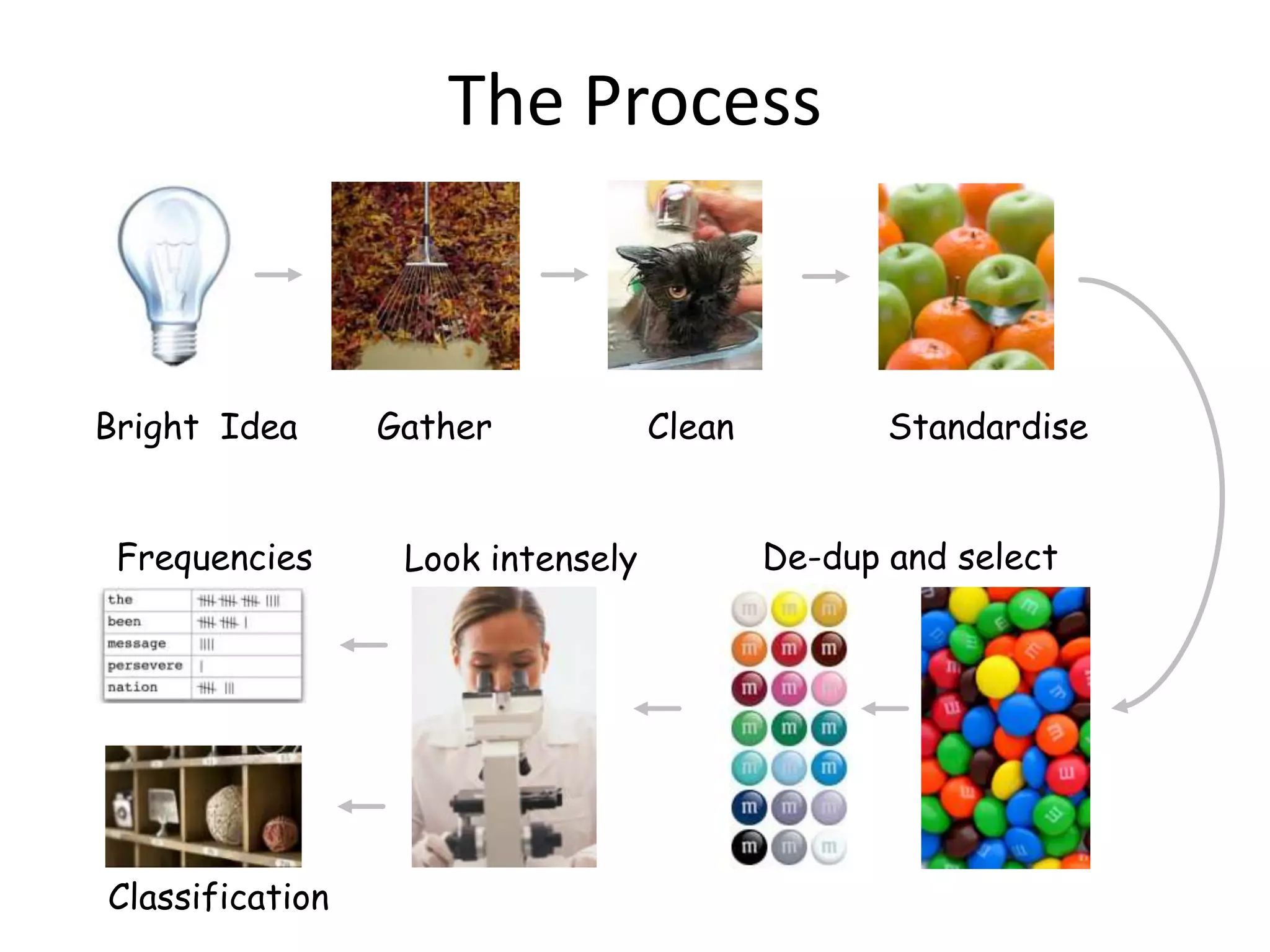
The Process
Look intenselyFrequencies
Classification
Bright Idea Gather Clean Standardise
De-dup and select
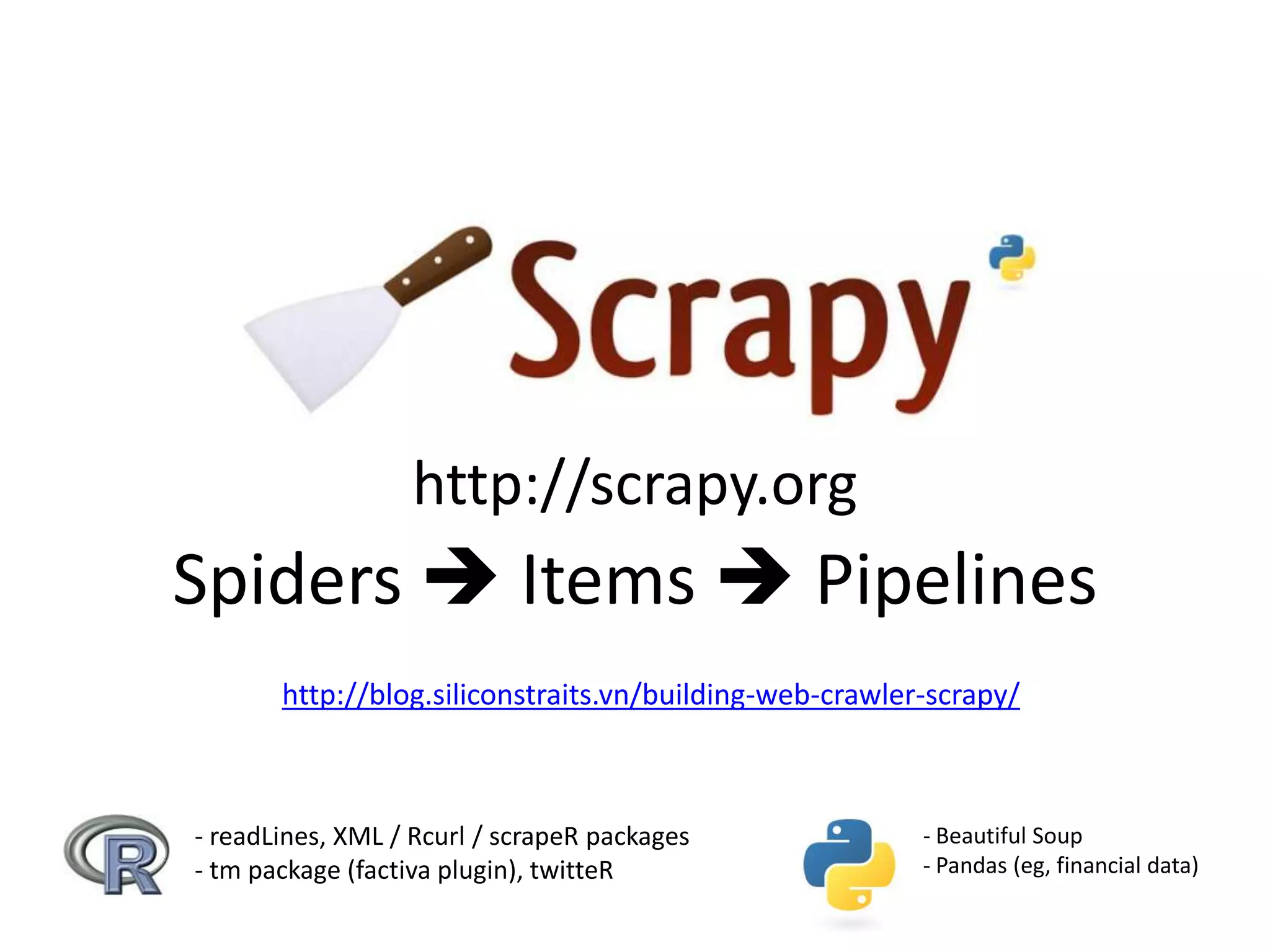
http://scrapy.org
Spiders  Items  Pipelines
- readLines, XML / Rcurl / scrapeR packages
- tm package (factiva plugin), twitteR
- Beautiful Soup
- Pandas (eg, financial data)
http://blog.siliconstraits.vn/building-web-crawler-scrapy/
• Translating text to consistent form
– Scrapy returns unicode strings
– Māori  Maori
• SWAPSET =
[[ u"Ā", "A"], [ u"ā", "a"], [ u"ä", "a"]]
• translation_table =
dict([(ord(k), unicode(v)) for k, v in settings.SWAPSET])
• cleaned_content =
html_content.translate(translation_table)
– Or…
• test=u’Māori’ (you already have unicode)
• Unidecode(test) (returns ‘Maori’)
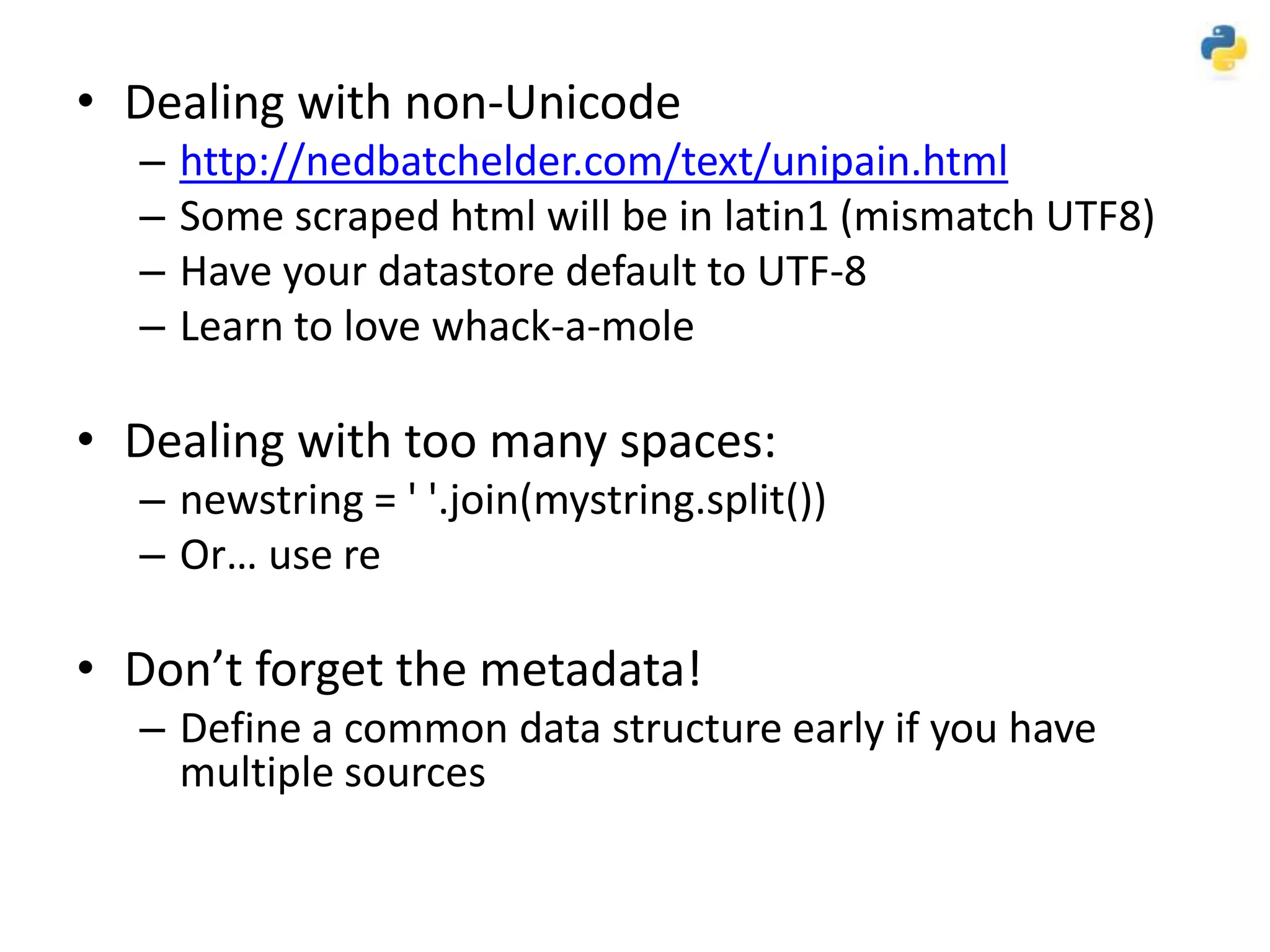
• Dealing with non-Unicode
– http://nedbatchelder.com/text/unipain.html
– Some scraped html will be in latin1 (mismatch UTF8)
– Have your datastore default to UTF-8
– Learn to love whack-a-mole
• Dealing with too many spaces:
– newstring = ' '.join(mystring.split())
– Or… use re
• Don’t forget the metadata!
– Define a common data structure early if you have
multiple sources
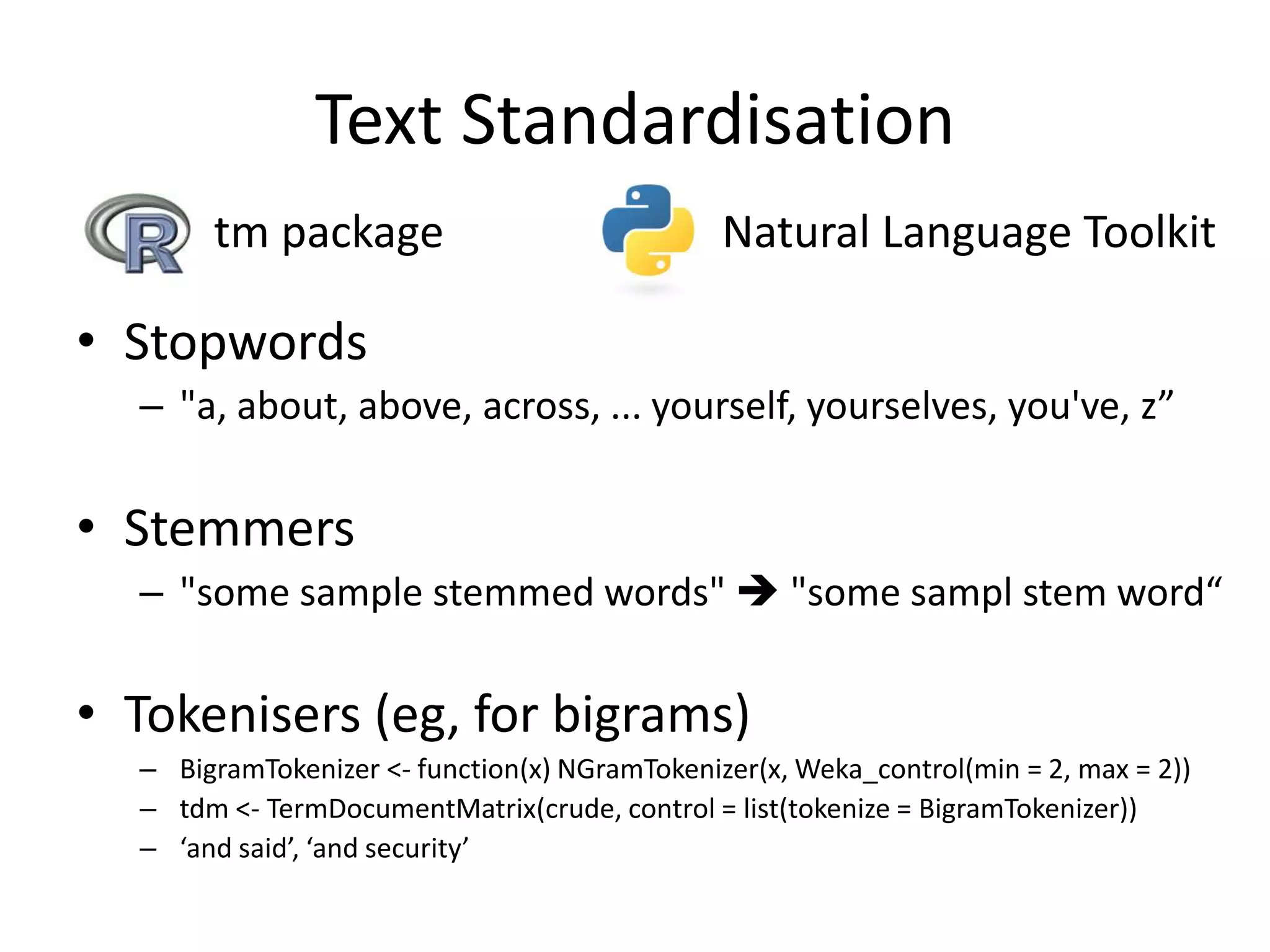
Text Standardisation
• Stopwords
– "a, about, above, across, ... yourself, yourselves, you've, z”
• Stemmers
– "some sample stemmed words"  "some sampl stem word“
• Tokenisers (eg, for bigrams)
– BigramTokenizer <- function(x) NGramTokenizer(x, Weka_control(min = 2, max = 2))
– tdm <- TermDocumentMatrix(crude, control = list(tokenize = BigramTokenizer))
– ‘and said’, ‘and security’
Natural Language Toolkittm package
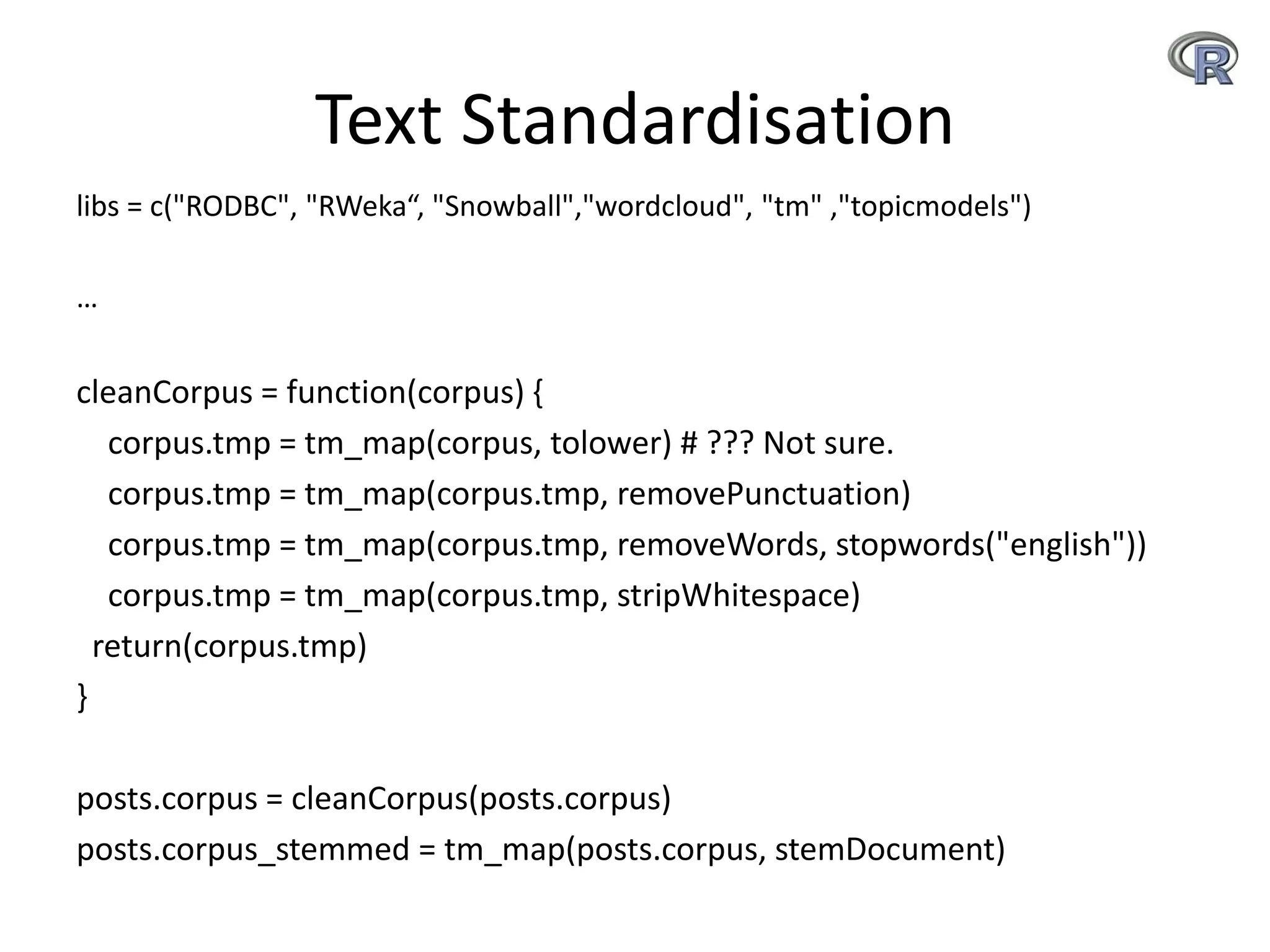
Text Standardisation
libs = c("RODBC", "RWeka“, "Snowball","wordcloud", "tm" ,"topicmodels")
…
cleanCorpus = function(corpus) {
corpus.tmp = tm_map(corpus, tolower) # ??? Not sure.
corpus.tmp = tm_map(corpus.tmp, removePunctuation)
corpus.tmp = tm_map(corpus.tmp, removeWords, stopwords("english"))
corpus.tmp = tm_map(corpus.tmp, stripWhitespace)
return(corpus.tmp)
}
posts.corpus = cleanCorpus(posts.corpus)
posts.corpus_stemmed = tm_map(posts.corpus, stemDocument)
Text Standardisation
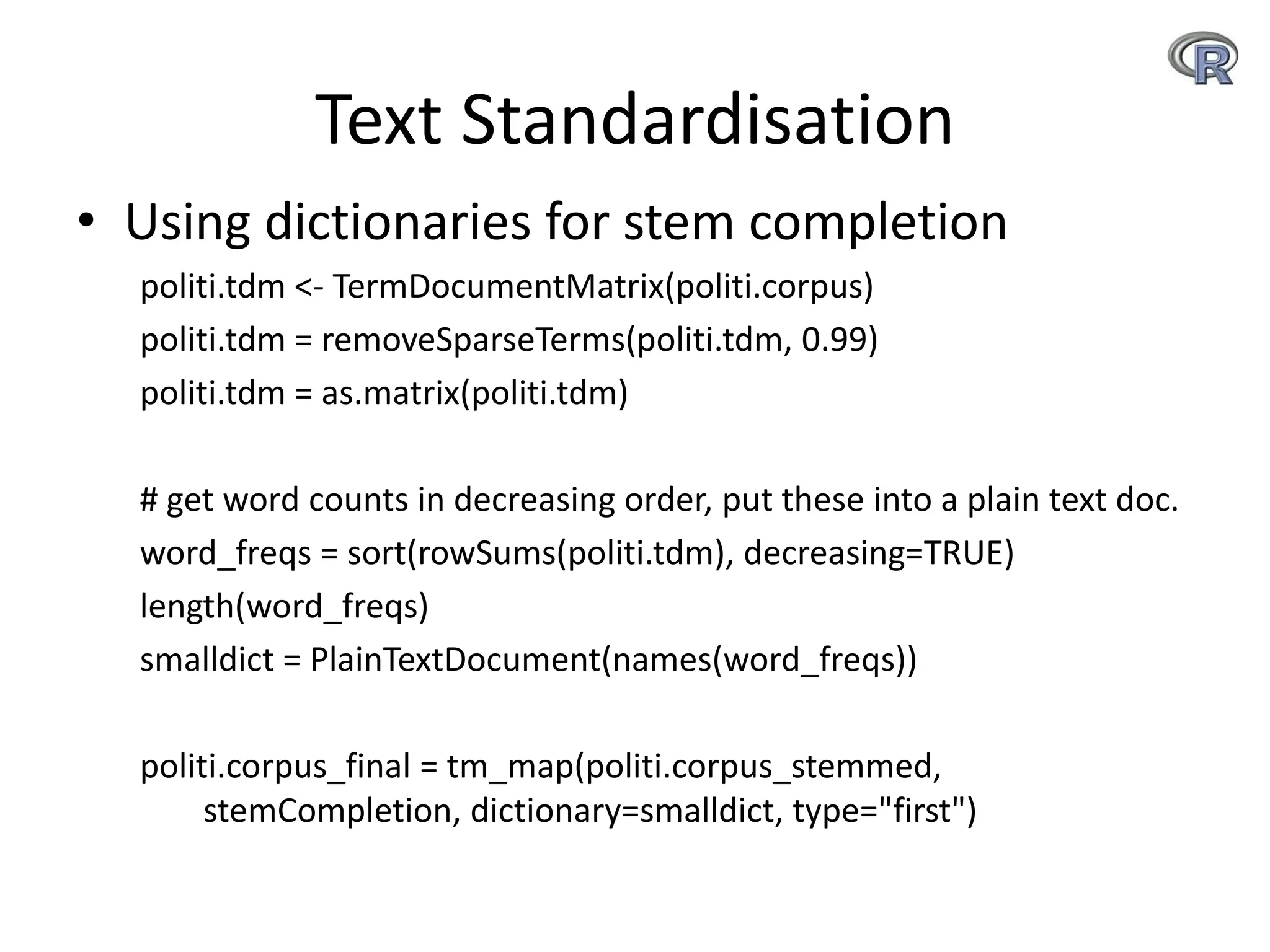
• Using dictionaries for stem completion
politi.tdm <- TermDocumentMatrix(politi.corpus)
politi.tdm = removeSparseTerms(politi.tdm, 0.99)
politi.tdm = as.matrix(politi.tdm)
# get word counts in decreasing order, put these into a plain text doc.
word_freqs = sort(rowSums(politi.tdm), decreasing=TRUE)
length(word_freqs)
smalldict = PlainTextDocument(names(word_freqs))
politi.corpus_final = tm_map(politi.corpus_stemmed,
stemCompletion, dictionary=smalldict, type="first")
Deduplication
• Python sets
– shingles1 = set(get_shingles(record1['standardised_content']))
• Shingling and Jaccard similarity
– (a,rose,is,a,rose,is,a,rose)
– {(a,rose,is,a), (rose,is,a,rose), (is,a,rose,is), (a,rose,is,a), (rose,is,a,rose)}
• {(a,rose,is,a), (rose,is,a,rose), (is,a,rose,is)}
–
http://infolab.stanford.edu/~ullman/mmds/ch3.pdf  a free text
http://www.cs.utah.edu/~jeffp/teaching/cs5955/L4-Jaccard+Shingle.pdf
Frequency Analysis
• Document-Term Matrix
– politi.dtm <- DocumentTermMatrix(politi.corpus_stemmed,
control = list(wordLengths=c(4,Inf)))
• Frequent and co-occurring terms
– findFreqTerms(politi.dtm, 5000)
[1] "2011" "also" "announc" "area" "around"
[6] "auckland" "better" "bill" "build" "busi"
– findAssocs(politi.dtm, "smoke", 0.5)
smoke tobacco quit smokefre smoker 2025 cigarett
1.00 0.74 0.68 0.62 0.62 0.58 0.57
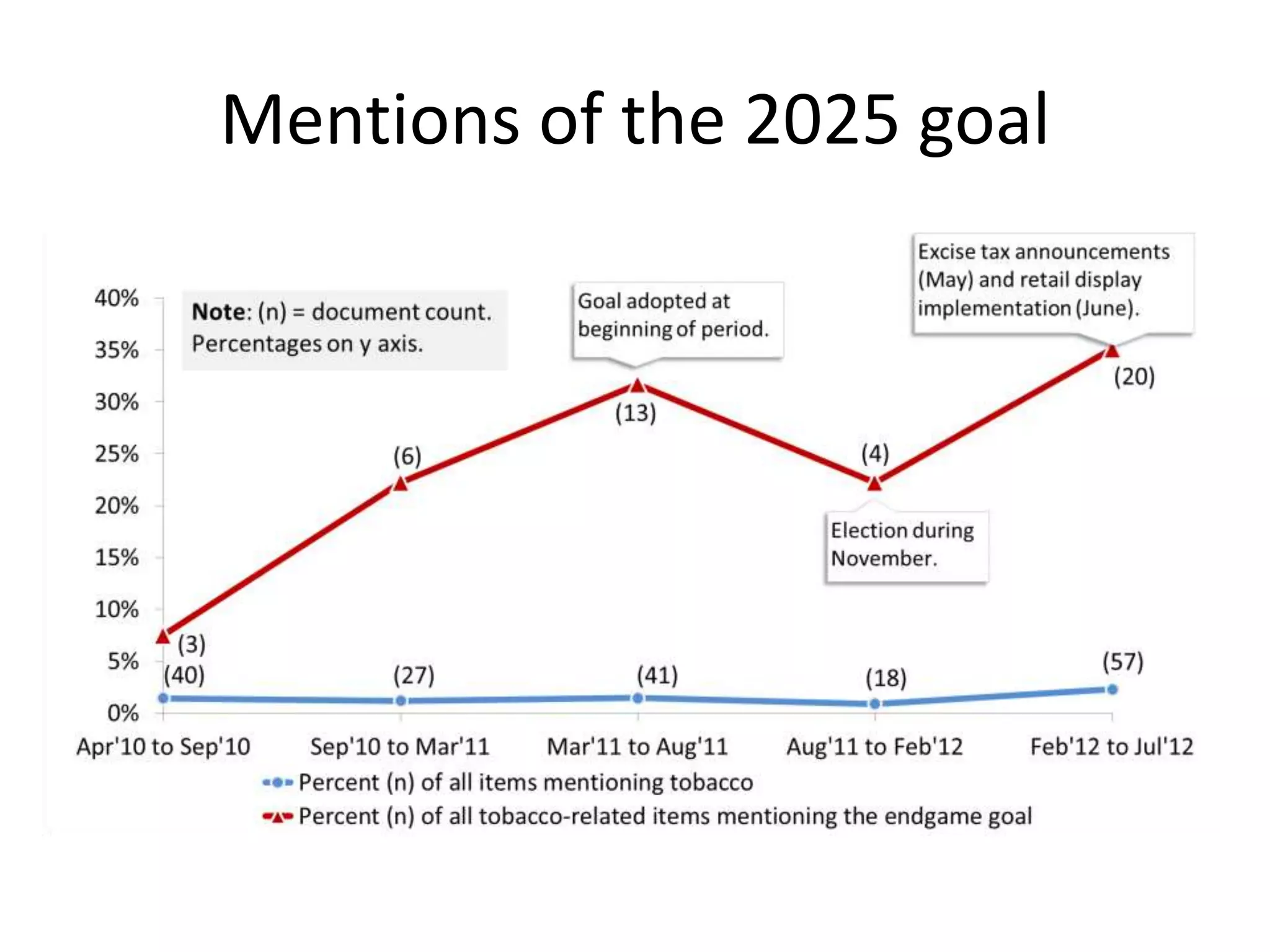
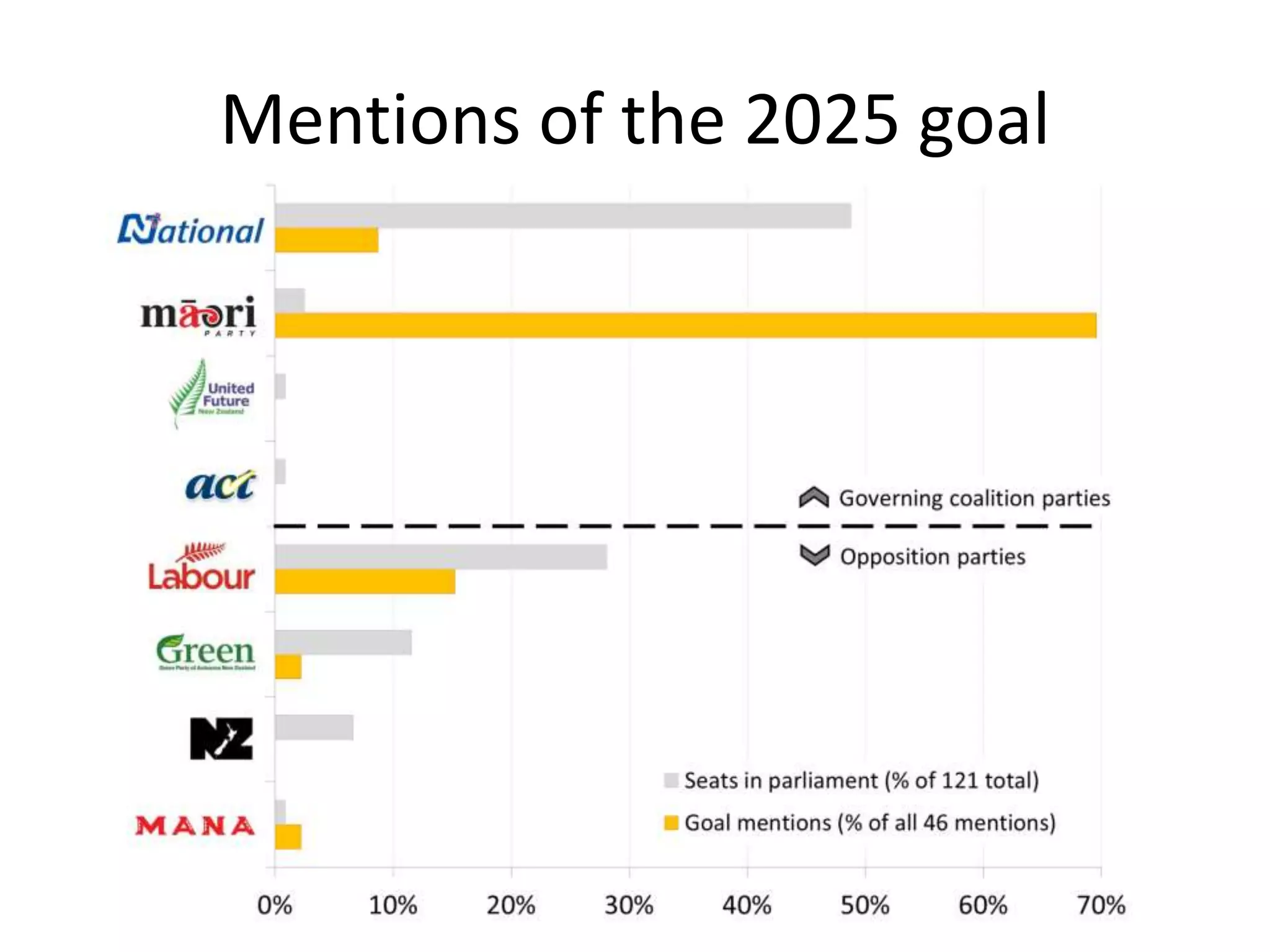
Mentions of the 2025 goal
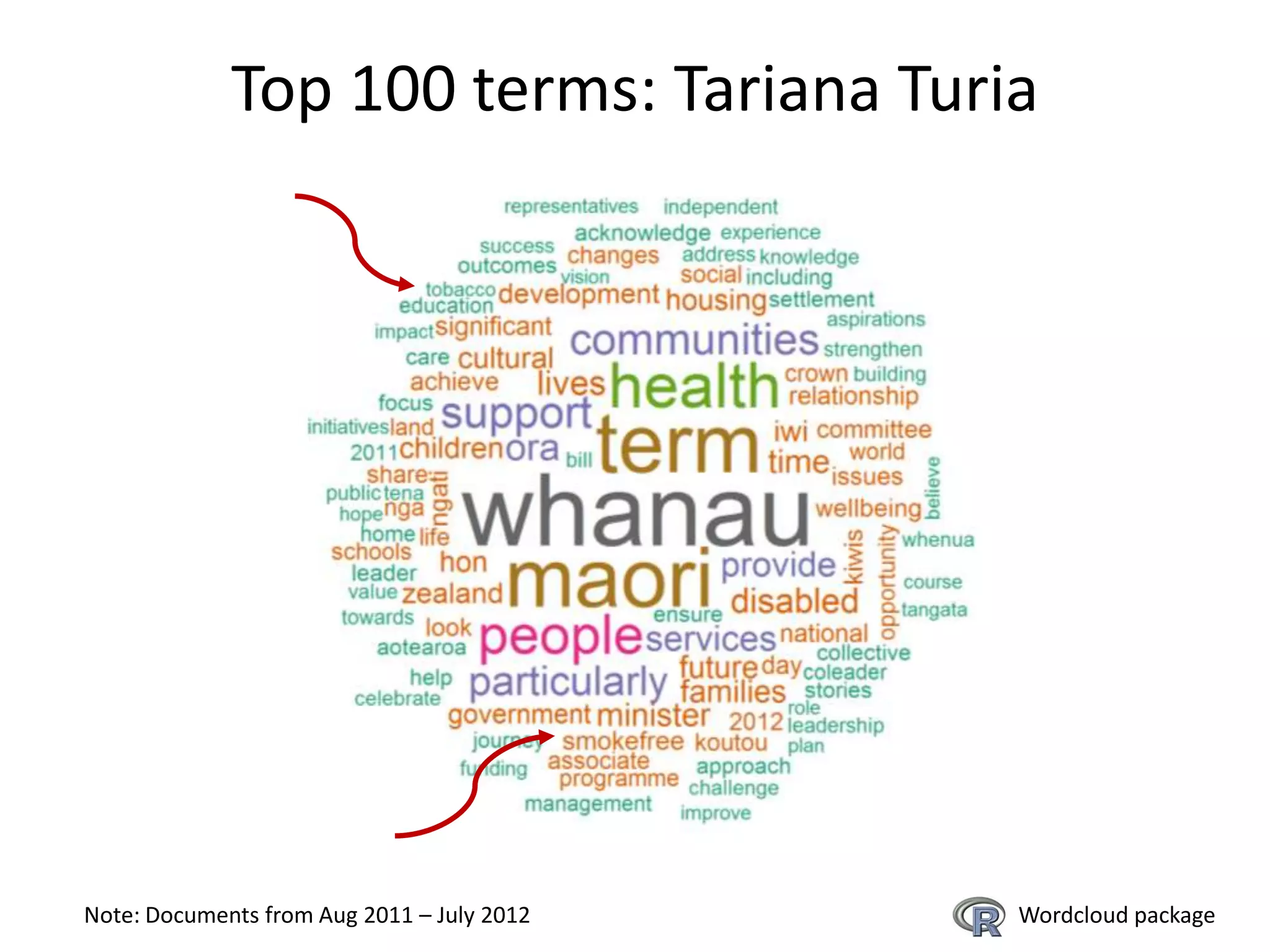
Top 100 terms: Tariana Turia
Note: Documents from Aug 2011 – July 2012 Wordcloud package
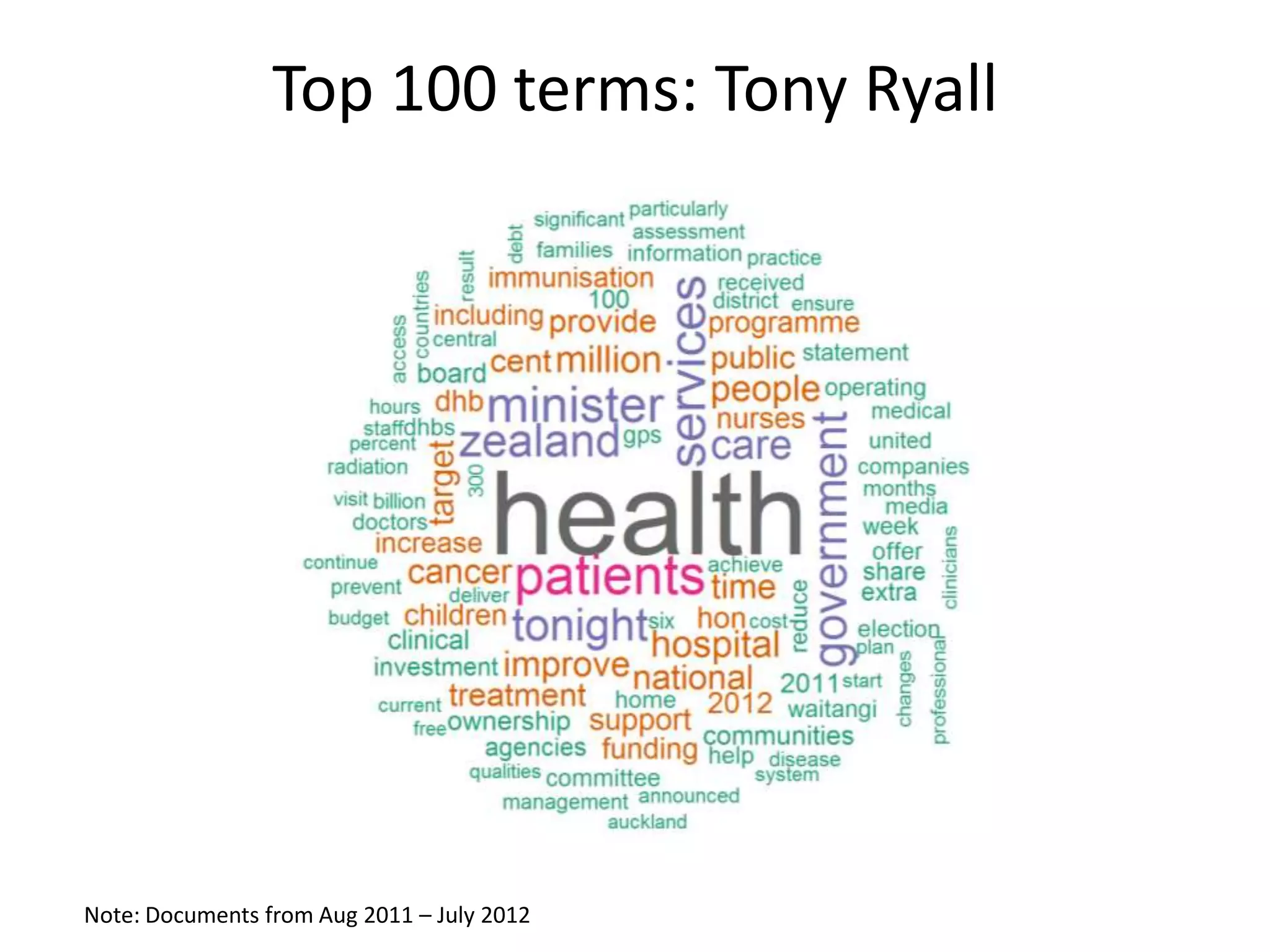
Top 100 terms: Tony Ryall
Note: Documents from Aug 2011 – July 2012
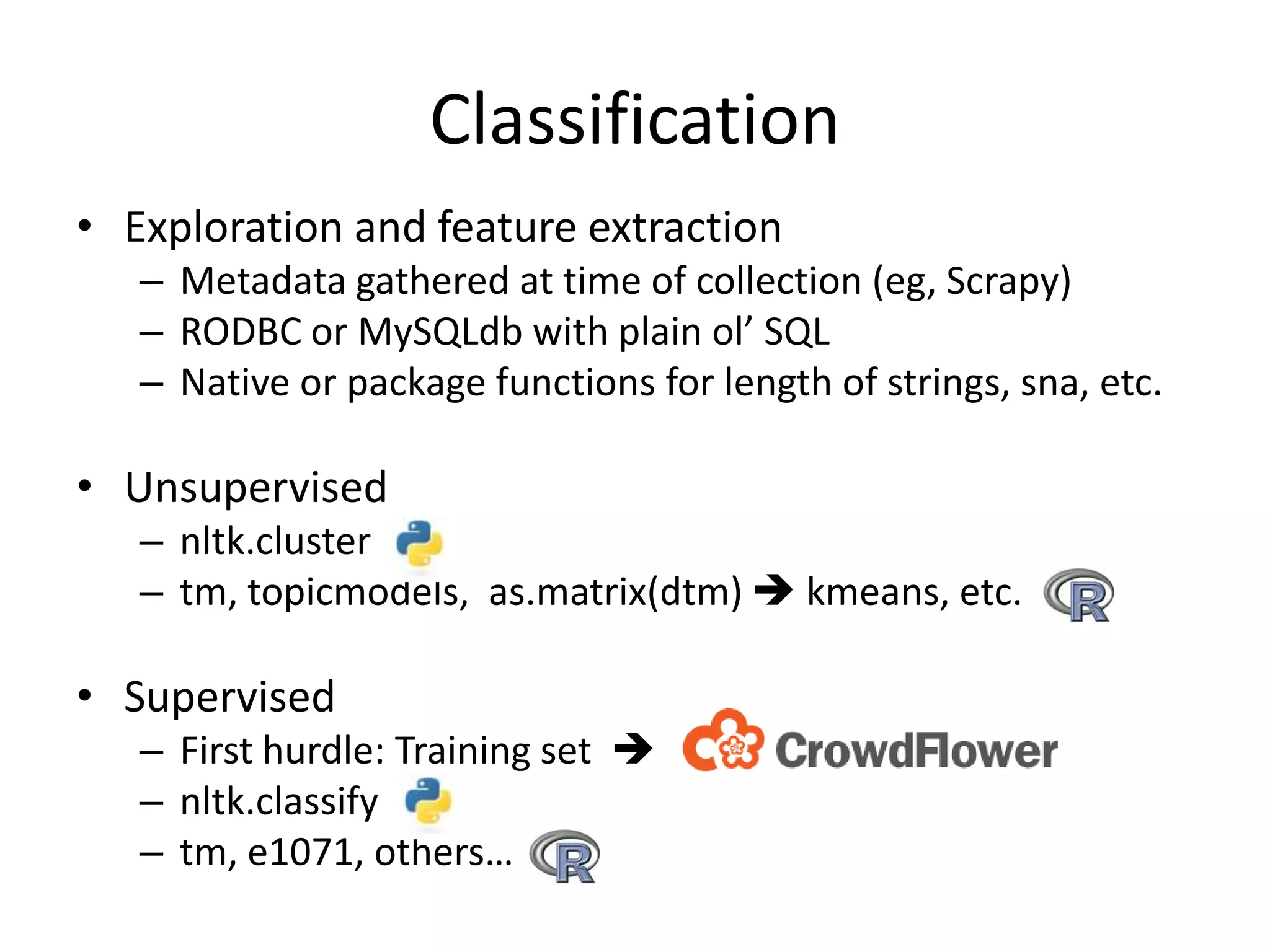
• Exploration and feature extraction
– Metadata gathered at time of collection (eg, Scrapy)
– RODBC or MySQLdb with plain ol’ SQL
– Native or package functions for length of strings, sna, etc.
• Unsupervised
– nltk.cluster
– tm, topicmodels, as.matrix(dtm)  kmeans, etc.
• Supervised
– First hurdle: Training set 
– nltk.classify
– tm, e1071, others…
Classification
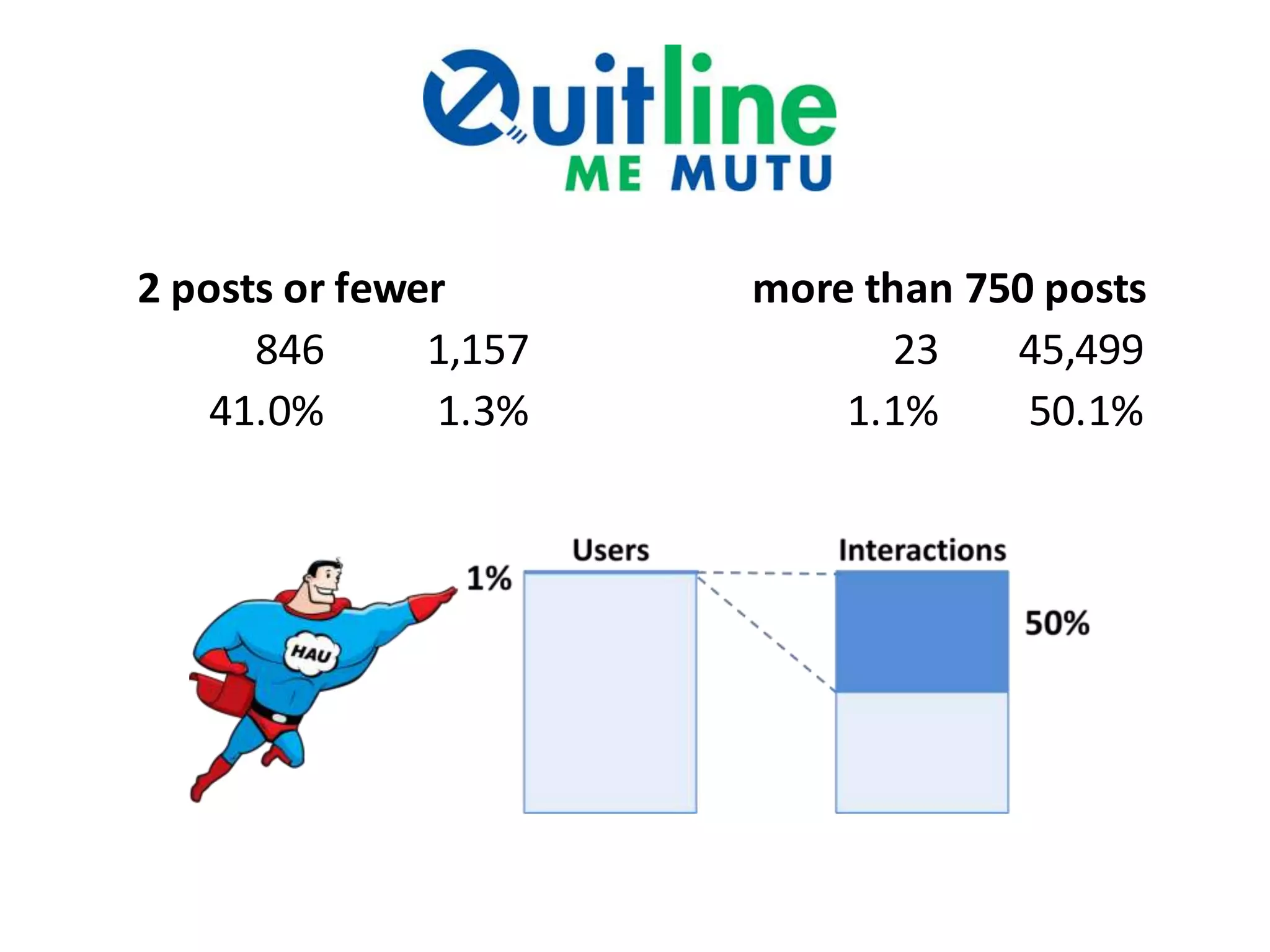
2 posts or fewer more than 750 posts
846 1,157 23 45,499
41.0% 1.3% 1.1% 50.1%
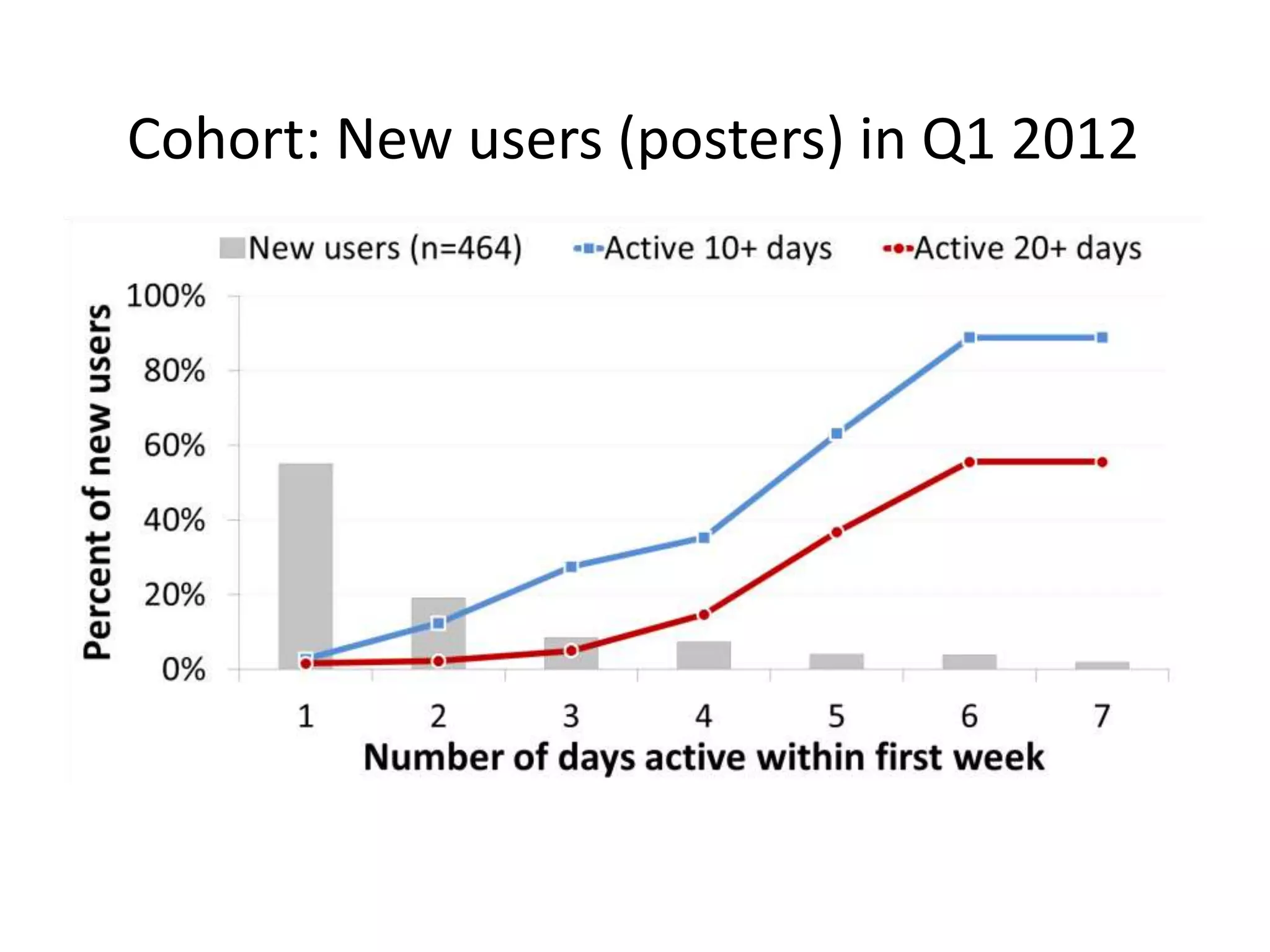
Cohort: New users (posters) in Q1 2012
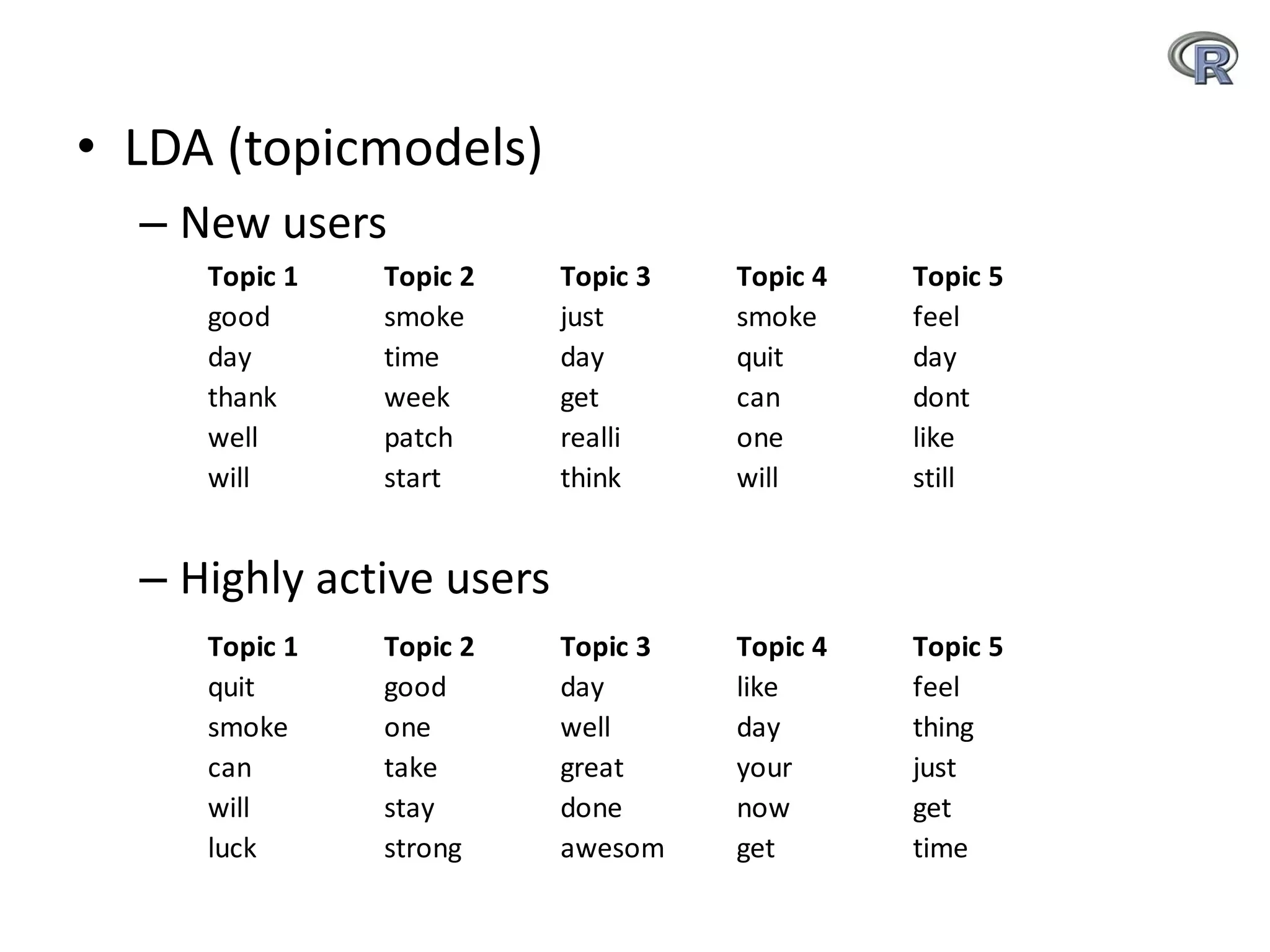
• LDA (topicmodels)
– New users
– Highly active users
Topic 1 Topic 2 Topic 3 Topic 4 Topic 5
good smoke just smoke feel
day time day quit day
thank week get can dont
well patch realli one like
will start think will still
Topic 1 Topic 2 Topic 3 Topic 4 Topic 5
quit good day like feel
smoke one well day thing
can take great your just
will stay done now get
luck strong awesom get time
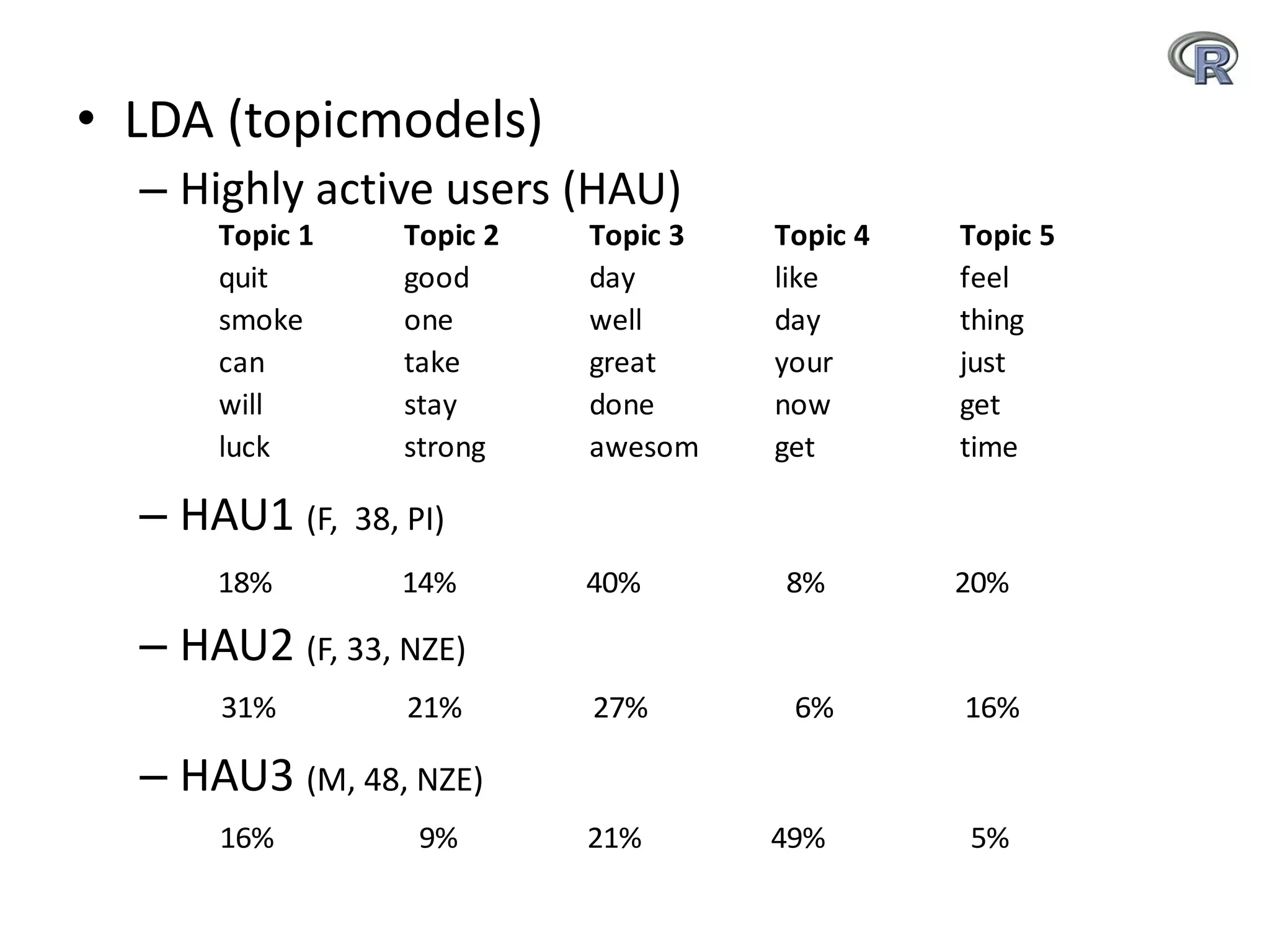
• LDA (topicmodels)
– Highly active users (HAU)
– HAU1 (F, 38, PI)
– HAU2 (F, 33, NZE)
– HAU3 (M, 48, NZE)
Topic 1 Topic 2 Topic 3 Topic 4 Topic 5
quit good day like feel
smoke one well day thing
can take great your just
will stay done now get
luck strong awesom get time
18% 14% 40% 8% 20%
31% 21% 27% 6% 16%
16% 9% 21% 49% 5%
Recap
• Your text will probably be messy
– Python, R-based tools reduce the pain
• Simple analyses can generate useful insight
• Combine with data of other types for context
– source, quantities, dates, network position, history
• May surface useful features for classification
Slides, Code: message2ben@gmail.com

Text analytics in Python and R with examples from Tobacco Control

  • 1.
    Text Analytics with and (w/examples from Tobacco Control) @BenHealey
  • 2.
    The Process Look intenselyFrequencies Classification BrightIdea Gather Clean Standardise De-dup and select
  • 3.
    http://scrapy.org Spiders  Items Pipelines - readLines, XML / Rcurl / scrapeR packages - tm package (factiva plugin), twitteR - Beautiful Soup - Pandas (eg, financial data) http://blog.siliconstraits.vn/building-web-crawler-scrapy/
  • 7.
    • Translating textto consistent form – Scrapy returns unicode strings – Māori  Maori • SWAPSET = [[ u"Ā", "A"], [ u"ā", "a"], [ u"ä", "a"]] • translation_table = dict([(ord(k), unicode(v)) for k, v in settings.SWAPSET]) • cleaned_content = html_content.translate(translation_table) – Or… • test=u’Māori’ (you already have unicode) • Unidecode(test) (returns ‘Maori’)
  • 8.
    • Dealing withnon-Unicode – http://nedbatchelder.com/text/unipain.html – Some scraped html will be in latin1 (mismatch UTF8) – Have your datastore default to UTF-8 – Learn to love whack-a-mole • Dealing with too many spaces: – newstring = ' '.join(mystring.split()) – Or… use re • Don’t forget the metadata! – Define a common data structure early if you have multiple sources
  • 9.
    Text Standardisation • Stopwords –"a, about, above, across, ... yourself, yourselves, you've, z” • Stemmers – "some sample stemmed words"  "some sampl stem word“ • Tokenisers (eg, for bigrams) – BigramTokenizer <- function(x) NGramTokenizer(x, Weka_control(min = 2, max = 2)) – tdm <- TermDocumentMatrix(crude, control = list(tokenize = BigramTokenizer)) – ‘and said’, ‘and security’ Natural Language Toolkittm package
  • 10.
    Text Standardisation libs =c("RODBC", "RWeka“, "Snowball","wordcloud", "tm" ,"topicmodels") … cleanCorpus = function(corpus) { corpus.tmp = tm_map(corpus, tolower) # ??? Not sure. corpus.tmp = tm_map(corpus.tmp, removePunctuation) corpus.tmp = tm_map(corpus.tmp, removeWords, stopwords("english")) corpus.tmp = tm_map(corpus.tmp, stripWhitespace) return(corpus.tmp) } posts.corpus = cleanCorpus(posts.corpus) posts.corpus_stemmed = tm_map(posts.corpus, stemDocument)
  • 11.
    Text Standardisation • Usingdictionaries for stem completion politi.tdm <- TermDocumentMatrix(politi.corpus) politi.tdm = removeSparseTerms(politi.tdm, 0.99) politi.tdm = as.matrix(politi.tdm) # get word counts in decreasing order, put these into a plain text doc. word_freqs = sort(rowSums(politi.tdm), decreasing=TRUE) length(word_freqs) smalldict = PlainTextDocument(names(word_freqs)) politi.corpus_final = tm_map(politi.corpus_stemmed, stemCompletion, dictionary=smalldict, type="first")
  • 12.
    Deduplication • Python sets –shingles1 = set(get_shingles(record1['standardised_content'])) • Shingling and Jaccard similarity – (a,rose,is,a,rose,is,a,rose) – {(a,rose,is,a), (rose,is,a,rose), (is,a,rose,is), (a,rose,is,a), (rose,is,a,rose)} • {(a,rose,is,a), (rose,is,a,rose), (is,a,rose,is)} – http://infolab.stanford.edu/~ullman/mmds/ch3.pdf  a free text http://www.cs.utah.edu/~jeffp/teaching/cs5955/L4-Jaccard+Shingle.pdf
  • 13.
    Frequency Analysis • Document-TermMatrix – politi.dtm <- DocumentTermMatrix(politi.corpus_stemmed, control = list(wordLengths=c(4,Inf))) • Frequent and co-occurring terms – findFreqTerms(politi.dtm, 5000) [1] "2011" "also" "announc" "area" "around" [6] "auckland" "better" "bill" "build" "busi" – findAssocs(politi.dtm, "smoke", 0.5) smoke tobacco quit smokefre smoker 2025 cigarett 1.00 0.74 0.68 0.62 0.62 0.58 0.57
  • 15.
    Mentions of the2025 goal
  • 16.
    Mentions of the2025 goal
  • 17.
    Top 100 terms:Tariana Turia Note: Documents from Aug 2011 – July 2012 Wordcloud package
  • 18.
    Top 100 terms:Tony Ryall Note: Documents from Aug 2011 – July 2012
  • 19.
    • Exploration andfeature extraction – Metadata gathered at time of collection (eg, Scrapy) – RODBC or MySQLdb with plain ol’ SQL – Native or package functions for length of strings, sna, etc. • Unsupervised – nltk.cluster – tm, topicmodels, as.matrix(dtm)  kmeans, etc. • Supervised – First hurdle: Training set  – nltk.classify – tm, e1071, others… Classification
  • 20.
    2 posts orfewer more than 750 posts 846 1,157 23 45,499 41.0% 1.3% 1.1% 50.1%
  • 21.
    Cohort: New users(posters) in Q1 2012
  • 22.
    • LDA (topicmodels) –New users – Highly active users Topic 1 Topic 2 Topic 3 Topic 4 Topic 5 good smoke just smoke feel day time day quit day thank week get can dont well patch realli one like will start think will still Topic 1 Topic 2 Topic 3 Topic 4 Topic 5 quit good day like feel smoke one well day thing can take great your just will stay done now get luck strong awesom get time
  • 23.
    • LDA (topicmodels) –Highly active users (HAU) – HAU1 (F, 38, PI) – HAU2 (F, 33, NZE) – HAU3 (M, 48, NZE) Topic 1 Topic 2 Topic 3 Topic 4 Topic 5 quit good day like feel smoke one well day thing can take great your just will stay done now get luck strong awesom get time 18% 14% 40% 8% 20% 31% 21% 27% 6% 16% 16% 9% 21% 49% 5%
  • 24.
    Recap • Your textwill probably be messy – Python, R-based tools reduce the pain • Simple analyses can generate useful insight • Combine with data of other types for context – source, quantities, dates, network position, history • May surface useful features for classification Slides, Code: message2ben@gmail.com

Editor's Notes

  • #5 Gather stage.
  • #6 Gather stage.
  • #7 Clean stage
  • #8 Clean stage
  • #9 Clean stage
  • #10 Standardise stage
  • #11 Standardise stage
  • #12 Standardise stage0.99 is generous. Lower would remove more terms.A term-document matrix where those terms from x are removed which have at least asparse percentage of empty (i.e., terms occurring 0 times in a document) elements. I.e., the resulting matrix contains only terms with a sparse factor of less than sparse.TermDocumentMatrix (terms along side (rows), docs along top (columns))
  • #13 Dedup and select stage
  • #14 Analysis stage
  • #15 Analysis stage
  • #16 Analysis stage
  • #17 Analysis stage
  • #18 Analysis stage
  • #19 Analysis stage
  • #20 Analysis stageDragonfly talk by Marcus Frean on LatentDirichletAllocation
  • #21 Analysis stage (exploratory)
  • #22 Analysis stage (Exploratory)
  • #23 Analysis stage (Unsupervised classification)
  • #24 Analysis stage (Unsupervised classification)