Information Retrieval and
Map-Reduce Implementations
Roadmap
 Introduction to information retrieval
 Basics of indexing and retrieval
 Inverted indexing in MapReduce
 Retrieval at scale
First, nomenclature…
 Information retrieval (IR)
 Focus on textual information (= text/document retrieval)
 Other possibilities include image, video, music, …
 What do we search?
 Generically, “collections”
 Less-frequently used, “corpora”
 What do we find?
 Generically, “documents”
 Even though we may be referring to web pages, PDFs,
PowerPoint slides, paragraphs, etc.
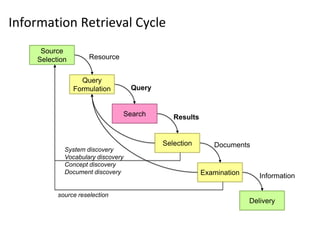
Information Retrieval Cycle
Source
Selection
Search
Query
Selection
Results
Examination
Documents
Delivery
Information
Query
Formulation
Resource
source reselection
System discovery
Vocabulary discovery
Concept discovery
Document discovery
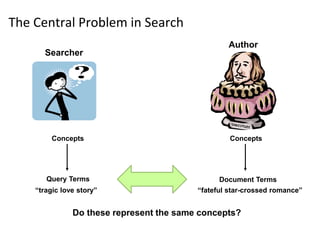
The Central Problem in Search
Searcher
Author
Concepts Concepts
Query Terms Document Terms
Do these represent the same concepts?
“tragic love story” “fateful star-crossed romance”
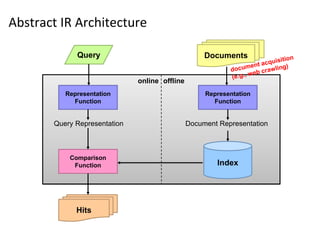
Abstract IR Architecture
Documents
Query
Hits
Representation
Function
Representation
Function
Query Representation Document Representation
Comparison
Function Index
offline
online
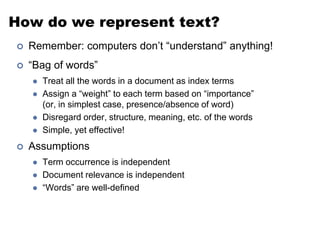
How do we represent text?
 Remember: computers don’t “understand” anything!
 “Bag of words”
 Treat all the words in a document as index terms
 Assign a “weight” to each term based on “importance”
(or, in simplest case, presence/absence of word)
 Disregard order, structure, meaning, etc. of the words
 Simple, yet effective!
 Assumptions
 Term occurrence is independent
 Document relevance is independent
 “Words” are well-defined
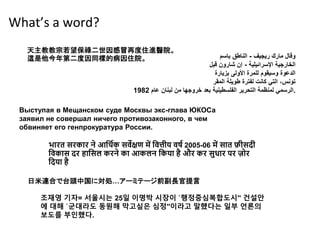
What’s a word?
天主教教宗若望保祿二世因感冒再度住進醫院。
這是他今年第二度因同樣的病因住院。 ‫ريجيف‬ ‫مارك‬ ‫وقال‬
-
‫باسم‬ ‫الناطق‬
‫اإلسرائيلية‬ ‫الخارجية‬
-
‫قبل‬ ‫شارون‬ ‫إن‬
‫بزيارة‬ ‫األولى‬ ‫للمرة‬ ‫وسيقوم‬ ‫الدعوة‬
‫المقر‬ ‫طويلة‬ ‫لفترة‬ ‫كانت‬ ‫التي‬ ،‫تونس‬
‫عام‬ ‫لبنان‬ ‫من‬ ‫خروجها‬ ‫بعد‬ ‫الفلسطينية‬ ‫التحرير‬ ‫لمنظمة‬ ‫الرسمي‬
1982 .
Выступая в Мещанском суде Москвы экс-глава ЮКОСа
заявил не совершал ничего противозаконного, в чем
обвиняет его генпрокуратура России.
भारत सरकार ने आर्थिक सर्वेक्षण में र्र्वत्तीय र्वर्ि 2005-06 में सात फीसदी
र्र्वकास दर हार्सल करने का आकलन र्कया है और कर सुधार पर ज़ोर
र्दया है
日米連合で台頭中国に対処…アーミテージ前副長官提言
조재영 기자= 서울시는 25일 이명박 시장이 `행정중심복합도시'' 건설안
에 대해 `군대라도 동원해 막고싶은 심정''이라고 말했다는 일부 언론의
보도를 부인했다.
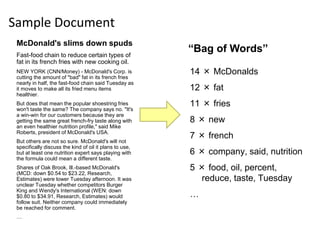
Sample Document
McDonald's slims down spuds
Fast-food chain to reduce certain types of
fat in its french fries with new cooking oil.
NEW YORK (CNN/Money) - McDonald's Corp. is
cutting the amount of "bad" fat in its french fries
nearly in half, the fast-food chain said Tuesday as
it moves to make all its fried menu items
healthier.
But does that mean the popular shoestring fries
won't taste the same? The company says no. "It's
a win-win for our customers because they are
getting the same great french-fry taste along with
an even healthier nutrition profile," said Mike
Roberts, president of McDonald's USA.
But others are not so sure. McDonald's will not
specifically discuss the kind of oil it plans to use,
but at least one nutrition expert says playing with
the formula could mean a different taste.
Shares of Oak Brook, Ill.-based McDonald's
(MCD: down $0.54 to $23.22, Research,
Estimates) were lower Tuesday afternoon. It was
unclear Tuesday whether competitors Burger
King and Wendy's International (WEN: down
$0.80 to $34.91, Research, Estimates) would
follow suit. Neither company could immediately
be reached for comment.
…
14 × McDonalds
12 × fat
11 × fries
8 × new
7 × french
6 × company, said, nutrition
5 × food, oil, percent,
reduce, taste, Tuesday
…
“Bag of Words”
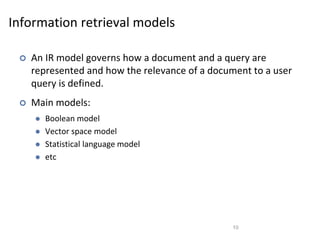
Information retrieval models
 An IR model governs how a document and a query are
represented and how the relevance of a document to a user
query is defined.
 Main models:
 Boolean model
 Vector space model
 Statistical language model
 etc
10
Boolean model
 Each document or query is treated as a “bag” of words or
terms. Word sequence is not considered.
 Given a collection of documents D, let V = {t1, t2, ..., t|V|} be
the set of distinctive words/terms in the collection. V is called
the vocabulary.
 A weight wij > 0 is associated with each term ti of a document
dj ∈ D. For a term that does not appear in document dj, wij =
0.
dj = (w1j, w2j, ..., w|V|j),
11
Boolean model (contd)
 Query terms are combined logically using the Boolean
operators AND, OR, and NOT.
 E.g., ((data AND mining) AND (NOT text))
 Retrieval
 Given a Boolean query, the system retrieves every document that
makes the query logically true.
 Called exact match.
 The retrieval results are usually quite poor because term
frequency is not considered.
12
Boolean queries: Exact match
• The Boolean retrieval model is being able to ask a query
that is a Boolean expression:
– Boolean Queries are queries using AND, OR and NOT to join
query terms
• Views each document as a set of words
• Is precise: document matches condition or not.
– Perhaps the simplest model to build an IR system on
• Primary commercial retrieval tool for 3 decades.
• Many search systems you still use are Boolean:
– Email, library catalog, Mac OS X Spotlight
13
Sec. 1.3
Strengths and Weaknesses
 Strengths
 Precise, if you know the right strategies
 Precise, if you have an idea of what you’re looking for
 Implementations are fast and efficient
 Weaknesses
 Users must learn Boolean logic
 Boolean logic insufficient to capture the richness of language
 No control over size of result set: either too many hits or none
 When do you stop reading? All documents in the result set are
considered “equally good”
 What about partial matches? Documents that “don’t quite match”
the query may be useful also
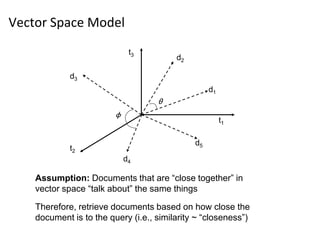
Vector Space Model
Assumption: Documents that are “close together” in
vector space “talk about” the same things
t1
d2
d1
d3
d4
d5
t3
t2
θ
φ
Therefore, retrieve documents based on how close the
document is to the query (i.e., similarity ~ “closeness”)
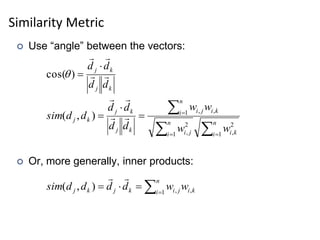
Similarity Metric
 Use “angle” between the vectors:
 Or, more generally, inner products:









n
i k
i
n
i j
i
n
i k
i
j
i
k
j
k
j
k
j
w
w
w
w
d
d
d
d
d
d
sim
1
2
,
1
2
,
1 ,
,
)
,
( 



k
j
k
j
d
d
d
d






)
cos(




n
i k
i
j
i
k
j
k
j w
w
d
d
d
d
sim 1 ,
,
)
,
(


Vector space model
 Documents are also treated as a “bag” of words or terms.
 Each document is represented as a vector.
 However, the term weights are no longer 0 or 1. Each
term weight is computed based on some variations of TF
or TF-IDF scheme.
17
Term Weighting
 Term weights consist of two components
 Local: how important is the term in this document?
 Global: how important is the term in the collection?
 Here’s the intuition:
 Terms that appear often in a document should get high weights
 Terms that appear in many documents should get low weights
 How do we capture this mathematically?
 Term frequency (local)
 Inverse document frequency (global)
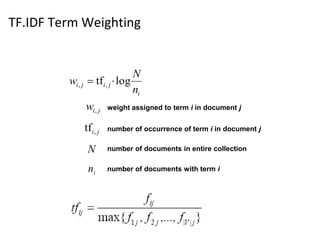
TF.IDF Term Weighting
i
j
i
j
i
n
N
w log
tf ,
, 

j
i
w,
j
i,
tf
N
i
n
weight assigned to term i in document j
number of occurrence of term i in document j
number of documents in entire collection
number of documents with term i
Retrieval in vector space model
 Query q is represented in the same way or slightly
differently.
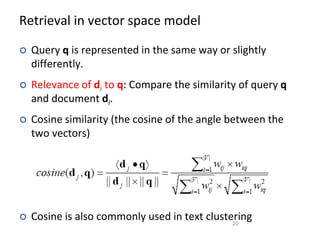
 Relevance of di to q: Compare the similarity of query q
and document di.
 Cosine similarity (the cosine of the angle between the
two vectors)
 Cosine is also commonly used in text clustering
20
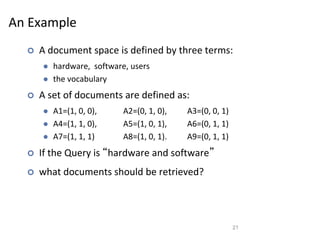
An Example
 A document space is defined by three terms:
 hardware, software, users
 the vocabulary
 A set of documents are defined as:
 A1=(1, 0, 0), A2=(0, 1, 0), A3=(0, 0, 1)
 A4=(1, 1, 0), A5=(1, 0, 1), A6=(0, 1, 1)
 A7=(1, 1, 1) A8=(1, 0, 1). A9=(0, 1, 1)
 If the Query is “hardware and software”
 what documents should be retrieved?
21
An Example (cont.)
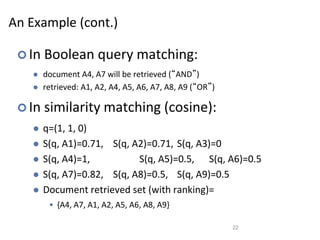
 In Boolean query matching:
 document A4, A7 will be retrieved (“AND”)
 retrieved: A1, A2, A4, A5, A6, A7, A8, A9 (“OR”)
 In similarity matching (cosine):
 q=(1, 1, 0)
 S(q, A1)=0.71, S(q, A2)=0.71, S(q, A3)=0
 S(q, A4)=1, S(q, A5)=0.5, S(q, A6)=0.5
 S(q, A7)=0.82, S(q, A8)=0.5, S(q, A9)=0.5
 Document retrieved set (with ranking)=
• {A4, A7, A1, A2, A5, A6, A8, A9}
22
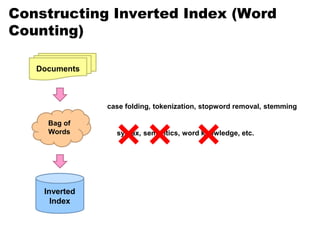
Constructing Inverted Index (Word
Counting)
Documents
Inverted
Index
Bag of
Words
case folding, tokenization, stopword removal, stemming
syntax, semantics, word knowledge, etc.
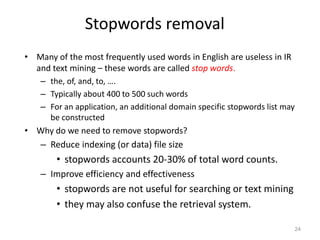
Stopwords removal
• Many of the most frequently used words in English are useless in IR
and text mining – these words are called stop words.
– the, of, and, to, ….
– Typically about 400 to 500 such words
– For an application, an additional domain specific stopwords list may
be constructed
• Why do we need to remove stopwords?
– Reduce indexing (or data) file size
• stopwords accounts 20-30% of total word counts.
– Improve efficiency and effectiveness
• stopwords are not useful for searching or text mining
• they may also confuse the retrieval system.
24
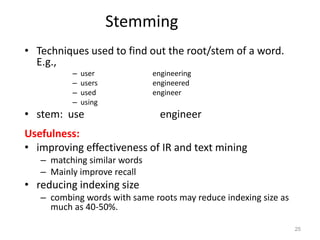
Stemming
• Techniques used to find out the root/stem of a word.
E.g.,
– user engineering
– users engineered
– used engineer
– using
• stem: use engineer
Usefulness:
• improving effectiveness of IR and text mining
– matching similar words
– Mainly improve recall
• reducing indexing size
– combing words with same roots may reduce indexing size as
much as 40-50%.
25
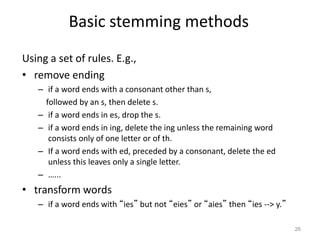
Basic stemming methods
Using a set of rules. E.g.,
• remove ending
– if a word ends with a consonant other than s,
followed by an s, then delete s.
– if a word ends in es, drop the s.
– if a word ends in ing, delete the ing unless the remaining word
consists only of one letter or of th.
– If a word ends with ed, preceded by a consonant, delete the ed
unless this leaves only a single letter.
– …...
• transform words
– if a word ends with “ies” but not “eies” or “aies” then “ies --> y.”
26
Inverted index
 The inverted index of a document collection is basically a data
structure that
 attaches each distinctive term with a list of all documents that
contains the term.
 Thus, in retrieval, it takes constant time to
 find the documents that contains a query term.
 multiple query terms are also easy handle as we will see soon.
27
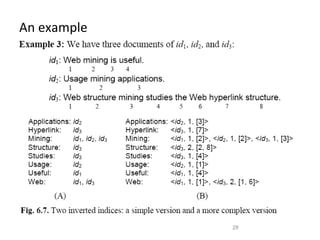
An example
28
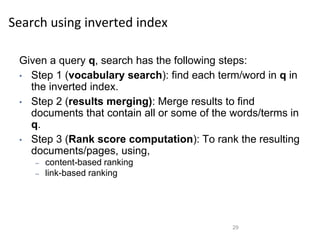
Search using inverted index
Given a query q, search has the following steps:
• Step 1 (vocabulary search): find each term/word in q in
the inverted index.
• Step 2 (results merging): Merge results to find
documents that contain all or some of the words/terms in
q.
• Step 3 (Rank score computation): To rank the resulting
documents/pages, using,
– content-based ranking
– link-based ranking
29
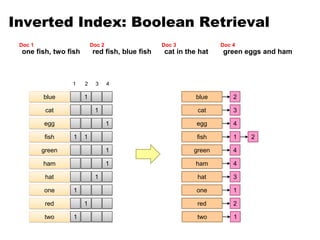
Inverted Index: Boolean Retrieval
one fish, two fish
Doc 1
red fish, blue fish
Doc 2
cat in the hat
Doc 3
1
1
1
1
1
1
1 2 3
1
1
1
4
blue
cat
egg
fish
green
ham
hat
one
3
4
1
4
4
3
2
1
blue
cat
egg
fish
green
ham
hat
one
2
green eggs and ham
Doc 4
1
red
1
two
2
red
1
two
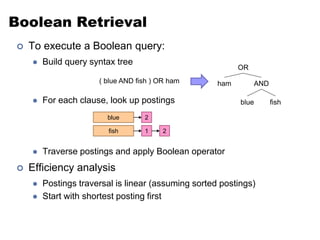
Boolean Retrieval
 To execute a Boolean query:
 Build query syntax tree
 For each clause, look up postings
 Traverse postings and apply Boolean operator
 Efficiency analysis
 Postings traversal is linear (assuming sorted postings)
 Start with shortest posting first
( blue AND fish ) OR ham
blue fish
AND
ham
OR
1
2
blue
fish 2
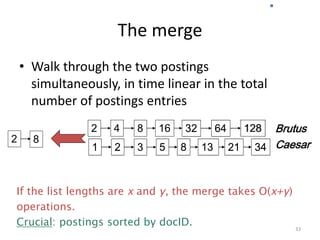
Query processing: AND
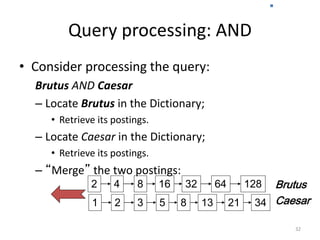
• Consider processing the query:
Brutus AND Caesar
– Locate Brutus in the Dictionary;
• Retrieve its postings.
– Locate Caesar in the Dictionary;
• Retrieve its postings.
– “Merge” the two postings:
32
128
34
2 4 8 16 32 64
1 2 3 5 8 13 21
Brutus
Caesar
Sec. 1.3
The merge
• Walk through the two postings
simultaneously, in time linear in the total
number of postings entries
33
34
128
2 4 8 16 32 64
1 2 3 5 8 13 21
128
34
2 4 8 16 32 64
1 2 3 5 8 13 21
Brutus
Caesar
2 8
If the list lengths are x and y, the merge takes O(x+y)
operations.
Crucial: postings sorted by docID.
Sec. 1.3
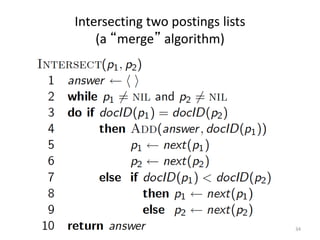
Intersecting two postings lists
(a “merge” algorithm)
34
2
1
1
2
1
1
1
1
1
1
1
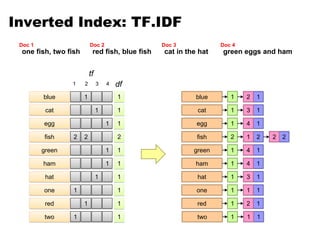
Inverted Index: TF.IDF
2
1
2
1
1
1
1 2 3
1
1
1
4
1
1
1
1
1
1
2
1
tf
df
blue
cat
egg
fish
green
ham
hat
one
1
1
1
1
1
1
2
1
blue
cat
egg
fish
green
ham
hat
one
1 1
red
1 1
two
1
red
1
two
one fish, two fish
Doc 1
red fish, blue fish
Doc 2
cat in the hat
Doc 3
green eggs and ham
Doc 4
3
4
1
4
4
3
2
1
2
2
1
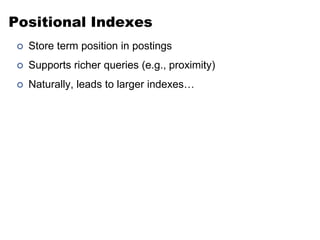
Positional Indexes
 Store term position in postings
 Supports richer queries (e.g., proximity)
 Naturally, leads to larger indexes…
[2,4]
[3]
[2,4]
[2]
[1]
[1]
[3]
[2]
[1]
[1]
[3]
2
1
1
2
1
1
1
1
1
1
1
Inverted Index: Positional Information
2
1
2
1
1
1
1 2 3
1
1
1
4
1
1
1
1
1
1
2
1
tf
df
blue
cat
egg
fish
green
ham
hat
one
1
1
1
1
1
1
2
1
blue
cat
egg
fish
green
ham
hat
one
1 1
red
1 1
two
1
red
1
two
one fish, two fish
Doc 1
red fish, blue fish
Doc 2
cat in the hat
Doc 3
green eggs and ham
Doc 4
3
4
1
4
4
3
2
1
2
2
1
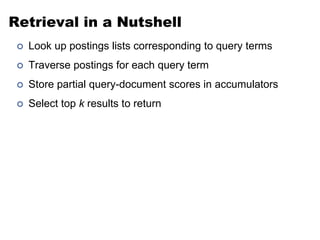
Retrieval in a Nutshell
 Look up postings lists corresponding to query terms
 Traverse postings for each query term
 Store partial query-document scores in accumulators
 Select top k results to return
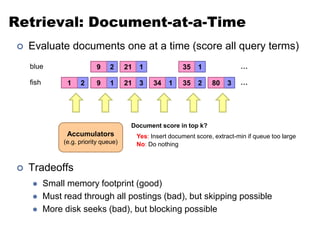
Retrieval: Document-at-a-Time
 Evaluate documents one at a time (score all query terms)
 Tradeoffs
 Small memory footprint (good)
 Must read through all postings (bad), but skipping possible
 More disk seeks (bad), but blocking possible
fish 2 1 3 1 2 3
1 9 21 34 35 80 …
blue 2 1 1
9 21 35 …
Accumulators
(e.g. priority queue)
Document score in top k?
Yes: Insert document score, extract-min if queue too large
No: Do nothing
Retrieval: Query-At-A-Time
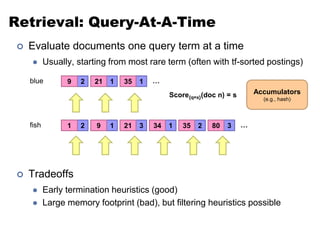
 Evaluate documents one query term at a time
 Usually, starting from most rare term (often with tf-sorted postings)
 Tradeoffs
 Early termination heuristics (good)
 Large memory footprint (bad), but filtering heuristics possible
fish 2 1 3 1 2 3
1 9 21 34 35 80 …
blue 2 1 1
9 21 35 …
Accumulators
(e.g., hash)
Score{q=x}(doc n) = s
MapReduce it?
 The indexing problem
 Scalability is critical
 Must be relatively fast, but need not be real time
 Fundamentally a batch operation
 Incremental updates may or may not be important
 For the web, crawling is a challenge in itself
 The retrieval problem
 Must have sub-second response time
 For the web, only need relatively few results
Indexing: Performance Analysis
 Fundamentally, a large sorting problem
 Terms usually fit in memory
 Postings usually don’t
 How is it done on a single machine?
 How can it be done with MapReduce?
 First, let’s characterize the problem size:
 Size of vocabulary
 Size of postings
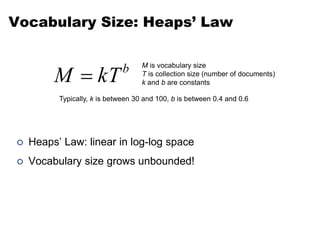
Vocabulary Size: Heaps’ Law
 Heaps’ Law: linear in log-log space
 Vocabulary size grows unbounded!
b
kT
M 
M is vocabulary size
T is collection size (number of documents)
k and b are constants
Typically, k is between 30 and 100, b is between 0.4 and 0.6
Heaps’ Law for RCV1
Reuters-RCV1 collection: 806,791 newswire documents (Aug 20, 1996-August 19, 1997)
k = 44
b = 0.49
First 1,000,020 terms:
Predicted = 38,323
Actual = 38,365
Manning, Raghavan, Schütze, Introduction to Information Retrieval (2008)
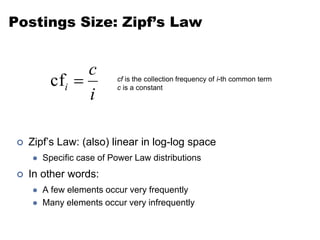
Postings Size: Zipf’s Law
 Zipf’s Law: (also) linear in log-log space
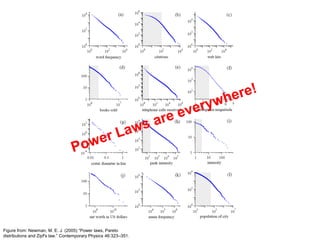
 Specific case of Power Law distributions
 In other words:
 A few elements occur very frequently
 Many elements occur very infrequently
i
c
i 
cf cf is the collection frequency of i-th common term
c is a constant
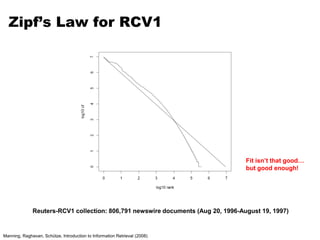
Zipf’s Law for RCV1
Reuters-RCV1 collection: 806,791 newswire documents (Aug 20, 1996-August 19, 1997)
Fit isn’t that good…
but good enough!
Manning, Raghavan, Schütze, Introduction to Information Retrieval (2008)
Figure from: Newman, M. E. J. (2005) “Power laws, Pareto
distributions and Zipf's law.” Contemporary Physics 46:323–351.
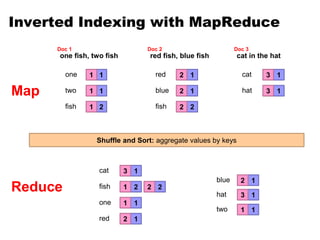
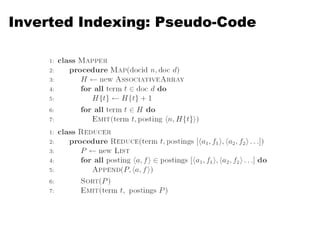
MapReduce: Index Construction
 Map over all documents
 Emit term as key, (docno, tf) as value
 Emit other information as necessary (e.g., term position)
 Sort/shuffle: group postings by term
 Reduce
 Gather and sort the postings (e.g., by docno or tf)
 Write postings to disk
 MapReduce does all the heavy lifting!
1
1
2
1
1
2 2
1
1
1
1
1
1
1
1
2
Inverted Indexing with MapReduce
1
one
1
two
1
fish
one fish, two fish
Doc 1
2
red
2
blue
2
fish
red fish, blue fish
Doc 2
3
cat
3
hat
cat in the hat
Doc 3
1
fish 2
1
one
1
two
2
red
3
cat
2
blue
3
hat
Shuffle and Sort: aggregate values by keys
Map
Reduce
Inverted Indexing: Pseudo-Code
[2,4]
[1]
[3]
[1]
[2]
[1]
[1]
[3]
[2]
[3]
[2,4]
[1]
[2,4]
[2,4]
[1]
[3]
1
1
2
1
1
2
1
1
2 2
1
1
1
1
1
1
Positional Indexes
1
one
1
two
1
fish
2
red
2
blue
2
fish
3
cat
3
hat
1
fish 2
1
one
1
two
2
red
3
cat
2
blue
3
hat
Shuffle and Sort: aggregate values by keys
Map
Reduce
one fish, two fish
Doc 1
red fish, blue fish
Doc 2
cat in the hat
Doc 3
Inverted Indexing: Pseudo-Code
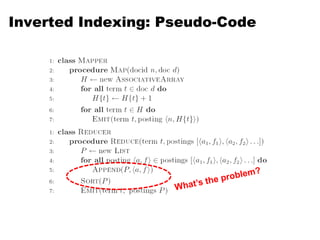
Scalability Bottleneck
 Initial implementation: terms as keys, postings as values
 Reducers must buffer all postings associated with key (to sort)
 What if we run out of memory to buffer postings?
 Uh oh!
[2,4]
[9]
[1,8,22]
[23]
[8,41]
[2,9,76]
[2,4]
[9]
[1,8,22]
[23]
[8,41]
[2,9,76]
2
1
3
1
2
3
Another Try…
1
fish
9
21
(values)
(key)
34
35
80
1
fish
9
21
(values)
(keys)
34
35
80
fish
fish
fish
fish
fish
How is this different?
• Let the framework do the sorting
• Term frequency implicitly stored
• Directly write postings to disk!
Where have we seen this before?
2 1 3 1 2 3
2 1 3 1 2 3
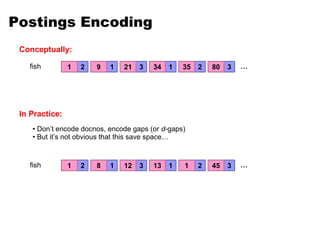
Postings Encoding
1
fish 9 21 34 35 80 …
1
fish 8 12 13 1 45 …
Conceptually:
In Practice:
• Don’t encode docnos, encode gaps (or d-gaps)
• But it’s not obvious that this save space…
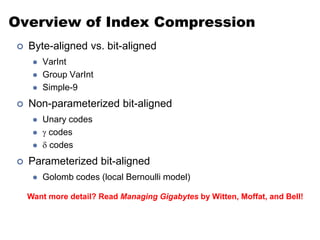
Overview of Index Compression
 Byte-aligned vs. bit-aligned
 VarInt
 Group VarInt
 Simple-9
 Non-parameterized bit-aligned
 Unary codes
  codes
  codes
 Parameterized bit-aligned
 Golomb codes (local Bernoulli model)
Want more detail? Read Managing Gigabytes by Witten, Moffat, and Bell!
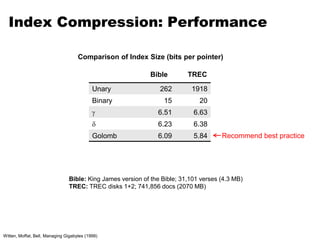
Index Compression: Performance
Witten, Moffat, Bell, Managing Gigabytes (1999)
Unary 262 1918
Binary 15 20
 6.51 6.63
 6.23 6.38
Golomb 6.09 5.84
Bible TREC
Bible: King James version of the Bible; 31,101 verses (4.3 MB)
TREC: TREC disks 1+2; 741,856 docs (2070 MB)
Recommend best practice
Comparison of Index Size (bits per pointer)
Getting the df
 In the mapper:
 Emit “special” key-value pairs to keep track of df
 In the reducer:
 Make sure “special” key-value pairs come first: process them to
determine df
 Remember: proper partitioning!
Getting the df: Modified Mapper
one fish, two fish
Doc 1
1
fish [2,4]
(value)
(key)
1
one [1]
1
two [3]

fish [1]

one [1]

two [1]
Input document…
Emit normal key-value pairs…
Emit “special” key-value pairs to keep track of df…
Getting the df: Modified Reducer
1
fish
9
[2,4]
[9]
21 [1,8,22]
(value)
(key)
34 [23]
35 [8,41]
80 [2,9,76]
fish
fish
fish
fish
fish
Write postings directly to disk

fish [63] [82] [27] …
…
First, compute the df by summing contributions
from all “special” key-value pair…
Compute Golomb parameter b…
Important: properly define sort order to make
sure “special” key-value pairs come first!
Where have we seen this before?
MapReduce it?
 The indexing problem
 Scalability is paramount
 Must be relatively fast, but need not be real time
 Fundamentally a batch operation
 Incremental updates may or may not be important
 For the web, crawling is a challenge in itself
 The retrieval problem
 Must have sub-second response time
 For the web, only need relatively few results
Just covered
Now
Retrieval with MapReduce?
 MapReduce is fundamentally batch-oriented
 Optimized for throughput, not latency
 Startup of mappers and reducers is expensive
 MapReduce is not suitable for real-time queries!
 Use separate infrastructure for retrieval…
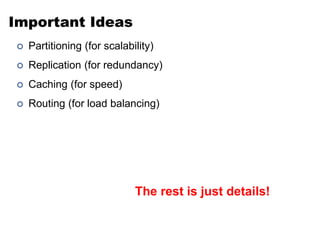
Important Ideas
 Partitioning (for scalability)
 Replication (for redundancy)
 Caching (for speed)
 Routing (for load balancing)
The rest is just details!
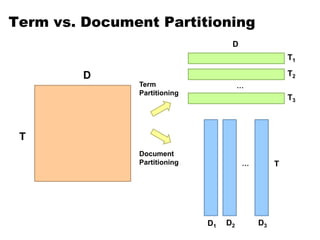
Term vs. Document Partitioning
…
T
D
T1
T2
T3
D
T
…
D1 D2 D3
Term
Partitioning
Document
Partitioning
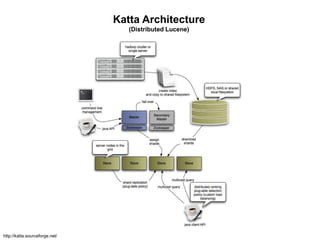
Katta Architecture
(Distributed Lucene)
http://katta.sourceforge.net/

Information Retrieval and Map-Reduce Implementations

  • 1.
  • 2.
    Roadmap  Introduction toinformation retrieval  Basics of indexing and retrieval  Inverted indexing in MapReduce  Retrieval at scale
  • 3.
    First, nomenclature…  Informationretrieval (IR)  Focus on textual information (= text/document retrieval)  Other possibilities include image, video, music, …  What do we search?  Generically, “collections”  Less-frequently used, “corpora”  What do we find?  Generically, “documents”  Even though we may be referring to web pages, PDFs, PowerPoint slides, paragraphs, etc.
  • 4.
  • 5.
    The Central Problemin Search Searcher Author Concepts Concepts Query Terms Document Terms Do these represent the same concepts? “tragic love story” “fateful star-crossed romance”
  • 6.
    Abstract IR Architecture Documents Query Hits Representation Function Representation Function QueryRepresentation Document Representation Comparison Function Index offline online
  • 7.
    How do werepresent text?  Remember: computers don’t “understand” anything!  “Bag of words”  Treat all the words in a document as index terms  Assign a “weight” to each term based on “importance” (or, in simplest case, presence/absence of word)  Disregard order, structure, meaning, etc. of the words  Simple, yet effective!  Assumptions  Term occurrence is independent  Document relevance is independent  “Words” are well-defined
  • 8.
    What’s a word? 天主教教宗若望保祿二世因感冒再度住進醫院。 這是他今年第二度因同樣的病因住院。‫ريجيف‬ ‫مارك‬ ‫وقال‬ - ‫باسم‬ ‫الناطق‬ ‫اإلسرائيلية‬ ‫الخارجية‬ - ‫قبل‬ ‫شارون‬ ‫إن‬ ‫بزيارة‬ ‫األولى‬ ‫للمرة‬ ‫وسيقوم‬ ‫الدعوة‬ ‫المقر‬ ‫طويلة‬ ‫لفترة‬ ‫كانت‬ ‫التي‬ ،‫تونس‬ ‫عام‬ ‫لبنان‬ ‫من‬ ‫خروجها‬ ‫بعد‬ ‫الفلسطينية‬ ‫التحرير‬ ‫لمنظمة‬ ‫الرسمي‬ 1982 . Выступая в Мещанском суде Москвы экс-глава ЮКОСа заявил не совершал ничего противозаконного, в чем обвиняет его генпрокуратура России. भारत सरकार ने आर्थिक सर्वेक्षण में र्र्वत्तीय र्वर्ि 2005-06 में सात फीसदी र्र्वकास दर हार्सल करने का आकलन र्कया है और कर सुधार पर ज़ोर र्दया है 日米連合で台頭中国に対処…アーミテージ前副長官提言 조재영 기자= 서울시는 25일 이명박 시장이 `행정중심복합도시'' 건설안 에 대해 `군대라도 동원해 막고싶은 심정''이라고 말했다는 일부 언론의 보도를 부인했다.
  • 9.
    Sample Document McDonald's slimsdown spuds Fast-food chain to reduce certain types of fat in its french fries with new cooking oil. NEW YORK (CNN/Money) - McDonald's Corp. is cutting the amount of "bad" fat in its french fries nearly in half, the fast-food chain said Tuesday as it moves to make all its fried menu items healthier. But does that mean the popular shoestring fries won't taste the same? The company says no. "It's a win-win for our customers because they are getting the same great french-fry taste along with an even healthier nutrition profile," said Mike Roberts, president of McDonald's USA. But others are not so sure. McDonald's will not specifically discuss the kind of oil it plans to use, but at least one nutrition expert says playing with the formula could mean a different taste. Shares of Oak Brook, Ill.-based McDonald's (MCD: down $0.54 to $23.22, Research, Estimates) were lower Tuesday afternoon. It was unclear Tuesday whether competitors Burger King and Wendy's International (WEN: down $0.80 to $34.91, Research, Estimates) would follow suit. Neither company could immediately be reached for comment. … 14 × McDonalds 12 × fat 11 × fries 8 × new 7 × french 6 × company, said, nutrition 5 × food, oil, percent, reduce, taste, Tuesday … “Bag of Words”
  • 10.
    Information retrieval models An IR model governs how a document and a query are represented and how the relevance of a document to a user query is defined.  Main models:  Boolean model  Vector space model  Statistical language model  etc 10
  • 11.
    Boolean model  Eachdocument or query is treated as a “bag” of words or terms. Word sequence is not considered.  Given a collection of documents D, let V = {t1, t2, ..., t|V|} be the set of distinctive words/terms in the collection. V is called the vocabulary.  A weight wij > 0 is associated with each term ti of a document dj ∈ D. For a term that does not appear in document dj, wij = 0. dj = (w1j, w2j, ..., w|V|j), 11
  • 12.
    Boolean model (contd) Query terms are combined logically using the Boolean operators AND, OR, and NOT.  E.g., ((data AND mining) AND (NOT text))  Retrieval  Given a Boolean query, the system retrieves every document that makes the query logically true.  Called exact match.  The retrieval results are usually quite poor because term frequency is not considered. 12
  • 13.
    Boolean queries: Exactmatch • The Boolean retrieval model is being able to ask a query that is a Boolean expression: – Boolean Queries are queries using AND, OR and NOT to join query terms • Views each document as a set of words • Is precise: document matches condition or not. – Perhaps the simplest model to build an IR system on • Primary commercial retrieval tool for 3 decades. • Many search systems you still use are Boolean: – Email, library catalog, Mac OS X Spotlight 13 Sec. 1.3
  • 14.
    Strengths and Weaknesses Strengths  Precise, if you know the right strategies  Precise, if you have an idea of what you’re looking for  Implementations are fast and efficient  Weaknesses  Users must learn Boolean logic  Boolean logic insufficient to capture the richness of language  No control over size of result set: either too many hits or none  When do you stop reading? All documents in the result set are considered “equally good”  What about partial matches? Documents that “don’t quite match” the query may be useful also
  • 15.
    Vector Space Model Assumption:Documents that are “close together” in vector space “talk about” the same things t1 d2 d1 d3 d4 d5 t3 t2 θ φ Therefore, retrieve documents based on how close the document is to the query (i.e., similarity ~ “closeness”)
  • 16.
    Similarity Metric  Use“angle” between the vectors:  Or, more generally, inner products:          n i k i n i j i n i k i j i k j k j k j w w w w d d d d d d sim 1 2 , 1 2 , 1 , , ) , (     k j k j d d d d       ) cos(     n i k i j i k j k j w w d d d d sim 1 , , ) , (  
  • 17.
    Vector space model Documents are also treated as a “bag” of words or terms.  Each document is represented as a vector.  However, the term weights are no longer 0 or 1. Each term weight is computed based on some variations of TF or TF-IDF scheme. 17
  • 18.
    Term Weighting  Termweights consist of two components  Local: how important is the term in this document?  Global: how important is the term in the collection?  Here’s the intuition:  Terms that appear often in a document should get high weights  Terms that appear in many documents should get low weights  How do we capture this mathematically?  Term frequency (local)  Inverse document frequency (global)
  • 19.
    TF.IDF Term Weighting i j i j i n N wlog tf , ,   j i w, j i, tf N i n weight assigned to term i in document j number of occurrence of term i in document j number of documents in entire collection number of documents with term i
  • 20.
    Retrieval in vectorspace model  Query q is represented in the same way or slightly differently.  Relevance of di to q: Compare the similarity of query q and document di.  Cosine similarity (the cosine of the angle between the two vectors)  Cosine is also commonly used in text clustering 20
  • 21.
    An Example  Adocument space is defined by three terms:  hardware, software, users  the vocabulary  A set of documents are defined as:  A1=(1, 0, 0), A2=(0, 1, 0), A3=(0, 0, 1)  A4=(1, 1, 0), A5=(1, 0, 1), A6=(0, 1, 1)  A7=(1, 1, 1) A8=(1, 0, 1). A9=(0, 1, 1)  If the Query is “hardware and software”  what documents should be retrieved? 21
  • 22.
    An Example (cont.) In Boolean query matching:  document A4, A7 will be retrieved (“AND”)  retrieved: A1, A2, A4, A5, A6, A7, A8, A9 (“OR”)  In similarity matching (cosine):  q=(1, 1, 0)  S(q, A1)=0.71, S(q, A2)=0.71, S(q, A3)=0  S(q, A4)=1, S(q, A5)=0.5, S(q, A6)=0.5  S(q, A7)=0.82, S(q, A8)=0.5, S(q, A9)=0.5  Document retrieved set (with ranking)= • {A4, A7, A1, A2, A5, A6, A8, A9} 22
  • 23.
    Constructing Inverted Index(Word Counting) Documents Inverted Index Bag of Words case folding, tokenization, stopword removal, stemming syntax, semantics, word knowledge, etc.
  • 24.
    Stopwords removal • Manyof the most frequently used words in English are useless in IR and text mining – these words are called stop words. – the, of, and, to, …. – Typically about 400 to 500 such words – For an application, an additional domain specific stopwords list may be constructed • Why do we need to remove stopwords? – Reduce indexing (or data) file size • stopwords accounts 20-30% of total word counts. – Improve efficiency and effectiveness • stopwords are not useful for searching or text mining • they may also confuse the retrieval system. 24
  • 25.
    Stemming • Techniques usedto find out the root/stem of a word. E.g., – user engineering – users engineered – used engineer – using • stem: use engineer Usefulness: • improving effectiveness of IR and text mining – matching similar words – Mainly improve recall • reducing indexing size – combing words with same roots may reduce indexing size as much as 40-50%. 25
  • 26.
    Basic stemming methods Usinga set of rules. E.g., • remove ending – if a word ends with a consonant other than s, followed by an s, then delete s. – if a word ends in es, drop the s. – if a word ends in ing, delete the ing unless the remaining word consists only of one letter or of th. – If a word ends with ed, preceded by a consonant, delete the ed unless this leaves only a single letter. – …... • transform words – if a word ends with “ies” but not “eies” or “aies” then “ies --> y.” 26
  • 27.
    Inverted index  Theinverted index of a document collection is basically a data structure that  attaches each distinctive term with a list of all documents that contains the term.  Thus, in retrieval, it takes constant time to  find the documents that contains a query term.  multiple query terms are also easy handle as we will see soon. 27
  • 28.
  • 29.
    Search using invertedindex Given a query q, search has the following steps: • Step 1 (vocabulary search): find each term/word in q in the inverted index. • Step 2 (results merging): Merge results to find documents that contain all or some of the words/terms in q. • Step 3 (Rank score computation): To rank the resulting documents/pages, using, – content-based ranking – link-based ranking 29
  • 30.
    Inverted Index: BooleanRetrieval one fish, two fish Doc 1 red fish, blue fish Doc 2 cat in the hat Doc 3 1 1 1 1 1 1 1 2 3 1 1 1 4 blue cat egg fish green ham hat one 3 4 1 4 4 3 2 1 blue cat egg fish green ham hat one 2 green eggs and ham Doc 4 1 red 1 two 2 red 1 two
  • 31.
    Boolean Retrieval  Toexecute a Boolean query:  Build query syntax tree  For each clause, look up postings  Traverse postings and apply Boolean operator  Efficiency analysis  Postings traversal is linear (assuming sorted postings)  Start with shortest posting first ( blue AND fish ) OR ham blue fish AND ham OR 1 2 blue fish 2
  • 32.
    Query processing: AND •Consider processing the query: Brutus AND Caesar – Locate Brutus in the Dictionary; • Retrieve its postings. – Locate Caesar in the Dictionary; • Retrieve its postings. – “Merge” the two postings: 32 128 34 2 4 8 16 32 64 1 2 3 5 8 13 21 Brutus Caesar Sec. 1.3
  • 33.
    The merge • Walkthrough the two postings simultaneously, in time linear in the total number of postings entries 33 34 128 2 4 8 16 32 64 1 2 3 5 8 13 21 128 34 2 4 8 16 32 64 1 2 3 5 8 13 21 Brutus Caesar 2 8 If the list lengths are x and y, the merge takes O(x+y) operations. Crucial: postings sorted by docID. Sec. 1.3
  • 34.
    Intersecting two postingslists (a “merge” algorithm) 34
  • 35.
    2 1 1 2 1 1 1 1 1 1 1 Inverted Index: TF.IDF 2 1 2 1 1 1 12 3 1 1 1 4 1 1 1 1 1 1 2 1 tf df blue cat egg fish green ham hat one 1 1 1 1 1 1 2 1 blue cat egg fish green ham hat one 1 1 red 1 1 two 1 red 1 two one fish, two fish Doc 1 red fish, blue fish Doc 2 cat in the hat Doc 3 green eggs and ham Doc 4 3 4 1 4 4 3 2 1 2 2 1
  • 36.
    Positional Indexes  Storeterm position in postings  Supports richer queries (e.g., proximity)  Naturally, leads to larger indexes…
  • 37.
    [2,4] [3] [2,4] [2] [1] [1] [3] [2] [1] [1] [3] 2 1 1 2 1 1 1 1 1 1 1 Inverted Index: PositionalInformation 2 1 2 1 1 1 1 2 3 1 1 1 4 1 1 1 1 1 1 2 1 tf df blue cat egg fish green ham hat one 1 1 1 1 1 1 2 1 blue cat egg fish green ham hat one 1 1 red 1 1 two 1 red 1 two one fish, two fish Doc 1 red fish, blue fish Doc 2 cat in the hat Doc 3 green eggs and ham Doc 4 3 4 1 4 4 3 2 1 2 2 1
  • 38.
    Retrieval in aNutshell  Look up postings lists corresponding to query terms  Traverse postings for each query term  Store partial query-document scores in accumulators  Select top k results to return
  • 39.
    Retrieval: Document-at-a-Time  Evaluatedocuments one at a time (score all query terms)  Tradeoffs  Small memory footprint (good)  Must read through all postings (bad), but skipping possible  More disk seeks (bad), but blocking possible fish 2 1 3 1 2 3 1 9 21 34 35 80 … blue 2 1 1 9 21 35 … Accumulators (e.g. priority queue) Document score in top k? Yes: Insert document score, extract-min if queue too large No: Do nothing
  • 40.
    Retrieval: Query-At-A-Time  Evaluatedocuments one query term at a time  Usually, starting from most rare term (often with tf-sorted postings)  Tradeoffs  Early termination heuristics (good)  Large memory footprint (bad), but filtering heuristics possible fish 2 1 3 1 2 3 1 9 21 34 35 80 … blue 2 1 1 9 21 35 … Accumulators (e.g., hash) Score{q=x}(doc n) = s
  • 41.
    MapReduce it?  Theindexing problem  Scalability is critical  Must be relatively fast, but need not be real time  Fundamentally a batch operation  Incremental updates may or may not be important  For the web, crawling is a challenge in itself  The retrieval problem  Must have sub-second response time  For the web, only need relatively few results
  • 42.
    Indexing: Performance Analysis Fundamentally, a large sorting problem  Terms usually fit in memory  Postings usually don’t  How is it done on a single machine?  How can it be done with MapReduce?  First, let’s characterize the problem size:  Size of vocabulary  Size of postings
  • 43.
    Vocabulary Size: Heaps’Law  Heaps’ Law: linear in log-log space  Vocabulary size grows unbounded! b kT M  M is vocabulary size T is collection size (number of documents) k and b are constants Typically, k is between 30 and 100, b is between 0.4 and 0.6
  • 44.
    Heaps’ Law forRCV1 Reuters-RCV1 collection: 806,791 newswire documents (Aug 20, 1996-August 19, 1997) k = 44 b = 0.49 First 1,000,020 terms: Predicted = 38,323 Actual = 38,365 Manning, Raghavan, Schütze, Introduction to Information Retrieval (2008)
  • 45.
    Postings Size: Zipf’sLaw  Zipf’s Law: (also) linear in log-log space  Specific case of Power Law distributions  In other words:  A few elements occur very frequently  Many elements occur very infrequently i c i  cf cf is the collection frequency of i-th common term c is a constant
  • 46.
    Zipf’s Law forRCV1 Reuters-RCV1 collection: 806,791 newswire documents (Aug 20, 1996-August 19, 1997) Fit isn’t that good… but good enough! Manning, Raghavan, Schütze, Introduction to Information Retrieval (2008)
  • 47.
    Figure from: Newman,M. E. J. (2005) “Power laws, Pareto distributions and Zipf's law.” Contemporary Physics 46:323–351.
  • 48.
    MapReduce: Index Construction Map over all documents  Emit term as key, (docno, tf) as value  Emit other information as necessary (e.g., term position)  Sort/shuffle: group postings by term  Reduce  Gather and sort the postings (e.g., by docno or tf)  Write postings to disk  MapReduce does all the heavy lifting!
  • 49.
    1 1 2 1 1 2 2 1 1 1 1 1 1 1 1 2 Inverted Indexingwith MapReduce 1 one 1 two 1 fish one fish, two fish Doc 1 2 red 2 blue 2 fish red fish, blue fish Doc 2 3 cat 3 hat cat in the hat Doc 3 1 fish 2 1 one 1 two 2 red 3 cat 2 blue 3 hat Shuffle and Sort: aggregate values by keys Map Reduce
  • 50.
  • 51.
    [2,4] [1] [3] [1] [2] [1] [1] [3] [2] [3] [2,4] [1] [2,4] [2,4] [1] [3] 1 1 2 1 1 2 1 1 2 2 1 1 1 1 1 1 Positional Indexes 1 one 1 two 1 fish 2 red 2 blue 2 fish 3 cat 3 hat 1 fish2 1 one 1 two 2 red 3 cat 2 blue 3 hat Shuffle and Sort: aggregate values by keys Map Reduce one fish, two fish Doc 1 red fish, blue fish Doc 2 cat in the hat Doc 3
  • 52.
  • 53.
    Scalability Bottleneck  Initialimplementation: terms as keys, postings as values  Reducers must buffer all postings associated with key (to sort)  What if we run out of memory to buffer postings?  Uh oh!
  • 54.
    [2,4] [9] [1,8,22] [23] [8,41] [2,9,76] [2,4] [9] [1,8,22] [23] [8,41] [2,9,76] 2 1 3 1 2 3 Another Try… 1 fish 9 21 (values) (key) 34 35 80 1 fish 9 21 (values) (keys) 34 35 80 fish fish fish fish fish How isthis different? • Let the framework do the sorting • Term frequency implicitly stored • Directly write postings to disk! Where have we seen this before?
  • 55.
    2 1 31 2 3 2 1 3 1 2 3 Postings Encoding 1 fish 9 21 34 35 80 … 1 fish 8 12 13 1 45 … Conceptually: In Practice: • Don’t encode docnos, encode gaps (or d-gaps) • But it’s not obvious that this save space…
  • 56.
    Overview of IndexCompression  Byte-aligned vs. bit-aligned  VarInt  Group VarInt  Simple-9  Non-parameterized bit-aligned  Unary codes   codes   codes  Parameterized bit-aligned  Golomb codes (local Bernoulli model) Want more detail? Read Managing Gigabytes by Witten, Moffat, and Bell!
  • 57.
    Index Compression: Performance Witten,Moffat, Bell, Managing Gigabytes (1999) Unary 262 1918 Binary 15 20  6.51 6.63  6.23 6.38 Golomb 6.09 5.84 Bible TREC Bible: King James version of the Bible; 31,101 verses (4.3 MB) TREC: TREC disks 1+2; 741,856 docs (2070 MB) Recommend best practice Comparison of Index Size (bits per pointer)
  • 58.
    Getting the df In the mapper:  Emit “special” key-value pairs to keep track of df  In the reducer:  Make sure “special” key-value pairs come first: process them to determine df  Remember: proper partitioning!
  • 59.
    Getting the df:Modified Mapper one fish, two fish Doc 1 1 fish [2,4] (value) (key) 1 one [1] 1 two [3]  fish [1]  one [1]  two [1] Input document… Emit normal key-value pairs… Emit “special” key-value pairs to keep track of df…
  • 60.
    Getting the df:Modified Reducer 1 fish 9 [2,4] [9] 21 [1,8,22] (value) (key) 34 [23] 35 [8,41] 80 [2,9,76] fish fish fish fish fish Write postings directly to disk  fish [63] [82] [27] … … First, compute the df by summing contributions from all “special” key-value pair… Compute Golomb parameter b… Important: properly define sort order to make sure “special” key-value pairs come first! Where have we seen this before?
  • 61.
    MapReduce it?  Theindexing problem  Scalability is paramount  Must be relatively fast, but need not be real time  Fundamentally a batch operation  Incremental updates may or may not be important  For the web, crawling is a challenge in itself  The retrieval problem  Must have sub-second response time  For the web, only need relatively few results Just covered Now
  • 62.
    Retrieval with MapReduce? MapReduce is fundamentally batch-oriented  Optimized for throughput, not latency  Startup of mappers and reducers is expensive  MapReduce is not suitable for real-time queries!  Use separate infrastructure for retrieval…
  • 63.
    Important Ideas  Partitioning(for scalability)  Replication (for redundancy)  Caching (for speed)  Routing (for load balancing) The rest is just details!
  • 64.
    Term vs. DocumentPartitioning … T D T1 T2 T3 D T … D1 D2 D3 Term Partitioning Document Partitioning
  • 65.