PRESENTATION
NAME
DATABASE LANGUAGE
#WHAT IS DATABASE MANAGEMENT SYSTEM??
A database management system (DBMS) is system software for creating and
managing database. The DBMS provides users and programmers with a systematic way
to create, retrieve, update and manage data.
#There are many part of DBMS:
• Introduction to Database Management System
• DBMS vs File System
• View of data
• Data models
• Database Languages.
• Database users and administrators
• Transaction Management
• Database System Structure
• Application architectures
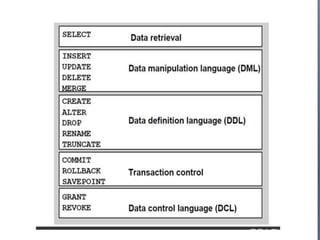
# In DBMS has 3 types language:
*Data Definition Language(DDL).
*Data Manipulation Language(DML).
*Data Control language (DCL).
#Data Definition Language(DDL):
• Database language that is used to create, delete or modify database
schema is called DDL.
• It is used by Database Administrators(DBA) to specify the
conceptual schema.
• DDL interpreter converts DDL statements into equivalent low level
statements understood by the DBMS.
• Normally, create, alter, and drop statements are DDL statements.
• DDL statements make changes in the schema
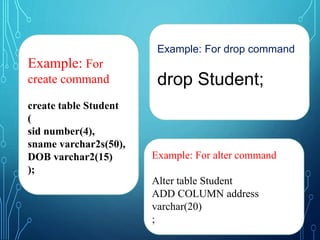
Example: For alter command
Alter table Student
ADD COLUMN address
varchar(20)
;
Example: For drop command
drop Student;
Example: For
create command
create table Student
(
sid number(4),
sname varchar2s(50),
DOB varchar2(15)
);
*DATA MANIPULATION LANGUAGE(DML)
• Database language that enables insert, update, delete, and
retrieval of data from the database is called Data
Manipulation Language.
• DML complier converts DML statements into equivalent
low level statements that the database understands.
• Normally, insert, update, delete, select are DML commands.
• DML reflects change in the instance, not the schema
Example: For
insert
Insert into Student
values(“A-101”,
“Ramesh”, 12);
Example: for update
Update Student
Set class = 11
Where sid = “A-101”
;
Example: for
select
Select * From
Student
Example: For
delete
Delete from
student
Where sname =
“RAj”
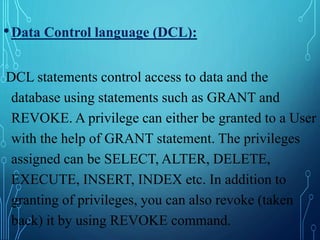
•Data Control language (DCL):
DCL statements control access to data and the
database using statements such as GRANT and
REVOKE. A privilege can either be granted to a User
with the help of GRANT statement. The privileges
assigned can be SELECT, ALTER, DELETE,
EXECUTE, INSERT, INDEX etc. In addition to
granting of privileges, you can also revoke (taken
back) it by using REVOKE command.
*In SQL, cases are insensitive. So, instead of Student one
can write StUdEnT as well.
* Also, for integer values “12” is incorrect but 12 is
correct.
*And, for char and varchar “course” is correct and course
is incorrect.
Note that

Database language

  • 1.
  • 2.
    #WHAT IS DATABASEMANAGEMENT SYSTEM?? A database management system (DBMS) is system software for creating and managing database. The DBMS provides users and programmers with a systematic way to create, retrieve, update and manage data. #There are many part of DBMS: • Introduction to Database Management System • DBMS vs File System • View of data • Data models • Database Languages. • Database users and administrators • Transaction Management • Database System Structure • Application architectures
  • 3.
    # In DBMShas 3 types language: *Data Definition Language(DDL). *Data Manipulation Language(DML). *Data Control language (DCL). #Data Definition Language(DDL): • Database language that is used to create, delete or modify database schema is called DDL. • It is used by Database Administrators(DBA) to specify the conceptual schema. • DDL interpreter converts DDL statements into equivalent low level statements understood by the DBMS. • Normally, create, alter, and drop statements are DDL statements. • DDL statements make changes in the schema
  • 4.
    Example: For altercommand Alter table Student ADD COLUMN address varchar(20) ; Example: For drop command drop Student; Example: For create command create table Student ( sid number(4), sname varchar2s(50), DOB varchar2(15) );
  • 5.
    *DATA MANIPULATION LANGUAGE(DML) •Database language that enables insert, update, delete, and retrieval of data from the database is called Data Manipulation Language. • DML complier converts DML statements into equivalent low level statements that the database understands. • Normally, insert, update, delete, select are DML commands. • DML reflects change in the instance, not the schema
  • 6.
    Example: For insert Insert intoStudent values(“A-101”, “Ramesh”, 12); Example: for update Update Student Set class = 11 Where sid = “A-101” ; Example: for select Select * From Student Example: For delete Delete from student Where sname = “RAj”
  • 7.
    •Data Control language(DCL): DCL statements control access to data and the database using statements such as GRANT and REVOKE. A privilege can either be granted to a User with the help of GRANT statement. The privileges assigned can be SELECT, ALTER, DELETE, EXECUTE, INSERT, INDEX etc. In addition to granting of privileges, you can also revoke (taken back) it by using REVOKE command.
  • 9.
    *In SQL, casesare insensitive. So, instead of Student one can write StUdEnT as well. * Also, for integer values “12” is incorrect but 12 is correct. *And, for char and varchar “course” is correct and course is incorrect. Note that