Concept of Sleep& Rest
by Gulshan Iqbal
MSN scholor
INS-SUIT Peshawar
2.
Objectives
1. Define restand sleep pattern
2. Define terms related to rest and sleep.
3. Compare the characteristics of sleep and rest.
4. Discuss the characteristics of two kinds of sleep.
5. Enumerate the functions of sleep.
6. Discuss factors affecting sleep.
7. Identify common sleep disorders.
8. Identify conditions necessary to promote sleep.
9. Discuss nursing process for a patient to promote sleep
3.
Rest and sleeppattern
Sleep is a basic human need; it is a universal biological
process common to all people. Humans spend about
one third of their lives asleep
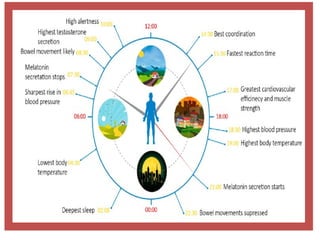
A sleep pattern, also referred to as sleep-wake pattern,
is a biological rhythm that guides the body as to
when it should sleep and when it should wake. It is
one of the body's circadian rhythms and typically
follows a 24-hour cycle, controling the body's
schedule for sleeping and waking.
5.
Rest and sleeppattern
Proper sleep & rest are importanat for patients and
may be interrupted because of pain, fear,stress, or
side effects of medication and necessary treatment.
An important nursing action is to assist the patients in
obtaining enough sleep to aid in healing and
maintaing health.
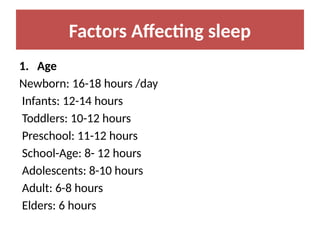
Adults need 7 hours of sleep at night
6.
Rest
Rest is acondition in which the body is in a decreased state
of activity without physical, emotional stress and
freedom from anxiety.Rest is without altered level of
consciousness. OR
In medical care, rest is defined as behavior aimed at
increasing physical and mental well-being, which usually
involves stopping activity.
Rest has positive outcomes for our physical, mental, and
emotional health. By relaxing muscles and quieting the brain,
rest can help restore a sense of calm during times of
exhaustion, illness, or overexertion.
7.
Sleep
An altered stateof consciousness in which the individual’s
perception of and reaction to the environment is
decreased.
OR
A physical and mental resting state in which a person
becomes relatively inactive and unaware of the
environment.
Sleep is a partial detachment from the world, where most
external stimuli are blocked from the senses.
8.
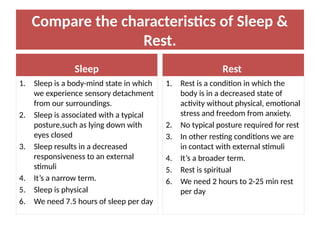
Compare the characteristicsof Sleep &
Rest.
Sleep
1. Sleep is a body-mind state in which
we experience sensory detachment
from our surroundings.
2. Sleep is associated with a typical
posture,such as lying down with
eyes closed
3. Sleep results in a decreased
responsiveness to an external
stimuli
4. It’s a narrow term.
5. Sleep is physical
6. We need 7.5 hours of sleep per day
Rest
1. Rest is a condition in which the
body is in a decreased state of
activity without physical, emotional
stress and freedom from anxiety.
2. No typical posture required for rest
3. In other resting conditions we are
in contact with external stimuli
4. It’s a broader term.
5. Rest is spiritual
6. We need 2 hours to 2-25 min rest
per day
9.
Characteristics of Sleep
•Sleep is a state that is characterized by changes in
brain wave activity, breathing, heart rate, body
temperature, and other physiological functions.
• Depending on the sleep stage, different physiological
functions may be
• more active and variable ,for example, during REM
sleep,
• less active and more stable for example, during NREM
sleep.
10.
Characteristics of Sleep
•Sleep is a period of reduced activity.
• Sleep is associated with a typical posture, such as
lying down with eyes closed in humans.
• Sleep results in a decreased responsiveness to
external stimuli.
• Sleep is a state that is relatively easy to reverse
• Sleep consist of two main phases that are
– Non Rapid Movement (NREM)
– Rapid Eye Movement(REM)
11.
Stages of Sleep
1.Non Rapid Movement (NREM)
About 75% to 80% of sleep during a night is NREM
sleep. NREM sleep is divided into four stages, each
associated with distinct brain activity and physiology.
NREM –Non rapid eye moment
Stage -I
Stage -II
Stage -III
Stage-IV
12.
1. Characteristics ofNREM
Stage I
Stage I is the stage of very light sleep and lasts only a few
minutes. During this stage, the person feels drowsy and
relaxed, the eyes roll from side to side, and the heart and
respiratory rates drop slightly. The sleeper can be readily
awakened and may deny that he or she was sleeping.
• Relax and drowsy
• Profound and restfullness
• Floating sensation
• Eyes roll from sisde to side
• Usually last only a few minutes
13.
Characteristics of NREM
StageII
Stage II is the stage of light sleep during which body processes
continue to slow down. The eyes are generally still, the
heart and respiratory rates decrease slightly, and body
temperature falls. Stage II lasts only about 10 to 15 minutes
but constitutes 44% to 55% of total sleep (Choudhary &
Choudhary, 2009).
An individual in stage II requires more intense stimuli than in
stage I to awaken such as touching or shaking.
• Light sleep
• Easily aroused
14.
1. Characteristics ofNREM
Stage -III
Stage-III refers to a medium-depth sleep where vital signs and
metabolic processes slow further because of the
PARASYMPATHETIC nervous system influence. The sleeper is
difficult to arouse.
• Stage lasts 15 to 30 minutes.
• It involves initial stages of deep sleep.
• Muscles are completely relaxed.
• Large slow waves in EEG
• Vital signs decline but remain regular.
• Sleeper is difficult to arouse and rarely moves
15.
1. Characteristics ofNREM
STAGE 4 -this is the deepest sleep or delta sleep. It is the stage where the
heart rate and respiratory rate drop 20-30% below those exhibited
during waking hours. This stage is thought to restore the body physically.
Some dreaming may occur here. This stage may be absent in the elderly.
• Stage lasts approximately 15 to 30 minutes.
• It is the deepest stage of sleep.
• If sleep loss has occurred, sleeper spends considerable portion of night
in this stage.
• Vital signs are significantly lower than during waking hours.
• Further slowing of EEG
• Sleep walking and enuresis (bed-wetting) sometimes occur.
• It is very difficult to arouse sleeper
16.
1. Characteristics ofNREM
Stages III & stage IV
Stages III and IVare the deepest stages of sleep, differing only in the
percentage of delta waves recorded during a 30-second period.
During deep sleep or delta sleep,the sleeper’s heart and respiratory
rates drop 20% to 30% below those exhibited during waking hours.
The sleeper is difficult to arouse. The person is not disturbed by
sensory stimuli, the skeletal muscles are very relaxed, reflexes are
diminished, and snoring is most likely to occur. Even swallowing and
saliva production are reduced during delta sleep (Choudhary &
Choudhary, 2009).
These stages are essential for restoring energy and releasing
important growth hormones
17.
2.Characteristics of REM
Thissleep type usually recurs about every 90 minutes
and lasts 5 to 30 minutes.
Othername: PARADOXICAL Sleep. The EEG pattern
resembles that of the “ awake” state. This is not as
restful as NREM sleep.
Most dreams take place during this period and the
dreams are usually remembered or consolidated to
memory. The brain is highly active with metabolic
rate increasing as much as 20%
.
18.
2. Characteristics ofREM
The sleeper may be very difficult to arouse.There are
rapid conjugate eye movements, muscle tone is
depressed, but gastric secretions increase, HR and RR
are increased and IRREGULAR.
This sleep period becomes longer as the night
progresses
19.
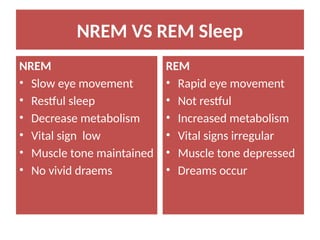
NREM VS REMSleep
NREM
• Slow eye movement
• Restful sleep
• Decrease metabolism
• Vital sign low
• Muscle tone maintained
• No vivid draems
REM
• Rapid eye movement
• Not restful
• Increased metabolism
• Vital signs irregular
• Muscle tone depressed
• Dreams occur
20.
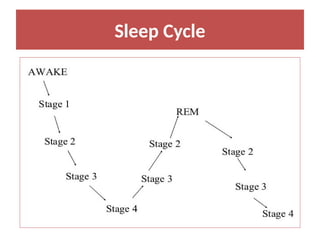
Sleep Cycles
During asleep cycle, people typically pass through NREM
and REM sleep, the complete cycle usually lasting about
90 to 110 minutes in adults.
In the first sleep cycle, a sleeper usually passes through all
of the first three NREM stages in a total of about 20 to 30
minutes.
Then, stage IVmay last about 30 minutes. After stage IV
NREM, the sleep passes back through stages III and II over
about 20 minutes. Thereafter, the first REM stage occurs,
lasting about 10 minutes, completing the first sleep cycle.
21.
Sleep Cycles
It isnot unusual for the first REM period to be very brief
or even skipped entirely. The healthy adult sleeper
usually experiences four to six cycles of sleep during
7 to 8 hours .
The sleeper who is awakened during any stage must
begin a new at stage I NREM sleep and proceed
through all stages to REM sleep.
Functions of Sleep
Theeffects of sleep on the body are not completely
understood.
Sleep exerts physiological effects on both the nervous system
and other body structures.
The role of sleep in psychological well-being is best noticed by
the deterioration in mental functioning related to sleep
loss.
Persons with inadequate amounts of sleep tend to become
emotionally irritable, have poor concentration, and
experience difficulty making decisions.(Regulation of
emotion)
24.
Functions of Sleep
•Restore biological processes (NREM)
• Preserve cardiac functions
• Human growth harmone released
• Proteins synthesis and cell division
• Body conserve energy during sleep
• Thermoregulation
• REM sleep is necassry for brain tissue restoration and
cognitive functions
• Loss of REM sleep leads to feeling of confusion and
suspecion
25.
Functions of Sleep
Prolongsleep loss leads to alterations in mood,
memmory and motor performance
Disturb REM sleep may affect on body such as,
• Risk for obesity
• Memory problem
• Easily gets depression
• Disturb metabolism
26.
Factors Affecting sleep
Boththe quality and the quantity of sleep are affected
by a number of factors. Factors that affects sleeps
are:
• Age
• Illness
• Environment
• Lifestyle
• Emotional stress
• Stimulants and Alcohol
• Diet
• Smoking
• Motivation
• Medications
Factors Affecting sleep
•Certain endocrine disturbances can also affect sleep.
Hyperthyrodism lengthens presleep time making it
difficult for a client to fall asleep.Hypothyroidism,
conversely, decreases stage IV sleep.
• Elevated body temperatures can cause some reduction in
delta sleep and REM sleep.
• The need to urinate during the night also disrupts sleep,
and people who awaken at night to urinate sometimes
have difficulty getting back to sleep.
29.
Factors Affecting sleep
2.Illness
Illness that causes pain or physical distress (e.g., arthritis,
back pain & low level of estrogen) can result in sleep
problems. People who are ill require more sleep than
normal, and the normal rhythm of sleep and wakefulness
is often disturbed.
• Respiratory conditions can disturb an individual’s sleep.
• People who have gastric or duodenal ulcers may find their
sleep disturbed because of pain, often a result of the
increased gastric secretions that occur during REM sleep.
30.
Factors Affecting sleep
3.Environment
Environment can promote or hinder sleep. The person must
be able to achieve a state of relaxation prior to entering a
period of sleep.
Any change—for example, noise in the environment— can
inhibit sleep.The absence of usual stimuli or the presence
of unfamiliar stimuli can prevent people from sleeping.
Hospital environments can be quite noisy, and special
care needs to be taken to reduce noise in the hallways
and nursing care units.
31.
Factors Affecting sleep
Infact, some hospitals have instituted “quiet times” in the
afternoon on nursing units where the lights are lowered
and activity and noise are purposefully decreased so
clients can rest or nap.Discomfort from environmental
temperature (e.g., too hot or cold) and lack of ventilation
can affect sleep.
Light levels can be another factor. A person accustomed to
darkness while sleeping may find it difficult to sleep in
the light. Another influence includes the comfort and size
of the bed.
A person’s partner who has different sleep habits, snores, or has other sleep
difficulties may become a problem for the person also.
32.
Factors Affecting sleep
4.Lifestyle
Followingan irregular morning and night time schedule can
affect sleep. Moderate exercise in the morning or early
afternoon usually is conducive to sleep, but exercise late
in the day can delay sleep.
The person’s ability to relax before retiring is an important
factor affecting the ability to fall asleep. It is best,
therefore, to avoid doing homework or office work
before or after getting into bed.
33.
Factors Affecting sleep
Nightshift workers frequently obtain less sleep than other
workers and have difficulty falling asleep after getting off
work. Wearing dark wrap-around sunglasses during the
drive home and light-blocking shades can minimize the
alerting effects of exposure to daylight, thus making it
easier to fall asleep when body temperature is rising.
34.
Factors Affecting sleep
5.Emotional Stress
Stress is considered by most sleep experts to be the number
one cause of short-term sleeping difficulties (National
Sleep Foundation).
A person preoccupied with personal problems (e.g., school-
or job-related pressures, family or marriage problems)
may be unable to relax sufficiently to get to sleep.
Anxiety increases the norepinephrine blood levels through
stimulation of the sympathetic nervous system. This chemical
change results in less deep sleep and REM sleep and more stage
changes and awakenings.
35.
Factors Affecting sleep
6.Stimulants and Alcohol
Caffeine-containing beverages act as stimulants of the
central nervous system (CNS). Drinking beverages
containing caffeine in the afternoon or evening may
interfere with sleep. People who drink an excessive
amount of alcohol often find their sleep disturbed.
Alcohol disrupts REM sleep, although it may hasten the
onset of sleep. The alcohol-tolerant person may be
unable to sleep well and become irritable as a result.
36.
Factors Affecting sleep
7.Diet
Weight gain has been associated with reduced total sleep
time as well as broken sleep and earlier awakening.
Weight loss, on the other hand, seems to be associated
with an increase in total sleep time and less broken
sleep.
Dietary L-tryptophan—found, for example, in cheese and
milk—may induce sleep, a fact that might explain why
warm milk helps some people get to sleep.
37.
Factors Affecting sleep
8.Smoking
Nicotine has a stimulating effect on the body, and smokers
often have more difficulty falling asleep than
nonsmokers. Smokers are usually easily aroused and
often describe themselves as light sleepers.
By refraining from smoking after the evening meal, the
person usually sleeps better; moreover, many former
smokers report that their sleeping patterns improved
once they stopped smoking
38.
Factors Affecting sleep
9.Motivation
Motivation can increase alertness in some situations (e.g.,
a tired person can probably stay alert while attending
an interesting concert or surfing the web late at night).
Motivation alone, however,is usually not sufficient to
overcome the normal circadian drive to sleep during
the night.Nor is motivation sufficient to overcome
sleepiness due to insufficient sleep.Boredom alone is
not sufficient to cause sleepiness, but when insufficient
sleep combines with boredom, sleep is likely to occur.
39.
Factors Affecting sleep
10.Medications
Some medications affect the quality of sleep. Most
hypnotics can interfere with deep sleep and suppress
REM sleep.
• Beta-blockers have been known to cause insomnia and
nightmares.
• Narcotics, such as morphine, are known to suppress REM
sleep and to cause frequent awakenings and drowsiness.
• Tranquilizers interfere with REM sleep.
• Although antidepressants suppress REM sleep, this effect is
considered a therapeutic action
Common Sleep Disorders.
Aknowledge of common sleep disorders can help nurses assess
the sleep complaints of their clients and, when appropriate,
make a referral to a specialist in sleep disorders medicine.
Sleep disorders are typically categorized for the purpose of
research as
• Dysomnias,
• Parasomnias, and
• Disorders associated with medical or psychiatric illness,
Primary disorders can be divided into parasomnias and dyssomnias.
Parasomnia sleep disorders cause abnormal activities during sleep, such as
sleep terrors or sleep walking. Dyssomnia sleep disorders cause trouble
falling asleep or staying asleep.
42.
Common Sleep Disorders
1.Insomnia
Insomnia is described as the inability to fall asleep or remain
asleep. Persons with insomnia awaken not feeling rested.
Acute insomnia lasts one to several nights and is often caused
by personal stressors or worry.
Chronic insmnia:If the insomnia persists for longer than a
month, it is considered chronic insomnia.
More often, people experience chronic-intermittent insomnia,
which means difficulty sleeping for a few nights, followed
by a few nights of adequate sleep
43.
Common Sleep Disorders
Thetwo main risk factors of insomnia are 1) Older age
and 2) Female gender (National Sleep Foundation).
Women suffer sleep loss in connection with hormonal
changes (e.g., menstruation, pregnancy, and
menopause). The incidence of insomnia increases
with age, but it is thought that this is caused by some
other medical condition.
44.
Common Sleep Disorders
Treatmentfor insomnia frequently requires the client to develop
new behavior patterns that induce sleep and maintain sleep.
Examples of behavioral treatments include the following
• Stimulus control: creating a sleep environment that promotes
sleep
• Cognitive therapy:learning to develop positive thoughts and
beliefs about sleep
• Sleep restriction:following a program that limits time in bed in
order to get to sleep and stay asleep throughout the nigh.
Similarly,the long-term efficacy of hypnotic medications is questionable.
Such medications do not deal with the cause of the problem, and their
prolonged use can create drug dependencies.
45.
Common Sleep Disorders
2.Excessive Daytime Sleepines
Clients may experience excessive day time sleepiness as a result of
hypersomnia , narcolepsy, sleep apnea, and insufficient sleep.
Hypersomnia
Hypersomnia refers to conditions where the affected individual
obtains sufficient sleep at night but still cannot stay awake
during the day. Hypersomnia can be caused by medical
conditions, for example, CNS damage and certain kidney, liver, or
metabolic disorders, such as diabetic acidosis and
hypothyroidism.Rarely does hypersomnia have a psychological
origin
46.
Common Sleep Disorders
Narcolepsy(Sleeping at the wrong time) or falling asleep uncontrollably at
inappropriate time
Narcolepsy is a disorder of excessive daytime sleepiness caused by the
lack of the chemical hypocretin in the area of the CNS that regulates
sleep. Clients with narcolepsy have sleep attacks or excessive day time
sleepiness, and their sleep at night usually begins with a sleep-onset
REM period (dreamingsleep occurs within the first 15 minutes of
falling asleep ).
• Sleep intrudes into wakefulness, causing clients to fall asleep almost
instantly
• Sleep is brief but refreshing
• May also have sleep paralysis, sudden loss of strength, and
hallucinations as fall asleep or awaken.
47.
Common Sleep Disorders
SleepApnea (inability to sleep & breath at the same time)
Sleep apnea is characterized by frequent short breathing
pauses during sleep. Although all individuals have
occasional periods of apnea during sleep, more than five
apneic episodes or five breathing pauses longer than 10
seconds/hour is considered abnormal and should be
evaluated by a sleep medicine specialist.
Symptoms suggestive of sleep apnea include loud snoring, frequent
nocturnal awakenings, excessive daytime sleepiness, difficulties
falling asleep at night, morning headaches, memory and cognitive
problems, and irritability.
48.
Common Sleep Disorders
Althoughsleep apnea is most frequently diagnosed in men
and postmenopausal women, it may occur during
childhood.
Three common types of sleep apnea are
• Obstructive Apnea,
• Central Apnea, And
• Mixed Apnea.
49.
Common Sleep Disordersa
Obstructiveapnea occurs when the structures of the pharynx
or oral cavity block the flow of air.
The person continues to try to breathe; that is, the chest and
abdominal muscles move. The movements of the diaphragm
become stronger and stronger until the obstruction is
removed. Enlarged tonsils and adenoids, a deviated nasal
septum, nasal polyps, and obesity predispose the client to
obstructive apnea.
An episode of obstructive sleep apnea usually begins with snoring; thereafter,
breathing ceases, followed by marked snorting as breathing resumes.
Toward the end of each apneic episode, increased carbon dioxide levels in the
blood cause the client to wake.
50.
Common Sleep Disordersa
Centralapnea is thought to involve a defect in the
respiratory center of the brain.All actions involved in
breathing, such as chest movement and airflow, cease.
Clients who have brainstem injuries and muscular
dystrophy, for example, often have central sleep apnea.
At this time, there is no available treatment.
Mixed apnea is a combination of central apnea and
obstructive apnea.
51.
Common Sleep Disordersa
3.Insufficient Sleep (Disturbed Sleep or Sleep Deprivation)
Healthy individuals who obtain less seep than they need
will experience sleepiness and fatigue during the day
time hours. Depending on the severity and chronicity of
this voluntary, unintentional sleep deprivation,
individuals may develop attention and concentration
deficits,reduced vigilance,distractibility, reduced
motivation, fatigue, malaise, and occasionally diplopia
and dry mouth.
52.
Common Sleep Disorders
Parasomnia
Aparasomnia is behavior that may interfere with sleep
and may even occur during sleep. The
InternationalClassification of Sleep Disorders
subdivides parasomnias into
• Arousal disorders (e.g., sleepwalking, sleep terrors),
• Seep/wake transition disorders (e.g., sleeptalking),
• Parasomnias associated with REM sleep (e.g.,
nightmares), and others (e.g., bruxism).
53.
Parasomnias
Bruxism.
Usually occurring duringstage II NREM sleep, this clenching
and grinding of the teeth can eventually erode dental
crowns, cause teeth to come loose, and lead to
deterioration of the temporomandibular (TMJ) joint,
called TMJ syndrome.
Enuresis.
Bed-wetting during sleep can occur in children over 3 years
old. More males than females are affected. It often
occurs 1 to 2 hours after falling asleep, when rousing
from NREM stages III and IV.
54.
Parasomnias
Periodic limb movementdisorder (PLMD).
In this condition, the legs jerk twice or three times per minute during
sleep. It is most common among older adults. This kicking motion can
wake the client and result in poor sleep.
Sleeptalking.
Talking during sleep occurs during NREM sleep before REM sleep. It rarely
presents a problem to the person unless it becomes troublesome to
others.
Sleepwalking.
Sleepwalking (somnambulism) occurs during stages III and IV of NREM
sleep. It is episodic and usually occurs 1 to 2 hours after falling asleep.
Sleepwalkers tend not to notice dangers (e.g., stairs) and often need to
be protected from injury.
55.
Disorders due toother medical conditions
These disorders are associated with Medical or
Psychiatric or other illness. Usually the disorders that
cause sleep disturbance includes:
• Depression
• Alcolism
• Thyroid dysfunction
• Peptic ulcer
• COPD
56.
Promoting Sleep
SLEEP PATTERN
•If you have difficulty falling asleep or staying asleep, it is important to establish
a regular bedtime and wake-up time for all days of the week to enhance your
biological rhythm.
• A short daytime nap (e.g., 15 to 30 minutes), particularly among older adults,
can be restorative and not interfere with nighttime sleep. A younger person
with insomnia should not nap.
• Establish a regular, relaxing bedtime routine before sleep such as reading,
listening to soft music, taking a warm bath, or doing some other quiet activity
you enjoy.
• Avoid dealing with office work or family problems before bedtime.
• Get adequate exercise during the day to reduce stress.
• When you are unable to sleep, get out of bed, go into another room, and
pursue some relaxing activity until you feel drows
57.
Promoting Sleep
ENVIRONMENT
• Createa sleep-conducive environment that is dark,
quiet, comfortable, and cool.
• Keep noise to a minimum; block out extraneous noise
as necessary with noise from a fan, air conditioner, or
noise machine.
• Music is not recommended as studies have shown that
music will promote wakefulness (it is interesting and
people will pay attention to it).
• Sleep on a comfortable mattress and pillows
58.
Promoting Sleep
DIET
• Avoidheavy meals 2 to 3 hours before bedtime.
• Avoid alcohol and caffeine-containing foods and
beverages (e.g., coffee, tea, chocolate) at least 4 hours
before bedtime. Caffeine can interfere with sleep. Both
caffeine and alcohol act as diuretics, creating the need
to void during sleep time.
• If a bedtime snack is necessary, consume only light
carbohydrates or a milk drink. Heavy or spicy foods can
cause gastrointestinal upsets that disturb sleep
59.
Promoting Sleep
MEDICATIONS
• Usesleeping medications only as a last resort. Use
OTC medications sparingly because many contain
antihistamines that cause daytime drowsiness.
• Take analgesics before bedtime to relieve aches and
pains.
• Consult with your health care provider about
adjusting other medications that may cause
insomnia.
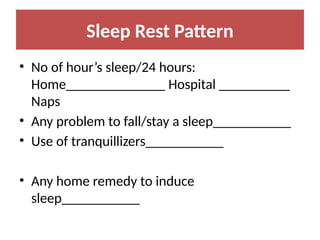
Sleep Rest Pattern
•No of hour’s sleep/24 hours:
Home______________ Hospital __________
Naps
• Any problem to fall/stay a sleep___________
• Use of tranquillizers___________
• Any home remedy to induce
sleep___________
63.
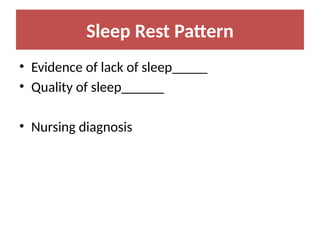
Sleep Rest Pattern
•Evidence of lack of sleep_____
• Quality of sleep______
• Nursing diagnosis
64.
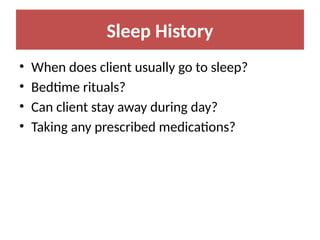
Sleep History
• Whendoes client usually go to sleep?
• Bedtime rituals?
• Can client stay away during day?
• Taking any prescribed medications?
65.
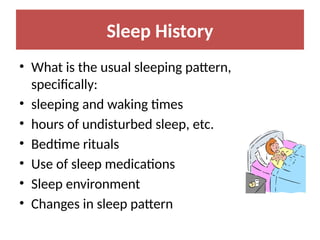
Sleep History
• Whatis the usual sleeping pattern,
specifically:
• sleeping and waking times
• hours of undisturbed sleep, etc.
• Bedtime rituals
• Use of sleep medications
• Sleep environment
• Changes in sleep pattern
66.
Physical Examination
• Observationof clients facial appearance,
behaviour, and energy level.
• Darkened areas around the eyes, puffy
eyelids, reddened conjunctiva, dull
appearing eyes.
• Irritability, yawning, slumped posture, hand
tremor, rubbing of eyes, confusion, fatigued,
lethargic, etc.
67.
NursingDiagnosis
• Readiness forenhanced sleep
• Insomnia related to anxiety
• Insomnia related to the disruption in the amount
and quality of sleep
• Sleep deprivation related to jet lag
• Sleep deprivation related to nocturnal work hours
• Sleep deprivation related to prolonged periods of
time without sleep
68.
Conti..
• Impaired sleeprelated to obstructive sleep apnea
• At risk for injury and accidents relating to
somnambulism
• Impaired gas exchange related to central or
obstructive sleep apnea
• At risk for disturbed sleep secondary to alcohol
use
• Insomnia related to unrelenting pain and the lack
of comfort
69.
Intervention
• The promotionof sleep and adequate rest depends on
correcting any underlying problems, including pain and
alcohol use, and then planning activities and routines that
will enhance the duration and the quality of sleep.
• Some of these sleep promotion interventions and
schedules include:
• Establishing and adhering to a regular sleep time and
wake time for the client based on their patterns and needs
• Limiting the duration and frequency of day time naps
• The promotion of daily exercise
70.
Conti...
• The avoidanceof alcohol, caffeine, heavy
meals and exercise at least a couple of hours
before bedtime
• The promotion of comfort using techniques
such as white noise, dim lighting, pain
management, stress reduction techniques,
massage and the elimination of
environmental noise
71.
• Close windowcurtains if street lights shine through
• Close curtains between clients in semiprivate and larger
rooms
• Reduce or eliminate overhead lighting: provide night
light at the bedside or in the bathroom
• Close the door of the client’s room
• Perform only essential noisy activities during sleeping
hours
Conti...
72.
Reducing environmental distractionsin
Hospitals
• Close window curtains if street lights shine through
• Close curtains between clients in semiprivate and larger
rooms
• Reduce or eliminate overhead lighting: provide night
light at the bedside or in the bathroom
• Close the door of the client’s room
• Perform only essential noisy activities during sleeping
hours
73.
• Ensure thatall carts wheels are well oiled
• Wear rubber soled shoes
• Keep required staff conversations at low
levels: conduct nursing reports or other
discussions in a separate area away from
clients rooms
Conti...
74.
Teaching to promoterest & sleep
• Establish regular betimes & wake up
• Eliminate lengthy naps
• Exercise just not 2 hrs before bedtime
• Take analgesics before bedtime if needed
• Decrease fluid intake 2-4 hrs before bed
• Use sleeping meds as last resort
• Avoid heavy meals 3 hrs before bedtime
• Avoid alcohol & caffeine at least 4 hrs before bedtime
75.
References
• Kozier &Erb’s Fundamental of Nursing Book, 8th
edition.
• Potter and Perry (2005) “Fundamentals of nursing”
published by most by an imprint of Elsevier, 6th
edition. New Delhi. Page no 1068 – 1071
• www.google.com
#7 sleep directly impacts almost every bodily system, ranging from the skin to the immune system
#9 Sleep is a state that is relatively easy to reverse (this distinguishes sleep from other states of reduced consciousness, such as hibernation and coma).
#26 Sleep quality is a subjective characteristic and is often determined by whether a person wakes up feeling energetic or not. Quantity of sleep is the total time the individual sleeps
#29 . People deprived of REM sleep subsequently spend more sleep time than normal in this stage.
#39 These drugs may disrupt REM sleep, delay onset of sleep, or decrease sleep time: ■ Alcohol ■ Amphetamines ■ Antidepressants ■ Beta-blockers ■ Bronchodilators ■ Caffeine ■ Decongestants ■ Narcotics ■ Steroids
#41 Primary disorders can be divided into parasomnias and dyssomnias. Parasomnia sleep disorders cause abnormal activities during sleep, such as sleep terrors or sleep walking. Dyssomnia sleep disorders cause trouble falling asleep or staying asleep.