The Gilded Age 
The Organization of Labor
Labor Unions 
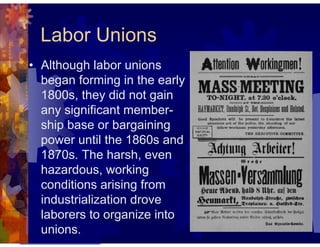
• Although labor unions 
began forming in the early 
1800s, they did not gain 
any significant member-ship 
base or bargaining 
power until the 1860s and 
1870s. The harsh, even 
hazardous, working 
conditions arising from 
industrialization drove 
laborers to organize into 
unions.
Management vs. Labor 
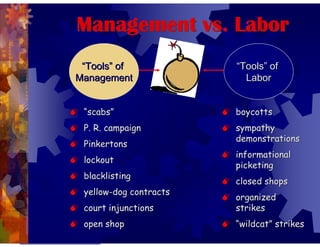
““Tools”” of 
Management 
““Tools”” of 
Labor 
 ““scabs”” 
 P. R. campaign 
 Pinkertons 
 lockout 
 blacklisting 
 yellow-dog contracts 
 court injunctions 
 open shop 
 boycotts 
 sympathy 
demonstrations 
 informational 
picketing 
 closed shops 
 organized 
strikes 
 ““wildcat”” strikes
Knights of Labor 
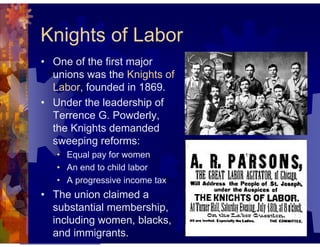
• One of the first major 
unions was the Knights of 
Labor, founded in 1869. 
• Under the leadership of 
Terrence G. Powderly, 
the Knights demanded 
sweeping reforms: 
• Equal pay for women 
• An end to child labor 
• A progressive income tax 
• The union claimed a 
substantial membership, 
including women, blacks, 
and immigrants.
Goals of the Knights of 
ù Eight-hour workday. Labor 
ù Workers’’ cooperatives. 
ù Worker-owned factories. 
ù Abolition of child and prison labor. 
ù Increased circulation of greenbacks. 
ù Equal pay for men and women. 
ù Safety codes in the workplace. 
ù Prohibition of contract foreign labor. 
ù Abolition of the National Bank.
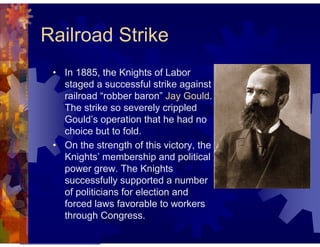
Railroad Strike 
• In 1885, the Knights of Labor 
staged a successful strike against 
railroad “robber baron” Jay Gould. 
The strike so severely crippled 
Gould’s operation that he had no 
choice but to fold. 
• On the strength of this victory, the 
Knights’ membership and political 
power grew. The Knights 
successfully supported a number 
of politicians for election and 
forced laws favorable to workers 
through Congress.
Haymarket Riot 
• The Knights’ power 
waned after a series of 
unauthorized strikes 
became violent. 
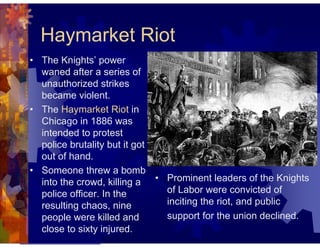
• The Haymarket Riot in 
Chicago in 1886 was 
intended to protest 
police brutality but it got 
out of hand. 
• Someone threw a bomb 
into the crowd, killing a 
police officer. In the 
resulting chaos, nine 
people were killed and 
close to sixty injured. 
• Prominent leaders of the Knights 
of Labor were convicted of 
inciting the riot, and public 
support for the union declined.
American Federation of Labor 
• To salvage the labor movement, 
craft laborers who had been 
members of the Knights of Labor 
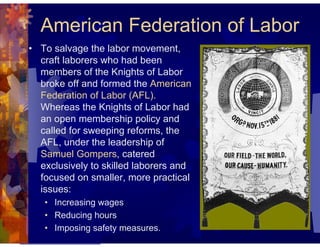
broke off and formed the American 
Federation of Labor (AFL). 
Whereas the Knights of Labor had 
an open membership policy and 
called for sweeping reforms, the 
AFL, under the leadership of 
Samuel Gompers, catered 
exclusively to skilled laborers and 
focused on smaller, more practical 
issues: 
• Increasing wages 
• Reducing hours 
• Imposing safety measures.
How the AF of L 
Would Help the Workers 
ù Catered to the skilled worker. 
ù Represented workers in matters of national 
legislation. 
ù Maintained a national strike fund. 
ù Evangelized the cause of unionism. 
ù Prevented disputes among the many craft 
unions. 
ù Mediated disputes between management 
and labor. 
ù Pushed for closed shops.
Industrial Workers of the World 
• More radical labor 
organizations also emerged, 
most notably the Industrial 
Workers of the World, 
nicknamed the Wobblies, 
founded in 1905. More 
famous for their militant anti-capitalism 
than for being 
large or influential, the 
Wobblies never grew to 
more than 30,000 members 
before fading away in about 
1920.
International Workers of the 
World (“Wobblies”)
“Big Bill” Haywood of the 
IWW 
 Violence was justified to 
overthrow capitalism.
The Hand That Will Rule the 
World One Big Union
Mother Jones: 
“The Miner’s Angel” 
 Mary Harris. 
 Organizer for the 
United Mine 
Workers. 
 Founded the Social 
Democratic Party 
in 1898. 
 One of the 
founding members 
of the I. W. W. in 
1905.
Labor Strikes 
• Between 1880 
and 1905, union 
activity in the 
United States led 
to well over 
35,000 strikes. 
• As evidenced by 
the Haymarket 
riot, these 
demonstrations 
at times erupted 
into violence.
Strike-Related Violence 
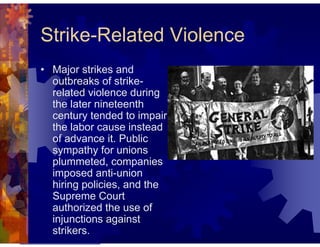
• Major strikes and 
outbreaks of strike-related 
violence during 
the later nineteenth 
century tended to impair 
the labor cause instead 
of advance it. Public 
sympathy for unions 
plummeted, companies 
imposed anti-union 
hiring policies, and the 
Supreme Court 
authorized the use of 
injunctions against 
strikers.
Railroad Strike of 1877 
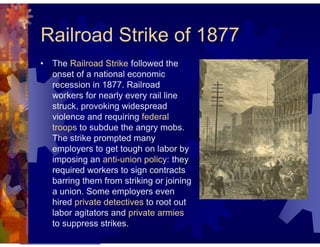
• The Railroad Strike followed the 
onset of a national economic 
recession in 1877. Railroad 
workers for nearly every rail line 
struck, provoking widespread 
violence and requiring federal 
troops to subdue the angry mobs. 
The strike prompted many 
employers to get tough on labor by 
imposing an anti-union policy: they 
required workers to sign contracts 
barring them from striking or joining 
a union. Some employers even 
hired private detectives to root out 
labor agitators and private armies 
to suppress strikes.
Homestead Strike of 1892 
• Workers staged the 1892 
Homestead Strike against 
Carnegie Steel Company to 
protest a pay cut and 
seventy-hour workweek. Ten 
workers were killed in the 
riot. Federal troops were 
called in to suppress the 
violence, and non-union 
workers were hired to break 
the strike.
The Pullman Strike of 1894 
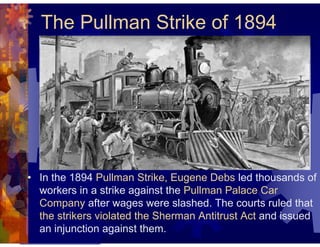
• In the 1894 Pullman Strike, Eugene Debs led thousands of 
workers in a strike against the Pullman Palace Car 
Company after wages were slashed. The courts ruled that 
the strikers violated the Sherman Antitrust Act and issued 
an injunction against them.
Eugene Debs 
• When the strikers 
refused to obey the 
injunction, Debs was 
arrested and federal 
troops marched in to 
crush the strike. In 
the ensuing frenzy, 
thirteen died and 
fifty-three were 
injured.
Organized Labor Lost Strength 
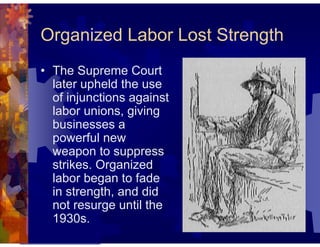
• The Supreme Court 
later upheld the use 
of injunctions against 
labor unions, giving 
businesses a 
powerful new 
weapon to suppress 
strikes. Organized 
labor began to fade 
in strength, and did 
not resurge until the 
1930s.
Workers Benefits Today
The Rise & Decline of 
Organized Labor
Right-to-Work States Today

The organization-of-labor

  • 1.
    The Gilded Age The Organization of Labor
  • 2.
    Labor Unions •Although labor unions began forming in the early 1800s, they did not gain any significant member-ship base or bargaining power until the 1860s and 1870s. The harsh, even hazardous, working conditions arising from industrialization drove laborers to organize into unions.
  • 3.
    Management vs. Labor ““Tools”” of Management ““Tools”” of Labor  ““scabs””  P. R. campaign  Pinkertons  lockout  blacklisting  yellow-dog contracts  court injunctions  open shop  boycotts  sympathy demonstrations  informational picketing  closed shops  organized strikes  ““wildcat”” strikes
  • 4.
    Knights of Labor • One of the first major unions was the Knights of Labor, founded in 1869. • Under the leadership of Terrence G. Powderly, the Knights demanded sweeping reforms: • Equal pay for women • An end to child labor • A progressive income tax • The union claimed a substantial membership, including women, blacks, and immigrants.
  • 5.
    Goals of theKnights of ù Eight-hour workday. Labor ù Workers’’ cooperatives. ù Worker-owned factories. ù Abolition of child and prison labor. ù Increased circulation of greenbacks. ù Equal pay for men and women. ù Safety codes in the workplace. ù Prohibition of contract foreign labor. ù Abolition of the National Bank.
  • 6.
    Railroad Strike •In 1885, the Knights of Labor staged a successful strike against railroad “robber baron” Jay Gould. The strike so severely crippled Gould’s operation that he had no choice but to fold. • On the strength of this victory, the Knights’ membership and political power grew. The Knights successfully supported a number of politicians for election and forced laws favorable to workers through Congress.
  • 7.
    Haymarket Riot •The Knights’ power waned after a series of unauthorized strikes became violent. • The Haymarket Riot in Chicago in 1886 was intended to protest police brutality but it got out of hand. • Someone threw a bomb into the crowd, killing a police officer. In the resulting chaos, nine people were killed and close to sixty injured. • Prominent leaders of the Knights of Labor were convicted of inciting the riot, and public support for the union declined.
  • 8.
    American Federation ofLabor • To salvage the labor movement, craft laborers who had been members of the Knights of Labor broke off and formed the American Federation of Labor (AFL). Whereas the Knights of Labor had an open membership policy and called for sweeping reforms, the AFL, under the leadership of Samuel Gompers, catered exclusively to skilled laborers and focused on smaller, more practical issues: • Increasing wages • Reducing hours • Imposing safety measures.
  • 9.
    How the AFof L Would Help the Workers ù Catered to the skilled worker. ù Represented workers in matters of national legislation. ù Maintained a national strike fund. ù Evangelized the cause of unionism. ù Prevented disputes among the many craft unions. ù Mediated disputes between management and labor. ù Pushed for closed shops.
  • 10.
    Industrial Workers ofthe World • More radical labor organizations also emerged, most notably the Industrial Workers of the World, nicknamed the Wobblies, founded in 1905. More famous for their militant anti-capitalism than for being large or influential, the Wobblies never grew to more than 30,000 members before fading away in about 1920.
  • 11.
    International Workers ofthe World (“Wobblies”)
  • 12.
    “Big Bill” Haywoodof the IWW  Violence was justified to overthrow capitalism.
  • 13.
    The Hand ThatWill Rule the World One Big Union
  • 14.
    Mother Jones: “TheMiner’s Angel”  Mary Harris.  Organizer for the United Mine Workers.  Founded the Social Democratic Party in 1898.  One of the founding members of the I. W. W. in 1905.
  • 15.
    Labor Strikes •Between 1880 and 1905, union activity in the United States led to well over 35,000 strikes. • As evidenced by the Haymarket riot, these demonstrations at times erupted into violence.
  • 16.
    Strike-Related Violence •Major strikes and outbreaks of strike-related violence during the later nineteenth century tended to impair the labor cause instead of advance it. Public sympathy for unions plummeted, companies imposed anti-union hiring policies, and the Supreme Court authorized the use of injunctions against strikers.
  • 17.
    Railroad Strike of1877 • The Railroad Strike followed the onset of a national economic recession in 1877. Railroad workers for nearly every rail line struck, provoking widespread violence and requiring federal troops to subdue the angry mobs. The strike prompted many employers to get tough on labor by imposing an anti-union policy: they required workers to sign contracts barring them from striking or joining a union. Some employers even hired private detectives to root out labor agitators and private armies to suppress strikes.
  • 18.
    Homestead Strike of1892 • Workers staged the 1892 Homestead Strike against Carnegie Steel Company to protest a pay cut and seventy-hour workweek. Ten workers were killed in the riot. Federal troops were called in to suppress the violence, and non-union workers were hired to break the strike.
  • 19.
    The Pullman Strikeof 1894 • In the 1894 Pullman Strike, Eugene Debs led thousands of workers in a strike against the Pullman Palace Car Company after wages were slashed. The courts ruled that the strikers violated the Sherman Antitrust Act and issued an injunction against them.
  • 20.
    Eugene Debs •When the strikers refused to obey the injunction, Debs was arrested and federal troops marched in to crush the strike. In the ensuing frenzy, thirteen died and fifty-three were injured.
  • 21.
    Organized Labor LostStrength • The Supreme Court later upheld the use of injunctions against labor unions, giving businesses a powerful new weapon to suppress strikes. Organized labor began to fade in strength, and did not resurge until the 1930s.
  • 22.
  • 23.
    The Rise &Decline of Organized Labor
  • 24.