A SURVEY OF
AMERICAN HISTORY
Unit 2: Westward Expansion and Civil War

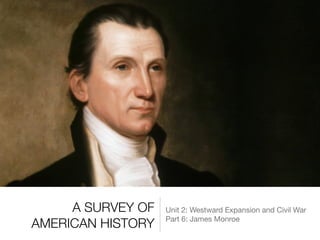
Part 6: James Monroe
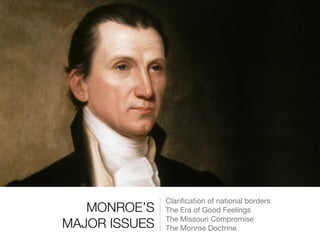
MONROE’S

MAJOR ISSUES
Clarification of national borders

The Era of Good Feelings

The Missouri Compromise

The Monroe Doctrine
THE FIRST PARTY
SYSTEM (1789-1824)
In American politics, the First Party
System was characterized by the
dominance of the Federalists and
the Democratic-Republicans, and
by the disputes between them.
BEFORE THE FOUNDING
OF THE REPUBLIC

- Federalists

- Anti-Federalists

NO PARTY

- George Washington

FEDERALIST PARTY

- John Adams

THE DEMOCRATIC-
REPUBLICAN PARTY

- Thomas Jefferson

- James Madison

- James Monroe
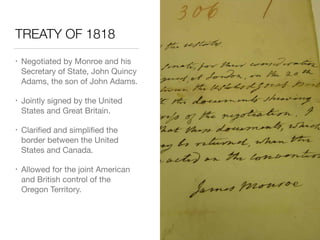
TREATY OF 1818
• Negotiated by Monroe and his
Secretary of State, John Quincy
Adams, the son of John Adams.

• Jointly signed by the United
States and Great Britain.

• Clarified and simplified the
border between the United
States and Canada.

• Allowed for the joint American
and British control of the
Oregon Territory.
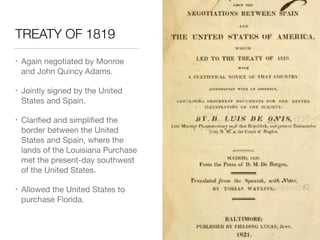
TREATY OF 1819
• Again negotiated by Monroe
and John Quincy Adams.

• Jointly signed by the United
States and Spain.

• Clarified and simplified the
border between the United
States and Spain, where the
lands of the Louisiana Purchase
met the present-day southwest
of the United States.

• Allowed the United States to
purchase Florida.
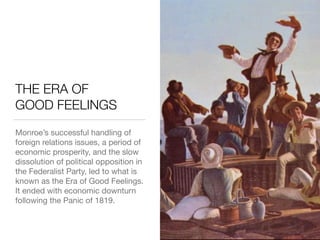
THE ERA OF

GOOD FEELINGS
Monroe’s successful handling of
foreign relations issues, a period of
economic prosperity, and the slow
dissolution of political opposition in
the Federalist Party, led to what is
known as the Era of Good Feelings.
It ended with economic downturn
following the Panic of 1819.
THE MISSOURI
COMPROMISE (1820)
• As settlement increased in the
western territories, these territories
petitioned Congress to be
transformed into states.

• By 1820, nine states that did not
exist at the time of the creation of
the United States had entered the
Union: Vermont, Kentucky,
Tennessee, Ohio, Louisiana,
Indiana, Mississippi, Illinois, and
Alabama. They were created from
pieces of the various territories
annexed by the United States.

• Each time a territory became a
state, it raised the question of
whether the new state should
permit or prohibit slavery.
THE MISSOURI
COMPROMISE (1820)
• The Northern states had mostly
abolished slavery. They worried
that too many slaveholding states
in Congress would make slavery a
permanent feature of the nation.
The Southern states had not
abolished slavery. They worried
that too many free states would
abolish slavery nationwide.

• In 1820, Missouri petitioned to
become a new state. Because
slavery was legal in Missouri, its
admission into the union would
have given the slaveholding states
more power than the free states.
THE MISSOURI
COMPROMISE (1820)
• As a compromise, it was agreed
that slavery would be prohibited
everywhere north of latitude 36o
30’
except for Missouri.

• It was also agreed that a new
northern state would be created in
order to keep a balance of power
in Congress. The result of this
agreement was the state of Maine.
AMERICAN COLONIES IN AFRICA AND THE FOUNDING OF LIBERIA (1821)
In the early 1800s,

a popular movement
arose in America
which proposed to
send free slaves
back to their African
‘homelands,’ even if
they had been born
in the United States.
The eventual result
was the creation of
the country now
known as Liberia.
James Monroe’s
support for the idea
led to the capital city
of Monrovia being
named after him.
THE MONROE
DOCTRINE (1823)
• Many South American countries
won independence from
various European imperial
powers in the early 1800s.

• As more and more nations
became independent, James
Monroe declared that the
United States military would
move against any European
powers who interfered in the
affairs of any nation in North or
South America.

• Under Monroe, the United
States became the ‘policeman’
of the Western Hemisphere.
A SURVEY OF
AMERICAN HISTORY
Unit 2: Westward Expansion and Civil War

Part 6: James Monroe

26 James Monroe

  • 1.
    A SURVEY OF AMERICANHISTORY Unit 2: Westward Expansion and Civil War Part 6: James Monroe
  • 2.
    MONROE’S
 MAJOR ISSUES Clarification ofnational borders The Era of Good Feelings The Missouri Compromise The Monroe Doctrine
  • 3.
    THE FIRST PARTY SYSTEM(1789-1824) In American politics, the First Party System was characterized by the dominance of the Federalists and the Democratic-Republicans, and by the disputes between them. BEFORE THE FOUNDING OF THE REPUBLIC
 - Federalists
 - Anti-Federalists NO PARTY
 - George Washington FEDERALIST PARTY
 - John Adams THE DEMOCRATIC- REPUBLICAN PARTY
 - Thomas Jefferson
 - James Madison
 - James Monroe
  • 4.
    TREATY OF 1818 •Negotiated by Monroe and his Secretary of State, John Quincy Adams, the son of John Adams. • Jointly signed by the United States and Great Britain. • Clarified and simplified the border between the United States and Canada. • Allowed for the joint American and British control of the Oregon Territory.
  • 5.
    TREATY OF 1819 •Again negotiated by Monroe and John Quincy Adams. • Jointly signed by the United States and Spain. • Clarified and simplified the border between the United States and Spain, where the lands of the Louisiana Purchase met the present-day southwest of the United States. • Allowed the United States to purchase Florida.
  • 7.
    THE ERA OF
 GOODFEELINGS Monroe’s successful handling of foreign relations issues, a period of economic prosperity, and the slow dissolution of political opposition in the Federalist Party, led to what is known as the Era of Good Feelings. It ended with economic downturn following the Panic of 1819.
  • 8.
    THE MISSOURI COMPROMISE (1820) •As settlement increased in the western territories, these territories petitioned Congress to be transformed into states. • By 1820, nine states that did not exist at the time of the creation of the United States had entered the Union: Vermont, Kentucky, Tennessee, Ohio, Louisiana, Indiana, Mississippi, Illinois, and Alabama. They were created from pieces of the various territories annexed by the United States. • Each time a territory became a state, it raised the question of whether the new state should permit or prohibit slavery.
  • 9.
    THE MISSOURI COMPROMISE (1820) •The Northern states had mostly abolished slavery. They worried that too many slaveholding states in Congress would make slavery a permanent feature of the nation. The Southern states had not abolished slavery. They worried that too many free states would abolish slavery nationwide. • In 1820, Missouri petitioned to become a new state. Because slavery was legal in Missouri, its admission into the union would have given the slaveholding states more power than the free states.
  • 10.
    THE MISSOURI COMPROMISE (1820) •As a compromise, it was agreed that slavery would be prohibited everywhere north of latitude 36o 30’ except for Missouri. • It was also agreed that a new northern state would be created in order to keep a balance of power in Congress. The result of this agreement was the state of Maine.
  • 12.
    AMERICAN COLONIES INAFRICA AND THE FOUNDING OF LIBERIA (1821) In the early 1800s,
 a popular movement arose in America which proposed to send free slaves back to their African ‘homelands,’ even if they had been born in the United States. The eventual result was the creation of the country now known as Liberia. James Monroe’s support for the idea led to the capital city of Monrovia being named after him.
  • 13.
    THE MONROE DOCTRINE (1823) •Many South American countries won independence from various European imperial powers in the early 1800s. • As more and more nations became independent, James Monroe declared that the United States military would move against any European powers who interfered in the affairs of any nation in North or South America. • Under Monroe, the United States became the ‘policeman’ of the Western Hemisphere.
  • 14.
    A SURVEY OF AMERICANHISTORY Unit 2: Westward Expansion and Civil War Part 6: James Monroe