To Mr. Haskvitz’s
E Period Class..
A Special Production Brought To You
By Charlene Nguyen & Mayant Lan
In partial fulfillment of grade 8 Social Studies on May 20, 2005 by Charlene
Nguyen and Mayant Lan to Mr. Haskvitz.
THE TRAIL OF
TEARS
HOW IT STARTED…
After being introduced to the concept
of expanding westward, many settlers
demanded the relocation of Native
Americans who had situated in the
Southeast. They urged President Andrew
Jackson to transfer the Natives to another
area, which in return had influenced the
Congress to pass the Indian Removal Act.
 
CAUSES AND MOTIVES
 Indian Removal Act
- To please the people, Congress passed the
Indian Removal Act, which allowed the
federal government to pay the Native
Americans to travel west. Congress created
the Indian Territory, presently Oklahoma,
where the Native Americans would settle.
 Manifest Destiny
- Many believed that the United States
should expand its borders to the Pacific.
WORCESTER VS. GEORGIA
 Specifically, the Cherokee Nation refused to leave
their land in the state of Georgia.
 Georgia denied the presence of the Cherokee
people, so as a result, the Cherokee sued the state
government and took their case to the Supreme
Court.
 In the 1832 Worcester v. Georgia, Chief Justice John
Marshall ruled that Georgia had no right to remove
the Cherokee. He said that they were protected by
the federal government and Constitution.
 Andrew Jackson, a supporter of Georgia’s actions,
ignored the Supreme Court ruling and continued
with the Cherokee’s removal.
HOW IT ENDED…
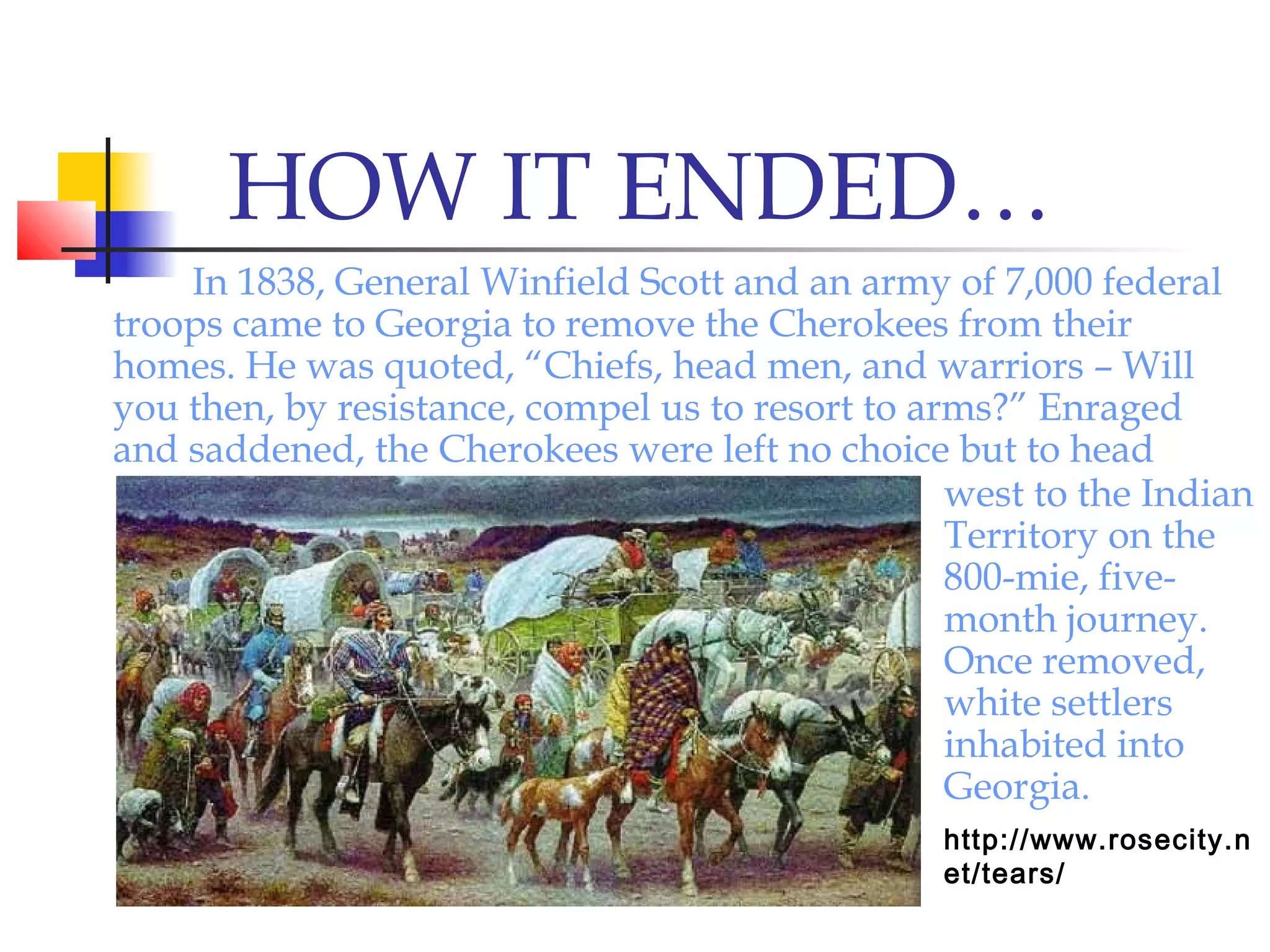
In 1838, General Winfield Scott and an army of 7,000 federal
troops came to Georgia to remove the Cherokees from their
homes. He was quoted, “Chiefs, head men, and warriors – Will
you then, by resistance, compel us to resort to arms?” Enraged
and saddened, the Cherokees were left no choice but to head
west to the Indian
Territory on the
800-mie, five-
month journey.
Once removed,
white settlers
inhabited into
Georgia.
http://www.rosecity.n
et/tears/
“TRAIL WHERE THEY CRIED”
 After being forced out of their land,
the Cherokee Indians began the long
trail to Oklahoma, the Indian
Territory.
 Along the way, they encountered
vicious weather conditions which
killed many Cherokee lives.
 Every few miles, the Cherokees
would stop to bury the people who
had died.
 One man who had witnessed the
move stated, “Even [the] aged…
nearly ready to drop in the grave,
were traveling with heavy burdens
attached to their backs, sometimes on
frozen ground and sometimes on
muddy streets, with no covering for
their feet.” www.cherokeemountain.com/ images/litcog.jpg
STATISTICS
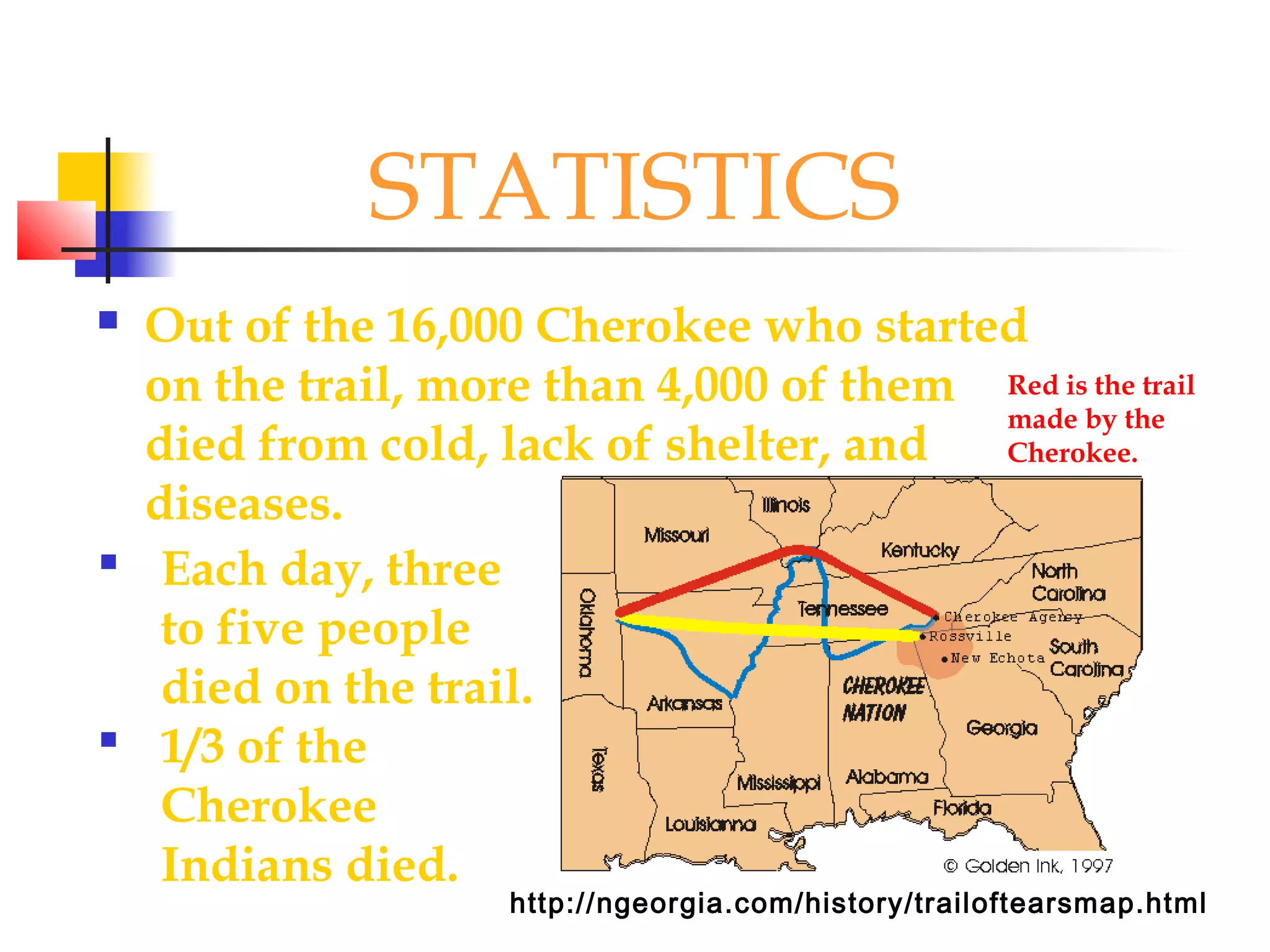
 Out of the 16,000 Cherokee who started
on the trail, more than 4,000 of them
died from cold, lack of shelter, and
diseases.
 Each day, three
to five people
died on the trail.
 1/3 of the
Cherokee
Indians died.
Red is the trail
made by the
Cherokee.
http://ngeorgia.com/history/trailoftearsmap.html
EFFECTS AND RESULTS
 In 1946, the government set up the Indian
Claims Commission, which heard and
decided over 500 Indian claims against the
United States for fraud and unfair treatment
that had occurred within the Trail of Tears.
 There was little hope for the survival of the
Indian culture since the Trail of Tears
destroyed the invigoration of the Native
American culture.
 Soon, white settlers flooded the West.
BIBLIOGRAPHY
 Appleby, Joyce , James M. McPherson, and Alan
Brinkley. The American Journey: Building A
Nation. Student ed. Columbus: Glencoe/McGraw-
Hill, 2000.
 Trail of Tears. 18 May. 2005
<http://www.crystalinks.com/trailoftears.html>.
 "Trail of Tears." Trail of Tears National Historic
Trail. National Park Service. 18 May. 2005
<http://www.nps.gov/trte/>.
 Trail of Tears Map. 18 May. 2005
<http://ngeorgia.com/history/trailoftearsmap.ht
ml>.

Presentation on the Trail of Tears

  • 1.
    To Mr. Haskvitz’s EPeriod Class.. A Special Production Brought To You By Charlene Nguyen & Mayant Lan In partial fulfillment of grade 8 Social Studies on May 20, 2005 by Charlene Nguyen and Mayant Lan to Mr. Haskvitz.
  • 2.
  • 3.
    HOW IT STARTED… Afterbeing introduced to the concept of expanding westward, many settlers demanded the relocation of Native Americans who had situated in the Southeast. They urged President Andrew Jackson to transfer the Natives to another area, which in return had influenced the Congress to pass the Indian Removal Act.  
  • 4.
    CAUSES AND MOTIVES Indian Removal Act - To please the people, Congress passed the Indian Removal Act, which allowed the federal government to pay the Native Americans to travel west. Congress created the Indian Territory, presently Oklahoma, where the Native Americans would settle.  Manifest Destiny - Many believed that the United States should expand its borders to the Pacific.
  • 5.
    WORCESTER VS. GEORGIA Specifically, the Cherokee Nation refused to leave their land in the state of Georgia.  Georgia denied the presence of the Cherokee people, so as a result, the Cherokee sued the state government and took their case to the Supreme Court.  In the 1832 Worcester v. Georgia, Chief Justice John Marshall ruled that Georgia had no right to remove the Cherokee. He said that they were protected by the federal government and Constitution.  Andrew Jackson, a supporter of Georgia’s actions, ignored the Supreme Court ruling and continued with the Cherokee’s removal.
  • 6.
    HOW IT ENDED… In1838, General Winfield Scott and an army of 7,000 federal troops came to Georgia to remove the Cherokees from their homes. He was quoted, “Chiefs, head men, and warriors – Will you then, by resistance, compel us to resort to arms?” Enraged and saddened, the Cherokees were left no choice but to head west to the Indian Territory on the 800-mie, five- month journey. Once removed, white settlers inhabited into Georgia. http://www.rosecity.n et/tears/
  • 7.
    “TRAIL WHERE THEYCRIED”  After being forced out of their land, the Cherokee Indians began the long trail to Oklahoma, the Indian Territory.  Along the way, they encountered vicious weather conditions which killed many Cherokee lives.  Every few miles, the Cherokees would stop to bury the people who had died.  One man who had witnessed the move stated, “Even [the] aged… nearly ready to drop in the grave, were traveling with heavy burdens attached to their backs, sometimes on frozen ground and sometimes on muddy streets, with no covering for their feet.” www.cherokeemountain.com/ images/litcog.jpg
  • 8.
    STATISTICS  Out ofthe 16,000 Cherokee who started on the trail, more than 4,000 of them died from cold, lack of shelter, and diseases.  Each day, three to five people died on the trail.  1/3 of the Cherokee Indians died. Red is the trail made by the Cherokee. http://ngeorgia.com/history/trailoftearsmap.html
  • 9.
    EFFECTS AND RESULTS In 1946, the government set up the Indian Claims Commission, which heard and decided over 500 Indian claims against the United States for fraud and unfair treatment that had occurred within the Trail of Tears.  There was little hope for the survival of the Indian culture since the Trail of Tears destroyed the invigoration of the Native American culture.  Soon, white settlers flooded the West.
  • 10.
    BIBLIOGRAPHY  Appleby, Joyce, James M. McPherson, and Alan Brinkley. The American Journey: Building A Nation. Student ed. Columbus: Glencoe/McGraw- Hill, 2000.  Trail of Tears. 18 May. 2005 <http://www.crystalinks.com/trailoftears.html>.  "Trail of Tears." Trail of Tears National Historic Trail. National Park Service. 18 May. 2005 <http://www.nps.gov/trte/>.  Trail of Tears Map. 18 May. 2005 <http://ngeorgia.com/history/trailoftearsmap.ht ml>.