SKIN BANKING
DR SAMIK SHARMA
 Skin banking is a facility where the skin is
collected from eligible donor,processed as
per international protocols and stored in the
skin bank at 4-80 Celsius up to 3years.



In case of extensive burns, the protective
barrier- skin is burnt.
Leading to infection, in most cases it
becomes fatal.
Patients can be saved if we have enough
skin in Skin bank.
 The estimated annual burn incidence in India is
approximately 6-7 million per
year.
 Nearly 1 to 1.5 lac people get crippled and
require multiple surgeries and prolonged
rehabilitation
 Seventy percent of the burn victims are in
most
productive age group of 15 to 40
years .
 most of the patients belong to poor
socioeconomic
strata
.






Acts as the most effective dressing.
Acts as a barrier to infection & the rate of
infection is reduced significantly.
Lesser hospital stay.
Cost of treatment goes
down. Reduced pain.
Increased survival rate.






Burns >30% BSA Adult
Burns >10% BSA
Children Deep Burns
Chemical
Burns
Electrical
Burns
Radiation
Burns
1. SETTING UP THE NECESSARY
INFRASTRUCTURES AND EQUIPMENTS.
2. RECRUITING MANPOWER.
3. CREATING AWARENESS ABOUT SKIN
DONATION.
4. RETRIEVAL.
5. PROCESSING.
6. STORAGE.
7. QUALITY MANAGEMENT
SYSTEM FOR CONSISTENT
QUALITY.
8. MEDICAL DOCUMENTATION.
ORIGIN OF SKIN BANK CONCEPT
• Skin autografting was first described by Reverdin in 1871
• Girdner was the first to report the use of allogeneic skin to cover a
burn wound; however, it wasn’t until 5 years later that Thiersch
described the histologic anatomy of skin engraftment and later
popularized the clinical use of split-thickness skin grafts.
• Banking of human skin did not begin until the early 1900s. Wentscher
reported the transplantation of human skin that had been
refrigerated for 3 to 14 days.
• Bettman reported its success in the treatment of children with
extensive full-thickness injuries.
• Webster (1944) [8] and Matthews (1945) described the successful
take of skin autografts stored for 3 weeks at 4·C to 7·C
• 1949 that the United States Navy Tissue Bank was established,
signaling the beginning of modern day skin banking.
• Bondoc and Burke are credited with establishing the first functional
skin bank in 1971.



The concept of Skin Bank was originated in
India by Late Dr.Manohar
H. Keswani out of dire need to save patients
with critical burns who were dying because of
lack of HOMOGRAFT .
In 1972, first skin bank was established at Wadia children's
hospital in Mumbai by Dr. Manohar H Keswani,which was
1stof its kind in India.
Exactly 35 yrs later in 2007, second skin bank in Mumbai
was established at National Burn Centre.
ORIGIN OF SKIN BANK CONCEPT IN INDIA
Changing Room Skin Processing Room
Cold Room (Outer View)
Cold Room (Inner View)
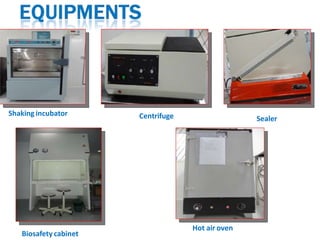
Shaking incubator
Biosafety cabinet
Hot air oven
Sealer
Centrifuge
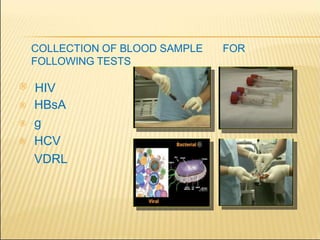
COLLECTION OF BLOOD SAMPLE FOR
FOLLOWING TESTS




HIV
HBsA
g
HCV
VDRL
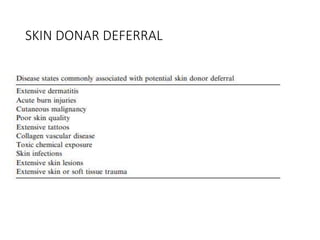
SKIN DONAR DEFERRAL

Body is cleaned with Betadine scrub
Skin Harvesting with the
help of Dermatome
Body is dressed after harvesting
Liquid paraffin is applied
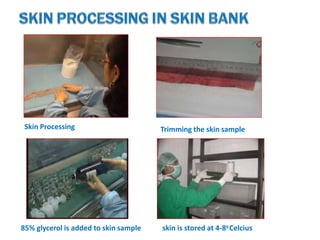
Skin Processing
85% glycerol is added to skin sample skin is stored at 4-80 Celcius
Trimming the skin sample
tion
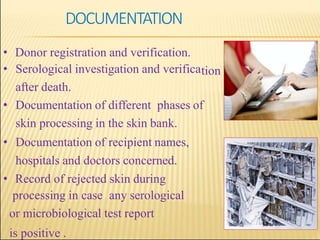
• Donor registration and verification.
• Serological investigation and verifica
after death.
• Documentation of different phases of
skin processing in the skin bank.
• Documentation of recipient names,
hospitals and doctors concerned.
• Record of rejected skin during
processing in case any serological
or microbiological test report
is positive .
DOCUMENTATION
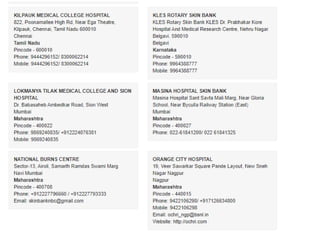
SKIN BANKS AND COLLECTION CENTRES IN
INDIA (16)
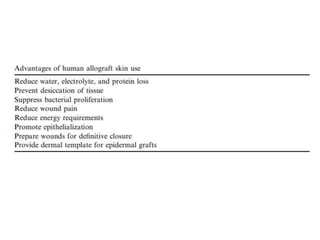
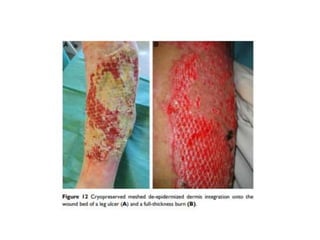
Clinical uses of allograft skin
Potential disadvantages of allograft use
SKIN DONAR DEFERRAL
SKIN PROCESSING
• Processing environment
• Skin is processed under aseptic conditions.
• Current AATB Standards indicate the need for processing in a class
10,000 laminar flow environment
• Microbiologic testing
• recommended is 1 cm2 biopsy sample be taken for each 10% of the
body surface area from which the skin has been removed.
• Allograft skin should not be used for transplantation if it contains any
of the following:
• (1) Coagulase-positive Staphylococci,
• (2) Group A, beta-hemolytic Streptococci,
• (3) Enterococci,
• (4) Gram-negative organisms,
• (5) Clostridia sp.,
• (6) yeast or fungi.
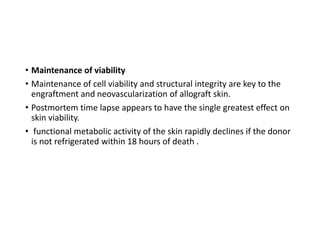
• Maintenance of viability
• Maintenance of cell viability and structural integrity are key to the
engraftment and neovascularization of allograft skin.
• Postmortem time lapse appears to have the single greatest effect on
skin viability.
• functional metabolic activity of the skin rapidly declines if the donor
is not refrigerated within 18 hours of death .
• Ideal nutrient tissue culture medium has not yet been identified
• Minimal Essential Medium (MEM)
• RPMI-1640
• University of Wisconsin solution
• Glycerol (10–20%) and dimethylsulfoxide (10–15%) widely used in
skin preservation.
• For heart-beating multiorgan donors, skin is procured after
circulation has ceased.
• Non-heart-beating donor skin can be harvested until 24 h after death
if the body is refrigerated or cooled within 12 h of death
• If the body is not cooled nor refrigerated, skin procurement must be
carried out within 15 h of death.
• Skin layers that are 400–800 µm thick are cut from the posterior
trunk and the lower limbs by battery-operated dermatome
• Skin allografts are placed in sealed sterile containers filled with a
specific transport medium supplemented with a combination of
antibiotics, according to validated skin bank protocols.
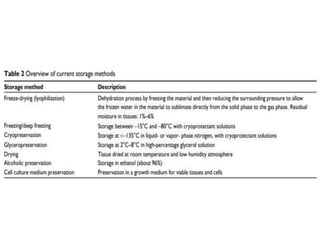
Storage methods
• Two common methods of skin allograft preservation are
• glycero-preservation
• cryopreservation.
• The main difference between the two techniques lies in tissue
viability:
• glycerolized and lyophilized skin grafts are not viable but retain structural and
mechanical properties
• whereas cell viability is maintained by cryopreserved, and to a lesser degree
deep frozen, skin grafts, so the tissue can be grafted onto a wound bed after
a certain period of time
•THANK YOU

Skin banking

  • 1.
  • 2.
     Skin bankingis a facility where the skin is collected from eligible donor,processed as per international protocols and stored in the skin bank at 4-80 Celsius up to 3years.
  • 3.
       In case ofextensive burns, the protective barrier- skin is burnt. Leading to infection, in most cases it becomes fatal. Patients can be saved if we have enough skin in Skin bank.
  • 4.
     The estimatedannual burn incidence in India is approximately 6-7 million per year.  Nearly 1 to 1.5 lac people get crippled and require multiple surgeries and prolonged rehabilitation  Seventy percent of the burn victims are in most productive age group of 15 to 40 years .  most of the patients belong to poor socioeconomic strata .
  • 5.
          Acts as themost effective dressing. Acts as a barrier to infection & the rate of infection is reduced significantly. Lesser hospital stay. Cost of treatment goes down. Reduced pain. Increased survival rate.
  • 6.
          Burns >30% BSAAdult Burns >10% BSA Children Deep Burns Chemical Burns Electrical Burns Radiation Burns
  • 7.
    1. SETTING UPTHE NECESSARY INFRASTRUCTURES AND EQUIPMENTS. 2. RECRUITING MANPOWER. 3. CREATING AWARENESS ABOUT SKIN DONATION. 4. RETRIEVAL. 5. PROCESSING. 6. STORAGE. 7. QUALITY MANAGEMENT SYSTEM FOR CONSISTENT QUALITY. 8. MEDICAL DOCUMENTATION.
  • 8.
    ORIGIN OF SKINBANK CONCEPT • Skin autografting was first described by Reverdin in 1871 • Girdner was the first to report the use of allogeneic skin to cover a burn wound; however, it wasn’t until 5 years later that Thiersch described the histologic anatomy of skin engraftment and later popularized the clinical use of split-thickness skin grafts. • Banking of human skin did not begin until the early 1900s. Wentscher reported the transplantation of human skin that had been refrigerated for 3 to 14 days.
  • 9.
    • Bettman reportedits success in the treatment of children with extensive full-thickness injuries. • Webster (1944) [8] and Matthews (1945) described the successful take of skin autografts stored for 3 weeks at 4·C to 7·C • 1949 that the United States Navy Tissue Bank was established, signaling the beginning of modern day skin banking. • Bondoc and Burke are credited with establishing the first functional skin bank in 1971.
  • 10.
       The concept ofSkin Bank was originated in India by Late Dr.Manohar H. Keswani out of dire need to save patients with critical burns who were dying because of lack of HOMOGRAFT . In 1972, first skin bank was established at Wadia children's hospital in Mumbai by Dr. Manohar H Keswani,which was 1stof its kind in India. Exactly 35 yrs later in 2007, second skin bank in Mumbai was established at National Burn Centre. ORIGIN OF SKIN BANK CONCEPT IN INDIA
  • 11.
    Changing Room SkinProcessing Room Cold Room (Outer View) Cold Room (Inner View)
  • 12.
    Shaking incubator Biosafety cabinet Hotair oven Sealer Centrifuge
  • 13.
    COLLECTION OF BLOODSAMPLE FOR FOLLOWING TESTS     HIV HBsA g HCV VDRL
  • 14.
  • 15.
     Body is cleanedwith Betadine scrub Skin Harvesting with the help of Dermatome Body is dressed after harvesting Liquid paraffin is applied
  • 16.
    Skin Processing 85% glycerolis added to skin sample skin is stored at 4-80 Celcius Trimming the skin sample
  • 17.
    tion • Donor registrationand verification. • Serological investigation and verifica after death. • Documentation of different phases of skin processing in the skin bank. • Documentation of recipient names, hospitals and doctors concerned. • Record of rejected skin during processing in case any serological or microbiological test report is positive . DOCUMENTATION
  • 18.
    SKIN BANKS ANDCOLLECTION CENTRES IN INDIA (16)
  • 21.
    Clinical uses ofallograft skin
  • 23.
  • 24.
  • 25.
    SKIN PROCESSING • Processingenvironment • Skin is processed under aseptic conditions. • Current AATB Standards indicate the need for processing in a class 10,000 laminar flow environment • Microbiologic testing • recommended is 1 cm2 biopsy sample be taken for each 10% of the body surface area from which the skin has been removed.
  • 26.
    • Allograft skinshould not be used for transplantation if it contains any of the following: • (1) Coagulase-positive Staphylococci, • (2) Group A, beta-hemolytic Streptococci, • (3) Enterococci, • (4) Gram-negative organisms, • (5) Clostridia sp., • (6) yeast or fungi.
  • 27.
    • Maintenance ofviability • Maintenance of cell viability and structural integrity are key to the engraftment and neovascularization of allograft skin. • Postmortem time lapse appears to have the single greatest effect on skin viability. • functional metabolic activity of the skin rapidly declines if the donor is not refrigerated within 18 hours of death .
  • 28.
    • Ideal nutrienttissue culture medium has not yet been identified • Minimal Essential Medium (MEM) • RPMI-1640 • University of Wisconsin solution • Glycerol (10–20%) and dimethylsulfoxide (10–15%) widely used in skin preservation.
  • 29.
    • For heart-beatingmultiorgan donors, skin is procured after circulation has ceased. • Non-heart-beating donor skin can be harvested until 24 h after death if the body is refrigerated or cooled within 12 h of death • If the body is not cooled nor refrigerated, skin procurement must be carried out within 15 h of death. • Skin layers that are 400–800 µm thick are cut from the posterior trunk and the lower limbs by battery-operated dermatome
  • 30.
    • Skin allograftsare placed in sealed sterile containers filled with a specific transport medium supplemented with a combination of antibiotics, according to validated skin bank protocols.
  • 31.
    Storage methods • Twocommon methods of skin allograft preservation are • glycero-preservation • cryopreservation. • The main difference between the two techniques lies in tissue viability: • glycerolized and lyophilized skin grafts are not viable but retain structural and mechanical properties • whereas cell viability is maintained by cryopreserved, and to a lesser degree deep frozen, skin grafts, so the tissue can be grafted onto a wound bed after a certain period of time
  • 40.