Skin Substitutes
By-Dr Raghav Shrotriya
Department of Plastic Surgery
KEM Hospital, Mumbai
Definition
 Skin substitutes are heterogeneous group of wound
coverage materials that aid in wound closure and replace
the functions of the skin, either temporarily or
permanently, depending on the product characteristics.
 These substances are alternatives to the standard wound
coverage in circumstances when standard therapies are
not desirable
Introduction
 The need for supplements to autologous skin grafts has
prompted development and use of wide variety of skin
substitutes as biologic and synthetic wound dressings
 Functions:
 Permanent wound coverage
 Temporary coverage to promote healthy wound bed
Ideal Skin Substitutes
 little or no antigenicity
 tissue compatibility
 lack of toxicity, either local or systemic
 permeability to water vapor just like normal skin
 impenetrability to microorganisms
 rapid and persistent adherence to a wound surface
 porosity for ingrowth of fibrovascular tissue from the
wound bed
 Able to resist infection
 Able to prevent water loss
 Able to withstand the shear forces
 Cost effective
 Widely available
 Long shelf life and easy to store
 Flexible in thickness
 Durable with long-term wound stability
 Can be conformed to irregular wound surfaces and
 Easy to be secured and applied
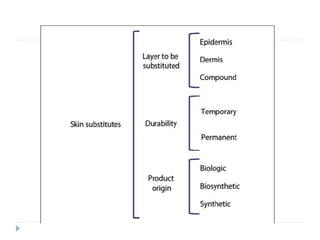
Classification (Kumar P, 2008)
 Class I: Temporary impervious dressing materials
a) single layer materials
 naturally occurring or biological dressing substitute, e.g. amniotic
membrane, potato peel
 synthetic dressing substitute, e.g. synthetic polymer sheet
(Tegaderm®, Opsite®), polymer foam or spray
b) bi-layered tissue engineered materials, e.g. TransCyte®
 Class II: Single layer durable skin substitutes
 Epidermal substitutes, e.g. cultured epithelial autograft (CEA),
Apligraf®
 Dermal substuitutes
 bovine collagen sheet, e.g. Kollagen®
 porcine collagen sheet
 bovine dermal matrix, e.g. Matriderm®
 human dermal matrix, e.g. Alloderm®
 Class III: Composite skin substitutes (containing both
dermal and epidermal component)

a) Skin graft
 Allograft
 Xenograft
b) Tissue engineered skin
 Dermal regeneration template, e.g. Integra®
 Biobrane®
Use of Bioactive Skin Substitutes
 Wound cover
 Improve wound healing
 Control pain
 Improve functional and cosmetic outcome
 Increase survival
Temporary
1. Porcine xenograft
2. Human Allograft
3. Human amnion
4. Biobrane
5. Transcyte
Xenografts
 Earliest In 1500 BC
 Homogenised cryopreserved porcine xenograft
 recent modifications to the porcine skin include aldehyde
cross-linking and silver ion impregnation to increase the
antimicrobial properties
 Advantages:
 Low cost
 Reduces pain
 Decreased fluid loss
 Good wound adherence
 Disadvantages:
 Lack of revascularisation
 Lack of transparency
Cadaver Allograft
 Most common
 2 types:
 Cryopreserved
 Glycerol preserved
 Uses:
 Wound bed preparation
 provide growth factors and essential cytokines
 creating chemotaxis and proliferation at wound beds.
 increase vascularity in the wound bed
 promoting angiogenesis with enhanced capillary ingrowth on the wound bed 
 Pain free dressings
 Sandwich grafting technique
 prevents desiccation of the wound bed in the interstices of widely expanded
autografts
 reduces bacterial colonisation
 autograft is protected from shear
 Advantages :
 Provide biologically active temporary wound cover
 Decrease metabolic demands
 Provide a ‘test’ to assess whether wound is ready for
autograft
 Disadvantages:
 Expensive
 Risk of disease transmission
 Need for further procedure for wound closure
Amnion
  thin semi-transparent tissue forming the innermost layer
of the foetal membrane
 Advantages:
  maintains low bacteria count
 reduces loss of protein, electrolytes and fluids, decreasing the
risk infection
 minimises pain
 acceleration of wound healing
 good handling properties.
Synthetic Skin substitutes
 Advantages:
 composition and properties of the product can be much more
precisely controlled
 avoid complications due to potential disease transmission
 Disadvantages:
 lack basement membrane
 their architecture do not resemble native skin
Biobrane®
 Composed of bilaminated membrane formed by nylon
mesh filled with Type I porcine collagen (dermal analogue)
and covered by a thin membrane of silicon (epidermal
analogue)
 Indications:
 Superficial partial thickness burn wounds
 Donor sites
 TENS patients
 Contraindications:
 Full thickness burns
 Patial thickness burn with eschar
 Chemical or electrical burns
 Advantages:
 Pliability and elasticisity
 Confirms to irregular wounds
 Good pain control
 Less frequent dressing change
 Extended shelf life
 Transparent dressing for wound monitoring
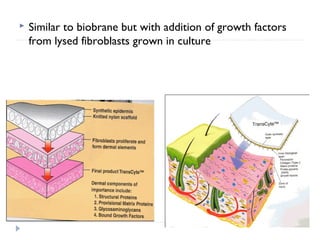
Transcyte®
 Temporary
 Dermal layer of neonatal fibroblasts on a nylon mesh and
outer layer of synthetic epidermis
 Contains :
 Collagen type III, V
 Fibronectin and tenascin
 GAGs
 GF : TGF-B1, VEGF, IGF-1
 Similar to biobrane but with addition of growth factors
from lysed fibroblasts grown in culture
 Semipermeable to allow fluid and gas exchange
 Transparent for monitoring
 Used as substitute for cadaveric allograft in full thickness
burns after excision
 Permanent Skin Substitutes
1. Integra
2. Apligraf
3. Alloderm
4. Dermagraft
5. Orcel
6. Epicel
Integra® (Yannas et al, 1980)
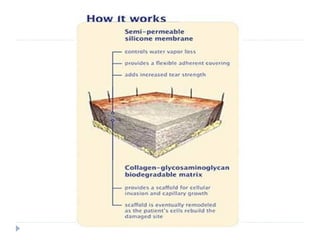
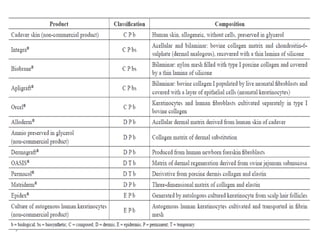
 Dermal analog made of cross linked bovine collagen-
GAG (chondroitin -6- sulphate) copolymer matrix
 Epidermal analog thin silicone elastomer
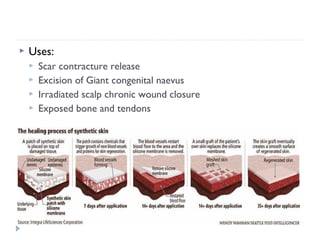
 After dermal analog incorporates (2-3 wks), silicon layer
is removed and replaced by thin SSG or Epicel
 Advantages:
 Regenerated skin is more pliable
 Resembles normal skin
 Favourable scarring
 Provides physiologic wound closure
 Disadvantages:
 Costly
 2 stage procedure with 3-4 week interval
 Uses:
 Scar contracture release
 Excision of Giant congenital naevus
 Irradiated scalp chronic wound closure
 Exposed bone and tendons
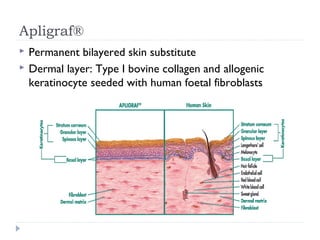
Apligraf®
 Permanent bilayered skin substitute
 Dermal layer: Type I bovine collagen and allogenic
keratinocyte seeded with human foetal fibroblasts
 Advantages:
 Readily available
 Applied in OPD setting
 Disadvantages
 Remote risk of disease transmission
 Multiple applications
 Short shelf life (5 days)
 Expensive
 Uses:
 Diabetic ulcers
 Venous stasis ulcers
 Epidermolysis Bullosa.
Alloderm®
 Scar Contracture is inversely related to the amount of
dermis
 Treated human allograft with epidermis removed
resulting in intact BM and Collagen and removal of
antigenic Langerhans cells, melanocytes and fibroblasts
 Used as dermal implant
 Thin epithelial autograft is required
 Advantages:
 Thick dermis limits recontracture
 Disadvantages:
 Costly
 Disease transmission
Dermagraft®
 A cryopreserved human fibroblast derived dermal
substitute made of bioabsorbable polyglactin mesh
(bioabsorbable scaffold) seeded with allogenic neonatal
fibroblasts
 Dermagraft human fibroblasts which secrete growth
factors, cytokine, ECM proteins and GAGs
 Formation of neodermis through stimulation of
fibrovascular growth from wound bed and not by direct
re epithelialization from wound perimeter
 Indications
 chronic wounds and diabetic foot ulcers
 to support the take of meshed split-thickness skin grafts on
excised burn wounds
OrCel®
 Bilayered cellular matrix in which normal human
allogeneic skin cells (epidermal keratinocytes and dermal
fibroblasts) are cultured in two separate layers into a
type I bovine collagen sponge.
 Indication:
 treatment of chronic wounds
 skin graft donor sites
 as an overlay dressing on split-thickness skin grafts to improve
function and cosmesis
Cultured Epithelial Autografts
Epicel®
 Rhinewald and Green (1975)
 The autologous keratinocytes are isolated, cultured and
expanded into sheets over periods of 3–5 weeks. The
technique of suspension in fibrin glue has reduced the
time for clinical use to 2 weeks.
 Uses:
 Coverage of large TBSA wounds
 Coverage of giant congenital naevus wound
 Pressure ulcers
 Vitiligo
 Advantages:
 avoids the mesh aspect of split skin autografts
 avoids discomfort of donor site after skin harvesting.
 Disadvantages:
 fragility and difficulty of handling
 Shearing and blistering
 unpredictable take rate
 high cost.
Conclusion
 Skin substitutes have a important role to play in plastic
surgery in complex wound management for cutaneous
continuity
 Only a bridge until wound is better suited to accept graft
 Prohibitive costs and availability limit the usage to
research settings
 Future prospects
Thank you

Skin substitutes

  • 1.
    Skin Substitutes By-Dr RaghavShrotriya Department of Plastic Surgery KEM Hospital, Mumbai
  • 2.
    Definition  Skin substitutesare heterogeneous group of wound coverage materials that aid in wound closure and replace the functions of the skin, either temporarily or permanently, depending on the product characteristics.  These substances are alternatives to the standard wound coverage in circumstances when standard therapies are not desirable
  • 3.
    Introduction  The needfor supplements to autologous skin grafts has prompted development and use of wide variety of skin substitutes as biologic and synthetic wound dressings  Functions:  Permanent wound coverage  Temporary coverage to promote healthy wound bed
  • 4.
    Ideal Skin Substitutes little or no antigenicity  tissue compatibility  lack of toxicity, either local or systemic  permeability to water vapor just like normal skin  impenetrability to microorganisms  rapid and persistent adherence to a wound surface  porosity for ingrowth of fibrovascular tissue from the wound bed  Able to resist infection
  • 5.
     Able toprevent water loss  Able to withstand the shear forces  Cost effective  Widely available  Long shelf life and easy to store  Flexible in thickness  Durable with long-term wound stability  Can be conformed to irregular wound surfaces and  Easy to be secured and applied
  • 6.
    Classification (Kumar P,2008)  Class I: Temporary impervious dressing materials a) single layer materials  naturally occurring or biological dressing substitute, e.g. amniotic membrane, potato peel  synthetic dressing substitute, e.g. synthetic polymer sheet (Tegaderm®, Opsite®), polymer foam or spray b) bi-layered tissue engineered materials, e.g. TransCyte®
  • 7.
     Class II:Single layer durable skin substitutes  Epidermal substitutes, e.g. cultured epithelial autograft (CEA), Apligraf®  Dermal substuitutes  bovine collagen sheet, e.g. Kollagen®  porcine collagen sheet  bovine dermal matrix, e.g. Matriderm®  human dermal matrix, e.g. Alloderm®
  • 8.
     Class III:Composite skin substitutes (containing both dermal and epidermal component)  a) Skin graft  Allograft  Xenograft b) Tissue engineered skin  Dermal regeneration template, e.g. Integra®  Biobrane®
  • 10.
    Use of BioactiveSkin Substitutes  Wound cover  Improve wound healing  Control pain  Improve functional and cosmetic outcome  Increase survival
  • 11.
    Temporary 1. Porcine xenograft 2.Human Allograft 3. Human amnion 4. Biobrane 5. Transcyte
  • 12.
    Xenografts  Earliest In 1500BC  Homogenised cryopreserved porcine xenograft  recent modifications to the porcine skin include aldehyde cross-linking and silver ion impregnation to increase the antimicrobial properties
  • 13.
     Advantages:  Lowcost  Reduces pain  Decreased fluid loss  Good wound adherence  Disadvantages:  Lack of revascularisation  Lack of transparency
  • 14.
    Cadaver Allograft  Mostcommon  2 types:  Cryopreserved  Glycerol preserved
  • 15.
     Uses:  Woundbed preparation  provide growth factors and essential cytokines  creating chemotaxis and proliferation at wound beds.  increase vascularity in the wound bed  promoting angiogenesis with enhanced capillary ingrowth on the wound bed   Pain free dressings  Sandwich grafting technique  prevents desiccation of the wound bed in the interstices of widely expanded autografts  reduces bacterial colonisation  autograft is protected from shear
  • 16.
     Advantages : Provide biologically active temporary wound cover  Decrease metabolic demands  Provide a ‘test’ to assess whether wound is ready for autograft  Disadvantages:  Expensive  Risk of disease transmission  Need for further procedure for wound closure
  • 17.
    Amnion   thin semi-transparenttissue forming the innermost layer of the foetal membrane  Advantages:   maintains low bacteria count  reduces loss of protein, electrolytes and fluids, decreasing the risk infection  minimises pain  acceleration of wound healing  good handling properties.
  • 18.
    Synthetic Skin substitutes Advantages:  composition and properties of the product can be much more precisely controlled  avoid complications due to potential disease transmission  Disadvantages:  lack basement membrane  their architecture do not resemble native skin
  • 19.
    Biobrane®  Composed ofbilaminated membrane formed by nylon mesh filled with Type I porcine collagen (dermal analogue) and covered by a thin membrane of silicon (epidermal analogue)
  • 20.
     Indications:  Superficialpartial thickness burn wounds  Donor sites  TENS patients  Contraindications:  Full thickness burns  Patial thickness burn with eschar  Chemical or electrical burns
  • 21.
     Advantages:  Pliabilityand elasticisity  Confirms to irregular wounds  Good pain control  Less frequent dressing change  Extended shelf life  Transparent dressing for wound monitoring
  • 22.
    Transcyte®  Temporary  Dermallayer of neonatal fibroblasts on a nylon mesh and outer layer of synthetic epidermis  Contains :  Collagen type III, V  Fibronectin and tenascin  GAGs  GF : TGF-B1, VEGF, IGF-1
  • 23.
     Similar tobiobrane but with addition of growth factors from lysed fibroblasts grown in culture
  • 24.
     Semipermeable toallow fluid and gas exchange  Transparent for monitoring  Used as substitute for cadaveric allograft in full thickness burns after excision
  • 25.
     Permanent SkinSubstitutes 1. Integra 2. Apligraf 3. Alloderm 4. Dermagraft 5. Orcel 6. Epicel
  • 26.
    Integra® (Yannas etal, 1980)  Dermal analog made of cross linked bovine collagen- GAG (chondroitin -6- sulphate) copolymer matrix  Epidermal analog thin silicone elastomer  After dermal analog incorporates (2-3 wks), silicon layer is removed and replaced by thin SSG or Epicel
  • 28.
     Advantages:  Regeneratedskin is more pliable  Resembles normal skin  Favourable scarring  Provides physiologic wound closure  Disadvantages:  Costly  2 stage procedure with 3-4 week interval
  • 29.
     Uses:  Scarcontracture release  Excision of Giant congenital naevus  Irradiated scalp chronic wound closure  Exposed bone and tendons
  • 30.
    Apligraf®  Permanent bilayeredskin substitute  Dermal layer: Type I bovine collagen and allogenic keratinocyte seeded with human foetal fibroblasts
  • 31.
     Advantages:  Readilyavailable  Applied in OPD setting  Disadvantages  Remote risk of disease transmission  Multiple applications  Short shelf life (5 days)  Expensive  Uses:  Diabetic ulcers  Venous stasis ulcers  Epidermolysis Bullosa.
  • 32.
    Alloderm®  Scar Contractureis inversely related to the amount of dermis  Treated human allograft with epidermis removed resulting in intact BM and Collagen and removal of antigenic Langerhans cells, melanocytes and fibroblasts  Used as dermal implant  Thin epithelial autograft is required
  • 33.
     Advantages:  Thickdermis limits recontracture  Disadvantages:  Costly  Disease transmission
  • 34.
    Dermagraft®  A cryopreservedhuman fibroblast derived dermal substitute made of bioabsorbable polyglactin mesh (bioabsorbable scaffold) seeded with allogenic neonatal fibroblasts  Dermagraft human fibroblasts which secrete growth factors, cytokine, ECM proteins and GAGs  Formation of neodermis through stimulation of fibrovascular growth from wound bed and not by direct re epithelialization from wound perimeter
  • 35.
     Indications  chronicwounds and diabetic foot ulcers  to support the take of meshed split-thickness skin grafts on excised burn wounds
  • 36.
    OrCel®  Bilayered cellularmatrix in which normal human allogeneic skin cells (epidermal keratinocytes and dermal fibroblasts) are cultured in two separate layers into a type I bovine collagen sponge.  Indication:  treatment of chronic wounds  skin graft donor sites  as an overlay dressing on split-thickness skin grafts to improve function and cosmesis
  • 37.
    Cultured Epithelial Autografts Epicel® Rhinewald and Green (1975)  The autologous keratinocytes are isolated, cultured and expanded into sheets over periods of 3–5 weeks. The technique of suspension in fibrin glue has reduced the time for clinical use to 2 weeks.  Uses:  Coverage of large TBSA wounds  Coverage of giant congenital naevus wound  Pressure ulcers  Vitiligo
  • 38.
     Advantages:  avoidsthe mesh aspect of split skin autografts  avoids discomfort of donor site after skin harvesting.  Disadvantages:  fragility and difficulty of handling  Shearing and blistering  unpredictable take rate  high cost.
  • 42.
    Conclusion  Skin substituteshave a important role to play in plastic surgery in complex wound management for cutaneous continuity  Only a bridge until wound is better suited to accept graft  Prohibitive costs and availability limit the usage to research settings  Future prospects
  • 43.

Editor's Notes

  • #5 To date, there is no ideal skin substitute available that fulfills all the above-mentioned features. Currently, tissue engineering and biotechnology are gearing towards the direction of creating an optimal skin substitute.