MICRO TEACHING ORIENTATION
SKILL OF DEMONSTRATION
Demonstration Method
Demonstration method is a method of providing lessons by exhibiting and
demonstrating
• things
• events
• rules
• sequences of activities
either directly or through using instructional media which is relevant to
the subject matter or material .
• Reading map
• Testing starch in food.
• role play
• Reciting a poem
• map projection
• puppetry
• Drawing a diagram
• PH Testing
• Using globe
Effectiveness of Demonstration
• Helps in connecting theories to actual practice.
• Helps in understanding applications of theories.
• To stimulate the senses through multisensory Approach.
• Clarifies Material presented by Verbal methods .
• Supplements other methods.
• In securing the acceptance of new and improved ways of doing things.
• Enhancing skill of observation
• Create enthusiasm.
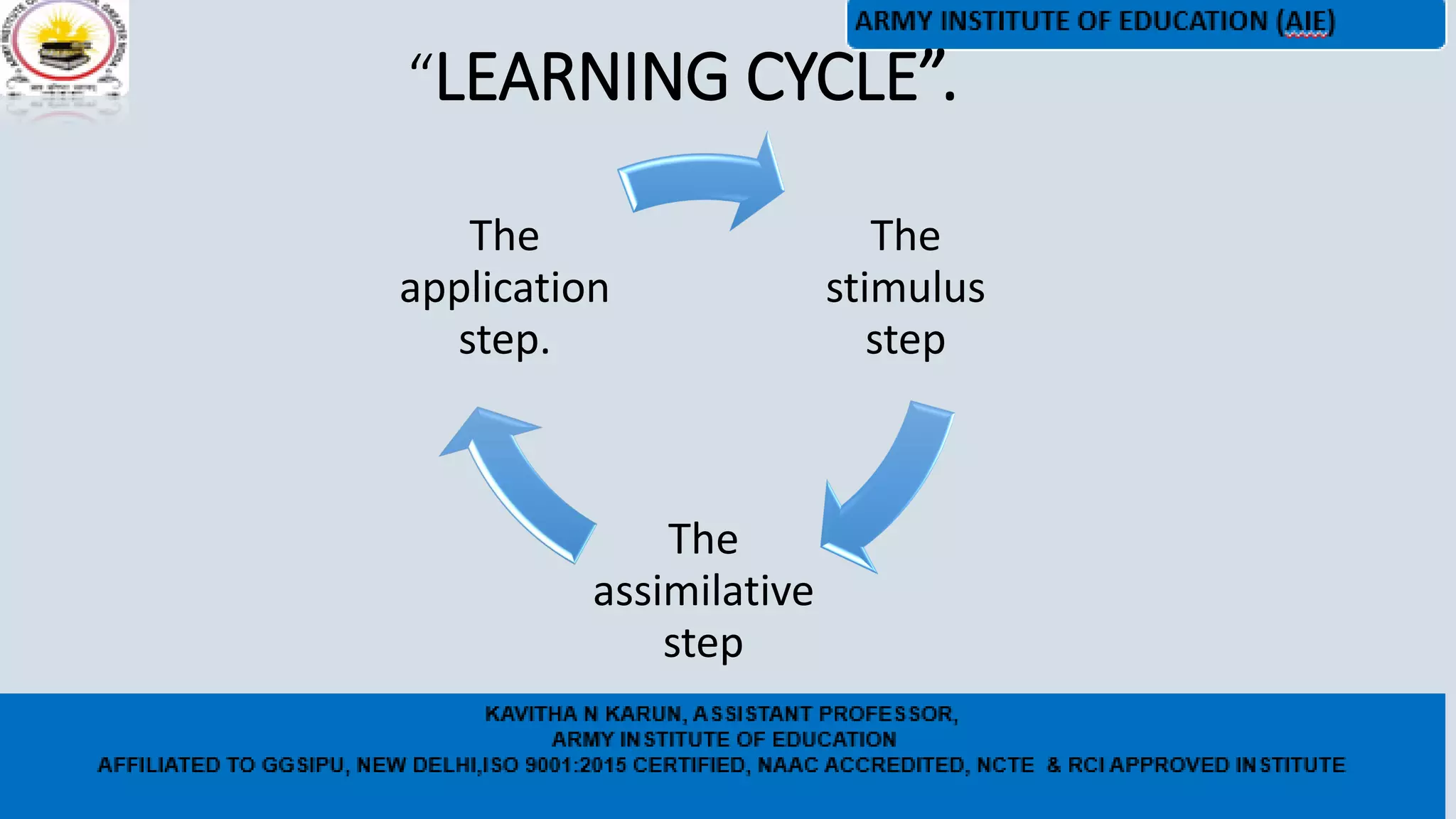
“LEARNING CYCLE”.
The
stimulus
step
The
assimilative
step
The
application
step.
Steps of Demonstration method
(1) Planning and preparation
(2) Introducing the lesson
(3) Preview
(4) Maintain Safety standards-
(5) Presentation of subject matter
(6) Evaluation
(7) Summarize
(8) Summarize-
Steps of Demonstration method
(1) Planning and preparation
(2) Introducing the lesson and asking key questions relates to the
important concepts in the Demonstration.
(3) Preview The step following the introduction and preceding the actual
demonstration is called the preview. The preview is a brief statement
of the demonstration.
(4) Maintain Safety standards- The teacher should stress the key points
of safety at each step
(5) Presentation of subject matter
6. Evaluation- To know about the effectiveness of the demonstration
and The purpose of critique is to answer key question revealing the
degree of understanding attained by students as a result of observing
the demonstration.
• It also afford students opportunities to ask question about any phase of
demonstration.
7. Summarize-
• the steps involved in the demonstration are enumerated and emphasized.
• key points should be stressed
• summarize the phases in the same order as they occurred in the
demonstration.
• No phase should be omitted.
8. Follow- Up activity
A demonstration should be followed by activities that help students
interpret and further understand the important points that were
presented. Such activities could include a discussion or a writing
exercise in which students can describe what they have observed.
Points to Remember
• Carefully plan the demonstration:
Like all other methods of teaching, the teacher must know exactly what s/he is doing.
• Practice the demonstration:
Once a well thought out plan has been developed, proper practice should be done. It
is very risky to give a demonstration without having practiced it beforehand,
especially when the procedure or topic is relatively complex or unfamiliar.
• Develop an outline to guide the demonstration:
have an outline that lists the steps to follow, the materials to use, the questions to ask
and the important points to make. Developing such an outline provides the teacher
not only a guide for carrying out the demonstration but also with a well designed
framework into which spontaneous ideas can be incorporated as the situation
demands.
Points to remember• Relevancy with the content.
• Should be student participation.
• Demonstration must be appropriate
• The object being displayed during demonstration should not be so small.
• The demonstration should be visible to all students.
• When a demonstration requires the class stand around a display, the teacher
should ensure everyone can see by having the class form a semi-circle
• Use clear language
• The pupils should be able to ask question
• Should be capable to draw the result.
• Appropriate timing
• Aids and equipment used in the demonstration can distract the class
if they are placed on display before the time of demonstration.
• Follow a logical sequence. Perform the demonstration in a logical
sequence
Disadvantages
• Not hands-on: Not a direct hands on experience for student unless
being lead step by step and student participation is ensured.
• Limited view: Students may not have an equal view of demonstration,
so some may miss an aspect of the demonstration.
• Pacing issue: Not all students will be able to follow single paced
demonstration
• Restrict on certain kinds of teaching.
• Result demonstration takes time.
• Required large amount of preliminary preparation.
Components of Evaluation in Micro Teaching
1. Relevancy with the contents.
2. Pupil-Participation.
3. Handling of equipment and materials.
4. Appropriateness of the demonstration.
5. Visibility of the demonstration work.
6. Capability of drawing result.
7. Display timing.

Skill of demonstration

  • 1.
  • 3.
    Demonstration Method Demonstration methodis a method of providing lessons by exhibiting and demonstrating • things • events • rules • sequences of activities either directly or through using instructional media which is relevant to the subject matter or material .
  • 4.
    • Reading map •Testing starch in food. • role play • Reciting a poem • map projection • puppetry • Drawing a diagram • PH Testing • Using globe
  • 5.
    Effectiveness of Demonstration •Helps in connecting theories to actual practice. • Helps in understanding applications of theories. • To stimulate the senses through multisensory Approach. • Clarifies Material presented by Verbal methods . • Supplements other methods. • In securing the acceptance of new and improved ways of doing things. • Enhancing skill of observation • Create enthusiasm.
  • 6.
  • 7.
    Steps of Demonstrationmethod (1) Planning and preparation (2) Introducing the lesson (3) Preview (4) Maintain Safety standards- (5) Presentation of subject matter (6) Evaluation (7) Summarize (8) Summarize-
  • 8.
    Steps of Demonstrationmethod (1) Planning and preparation (2) Introducing the lesson and asking key questions relates to the important concepts in the Demonstration. (3) Preview The step following the introduction and preceding the actual demonstration is called the preview. The preview is a brief statement of the demonstration. (4) Maintain Safety standards- The teacher should stress the key points of safety at each step (5) Presentation of subject matter
  • 9.
    6. Evaluation- Toknow about the effectiveness of the demonstration and The purpose of critique is to answer key question revealing the degree of understanding attained by students as a result of observing the demonstration. • It also afford students opportunities to ask question about any phase of demonstration.
  • 10.
    7. Summarize- • thesteps involved in the demonstration are enumerated and emphasized. • key points should be stressed • summarize the phases in the same order as they occurred in the demonstration. • No phase should be omitted.
  • 11.
    8. Follow- Upactivity A demonstration should be followed by activities that help students interpret and further understand the important points that were presented. Such activities could include a discussion or a writing exercise in which students can describe what they have observed.
  • 12.
    Points to Remember •Carefully plan the demonstration: Like all other methods of teaching, the teacher must know exactly what s/he is doing. • Practice the demonstration: Once a well thought out plan has been developed, proper practice should be done. It is very risky to give a demonstration without having practiced it beforehand, especially when the procedure or topic is relatively complex or unfamiliar. • Develop an outline to guide the demonstration: have an outline that lists the steps to follow, the materials to use, the questions to ask and the important points to make. Developing such an outline provides the teacher not only a guide for carrying out the demonstration but also with a well designed framework into which spontaneous ideas can be incorporated as the situation demands.
  • 13.
    Points to remember•Relevancy with the content. • Should be student participation. • Demonstration must be appropriate • The object being displayed during demonstration should not be so small. • The demonstration should be visible to all students. • When a demonstration requires the class stand around a display, the teacher should ensure everyone can see by having the class form a semi-circle • Use clear language • The pupils should be able to ask question • Should be capable to draw the result. • Appropriate timing
  • 14.
    • Aids andequipment used in the demonstration can distract the class if they are placed on display before the time of demonstration. • Follow a logical sequence. Perform the demonstration in a logical sequence
  • 15.
    Disadvantages • Not hands-on:Not a direct hands on experience for student unless being lead step by step and student participation is ensured. • Limited view: Students may not have an equal view of demonstration, so some may miss an aspect of the demonstration. • Pacing issue: Not all students will be able to follow single paced demonstration • Restrict on certain kinds of teaching. • Result demonstration takes time. • Required large amount of preliminary preparation.
  • 16.
    Components of Evaluationin Micro Teaching 1. Relevancy with the contents. 2. Pupil-Participation. 3. Handling of equipment and materials. 4. Appropriateness of the demonstration. 5. Visibility of the demonstration work. 6. Capability of drawing result. 7. Display timing.