DEMONSTRATION IN TEACHING
“Good Demonstration is Good Communication”
BY: Marjorie V. Famadico
INTRODUCTION
• Like role-playing and pantomime of the dramatized
experiences, demonstration is also something very
handy. It requires to elaborate preparation and yet is
effective as the other instructional materials when done
properly.
ABSTRACTION
In the demonstration of a new product, the speaker shows
the product, tells all the good things about the product to
promote it in order to convince the audience that the
product is worth buying. In the activists’ demonstration, the
activists air their grievances and publicly denounce the acts
of a person or of an institution, like government, against
whom they are demonstrating.
When a Master teacher is asked to do demonstration
teaching on a teaching strategy, she shows to the
audience how to use a teaching strategy effectively.
In all three instances of demonstration, there is an
audience, a process of speaking, and a process of
showing a product or a method or proof to convince the
audience to buy the product, use the strategy or rally
behind their cause.
In teaching it is showing how a thing is done and
emphasizing of the salient merits, utility and efficiency of
a concept, a method or a process or an attitude.
Guiding Principles must we observe in using Demonstration
as a Teaching learning experience. (Dale 1969)
•Establish Rapport. Greet your Audience. Make them feel at
ease by your warmth and sincerity. Stimulate their interest
by making your demonstration and yourself interesting.
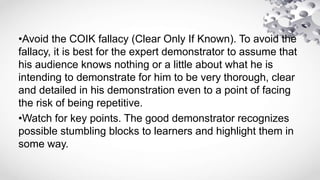
•Avoid the COIK fallacy (Clear Only If Known). To avoid the
fallacy, it is best for the expert demonstrator to assume that
his audience knows nothing or a little about what he is
intending to demonstrate for him to be very thorough, clear
and detailed in his demonstration even to a point of facing
the risk of being repetitive.
•Watch for key points. The good demonstrator recognizes
possible stumbling blocks to learners and highlight them in
some way.
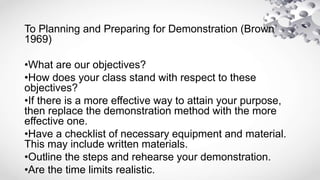
To Planning and Preparing for Demonstration (Brown
1969)
•What are our objectives?
•How does your class stand with respect to these
objectives?
•If there is a more effective way to attain your purpose,
then replace the demonstration method with the more
effective one.
•Have a checklist of necessary equipment and material.
This may include written materials.
•Outline the steps and rehearse your demonstration.
•Are the time limits realistic.
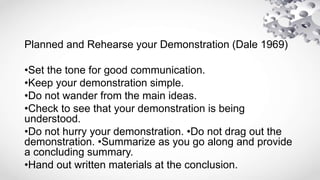
Planned and Rehearse your Demonstration (Dale 1969)
•Set the tone for good communication.
•Keep your demonstration simple.
•Do not wander from the main ideas.
•Check to see that your demonstration is being
understood.
•Do not hurry your demonstration. •Do not drag out the
demonstration. •Summarize as you go along and provide
a concluding summary.
•Hand out written materials at the conclusion.
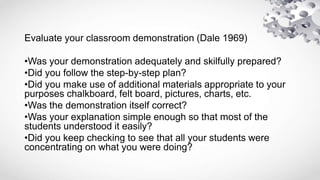
Evaluate your classroom demonstration (Dale 1969)
•Was your demonstration adequately and skilfully prepared?
•Did you follow the step-by-step plan?
•Did you make use of additional materials appropriate to your
purposes chalkboard, felt board, pictures, charts, etc.
•Was the demonstration itself correct?
•Was your explanation simple enough so that most of the
students understood it easily?
•Did you keep checking to see that all your students were
concentrating on what you were doing?
•Could every person see and hear?
•Did you help students to their own generalizing?
•Did you take enough time to demonstrate the key
points?
•Did you review and summarize the key points?
•Did your students participate in what you were doing by
asking thoughtful questions at the appropriate time?
•Did your evaluate of student learning indicate that your
demonstration achieved its purpose?
A good demonstration is an audio-visual presentation. It is
not enough that the teacher talks.
To be effective, his/her demonstration must be
accompanied by some visuals. To plan and prepare
adequately for a demonstration, we first determine our
goals, the materials we need our steps, and rehearse.
thank you!!!

Demonstration in teaching

  • 1.
    DEMONSTRATION IN TEACHING “GoodDemonstration is Good Communication” BY: Marjorie V. Famadico
  • 2.
    INTRODUCTION • Like role-playingand pantomime of the dramatized experiences, demonstration is also something very handy. It requires to elaborate preparation and yet is effective as the other instructional materials when done properly.
  • 3.
    ABSTRACTION In the demonstrationof a new product, the speaker shows the product, tells all the good things about the product to promote it in order to convince the audience that the product is worth buying. In the activists’ demonstration, the activists air their grievances and publicly denounce the acts of a person or of an institution, like government, against whom they are demonstrating.
  • 4.
    When a Masterteacher is asked to do demonstration teaching on a teaching strategy, she shows to the audience how to use a teaching strategy effectively. In all three instances of demonstration, there is an audience, a process of speaking, and a process of showing a product or a method or proof to convince the audience to buy the product, use the strategy or rally behind their cause. In teaching it is showing how a thing is done and emphasizing of the salient merits, utility and efficiency of a concept, a method or a process or an attitude.
  • 5.
    Guiding Principles mustwe observe in using Demonstration as a Teaching learning experience. (Dale 1969) •Establish Rapport. Greet your Audience. Make them feel at ease by your warmth and sincerity. Stimulate their interest by making your demonstration and yourself interesting.
  • 6.
    •Avoid the COIKfallacy (Clear Only If Known). To avoid the fallacy, it is best for the expert demonstrator to assume that his audience knows nothing or a little about what he is intending to demonstrate for him to be very thorough, clear and detailed in his demonstration even to a point of facing the risk of being repetitive. •Watch for key points. The good demonstrator recognizes possible stumbling blocks to learners and highlight them in some way.
  • 7.
    To Planning andPreparing for Demonstration (Brown 1969) •What are our objectives? •How does your class stand with respect to these objectives? •If there is a more effective way to attain your purpose, then replace the demonstration method with the more effective one. •Have a checklist of necessary equipment and material. This may include written materials. •Outline the steps and rehearse your demonstration. •Are the time limits realistic.
  • 8.
    Planned and Rehearseyour Demonstration (Dale 1969) •Set the tone for good communication. •Keep your demonstration simple. •Do not wander from the main ideas. •Check to see that your demonstration is being understood. •Do not hurry your demonstration. •Do not drag out the demonstration. •Summarize as you go along and provide a concluding summary. •Hand out written materials at the conclusion.
  • 9.
    Evaluate your classroomdemonstration (Dale 1969) •Was your demonstration adequately and skilfully prepared? •Did you follow the step-by-step plan? •Did you make use of additional materials appropriate to your purposes chalkboard, felt board, pictures, charts, etc. •Was the demonstration itself correct? •Was your explanation simple enough so that most of the students understood it easily? •Did you keep checking to see that all your students were concentrating on what you were doing?
  • 10.
    •Could every personsee and hear? •Did you help students to their own generalizing? •Did you take enough time to demonstrate the key points? •Did you review and summarize the key points? •Did your students participate in what you were doing by asking thoughtful questions at the appropriate time? •Did your evaluate of student learning indicate that your demonstration achieved its purpose?
  • 11.
    A good demonstrationis an audio-visual presentation. It is not enough that the teacher talks. To be effective, his/her demonstration must be accompanied by some visuals. To plan and prepare adequately for a demonstration, we first determine our goals, the materials we need our steps, and rehearse.
  • 12.