Assignment
Subject :
General methods of teaching
Topic :
Demonstration method of teaching
Submitted by :
1.Ali Zia (bsf-1702570)
Submitted to:
Mr. Rizwan
Class:
BS Chemistry 2nd
(morn)
Session :
2017-2021
University of Education Faisalabadcampus
Contents
 Introduction to demonstration
 Nature
 Focus
 Structure
 Principles
 Application
 How to effectively execute
 Purposes
 Advantages and disadvantages of demonstration method
 Guidelines for effective demonstration
“We are what we repeatedly do; excellence, then, is not an act
but a habit”(Aristotle)
Demonstrationmethod of teaching
“Demonstration is a planned manipulation of materials and equipment to the
end that learners are able to observeall or at least some of the manifestations
of oneor more scientific principles and operations within a
phenomena”(Woodburn &Obourn ).
“Demonstration is a process where the teacher shows or illustrates a skill or a
principle”(Kramer).
A method demonstration is a teaching method used to communicate an idea
with the aid of visuals such as flip charts, posters, power point, etc. A
demonstration is the process of teaching someone how to make or do
something in a step-by-step process. As you show how, you “tell” what you are
doing. A demonstration always has a finished product. The key to a good
demonstration is for the audience to be able to go home and do whatyou have
taught hem how to do.
Thus it can be simplified as :
Verbal explanation +livedisplay/use of apparatus =demonstration
Demonstration is:
 A method of teaching that relies heavily upon showing the learner a
model performance that he/she would match or pass after he/she has
seen a presentation that is live, filmed or electronically operated.
 A traditional classroomstrategy.
 A method that demonstrates the procedures step by step in a job task,
using exact physicalprocedures if possible.
 Demonstration matches explanation to manipulation.
Nature
 Teacher dominated-the teacher shows how to operate, manipulate an
equipment while the class observes.
 The techniques for imparting skills are presented in steps rather than
activities.
Focus
To achieve:
 Psychomotor
 Cognitive objectives
Structure
The structureof a good demonstration involves:
1. Introduction
2. Development
3. Integration
1.Introduction
In introduction:
1) Objectives of lesson are stated.
2) The teacher may be called demonstrator.
3) He/she demonstrates the activity before the students, to be developed.
4.Development
 Student try to initiate the demonstrated activity.
 If there is any query the teacher tries to satisfy them by further
demonstrations and illustrations.
3.Integration
The reacher integrates all the activities and then these activities are rehearsed,
revised and evaluated.
Principles
 Learning by doing maxim is followed.
 Skills can be developed by imitation.
 The perception helps in imitation.
Application
 Applied mainly in technical training institutes.
 In teacher education program, it is used to develop skills in student
teacher.
 At school level a teacher applies it in teaching science, biology, nature
study arts and crafts.
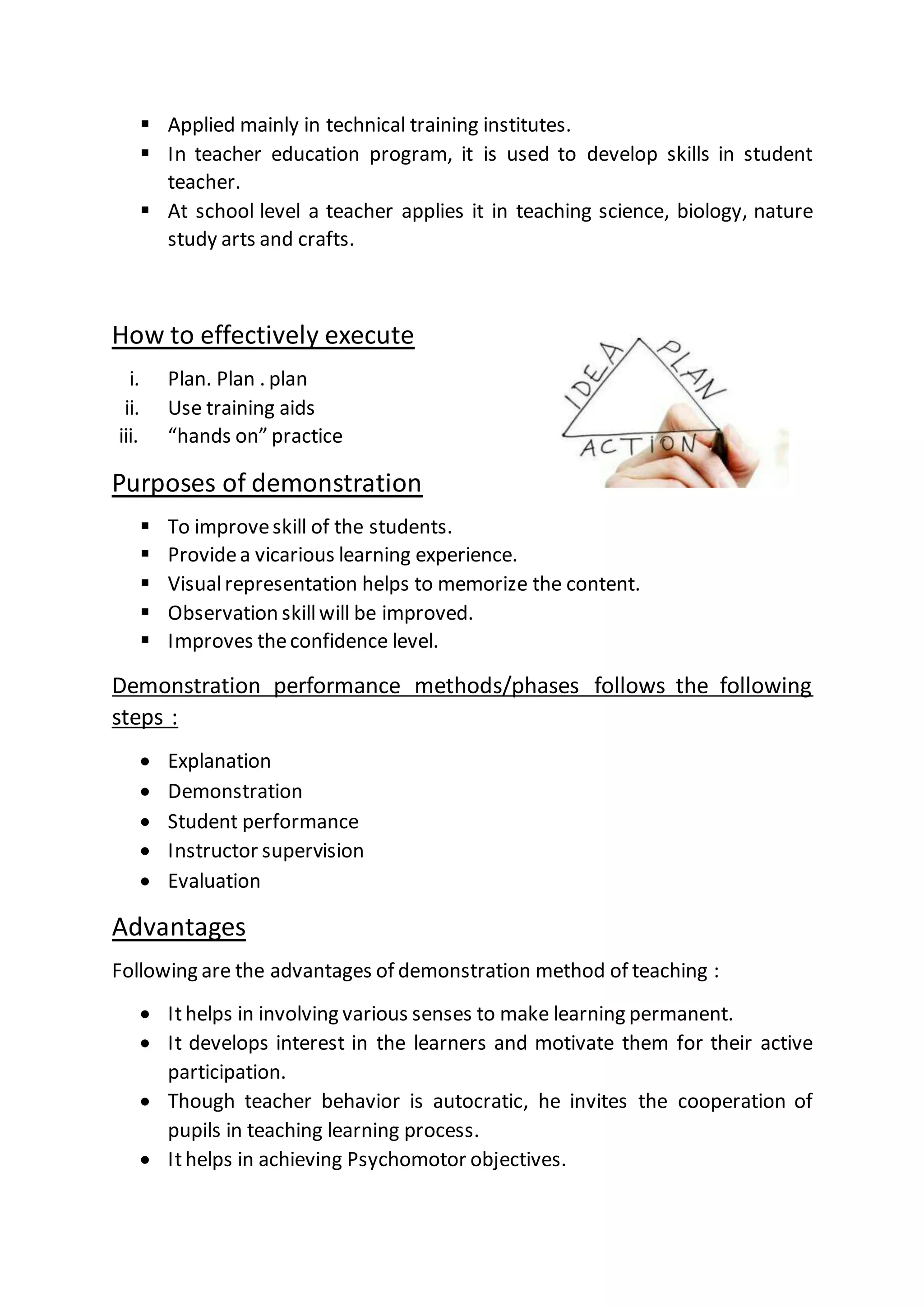
How to effectively execute
i. Plan. Plan . plan
ii. Use training aids
iii. “hands on” practice
Purposes of demonstration
 To improveskill of the students.
 Providea vicarious learning experience.
 Visualrepresentation helps to memorize the content.
 Observation skillwill be improved.
 Improves theconfidence level.
Demonstration performance methods/phases follows the following
steps :
 Explanation
 Demonstration
 Student performance
 Instructor supervision
 Evaluation
Advantages
Following are the advantages of demonstration method of teaching :
 Ithelps in involving various senses to make learning permanent.
 It develops interest in the learners and motivate them for their active
participation.
 Though teacher behavior is autocratic, he invites the cooperation of
pupils in teaching learning process.
 Ithelps in achieving Psychomotor objectives.
 Any simple or complex skill becomes easy to understand.
 There is an immediate application of learning.
 The teacher gets to instantly seeand correctthe mistakesof thestudents.
Disadvantages
 Itcan be only used for the skills subject.
 Only the attention of the learners is invited towards the activity
demonstrated, they are not free to discuss aboutit.
 Due to poor economic conditions of government schools, there is a
scarcity of audiovisualside and equipments, and the teachers are not so
creative to produce handmademodels for demonstration.
 Time consuming.
 Communication barriers.
 Becomes a failure when there is a great number of students.
In short:
Demonstration method is :
 “Doing” method.
 Pre planed.
 Learners can see and hear.
 More senseorgans involved.
 Easy to understand
 Develop Psychomotor and cognitivedomains.
 Lead experiences fromconcrete to abstract.
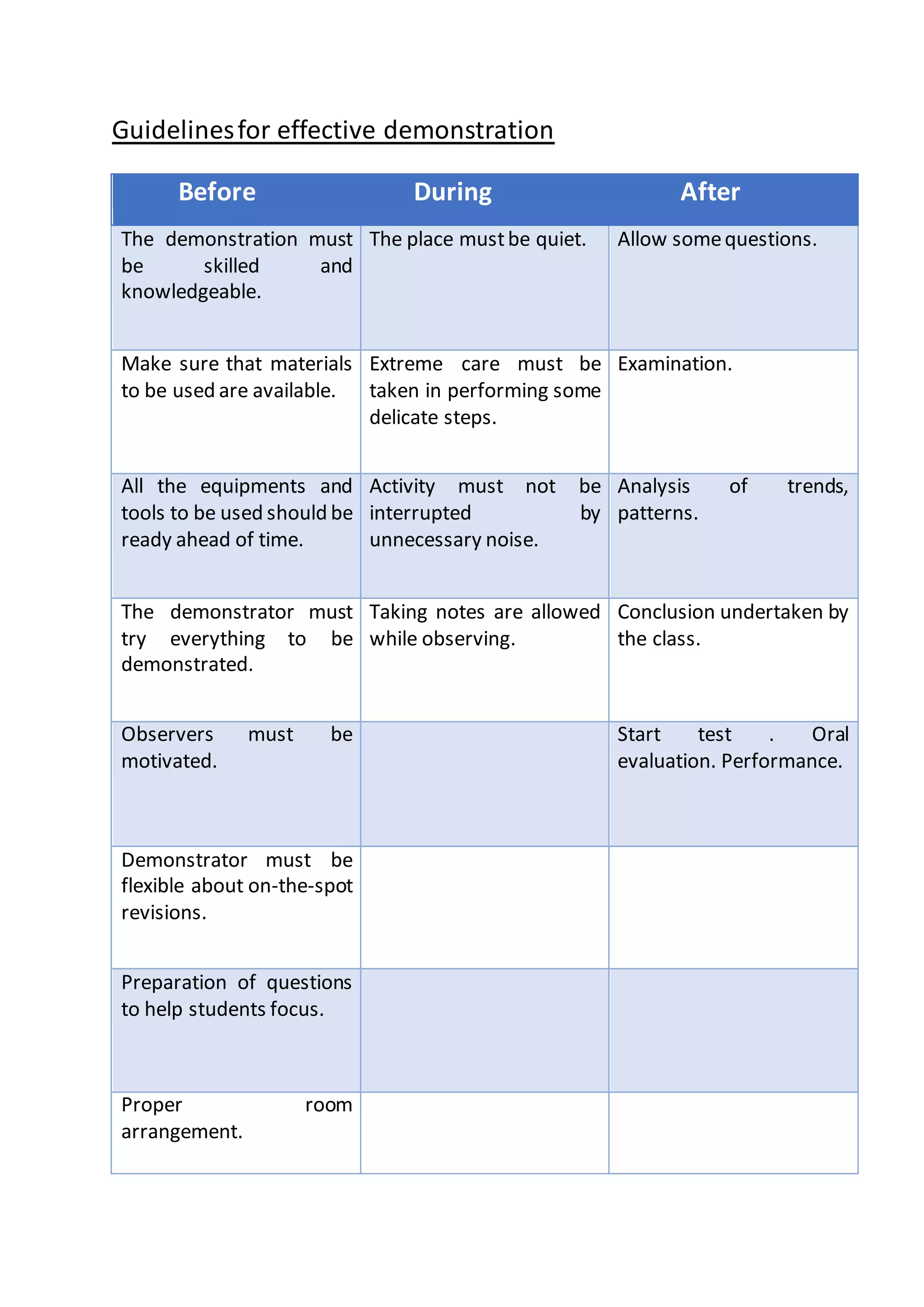
Guidelinesfor effective demonstration
Before During After
The demonstration must
be skilled and
knowledgeable.
The place mustbe quiet. Allow somequestions.
Make sure that materials
to be used are available.
Extreme care must be
taken in performing some
delicate steps.
Examination.
All the equipments and
tools to be used should be
ready ahead of time.
Activity must not be
interrupted by
unnecessary noise.
Analysis of trends,
patterns.
The demonstrator must
try everything to be
demonstrated.
Taking notes are allowed
while observing.
Conclusion undertaken by
the class.
Observers must be
motivated.
Start test . Oral
evaluation. Performance.
Demonstrator must be
flexible about on-the-spot
revisions.
Preparation of questions
to help students focus.
Proper room
arrangement.
References
1. yourdictionary.com.Demonstrating
Definition.http://www.yourdictionary.com/demonstrating.
2. McKee, Erik, Vickie M. Williamson, and Laura E. Ruebush. &Effects of Demonstration
Laboratory on Student Learning&. Journal of ScienceEducation and Technology. 16.5
(2007) 395-400.
3. Bruce, Catherine D., John Ross, Tara Flynn, and Rich McPherson. &Lesson Study
and Demonstration Classrooms: Examining the Effects of Two Models of Teacher
Professional Development.&Google. CDBruce, Aug. 2009. Web. 15 September 2010.

Demonstration method of teaching

  • 1.
    Assignment Subject : General methodsof teaching Topic : Demonstration method of teaching Submitted by : 1.Ali Zia (bsf-1702570) Submitted to: Mr. Rizwan Class: BS Chemistry 2nd (morn) Session : 2017-2021 University of Education Faisalabadcampus
  • 2.
    Contents  Introduction todemonstration  Nature  Focus  Structure  Principles  Application  How to effectively execute  Purposes  Advantages and disadvantages of demonstration method  Guidelines for effective demonstration
  • 3.
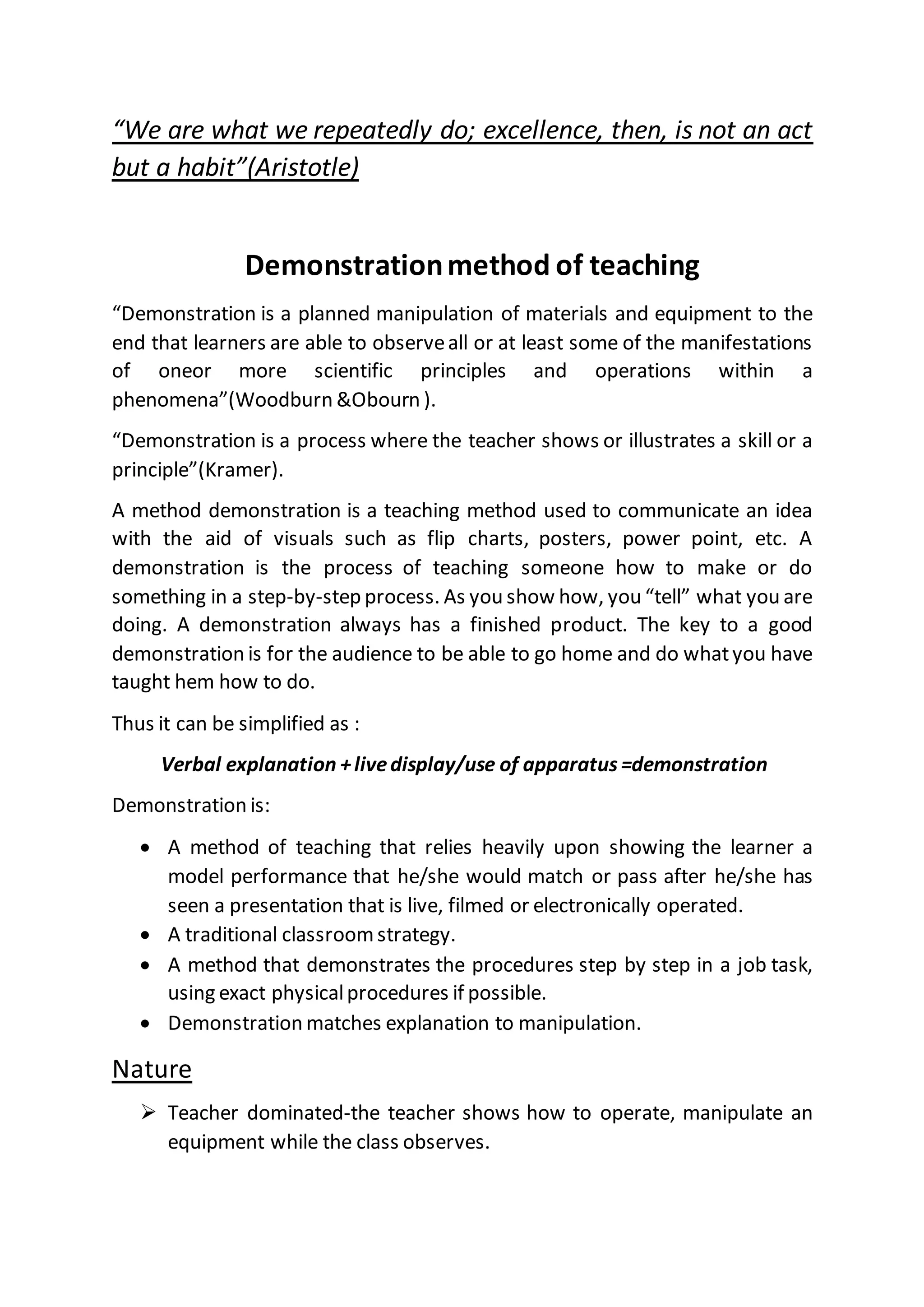
    “We are whatwe repeatedly do; excellence, then, is not an act but a habit”(Aristotle) Demonstrationmethod of teaching “Demonstration is a planned manipulation of materials and equipment to the end that learners are able to observeall or at least some of the manifestations of oneor more scientific principles and operations within a phenomena”(Woodburn &Obourn ). “Demonstration is a process where the teacher shows or illustrates a skill or a principle”(Kramer). A method demonstration is a teaching method used to communicate an idea with the aid of visuals such as flip charts, posters, power point, etc. A demonstration is the process of teaching someone how to make or do something in a step-by-step process. As you show how, you “tell” what you are doing. A demonstration always has a finished product. The key to a good demonstration is for the audience to be able to go home and do whatyou have taught hem how to do. Thus it can be simplified as : Verbal explanation +livedisplay/use of apparatus =demonstration Demonstration is:  A method of teaching that relies heavily upon showing the learner a model performance that he/she would match or pass after he/she has seen a presentation that is live, filmed or electronically operated.  A traditional classroomstrategy.  A method that demonstrates the procedures step by step in a job task, using exact physicalprocedures if possible.  Demonstration matches explanation to manipulation. Nature  Teacher dominated-the teacher shows how to operate, manipulate an equipment while the class observes.
  • 4.
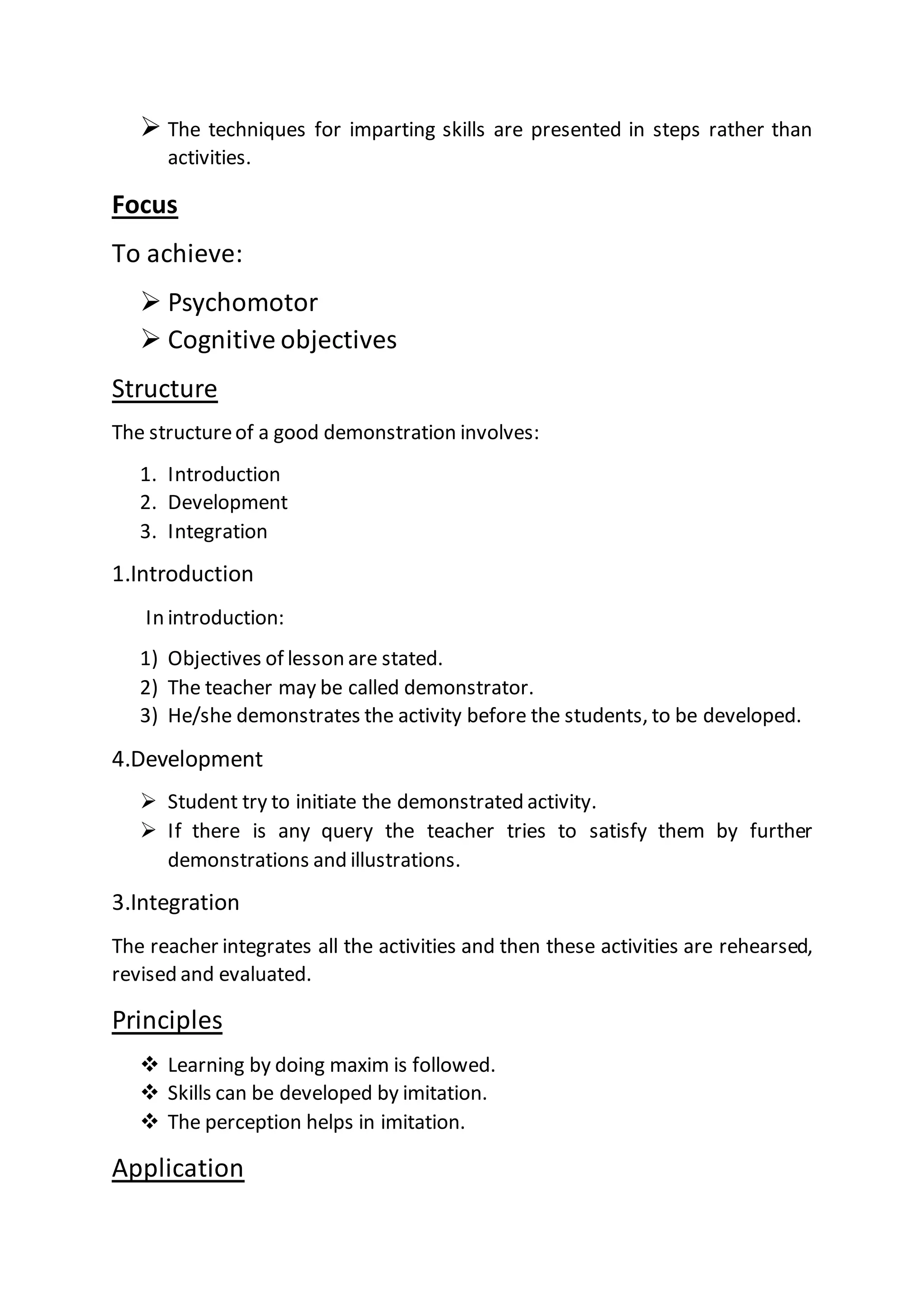
     The techniquesfor imparting skills are presented in steps rather than activities. Focus To achieve:  Psychomotor  Cognitive objectives Structure The structureof a good demonstration involves: 1. Introduction 2. Development 3. Integration 1.Introduction In introduction: 1) Objectives of lesson are stated. 2) The teacher may be called demonstrator. 3) He/she demonstrates the activity before the students, to be developed. 4.Development  Student try to initiate the demonstrated activity.  If there is any query the teacher tries to satisfy them by further demonstrations and illustrations. 3.Integration The reacher integrates all the activities and then these activities are rehearsed, revised and evaluated. Principles  Learning by doing maxim is followed.  Skills can be developed by imitation.  The perception helps in imitation. Application
  • 5.
     Applied mainlyin technical training institutes.  In teacher education program, it is used to develop skills in student teacher.  At school level a teacher applies it in teaching science, biology, nature study arts and crafts. How to effectively execute i. Plan. Plan . plan ii. Use training aids iii. “hands on” practice Purposes of demonstration  To improveskill of the students.  Providea vicarious learning experience.  Visualrepresentation helps to memorize the content.  Observation skillwill be improved.  Improves theconfidence level. Demonstration performance methods/phases follows the following steps :  Explanation  Demonstration  Student performance  Instructor supervision  Evaluation Advantages Following are the advantages of demonstration method of teaching :  Ithelps in involving various senses to make learning permanent.  It develops interest in the learners and motivate them for their active participation.  Though teacher behavior is autocratic, he invites the cooperation of pupils in teaching learning process.  Ithelps in achieving Psychomotor objectives.
  • 6.
     Any simpleor complex skill becomes easy to understand.  There is an immediate application of learning.  The teacher gets to instantly seeand correctthe mistakesof thestudents. Disadvantages  Itcan be only used for the skills subject.  Only the attention of the learners is invited towards the activity demonstrated, they are not free to discuss aboutit.  Due to poor economic conditions of government schools, there is a scarcity of audiovisualside and equipments, and the teachers are not so creative to produce handmademodels for demonstration.  Time consuming.  Communication barriers.  Becomes a failure when there is a great number of students. In short: Demonstration method is :  “Doing” method.  Pre planed.  Learners can see and hear.  More senseorgans involved.  Easy to understand  Develop Psychomotor and cognitivedomains.  Lead experiences fromconcrete to abstract.
  • 7.
    Guidelinesfor effective demonstration BeforeDuring After The demonstration must be skilled and knowledgeable. The place mustbe quiet. Allow somequestions. Make sure that materials to be used are available. Extreme care must be taken in performing some delicate steps. Examination. All the equipments and tools to be used should be ready ahead of time. Activity must not be interrupted by unnecessary noise. Analysis of trends, patterns. The demonstrator must try everything to be demonstrated. Taking notes are allowed while observing. Conclusion undertaken by the class. Observers must be motivated. Start test . Oral evaluation. Performance. Demonstrator must be flexible about on-the-spot revisions. Preparation of questions to help students focus. Proper room arrangement.
  • 8.
    References 1. yourdictionary.com.Demonstrating Definition.http://www.yourdictionary.com/demonstrating. 2. McKee,Erik, Vickie M. Williamson, and Laura E. Ruebush. &Effects of Demonstration Laboratory on Student Learning&. Journal of ScienceEducation and Technology. 16.5 (2007) 395-400. 3. Bruce, Catherine D., John Ross, Tara Flynn, and Rich McPherson. &Lesson Study and Demonstration Classrooms: Examining the Effects of Two Models of Teacher Professional Development.&Google. CDBruce, Aug. 2009. Web. 15 September 2010.