- Carlito Manansala Jr.
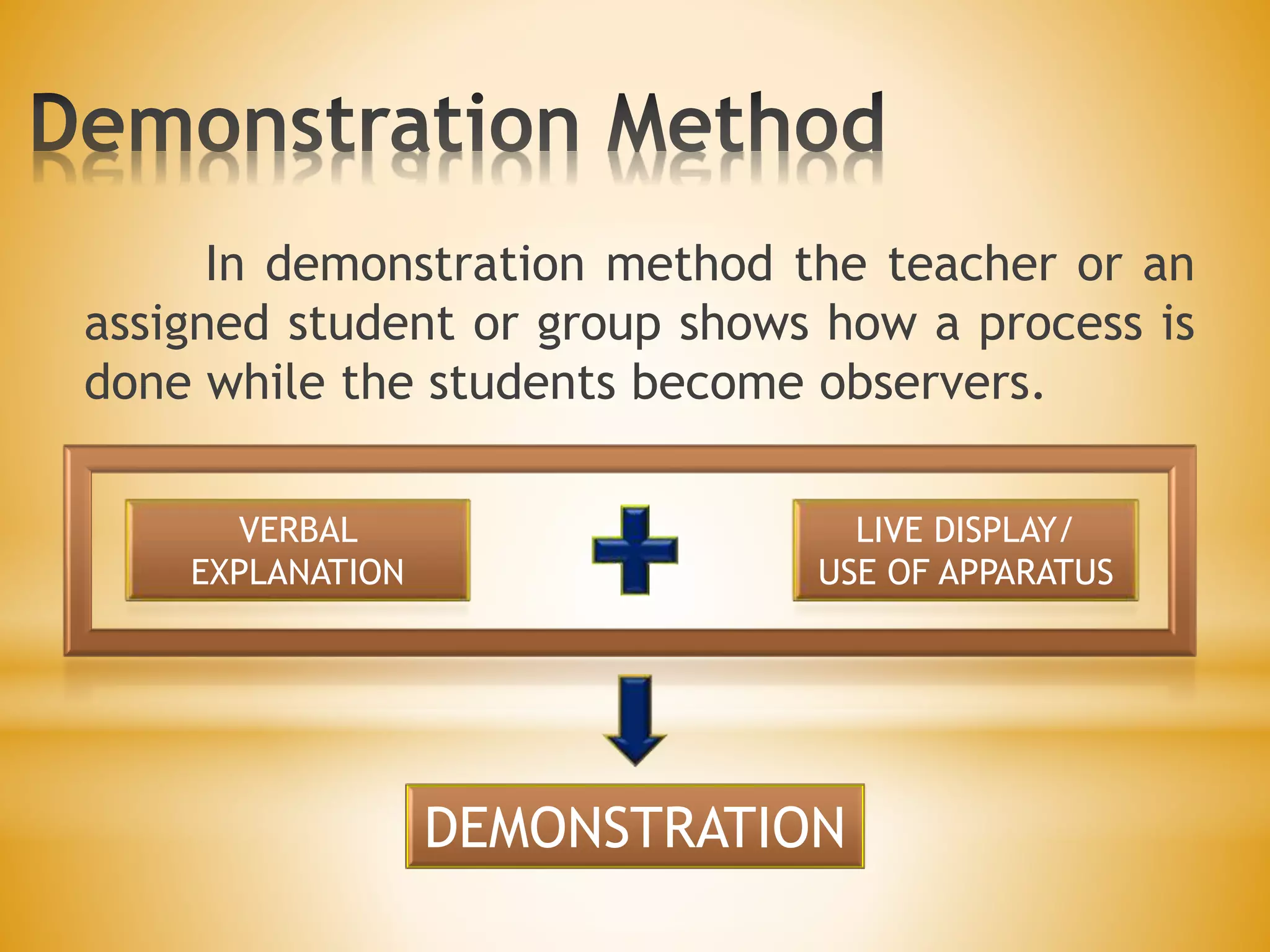
In demonstration method the teacher or an
assigned student or group shows how a process is
done while the students become observers.
VERBAL
EXPLANATION
LIVE DISPLAY/
USE OF APPARATUS
DEMONSTRATION
2. When planning the activities make sure
that the materials are easily available.
Likewise, get prepared with possible
substitutes.
1. The demonstrator/s must be well-selected.
He/she/they must be skilled in operating
modern equipment and proficient in
undertaking scientific investigations.
3. Get ready with the equipment and tools to
be used. Demonstration should be scheduled as
to day and class period.
4. The demonstrator must try the activity
several times before the real demonstrations
for a smooth sequencing of the steps as well as
accuracy of the result.
5. The observers must be prepared and
motivated to ensure concentration throughout
the activity.
6. The demonstrator must be ready with on-
the-spot revision/s such as alternative steps or
substitute materials when needed.
7. Arrange the observers around the
demonstration area or at a distance where they
will be able to observe fully what is going on.
8. Depending on the kind of demonstration
to be undertaken, pointers or questions may be
given to focus students’ attention and avoid
irrelevant observations.
1. The place must be quiet in order to sustain
the observers’ attention and interest during
the activity.
2. Extreme care must be taken in performing
some delicate steps
3. The activity must not be interrupted by
unnecessary announcements or noise in the
surroundings.
4. They are allowed to take down short notes
or record some data which may be analyzed
after.
1. Allow some questions which bothered them
during the demonstration.
2. An examination of the observed data and all
information recorded follows.
3. Have an analysis of trends, patterns or
uniform occurrences that can help in arriving
at a conclusion.
4. The solution or summary must be
cooperatively undertaken by the whole class.
5. Assess learning by way of a short test, an
oral evaluation or a performance test.
1. The demonstration method follows a
systematic procedure.
2. The use of expensive equipment and
machines will be maximized.
3. Possible wastage of time, effort and
resources will be avoided since the
demonstration is supposed to be well- planned
in advance.
4. It will not result to trial and error learning
as what happens with unplanned learning
activities.
5. The findings are reliable and accurate
since the procedure has bee tried before.
6. The value of confidence is developed
among the demonstrators for such hands-on
demonstration.
7. Curiosity and keen observing ability are
instilled among the observers.
Demonstration method

Demonstration method

  • 1.
  • 2.
    In demonstration methodthe teacher or an assigned student or group shows how a process is done while the students become observers. VERBAL EXPLANATION LIVE DISPLAY/ USE OF APPARATUS DEMONSTRATION
  • 4.
    2. When planningthe activities make sure that the materials are easily available. Likewise, get prepared with possible substitutes. 1. The demonstrator/s must be well-selected. He/she/they must be skilled in operating modern equipment and proficient in undertaking scientific investigations.
  • 5.
    3. Get readywith the equipment and tools to be used. Demonstration should be scheduled as to day and class period. 4. The demonstrator must try the activity several times before the real demonstrations for a smooth sequencing of the steps as well as accuracy of the result.
  • 6.
    5. The observersmust be prepared and motivated to ensure concentration throughout the activity. 6. The demonstrator must be ready with on- the-spot revision/s such as alternative steps or substitute materials when needed.
  • 7.
    7. Arrange theobservers around the demonstration area or at a distance where they will be able to observe fully what is going on. 8. Depending on the kind of demonstration to be undertaken, pointers or questions may be given to focus students’ attention and avoid irrelevant observations.
  • 8.
    1. The placemust be quiet in order to sustain the observers’ attention and interest during the activity. 2. Extreme care must be taken in performing some delicate steps 3. The activity must not be interrupted by unnecessary announcements or noise in the surroundings. 4. They are allowed to take down short notes or record some data which may be analyzed after.
  • 9.
    1. Allow somequestions which bothered them during the demonstration. 2. An examination of the observed data and all information recorded follows. 3. Have an analysis of trends, patterns or uniform occurrences that can help in arriving at a conclusion. 4. The solution or summary must be cooperatively undertaken by the whole class. 5. Assess learning by way of a short test, an oral evaluation or a performance test.
  • 11.
    1. The demonstrationmethod follows a systematic procedure. 2. The use of expensive equipment and machines will be maximized. 3. Possible wastage of time, effort and resources will be avoided since the demonstration is supposed to be well- planned in advance.
  • 12.
    4. It willnot result to trial and error learning as what happens with unplanned learning activities. 5. The findings are reliable and accurate since the procedure has bee tried before. 6. The value of confidence is developed among the demonstrators for such hands-on demonstration. 7. Curiosity and keen observing ability are instilled among the observers.