Lesson Overview    The Skeletal System


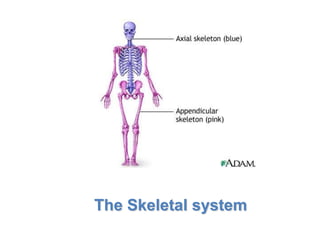
                  The Skeletal system
Lesson Overview            The Skeletal System


                              The Skeleton


    What are the functions of the
          skeletal system?

  • The skeleton supports the body.
  • Protects internal organs.
  • Assists movement.
  • Stores minerals.
  • Is a site of blood cell formation.
Lesson Overview       The Skeletal System


  The Skeleton
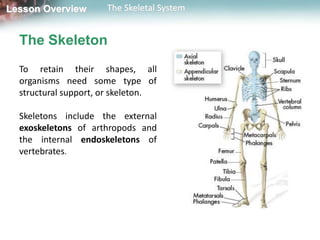
  To retain their shapes, all
  organisms need some type of
  structural support, or skeleton.

  Skeletons include the external
  exoskeletons of arthropods and
  the internal endoskeletons of
  vertebrates.
Lesson Overview           The Skeletal System

                       Structure of the Skeleton

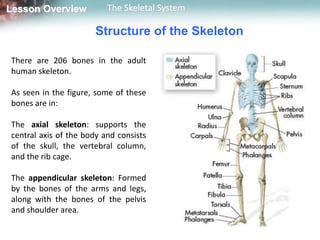
There are 206 bones in the adult
human skeleton.

As seen in the figure, some of these
bones are in:

The axial skeleton: supports the
central axis of the body and consists
of the skull, the vertebral column,
and the rib cage.

The appendicular skeleton: Formed
by the bones of the arms and legs,
along with the bones of the pelvis
and shoulder area.
Lesson Overview        The Skeletal System


                               Bones

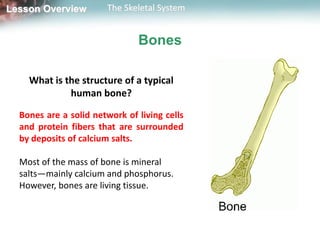
    What is the structure of a typical
             human bone?

  Bones are a solid network of living cells
  and protein fibers that are surrounded
  by deposits of calcium salts.

  Most of the mass of bone is mineral
  salts—mainly calcium and phosphorus.
  However, bones are living tissue.
Lesson Overview   The Skeletal System


                   Structure of Bones
Lesson Overview           The Skeletal System


     Structure of Bones
      The bone is surrounded by a tough layer of connective tissue called periosteum.
Lesson Overview          The Skeletal System


     Structure of Bones
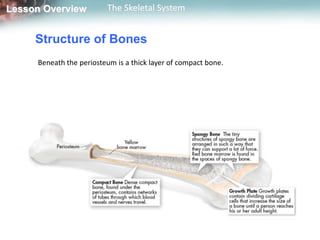
     Beneath the periosteum is a thick layer of compact bone.
Lesson Overview          The Skeletal System


     Structure of Bones
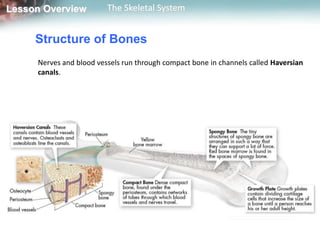
     Nerves and blood vessels run through compact bone in channels called Haversian
     canals.
Lesson Overview          The Skeletal System


     Structure of Bones
     A less dense tissue known as spongy bone may be found under the outer layer of
     compact bone.
Lesson Overview          The Skeletal System


     Structure of Bones
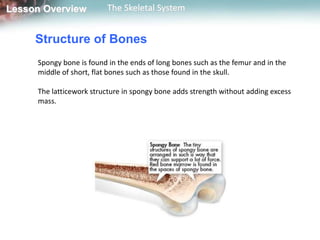
     Spongy bone is found in the ends of long bones such as the femur and in the
     middle of short, flat bones such as those found in the skull.

     The latticework structure in spongy bone adds strength without adding excess
     mass.
Lesson Overview           The Skeletal System


     Structure of Bones
     Within many bones are cavities that contain a soft tissue called bone marrow.
Lesson Overview            The Skeletal System


     Structure of Bones
     Yellow marrow consists primarily of cells that store fat.


      Red marrow contains stem cells that produce most types of blood cells
Lesson Overview           The Skeletal System


                        Development of Bones


  The skeleton of a human embryo is
  composed almost entirely of a type of
  connective tissue called cartilage.

  Cartilage is gradually replaced by bone
  during the process of bone formation
  called ossification, which begins up to
  seven months before birth.
Lesson Overview            The Skeletal System


                         Development of Bones


  Bone tissue forms as cells called osteoblasts
  secrete mineral deposits that replace the
  cartilage in developing bones.

  As bone tissue completes its development, most
  osteoblasts mature into osteocytes, which help
  to maintain the minerals in bone tissue and
  continue to strengthen the growing bone.
Lesson Overview                         The Skeletal System


                                       Development of Bones
                           Many long bones have growth plates at either end.


• The growth of cartilage at these plates causes the bones to lengthen. The cartilage is gradually replaced by bone.

• During late adolescence or early adulthood, growth plates become completely ossified, and the person “stops growing.”
Lesson Overview             The Skeletal System


                          Development of Bones

   Cartilage remains in parts of the body
   that are flexible, such as the tip of the
   nose and the external part of ears.

   It also cushions the areas where bones
   meet, such as in the knee.
Lesson Overview         The Skeletal System

                 Bone Remodeling and Repair

 Bones are remodeled throughout life by osteoblasts, which continue to build
 bone tissue, and osteoclasts—cells that break down bone minerals.

 Without the continual breakdown of old bone tissue and buildup of new bone
 tissue, bones would become brittle and weak.
Lesson Overview          The Skeletal System


                  Bone Remodeling and Repair

  Some older adults, especially women,
  develop a disorder called osteoporosis.

  In osteoporosis, osteoclasts break
  down bone much faster than
  osteoblasts rebuild it.

  Osteoporosis leads to weak bones due
  to excessive decrease in bone density.

  Research suggests that consuming
  plenty of calcium and performing
  weight-bearing exercise could help to
  prevent this serious problem.
Lesson Overview          The Skeletal System


                            Joints


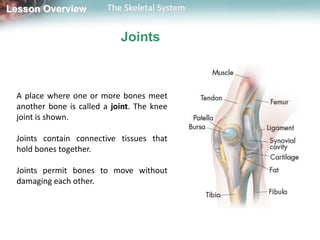
 A place where one or more bones meet
 another bone is called a joint. The knee
 joint is shown.

 Joints contain connective tissues that
 hold bones together.

 Joints permit bones to move without
 damaging each other.
Lesson Overview          The Skeletal System


                             Types of Joints

Depending on its type of movement, a
joint is classified as:

• Immovable,
• Slightly movable,
• Freely movable.
Lesson Overview          The Skeletal System


                              Types of Joints
     Many freely movable joints are involved in the movements of a gymnast.
Lesson Overview             The Skeletal System


                               Immovable Joints

  Immovable joints, often called fixed joints, allow no movement.

  The bones at an immovable joint are interlocked and grow together until they are fused.

  The places where the bones in the skull meet are examples of immovable joints.
Lesson Overview              The Skeletal System


                          Slightly Movable Joints

 Slightly movable joints permit a small amount of
 movement.

 Unlike the bones of immovable joints, the
 bones of slightly movable joints are
 separated from each other.

 The joints between the two bones of the
 lower leg and the joints between vertebrae
 are examples of slightly movable joints.
Lesson Overview             The Skeletal System


                             Structure of Joints

  Freely movable joints permit movement
  in two or more directions and are
  grouped according to the shapes of the
  surfaces of the adjacent bones.

  In freely movable joints, cartilage covers
  the surfaces where two bones come
  together and protects the bones from
  damage as they move against each other.

  The joints are also surrounded by a
  fibrous joint capsule that helps hold the
  bones together while still allowing for
  movement. The outer layer of the capsule
  is called ligament.
Lesson Overview             The Skeletal System


                              Structure of Joints
    The inner layer of the joint capsule, called
    the synovial cavity, produces a substance
    called synovial fluid.

    Synovial fluid enables the surfaces of the
    bones connected at the joint to slide over
    each other smoothly.

    In some freely movable joints, such as the
    knee, there are small sacs of synovial
    fluid called bursae (singular: bursa).

    Bursae reduce the friction between the
    bones of a joint and any tissues they
    come in contact with and also act as tiny
    shock absorbers.
Lesson Overview             The Skeletal System


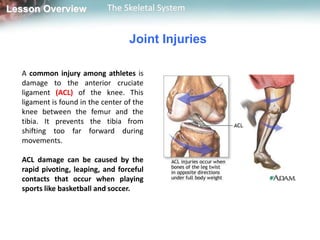
                                   Joint Injuries

  A common injury among athletes is
  damage to the anterior cruciate
  ligament (ACL) of the knee. This
  ligament is found in the center of the
  knee between the femur and the
  tibia. It prevents the tibia from
  shifting too far forward during
  movements.

  ACL damage can be caused by the
  rapid pivoting, leaping, and forceful
  contacts that occur when playing
  sports like basketball and soccer.
Lesson Overview   The Skeletal System
Lesson Overview             The Skeletal System


                                   Joint Injuries


  Excessive strain on a joint may produce
  inflammation, a response in which excess
  fluid causes swelling, pain, heat, and
  redness.

  Inflammation of a bursa is called bursitis.
Lesson Overview            The Skeletal System


                                  Joint Injuries
  Wear and tear over the years often leads to osteoarthritis, which develops as the
  cartilage of often-used joints in the fingers, knees, hips, and spine begins to break
  down.

  The affected joints become painful and stiff as unprotected bones start to rub
  together.

Skeletal+system

  • 1.
    Lesson Overview The Skeletal System The Skeletal system
  • 2.
    Lesson Overview The Skeletal System The Skeleton What are the functions of the skeletal system? • The skeleton supports the body. • Protects internal organs. • Assists movement. • Stores minerals. • Is a site of blood cell formation.
  • 3.
    Lesson Overview The Skeletal System The Skeleton To retain their shapes, all organisms need some type of structural support, or skeleton. Skeletons include the external exoskeletons of arthropods and the internal endoskeletons of vertebrates.
  • 4.
    Lesson Overview The Skeletal System Structure of the Skeleton There are 206 bones in the adult human skeleton. As seen in the figure, some of these bones are in: The axial skeleton: supports the central axis of the body and consists of the skull, the vertebral column, and the rib cage. The appendicular skeleton: Formed by the bones of the arms and legs, along with the bones of the pelvis and shoulder area.
  • 5.
    Lesson Overview The Skeletal System Bones What is the structure of a typical human bone? Bones are a solid network of living cells and protein fibers that are surrounded by deposits of calcium salts. Most of the mass of bone is mineral salts—mainly calcium and phosphorus. However, bones are living tissue.
  • 6.
    Lesson Overview The Skeletal System Structure of Bones
  • 7.
    Lesson Overview The Skeletal System Structure of Bones The bone is surrounded by a tough layer of connective tissue called periosteum.
  • 8.
    Lesson Overview The Skeletal System Structure of Bones Beneath the periosteum is a thick layer of compact bone.
  • 9.
    Lesson Overview The Skeletal System Structure of Bones Nerves and blood vessels run through compact bone in channels called Haversian canals.
  • 10.
    Lesson Overview The Skeletal System Structure of Bones A less dense tissue known as spongy bone may be found under the outer layer of compact bone.
  • 11.
    Lesson Overview The Skeletal System Structure of Bones Spongy bone is found in the ends of long bones such as the femur and in the middle of short, flat bones such as those found in the skull. The latticework structure in spongy bone adds strength without adding excess mass.
  • 12.
    Lesson Overview The Skeletal System Structure of Bones Within many bones are cavities that contain a soft tissue called bone marrow.
  • 13.
    Lesson Overview The Skeletal System Structure of Bones Yellow marrow consists primarily of cells that store fat. Red marrow contains stem cells that produce most types of blood cells
  • 14.
    Lesson Overview The Skeletal System Development of Bones The skeleton of a human embryo is composed almost entirely of a type of connective tissue called cartilage. Cartilage is gradually replaced by bone during the process of bone formation called ossification, which begins up to seven months before birth.
  • 15.
    Lesson Overview The Skeletal System Development of Bones Bone tissue forms as cells called osteoblasts secrete mineral deposits that replace the cartilage in developing bones. As bone tissue completes its development, most osteoblasts mature into osteocytes, which help to maintain the minerals in bone tissue and continue to strengthen the growing bone.
  • 16.
    Lesson Overview The Skeletal System Development of Bones Many long bones have growth plates at either end. • The growth of cartilage at these plates causes the bones to lengthen. The cartilage is gradually replaced by bone. • During late adolescence or early adulthood, growth plates become completely ossified, and the person “stops growing.”
  • 17.
    Lesson Overview The Skeletal System Development of Bones Cartilage remains in parts of the body that are flexible, such as the tip of the nose and the external part of ears. It also cushions the areas where bones meet, such as in the knee.
  • 18.
    Lesson Overview The Skeletal System Bone Remodeling and Repair Bones are remodeled throughout life by osteoblasts, which continue to build bone tissue, and osteoclasts—cells that break down bone minerals. Without the continual breakdown of old bone tissue and buildup of new bone tissue, bones would become brittle and weak.
  • 19.
    Lesson Overview The Skeletal System Bone Remodeling and Repair Some older adults, especially women, develop a disorder called osteoporosis. In osteoporosis, osteoclasts break down bone much faster than osteoblasts rebuild it. Osteoporosis leads to weak bones due to excessive decrease in bone density. Research suggests that consuming plenty of calcium and performing weight-bearing exercise could help to prevent this serious problem.
  • 20.
    Lesson Overview The Skeletal System Joints A place where one or more bones meet another bone is called a joint. The knee joint is shown. Joints contain connective tissues that hold bones together. Joints permit bones to move without damaging each other.
  • 21.
    Lesson Overview The Skeletal System Types of Joints Depending on its type of movement, a joint is classified as: • Immovable, • Slightly movable, • Freely movable.
  • 22.
    Lesson Overview The Skeletal System Types of Joints Many freely movable joints are involved in the movements of a gymnast.
  • 23.
    Lesson Overview The Skeletal System Immovable Joints Immovable joints, often called fixed joints, allow no movement. The bones at an immovable joint are interlocked and grow together until they are fused. The places where the bones in the skull meet are examples of immovable joints.
  • 24.
    Lesson Overview The Skeletal System Slightly Movable Joints Slightly movable joints permit a small amount of movement. Unlike the bones of immovable joints, the bones of slightly movable joints are separated from each other. The joints between the two bones of the lower leg and the joints between vertebrae are examples of slightly movable joints.
  • 25.
    Lesson Overview The Skeletal System Structure of Joints Freely movable joints permit movement in two or more directions and are grouped according to the shapes of the surfaces of the adjacent bones. In freely movable joints, cartilage covers the surfaces where two bones come together and protects the bones from damage as they move against each other. The joints are also surrounded by a fibrous joint capsule that helps hold the bones together while still allowing for movement. The outer layer of the capsule is called ligament.
  • 26.
    Lesson Overview The Skeletal System Structure of Joints The inner layer of the joint capsule, called the synovial cavity, produces a substance called synovial fluid. Synovial fluid enables the surfaces of the bones connected at the joint to slide over each other smoothly. In some freely movable joints, such as the knee, there are small sacs of synovial fluid called bursae (singular: bursa). Bursae reduce the friction between the bones of a joint and any tissues they come in contact with and also act as tiny shock absorbers.
  • 27.
    Lesson Overview The Skeletal System Joint Injuries A common injury among athletes is damage to the anterior cruciate ligament (ACL) of the knee. This ligament is found in the center of the knee between the femur and the tibia. It prevents the tibia from shifting too far forward during movements. ACL damage can be caused by the rapid pivoting, leaping, and forceful contacts that occur when playing sports like basketball and soccer.
  • 28.
    Lesson Overview The Skeletal System
  • 29.
    Lesson Overview The Skeletal System Joint Injuries Excessive strain on a joint may produce inflammation, a response in which excess fluid causes swelling, pain, heat, and redness. Inflammation of a bursa is called bursitis.
  • 30.
    Lesson Overview The Skeletal System Joint Injuries Wear and tear over the years often leads to osteoarthritis, which develops as the cartilage of often-used joints in the fingers, knees, hips, and spine begins to break down. The affected joints become painful and stiff as unprotected bones start to rub together.