Skeletal muscle relaxants
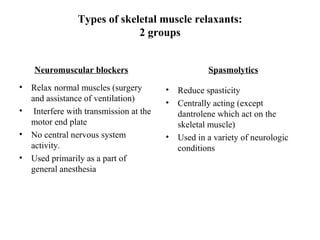
Types of skeletal muscle relaxants:
2 groups
Neuromuscular blockers
•
•
•
•

Relax normal muscles (surgery
and assistance of ventilation)
Interfere with transmission at the
motor end plate
No central nervous system
activity.
Used primarily as a part of
general anesthesia

Spasmolytics
•
•

•

Reduce spasticity
Centrally acting (except
dantrolene which act on the
skeletal muscle)
Used in a variety of neurologic
conditions
Neuromuscular Blocking Drugs
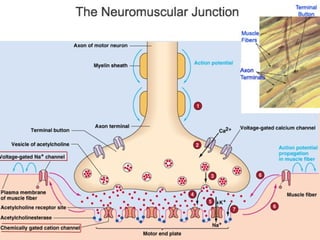
1- Transmission at the neuromuscular junction
1) Motor neuron depolarization causes action potential to travel down the nerve
fiber to the neuromuscular junction.
2) Depolarization of the axon terminal causes an influx of Ca 2+
3) Calcium influx triggers fusion of the synaptic vesicles with the membrane of the
neuron
4) Release of neurotransmitter (Acetylcholine; ACh)
5) ACh diffuses across the synaptic cleft and binds to post-synaptic nicotinic
receptor (NM) located on the muscle fiber at the motor end-plate .
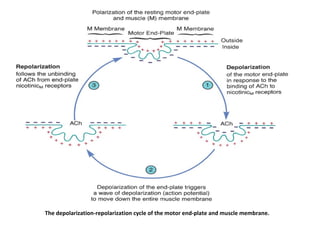
Binding of 2 molecules of ACh to the receptor opens the membrane channels
causing an influx of Na and outflux of K leading to depolarization of the end
plate membrane.
This change in voltage is termed the motor end plate potential. If the potential is
small, the permeability and the end plate potential return to normal without an
impulse being propagated from the end plate region to the rest of the muscle
membrane.
6) If the end plate potential is large, the adjacent muscle membrane is depolarized,
and an action potential will be propagated along the entire muscle fiber and
ultimately causes the release of Ca2+ from the sarcoplasmic reticulum causing
CONTRACTION.
7) Unbound ACh in synaptic cleft defuses away or is hydrolyzed (inactivated) by
acetylcholinesterase (AChE).
The depolarization-repolarization cycle of the motor end-plate and muscle membrane.
Neuromuscular blockers
Definition:
Drugs which relax skeletal muscles by acting at the neuromuscular junction.
o All of the available neuromuscular blocking drugs are similar in structure to
acetylcholine (e.g., succinylcholine is two acetylcholine molecules linked endto-end)
o All have one or two quaternary nitrogens, which makes them poorly lipidsoluble (not absorbed orally, must be given parenterally and have limited entry
into the CNS).
Types:
1- Antagonist (nondepolarizing) neuromuscular blocking drugs prevent access of
acetylcholine to its NM receptor and prevent depolarization of the motor end
plate (d-tubocurarine)
2- Agonist (depolarizing) neuromuscular blocking drugs produce excessive
depolarization of the motor end plate by causing excessive stimulation of the
NM receptor (Succinylcholine)
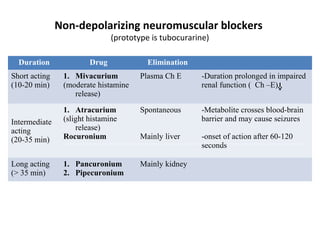
Non-depolarizing neuromuscular blockers
(prototype is tubocurarine)

Duration
Short acting
(10-20 min)

Drug

Elimination

1. Mivacurium
(moderate histamine
release)

Plasma Ch E

-Duration prolonged in impaired
renal function ( Ch –E)

Spontaneous

Intermediate
acting
(20-35 min)

1. Atracurium
(slight histamine
release)
Rocuronium

-Metabolite crosses blood-brain
barrier and may cause seizures

Mainly liver

-onset of action after 60-120
seconds

Long acting
(> 35 min)

1. Pancuronium
2. Pipecuronium

Mainly kidney
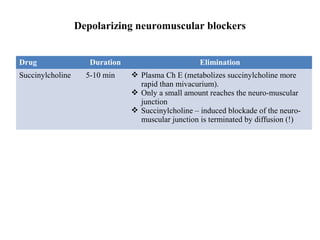
Depolarizing neuromuscular blockers
Drug
Succinylcholine

Duration
5-10 min

Elimination
 Plasma Ch E (metabolizes succinylcholine more
rapid than mivacurium).
 Only a small amount reaches the neuro-muscular
junction
 Succinylcholine – induced blockade of the neuromuscular junction is terminated by diffusion (!)
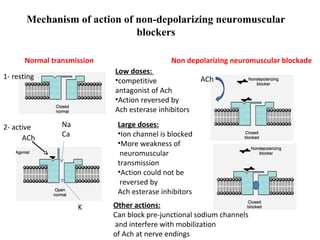
Mechanism of action of non-depolarizing neuromuscular
blockers
Normal transmission

Low doses:
•competitive
antagonist of Ach
•Action reversed by
Ach esterase inhibitors

1- resting

2- active
ACh

Non depolarizing neuromuscular blockade

Na
Ca

ACh

Large doses:
•Ion channel is blocked
•More weakness of
neuromuscular
transmission
•Action could not be
reversed by
Ach esterase inhibitors
K

Other actions:
Can block pre-junctional sodium channels
and interfere with mobilization
of Ach at nerve endings
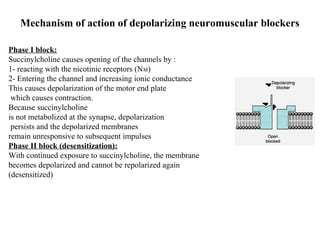
Mechanism of action of depolarizing neuromuscular blockers
Phase I block:
Succinylcholine causes opening of the channels by :
1- reacting with the nicotinic receptors (NM)
2- Entering the channel and increasing ionic conductance
This causes depolarization of the motor end plate
which causes contraction.
Because succinylcholine
is not metabolized at the synapse, depolarization
persists and the depolarized membranes
remain unresponsive to subsequent impulses
Phase II block (desensitization):
With continued exposure to succinylcholine, the membrane
becomes depolarized and cannot be repolarized again
(desensitized)
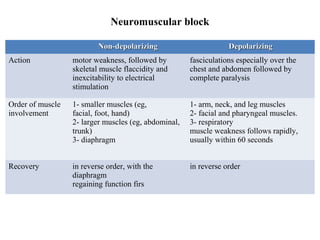
Neuromuscular block
Non-depolarizing

Depolarizing

Action

motor weakness, followed by
skeletal muscle flaccidity and
inexcitability to electrical
stimulation

fasciculations especially over the
chest and abdomen followed by
complete paralysis

Order of muscle
involvement

1- smaller muscles (eg,
facial, foot, hand)
2- larger muscles (eg, abdominal,
trunk)
3- diaphragm

1- arm, neck, and leg muscles
2- facial and pharyngeal muscles.
3- respiratory
muscle weakness follows rapidly,
usually within 60 seconds

Recovery

in reverse order, with the
diaphragm
regaining function firs

in reverse order
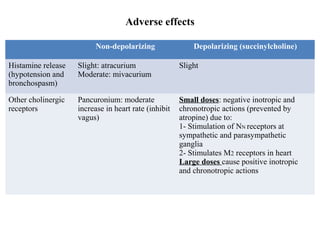
Adverse effects
Non-depolarizing

Depolarizing (succinylcholine)

Histamine release
(hypotension and
bronchospasm)

Slight: atracurium
Moderate: mivacurium

Slight

Other cholinergic
receptors

Pancuronium: moderate
increase in heart rate (inhibit
vagus)

Small doses: negative inotropic and
chronotropic actions (prevented by
atropine) due to:
1- Stimulation of NN receptors at
sympathetic and parasympathetic
ganglia
2- Stimulates M2 receptors in heart
Large doses cause positive inotropic
and chronotropic actions
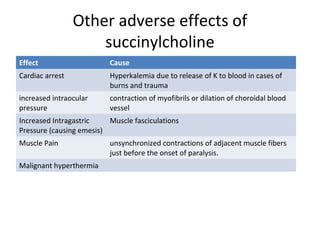
Other adverse effects of
succinylcholine
Effect

Cause

Cardiac arrest

Hyperkalemia due to release of K to blood in cases of
burns and trauma

increased intraocular
pressure

contraction of myofibrils or dilation of choroidal blood
vessel

Increased Intragastric
Muscle fasciculations
Pressure (causing emesis)
Muscle Pain
Malignant hyperthermia

unsynchronized contractions of adjacent muscle fibers
just before the onset of paralysis.
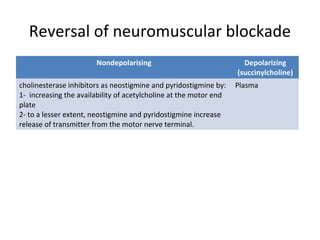
Reversal of neuromuscular blockade
Nondepolarising
cholinesterase inhibitors as neostigmine and pyridostigmine by:
1- increasing the availability of acetylcholine at the motor end
plate
2- to a lesser extent, neostigmine and pyridostigmine increase
release of transmitter from the motor nerve terminal.

Depolarizing
(succinylcholine)
Plasma
Interactions with other drugs
• Inhaled anesthetics: augment the
neuromuscular blockade produced by
nondepolarizing muscle relaxants because
1) CNS depression
2) peripheral vasodilatation which allows a
larger fraction of the injected muscle relaxant
to reach the neuromuscular junction
3) decreased sensitivity of the postjunctional
membrane to depolarization.
• Aminoglycosides: augment the
neuromuscular blockade produced by
nondepolarizing muscle relaxants by
decreasing release of Ach
• Local Anesthetics enhance the neuromuscular
block produced by both nondepolarizing and
depolarizing
Indications
1.
2.
3.

Muscle relaxation during surgery
Control of ventilation in critically ill patients with ventilatory failure
Treatment of Convulsions
Spasmolytic drugs
Definition of muscle spasm (spasticity):
1. Increased muscle tone
2. together with muscle weakness
It is often associated with cerebral palsy, multiple sclerosis, and stroke.
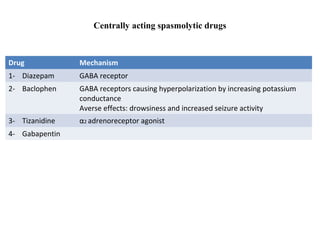
Centrally acting spasmolytic drugs

Drug

Mechanism

1- Diazepam

GABA receptor

2- Baclophen

GABA receptors causing hyperpolarization by increasing potassium
conductance
Averse effects: drowsiness and increased seizure activity

3- Tizanidine

α2 adrenoreceptor agonist

4- Gabapentin
Peripheraly acting spasmolytic drugs
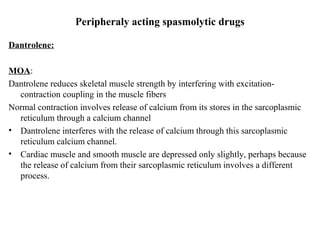
Dantrolene:
MOA:
Dantrolene reduces skeletal muscle strength by interfering with excitationcontraction coupling in the muscle fibers
Normal contraction involves release of calcium from its stores in the sarcoplasmic
reticulum through a calcium channel
• Dantrolene interferes with the release of calcium through this sarcoplasmic
reticulum calcium channel.
• Cardiac muscle and smooth muscle are depressed only slightly, perhaps because
the release of calcium from their sarcoplasmic reticulum involves a different
process.
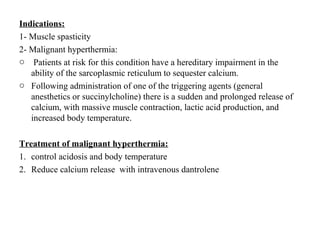
Indications:
1- Muscle spasticity
2- Malignant hyperthermia:
o Patients at risk for this condition have a hereditary impairment in the
ability of the sarcoplasmic reticulum to sequester calcium.
o Following administration of one of the triggering agents (general
anesthetics or succinylcholine) there is a sudden and prolonged release of
calcium, with massive muscle contraction, lactic acid production, and
increased body temperature.
Treatment of malignant hyperthermia:
1. control acidosis and body temperature
2. Reduce calcium release with intravenous dantrolene

Skeletal muscle relaxants

  • 1.
  • 2.
    Types of skeletalmuscle relaxants: 2 groups Neuromuscular blockers • • • • Relax normal muscles (surgery and assistance of ventilation) Interfere with transmission at the motor end plate No central nervous system activity. Used primarily as a part of general anesthesia Spasmolytics • • • Reduce spasticity Centrally acting (except dantrolene which act on the skeletal muscle) Used in a variety of neurologic conditions
  • 4.
    Neuromuscular Blocking Drugs 1-Transmission at the neuromuscular junction 1) Motor neuron depolarization causes action potential to travel down the nerve fiber to the neuromuscular junction. 2) Depolarization of the axon terminal causes an influx of Ca 2+ 3) Calcium influx triggers fusion of the synaptic vesicles with the membrane of the neuron 4) Release of neurotransmitter (Acetylcholine; ACh) 5) ACh diffuses across the synaptic cleft and binds to post-synaptic nicotinic receptor (NM) located on the muscle fiber at the motor end-plate . Binding of 2 molecules of ACh to the receptor opens the membrane channels causing an influx of Na and outflux of K leading to depolarization of the end plate membrane. This change in voltage is termed the motor end plate potential. If the potential is small, the permeability and the end plate potential return to normal without an impulse being propagated from the end plate region to the rest of the muscle membrane.
  • 5.
    6) If theend plate potential is large, the adjacent muscle membrane is depolarized, and an action potential will be propagated along the entire muscle fiber and ultimately causes the release of Ca2+ from the sarcoplasmic reticulum causing CONTRACTION. 7) Unbound ACh in synaptic cleft defuses away or is hydrolyzed (inactivated) by acetylcholinesterase (AChE).
  • 6.
    The depolarization-repolarization cycleof the motor end-plate and muscle membrane.
  • 7.
    Neuromuscular blockers Definition: Drugs whichrelax skeletal muscles by acting at the neuromuscular junction. o All of the available neuromuscular blocking drugs are similar in structure to acetylcholine (e.g., succinylcholine is two acetylcholine molecules linked endto-end) o All have one or two quaternary nitrogens, which makes them poorly lipidsoluble (not absorbed orally, must be given parenterally and have limited entry into the CNS). Types: 1- Antagonist (nondepolarizing) neuromuscular blocking drugs prevent access of acetylcholine to its NM receptor and prevent depolarization of the motor end plate (d-tubocurarine) 2- Agonist (depolarizing) neuromuscular blocking drugs produce excessive depolarization of the motor end plate by causing excessive stimulation of the NM receptor (Succinylcholine)
  • 8.
    Non-depolarizing neuromuscular blockers (prototypeis tubocurarine) Duration Short acting (10-20 min) Drug Elimination 1. Mivacurium (moderate histamine release) Plasma Ch E -Duration prolonged in impaired renal function ( Ch –E) Spontaneous Intermediate acting (20-35 min) 1. Atracurium (slight histamine release) Rocuronium -Metabolite crosses blood-brain barrier and may cause seizures Mainly liver -onset of action after 60-120 seconds Long acting (> 35 min) 1. Pancuronium 2. Pipecuronium Mainly kidney
  • 9.
    Depolarizing neuromuscular blockers Drug Succinylcholine Duration 5-10min Elimination  Plasma Ch E (metabolizes succinylcholine more rapid than mivacurium).  Only a small amount reaches the neuro-muscular junction  Succinylcholine – induced blockade of the neuromuscular junction is terminated by diffusion (!)
  • 10.
    Mechanism of actionof non-depolarizing neuromuscular blockers Normal transmission Low doses: •competitive antagonist of Ach •Action reversed by Ach esterase inhibitors 1- resting 2- active ACh Non depolarizing neuromuscular blockade Na Ca ACh Large doses: •Ion channel is blocked •More weakness of neuromuscular transmission •Action could not be reversed by Ach esterase inhibitors K Other actions: Can block pre-junctional sodium channels and interfere with mobilization of Ach at nerve endings
  • 11.
    Mechanism of actionof depolarizing neuromuscular blockers Phase I block: Succinylcholine causes opening of the channels by : 1- reacting with the nicotinic receptors (NM) 2- Entering the channel and increasing ionic conductance This causes depolarization of the motor end plate which causes contraction. Because succinylcholine is not metabolized at the synapse, depolarization persists and the depolarized membranes remain unresponsive to subsequent impulses Phase II block (desensitization): With continued exposure to succinylcholine, the membrane becomes depolarized and cannot be repolarized again (desensitized)
  • 12.
    Neuromuscular block Non-depolarizing Depolarizing Action motor weakness,followed by skeletal muscle flaccidity and inexcitability to electrical stimulation fasciculations especially over the chest and abdomen followed by complete paralysis Order of muscle involvement 1- smaller muscles (eg, facial, foot, hand) 2- larger muscles (eg, abdominal, trunk) 3- diaphragm 1- arm, neck, and leg muscles 2- facial and pharyngeal muscles. 3- respiratory muscle weakness follows rapidly, usually within 60 seconds Recovery in reverse order, with the diaphragm regaining function firs in reverse order
  • 13.
    Adverse effects Non-depolarizing Depolarizing (succinylcholine) Histaminerelease (hypotension and bronchospasm) Slight: atracurium Moderate: mivacurium Slight Other cholinergic receptors Pancuronium: moderate increase in heart rate (inhibit vagus) Small doses: negative inotropic and chronotropic actions (prevented by atropine) due to: 1- Stimulation of NN receptors at sympathetic and parasympathetic ganglia 2- Stimulates M2 receptors in heart Large doses cause positive inotropic and chronotropic actions
  • 14.
    Other adverse effectsof succinylcholine Effect Cause Cardiac arrest Hyperkalemia due to release of K to blood in cases of burns and trauma increased intraocular pressure contraction of myofibrils or dilation of choroidal blood vessel Increased Intragastric Muscle fasciculations Pressure (causing emesis) Muscle Pain Malignant hyperthermia unsynchronized contractions of adjacent muscle fibers just before the onset of paralysis.
  • 15.
    Reversal of neuromuscularblockade Nondepolarising cholinesterase inhibitors as neostigmine and pyridostigmine by: 1- increasing the availability of acetylcholine at the motor end plate 2- to a lesser extent, neostigmine and pyridostigmine increase release of transmitter from the motor nerve terminal. Depolarizing (succinylcholine) Plasma
  • 16.
    Interactions with otherdrugs • Inhaled anesthetics: augment the neuromuscular blockade produced by nondepolarizing muscle relaxants because 1) CNS depression 2) peripheral vasodilatation which allows a larger fraction of the injected muscle relaxant to reach the neuromuscular junction 3) decreased sensitivity of the postjunctional membrane to depolarization.
  • 17.
    • Aminoglycosides: augmentthe neuromuscular blockade produced by nondepolarizing muscle relaxants by decreasing release of Ach • Local Anesthetics enhance the neuromuscular block produced by both nondepolarizing and depolarizing
  • 18.
    Indications 1. 2. 3. Muscle relaxation duringsurgery Control of ventilation in critically ill patients with ventilatory failure Treatment of Convulsions
  • 19.
    Spasmolytic drugs Definition ofmuscle spasm (spasticity): 1. Increased muscle tone 2. together with muscle weakness It is often associated with cerebral palsy, multiple sclerosis, and stroke.
  • 20.
    Centrally acting spasmolyticdrugs Drug Mechanism 1- Diazepam GABA receptor 2- Baclophen GABA receptors causing hyperpolarization by increasing potassium conductance Averse effects: drowsiness and increased seizure activity 3- Tizanidine α2 adrenoreceptor agonist 4- Gabapentin
  • 21.
    Peripheraly acting spasmolyticdrugs Dantrolene: MOA: Dantrolene reduces skeletal muscle strength by interfering with excitationcontraction coupling in the muscle fibers Normal contraction involves release of calcium from its stores in the sarcoplasmic reticulum through a calcium channel • Dantrolene interferes with the release of calcium through this sarcoplasmic reticulum calcium channel. • Cardiac muscle and smooth muscle are depressed only slightly, perhaps because the release of calcium from their sarcoplasmic reticulum involves a different process.
  • 22.
    Indications: 1- Muscle spasticity 2-Malignant hyperthermia: o Patients at risk for this condition have a hereditary impairment in the ability of the sarcoplasmic reticulum to sequester calcium. o Following administration of one of the triggering agents (general anesthetics or succinylcholine) there is a sudden and prolonged release of calcium, with massive muscle contraction, lactic acid production, and increased body temperature. Treatment of malignant hyperthermia: 1. control acidosis and body temperature 2. Reduce calcium release with intravenous dantrolene