EXCITATION CONTRACTION
COUPLING.
MAHEEN ZEESHAN
3RD YEAR (5TH SEMESTER)
EP1865037
Objectives:
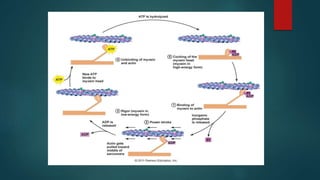
 The contraction cycle
 Excitation contraction coupling
 Neuromuscular junction
 THE CONTRACION CYCLE :
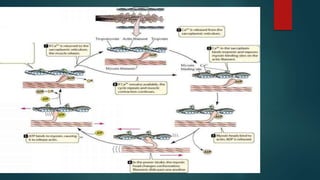
 The contraction cycle starts when sarcoplasm reticulum releases calcium ions into
sarcoplasm. In sarcoplasm they bind to troponin , troponin then moves to tropomyosin
away rom myosin binding sites on actin.
 The contraction cycle consist of 4 steps.
 1: ATP HYDROLYSIS:
 The myosin heads have ATP binding site.
 ATPase enzyme that hydrolyze ATP into ADP and phosphate.
 This hydrolyze reaction reenergize the myosin heads.
 2: ATTACHMENT OF MYOSIN TO ACTIN TO FORM CROSS BRIDGES:
 The energized myosin head attaches to the myosin binding site on actin and releases
the hydrolysed phosphate group.
 In contraction cycle the myosin heads attach to actin and the cross bridges are formed.
 3: POWER STROKE:
 The power stroke phase occurs after formation of cross bridges.
 In which the site of bridge where ADP attaches are open,in the result of cross bridge
rotates and release the ADP.
 It generate the force and rotates towards the center of sarcomere, sliding the thin
filaments and past the thick filaments towards the M line.
 4: DETACHMENT OF MYOSIN FROM ACTIN:
 At the end of power stroke , the cross bridge remain attach to actin until it binds to
another ATP molecule.
 As ATP binds to ATP binding site on the myosin head, the myosin head detaches from
actin.
 EXCITATION CONTRACTION COUPLING:
 It is a physiological process of converting an electrical stimulus to a mechanical
response.
1: TRANSVERSE TUBLE-SARCOPLASM RETICULUM:
1. The T-tubules are very small and run transverse to the myofibrils.
2. They present at the cell membrane and penetrate all the way from one sideof the muscle
fiber to the opposite side.
3. Therefore, they communicate with the extra-cellular fluid surrounding the muscle fiber , and
they contain ESF in their lumens.
4. T-tubule are internal extension of muscle cell membrane, therefore when an action potential
spreads over a muscle fiber membrane , the potential change also spreads deep interior
muscle fiber along with T-tubule.
5. The electric current surrounding these T-tubule then elicit muscle extraction.
2. Release Of Calcium Ions BY Sarcoplasm Reticulum:
 In sarcoplasm reticulum there is vesicular-tubule in which the calcium ions
are high in concentration.
 Many of these calcium ions are released from each vesicle when action
potential occurs in the adjacent T-tubule.
 When the current flow in the sarcoplasm reticulum cisternae through T-
tubule it causes rapid opening of large number of calcium channels.
 These channels are open for a few milliseconds during this time , enough
calcium ions released into the sarcoplasm sorroundings the myofibrils to
cause contraction.
3: Troponin
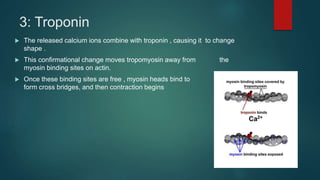
 The released calcium ions combine with troponin , causing it to change
shape .
 This confirmational change moves tropomyosin away from the
myosin binding sites on actin.
 Once these binding sites are free , myosin heads bind to them to
form cross bridges, and then contraction begins
AFTER CONTRACTION PHASE :
 1-CALCIUM PUMP FOR REMOVING CALCIUM IONS FROM THE
MYOFIBRILLAR FLUID:
 The calcium ions released from sarcoplasm reticulum and have diffuse
among the myofibrils, muscle contraction continues until calcium ions is in
high concentration.
 A calcium pump located in the walls of sarcoplasm reticulum pumps the
calcium ions away from the myofibrils back into sarcoplasm tubules.
 This pump can concentrate the calcium ions about 10,000 folds inside the
tubule.
 Inside the tubule there is a protein called calsequestrin that can bind upto
40 times more calcium.
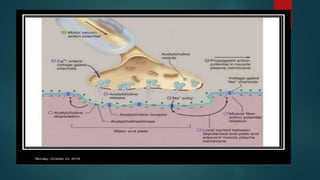
NEUROMUSCLAR JUNCTION:
 Following are the events occurs in neuromuscular junction.
 Nerve impulse arrives at axon terminal of motor neuron and triggers
release of acetylcholine.
 Ach diffuses across synaptic cleft, binds to its receptors in the motor end
plate and triggers a muscle action potential.
 The enzyme acetylcholinesterase in synaptic cleft destroys acetylcholine
so another muscle action potentional doesnot arise until more
acetylcholineis released from the motor neuron.
 Muscle action potential travelling along tranverse tubule opens calcium
release channels in the saroplasimic reticulum membrane , which allows
calcium ions to flood into the sarcoplasm.
 Calcium binds to troponin on the thin filament , exposing the binding sites
for myosin.
NEUROMUSCULAR JUNCTION:
 Muscle Contracted
 power strokes use ATP, myosin heads bind to actin and release thin
filaments to pulled toward centre of sarcomere .
 Calcium releases channels in sarcoplasmic close and calcium active
transport pumps use ATP to restore low level of calcium in sarcoplasm.
 Troponin – tropomysin complex slides back into position where it blocks
the myosin binding sites on actin.
 Muscles relaxes.
THANK YOU

Excitation contraction coupling

  • 1.
    EXCITATION CONTRACTION COUPLING. MAHEEN ZEESHAN 3RDYEAR (5TH SEMESTER) EP1865037 Objectives:  The contraction cycle  Excitation contraction coupling  Neuromuscular junction
  • 2.
     THE CONTRACIONCYCLE :  The contraction cycle starts when sarcoplasm reticulum releases calcium ions into sarcoplasm. In sarcoplasm they bind to troponin , troponin then moves to tropomyosin away rom myosin binding sites on actin.  The contraction cycle consist of 4 steps.  1: ATP HYDROLYSIS:  The myosin heads have ATP binding site.  ATPase enzyme that hydrolyze ATP into ADP and phosphate.  This hydrolyze reaction reenergize the myosin heads.  2: ATTACHMENT OF MYOSIN TO ACTIN TO FORM CROSS BRIDGES:  The energized myosin head attaches to the myosin binding site on actin and releases the hydrolysed phosphate group.  In contraction cycle the myosin heads attach to actin and the cross bridges are formed.
  • 3.
     3: POWERSTROKE:  The power stroke phase occurs after formation of cross bridges.  In which the site of bridge where ADP attaches are open,in the result of cross bridge rotates and release the ADP.  It generate the force and rotates towards the center of sarcomere, sliding the thin filaments and past the thick filaments towards the M line.  4: DETACHMENT OF MYOSIN FROM ACTIN:  At the end of power stroke , the cross bridge remain attach to actin until it binds to another ATP molecule.  As ATP binds to ATP binding site on the myosin head, the myosin head detaches from actin.
  • 5.
     EXCITATION CONTRACTIONCOUPLING:  It is a physiological process of converting an electrical stimulus to a mechanical response. 1: TRANSVERSE TUBLE-SARCOPLASM RETICULUM: 1. The T-tubules are very small and run transverse to the myofibrils. 2. They present at the cell membrane and penetrate all the way from one sideof the muscle fiber to the opposite side. 3. Therefore, they communicate with the extra-cellular fluid surrounding the muscle fiber , and they contain ESF in their lumens. 4. T-tubule are internal extension of muscle cell membrane, therefore when an action potential spreads over a muscle fiber membrane , the potential change also spreads deep interior muscle fiber along with T-tubule. 5. The electric current surrounding these T-tubule then elicit muscle extraction.
  • 6.
    2. Release OfCalcium Ions BY Sarcoplasm Reticulum:  In sarcoplasm reticulum there is vesicular-tubule in which the calcium ions are high in concentration.  Many of these calcium ions are released from each vesicle when action potential occurs in the adjacent T-tubule.  When the current flow in the sarcoplasm reticulum cisternae through T- tubule it causes rapid opening of large number of calcium channels.  These channels are open for a few milliseconds during this time , enough calcium ions released into the sarcoplasm sorroundings the myofibrils to cause contraction.
  • 7.
    3: Troponin  Thereleased calcium ions combine with troponin , causing it to change shape .  This confirmational change moves tropomyosin away from the myosin binding sites on actin.  Once these binding sites are free , myosin heads bind to them to form cross bridges, and then contraction begins
  • 8.
    AFTER CONTRACTION PHASE:  1-CALCIUM PUMP FOR REMOVING CALCIUM IONS FROM THE MYOFIBRILLAR FLUID:  The calcium ions released from sarcoplasm reticulum and have diffuse among the myofibrils, muscle contraction continues until calcium ions is in high concentration.  A calcium pump located in the walls of sarcoplasm reticulum pumps the calcium ions away from the myofibrils back into sarcoplasm tubules.  This pump can concentrate the calcium ions about 10,000 folds inside the tubule.  Inside the tubule there is a protein called calsequestrin that can bind upto 40 times more calcium.
  • 10.
    NEUROMUSCLAR JUNCTION:  Followingare the events occurs in neuromuscular junction.  Nerve impulse arrives at axon terminal of motor neuron and triggers release of acetylcholine.  Ach diffuses across synaptic cleft, binds to its receptors in the motor end plate and triggers a muscle action potential.  The enzyme acetylcholinesterase in synaptic cleft destroys acetylcholine so another muscle action potentional doesnot arise until more acetylcholineis released from the motor neuron.  Muscle action potential travelling along tranverse tubule opens calcium release channels in the saroplasimic reticulum membrane , which allows calcium ions to flood into the sarcoplasm.  Calcium binds to troponin on the thin filament , exposing the binding sites for myosin.
  • 11.
    NEUROMUSCULAR JUNCTION:  MuscleContracted  power strokes use ATP, myosin heads bind to actin and release thin filaments to pulled toward centre of sarcomere .  Calcium releases channels in sarcoplasmic close and calcium active transport pumps use ATP to restore low level of calcium in sarcoplasm.  Troponin – tropomysin complex slides back into position where it blocks the myosin binding sites on actin.  Muscles relaxes.
  • 13.