




Congratulations…….. On Joining the Six Sigma Journey
What is Quality? Know Six Sigma Introduction to Six Sigma as methodology Awareness with respect to origin and history of Six Sigma. The Six Sigma organization  Variation and Normal Distribution The Pareto Principle reading and Making Paretos.
What is Quality?
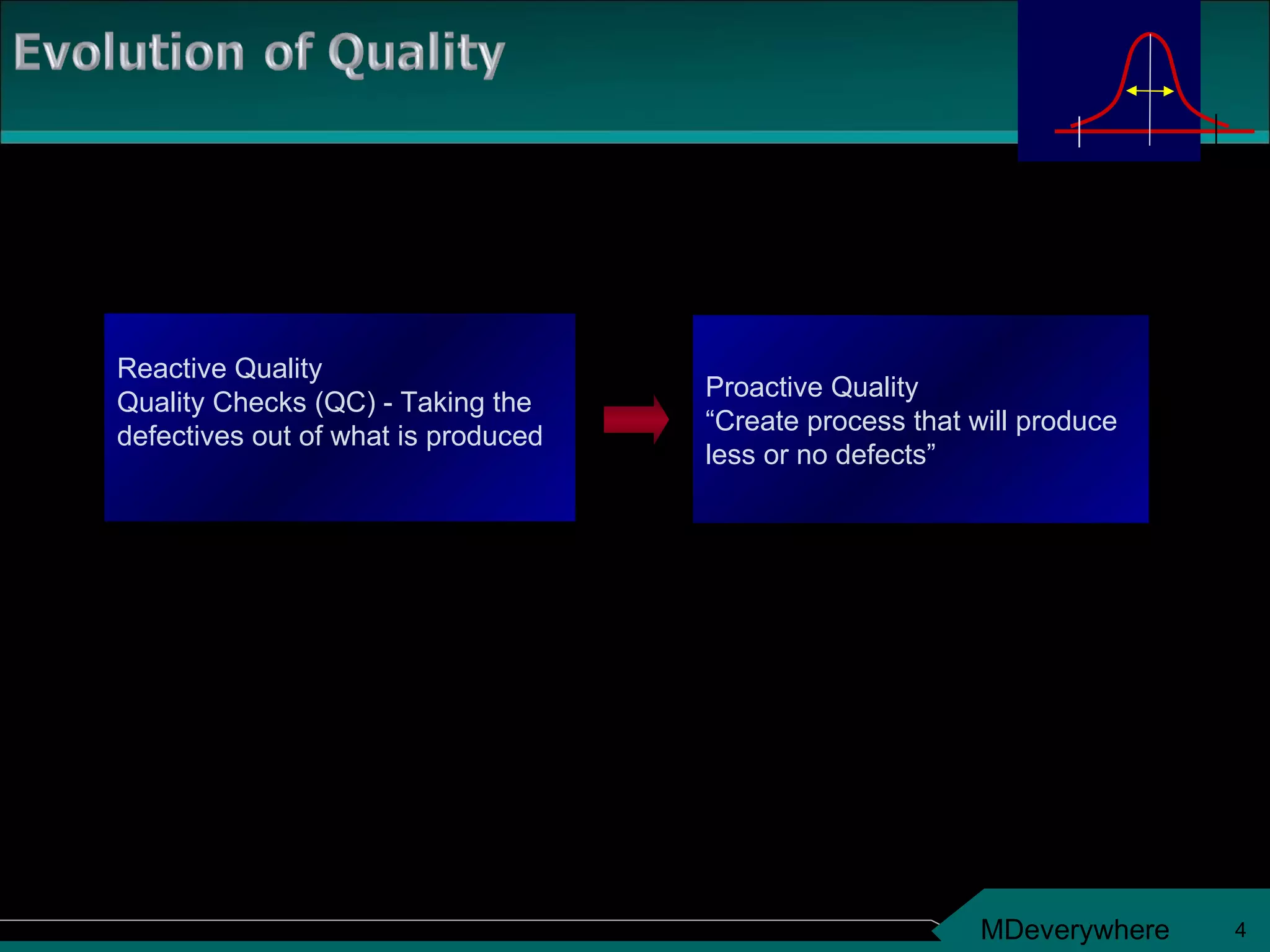
Historically Proactive Quality “ Create process that will produce less or no defects” Contemporary Reactive Quality Quality Checks (QC) - Taking the defectives out of what is produced
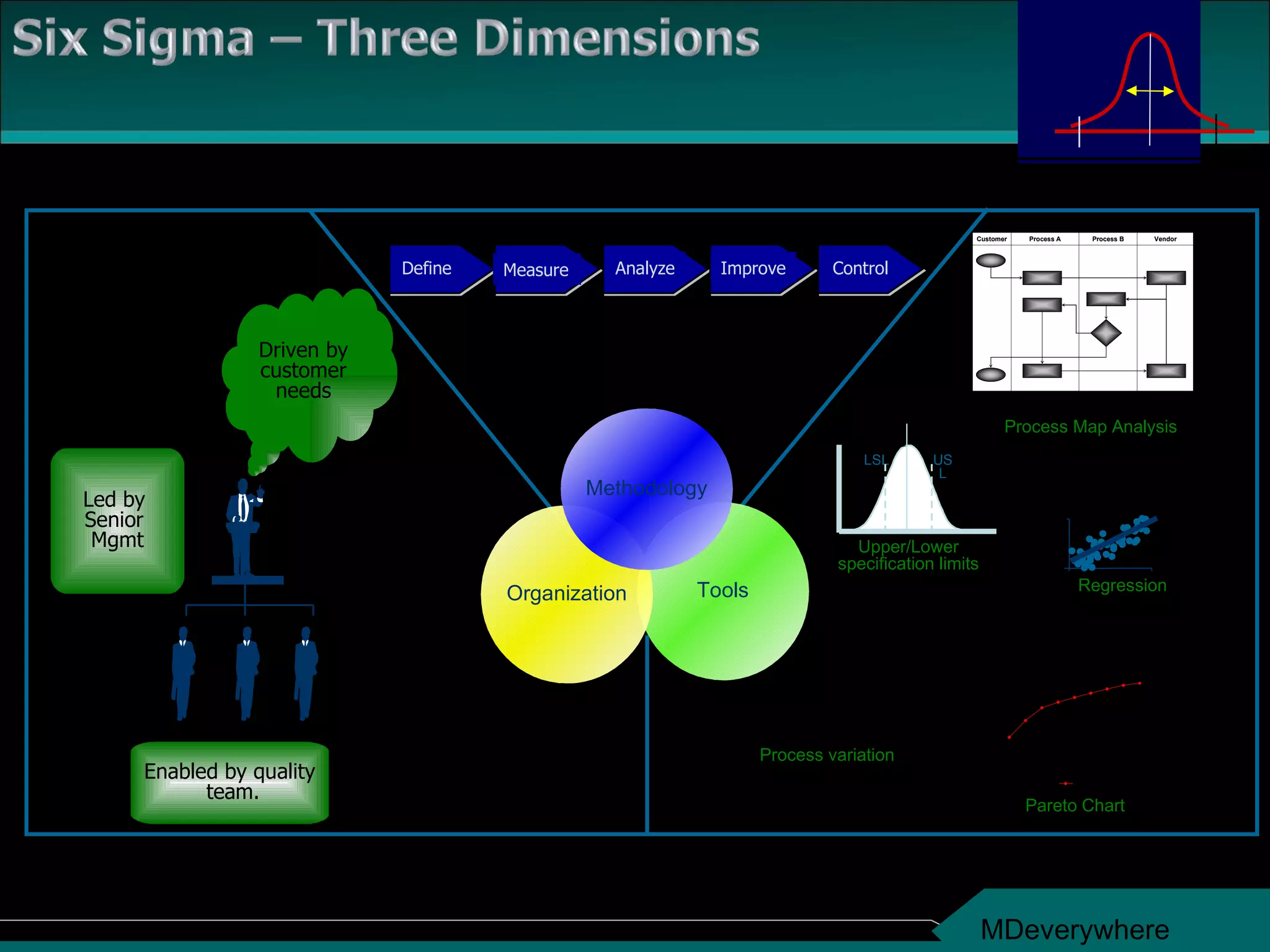
Tools Organization Methodology Driven by customer needs Enabled by quality team. Led by  Senior  Mgmt Define Measure Analyze Improve Control Process Map Analysis Pareto Chart Process   variation LSL USL Upper/Lower specification limits Regression • • • • • • • • • • • • • • • • • • • • • • • • • • • • • • • • • • • • • • • • • • • • • •
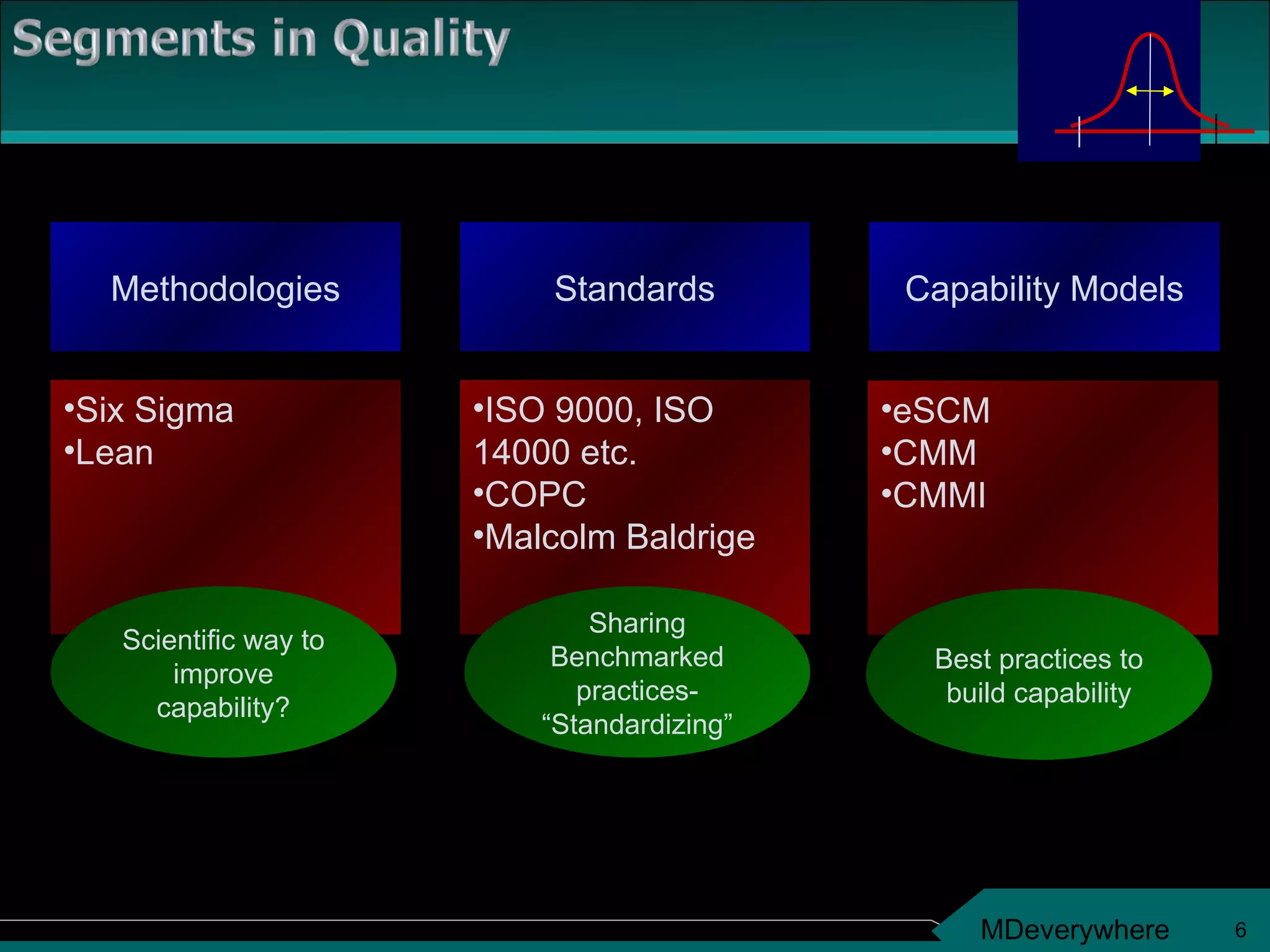
Methodologies Standards Capability Models Six Sigma Lean ISO 9000, ISO 14000 etc. COPC Malcolm Baldrige eSCM CMM CMMI Scientific way to improve capability? Sharing Benchmarked practices- “Standardizing” Best practices to build capability
It is a methodology for continuous improvement It is a methodology for creating products/ processes that perform at high standards It is a set of statistical and other quality tools arranged in unique way It is a way of knowing where you are and where you could be! It is a Quality Philosophy and a management technique Six Sigma is not: A standard A certification Another metric like percentage
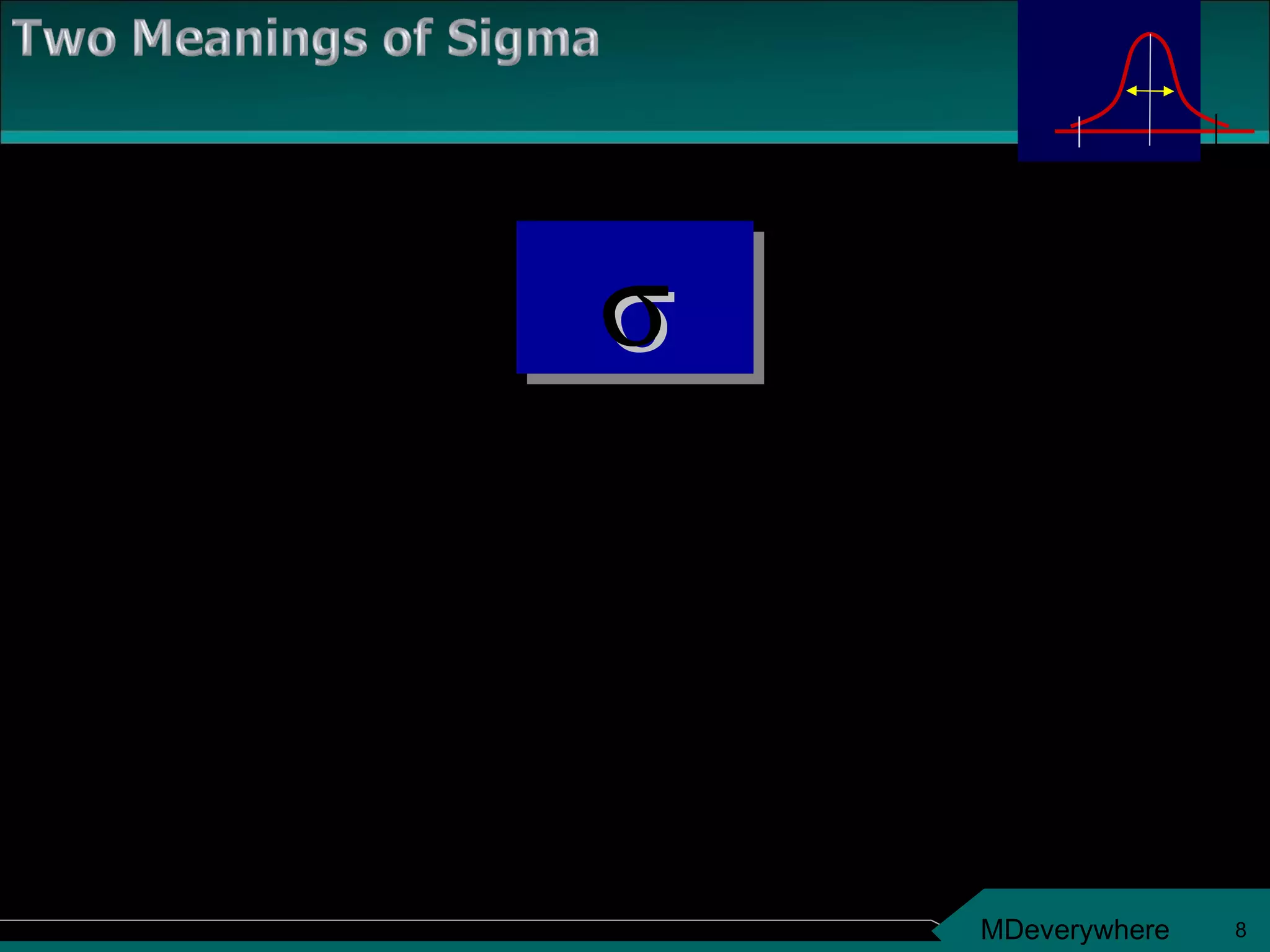
The term “sigma” is used to designate the distribution or spread about the mean (average) of any process or procedure. For a process, the sigma capability (z-value) is a metric that indicates how well that process is performing. The higher the sigma capability, the better. Sigma capability measures the capability of the process to produce defect-free outputs. A defect is anything that results in customer dissatisfaction. 
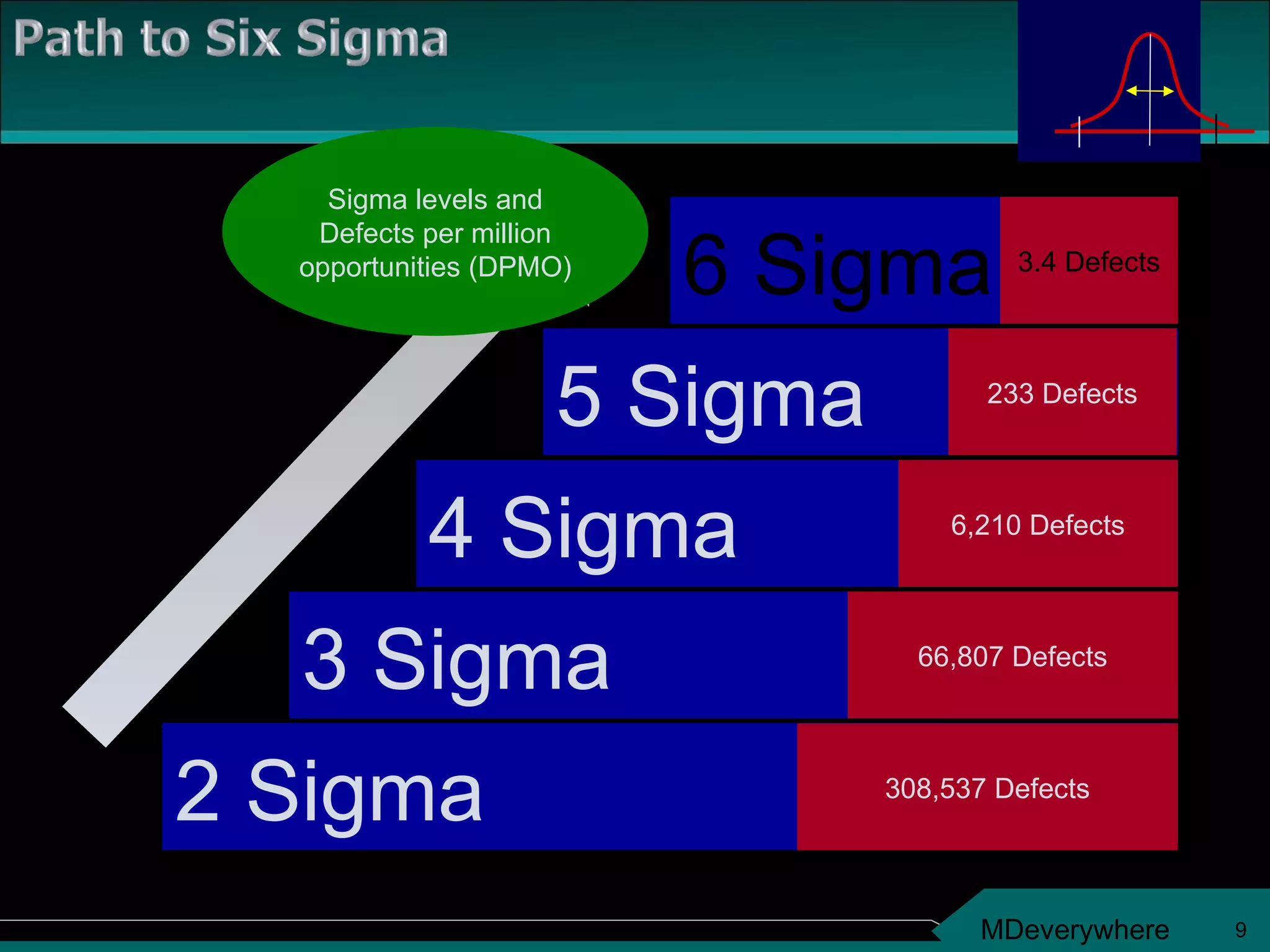
Sigma levels and Defects per million opportunities (DPMO) 4 Sigma 6,210 Defects 2 Sigma 308,537 Defects 3 Sigma 66,807 Defects 5 Sigma 233 Defects 6 Sigma 3.4 Defects
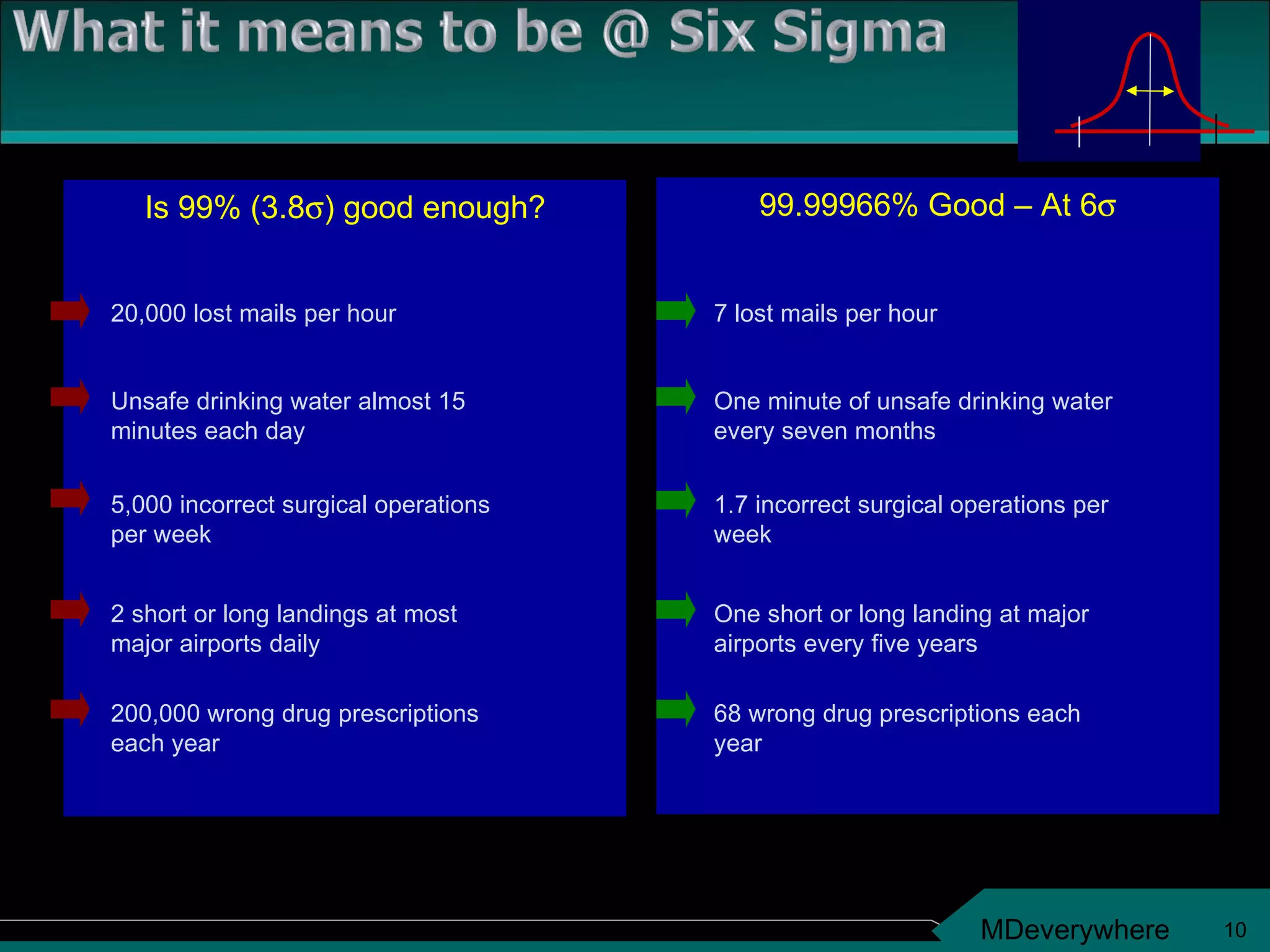
Example quoted from GE Book of Knowledge -  copyright GE Is 99% (3.8  ) good enough? 99.99966% Good – At 6  20,000 lost mails per hour 7 lost mails per hour Unsafe drinking water almost 15 minutes each day One minute of unsafe drinking water every seven months 5,000 incorrect surgical operations per week 1.7 incorrect surgical operations per week 2 short or long landings at most major airports daily One short or long landing at major airports every five years 200,000 wrong drug prescriptions each year 68 wrong drug prescriptions each year
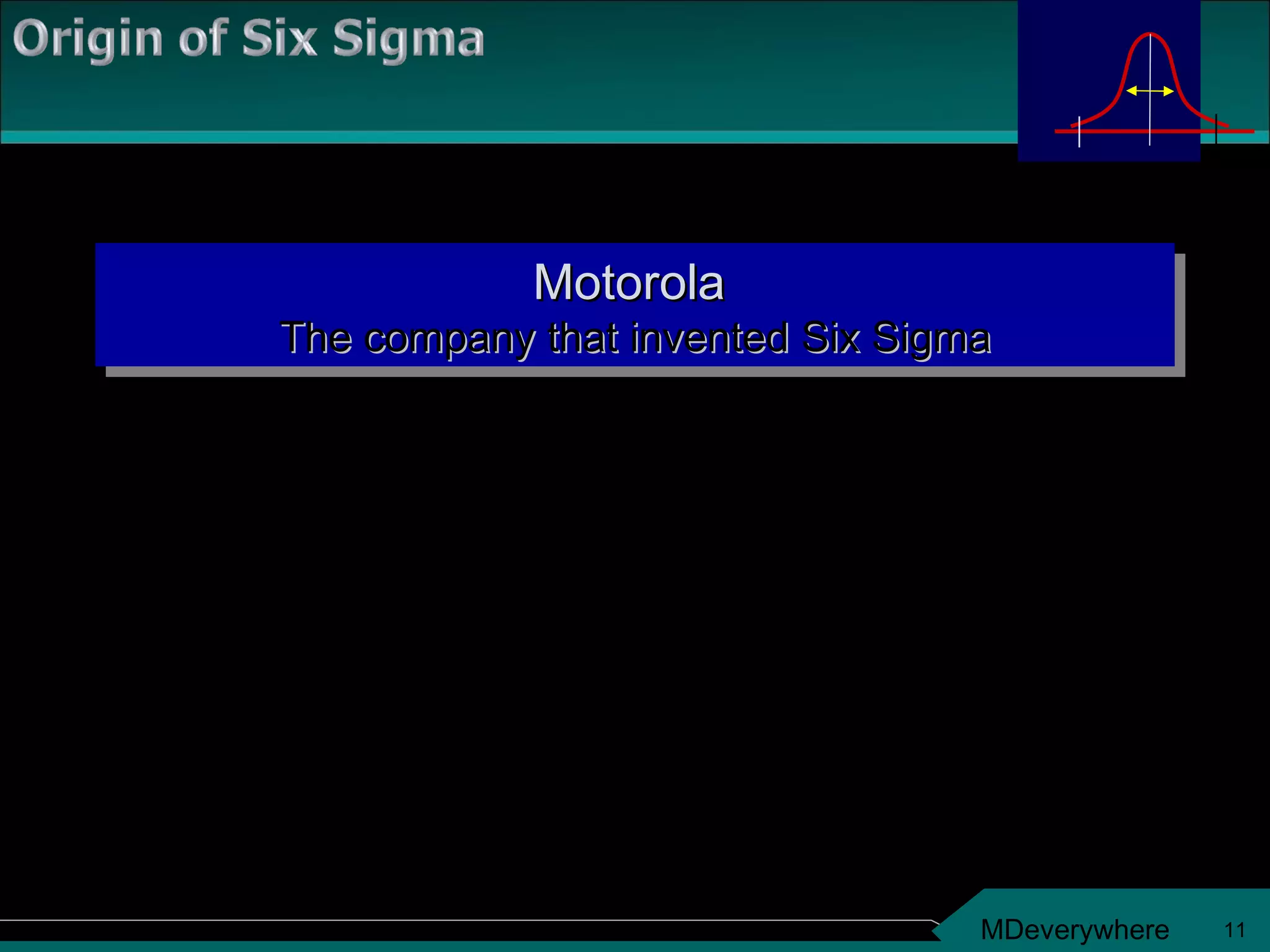
The term “Six Sigma” was coined by Bill Smith, an engineer with Motorola Late 1970s - Motorola started experimenting with problem solving through statistical analysis 1987 - Motorola officially launched it’s Six Sigma program Motorola   The company that invented Six Sigma
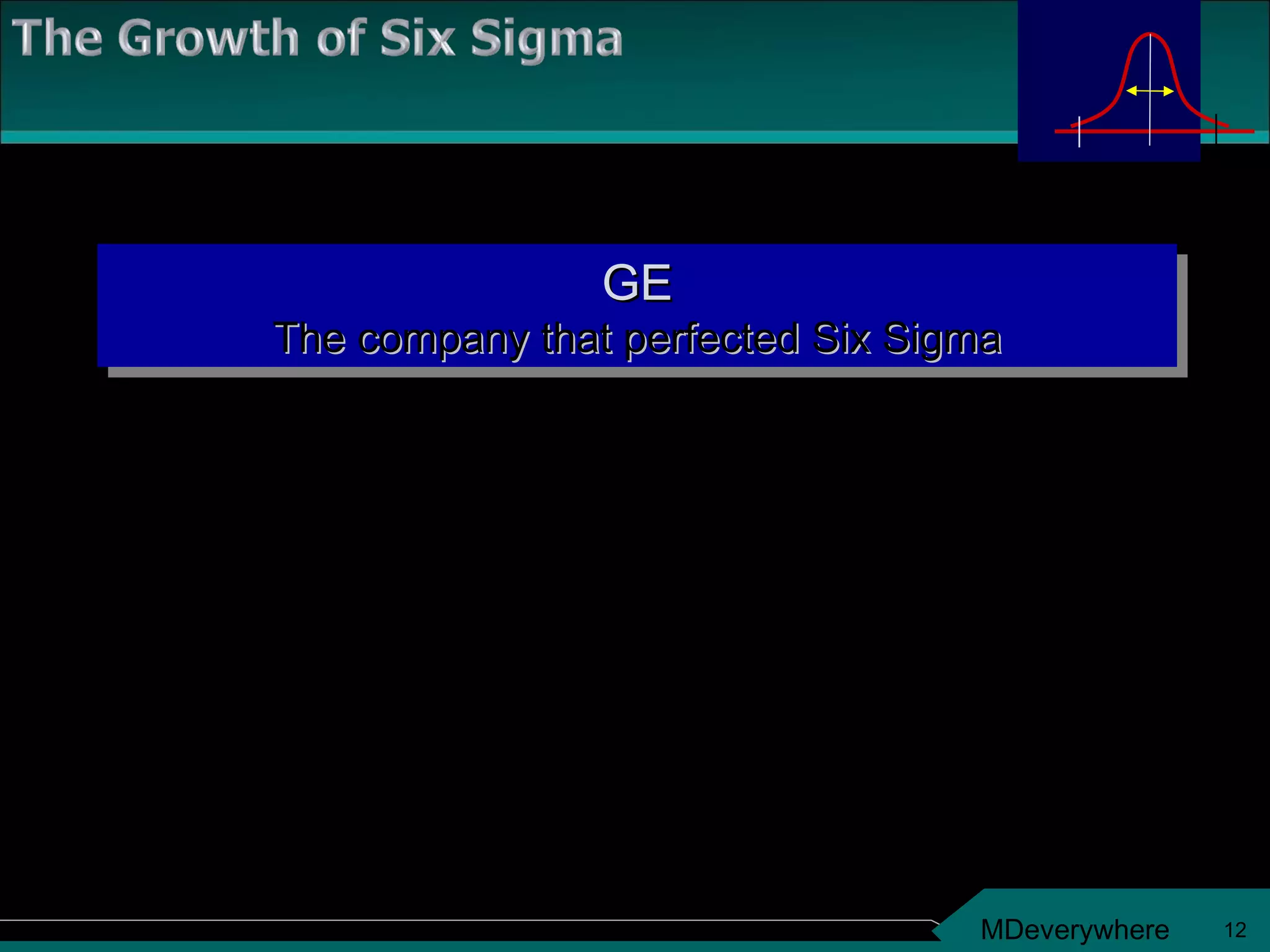
Jack Welch launched Six Sigma at GE in Jan,1996 1998/99 - Green Belt exam certification became the criteria for management promotions 2002/03 - Green Belt  certification became the criteria for promotion to management roles GE The company that perfected Six Sigma
http://en.wikipedia.org/wiki/List_of_Six_Sigma_companies
And Now…
Six Sigma Organization
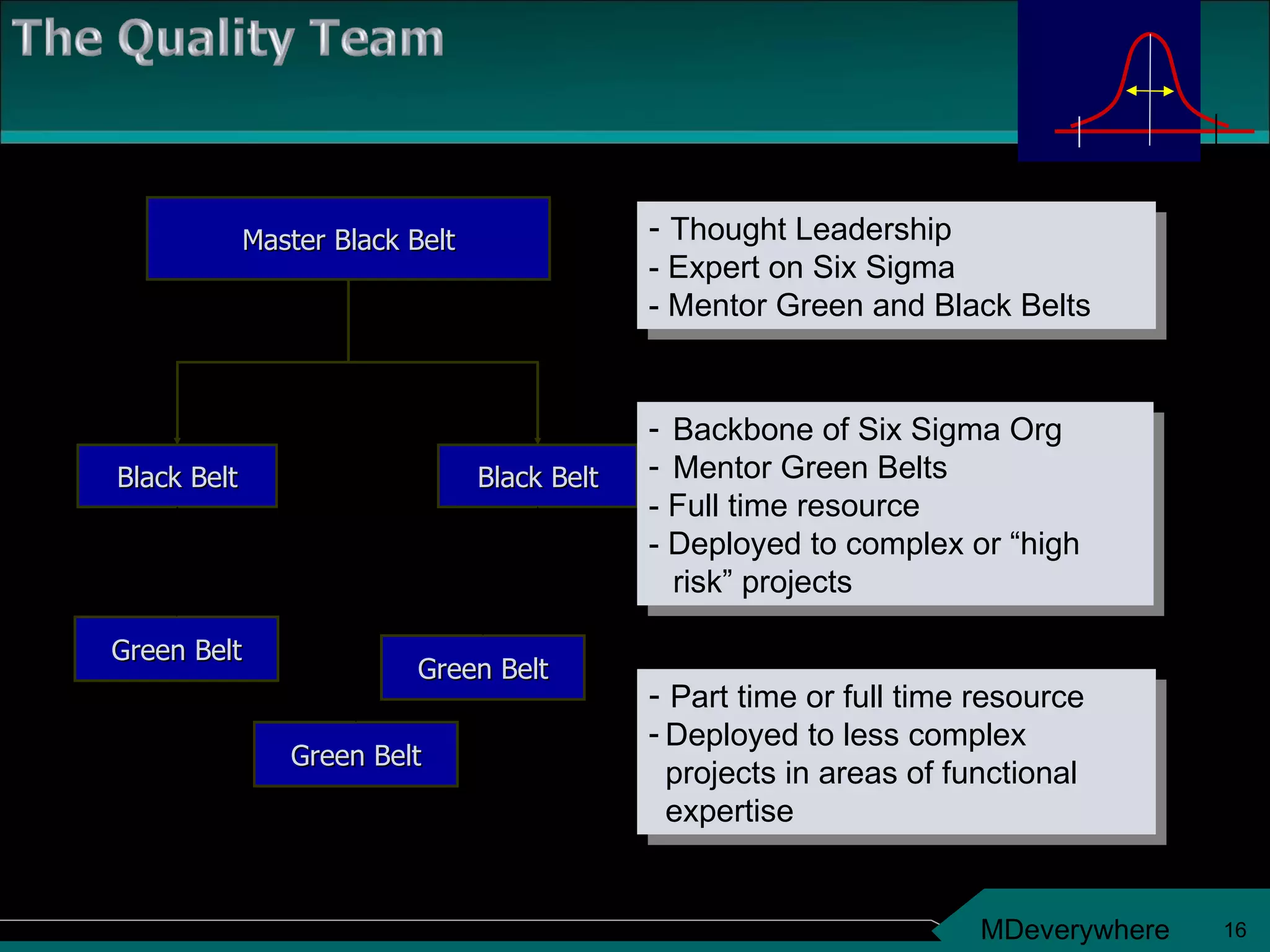
Master Black Belt Black Belt Black Belt Green Belt Green Belt Green Belt -  Thought Leadership - Expert on Six Sigma - Mentor Green and Black Belts Backbone of Six Sigma Org Mentor Green Belts - Full time resource - Deployed to complex or “high risk” projects -  Part time or full time resource Deployed to less complex projects in areas of functional expertise
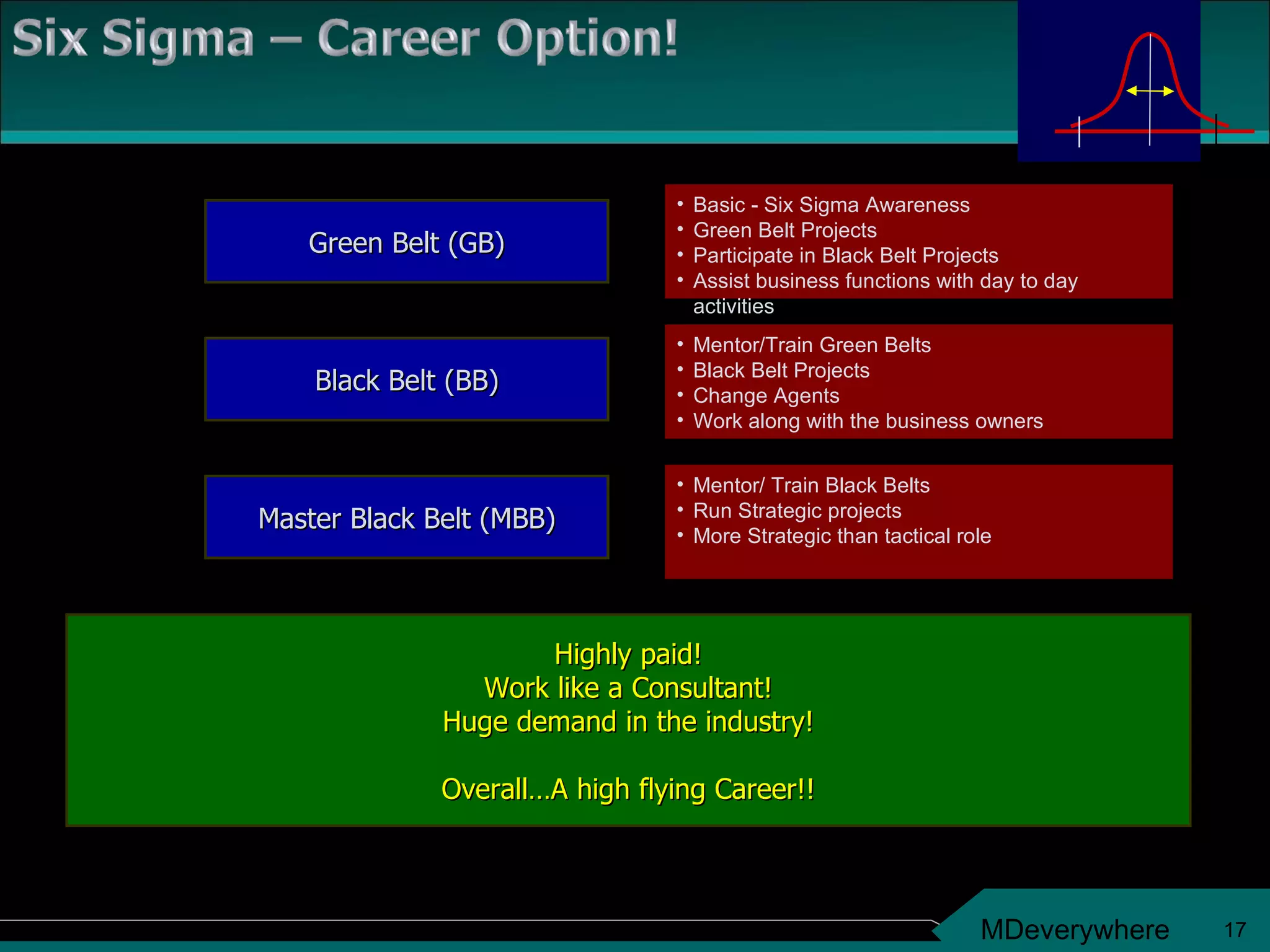
Basic - Six Sigma Awareness Green Belt Projects Participate in Black Belt Projects Assist business functions with day to day activities Mentor/Train Green Belts Black Belt Projects Change Agents Work along with the business owners Mentor/ Train Black Belts Run Strategic projects More Strategic than tactical role Green Belt (GB) Black Belt (BB) Master Black Belt (MBB) Highly paid! Work like a Consultant! Huge demand in the industry! Overall…A high flying Career!!
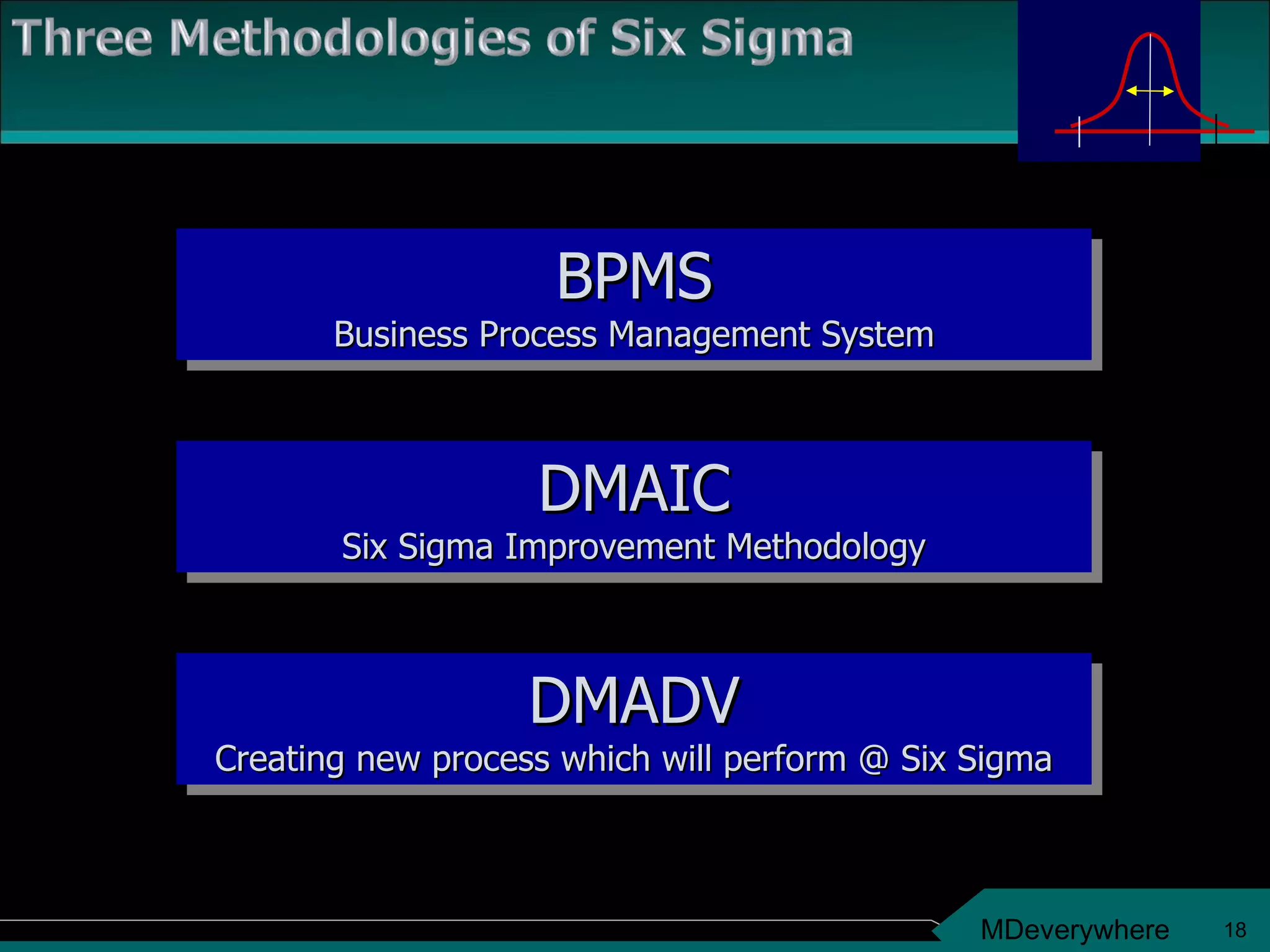
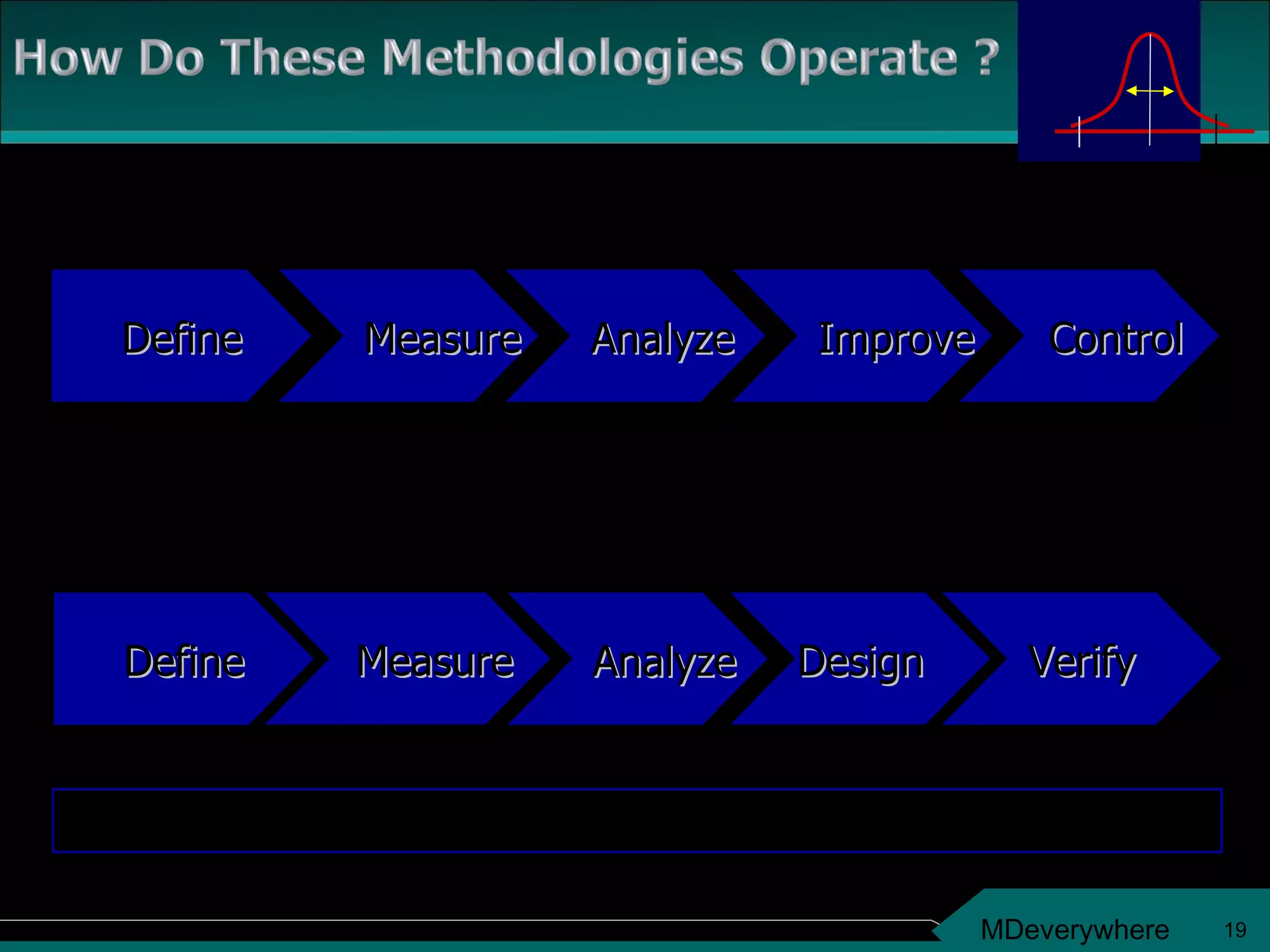
BPMS Business Process Management System DMAIC Six Sigma Improvement Methodology DMADV Creating new process which will perform @ Six Sigma
THE DMAIC  MODEL – For attaining Excellence  in existing Processes Define Measure Analyze Improve Control Combination of change management & statistical analysis Define Measure Analyze Design Verify THE DMADV MODEL -  Setting up New Processes to Deliver @ SIX SIGMA also known as DFSS ( Design For Six Sigma)
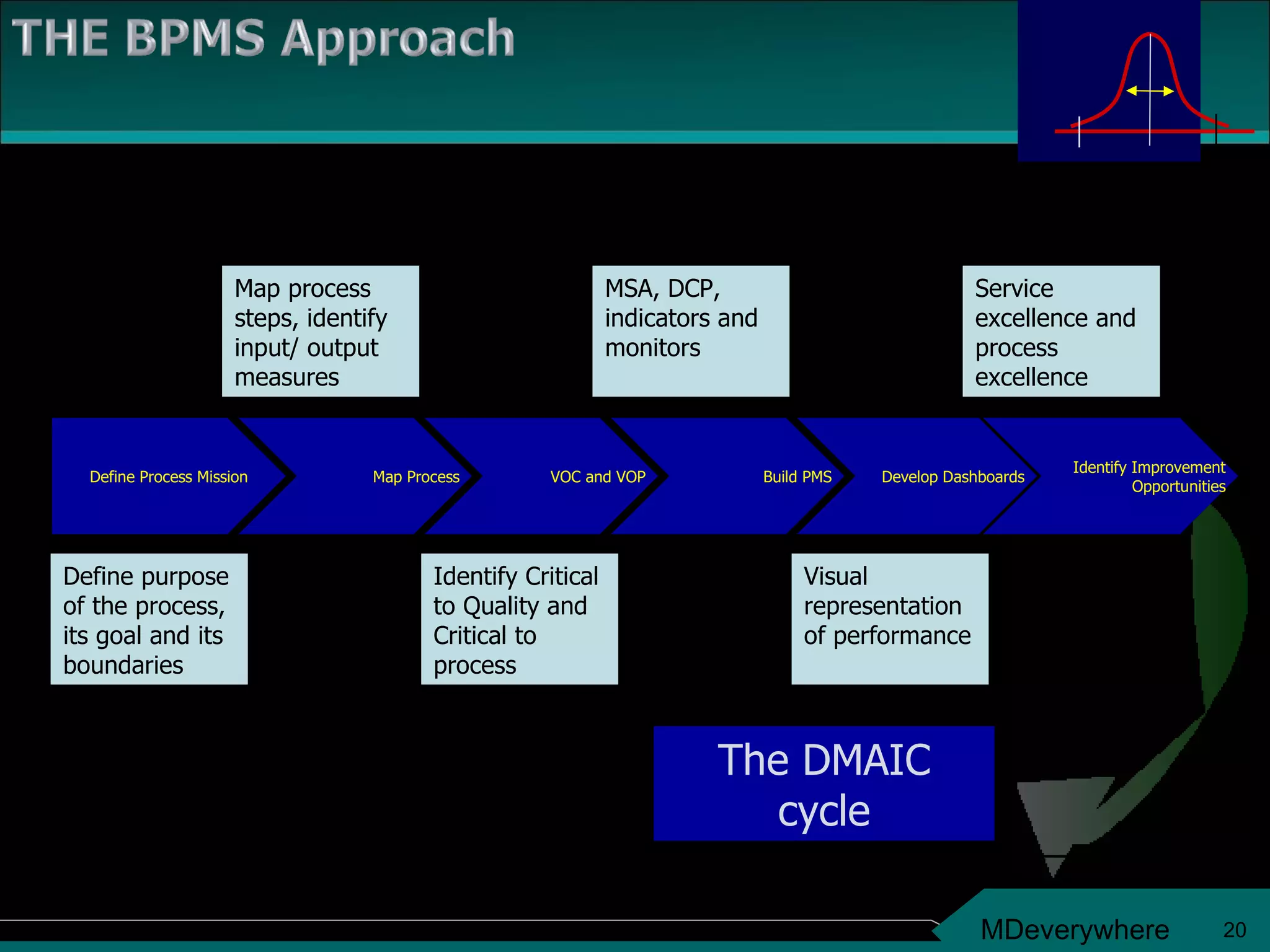
Define purpose of the process, its goal and its boundaries Identify Critical to Quality and Critical to process Visual representation of performance Map process steps, identify input/ output measures MSA, DCP, indicators and monitors Service excellence and process excellence The DMAIC cycle Define Process Mission Map Process VOC and VOP Build PMS Develop Dashboards Identify Improvement Opportunities
To understand the process; it’s mission, flow and scope To know the customers and their expectations To identify, monitor and improve correct performance measures for the process
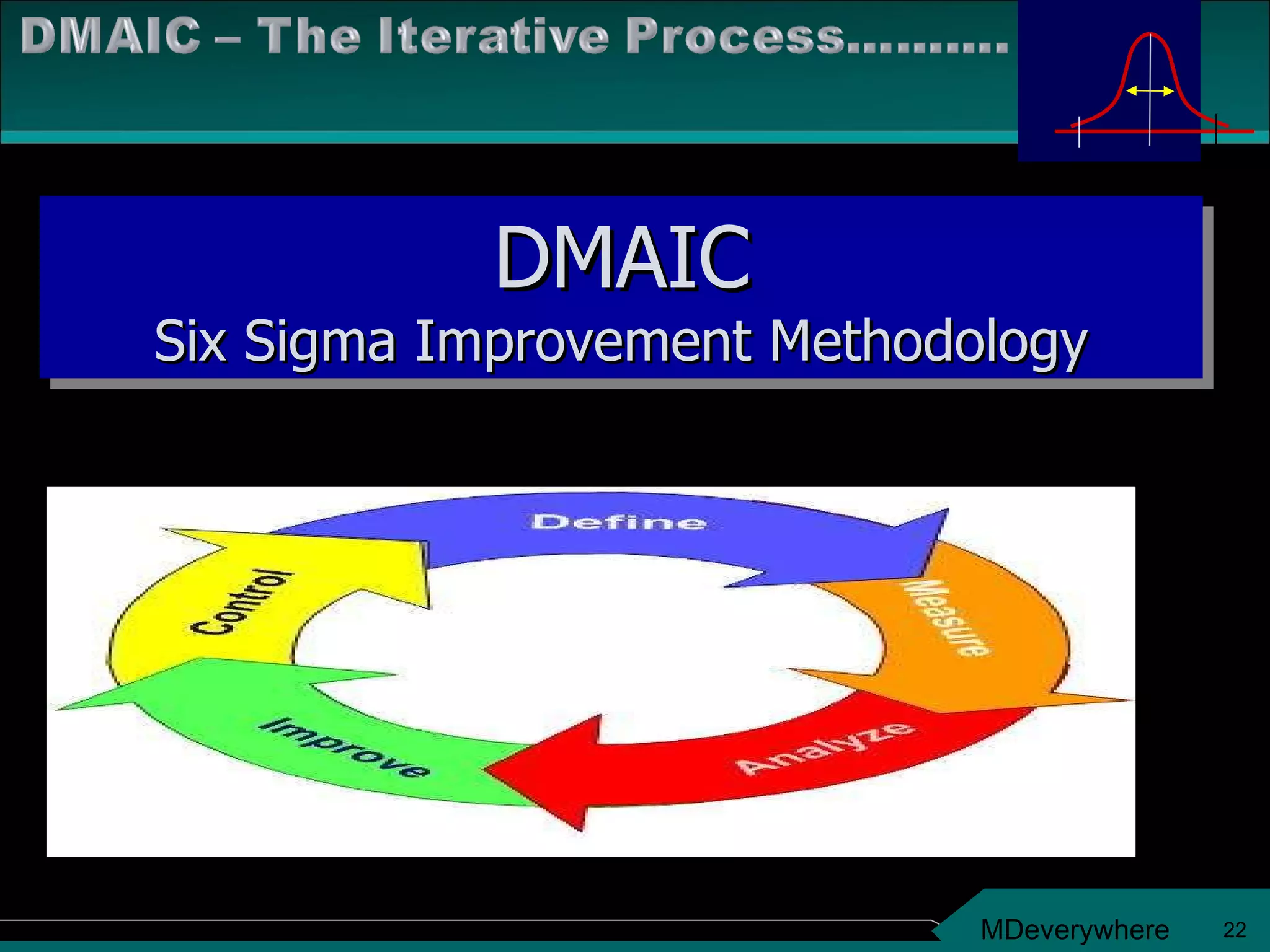
DMAIC Six Sigma Improvement Methodology
A logical and structured approach to problem solving and process improvement An iterative process (continuous improvement) A quality tool with focus on change management Essentially Six Sigma DMAIC Is…………… Y = F(X1,X2,X3…………………Xn)
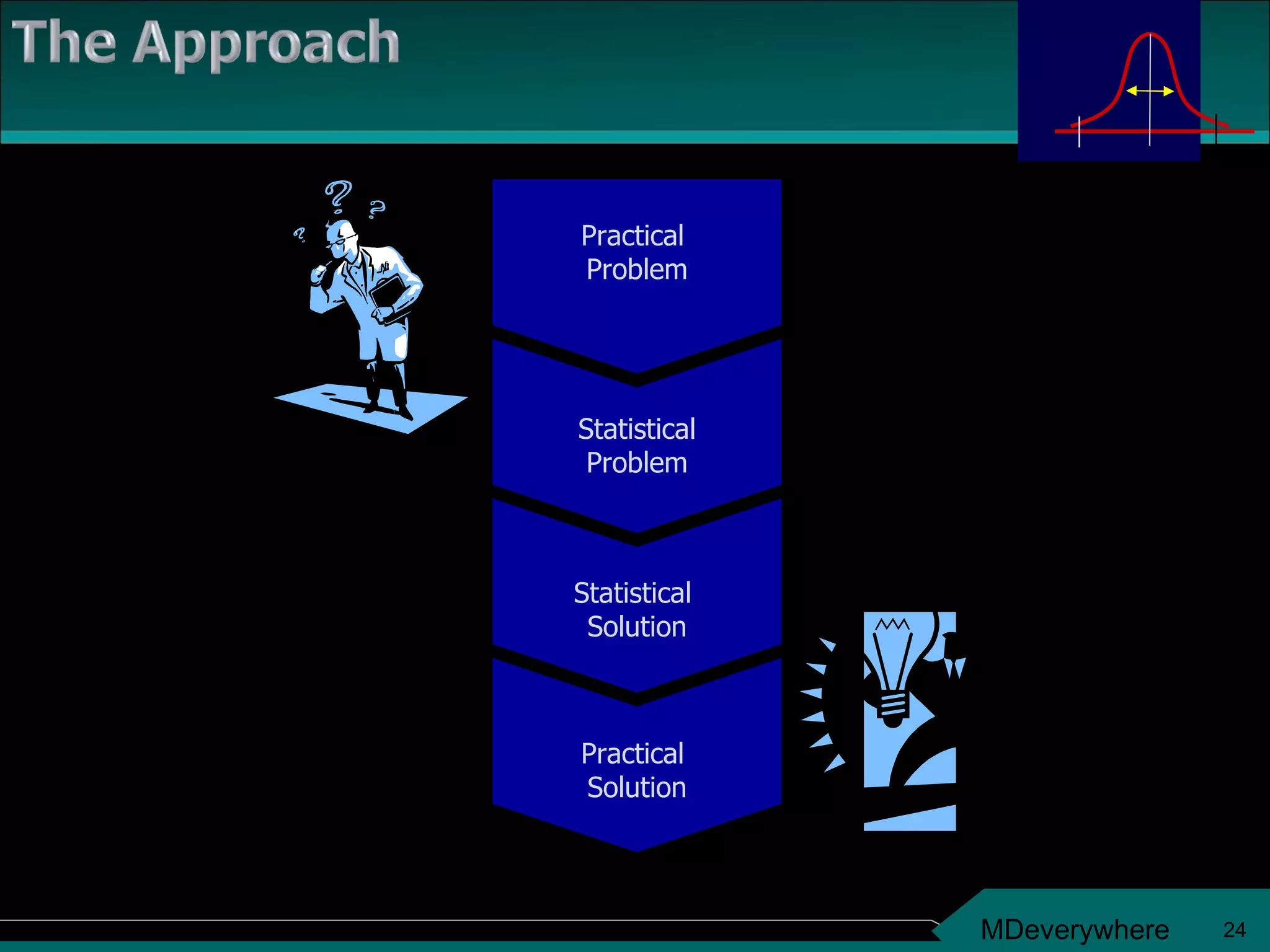
Practical  Problem Statistical Problem Statistical  Solution Practical  Solution
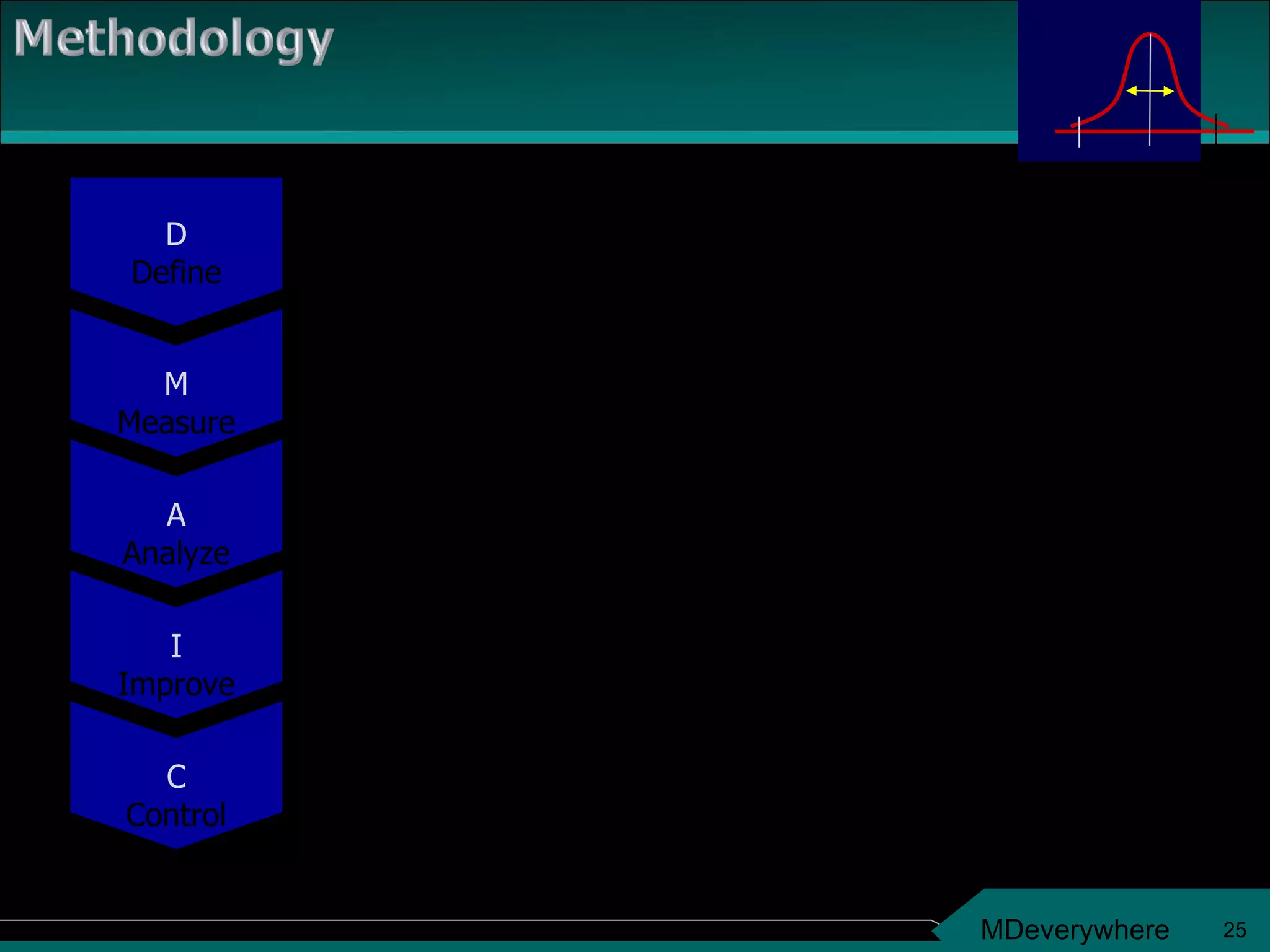
D Define M Measure A Analyze I Improve C Control Identify and state the practical problem Validate the practical problem by collecting data Convert the practical problem to a statistical one, define statistical goal and identify potential statistical solution Confirm and test the statistical solution Convert the statistical solution to a practical solution Monitor and Sustain implemented solutions / processes and make new processes a way of Life.
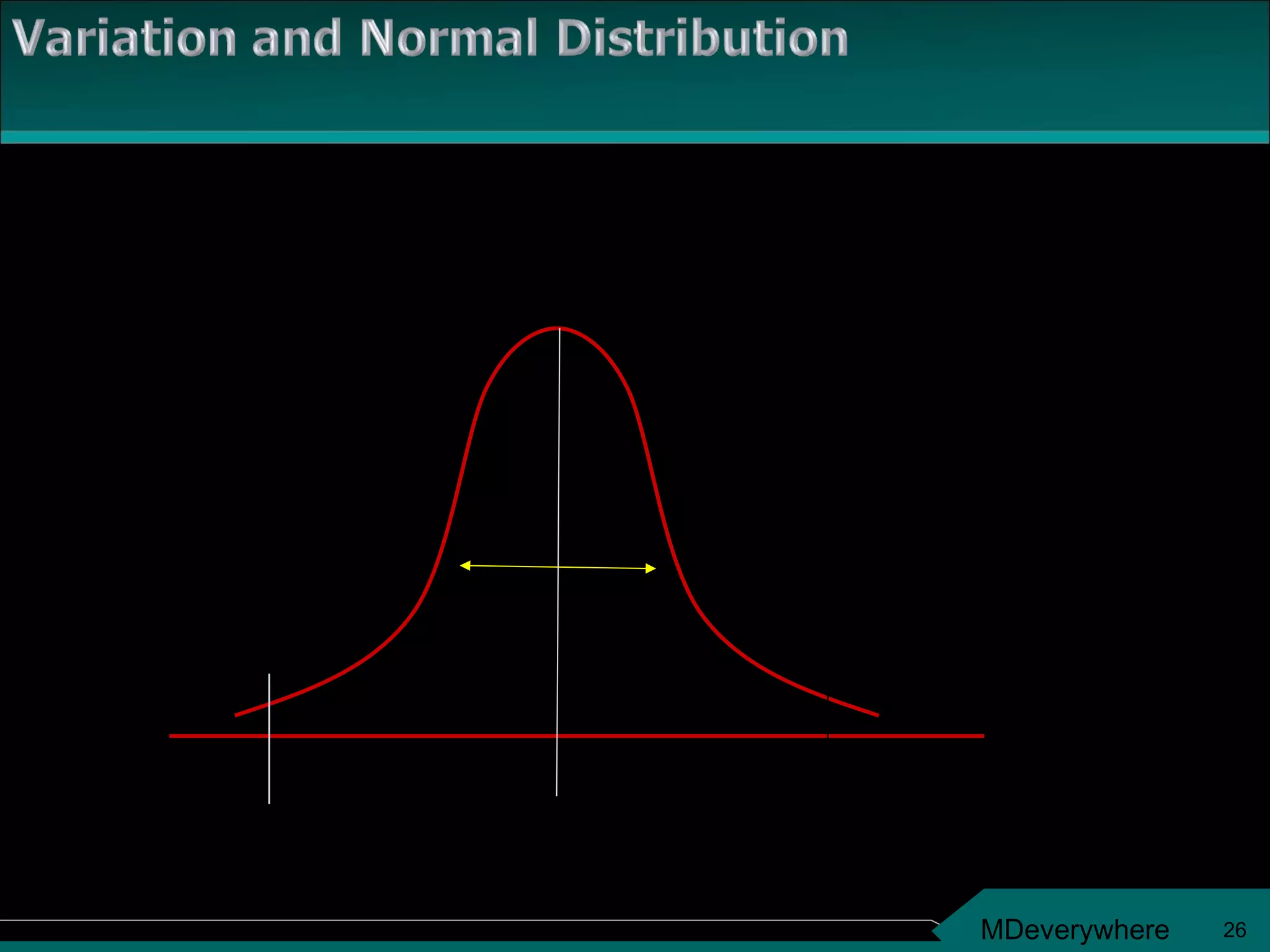
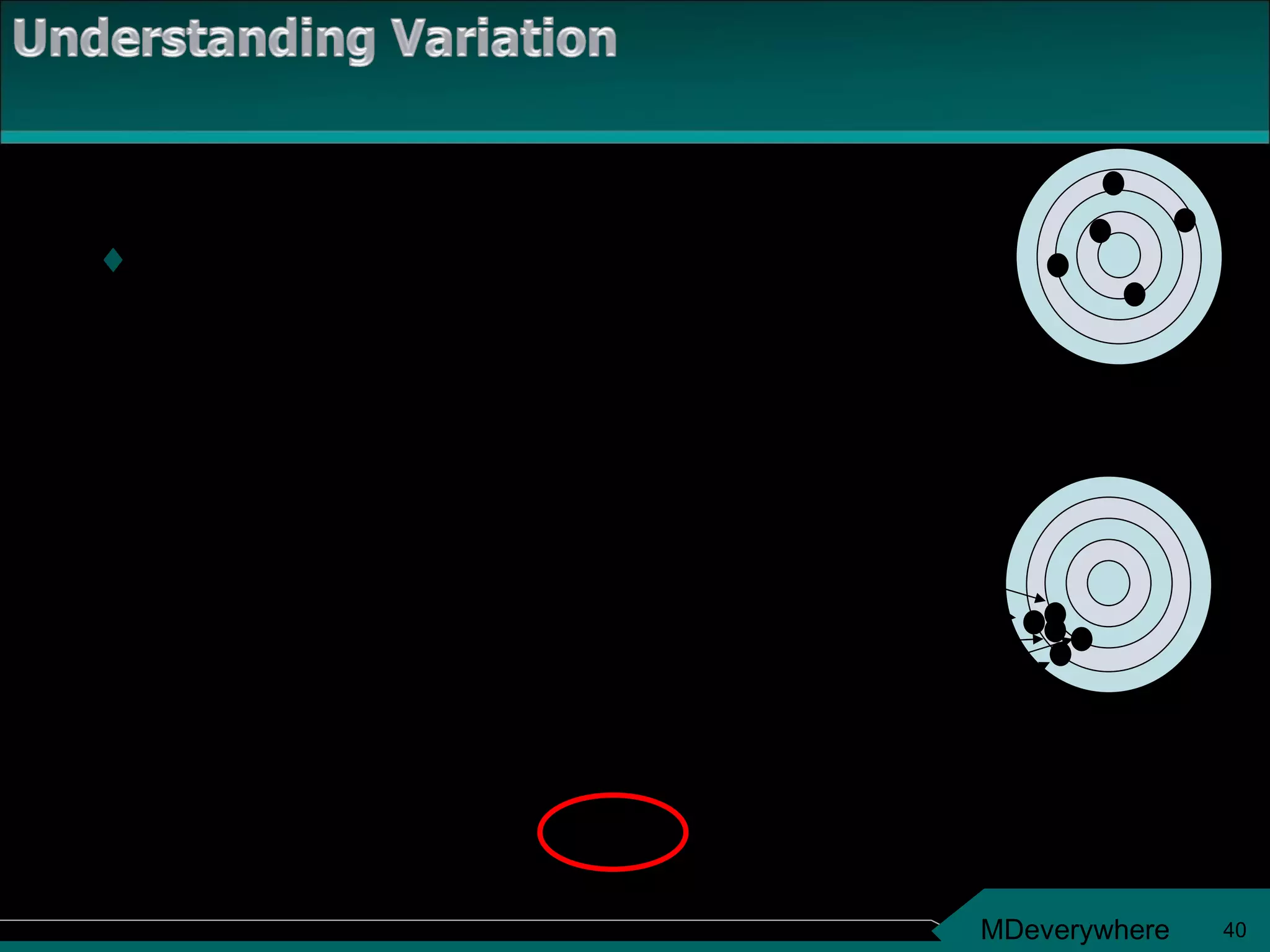
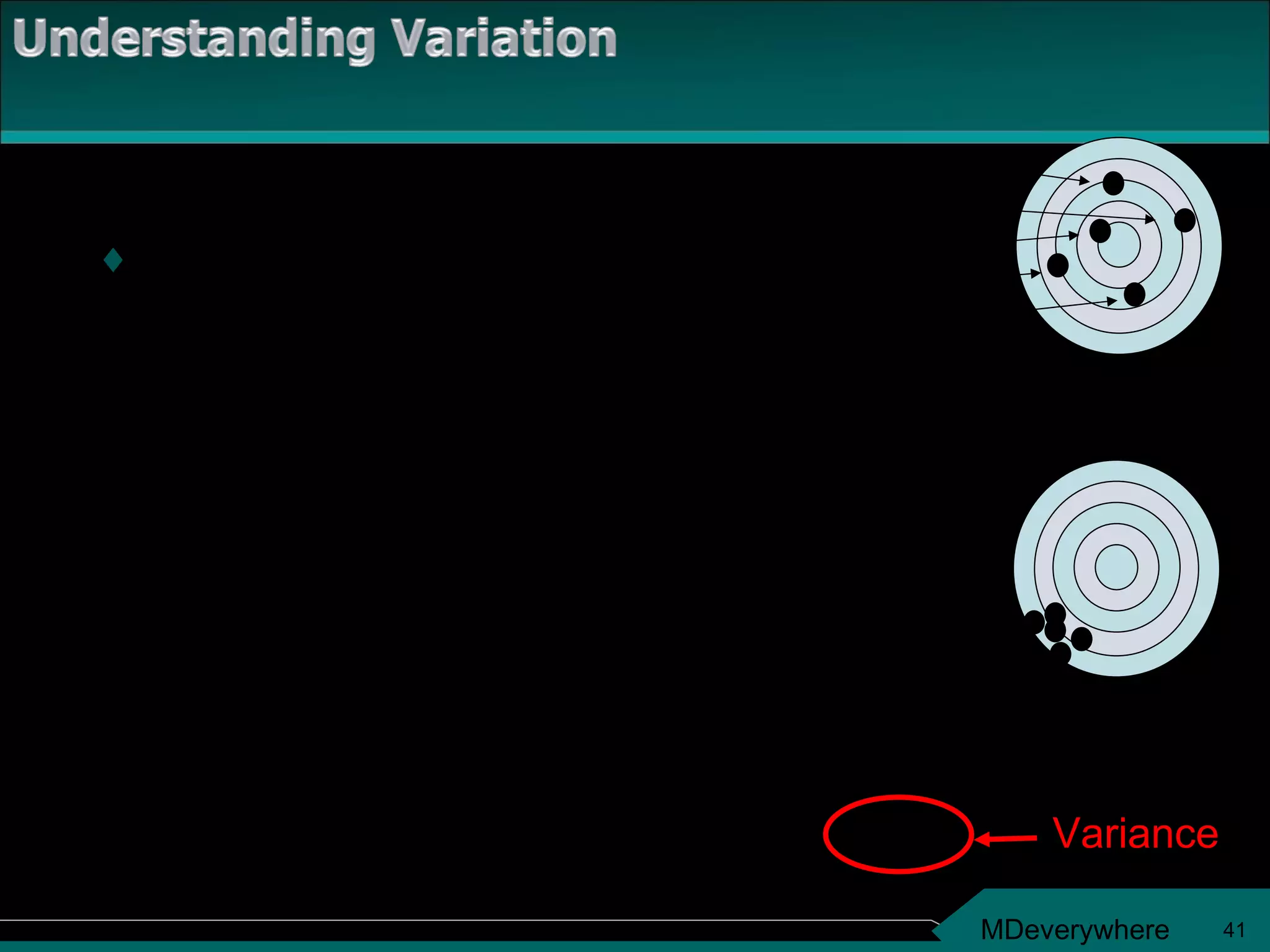
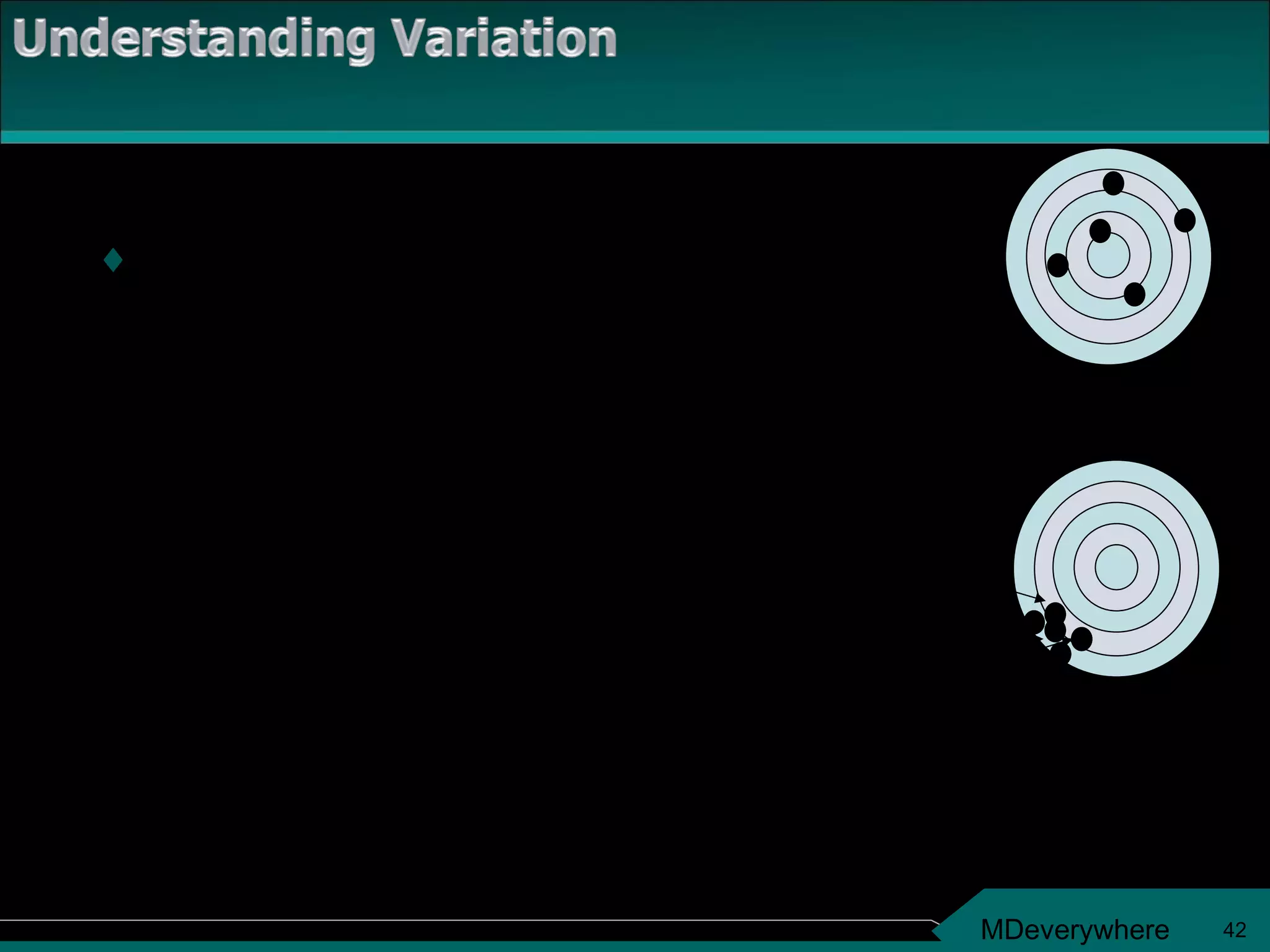
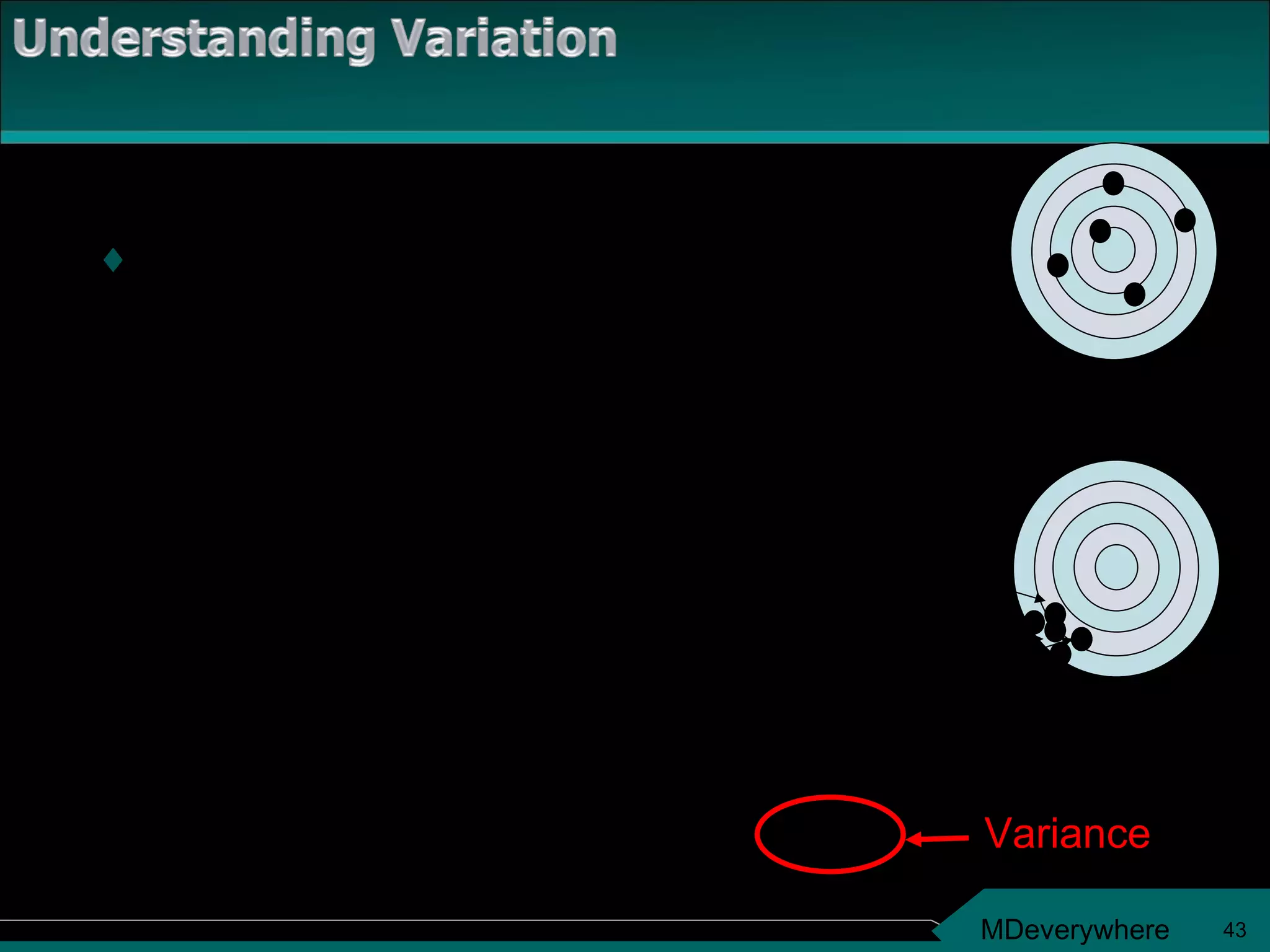
If the outcome of a process when observed over multiple  instances / data points is not consistent then the process is  termed  as a process with variation.  The term variation refers to the amount of fluctuations which  creep into a process over time. Variation doesn’t essentially mean missing targets or customer  expectations all the time. Its more about measuring the  inconsistency in a process and is a vital measure in determining  the process capability. Variation = Spread around the centre
Measurement Variation Generally a result of an improper or non-calibrated measurement system which produces different outputs in different attempts even with all measuring parameters constant. or Variation in the way you measure a process Process Variation Result of random or non random causes or Variation as part of a process
Measurement system variation is often a result of the following few reasons Inappropriate measurement tools being used providing inaccurate or inconsistent results for the same exercise. Least count is not granular enough to provide precise outputs. Operators not adequately trained etc. Measurement  errors are commonly termed as GRR errors i.e. Gauge of Repeatability and Reproducibility errors
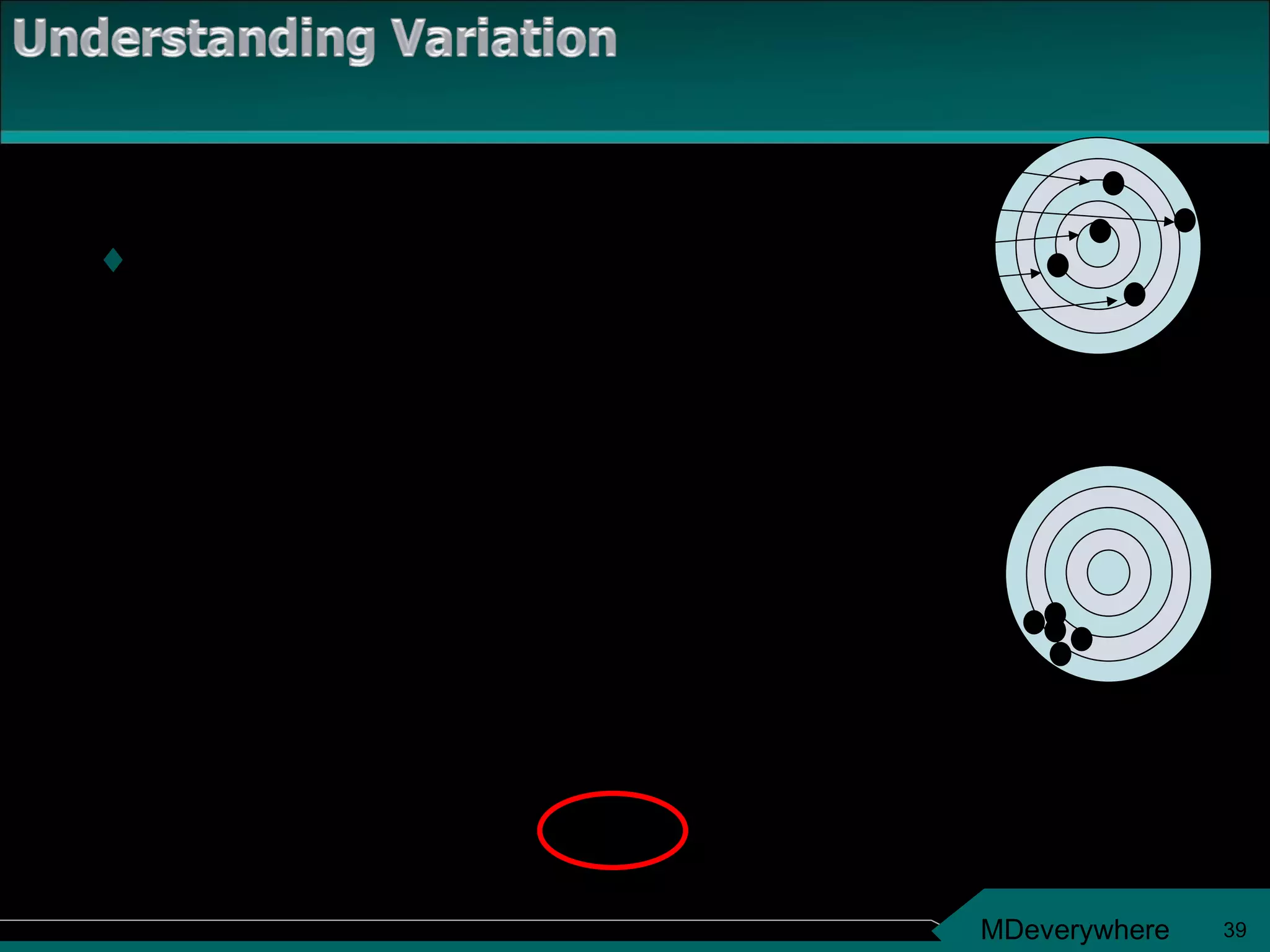
Common Causes: Random variation (usual) No pattern Inherent in process Adjusting the process decreases its variation Special Causes Non-random variation (unusual) May exhibit a pattern Assignable, explainable, controllable Adjusting the process decreases its variation
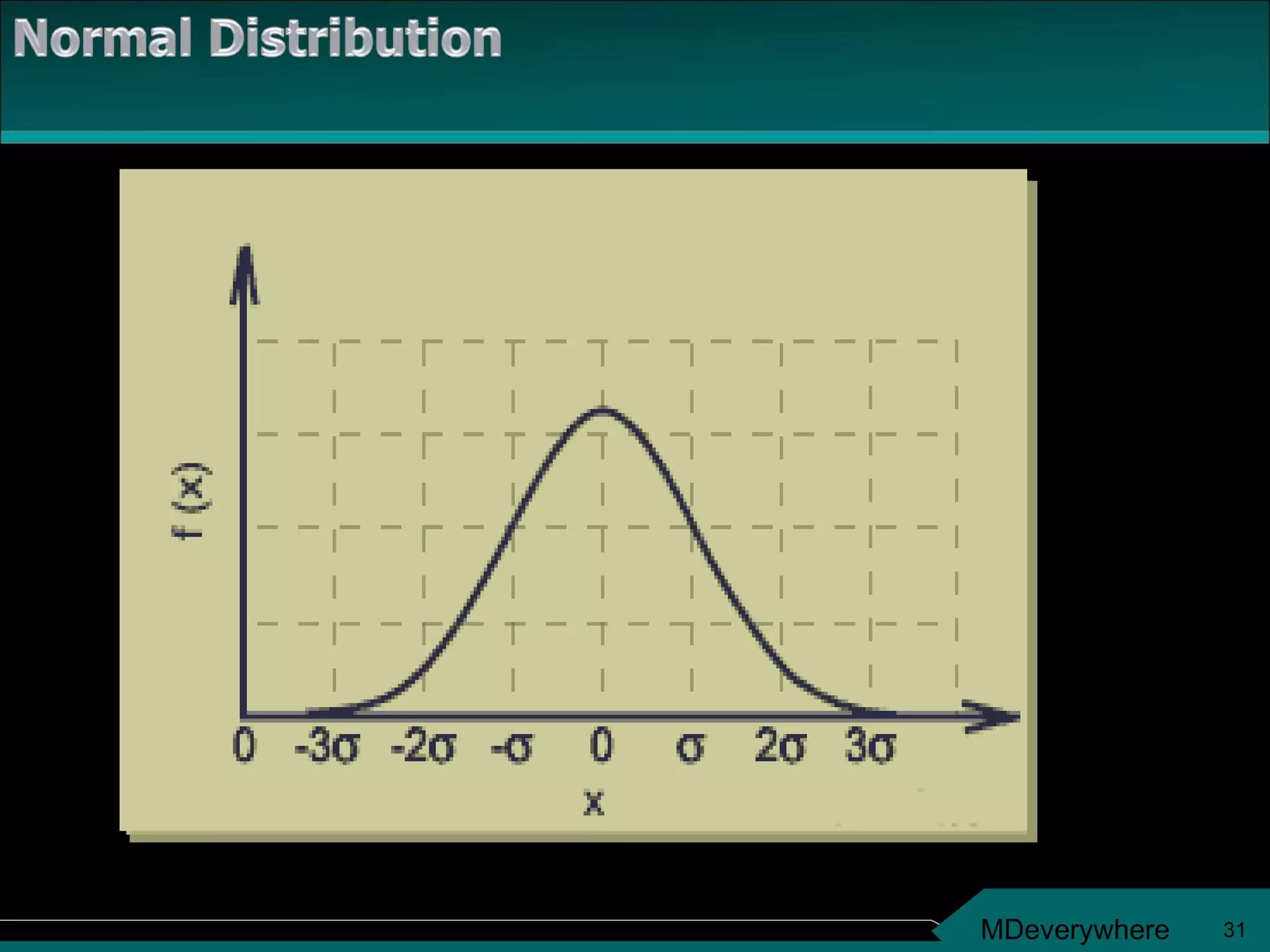
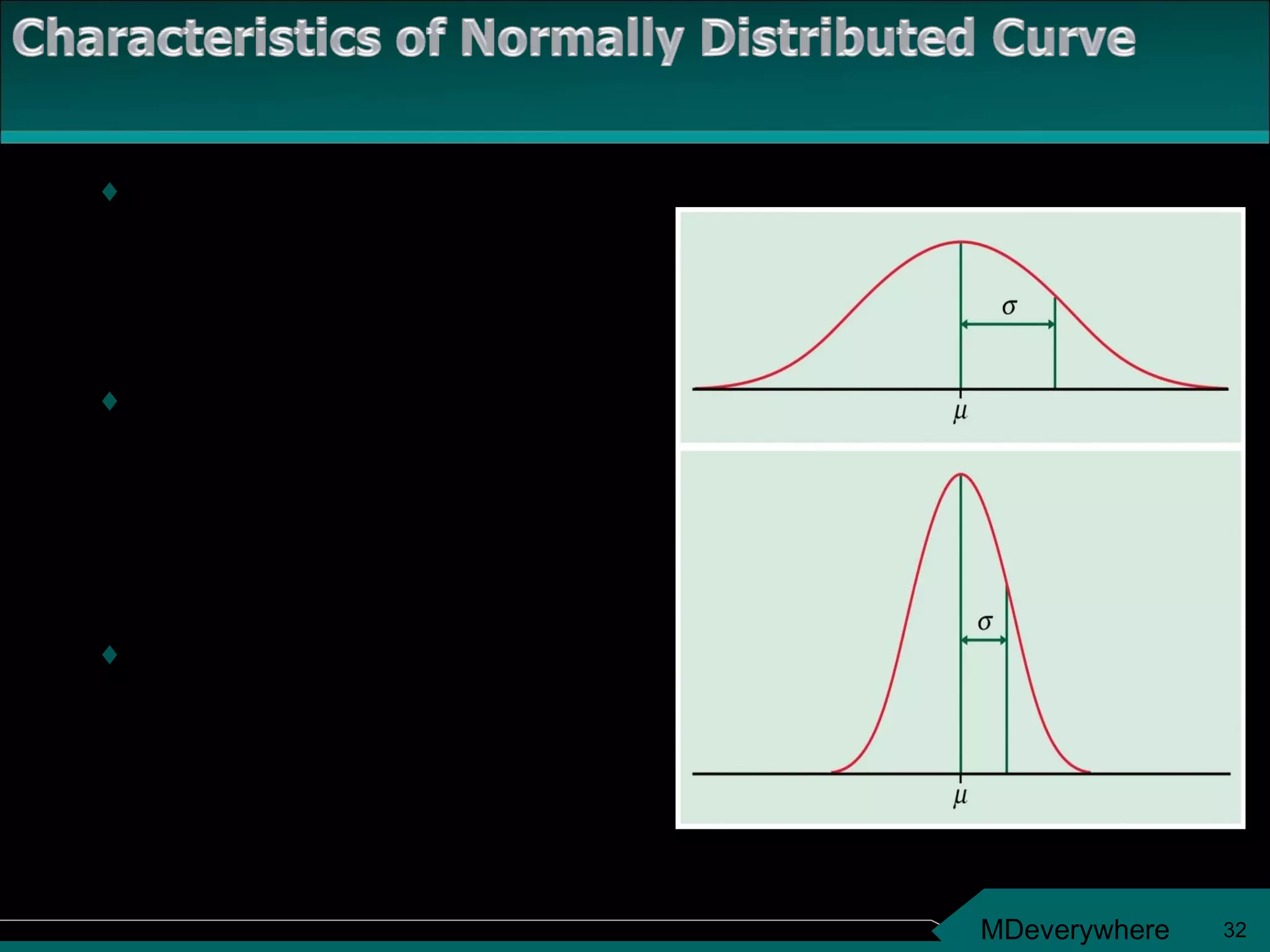
A normal distribution is bell-shaped and symmetric. The mean (mu) controls the center and standard deviation/variation (s) controls the spread  The distribution is determined by the mean (mu,   and the standard deviation (s)
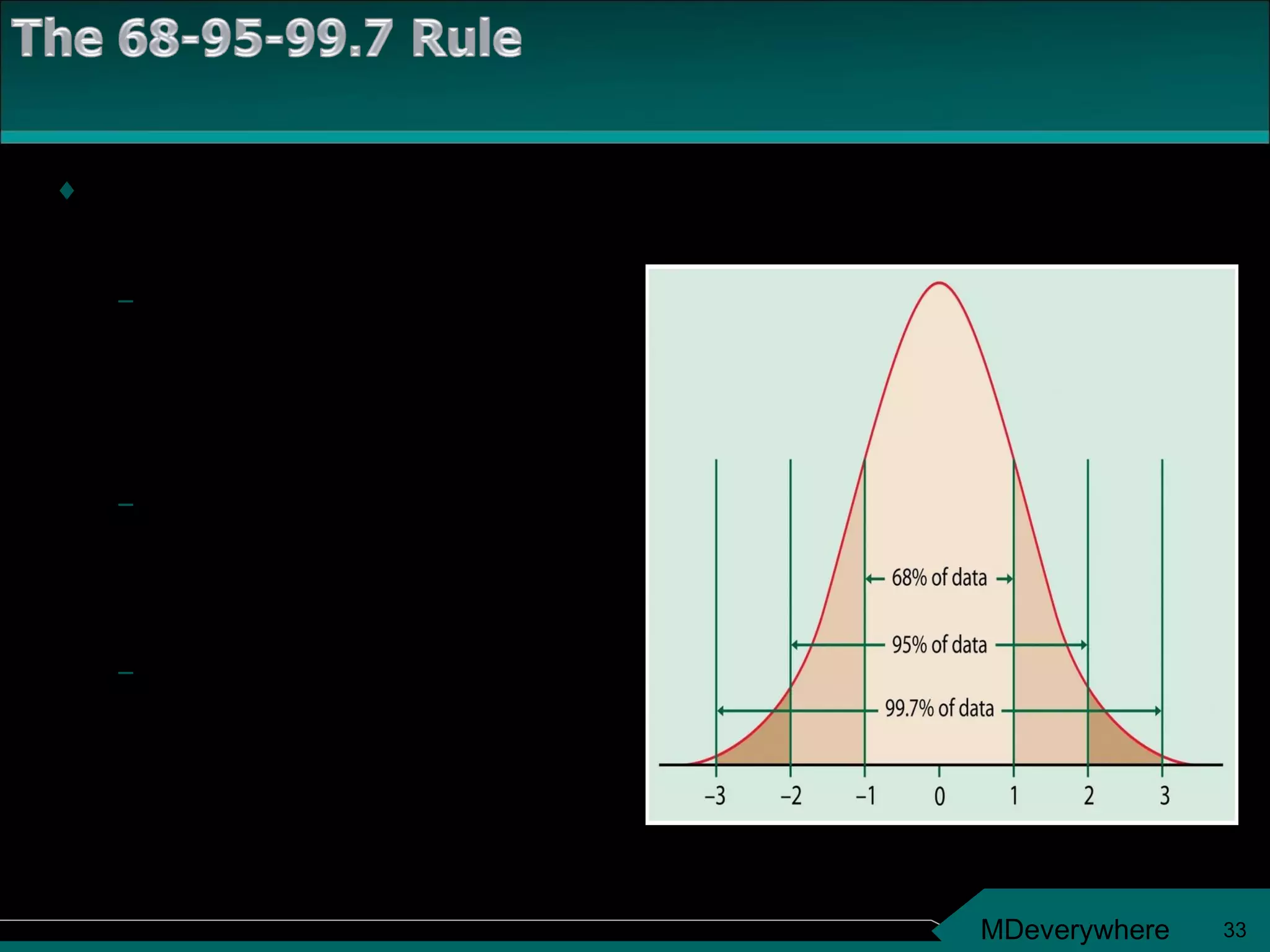
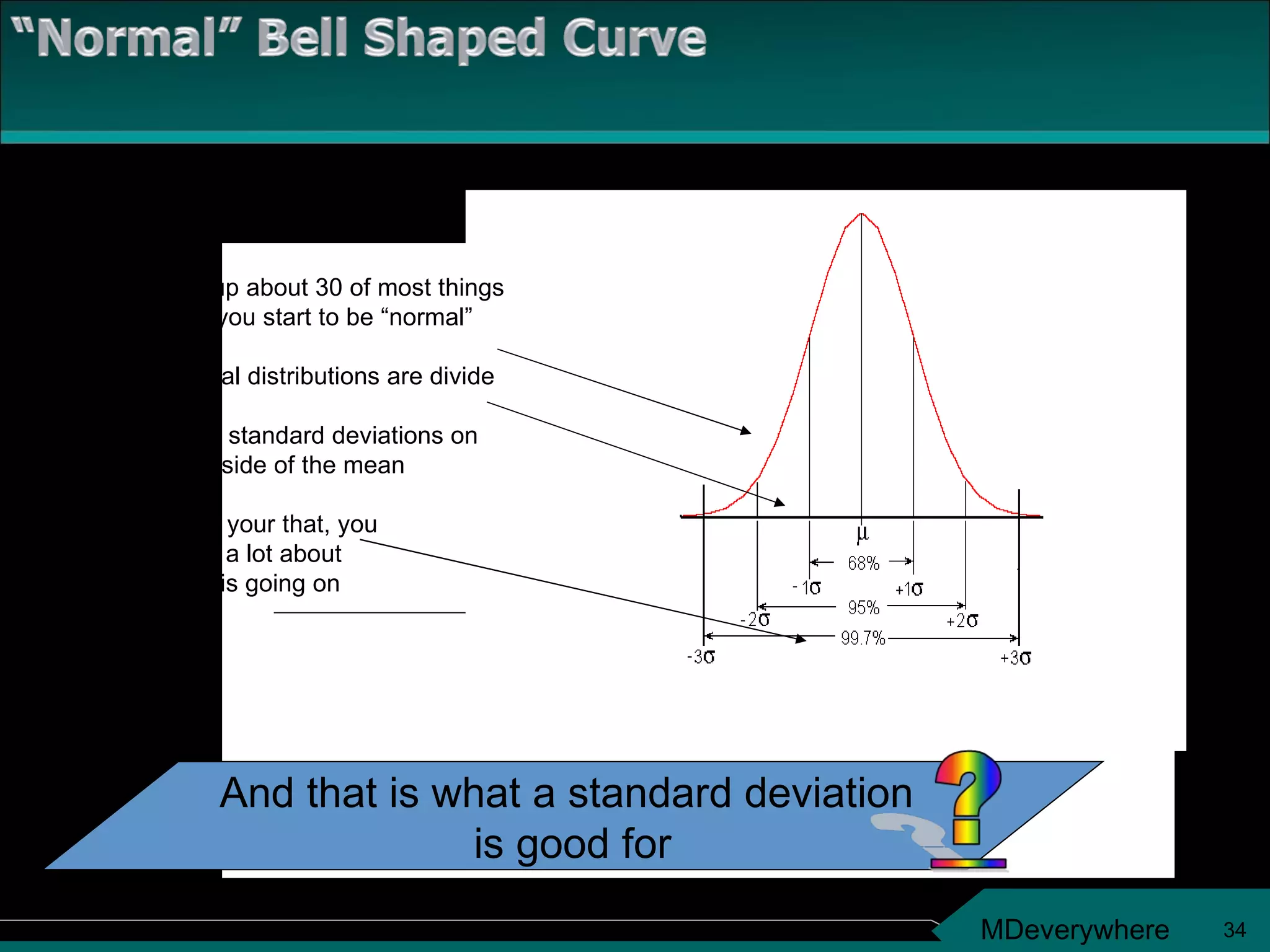
For any normal curve : 68 percent of the observations fall within one standard deviation of the mean. 95 percent of observation fall within 2 standard deviations and  99.7 percent of observations fall within 3 standard deviations of the mean.
Add up about 30 of most things and you start to be “normal” Normal distributions are divide up into 3 standard deviations on  each side of the mean Once your that, you know a lot about  what is going on And that is what a standard deviation  is good for
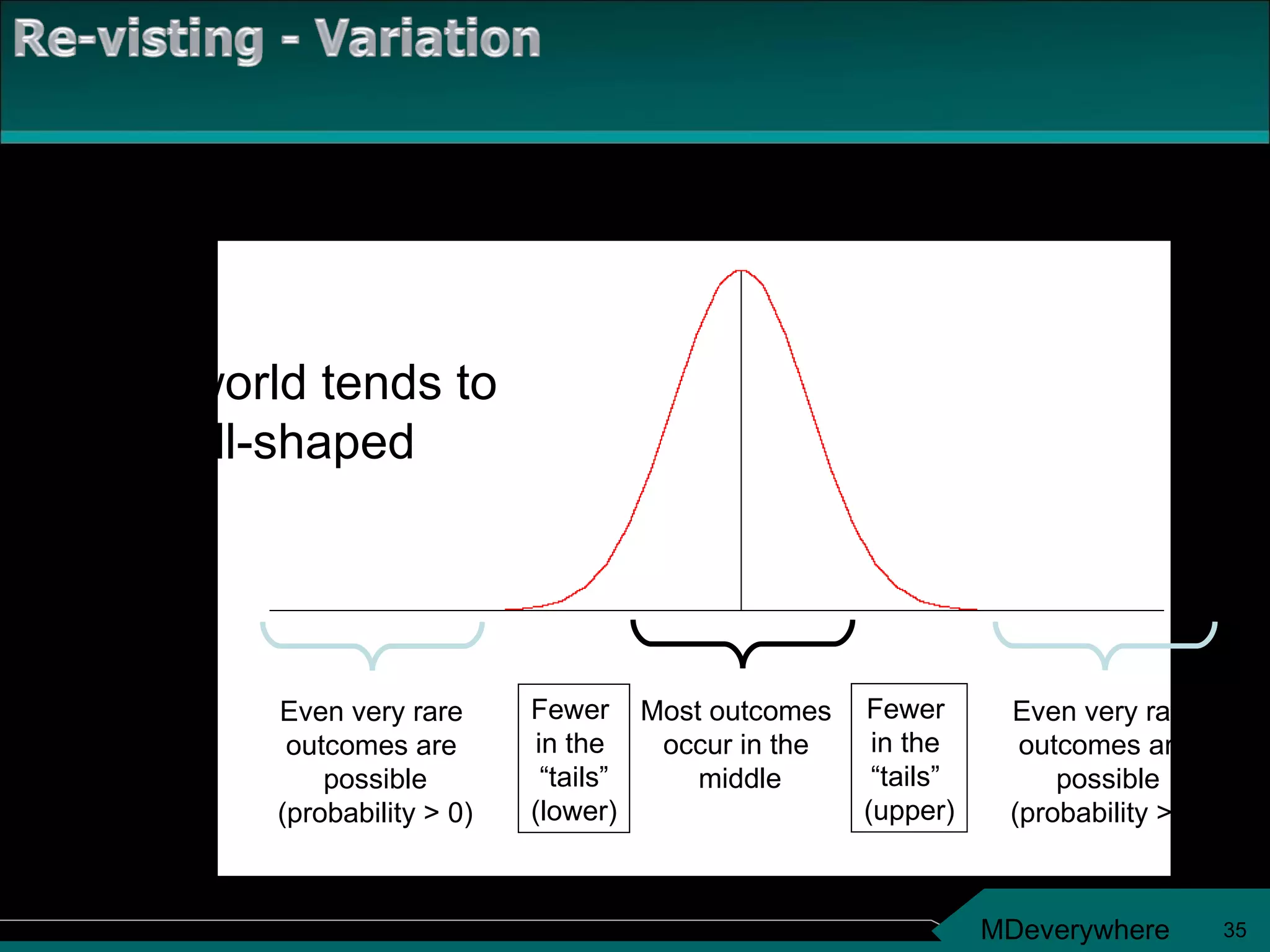
The world tends to be bell-shaped Most outcomes  occur in the  middle Fewer  in the  “ tails” (lower) Fewer  in the  “ tails”  (upper) Even very rare  outcomes are  possible (probability > 0) Even very rare  outcomes are  possible (probability > 0)
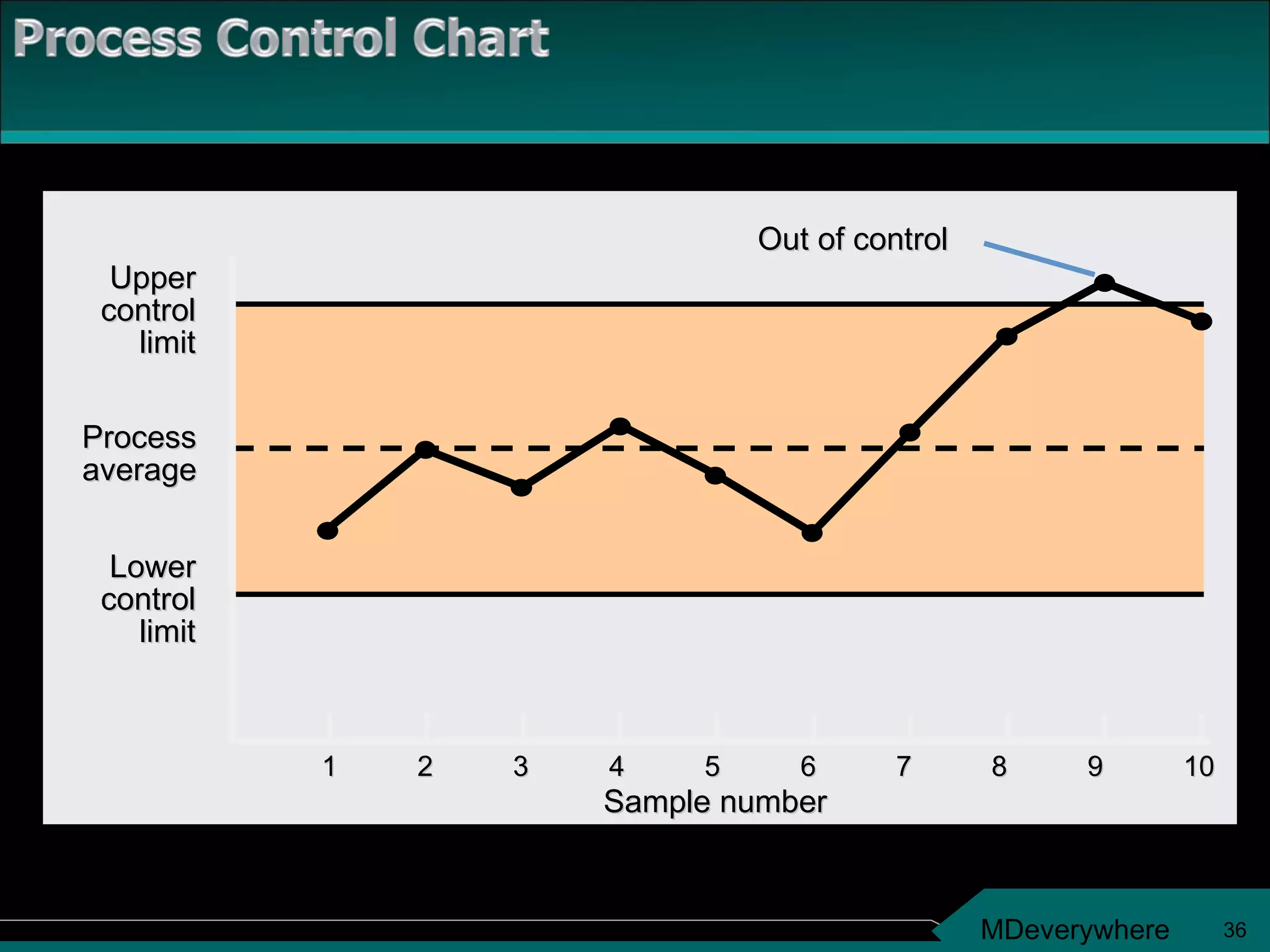
4- 1 2 3 4 5 6 7 8 9 10 Sample number Upper control limit Process average Lower control limit Out of control
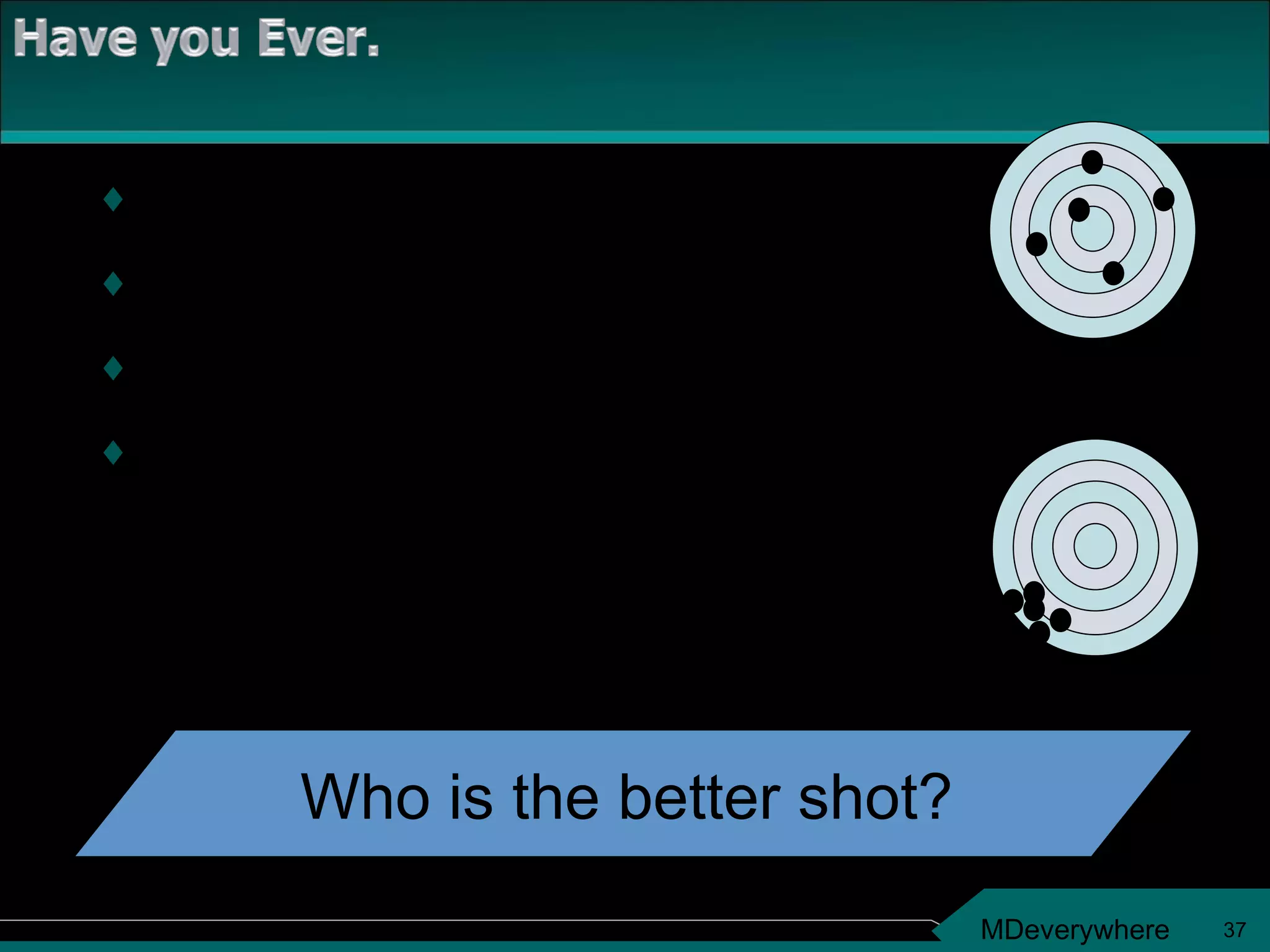
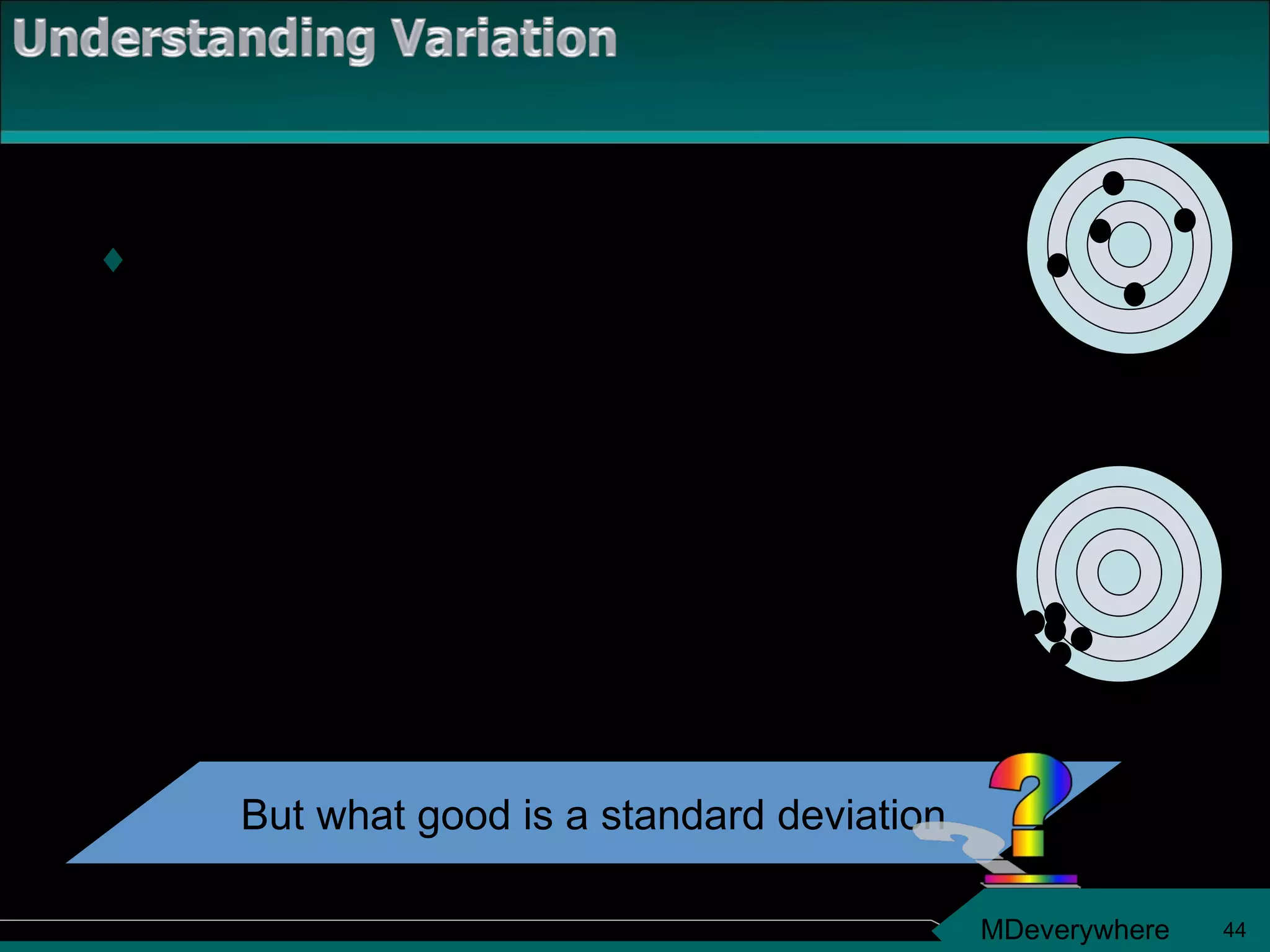
Shot a rifle? Played darts? Shot a round of golf? Played basketball? Emmett Jake Who is the better shot?
What do you measure in your process? Why do those measures matter? Are those measures consistently the same? Why not?
Deviation = distance between observations and the mean (or average) Emmett Jake 8 7 10 8 9 Observations 10 9 8 8 7 averages 8.4 Deviations 10 - 8.4 = 1.6 9 – 8.4 = 0.6 8 – 8.4 = -0.4 8 – 8.4 = -0.4  7 – 8.4 = -1.4 0.0
Deviation = distance between observations and the mean (or average) Emmett Jake 7 6 7 7 6 Observations 7 7 7 6 6 averages 6.6 Deviations 7 – 6.6 = 0.4 7 – 6.6 = 0.4 7 – 6.6 = 0.4 6 – 6.6 = -0.6 6 – 6.6 = -0.6 0.0
Variance = average distance between observations and the mean squared Emmett Jake 8 7 10 8 9 Observations 10 9 8 8 7 averages 8.4 Deviations 10 - 8.4 = 1.6 9 – 8.4 = 0.6 8 – 8.4 = -0.4 8 – 8.4 = -0.4  7 – 8.4 = -1.4 0.0 Squared Deviations 2.56 0.36 0.16 0.16 1.96 1.0 Variance
Variance = average distance between observations and the mean squared Emmett Jake 7 6 7 7 6 Observations 7 7 7 6 6 averages Deviations Squared Deviations
Variance = average distance between observations and the mean squared Emmett Jake 7 6 7 7 6 Observations 7 7 7 6 6 averages 6.6 Deviations 7 - 6.6 = 0.4 7 - 6.6 = 0.4 7 - 6.6 = 0.4 6 – 6.6 = -0.6  6 – 6.6 = -0.6 0.0 Squared Deviations 0.16 0.16 0.16 0.36 0.36 0.24 Variance
Standard deviation = square root of variance Emmett Jake Variance Standard Deviation Emmett 1.0 1.0 Jake 0.24 0.4898979 But what good is a standard deviation
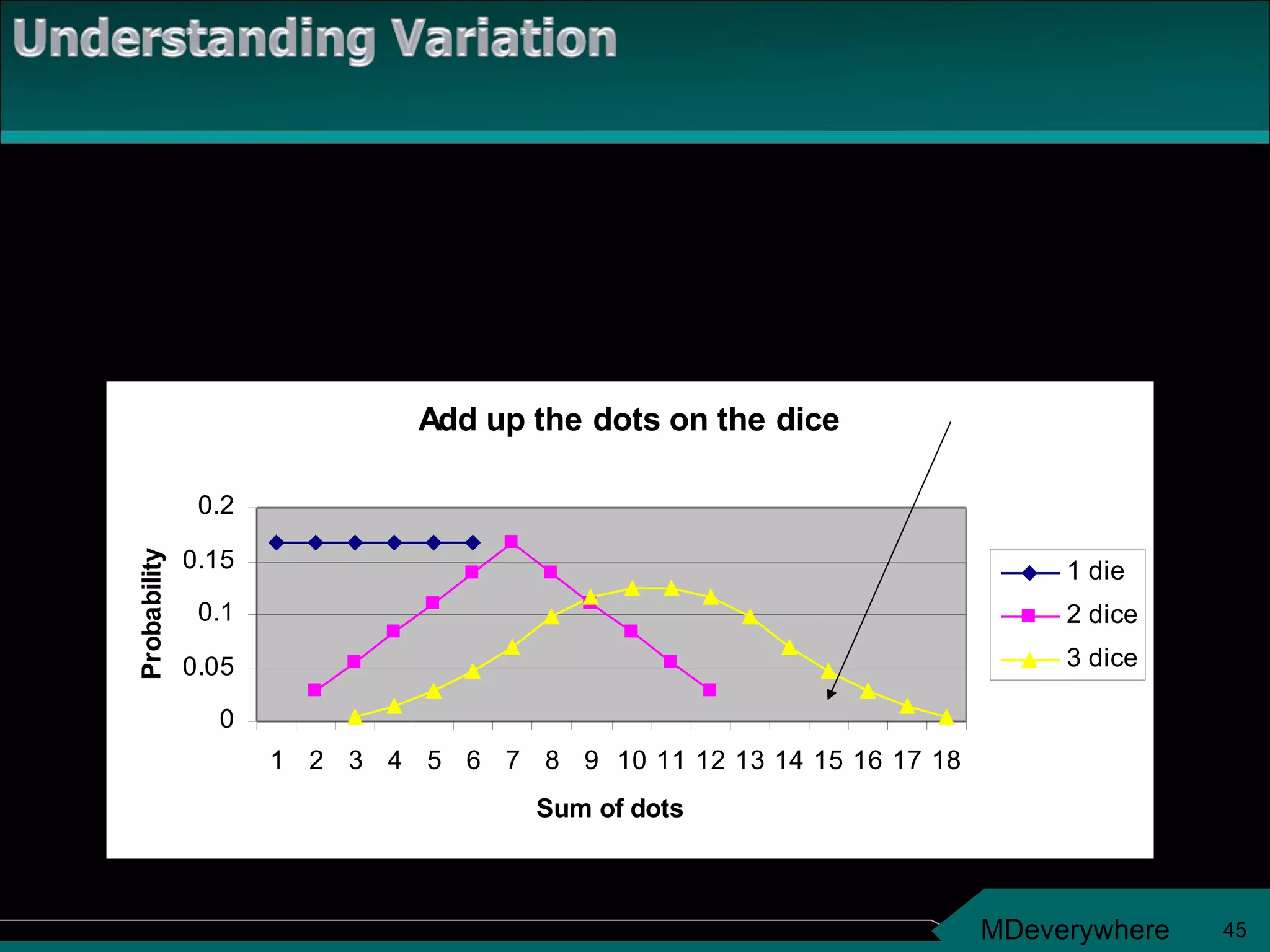
Here is why:  Even outcomes that are equally likely (like dice), when you add them up, become bell shaped
Day – 2
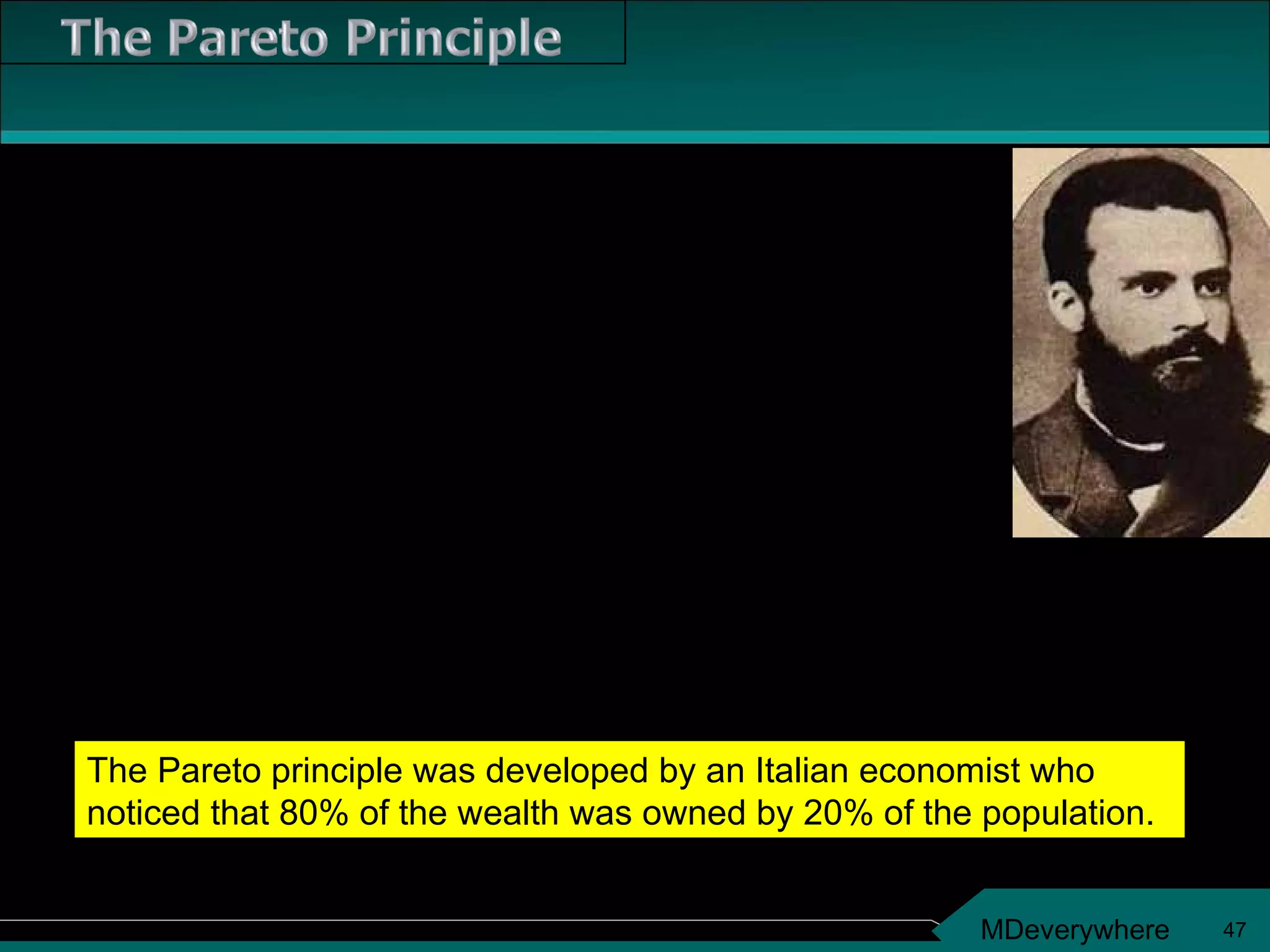
This is also known as the "80/20 Rule“ The rule states that about 80% of the situations of the problem can be traced to 20% of possible causes. The Pareto principle was developed by an Italian economist who noticed that 80% of the wealth was owned by 20% of the population.
The Pareto principle implies that we can frequently solve a problem by identifying and attacking the “vital few” sources. This principle can be applied to most systems and processes. The concept is used to dissect a large problem into smaller pieces and in order to identify the biggest contributors. Pareto analysis helps to ‘localize’ the problem
Most of the equipment breakdowns are due to a small percentage of the equipment. The majority of calls to a IT help desk are attributed to a small number of reasons. Most of the errors in any process occur in one or two process steps. Only a handful of students in the school district account for most of the tardy events.
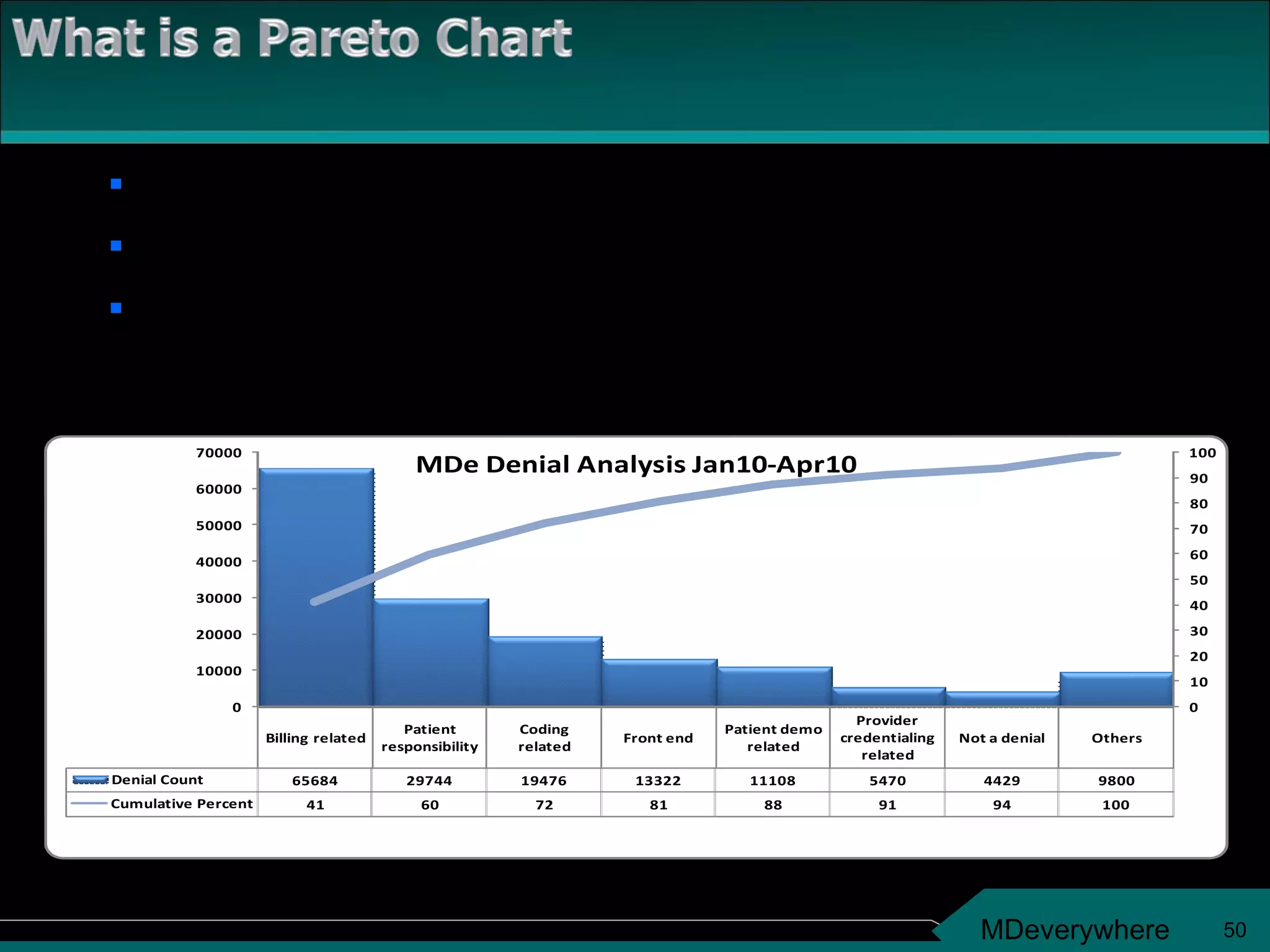
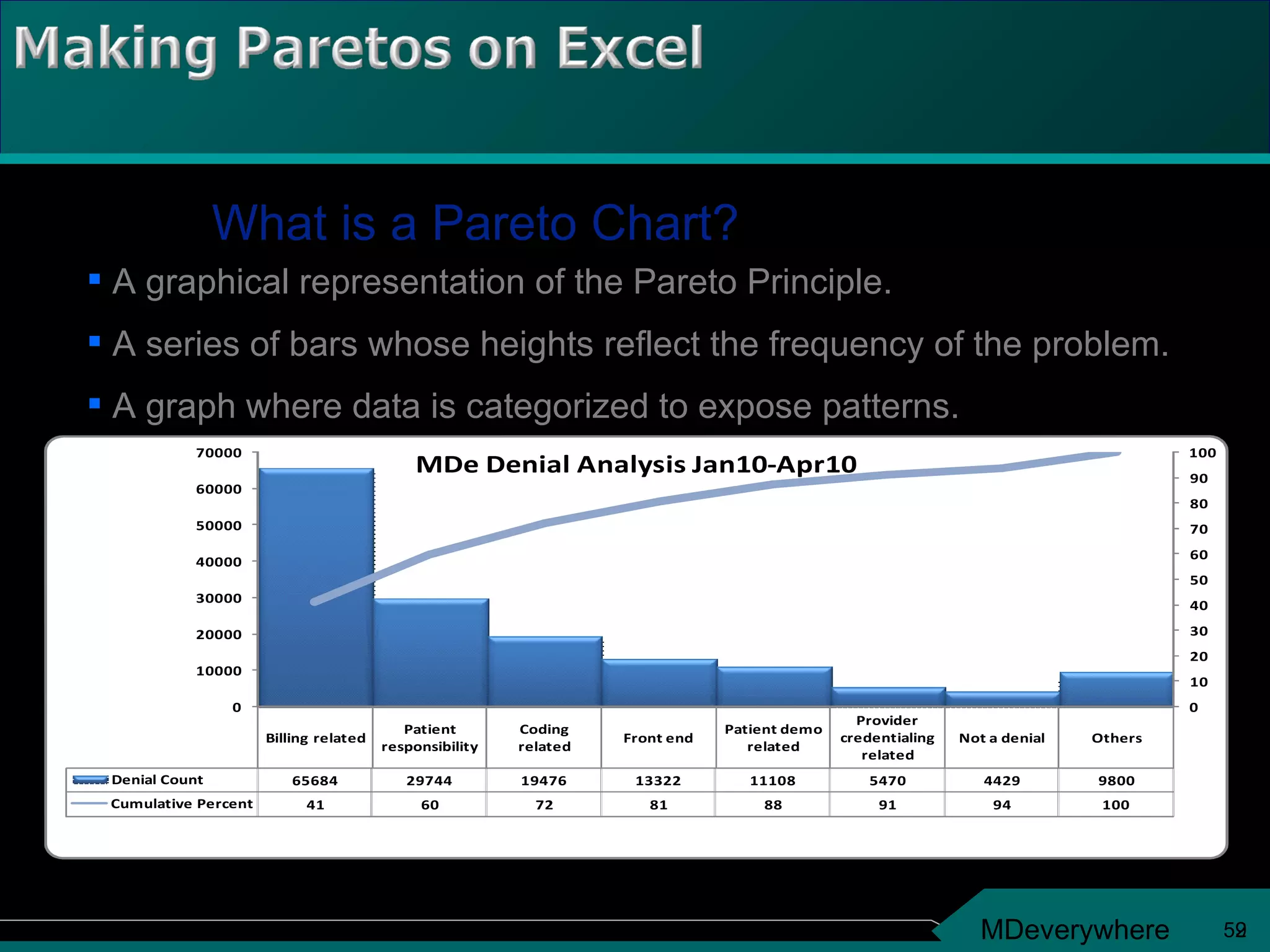
A graphical representation of the Pareto Principle. A series of bars whose heights reflect the frequency of the problem. A graph where data is categorized to expose patterns.
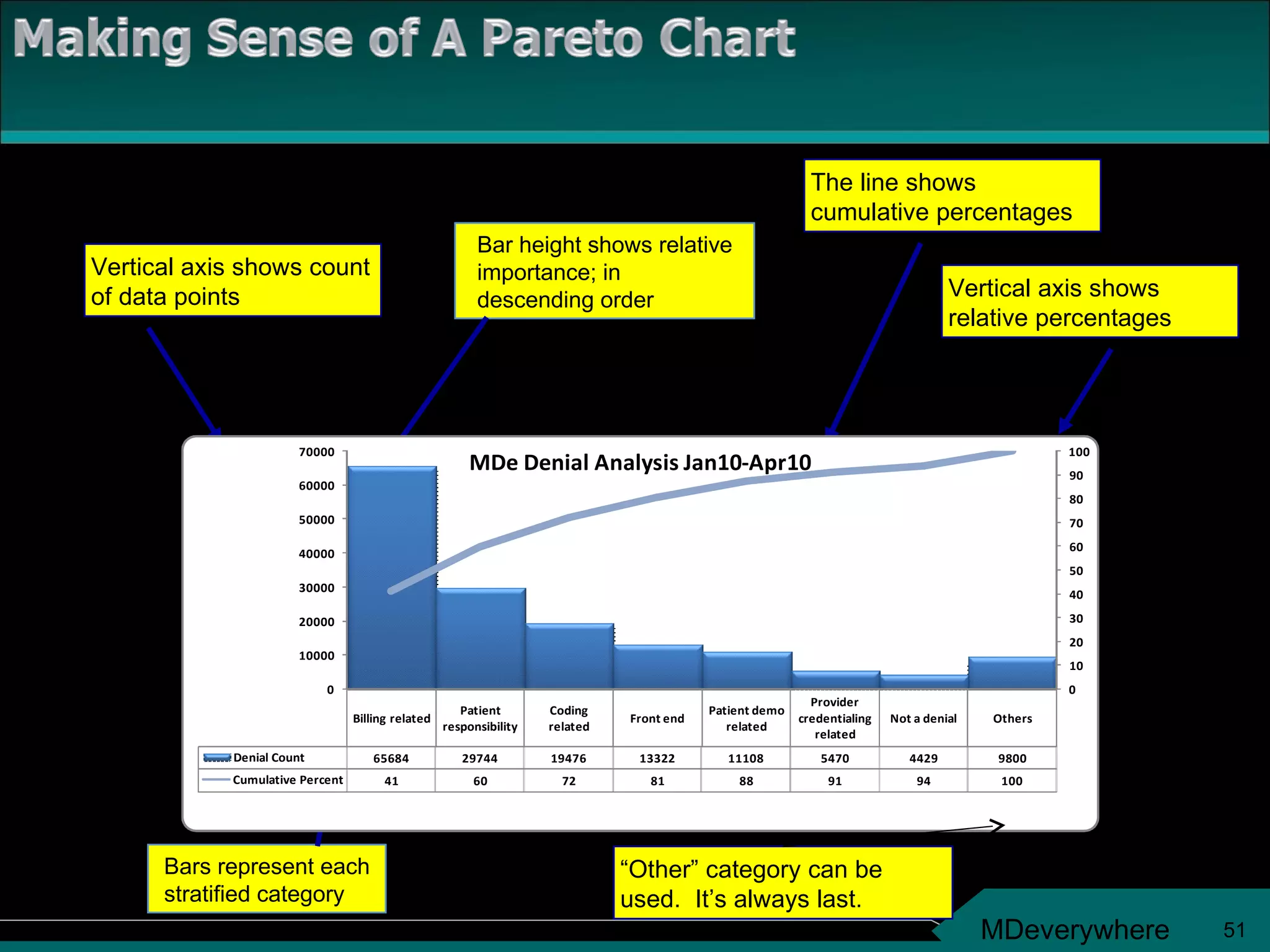
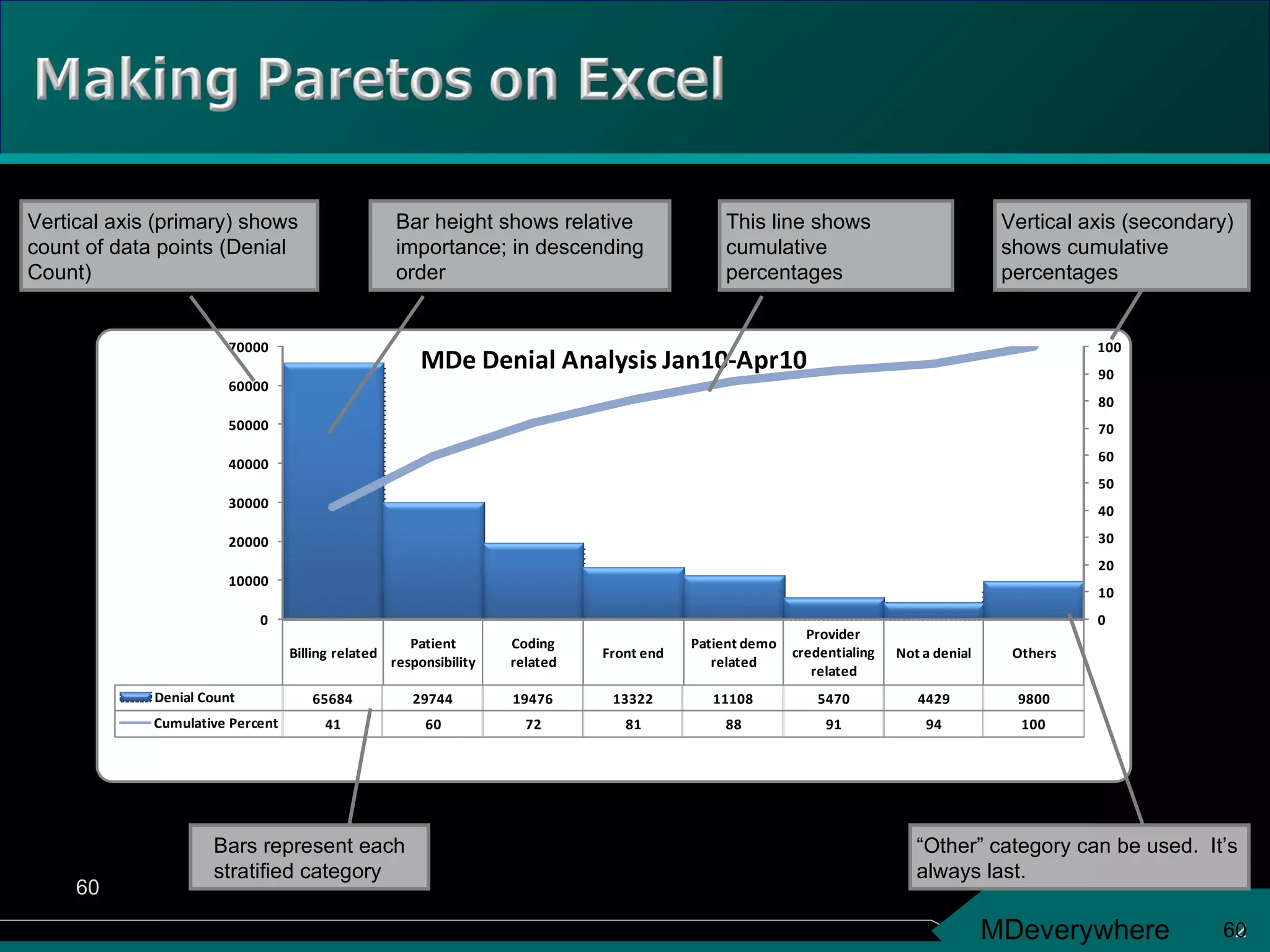
Bar height shows relative importance; in descending order  Bars represent each stratified category Vertical axis shows relative percentages “ Other” category can be used.  It’s always last. Vertical axis shows count of data points The line shows cumulative percentages
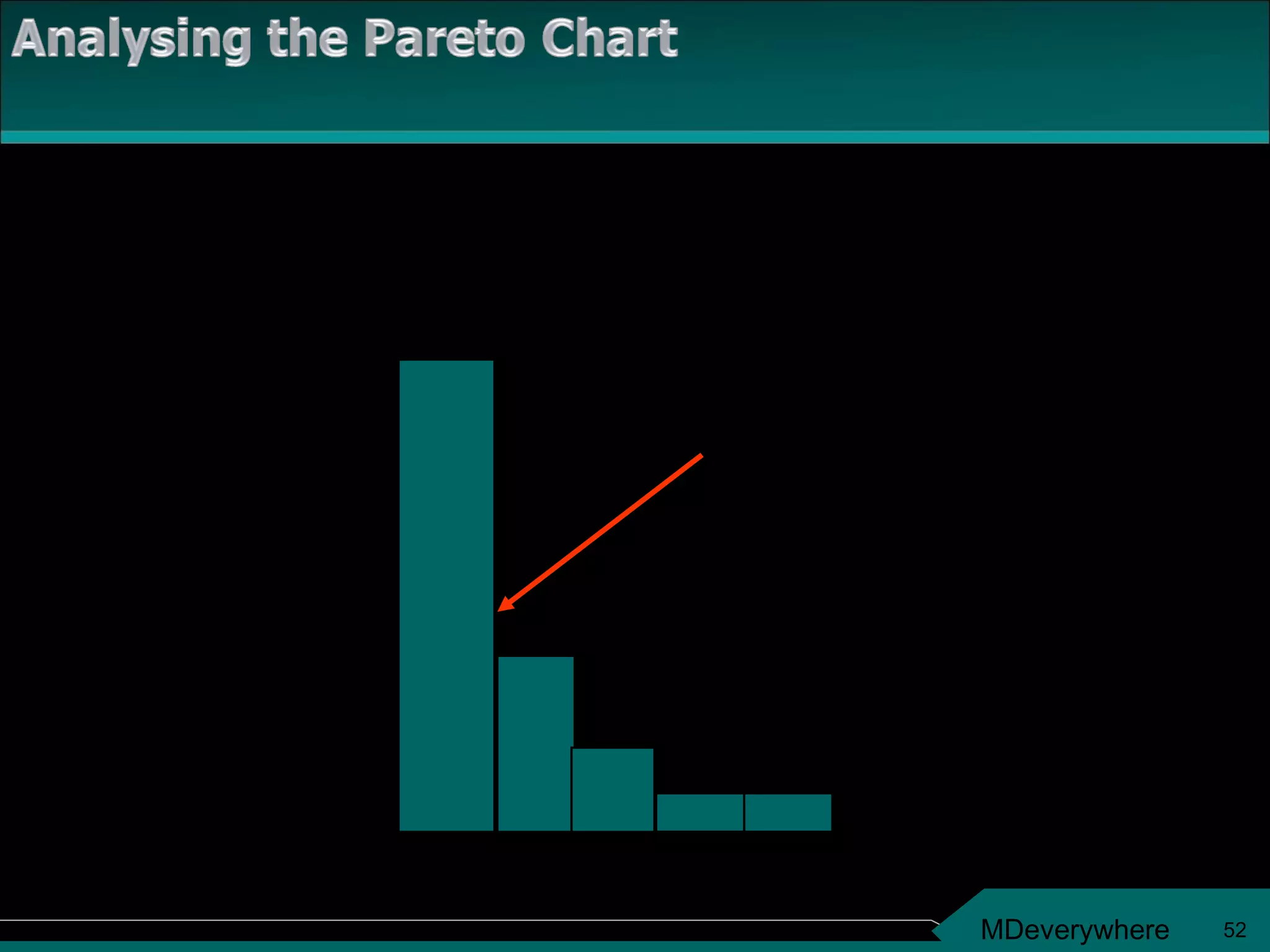
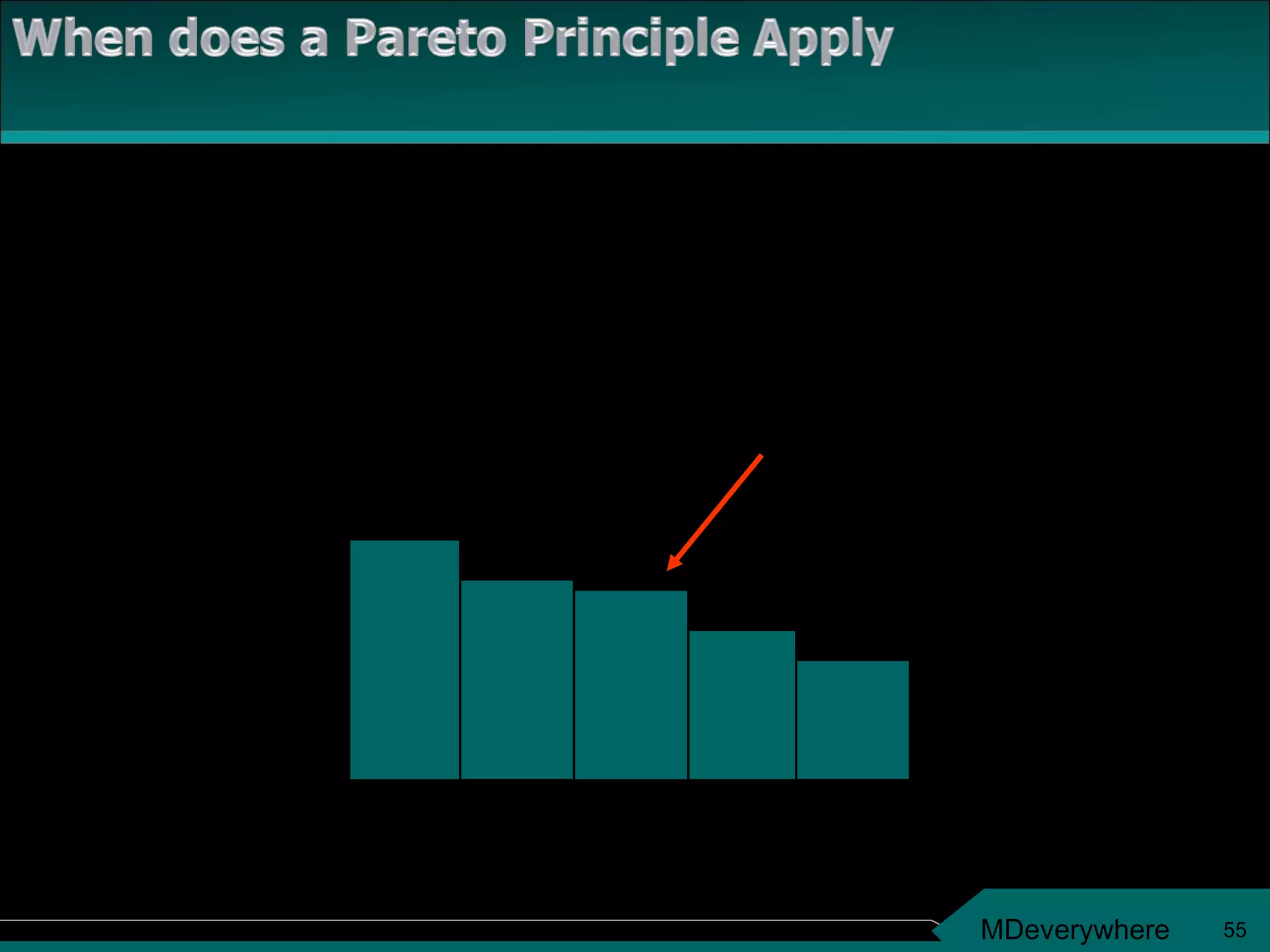
The Pareto Principle applies if one or more categories account for a large percentage of the occurrences.  Look for the bars that are much taller than the rest.
Focus your improvement efforts on the largest category or categories of the Pareto Chart, in order to achieve the maximum gain. Only focus on a smaller bar if it has a larger impact or is easier to fix. Using  only  the data from the large categories of the Pareto Chart, determine if they can be further stratified into additional categories.
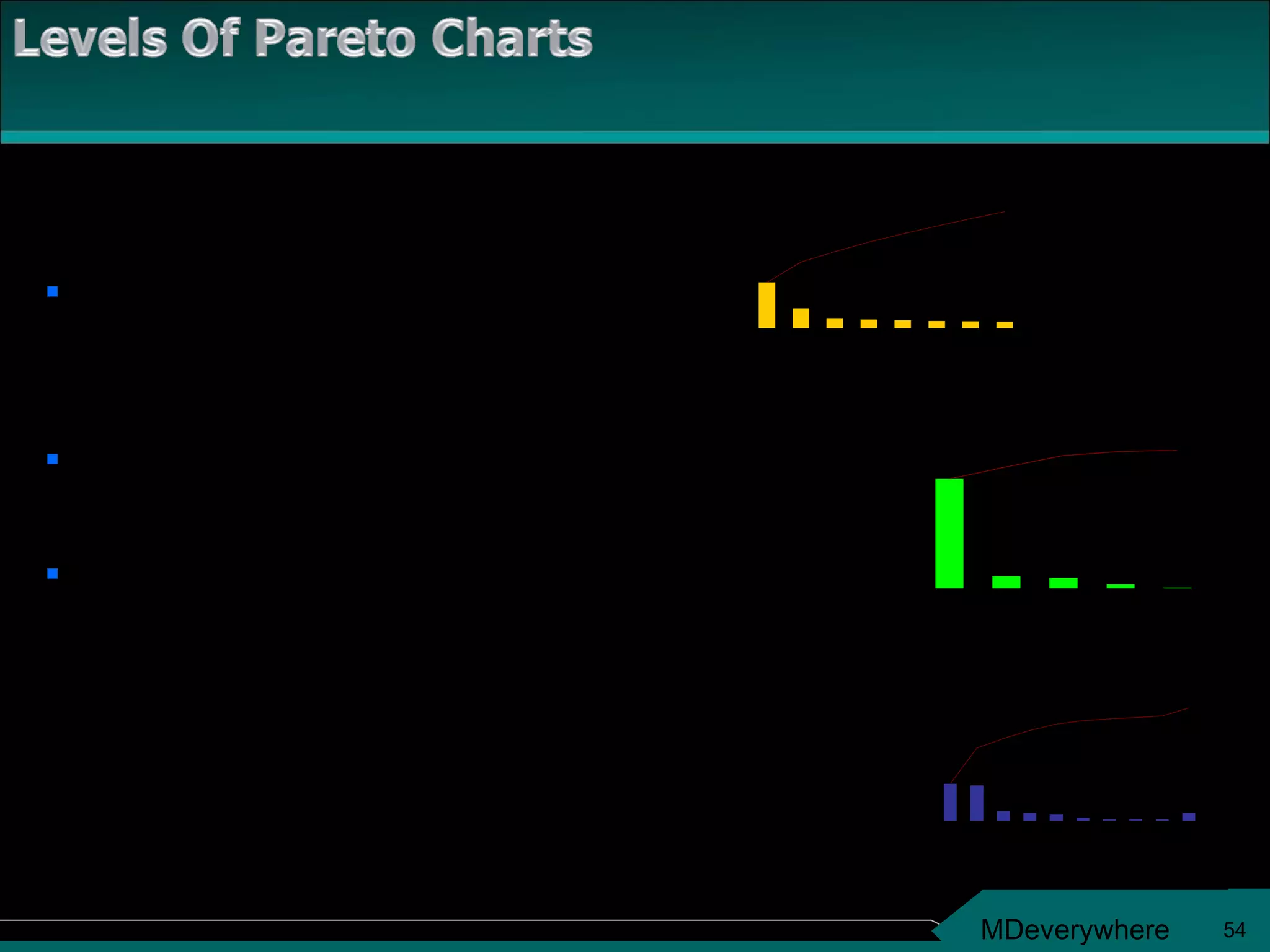
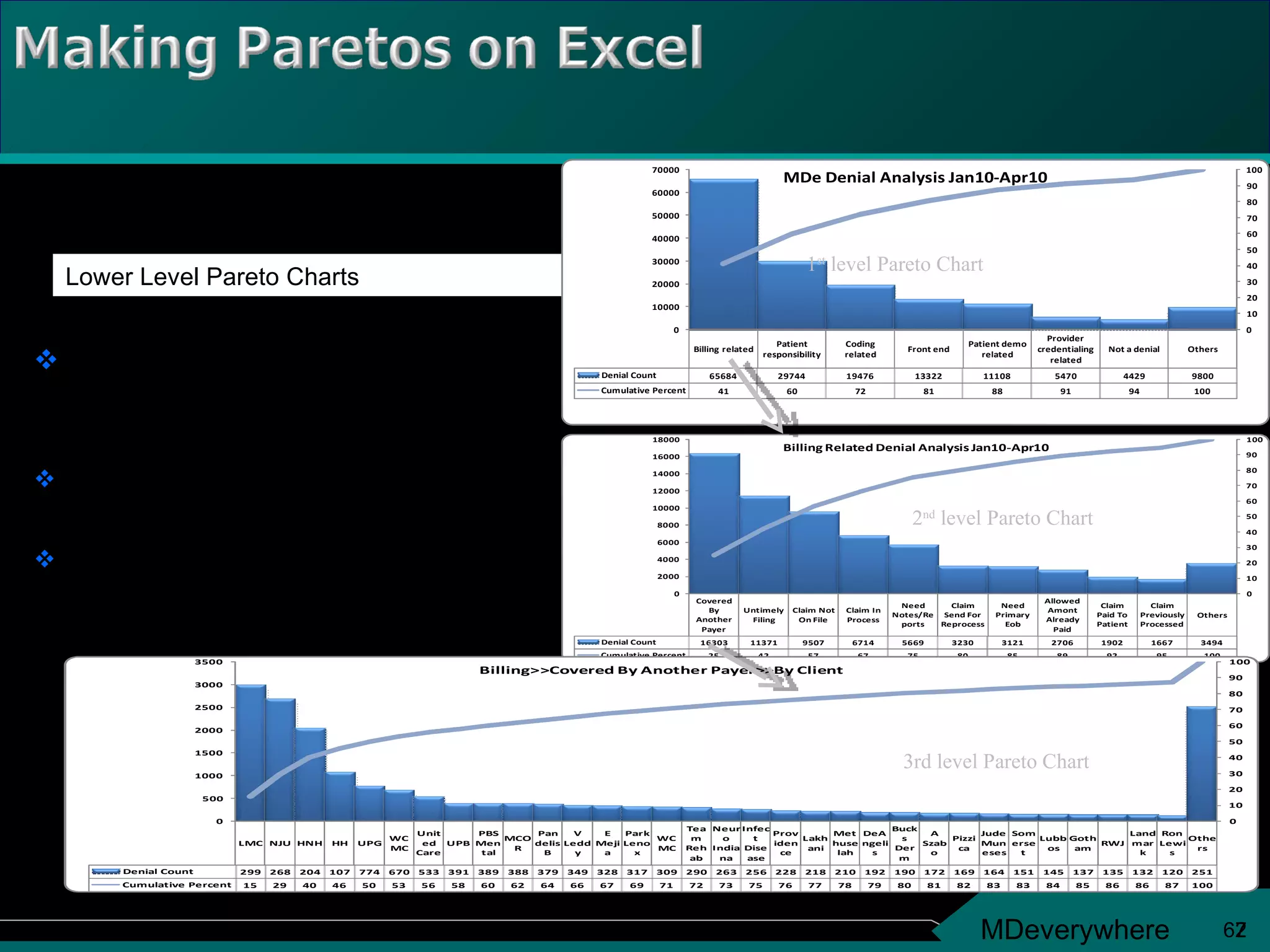
2 nd  level Pareto Chart  If the data from the Pareto chart  can be stratified further, create 2 nd  or  even 3 rd  level charts. Analyze these charts to determine if the  Pareto Principle applies. When you’ve narrowed down the  problems on the deepest levels you will  start finding root causes. 1 st  level Pareto Chart  3rd level Pareto Chart
The Pareto Principle does not apply if all the categories account for an approximately equal percentage of the occurrences.  All the bars are about the same height.
Do  not  analyze the tallest bar any further.  It is clear that this categorization is not related to the root cause of the problem.  You need to find another way to look at the data.  - Determine if there is another way to stratify the data. - Normalize the data (make all the categories comparable by making the thing you are measuring into a rate).
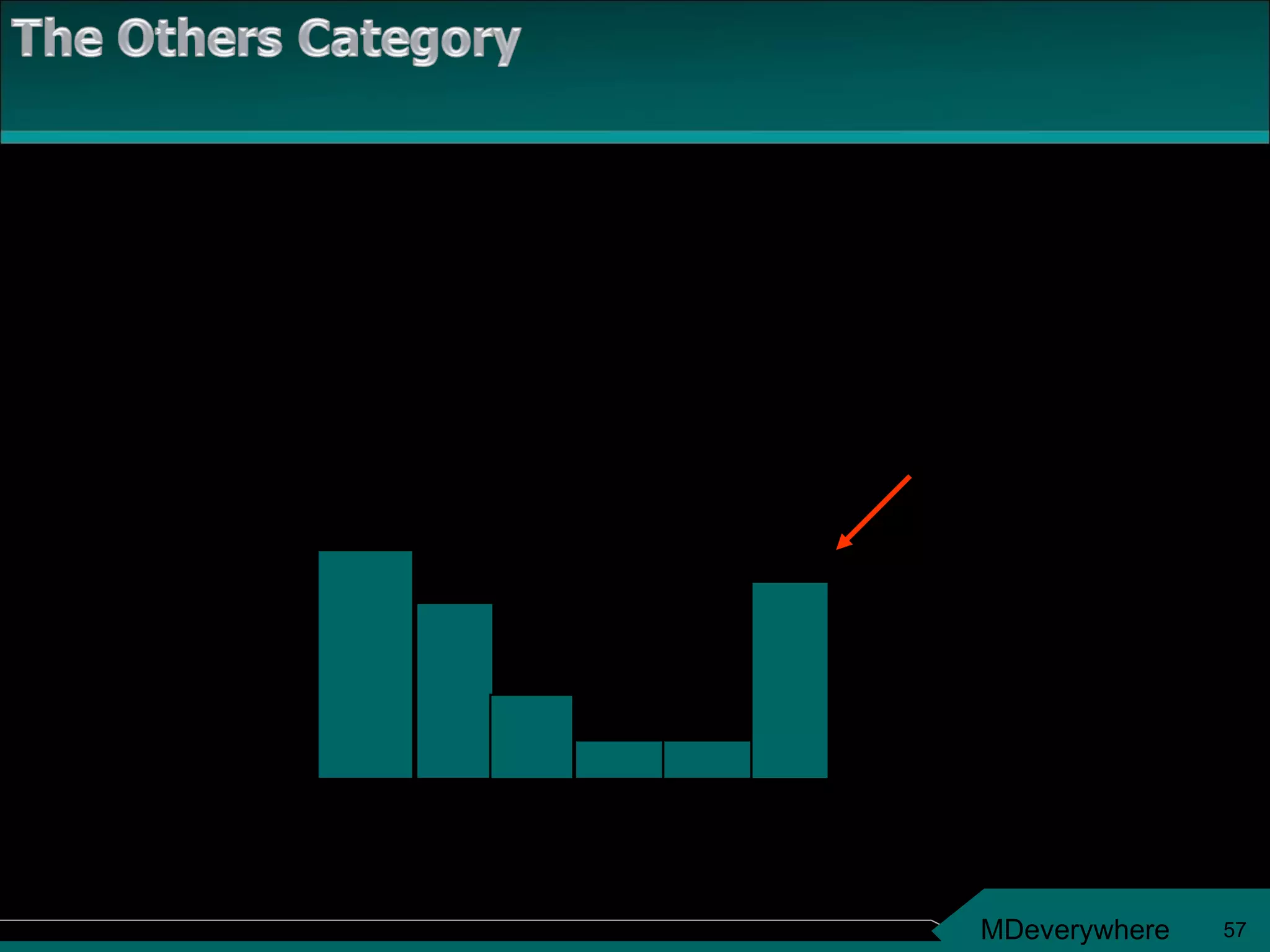
Occurrences in the “other” category should be redistributed to existing categories or a new category should be created If you create an “other” category ensure that it is not one of the larger bars on the chart.
2
2 What is a Pareto Chart? A graphical representation of the Pareto Principle. A series of bars whose heights reflect the frequency of the problem. A graph where data is categorized to expose patterns.
2 Bar height shows relative importance; in descending order  Bars represent each stratified category Vertical axis (secondary) shows cumulative percentages “ Other” category can be used.  It’s always last. Vertical axis (primary) shows count of data points (Denial Count) This line shows cumulative percentages
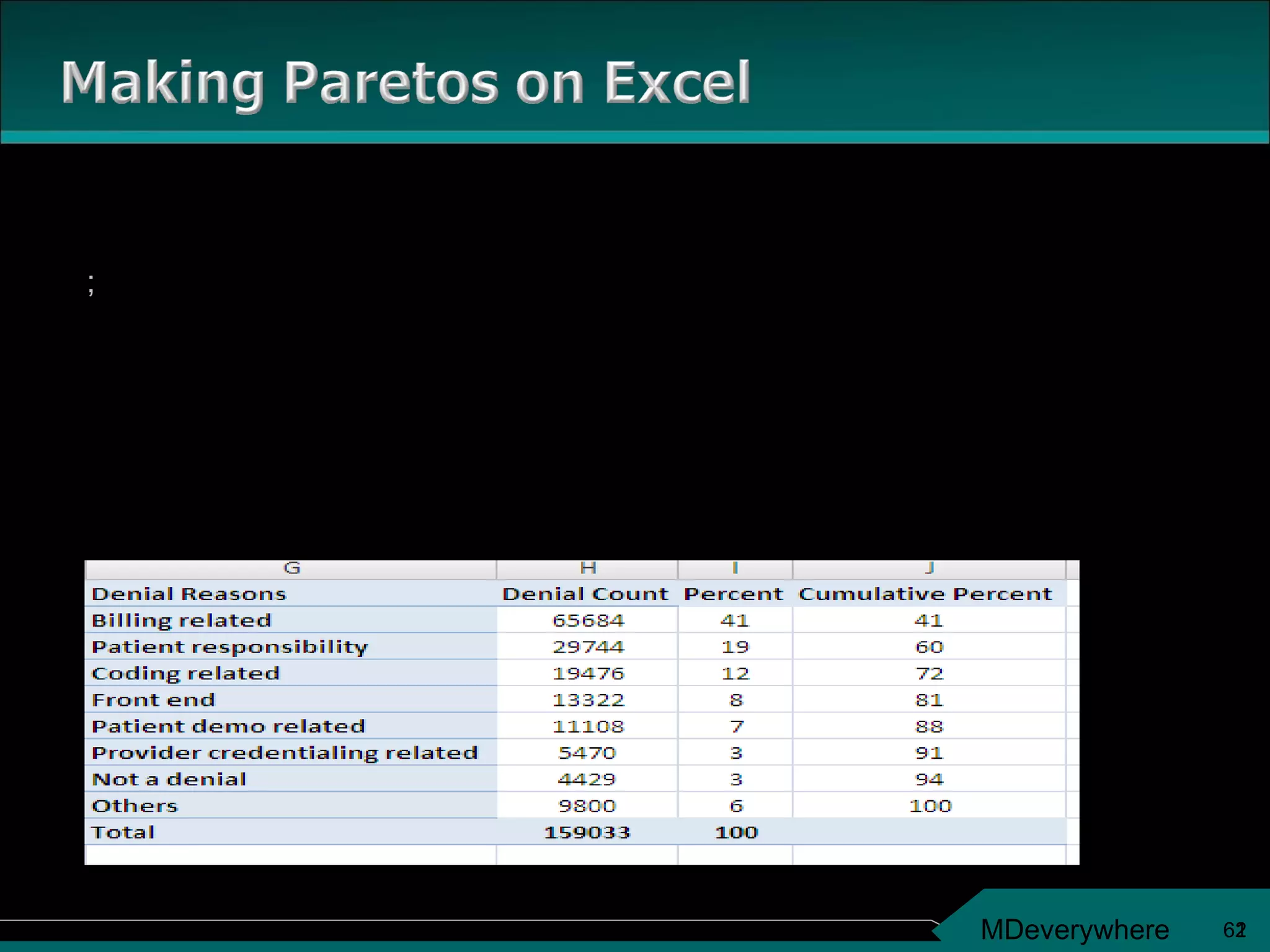
2 ; Enter all Attributes that Contribute to the Problem Sort occurrences of each one of them in descending order Calculate their individual contribution percentage to the overall problem. Calculate cumulative frequency to club top contributors together. A table Similar to the picture below should appear on your screen.
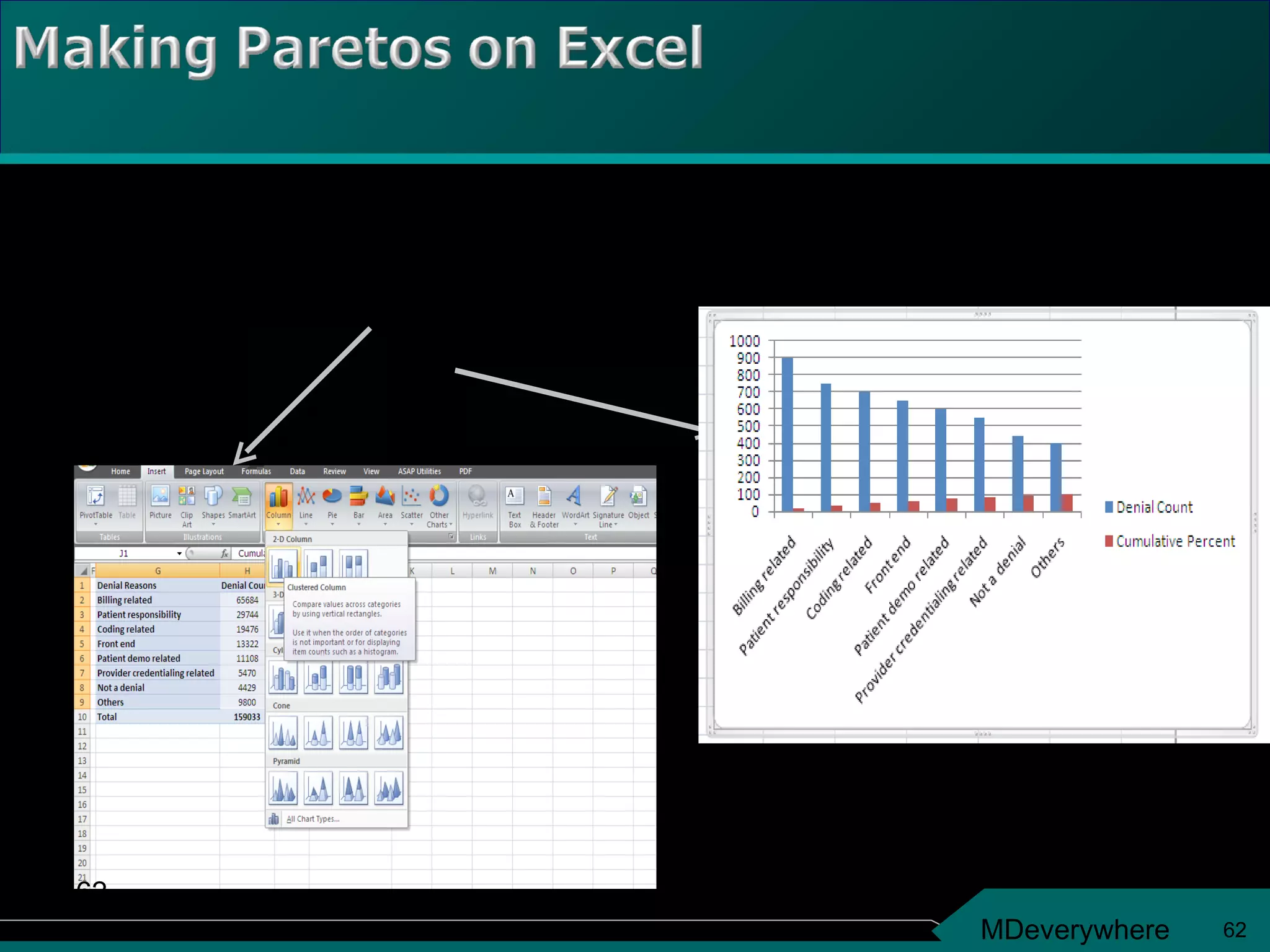
2 Step 2: Go to INSERT tab of excel 2007 and click on COLUMN Select the 1 st  histogram of 2D COLUMN Now the Histogram is ready
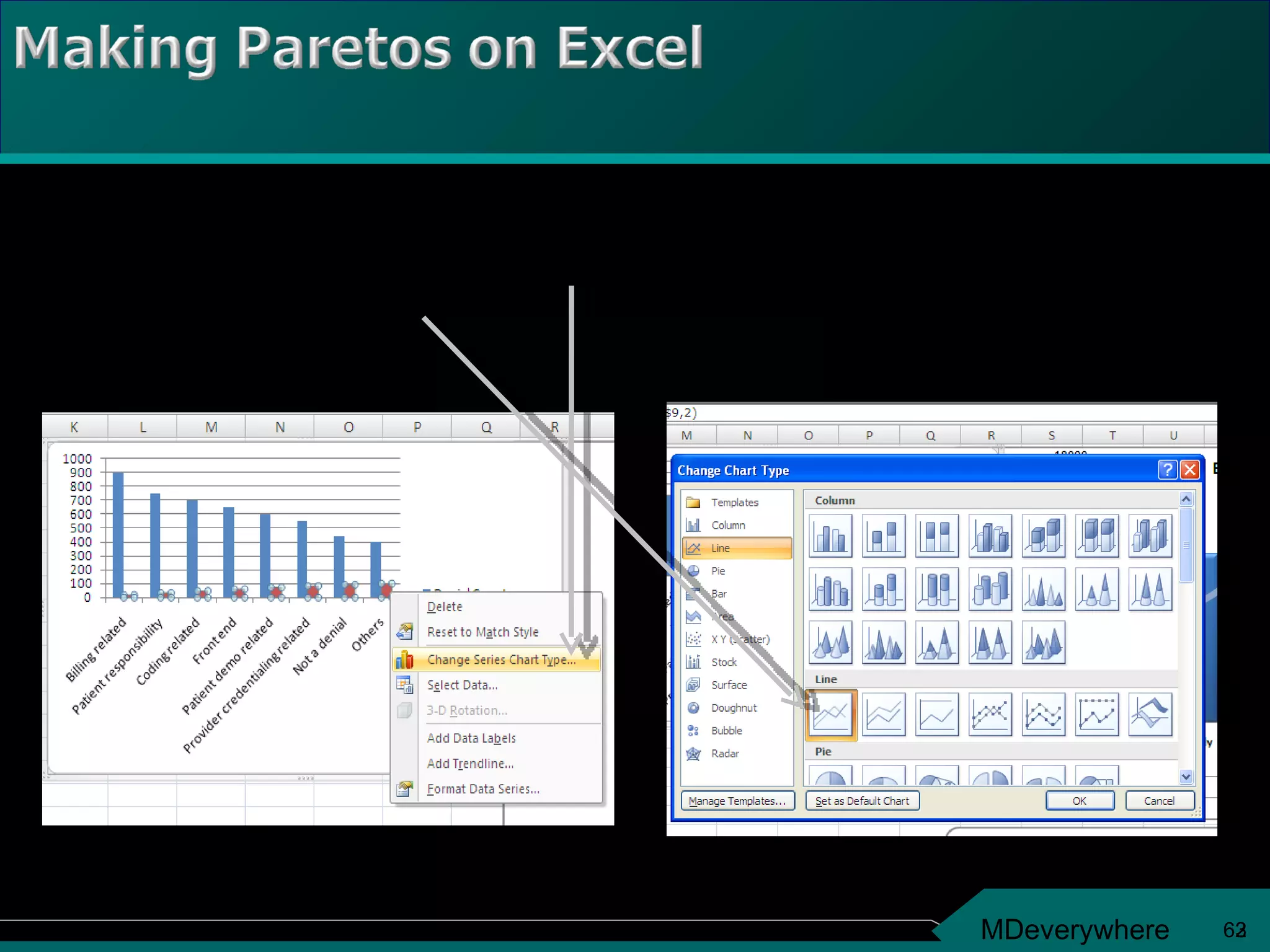
2 Step 3: Right click on the RED bar, then click on the “Change Series Chart Type” Then select first Line graph
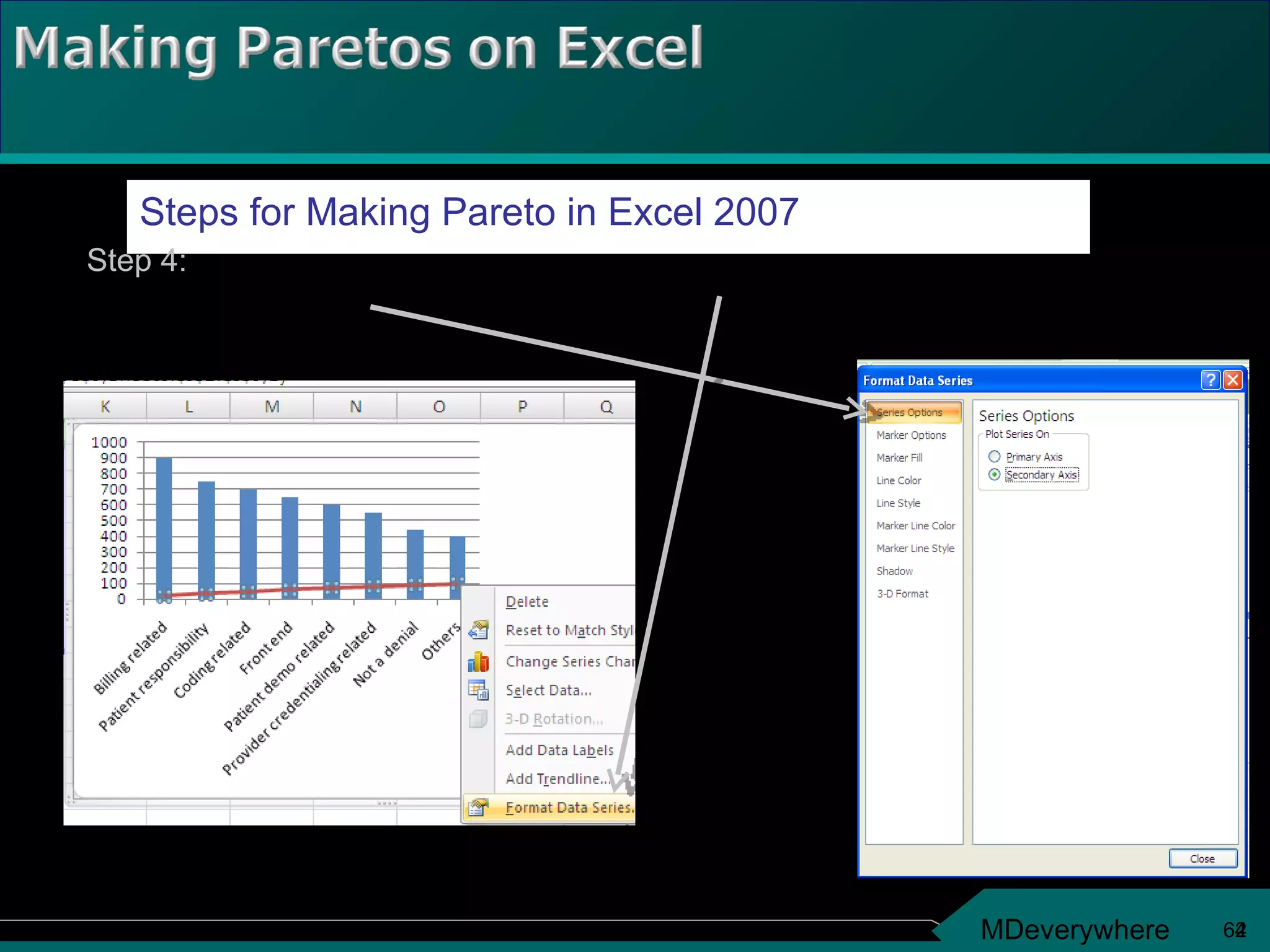
2 Steps for Making Pareto in Excel 2007 Step 4: Right click on the RED line, then click on the “Format Data Series” Select Series Options Select Secondary Axis
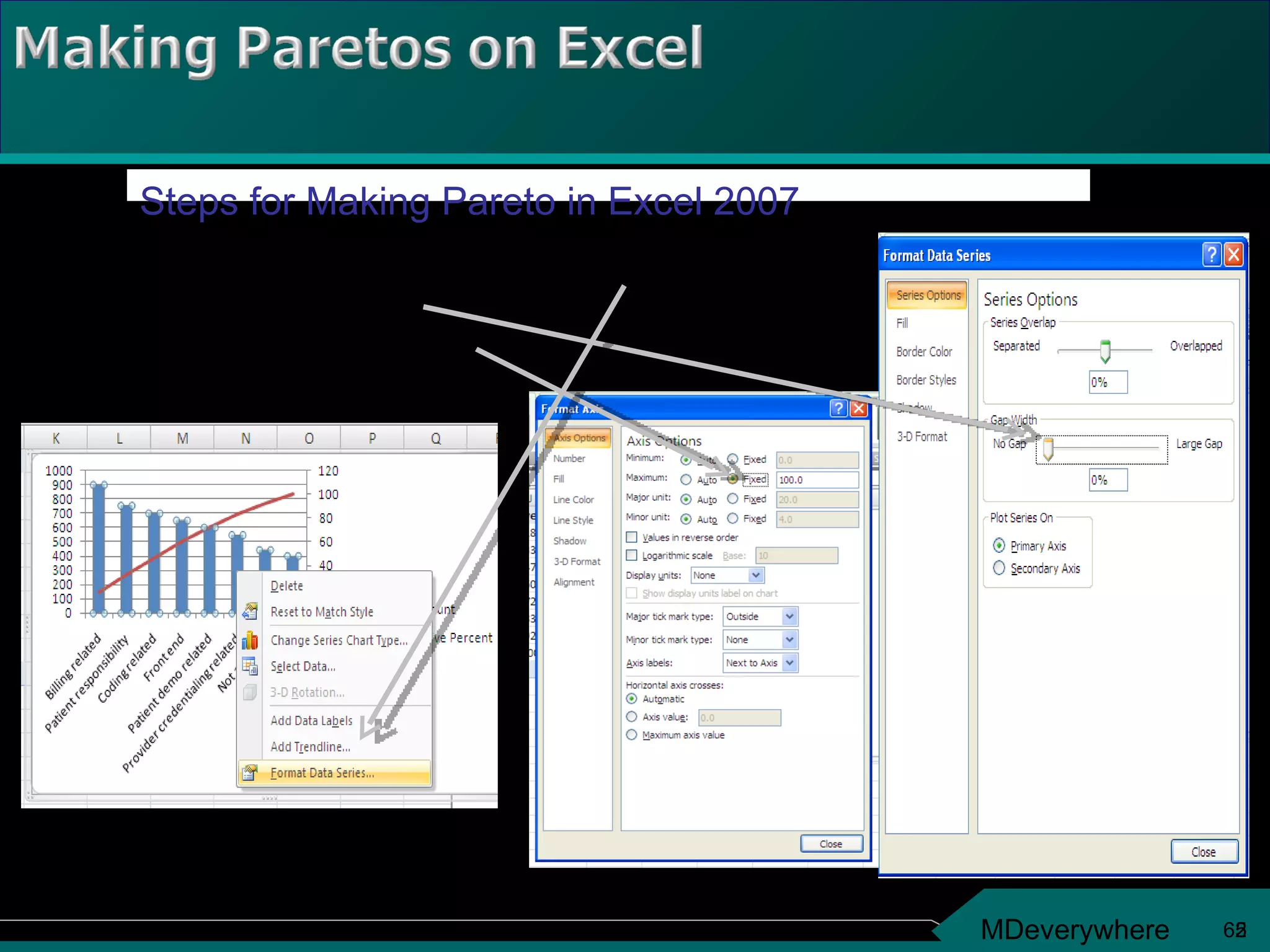
2 Steps for Making Pareto in Excel 2007 Step 5: Right click on the BLUE bar, then click on the “Format Data Series” Reduce the Gap Width to 0% Right Click on the secondary Axis> Go to Format Axis> Axis Options Make the Maximum fixed 100.00
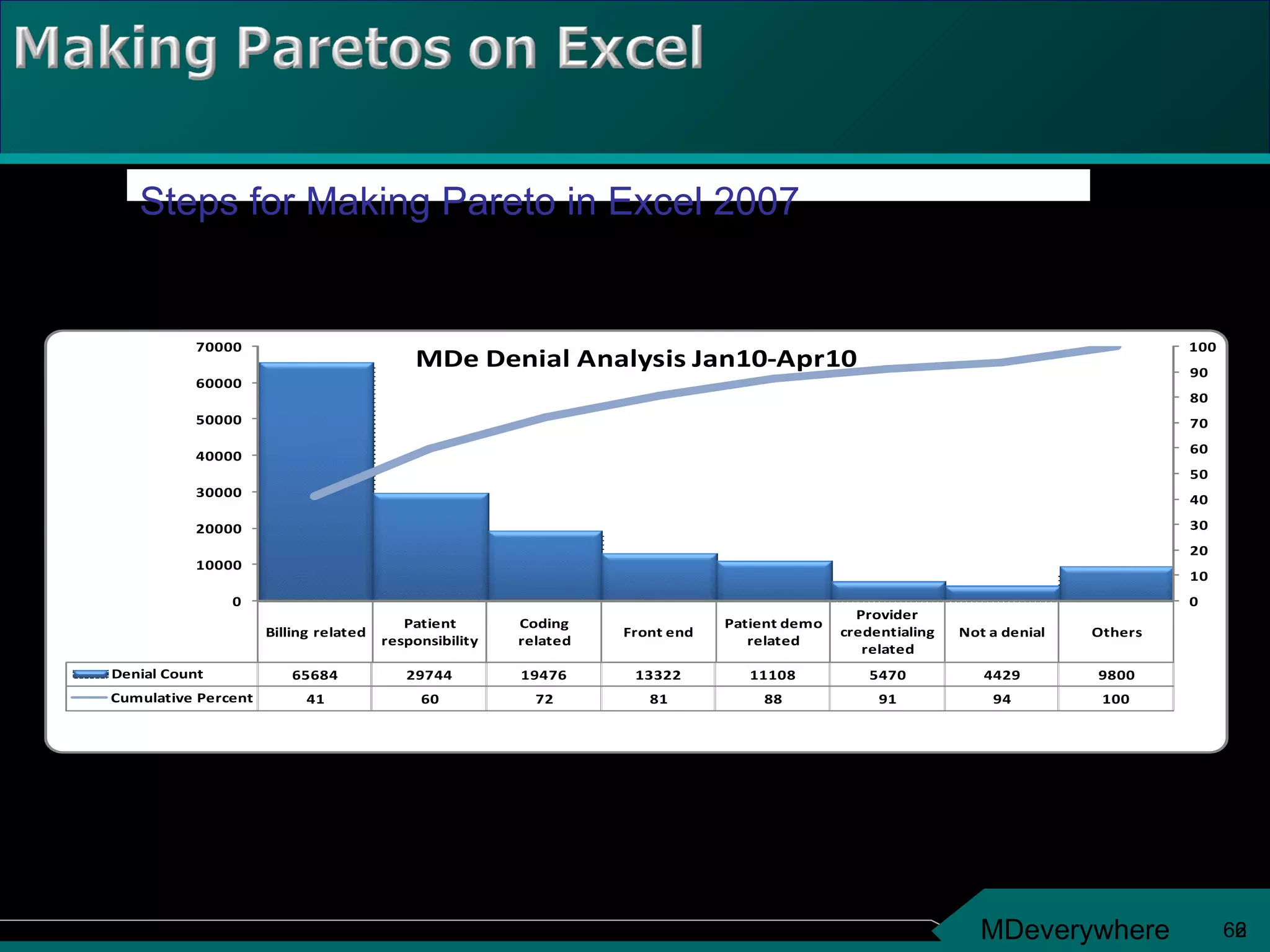
2 Steps for Making Pareto in Excel 2007 Step 6: Pareto is Ready for ANALYSIS
2 If the data from the Pareto chart  can be stratified further, create 2 nd  or  even 3 rd  level charts. Analyze these charts to determine if the  Pareto Principle applies. When you’ve narrowed down the  problems on the deepest levels you will  start finding root causes. Lower Level Pareto Charts 1 st  level Pareto Chart  2 nd  level Pareto Chart  3rd level Pareto Chart

Six sigma - yellow belt program v3-030610

  • 1.
  • 2.
    What is Quality?Know Six Sigma Introduction to Six Sigma as methodology Awareness with respect to origin and history of Six Sigma. The Six Sigma organization Variation and Normal Distribution The Pareto Principle reading and Making Paretos.
  • 3.
  • 4.
    Historically Proactive Quality“ Create process that will produce less or no defects” Contemporary Reactive Quality Quality Checks (QC) - Taking the defectives out of what is produced
  • 5.
    Tools Organization MethodologyDriven by customer needs Enabled by quality team. Led by Senior Mgmt Define Measure Analyze Improve Control Process Map Analysis Pareto Chart Process variation LSL USL Upper/Lower specification limits Regression • • • • • • • • • • • • • • • • • • • • • • • • • • • • • • • • • • • • • • • • • • • • • •
  • 6.
    Methodologies Standards CapabilityModels Six Sigma Lean ISO 9000, ISO 14000 etc. COPC Malcolm Baldrige eSCM CMM CMMI Scientific way to improve capability? Sharing Benchmarked practices- “Standardizing” Best practices to build capability
  • 7.
    It is amethodology for continuous improvement It is a methodology for creating products/ processes that perform at high standards It is a set of statistical and other quality tools arranged in unique way It is a way of knowing where you are and where you could be! It is a Quality Philosophy and a management technique Six Sigma is not: A standard A certification Another metric like percentage
  • 8.
    The term “sigma”is used to designate the distribution or spread about the mean (average) of any process or procedure. For a process, the sigma capability (z-value) is a metric that indicates how well that process is performing. The higher the sigma capability, the better. Sigma capability measures the capability of the process to produce defect-free outputs. A defect is anything that results in customer dissatisfaction. 
  • 9.
    Sigma levels andDefects per million opportunities (DPMO) 4 Sigma 6,210 Defects 2 Sigma 308,537 Defects 3 Sigma 66,807 Defects 5 Sigma 233 Defects 6 Sigma 3.4 Defects
  • 10.
    Example quoted fromGE Book of Knowledge - copyright GE Is 99% (3.8  ) good enough? 99.99966% Good – At 6  20,000 lost mails per hour 7 lost mails per hour Unsafe drinking water almost 15 minutes each day One minute of unsafe drinking water every seven months 5,000 incorrect surgical operations per week 1.7 incorrect surgical operations per week 2 short or long landings at most major airports daily One short or long landing at major airports every five years 200,000 wrong drug prescriptions each year 68 wrong drug prescriptions each year
  • 11.
    The term “SixSigma” was coined by Bill Smith, an engineer with Motorola Late 1970s - Motorola started experimenting with problem solving through statistical analysis 1987 - Motorola officially launched it’s Six Sigma program Motorola The company that invented Six Sigma
  • 12.
    Jack Welch launchedSix Sigma at GE in Jan,1996 1998/99 - Green Belt exam certification became the criteria for management promotions 2002/03 - Green Belt certification became the criteria for promotion to management roles GE The company that perfected Six Sigma
  • 13.
  • 14.
  • 15.
  • 16.
    Master Black BeltBlack Belt Black Belt Green Belt Green Belt Green Belt - Thought Leadership - Expert on Six Sigma - Mentor Green and Black Belts Backbone of Six Sigma Org Mentor Green Belts - Full time resource - Deployed to complex or “high risk” projects - Part time or full time resource Deployed to less complex projects in areas of functional expertise
  • 17.
    Basic - SixSigma Awareness Green Belt Projects Participate in Black Belt Projects Assist business functions with day to day activities Mentor/Train Green Belts Black Belt Projects Change Agents Work along with the business owners Mentor/ Train Black Belts Run Strategic projects More Strategic than tactical role Green Belt (GB) Black Belt (BB) Master Black Belt (MBB) Highly paid! Work like a Consultant! Huge demand in the industry! Overall…A high flying Career!!
  • 18.
    BPMS Business ProcessManagement System DMAIC Six Sigma Improvement Methodology DMADV Creating new process which will perform @ Six Sigma
  • 19.
    THE DMAIC MODEL – For attaining Excellence in existing Processes Define Measure Analyze Improve Control Combination of change management & statistical analysis Define Measure Analyze Design Verify THE DMADV MODEL - Setting up New Processes to Deliver @ SIX SIGMA also known as DFSS ( Design For Six Sigma)
  • 20.
    Define purpose ofthe process, its goal and its boundaries Identify Critical to Quality and Critical to process Visual representation of performance Map process steps, identify input/ output measures MSA, DCP, indicators and monitors Service excellence and process excellence The DMAIC cycle Define Process Mission Map Process VOC and VOP Build PMS Develop Dashboards Identify Improvement Opportunities
  • 21.
    To understand theprocess; it’s mission, flow and scope To know the customers and their expectations To identify, monitor and improve correct performance measures for the process
  • 22.
    DMAIC Six SigmaImprovement Methodology
  • 23.
    A logical andstructured approach to problem solving and process improvement An iterative process (continuous improvement) A quality tool with focus on change management Essentially Six Sigma DMAIC Is…………… Y = F(X1,X2,X3…………………Xn)
  • 24.
    Practical ProblemStatistical Problem Statistical Solution Practical Solution
  • 25.
    D Define MMeasure A Analyze I Improve C Control Identify and state the practical problem Validate the practical problem by collecting data Convert the practical problem to a statistical one, define statistical goal and identify potential statistical solution Confirm and test the statistical solution Convert the statistical solution to a practical solution Monitor and Sustain implemented solutions / processes and make new processes a way of Life.
  • 27.
    If the outcomeof a process when observed over multiple instances / data points is not consistent then the process is termed as a process with variation. The term variation refers to the amount of fluctuations which creep into a process over time. Variation doesn’t essentially mean missing targets or customer expectations all the time. Its more about measuring the inconsistency in a process and is a vital measure in determining the process capability. Variation = Spread around the centre
  • 28.
    Measurement Variation Generallya result of an improper or non-calibrated measurement system which produces different outputs in different attempts even with all measuring parameters constant. or Variation in the way you measure a process Process Variation Result of random or non random causes or Variation as part of a process
  • 29.
    Measurement system variationis often a result of the following few reasons Inappropriate measurement tools being used providing inaccurate or inconsistent results for the same exercise. Least count is not granular enough to provide precise outputs. Operators not adequately trained etc. Measurement errors are commonly termed as GRR errors i.e. Gauge of Repeatability and Reproducibility errors
  • 30.
    Common Causes: Randomvariation (usual) No pattern Inherent in process Adjusting the process decreases its variation Special Causes Non-random variation (unusual) May exhibit a pattern Assignable, explainable, controllable Adjusting the process decreases its variation
  • 32.
    A normal distributionis bell-shaped and symmetric. The mean (mu) controls the center and standard deviation/variation (s) controls the spread The distribution is determined by the mean (mu,  and the standard deviation (s)
  • 33.
    For any normalcurve : 68 percent of the observations fall within one standard deviation of the mean. 95 percent of observation fall within 2 standard deviations and 99.7 percent of observations fall within 3 standard deviations of the mean.
  • 34.
    Add up about30 of most things and you start to be “normal” Normal distributions are divide up into 3 standard deviations on each side of the mean Once your that, you know a lot about what is going on And that is what a standard deviation is good for
  • 35.
    The world tendsto be bell-shaped Most outcomes occur in the middle Fewer in the “ tails” (lower) Fewer in the “ tails” (upper) Even very rare outcomes are possible (probability > 0) Even very rare outcomes are possible (probability > 0)
  • 36.
    4- 1 23 4 5 6 7 8 9 10 Sample number Upper control limit Process average Lower control limit Out of control
  • 37.
    Shot a rifle?Played darts? Shot a round of golf? Played basketball? Emmett Jake Who is the better shot?
  • 38.
    What do youmeasure in your process? Why do those measures matter? Are those measures consistently the same? Why not?
  • 39.
    Deviation = distancebetween observations and the mean (or average) Emmett Jake 8 7 10 8 9 Observations 10 9 8 8 7 averages 8.4 Deviations 10 - 8.4 = 1.6 9 – 8.4 = 0.6 8 – 8.4 = -0.4 8 – 8.4 = -0.4 7 – 8.4 = -1.4 0.0
  • 40.
    Deviation = distancebetween observations and the mean (or average) Emmett Jake 7 6 7 7 6 Observations 7 7 7 6 6 averages 6.6 Deviations 7 – 6.6 = 0.4 7 – 6.6 = 0.4 7 – 6.6 = 0.4 6 – 6.6 = -0.6 6 – 6.6 = -0.6 0.0
  • 41.
    Variance = averagedistance between observations and the mean squared Emmett Jake 8 7 10 8 9 Observations 10 9 8 8 7 averages 8.4 Deviations 10 - 8.4 = 1.6 9 – 8.4 = 0.6 8 – 8.4 = -0.4 8 – 8.4 = -0.4 7 – 8.4 = -1.4 0.0 Squared Deviations 2.56 0.36 0.16 0.16 1.96 1.0 Variance
  • 42.
    Variance = averagedistance between observations and the mean squared Emmett Jake 7 6 7 7 6 Observations 7 7 7 6 6 averages Deviations Squared Deviations
  • 43.
    Variance = averagedistance between observations and the mean squared Emmett Jake 7 6 7 7 6 Observations 7 7 7 6 6 averages 6.6 Deviations 7 - 6.6 = 0.4 7 - 6.6 = 0.4 7 - 6.6 = 0.4 6 – 6.6 = -0.6 6 – 6.6 = -0.6 0.0 Squared Deviations 0.16 0.16 0.16 0.36 0.36 0.24 Variance
  • 44.
    Standard deviation =square root of variance Emmett Jake Variance Standard Deviation Emmett 1.0 1.0 Jake 0.24 0.4898979 But what good is a standard deviation
  • 45.
    Here is why: Even outcomes that are equally likely (like dice), when you add them up, become bell shaped
  • 46.
  • 47.
    This is alsoknown as the "80/20 Rule“ The rule states that about 80% of the situations of the problem can be traced to 20% of possible causes. The Pareto principle was developed by an Italian economist who noticed that 80% of the wealth was owned by 20% of the population.
  • 48.
    The Pareto principleimplies that we can frequently solve a problem by identifying and attacking the “vital few” sources. This principle can be applied to most systems and processes. The concept is used to dissect a large problem into smaller pieces and in order to identify the biggest contributors. Pareto analysis helps to ‘localize’ the problem
  • 49.
    Most of theequipment breakdowns are due to a small percentage of the equipment. The majority of calls to a IT help desk are attributed to a small number of reasons. Most of the errors in any process occur in one or two process steps. Only a handful of students in the school district account for most of the tardy events.
  • 50.
    A graphical representationof the Pareto Principle. A series of bars whose heights reflect the frequency of the problem. A graph where data is categorized to expose patterns.
  • 51.
    Bar height showsrelative importance; in descending order Bars represent each stratified category Vertical axis shows relative percentages “ Other” category can be used. It’s always last. Vertical axis shows count of data points The line shows cumulative percentages
  • 52.
    The Pareto Principleapplies if one or more categories account for a large percentage of the occurrences. Look for the bars that are much taller than the rest.
  • 53.
    Focus your improvementefforts on the largest category or categories of the Pareto Chart, in order to achieve the maximum gain. Only focus on a smaller bar if it has a larger impact or is easier to fix. Using only the data from the large categories of the Pareto Chart, determine if they can be further stratified into additional categories.
  • 54.
    2 nd level Pareto Chart If the data from the Pareto chart can be stratified further, create 2 nd or even 3 rd level charts. Analyze these charts to determine if the Pareto Principle applies. When you’ve narrowed down the problems on the deepest levels you will start finding root causes. 1 st level Pareto Chart 3rd level Pareto Chart
  • 55.
    The Pareto Principledoes not apply if all the categories account for an approximately equal percentage of the occurrences. All the bars are about the same height.
  • 56.
    Do not analyze the tallest bar any further. It is clear that this categorization is not related to the root cause of the problem. You need to find another way to look at the data. - Determine if there is another way to stratify the data. - Normalize the data (make all the categories comparable by making the thing you are measuring into a rate).
  • 57.
    Occurrences in the“other” category should be redistributed to existing categories or a new category should be created If you create an “other” category ensure that it is not one of the larger bars on the chart.
  • 58.
  • 59.
    2 What isa Pareto Chart? A graphical representation of the Pareto Principle. A series of bars whose heights reflect the frequency of the problem. A graph where data is categorized to expose patterns.
  • 60.
    2 Bar heightshows relative importance; in descending order Bars represent each stratified category Vertical axis (secondary) shows cumulative percentages “ Other” category can be used. It’s always last. Vertical axis (primary) shows count of data points (Denial Count) This line shows cumulative percentages
  • 61.
    2 ; Enterall Attributes that Contribute to the Problem Sort occurrences of each one of them in descending order Calculate their individual contribution percentage to the overall problem. Calculate cumulative frequency to club top contributors together. A table Similar to the picture below should appear on your screen.
  • 62.
    2 Step 2:Go to INSERT tab of excel 2007 and click on COLUMN Select the 1 st histogram of 2D COLUMN Now the Histogram is ready
  • 63.
    2 Step 3:Right click on the RED bar, then click on the “Change Series Chart Type” Then select first Line graph
  • 64.
    2 Steps forMaking Pareto in Excel 2007 Step 4: Right click on the RED line, then click on the “Format Data Series” Select Series Options Select Secondary Axis
  • 65.
    2 Steps forMaking Pareto in Excel 2007 Step 5: Right click on the BLUE bar, then click on the “Format Data Series” Reduce the Gap Width to 0% Right Click on the secondary Axis> Go to Format Axis> Axis Options Make the Maximum fixed 100.00
  • 66.
    2 Steps forMaking Pareto in Excel 2007 Step 6: Pareto is Ready for ANALYSIS
  • 67.
    2 If thedata from the Pareto chart can be stratified further, create 2 nd or even 3 rd level charts. Analyze these charts to determine if the Pareto Principle applies. When you’ve narrowed down the problems on the deepest levels you will start finding root causes. Lower Level Pareto Charts 1 st level Pareto Chart 2 nd level Pareto Chart 3rd level Pareto Chart

Editor's Notes

  • #3 Setting the expectation of audience. Following are the topics which would be covered not necessarily in the same order.
  • #48 The Pareto Chart is named after Vilfredo Pareto, an Italian economist who observed in the early 1900s that the vast majority of wealth was in the possession of only a few people. Dr. Joseph Juran, who published this principle in the 1950s, showed that the principle can be applied to a wide variety of situations, especially quality problems in particular. Applying the principle in the workplace means that the greatest achievements are gained from action when attention is concentrated on the "vital few" problems. The Pareto chart is named after Vilfredo Pareto, an Italian economist, who observed in the early 1900s that a relatively few people held the majority of the wealth. In the 1950s, Dr. Joseph Juran popularized this principle by showing that it applied in a variety of situations, especially quality problems. Applying this principle to our everyday problems means we will get the biggest gains for our efforts if we focus on the “vital few” problems.
  • #50 These are examples in everyday situations where the Pareto Principle applies. The last example “tardy events” is used in subsequent slides are an example.
  • #52 Category 0 5000 10000 15000 20000 25000 Amount of Spoilage ($$) Produce Meat Dairy Bakery Other Grocery Store Spoilage by Department October–December 1997 100% 80% 60% 40% 20% Percentage of total Sometimes a “cumulative percentage” line is added to a Pareto chart to help visualize the percentage of the problem contributed by each category Pareto Chart Used for categorical data. Categories must be nonoverlapping and exhaustive of the total problem. That is, each instance sorted can go into one, and only one, category. Height of bar represents relative importance of that category. Bars are arranged in descending order from left to right. The bar for the biggest problem is always on the left. Height of vertical axis represents sum of all occurrences (not just the height of the tallest bar). Some Pareto charts will also show a “cumulative percentage” line. The raw data is converted to “percentage of the total” and a parallel vertical axis drawn on the right side of the chart. For example, in the chart shown, it’s easy to see that produce accounted for close to 50% of the total dollars lost.
  • #53 The first thing to check on a Pareto chart is whether the Pareto principle holds. A few of the categories should account for most of the problem.
  • #54 Start with the largest bar, unless you believe that one of the other bars will be much easier to attack. If possible, make a new Pareto chart of the problems that make up the tallest bar. If any of the bars point to problems with simple solutions, by all means attack them, even if these problems are not the tallest bars.
  • #55 Start with the largest bar, unless you believe that one of the other bars will be much easier to attack. If possible, make a new Pareto chart of the problems that make up the tallest bar. If any of the bars point to problems with simple solutions, by all means attack them, even if these problems are not the tallest bars.
  • #56 The first thing to check on a Pareto chart is whether the Pareto principle holds. A few of the categories should account for most of the problem.
  • #58 Analyze the Pareto chart to ensure that the “Other” bar is not one of the taller categories. If so, the data in the “other” category needs to be reanalyzed to see if new categories can be made.