Six sigma Orientation
expectations What is Quality? Know Six Sigma Awareness with respect to origin and history of Six Sigma. The utility and benefits Introduction to Six Sigma as methodology The Six Sigma organization
What is Quality?
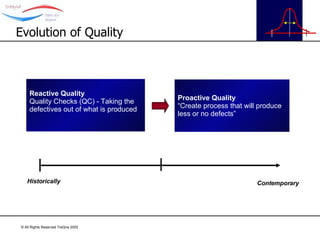
Evolution of Quality Historically Proactive Quality “ Create process that will produce less or no defects” Contemporary Reactive Quality Quality Checks (QC) - Taking the defectives out of what is produced
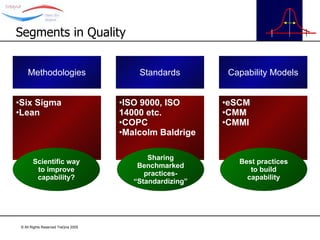
Segments in Quality Methodologies Standards Capability Models Six Sigma Lean ISO 9000, ISO 14000 etc. COPC Malcolm Baldrige eSCM CMM CMMI Scientific way to improve capability? Sharing Benchmarked practices- “Standardizing” Best practices to build capability
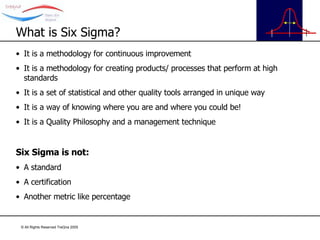
What is Six Sigma? It is a methodology for continuous improvement It is a methodology for creating products/ processes that perform at high standards It is a set of statistical and other quality tools arranged in unique way It is a way of knowing where you are and where you could be! It is a Quality Philosophy and a management technique Six Sigma is not: A standard A certification Another metric like percentage
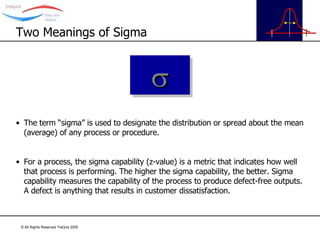
The term “sigma” is used to designate the distribution or spread about the mean (average) of any process or procedure. For a process, the sigma capability (z-value) is a metric that indicates how well that process is performing. The higher the sigma capability, the better. Sigma capability measures the capability of the process to produce defect-free outputs. A defect is anything that results in customer dissatisfaction. Two Meanings of Sigma 
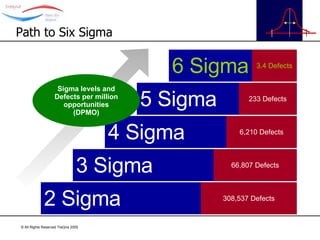
Path to Six Sigma Sigma levels and Defects per million opportunities (DPMO) 4 Sigma 6,210 Defects 2 Sigma 308,537 Defects 3 Sigma 66,807 Defects 5 Sigma 233 Defects 6 Sigma 3.4 Defects
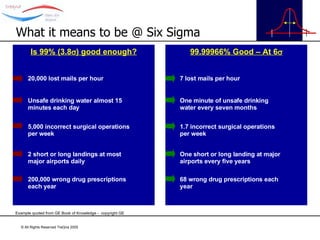
What it means to be @ Six Sigma Example quoted from GE Book of Knowledge -  copyright GE Is 99% (3.8  ) good enough? 99.99966% Good – At 6  20,000 lost mails per hour 7 lost mails per hour Unsafe drinking water almost 15 minutes each day One minute of unsafe drinking water every seven months 5,000 incorrect surgical operations per week 1.7 incorrect surgical operations per week 2 short or long landings at most major airports daily One short or long landing at major airports every five years 200,000 wrong drug prescriptions each year 68 wrong drug prescriptions each year
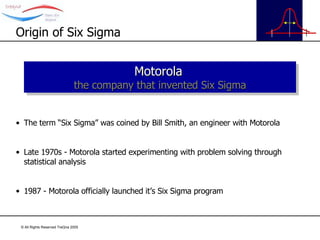
The term “Six Sigma” was coined by Bill Smith, an engineer with Motorola Late 1970s - Motorola started experimenting with problem solving through statistical analysis 1987 - Motorola officially launched it’s Six Sigma program Origin of Six Sigma Motorola   the company that invented Six Sigma
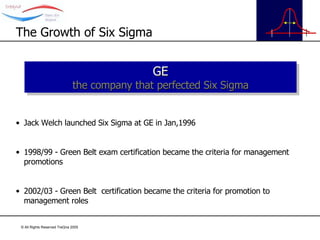
Jack Welch launched Six Sigma at GE in Jan,1996 1998/99 - Green Belt exam certification became the criteria for management promotions 2002/03 - Green Belt  certification became the criteria for promotion to management roles The Growth of Six Sigma GE the company that perfected Six Sigma
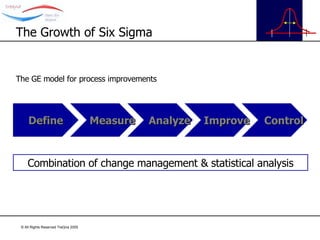
The GE model for process improvements The Growth of Six Sigma Define Measure Analyze Improve Control Combination of change management & statistical analysis
The Growth of Six Sigma
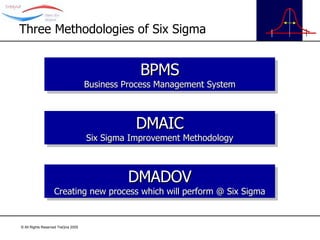
BPMS Business Process Management System DMAIC Six Sigma Improvement Methodology DMADOV Creating new process which will perform @ Six Sigma Three Methodologies of Six Sigma
BPMS Business Process Management System
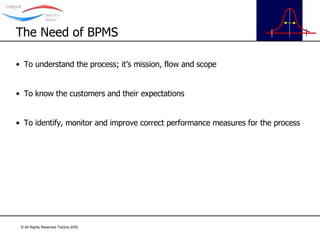
To understand the process; it’s mission, flow and scope To know the customers and their expectations To identify, monitor and improve correct performance measures for the process The Need of BPMS
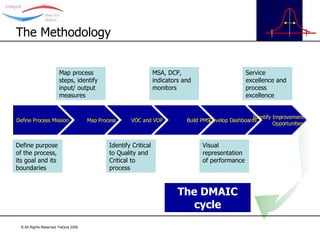
The Methodology Define purpose of the process, its goal and its boundaries Identify Critical to Quality and Critical to process Visual representation of performance Map process steps, identify input/ output measures MSA, DCP, indicators and monitors Service excellence and process excellence The DMAIC cycle Define Process Mission Map Process VOC and VOP Build PMS Develop Dashboards Identify Improvement Opportunities
DMAIC Six Sigma Improvement Methodology
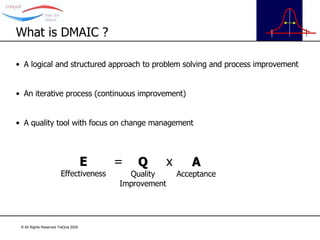
A logical and structured approach to problem solving and process improvement An iterative process (continuous improvement) A quality tool with focus on change management What is DMAIC ? E Effectiveness = Q Quality Improvement x A Acceptance
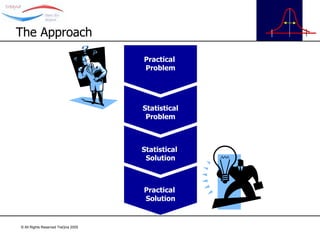
The Approach Practical  Problem Statistical Problem Statistical  Solution Practical  Solution
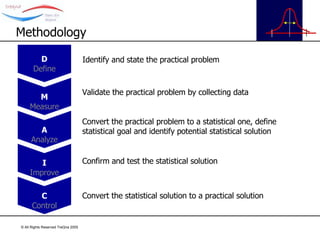
D Define M Measure A Analyze I Improve C Control Identify and state the practical problem Validate the practical problem by collecting data Convert the practical problem to a statistical one, define statistical goal and identify potential statistical solution Confirm and test the statistical solution Convert the statistical solution to a practical solution Methodology
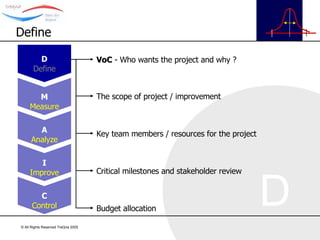
VoC  - Who wants the project and why ? The scope of project / improvement Key team members / resources for the project Critical milestones and stakeholder review Budget allocation Define D Define M Measure A Analyze I Improve C Control
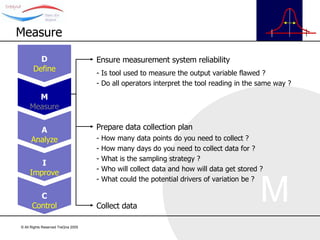
Ensure measurement system reliability Prepare data collection plan Collect data - Is tool used to measure the output variable flawed ? - Do all operators interpret the tool reading in the same way ?  - How many data points do you need to collect ? How many days do you need to collect data for ? What is the sampling strategy ? Who will collect data and how will data get stored ?  What could the potential drivers of variation be ? Measure D Define M Measure A Analyze I Improve C Control
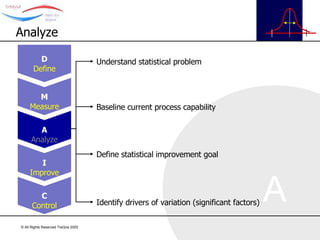
Understand statistical problem Baseline current process capability Define statistical improvement goal Identify drivers of variation (significant factors) Analyze D Define M Measure A Analyze I Improve C Control
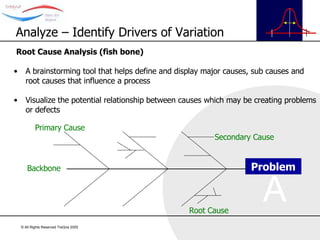
Root Cause Analysis (fish bone) A brainstorming tool that helps define and display major causes, sub causes and root causes that influence a process Visualize the potential relationship between causes which may be creating problems or defects Analyze – Identify Drivers of Variation Problem Backbone Primary Cause Secondary Cause Root Cause
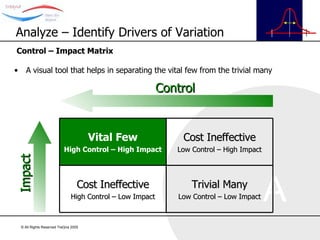
Control – Impact Matrix A visual tool that helps in separating the vital few from the trivial many Control Impact Analyze – Identify Drivers of Variation Trivial Many Low Control – Low Impact Cost Ineffective High Control – Low Impact Cost Ineffective Low Control – High Impact Vital Few High Control – High Impact
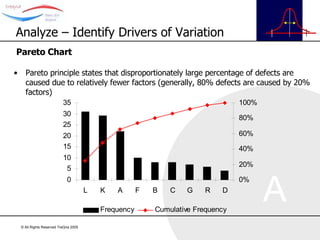
Pareto Chart Pareto principle states that disproportionately large percentage of defects are caused due to relatively fewer factors (generally, 80% defects are caused by 20% factors)  Analyze – Identify Drivers of Variation
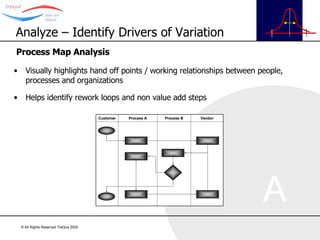
Process Map Analysis Visually highlights hand off points / working relationships between people, processes and organizations Helps identify rework loops and non value add steps Analyze – Identify Drivers of Variation
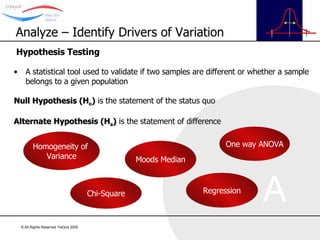
Hypothesis Testing A statistical tool used to validate if two samples are different or whether a sample belongs to a given population Null Hypothesis (H o )  is the statement of the status quo Alternate Hypothesis (H a )  is the statement of difference Analyze – Identify Drivers of Variation One way ANOVA Regression Homogeneity of  Variance Moods Median Chi-Square
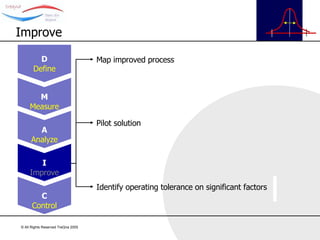
Map improved process Pilot solution Identify operating tolerance on significant factors Improve D Define M Measure A Analyze I Improve C Control
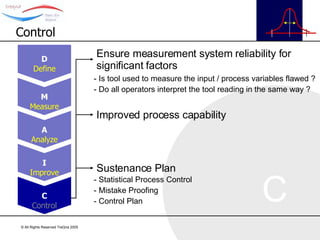
Ensure measurement system reliability for significant factors Improved process capability Sustenance Plan - Is tool used to measure the input / process variables flawed ? - Do all operators interpret the tool reading in the same way ?  - Statistical Process Control - Mistake Proofing - Control Plan Control D Define M Measure A Analyze I Improve C Control
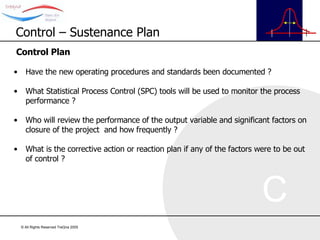
Control Plan Have the new operating procedures and standards been documented ? What Statistical Process Control (SPC) tools will be used to monitor the process performance ? Who will review the performance of the output variable and significant factors on closure of the project  and how frequently ? What is the corrective action or reaction plan if any of the factors were to be out of control ? Control – Sustenance Plan
Six Sigma Organization
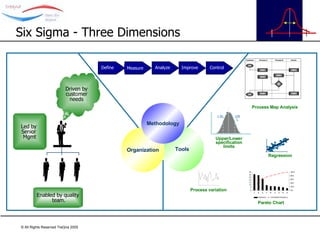
Six Sigma - Three Dimensions Tools Organization Methodology Driven by customer needs Enabled by quality team. Led by  Senior  Mgmt Define Measure Analyze Improve Control Process Map Analysis Pareto Chart Process   variation LSL USL Upper/Lower specification limits Regression • • • • • • • • • • • • • • • • • • • • • • • • • • • • • • • • • • • • • • • • • • • • • •
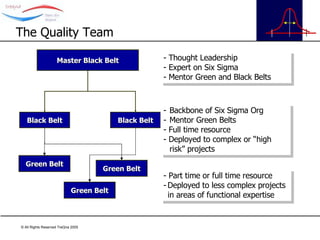
The Quality Team Master Black Belt Black Belt Black Belt Green Belt Green Belt Green Belt - Thought Leadership - Expert on Six Sigma - Mentor Green and Black Belts Backbone of Six Sigma Org Mentor Green Belts - Full time resource - Deployed to complex or “high risk” projects - Part time or full time resource Deployed to less complex projects in areas of functional expertise
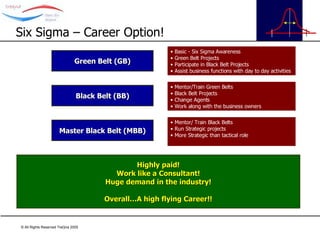
Six Sigma – Career Option! Basic - Six Sigma Awareness Green Belt Projects Participate in Black Belt Projects Assist business functions with day to day activities Mentor/Train Green Belts Black Belt Projects Change Agents Work along with the business owners Mentor/ Train Black Belts Run Strategic projects More Strategic than tactical role Green Belt (GB) Black Belt (BB) Master Black Belt (MBB) Highly paid! Work like a Consultant! Huge demand in the industry! Overall…A high flying Career!!
Thank You

U20

  • 1.
  • 2.
    expectations What isQuality? Know Six Sigma Awareness with respect to origin and history of Six Sigma. The utility and benefits Introduction to Six Sigma as methodology The Six Sigma organization
  • 3.
  • 4.
    Evolution of QualityHistorically Proactive Quality “ Create process that will produce less or no defects” Contemporary Reactive Quality Quality Checks (QC) - Taking the defectives out of what is produced
  • 5.
    Segments in QualityMethodologies Standards Capability Models Six Sigma Lean ISO 9000, ISO 14000 etc. COPC Malcolm Baldrige eSCM CMM CMMI Scientific way to improve capability? Sharing Benchmarked practices- “Standardizing” Best practices to build capability
  • 6.
    What is SixSigma? It is a methodology for continuous improvement It is a methodology for creating products/ processes that perform at high standards It is a set of statistical and other quality tools arranged in unique way It is a way of knowing where you are and where you could be! It is a Quality Philosophy and a management technique Six Sigma is not: A standard A certification Another metric like percentage
  • 7.
    The term “sigma”is used to designate the distribution or spread about the mean (average) of any process or procedure. For a process, the sigma capability (z-value) is a metric that indicates how well that process is performing. The higher the sigma capability, the better. Sigma capability measures the capability of the process to produce defect-free outputs. A defect is anything that results in customer dissatisfaction. Two Meanings of Sigma 
  • 8.
    Path to SixSigma Sigma levels and Defects per million opportunities (DPMO) 4 Sigma 6,210 Defects 2 Sigma 308,537 Defects 3 Sigma 66,807 Defects 5 Sigma 233 Defects 6 Sigma 3.4 Defects
  • 9.
    What it meansto be @ Six Sigma Example quoted from GE Book of Knowledge - copyright GE Is 99% (3.8  ) good enough? 99.99966% Good – At 6  20,000 lost mails per hour 7 lost mails per hour Unsafe drinking water almost 15 minutes each day One minute of unsafe drinking water every seven months 5,000 incorrect surgical operations per week 1.7 incorrect surgical operations per week 2 short or long landings at most major airports daily One short or long landing at major airports every five years 200,000 wrong drug prescriptions each year 68 wrong drug prescriptions each year
  • 10.
    The term “SixSigma” was coined by Bill Smith, an engineer with Motorola Late 1970s - Motorola started experimenting with problem solving through statistical analysis 1987 - Motorola officially launched it’s Six Sigma program Origin of Six Sigma Motorola the company that invented Six Sigma
  • 11.
    Jack Welch launchedSix Sigma at GE in Jan,1996 1998/99 - Green Belt exam certification became the criteria for management promotions 2002/03 - Green Belt certification became the criteria for promotion to management roles The Growth of Six Sigma GE the company that perfected Six Sigma
  • 12.
    The GE modelfor process improvements The Growth of Six Sigma Define Measure Analyze Improve Control Combination of change management & statistical analysis
  • 13.
    The Growth ofSix Sigma
  • 14.
    BPMS Business ProcessManagement System DMAIC Six Sigma Improvement Methodology DMADOV Creating new process which will perform @ Six Sigma Three Methodologies of Six Sigma
  • 15.
    BPMS Business ProcessManagement System
  • 16.
    To understand theprocess; it’s mission, flow and scope To know the customers and their expectations To identify, monitor and improve correct performance measures for the process The Need of BPMS
  • 17.
    The Methodology Definepurpose of the process, its goal and its boundaries Identify Critical to Quality and Critical to process Visual representation of performance Map process steps, identify input/ output measures MSA, DCP, indicators and monitors Service excellence and process excellence The DMAIC cycle Define Process Mission Map Process VOC and VOP Build PMS Develop Dashboards Identify Improvement Opportunities
  • 18.
    DMAIC Six SigmaImprovement Methodology
  • 19.
    A logical andstructured approach to problem solving and process improvement An iterative process (continuous improvement) A quality tool with focus on change management What is DMAIC ? E Effectiveness = Q Quality Improvement x A Acceptance
  • 20.
    The Approach Practical Problem Statistical Problem Statistical Solution Practical Solution
  • 21.
    D Define MMeasure A Analyze I Improve C Control Identify and state the practical problem Validate the practical problem by collecting data Convert the practical problem to a statistical one, define statistical goal and identify potential statistical solution Confirm and test the statistical solution Convert the statistical solution to a practical solution Methodology
  • 22.
    VoC -Who wants the project and why ? The scope of project / improvement Key team members / resources for the project Critical milestones and stakeholder review Budget allocation Define D Define M Measure A Analyze I Improve C Control
  • 23.
    Ensure measurement systemreliability Prepare data collection plan Collect data - Is tool used to measure the output variable flawed ? - Do all operators interpret the tool reading in the same way ? - How many data points do you need to collect ? How many days do you need to collect data for ? What is the sampling strategy ? Who will collect data and how will data get stored ? What could the potential drivers of variation be ? Measure D Define M Measure A Analyze I Improve C Control
  • 24.
    Understand statistical problemBaseline current process capability Define statistical improvement goal Identify drivers of variation (significant factors) Analyze D Define M Measure A Analyze I Improve C Control
  • 25.
    Root Cause Analysis(fish bone) A brainstorming tool that helps define and display major causes, sub causes and root causes that influence a process Visualize the potential relationship between causes which may be creating problems or defects Analyze – Identify Drivers of Variation Problem Backbone Primary Cause Secondary Cause Root Cause
  • 26.
    Control – ImpactMatrix A visual tool that helps in separating the vital few from the trivial many Control Impact Analyze – Identify Drivers of Variation Trivial Many Low Control – Low Impact Cost Ineffective High Control – Low Impact Cost Ineffective Low Control – High Impact Vital Few High Control – High Impact
  • 27.
    Pareto Chart Paretoprinciple states that disproportionately large percentage of defects are caused due to relatively fewer factors (generally, 80% defects are caused by 20% factors) Analyze – Identify Drivers of Variation
  • 28.
    Process Map AnalysisVisually highlights hand off points / working relationships between people, processes and organizations Helps identify rework loops and non value add steps Analyze – Identify Drivers of Variation
  • 29.
    Hypothesis Testing Astatistical tool used to validate if two samples are different or whether a sample belongs to a given population Null Hypothesis (H o ) is the statement of the status quo Alternate Hypothesis (H a ) is the statement of difference Analyze – Identify Drivers of Variation One way ANOVA Regression Homogeneity of Variance Moods Median Chi-Square
  • 30.
    Map improved processPilot solution Identify operating tolerance on significant factors Improve D Define M Measure A Analyze I Improve C Control
  • 31.
    Ensure measurement systemreliability for significant factors Improved process capability Sustenance Plan - Is tool used to measure the input / process variables flawed ? - Do all operators interpret the tool reading in the same way ? - Statistical Process Control - Mistake Proofing - Control Plan Control D Define M Measure A Analyze I Improve C Control
  • 32.
    Control Plan Havethe new operating procedures and standards been documented ? What Statistical Process Control (SPC) tools will be used to monitor the process performance ? Who will review the performance of the output variable and significant factors on closure of the project and how frequently ? What is the corrective action or reaction plan if any of the factors were to be out of control ? Control – Sustenance Plan
  • 33.
  • 34.
    Six Sigma -Three Dimensions Tools Organization Methodology Driven by customer needs Enabled by quality team. Led by Senior Mgmt Define Measure Analyze Improve Control Process Map Analysis Pareto Chart Process variation LSL USL Upper/Lower specification limits Regression • • • • • • • • • • • • • • • • • • • • • • • • • • • • • • • • • • • • • • • • • • • • • •
  • 35.
    The Quality TeamMaster Black Belt Black Belt Black Belt Green Belt Green Belt Green Belt - Thought Leadership - Expert on Six Sigma - Mentor Green and Black Belts Backbone of Six Sigma Org Mentor Green Belts - Full time resource - Deployed to complex or “high risk” projects - Part time or full time resource Deployed to less complex projects in areas of functional expertise
  • 36.
    Six Sigma –Career Option! Basic - Six Sigma Awareness Green Belt Projects Participate in Black Belt Projects Assist business functions with day to day activities Mentor/Train Green Belts Black Belt Projects Change Agents Work along with the business owners Mentor/ Train Black Belts Run Strategic projects More Strategic than tactical role Green Belt (GB) Black Belt (BB) Master Black Belt (MBB) Highly paid! Work like a Consultant! Huge demand in the industry! Overall…A high flying Career!!
  • 37.