Transactional Black Belts  Are Different! Six Sigma In Service and Transaction Environments
Transactional Black Belts Are Different! Transactional Black Belts are different!   We advance this argument based on our experience that Transactional Black Belts often encounter environments where no process is defined, often must define and re-design a whole process versus a step in a manufacturing process, find cycle time is a more useful overall measure versus defect count for project selection, and find changes are hard to reverse in a human related environment versus the more reversible machine or material-related environment. Learn more details in this presentation and how this training will have more impact on your results.
Transactional Black Belts Are Different! Transactional Black Belts are different!   Learn typical problem modes, why cycle time is your most useful overall measure, and the cultural impact on your organization.  
Agenda Origins of Six Sigma  —  Manufacturing Systems Previous applications of Six Sigma in Service and Transaction Environments Characteristics of the Service and Transaction Environment Principles and structures of a new transaction curriculum
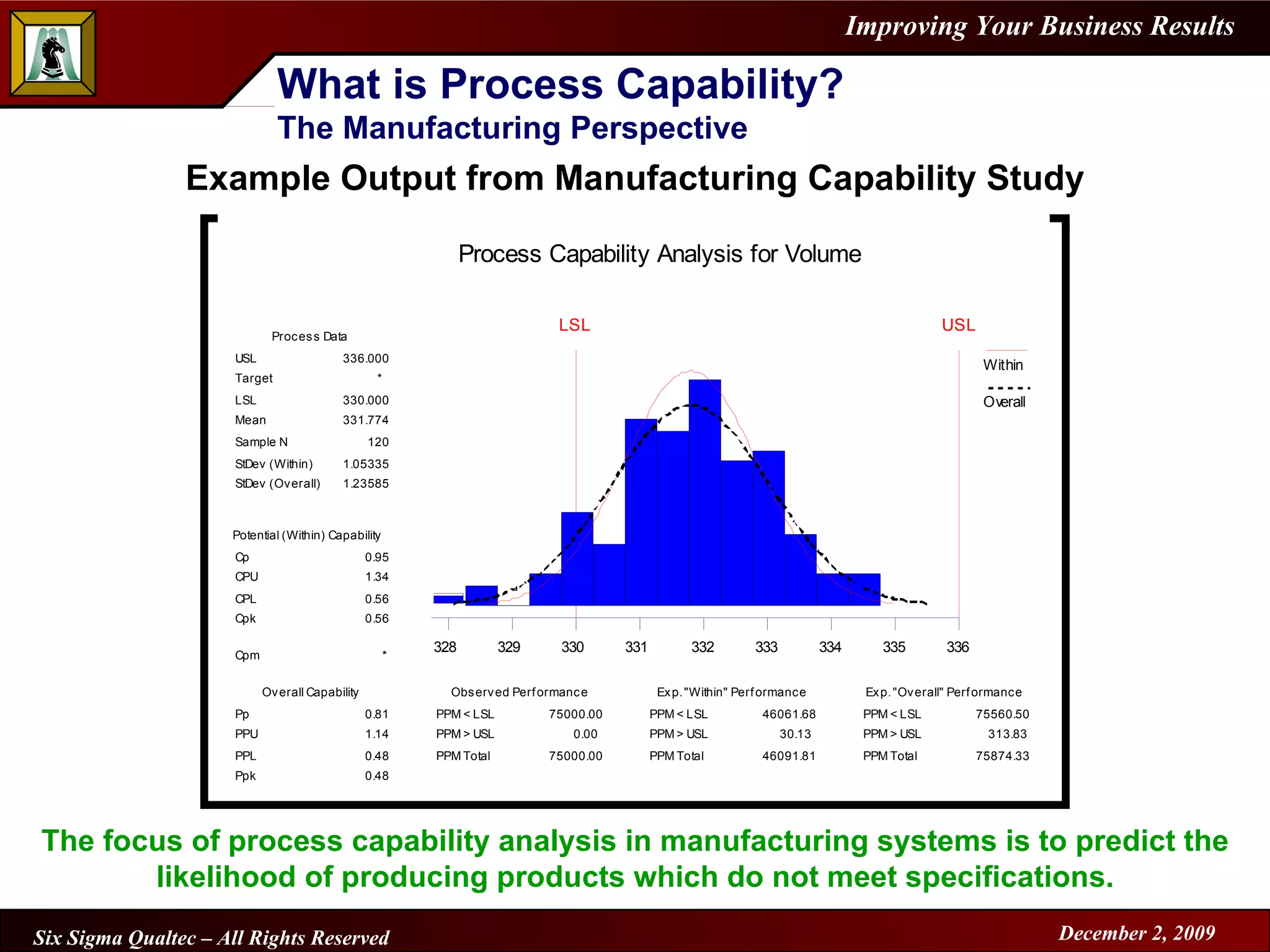
What is Process Capability? The Manufacturing Perspective Example Output from Manufacturing Capability Study The focus of process capability analysis in manufacturing systems is to predict the likelihood of producing products which do not meet specifications.
Components of Variation The Manufacturing Perspective Most variation has multiple causes.  We refer to these causes as “components” of variation.  In a manufacturing process,  variation is caused by: Machines Materials Product Designs People The environment Measurement systems
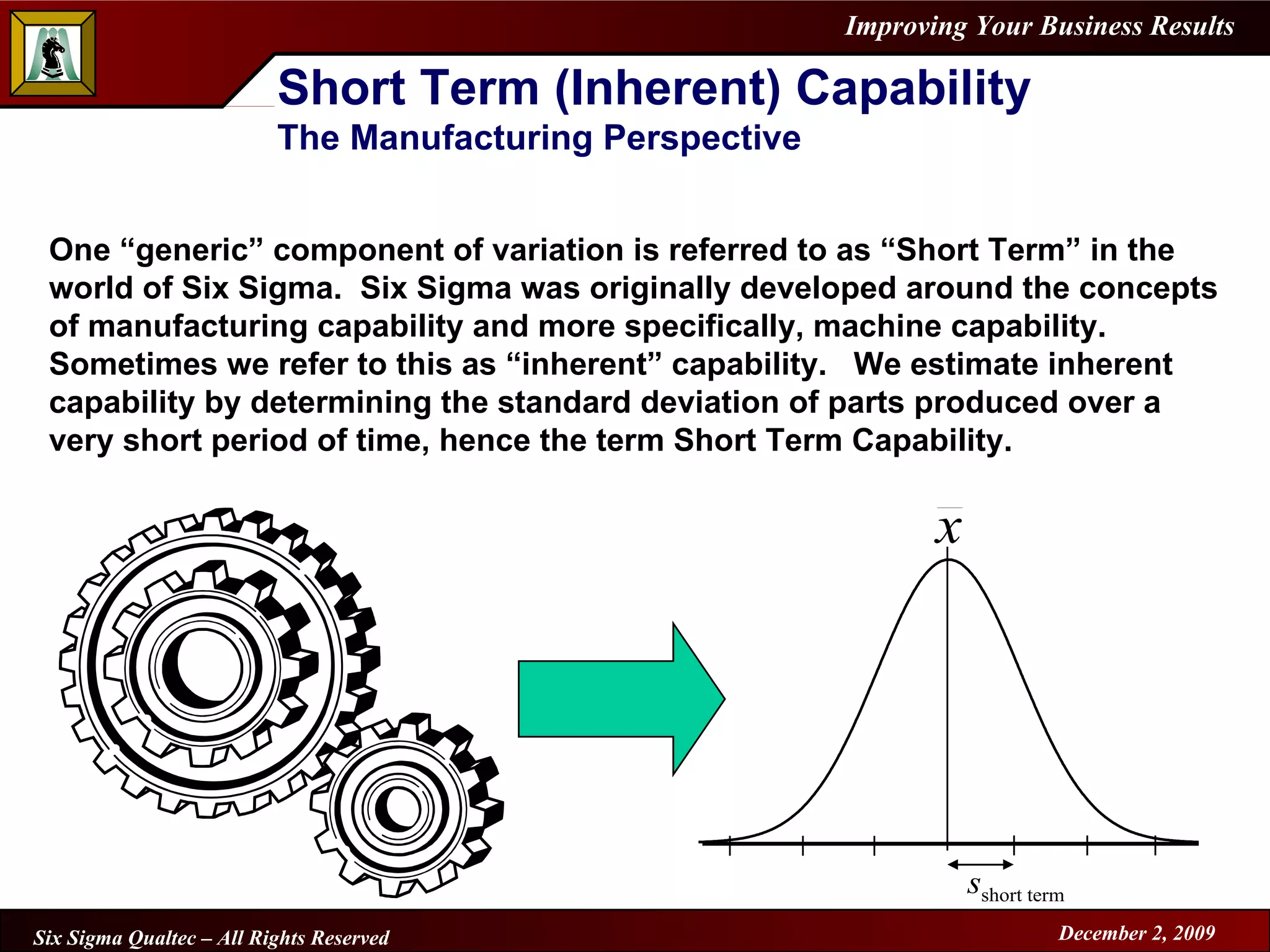
Short Term (Inherent) Capability The Manufacturing Perspective One “generic” component of variation is referred to as “Short Term” in the world of Six Sigma.  Six Sigma was originally developed around the concepts of manufacturing capability and more specifically, machine capability.  Sometimes we refer to this as “inherent” capability.  We estimate inherent capability by determining the standard deviation of parts produced over a very short period of time, hence the term Short Term Capability.
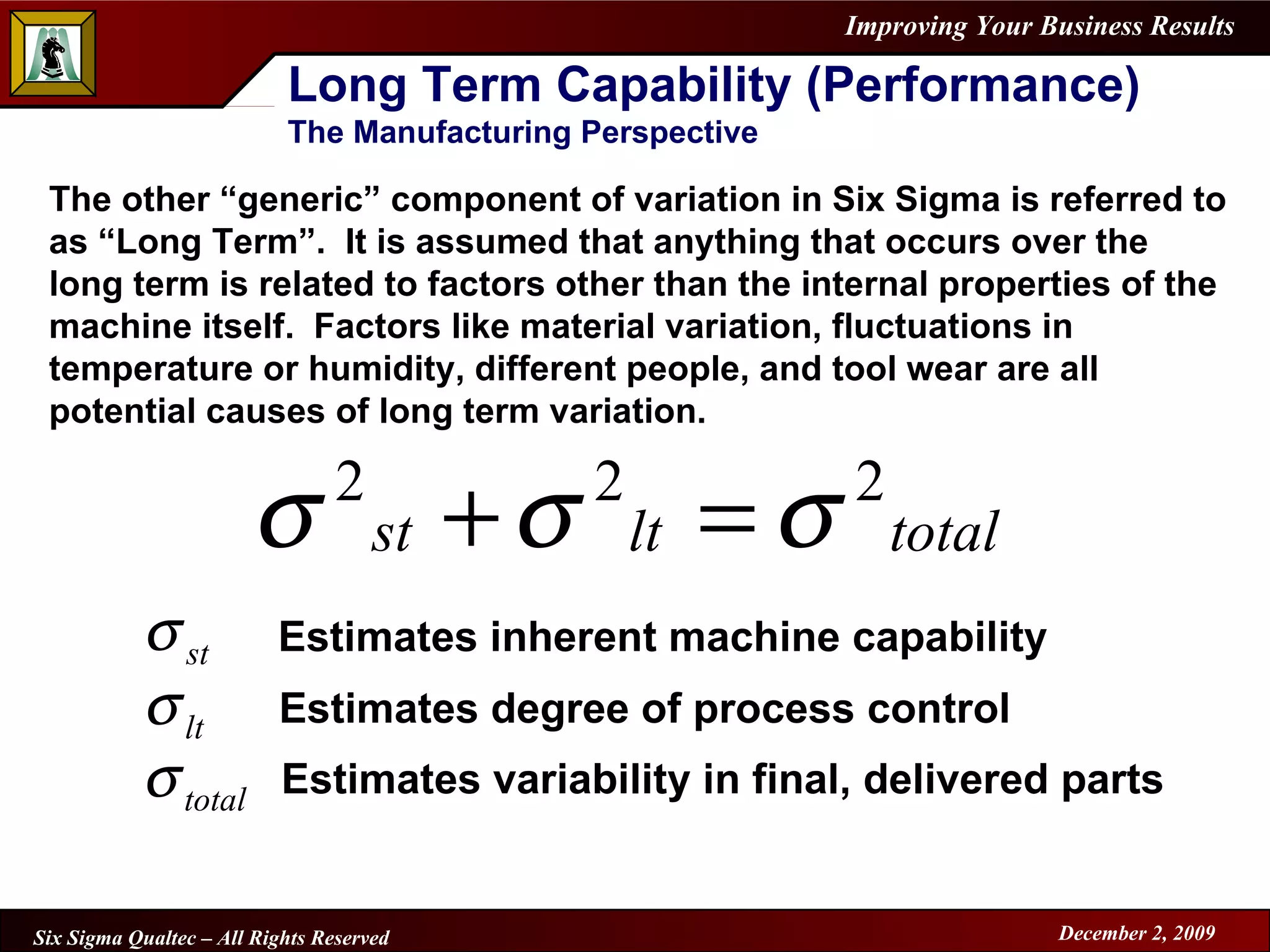
Long Term Capability (Performance) The Manufacturing Perspective The other “generic” component of variation in Six Sigma is referred to as “Long Term”.  It is assumed that anything that occurs over the long term is related to factors other than the internal properties of the machine itself.  Factors like material variation, fluctuations in temperature or humidity, different people, and tool wear are all potential causes of long term variation. Estimates inherent machine capability Estimates degree of process control Estimates variability in final, delivered parts
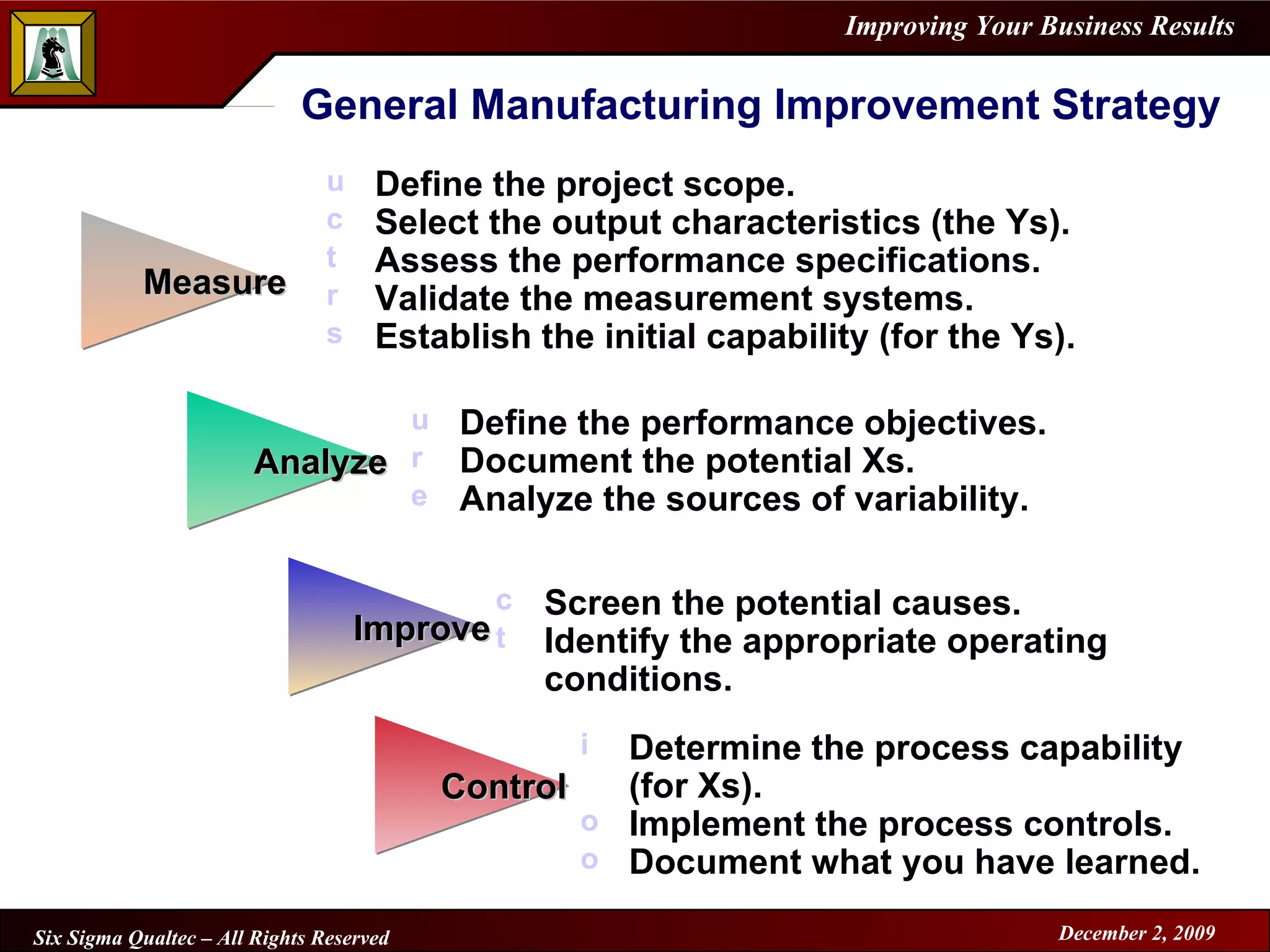
General Manufacturing Improvement Strategy Define the project scope. Select the output characteristics (the Ys). Assess the performance specifications. Validate the measurement systems. Establish the initial capability (for the Ys). Determine the process capability  (for Xs). Implement the process controls. Document what you have learned. Define the performance objectives. Document the potential Xs. Analyze the sources of variability. Screen the potential causes. Identify the appropriate operating conditions. Measure Control Analyze Improve
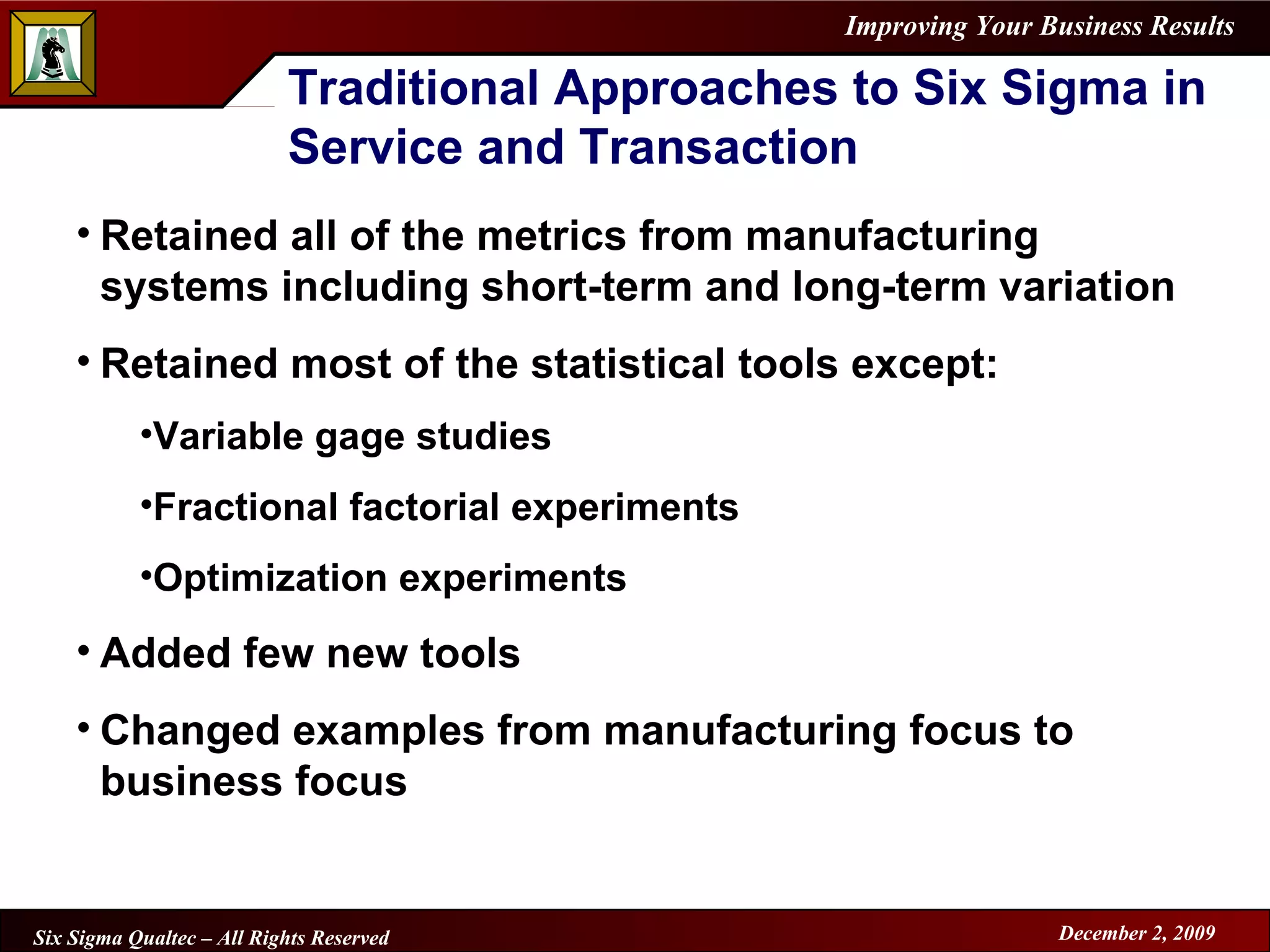
Traditional Approaches to Six Sigma in Service and Transaction Retained all of the metrics from manufacturing systems including short-term and long-term variation Retained most of the statistical tools except: Variable gage studies Fractional factorial experiments Optimization experiments Added few new tools Changed examples from manufacturing focus to business focus
Understanding the Service & Transaction Process “ Let the data do the talking” Recently, we evaluated completed Black Belt projects from service and transaction oriented companies to determine if there were any patterns to the problems these organizations face.  In addition, we discussed Six Sigma implementation efforts with Black Belts, Black Belt Candidates, course instructors, and other consultants. Here’s what we found:
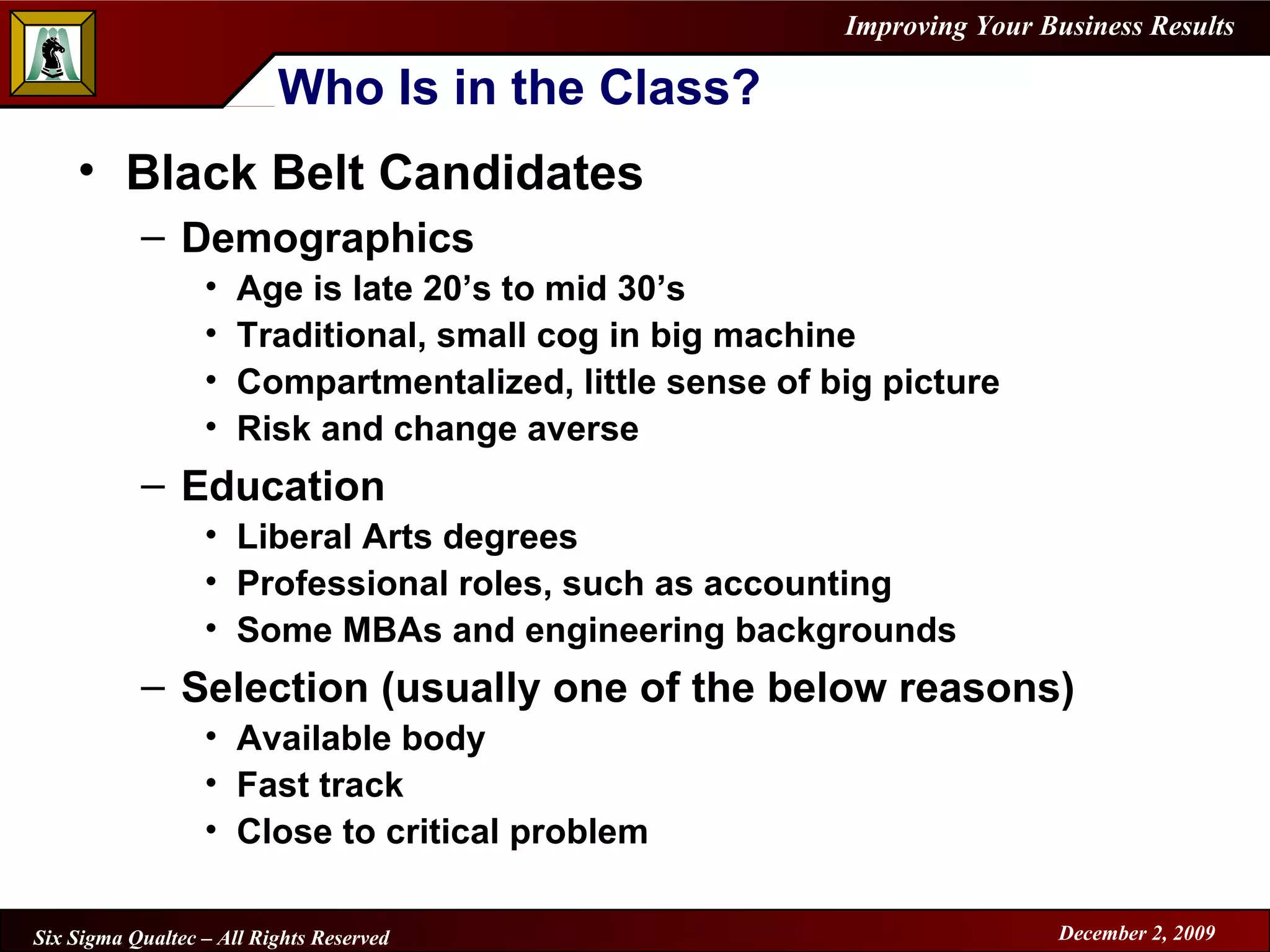
Who Is in the Class? Black Belt Candidates Demographics Age is late 20’s to mid 30’s Traditional, small cog in big machine Compartmentalized, little sense of big picture Risk and change averse Education Liberal Arts degrees Professional roles, such as accounting Some MBAs and engineering backgrounds Selection (usually one of the below reasons) Available body Fast track  Close to critical problem
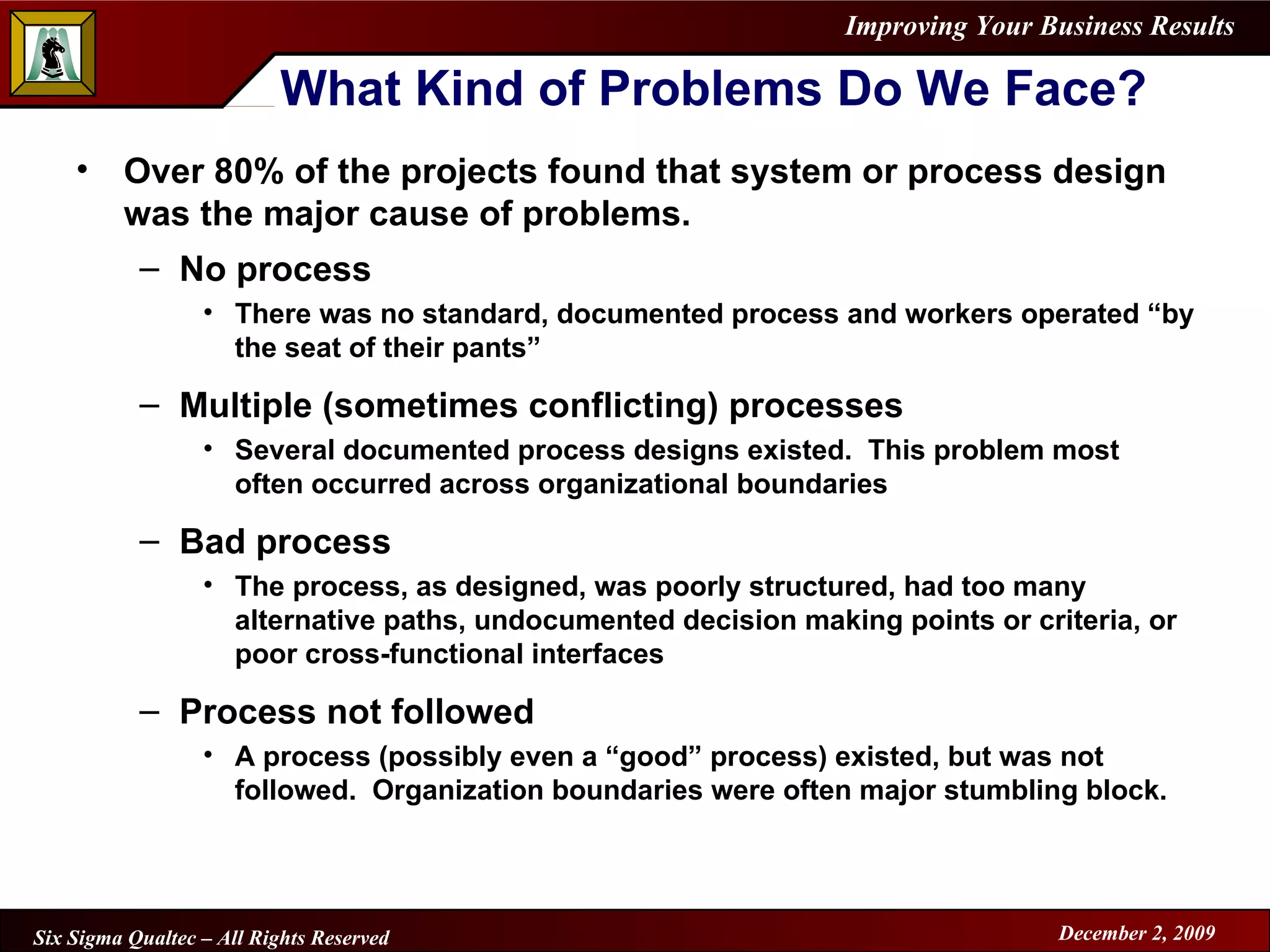
What Kind of Problems Do We Face? Over 80% of the projects found that system or process design was the major cause of problems. No process There was no standard, documented process and workers operated “by the seat of their pants” Multiple (sometimes conflicting) processes Several documented process designs existed.  This problem most often occurred across organizational boundaries Bad process The process, as designed, was poorly structured, had too many alternative paths, undocumented decision making points or criteria, or poor cross-functional interfaces Process not followed A process (possibly even a “good” process) existed, but was not followed.  Organization boundaries were often major stumbling block.
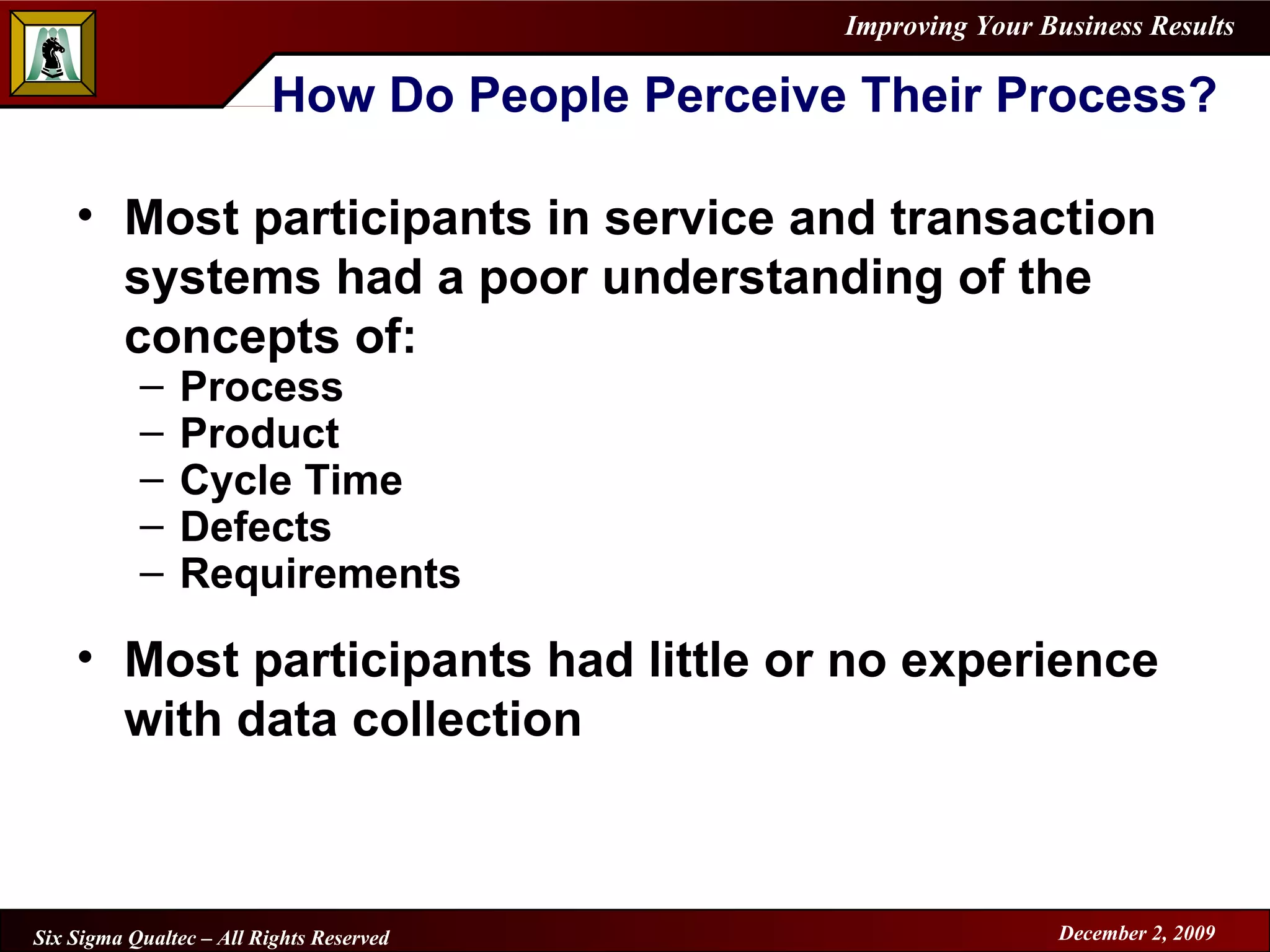
How Do People Perceive Their Process? Most participants in service and transaction systems had a poor understanding of the concepts of: Process Product Cycle Time Defects Requirements Most participants had little or no experience with data collection
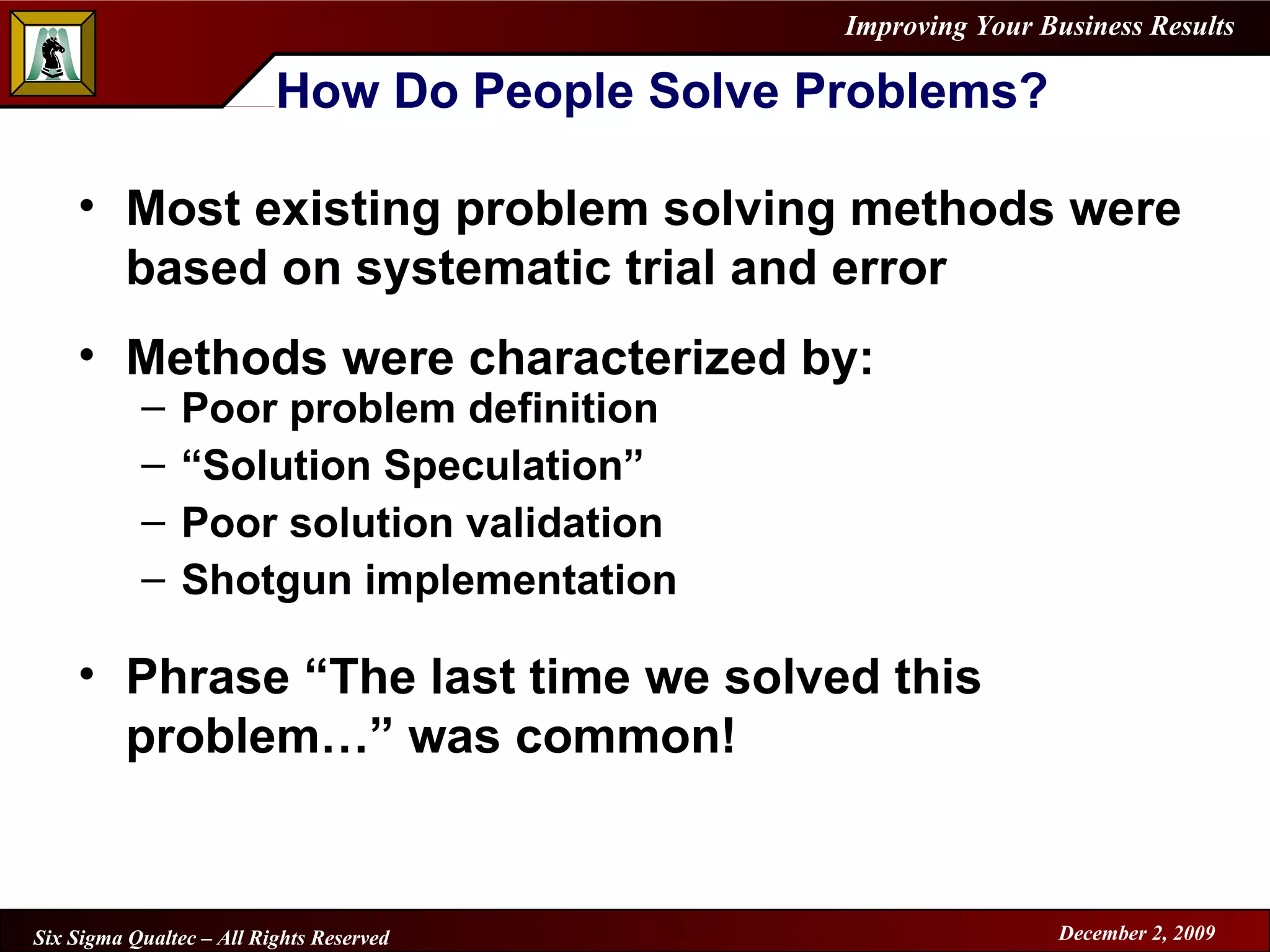
How Do People Solve Problems? Most existing problem solving methods were based on systematic trial and error Methods were characterized by: Poor problem definition “ Solution Speculation” Poor solution validation Shotgun implementation Phrase “The last time we solved this problem…” was common!
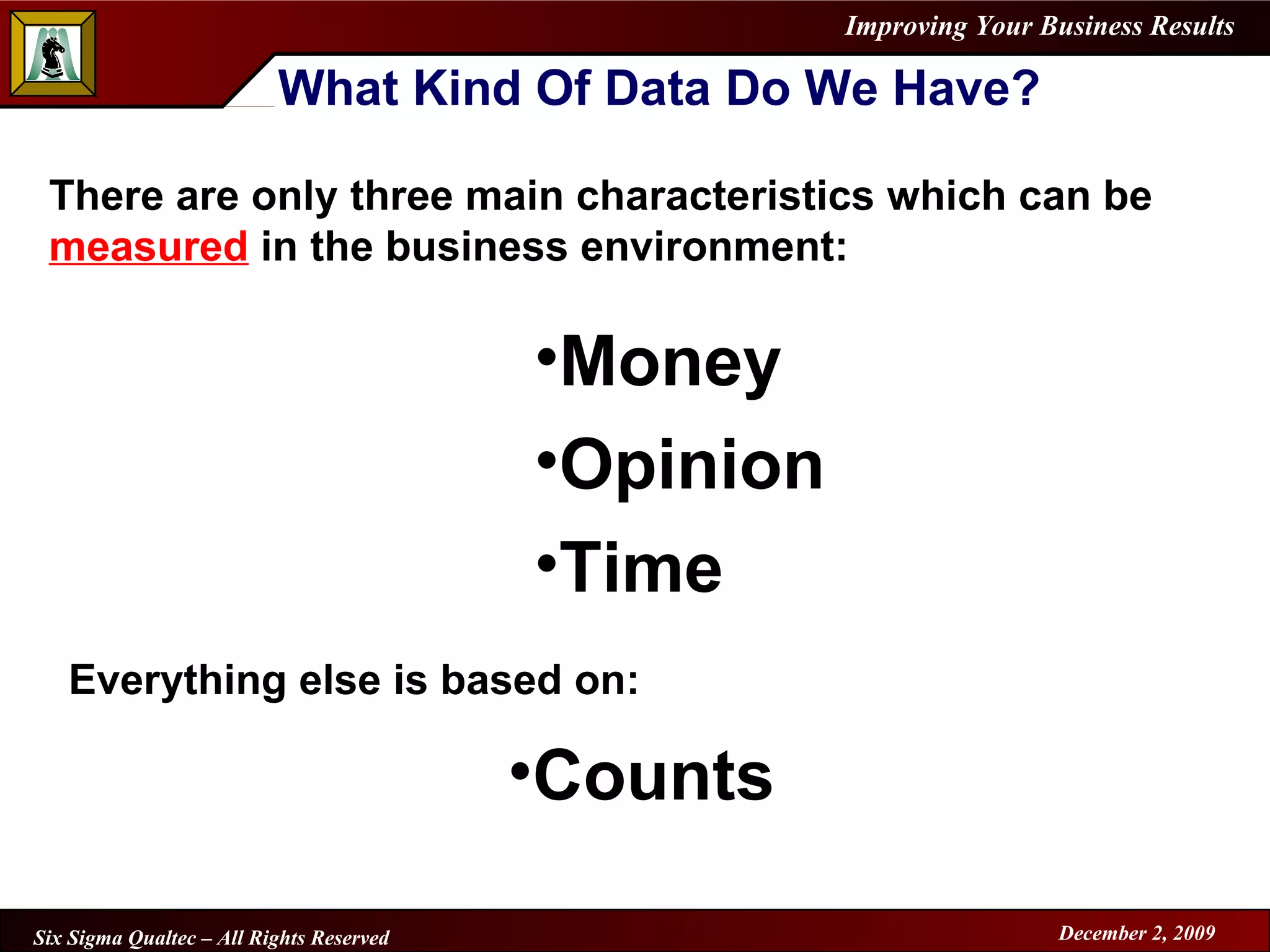
What Kind Of Data Do We Have? There are only three main characteristics which can be  measured  in the business environment: Money  Opinion  Time Everything else is based on: Counts
How Good Is Our Data? Existing process measurements had the following general characteristics: Measures of money were fairly accurate and reliable, but were often made too far after problem creation to be of value in problem solving.  Financial measures were most valuable in project selection. Measures of of time were non-existent, wrong, or over-simplified.  Time was observed to be the best problem identification and problem solving metric. Measures of opinion (where they existed) were found to be of poor reliability, from uncertain sources, and pointed to product Vs. process characteristics.  Most of the time, they were over-simplified (to averages) and poorly analyzed. Service and transaction projects need to focus on measuring  the right things rather than measuring things right!
How Good Are Inspections and Reviews? Best case inspection efficiencies were in the range of 90% to 95%.  Typical inspection efficiencies were between 75% and 85%. A “better safe than sorry” attitude is common in inspections and reviews.  This leads to increased cycle time, more labor and cost. No organizations dealt effectively with statistical uncertainty in counts. Most counts of defects or errors are based on some form of review or inspection.  Evaluations of inspection efficiencies found that:
How Do We Address These  System Characteristics? Six Sigma focuses on understanding the system: Process flow Decision making points and decision reliability Cycle Time Resources Schedules These elements are incorporated into an “as is” process model This model is validated against the actual process and then used as a characterization and improvement tool.
Understanding Process Flow & Structure Detailed process maps are created.  Maps address issues of: Parallel vs. serial processes Decision points Inspections Loops Splits and Joins Process hierarchy is addressed from system level through individual tasks A software tool, IGrafx Process, is used to support the creation of process maps and, ultimately, process models.
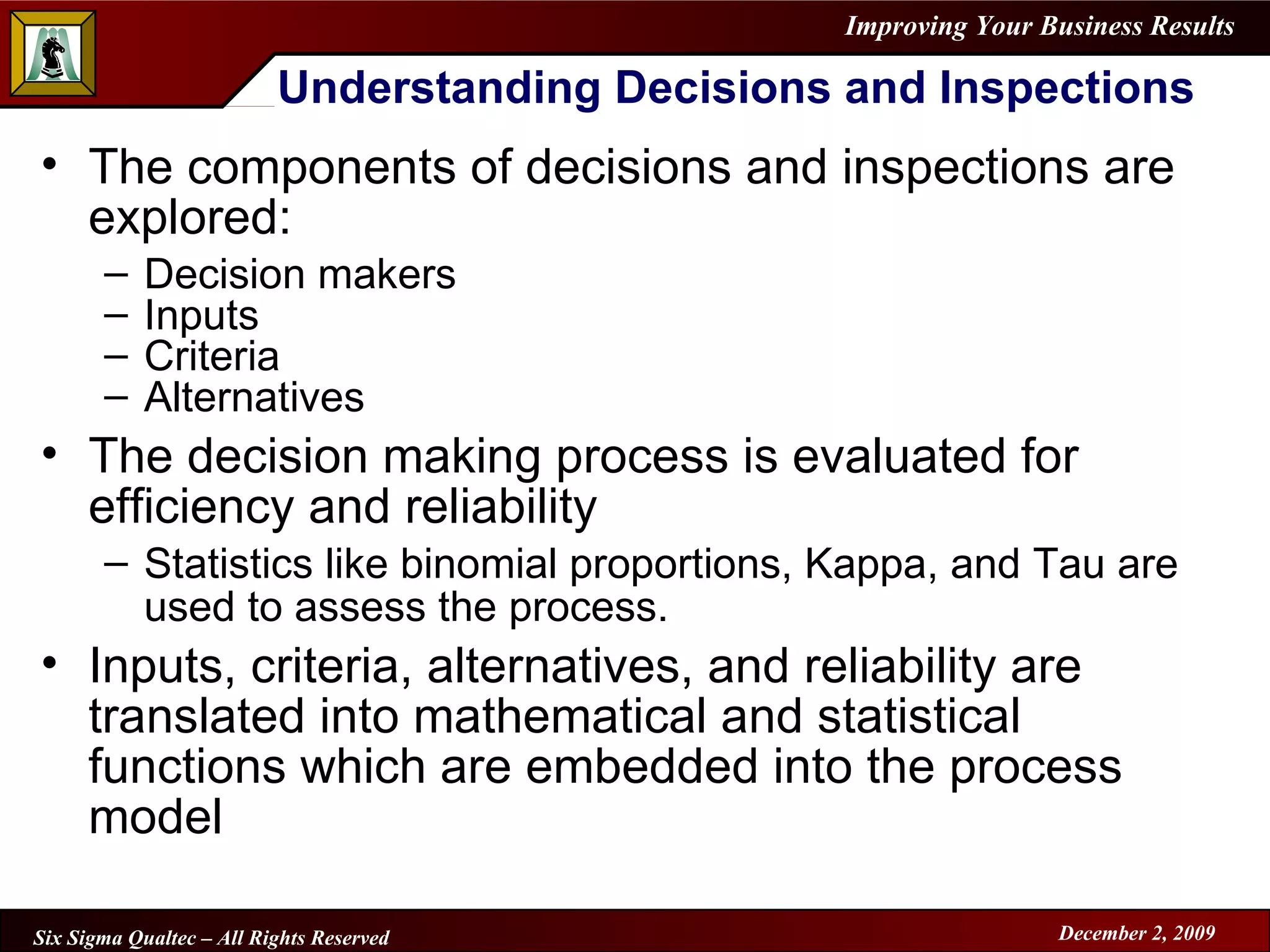
Understanding Decisions and Inspections The components of decisions and inspections are explored: Decision makers Inputs Criteria Alternatives The decision making process is evaluated for efficiency and reliability Statistics like binomial proportions, Kappa, and Tau are used to assess the process. Inputs, criteria, alternatives, and reliability are translated into mathematical and statistical functions which are embedded into the process model
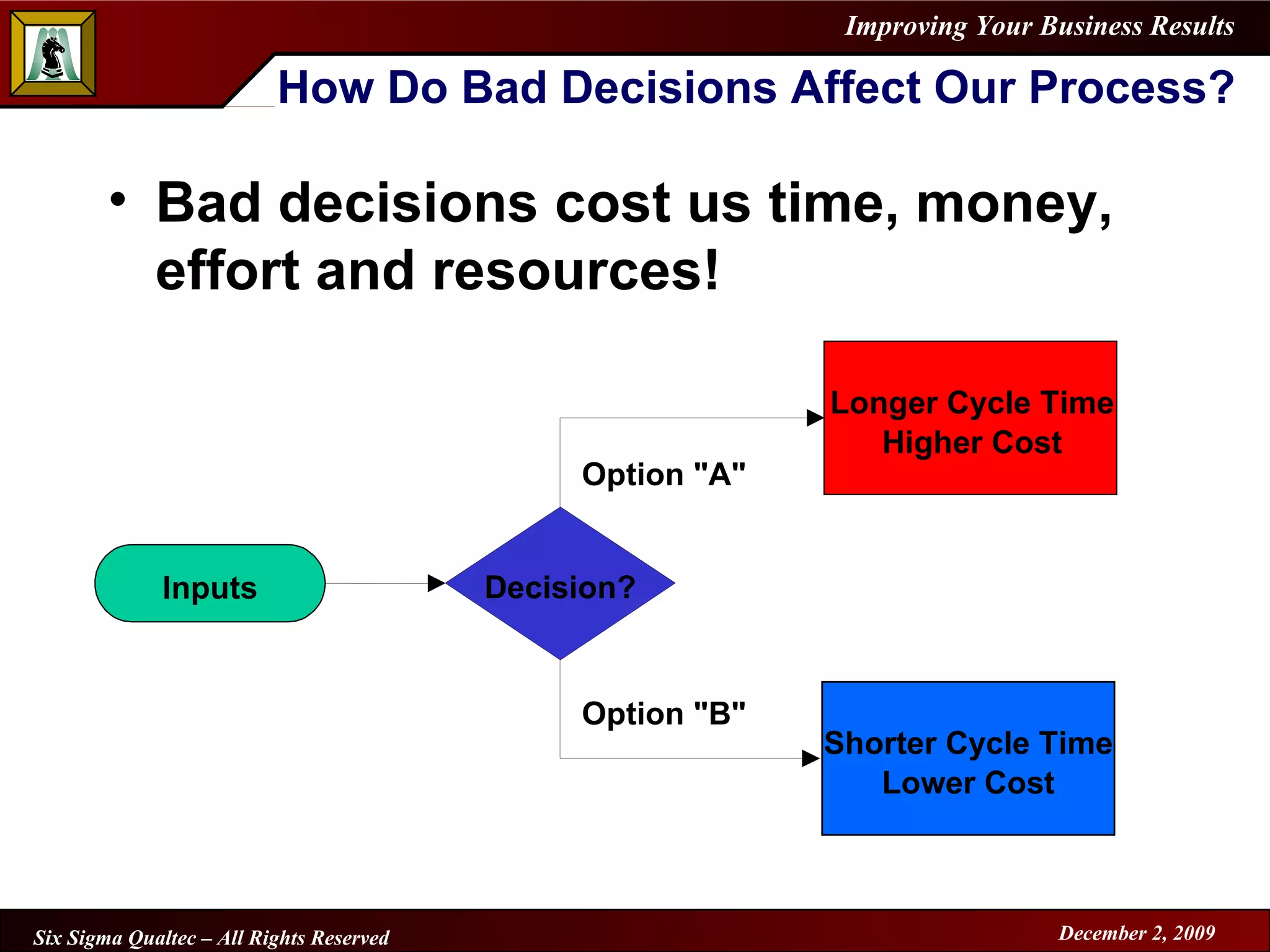
How Do Bad Decisions Affect Our Process?  Bad decisions cost us time, money, effort and resources! Decision? Longer Cycle Time Higher Cost Shorter Cycle Time Lower Cost Option "A" Option "B" Inputs
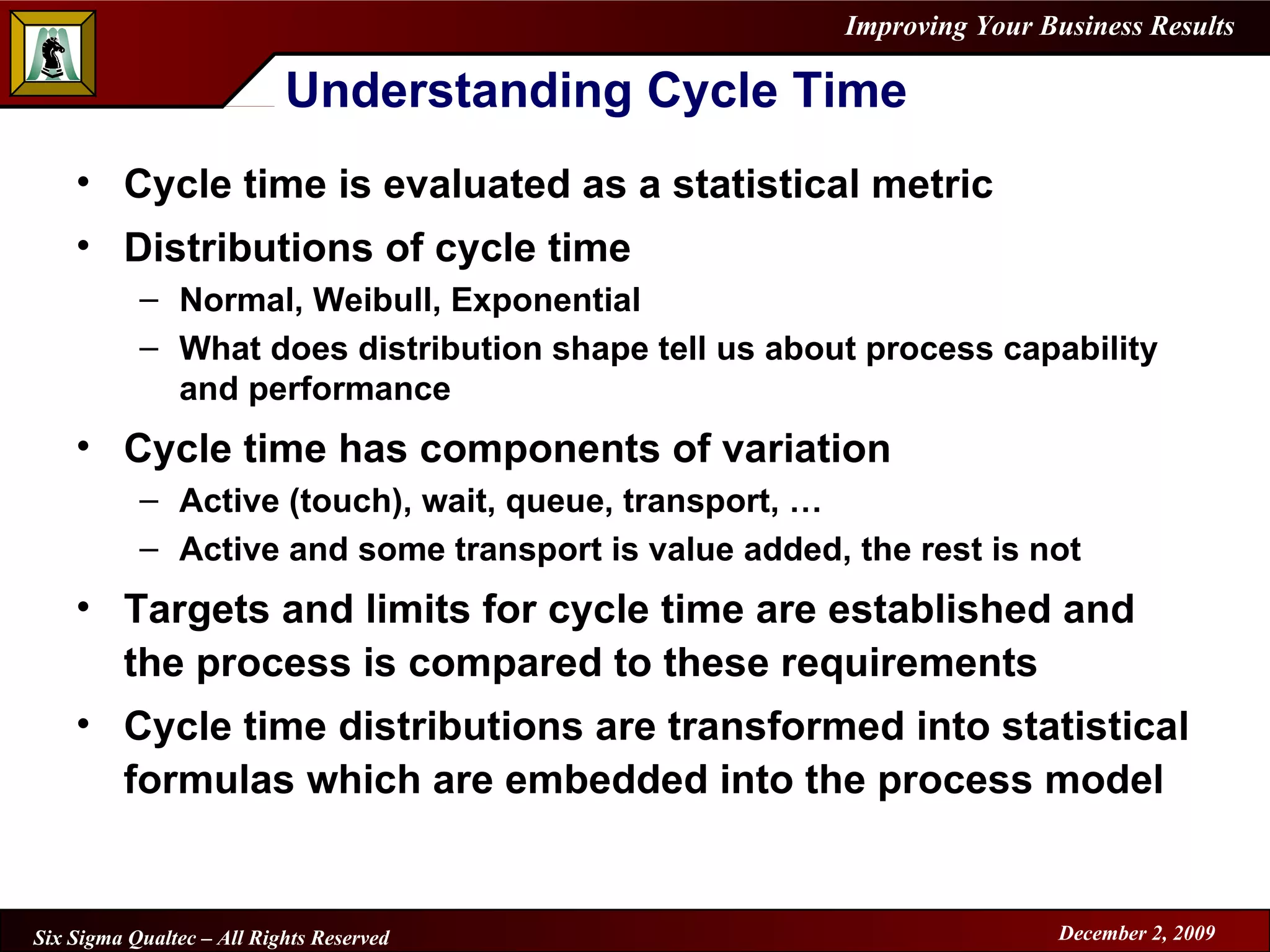
Understanding Cycle Time Cycle time is evaluated as a statistical metric Distributions of cycle time Normal, Weibull, Exponential What does distribution shape tell us about process capability and performance Cycle time has components of variation Active (touch), wait, queue, transport, … Active and some transport is value added, the rest is not Targets and limits for cycle time are established and the process is compared to these requirements Cycle time distributions are transformed into statistical formulas which are embedded into the process model
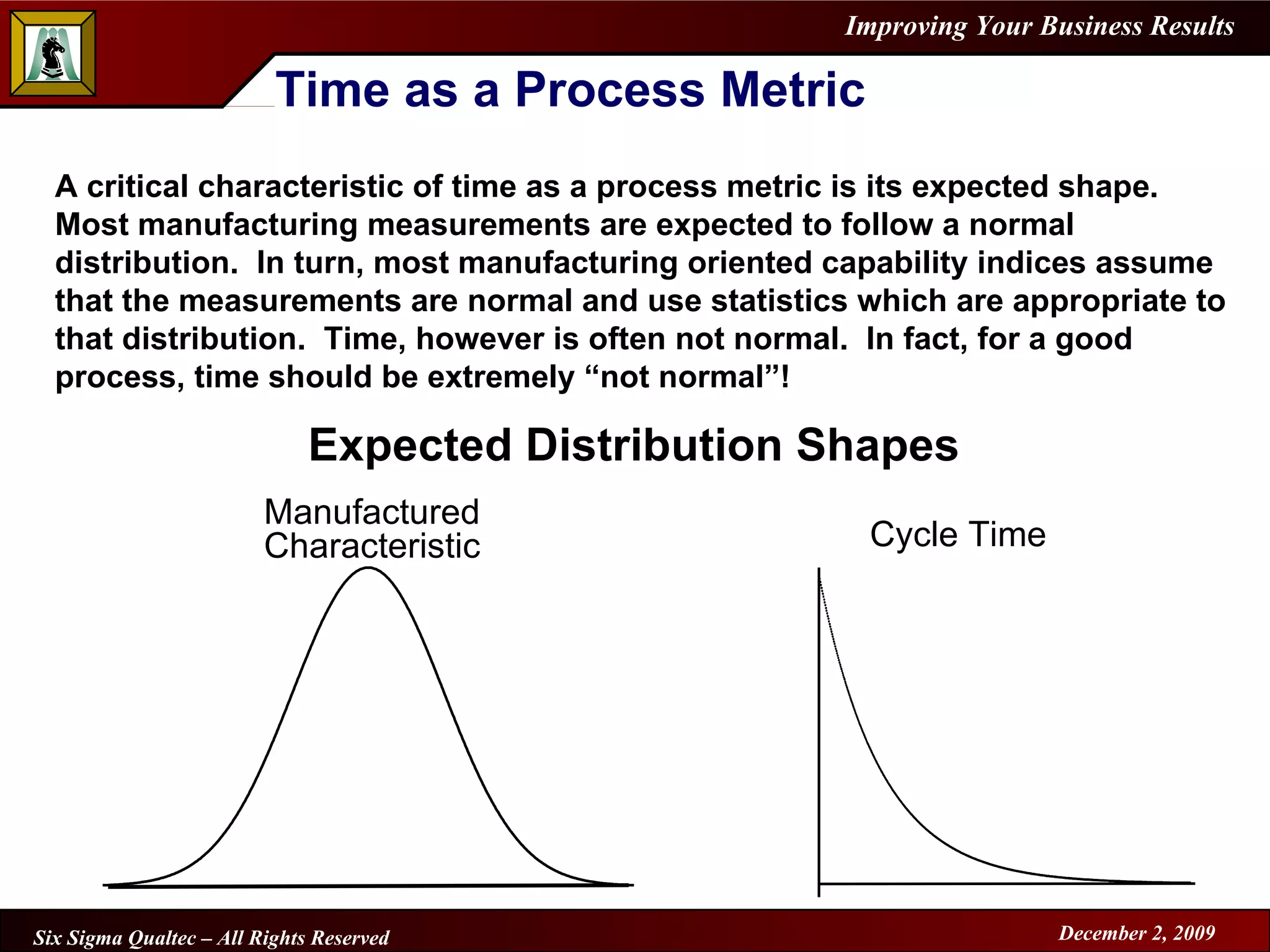
Time as a Process Metric A critical characteristic of time as a process metric is its expected shape.  Most manufacturing measurements are expected to follow a normal distribution.  In turn, most manufacturing oriented capability indices assume that the measurements are normal and use statistics which are appropriate to that distribution.  Time, however is often not normal.  In fact, for a good process, time should be extremely “not normal”! Expected Distribution Shapes Manufactured Characteristic Cycle Time
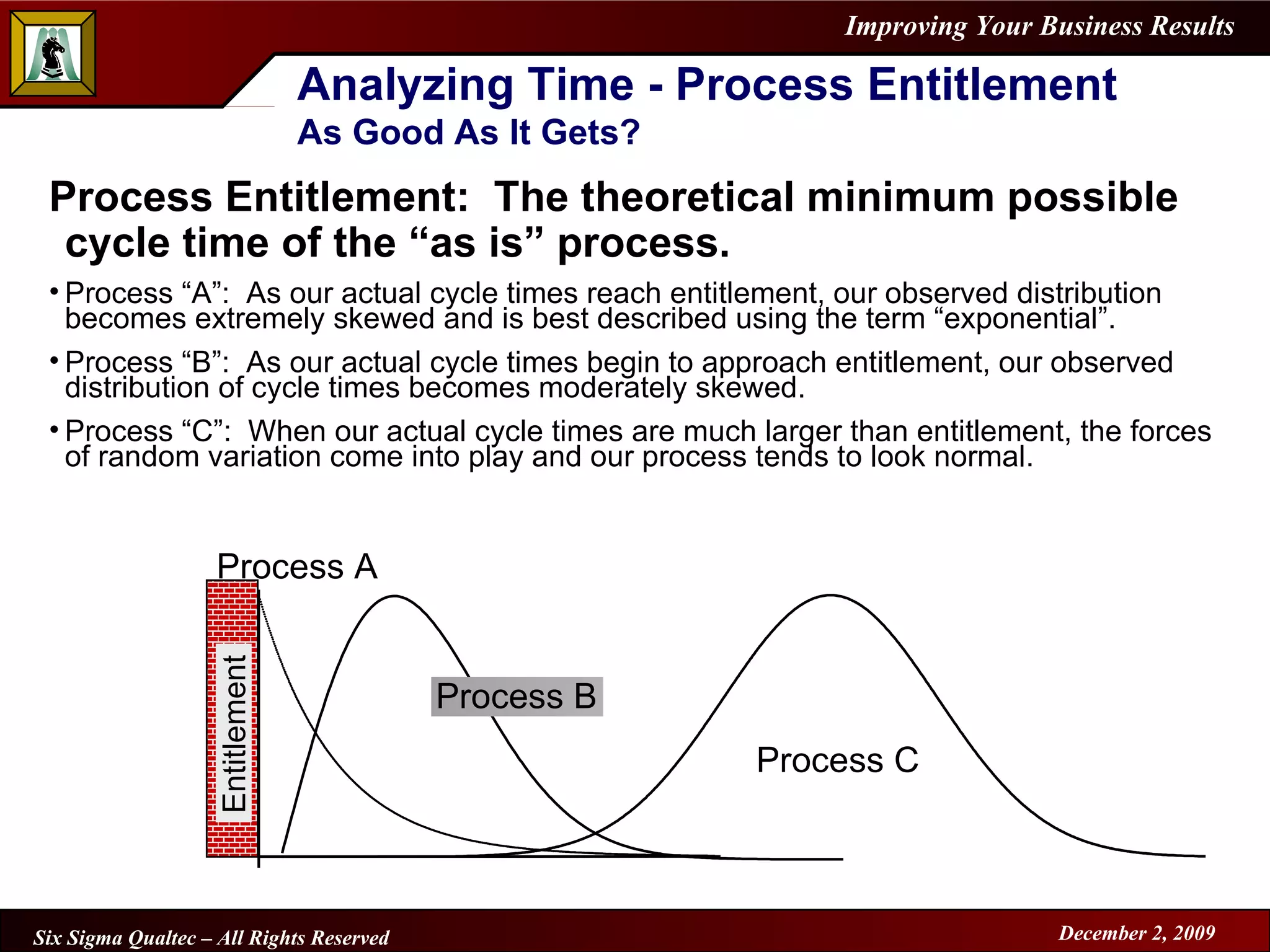
Analyzing Time - Process Entitlement As Good As It Gets? Process Entitlement:  The theoretical minimum possible cycle time of the “as is” process.   Process “A”:  As our actual cycle times reach entitlement, our observed distribution becomes extremely skewed and is best described using the term “exponential”. Process “B”:  As our actual cycle times begin to approach entitlement, our observed distribution of cycle times becomes moderately skewed.  Process “C”:  When our actual cycle times are much larger than entitlement, the forces of random variation come into play and our process tends to look normal. Entitlement Process C Process A Process B
Understanding Resources & Schedules All process resources are identified Personnel Equipment Data/Information Resource availability is characterized The nature and schedule of transaction arrivals is characterized Availability and transaction arrivals are converted to schedules and statistical equations which are embedded into the process model The process model is completed and then validated against the true process
Exploring Improvement Opportunities Key output characteristics of the process are identified Cycle times Resource utilization Queue times and sizes Based on observation of the actual process and on simulation using the process model, weak areas of the process are identified Alternative process conditions and structures are hypothesized Alternatives are simulated using statistically designed experiments Potential improvement opportunities can be explored WITHOUT touching the physical process!
Implementing Change & Maintaining Gains Human and organizational issues of change management are addressed Elements and issues of process design, human factors, long term data management, and process documentation are addressed Risk Management The Hawthorn Effect Lean Enterprise Process Design Mistake Proofing Countermeasures Matrices Statistical Process Control
Ancillary Effects of the Curriculum Changes in Culture Forces participants to adopt a process oriented viewpoint Stresses and reinforces issues of: Components of variation Process design and structure Resource management Cycle time as a critical process metric The effects of decisions on process efficiency The importance of process discipline
Q&A Thank You! Please visit our website at  http://www.ssqi.com  to learn more about our offerings

Transactional Blackbelts are different

  • 1.
    Transactional Black Belts Are Different! Six Sigma In Service and Transaction Environments
  • 2.
    Transactional Black BeltsAre Different! Transactional Black Belts are different! We advance this argument based on our experience that Transactional Black Belts often encounter environments where no process is defined, often must define and re-design a whole process versus a step in a manufacturing process, find cycle time is a more useful overall measure versus defect count for project selection, and find changes are hard to reverse in a human related environment versus the more reversible machine or material-related environment. Learn more details in this presentation and how this training will have more impact on your results.
  • 3.
    Transactional Black BeltsAre Different! Transactional Black Belts are different! Learn typical problem modes, why cycle time is your most useful overall measure, and the cultural impact on your organization.  
  • 4.
    Agenda Origins ofSix Sigma — Manufacturing Systems Previous applications of Six Sigma in Service and Transaction Environments Characteristics of the Service and Transaction Environment Principles and structures of a new transaction curriculum
  • 5.
    What is ProcessCapability? The Manufacturing Perspective Example Output from Manufacturing Capability Study The focus of process capability analysis in manufacturing systems is to predict the likelihood of producing products which do not meet specifications.
  • 6.
    Components of VariationThe Manufacturing Perspective Most variation has multiple causes. We refer to these causes as “components” of variation. In a manufacturing process, variation is caused by: Machines Materials Product Designs People The environment Measurement systems
  • 7.
    Short Term (Inherent)Capability The Manufacturing Perspective One “generic” component of variation is referred to as “Short Term” in the world of Six Sigma. Six Sigma was originally developed around the concepts of manufacturing capability and more specifically, machine capability. Sometimes we refer to this as “inherent” capability. We estimate inherent capability by determining the standard deviation of parts produced over a very short period of time, hence the term Short Term Capability.
  • 8.
    Long Term Capability(Performance) The Manufacturing Perspective The other “generic” component of variation in Six Sigma is referred to as “Long Term”. It is assumed that anything that occurs over the long term is related to factors other than the internal properties of the machine itself. Factors like material variation, fluctuations in temperature or humidity, different people, and tool wear are all potential causes of long term variation. Estimates inherent machine capability Estimates degree of process control Estimates variability in final, delivered parts
  • 9.
    General Manufacturing ImprovementStrategy Define the project scope. Select the output characteristics (the Ys). Assess the performance specifications. Validate the measurement systems. Establish the initial capability (for the Ys). Determine the process capability (for Xs). Implement the process controls. Document what you have learned. Define the performance objectives. Document the potential Xs. Analyze the sources of variability. Screen the potential causes. Identify the appropriate operating conditions. Measure Control Analyze Improve
  • 10.
    Traditional Approaches toSix Sigma in Service and Transaction Retained all of the metrics from manufacturing systems including short-term and long-term variation Retained most of the statistical tools except: Variable gage studies Fractional factorial experiments Optimization experiments Added few new tools Changed examples from manufacturing focus to business focus
  • 11.
    Understanding the Service& Transaction Process “ Let the data do the talking” Recently, we evaluated completed Black Belt projects from service and transaction oriented companies to determine if there were any patterns to the problems these organizations face. In addition, we discussed Six Sigma implementation efforts with Black Belts, Black Belt Candidates, course instructors, and other consultants. Here’s what we found:
  • 12.
    Who Is inthe Class? Black Belt Candidates Demographics Age is late 20’s to mid 30’s Traditional, small cog in big machine Compartmentalized, little sense of big picture Risk and change averse Education Liberal Arts degrees Professional roles, such as accounting Some MBAs and engineering backgrounds Selection (usually one of the below reasons) Available body Fast track Close to critical problem
  • 13.
    What Kind ofProblems Do We Face? Over 80% of the projects found that system or process design was the major cause of problems. No process There was no standard, documented process and workers operated “by the seat of their pants” Multiple (sometimes conflicting) processes Several documented process designs existed. This problem most often occurred across organizational boundaries Bad process The process, as designed, was poorly structured, had too many alternative paths, undocumented decision making points or criteria, or poor cross-functional interfaces Process not followed A process (possibly even a “good” process) existed, but was not followed. Organization boundaries were often major stumbling block.
  • 14.
    How Do PeoplePerceive Their Process? Most participants in service and transaction systems had a poor understanding of the concepts of: Process Product Cycle Time Defects Requirements Most participants had little or no experience with data collection
  • 15.
    How Do PeopleSolve Problems? Most existing problem solving methods were based on systematic trial and error Methods were characterized by: Poor problem definition “ Solution Speculation” Poor solution validation Shotgun implementation Phrase “The last time we solved this problem…” was common!
  • 16.
    What Kind OfData Do We Have? There are only three main characteristics which can be measured in the business environment: Money Opinion Time Everything else is based on: Counts
  • 17.
    How Good IsOur Data? Existing process measurements had the following general characteristics: Measures of money were fairly accurate and reliable, but were often made too far after problem creation to be of value in problem solving. Financial measures were most valuable in project selection. Measures of of time were non-existent, wrong, or over-simplified. Time was observed to be the best problem identification and problem solving metric. Measures of opinion (where they existed) were found to be of poor reliability, from uncertain sources, and pointed to product Vs. process characteristics. Most of the time, they were over-simplified (to averages) and poorly analyzed. Service and transaction projects need to focus on measuring the right things rather than measuring things right!
  • 18.
    How Good AreInspections and Reviews? Best case inspection efficiencies were in the range of 90% to 95%. Typical inspection efficiencies were between 75% and 85%. A “better safe than sorry” attitude is common in inspections and reviews. This leads to increased cycle time, more labor and cost. No organizations dealt effectively with statistical uncertainty in counts. Most counts of defects or errors are based on some form of review or inspection. Evaluations of inspection efficiencies found that:
  • 19.
    How Do WeAddress These System Characteristics? Six Sigma focuses on understanding the system: Process flow Decision making points and decision reliability Cycle Time Resources Schedules These elements are incorporated into an “as is” process model This model is validated against the actual process and then used as a characterization and improvement tool.
  • 20.
    Understanding Process Flow& Structure Detailed process maps are created. Maps address issues of: Parallel vs. serial processes Decision points Inspections Loops Splits and Joins Process hierarchy is addressed from system level through individual tasks A software tool, IGrafx Process, is used to support the creation of process maps and, ultimately, process models.
  • 21.
    Understanding Decisions andInspections The components of decisions and inspections are explored: Decision makers Inputs Criteria Alternatives The decision making process is evaluated for efficiency and reliability Statistics like binomial proportions, Kappa, and Tau are used to assess the process. Inputs, criteria, alternatives, and reliability are translated into mathematical and statistical functions which are embedded into the process model
  • 22.
    How Do BadDecisions Affect Our Process? Bad decisions cost us time, money, effort and resources! Decision? Longer Cycle Time Higher Cost Shorter Cycle Time Lower Cost Option "A" Option "B" Inputs
  • 23.
    Understanding Cycle TimeCycle time is evaluated as a statistical metric Distributions of cycle time Normal, Weibull, Exponential What does distribution shape tell us about process capability and performance Cycle time has components of variation Active (touch), wait, queue, transport, … Active and some transport is value added, the rest is not Targets and limits for cycle time are established and the process is compared to these requirements Cycle time distributions are transformed into statistical formulas which are embedded into the process model
  • 24.
    Time as aProcess Metric A critical characteristic of time as a process metric is its expected shape. Most manufacturing measurements are expected to follow a normal distribution. In turn, most manufacturing oriented capability indices assume that the measurements are normal and use statistics which are appropriate to that distribution. Time, however is often not normal. In fact, for a good process, time should be extremely “not normal”! Expected Distribution Shapes Manufactured Characteristic Cycle Time
  • 25.
    Analyzing Time -Process Entitlement As Good As It Gets? Process Entitlement: The theoretical minimum possible cycle time of the “as is” process. Process “A”: As our actual cycle times reach entitlement, our observed distribution becomes extremely skewed and is best described using the term “exponential”. Process “B”: As our actual cycle times begin to approach entitlement, our observed distribution of cycle times becomes moderately skewed. Process “C”: When our actual cycle times are much larger than entitlement, the forces of random variation come into play and our process tends to look normal. Entitlement Process C Process A Process B
  • 26.
    Understanding Resources &Schedules All process resources are identified Personnel Equipment Data/Information Resource availability is characterized The nature and schedule of transaction arrivals is characterized Availability and transaction arrivals are converted to schedules and statistical equations which are embedded into the process model The process model is completed and then validated against the true process
  • 27.
    Exploring Improvement OpportunitiesKey output characteristics of the process are identified Cycle times Resource utilization Queue times and sizes Based on observation of the actual process and on simulation using the process model, weak areas of the process are identified Alternative process conditions and structures are hypothesized Alternatives are simulated using statistically designed experiments Potential improvement opportunities can be explored WITHOUT touching the physical process!
  • 28.
    Implementing Change &Maintaining Gains Human and organizational issues of change management are addressed Elements and issues of process design, human factors, long term data management, and process documentation are addressed Risk Management The Hawthorn Effect Lean Enterprise Process Design Mistake Proofing Countermeasures Matrices Statistical Process Control
  • 29.
    Ancillary Effects ofthe Curriculum Changes in Culture Forces participants to adopt a process oriented viewpoint Stresses and reinforces issues of: Components of variation Process design and structure Resource management Cycle time as a critical process metric The effects of decisions on process efficiency The importance of process discipline
  • 30.
    Q&A Thank You!Please visit our website at http://www.ssqi.com to learn more about our offerings