5 ‘S’
Cost Competitiveness through
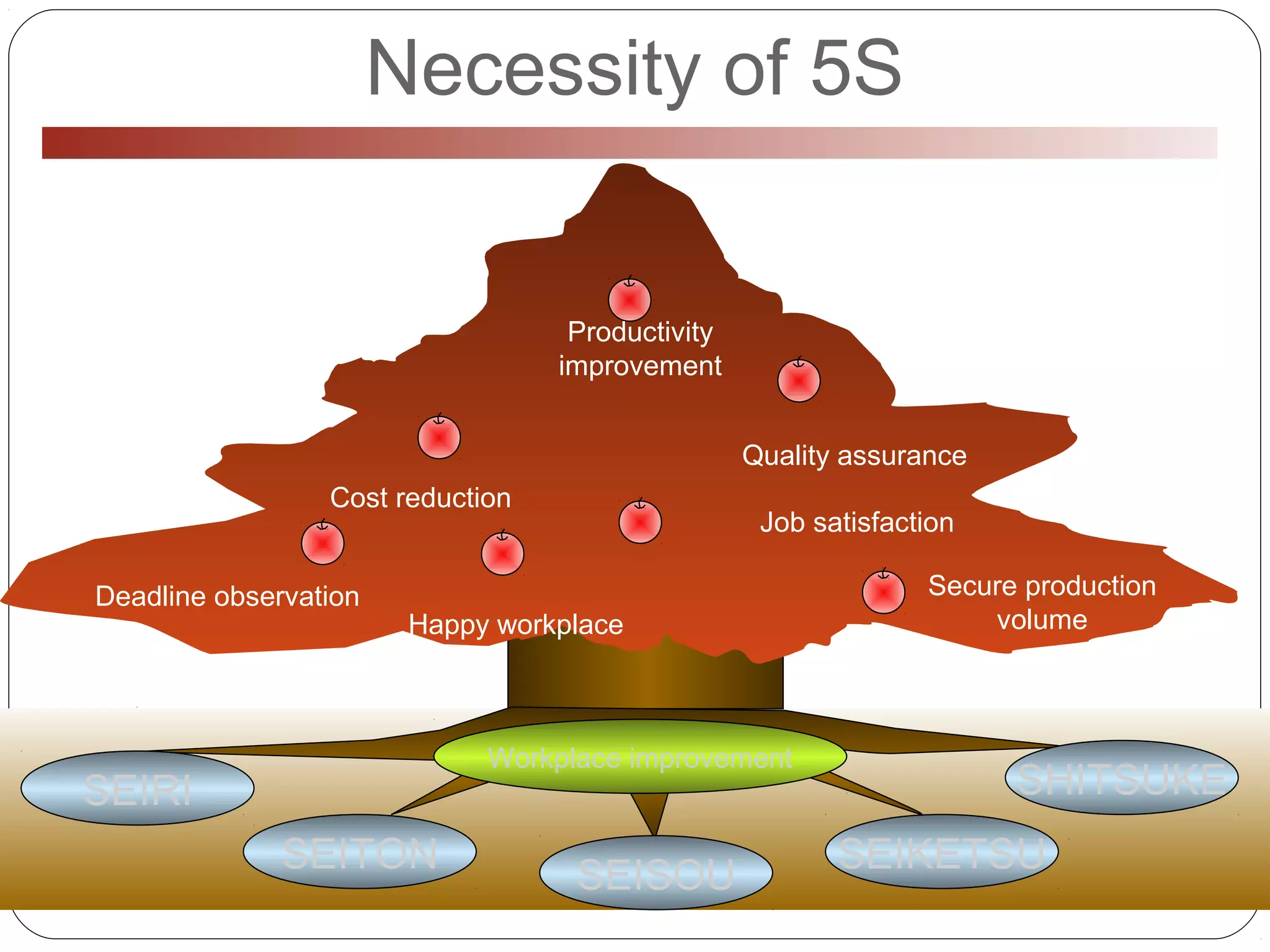
Necessity of 5S
SEIRI
SEITON
SEISOU
SEIKETSU
SHITSUKE
Productivity
improvement
Quality assurance
Cost reduction
Secure production
volume
Deadline observation
Happy workplace
Job satisfaction
Workplace improvement
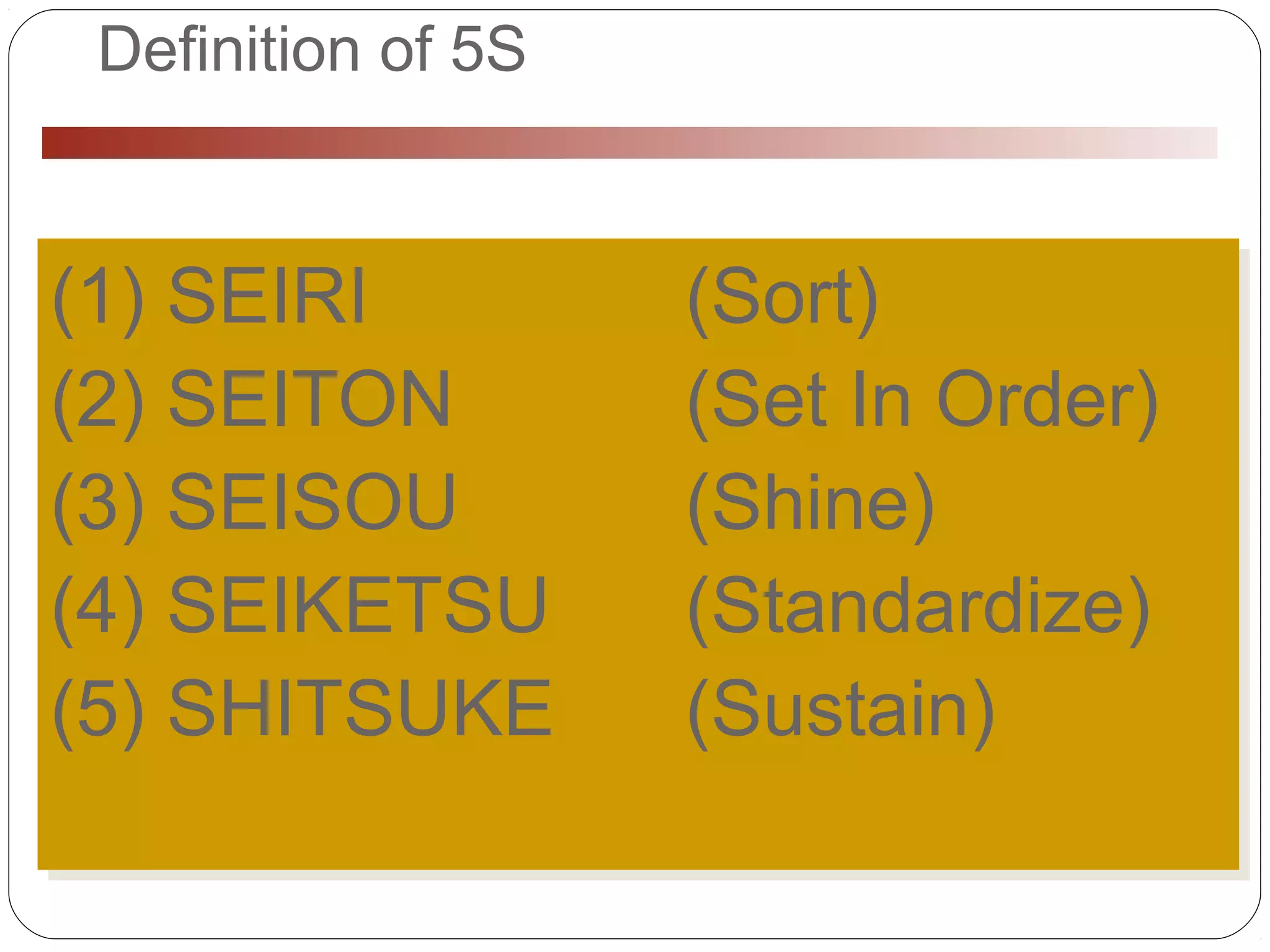
Definition of 5S
(1) SEIRI (Sort)
(2) SEITON (Set In Order)
(3) SEISOU (Shine)
(4) SEIKETSU (Standardize)
(5) SHITSUKE (Sustain)
(1) SEIRI (Sort)
(2) SEITON (Set In Order)
(3) SEISOU (Shine)
(4) SEIKETSU (Standardize)
(5) SHITSUKE (Sustain)
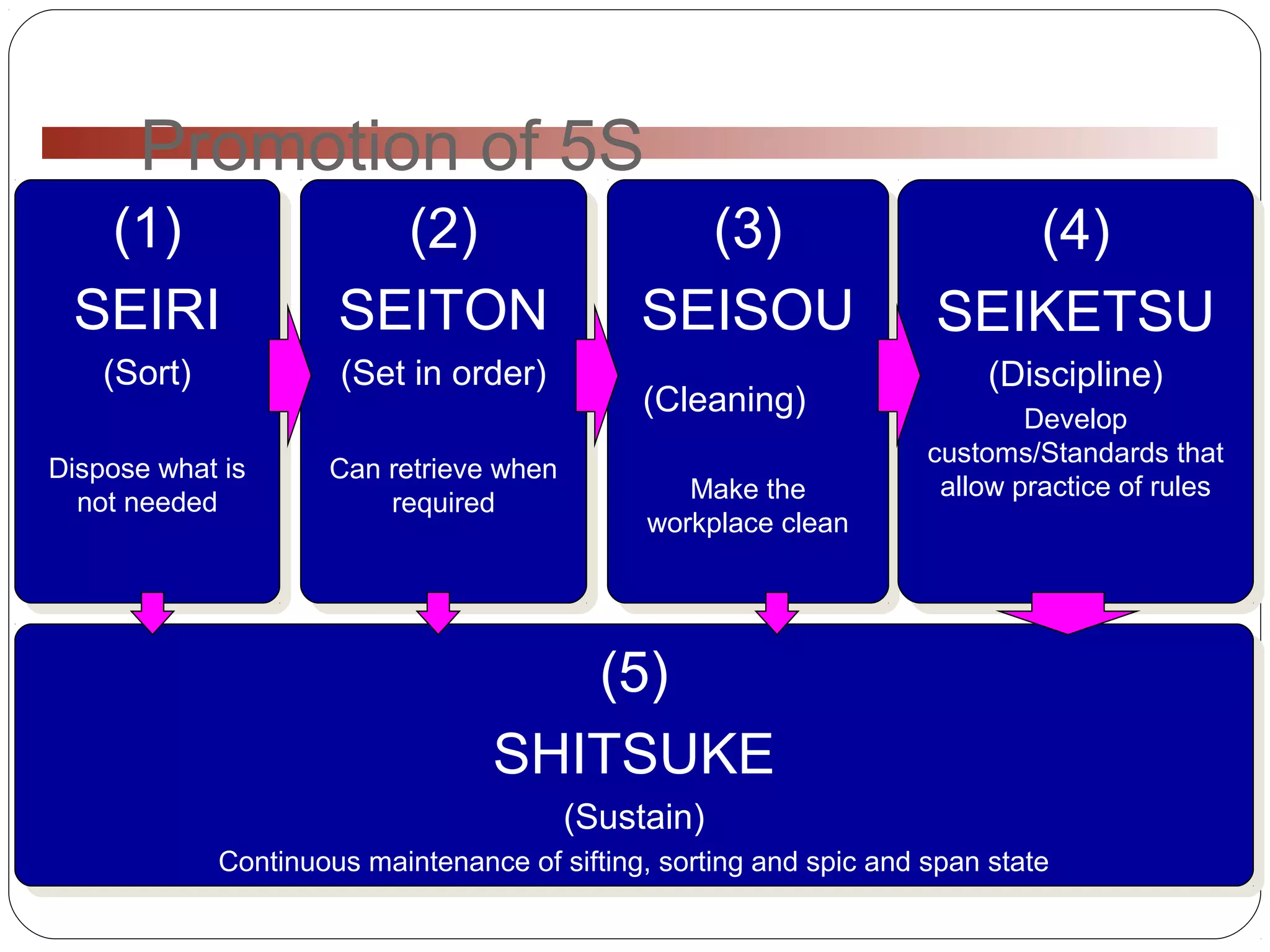
Promotion of 5S
(1)
SEIRI
(Sort)
Dispose what is
not needed
(1)
SEIRI
(Sort)
Dispose what is
not needed
(2)
SEITON
(Set in order)
Can retrieve when
required
(2)
SEITON
(Set in order)
Can retrieve when
required
(3)
SEISOU
(Cleaning)
Make the
workplace clean
(3)
SEISOU
(Cleaning)
Make the
workplace clean
(4)
SEIKETSU
(Discipline)
Develop
customs/Standards that
allow practice of rules
(4)
SEIKETSU
(Discipline)
Develop
customs/Standards that
allow practice of rules
(5)
SHITSUKE
(Sustain)
Continuous maintenance of sifting, sorting and spic and span state
(5)
SHITSUKE
(Sustain)
Continuous maintenance of sifting, sorting and spic and span state
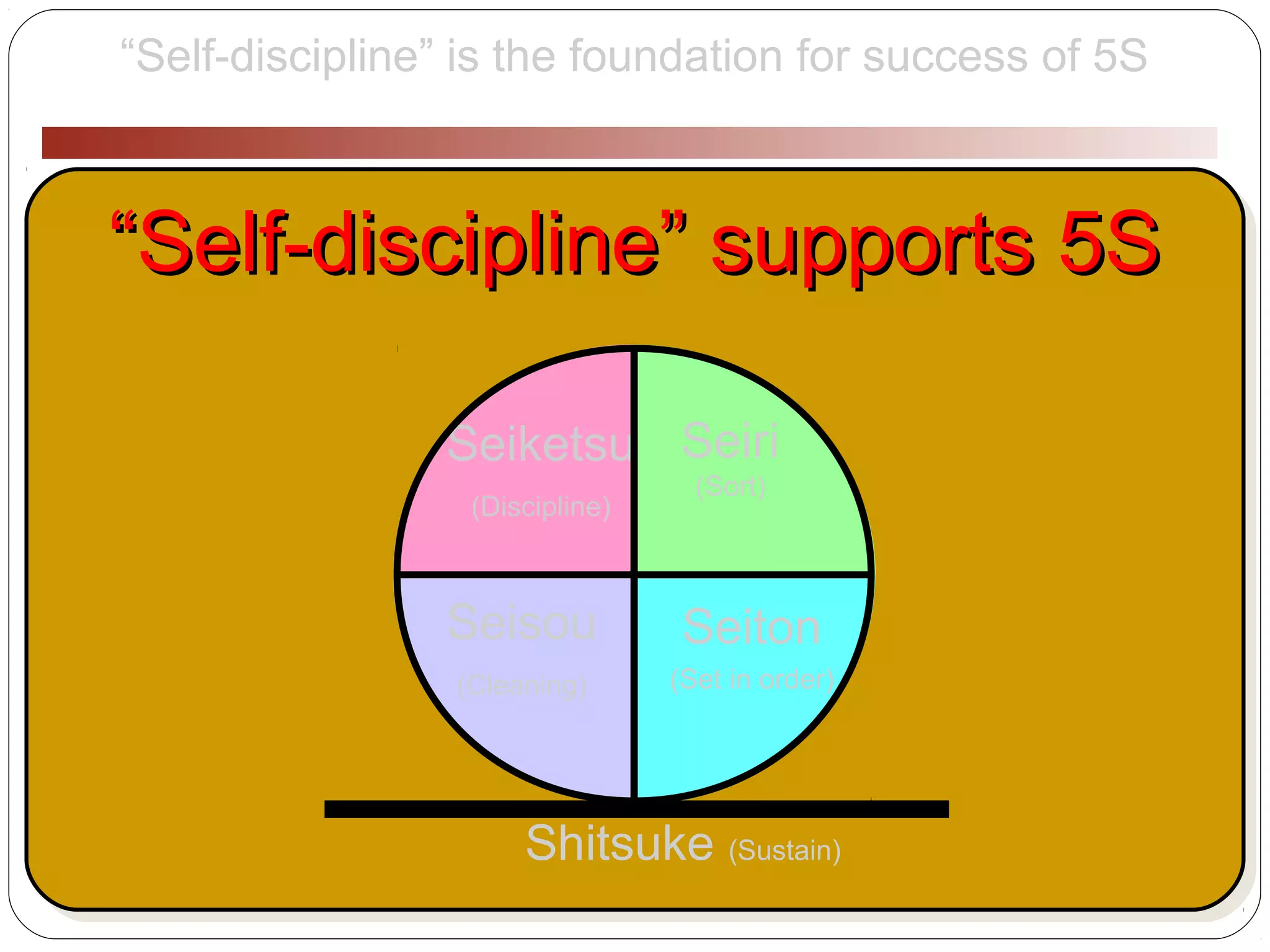
“Self-discipline” is the foundation for success of 5S
““Self-discipline” supports 5SSelf-discipline” supports 5S““Self-discipline” supports 5SSelf-discipline” supports 5S
Seisou
(Cleaning)
Seiketsu
(Discipline)
Seiri
(Sort)
Seiton
(Set in order)
Shitsuke (Sustain)
SEIRI
Dispose Assign fixed place
SEIRI (Sort) refers to:
Separating what is and is not needed and removing
what is not needed
SEIRI (Sort) refers to:
Separating what is and is not needed and removing
what is not needed
Stratify
Steps
SEITON
Make it compact
SEITON (Set in Order) refers to :
Implementing functional storage by deciding correct
placement method and layout so that the required
objects can be quickly used what it is required
SEITON (Set in Order) refers to :
Implementing functional storage by deciding correct
placement method and layout so that the required
objects can be quickly used what it is required
Assign fixed places and
fixed quantity
Steps
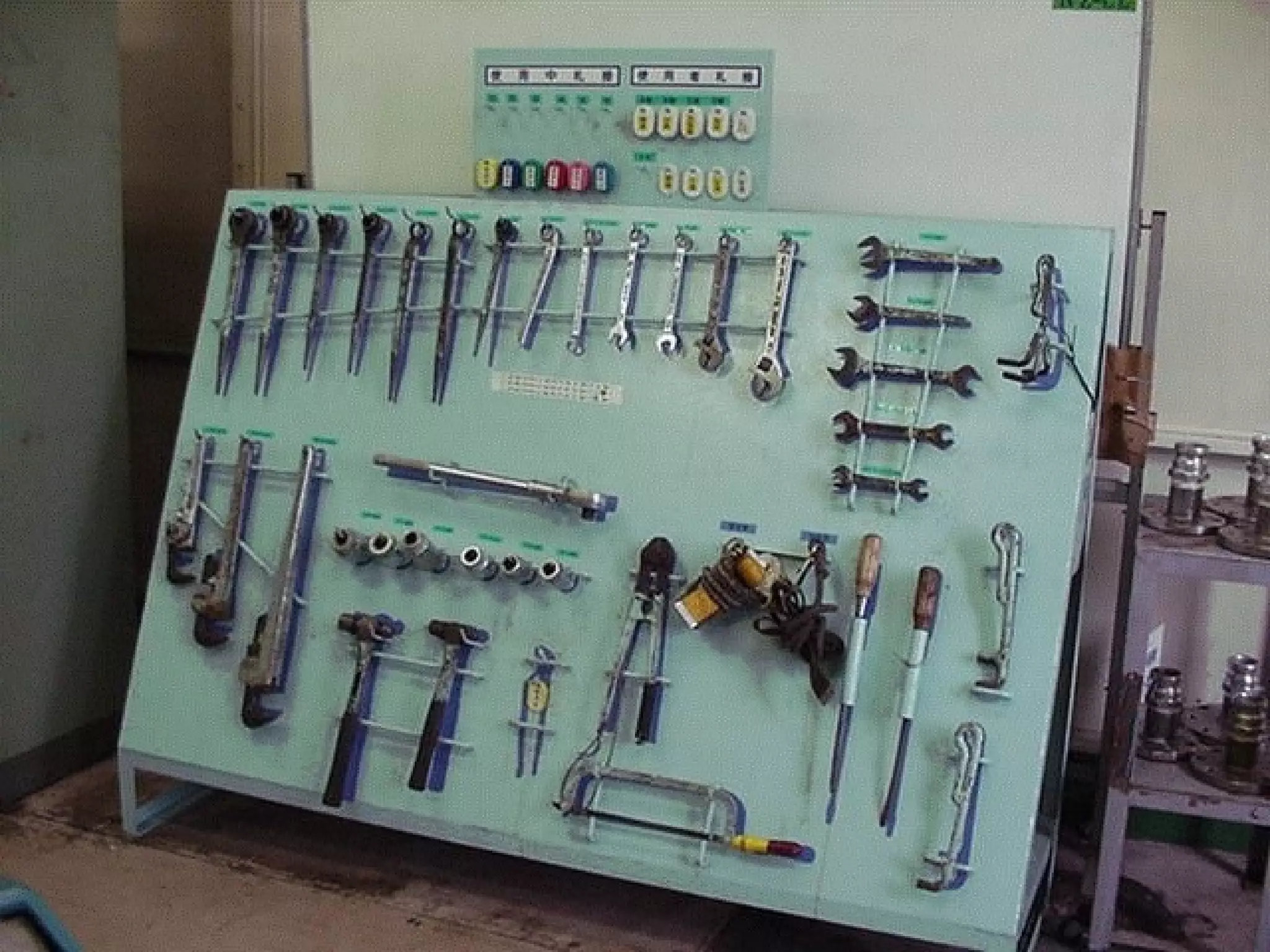
Examples of tools set in order
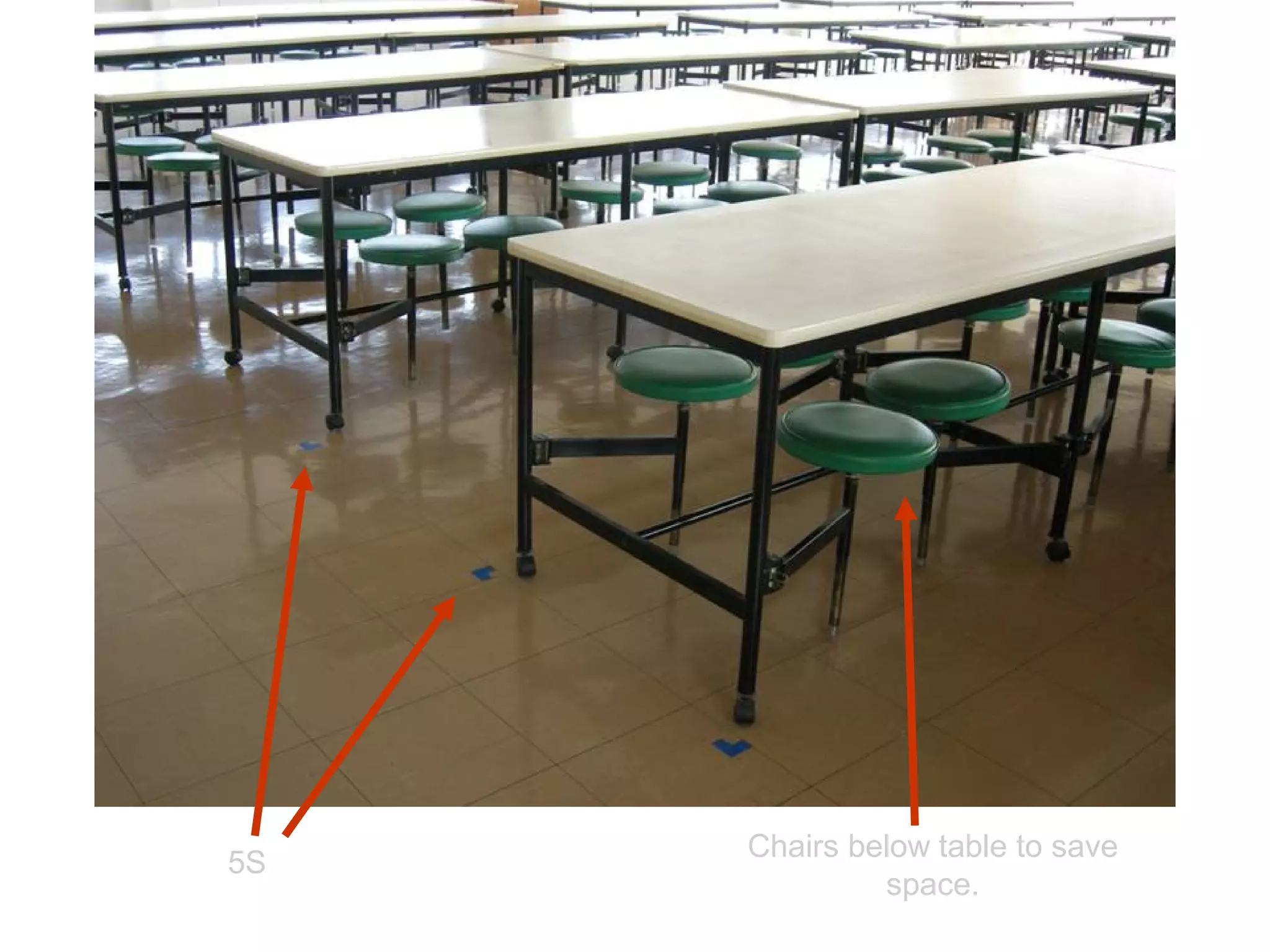
5S
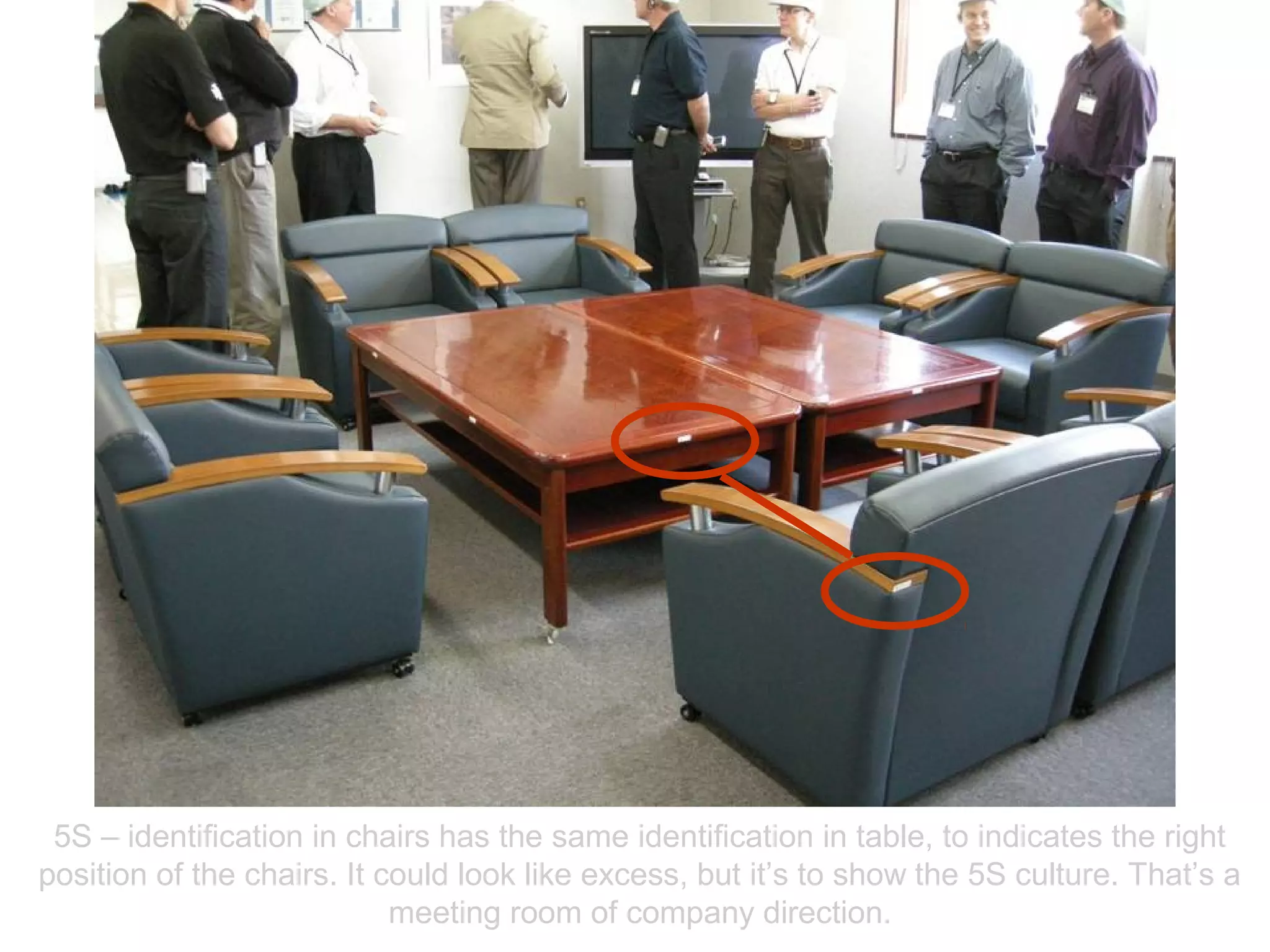
Chairs below table to save
space.
5S – identification in chairs has the same identification in table, to indicates the right
position of the chairs. It could look like excess, but it’s to show the 5S culture. That’s a
meeting room of company direction.
5S. A training material folder to organize all procedures. Most of them are made
manually.
5S
Even here you find 5S.
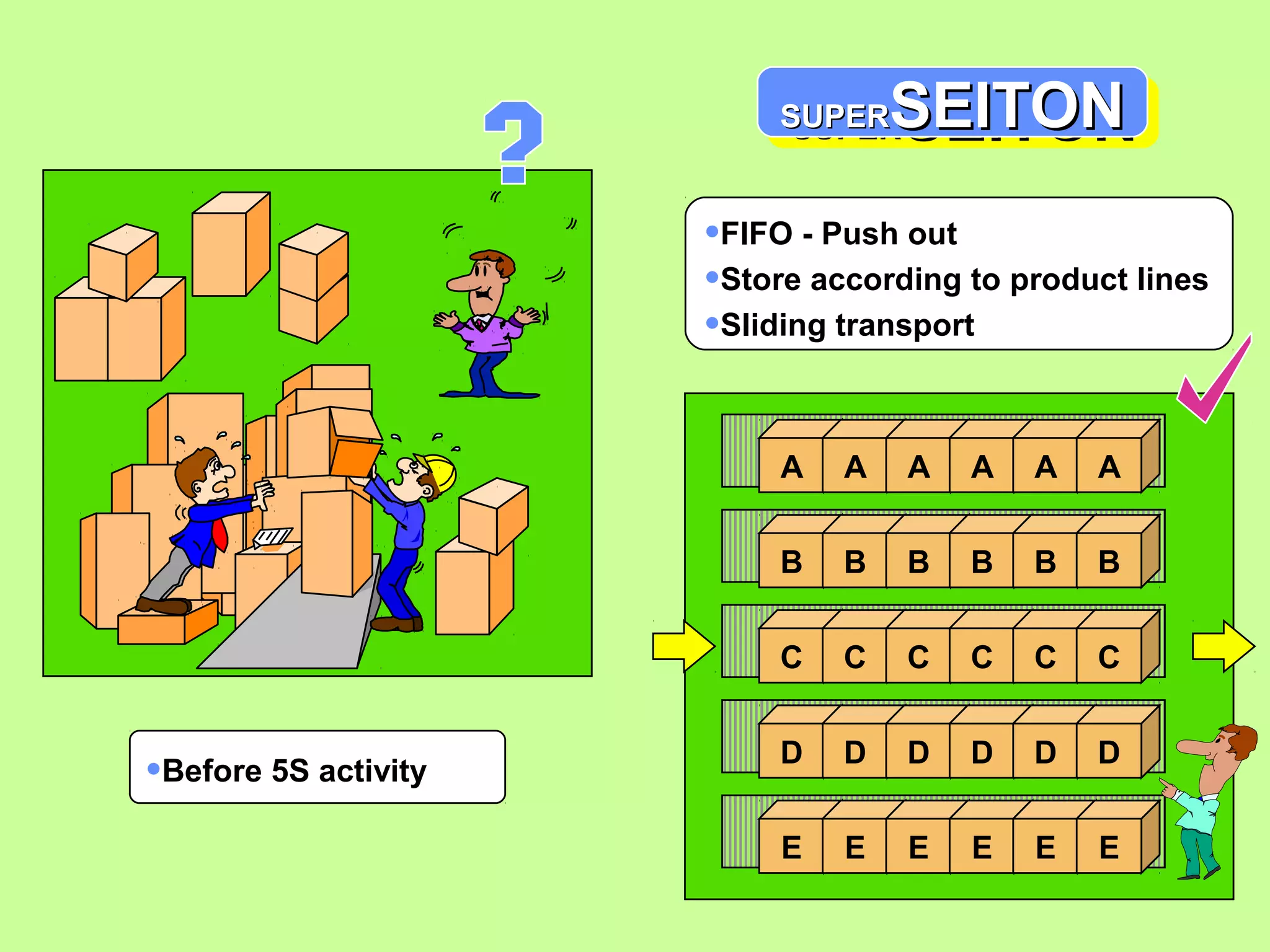
A A A A A A
B B B B B B
D D D D D D
C C C C C C
E E E E E E
•FIFO - Push out
•Store according to product lines
•Sliding transport
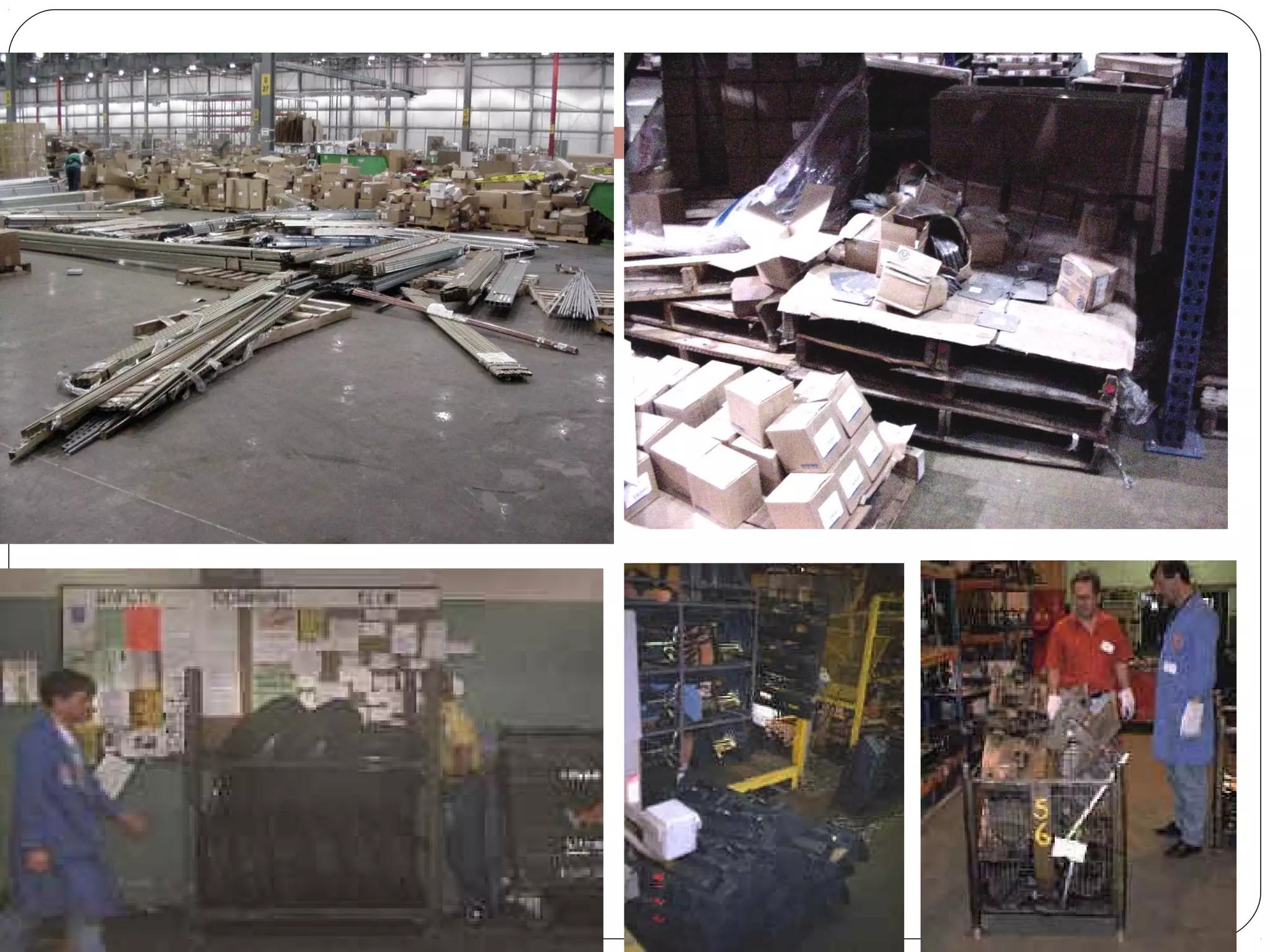
•Before 5S activity
SUPERSUPERSEITONSEITONSUPERSUPERSEITONSEITON
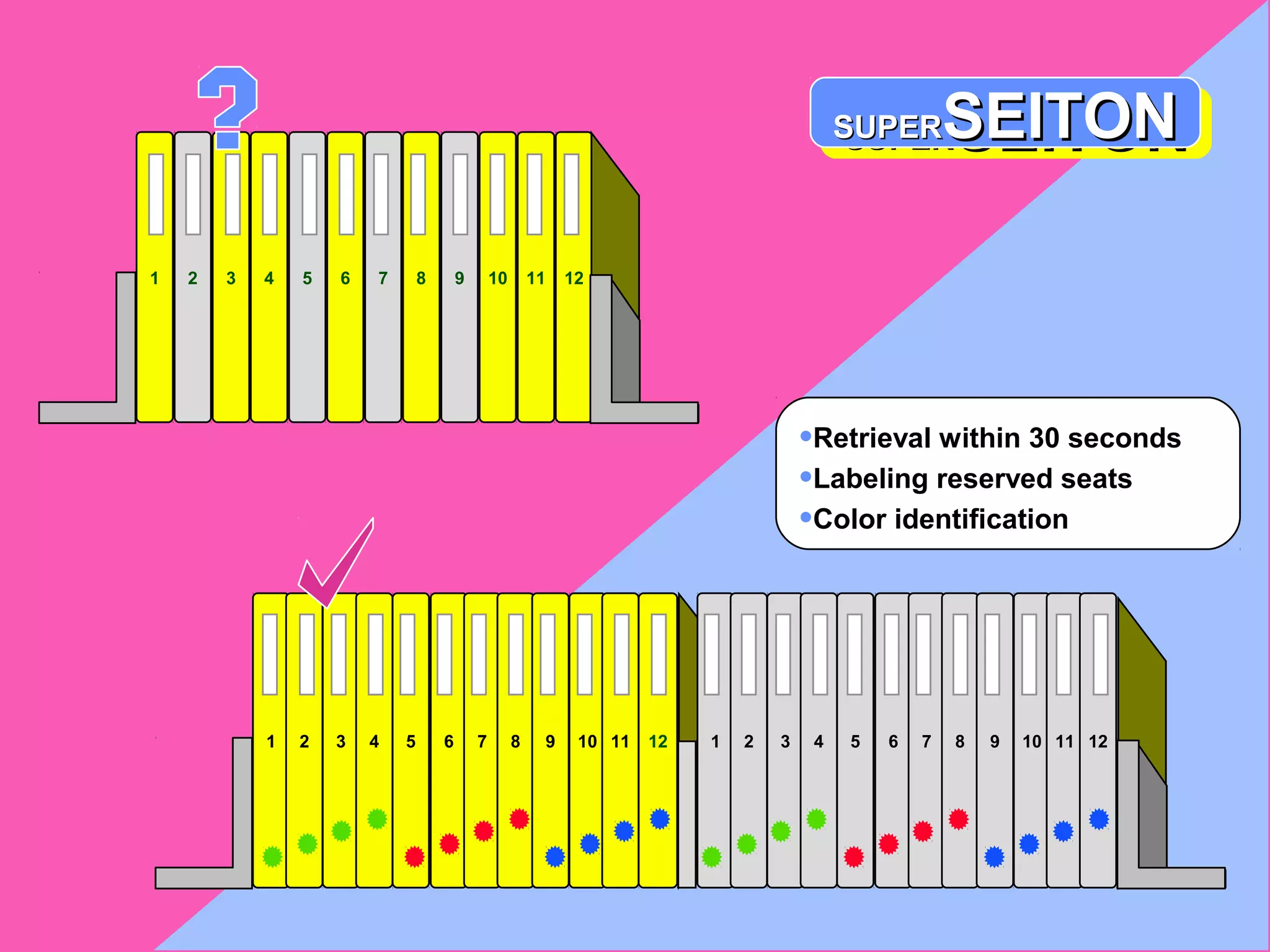
•Retrieval within 30 seconds
•Labeling reserved seats
•Color identification
1 2 3 4 5 6 7 8 9 10 11 12 1 2 3 4 5 6 7 8 9 10 11 12
8 102 9 111 3 4 5 6 7 12
SUPERSUPERSEITONSEITONSUPERSUPERSEITONSEITON
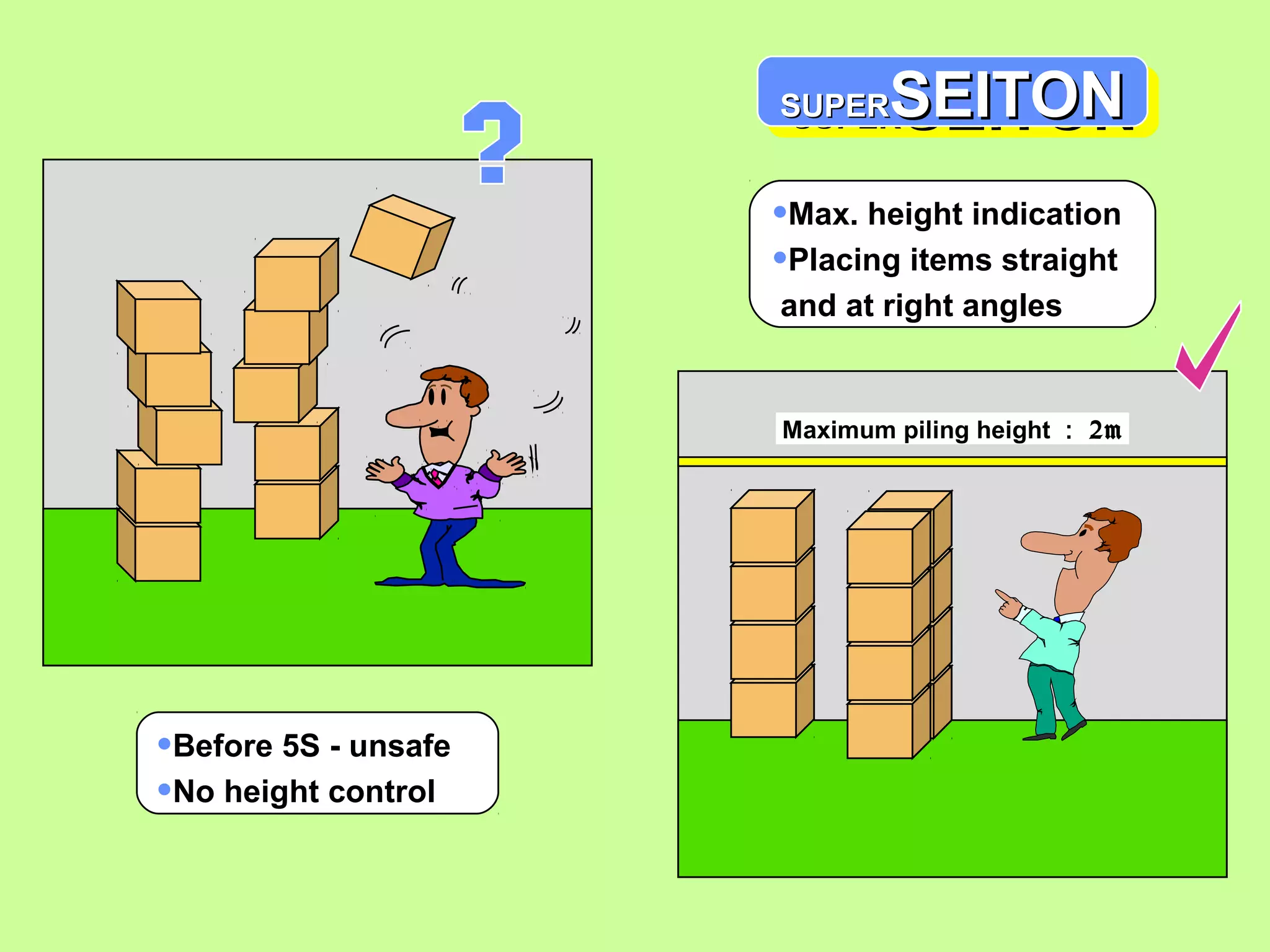
Maximum piling height : 2m
•Max. height indication
•Placing items straight
and at right angles
•Before 5S - unsafe
•No height control
SUPERSUPERSEITONSEITONSUPERSUPERSEITONSEITON
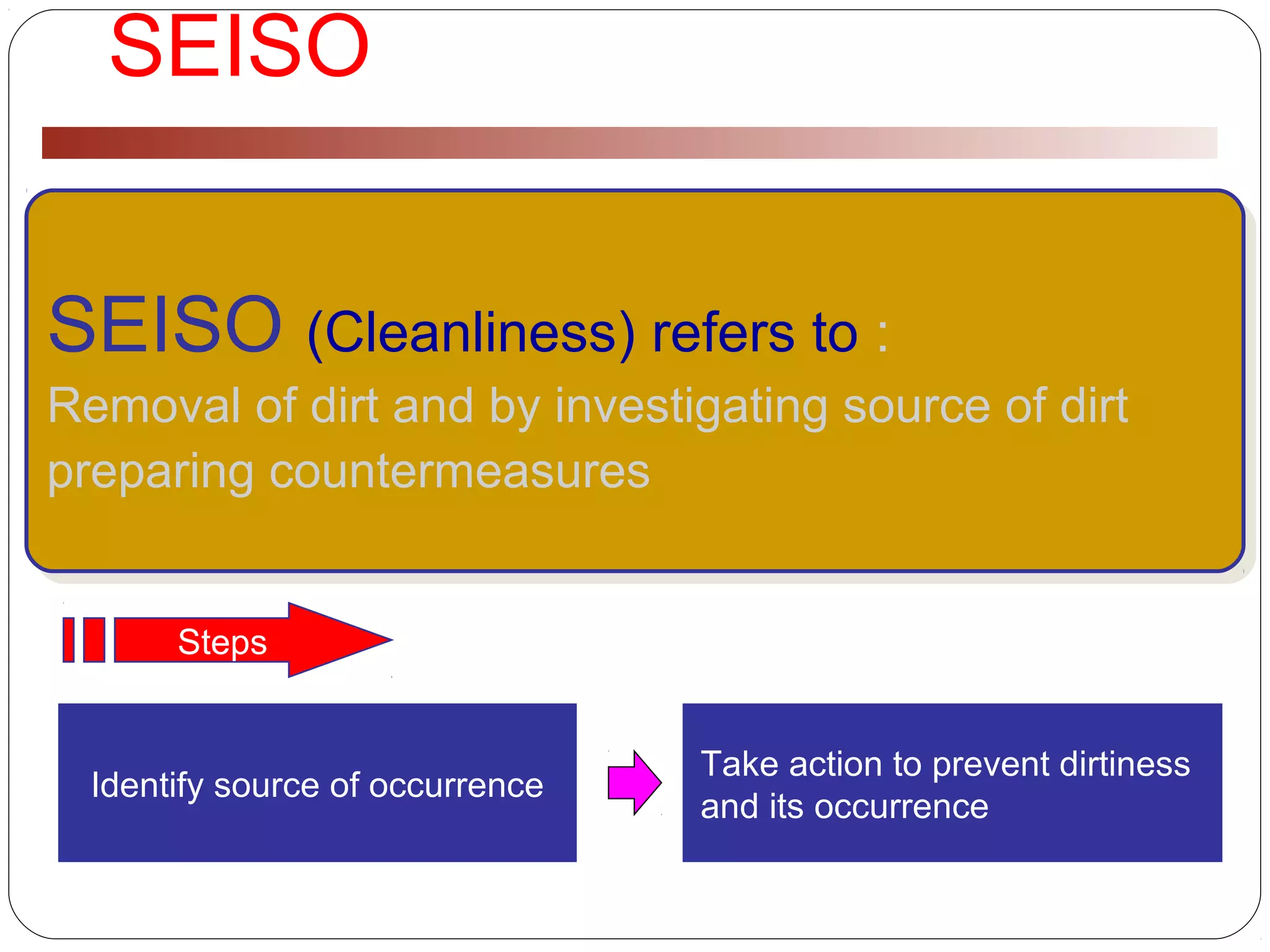
SEISO
Take action to prevent dirtiness
and its occurrence
SEISO (Cleanliness) refers to :
Removal of dirt and by investigating source of dirt
preparing countermeasures
SEISO (Cleanliness) refers to :
Removal of dirt and by investigating source of dirt
preparing countermeasures
Identify source of occurrence
Steps
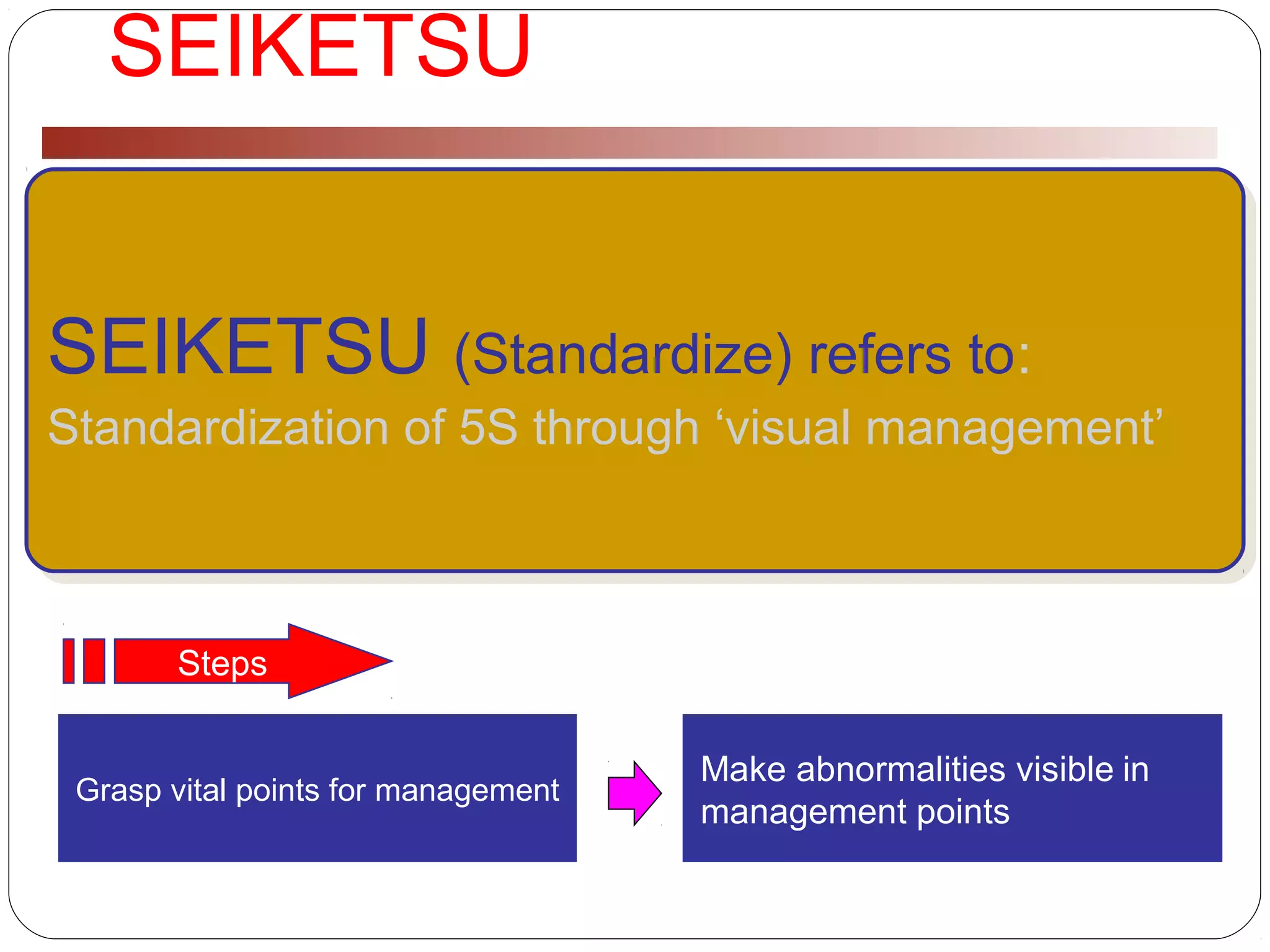
SEIKETSU
Make abnormalities visible in
management points
SEIKETSU (Standardize) refers to:
Standardization of 5S through ‘visual management’
SEIKETSU (Standardize) refers to:
Standardization of 5S through ‘visual management’
Grasp vital points for management
Steps

5 s for store

  • 1.
  • 2.
    Necessity of 5S SEIRI SEITON SEISOU SEIKETSU SHITSUKE Productivity improvement Qualityassurance Cost reduction Secure production volume Deadline observation Happy workplace Job satisfaction Workplace improvement
  • 3.
    Definition of 5S (1)SEIRI (Sort) (2) SEITON (Set In Order) (3) SEISOU (Shine) (4) SEIKETSU (Standardize) (5) SHITSUKE (Sustain) (1) SEIRI (Sort) (2) SEITON (Set In Order) (3) SEISOU (Shine) (4) SEIKETSU (Standardize) (5) SHITSUKE (Sustain)
  • 4.
    Promotion of 5S (1) SEIRI (Sort) Disposewhat is not needed (1) SEIRI (Sort) Dispose what is not needed (2) SEITON (Set in order) Can retrieve when required (2) SEITON (Set in order) Can retrieve when required (3) SEISOU (Cleaning) Make the workplace clean (3) SEISOU (Cleaning) Make the workplace clean (4) SEIKETSU (Discipline) Develop customs/Standards that allow practice of rules (4) SEIKETSU (Discipline) Develop customs/Standards that allow practice of rules (5) SHITSUKE (Sustain) Continuous maintenance of sifting, sorting and spic and span state (5) SHITSUKE (Sustain) Continuous maintenance of sifting, sorting and spic and span state
  • 5.
    “Self-discipline” is thefoundation for success of 5S ““Self-discipline” supports 5SSelf-discipline” supports 5S““Self-discipline” supports 5SSelf-discipline” supports 5S Seisou (Cleaning) Seiketsu (Discipline) Seiri (Sort) Seiton (Set in order) Shitsuke (Sustain)
  • 6.
    SEIRI Dispose Assign fixedplace SEIRI (Sort) refers to: Separating what is and is not needed and removing what is not needed SEIRI (Sort) refers to: Separating what is and is not needed and removing what is not needed Stratify Steps
  • 8.
    SEITON Make it compact SEITON(Set in Order) refers to : Implementing functional storage by deciding correct placement method and layout so that the required objects can be quickly used what it is required SEITON (Set in Order) refers to : Implementing functional storage by deciding correct placement method and layout so that the required objects can be quickly used what it is required Assign fixed places and fixed quantity Steps
  • 9.
    Examples of toolsset in order
  • 11.
    5S Chairs below tableto save space.
  • 12.
    5S – identificationin chairs has the same identification in table, to indicates the right position of the chairs. It could look like excess, but it’s to show the 5S culture. That’s a meeting room of company direction.
  • 13.
    5S. A trainingmaterial folder to organize all procedures. Most of them are made manually.
  • 14.
  • 15.
    Even here youfind 5S.
  • 16.
    A A AA A A B B B B B B D D D D D D C C C C C C E E E E E E •FIFO - Push out •Store according to product lines •Sliding transport •Before 5S activity SUPERSUPERSEITONSEITONSUPERSUPERSEITONSEITON
  • 17.
    •Retrieval within 30seconds •Labeling reserved seats •Color identification 1 2 3 4 5 6 7 8 9 10 11 12 1 2 3 4 5 6 7 8 9 10 11 12 8 102 9 111 3 4 5 6 7 12 SUPERSUPERSEITONSEITONSUPERSUPERSEITONSEITON
  • 18.
    Maximum piling height: 2m •Max. height indication •Placing items straight and at right angles •Before 5S - unsafe •No height control SUPERSUPERSEITONSEITONSUPERSUPERSEITONSEITON
  • 19.
    SEISO Take action toprevent dirtiness and its occurrence SEISO (Cleanliness) refers to : Removal of dirt and by investigating source of dirt preparing countermeasures SEISO (Cleanliness) refers to : Removal of dirt and by investigating source of dirt preparing countermeasures Identify source of occurrence Steps
  • 20.
    SEIKETSU Make abnormalities visiblein management points SEIKETSU (Standardize) refers to: Standardization of 5S through ‘visual management’ SEIKETSU (Standardize) refers to: Standardization of 5S through ‘visual management’ Grasp vital points for management Steps

Editor's Notes

  • #17 Seiton principles applied here: Follow the first-in-first-out (FIFO) method of storing items. Place items so they can be reached or handled easily. The first-in-first-out (FIFO) method is suitable for storing raw materials, goods in process and finished goods. It is convenient to retrieve items from storage in order they were stored. One thing that should be pursued is reducing unsafe and unreasonable work such as manually lifting or carrying heavy items. The figure above illustrates an example of transport rationalized by using rolling conveyers rather than manual labor.
  • #18 Seiton principles applied here: Assign each item a dedicated location. All items and their locations should be indicated by systematic labeling. Place items in in a visible spot to minimize search time. Place items so they can be reached or handled easily. It is good to be able to easily return a file to its proper place. Each file in the right figure has a colored label on its back that indicates the group it belongs to and its place in the group, enabling people to return it quickly and correctly.
  • #19 Seiton principles applied here: Follow the first-in-first-out (FIFO) method of storing items. Assign each item a dedicated location. All items and their locations should be indicated by systematic labeling. Place items in a visible spot to minimize search time. Place items so they can be reached or handled easily. The figure above shows a good example of a warehouse marked with the maximum stacking height, for safety and quality control. Cartons and other containers should have markings as to orientation (top and bottom), weight and stacking limits, of which the last is of the highest priority.