REVERSE LOGISTICS

    Reverse logistics is not simply a matter of
       “driving the truck the opposite way”.

    Reverse Logistics: From Trash to Cash

                                 - Khaja Hammaduddin
Definitions
   Logistics (Forward)
       “Process of planning, implementing and controlling the efficient, cost-effective
       flow of raw materials, in-process inventory, finished goods and related
       information from the point of origin to the point of consumption for the purpose
       of conforming to customer requirements”
                                                         - Council of Logistics, 1988 -


   Reverse Logistics
       “Process of planning, implementing and controlling the efficient, cost-effective
       flow of raw materials, in-process inventory, finished goods and related
       information from the point of consumption to the point of origin for the purpose
       of recapturing value or proper disposal”
                                                       - Rogers and Tibben-Lembke -
Reverse Logistics Activities
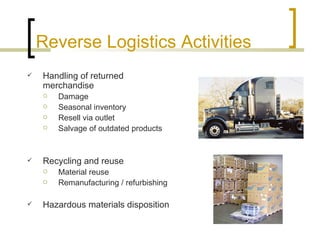
   Handling of returned
    merchandise
       Damage
       Seasonal inventory
       Resell via outlet
       Salvage of outdated products


   Recycling and reuse
       Material reuse
       Remanufacturing / refurbishing

   Hazardous materials disposition
The Reverse Logistics Process


Source: http://www.rlmagazine.com/img/edition04_ups.jpg
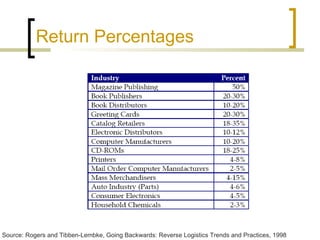
Return Percentages


Source: Rogers and Tibben-Lembke, Going Backwards: Reverse Logistics Trends and Practices, 1998
Publishing Industry
   Highest rate of unsold copies (28% on
    average)
   To secure a prominent display in
    superstores, publishers must supply large
    quantities of books
   Superstores sell less than 70% of books
    they order
   Shorter shelf life
Computer / Electronic Industry
   Shorter life cycles
   Approximately 325 million PC’s became obsolete in
    the US between 1985 and 2005
   How to recover and reuse materials contained within
    E-waste?
          E-waste includes computers, televisions, cell phones,
           audio equipment and batteries
   Remanufacturing of toner cartridges: 12,000
    remanufacturers, employing 42,000 workers, sell
    nearly $1 billion annually
Automotive Industry
   Three primary areas:
        Components in working order sold as is
        Other components, such as engines,
         alternators, starters, and transmissions
         are refurbished before they can be sold
        Materials are reclaimed through
         crushing or shredding
   Automotive recyclers handle more
    than 37% of the nation’s ferrous
    scrap
   Remanufactured auto parts market
    is estimated at $34 billion, annually
Retail Industry
   Profit margins are so slim that
    good return management is
    critical
   Returns reduce the
    profitability of retailers
    marginally more than
    manufacturers
       Returns reduce the profitability
        of retailers by 4.3%
       The average amount that
        returns reduce profitability
        among manufacturers is 3.80%
Forward vs. Reverse Logistics
STRATEGIC USE OF REVERSE LOGISTICS

    Reverse Logistics as a Strategic Weapon
         Many firms have not yet decided to emphasize reverse logistics
          as a strategic variable.


    Source: Rogers and Tibben-Lembke, Going Backwards: Reverse Logistics Trends and Practices,
    1998
STRATEGIC USE OF REVERSE LOGISTICS

   Competitive Reasons:

        Taking back unwanted products or products
         customers believe do not meet needs.


                              Good Corporate Citizenship
                          o    Use reverse logistics capabilities for altruistic reasons,
                               such as philanthropy.
                          o    These activities enhance the value of the brand and are
                               a marketing incentive to purchase their products.

    Source: Rogers and Tibben-Lembke, Going Backwards: Reverse Logistics Trends and Practices,
    1998
STRATEGIC USE OF REVERSE LOGISTICS

       Clean Channel
            Clean out customer inventories, so that they can purchase more new goods.
        
             Fresher inventories can demand better prices, which in turn, protects margin.


                                               Recapture Value and Recover Assets

                                                   Large portion of bottom-line profits is
                                                    derived from asset recovery programs.

                                                   Profit derived from materials that were
                                                    previously discarded.
   Legal Disposal Issues

    o       As landfill fees increase, and options for disposal of hazardous material decrease,
            legally disposing of non-salvageable materials becomes more difficult.
REVERSE LOGISTICS CHALLENGES
      Retailer – Manufacturer Conflict
           Inefficiencies that lengthen the time for processing returns:
            √    Condition of the item
            √    Value of the item
            √    Timeliness of response
           They have to develop a working partnership to derive mutual benefit.

                                                         Problem Return Symptoms
                                                          o    Lack of information about
                                                               the process.
                                                          o    If you aren’t measuring it,
                                                               you aren’t managing it.


    Source: Rogers and Tibben-Lembke, Going Backwards: Reverse Logistics Trends and Practices,
    1998
REVERSE LOGISTICS CHALLENGES

   Cause and Effect
        Poor data collection leads to uncertainty
         about return causes.
        Improving the return process decreases
         costs.
        Being able to see defective products and
         to track return issues.


   Reactive Response
    o    Government regulation or pressure from environmental agencies .
    o    It has not been possible to justify a large investment in improving
         reverse logistics systems and capabilities.
Key Reverse Logistics Management Element

    Avoidance
        Goal: design its merchandise and systems in a manner that will
        minimize returns to prevent customers from sending purchased
        products back
    Preventive Measures:

           To increase Quality – minimize returns by defective
           products

          Return agreements with retailers / distributors

           Customer Service – providing toll-free numbers that
           customers can call before returning products
Key Reverse Logistics Management Element

   GATEKEEPING

    “The screening of defective and unwarranted returned merchandise
    at the entry point into the reverse logistics process”
                                                  Rogers, Dale, and Don Tibben-Lembke


The Nintendo example:
           - Rebate retailers if they register the game player sold to the
consumer at the point of sale
           - Nintendo/retailers can determine if the product is under warranty,
and also if it is being returned inside the allowed time window
           - The impact from this new system on their bottom line was
substantial: 80% drop in return rates
Key Reverse Logistics Management Element

   Compacting Disposition Cycle Time
      Goal: to reduce the amount of time to figure out what to do with
      returned products once they arrive


                        Important to know beforehand what to do with returned goods

                      When material often comes back in to a distribution center, it is
                     not clear whether the items are: defective, can be reused, or
                     refurbished, or need to be sent to a landfill

                       The challenge of running a distribution system in forward is
                     difficult – employees have difficulty making decisions when the
                     decision rules are not clearly stated and exceptions are often
                     made
Key Reverse Logistics Management Element

       Reverse Logistics Information Systems
          One of the most serious problems that the companies face in the
          execution of a reverse logistics is the dearth of a good information
          systems. To work well, a flexible reverse logistics information
          system is required.

      The system should create a database at store level so that the retailer can begin
    tracking returned product and follow it all the way back through the supply chain

      Information system should also include detailed information programs about
    important reverse logistics measurements, such as returns rates, recovery rates, and
    returns inventory turnover

     Useful tools such as radio frequency (RF) are helpful. New innovations such as two-
    dimensional bar code and radio frequency identification license plates (RFID) may
    soon be in use extensively
Key Reverse Logistics Management Element

       Zero Returns
     A program where the company in question does not accept returns from its
    customers. Rather, it gives the retailer an allowable return rate, and proposes
    guidelines as to the proper disposition of the items. Such policies are usually
    accompanied by discounts for the retailer

    It passes the returns responsibility onto the retailer, while reducing costs for the
    manufacturer or distributor

       The drawback: the manufacturer losses control over its merchandise
Key Reverse Logistics Management Element

        Remanufacture and Refurbishment
             The advantage to using reworked parts is felt through cost saving


       Five categories of remanufacture and refurbishment:

Make the product reusable for      Retrieving reusable parts from   Reusing parts of products for
its intended purpose               old or broken products           different purpose

1) Repair                          4) Cannibalization               5) Recycling
2) Refurbishing
3) Remanufacturing
Key Reverse Logistics Management Element

     Negotiation
 Negotiation is a key element for all parties of the reverse logistics process. Because of
the inherent lack of expertise on product returns, negotiations usually are informal and
approached without formal pricing guidelines. Firms often do not maximize the residual
value of returned product

     Financial Management
   Probably the most difficult part of reverse logistic and also one of the most important

 Returns are sometimes charged against sales. People in the sales department may
tend to fight returns and delay them as much as possible. Furthermore, accounts
receivables are impacted by returns

     Outsourcing
 Reverse logistic is usually not a core competence of the firm. In many cases, however, it
makes more sense for the firm to outsource their reverse logistics functions than keep
those in-house.
Reverse Logistics and the
Environment

   Environmental considerations have a
    greater impact on many logistics decisions.
   For example:
     Many products can no longer be placed

       in landfills
     Firms forced to take back their products

       at the end of their useful lifetime.
CONCLUSIONS
   More firms will give considerable attention on reverse logistics
   Efficient handling and disposition of returned product can make a
    competitive difference.
   Excellent reverse logistics practices add to the company’s bottom line.

                                 Aspects to reduce the cost of reverse
                                  logistics:
                                     Improved Gatekeeping technology
                                     Partial returns credit
                                     Earlier disposition decisions
                                     Faster processing / shorter cycle times
                                     Better data management
CONCLUSIONS

   Within reverse logistics, maintaining the environment and making
    profits are complementary.
       Fewer disposed products can benefit companies and the environment.
       Alternate uses of resources by extending products’ normal life cycles.
       Cost effective and ecologically friendly solutions.


         Reverse logistics is not simply a matter of
            “driving the truck the opposite way”.

Reverse logistics

  • 1.
    REVERSE LOGISTICS Reverse logistics is not simply a matter of “driving the truck the opposite way”.  Reverse Logistics: From Trash to Cash - Khaja Hammaduddin
  • 2.
    Definitions  Logistics (Forward) “Process of planning, implementing and controlling the efficient, cost-effective flow of raw materials, in-process inventory, finished goods and related information from the point of origin to the point of consumption for the purpose of conforming to customer requirements” - Council of Logistics, 1988 -  Reverse Logistics “Process of planning, implementing and controlling the efficient, cost-effective flow of raw materials, in-process inventory, finished goods and related information from the point of consumption to the point of origin for the purpose of recapturing value or proper disposal” - Rogers and Tibben-Lembke -
  • 3.
    Reverse Logistics Activities  Handling of returned merchandise  Damage  Seasonal inventory  Resell via outlet  Salvage of outdated products  Recycling and reuse  Material reuse  Remanufacturing / refurbishing  Hazardous materials disposition
  • 4.
    The Reverse LogisticsProcess Source: http://www.rlmagazine.com/img/edition04_ups.jpg
  • 5.
    Return Percentages Source: Rogersand Tibben-Lembke, Going Backwards: Reverse Logistics Trends and Practices, 1998
  • 6.
    Publishing Industry  Highest rate of unsold copies (28% on average)  To secure a prominent display in superstores, publishers must supply large quantities of books  Superstores sell less than 70% of books they order  Shorter shelf life
  • 7.
    Computer / ElectronicIndustry  Shorter life cycles  Approximately 325 million PC’s became obsolete in the US between 1985 and 2005  How to recover and reuse materials contained within E-waste?  E-waste includes computers, televisions, cell phones, audio equipment and batteries  Remanufacturing of toner cartridges: 12,000 remanufacturers, employing 42,000 workers, sell nearly $1 billion annually
  • 8.
    Automotive Industry  Three primary areas:  Components in working order sold as is  Other components, such as engines, alternators, starters, and transmissions are refurbished before they can be sold  Materials are reclaimed through crushing or shredding  Automotive recyclers handle more than 37% of the nation’s ferrous scrap  Remanufactured auto parts market is estimated at $34 billion, annually
  • 9.
    Retail Industry  Profit margins are so slim that good return management is critical  Returns reduce the profitability of retailers marginally more than manufacturers  Returns reduce the profitability of retailers by 4.3%  The average amount that returns reduce profitability among manufacturers is 3.80%
  • 10.
  • 11.
    STRATEGIC USE OFREVERSE LOGISTICS  Reverse Logistics as a Strategic Weapon  Many firms have not yet decided to emphasize reverse logistics as a strategic variable. Source: Rogers and Tibben-Lembke, Going Backwards: Reverse Logistics Trends and Practices, 1998
  • 12.
    STRATEGIC USE OFREVERSE LOGISTICS  Competitive Reasons:  Taking back unwanted products or products customers believe do not meet needs.  Good Corporate Citizenship o Use reverse logistics capabilities for altruistic reasons, such as philanthropy. o These activities enhance the value of the brand and are a marketing incentive to purchase their products. Source: Rogers and Tibben-Lembke, Going Backwards: Reverse Logistics Trends and Practices, 1998
  • 13.
    STRATEGIC USE OFREVERSE LOGISTICS  Clean Channel  Clean out customer inventories, so that they can purchase more new goods.  Fresher inventories can demand better prices, which in turn, protects margin.  Recapture Value and Recover Assets  Large portion of bottom-line profits is derived from asset recovery programs.  Profit derived from materials that were previously discarded.  Legal Disposal Issues o As landfill fees increase, and options for disposal of hazardous material decrease, legally disposing of non-salvageable materials becomes more difficult.
  • 14.
    REVERSE LOGISTICS CHALLENGES  Retailer – Manufacturer Conflict  Inefficiencies that lengthen the time for processing returns: √ Condition of the item √ Value of the item √ Timeliness of response  They have to develop a working partnership to derive mutual benefit.  Problem Return Symptoms o Lack of information about the process. o If you aren’t measuring it, you aren’t managing it. Source: Rogers and Tibben-Lembke, Going Backwards: Reverse Logistics Trends and Practices, 1998
  • 15.
    REVERSE LOGISTICS CHALLENGES  Cause and Effect  Poor data collection leads to uncertainty about return causes.  Improving the return process decreases costs.  Being able to see defective products and to track return issues.  Reactive Response o Government regulation or pressure from environmental agencies . o It has not been possible to justify a large investment in improving reverse logistics systems and capabilities.
  • 16.
    Key Reverse LogisticsManagement Element  Avoidance Goal: design its merchandise and systems in a manner that will minimize returns to prevent customers from sending purchased products back Preventive Measures:  To increase Quality – minimize returns by defective products  Return agreements with retailers / distributors  Customer Service – providing toll-free numbers that customers can call before returning products
  • 17.
    Key Reverse LogisticsManagement Element  GATEKEEPING “The screening of defective and unwarranted returned merchandise at the entry point into the reverse logistics process” Rogers, Dale, and Don Tibben-Lembke The Nintendo example: - Rebate retailers if they register the game player sold to the consumer at the point of sale - Nintendo/retailers can determine if the product is under warranty, and also if it is being returned inside the allowed time window - The impact from this new system on their bottom line was substantial: 80% drop in return rates
  • 18.
    Key Reverse LogisticsManagement Element  Compacting Disposition Cycle Time Goal: to reduce the amount of time to figure out what to do with returned products once they arrive  Important to know beforehand what to do with returned goods  When material often comes back in to a distribution center, it is not clear whether the items are: defective, can be reused, or refurbished, or need to be sent to a landfill  The challenge of running a distribution system in forward is difficult – employees have difficulty making decisions when the decision rules are not clearly stated and exceptions are often made
  • 19.
    Key Reverse LogisticsManagement Element  Reverse Logistics Information Systems One of the most serious problems that the companies face in the execution of a reverse logistics is the dearth of a good information systems. To work well, a flexible reverse logistics information system is required.  The system should create a database at store level so that the retailer can begin tracking returned product and follow it all the way back through the supply chain  Information system should also include detailed information programs about important reverse logistics measurements, such as returns rates, recovery rates, and returns inventory turnover  Useful tools such as radio frequency (RF) are helpful. New innovations such as two- dimensional bar code and radio frequency identification license plates (RFID) may soon be in use extensively
  • 20.
    Key Reverse LogisticsManagement Element  Zero Returns  A program where the company in question does not accept returns from its customers. Rather, it gives the retailer an allowable return rate, and proposes guidelines as to the proper disposition of the items. Such policies are usually accompanied by discounts for the retailer It passes the returns responsibility onto the retailer, while reducing costs for the manufacturer or distributor  The drawback: the manufacturer losses control over its merchandise
  • 21.
    Key Reverse LogisticsManagement Element  Remanufacture and Refurbishment The advantage to using reworked parts is felt through cost saving  Five categories of remanufacture and refurbishment: Make the product reusable for Retrieving reusable parts from Reusing parts of products for its intended purpose old or broken products different purpose 1) Repair 4) Cannibalization 5) Recycling 2) Refurbishing 3) Remanufacturing
  • 22.
    Key Reverse LogisticsManagement Element  Negotiation  Negotiation is a key element for all parties of the reverse logistics process. Because of the inherent lack of expertise on product returns, negotiations usually are informal and approached without formal pricing guidelines. Firms often do not maximize the residual value of returned product  Financial Management  Probably the most difficult part of reverse logistic and also one of the most important  Returns are sometimes charged against sales. People in the sales department may tend to fight returns and delay them as much as possible. Furthermore, accounts receivables are impacted by returns  Outsourcing  Reverse logistic is usually not a core competence of the firm. In many cases, however, it makes more sense for the firm to outsource their reverse logistics functions than keep those in-house.
  • 23.
    Reverse Logistics andthe Environment  Environmental considerations have a greater impact on many logistics decisions.  For example:  Many products can no longer be placed in landfills  Firms forced to take back their products at the end of their useful lifetime.
  • 24.
    CONCLUSIONS  More firms will give considerable attention on reverse logistics  Efficient handling and disposition of returned product can make a competitive difference.  Excellent reverse logistics practices add to the company’s bottom line.  Aspects to reduce the cost of reverse logistics:  Improved Gatekeeping technology  Partial returns credit  Earlier disposition decisions  Faster processing / shorter cycle times  Better data management
  • 25.
    CONCLUSIONS  Within reverse logistics, maintaining the environment and making profits are complementary.  Fewer disposed products can benefit companies and the environment.  Alternate uses of resources by extending products’ normal life cycles.  Cost effective and ecologically friendly solutions. Reverse logistics is not simply a matter of “driving the truck the opposite way”.