© 2004 Prentice-Hall, Inc. 2-1
Chapter 2
Supply Chain Performance:
Achieving Strategic Fit and Scope
Supply Chain Management
(2nd Edition)
© 2004 Prentice-Hall, Inc.
Outline
Competitive and supply chain strategies
Achieving strategic fit
Expanding strategic scope
© 2004 Prentice-Hall, Inc.
What is Supply Chain Management?
Managing supply chain flows and assets, to maximize
supply chain value.
What is supply chain value?
© 2004 Prentice-Hall, Inc.
Competitive and Supply
Chain Strategies
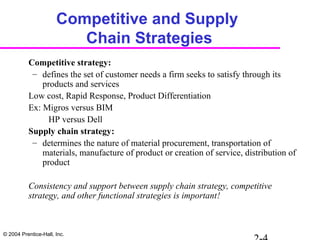
Competitive strategy:
– defines the set of customer needs a firm seeks to satisfy through its
products and services
Low cost, Rapid Response, Product Differentiation
Ex: Migros versus BIM
HP versus Dell
Supply chain strategy:
– determines the nature of material procurement, transportation of
materials, manufacture of product or creation of service, distribution of
product
Consistency and support between supply chain strategy, competitive
strategy, and other functional strategies is important!
© 2004 Prentice-Hall, Inc.
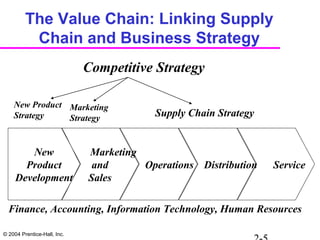
The Value Chain: Linking Supply
Chain and Business Strategy
New
Product
Development
Marketing
and
Sales
Operations Distribution Service
Finance, Accounting, Information Technology, Human Resources
Competitive Strategy
New Product
Strategy
Marketing
Strategy
Supply Chain Strategy
© 2004 Prentice-Hall, Inc.
Product development strategy: specifies the
portfolio of new products that the company will try to
develop
Marketing and sales strategy: specifies how the
market will be segmented and product positioned,
priced, and promoted
© 2004 Prentice-Hall, Inc.
Supply Chain Strategy
Traditionally, SC strategy includes
-Suppliers Strategy
-Operations Strategy
-Logistics Strategy
regarding
inventory, transportation, operating facilities,
information flows.
© 2004 Prentice-Hall, Inc.
Achieving Strategic Fit
What is strategic fit?
How is it achieved?
Other issues affecting strategic fit
© 2004 Prentice-Hall, Inc.
Achieving Strategic Fit
Strategic fit:
– Consistency between customer priorities of competitive
strategy and supply chain capabilities specified by the
supply chain strategy
– Competitive and supply chain strategies have the same
goals
A company may fail because of a lack of strategic fit
Example of strategic fit -- Dell
© 2004 Prentice-Hall, Inc.
How is Strategic Fit Achieved?
Step 1: Understanding the customer and supply chain
uncertainty
Step 2: Understanding the supply chain capabilities
Step 3: Achieving strategic fit
© 2004 Prentice-Hall, Inc.
Step 1: Understanding the Customer
and Supply Chain Uncertainty
Identify the needs of the customer segment being
served by the following attributes:
– Quantity of product needed in each lot
– Response time customers will tolerate
– Variety of products needed
– Service level required
– Price of the product
– Desired rate of innovation in the product
Ex: 7-Eleven vs. Wallmart
© 2004 Prentice-Hall, Inc.
Step 1: Understanding the Customer
and Supply Chain Uncertainty
Understand the overall attributes of customer demand
Demand uncertainty: uncertainty of customer demand
for a product
Implied demand uncertainty: resulting uncertainty for
the supply chain due to the portion of the demand the
supply chain is required to handle and attributes the
customer desires
Ex: A firm supplying only emergency orders for a product
faces higher implied demand uncertainty then when there is
long lead time.
Ex: Imputed demand uncertainty increases with service level,
but demand uncertainty does not change.
© 2004 Prentice-Hall, Inc.
Step 1: Understanding the Customer
and Supply Chain Uncertainty
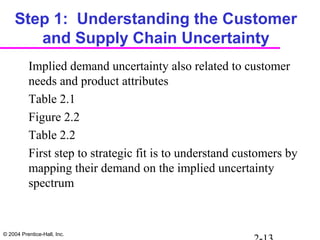
Implied demand uncertainty also related to customer
needs and product attributes
Table 2.1
Figure 2.2
Table 2.2
First step to strategic fit is to understand customers by
mapping their demand on the implied uncertainty
spectrum
© 2004 Prentice-Hall, Inc.
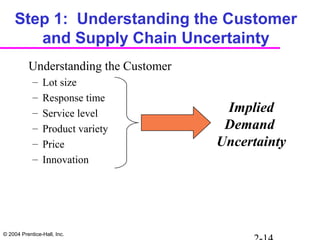
Understanding the Customer
– Lot size
– Response time
– Service level
– Product variety
– Price
– Innovation
Implied
Demand
Uncertainty
Step 1: Understanding the Customer
and Supply Chain Uncertainty
© 2004 Prentice-Hall, Inc.
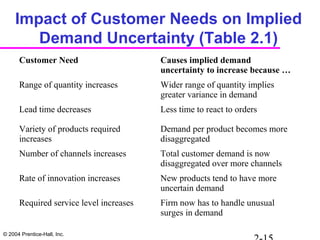
Impact of Customer Needs on Implied
Demand Uncertainty (Table 2.1)
Customer Need Causes implied demand
uncertainty to increase because …
Range of quantity increases Wider range of quantity implies
greater variance in demand
Lead time decreases Less time to react to orders
Variety of products required
increases
Demand per product becomes more
disaggregated
Number of channels increases Total customer demand is now
disaggregated over more channels
Rate of innovation increases New products tend to have more
uncertain demand
Required service level increases Firm now has to handle unusual
surges in demand
© 2004 Prentice-Hall, Inc.
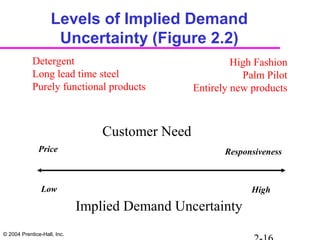
Levels of Implied Demand
Uncertainty (Figure 2.2)
Low High
Price Responsiveness
Customer Need
Implied Demand Uncertainty
Detergent
Long lead time steel
Purely functional products
High Fashion
Palm Pilot
Entirely new products
© 2004 Prentice-Hall, Inc.
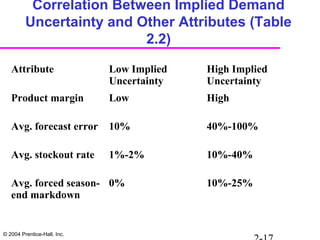
Correlation Between Implied Demand
Uncertainty and Other Attributes (Table
2.2)
Attribute Low Implied
Uncertainty
High Implied
Uncertainty
Product margin Low High
Avg. forecast error 10% 40%-100%
Avg. stockout rate 1%-2% 10%-40%
Avg. forced season-
end markdown
0% 10%-25%
© 2004 Prentice-Hall, Inc.
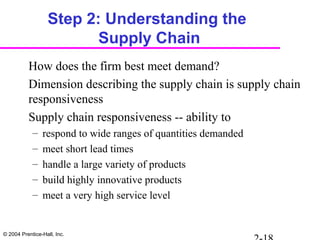
Step 2: Understanding the
Supply Chain
How does the firm best meet demand?
Dimension describing the supply chain is supply chain
responsiveness
Supply chain responsiveness -- ability to
– respond to wide ranges of quantities demanded
– meet short lead times
– handle a large variety of products
– build highly innovative products
– meet a very high service level
© 2004 Prentice-Hall, Inc.
Step 2: Understanding the
Supply Chain
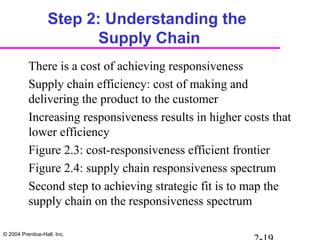
There is a cost of achieving responsiveness
Supply chain efficiency: cost of making and
delivering the product to the customer
Increasing responsiveness results in higher costs that
lower efficiency
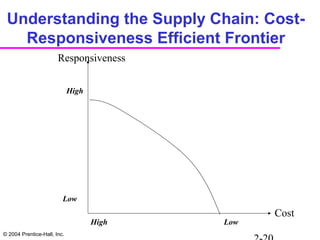
Figure 2.3: cost-responsiveness efficient frontier
Figure 2.4: supply chain responsiveness spectrum
Second step to achieving strategic fit is to map the
supply chain on the responsiveness spectrum
© 2004 Prentice-Hall, Inc.
Understanding the Supply Chain: Cost-
Responsiveness Efficient Frontier
High Low
Low
High
Responsiveness
Cost
© 2004 Prentice-Hall, Inc.
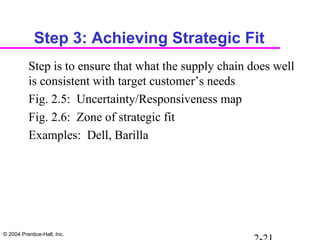
Step 3: Achieving Strategic Fit
Step is to ensure that what the supply chain does well
is consistent with target customer’s needs
Fig. 2.5: Uncertainty/Responsiveness map
Fig. 2.6: Zone of strategic fit
Examples: Dell, Barilla
© 2004 Prentice-Hall, Inc.
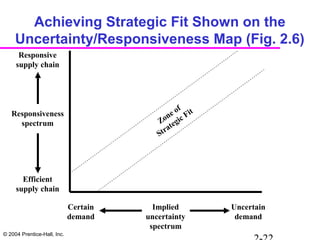
Achieving Strategic Fit Shown on the
Uncertainty/Responsiveness Map (Fig. 2.6)
Implied
uncertainty
spectrum
Responsive
supply chain
Efficient
supply chain
Certain
demand
Uncertain
demand
Responsiveness
spectrum Zone of
Strategic Fit
© 2004 Prentice-Hall, Inc.
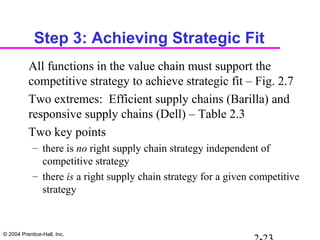
Step 3: Achieving Strategic Fit
All functions in the value chain must support the
competitive strategy to achieve strategic fit – Fig. 2.7
Two extremes: Efficient supply chains (Barilla) and
responsive supply chains (Dell) – Table 2.3
Two key points
– there is no right supply chain strategy independent of
competitive strategy
– there is a right supply chain strategy for a given competitive
strategy
© 2004 Prentice-Hall, Inc.
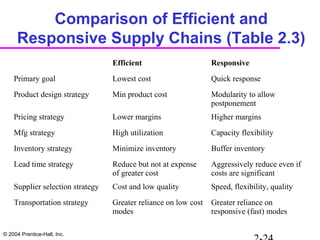
Comparison of Efficient and
Responsive Supply Chains (Table 2.3)
Efficient Responsive
Primary goal Lowest cost Quick response
Product design strategy Min product cost Modularity to allow
postponement
Pricing strategy Lower margins Higher margins
Mfg strategy High utilization Capacity flexibility
Inventory strategy Minimize inventory Buffer inventory
Lead time strategy Reduce but not at expense
of greater cost
Aggressively reduce even if
costs are significant
Supplier selection strategy Cost and low quality Speed, flexibility, quality
Transportation strategy Greater reliance on low cost
modes
Greater reliance on
responsive (fast) modes
© 2004 Prentice-Hall, Inc.
Other Issues Affecting Strategic Fit
Multiple products and customer segments
Product life cycle
Competitive changes over time
© 2004 Prentice-Hall, Inc.
Multiple Products and
Customer Segments
Firms sell different products to different customer
segments (with different implied demand uncertainty)
The supply chain has to be able to balance efficiency
and responsiveness given its portfolio of products and
customer segments
Two approaches:
– Different supply chains if the segments are large
enough
– Tailor supply chain to best meet the needs of each
product’s demand, i.e., share some links.
© 2004 Prentice-Hall, Inc.
Product Life Cycle
The demand characteristics of a product and the needs
of a customer segment change as a product goes
through its life cycle
Supply chain strategy must evolve throughout the life
cycle
Early: uncertain demand, high margins (time is
important), product availability is most important, cost
is secondary
Late: predictable demand, lower margins, price is
important
© 2004 Prentice-Hall, Inc.
Product Life Cycle
Examples: pharmaceutical firms, Intel
As the product goes through the life cycle, the supply
chain changes from one emphasizing responsiveness
to one emphasizing efficiency
© 2004 Prentice-Hall, Inc.
Competitive Changes Over Time
Competitive pressures can change over time
More competitors may result in an increased emphasis
on variety at a reasonable price
The Internet makes it easier to offer a wide variety of
products
The supply chain must change to meet these changing
competitive conditions
© 2004 Prentice-Hall, Inc.
Expanding Strategic Scope
Scope of strategic fit
– The functions and stages within a supply chain that devise an
integrated stategy with a shared objective
– One extreme: each function at each stage develops its own
strategy
– Other extreme: all functions in all stages devise a strategy jointly
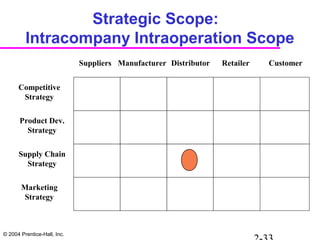
Five categories:
– Intracompany intraoperation scope
– Intracompany intrafunctional scope
– Intracompany interfunctional scope
– Intercompany interfunctional scope
– Flexible interfunctional scope
© 2004 Prentice-Hall, Inc.
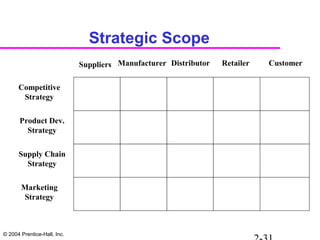
Strategic Scope
Suppliers Manufacturer Distributor Retailer Customer
Competitive
Strategy
Product Dev.
Strategy
Supply Chain
Strategy
Marketing
Strategy
© 2004 Prentice-Hall, Inc.
Intracompany
Intraoperational Scope
One operation within a functional area in a company
Each operation within each stage of the supply chain
devises a strategy independently and attempts to
optimize its own performance independently
Usually results in different operations having
conflicting objectives – does not maximize total
supply chain profits
Figure 2.9
© 2004 Prentice-Hall, Inc.
Strategic Scope:
Intracompany Intraoperation Scope
Suppliers Manufacturer Distributor Retailer Customer
Competitive
Strategy
Product Dev.
Strategy
Supply Chain
Strategy
Marketing
Strategy
© 2004 Prentice-Hall, Inc.
Intracompany
Intrafunctional Scope
Strategic fit is expanded to include all operations
within a function
Attempt to maximize performance for the entire
function
Figure 2.10
© 2004 Prentice-Hall, Inc.
Strategic Scope:
Intracompany Intrafunctional Scope
Suppliers Manufacturer Distributor Retailer Customer
Competitive
Strategy
Product Dev.
Strategy
Supply Chain
Strategy
Marketing
Strategy
© 2004 Prentice-Hall, Inc.
Intracompany
Interfunctional Scope
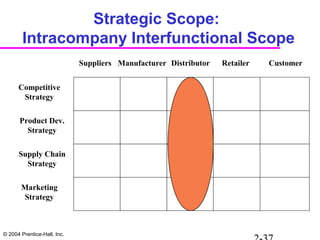
All functional strategies within a company are
developed to support each other and the company’s
competitive strategy
Strategic fit is expanded to include all functions in a
firm
Goal is to maximize company profit
Figure 2.11
© 2004 Prentice-Hall, Inc.
Strategic Scope:
Intracompany Interfunctional Scope
Suppliers Manufacturer Distributor Retailer Customer
Competitive
Strategy
Product Dev.
Strategy
Supply Chain
Strategy
Marketing
Strategy
© 2004 Prentice-Hall, Inc.
Intercompany
Interfunctional Scope
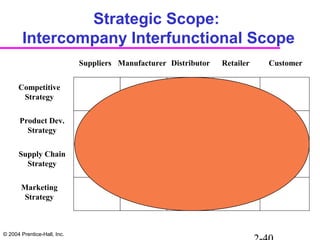
The only positive cash flow for the supply chain
occurs when the customer pays for the product –
all other cash flows are resettling of accounts
within the chain and add to total supply chain cost
Supply chain surplus
– Difference between what the customer pays and total
supply chain cost
– Total profit to be shared among all members of the
supply chain
© 2004 Prentice-Hall, Inc.
Intercompany
Interfunctional Scope
Increasing supply chain surplus increases the amount
to be shared
All stages coordinate strategy across all functions to
ensure that they best meet the customer’s needs and
maximize supply chain surplus
Also provides more speed by managing the interfaces
between supply chain stages
Each company must evaluate its actions in the context
of the entire supply chain
Figure 2.12
© 2004 Prentice-Hall, Inc.
Strategic Scope:
Intercompany Interfunctional Scope
Suppliers Manufacturer Distributor Retailer Customer
Competitive
Strategy
Product Dev.
Strategy
Supply Chain
Strategy
Marketing
Strategy
© 2004 Prentice-Hall, Inc.
Flexible Intercompany
Interfunctional Scope
Ability to achieve strategic fit when partnering with
stages that change over time in the supply chain
Customer needs and members of the supply chain
change over time
A firm may have to partner with many different firms
over time
© 2004 Prentice-Hall, Inc.
Summary of Learning Objectives
Why is achieving strategic fit critical to a company’s
overall success?
How does a company achieve strategic fit between its
supply chain strategy and its competitive strategy?
What is the importance of expanding the scope of
strategic fit across the supply chain?

Supply chain management ch02 chopra

  • 1.
    © 2004 Prentice-Hall,Inc. 2-1 Chapter 2 Supply Chain Performance: Achieving Strategic Fit and Scope Supply Chain Management (2nd Edition)
  • 2.
    © 2004 Prentice-Hall,Inc. Outline Competitive and supply chain strategies Achieving strategic fit Expanding strategic scope
  • 3.
    © 2004 Prentice-Hall,Inc. What is Supply Chain Management? Managing supply chain flows and assets, to maximize supply chain value. What is supply chain value?
  • 4.
    © 2004 Prentice-Hall,Inc. Competitive and Supply Chain Strategies Competitive strategy: – defines the set of customer needs a firm seeks to satisfy through its products and services Low cost, Rapid Response, Product Differentiation Ex: Migros versus BIM HP versus Dell Supply chain strategy: – determines the nature of material procurement, transportation of materials, manufacture of product or creation of service, distribution of product Consistency and support between supply chain strategy, competitive strategy, and other functional strategies is important!
  • 5.
    © 2004 Prentice-Hall,Inc. The Value Chain: Linking Supply Chain and Business Strategy New Product Development Marketing and Sales Operations Distribution Service Finance, Accounting, Information Technology, Human Resources Competitive Strategy New Product Strategy Marketing Strategy Supply Chain Strategy
  • 6.
    © 2004 Prentice-Hall,Inc. Product development strategy: specifies the portfolio of new products that the company will try to develop Marketing and sales strategy: specifies how the market will be segmented and product positioned, priced, and promoted
  • 7.
    © 2004 Prentice-Hall,Inc. Supply Chain Strategy Traditionally, SC strategy includes -Suppliers Strategy -Operations Strategy -Logistics Strategy regarding inventory, transportation, operating facilities, information flows.
  • 8.
    © 2004 Prentice-Hall,Inc. Achieving Strategic Fit What is strategic fit? How is it achieved? Other issues affecting strategic fit
  • 9.
    © 2004 Prentice-Hall,Inc. Achieving Strategic Fit Strategic fit: – Consistency between customer priorities of competitive strategy and supply chain capabilities specified by the supply chain strategy – Competitive and supply chain strategies have the same goals A company may fail because of a lack of strategic fit Example of strategic fit -- Dell
  • 10.
    © 2004 Prentice-Hall,Inc. How is Strategic Fit Achieved? Step 1: Understanding the customer and supply chain uncertainty Step 2: Understanding the supply chain capabilities Step 3: Achieving strategic fit
  • 11.
    © 2004 Prentice-Hall,Inc. Step 1: Understanding the Customer and Supply Chain Uncertainty Identify the needs of the customer segment being served by the following attributes: – Quantity of product needed in each lot – Response time customers will tolerate – Variety of products needed – Service level required – Price of the product – Desired rate of innovation in the product Ex: 7-Eleven vs. Wallmart
  • 12.
    © 2004 Prentice-Hall,Inc. Step 1: Understanding the Customer and Supply Chain Uncertainty Understand the overall attributes of customer demand Demand uncertainty: uncertainty of customer demand for a product Implied demand uncertainty: resulting uncertainty for the supply chain due to the portion of the demand the supply chain is required to handle and attributes the customer desires Ex: A firm supplying only emergency orders for a product faces higher implied demand uncertainty then when there is long lead time. Ex: Imputed demand uncertainty increases with service level, but demand uncertainty does not change.
  • 13.
    © 2004 Prentice-Hall,Inc. Step 1: Understanding the Customer and Supply Chain Uncertainty Implied demand uncertainty also related to customer needs and product attributes Table 2.1 Figure 2.2 Table 2.2 First step to strategic fit is to understand customers by mapping their demand on the implied uncertainty spectrum
  • 14.
    © 2004 Prentice-Hall,Inc. Understanding the Customer – Lot size – Response time – Service level – Product variety – Price – Innovation Implied Demand Uncertainty Step 1: Understanding the Customer and Supply Chain Uncertainty
  • 15.
    © 2004 Prentice-Hall,Inc. Impact of Customer Needs on Implied Demand Uncertainty (Table 2.1) Customer Need Causes implied demand uncertainty to increase because … Range of quantity increases Wider range of quantity implies greater variance in demand Lead time decreases Less time to react to orders Variety of products required increases Demand per product becomes more disaggregated Number of channels increases Total customer demand is now disaggregated over more channels Rate of innovation increases New products tend to have more uncertain demand Required service level increases Firm now has to handle unusual surges in demand
  • 16.
    © 2004 Prentice-Hall,Inc. Levels of Implied Demand Uncertainty (Figure 2.2) Low High Price Responsiveness Customer Need Implied Demand Uncertainty Detergent Long lead time steel Purely functional products High Fashion Palm Pilot Entirely new products
  • 17.
    © 2004 Prentice-Hall,Inc. Correlation Between Implied Demand Uncertainty and Other Attributes (Table 2.2) Attribute Low Implied Uncertainty High Implied Uncertainty Product margin Low High Avg. forecast error 10% 40%-100% Avg. stockout rate 1%-2% 10%-40% Avg. forced season- end markdown 0% 10%-25%
  • 18.
    © 2004 Prentice-Hall,Inc. Step 2: Understanding the Supply Chain How does the firm best meet demand? Dimension describing the supply chain is supply chain responsiveness Supply chain responsiveness -- ability to – respond to wide ranges of quantities demanded – meet short lead times – handle a large variety of products – build highly innovative products – meet a very high service level
  • 19.
    © 2004 Prentice-Hall,Inc. Step 2: Understanding the Supply Chain There is a cost of achieving responsiveness Supply chain efficiency: cost of making and delivering the product to the customer Increasing responsiveness results in higher costs that lower efficiency Figure 2.3: cost-responsiveness efficient frontier Figure 2.4: supply chain responsiveness spectrum Second step to achieving strategic fit is to map the supply chain on the responsiveness spectrum
  • 20.
    © 2004 Prentice-Hall,Inc. Understanding the Supply Chain: Cost- Responsiveness Efficient Frontier High Low Low High Responsiveness Cost
  • 21.
    © 2004 Prentice-Hall,Inc. Step 3: Achieving Strategic Fit Step is to ensure that what the supply chain does well is consistent with target customer’s needs Fig. 2.5: Uncertainty/Responsiveness map Fig. 2.6: Zone of strategic fit Examples: Dell, Barilla
  • 22.
    © 2004 Prentice-Hall,Inc. Achieving Strategic Fit Shown on the Uncertainty/Responsiveness Map (Fig. 2.6) Implied uncertainty spectrum Responsive supply chain Efficient supply chain Certain demand Uncertain demand Responsiveness spectrum Zone of Strategic Fit
  • 23.
    © 2004 Prentice-Hall,Inc. Step 3: Achieving Strategic Fit All functions in the value chain must support the competitive strategy to achieve strategic fit – Fig. 2.7 Two extremes: Efficient supply chains (Barilla) and responsive supply chains (Dell) – Table 2.3 Two key points – there is no right supply chain strategy independent of competitive strategy – there is a right supply chain strategy for a given competitive strategy
  • 24.
    © 2004 Prentice-Hall,Inc. Comparison of Efficient and Responsive Supply Chains (Table 2.3) Efficient Responsive Primary goal Lowest cost Quick response Product design strategy Min product cost Modularity to allow postponement Pricing strategy Lower margins Higher margins Mfg strategy High utilization Capacity flexibility Inventory strategy Minimize inventory Buffer inventory Lead time strategy Reduce but not at expense of greater cost Aggressively reduce even if costs are significant Supplier selection strategy Cost and low quality Speed, flexibility, quality Transportation strategy Greater reliance on low cost modes Greater reliance on responsive (fast) modes
  • 25.
    © 2004 Prentice-Hall,Inc. Other Issues Affecting Strategic Fit Multiple products and customer segments Product life cycle Competitive changes over time
  • 26.
    © 2004 Prentice-Hall,Inc. Multiple Products and Customer Segments Firms sell different products to different customer segments (with different implied demand uncertainty) The supply chain has to be able to balance efficiency and responsiveness given its portfolio of products and customer segments Two approaches: – Different supply chains if the segments are large enough – Tailor supply chain to best meet the needs of each product’s demand, i.e., share some links.
  • 27.
    © 2004 Prentice-Hall,Inc. Product Life Cycle The demand characteristics of a product and the needs of a customer segment change as a product goes through its life cycle Supply chain strategy must evolve throughout the life cycle Early: uncertain demand, high margins (time is important), product availability is most important, cost is secondary Late: predictable demand, lower margins, price is important
  • 28.
    © 2004 Prentice-Hall,Inc. Product Life Cycle Examples: pharmaceutical firms, Intel As the product goes through the life cycle, the supply chain changes from one emphasizing responsiveness to one emphasizing efficiency
  • 29.
    © 2004 Prentice-Hall,Inc. Competitive Changes Over Time Competitive pressures can change over time More competitors may result in an increased emphasis on variety at a reasonable price The Internet makes it easier to offer a wide variety of products The supply chain must change to meet these changing competitive conditions
  • 30.
    © 2004 Prentice-Hall,Inc. Expanding Strategic Scope Scope of strategic fit – The functions and stages within a supply chain that devise an integrated stategy with a shared objective – One extreme: each function at each stage develops its own strategy – Other extreme: all functions in all stages devise a strategy jointly Five categories: – Intracompany intraoperation scope – Intracompany intrafunctional scope – Intracompany interfunctional scope – Intercompany interfunctional scope – Flexible interfunctional scope
  • 31.
    © 2004 Prentice-Hall,Inc. Strategic Scope Suppliers Manufacturer Distributor Retailer Customer Competitive Strategy Product Dev. Strategy Supply Chain Strategy Marketing Strategy
  • 32.
    © 2004 Prentice-Hall,Inc. Intracompany Intraoperational Scope One operation within a functional area in a company Each operation within each stage of the supply chain devises a strategy independently and attempts to optimize its own performance independently Usually results in different operations having conflicting objectives – does not maximize total supply chain profits Figure 2.9
  • 33.
    © 2004 Prentice-Hall,Inc. Strategic Scope: Intracompany Intraoperation Scope Suppliers Manufacturer Distributor Retailer Customer Competitive Strategy Product Dev. Strategy Supply Chain Strategy Marketing Strategy
  • 34.
    © 2004 Prentice-Hall,Inc. Intracompany Intrafunctional Scope Strategic fit is expanded to include all operations within a function Attempt to maximize performance for the entire function Figure 2.10
  • 35.
    © 2004 Prentice-Hall,Inc. Strategic Scope: Intracompany Intrafunctional Scope Suppliers Manufacturer Distributor Retailer Customer Competitive Strategy Product Dev. Strategy Supply Chain Strategy Marketing Strategy
  • 36.
    © 2004 Prentice-Hall,Inc. Intracompany Interfunctional Scope All functional strategies within a company are developed to support each other and the company’s competitive strategy Strategic fit is expanded to include all functions in a firm Goal is to maximize company profit Figure 2.11
  • 37.
    © 2004 Prentice-Hall,Inc. Strategic Scope: Intracompany Interfunctional Scope Suppliers Manufacturer Distributor Retailer Customer Competitive Strategy Product Dev. Strategy Supply Chain Strategy Marketing Strategy
  • 38.
    © 2004 Prentice-Hall,Inc. Intercompany Interfunctional Scope The only positive cash flow for the supply chain occurs when the customer pays for the product – all other cash flows are resettling of accounts within the chain and add to total supply chain cost Supply chain surplus – Difference between what the customer pays and total supply chain cost – Total profit to be shared among all members of the supply chain
  • 39.
    © 2004 Prentice-Hall,Inc. Intercompany Interfunctional Scope Increasing supply chain surplus increases the amount to be shared All stages coordinate strategy across all functions to ensure that they best meet the customer’s needs and maximize supply chain surplus Also provides more speed by managing the interfaces between supply chain stages Each company must evaluate its actions in the context of the entire supply chain Figure 2.12
  • 40.
    © 2004 Prentice-Hall,Inc. Strategic Scope: Intercompany Interfunctional Scope Suppliers Manufacturer Distributor Retailer Customer Competitive Strategy Product Dev. Strategy Supply Chain Strategy Marketing Strategy
  • 41.
    © 2004 Prentice-Hall,Inc. Flexible Intercompany Interfunctional Scope Ability to achieve strategic fit when partnering with stages that change over time in the supply chain Customer needs and members of the supply chain change over time A firm may have to partner with many different firms over time
  • 42.
    © 2004 Prentice-Hall,Inc. Summary of Learning Objectives Why is achieving strategic fit critical to a company’s overall success? How does a company achieve strategic fit between its supply chain strategy and its competitive strategy? What is the importance of expanding the scope of strategic fit across the supply chain?

Editor's Notes

  • #4 Notes: Supply chain surplus refers to what the customer has paid - total cost expended by supply chain in filling order.
  • #32 Strategic scope must cover all boxes, at least at the supply chain end. Each stage must have fit across its vertical boxes and supply chain strategy spanning all players. This fit allows the countering of multiple owners and helps avoid local optimization.
  • #34 Strategic scope must cover all boxes, at least at the supply chain end. Each stage must have fit across its vertical boxes and supply chain strategy spanning all players. This fit allows the countering of multiple owners and helps avoid local optimization.
  • #36 Strategic scope must cover all boxes, at least at the supply chain end. Each stage must have fit across its vertical boxes and supply chain strategy spanning all players. This fit allows the countering of multiple owners and helps avoid local optimization.
  • #38 Strategic scope must cover all boxes, at least at the supply chain end. Each stage must have fit across its vertical boxes and supply chain strategy spanning all players. This fit allows the countering of multiple owners and helps avoid local optimization.
  • #41 Strategic scope must cover all boxes, at least at the supply chain end. Each stage must have fit across its vertical boxes and supply chain strategy spanning all players. This fit allows the countering of multiple owners and helps avoid local optimization.