
SIX SIGMA
CONTINUOUS
IMPROVEMENT
PROCESS
QIA
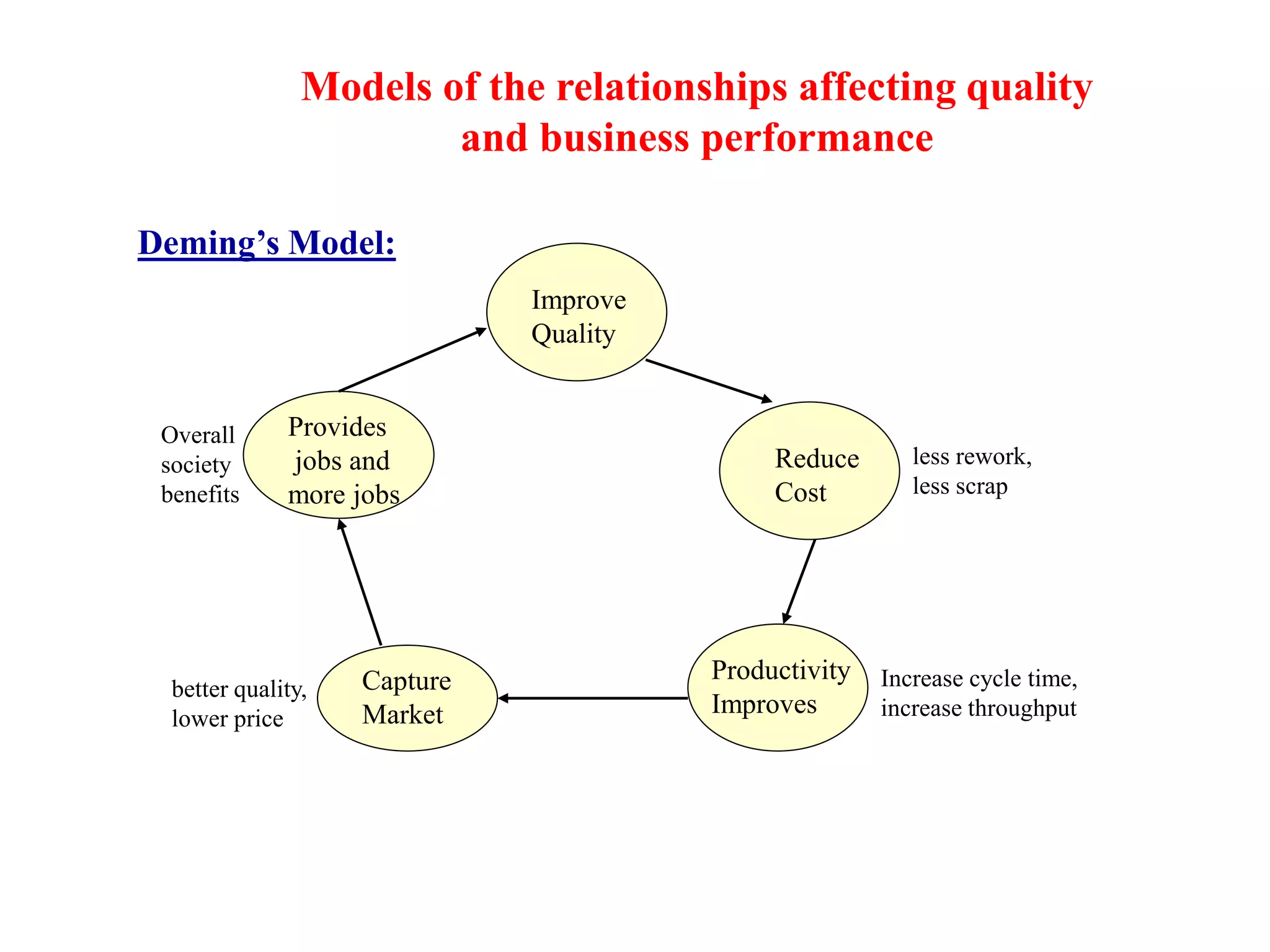
Improve
Quality
Reduce
Cost
Productivity
Improves
Capture
Market
Provides
jobs and
more jobs
Models of the relationships affecting quality
and business performance
Deming’s Model:
less rework,
less scrap
Increase cycle time,
increase throughput
better quality,
lower price
Overall
society
benefits
COST OF POOR QUALITY (COPQ)
•External Failure Costs
–Warranty Adjustments
–Repairs
–Customer Service
–Returned Goods
–Returned Repaired Goods
–Product Recalls
–Product Liability Suits
–Opportunity Costs……………
•Internal Failure Costs
–Scrap
–Rework
–RE-INSPECTION of Rework
–Downgrading Because of Defects
–Losses Caused by Vendor Scrap
–Downtime Caused by Defects
–Failure Analysis……………..
•Appraisal Costs
–Receiving Inspection
–In-process Inspection
–Laboratory Inspection
–Outside Laboratory Endorsements
–Setup for Testing
–Maintenance of Test Equipment
–Quality Audits
–Calibration of Quality Equipment………..
•Prevention Costs
–Quality Engineering
–Design and Development of Quality Equipment
–Design Verification and Review to Evaluate the Quality of
New Products
–Quality Training
–Quality Improvement Projects
–Quality Data Gathering Analysis and Reporting
–Other Process Control Activities Used to Prevent
Defects………………
Lost Opportunity
Scrap
Rework
Inspection
Warranty
Rejects
Lost sales
Late delivery
Engineering change orders
Long cycle times
Expediting costs
Excess inventory
The Cost of Poor Quality (COPQ) “Iceberg”
Traditional Quality Costs
Additional Costs of Poor Quality
(intangible)
(tangible)
4-8%
25-35%
(Easily Identified)
(Difficult or impossible to measure)
Lost Customer Loyalty
More Setups
Six Sigma Philosophy
• We are in business to make money
• We make money by satisfying needs
• We are able to satisfy needs by doing
• Every need/do pair is an interaction
• The aim of customer focus is on improving need/do interaction
• Repetition of the same action constitute a process
•Improve our business means improvement of our processes
•Customers need products/services on-time, with zero defects, with
lower cost
• As process capability improves, the product quality increases
• As quality increases, costs and cycle-time go down…………...
• The reduction of defects, cycle-time, cost leads to improved
customer satisfaction
• As customer satisfaction improves, the likelihood of doing
business increases
• As business increases, we (as individual and society) grow and
prosper
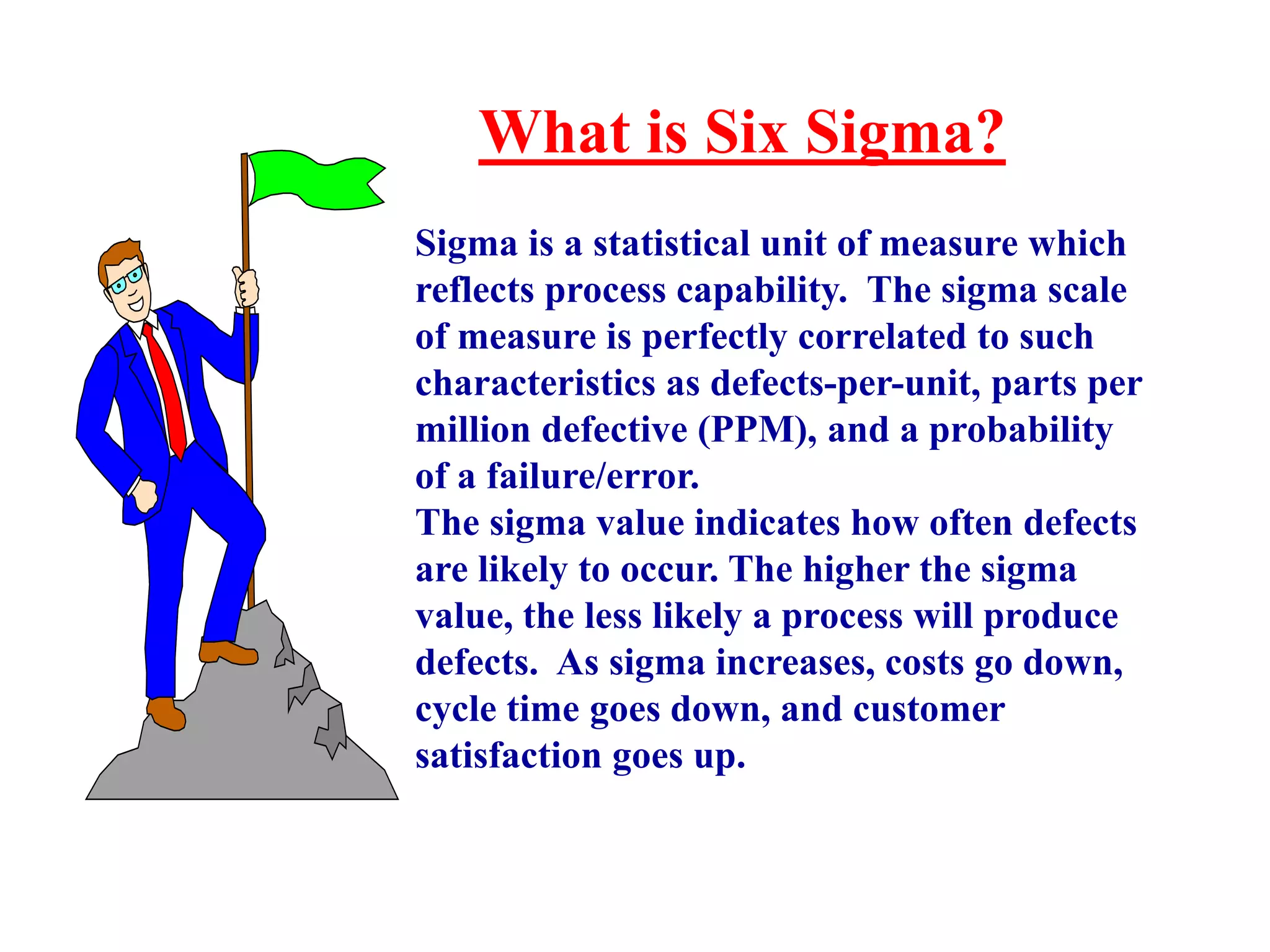
What is Six Sigma?
Sigma is a statistical unit of measure which
reflects process capability. The sigma scale
of measure is perfectly correlated to such
characteristics as defects-per-unit, parts per
million defective (PPM), and a probability
of a failure/error.
The sigma value indicates how often defects
are likely to occur. The higher the sigma
value, the less likely a process will produce
defects. As sigma increases, costs go down,
cycle time goes down, and customer
satisfaction goes up.
What is the meaning of quality???
99% Good (3.8 Sigma) 99.9997% Good (6 Sigma)
20,000 lost articles of mail per hour Seven articles of mail lost per hour
Unsafe drinking water for almost One unsafe minute every seven months
15 minutes each day
5,000 incorrect surgical operations 1.7 incorrect operations per week
per week
2 short or long landings at most major one short or long landing every five
airports each day years at each airport
200,000 wrong drug prescriptions per year 68 wrong drug prescriptions per year
No electricity for seven hours each month One hour without electricity every
34 years
Six Sigma Is….
Six Sigma is disciplined methodology for continuous
improvement for
• Reducing process variability and keeping it reduced
• achieve benefits from improvements in:
• better product/process quality
• reduce scarp and rework
• reduce cycle time
• better product/process design
• reduce major expanses
• A tool set to make that change practical
• Empowered people have the control they need to improve
the way they work
• A common language for discussing, measuring and
comparing process capabilities
• A powerful competitive advantage……….
-6 -5 -4 -3 -2  -1  X +1 +2 +3 +4 +5  +6 
Normal Distribution
Shifted 1.5
Process Capability (Sigma) PPM Yield
2 308,537 69%
3 66,807 93.3%
4 6,210 99.3%
5 233 99.98%
6 3.4 99.9997%
Sigma Measures - Process Capability
Performance
Level SIGMA % Yield
# of Defects per
Million (DPM)
A+ 6 99.99966 3.4
A 5 99.9767 233
B 4 99.3790 6,210
C 3 93.3 66,807
D 2 69 308,537
F 1 31 691,462
Cost of
Quality %
<1% of sales
5 - 15% of sales
15 - 25% of sales
25 - 40% of salesC 93.3 66,8073
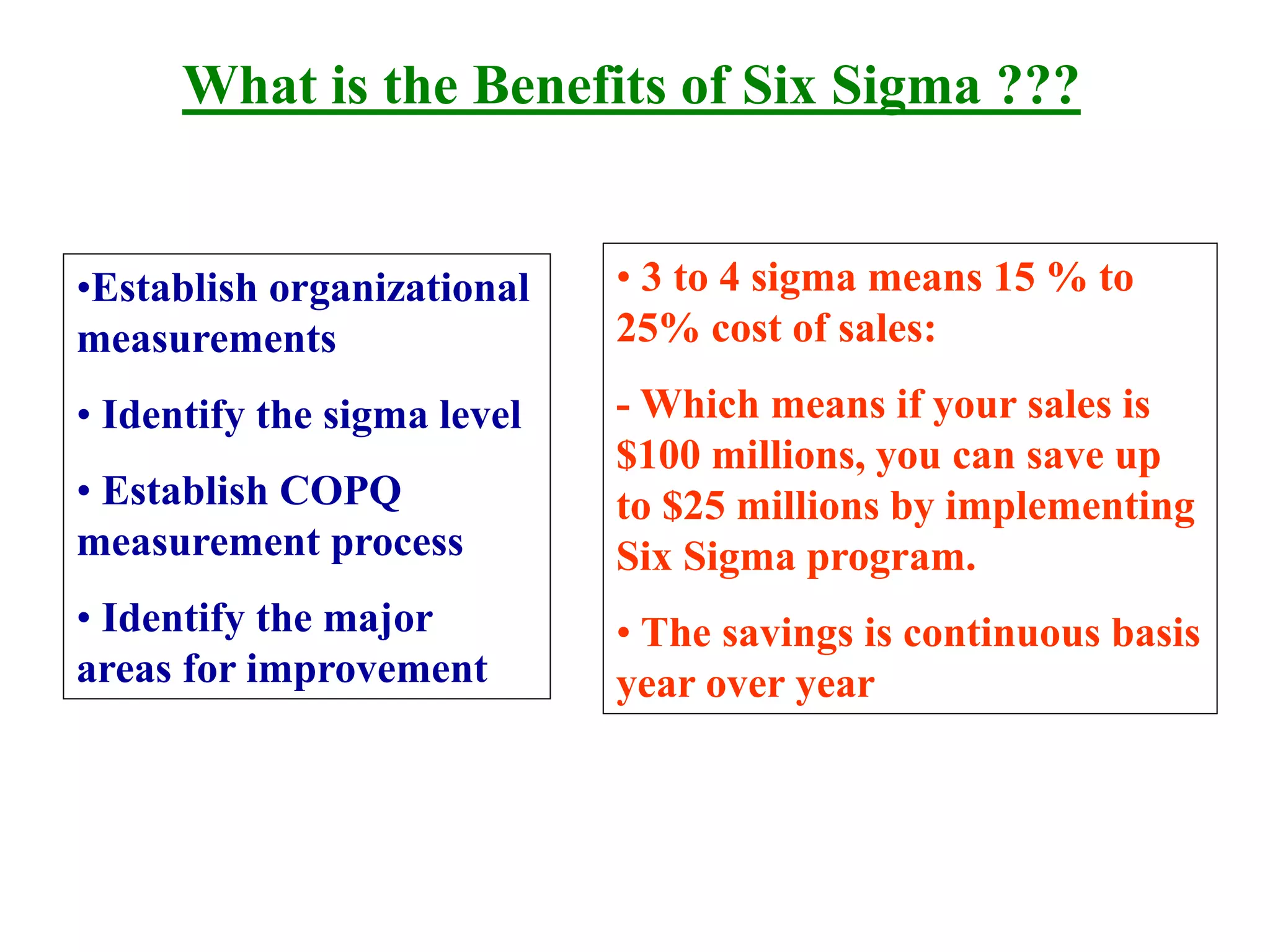
•Establish organizational
measurements
• Identify the sigma level
• Establish COPQ
measurement process
• Identify the major
areas for improvement
• 3 to 4 sigma means 15 % to
25% cost of sales:
- Which means if your sales is
$100 millions, you can save up
to $25 millions by implementing
Six Sigma program.
• The savings is continuous basis
year over year
What is the Benefits of Six Sigma ???
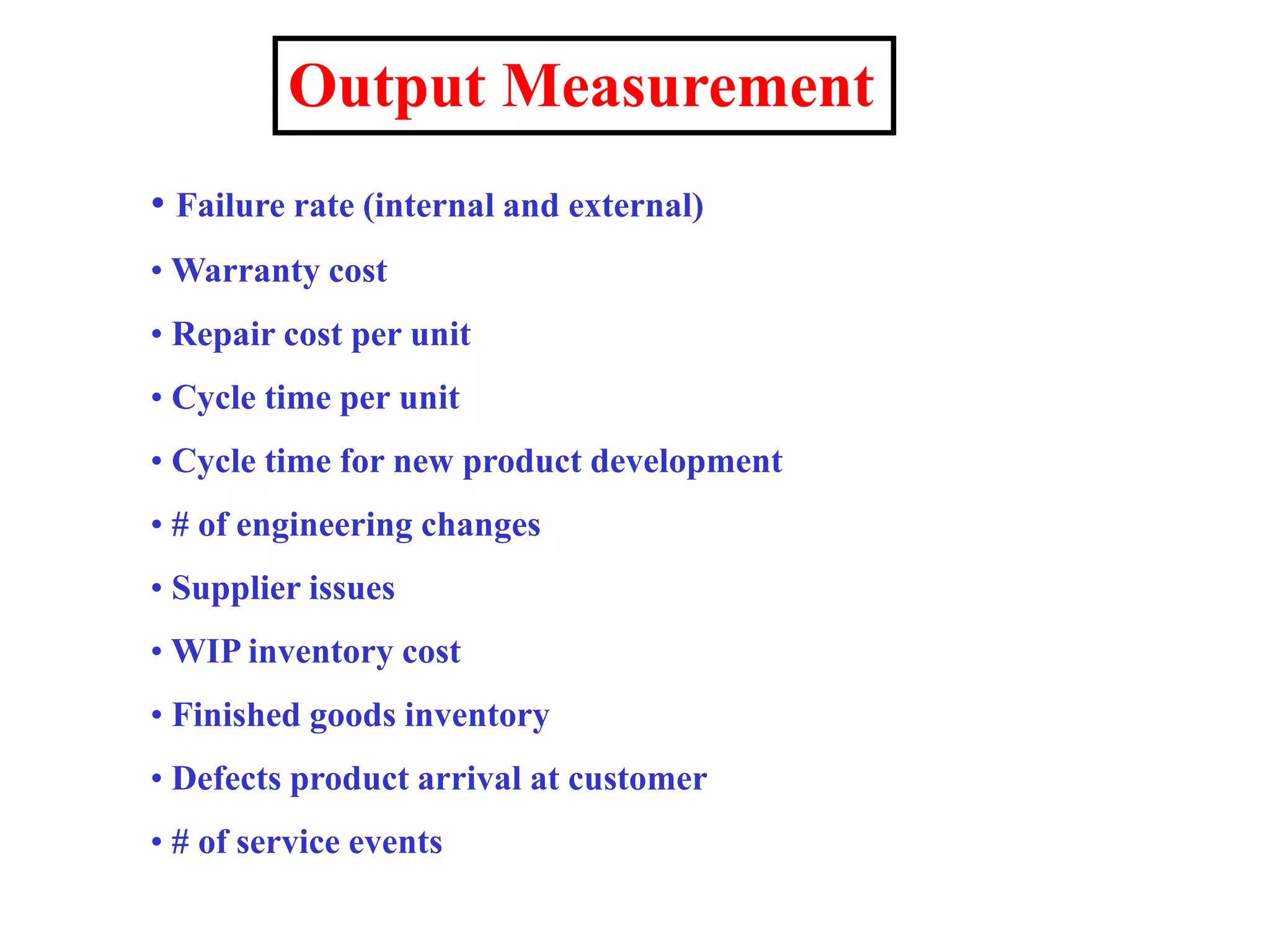
Output Measurement
• Failure rate (internal and external)
• Warranty cost
• Repair cost per unit
• Cycle time per unit
• Cycle time for new product development
• # of engineering changes
• Supplier issues
• WIP inventory cost
• Finished goods inventory
• Defects product arrival at customer
• # of service events
Learn how the companies like General Electric,
AlliedSignal, Motorola, Lockheed Martin, American
Express, J.P. Morgan & Chase, and others use Six Sigma
methodologies to reduce defects, improve processes, lower
cost, higher profit, increase customer satisfaction, and
drive improvement to a new levels.
“The Six Sigma Quality initiatives has lowered GE’s costs
by dramatically reducing rework, simplifying processes,
and reducing direct material costs. Design for six sigma
has been a key to the introduction of numerous high-
quality new products with significantly enhanced
features.”
John F. Welch jr., General electric Chairman and Chief
Executive Officer, GE Annual Report 2000.
bKnowledge
Management
Knowledge
Management
b
Business Results
Ops Review, Strategy Review
Leadership
Values, Vision, Mission
Learning and
Growth
Strategy Management
Balanced Scorecard
Process
Management
Customer
Management
Knowledge
Management
Quality
Management
QMS
The Six Sigma System
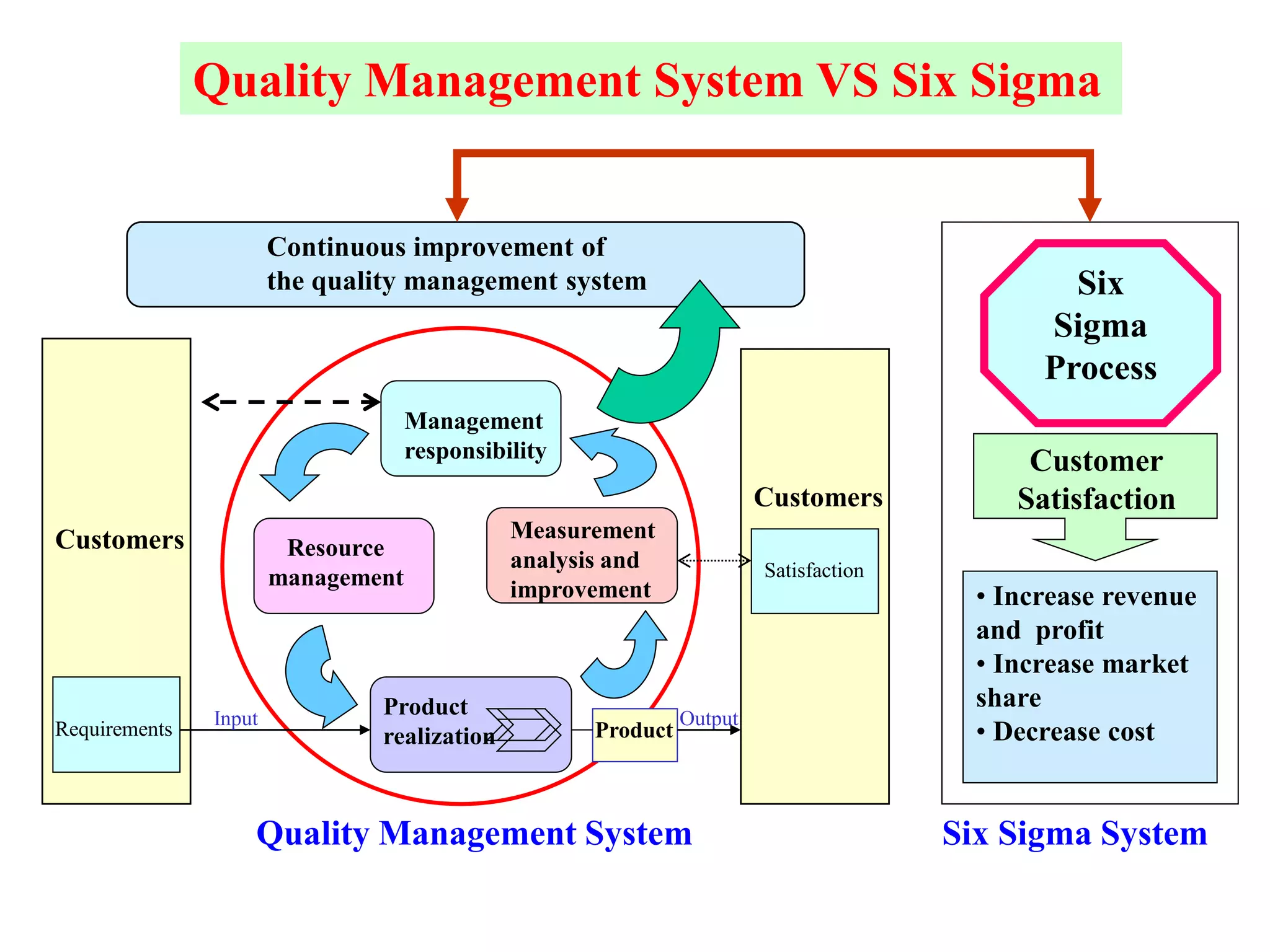
Customers
Requirements
Satisfaction
Customers
Continuous improvement of
the quality management system
Management
responsibility
Resource
management
Product
realization
Measurement
analysis and
improvement
Product
Input Output
Six
Sigma
Process
Customer
Satisfaction
• Increase revenue
and profit
• Increase market
share
• Decrease cost
Quality Management System VS Six Sigma
Quality Management System Six Sigma System
Customer
Satisfaction
Business
Objectives
Business
Strategy
Process
Improvement
Business Governance Model
Delivery
Return Rate
Warranty $
Problem Resolution
New prod Performance
Cust. Survey
Mfg Quality
Supplier Performance
Revenue
Cost
Profit
Market Share
Growth
Business
Results
Assessment
• PDP
• Product LCM
• Supplier Development
• Planning
• Marketing
• Customer Service
• Manufacturing
ISO/QS 9000 Process Six Sigma Process
QIA Six Sigma
QIA Six Sigma
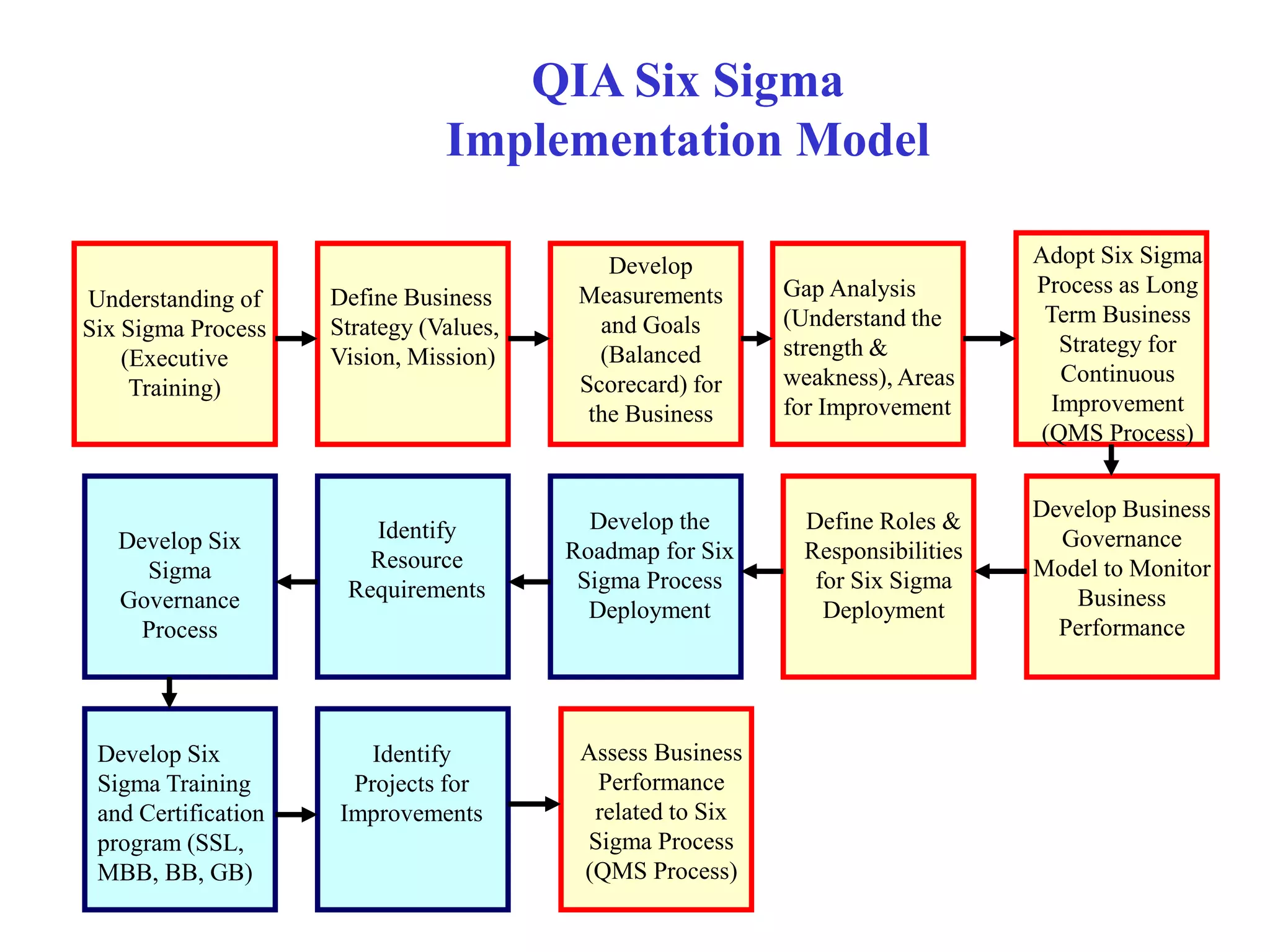
Implementation Model
Understanding of
Six Sigma Process
(Executive
Training)
Define Business
Strategy (Values,
Vision, Mission)
Adopt Six Sigma
Process as Long
Term Business
Strategy for
Continuous
Improvement
(QMS Process)
Develop
Measurements
and Goals
(Balanced
Scorecard) for
the Business
Gap Analysis
(Understand the
strength &
weakness), Areas
for Improvement
Develop Business
Governance
Model to Monitor
Business
Performance
Define Roles &
Responsibilities
for Six Sigma
Deployment
Develop the
Roadmap for Six
Sigma Process
Deployment
Identify
Resource
Requirements
Develop Six
Sigma
Governance
Process
Develop Six
Sigma Training
and Certification
program (SSL,
MBB, BB, GB)
Identify
Projects for
Improvements
Assess Business
Performance
related to Six
Sigma Process
(QMS Process)
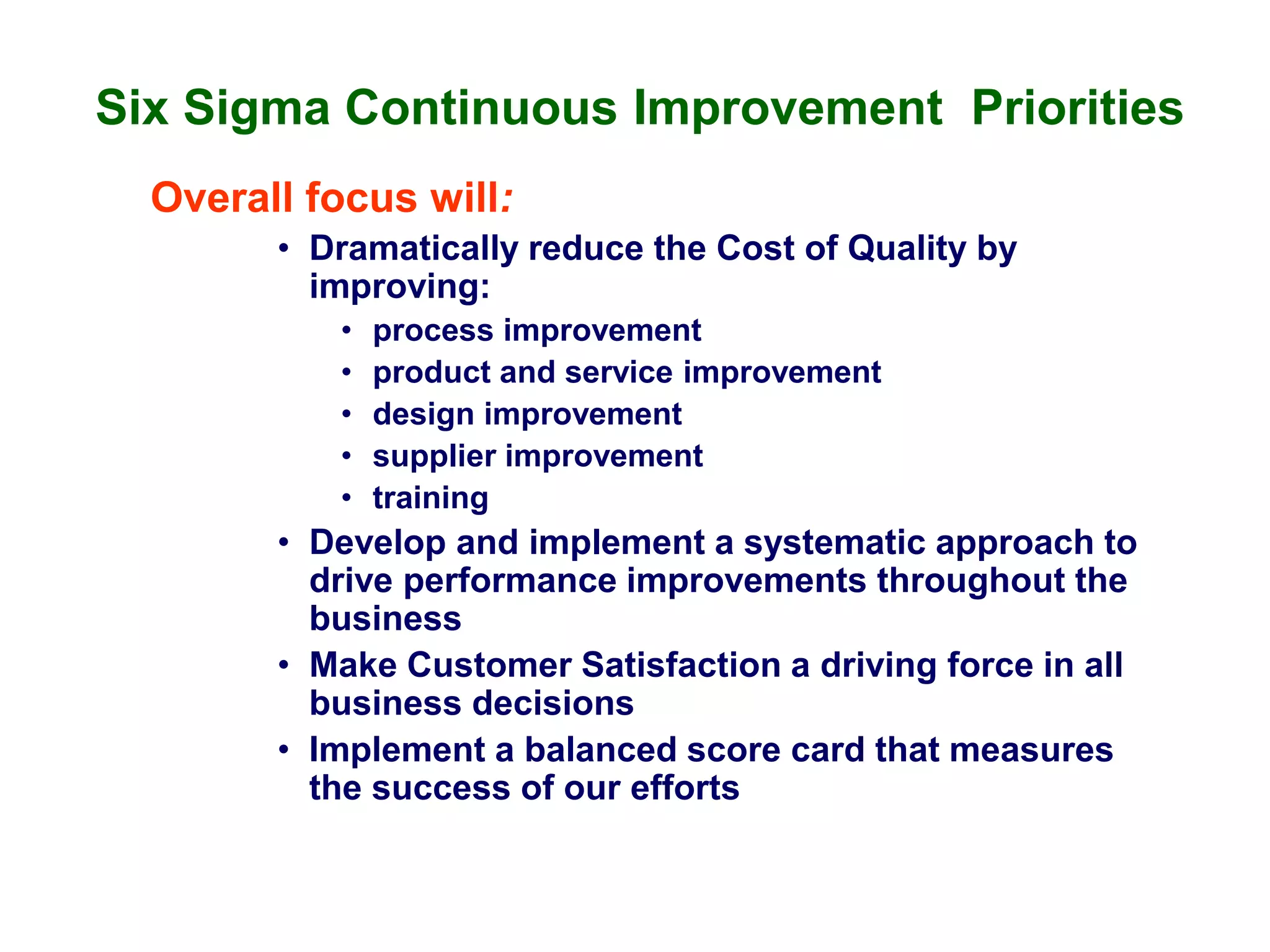
Six Sigma Continuous Improvement Priorities
Overall focus will:
• Dramatically reduce the Cost of Quality by
improving:
• process improvement
• product and service improvement
• design improvement
• supplier improvement
• training
• Develop and implement a systematic approach to
drive performance improvements throughout the
business
• Make Customer Satisfaction a driving force in all
business decisions
• Implement a balanced score card that measures
the success of our efforts
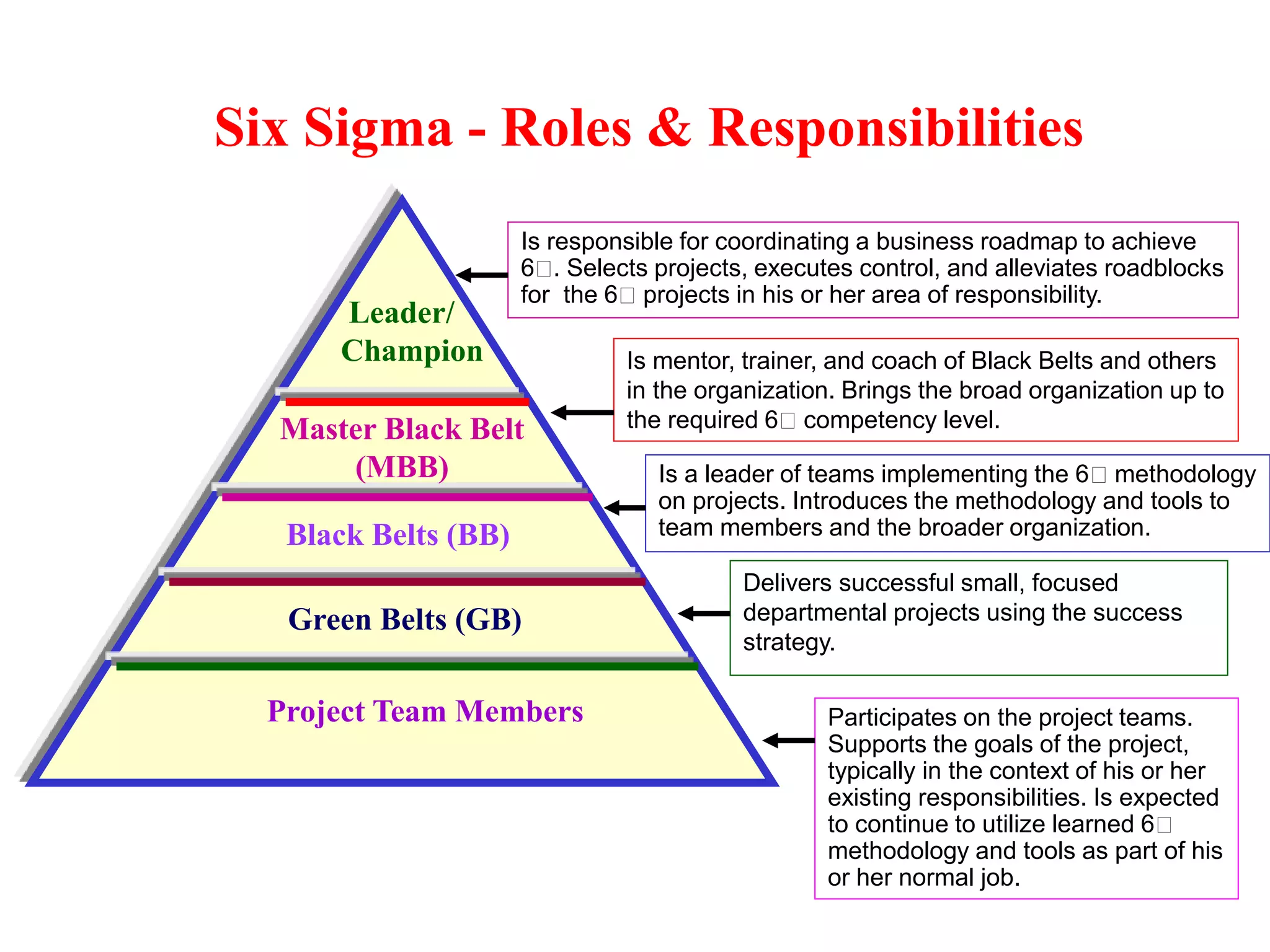
Leader/
Champion
Master Black Belt
(MBB)
Black Belts (BB)
Green Belts (GB)
Project Team Members
Six Sigma - Roles & Responsibilities
Is responsible for coordinating a business roadmap to achieve
6 . Selects projects, executes control, and alleviates roadblocks
for the 6 projects in his or her area of responsibility.
Is mentor, trainer, and coach of Black Belts and others
in the organization. Brings the broad organization up to
the required 6 competency level.
Is a leader of teams implementing the 6 methodology
on projects. Introduces the methodology and tools to
team members and the broader organization.
Delivers successful small, focused
departmental projects using the success
strategy.
Participates on the project teams.
Supports the goals of the project,
typically in the context of his or her
existing responsibilities. Is expected
to continue to utilize learned 6
methodology and tools as part of his
or her normal job.
QIA can help you to grow your business by
introducing you a world class business strategy by
combining your existing Quality Management
System (QMS) with Six Sigma continuous
improvement process.
This strategy helps you to provide best quality
products and services to your customer, which will
help you to significantly improve customer
satisfaction, business growth, lower cost and
higher profits.
WHAT QIA CAN DO FOR YOU!!!
QIA Six Sigma Training & Certification Program
• An Executive Overview of Six Sigma Program
• Six Sigma Leader/Champion
• Master Black Belt
• Black Belt
• Green Belt
What is Next?
•Six Sigma executive training
•Adopt Six Sigma process as long term business strategy
•Business gap analysis (identify strengths and weaknesses)
• Benchmark
• Develop business strategy and governance model
• Develop measurement processes
• Develop roadmap for Six Sigma deployment
• Identify resource requirements
• Identify training roadmap for Six Sigma
• Develop six sigma training program
•Identify improvement projects
•Assess business success…………….

Continuous improvement 6 sigma

  • 1.
  • 2.
    Improve Quality Reduce Cost Productivity Improves Capture Market Provides jobs and more jobs Modelsof the relationships affecting quality and business performance Deming’s Model: less rework, less scrap Increase cycle time, increase throughput better quality, lower price Overall society benefits
  • 3.
    COST OF POORQUALITY (COPQ) •External Failure Costs –Warranty Adjustments –Repairs –Customer Service –Returned Goods –Returned Repaired Goods –Product Recalls –Product Liability Suits –Opportunity Costs…………… •Internal Failure Costs –Scrap –Rework –RE-INSPECTION of Rework –Downgrading Because of Defects –Losses Caused by Vendor Scrap –Downtime Caused by Defects –Failure Analysis…………….. •Appraisal Costs –Receiving Inspection –In-process Inspection –Laboratory Inspection –Outside Laboratory Endorsements –Setup for Testing –Maintenance of Test Equipment –Quality Audits –Calibration of Quality Equipment……….. •Prevention Costs –Quality Engineering –Design and Development of Quality Equipment –Design Verification and Review to Evaluate the Quality of New Products –Quality Training –Quality Improvement Projects –Quality Data Gathering Analysis and Reporting –Other Process Control Activities Used to Prevent Defects………………
  • 4.
    Lost Opportunity Scrap Rework Inspection Warranty Rejects Lost sales Latedelivery Engineering change orders Long cycle times Expediting costs Excess inventory The Cost of Poor Quality (COPQ) “Iceberg” Traditional Quality Costs Additional Costs of Poor Quality (intangible) (tangible) 4-8% 25-35% (Easily Identified) (Difficult or impossible to measure) Lost Customer Loyalty More Setups
  • 5.
    Six Sigma Philosophy •We are in business to make money • We make money by satisfying needs • We are able to satisfy needs by doing • Every need/do pair is an interaction • The aim of customer focus is on improving need/do interaction • Repetition of the same action constitute a process •Improve our business means improvement of our processes •Customers need products/services on-time, with zero defects, with lower cost • As process capability improves, the product quality increases • As quality increases, costs and cycle-time go down…………... • The reduction of defects, cycle-time, cost leads to improved customer satisfaction • As customer satisfaction improves, the likelihood of doing business increases • As business increases, we (as individual and society) grow and prosper
  • 6.
    What is SixSigma? Sigma is a statistical unit of measure which reflects process capability. The sigma scale of measure is perfectly correlated to such characteristics as defects-per-unit, parts per million defective (PPM), and a probability of a failure/error. The sigma value indicates how often defects are likely to occur. The higher the sigma value, the less likely a process will produce defects. As sigma increases, costs go down, cycle time goes down, and customer satisfaction goes up.
  • 7.
    What is themeaning of quality??? 99% Good (3.8 Sigma) 99.9997% Good (6 Sigma) 20,000 lost articles of mail per hour Seven articles of mail lost per hour Unsafe drinking water for almost One unsafe minute every seven months 15 minutes each day 5,000 incorrect surgical operations 1.7 incorrect operations per week per week 2 short or long landings at most major one short or long landing every five airports each day years at each airport 200,000 wrong drug prescriptions per year 68 wrong drug prescriptions per year No electricity for seven hours each month One hour without electricity every 34 years
  • 8.
    Six Sigma Is…. SixSigma is disciplined methodology for continuous improvement for • Reducing process variability and keeping it reduced • achieve benefits from improvements in: • better product/process quality • reduce scarp and rework • reduce cycle time • better product/process design • reduce major expanses • A tool set to make that change practical • Empowered people have the control they need to improve the way they work • A common language for discussing, measuring and comparing process capabilities • A powerful competitive advantage……….
  • 9.
    -6 -5 -4-3 -2  -1  X +1 +2 +3 +4 +5  +6  Normal Distribution Shifted 1.5 Process Capability (Sigma) PPM Yield 2 308,537 69% 3 66,807 93.3% 4 6,210 99.3% 5 233 99.98% 6 3.4 99.9997%
  • 10.
    Sigma Measures -Process Capability Performance Level SIGMA % Yield # of Defects per Million (DPM) A+ 6 99.99966 3.4 A 5 99.9767 233 B 4 99.3790 6,210 C 3 93.3 66,807 D 2 69 308,537 F 1 31 691,462 Cost of Quality % <1% of sales 5 - 15% of sales 15 - 25% of sales 25 - 40% of salesC 93.3 66,8073
  • 11.
    •Establish organizational measurements • Identifythe sigma level • Establish COPQ measurement process • Identify the major areas for improvement • 3 to 4 sigma means 15 % to 25% cost of sales: - Which means if your sales is $100 millions, you can save up to $25 millions by implementing Six Sigma program. • The savings is continuous basis year over year What is the Benefits of Six Sigma ???
  • 12.
    Output Measurement • Failurerate (internal and external) • Warranty cost • Repair cost per unit • Cycle time per unit • Cycle time for new product development • # of engineering changes • Supplier issues • WIP inventory cost • Finished goods inventory • Defects product arrival at customer • # of service events
  • 13.
    Learn how thecompanies like General Electric, AlliedSignal, Motorola, Lockheed Martin, American Express, J.P. Morgan & Chase, and others use Six Sigma methodologies to reduce defects, improve processes, lower cost, higher profit, increase customer satisfaction, and drive improvement to a new levels. “The Six Sigma Quality initiatives has lowered GE’s costs by dramatically reducing rework, simplifying processes, and reducing direct material costs. Design for six sigma has been a key to the introduction of numerous high- quality new products with significantly enhanced features.” John F. Welch jr., General electric Chairman and Chief Executive Officer, GE Annual Report 2000.
  • 14.
    bKnowledge Management Knowledge Management b Business Results Ops Review,Strategy Review Leadership Values, Vision, Mission Learning and Growth Strategy Management Balanced Scorecard Process Management Customer Management Knowledge Management Quality Management QMS The Six Sigma System
  • 15.
    Customers Requirements Satisfaction Customers Continuous improvement of thequality management system Management responsibility Resource management Product realization Measurement analysis and improvement Product Input Output Six Sigma Process Customer Satisfaction • Increase revenue and profit • Increase market share • Decrease cost Quality Management System VS Six Sigma Quality Management System Six Sigma System
  • 16.
    Customer Satisfaction Business Objectives Business Strategy Process Improvement Business Governance Model Delivery ReturnRate Warranty $ Problem Resolution New prod Performance Cust. Survey Mfg Quality Supplier Performance Revenue Cost Profit Market Share Growth Business Results Assessment • PDP • Product LCM • Supplier Development • Planning • Marketing • Customer Service • Manufacturing ISO/QS 9000 Process Six Sigma Process
  • 17.
    QIA Six Sigma QIASix Sigma Implementation Model Understanding of Six Sigma Process (Executive Training) Define Business Strategy (Values, Vision, Mission) Adopt Six Sigma Process as Long Term Business Strategy for Continuous Improvement (QMS Process) Develop Measurements and Goals (Balanced Scorecard) for the Business Gap Analysis (Understand the strength & weakness), Areas for Improvement Develop Business Governance Model to Monitor Business Performance Define Roles & Responsibilities for Six Sigma Deployment Develop the Roadmap for Six Sigma Process Deployment Identify Resource Requirements Develop Six Sigma Governance Process Develop Six Sigma Training and Certification program (SSL, MBB, BB, GB) Identify Projects for Improvements Assess Business Performance related to Six Sigma Process (QMS Process)
  • 18.
    Six Sigma ContinuousImprovement Priorities Overall focus will: • Dramatically reduce the Cost of Quality by improving: • process improvement • product and service improvement • design improvement • supplier improvement • training • Develop and implement a systematic approach to drive performance improvements throughout the business • Make Customer Satisfaction a driving force in all business decisions • Implement a balanced score card that measures the success of our efforts
  • 19.
    Leader/ Champion Master Black Belt (MBB) BlackBelts (BB) Green Belts (GB) Project Team Members Six Sigma - Roles & Responsibilities Is responsible for coordinating a business roadmap to achieve 6 . Selects projects, executes control, and alleviates roadblocks for the 6 projects in his or her area of responsibility. Is mentor, trainer, and coach of Black Belts and others in the organization. Brings the broad organization up to the required 6 competency level. Is a leader of teams implementing the 6 methodology on projects. Introduces the methodology and tools to team members and the broader organization. Delivers successful small, focused departmental projects using the success strategy. Participates on the project teams. Supports the goals of the project, typically in the context of his or her existing responsibilities. Is expected to continue to utilize learned 6 methodology and tools as part of his or her normal job.
  • 20.
    QIA can helpyou to grow your business by introducing you a world class business strategy by combining your existing Quality Management System (QMS) with Six Sigma continuous improvement process. This strategy helps you to provide best quality products and services to your customer, which will help you to significantly improve customer satisfaction, business growth, lower cost and higher profits. WHAT QIA CAN DO FOR YOU!!!
  • 21.
    QIA Six SigmaTraining & Certification Program • An Executive Overview of Six Sigma Program • Six Sigma Leader/Champion • Master Black Belt • Black Belt • Green Belt
  • 22.
    What is Next? •SixSigma executive training •Adopt Six Sigma process as long term business strategy •Business gap analysis (identify strengths and weaknesses) • Benchmark • Develop business strategy and governance model • Develop measurement processes • Develop roadmap for Six Sigma deployment • Identify resource requirements • Identify training roadmap for Six Sigma • Develop six sigma training program •Identify improvement projects •Assess business success…………….