What is Six Sigma?
Basics A new way of doing business Wise application of statistical tools within a structured methodology Repeated application of strategy  to individual projects Projects selected that will have a substantial impact on the ‘bottom line’
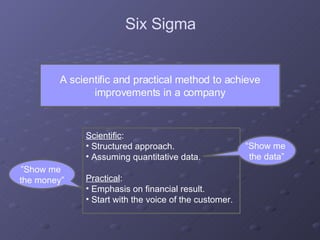
A scientific and practical method to achieve improvements in a company Scientific : Structured approach. Assuming quantitative data. Practical : Emphasis on financial result. Start with the voice of the customer. “ Show me  the data” ” Show me  the money” Six Sigma
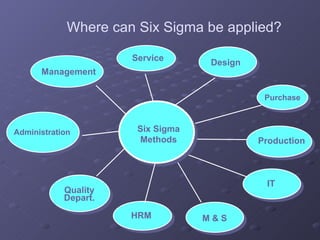
Six Sigma Methods Production Design Service Purchase HRM Administration Quality Depart. Management M & S IT Where can Six Sigma be applied?
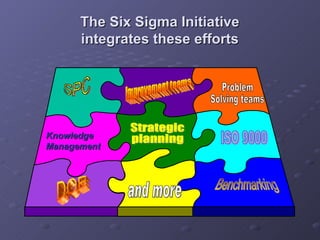
DOE SPC Knowledge Management Benchmarking The Six Sigma Initiative integrates these efforts Improvement teams Problem  Solving teams ISO 9000 Strategic planning and more
‘ Six Sigma’ companies Companies who have successfully adopted ‘Six Sigma’ strategies include:
GE “Service company” - examples Approving a credit card application Installing a turbine Lending money Servicing an aircraft engine Answering a service call for an appliance Underwriting an insurance policy Developing software for a new CAT product Overhauling a locomotive
“ the most important initiative GE has ever undertaken”. Jack Welch Chief Executive Officer General Electric In 1995 GE mandated each employee to work towards achieving 6 sigma The average process at GE was 3 sigma in 1995 In 1997 the average reached 3.5 sigma  GE’s goal was to reach 6 sigma by 2001 Investments in 6 sigma training and projects reached 45MUS$ in 1998, profits increased by 1.2BUS$ General Electric
“ At  Motorola we use statistical methods daily throughout all of our disciplines to synthesize an abundance of  data to derive concrete actions…. How has the use of statistical methods within Motorola Six Sigma initiative, across disciplines, contributed to our growth? Over the past decade we have reduced in-process defects by over 300 fold, which has resulted in cumulative manufacturing cost savings of over 11 billion dollars”*. Robert W. Galvin Chairman of the Executive Committee Motorola, Inc. MOTOROLA *From the forward to MODERN INDUSTRIAL STATISTICS by Kenett and Zacks, Duxbury, 1998
Positive quotations “ If you’re an average Black Belt, proponents say you’ll find ways to save $1 million each year” “ Raytheon figures it spends 25% of each sales dollar fixing problems when it operates at four sigma, a lower level of efficiency. But if it raises its quality and efficiency to Six Sigma, it would reduce spending on fixes to 1%” “ The plastics business, through rigorous Six Sigma process work , added 300 million pounds of new capacity (equivalent to a ‘free plant’), saved $400 million in investment and will save another $400 million by 2000”
Negative quotations “ Because managers’ bonuses are tied to Six Sigma savings, it causes them to fabricate results and savings turn out to be phantom” “ Marketing will always use the number that makes the company look best …Promises are made to potential customers around capability statistics that are not anchored in reality” “  Six Sigma will eventually go the way of the other fads”
Barrier #1:  Engineers and managers are not interested in mathematical statistics Barrier #2:  Statisticians have problems communicating with managers and engineers Barrier #3:  Non-statisticians experience “statistical anxiety” which has to be minimized before learning can take place Barrier # 4:  Statistical methods need to be matched to management style and organizational culture Barriers to implementation
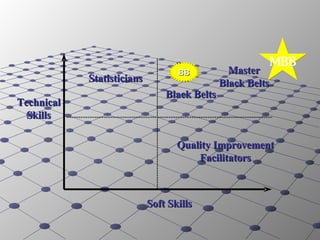
Technical Skills Soft Skills Statisticians Master Black Belts Black Belts Quality Improvement Facilitators BB MBB
Reality Six Sigma through the correct application of statistical tools can reap a company enormous rewards that will have a positive effect for years or Six Sigma can be a dismal failure if not used correctly ISRU, CAMT and Sauer Danfoss will ensure the  former occurs
Six Sigma The precise definition of Six Sigma is not important; the content of the program is  A disciplined quantitative approach for improvement of defined metrics Can be applied to all business processes, manufacturing, finance and services
Focus of Six Sigma* Accelerating fast breakthrough performance  Significant financial results in 4-8 months Ensuring Six Sigma is an extension of the Corporate culture, not the program of the month  Results first, then culture change! * Adapted from Zinkgraf (1999), Sigma Breakthrough  Technologies Inc., Austin, TX.
Six Sigma: Reasons for Success The Success at Motorola, GE and AlliedSignal has been attributed to: Strong leadership (Jack Welch, Larry Bossidy and Bob Galvin personally involved) Initial focus on operations  Aggressive project selection (potential savings in cost of poor quality > $50,000/year) Training the right people
The right way! Plan for “quick wins” Find good initial projects - fast wins Establish resource structure Make sure you know where it is Publicise success Often and continually - blow that trumpet Embed the skills Everyone owns successes
The Six Sigma metric
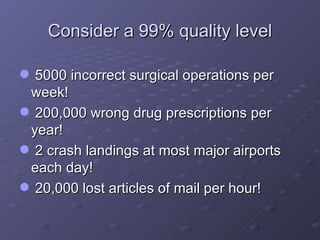
Consider a 99% quality level 5000 incorrect surgical operations per week! 200,000 wrong drug prescriptions per year! 2 crash landings at most major airports each day! 20,000 lost articles of mail per hour!
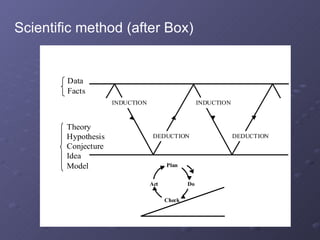
Not very satisfactory! Companies should strive for ‘Six Sigma’ quality levels A successful Six Sigma programme can measure and improve quality levels across all areas within a company to achieve ‘world class’ status Six Sigma is a  continuous improvement   cycle
Scientific method (after Box)
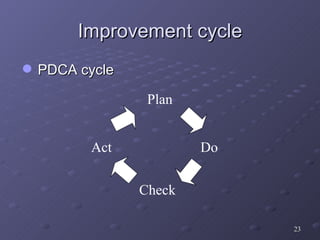
Improvement cycle PDCA cycle Plan Do Check Act
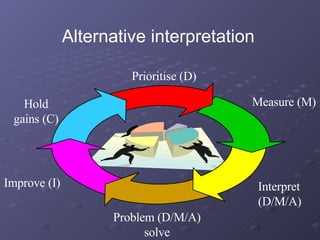
Prioritise (D) Measure (M) Interpret  (D/M/A) Problem (D/M/A) solve Improve (I) Hold gains (C) Alternative interpretation
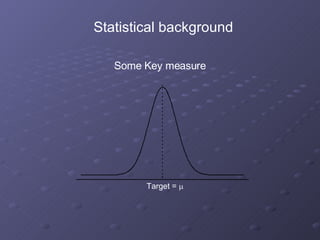
  Statistical background Target =   Some Key measure
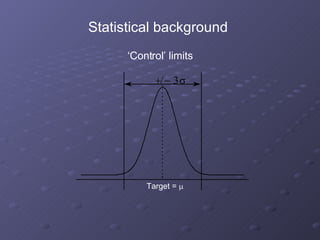
       Statistical background Target =   ‘ Control’ limits
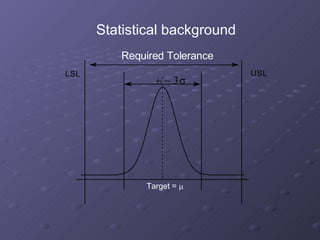
       L S L U S L Statistical background Required Tolerance Target =  
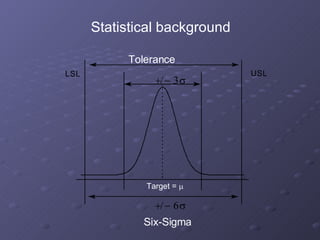
            L S L U S L Statistical background Tolerance Target =   Six-Sigma
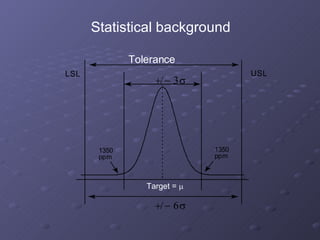
            L S L U S L p p m 1 3 5 0 p p m 1 3 5 0 Statistical background Tolerance Target =  
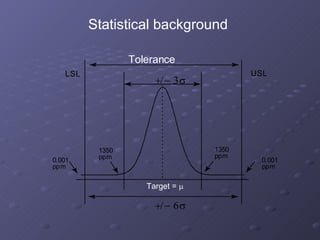
            L S L U S L p p m 0 . 0 0 1 p p m 1 3 5 0 p p m 1 3 5 0 p p m 0 . 0 0 1 Statistical background Tolerance Target =  
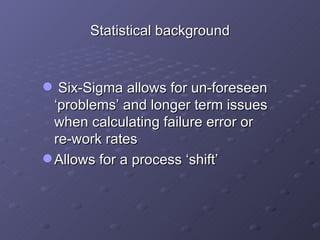
Statistical background Six-Sigma allows for un-foreseen ‘problems’ and longer term issues when calculating failure error or  re-work rates Allows for a process ‘shift’
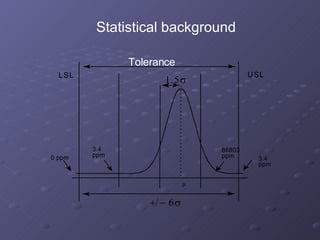
L S L 0 p p m p p m 3 . 4     U S L p p m 3 . 4 p p m 6 6 8 0 3        Statistical background Tolerance
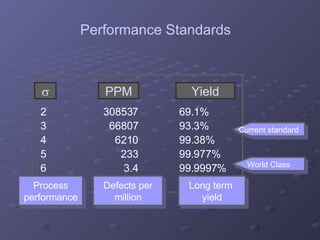
Performance Standards 2 3 4 5 6 308537 66807 6210 233 3.4  PPM 69.1% 93.3% 99.38% 99.977% 99.9997% Yield Process performance Defects per million Long term  yield Current standard World Class
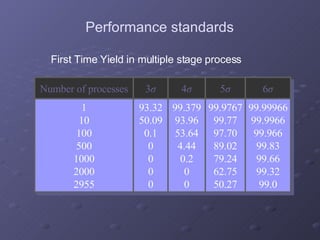
Number of processes 3 σ 4 σ 5 σ 6 σ 1 10 100 500 1000 2000 2955 93.32 50.09 0.1 0 0 0 0 99.379 93.96 53.64 4.44 0.2 0 0 99.9767 99.77 97.70 89.02 79.24 62.75 50.27 99.99966 99.9966 99.966 99.83 99.66 99.32 99.0 First Time Yield in multiple stage process Performance standards
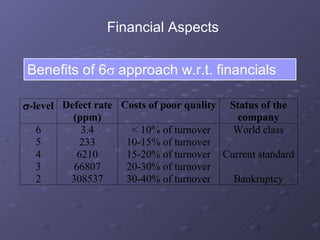
Benefits of 6  approach w.r.t. financials Financial Aspects
Six Sigma and other Quality programmes
Comparing three recent developments in “Quality Management” ISO 9000 (-2000) EFQM Model  Quality Improvement and Six Sigma Programs
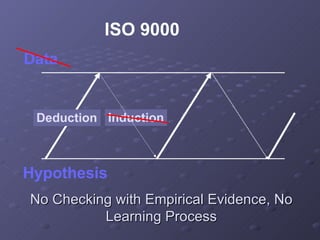
ISO 9000 Proponents claim that ISO 9000 is a general system for Quality Management  In fact the application seems to involve an excessive emphasis on  Quality Assurance , and  standardization of already existing systems with little attention to Quality Improvement  It would have been better if improvement efforts had preceded standardization
Critique of ISO 9000 Bureaucratic, large scale Focus on satisfying auditors,  not  customers Certification is the goal; the job is done when certified  Little emphasis on improvement The return on investment is not transparent  Main driver is:  We need ISO 9000 to become a certified supplier,  Not  “we need to be the  best  and most cost effective supplier to win our customer’s business” Corrupting influence on the quality profession
EFQM Model A tool for assessment: Can measure where we are and how well we are doing Assessment is a small piece of the bigger scheme of Quality Management: Planning  Control  Improvement EFQM provides a tool for assessment, but no tools, training, concepts and managerial approaches for improvement and planning
The “Success” of Change Programs? “ Performance improvement efforts … have as much impact on  operational and financial results as a  ceremonial rain dance has on the weather” Schaffer and Thomson, Harvard Business Review  (1992)
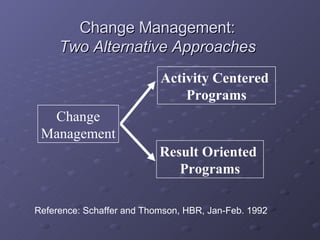
Change Management: Two Alternative Approaches Activity Centered  Programs Result Oriented  Programs Change Management Reference: Schaffer and Thomson, HBR, Jan-Feb. 1992
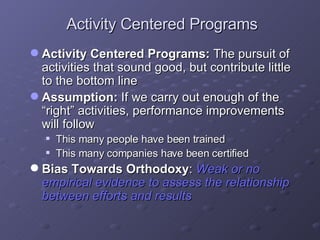
Activity Centered Programs Activity Centered Programs:  The pursuit of activities that sound good, but contribute little to the bottom line  Assumption:  If we carry out enough of the “right” activities, performance improvements will follow This many people have been trained This many companies have been certified Bias Towards Orthodoxy :   Weak or no empirical evidence to assess the relationship between efforts and results
No Checking with Empirical Evidence, No Learning Process ISO 9000 Data Hypothesis Deduction Induction
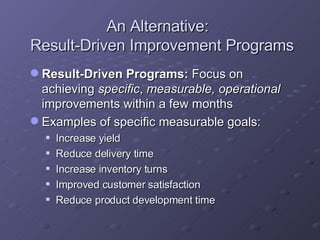
An Alternative:  Result-Driven Improvement Programs Result-Driven Programs:  Focus on achieving  specific ,  measurable,   operational  improvements within a few months  Examples of specific measurable goals: Increase yield Reduce delivery time Increase inventory turns Improved customer satisfaction Reduce product development time
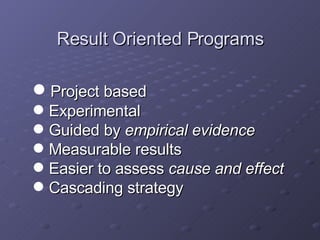
Result Oriented Programs Project based Experimental  Guided by  empirical evidence Measurable results Easier to assess  cause and effect Cascading strategy
Why Transformation  Efforts Fail! John Kotter, Professor, Harvard Business School  Leading scholar on Change Management  Lists 8 common errors in managing change, two of which are:  Not establishing a sense of urgency Not systematically planning for and creating  short term wins
Six Sigma Demystified* Six Sigma is TQM in disguise, but this time the focus is: Alignment of customers, strategy, process and people Significant measurable business results Large scale deployment of advanced quality and statistical tools Data based, quantitative *Adapted from Zinkgraf (1999), Sigma Breakthrough  Technologies Inc., Austin, TX.
Keys to Success* Set clear  expectations  for results Measure  the progress (metrics) Manage for  results *Adapted from Zinkgraf (1999), Sigma Breakthrough  Technologies Inc., Austin, TX.
Key personnel in successful Six Sigma programmes
Black Belts Six Sigma practitioners who are employed by the company using the Six Sigma methodology work full time on the implementation of problem solving & statistical techniques through projects selected on business needs become recognised ‘Black Belts’ after embarking on Six Sigma training programme and completion of at least two projects which have a significant impact on the ‘bottom-line’
Black Belt required resources Training in statistical methods. Time to conduct the project! Software to facilitate data analysis. Permissions to make required changes!! Coaching by a champion – or external support. Black Belt requirements
In other words the Black Belt is Empowered. In the sense that it was always meant! As the theroists have been saying for years! Black Belt role!
Champions or ‘enablers’ High-level managers who champion Six Sigma projects they have direct support from an executive management committee orchestrate the work of Six Sigma Black Belts provide Black Belts with the necessary backing at the executive level
Further down the line -  after initial Six Sigma implementation package Master Black Belts  Black Belts who have reached an acquired level of statistical and technical competence Provide expert advice to Black Belts  Green Belts Provide assistance to Black Belts in Six Sigma projects Undergo only two weeks of statistical and problem solving training
Six Sigma instructors (ISRU) Aim :  Successfully integrate the Six Sigma methodology into a company’s existing culture and working practices Key traits Knowledge of statistical techniques Ability to manage projects and reach closure High level of analytical skills Ability to train, facilitate and lead teams to success, ‘soft skills’
Six Sigma training package
Aim of training package To successfully integrate Six Sigma methodology into Sauer Danfoss’ culture and attain significant improvements in quality, service and operational performance
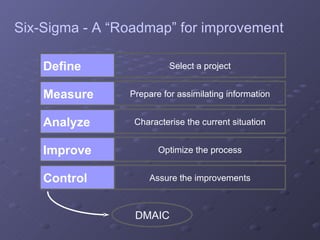
DMAIC Six-Sigma - A “Roadmap” for improvement Define Select a project Measure Prepare for assimilating information Analyze Characterise the current situation Improve Optimize the process Control Assure the improvements
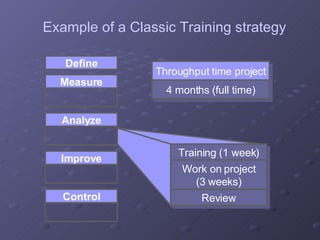
Define Throughput time project 4 months (full time) Example of a Classic Training strategy Training (1 week) Work on project (3 weeks) Review Measure Analyze Improve Control
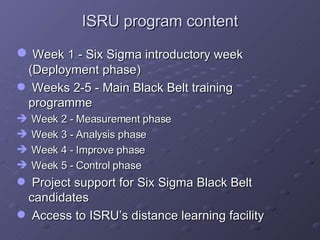
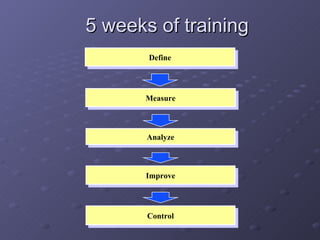
ISRU program content Week 1 - Six Sigma introductory week (Deployment phase) Weeks 2-5 - Main Black Belt training programme Week 2 - Measurement phase Week 3 - Analysis phase Week 4 - Improve phase Week 5 - Control phase Project support for Six Sigma Black Belt candidates Access to ISRU’s distance learning facility
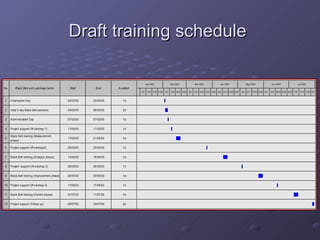
Draft training schedule
Training programme delivery Lectures supported by appropriate technology Video case studies Games and simulations Experiments and workshops Exercises Defined projects Delegate presentations Homework!
5 weeks of training Measure Analyze Improve Control Define
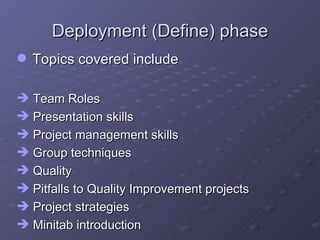
Deployment (Define) phase Topics covered include Team Roles Presentation skills Project management skills Group techniques Quality Pitfalls to Quality Improvement projects Project strategies Minitab introduction
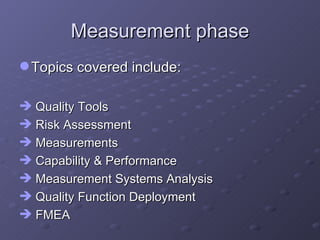
Measurement phase Topics covered include: Quality Tools Risk Assessment Measurements Capability & Performance Measurement Systems Analysis Quality Function Deployment  FMEA
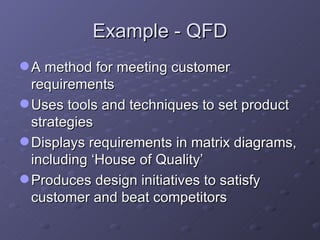
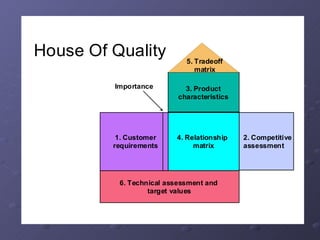
Example - QFD A method for meeting customer requirements Uses tools and techniques to set product strategies Displays requirements in matrix diagrams, including ‘House of Quality’ Produces design initiatives to satisfy customer and beat competitors
 
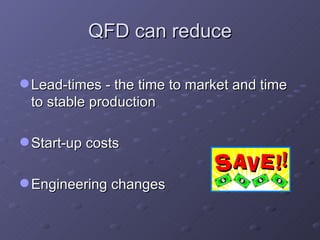
Lead-times - the time to market and time to stable production Start-up costs Engineering changes QFD can reduce
Analysis phase Topics include: Hypothesis testing Comparing samples Confidence Intervals Multi-Vari analysis ANOVA (Analysis of Variance) Regression
Improvement phase Topics include: History of Design of Experiments (DoE) DoE Pre-planning and Factors  DoE Practical workshop DoE Analysis Response Surface Methodology (Optimisation) Lean Manufacturing
Example - Design of Experiments What can it do for you? Minimum  cost Maximum  output
What does it involve? Brainstorming sessions to identify  important factors Conducting a  few  experimental trials Recognising  significant factors  which influence a process Setting these factors to get  maximum output
Control phase Topics include: Control charts SPC case studies EWMA Poka-Yoke 5S Reliability testing Business impact assessment
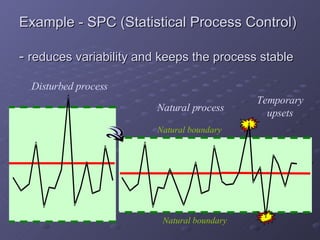
Example - SPC (Statistical Process Control)  -  reduces variability and keeps the process stable Disturbed process Natural process Temporary upsets Natural boundary Natural boundary
Results of SPC An improvement in the process Reduction in variation Better control over process Provides practical experience of collecting useful information for analysis Hopefully some enthusiasm for measurement!
Project support Initial ‘Black Belt’ projects will be considered in Week 1 by Executive management committee, ‘Champions’ and ‘Black Belt’ candidates Projects will be advanced significantly during the training programme via: continuous application of newly acquired statistical techniques workshops and on-going support from ISRU and CAMT delivery of regular project updates by ‘Black Belt’ candidates
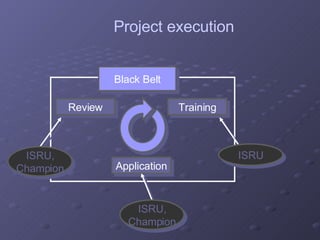
Black Belt Training Application Review ISRU ISRU, Champion ISRU, Champion Project execution
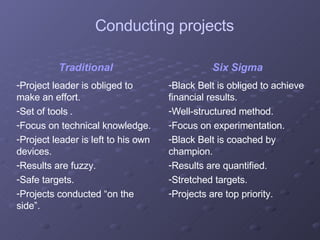
Traditional Six Sigma Project leader is obliged to make an effort. Set of tools . Focus on technical knowledge. Project leader is left to his own devices. Results are fuzzy. Safe targets. Projects conducted “on the side”. Black Belt is obliged to achieve financial results. Well-structured method. Focus on experimentation. Black Belt is coached by champion. Results are quantified. Stretched targets. Projects are top priority. Conducting projects
The  right  support + The  right  projects  + The  right  people + The  right  tools + The  right  plan =  The  right  results
Champions Role Communicate vision and progress   Facilitate selecting projects and people   Track the progress of Black Belts  Breakdown barriers for Black Belts Create supporting systems
Champions Role Measure and report Business Impact Lead projects overall Overcome resistance to Change Encourage others to Follow
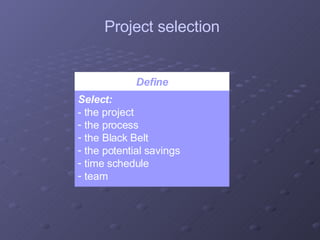
Define Select: - the project  the process the Black Belt the potential savings time schedule team Project selection
Projects may be selected according to: A complete list of requirements of customers. A complete list of costs of poor quality. A complete list of existing problems or targets. Any sensible meaningful criteria Usually improves bottom line - but exceptions Project selection
Key Quality Characteristics “CTQs” How will you measure them? How often? Who will measure? Is the outcome critical or important to results?
Outcome Examples Reduce defective parts per million Increased capacity or yield Improved quality Reduced re-work or scrap Faster throughput
Key Questions Is this a new product - process? Yes - then potential six-sigma Do you know how best to run a process? No - then potential six-sigma
Key Criteria Is the potential gain enough - e.g. - saving > $50,000 per annum? Can you do this within 3-4 months? Will results be usable? Is this the most important issue at the moment?
Why is ISRU an effective Six Sigma practitioner?
Because we are experts in the application of industrial statistics and managing the accompanying change  We want to assist companies in improving performance thus helping companies to greater success We will act as mentors to staff embarking on Six Sigma programmes Reasons
I NDUSTRIAL  S TATISTICS R ESEARCH  U NIT We are based in the School of Mechanical and Systems Engineering, University of Newcastle upon Tyne, England
Mission statement " To promote the effective and widespread use of statistical methods throughout European industry. "
The work we do can be broken down into 3 main categories: Consultancy Training Major Research Projects All with the common goal of promoting quality improvement by implementing statistical techniques
Consultancy We have long term one to one consultancies with large and small companies, e.g. Transco Prescription Pricing Agency Silverlink To name but a few
Training In-House courses SPC QFD Design of Experiments Measurement Systems Analysis On-Site courses As above, tailored courses to suit the company Six Sigma programmes
European projects The Unit has provided the statistical input into many major European projects  Examples include - Use of sensory panels to assess butter quality Using water pressures to detect leaks Assessing steel rail reliability Testing fire-fighter’s boots for safety
European projects Eurostat  -   investigating  the multi-dimensional aspects of innovation using the  Community Innovation Survey (CIS) II -  17 major European countries involved -determining the factors that influence innovation Certified Reference materials for assessing water quality - validating  EC Laboratories New project  -  ‘Effect on food of the taints  and odours in packaging materials’
Typical local projects Assessment of environmental risks in chemical and process industries Introduction of statistical process control (SPC) into a micro-electronics company Helping to develop a new catheter for open-heart surgery via designed experiments (DoE) ‘ Restaurant of the Year’  &  ‘Pub of the Year’  competitions!
Benefits Better monitoring of processes Better involvement of people Staff morale is raised Throughput is increased Profits go up
Examples of past successes Down time cut by 40% -  Villa soft drinks Waste reduced by 50% -  Many projects Stock holding levels halved -  Many projects Material use optimised saving £150k pa -  Boots Expensive equipment shown to be unnecessary -  Wavin
Examples of past successes Faster Payment of Bills (cut by 30 days) Scrap rates cut by 80% New orders won (e.g £100,000 for an  SME ) Cutting stages from a process Reduction in materials use ( Paper - Ink )
Distance Learning Facility
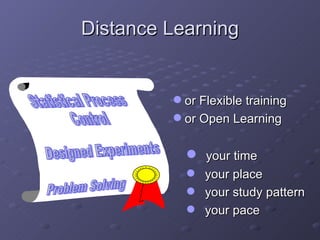
Distance Learning your time your place your study pattern your pace or Flexible training or Open Learning Statistical Process Control Designed Experiments Problem Solving
Distance Learning http://www.ncl.ac.uk/blackboard Clear descriptions Step by step guidelines Case studies Web links, references Self assessment exercises in ‘Microsoft Excel’ and ‘Minitab’ Help line and discussion forum Essentially a further learning resource for Six Sigma tools and methodology
Case study
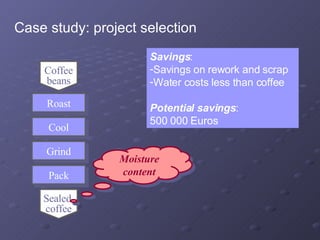
Roast Cool Grind Pack Coffee beans Sealed  coffee Moisture content Savings : Savings on rework and scrap Water costs less than coffee Potential savings : 500 000 Euros Case study: project selection
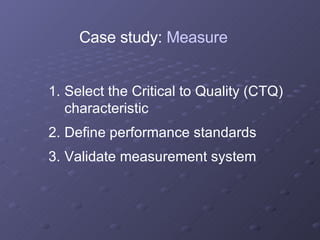
Select the Critical to Quality (CTQ) characteristic Define performance standards Validate measurement system Case study:  Measure
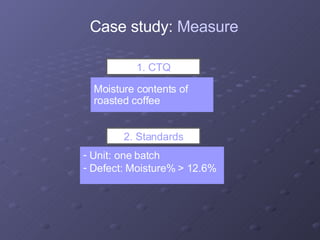
Moisture contents of  roasted coffee 1. CTQ Unit: one batch Defect: Moisture% > 12.6% 2. Standards Case study:  Measure
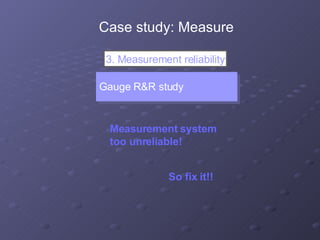
Gauge R&R study 3. Measurement reliability Measurement system too unreliable! Case study: Measure So fix it!!
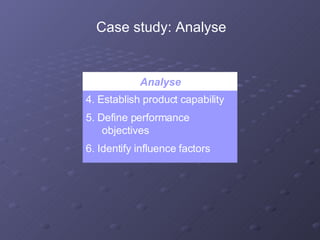
Analyse 4. Establish product capability 5. Define performance objectives 6. Identify influence factors Case study: Analyse
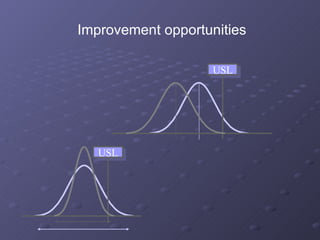
Improvement opportunities USL USL
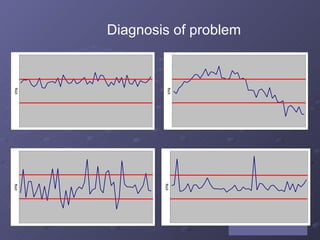
Diagnosis of problem
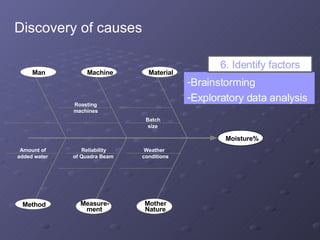
Brainstorming Exploratory data analysis 6. Identify factors Material Machine Man Method Measure- ment Mother Nature Amount of added water Roasting machines Batch size Reliability of Quadra Beam Weather conditions Moisture% Discovery of causes
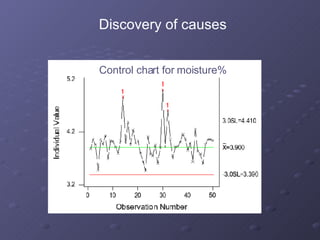
Control chart for moisture% Discovery of causes
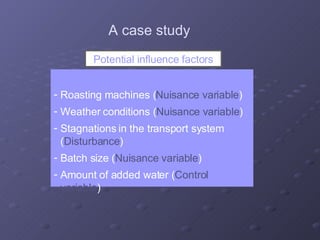
Roasting machines ( Nuisance variable ) Weather conditions ( Nuisance variable ) Stagnations in the transport system ( Disturbance ) Batch size ( Nuisance variable ) Amount of added water ( Control variable ) Potential influence factors A case study
Improve 7. Screen potential causes 8. Discover variable relationships 9. Establish operating tolerances Case study: Improve
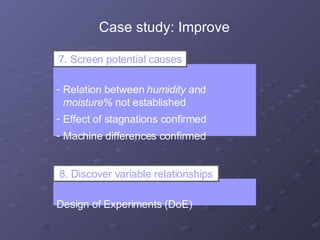
Relation between  humidity  and  moisture%  not established Effect of stagnations confirmed Machine differences confirmed 7. Screen potential causes Design of Experiments (DoE) 8. Discover variable relationships Case study: Improve
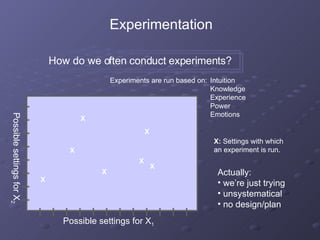
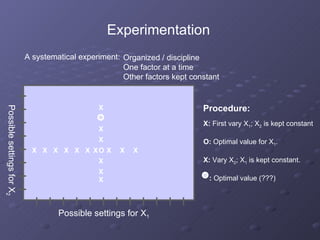
Experiments are run based on:  Intuition Knowledge Experience Power Emotions Possible settings for X 1 Possible settings for X 2 X:  Settings with which  an experiment is run. X X X X X X X Actually: we’re just trying  unsystematical no design/plan How do we often conduct experiments? Experimentation
A systematical experiment: Organized / discipline One factor at a time Other factors kept constant Procedure: X X X X O X X X X X X:  First vary X 1 ; X 2  is kept constant O:  Optimal value for X 1 . X:  Vary X 2 ; X 1  is kept constant. :  Optimal value (???) X X X X X X X Possible settings for X 1 Possible settings for X 2 Experimentation
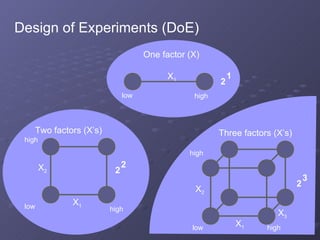
Design of Experiments (DoE) One factor (X) low high X 1 2 1 Two factors (X’ s ) low high high X 2 X 1 2 2 high Three factors (X’ s ) low high X 1 X 3 X 2 2 3
Advantages of multi-factor  over one-factor
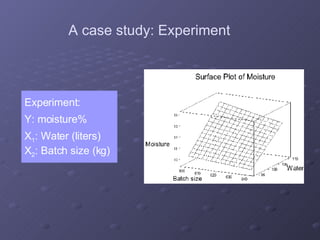
Experiment: Y: moisture% X 1 : Water (liters) X 2 : Batch size (kg) A case study: Experiment
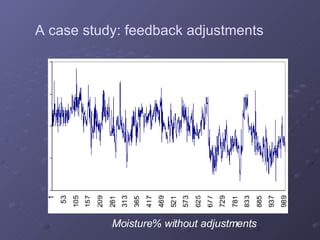
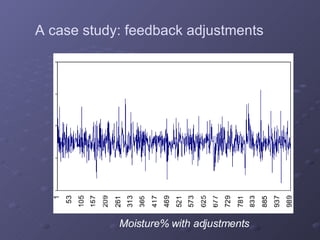
Feedback adjustments for influence of weather conditions A case study 9. Establish operating tolerances
A case study: feedback adjustments Moisture% without adjustments
A case study: feedback adjustments Moisture% with adjustments
Control 10. Validate measurement system (X’s) 11. Determine process capability 12. Implement process controls Case study: Control
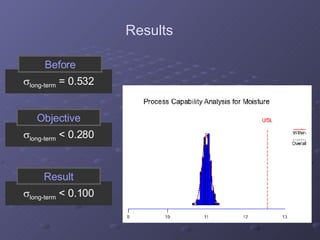
 long-term  = 0.532 Before Results  long-term  < 0.280 Objective  long-term  < 0.100 Result
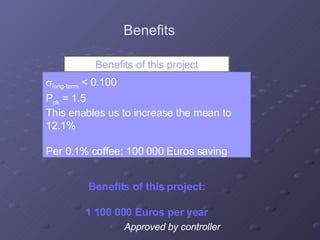
Benefits of this project  long-term  < 0.100 P pk  = 1.5 This enables us to increase the mean to 12.1%  Per 0.1% coffee: 100 000 Euros saving Benefits of this project: 1 100 000 Euros per year Benefits Approved by controller
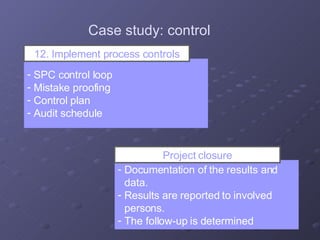
SPC control loop Mistake proofing Control plan Audit schedule 12. Implement process controls Case study: control Documentation of the results and data. Results are reported to involved persons. The follow-up is determined Project closure
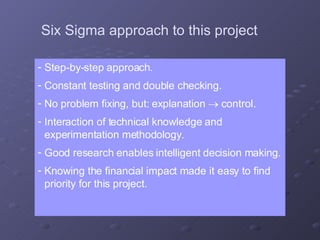
Step-by-step approach. Constant testing and double checking. No problem fixing, but: explanation    control. Interaction of technical knowledge and experimentation methodology. Good research enables intelligent decision making. Knowing the financial impact made it easy to find priority for this project. Six Sigma approach to this project
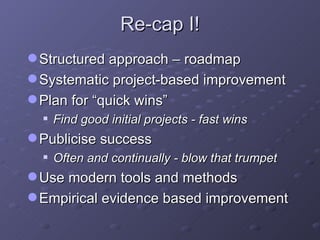
Re-cap I! Structured approach – roadmap Systematic project-based improvement Plan for “quick wins” Find good initial projects - fast wins Publicise success Often and continually - blow that trumpet Use modern tools and methods Empirical evidence based improvement
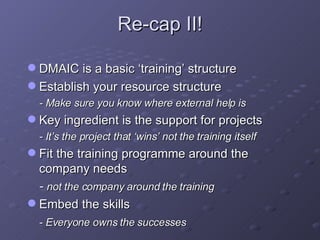
Re-cap II! DMAIC is a basic ‘training’ structure Establish your resource structure - Make sure you know where external help is Key ingredient is the support for projects - It’s the project that ‘wins’ not the training itself Fit the training programme around the company needs  -  not the company around the training Embed the skills - Everyone owns the successes
ENBIS All joint authors - presenters - are members of:  Pro-Enbis or ENBIS. This presentation is supported by Pro-Enbis  a Thematic Network funded under the ‘Growth’ programme of the European Commission’s 5th Framework research programme - contract number G6RT-CT-2001-05059

Six Sigma

  • 1.
  • 2.
    Basics A newway of doing business Wise application of statistical tools within a structured methodology Repeated application of strategy to individual projects Projects selected that will have a substantial impact on the ‘bottom line’
  • 3.
    A scientific andpractical method to achieve improvements in a company Scientific : Structured approach. Assuming quantitative data. Practical : Emphasis on financial result. Start with the voice of the customer. “ Show me the data” ” Show me the money” Six Sigma
  • 4.
    Six Sigma MethodsProduction Design Service Purchase HRM Administration Quality Depart. Management M & S IT Where can Six Sigma be applied?
  • 5.
    DOE SPC KnowledgeManagement Benchmarking The Six Sigma Initiative integrates these efforts Improvement teams Problem Solving teams ISO 9000 Strategic planning and more
  • 6.
    ‘ Six Sigma’companies Companies who have successfully adopted ‘Six Sigma’ strategies include:
  • 7.
    GE “Service company”- examples Approving a credit card application Installing a turbine Lending money Servicing an aircraft engine Answering a service call for an appliance Underwriting an insurance policy Developing software for a new CAT product Overhauling a locomotive
  • 8.
    “ the mostimportant initiative GE has ever undertaken”. Jack Welch Chief Executive Officer General Electric In 1995 GE mandated each employee to work towards achieving 6 sigma The average process at GE was 3 sigma in 1995 In 1997 the average reached 3.5 sigma GE’s goal was to reach 6 sigma by 2001 Investments in 6 sigma training and projects reached 45MUS$ in 1998, profits increased by 1.2BUS$ General Electric
  • 9.
    “ At Motorola we use statistical methods daily throughout all of our disciplines to synthesize an abundance of data to derive concrete actions…. How has the use of statistical methods within Motorola Six Sigma initiative, across disciplines, contributed to our growth? Over the past decade we have reduced in-process defects by over 300 fold, which has resulted in cumulative manufacturing cost savings of over 11 billion dollars”*. Robert W. Galvin Chairman of the Executive Committee Motorola, Inc. MOTOROLA *From the forward to MODERN INDUSTRIAL STATISTICS by Kenett and Zacks, Duxbury, 1998
  • 10.
    Positive quotations “If you’re an average Black Belt, proponents say you’ll find ways to save $1 million each year” “ Raytheon figures it spends 25% of each sales dollar fixing problems when it operates at four sigma, a lower level of efficiency. But if it raises its quality and efficiency to Six Sigma, it would reduce spending on fixes to 1%” “ The plastics business, through rigorous Six Sigma process work , added 300 million pounds of new capacity (equivalent to a ‘free plant’), saved $400 million in investment and will save another $400 million by 2000”
  • 11.
    Negative quotations “Because managers’ bonuses are tied to Six Sigma savings, it causes them to fabricate results and savings turn out to be phantom” “ Marketing will always use the number that makes the company look best …Promises are made to potential customers around capability statistics that are not anchored in reality” “ Six Sigma will eventually go the way of the other fads”
  • 12.
    Barrier #1: Engineers and managers are not interested in mathematical statistics Barrier #2: Statisticians have problems communicating with managers and engineers Barrier #3: Non-statisticians experience “statistical anxiety” which has to be minimized before learning can take place Barrier # 4: Statistical methods need to be matched to management style and organizational culture Barriers to implementation
  • 13.
    Technical Skills SoftSkills Statisticians Master Black Belts Black Belts Quality Improvement Facilitators BB MBB
  • 14.
    Reality Six Sigmathrough the correct application of statistical tools can reap a company enormous rewards that will have a positive effect for years or Six Sigma can be a dismal failure if not used correctly ISRU, CAMT and Sauer Danfoss will ensure the former occurs
  • 15.
    Six Sigma Theprecise definition of Six Sigma is not important; the content of the program is A disciplined quantitative approach for improvement of defined metrics Can be applied to all business processes, manufacturing, finance and services
  • 16.
    Focus of SixSigma* Accelerating fast breakthrough performance Significant financial results in 4-8 months Ensuring Six Sigma is an extension of the Corporate culture, not the program of the month Results first, then culture change! * Adapted from Zinkgraf (1999), Sigma Breakthrough Technologies Inc., Austin, TX.
  • 17.
    Six Sigma: Reasonsfor Success The Success at Motorola, GE and AlliedSignal has been attributed to: Strong leadership (Jack Welch, Larry Bossidy and Bob Galvin personally involved) Initial focus on operations Aggressive project selection (potential savings in cost of poor quality > $50,000/year) Training the right people
  • 18.
    The right way!Plan for “quick wins” Find good initial projects - fast wins Establish resource structure Make sure you know where it is Publicise success Often and continually - blow that trumpet Embed the skills Everyone owns successes
  • 19.
  • 20.
    Consider a 99%quality level 5000 incorrect surgical operations per week! 200,000 wrong drug prescriptions per year! 2 crash landings at most major airports each day! 20,000 lost articles of mail per hour!
  • 21.
    Not very satisfactory!Companies should strive for ‘Six Sigma’ quality levels A successful Six Sigma programme can measure and improve quality levels across all areas within a company to achieve ‘world class’ status Six Sigma is a continuous improvement cycle
  • 22.
  • 23.
    Improvement cycle PDCAcycle Plan Do Check Act
  • 24.
    Prioritise (D) Measure(M) Interpret (D/M/A) Problem (D/M/A) solve Improve (I) Hold gains (C) Alternative interpretation
  • 25.
      Statisticalbackground Target =  Some Key measure
  • 26.
          Statistical background Target =  ‘ Control’ limits
  • 27.
          L S L U S L Statistical background Required Tolerance Target = 
  • 28.
               L S L U S L Statistical background Tolerance Target =  Six-Sigma
  • 29.
               L S L U S L p p m 1 3 5 0 p p m 1 3 5 0 Statistical background Tolerance Target = 
  • 30.
               L S L U S L p p m 0 . 0 0 1 p p m 1 3 5 0 p p m 1 3 5 0 p p m 0 . 0 0 1 Statistical background Tolerance Target = 
  • 31.
    Statistical background Six-Sigmaallows for un-foreseen ‘problems’ and longer term issues when calculating failure error or re-work rates Allows for a process ‘shift’
  • 32.
    L S L0 p p m p p m 3 . 4     U S L p p m 3 . 4 p p m 6 6 8 0 3        Statistical background Tolerance
  • 33.
    Performance Standards 23 4 5 6 308537 66807 6210 233 3.4  PPM 69.1% 93.3% 99.38% 99.977% 99.9997% Yield Process performance Defects per million Long term yield Current standard World Class
  • 34.
    Number of processes3 σ 4 σ 5 σ 6 σ 1 10 100 500 1000 2000 2955 93.32 50.09 0.1 0 0 0 0 99.379 93.96 53.64 4.44 0.2 0 0 99.9767 99.77 97.70 89.02 79.24 62.75 50.27 99.99966 99.9966 99.966 99.83 99.66 99.32 99.0 First Time Yield in multiple stage process Performance standards
  • 35.
    Benefits of 6 approach w.r.t. financials Financial Aspects
  • 36.
    Six Sigma andother Quality programmes
  • 37.
    Comparing three recentdevelopments in “Quality Management” ISO 9000 (-2000) EFQM Model Quality Improvement and Six Sigma Programs
  • 38.
    ISO 9000 Proponentsclaim that ISO 9000 is a general system for Quality Management In fact the application seems to involve an excessive emphasis on Quality Assurance , and standardization of already existing systems with little attention to Quality Improvement It would have been better if improvement efforts had preceded standardization
  • 39.
    Critique of ISO9000 Bureaucratic, large scale Focus on satisfying auditors, not customers Certification is the goal; the job is done when certified Little emphasis on improvement The return on investment is not transparent Main driver is: We need ISO 9000 to become a certified supplier, Not “we need to be the best and most cost effective supplier to win our customer’s business” Corrupting influence on the quality profession
  • 40.
    EFQM Model Atool for assessment: Can measure where we are and how well we are doing Assessment is a small piece of the bigger scheme of Quality Management: Planning Control Improvement EFQM provides a tool for assessment, but no tools, training, concepts and managerial approaches for improvement and planning
  • 41.
    The “Success” ofChange Programs? “ Performance improvement efforts … have as much impact on operational and financial results as a ceremonial rain dance has on the weather” Schaffer and Thomson, Harvard Business Review (1992)
  • 42.
    Change Management: TwoAlternative Approaches Activity Centered Programs Result Oriented Programs Change Management Reference: Schaffer and Thomson, HBR, Jan-Feb. 1992
  • 43.
    Activity Centered ProgramsActivity Centered Programs: The pursuit of activities that sound good, but contribute little to the bottom line Assumption: If we carry out enough of the “right” activities, performance improvements will follow This many people have been trained This many companies have been certified Bias Towards Orthodoxy : Weak or no empirical evidence to assess the relationship between efforts and results
  • 44.
    No Checking withEmpirical Evidence, No Learning Process ISO 9000 Data Hypothesis Deduction Induction
  • 45.
    An Alternative: Result-Driven Improvement Programs Result-Driven Programs: Focus on achieving specific , measurable, operational improvements within a few months Examples of specific measurable goals: Increase yield Reduce delivery time Increase inventory turns Improved customer satisfaction Reduce product development time
  • 46.
    Result Oriented ProgramsProject based Experimental Guided by empirical evidence Measurable results Easier to assess cause and effect Cascading strategy
  • 47.
    Why Transformation Efforts Fail! John Kotter, Professor, Harvard Business School Leading scholar on Change Management Lists 8 common errors in managing change, two of which are: Not establishing a sense of urgency Not systematically planning for and creating short term wins
  • 48.
    Six Sigma Demystified*Six Sigma is TQM in disguise, but this time the focus is: Alignment of customers, strategy, process and people Significant measurable business results Large scale deployment of advanced quality and statistical tools Data based, quantitative *Adapted from Zinkgraf (1999), Sigma Breakthrough Technologies Inc., Austin, TX.
  • 49.
    Keys to Success*Set clear expectations for results Measure the progress (metrics) Manage for results *Adapted from Zinkgraf (1999), Sigma Breakthrough Technologies Inc., Austin, TX.
  • 50.
    Key personnel insuccessful Six Sigma programmes
  • 51.
    Black Belts SixSigma practitioners who are employed by the company using the Six Sigma methodology work full time on the implementation of problem solving & statistical techniques through projects selected on business needs become recognised ‘Black Belts’ after embarking on Six Sigma training programme and completion of at least two projects which have a significant impact on the ‘bottom-line’
  • 52.
    Black Belt requiredresources Training in statistical methods. Time to conduct the project! Software to facilitate data analysis. Permissions to make required changes!! Coaching by a champion – or external support. Black Belt requirements
  • 53.
    In other wordsthe Black Belt is Empowered. In the sense that it was always meant! As the theroists have been saying for years! Black Belt role!
  • 54.
    Champions or ‘enablers’High-level managers who champion Six Sigma projects they have direct support from an executive management committee orchestrate the work of Six Sigma Black Belts provide Black Belts with the necessary backing at the executive level
  • 55.
    Further down theline - after initial Six Sigma implementation package Master Black Belts Black Belts who have reached an acquired level of statistical and technical competence Provide expert advice to Black Belts Green Belts Provide assistance to Black Belts in Six Sigma projects Undergo only two weeks of statistical and problem solving training
  • 56.
    Six Sigma instructors(ISRU) Aim : Successfully integrate the Six Sigma methodology into a company’s existing culture and working practices Key traits Knowledge of statistical techniques Ability to manage projects and reach closure High level of analytical skills Ability to train, facilitate and lead teams to success, ‘soft skills’
  • 57.
  • 58.
    Aim of trainingpackage To successfully integrate Six Sigma methodology into Sauer Danfoss’ culture and attain significant improvements in quality, service and operational performance
  • 59.
    DMAIC Six-Sigma -A “Roadmap” for improvement Define Select a project Measure Prepare for assimilating information Analyze Characterise the current situation Improve Optimize the process Control Assure the improvements
  • 60.
    Define Throughput timeproject 4 months (full time) Example of a Classic Training strategy Training (1 week) Work on project (3 weeks) Review Measure Analyze Improve Control
  • 61.
    ISRU program contentWeek 1 - Six Sigma introductory week (Deployment phase) Weeks 2-5 - Main Black Belt training programme Week 2 - Measurement phase Week 3 - Analysis phase Week 4 - Improve phase Week 5 - Control phase Project support for Six Sigma Black Belt candidates Access to ISRU’s distance learning facility
  • 62.
  • 63.
    Training programme deliveryLectures supported by appropriate technology Video case studies Games and simulations Experiments and workshops Exercises Defined projects Delegate presentations Homework!
  • 64.
    5 weeks oftraining Measure Analyze Improve Control Define
  • 65.
    Deployment (Define) phaseTopics covered include Team Roles Presentation skills Project management skills Group techniques Quality Pitfalls to Quality Improvement projects Project strategies Minitab introduction
  • 66.
    Measurement phase Topicscovered include: Quality Tools Risk Assessment Measurements Capability & Performance Measurement Systems Analysis Quality Function Deployment FMEA
  • 67.
    Example - QFDA method for meeting customer requirements Uses tools and techniques to set product strategies Displays requirements in matrix diagrams, including ‘House of Quality’ Produces design initiatives to satisfy customer and beat competitors
  • 68.
  • 69.
    Lead-times - thetime to market and time to stable production Start-up costs Engineering changes QFD can reduce
  • 70.
    Analysis phase Topicsinclude: Hypothesis testing Comparing samples Confidence Intervals Multi-Vari analysis ANOVA (Analysis of Variance) Regression
  • 71.
    Improvement phase Topicsinclude: History of Design of Experiments (DoE) DoE Pre-planning and Factors DoE Practical workshop DoE Analysis Response Surface Methodology (Optimisation) Lean Manufacturing
  • 72.
    Example - Designof Experiments What can it do for you? Minimum cost Maximum output
  • 73.
    What does itinvolve? Brainstorming sessions to identify important factors Conducting a few experimental trials Recognising significant factors which influence a process Setting these factors to get maximum output
  • 74.
    Control phase Topicsinclude: Control charts SPC case studies EWMA Poka-Yoke 5S Reliability testing Business impact assessment
  • 75.
    Example - SPC(Statistical Process Control) - reduces variability and keeps the process stable Disturbed process Natural process Temporary upsets Natural boundary Natural boundary
  • 76.
    Results of SPCAn improvement in the process Reduction in variation Better control over process Provides practical experience of collecting useful information for analysis Hopefully some enthusiasm for measurement!
  • 77.
    Project support Initial‘Black Belt’ projects will be considered in Week 1 by Executive management committee, ‘Champions’ and ‘Black Belt’ candidates Projects will be advanced significantly during the training programme via: continuous application of newly acquired statistical techniques workshops and on-going support from ISRU and CAMT delivery of regular project updates by ‘Black Belt’ candidates
  • 78.
    Black Belt TrainingApplication Review ISRU ISRU, Champion ISRU, Champion Project execution
  • 79.
    Traditional Six SigmaProject leader is obliged to make an effort. Set of tools . Focus on technical knowledge. Project leader is left to his own devices. Results are fuzzy. Safe targets. Projects conducted “on the side”. Black Belt is obliged to achieve financial results. Well-structured method. Focus on experimentation. Black Belt is coached by champion. Results are quantified. Stretched targets. Projects are top priority. Conducting projects
  • 80.
    The right support + The right projects + The right people + The right tools + The right plan = The right results
  • 81.
    Champions Role Communicatevision and progress Facilitate selecting projects and people Track the progress of Black Belts Breakdown barriers for Black Belts Create supporting systems
  • 82.
    Champions Role Measureand report Business Impact Lead projects overall Overcome resistance to Change Encourage others to Follow
  • 83.
    Define Select: -the project the process the Black Belt the potential savings time schedule team Project selection
  • 84.
    Projects may beselected according to: A complete list of requirements of customers. A complete list of costs of poor quality. A complete list of existing problems or targets. Any sensible meaningful criteria Usually improves bottom line - but exceptions Project selection
  • 85.
    Key Quality Characteristics“CTQs” How will you measure them? How often? Who will measure? Is the outcome critical or important to results?
  • 86.
    Outcome Examples Reducedefective parts per million Increased capacity or yield Improved quality Reduced re-work or scrap Faster throughput
  • 87.
    Key Questions Isthis a new product - process? Yes - then potential six-sigma Do you know how best to run a process? No - then potential six-sigma
  • 88.
    Key Criteria Isthe potential gain enough - e.g. - saving > $50,000 per annum? Can you do this within 3-4 months? Will results be usable? Is this the most important issue at the moment?
  • 89.
    Why is ISRUan effective Six Sigma practitioner?
  • 90.
    Because we areexperts in the application of industrial statistics and managing the accompanying change We want to assist companies in improving performance thus helping companies to greater success We will act as mentors to staff embarking on Six Sigma programmes Reasons

  • 91.
    I NDUSTRIAL S TATISTICS R ESEARCH U NIT We are based in the School of Mechanical and Systems Engineering, University of Newcastle upon Tyne, England
  • 92.
    Mission statement &quot;To promote the effective and widespread use of statistical methods throughout European industry. &quot;
  • 93.
    The work wedo can be broken down into 3 main categories: Consultancy Training Major Research Projects All with the common goal of promoting quality improvement by implementing statistical techniques
  • 94.
    Consultancy We havelong term one to one consultancies with large and small companies, e.g. Transco Prescription Pricing Agency Silverlink To name but a few
  • 95.
    Training In-House coursesSPC QFD Design of Experiments Measurement Systems Analysis On-Site courses As above, tailored courses to suit the company Six Sigma programmes
  • 96.
    European projects TheUnit has provided the statistical input into many major European projects Examples include - Use of sensory panels to assess butter quality Using water pressures to detect leaks Assessing steel rail reliability Testing fire-fighter’s boots for safety

  • 97.
    European projects Eurostat - investigating the multi-dimensional aspects of innovation using the Community Innovation Survey (CIS) II - 17 major European countries involved -determining the factors that influence innovation Certified Reference materials for assessing water quality - validating EC Laboratories New project - ‘Effect on food of the taints and odours in packaging materials’
  • 98.
    Typical local projectsAssessment of environmental risks in chemical and process industries Introduction of statistical process control (SPC) into a micro-electronics company Helping to develop a new catheter for open-heart surgery via designed experiments (DoE) ‘ Restaurant of the Year’ & ‘Pub of the Year’ competitions!
  • 99.
    Benefits Better monitoringof processes Better involvement of people Staff morale is raised Throughput is increased Profits go up
  • 100.
    Examples of pastsuccesses Down time cut by 40% - Villa soft drinks Waste reduced by 50% - Many projects Stock holding levels halved - Many projects Material use optimised saving £150k pa - Boots Expensive equipment shown to be unnecessary - Wavin
  • 101.
    Examples of pastsuccesses Faster Payment of Bills (cut by 30 days) Scrap rates cut by 80% New orders won (e.g £100,000 for an SME ) Cutting stages from a process Reduction in materials use ( Paper - Ink )
  • 102.
  • 103.
    Distance Learning yourtime your place your study pattern your pace or Flexible training or Open Learning Statistical Process Control Designed Experiments Problem Solving
  • 104.
    Distance Learning http://www.ncl.ac.uk/blackboardClear descriptions Step by step guidelines Case studies Web links, references Self assessment exercises in ‘Microsoft Excel’ and ‘Minitab’ Help line and discussion forum Essentially a further learning resource for Six Sigma tools and methodology
  • 105.
  • 106.
    Roast Cool GrindPack Coffee beans Sealed coffee Moisture content Savings : Savings on rework and scrap Water costs less than coffee Potential savings : 500 000 Euros Case study: project selection
  • 107.
    Select the Criticalto Quality (CTQ) characteristic Define performance standards Validate measurement system Case study: Measure
  • 108.
    Moisture contents of roasted coffee 1. CTQ Unit: one batch Defect: Moisture% > 12.6% 2. Standards Case study: Measure
  • 109.
    Gauge R&R study3. Measurement reliability Measurement system too unreliable! Case study: Measure So fix it!!
  • 110.
    Analyse 4. Establishproduct capability 5. Define performance objectives 6. Identify influence factors Case study: Analyse
  • 111.
  • 112.
  • 113.
    Brainstorming Exploratory dataanalysis 6. Identify factors Material Machine Man Method Measure- ment Mother Nature Amount of added water Roasting machines Batch size Reliability of Quadra Beam Weather conditions Moisture% Discovery of causes
  • 114.
    Control chart formoisture% Discovery of causes
  • 115.
    Roasting machines (Nuisance variable ) Weather conditions ( Nuisance variable ) Stagnations in the transport system ( Disturbance ) Batch size ( Nuisance variable ) Amount of added water ( Control variable ) Potential influence factors A case study
  • 116.
    Improve 7. Screenpotential causes 8. Discover variable relationships 9. Establish operating tolerances Case study: Improve
  • 117.
    Relation between humidity and moisture% not established Effect of stagnations confirmed Machine differences confirmed 7. Screen potential causes Design of Experiments (DoE) 8. Discover variable relationships Case study: Improve
  • 118.
    Experiments are runbased on: Intuition Knowledge Experience Power Emotions Possible settings for X 1 Possible settings for X 2 X: Settings with which an experiment is run. X X X X X X X Actually: we’re just trying unsystematical no design/plan How do we often conduct experiments? Experimentation
  • 119.
    A systematical experiment:Organized / discipline One factor at a time Other factors kept constant Procedure: X X X X O X X X X X X: First vary X 1 ; X 2 is kept constant O: Optimal value for X 1 . X: Vary X 2 ; X 1 is kept constant. : Optimal value (???) X X X X X X X Possible settings for X 1 Possible settings for X 2 Experimentation
  • 120.
    Design of Experiments(DoE) One factor (X) low high X 1 2 1 Two factors (X’ s ) low high high X 2 X 1 2 2 high Three factors (X’ s ) low high X 1 X 3 X 2 2 3
  • 121.
  • 122.
    Experiment: Y: moisture%X 1 : Water (liters) X 2 : Batch size (kg) A case study: Experiment
  • 123.
    Feedback adjustments forinfluence of weather conditions A case study 9. Establish operating tolerances
  • 124.
    A case study:feedback adjustments Moisture% without adjustments
  • 125.
    A case study:feedback adjustments Moisture% with adjustments
  • 126.
    Control 10. Validatemeasurement system (X’s) 11. Determine process capability 12. Implement process controls Case study: Control
  • 127.
     long-term = 0.532 Before Results  long-term < 0.280 Objective  long-term < 0.100 Result
  • 128.
    Benefits of thisproject  long-term < 0.100 P pk = 1.5 This enables us to increase the mean to 12.1% Per 0.1% coffee: 100 000 Euros saving Benefits of this project: 1 100 000 Euros per year Benefits Approved by controller
  • 129.
    SPC control loopMistake proofing Control plan Audit schedule 12. Implement process controls Case study: control Documentation of the results and data. Results are reported to involved persons. The follow-up is determined Project closure
  • 130.
    Step-by-step approach. Constanttesting and double checking. No problem fixing, but: explanation  control. Interaction of technical knowledge and experimentation methodology. Good research enables intelligent decision making. Knowing the financial impact made it easy to find priority for this project. Six Sigma approach to this project
  • 131.
    Re-cap I! Structuredapproach – roadmap Systematic project-based improvement Plan for “quick wins” Find good initial projects - fast wins Publicise success Often and continually - blow that trumpet Use modern tools and methods Empirical evidence based improvement
  • 132.
    Re-cap II! DMAICis a basic ‘training’ structure Establish your resource structure - Make sure you know where external help is Key ingredient is the support for projects - It’s the project that ‘wins’ not the training itself Fit the training programme around the company needs - not the company around the training Embed the skills - Everyone owns the successes
  • 133.
    ENBIS All jointauthors - presenters - are members of: Pro-Enbis or ENBIS. This presentation is supported by Pro-Enbis a Thematic Network funded under the ‘Growth’ programme of the European Commission’s 5th Framework research programme - contract number G6RT-CT-2001-05059