SCHOOL OF ARCHITECTURE, BUILDING AND DESIGN 
BACHELOR OF QUANTITY SURVEYING (HONOURS) 
AUGUST INTAKE 2014 
SEMESTER 1 
[QSB 60104] MEASUREMENT 1 
-Sr. Ang Fuey Lin 
[BLD 60104] CONSTRUCTION TECHNOLOGY 1 
-Pn. Azrina Md Yaakob 
[BLD 62003] BUILDING MATERIALS 
-Pn. Myzatul Aishah Kamarazaly 
CONSTRUCTION SITE REPORT 
INDIVIDUAL ASSIGNMENT 
Yong Seen Yee (0315883)
TABLE OF CONTENT 
No Title Pages 
1. Cover page 
2 Table of content 
3. Introduction and objectives of the assignment 
4. Content/ Technical observation 
5. Photos and descriptions 
6. Learning outcome / Conclusion
Introduction 
In this assignment, we were required to produce a report on the construction site visit for 
combination of 3 subjects which are Measurement 1, Construction Technology 1 and Building 
Materials. It was organized by our Measurement 1 lecturer, Sr. Ang Fuey Lin. The building is 
named as D’Latour, developed by the Penang-based DK-MY Properties SDN BHD. The location 
of this building is located next to Taylor’s University lakeside campus. The address of the 
building is No.4, Jalan PPU3, Taman Perindustrian Puchong Utama, 47100 Puchong, Selangor, 
Malaysia. 
On 21 November 2014, about 45 students attended the site visit. We were to be divided into 
two groups. Group one contains 22 students where everyone needs to be there outside the site 
at 9am sharp whereas group 2 contains 23 students where everyone needs to be there outside 
the site at 10am sharp. We were required to wear safety helmet, long pants and sport 
shoe/safety shoe while visit the construction site. 
When we started our site visit, we were given a brief talk about the safety and rules at the site. 
Then we kicked off our site visit. Our site visited was leaded by a site contractor. He explained 
information of the building briefly and clearly. 
This building consists of 2 towers. Tower 1 is consisting of 629 units with 23 storeys of Duplex 
Design Soho and Tower 2 consisting of 332 units with 23 storeys of Service Apartment. The 
distinctive design features of D’latour include vertical garden city concept, internal void area for 
better natural ventilation, elevated infinity swimming pool with waterfall feature, 
environmental friendly Sky Garden at various floors, Roof Top Sky Hub and distinctive 
“Welcome Home” lobby.
Objective 
The objectives of the site visit are: 
 To let us experience the actual working environment and learn more about the life of 
being an Quantity Surveyor on site 
 To enable us to understand the building structure and the sequences of constructing a 
building 
 To allow us to have a better understanding of the types of the building materials 
involved in the construction site 
 To aware the important of taking care of personal safety and the safety precautions that 
may lead to accident 
 To gain more construction technology knowledge that are new to us 
 To understand the basic of the construction process 
 To make us understand the important of teamwork and communication skills while 
working together with the construction team such as engineers, project managers, 
contractors and workers. 
 To observe the usage of the construction equipment on site such as crane and bar 
bending machine 
 To make it easier for us to get clearer image of how the structures look like in real life
Content/ Technical Observations 
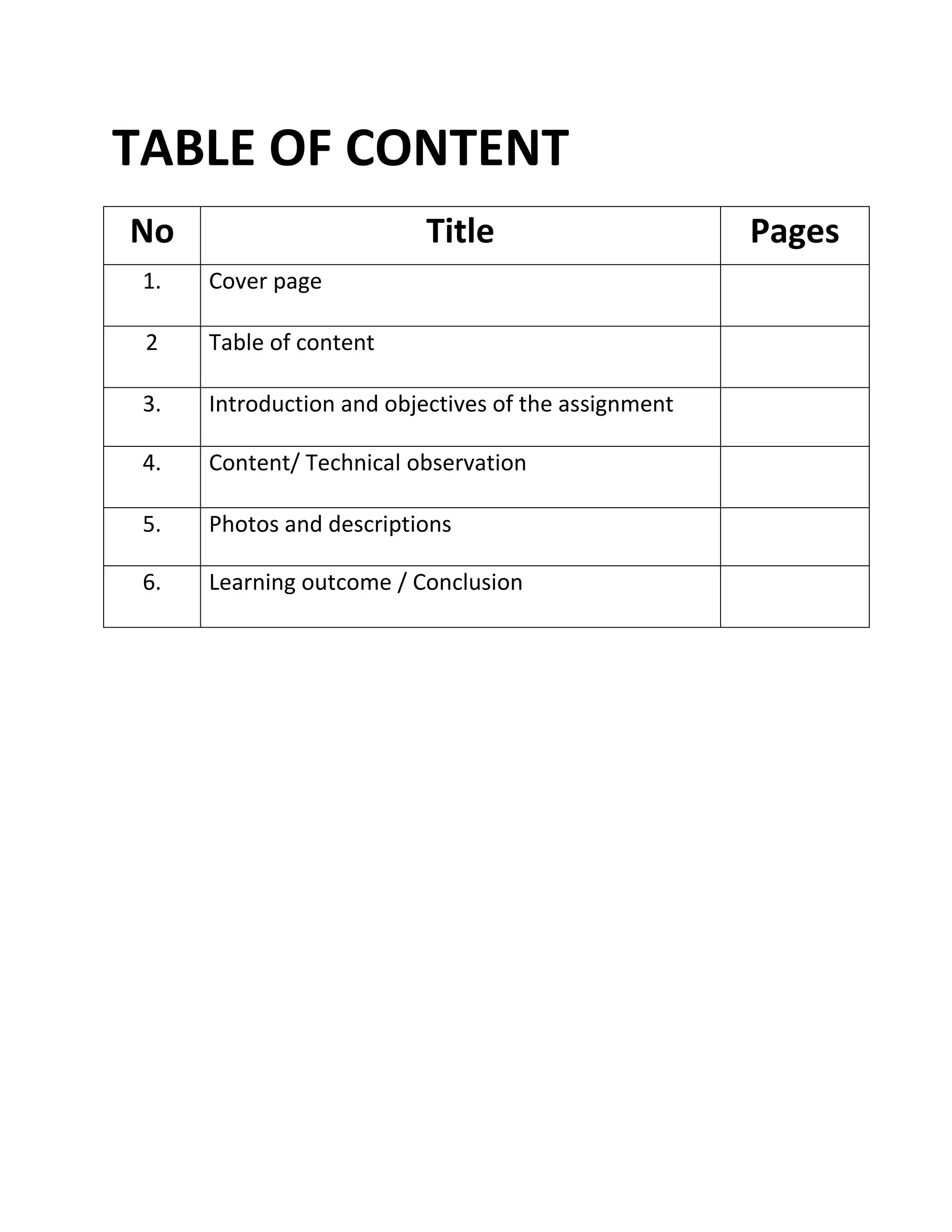
When we reached the construction site, I saw a project information board that was placed 
outside the fence. The function of the project information board is to state the role of each 
constructor involved. Moreover, there are a few temporary works installed at the site which are 
accommodation for workers, material storage, security and scaffolding. The whole area of the 
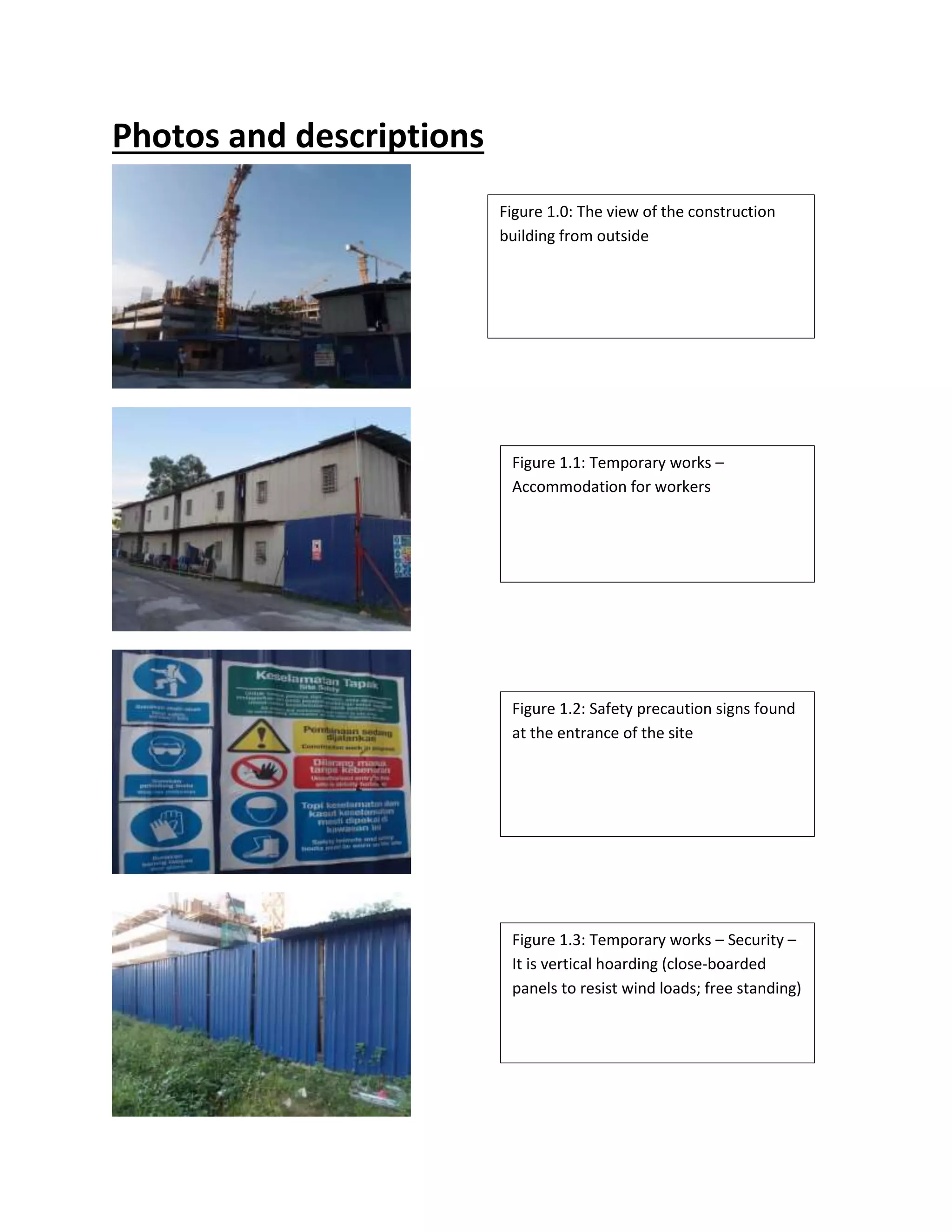
construction site is fenced by vertical hoarding. It is a close- boarded fence to prevent 
unauthorized persons access to site. It can also be used to resist wind loads and fixed by stays 
to external wall. Besides that, the entrance of the site is guarded by a guard house which is built 
using timber and enclosed with zinc roof. The role of the guard house is to record down the 
identity of people who intended to get access to the site or for trucks that are transporting the 
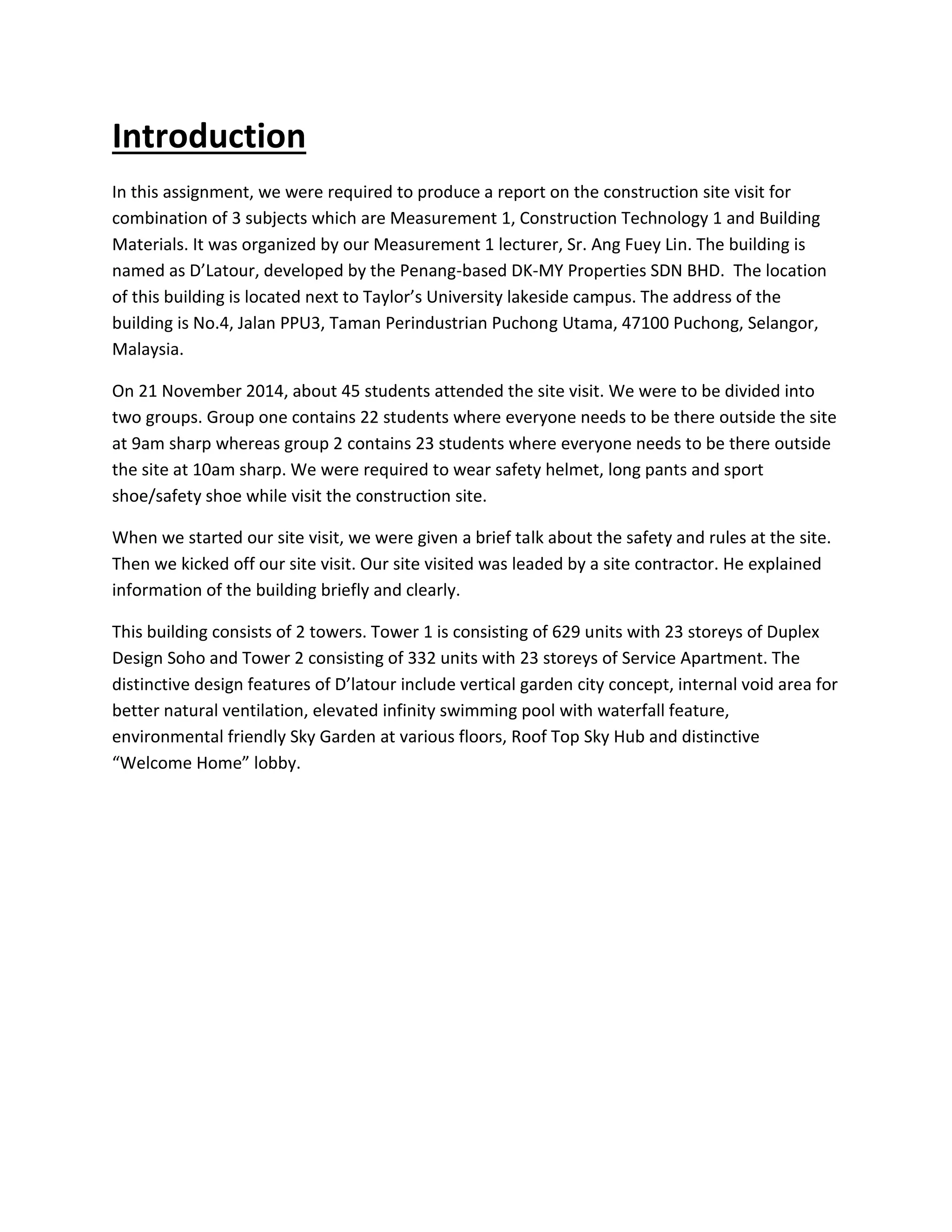
needed building materials into the site. There also exists an accommodation for workers which 
are located near to the entrance and a canteen located beside the accommodation of the 
workers. Furthermore, a temporary material storage can also be found at the basement to 
store materials. In addition we also came across a tower crane, mobile crane, truck and an 
excellent silent generator first hand on site. It will give us firsthand experience on how this 
machineries function in real life. 
Around the surrounding area of the structural buildings, there exists a few independent 
scaffolding with safety net cast around it to protect people from falling down by limiting the 
distance they fall. It is used to support people and hold materials that are to be used for 
construction or repair of buildings and other structures. It aided the safety of the workmen and 
allowed easy access to areas that are difficult to reach. They are constructed by using metal 
tubes with metal platforms. Besides that around the inner part of the scaffolding, they have 
cleverly installed a series of stairs for the purposes of easy movement of workers up and down 
the building structure. Not to mention there are also a few mobile access towers sighted for the 
workers to use when working around the basement of the site. This is to bring a more 
comfortable working environment for the workers to work in. 
The three types of formwork that can be seen around the site are beam, column and slab 
formwork. 
A) Beam /Slab formwork 
 -It consists of 
 Sole plates 
 Wedges 
 Props
 Head tree 
 Planks 
 Batten 
 Ledgers 
 -Beam formwork rests on head tree 
 -Slab formwork rests on battens and joists 
 -If prop height are more than 8’ provide horizontal braces 
B) Column formwork 
 -It consists of the following 
 Sides & End Planks 
 Yoke 
 Nut & Bolts 
 -Two end & two side planks are joined by the yokes and bolts 
Furthermore, the surrounding area of the building is supported by table formwork which is 
widely used. It is a type of formwork that offer quick mobility and installation which is highly 
recommendable to flat slab, beam and slab layouts. Not only that is can be easily install or 
disassemble in a matter of moments to be reused once the concrete has set in to its desirable 
grade by the use of crane. 
There are three types of material formworks which are being used on site which are table 
formwork, plywood formwork and steel formwork. 
The advantages and disadvantages of table formwork are as listed below 
ADVANTAGES 
• Fast construction for large floor layouts. 
• Fully assembled units can be maneuvered quickly into place. 
• Using appropriate quality control, high quality surface finishes can be achieved. 
• Reduced long-term workforce requirement on site. 
• The need for infill areas and decking joints is minimized. 
• Individual components of the formwork system can be precisely adjusted. 
• Repetitive nature of the work makes it easier to plan construction activities. 
DISADVANTAGES 
• Cost of raw materials and cranes are expensive
The advantages and disadvantages of plywood formwork are as listed below: 
ADVANTAGES 
• Increased stability 
• High impact resistance 
• It remains stable under changes of temperature and moisture 
• High strength to weight ratio 
• Chemical resistance 
DISADVANTAGES 
• More expensive than timber 
• More difficult to clean after use (than timber) 
The advantages and disadvantages of steel formwork are as listed below: 
ADVANTAGES 
• Very strong and able to carry heavy load 
• Easy to be fixed 
• Uniform size and surface 
• Can be used for a very long time 
• Span longer than timber 
• More durable than timber formwork 
DISADVANTAGES 
• More expensive than wood 
• Limited size or shape 
• Excessive loss of heat 
• A very smooth surface will be produced which would give problem for finishing process 
• Limited fixing 
• Steel dents relatively easy 
Furthermore as we wandered around the site, we would be able to come across a few basic 
materials on site that we can more or less be able to distinguish most of which we had learnt in 
class. For instance, we are able to come across a few heaps of PVC pipes, bars, stirrups, links 
and bags of concrete lying around here and there. Most probably used for other types of 
specific functions to the building that will shape the way how they wanted it to be. That how 
the material storage will come to be handy as inside of it will most probably contain all of this 
aforementioned materials.
Along the basement of site, we are able to witness a few telescopic props and columns properly 
construct to act as a support for the loads above. This is to accommodate the micro pile type of 
piling being used underneath. It is a sort of pile which acts as a supporting structure to transfer 
the load from the building to the ground. Micro-pile is specifically used to meet the demands 
for low noise and vibration regulations especially in congested environments around the site. 
Furthermore, the most common used of concrete apply to the construction building is grade 40 
concrete. This type of concrete is used because it offers greater strength than other types of 
concrete grades. The advantages of using Grade 40 concrete are the size of the structure can be 
reduced and therefore the amount of concrete required is consequently reduced, this can 
result in cost savings. Besides, it can be extended life cycles and it has relatively high 
compressive strength. The disadvantages of using Grade 40 concrete are the surface of the 
concrete is very hard, it is more expensive than Grade 30 concrete because Grade 40 concrete 
is designed concrete and concrete do not retain heat very well. The surface of the concrete will 
be cold during the winter. 
In addition the concrete is to allow provide sufficient and support strength to the building. 
However grade 15 type of concrete is applicable to the column of this building and concrete 
grade 25 for the slab found. Regardless of the usage of concrete grade 40, another alternative 
to it is concrete grade 35. The advantages of using Grade 35 concrete are it is cheaper than 
Grade 40 concrete, more common used in construction area, better resistance to fire and long 
service life with low maintenance cost. The disadvantages of using Grade 35 concrete are low 
compressive strength as compared to Grade 40 concrete and it will easily cracks under service 
load
Photos and descriptions 
Figure 1.0: The view of the construction 
building from outside 
Figure 1.1: Temporary works – 
Accommodation for workers 
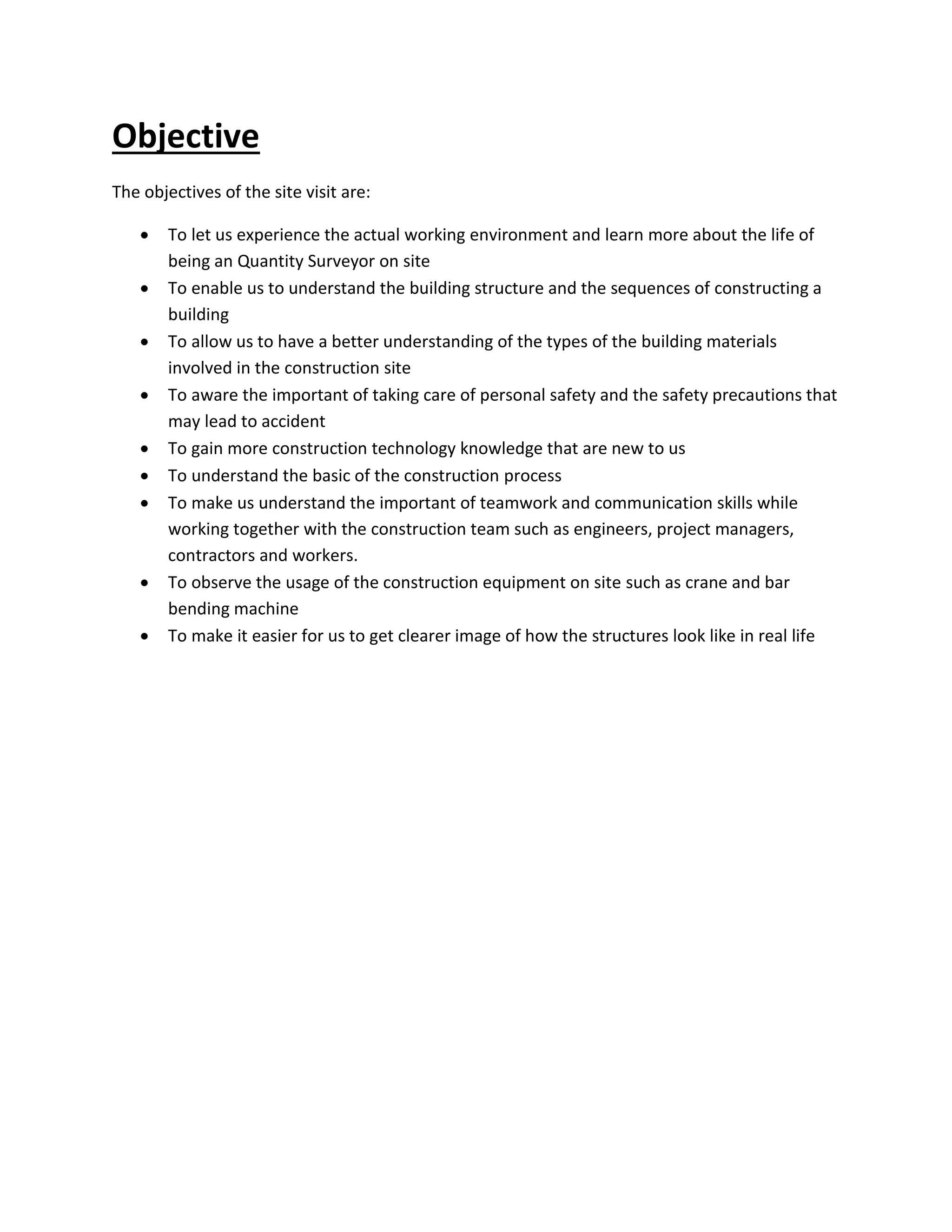
Figure 1.2: Safety precaution signs found 
at the entrance of the site 
Figure 1.3: Temporary works – Security – 
It is vertical hoarding (close-boarded 
panels to resist wind loads; free standing)
Figure 1.4: Project information board 
Figure 1.5: Temporary works – 
Scaffolding – Independent scaffold (2 
rows of standards at about 1m apart 
which tied by cross-members – 
transoms, it doesn’t rely upon 
building for support) 
Figure 1.6: Table formwork-it is a 
kind of formwork specializing in floor 
concreting and is widely used in high 
rise buildings and skyscrapers 
Figure 1.7: Exposed starter bars 42d 
from slabs
Figure 1.8: Tower crane on the site- to lift 
up the loads to a higher level of the 
building 
Figure 1.9: Independent scaffold with 
safety net – safety net is to protect 
people from injury after falling by 
limiting the distance they fall 
Figure 2.0: Temporary works – Guard 
house (To prevent unauthorized 
person from accessing to site) 
Figure 2.1: VSL- Use for construction 
of concrete containment structure, 
anchoring in rocks and soils, structural 
strengthening and repair, lifting and 
sliding of heavy load
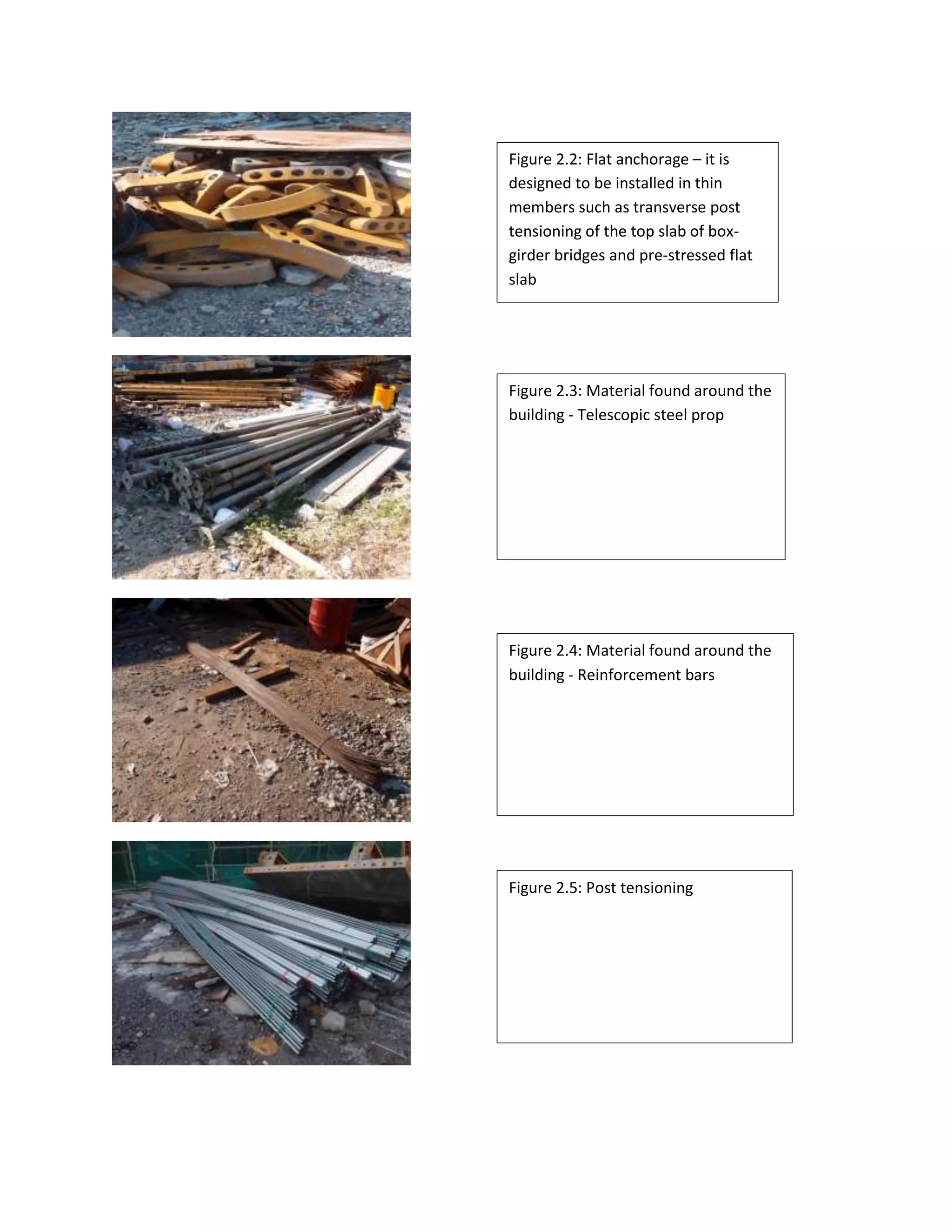
Figure 2.2: Flat anchorage – it is 
designed to be installed in thin 
members such as transverse post 
tensioning of the top slab of box-girder 
bridges and pre-stressed flat 
slab 
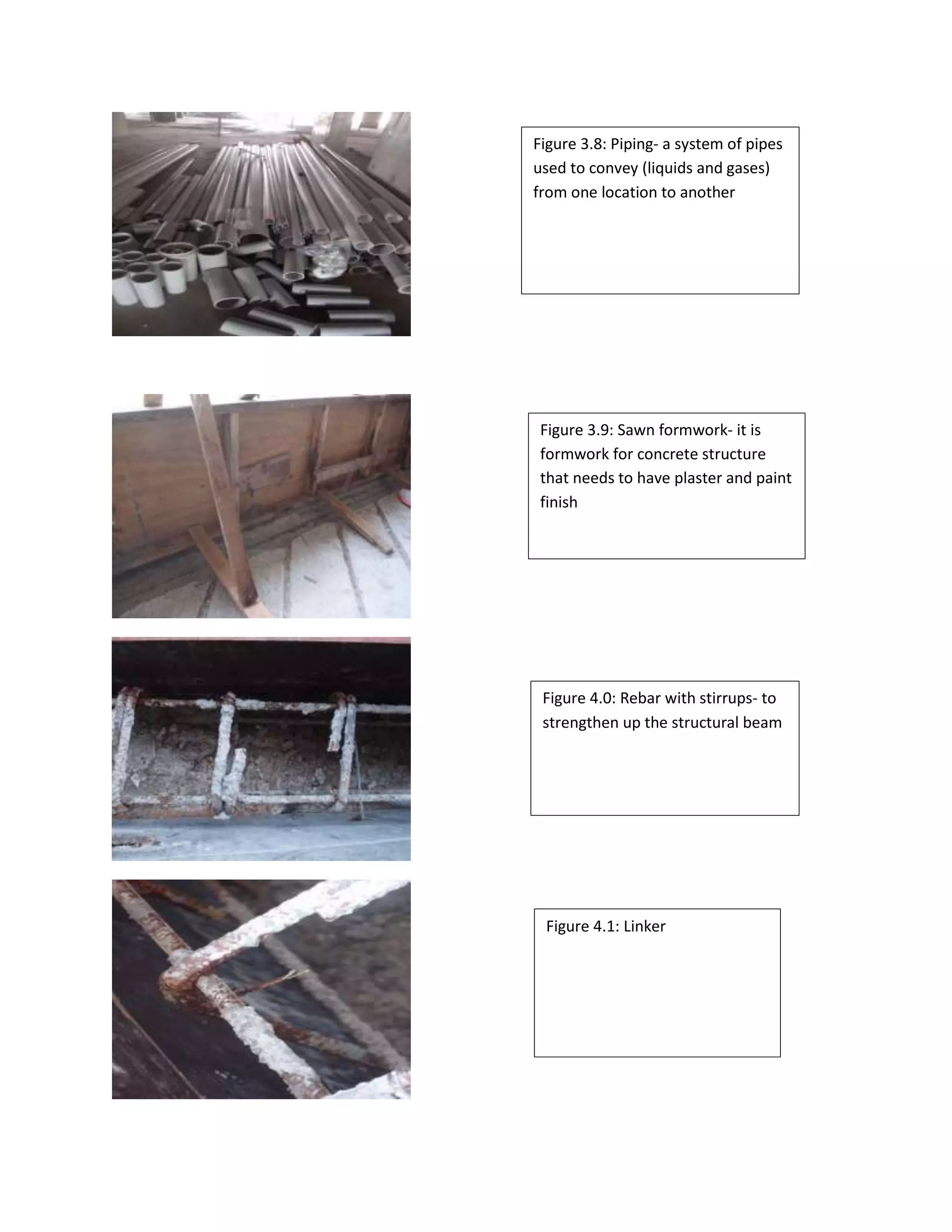
Figure 2.3: Material found around the 
building - Telescopic steel prop 
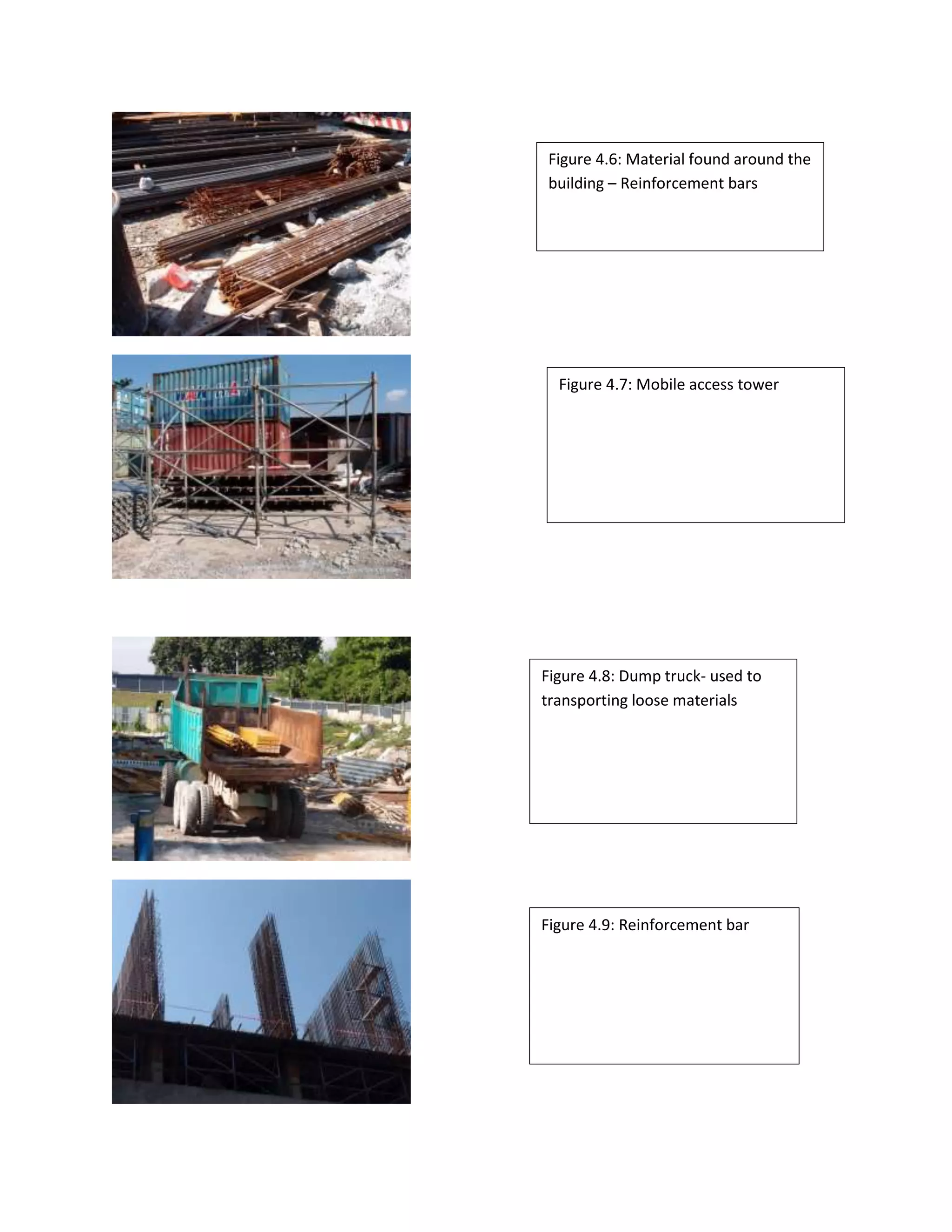
Figure 2.4: Material found around the 
building - Reinforcement bars 
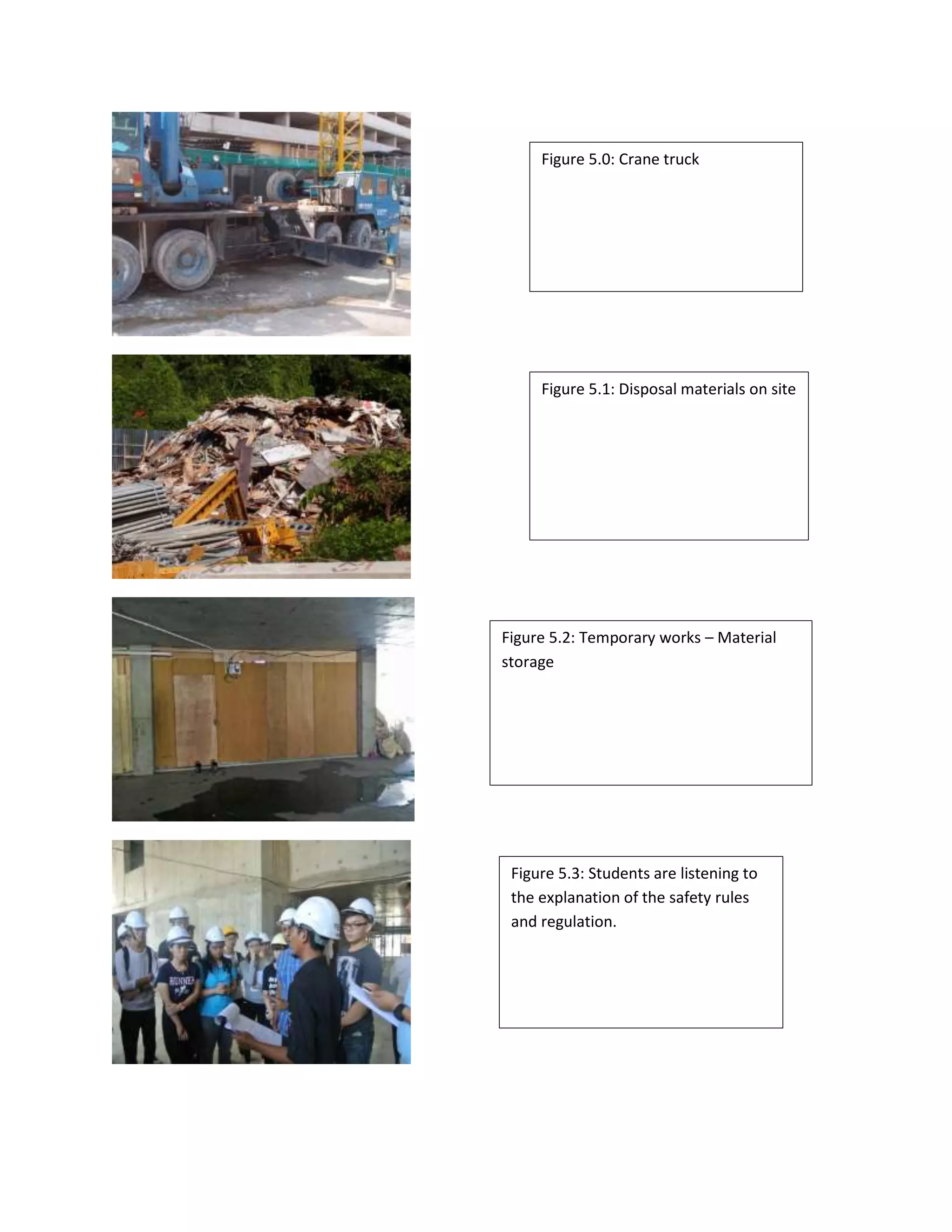
Figure 2.5: Post tensioning
Figure 2.6: White board - to record 
important information 
Figure 2.7: Fines imposed from breaking 
the safety rules 
Figure 2.8: Concrete slab 
Figure 2.9: Polymix - Fine Mortar Base 
(White)
Figure 3.0: Polymix - Plaster Finish 
(White) 
Figure 3.1: Telescopic steel prop- Used 
to support formwork shuttering, the 
Prop is an infinitely reusable product. 
Its telescopic function allows speedy 
erection and dismantling without tool. 
Figure 3.2: Starter bars- a steel 
reinforcement bars embedded in the 
concrete and projecting through a 
construction joint to bind adjoining 
masses of concrete together. 
Figure 3.3: Material found around 
the building- PVC pipe
Figure 3.4: Column- To support the 
building 
Figure 3.5: Excellent Silent 
Generator- To prevent disturbances 
to the workers while working 
Figure 3.6: Material found around 
the building - pipe 
Figure 3.7: Sand Block
Figure 3.8: Piping- a system of pipes 
used to convey (liquids and gases) 
from one location to another 
Figure 3.9: Sawn formwork- it is 
formwork for concrete structure 
that needs to have plaster and paint 
finish 
Figure 4.0: Rebar with stirrups- to 
strengthen up the structural beam 
Figure 4.1: Linker
Figure 4.2: Wiring 
Figure 4.3: Crane- To move 
heavy objects 
Figure 4.4: Water Tank- to store 
water 
Figure 4.5: Material found around 
the building - Stirrups
Figure 4.6: Material found around the 
building – Reinforcement bars 
Figure 4.7: Mobile access tower 
Figure 4.8: Dump truck- used to 
transporting loose materials 
Figure 4.9: Reinforcement bar
Figure 5.0: Crane truck 
Figure 5.1: Disposal materials on site 
Figure 5.2: Temporary works – Material 
storage 
Figure 5.3: Students are listening to 
the explanation of the safety rules 
and regulation.
Figure 5.5: Group photo for group 1 
Figure 5.4: Bar bending machine
Conclusion / Learning outcome 
After the meaningful construction site visit done by us on the 21 November, there are countless 
of valuable information of knowledge gained by me after the visit. Besides, I had the 
opportunity to learn something that I couldn’t learn from the lectures and textbook. I have 
better understanding about how a construction site works now after the visit. 
I had seen and explored various materials and tools used during the construction period. This is 
an eye opener for me as I have never had the chance to see it with my own eyes. Besides, I was 
taught by the site contractor about the various professional construction technique used and its 
application. 
Most importantly, I had the chance to witness how much they emphasize on safeties in the 
construction site. They demand every worker to have their proper safety equipment on when a 
construction is going on. Even we, the visitors have to wear safety helmet just like other 
workers to guarantee our safety during our visit since there might be bricks or rocks that might 
fall form high ground and might hit our head. Moreover, safety precaution signboard were seen 
everywhere to always remind their worker to emphasize on their own safety. 
Moreover, I can see that cooperation between workers is very important through this visit. 
Every worker at the construction site is cooperating with each other in order to accomplish the 
task given. This shows that cooperation is very vital in doing something important. 
Besides, construction site manager also plays a very important role. As I can see during the visit, 
the construction site was well planned. There was a site to throw all the domestic waste, and all 
the materials or tools were kept safe and sound to ensure their stability and secureness when it 
is being used in the future. 
In conclusion, this visit has greatly enhanced my knowledge about construction site. I am very 
grateful to have a chance to visit there as I have gained a lot of knowledge. I wish that I could 
have more chances like this in the future as in really benefit me a lot.
Site report

Site report

  • 1.
    SCHOOL OF ARCHITECTURE,BUILDING AND DESIGN BACHELOR OF QUANTITY SURVEYING (HONOURS) AUGUST INTAKE 2014 SEMESTER 1 [QSB 60104] MEASUREMENT 1 -Sr. Ang Fuey Lin [BLD 60104] CONSTRUCTION TECHNOLOGY 1 -Pn. Azrina Md Yaakob [BLD 62003] BUILDING MATERIALS -Pn. Myzatul Aishah Kamarazaly CONSTRUCTION SITE REPORT INDIVIDUAL ASSIGNMENT Yong Seen Yee (0315883)
  • 2.
    TABLE OF CONTENT No Title Pages 1. Cover page 2 Table of content 3. Introduction and objectives of the assignment 4. Content/ Technical observation 5. Photos and descriptions 6. Learning outcome / Conclusion
  • 3.
    Introduction In thisassignment, we were required to produce a report on the construction site visit for combination of 3 subjects which are Measurement 1, Construction Technology 1 and Building Materials. It was organized by our Measurement 1 lecturer, Sr. Ang Fuey Lin. The building is named as D’Latour, developed by the Penang-based DK-MY Properties SDN BHD. The location of this building is located next to Taylor’s University lakeside campus. The address of the building is No.4, Jalan PPU3, Taman Perindustrian Puchong Utama, 47100 Puchong, Selangor, Malaysia. On 21 November 2014, about 45 students attended the site visit. We were to be divided into two groups. Group one contains 22 students where everyone needs to be there outside the site at 9am sharp whereas group 2 contains 23 students where everyone needs to be there outside the site at 10am sharp. We were required to wear safety helmet, long pants and sport shoe/safety shoe while visit the construction site. When we started our site visit, we were given a brief talk about the safety and rules at the site. Then we kicked off our site visit. Our site visited was leaded by a site contractor. He explained information of the building briefly and clearly. This building consists of 2 towers. Tower 1 is consisting of 629 units with 23 storeys of Duplex Design Soho and Tower 2 consisting of 332 units with 23 storeys of Service Apartment. The distinctive design features of D’latour include vertical garden city concept, internal void area for better natural ventilation, elevated infinity swimming pool with waterfall feature, environmental friendly Sky Garden at various floors, Roof Top Sky Hub and distinctive “Welcome Home” lobby.
  • 4.
    Objective The objectivesof the site visit are:  To let us experience the actual working environment and learn more about the life of being an Quantity Surveyor on site  To enable us to understand the building structure and the sequences of constructing a building  To allow us to have a better understanding of the types of the building materials involved in the construction site  To aware the important of taking care of personal safety and the safety precautions that may lead to accident  To gain more construction technology knowledge that are new to us  To understand the basic of the construction process  To make us understand the important of teamwork and communication skills while working together with the construction team such as engineers, project managers, contractors and workers.  To observe the usage of the construction equipment on site such as crane and bar bending machine  To make it easier for us to get clearer image of how the structures look like in real life
  • 5.
    Content/ Technical Observations When we reached the construction site, I saw a project information board that was placed outside the fence. The function of the project information board is to state the role of each constructor involved. Moreover, there are a few temporary works installed at the site which are accommodation for workers, material storage, security and scaffolding. The whole area of the construction site is fenced by vertical hoarding. It is a close- boarded fence to prevent unauthorized persons access to site. It can also be used to resist wind loads and fixed by stays to external wall. Besides that, the entrance of the site is guarded by a guard house which is built using timber and enclosed with zinc roof. The role of the guard house is to record down the identity of people who intended to get access to the site or for trucks that are transporting the needed building materials into the site. There also exists an accommodation for workers which are located near to the entrance and a canteen located beside the accommodation of the workers. Furthermore, a temporary material storage can also be found at the basement to store materials. In addition we also came across a tower crane, mobile crane, truck and an excellent silent generator first hand on site. It will give us firsthand experience on how this machineries function in real life. Around the surrounding area of the structural buildings, there exists a few independent scaffolding with safety net cast around it to protect people from falling down by limiting the distance they fall. It is used to support people and hold materials that are to be used for construction or repair of buildings and other structures. It aided the safety of the workmen and allowed easy access to areas that are difficult to reach. They are constructed by using metal tubes with metal platforms. Besides that around the inner part of the scaffolding, they have cleverly installed a series of stairs for the purposes of easy movement of workers up and down the building structure. Not to mention there are also a few mobile access towers sighted for the workers to use when working around the basement of the site. This is to bring a more comfortable working environment for the workers to work in. The three types of formwork that can be seen around the site are beam, column and slab formwork. A) Beam /Slab formwork  -It consists of  Sole plates  Wedges  Props
  • 6.
     Head tree  Planks  Batten  Ledgers  -Beam formwork rests on head tree  -Slab formwork rests on battens and joists  -If prop height are more than 8’ provide horizontal braces B) Column formwork  -It consists of the following  Sides & End Planks  Yoke  Nut & Bolts  -Two end & two side planks are joined by the yokes and bolts Furthermore, the surrounding area of the building is supported by table formwork which is widely used. It is a type of formwork that offer quick mobility and installation which is highly recommendable to flat slab, beam and slab layouts. Not only that is can be easily install or disassemble in a matter of moments to be reused once the concrete has set in to its desirable grade by the use of crane. There are three types of material formworks which are being used on site which are table formwork, plywood formwork and steel formwork. The advantages and disadvantages of table formwork are as listed below ADVANTAGES • Fast construction for large floor layouts. • Fully assembled units can be maneuvered quickly into place. • Using appropriate quality control, high quality surface finishes can be achieved. • Reduced long-term workforce requirement on site. • The need for infill areas and decking joints is minimized. • Individual components of the formwork system can be precisely adjusted. • Repetitive nature of the work makes it easier to plan construction activities. DISADVANTAGES • Cost of raw materials and cranes are expensive
  • 7.
    The advantages anddisadvantages of plywood formwork are as listed below: ADVANTAGES • Increased stability • High impact resistance • It remains stable under changes of temperature and moisture • High strength to weight ratio • Chemical resistance DISADVANTAGES • More expensive than timber • More difficult to clean after use (than timber) The advantages and disadvantages of steel formwork are as listed below: ADVANTAGES • Very strong and able to carry heavy load • Easy to be fixed • Uniform size and surface • Can be used for a very long time • Span longer than timber • More durable than timber formwork DISADVANTAGES • More expensive than wood • Limited size or shape • Excessive loss of heat • A very smooth surface will be produced which would give problem for finishing process • Limited fixing • Steel dents relatively easy Furthermore as we wandered around the site, we would be able to come across a few basic materials on site that we can more or less be able to distinguish most of which we had learnt in class. For instance, we are able to come across a few heaps of PVC pipes, bars, stirrups, links and bags of concrete lying around here and there. Most probably used for other types of specific functions to the building that will shape the way how they wanted it to be. That how the material storage will come to be handy as inside of it will most probably contain all of this aforementioned materials.
  • 8.
    Along the basementof site, we are able to witness a few telescopic props and columns properly construct to act as a support for the loads above. This is to accommodate the micro pile type of piling being used underneath. It is a sort of pile which acts as a supporting structure to transfer the load from the building to the ground. Micro-pile is specifically used to meet the demands for low noise and vibration regulations especially in congested environments around the site. Furthermore, the most common used of concrete apply to the construction building is grade 40 concrete. This type of concrete is used because it offers greater strength than other types of concrete grades. The advantages of using Grade 40 concrete are the size of the structure can be reduced and therefore the amount of concrete required is consequently reduced, this can result in cost savings. Besides, it can be extended life cycles and it has relatively high compressive strength. The disadvantages of using Grade 40 concrete are the surface of the concrete is very hard, it is more expensive than Grade 30 concrete because Grade 40 concrete is designed concrete and concrete do not retain heat very well. The surface of the concrete will be cold during the winter. In addition the concrete is to allow provide sufficient and support strength to the building. However grade 15 type of concrete is applicable to the column of this building and concrete grade 25 for the slab found. Regardless of the usage of concrete grade 40, another alternative to it is concrete grade 35. The advantages of using Grade 35 concrete are it is cheaper than Grade 40 concrete, more common used in construction area, better resistance to fire and long service life with low maintenance cost. The disadvantages of using Grade 35 concrete are low compressive strength as compared to Grade 40 concrete and it will easily cracks under service load
  • 9.
    Photos and descriptions Figure 1.0: The view of the construction building from outside Figure 1.1: Temporary works – Accommodation for workers Figure 1.2: Safety precaution signs found at the entrance of the site Figure 1.3: Temporary works – Security – It is vertical hoarding (close-boarded panels to resist wind loads; free standing)
  • 10.
    Figure 1.4: Projectinformation board Figure 1.5: Temporary works – Scaffolding – Independent scaffold (2 rows of standards at about 1m apart which tied by cross-members – transoms, it doesn’t rely upon building for support) Figure 1.6: Table formwork-it is a kind of formwork specializing in floor concreting and is widely used in high rise buildings and skyscrapers Figure 1.7: Exposed starter bars 42d from slabs
  • 11.
    Figure 1.8: Towercrane on the site- to lift up the loads to a higher level of the building Figure 1.9: Independent scaffold with safety net – safety net is to protect people from injury after falling by limiting the distance they fall Figure 2.0: Temporary works – Guard house (To prevent unauthorized person from accessing to site) Figure 2.1: VSL- Use for construction of concrete containment structure, anchoring in rocks and soils, structural strengthening and repair, lifting and sliding of heavy load
  • 12.
    Figure 2.2: Flatanchorage – it is designed to be installed in thin members such as transverse post tensioning of the top slab of box-girder bridges and pre-stressed flat slab Figure 2.3: Material found around the building - Telescopic steel prop Figure 2.4: Material found around the building - Reinforcement bars Figure 2.5: Post tensioning
  • 13.
    Figure 2.6: Whiteboard - to record important information Figure 2.7: Fines imposed from breaking the safety rules Figure 2.8: Concrete slab Figure 2.9: Polymix - Fine Mortar Base (White)
  • 14.
    Figure 3.0: Polymix- Plaster Finish (White) Figure 3.1: Telescopic steel prop- Used to support formwork shuttering, the Prop is an infinitely reusable product. Its telescopic function allows speedy erection and dismantling without tool. Figure 3.2: Starter bars- a steel reinforcement bars embedded in the concrete and projecting through a construction joint to bind adjoining masses of concrete together. Figure 3.3: Material found around the building- PVC pipe
  • 15.
    Figure 3.4: Column-To support the building Figure 3.5: Excellent Silent Generator- To prevent disturbances to the workers while working Figure 3.6: Material found around the building - pipe Figure 3.7: Sand Block
  • 16.
    Figure 3.8: Piping-a system of pipes used to convey (liquids and gases) from one location to another Figure 3.9: Sawn formwork- it is formwork for concrete structure that needs to have plaster and paint finish Figure 4.0: Rebar with stirrups- to strengthen up the structural beam Figure 4.1: Linker
  • 17.
    Figure 4.2: Wiring Figure 4.3: Crane- To move heavy objects Figure 4.4: Water Tank- to store water Figure 4.5: Material found around the building - Stirrups
  • 18.
    Figure 4.6: Materialfound around the building – Reinforcement bars Figure 4.7: Mobile access tower Figure 4.8: Dump truck- used to transporting loose materials Figure 4.9: Reinforcement bar
  • 19.
    Figure 5.0: Cranetruck Figure 5.1: Disposal materials on site Figure 5.2: Temporary works – Material storage Figure 5.3: Students are listening to the explanation of the safety rules and regulation.
  • 20.
    Figure 5.5: Groupphoto for group 1 Figure 5.4: Bar bending machine
  • 21.
    Conclusion / Learningoutcome After the meaningful construction site visit done by us on the 21 November, there are countless of valuable information of knowledge gained by me after the visit. Besides, I had the opportunity to learn something that I couldn’t learn from the lectures and textbook. I have better understanding about how a construction site works now after the visit. I had seen and explored various materials and tools used during the construction period. This is an eye opener for me as I have never had the chance to see it with my own eyes. Besides, I was taught by the site contractor about the various professional construction technique used and its application. Most importantly, I had the chance to witness how much they emphasize on safeties in the construction site. They demand every worker to have their proper safety equipment on when a construction is going on. Even we, the visitors have to wear safety helmet just like other workers to guarantee our safety during our visit since there might be bricks or rocks that might fall form high ground and might hit our head. Moreover, safety precaution signboard were seen everywhere to always remind their worker to emphasize on their own safety. Moreover, I can see that cooperation between workers is very important through this visit. Every worker at the construction site is cooperating with each other in order to accomplish the task given. This shows that cooperation is very vital in doing something important. Besides, construction site manager also plays a very important role. As I can see during the visit, the construction site was well planned. There was a site to throw all the domestic waste, and all the materials or tools were kept safe and sound to ensure their stability and secureness when it is being used in the future. In conclusion, this visit has greatly enhanced my knowledge about construction site. I am very grateful to have a chance to visit there as I have gained a lot of knowledge. I wish that I could have more chances like this in the future as in really benefit me a lot.