ADVANCED CONSTRUCTION TECHNOLOGY & STRUCTURAL
SYSTEMS
PRESENTED BY :
YEDAPALLY. SRUJANA
18031AA079
6TH SEMESTER
ASSIGNMENT - 01
PRECAST CONCRETE CONSTRUCTION
•Precast concrete means a concrete member that is cast and cured at
a location other than its final designated location.
• The use of reinforced concrete is a relatively recent invention,
usually dated to 1848
• when jean- Louis Lambot became the first to use it.
•Joseph Monier, a French gardener, patented a design for reinforced
garden tubs in 1868,
• And later patented reinforced concrete beams and posts for railway
and road guardrails.
What is Precast Concrete ?
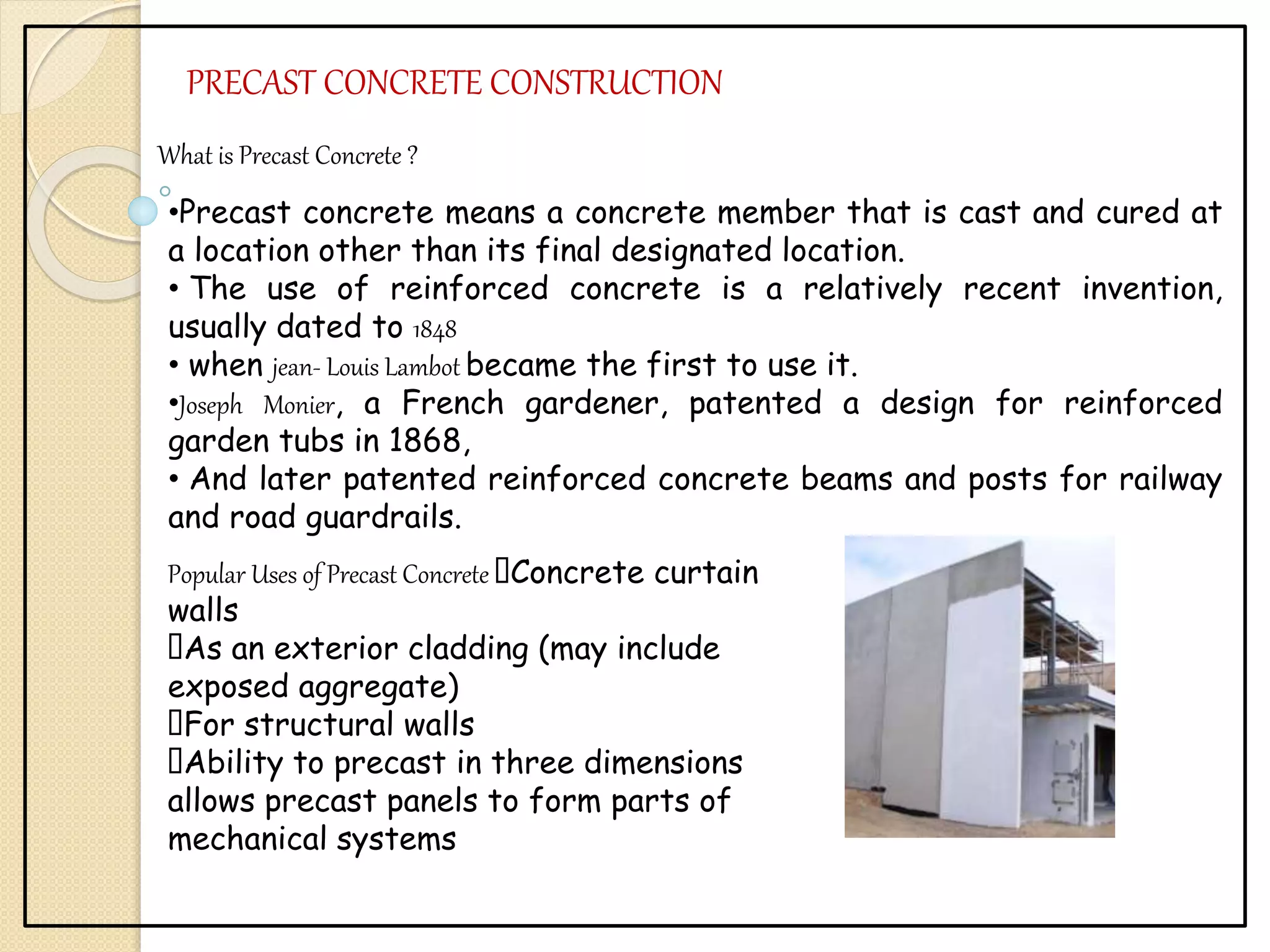
Popular Uses of Precast Concrete Concrete curtain
walls
As an exterior cladding (may include
exposed aggregate)
For structural walls
Ability to precast in three dimensions
allows precast panels to form parts of
mechanical systems
ADVANTAGES OF PRECAST CONCRETE CONSTRUCTION
Very rapid speed of erection
Good quality control
Entire building can be precast-walls, floors , beams , etc. Rapid
construction on site
High quality because of the controlled conditions in the factory
Prestressing is easily done which can reduce the size and number
of the structural members.
Disadvantages of Precast Concrete Construction
Very heavy members
Camber in beams and slabs
Very small margin for error
Connections may be difficult
Somewhat limited building design flexibility
Because panel size is limited, precast concrete can not be used for
two-way structural systems.
Economics of scale demand regularly shaped buildings.
Need for repetition of forms will affect building design.
Joints between panels are often expensive and complicated.
Skilled workmanship is required in the application of the panel on site.
Cranes are required to lift panels.
FOLDED PLATES
WHAT ARE FOLDED PLATES?
•Folded plates are assemblies of flat plates rigidly connected
together along their edges in such a way that the structural system
capable of carrying loads without the need for additional supporting
beams along mutual edges.
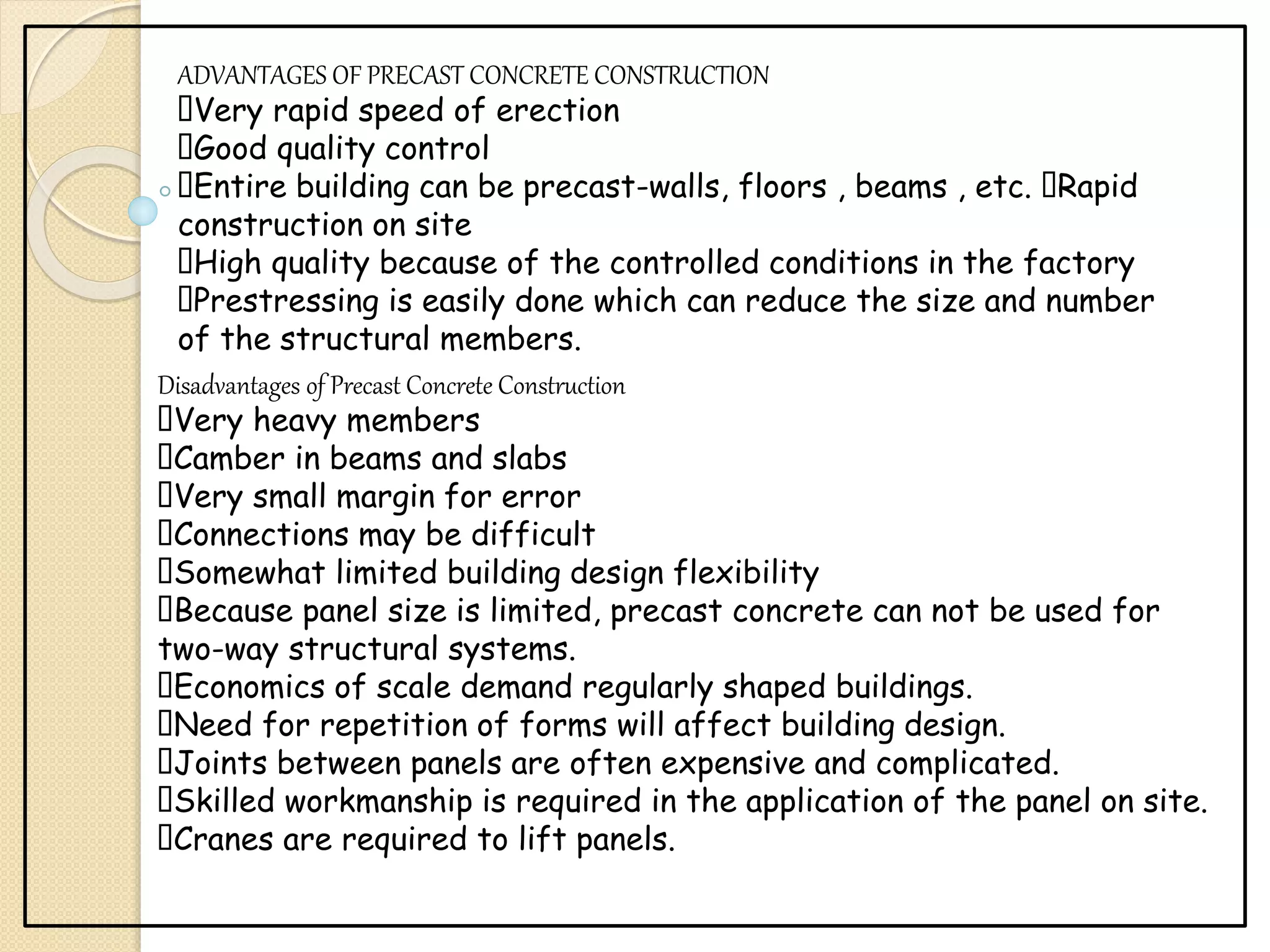
•Engineer Eudene Freyssinet performed the first roof with the folded
structure in 1923 as an aircraft hangar at Orly Airport in Paris.
THE PRINCIPLE OF FOLDING
The structural characteristics of folding structures depend on:
• The pattern of the folding.
• Their geometrical basic shape.
• Its material.
• The connection of the different folding planes.
• The design of the bearings.
• Movable form work can be employed.
• Form work required is relatively simpler.
• Design involves simpler calculations.
ADVANTAGES AND DISADVANTAGES OF FOLDED-PLATE STRUCTURE
Advantages:
• Very light form of construction. To span 30 m shell thickness required is
60 mm only.
• The use of concrete as a building material reduces both materials cost
and a construction cost.
• Longer span can be provided.
• Flat shapes by choosing certain arched shapes.
• Aesthetically it looks good over other forms of construction.
Disadvantages:
• Shuttering is difficult.
• Greater accuracy in formwork is required.
• Good labor and supervision necessary.
• Rise of roof may be a disadvantage.
TYPES OF FOLDED STRUCTURE
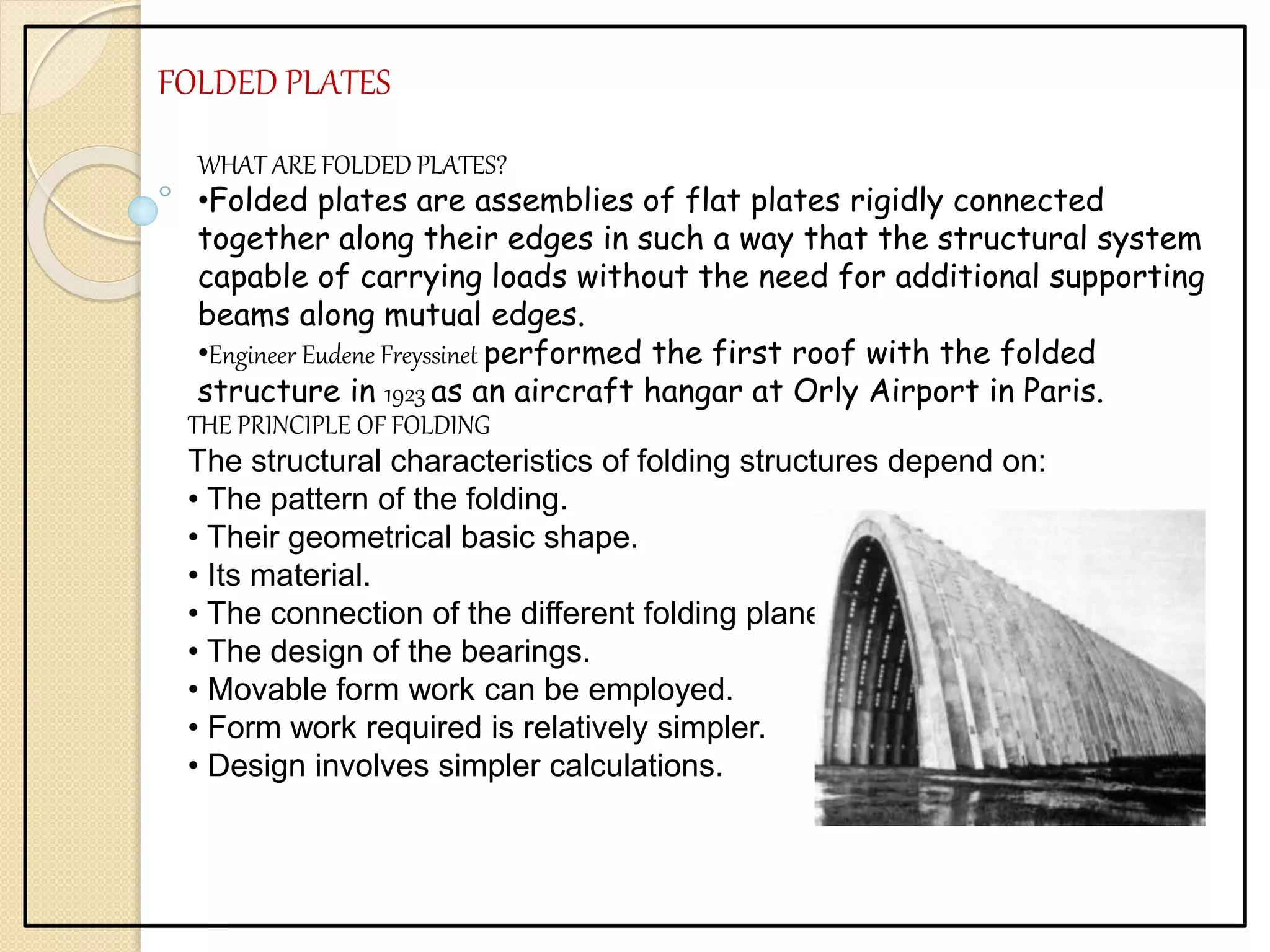
Based on geometric shape folded
structures can be divided into:
• Folded plate surfaces structures
o Prismatic: Rectangular plates.
o Pyramidal: Non-rectangular
plates.
o Prismoidal: Triangular or
trapezoidal
o plates
• Folded plate frames structures
• Spatial folded plate structures
SPACE FRAMES
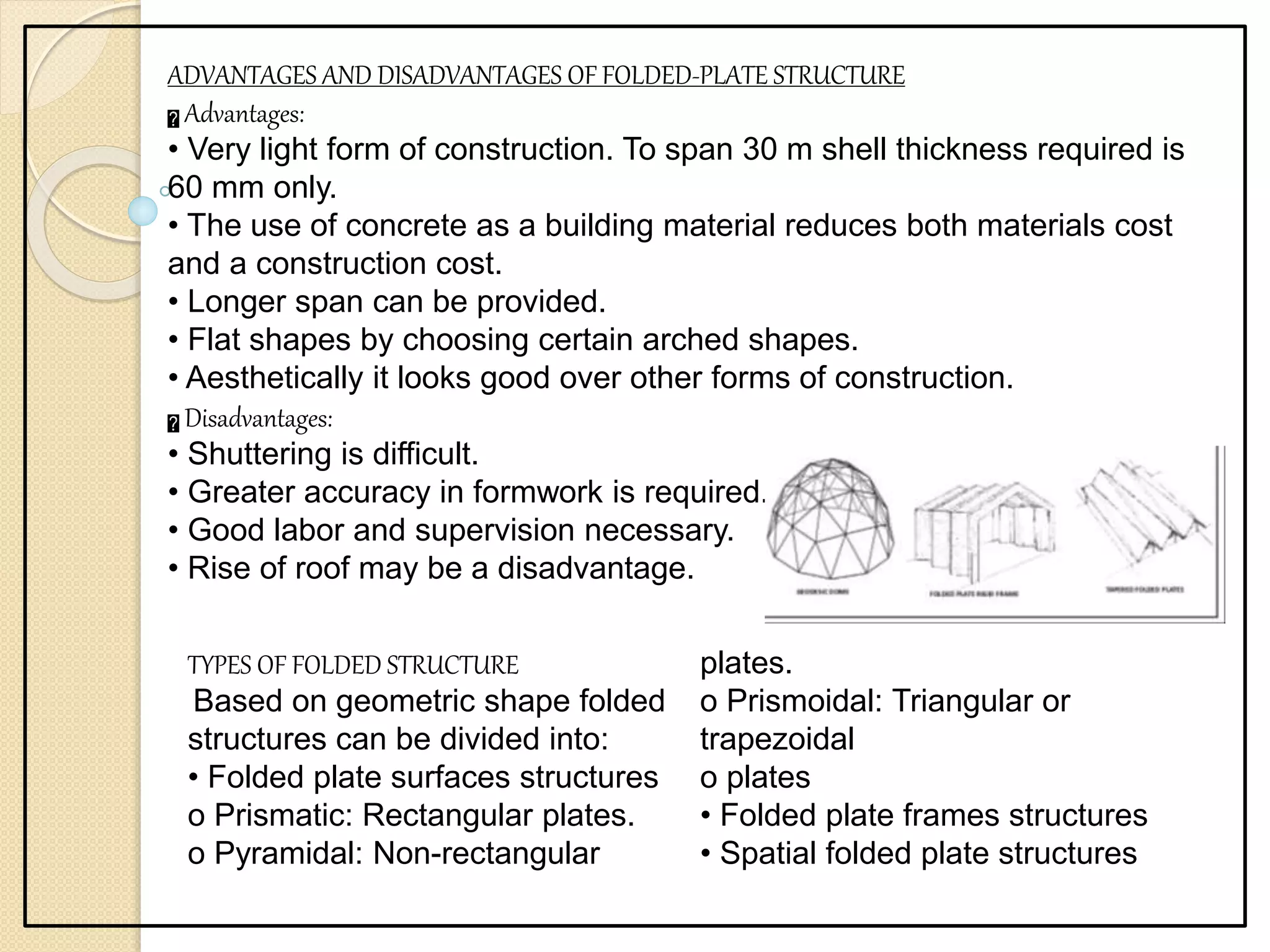
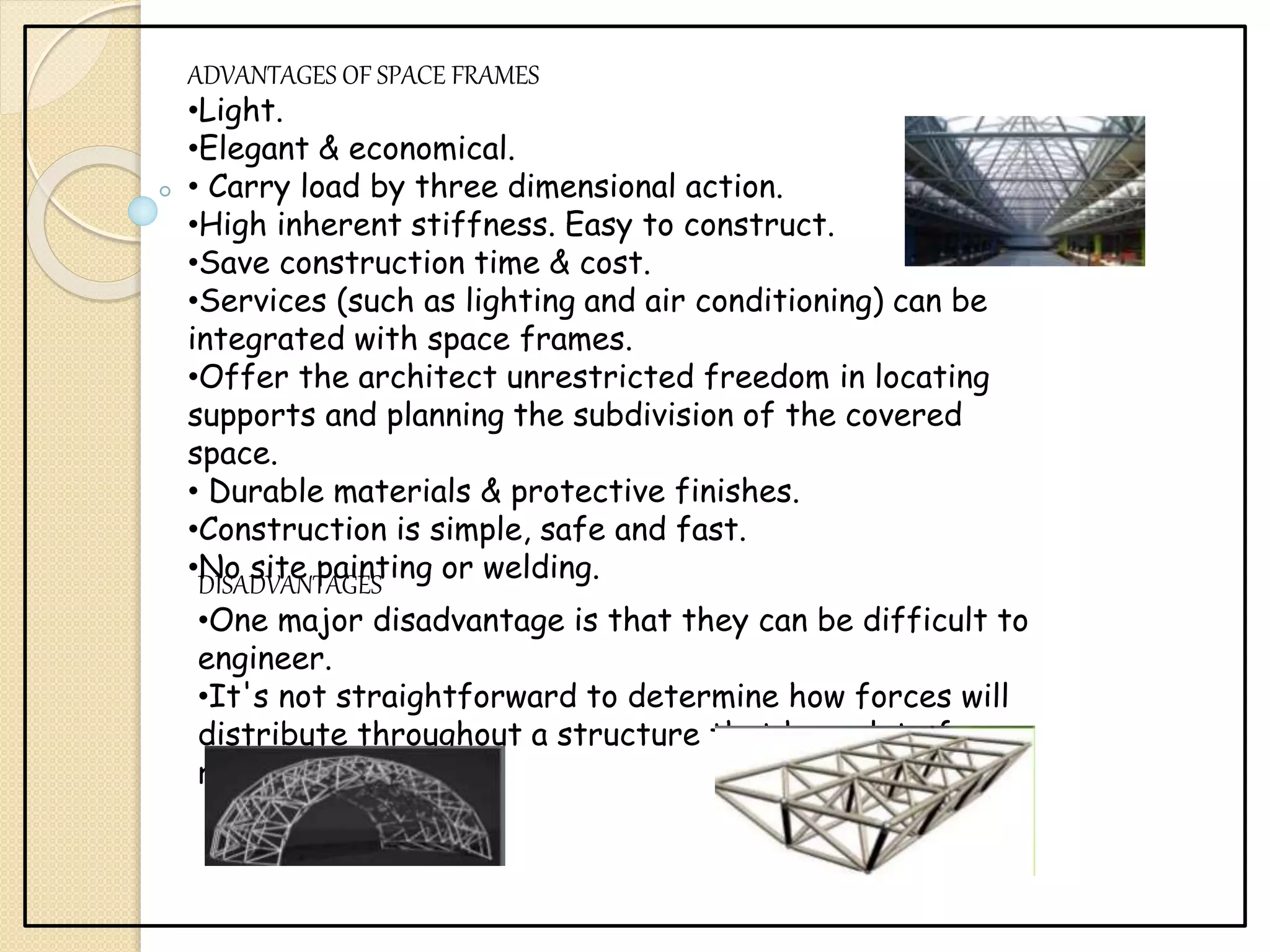
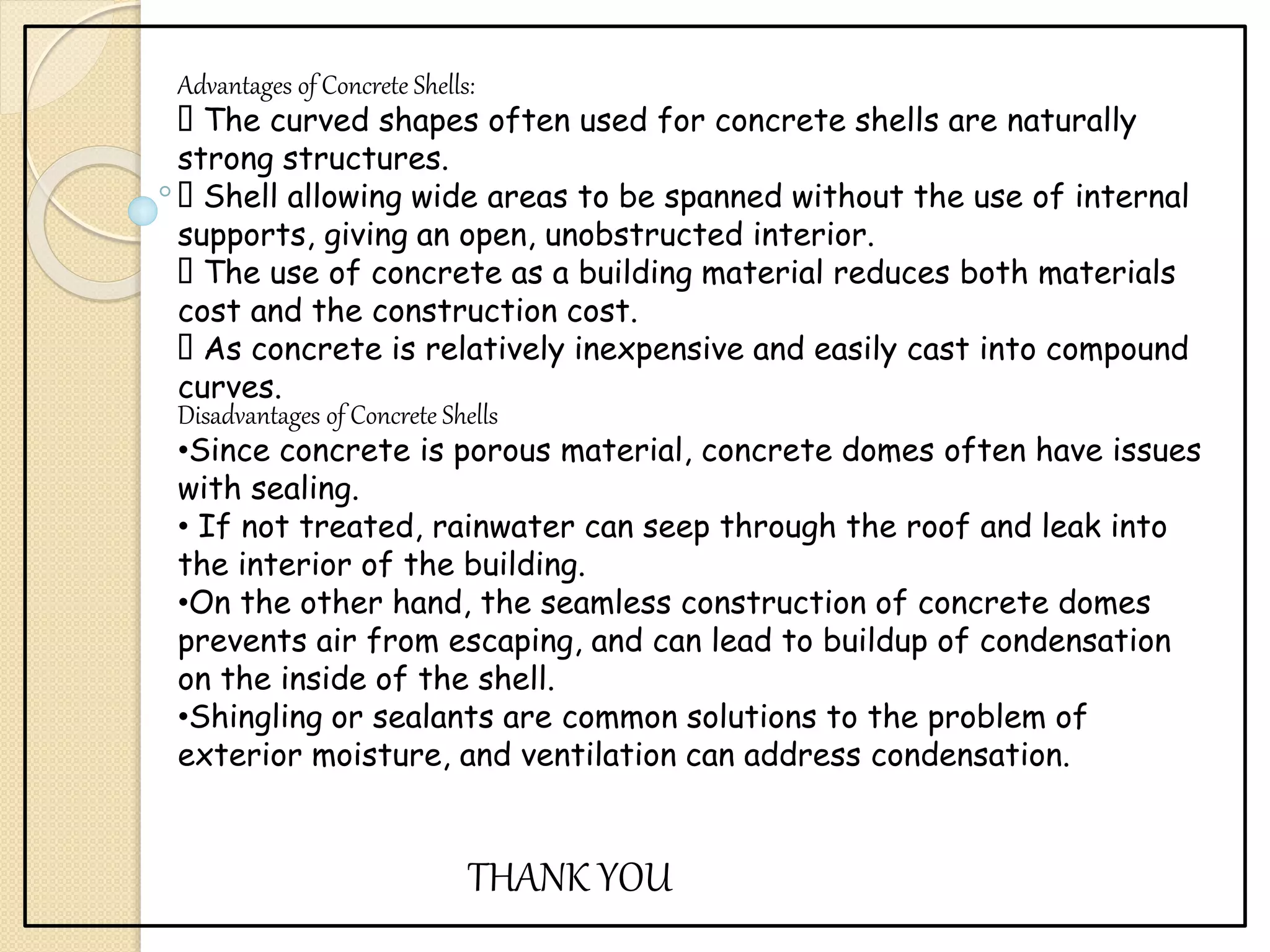
A space frame or space structure is a truss-like, lightweight rigid
structure constructed from interlocking struts in a geometric pattern.
Space frames can be used to span large areas with few interior
supports.
HISTORY OF SPACE FRAME SPACE
Frames were independently developed by alexander graham bell
around 1900 and buckminster fuller in the 1950s buckminster fuller's
focus was architectural structures; his work had greater influence.
It was developed in california during the 1960s and introduced to the
south african market in 1982, specifically developed for unstable soil
conditions, the panels form a monolithic structure offering superior
wall strength in which no cracking will occur
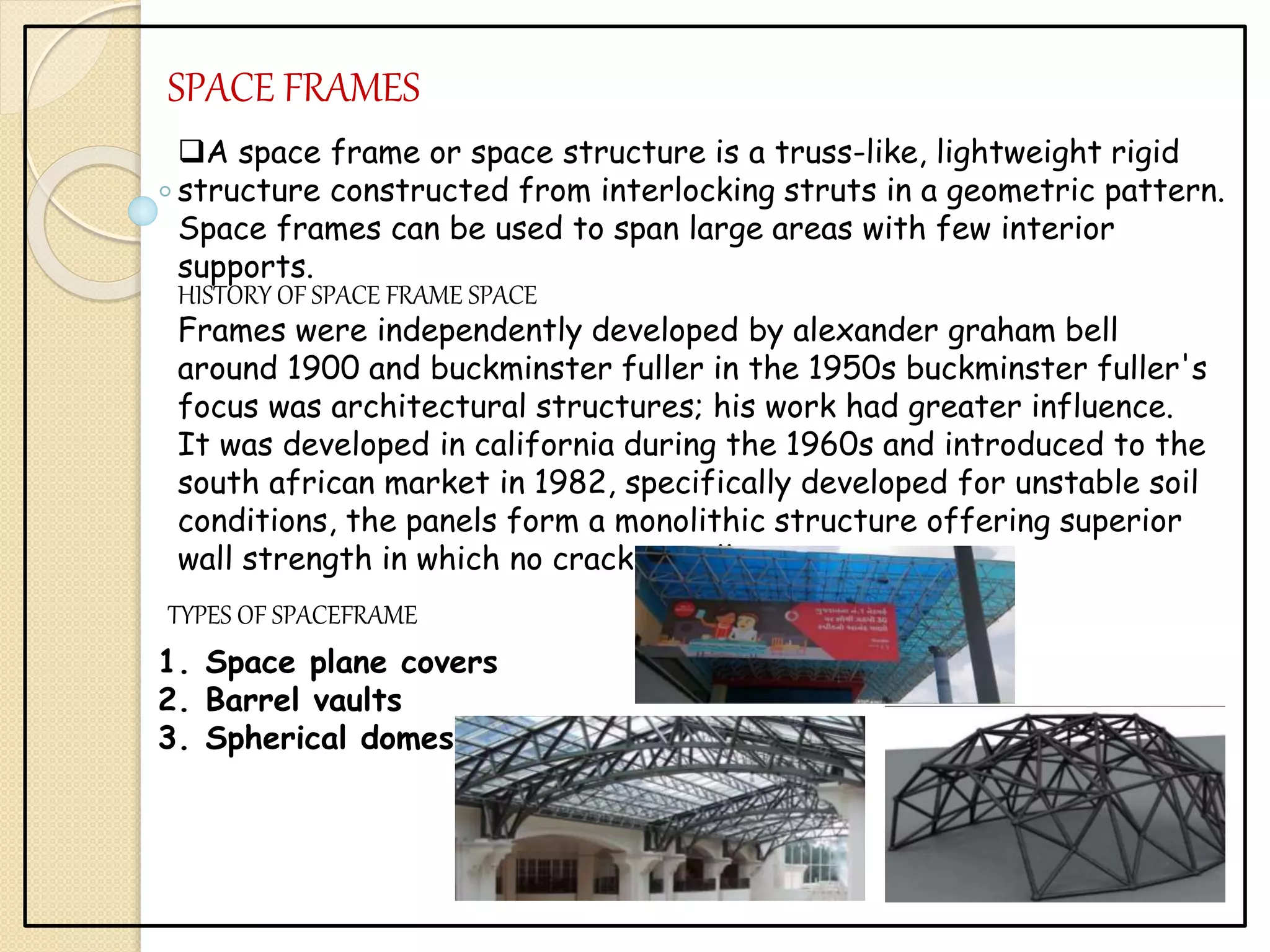
TYPES OF SPACEFRAME
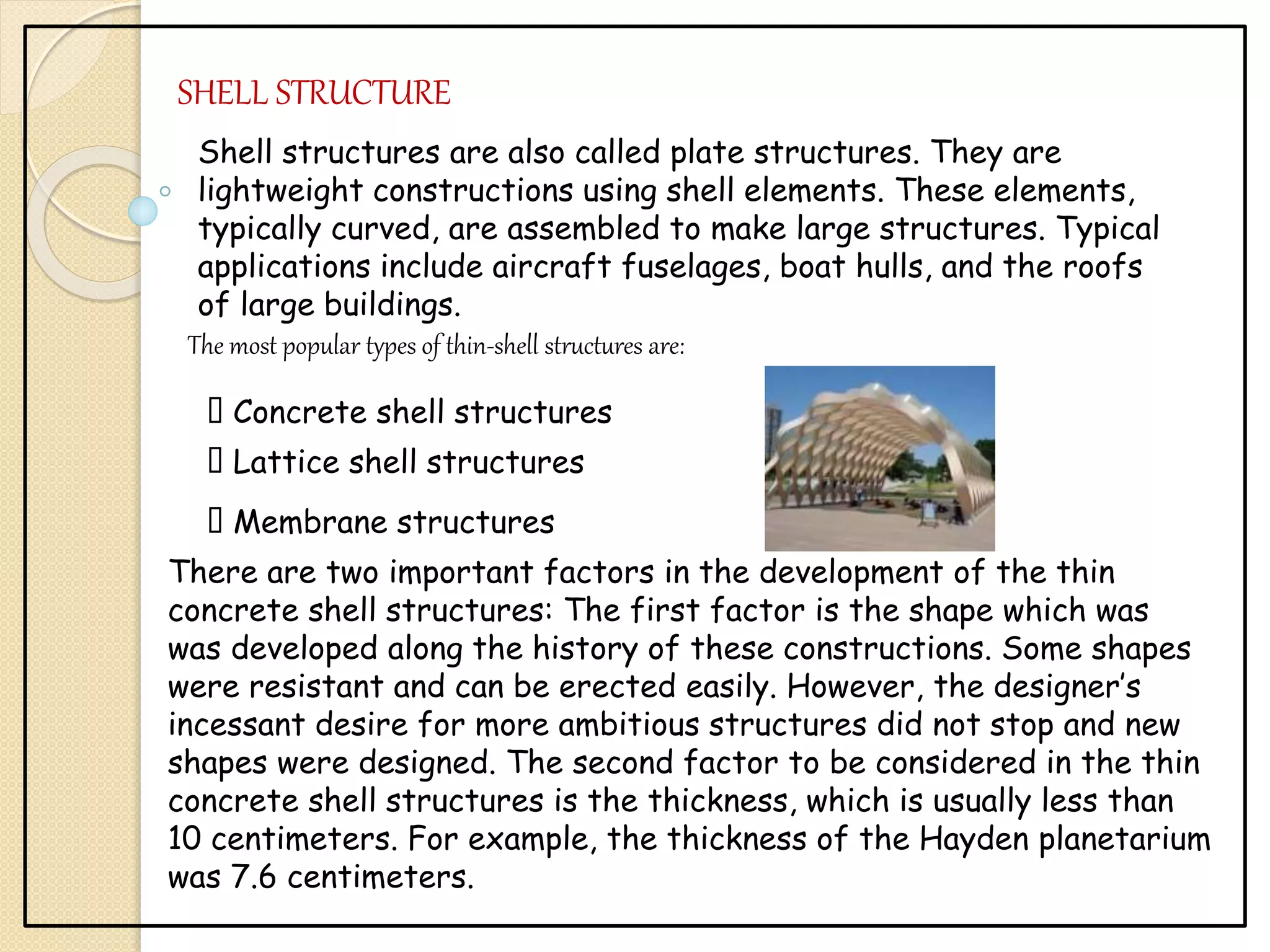
1. Space plane covers
2. Barrel vaults
3. Spherical domes
ADVANTAGES OF SPACE FRAMES
•Light.
•Elegant & economical.
• Carry load by three dimensional action.
•High inherent stiffness. Easy to construct.
•Save construction time & cost.
•Services (such as lighting and air conditioning) can be
integrated with space frames.
•Offer the architect unrestricted freedom in locating
supports and planning the subdivision of the covered
space.
• Durable materials & protective finishes.
•Construction is simple, safe and fast.
•No site painting or welding.
DISADVANTAGES
•One major disadvantage is that they can be difficult to
engineer.
•It's not straightforward to determine how forces will
distribute throughout a structure that has a lot of
redundant pieces.
SHELL STRUCTURE
Shell structures are also called plate structures. They are
lightweight constructions using shell elements. These elements,
typically curved, are assembled to make large structures. Typical
applications include aircraft fuselages, boat hulls, and the roofs
of large buildings.
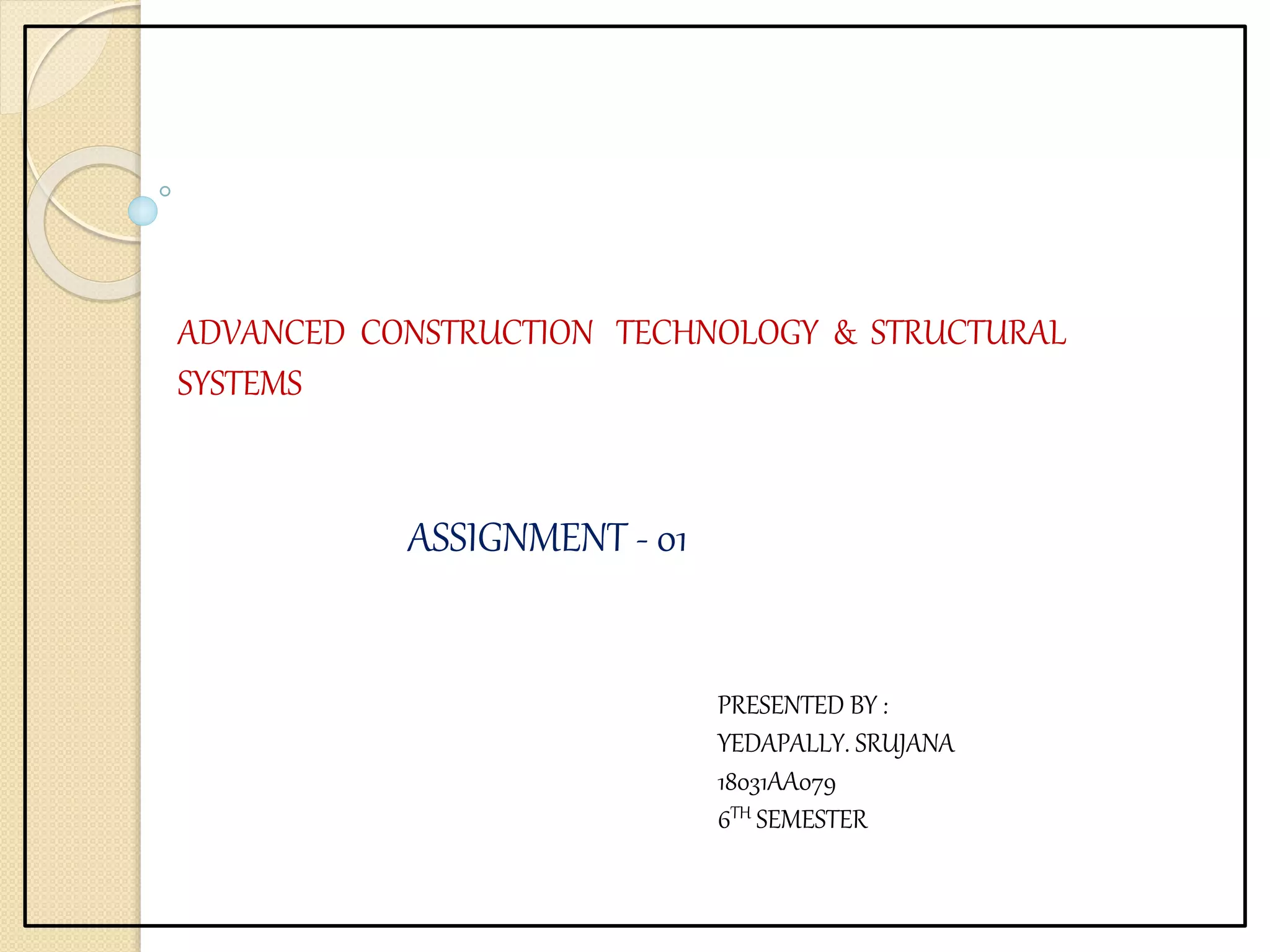
The most popular types of thin-shell structures are:
Concrete shell structures
Lattice shell structures
Membrane structures
There are two important factors in the development of the thin
concrete shell structures: The first factor is the shape which was
was developed along the history of these constructions. Some shapes
were resistant and can be erected easily. However, the designer’s
incessant desire for more ambitious structures did not stop and new
shapes were designed. The second factor to be considered in the thin
concrete shell structures is the thickness, which is usually less than
10 centimeters. For example, the thickness of the Hayden planetarium
was 7.6 centimeters.
Advantages of Concrete Shells:
The curved shapes often used for concrete shells are naturally
strong structures.
Shell allowing wide areas to be spanned without the use of internal
supports, giving an open, unobstructed interior.
The use of concrete as a building material reduces both materials
cost and the construction cost.
As concrete is relatively inexpensive and easily cast into compound
curves.
Disadvantages of Concrete Shells
•Since concrete is porous material, concrete domes often have issues
with sealing.
• If not treated, rainwater can seep through the roof and leak into
the interior of the building.
•On the other hand, the seamless construction of concrete domes
prevents air from escaping, and can lead to buildup of condensation
on the inside of the shell.
•Shingling or sealants are common solutions to the problem of
exterior moisture, and ventilation can address condensation.
THANK YOU

advanced construction

  • 1.
    ADVANCED CONSTRUCTION TECHNOLOGY& STRUCTURAL SYSTEMS PRESENTED BY : YEDAPALLY. SRUJANA 18031AA079 6TH SEMESTER ASSIGNMENT - 01
  • 2.
    PRECAST CONCRETE CONSTRUCTION •Precastconcrete means a concrete member that is cast and cured at a location other than its final designated location. • The use of reinforced concrete is a relatively recent invention, usually dated to 1848 • when jean- Louis Lambot became the first to use it. •Joseph Monier, a French gardener, patented a design for reinforced garden tubs in 1868, • And later patented reinforced concrete beams and posts for railway and road guardrails. What is Precast Concrete ? Popular Uses of Precast Concrete Concrete curtain walls As an exterior cladding (may include exposed aggregate) For structural walls Ability to precast in three dimensions allows precast panels to form parts of mechanical systems
  • 3.
    ADVANTAGES OF PRECASTCONCRETE CONSTRUCTION Very rapid speed of erection Good quality control Entire building can be precast-walls, floors , beams , etc. Rapid construction on site High quality because of the controlled conditions in the factory Prestressing is easily done which can reduce the size and number of the structural members. Disadvantages of Precast Concrete Construction Very heavy members Camber in beams and slabs Very small margin for error Connections may be difficult Somewhat limited building design flexibility Because panel size is limited, precast concrete can not be used for two-way structural systems. Economics of scale demand regularly shaped buildings. Need for repetition of forms will affect building design. Joints between panels are often expensive and complicated. Skilled workmanship is required in the application of the panel on site. Cranes are required to lift panels.
  • 4.
    FOLDED PLATES WHAT AREFOLDED PLATES? •Folded plates are assemblies of flat plates rigidly connected together along their edges in such a way that the structural system capable of carrying loads without the need for additional supporting beams along mutual edges. •Engineer Eudene Freyssinet performed the first roof with the folded structure in 1923 as an aircraft hangar at Orly Airport in Paris. THE PRINCIPLE OF FOLDING The structural characteristics of folding structures depend on: • The pattern of the folding. • Their geometrical basic shape. • Its material. • The connection of the different folding planes. • The design of the bearings. • Movable form work can be employed. • Form work required is relatively simpler. • Design involves simpler calculations.
  • 5.
    ADVANTAGES AND DISADVANTAGESOF FOLDED-PLATE STRUCTURE Advantages: • Very light form of construction. To span 30 m shell thickness required is 60 mm only. • The use of concrete as a building material reduces both materials cost and a construction cost. • Longer span can be provided. • Flat shapes by choosing certain arched shapes. • Aesthetically it looks good over other forms of construction. Disadvantages: • Shuttering is difficult. • Greater accuracy in formwork is required. • Good labor and supervision necessary. • Rise of roof may be a disadvantage. TYPES OF FOLDED STRUCTURE Based on geometric shape folded structures can be divided into: • Folded plate surfaces structures o Prismatic: Rectangular plates. o Pyramidal: Non-rectangular plates. o Prismoidal: Triangular or trapezoidal o plates • Folded plate frames structures • Spatial folded plate structures
  • 6.
    SPACE FRAMES A spaceframe or space structure is a truss-like, lightweight rigid structure constructed from interlocking struts in a geometric pattern. Space frames can be used to span large areas with few interior supports. HISTORY OF SPACE FRAME SPACE Frames were independently developed by alexander graham bell around 1900 and buckminster fuller in the 1950s buckminster fuller's focus was architectural structures; his work had greater influence. It was developed in california during the 1960s and introduced to the south african market in 1982, specifically developed for unstable soil conditions, the panels form a monolithic structure offering superior wall strength in which no cracking will occur TYPES OF SPACEFRAME 1. Space plane covers 2. Barrel vaults 3. Spherical domes
  • 7.
    ADVANTAGES OF SPACEFRAMES •Light. •Elegant & economical. • Carry load by three dimensional action. •High inherent stiffness. Easy to construct. •Save construction time & cost. •Services (such as lighting and air conditioning) can be integrated with space frames. •Offer the architect unrestricted freedom in locating supports and planning the subdivision of the covered space. • Durable materials & protective finishes. •Construction is simple, safe and fast. •No site painting or welding. DISADVANTAGES •One major disadvantage is that they can be difficult to engineer. •It's not straightforward to determine how forces will distribute throughout a structure that has a lot of redundant pieces.
  • 8.
    SHELL STRUCTURE Shell structuresare also called plate structures. They are lightweight constructions using shell elements. These elements, typically curved, are assembled to make large structures. Typical applications include aircraft fuselages, boat hulls, and the roofs of large buildings. The most popular types of thin-shell structures are: Concrete shell structures Lattice shell structures Membrane structures There are two important factors in the development of the thin concrete shell structures: The first factor is the shape which was was developed along the history of these constructions. Some shapes were resistant and can be erected easily. However, the designer’s incessant desire for more ambitious structures did not stop and new shapes were designed. The second factor to be considered in the thin concrete shell structures is the thickness, which is usually less than 10 centimeters. For example, the thickness of the Hayden planetarium was 7.6 centimeters.
  • 9.
    Advantages of ConcreteShells: The curved shapes often used for concrete shells are naturally strong structures. Shell allowing wide areas to be spanned without the use of internal supports, giving an open, unobstructed interior. The use of concrete as a building material reduces both materials cost and the construction cost. As concrete is relatively inexpensive and easily cast into compound curves. Disadvantages of Concrete Shells •Since concrete is porous material, concrete domes often have issues with sealing. • If not treated, rainwater can seep through the roof and leak into the interior of the building. •On the other hand, the seamless construction of concrete domes prevents air from escaping, and can lead to buildup of condensation on the inside of the shell. •Shingling or sealants are common solutions to the problem of exterior moisture, and ventilation can address condensation. THANK YOU