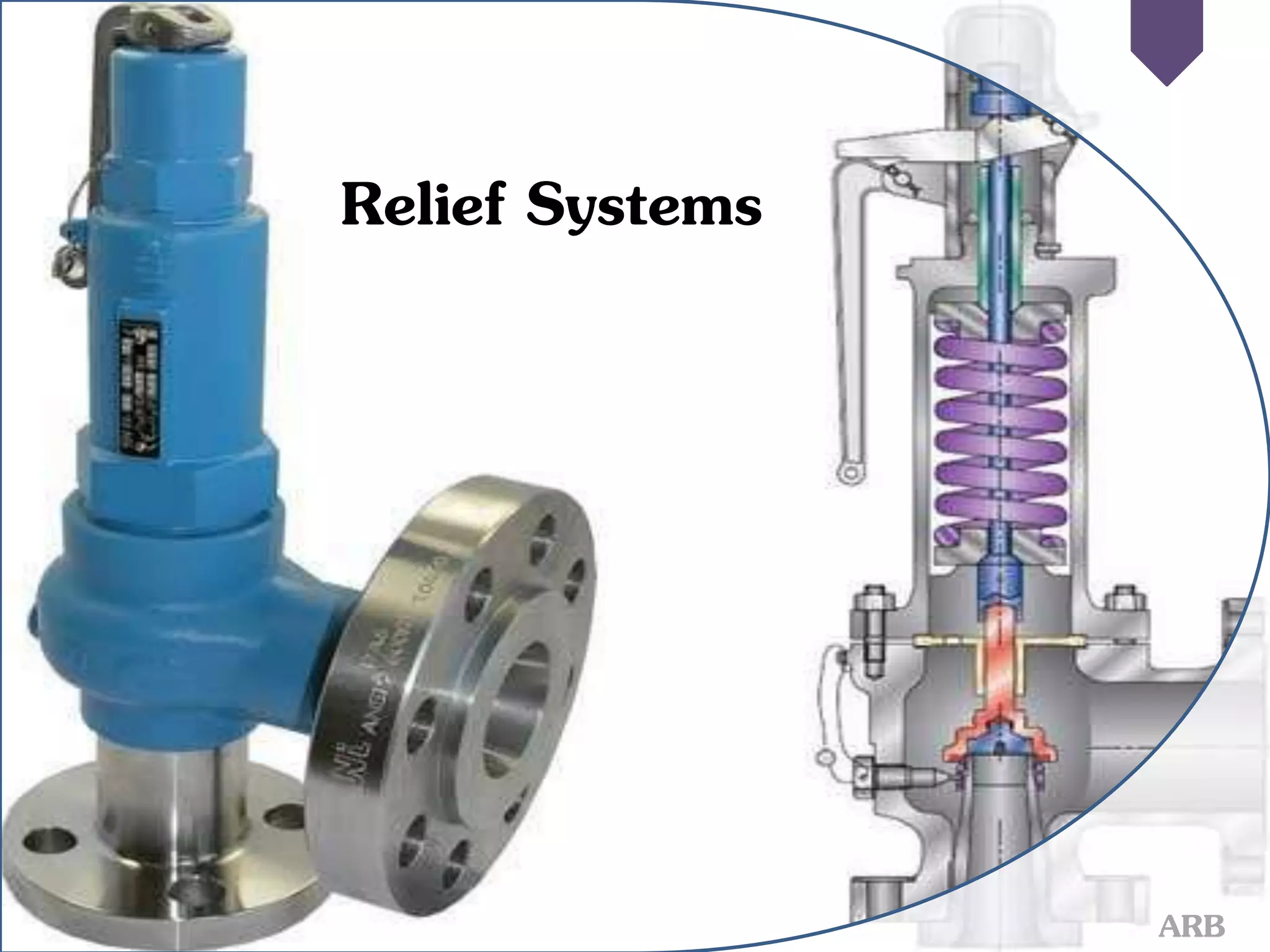
Relief Systems
ARB
Content
• Introduction to Reliefs
• Relief Concept
• Definitions
• Location of Reliefs
• Relief Types and Characteristics
• Data for Sizing Reliefs
• Relief Systems (Relief Installation Practices)
Introduction to Reliefs
• Despite many safety precautions within chemical plants, equipment
failures or operator errors can cause increases in process pressures
beyond safe levels.
• If pressures rise too high, they may exceed the maximum strength of
pipelines and vessels. This can result in rupturing of process equipment,
causing major releases of toxic or flammable chemicals.
• The defense against this type of accident is to prevent the accident in the
first place. The second line of defense is better process control.
• The third line of defense against excessive pressures is to install relief
systems to relieve liquids or gases before excessive pressures are
developed.
• The relief system is composed of the relief device and the associated
downstream process equipment to safely handle the material ejected.
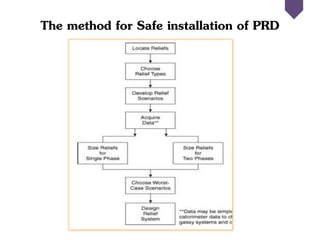
The method for Safe installation of PRD
Relief Concept
Pressure relief systems are required for the following reasons:
• To protect personnel from the dangers of over pressurizing
equipment
• To minimize chemical losses during pressure upsets
• To prevent damage to equipment
• To prevent damage to adjoining property
• To reduce insurance premiums
• To comply with governmental regulations
Definitions
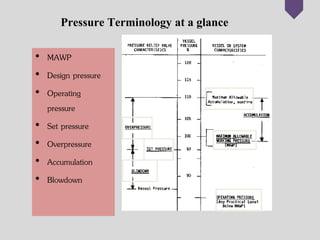
• Set pressure: The pressure at which the relief device begins to activate.
• Maximum allowable working pressure (MAWP): The maximum gauge pressure
permissible at the top of a vessel for a designated temperature. This is sometimes called
the design pressure. Vessel failure typically occurs at 4 or 5 times the
• Backpressure: The pressure at the outlet of the relief device during the relief process
resulting from pressure in the discharge system.
• Blowdown: The pressure difference between the relief set pressure and the relief
reseating pressure. It is expressed as a percentage of the set pressure.
• Maximum allowable accumulated pressure: The sum of the MAWP and the
allowable accumulation.
• Relief system: The network of components around a relief device, including the pipe
to the relief, the relief device, discharge pipelines, knockout drum, scrubber, flare, or
other types of equipment that assist in the safe relief process.
Contd.,
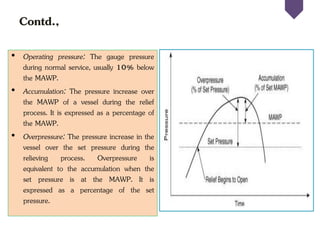
• Operating pressure: The gauge pressure
during normal service, usually 10% below
the MAWP.
• Accumulation: The pressure increase over
the MAWP of a vessel during the relief
process. It is expressed as a percentage of
the MAWP.
• Overpressure: The pressure increase in the
vessel over the set pressure during the
relieving process. Overpressure is
equivalent to the accumulation when the
set pressure is at the MAWP. It is
expressed as a percentage of the set
pressure.
Pressure Terminology at a glance
• MAWP
• Design pressure
• Operating
pressure
• Set pressure
• Overpressure
• Accumulation
• Blowdown
Location of Reliefs
Pressure relief devices are installed at every point identified as potentially hazardous,
that is, at points where upset conditions create pressures that may exceed the MAWP.
The types of questions asked in this review process are
• What happens with loss of cooling, heating, or agitation?
• What happens if the process is contaminated or has a mischarge of a catalyst or
monomer?
• What happens if the operator makes an error?
• What is the consequence of closing valves (block valves) on vessels or in lines that
are filled with liquids and exposed to heat or refrigeration?
• What happens if a line fails, for example, a failure of a high-pressure gas line into
a low-pressure vessel?
• What happens if the unit operation is engulfed in a fire?
• What conditions cause runaway reactions, and how are relief systems designed to
handle the discharge as a result of runaway reactions?
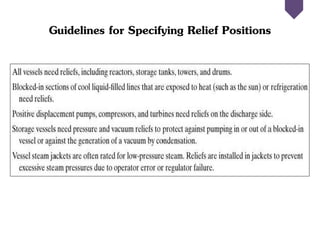
Guidelines for Specifying Relief Positions
Example
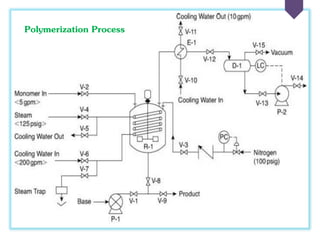
• Specify the location of reliefs in the simple polymerization reactor
system illustrated in Fig. The major steps in this polymerization
process include (1) pumping 100 lb of initiator into reactor R- 1, (2)
heating to the reaction temperature of 240°F, (3) adding monomer for a
period of 3 hr, and (4) stripping the residual monomer by means of a
vacuum using valve V-15. Because the reaction is exothermic, cooling
during monomer addition with cooling water is necessary.
Polymerization Process
Solution
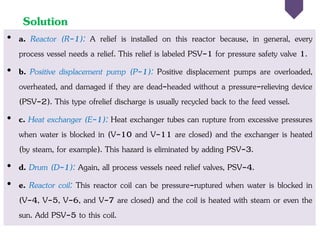
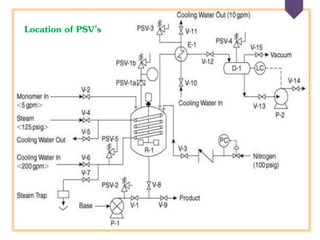
• a. Reactor (R-1): A relief is installed on this reactor because, in general, every
process vessel needs a relief. This relief is labeled PSV-1 for pressure safety valve 1.
• b. Positive displacement pump (P-1): Positive displacement pumps are overloaded,
overheated, and damaged if they are dead-headed without a pressure-relieving device
(PSV-2). This type ofrelief discharge is usually recycled back to the feed vessel.
• c. Heat exchanger (E-1): Heat exchanger tubes can rupture from excessive pressures
when water is blocked in (V-10 and V-11 are closed) and the exchanger is heated
(by steam, for example). This hazard is eliminated by adding PSV-3.
• d. Drum (D-1): Again, all process vessels need relief valves, PSV-4.
• e. Reactor coil: This reactor coil can be pressure-ruptured when water is blocked in
(V-4, V-5, V-6, and V-7 are closed) and the coil is heated with steam or even the
sun. Add PSV-5 to this coil.
Location of PSV’s
Relief Types and Characteristics
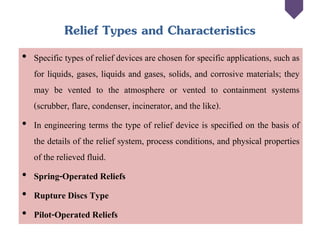
• Specific types of relief devices are chosen for specific applications, such as
for liquids, gases, liquids and gases, solids, and corrosive materials; they
may be vented to the atmosphere or vented to containment systems
(scrubber, flare, condenser, incinerator, and the like).
• In engineering terms the type of relief device is specified on the basis of
the details of the relief system, process conditions, and physical properties
of the relieved fluid.
• Spring-Operated Reliefs
• Rupture Discs Type
• Pilot-Operated Reliefs
Spring-Operated Reliefs
Conventional Type
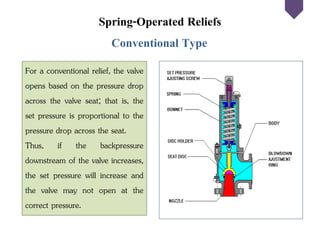
For a conventional relief, the valve
opens based on the pressure drop
across the valve seat; that is, the
set pressure is proportional to the
pressure drop across the seat.
Thus, if the backpressure
downstream of the valve increases,
the set pressure will increase and
the valve may not open at the
correct pressure.
• For the balanced-bellows
design the bellows on the
backside of the valve seat
ensures that the pressure
on that side of the seat is
always atmospheric.
• Thus the balanced-bellows
valve will always open at
the desired set pressure.
Spring-Operated Reliefs
Balanced Bellows Type
Pros & Cons:
Conventional Valve
• Advantages
+ Most reliable type if properly sized and operated
+ Versatile -- can be used in many services
• Disadvantages
– Relieving pressure affected by back pressure
– Susceptible to chatter if built-up back pressure is too high
• Chattering is the rapid opening and closing of a relief valve that
can cause valve seat damage or the mechanical failure of the
internals.
Pros & Cons:
Balanced Bellows Valve
• Advantages
+ Relieving pressure not affected by back pressure
+ Can handle higher built-up back pressure
+ Protects spring from corrosion
• Disadvantages
– Bellows susceptible to fatigue/rupture
– May release flammables/toxics to atmosphere
– Requires separate venting system
Subcategory types of spring-loaded pressure reliefs
• 1. The relief valve is primarily for liquid service. The relief valve (liquid
only) begins to open at the set pressure. This valve reaches full capacity
when the pressure reaches 25% overpressure. The valve closes as the
pressure returns to the set pressure.
• 2. The safety valve is for gas service. Safety valves pop open when the
pressure exceeds the set pressure. This is accomplished by using a discharge
nozzle that directs high-velocity material toward the valve seat. After
blowdown of the excess pressure, the valve reseats at approximately 4%
below the set pressure; the valve has a 4% blowdown.
• 3. The safety relief valve is used for liquid and gas service. Safety relief
valves function as relief valves for liquids and as safety valves for gases.
Pilot-Operated Reliefs
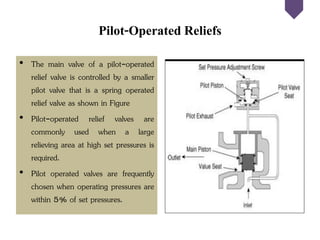
• The main valve of a pilot-operated
relief valve is controlled by a smaller
pilot valve that is a spring operated
relief valve as shown in Figure
• Pilot-operated relief valves are
commonly used when a large
relieving area at high set pressures is
required.
• Pilot operated valves are frequently
chosen when operating pressures are
within 5% of set pressures.
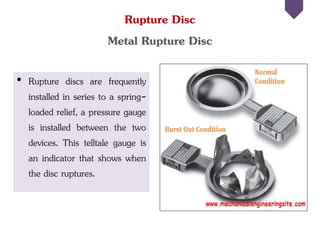
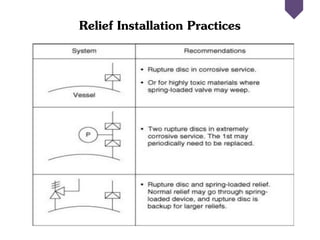
Rupture Disc
Metal Rupture Disc
• Rupture discs are frequently
installed in series to a spring-
loaded relief, a pressure gauge
is installed between the two
devices. This telltale gauge is
an indicator that shows when
the disc ruptures.
Advantages of Rupture Discs
• (1) to protect an expensive spring-loaded device from a
corrosive environment,
• (2) to give absolute isolation when handling extremely toxic
chemicals (spring-loaded reliefs may weep),
• (3) to give absolute isolation when handling flammable gases,
• (4) to protect the relatively complex parts of a spring-loaded
device from reactive monomers that could cause plugging, and
• (5) to relieve slurries that may plug spring-loaded devices.
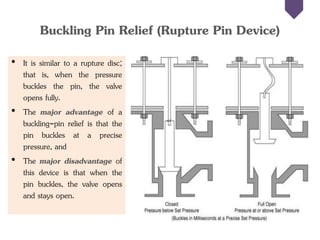
Buckling Pin Relief (Rupture Pin Device)
• It is similar to a rupture disc;
that is, when the pressure
buckles the pin, the valve
opens fully.
• The major advantage of a
buckling-pin relief is that the
pin buckles at a precise
pressure, and
• The major disadvantage of
this device is that when the
pin buckles, the valve opens
and stays open.
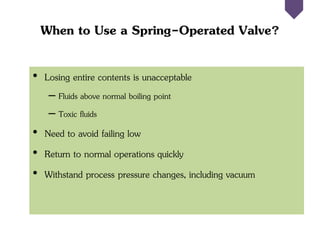
When to Use a Spring-Operated Valve?
• Losing entire contents is unacceptable
– Fluids above normal boiling point
– Toxic fluids
• Need to avoid failing low
• Return to normal operations quickly
• Withstand process pressure changes, including vacuum
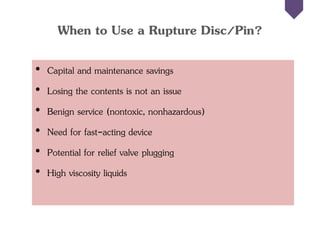
When to Use a Rupture Disc/Pin?
• Capital and maintenance savings
• Losing the contents is not an issue
• Benign service (nontoxic, nonhazardous)
• Need for fast-acting device
• Potential for relief valve plugging
• High viscosity liquids
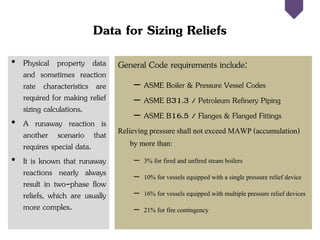
Data for Sizing Reliefs
• Physical property data
and sometimes reaction
rate characteristics are
required for making relief
sizing calculations.
• A runaway reaction is
another scenario that
requires special data.
• It is known that runaway
reactions nearly always
result in two-phase flow
reliefs, which are usually
more complex.
General Code requirements include:
– ASME Boiler & Pressure Vessel Codes
– ASME B31.3 / Petroleum Refinery Piping
– ASME B16.5 / Flanges & Flanged Fittings
Relieving pressureshall not exceed MAWP (accumulation)
by more than:
– 3% for fired and unfired steam boilers
– 10% for vessels equipped with a single pressure relief device
– 16% for vessels equipped with multiple pressure relief devices
– 21% for fire contingency
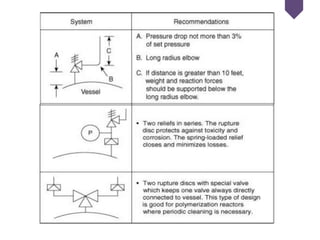
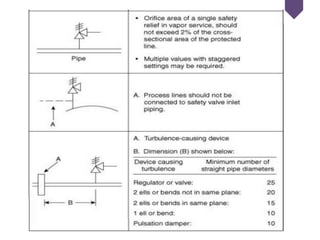
Relief Installation Practices
References
• Chemical Process Safety (Fundamentals with applications),
D.A.Crowl & J.F.Louvar, Prentice Hall, New Jersey,(1990).
• Safety and Accident Prevention in Chemical Operations, 2nd ed., H.
H. Fawcett and W.S. Wood, John Wiley and Sons, New York
1982
---ARB

Relief Systems.pdf

  • 1.
  • 2.
    Content • Introduction toReliefs • Relief Concept • Definitions • Location of Reliefs • Relief Types and Characteristics • Data for Sizing Reliefs • Relief Systems (Relief Installation Practices)
  • 3.
    Introduction to Reliefs •Despite many safety precautions within chemical plants, equipment failures or operator errors can cause increases in process pressures beyond safe levels. • If pressures rise too high, they may exceed the maximum strength of pipelines and vessels. This can result in rupturing of process equipment, causing major releases of toxic or flammable chemicals. • The defense against this type of accident is to prevent the accident in the first place. The second line of defense is better process control. • The third line of defense against excessive pressures is to install relief systems to relieve liquids or gases before excessive pressures are developed. • The relief system is composed of the relief device and the associated downstream process equipment to safely handle the material ejected.
  • 4.
    The method forSafe installation of PRD
  • 5.
    Relief Concept Pressure reliefsystems are required for the following reasons: • To protect personnel from the dangers of over pressurizing equipment • To minimize chemical losses during pressure upsets • To prevent damage to equipment • To prevent damage to adjoining property • To reduce insurance premiums • To comply with governmental regulations
  • 6.
    Definitions • Set pressure:The pressure at which the relief device begins to activate. • Maximum allowable working pressure (MAWP): The maximum gauge pressure permissible at the top of a vessel for a designated temperature. This is sometimes called the design pressure. Vessel failure typically occurs at 4 or 5 times the • Backpressure: The pressure at the outlet of the relief device during the relief process resulting from pressure in the discharge system. • Blowdown: The pressure difference between the relief set pressure and the relief reseating pressure. It is expressed as a percentage of the set pressure. • Maximum allowable accumulated pressure: The sum of the MAWP and the allowable accumulation. • Relief system: The network of components around a relief device, including the pipe to the relief, the relief device, discharge pipelines, knockout drum, scrubber, flare, or other types of equipment that assist in the safe relief process.
  • 7.
    Contd., • Operating pressure:The gauge pressure during normal service, usually 10% below the MAWP. • Accumulation: The pressure increase over the MAWP of a vessel during the relief process. It is expressed as a percentage of the MAWP. • Overpressure: The pressure increase in the vessel over the set pressure during the relieving process. Overpressure is equivalent to the accumulation when the set pressure is at the MAWP. It is expressed as a percentage of the set pressure.
  • 8.
    Pressure Terminology ata glance • MAWP • Design pressure • Operating pressure • Set pressure • Overpressure • Accumulation • Blowdown
  • 9.
    Location of Reliefs Pressurerelief devices are installed at every point identified as potentially hazardous, that is, at points where upset conditions create pressures that may exceed the MAWP. The types of questions asked in this review process are • What happens with loss of cooling, heating, or agitation? • What happens if the process is contaminated or has a mischarge of a catalyst or monomer? • What happens if the operator makes an error? • What is the consequence of closing valves (block valves) on vessels or in lines that are filled with liquids and exposed to heat or refrigeration? • What happens if a line fails, for example, a failure of a high-pressure gas line into a low-pressure vessel? • What happens if the unit operation is engulfed in a fire? • What conditions cause runaway reactions, and how are relief systems designed to handle the discharge as a result of runaway reactions?
  • 10.
    Guidelines for SpecifyingRelief Positions
  • 11.
    Example • Specify thelocation of reliefs in the simple polymerization reactor system illustrated in Fig. The major steps in this polymerization process include (1) pumping 100 lb of initiator into reactor R- 1, (2) heating to the reaction temperature of 240°F, (3) adding monomer for a period of 3 hr, and (4) stripping the residual monomer by means of a vacuum using valve V-15. Because the reaction is exothermic, cooling during monomer addition with cooling water is necessary.
  • 12.
  • 13.
    Solution • a. Reactor(R-1): A relief is installed on this reactor because, in general, every process vessel needs a relief. This relief is labeled PSV-1 for pressure safety valve 1. • b. Positive displacement pump (P-1): Positive displacement pumps are overloaded, overheated, and damaged if they are dead-headed without a pressure-relieving device (PSV-2). This type ofrelief discharge is usually recycled back to the feed vessel. • c. Heat exchanger (E-1): Heat exchanger tubes can rupture from excessive pressures when water is blocked in (V-10 and V-11 are closed) and the exchanger is heated (by steam, for example). This hazard is eliminated by adding PSV-3. • d. Drum (D-1): Again, all process vessels need relief valves, PSV-4. • e. Reactor coil: This reactor coil can be pressure-ruptured when water is blocked in (V-4, V-5, V-6, and V-7 are closed) and the coil is heated with steam or even the sun. Add PSV-5 to this coil.
  • 14.
  • 15.
    Relief Types andCharacteristics • Specific types of relief devices are chosen for specific applications, such as for liquids, gases, liquids and gases, solids, and corrosive materials; they may be vented to the atmosphere or vented to containment systems (scrubber, flare, condenser, incinerator, and the like). • In engineering terms the type of relief device is specified on the basis of the details of the relief system, process conditions, and physical properties of the relieved fluid. • Spring-Operated Reliefs • Rupture Discs Type • Pilot-Operated Reliefs
  • 16.
    Spring-Operated Reliefs Conventional Type Fora conventional relief, the valve opens based on the pressure drop across the valve seat; that is, the set pressure is proportional to the pressure drop across the seat. Thus, if the backpressure downstream of the valve increases, the set pressure will increase and the valve may not open at the correct pressure.
  • 17.
    • For thebalanced-bellows design the bellows on the backside of the valve seat ensures that the pressure on that side of the seat is always atmospheric. • Thus the balanced-bellows valve will always open at the desired set pressure. Spring-Operated Reliefs Balanced Bellows Type
  • 18.
    Pros & Cons: ConventionalValve • Advantages + Most reliable type if properly sized and operated + Versatile -- can be used in many services • Disadvantages – Relieving pressure affected by back pressure – Susceptible to chatter if built-up back pressure is too high • Chattering is the rapid opening and closing of a relief valve that can cause valve seat damage or the mechanical failure of the internals.
  • 19.
    Pros & Cons: BalancedBellows Valve • Advantages + Relieving pressure not affected by back pressure + Can handle higher built-up back pressure + Protects spring from corrosion • Disadvantages – Bellows susceptible to fatigue/rupture – May release flammables/toxics to atmosphere – Requires separate venting system
  • 20.
    Subcategory types ofspring-loaded pressure reliefs • 1. The relief valve is primarily for liquid service. The relief valve (liquid only) begins to open at the set pressure. This valve reaches full capacity when the pressure reaches 25% overpressure. The valve closes as the pressure returns to the set pressure. • 2. The safety valve is for gas service. Safety valves pop open when the pressure exceeds the set pressure. This is accomplished by using a discharge nozzle that directs high-velocity material toward the valve seat. After blowdown of the excess pressure, the valve reseats at approximately 4% below the set pressure; the valve has a 4% blowdown. • 3. The safety relief valve is used for liquid and gas service. Safety relief valves function as relief valves for liquids and as safety valves for gases.
  • 21.
    Pilot-Operated Reliefs • Themain valve of a pilot-operated relief valve is controlled by a smaller pilot valve that is a spring operated relief valve as shown in Figure • Pilot-operated relief valves are commonly used when a large relieving area at high set pressures is required. • Pilot operated valves are frequently chosen when operating pressures are within 5% of set pressures.
  • 22.
    Rupture Disc Metal RuptureDisc • Rupture discs are frequently installed in series to a spring- loaded relief, a pressure gauge is installed between the two devices. This telltale gauge is an indicator that shows when the disc ruptures.
  • 23.
    Advantages of RuptureDiscs • (1) to protect an expensive spring-loaded device from a corrosive environment, • (2) to give absolute isolation when handling extremely toxic chemicals (spring-loaded reliefs may weep), • (3) to give absolute isolation when handling flammable gases, • (4) to protect the relatively complex parts of a spring-loaded device from reactive monomers that could cause plugging, and • (5) to relieve slurries that may plug spring-loaded devices.
  • 24.
    Buckling Pin Relief(Rupture Pin Device) • It is similar to a rupture disc; that is, when the pressure buckles the pin, the valve opens fully. • The major advantage of a buckling-pin relief is that the pin buckles at a precise pressure, and • The major disadvantage of this device is that when the pin buckles, the valve opens and stays open.
  • 25.
    When to Usea Spring-Operated Valve? • Losing entire contents is unacceptable – Fluids above normal boiling point – Toxic fluids • Need to avoid failing low • Return to normal operations quickly • Withstand process pressure changes, including vacuum
  • 26.
    When to Usea Rupture Disc/Pin? • Capital and maintenance savings • Losing the contents is not an issue • Benign service (nontoxic, nonhazardous) • Need for fast-acting device • Potential for relief valve plugging • High viscosity liquids
  • 27.
    Data for SizingReliefs • Physical property data and sometimes reaction rate characteristics are required for making relief sizing calculations. • A runaway reaction is another scenario that requires special data. • It is known that runaway reactions nearly always result in two-phase flow reliefs, which are usually more complex. General Code requirements include: – ASME Boiler & Pressure Vessel Codes – ASME B31.3 / Petroleum Refinery Piping – ASME B16.5 / Flanges & Flanged Fittings Relieving pressureshall not exceed MAWP (accumulation) by more than: – 3% for fired and unfired steam boilers – 10% for vessels equipped with a single pressure relief device – 16% for vessels equipped with multiple pressure relief devices – 21% for fire contingency
  • 28.
  • 31.
    References • Chemical ProcessSafety (Fundamentals with applications), D.A.Crowl & J.F.Louvar, Prentice Hall, New Jersey,(1990). • Safety and Accident Prevention in Chemical Operations, 2nd ed., H. H. Fawcett and W.S. Wood, John Wiley and Sons, New York 1982
  • 32.