Subject Name :Computer Architecture
Presentation Title: Single Accumulator Based CPU Organisation
Team Members:
Students Name Reg.No:
1.Prabha .k 210618104032
2.Moreen Joice.J 210618104030
3.Vidula .V 210618104054
4.Abarna .E 210618104001
5.Saranya .I 210618104045
6.Swetha .P 210618104052
JEPPIAAR INSTITUTE OF TECHNOLOGY
“Self-Belief | Self Discipline | Self Respect”
Department of Computer Science and Engineering
Single Accumulator based CPU
organization
The computers, present in the early days of computer history, had
accumulator based CPUs.
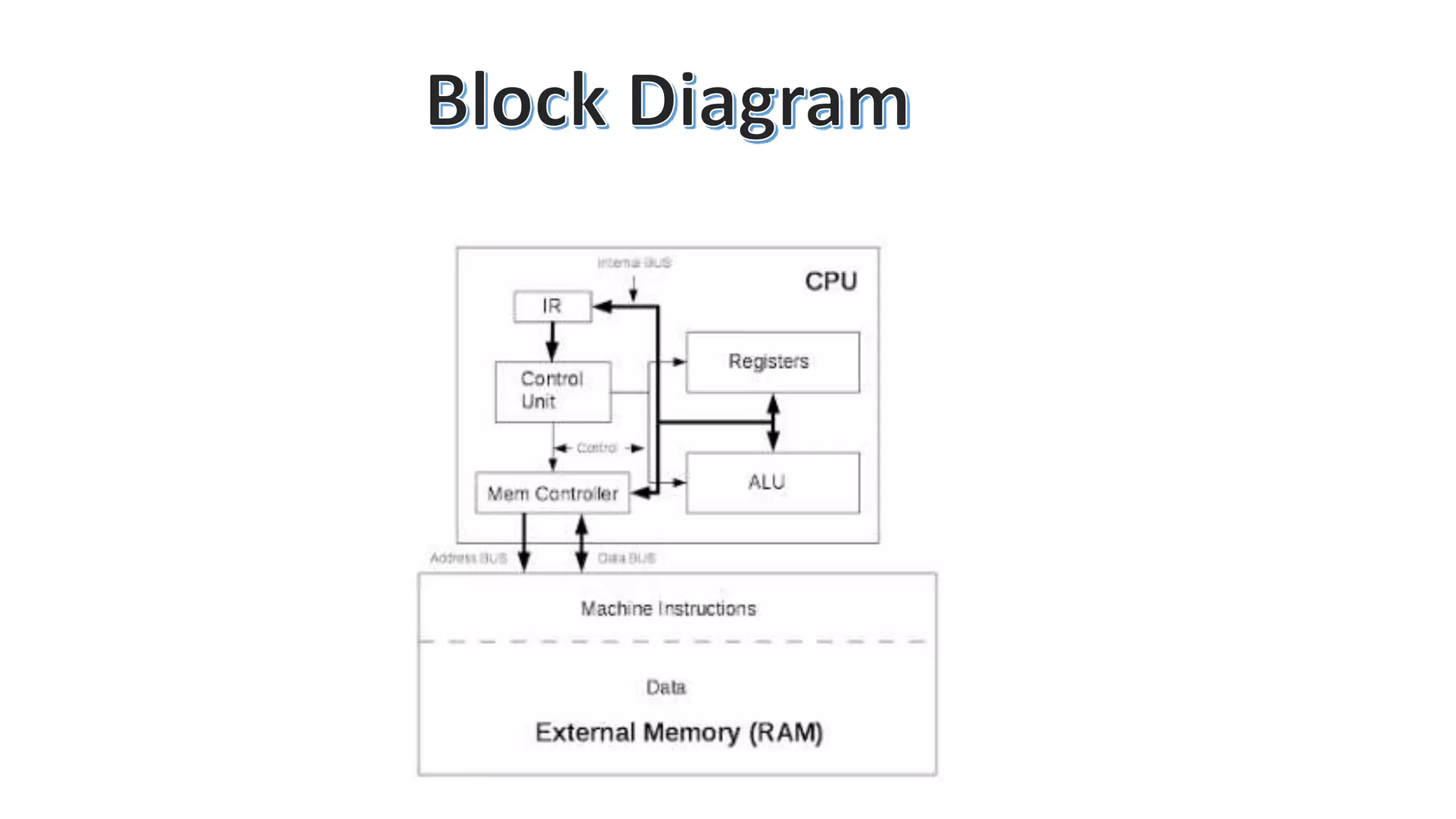
In this type of CPU organization, the accumulator register is used
implicitly for processing all instructions of a program and store the results
into the accumulator.
Single Accumulator based CPU
organization
>The main points about Single Accumulator based CPU Organisation are:
In this CPU Organization, the first ALU operand is always stored into the
Accumulator and the second operand is present either in Registers or in
the Memory.
Single Accumulator based CPU organization
• Accumulator is the default address thus after data manipulation the
results are stored into the accumulator.
• One address instruction is used in this type of organization.
• The instruction format that is used by this CPU Organisation is One
address field. Due to this the CPU is known as One Address Machine.
–
>In this type of operation, the data is transferred from a source to a destination.
For ex: LOAD X, STORE Y
>Here LOAD is memory read operation that is data is transfer from memory to accumulator
and STORE is memory write operation that is data is transfer from accumulator to memory.
Data transfer operation
ALUoperation –
>In this type of operation, arithmetic operations are performed on
the data.
For ex: MULT X
>where X is the address of the operand. The MULT instruction in
this example performs the operation,
AC <-- AC * M[X]
>AC is the Accumulator and M[X] is the memory word located at
location X.
>This type of CPU organization is first used in PDP-8
processor and is used for process control and laboratory
applications.
>It has been totally replaced by the introduction of the new
general register based CPU.
Advantages
One of the operands is always held by the accumulator register. This
results in short instructions and less memory space.
Instruction cycle takes less time because it saves time in instruction
fetching from memory.
Disadvantages
• When complex expressions are computed, program size increases due
to the usage of many short instructions to execute it. Thus memory
size increases.
• As the number of instructions increases for a program, the execution
time increases.
1. "HC16 Overview". Freescale.com. Archived from the original on 28 September
2007. Retrieved 2008-09-22.
2.^ J. Presper Eckert, "A Survey of Digital Computer Memory Systems", IEEE
Annals of the History of Computing, 1988, pp. 15-28.
3.^ "The Feasibility of Ludgate's Analytical Machine".
4.^ Jump up to:a b Haigh, Thomas; Priestley, Mark; Ropefir, Crispin (2016). ENIAC in
Action: Making and Remaking the Modern Computer. MIT
Press. ISBN 9780262334419.
5.^ Digital Equipment Corporation, Maynard, Massachusetts (1961)
"PROGRAMMED DATA PROCESSOR-1 MANUAL", page 7: PDP-1 system block
diagram accessdate=2014-07-03. The PDP-1 was an 18-bit processor, and was a
predecessor of PDP-8
THANK YOU

Single accumulator based CPU.pptx

  • 1.
    Subject Name :ComputerArchitecture Presentation Title: Single Accumulator Based CPU Organisation Team Members: Students Name Reg.No: 1.Prabha .k 210618104032 2.Moreen Joice.J 210618104030 3.Vidula .V 210618104054 4.Abarna .E 210618104001 5.Saranya .I 210618104045 6.Swetha .P 210618104052 JEPPIAAR INSTITUTE OF TECHNOLOGY “Self-Belief | Self Discipline | Self Respect” Department of Computer Science and Engineering
  • 2.
    Single Accumulator basedCPU organization The computers, present in the early days of computer history, had accumulator based CPUs. In this type of CPU organization, the accumulator register is used implicitly for processing all instructions of a program and store the results into the accumulator.
  • 3.
    Single Accumulator basedCPU organization >The main points about Single Accumulator based CPU Organisation are: In this CPU Organization, the first ALU operand is always stored into the Accumulator and the second operand is present either in Registers or in the Memory.
  • 4.
    Single Accumulator basedCPU organization • Accumulator is the default address thus after data manipulation the results are stored into the accumulator. • One address instruction is used in this type of organization. • The instruction format that is used by this CPU Organisation is One address field. Due to this the CPU is known as One Address Machine.
  • 6.
    – >In this typeof operation, the data is transferred from a source to a destination. For ex: LOAD X, STORE Y >Here LOAD is memory read operation that is data is transfer from memory to accumulator and STORE is memory write operation that is data is transfer from accumulator to memory. Data transfer operation
  • 7.
    ALUoperation – >In thistype of operation, arithmetic operations are performed on the data. For ex: MULT X >where X is the address of the operand. The MULT instruction in this example performs the operation, AC <-- AC * M[X]
  • 8.
    >AC is theAccumulator and M[X] is the memory word located at location X. >This type of CPU organization is first used in PDP-8 processor and is used for process control and laboratory applications. >It has been totally replaced by the introduction of the new general register based CPU.
  • 9.
    Advantages One of theoperands is always held by the accumulator register. This results in short instructions and less memory space. Instruction cycle takes less time because it saves time in instruction fetching from memory.
  • 10.
    Disadvantages • When complexexpressions are computed, program size increases due to the usage of many short instructions to execute it. Thus memory size increases. • As the number of instructions increases for a program, the execution time increases.
  • 11.
    1. "HC16 Overview".Freescale.com. Archived from the original on 28 September 2007. Retrieved 2008-09-22. 2.^ J. Presper Eckert, "A Survey of Digital Computer Memory Systems", IEEE Annals of the History of Computing, 1988, pp. 15-28. 3.^ "The Feasibility of Ludgate's Analytical Machine". 4.^ Jump up to:a b Haigh, Thomas; Priestley, Mark; Ropefir, Crispin (2016). ENIAC in Action: Making and Remaking the Modern Computer. MIT Press. ISBN 9780262334419. 5.^ Digital Equipment Corporation, Maynard, Massachusetts (1961) "PROGRAMMED DATA PROCESSOR-1 MANUAL", page 7: PDP-1 system block diagram accessdate=2014-07-03. The PDP-1 was an 18-bit processor, and was a predecessor of PDP-8
  • 12.