Scheduling techniques for reducing processor
energy use in MacOS
Jacob R. Lorch and Alan Jay Smith
CSL704 – Advanced Operating Systems
25/Jan/2019 – Class Presentation
Anurag Banerjee (2018CSM1007)
Introduction
Background
Research Problem
Data
Methodologies(Terms/Strategies/Tools)
Results
Conclusion
2
Introduction
 What components consume power?
 CPU, fan, physical drives
 Components depend on each other
fan on CPU etc.
 When on battery, high power consumption is undesirable
 Battery life
 Fan noise
3
Background
 Work set in late 90’s
 Focuses on PowerPC Duo 230 and 280c
 Runs on System 7 OS later rebranded as Mac OS
 It is a single user, single tasking OS
 Single memory space for OS and user processes
4
Background (contd…)
 “Macintosh lacks multitasking, but, tries to fake it…” – Byte, Sept. 1986
 Uses co-operative multitasking – non-preemptive
 Rapid process switching, when active window changes
 Regular cycling of applications
 Switching controlled by applications not OS
 One process crashes – OS can crash
 MacOS X Mojave is latest, renders most of this research obsolete
5
Research Problem
 CPU major power consumer in System 7 or Mac OS 7
 Does busy waiting
 Identify and put CPU in low power state
 This task is non-trivial
 Heuristics to identify busy wait – parametric scheduling
6
Data
 Trace-driven simulation data was collected from 6 Apple Computers, Inc. Engineers
 Workload focused on engineer’s usage pattern
 6 users, less data – can’t generalize results with high confidence
7
Methodologies
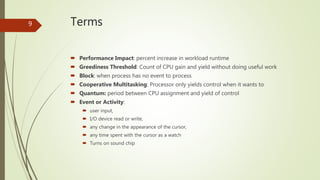
 The optimum scheduling results are calculated theoretically
 All strategies compared against it
 The current scheduling strategy is compared with new strategies proposed by
authors
 Comparison is done for processor energy savings and performance impact
 For evaluation, performance impact of current strategy is taken as baseline
 Scheduling is event driven, in a non-preemptive environment
8
Terms
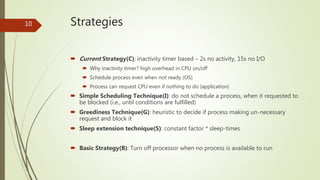
 Performance Impact: percent increase in workload runtime
 Greediness Threshold: Count of CPU gain and yield without doing useful work
 Block: when process has no event to process
 Cooperative Multitasking: Processor only yields control when it wants to
 Quantum: period between CPU assignment and yield of control
 Event or Activity:
 user input,
 I/O device read or write,
 any change in the appearance of the cursor,
 any time spent with the cursor as a watch
 Turns on sound chip
9
Strategies
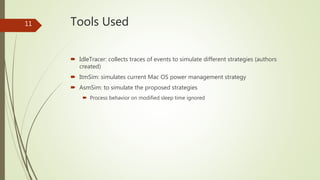
 Current Strategy(C): inactivity timer based – 2s no activity, 15s no I/O
 Why inactivity timer? high overhead in CPU on/off
 Schedule process even when not ready (OS)
 Process can request CPU even if nothing to do (application)
 Simple Scheduling Technique(I): do not schedule a process, when it requested to
be blocked (i.e., until conditions are fulfilled)
 Greediness Technique(G): heuristic to decide if process making un-necessary
request and block it
 Sleep extension technique(S): constant factor * sleep-times
 Basic Strategy(B): Turn off processor when no process is available to run
10
Tools Used
 IdleTracer: collects traces of events to simulate different strategies (authors
created)
 ItmSim: simulates current Mac OS power management strategy
 AsmSim: to simulate the proposed strategies
 Process behavior on modified sleep time ignored
11
Results
(per strategy)
 Optimal: 82% energy saving – 17.67% of useful work in 29.56 hours of trace
 *(ES – energy saving, PI – performance impact)
 C: 28.79% ES with 1.84% PI
 Recovers 35% of idle time
 B: 31.98% ES with 0% PI
 Recovers 39% of idle time
 BI: 47.10% ES with 1.08% PI
 Recovers 57% of idle time
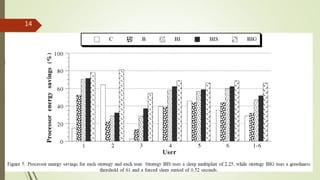
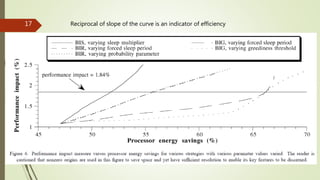
 BIS: 51.72% ES for 1.84% PI, sleep multiplier of 2.25
 BIG: 66.18% ES for 1.84% PI, forced sleep period of 0.52 and greediness threshold
of 61
 Recovers 80% of idle time
12
Results
(per strategy)
 BIGS: BIG is best BIGS for 1.84% PI
 If sleep multiplier increased, bad results
 changes on increasing PI threshold
 Results have low sensitivity to these parameters
 BIG > BIR > BIS > BI > C for energy saving
 BIR – process requests a sleep time of zero, with probability p we force it to sleep for a period
f instead
 For user 2, BIG > C > B
 Finder – yield with sleep time zero
 Greediness technique helps
 Sleep extension technique useless
13
14
15
Results
(discussions)
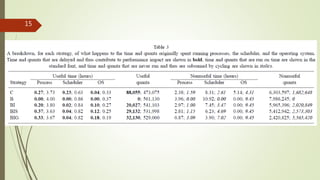
 Less data, possibility of type II error (when truth is rejected)
 Useful quanta considered non-useful or other way round
 Composite strategy BIG better than current
 A: Average total Power consumption
 P: Power consumed by components that remain on
 S: Power saving by turning CPU off
 𝐴 = 𝑃 +
1−𝐸𝑆
1+𝑃𝐼
𝑆
 For given workload, current strategy consumed A = 8.27 W
 For given workload, BIG strategy consumed A = 6.89 W
16
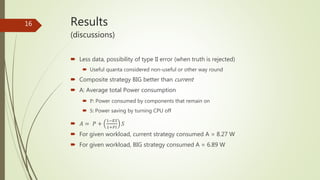
17 Reciprocal of slope of the curve is an indicator of efficiency
Conclusion
 “designers of OS and applications for single-user systems are not generally
concerned with rigorous management of processor time”
 Rather compactness of code and short development cycle
 Not scheduling non-useful quanta contributes to increased energy saving
 Delay in scheduling useful quanta (due to sleep etc.) causes performance impact
 This work is good for academic purposes, quite obsolete for present day
18
Future Research
 Actually implement it in the OS and observe benefits in real time
 Gather more trace data
 Applicability to other single user OS (like those of Microsoft)
 It may be re-emphasized that this direction of research is no longer relevant
19
Thank You
 Questions ?
20

Scheduling techniques for reducing processor energy use in MacOS

  • 1.
    Scheduling techniques forreducing processor energy use in MacOS Jacob R. Lorch and Alan Jay Smith CSL704 – Advanced Operating Systems 25/Jan/2019 – Class Presentation Anurag Banerjee (2018CSM1007)
  • 2.
  • 3.
    Introduction  What componentsconsume power?  CPU, fan, physical drives  Components depend on each other fan on CPU etc.  When on battery, high power consumption is undesirable  Battery life  Fan noise 3
  • 4.
    Background  Work setin late 90’s  Focuses on PowerPC Duo 230 and 280c  Runs on System 7 OS later rebranded as Mac OS  It is a single user, single tasking OS  Single memory space for OS and user processes 4
  • 5.
    Background (contd…)  “Macintoshlacks multitasking, but, tries to fake it…” – Byte, Sept. 1986  Uses co-operative multitasking – non-preemptive  Rapid process switching, when active window changes  Regular cycling of applications  Switching controlled by applications not OS  One process crashes – OS can crash  MacOS X Mojave is latest, renders most of this research obsolete 5
  • 6.
    Research Problem  CPUmajor power consumer in System 7 or Mac OS 7  Does busy waiting  Identify and put CPU in low power state  This task is non-trivial  Heuristics to identify busy wait – parametric scheduling 6
  • 7.
    Data  Trace-driven simulationdata was collected from 6 Apple Computers, Inc. Engineers  Workload focused on engineer’s usage pattern  6 users, less data – can’t generalize results with high confidence 7
  • 8.
    Methodologies  The optimumscheduling results are calculated theoretically  All strategies compared against it  The current scheduling strategy is compared with new strategies proposed by authors  Comparison is done for processor energy savings and performance impact  For evaluation, performance impact of current strategy is taken as baseline  Scheduling is event driven, in a non-preemptive environment 8
  • 9.
    Terms  Performance Impact:percent increase in workload runtime  Greediness Threshold: Count of CPU gain and yield without doing useful work  Block: when process has no event to process  Cooperative Multitasking: Processor only yields control when it wants to  Quantum: period between CPU assignment and yield of control  Event or Activity:  user input,  I/O device read or write,  any change in the appearance of the cursor,  any time spent with the cursor as a watch  Turns on sound chip 9
  • 10.
    Strategies  Current Strategy(C):inactivity timer based – 2s no activity, 15s no I/O  Why inactivity timer? high overhead in CPU on/off  Schedule process even when not ready (OS)  Process can request CPU even if nothing to do (application)  Simple Scheduling Technique(I): do not schedule a process, when it requested to be blocked (i.e., until conditions are fulfilled)  Greediness Technique(G): heuristic to decide if process making un-necessary request and block it  Sleep extension technique(S): constant factor * sleep-times  Basic Strategy(B): Turn off processor when no process is available to run 10
  • 11.
    Tools Used  IdleTracer:collects traces of events to simulate different strategies (authors created)  ItmSim: simulates current Mac OS power management strategy  AsmSim: to simulate the proposed strategies  Process behavior on modified sleep time ignored 11
  • 12.
    Results (per strategy)  Optimal:82% energy saving – 17.67% of useful work in 29.56 hours of trace  *(ES – energy saving, PI – performance impact)  C: 28.79% ES with 1.84% PI  Recovers 35% of idle time  B: 31.98% ES with 0% PI  Recovers 39% of idle time  BI: 47.10% ES with 1.08% PI  Recovers 57% of idle time  BIS: 51.72% ES for 1.84% PI, sleep multiplier of 2.25  BIG: 66.18% ES for 1.84% PI, forced sleep period of 0.52 and greediness threshold of 61  Recovers 80% of idle time 12
  • 13.
    Results (per strategy)  BIGS:BIG is best BIGS for 1.84% PI  If sleep multiplier increased, bad results  changes on increasing PI threshold  Results have low sensitivity to these parameters  BIG > BIR > BIS > BI > C for energy saving  BIR – process requests a sleep time of zero, with probability p we force it to sleep for a period f instead  For user 2, BIG > C > B  Finder – yield with sleep time zero  Greediness technique helps  Sleep extension technique useless 13
  • 14.
  • 15.
  • 16.
    Results (discussions)  Less data,possibility of type II error (when truth is rejected)  Useful quanta considered non-useful or other way round  Composite strategy BIG better than current  A: Average total Power consumption  P: Power consumed by components that remain on  S: Power saving by turning CPU off  𝐴 = 𝑃 + 1−𝐸𝑆 1+𝑃𝐼 𝑆  For given workload, current strategy consumed A = 8.27 W  For given workload, BIG strategy consumed A = 6.89 W 16
  • 17.
    17 Reciprocal ofslope of the curve is an indicator of efficiency
  • 18.
    Conclusion  “designers ofOS and applications for single-user systems are not generally concerned with rigorous management of processor time”  Rather compactness of code and short development cycle  Not scheduling non-useful quanta contributes to increased energy saving  Delay in scheduling useful quanta (due to sleep etc.) causes performance impact  This work is good for academic purposes, quite obsolete for present day 18
  • 19.
    Future Research  Actuallyimplement it in the OS and observe benefits in real time  Gather more trace data  Applicability to other single user OS (like those of Microsoft)  It may be re-emphasized that this direction of research is no longer relevant 19
  • 20.

Editor's Notes

  • #2 Discuss the paper…
  • #3 Structure of presentation Intro – motivation Background – what was there in 90’s Problem they focus on Where they get data
  • #4 SSD no optical drive – better Blade less cooling systems
  • #5 Powerpc - developed by AIM – apple, IBM, Motorola System 7 is last of the classic Mac OS – now obviously discontinued
  • #6 Process can monopolize Even when nothing to do it will use CPU
  • #7 Non trivial in the sense how do you recognize process is not doing useful work? Thus come in the heuristics
  • #8 A sum total of around 30 hours of trace data was collected
  • #9 Optimum – for 30 hours of trace we know the useful times, calculate the actual runtime Time – useful process work, process switching, bring process in/out, OS useful work, OS non-useful work Current is old
  • #10 Increase due to forced sleep
  • #12 Mr. Lorch Created as part of Master’s thesis ItmSim tries to duplicate proprietary MacOS strategy
  • #13 Optimal around 5.3 hours of useful work Observe the pattern of energy savings Recovers idle time means – save the processor from busy wait