Performance considerations


                                         V.Saranya
                                           AP/CSE
  Sri Vidya College of Engineering and Technology,
                                     Virudhunagar
Performance considerations
• A key design objective of a computer system is
  to achieve the best possible performance at the
  lowest possible cost.
   – Price/performance ratio is a common
     measure of success.
• Performance of a processor depends on:
   – How fast machine instructions can be
     brought into the processor for execution.
   – How fast the instructions can be executed.
Interleaving
 Divides the memory system into a number of
  memory modules. Each module has its own
  address buffer register (ABR) and data buffer
  register (DBR).
 Arranges addressing so that successive words
  in the address space are placed in different
  modules.
 When requests for memory access involve
  consecutive addresses, the access will be to
  different modules.
 Since parallel access to these modules is
  possible, the average rate of fetching words
  from the Main Memory can be increased.
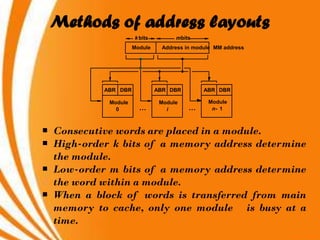
Methods of address layouts
                     k bits         mbits
                     Module    Address in module MM address


           ABR DBR            ABR DBR        ABR DBR

            Module             Module         Module
              0                  i             n- 1


 Consecutive words are placed in a module.
 High-order k bits of a memory address determine
  the module.
 Low-order m bits of a memory address determine
  the word within a module.
 When a block of words is transferred from main
  memory to cache, only one module is busy at a
  time.
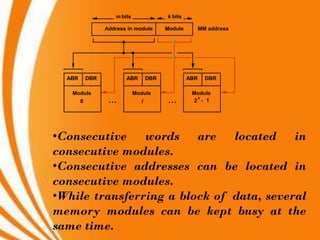
m bits               k bits

                  Address in module       Module         MM address


  ABR       DBR          ABR        DBR            ABR     DBR

   Module                     Module                Module
                                                     k
        0                       i                   2 - 1


•Consecutive words are located in
consecutive modules.
•Consecutive addresses can be located in
consecutive modules.
•While transferring a block of data, several
memory modules can be kept busy at the
same time.
Hit Rate and Miss Penalty
 • Hit rate.
 • Miss penalty.
 • Hit rate can be improved by increasing block size,
   while keeping cache size constant
 • Block sizes that are neither very small nor very
   large give best results.
 • Miss penalty can be reduced if load-through
   approach is used when loading new blocks into
   cache.
Caches on the processor chip
• In high performance processors 2 levels
  of caches are normally used.
• Avg access time in a system with 2 levels
  of caches is
  T ave = h1c1+(1-h1)h2c2+(1-h1)(1-h2)M
Other Performance Enhancements
                     Write buffer
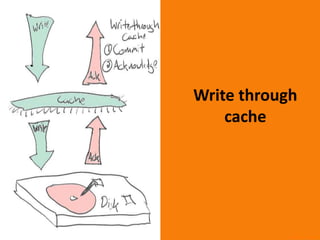
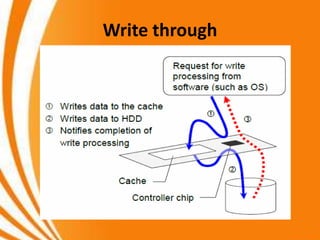
 Write-through:
• Each write operation involves writing to the main
  memory.
• If the processor has to wait for the write
  operation to be complete, it slows down the
  processor.
• Processor does not depend on the results of the
  write operation.
• Write buffer can be included for temporary
  storage of write requests.
• Processor places each write request into the buffer
  and continues execution.
• If a subsequent Read request references data
  which is still in the write buffer, then this data is
  referenced in the write buffer.
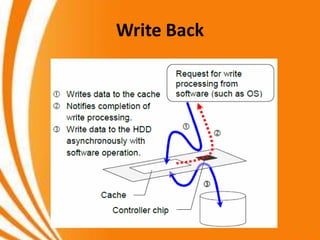
Write-back

• Block is written back to the main
  memory when it is replaced.
• If the processor waits for this write to
  complete, before reading the new
  block, it is slowed down.
• Fast write buffer can hold the block
  to be written, and the new block can
  be read first.
Other Performance Enhancements
Prefetching
• New data are brought into the processor when
  they are first needed.
• Processor has to wait before the data transfer is
  complete.
• Prefetch the data into the cache before they are
  actually needed, or a before a Read miss occurs.
• Prefetching can be accomplished through
  software by including a special instruction in the
  machine language of the processor.
   Inclusion of prefetch instructions increases the
    length of the programs.
• Prefetching can also be accomplished using
  hardware:
   Circuitry that attempts to discover patterns in
    memory references and then prefetches according
    to this pattern.
Other Performance Enhancements
  Lockup-Free Cache
  • Prefetching scheme does not work if it stops
    other accesses to the cache until the prefetch is
    completed.
  • A cache of this type is said to be “locked” while it
    services a miss.
  • Cache structure which supports multiple
    outstanding misses is called a lockup free cache.
  • Since only one miss can be serviced at a time, a
    lockup free cache must include circuits that keep
    track of all the outstanding misses.
  • Special registers may hold the necessary
    information about these misses.
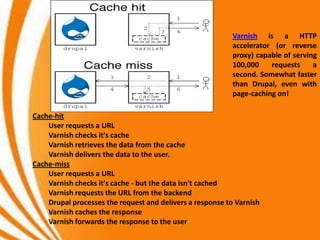
Varnish is a HTTP
                                                           accelerator (or reverse
                                                           proxy) capable of serving
                                                           100,000    requests     a
                                                           second. Somewhat faster
                                                           than Drupal, even with
                                                           page-caching on!

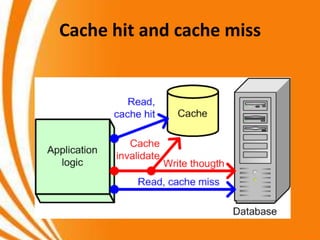
Cache-hit
    User requests a URL
    Varnish checks it's cache
    Varnish retrieves the data from the cache
    Varnish delivers the data to the user.
Cache-miss
    User requests a URL
    Varnish checks it's cache - but the data isn't cached
    Varnish requests the URL from the backend
    Drupal processes the request and delivers a response to Varnish
    Varnish caches the response
    Varnish forwards the response to the user
Write through
    cache
Write through
Write Back
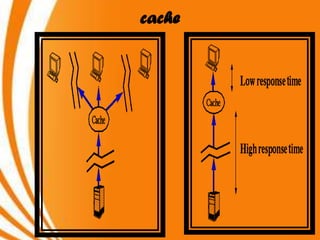
cache
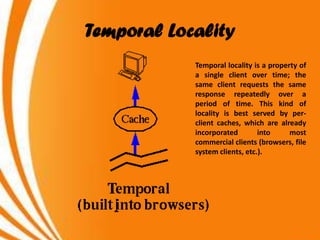
Temporal Locality
            Temporal locality is a property of
            a single client over time; the
            same client requests the same
            response repeatedly over a
            period of time. This kind of
            locality is best served by per-
            client caches, which are already
            incorporated        into     most
            commercial clients (browsers, file
            system clients, etc.).
Spatial Locality

     Spatial locality is a property of a
     group of clients over time; one
     client requests what another has
     requested earlier. This kind of
     locality is best served by shared
     caches, known as proxy caches in
     web systems. They require that
     the cache be placed central and
     near to the set of clients, and far
     from the server.
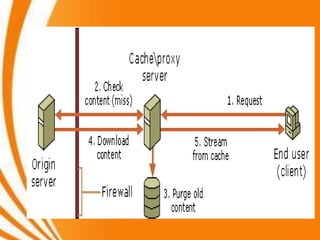
Cache hit and cache miss

Cache performance considerations

  • 1.
    Performance considerations V.Saranya AP/CSE Sri Vidya College of Engineering and Technology, Virudhunagar
  • 2.
    Performance considerations • Akey design objective of a computer system is to achieve the best possible performance at the lowest possible cost. – Price/performance ratio is a common measure of success. • Performance of a processor depends on: – How fast machine instructions can be brought into the processor for execution. – How fast the instructions can be executed.
  • 3.
    Interleaving  Divides thememory system into a number of memory modules. Each module has its own address buffer register (ABR) and data buffer register (DBR).  Arranges addressing so that successive words in the address space are placed in different modules.  When requests for memory access involve consecutive addresses, the access will be to different modules.  Since parallel access to these modules is possible, the average rate of fetching words from the Main Memory can be increased.
  • 4.
    Methods of addresslayouts k bits mbits Module Address in module MM address ABR DBR ABR DBR ABR DBR Module Module Module 0 i n- 1  Consecutive words are placed in a module.  High-order k bits of a memory address determine the module.  Low-order m bits of a memory address determine the word within a module.  When a block of words is transferred from main memory to cache, only one module is busy at a time.
  • 5.
    m bits k bits Address in module Module MM address ABR DBR ABR DBR ABR DBR Module Module Module k 0 i 2 - 1 •Consecutive words are located in consecutive modules. •Consecutive addresses can be located in consecutive modules. •While transferring a block of data, several memory modules can be kept busy at the same time.
  • 6.
    Hit Rate andMiss Penalty • Hit rate. • Miss penalty. • Hit rate can be improved by increasing block size, while keeping cache size constant • Block sizes that are neither very small nor very large give best results. • Miss penalty can be reduced if load-through approach is used when loading new blocks into cache.
  • 7.
    Caches on theprocessor chip • In high performance processors 2 levels of caches are normally used. • Avg access time in a system with 2 levels of caches is T ave = h1c1+(1-h1)h2c2+(1-h1)(1-h2)M
  • 8.
    Other Performance Enhancements Write buffer  Write-through: • Each write operation involves writing to the main memory. • If the processor has to wait for the write operation to be complete, it slows down the processor. • Processor does not depend on the results of the write operation. • Write buffer can be included for temporary storage of write requests. • Processor places each write request into the buffer and continues execution. • If a subsequent Read request references data which is still in the write buffer, then this data is referenced in the write buffer.
  • 9.
    Write-back • Block iswritten back to the main memory when it is replaced. • If the processor waits for this write to complete, before reading the new block, it is slowed down. • Fast write buffer can hold the block to be written, and the new block can be read first.
  • 10.
    Other Performance Enhancements Prefetching •New data are brought into the processor when they are first needed. • Processor has to wait before the data transfer is complete. • Prefetch the data into the cache before they are actually needed, or a before a Read miss occurs. • Prefetching can be accomplished through software by including a special instruction in the machine language of the processor.  Inclusion of prefetch instructions increases the length of the programs. • Prefetching can also be accomplished using hardware:  Circuitry that attempts to discover patterns in memory references and then prefetches according to this pattern.
  • 11.
    Other Performance Enhancements Lockup-Free Cache • Prefetching scheme does not work if it stops other accesses to the cache until the prefetch is completed. • A cache of this type is said to be “locked” while it services a miss. • Cache structure which supports multiple outstanding misses is called a lockup free cache. • Since only one miss can be serviced at a time, a lockup free cache must include circuits that keep track of all the outstanding misses. • Special registers may hold the necessary information about these misses.
  • 13.
    Varnish is aHTTP accelerator (or reverse proxy) capable of serving 100,000 requests a second. Somewhat faster than Drupal, even with page-caching on! Cache-hit User requests a URL Varnish checks it's cache Varnish retrieves the data from the cache Varnish delivers the data to the user. Cache-miss User requests a URL Varnish checks it's cache - but the data isn't cached Varnish requests the URL from the backend Drupal processes the request and delivers a response to Varnish Varnish caches the response Varnish forwards the response to the user
  • 14.
  • 15.
  • 16.
  • 17.
  • 18.
    Temporal Locality Temporal locality is a property of a single client over time; the same client requests the same response repeatedly over a period of time. This kind of locality is best served by per- client caches, which are already incorporated into most commercial clients (browsers, file system clients, etc.).
  • 19.
    Spatial Locality Spatial locality is a property of a group of clients over time; one client requests what another has requested earlier. This kind of locality is best served by shared caches, known as proxy caches in web systems. They require that the cache be placed central and near to the set of clients, and far from the server.
  • 20.
    Cache hit andcache miss