SIMULATION
GAME
CHAN KWOK BONG
WHAT IS SIMULATION GAME?
• Detailed MODELS intended to reflect a situation
of the REAL WORLD (a social system), an attempt
to simulate a social system, with its full arrays of
Roles, Rules and Regulations, Social Behaviour
and the Interplay of Forces within and outside the
environment of the system.
• One form of Experiential Learning Activities,
demand the participants to make DECISIONS and
CHOICES that based on the assessment of the
SIMULATED SITUATION, and the VIEWS and
DEMANDS of OTHER PLAYERS.
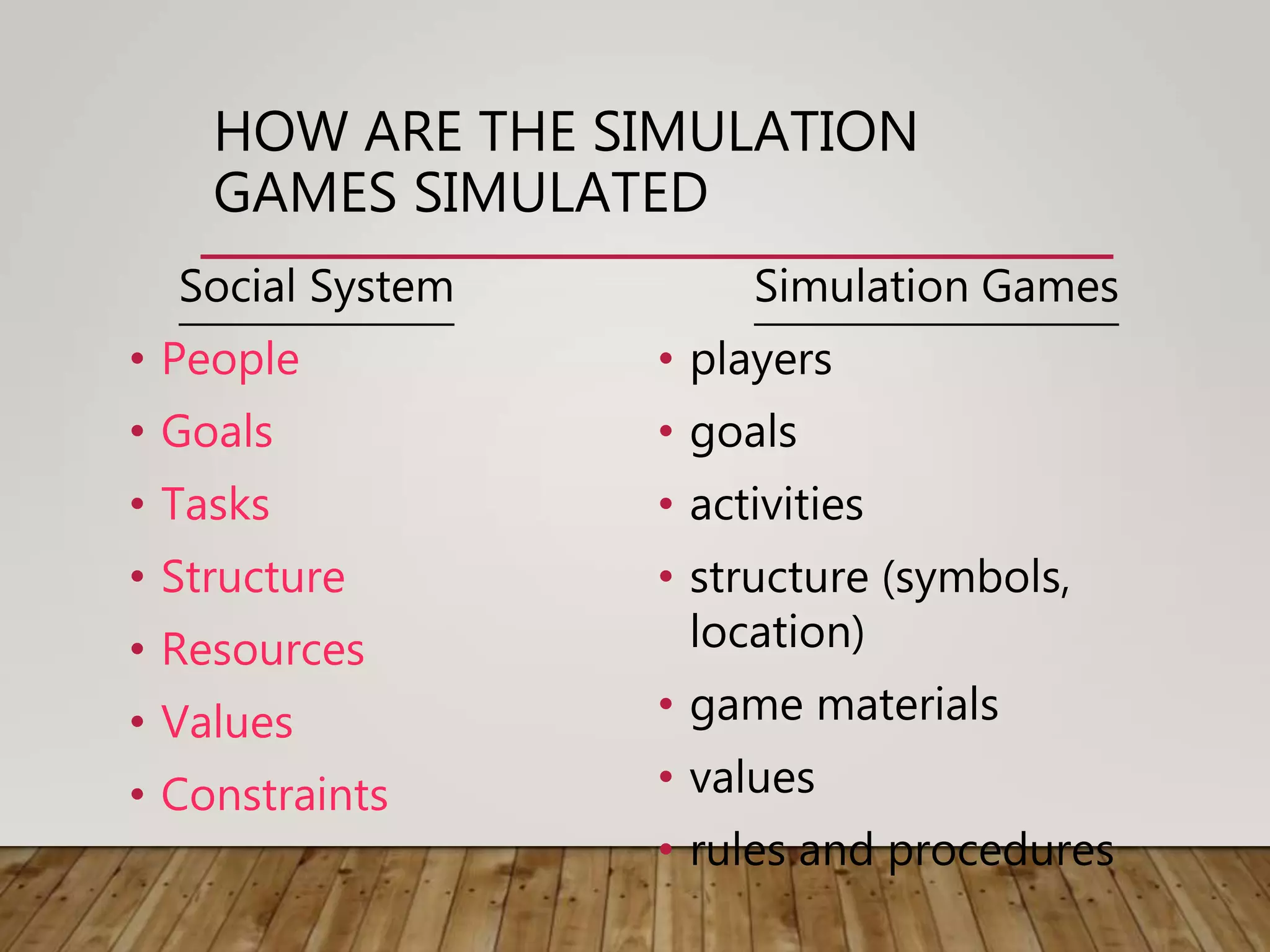
HOW ARE THE SIMULATION
GAMES SIMULATED
Social System
• People
• Goals
• Tasks
• Structure
• Resources
• Values
• Constraints
Simulation Games
• players
• goals
• activities
• structure (symbols,
location)
• game materials
• values
• rules and procedures
WHAT ARE THE STEPS IN
FACILITATING THROUGH
SIMULATION GAMES?
1. Preparation Phase
• Select right game
• Prepare the facilitator
• Preparation of the setting
(physical and emotional,
environment, and materials,
including discussion guidelines)
WHAT ARE THE STEPS IN
FACILITATING THROUGH
SIMULATION GAMES?
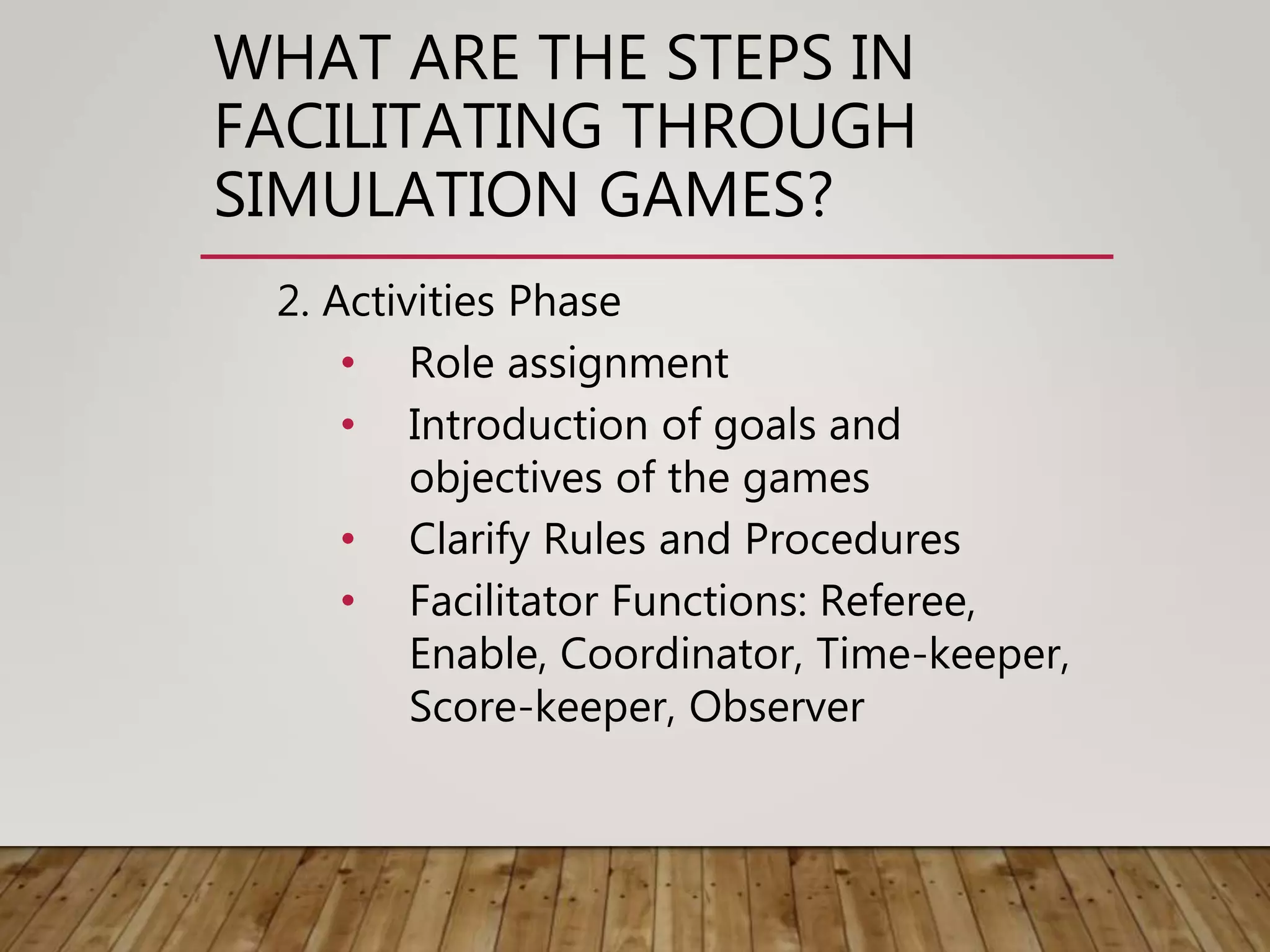
2. Activities Phase
• Role assignment
• Introduction of goals and
objectives of the games
• Clarify Rules and Procedures
• Facilitator Functions: Referee,
Enable, Coordinator, Time-keeper,
Score-keeper, Observer
WHAT ARE THE STEPS IN
FACILITATING THROUGH
SIMULATION GAMES?
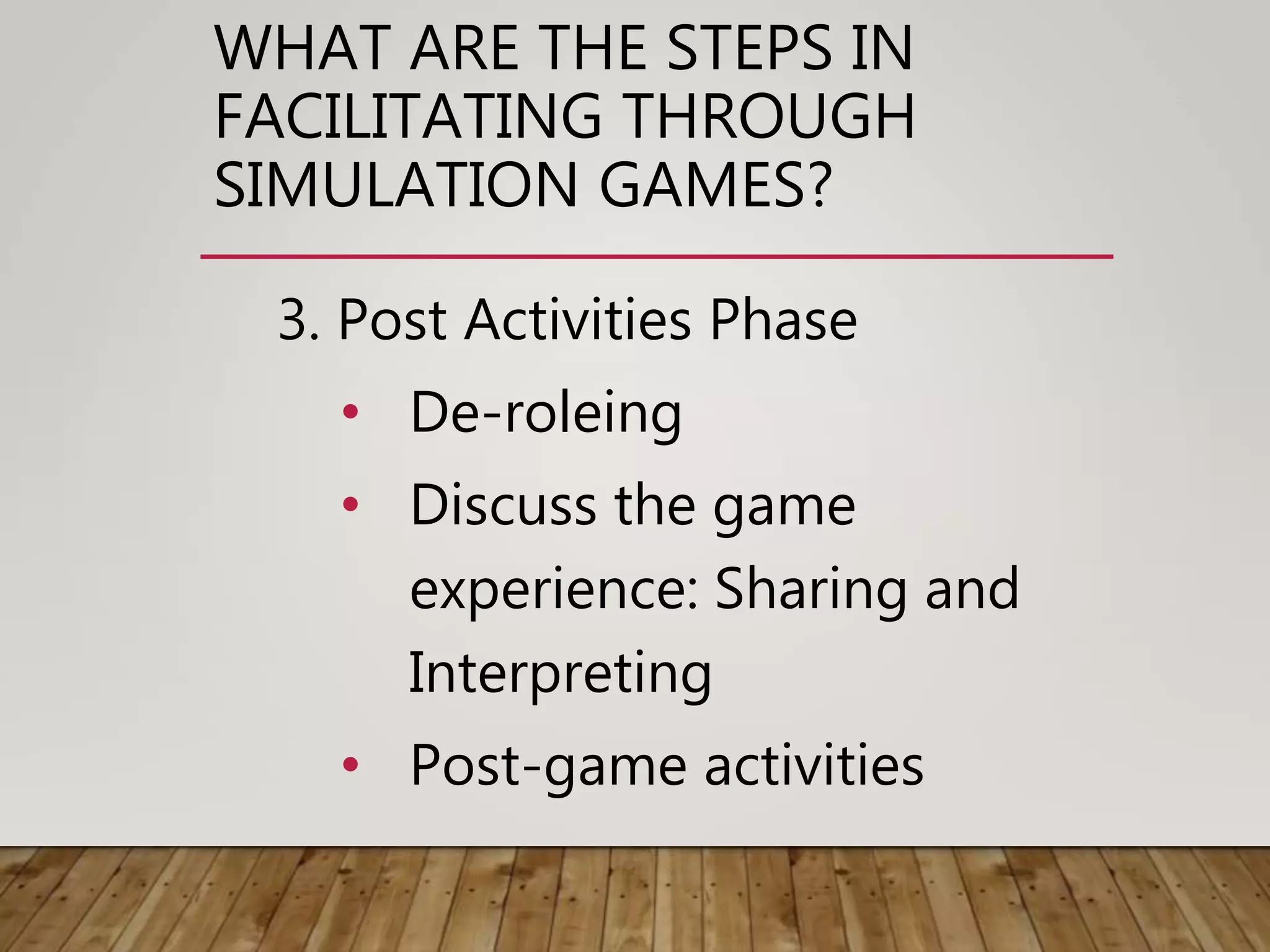
3. Post Activities Phase
• De-roleing
• Discuss the game
experience: Sharing and
Interpreting
• Post-game activities
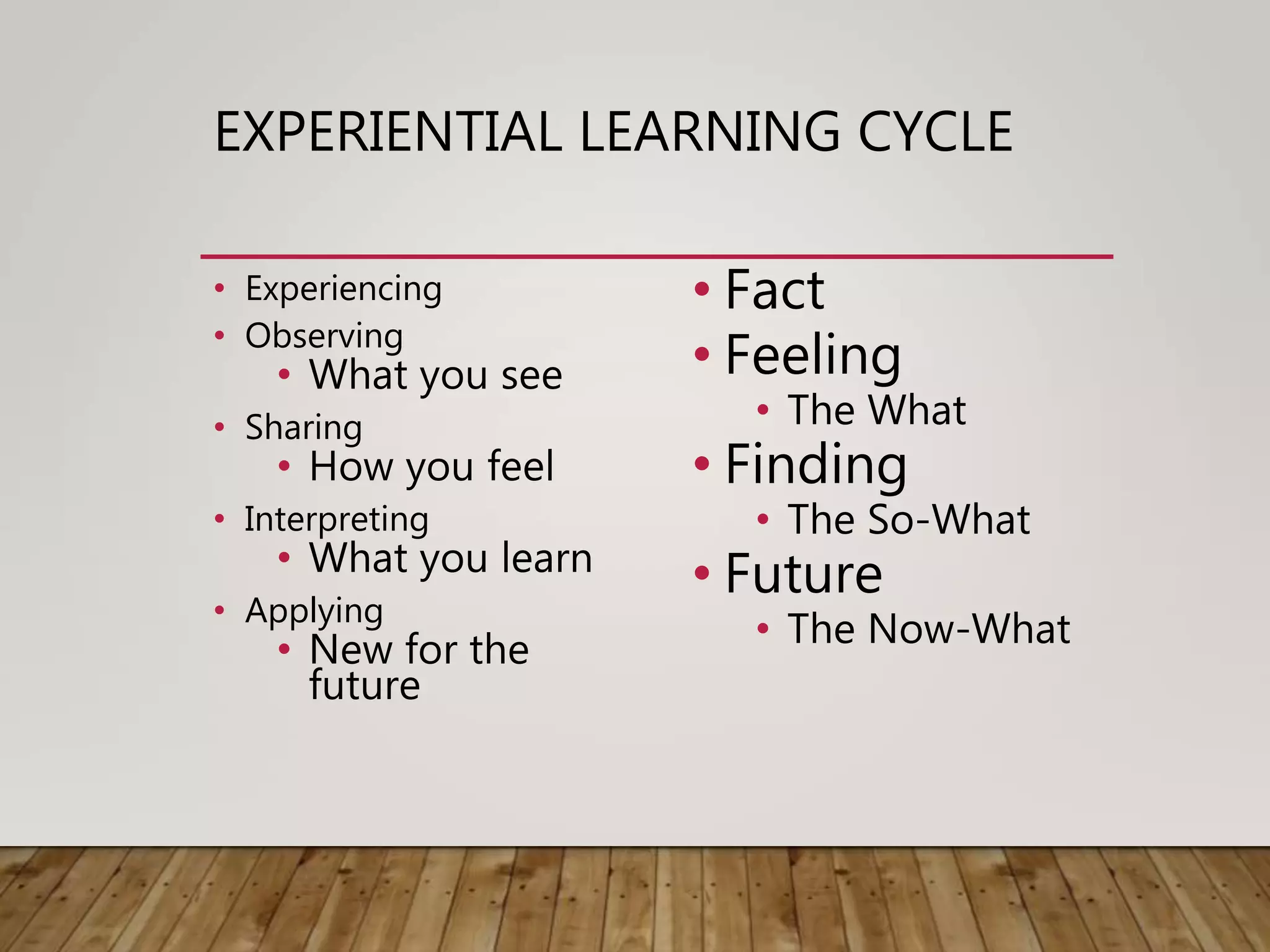
EXPERIENTIAL LEARNING CYCLE
• Experiencing
• Observing
• What you see
• Sharing
• How you feel
• Interpreting
• What you learn
• Applying
• New for the
future
• Fact
• Feeling
• The What
• Finding
• The So-What
• Future
• The Now-What
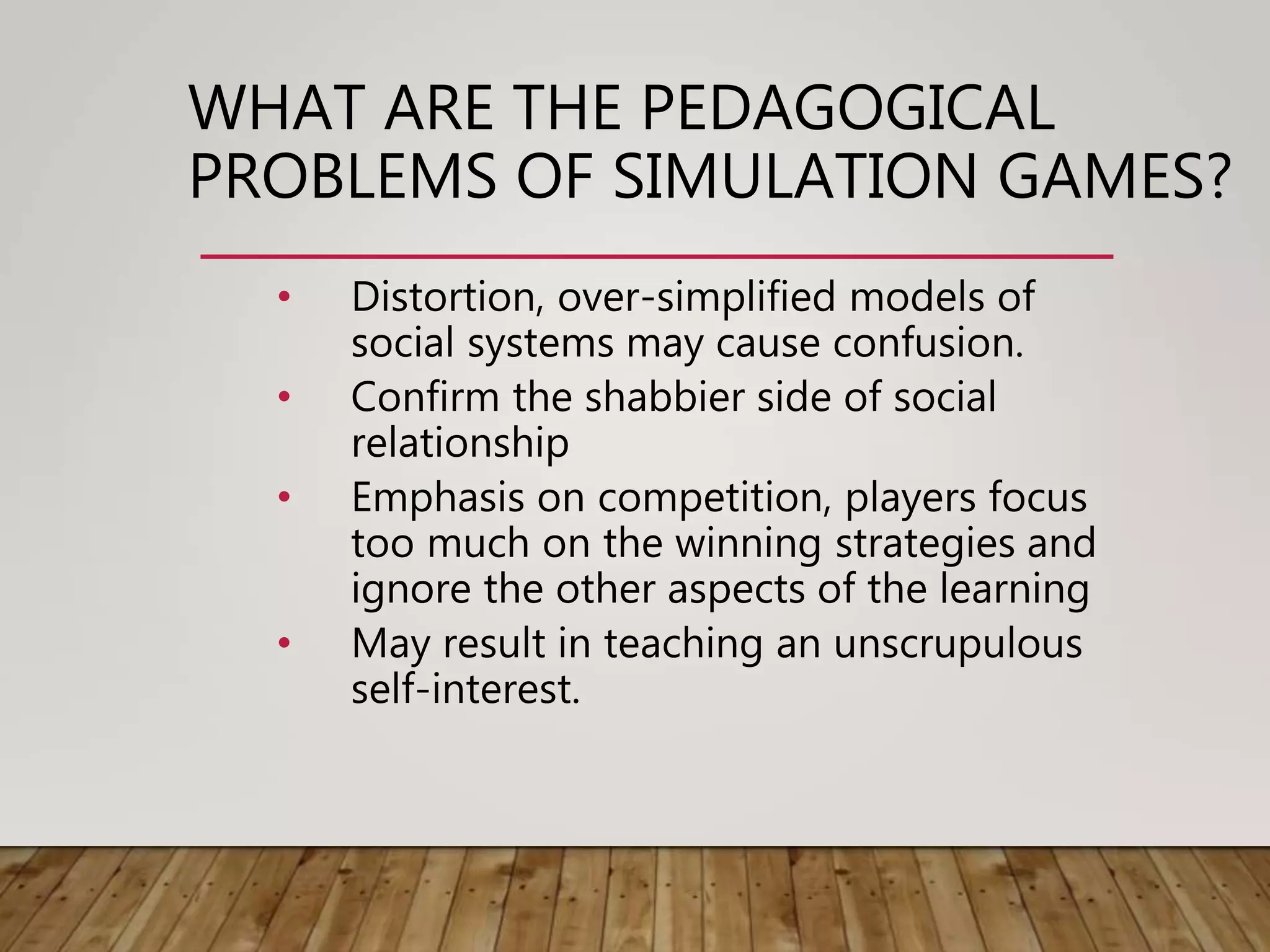
WHAT ARE THE PEDAGOGICAL
PROBLEMS OF SIMULATION GAMES?
• Distortion, over-simplified models of
social systems may cause confusion.
• Confirm the shabbier side of social
relationship
• Emphasis on competition, players focus
too much on the winning strategies and
ignore the other aspects of the learning
• May result in teaching an unscrupulous
self-interest.
REFERENCES:
• Margaret E. Gredler (1994) Designing and Evaluating
Games and Simulations: A Process Approach
• 郭凱儀、彭健夫 (1994) 模擬遊戲
• https://reviewing.co.uk/

Simulation game

  • 1.
  • 2.
    WHAT IS SIMULATIONGAME? • Detailed MODELS intended to reflect a situation of the REAL WORLD (a social system), an attempt to simulate a social system, with its full arrays of Roles, Rules and Regulations, Social Behaviour and the Interplay of Forces within and outside the environment of the system. • One form of Experiential Learning Activities, demand the participants to make DECISIONS and CHOICES that based on the assessment of the SIMULATED SITUATION, and the VIEWS and DEMANDS of OTHER PLAYERS.
  • 3.
    HOW ARE THESIMULATION GAMES SIMULATED Social System • People • Goals • Tasks • Structure • Resources • Values • Constraints Simulation Games • players • goals • activities • structure (symbols, location) • game materials • values • rules and procedures
  • 4.
    WHAT ARE THESTEPS IN FACILITATING THROUGH SIMULATION GAMES? 1. Preparation Phase • Select right game • Prepare the facilitator • Preparation of the setting (physical and emotional, environment, and materials, including discussion guidelines)
  • 5.
    WHAT ARE THESTEPS IN FACILITATING THROUGH SIMULATION GAMES? 2. Activities Phase • Role assignment • Introduction of goals and objectives of the games • Clarify Rules and Procedures • Facilitator Functions: Referee, Enable, Coordinator, Time-keeper, Score-keeper, Observer
  • 6.
    WHAT ARE THESTEPS IN FACILITATING THROUGH SIMULATION GAMES? 3. Post Activities Phase • De-roleing • Discuss the game experience: Sharing and Interpreting • Post-game activities
  • 7.
    EXPERIENTIAL LEARNING CYCLE •Experiencing • Observing • What you see • Sharing • How you feel • Interpreting • What you learn • Applying • New for the future • Fact • Feeling • The What • Finding • The So-What • Future • The Now-What
  • 8.
    WHAT ARE THEPEDAGOGICAL PROBLEMS OF SIMULATION GAMES? • Distortion, over-simplified models of social systems may cause confusion. • Confirm the shabbier side of social relationship • Emphasis on competition, players focus too much on the winning strategies and ignore the other aspects of the learning • May result in teaching an unscrupulous self-interest.
  • 9.
    REFERENCES: • Margaret E.Gredler (1994) Designing and Evaluating Games and Simulations: A Process Approach • 郭凱儀、彭健夫 (1994) 模擬遊戲 • https://reviewing.co.uk/